Give yourself a leg up in 2020 with these e-learning packages covering marketing’s hottest skills.
You don’t need to work in the ad sales department at Facebook in order to understand the importance of digital marketing today. And, if you want to land any of the growing number of lucrative positions in this constantly-evolving field, you need to be up-to-date with the latest tools and platforms. That’s why we’ve rounded up five of the best and most popular digital marketing training packages around to give you a leg up and set you up for success in the field. Read on for details:
No matter what industry you’re in, it pays for your site to rank on Google’s front page. Learn how to drastically increase the traffic to any website with this 7-course bundle that offers 44 hours of training on Google marketing, Facebook advertising and much more.
LinkedIn is more than just a platform for professionals to network on. With the right know-how, you can supercharge your brand’s awareness and ultimately generate powerful leads. Through 8 courses and over 600 lessons, you’ll learn how to fine-tune your resume, build powerful profiles, network with top players in your field and more.
With a user base numbering over one billion, Facebook is a platform you can’t afford to ignore in your marketing efforts. Companies get this, which is why they pay top-dollar for experts who know how to connect with audiences on Facebook. With nine courses and over 570 lessons, this bundle will teach you how to promote your business or brand by creating powerful Facebook ads that will attract new customers and increase conversions on your landing pages.
You don’t need to be part of a corporation to cash in on the marketing scene. Start earning a passive income at home by learning how to become an affiliate marketing master. This 19-hour guide will teach you everything you need to know through eight courses that show you both the fundamentals and more advanced elements of this booming field.
Instagram is another social media powerhouse with a booming user base. Break into the lucrative world of Instagram marketing with this mastery bundle that will teach you how to build best-selling content strategies while harnessing the latest affiliate marketing models.
We’re officially in the final weeks of the decade, and App Annie is celebrating with a look back at the biggest apps of the 2010s. According to the App Annie data, there were a few surprises, but some of it is just as you would expect.
App Annie’s charts are based on data from the iOS App Store and Google Play beginning in January 2012. Data through December 31, 2011 accounts only for iOS.
In terms of pure downloads, Facebook heavily dominated the charts for the 2010s. The Facebook app itself came in as the most-downloaded app, followed by Facebook Messenger, WhatsApp, and Instagram in second, third, and fourth places, respectively. Here are the full rankings for downloads from 2010 through 2019 – the inclusion of TikTok is especially notable given how much of a newcomer it is.
Facebook
Facebook Messenger
WhatsApp
Instagram
Snapchat
Skype
TikTok
UC Browser
YouTube
Twitter
What about the top apps in terms of spending? That list is heavily dominated by subscription applications, with Netflix coming in at number one. Even though Netflix ditched iTunes billing for new customers last year, it still has a large user base paying via iTunes.
Netflix
Tinder
Pandora Music
Tencent Video
LINE
iQIYI
Spotify
YouTube
HBO Now
Kwai
If you narrow things down to games, the most-downloaded list is a quite a nostalgic collection of some of the most viral games of the decade:
Subway Surfers
Candy Crush Saga
Temple Run 2
My Talking Tom
Clash of Clans
Pou
Hill Climb Racing
Minion Rush
Fruit Ninja
8 Ball Pool
And the top 10 games in terms of consumer spending:
Clash of Clans
Monster Strike
Candy Crush Saga
Puzzle & Dragons
Fate/Grand Order
Honour of Kings
Fantasy Westward Journey
Pokémon GO
Game of War – Fire Age
Clash Royale
All in all, App Annie says the app economy is poised to continue growing as we head into 2020:
This decade has been a time of remarkable growth for the mobile economy. With a 5% increase in downloads, and 15% growth in consumer spend (excluding third-party Android) year-over-year in 2019 this looks set to continue in 2020
What were some of your favourite apps and games of the decade? Do any of the apps that made these lists surprise you? Let us know down in the comments. You can read App Annie’s full report here.
News publishers have reaped the early rewards from paywalls and are increasingly turning their focus on the overall consumer marketing challenge of marketing their products beyond the most hard-core loyalists.
Part of that is bringing in new talent. Witness Condé Nast hiring former Stitch Fix marketer Dierdre Findlay to be its new chief marketing officer. And part of that is more robust marketing strategies that move people down the funnel to purchase a subscription by emphasizing the product benefits.
“When we look at the number of readers who’d encounter a paywall or encounter an offer from us, it is a very small percentage of our total audience,” Washington Post CMO Miki King said. “And while I think that the public understand to some degree that the Washington Post is a paid news product, there are many people who won’t necessarily encounter a paywall. We are trying to find ways to introduce the commercial aspect of our business in ways that are not intrusive.”
Over the summer, The Washington Post assembled a 12-person team tasked with improving the way that content is marketed and delivered to subscribers, King said. The team includes members of the Post’s newsroom, marketing, audience, product and engineering, whose goal is “to translate everything we’re doing across the organization into ways we can deliver things to subscribers,” King said. That group, which was assembled from existing staffers who still report in to their respective lines of business, coordinates to ensure that big stories are promoted in a more extensive, timely fashion.
For example, when the Post released “Where the Pain Pills Went,” a large editorial project around where prescription opioid medications were distributed across the United States, the Post’s team had a several-days head start creating messaging around the project for the Post’s subscribers.
Whereas in the past the Post’s consumer marketing team would largely have to rely on marketing stories after they had come out, coordination among the new team ensured that the Post was able to create several emails’ worth of marketing messages around several of its largest projects this year, including its opioid database.
King said at the Post, a newsroom representative keeps the group apprised of stories or projects that could work, ideally giving the marketing and product teams a chance to develop messaging and schedule promotions that can go out at the right time.
But the sensitive nature of many newsroom investigations limits the amount of coordination possible. For example, The Guardian’s blockbuster story about Cambridge Analytica was one of The Guardian’s biggest drivers of reader contributions and subscriptions, said Mark Rice-Oxley, the Guardian’s membership editor in the U.K. But the story was a closely held secret even within The Guardian’s newsroom, which required the contributions team to develop messaging and chatter around it after the fact.
“Ninety-nine percent of editorial didn’t even know about Cambridge Analytica,” Rice-Oxley said.
New publishers’ impulse to tailor messages about how much consumer revenue is valued must be balanced with an impulse to create messages that are broadly applicable. The Guardian, for example, tries to frame its requests for revenue and messaging around subscriptions in ways are “clear over clever,” said Amanda Michel, The Guardian’s global director of contributions.
“We have to write these things in a way that translates regardless of someone’s first language,” Michel said.
Publishers’ recent focus on consumer marketing are designed to support ambitious subscription targets that many news publishers have laid out. The Guardian plans to double the number of people directly contributing money by 2022, to 2 million; The New York Times has vowed to amass 10 million paying subscribers for its portfolio of products by 2025.
“We’re telling the story of our work,” Michel said.
Find out how you should use popular semantic HTML tags to build better future-proof sites.
HTML is the foundation of every website on the web. It defines where the visuals should be placed, what they look like and what behaviour they should have. It is the first thing a browser receives, making it a crucial piece to get right even before the CSS and JavaScript.
It is the main driver of the Document Object Model that allows the browser to read the structure of the page and render its contents (see more about page layouts here). Elements are created by parsing the tags we write in the markup. Because of this, it’s important to make sure the HTML is correct. The language itself has been improved upon over the years to make sure the syntax used can describe the content within it accurately, and allow consumers to make sense of it.
As HTML has evolved, things that were once recommended could now be considered bad practice. It’s important for us to keep on top of the language we use to make sure it best serves the visitors to our sites. Incorrect HTML can cause more harm than good. By ensuring we get the right structure in place we can be sure the content we create is set for the future.
The <div> element is the most generic container in HTML. By default, it has no styling applied to it, no inherent meaning associated with it and every browser supports it. By applying our own styling, we make it look and behave however we like. While this may sound ideal for visitors in a browser, it comes at a cost to other users and consumers of that content.
Read on to discover the basic HTML tags you should be using, and what underlying advantages using the right tags will bring to your builds.
What are the basic HTML tags?
In HTML tags, a semantic element is one that provides meaning to its contents e.g. <header>. A non-semantic element is typically used to apply styling and does not carry any meaning.
Before HTML5 introduced a new set of semantic elements, developers would use <div> to achieve the same effect e.g. <div id=”header”>. Adding a descriptive class to that element makes it clear to the developer what that element contains, but a computer would not be able to understand it.
We now have several semantic elements such as <nav> or <header> to help structure a page. We should be able to follow the structure by only looking at the tags being used – something that would not be possible with only non-semantic elements such as <div>.
This guide will help you make sure you are always using the right semantic tags for the right job. And, you could create your own HTML boilerplate template, so that your tags are always right and ready to go every time you start a new build.
The <header> tag
The header normally contains some kind of repeated content not directly related to the rest of the page. The specification defines it as “a group of introductory or navigational aids”, which could include a logo, site-wide navigation or a search function. There can be multiple <header> elements on a page. For example, a blog’s home page could contain a <header> tag for each post it displays.
The <nav> tag
Most sites will have an area dedicated to navigation. This can include links to specific areas of the site or a breadcrumb style hierarchy. Not all links need to be within one. Only collections of links in other parts of the page would be candidates for their own <nav> element, but this is dependant on the context.
A common pattern is to include links to a privacy policy or contact page in the footer. If this area makes use of the <footer> element, this is enough to identify these links as site navigation and there is no need to use a separate <nav> tag.
The <main> tag
The <main> element is the focal point of each page. Outside of the page’s header and footer, all other content should be inside here. There should only ever be one <main> on a page. Assistive technologies such as screen readers can detect this element and allow users to skip straight to the content.
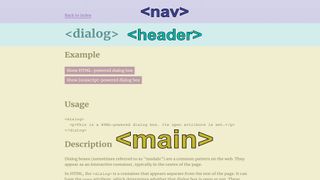
Semantic tags such as <header> help the browser recognise specific content (Image credit: Matt Crouch)
The <aside> tag
As the name suggests, the <aside> element contains information that is related to the main content of the page. The information inside this element could exist separate from everything else and not lose context. The most common use for this element is a sidebar navigation or to run adverts alongside the <footer>.
The <footer> tag
A <footer> element contains any summarising information about the page. For many websites, this includes an address, copyright information or links to supplementary pages. There is no requirement to always have a single footer at the bottom of the page. It can be placed anywhere – including inside other sections – or not included at all.
The <article> and <section> tags
The W3C specification defines <article> and <section> in a similar way. Both are designed to group distinct pieces of a page together. A key difference is composition. An <article> is designed to be self-contained. The contents inside of it would make sense as a standalone piece. Examples of this include a blog post, a user comment or an embedded tweet.
In contrast, a <section> groups together multiple parts of a page together that would otherwise have no other semantic meaning. These would lose their meaning if separated. Examples of this include a group of related paragraphs, a chapter of a book or a single tab as part of a tabbed interface.
It is worth noting that an <article> tag could be comprised of multiple <section> elements.
Remember, semantic HTML is more than just the outline structure of a page. Almost every element provides some kind of meaning, which means there is often a good fit to be found. Only ever use <div> or <span> tags when nothing else will work.
Why does proper HTML markup matter?
Specific tags such as <summary> must contain the right content to be effective (Image credit: Matt Crouch)
Getting the right HTML tags and markup is vital. Here’s are three reasons why.
01. Improved discoverability
Search engines such as Google are constantly crawling the web, finding sites and parsing their content. They do this by looking for certain tags such as <h1> and <article> and using the contents of those to inform their algorithm. For example, searching for tickets for a concert may involve looking for headings containing the name of the event, <p> elements discussing the artist and <time> for the correct date. If they cannot find what they are looking for, the site will not show up in those search results.
Some browsers and services such as Pocket allow users to read websites in a distraction-free mode. These extract the heading, contents and media from the site and lays it out in a view that makes it easier to read. By using the correct elements to construct the page, it makes is easier for these tools to extract the right information and provide a better experience for the user.
02. Better for accessiblity
Some elements have defined behaviours associated with them. A <button> element, for example, is expected to be interactive and perform an action when clicked. If a non-interactive element such as a <div> is used instead, a parser would not know it could click it without some added attributes.
This affects those using accessible technologies as well. It can be slow to navigate a page without any visuals. These users may instead choose to navigate through websites by landmark or heading level.
A landmark is created either by using a sectioning element such as <nav> or by applying an equivalent ‘role’ attribute. Without these, or by using them incorrectly, the user will not be able to find the content they need.
03. Plan for the future
One of the primary principles of the web is backwards compatibility. All specifications are designed to be compatible with sites made many years ago and have considerations in place for changes that may happen in the future. By using the correct elements and tags now, we are ensuring our site has a chance to be understood, found and seen in the future.
Do you want to learn more about web design? Then subscribe to net, the world’s best-selling magazine for web designers and developers.
We’ve all sent messages meant for someone else. Let’s just stop that.
Our emails aren’t always as well thought out, as accurately typed, or as succinct as we would like them to be—and that’s before you consider problems like sending emails without a required attachment, or typing the wrong person’s address altogether. If this happens to you often, you must know the “undo send” feature is heaven-sent.
This feature is easy to find on some platforms, but on others you may need to take some extra steps to set it up. Here’s how you can save yourself some embarrassment and enable it in all of your inboxes.
Gmail
Gmail already assumes you might make a mistake, so the Undo Sent button comes enabled by default. David Nield
A feature called Undo Send is built right into Gmail, and it works without you having to turn it on. Whenever you send a message, you’ll see an Undo link at the bottom left corner of the screen. If you tap on it, you’ll be able to bring your email back as a draft.
You can set the amount of time you’ve got before the email can’t be recovered anymore. On Gmail’s web interface, click the cog icon (top right), then choose Settings. Go to the General tab and you’ll see an Undo Send drop-down. There, you can choose from a time period of five (the default), 10, 20, or 30 seconds. Gmail will apply this choice across the web and mobile.
Emails you bring back from the digital ether pop back in the compose window and appear as if you’d never sent them. You can save them as drafts while you mull over your response, send them again, or delete them completely.
Outlook
You might have to jump through a couple of hoops before you can delay the shipment of Outlook emails.David Nield
The Mail app that comes preinstalled with Windows doesn’t have an undo send feature, but one is available in the free Outlook.com web client. You can set up a similar feature in the paid-for Outlook desktop app too, but it’s a bit more involved.
On the web platform of Outlook, click the cog icon (top right), choose View all Outlook settings, then Compose and reply. Use the Undo send slider to set up the window of time you’ve got for bringing the message back—from zero to 10 seconds (zero effectively disables the feature).
After you’ve sent a message on the web, click Undo at the bottom. This stops the message from being sent and returns it to draft status.
The desktop version of Outlook doesn’t have a simple undo send feature, but you can set a rule to delay every message you send. From the File tab, click Manage Rules & Alerts, then New Rule. Choose Apply rule on messages I send, then click Next twice, and Yes to confirm. You’ll reach a dialog box where you can click Defer delivery by a number of minutes. Check the box next to this rule, then click the link underneath to set how many minutes the delay should be—you can go from one to 120. Click through the wizard’s remaining screens to set the rule.
Any emails you send from Outlook from then on will sit in the Outbox folder for the specified number of minutes. If you want to cancel a sent message before the delay runs out, you’ll need to drag it back into the Drafts folder.
Unfortunately, there’s no way to undo the sending of emails in the Outlook apps for Android and iOS—if you want to be able to bring back your messages, you’ll need to use the website or the desktop application.
Third-party clients
Spark works with both iOS and Android, so you’ll never have to apologize for not sending the file you said you’d attach. David Nield
If you use anything besides Gmail or Outlook—including Apple Mail or Yahoo—you unfortunately don’t have a native undo send feature built in. If you think you’ll find a feature like this useful, you’ll need to set up a third-party client to access your messages.
Mailbird for Windows will set you back $20 per year or $40 for a lifetime purchase, though you can try it out for free for three days. If you click the menu button (three lines, top left), then Settings and Composing, and head to the Sending heading, you’ll be able to adjust the Undo send period from zero (disabled) to 30 seconds. Once you’ve enabled the undo send feature, you can click Undo at the bottom of the screen right after sending a message to bring it back.
Spark covers macOS, iOS, and Android, and is free for personal use (if you need team features, it’s $8 a month). The Undo option appears in the desktop and mobile apps as soon as you send a message, and you’ve got five seconds to change your mind—you can’t alter that time limit or disable the feature. If you undo a send, the message reverts to a draft.
Airmail for macOS and iOS is another option, yours for $27 for desktop but free on iOS. In the Mac app, open the Airmail menu and choose Preferences, Composing, and Sending Delay—you can pick from five to 120 seconds. While emails are waiting to be sent, you’ll find them in the Drafts folder, where you can click Cancel to stop them from being dispatched.
On iOS, tap the menu button (three lines, top left), then choose Settings, Undo Send, and either a five or 10-second time delay. For the specified time period, you’ll be able to tap Undo Send at the bottom of the screen right after sending an email.
Another option is Mailbutler, an extension that runs on top of Apple Mail on the Mac. You can pay for extra features, like support for teams, but the free version already includes the undo send feature. After installing it on your Mac, head to the web dashboard to set the undo send delay under Preferences and General from the web menu (the Mailbutler icon). With that done, you’ll see an Undo send pop-up appear whenever you send a message through Apple Mail.
Feature Image Credit: Did you just send that email to your boss? Yes, yes you did.Feedough via Depositphotos
Content and ads from politicians are not subject to review
Instagram began testing parent company Facebook’s third-party fact-checking initiative in the U.S. in May, and Monday, the program was expanded worldwide.
The social network’s 45 third-party fact-checkers will independently assess and rate false information on Instagram in order to help detect it and reduce its distribution.
Instagram said in a blog post that content rated as false or partly false by a third-party fact checker will be removed from its Explore tab and hashtag pages in order to reduce its distribution, and it will be labeled in order to enable people to better decide for themselves what to read, trust and share.
The labels link to the rating from the fact-checker and provide links to articles from credible sources that debunk the questionable content.
Instagram is using image-matching technology to find duplicates of the content and label them, and content that is rated false or partly false on Facebook will automatically be labeled as such on Instagram, as well.
The company uses a combination of feedback from its community and artificial intelligence to determine which content should be passed along to third-party fact-checkers for review.
Instagram said in its blog post, “We want you to trust what you see on Instagram. Photo- and video-based misinformation is increasingly a challenge across our industry and something our teams have been focused on addressing.”
Feature Image Credit: Labels link to the rating from the fact-checker and provide links to articles from credible sources. Instagram
Over the last 18 months,Time Out has been honing its audience segments since switching to first-party data-based data-management platform, Permutive. During that time, it’s scaled back to five core audience interest areas: Things to do, restaurant-goers, culture vultures, travel and family. These core audience segments have been further carved up as the team has tagged the site’s content under the most relevant and accurate categories. It now has around 170 different segments to offer advertisers covering a broad range, including art enthusiasts, Black Friday lovers, country explores and vegan champions.
The purpose: Gaining visibility over its addressable audience to then identify and target every user on their first visit to the site within 100 milliseconds. Targeting users while they are still on-site, showing them the right ad based on their interests and browsing behavior, reduces waste and, in theory, boosts ad effectiveness.
“It’s all about scale,” said Robyn Bartholomew, director of digital ad sales at Time Out Media. “How we can increase scale for campaigns, how we can increase lookalike models, how we can increase overlapping audiences and which segments index highly so we can bolster our overall reach.”
According to the publisher, the scale of Time Out’s audience was previously untapped due, in part, to inaccurate tagging. Now, the addressable audience pool has increased fivefold. It can also track reader behavior much quicker than previously, which ranged between 24 and 48 hours. Speeding up this process lets the ad team feed back to editorial teams who can make content decisions based on what people are reading.
Time Out can now show how segments overlap too, for instance, 90% of music lovers are also in the entertainment segment, or 44% regularly read the Things to do section, or are three times more likely to also fall into the dance-lovers segment. This level of detail means it can recommend who to target for future campaigns, giving clients a deeper understanding of how audiences engage with the site, a capability Time Out has been pitching in the last few months to U.K. agencies.
While the publisher has been on a mission to diversify revenues from advertising into commerce, events and food halls, digital advertising is its largest revenue source. In the first six months of 2019, it generated £7.3 million ($9.7 million) in revenue from digital advertising, a 4% increase from the same period the previous year, according to its financial results. Although it was unwilling to split out how much revenue was generated by interest in its ramped-up targeting capabilities.
Another hurdle that previously thwarted Time Out’s audience size is the crackdown from Safari and Firefox browsers on third-party tracking cookies. Around 49% of Time Out’s audience are iPhone users and so have the potential to go dark now Apple has unfurled Intelligent Tracking Prevention in Safari to stop companies from monitoring user behavior across the web. Using Permutive, TimeOut can recoup visibility of its audience because it does not rely on third-party cookies which are blocked by Safari and Firefox.
“[The impact] is not necessarily CPMs dropping,” said Bartholomew, “it’s more about how big the audience pool is and being able to target those people in the user segments. It’s a lot smaller by the time you push it through [Google Ad Manager] DFP, the avails just wouldn’t be there. Once you get down to criteria like device targeting the number of users dwindles significantly.”
Increasingly, publishers are finding new ways to make their first-party data sweat, targeting audiences at scale without relying on third-party cookies and expanding how that audience can be monetized. Publishers like The Washington Post,Insider Inc. and Immediate Media are exploring beyond-the-cookie strategies though more granular targeting around audience intents, behaviors, sentiments and interests. It all tallies up to new ways of commercializing publisher audiences and pitching new capabilities to advertisers.
Another opportunity for Time Out, thanks to its e-commerce business, is overlaying purchase data, so advertisers can target people who bought Taylor Swift concert tickets last year or who regularly visit the Royal Opera House.
Like other publishers, the race is on to grow logged-in users, a more overt declaration of user identity not reliant on first-or third-party data. Time Out has a small cohort of people who log in to access functions like leaving restaurant or show reviews. But to grow this it needs to understand what would encourage readers to share an email address in, whether that’s more tailored content or ads, to maintain a healthy identity-based advertising revenue stream.
As the decade draws to a close, Marketing Week looks back at the defining moments of the 2010s from the News of the World phone-hacking scandal to the launch of Instagram and the dawn of influencer culture.
2010 – The coalition government and start of austerity
Given the seismic ructions seen in politics in the years since the 2016 referendum, it’s easy to forget how significant the first government of the decade was.
After 13 years of New Labour, the country wanted change. The electorate, however, wasn’t entirely sure what the alternative was. The election of May 2010 was indecisive. David Cameron’s detoxification of the Conservative brand had helped the Tories become the biggest party, but shy of the requisite number of MPs needed to form a government.
Whether out of a sense of duty, or a naked pursuit of power, Cameron acted quickly and agreed with Liberal Democrat leader Nick Clegg to form the UK’s first post-war coalition. It was a government that would define politics, the economy and in many ways marketing for the next 10 years.
In 2010, the UK and world economy were still reeling from the financial crash, bank bailouts and subsequent monetary crisis in the eurozone. Consumer confidence was low, the deficit high and business brittle.
The response was brutal. To restore confidence in UK PLC, the coalition government prioritised debt control. A huge programme of cuts was unveiled.
Spend on marketing activity was immediately frozen, and then reviewed and cut by half in the coalition’s first year. The Central Office of Information (COI), the government’s marketing agency, was no longer the UK’s biggest advertiser and wouldn’t be long for this world.
Public information was an unnecessary cost. The language was unhelpful to the perception and standing of marketing.
Once shorn of much of its budget, its responsibilities were passed to the Cabinet Office. It left many agencies scrambling to fill the tens of millions they earned from being on the COI’s roster. Some suffered serious damage. Others reportedly worked for smaller margins in order to stay in line when the crumbs were being thrown.
The narrative around marketing communications was pejorative, with statements suggesting the government was taking decisive action by ridding Whitehall of the profligacy of marketers. Public information was an unnecessary cost. The language was unhelpful to the perception and standing of marketing.
Elsewhere, the coalition furthered the spread of brand purpose. Its flagship ‘Big Society’ initiative aimed to spread responsibility for societal advancement by marrying business, community and the benevolence of people.
While the Big Society was flawed and ultimately retired, the concept of brands having a wider role took deeper root. Corporations sensitive to the sense of injustice people felt following the near-collapse of the financial system at the end of the previous decade felt a growing need to do their bit.
The biggest act and legacy of the coalition, however, is austerity. The downsizing of the government’s marcomms operation was insignificant compared with other cuts to central and local government spending.
Although the economy stabilised through the decade from its 2008-2009 nadir, it remained in a perpetual state of uncertainty through to the end of the decade.
At the same time, those that bore the brunt of public sector cuts grew angry and frustrated. A sense of injustice that arguably played its part in triggering Brexit and yet more economic uncertainty. Marketers, as spenders of cash that would be otherwise returned to shareholders, were forced to tighten their belts. RP
2010 – The publication of How Brands Grow
Although the commercial viability of the printed word has undoubtedly lessened in the 2010s, one type of book appears to be in rude health – marketing theory.
Feeding the anxiety many marketers feel about their capabilities in wake of some of the big macro shifts seen in the decade, tens of such books appear to be published every month – with transformation, agile, disruption and customer experience particularly popular among publishers, at least.
Given the volume and often generic subject matter they are often sent for donation to charity after a short period as a talking point sat on your boss’s office desk. One very notable exception came right at the decade’s start: Byron Sharp’s How Brands Grow.
“The first book in a decade to say anything new about brand strategy,” according to Mark Ritson, How Brands Grow cut through a lot of the theory, and indeed practice, that had become common in marketing to that point.
In very brief summary: penetration should be key for marketers, with more sales from more people reached through mass marketing being demonstrably more effective than targeting a segment of a brand’s potential buyers. A focus on distinctive assets such as colours, tag lines and logos trumps differentiation.
There are few other marketing books launched in the decade that would be as known, as consumed and as polarising as How Brands Grow.
“Sales growth won’t come from relentlessly targeting a particular segment of a brand’s buyers,” Sharp asserted.
Ally this “mental availability” with the “physical availability” of being on sale in as many places as possible and you have a recipe for success, the book argued. With the Ehrenberg Bass Institute at his back, the professor is unwavering in the belief that he and his book are right. This wasn’t finger in the air theory, Sharp argued, it was science.
As the decade wore on so did the momentum behind the high-profile converts. Unilever, Procter & Gamble, Pepsico and Mars have all at times underpinned activity for some of their brands with takeaways from How Brands Grow.
One thing can be guaranteed, the book and/or its author will be mentioned at some point during any marketing conference, anywhere in the world.
Ubiquity also attracts criticism. There are plenty that reject Sharp’s blanket conclusions. Indeed, Ritson has argued strongly against Sharp’s dismissal of targeting and differentiation, memorably in a debate at The Festival of Marketing in 2017. And despite its influence on some, the movement towards micro-targeting and the quest for ever deeper engagement has grown exponentially in the decade since How Brands Grow was published.
Whether it is used or not to inform brand strategy, whether you flinch at or favour its findings, the book’s conclusions are parked in marketers’ minds.
At a recent conference, I asked the audience if they had heard of How Brands Grow, most hands went up. When I asked how many had read it, only a few went down. When I asked whether they agreed with its findings, the audience was split.
There are few other marketing books launched in the decade that would be as known, as consumed and as polarising. Or as influential. RP
2010 – The launch of Instagram
Instagram began life in 2010 as a micro-blog for sharing photos. It was created by two college friends, Mike Krieger and Kevin Systrom, with Krieger posting the first image on the platform – a lopsided shot of South Beach Harbour, San Francisco, with no caption. Later that day Systrom posted a pic of his dog and then girlfriend’s foot, with the word “Test”.
By October of that year, Instagram was available to download as an app and was gaining a following among a young, digital-native crowd. Just two years later Facebook bought the platform for $1bn (£700m).
At the time, Facebook CEO Mark Zuckerberg described the acquisition of Instagram as an “important milestone” as it was the first time his company had purchased a product or company with so many users. He added: “We don’t plan on doing many more of these, if any at all.”
The gamble of Instagram quickly began to pay off. By the end of 2012, Instagram boasted around 90 million active users and within two years of the Facebook buyout, the app was valued at $35bn (£26.5bn).
Instagram hit just as a more emotionally-entangled celebrity culture was taking hold, one that first surfaced in reality television.
Brands, attracted by a visual platform with a younger, predominantly female demographic, quickly started moving in. The fashion industry loved it, with Nike and Gucci among the Instagram early adopters.
Ads started appearing on the app in 2013 and, although never designed to be an ecommerce site, small independent sellers used artful images and caption info to direct users to their latest products.
Instagram hit just as a more emotionally-entangled celebrity culture was taking hold, one that first surfaced in reality television. It opened up the daily lives of TV and pop stars, not just from the back of a limo or getting ready for their close-up in a make-up room, but also hanging out in the kitchen or kicking off their heels in an airport lounge.
If a celeb’s daily life was increasingly being lived out on the platform, soon regular users behaving in an attention-grabbing way began to enjoy a certain type of fame. So influencer culture was born.
Hired by brands as a shortcut to users, seduced by images of their favourite Instagrammer posing in a new pair of shoes or sipping a poolside drink at a newly-opened hotel, the influencer’s bankability was measured by the number of likes they generated.
However, times are changing. The ‘Checkout on Instagram’ function now allows users to buy directly from brands within the app, while ongoing experiments around hiding the ‘like’ button – or deleting it altogether – will undoubtedly have a big impact on influencer culture as we know it.
Then there’s the credibility issue. In 2018, then Unilever CMO Keith Weed called on platforms like Instagram to take “urgent action” to rebuild trust amid accusations of influencer fraud around fake followers, bots and “dishonest business models”. Couple with this intense criticism regarding concerns about online bullying and peer pressure on the platform.
The issues around credibility and brand safety aside, Instagram remains a buoyant, creative space and with in excess of 1 billion users looks set to surpass Facebook usage in the years to come.
And to think, Zuckerberg very nearly opted to buy Foursquare instead. MB
2011 – News of the World shuts
It was the story that had everything. Espionage, power struggles, crime and punishment. The kind of story that would make the front page of Britain’s biggest selling Sunday newspaper, the News of the World.
Except in the summer of 2011, the newspaper was the story. What had been brewing for five years was brought to a dramatic, and sudden, conclusion when The Guardian broke the shocking news a private investigator working for the newspaper had hacked the voicemail of the then missing teenager Milly Dowler, who was later found murdered.
Celebrities were one thing. Dowler, whose disappearance and death had resonated deeply with the British public, was quite another.
Attuned to public opinion and fearing reputational damage through an association with the toxicity surrounding the tabloid, advertisers began to pull their patronage. Without the support of the public or brands, the newspaper was doomed. The stories that had given the News of the World brand salience became its undoing. It closed on 7 July.
The paper’s closure was significant. Even though sales were past their peak, the newspaper was still read by more than 2.5 million people just before its closure. The arrival of The Sun on Sunday just seven months later was evidence the market still existed. Indeed, it has been argued the extension of Murdoch’s favoured red top was something, if not planned, then welcomed.
Aside from the implications on the News Corporation newspaper empire and the liberty of editors Rebekah Brooks and Andy Coulson, the scandal also scuppered Murdoch’s plans to widen his UK broadcast empire.
The stories that had given the News of the World brand salience became its undoing.
News Corp’s bid to buy the remaining 60% of BSkyB was shelved two days after the closure of the News of the World. The company was bruised and therefore fair game for emboldened MPs who were preparing to pass a Commons motion to wreck the deal. Despite further attempts, the takeover never happened.
Rupert Murdoch had been irrevocably damaged too. Prime minister David Cameron launched the Leveson Inquiry to formally investigate the phone-hacking scandal. Up until then, politicians had courted Murdoch’s favour and the public perceived him as all-powerful. His appearance at the Select Committee hearing in front of unforgiving MPs may not have established any wrongdoing on his part, but it did at least reveal him to be fallible.
“This is the most humble day of my life” said Murdoch, the very least expected by way of contrition, doing nothing to redeem him in the minds of the public.
As a demonstration of the power of brands to force the hands of media owners, marking the beginning of the end for Murdoch’s stranglehold on British media, the events of July 2011 would resonate through the rest of the decade. RP
2011 – The John Lewis Christmas ad
It seemed the stars aligned when John Lewis revealed its Christmas TV ad in 2011. Suddenly the department store group was hot property, gaining social media shares and tabloid coverage for The Long Wait, by agency adam&eveDDB, which showed an excited boy waiting to give a present to his parents.
Most of the ingredients for success had been in place for a while. John Lewis ran its first Christmas TV ad in 2007, with a spot that used products to create shadow pictures, and followed it with a series of ads that focused on the range of gift products available in its stores.
All of the ads had some familiar features: a popular song, performed at a slower tempo and in a different key to the original – nostalgia, middle-class families, cute children.
Rival advertisers followed suit, making big budget Christmas adverts a fixture in the festive schedule.
What changed? In 2011, the retailer moved from a focus on products to broader brand building. This allowed more emphasis on story, without the need to squeeze in a bunch of products. And the brand timed the change well, picking up on the Christmas-shaped snowballing of social media participation.
The 2011 ad received such a positive response that subsequent John Lewis ads have been keenly awaited and commented upon ever since. The debut of the annual John Lewis Christmas advert is now promoted in advance, supported by product tie-ups and broadcast deals.
Rival advertisers followed suit, keen to capture some of that sparkle, making big budget Christmas adverts a fixture in the festive schedule. The Christmas advertising period has been extended and – like the Super Bowl in the US – there is as much discussion about the campaigns as there is about the big day itself.
Christmas ads are reviewed on mainstream breakfast TV shows and there is a growing tradition for low-budget independent ads to be touted as ‘even more heart-warming than John Lewis’. Spoof John Lewis ads are awaited almost as keenly as the real thing.
For its part, John Lewis has nurtured its theme carefully, not straying too far from a successful formula. The ingredients have remained the same, with a distinctive cute animal or fantasy character (or Elton John) taking centre stage. Audiences have now been charmed by dragons, monsters, dogs and a randy penguin. And, all the while, audiences wait to see what will be next. MV
2020 is set to be a landmark year for Apple. Jaws have already hit the floor on the back of reports the company will release up to six new iPhones with the iPhone 12 set for some particularly notable upgrades. And now yet another new iPhone has been revealed.
“The latest news coming from the supply chain is that Apple is likely to add yet another LCD-based model to its iPhone lineup for 2020m” DigiTimes explains. “This new member will be an upgraded version of the widely speculated iPhone SE2 featuring a [larger] 5.5- or 6.1-inch LCD display and available at the end of 2020 or in earlier 2021, said the sources.”
Gordon’s Top Apple Daily Deals:
AirPods with Charging Case – (typically $159.99) – Amazon: $139 / B&H: $144.99 ($10 price increase) / Best Buy: $144.99 / Staples: $144 / Target: $144.99 / Walmart: $139
AirPods with Wireless Charging Case – (typically $199.99) – Amazon: $169 / Target: $169.99 / Walmart: $169 (back in stock)
iPhone 11, iPhone 11 Pro, iPhone 11 Pro Max – save up to $700 with second purchase + free year of Apple TV+ – Verizon – shop deal now
A lot of this makes sense. Acclaimed industry insider Ming-Chi Kuo has touted a circa 5.4-inch iPhone for several months. This ‘iPhone SE3’ appears to be based on the iPhone 11 while ‘iPhone SE2’ is based on the older 4.7-inch iPhone 8 and sports a Touch ID home button alongside 3GB RAM and (remarkably) the same A13 chip inside the iPhone 11 range.
A circa 5.5-inch budget iPhone has been rumored for some time. Here is a proportional representation … [+]
MAX RUDBERG
Apple iPhone 12: Everything We Know So Far [Updated]
So, big or smaller, premium or affordable, 2020 looks like the year Apple’s iPhones may just offer it all. Not bad when one iPhone, in particular, is already my favourite smartphone of 2019.
Feature Image Credit: 2020 iPhone 12 concept, Ben Geskin
I am an experienced freelance technology journalist. I have written for Wired, The Next Web, TrustedReviews, The Guardian and the BBC in addition to Forbes. I began in b2b print journalism covering tech companies at the height of the dot com boom and switched to covering consumer technology as the iPod began to take off. A career highlight for me was being a founding member of TrustedReviews. It started in 2003 and we were repeatedly told websites could not compete with print! Within four years we were purchased by IPC Media (Time Warner’s publishing division) to become its flagship tech title. What fascinates me are the machinations of technology’s biggest companies. Got a pitch, tip or leak? Contact me on my professional Facebook page. I don’t bite.
Currently one of the most popular social media apps on the market, Instagram is now a fertile ground for growing internet fame and promoting brands and businesses. However, with the vast amounts of competition across the site, growing an authentic following requires a careful and strategic approach. Below is seven of the key steps one can take to growing a genuine following on Instagram.
Tune your profile
There are surprising amounts of Instagram accounts that neglect to do it. Carefully create every piece of your Instagram profile to evoke your brand and appeal to your target market. Craft your username to contain keywords relevant to your business so that it pops up when people search for your services. Use your bio to succinctly describe what your business does and what makes it great. Post carefully crafted images that evoke your business. Put together a profile that looks promising to follow.
Get your hashtag out there
By now, pretty much everyone knows that a major key to getting word of your brand across the internet is to create your own custom hashtag – #jennyssalon, #eatatjoes, #mikesgarage, whatever might be relevant. However, according to SMMRank online media platform it’s simply not enough to just throw your hashtag out there and hope that people will not only use it, but also associate it with your brand.
You need to go a bit further than that if the hashtag is going to gain any real momentum.
Consider the places that you advertise your business, both online and offline. Digital ads? Posters? TV or radio ads? Billboards? Put your hashtag in all of them. Feature it prominently next to your logo. Not only will this get your hashtag out there, it’ll also ensure that it’s associated with your brand.
WOW! Budapest is one of the most Instagrammed UNESCO sites!
Incredibly sexy plus-size Hungarian girl taking over Instagram! — PHOTOS
Look into influencer marketing
Marketing your Instagram profile (and your brand in general) through influencers might, be one of the most effective approaches to marketing.
Really, think about it.
Internet celebrities have some seriously loyal followings nowadays – hearing your brand recommended to them by a third party that they trust is likely to do a lot more to entice potential customers to your brand than any direct advertising.
Of course, you’ll need to ensure that the influencers you choose to market you have decently sized followings that cross over with your target market; but considering the sheer amount of prominent individuals to choose from on Instagram alone, chances are that you won’t have any trouble finding the right one.
Post at a consistent rate
It goes without saying that what you post ought to be engaging and relevant to your business; but besides that, if you’re going to keep your profile prominent, you need to be sure that your posts are also consistent.
Settle on a certain number of posts per day (and think out the number carefully – too few will likely cause you to get lost in the sea of other content, but too little might come off as spammy).
Then decide when they’ll be posted (consider the time zones of your target market, what time they’ll most likely be looking at their feeds, and so forth). Then, schedule the posts ahead of time to ensure that this schedule is maintained. Followers and newcomers who can rely on your content to be both engaging and to crop up on their feed at a consistent rate are much more likely to become genuinely loyal followers.
Participate in relevant conversations
An Instagram profile that simply makes posts and does nothing else is apt to come off as a bit detached. If you’re really going to get your name out there and gather a loyal following, a key tactic is to actually engage with other Instagram users – especially in conversations that are likely to interest your target market.
When followers comment on your posts, engage with them – let them know that you are hearing their feedback, and that you appreciate their support and loyalty. But take it beyond your profile, too – follow other accounts that relate to businesses like yours, and engage with them, and their followers. Get involved in conversations about matters relevant to your target market – though, of course, do so in a manner that averts stirring up controversy. Doing so will not only introduce your profile to a host of new potential followers; it’ll also give new followers the sense that your profile, and brand in general, has a team of actual human beings behind it, who are interested in actually engaging with the community, rather than just selling a product or promoting a brand.
Tap into what appeals to your audience
Whatever your brand or business may happen to be, it has a specific target market – a market with specific demographics, who have specific interests, and are likely to follow specific things.
Do research into what your target market enjoys. That’s to say, organic research – go onto chatrooms and websites frequented by your target market and follow accounts that they follow. Keep an eye on the sort of things they talk about and use this to inform yourself about what is popular among them now, and what will likely be popular in the future. By tapping into these interests and catering to them via your Instagram account, you’ll be much more likely to draw the interest of potential customers.
Prompt your followers to help
Last, but not least, is this one. And that’s referring to small things here – stuff like ending a post with “don’t forget to drop a like!” or “hit like if you can relate!” Minor prompts like that, which ask very little of your followers and only take a moment of their time could result in a serious influx of likes – which, in turn, will push your account up on the algorithm and make it far more likely to be found by fresh followers in the future! In addition, of it you always can buy high-quality Instagram followers on Instagrowing. This will make it possible to get new subscribers as soon as possible.