Monday Tips is a short list of the best finds across the internet to start your week off right.
Today I have some great resources to help you gain more knowledge that will help you become more successful with your marketing strategy. Here’s four links with tips and tricks to kick start your Monday.
Learning something new about a specific topic will help provide more opportunities for your brand to reach a larger audience in a meaningful way. And you can gain new skills that can be used today for your marketing campaigns. There some top online resources that can teach you anything from social media management to building a better brand image for your business. Do you need to improve your knowledge, but don’t know where to begin? Take advantage of these resources, and let me know how these work for you!
1) Gain the skills you need to build your business – Facebook Blueprint
Reach your marketing goals at no cost with over 75 courses. Facebook Blueprint is available to anyone who wants to learn how to master digital marketing or take a new career path. Learn at your own pace and find out more about terminology, creative best practices, and more. Schedule an exam to add an official blueprint to your profile online.
2) Gain in-demand certification – ALISON
Learn the latest in business and marketing with this free online course website. ALISON offers the best classes for businesses, authors, entrepreneurs, ect. who need to expand on or get new knowledge. Earn your certification in subjects like online business, business intelligence, and marketing management. There are hundreds of programs to choose from, and getting started is simple with a self-paced curriculum.
3) Improve your digital marketing knowledge – Google Ad Grants Online Marketing Challenge
If you are an undergraduate or graduate student you can learn directly from Google with real-world marketing classes. Google Ad Grants Online Marketing Challenge is a comprehensive online training challenge that enables you to master the skills you need to successfully launch and grow a campaign. Modules are self-paced and taught by actual professors in topics that include search advertising, analytics, AdWords fundamentals, ect.
4) Learn social media analytics – Quintly Academy
Learn the basics of social media analytics with this free resource. Quintly Academy provides users with a full curriculum that starts with an introduction then moves you step-by-step through each stage of data, metrics, and goals. Whether you work for a brand, agency, or want to improve your business this is a great course to help take the guesswork out of complicated measurement.
Hopefully you will find these marketing education tools useful to your brand or business. Are there any that you would like to add as well?
I’m a small dog addict, miniature horse owner, online marketing maniac, bestselling author, and eHow video contributor who’s been working online since 1999. I guess that makes me an old timer who is learning new tricks every day!
Managing operational and administrative functions to ensure specific projects are delivered efficiently. Providing leadership, motivation, direction and support to your team. Travelling to on site inspections and project management.
Based in Blackrock, Co. Dublin, Code Institute enables the pursuit of life-changing opportunities through software development education. Code Institute is the Fastest Growing Credit-Rated Coding Bootcamp in Europe. The business was set up in response to the global skills shortage in software development and our course curriculum is developed in partnership with our Industry Advisory Council including PayPal, GSK, Accenture, Capgemini, IBM and more. This ensures that the tech we teach is industry-validated thereby enhancing graduate employability. To date, we are operating in Ireland, UK, The Netherlands, Sweden, USA, Berlin, and Singapore. We are a global company, who conduct business through English only.
Duties and responsibilities:
This is a great opportunity to join a dynamic and expanding Marketing team and gain hands-on experience working as a member of a global tech company. You will be creating engaging online content for websites, blogs, social media, emails, white papers and case studies for a wide variety of B2B clients within the technology sector. This is an exciting fast-paced workplace, where you will be mentored by industry experts.
Main responsibilities
Support content manager in producing the B2B content strategy
Research, recommend and produce white paper content
Develop an effective B2B email strategy
Create video content for social media channels
Create engaging content for website and blogs
The opportunity for a permanent contract after 6 months
Experience:
Working in a fast-paced, dynamic environment the successful candidate should possess the following:
5+ years copywriting experience in a B2B Hi-Tech sector is a must
Agency experience is a plus
Understanding the fundamentals of B2B marketing
Outstanding writing and communication skills
Strong organizational skills and attention to detail
Accountability and self-motivation
Excellent persuasive and writing skills
Proven communication and interpersonal skills
Minimum Requirements
Level 8 (or higher) degree in marketing, media or communications.
The best-laid media plans of mice, men, buyers and sellers often go awry.
Advertising data automation company PremiumMedia360 launched a solution that reduces revenue leakage, payment issues and general reconciliation-related agita for broadcast advertising buyers and sellers.
But that headache isn’t exclusively the buyer’s dilemma. TV and radio stations also feel the effect on their bottom line when errors and inconsistencies prevent buyers from paying on time.
“Before they issue an invoice, media companies make sure the ad inventory in the invoice actually ran. However, just because it ran doesn’t mean it followed the ad agency’s business rules,” said Joan FitzGerald, SVP of advanced TV global partnerships at PremiumMedia360. “That’s where reconciliation comes in: Ad agencies interrogate the invoice line by line to find ‘discrepancies’ – ads that they won’t pay for because of errors.”
PremiumMedia360 estimates that revenue leakage costs local broadcast TV companies between $600 million and $1.5 billion, and local radio between $300 million and $825 million.
“Broadcasters want to get paid for 100% of the invoice, [but] today they get paid for between 92-97%,” FitzGerald said. “Keep in mind, broadcast television is an $18 billion industry, and radio is a $16 billion industry, so 3-8% revenue leakage is a lot of revenue.”
Discrepancies are an even bigger problem for digital and over-the-top, FitzGerald said.
“Several ad agencies have reported to us that over 90% of digital invoices have discrepancies,” she said.
There are many opportunities for errors to creep in. The wrong ad might run in a time slot or two ads could run too closely together in succession. An ad may hit the air during the incorrect daypart.
In some cases, broadcasters might preempt a previously scheduled ad to run something for a higher-paying advertiser – a common and accepted business on the sell side, but a headache for buyers trying to ensure they get what they’re paying for.
“From a buyer perspective, we want to make sure that our advertisers’ slots run as originally scheduled, but if there is a preemption, that results in our client’s spot needing to get rescheduled in the form of a makegood,” said Kevin Gallagher, EVP of media and managing director at Spark Foundry, which is evaluating PremiumMedia360’s reconciliation solution.
“The best solution for us would be to change that business practice, but until we get there, we want to use automated processes to better manage this,” he said.
PremiumMedia360’s solution, dubbed CLIR, automatically ingests, combines and compares a seller’s transactional data with the data provided by the ad agency and runs interference between the two. CLIR automatically identifies any differences between the data sets.
Tracking this is usually a drawn-out, manual process with lots of back and forth.
The technology can also help broadcasters find and fix discrepancies before a campaign makes it onto the air and an invoice is even issued, which could remove the need to chase a makegood altogether. The broadcast is notified of any red flags through a dashboard and given potential solutions to fix the problems before they spiral. A buyer, for example, can be informed in advance that an ad will be preempted.
“The reconciliation process is time consuming on both sides of the desk,” Gallagher said. “Synching records electronically on the buy side and the sell side would really help eliminate some of that.”
Trilogy Technologies is a leading provider of IT managed services for businesses across Ireland and the UK. We offer career progression opportunities for all, in a fun and caring environment. Following our recent acquisition of Zinopy, our portfolio has deepened to cover a range of specialised security and virtualisation managed services. These companies now form Trilogy Technologies Group and we have plans to further grow our customer base in existing and new markets.
Purpose of the role
Trilogy Technologies is seeking an enthusiastic graduate to be based at our Dublin headquarters to work closely with our Group MD in a key project associated with the strategic growth of the Group, aligned with the strategic marketing plan.
The graduate will engage in research and development of existing and new targeted markets in relation to Trilogy’s managed security, virtualisation and cloud services portfolio, working closely across the various solutions and services teams within the Trilogy Group.
The ideal candidate will be a business or marketing graduate and will possess the skills to work proactively and engage with key stakeholders across the Trilogy Group teams.
Role and responsibilities
Primary and secondary market research into key sectors and industry verticals for Trilogy Group in line with the strategic marketing plan.
Identify, profile and contact potential customers in the context of primary research to determine their needs, requirements and validate pain points that are assumed to be addressed by the Trilogy’s service.
Use a variety of techniques to research and target potential prospects.
Identify other relevant stakeholders in the market eg trade associations, industry groups/networks.
Develop a customised lead generation strategy for target markets and customers as agreed with sales directors based on research findings.
Set-up a process to develop and maintain key information profiles for target prospects to drive lead generation.
Developing a consistent pipeline based on research outputs.
Define, design and manage campaigns across a variety of platforms.
Monitor competitor trends and activity. Identify strengths and weaknesses of existing competitors including comparative pricing research.
Competitor service and competitor route to market direct/distribution/partner/digital analysis.
Use web-tools to measure performance.
Essential skills
Commercially aware with strong focus on technology marketing.
Excellent communication skills, both written and verbal.
Self-motivated and proactively drives own standards, development and business goals.
Flexible with ability to work independently and as part of a team.
Facebook announced on Tuesday it will commit $300 million to journalism projects to help local outlets strengthen their newsgathering operations and build their readership and subscription models.
“We’re going to continue fighting fake news, misinformation, and low quality news on Facebook,” said Campbell Brown, Facebook’s head of news partnerships, in a company blog post. “But we also have an opportunity, and a responsibility, to help local news organizations grow and thrive.”
Among the funded initiatives are a $20 million investment in a program to help local outlets design and execute subscription and membership models; a $5 million endowment to create a grant program with the Pulitzer Centre for local multimedia reporting projects; and a $2 million investment in Report for America, an initiative to recruit and fund journalists to cover under-covered topics in local newsrooms across the country.
Facebook’s financial commitment comes a year after Google pledged the same dollar amount, over the same timeline, to combat misinformation and support journalism, with a focus on boosting subscriptions to local news outlets. The pair’s investments are significant because of the tech giants’ dominance in the market for online advertising, which has exacerbated the decline of American newsrooms. Together, the two companies command about 58 percent of the digital ad market, steering massive amounts of ad dollars to their platforms.
The two companies have also come under intense scrutiny over the role their platforms played in the spread of a Russian disinformation campaign during the 2016 presidential election and after. Critics have said Facebook and Google were too slow to understand the foreign interference. But the companies have since cracked down on such threats.
Meanwhile, with restricted advertising revenue and an abundance of competing free news content and entertainment on the Web, employment in newspaper newsrooms has declined by nearly half since 2008. And local news has been especially hit by the collapsing news media ecosystem, with fewer customers willing to spend subscription dollars.
As The Washington Post’s Margaret Sullivan recently wrote, the decline of local reporting has profound consequences for communities and for self-governance. “One problem with losing local coverage is that we never know what we don’t know. Corruption can flourish, taxes can rise, public officials can indulge their worst impulses,” she said. Local reporting can also help establish a foundation of common information, easing polarization and misinformation, owing to high levels of trust that local outlets have with their audiences, she said.
Facebook said it decided to commit to the journalism initiatives based on feedback from users on what they wanted to see on the platform and from news outlets who told the company how to better boost their audience impact. “We heard one consistent answer: people want more local news, and local newsrooms are looking for more support,” Brown said. Facebook added that, over time, these initiatives can elevate civic engagement, which in turn can boost interest in local news.
Feature Image: Facebook’s financial commitment comes a year after Google pledged the same dollar amount, over the same timeline, to combat misinformation and support journalism. (Thibault Camus/AP)
Digital publisher Joe Media has unveiled a new logo and identity as the brand looks to deliver a more coherent look across its numerous sub brands.
The company, founded in 2010 by Irish entrepreneur Niall McGarry, has largely held the same identity for the last decade. Its look has been updated by an in-house team to run better on mobile and evolve to better reflect the intent of the company.
In particular, it has expanded from Joe Media to also encapsulate verticals such as Football Joe, Sports Joe, Politics Joe, Comedy Joe, MMA Joe, Fit Joe and Rugby Joe. As a result, it required an identity that can better adapt across numerous platforms and audiences.
Rebecca Fennelly, head of brand and communications, told The Drum: “The new design reflects our heritage as much as it does our growth, evolution and big ambitions for the near future. We are still the same Joe – same mission, values and personality. We want to enrich lives by entertaining and inspiring through our original content. We still pride ourselves on our continuous investment into legacy journalism and modern-day storytelling. But we are always innovating.
“It is something we’ve become known for. When it comes to new logo designs, there tends to be knee-jerk assumptions made that they mean a ‘rebrand’ or a move away from a previous identity. When others may need to change up shop in big ways, Joe is building on something we’ve been working hard on from day one. ‘Brick by Brick’ as we say here. We are very proud of our roots and the distinct brand heritage we’ve built for Joe, and it is all enveloped into the carefully calculated subtleties of the new logo design.”
The project was led by Joe’s head of design Jack Homan, having previously worked at Channel 4 and Channel 5, and was delivered by an in-house team.
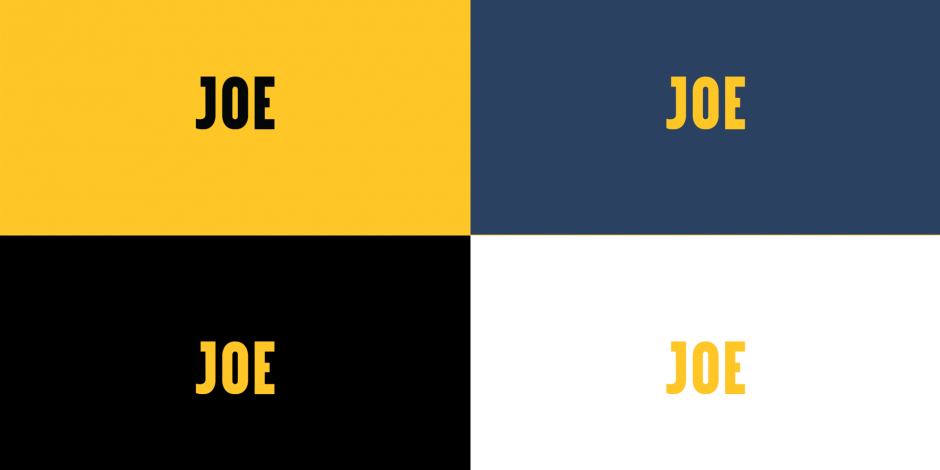
On the work, Homan said: “Breaking out from Joe’s old box means we can be more playful with our logo. For big editorial and commercial features we’ll look to build bespoke artwork featuring our logo, using the word-mark itself as the boundary box. The old Joe logo was boxed in, we wanted to break out and let the typography speak for itself.
“The logo now has a balance that the old did not. The ‘J’ and the ‘E’ are the same width. The aperture of the ‘O’ is the same size as the top bar of the ‘J’ and the middle appendage of the ‘E’. Turn both the ‘J’ and the ‘E’ in on themselves and they will meet in the middle of the ‘O’. This balance allows us to more easily lock our new logo up with commercial partners and our sub-brands.”
He concluded: “Whilst a lot of work went into this new design, it was important we didn’t move too far from our original logo, but rather embrace the best of it in the new iteration.
Late in 2018, The Drum sat down with the title’s, head of content Evan Fanning, to learn about how it is scaling up promising talent in order to take on more-established media players.
He said: “Going to a place like Joe with the freedom to attack things without the newspaper deadweight was really exciting. We say we do ‘traditional media, but digitally’.”
The Jameson International Graduate Programme offers candidates the opportunity to work as a Jameson International Brand Ambassador in an international market. As a Jameson Brand Ambassador, you will kick start your career and hone your commercial instincts on a global stage, working for the world’s bestselling Irish whiskey brand abroad. For many it will be the first step on a lifelong journey within Pernod Ricard.
Following 4-weeks of training in our head office in Dublin, you will travel to a foreign market and work across a wide range of marketing activities such as brand activation, event planning, promotions, education, mentoring and sales & marketing. You’ll work with your foreign based Jameson team and off your own initiative, and be on first name terms with bartenders, distributors and event organisers.
Apply today!
There are five key areas to the role of Brand Ambassador:
Brand Education
Brand Activation
Building Relationships with trade, consumers and key influencers
PR/Event Support
Supporting local Jameson Brand & Sales Team
Each market has its own challenges but you can expect the following to be on your ‘to do’ list:
Convert 25-35 year olds to the Jameson way of life through trial, market research and local media channels.
Help plan, strategize and initiate marketing opportunities to make Jameson a lifestyle choice for urban trendsetters the world over
Being a social media mogul, blogging and posting updates about your progress
Conduct tasting sessions with targeted consumer groups & influence the big players in the market, from the main distributors to barmen & loyal brand advocates
Support your local brand team in all their market activations
Research what the competitors are up to
Immerse yourself into the culture and be our ear to the ground.
With 90 Brand Ambassadors in 46 international markets from Spain to Belgium, China to Japan, our graduates live exciting, varied lives. Just check out a ‘Day in the Life’ of Jamie Rath, UCD graduate who spent his first 12-month rotation on our 3-year programme in Bangalore. His second rotation took him to the US, the biggest market for Jameson globally. Jamie is part of a team of 12 Brand Ambassadors based in the US. Here is a glimpse into Jamie’s #JamesonGradLife in Boston
To prove you have what it takes to be a Jameson Brand Ambassador you’ll also tick these boxes:
You have a full clean driver’s licence
You’re a creative and highly enthusiastic self-starter
You have strong business acumen
You’re independent, self-motivated and can work off your own initiative
You’re fluent in Russian
You have a strong desire and passion for brand marketing and sales
You’re outgoing, confident and an excellent communicator
You’re willing and able to adapt to new countries, cultures and situations
You have a positive, can do attitude
You’re a hard worker
You embody the Jameson personality traits of wit, charm and charisma
You’re driven to succeed
Last year 69% of our graduates moved to permanent post programme roles within Irish Distillers or the wider Pernod Ricard network globally. Some moved into marketing roles, others into sales roles, while others continued their journey as whiskey experts. Take a look at Hannah’s Jameson Career Journey below
The Perks:
From a competitive salary to top-class training & development, there are lots of perks on the Jameson International Graduate Programme. Take a look for yourself!
What We Offer?
The Jameson International Graduate Programme offers an initial 13-month contract; including one-month training in Irish Distillers Head Office, Ballsbridge, Dublin. For those who perform strongly over this period there is an option for a second and a third 12-month contract. You will receive a competitive graduate salary, a company phone and laptop as well as flights to and from your assigned market
The Jameson International Graduate Programme is unique; therefore, we look for exceptional candidates. Applications close at 1pm on Wednesday 17th so apply today!
Who Are Irish Distillers and Why Work for Us?
Irish Distillers is part of Pernod Ricard and oversee the production, marketing and distribution of a number of Pernod Ricard brands including Jameson.
As brand guardians for Jameson, the world’s bestselling Irish whiskey, we look after every stage of the process from our distilleries in Cork and Dublin to our marketing and strategic head office in Ballsbridge and our distribution network worldwide.
Over 500 enthusiastic, passionate and hardworking people make up Irish Distillers. We’re an eclectic bunch with many different talents from many different backgrounds and one unifying passion; our dedication to the brands of Pernod Ricard.
Why Work for Us?
Irish Distillers is an equal opportunities employer where all careers have the potential to reach to the very top of the Pernod Ricard Group. We pride ourselves on our exceptional career progression with many of our 500+ staff having started out on the Jameson Graduate Programme.
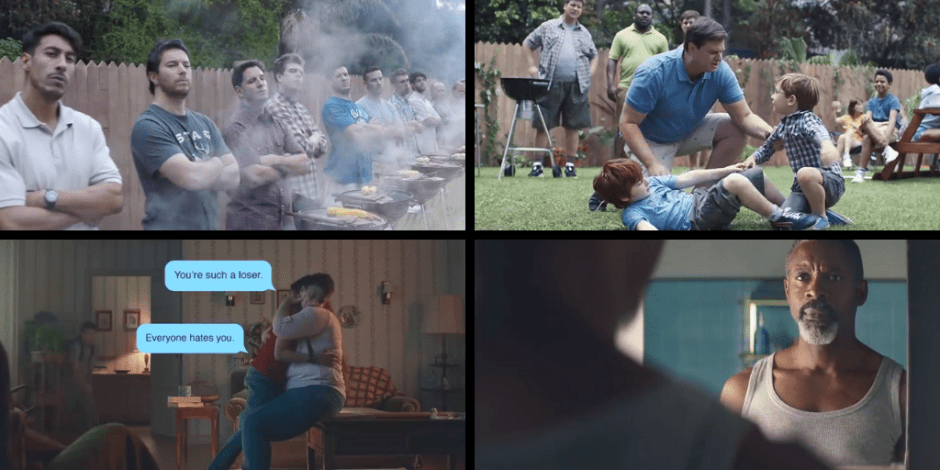
For better or worse, Gillette has sparked a debate about the next generation of masculinity in light of the Me Too scandals with the launch of a US campaign called ‘we believe: the best men can be’. Its message, urging men to be better, divided viewers.
On launch, Gary Coombe, president of P&G Global Grooming, said: “By holding each other accountable, eliminating excuses for bad behaviour, and supporting a new generation working toward their personal ‘best,’ we can help create positive change that will matter for years to come.”
Combe believed the brand has a legitimate right to speak on the subject as the “world’s largest marketer to men”. The razor and grooming brand also said it is donating $1m annually to for the next three years to US non-profits who also follow its values. This includes the Boys and Girls clubs of America.
Here’s how the ad industry felt about the ad, much like the public, the commentators are divided.
Sairah Ashman, global chief executive at Wolff Olins
Gillette has ruffled feathers with its newest ad, and the move was a risk for the brand. It’s calling out customers who associate with the version of masculinity it presents, and probably offending others who don’t identify with it.
Many question the company’s right to do this, given it isn’t typically associated with feminism or anti-bullying. Still, this mainstream buy-in to a contemporary understanding of male identity represents a significant step forward in our culture. If Gillette is willing to lose customers over its views (which it might, given that dislikes on YouTube far outweigh likes), that’s got to be applauded. Gillette is facing serious competition from the likes of Dollar Shave Club, aligning with a popular – if controversial – cause makes sense from a business perspective. Another point to consider is the economic power of women.
In the States alone, more than half of the population is female. Women are responsible for more than $39tn, meaning they control 30% of the world’s wealth and the majority of its shopping trollies. What happens in a world where women starting judging men on their blade choices – could it make a difference at the tills? In Amazon’s world, and with the rising power of direct to consumer brands, Gillette has taken a punt that the interest from those who wish to align with the anti-toxicity message will outweigh boycotting.
The need to differentiate is clear, while the success of Nike shows that social causes can drive sales. Gillette has pledged to actively challenge male stereotypes in the future by investing in relevant causes. I hope they put their money where their mouth is
Jesus fucking Christ. I mean. Where do I start with that? I’ve got to be honest, haven’t I? I think this is rubbish. I hate it. Overblown tripe, dripping with self-importance. In years to come, when professors are giving lectures on ‘Why Brand Purpose Died’, this is Fonzie on a motorcycle waving at a shark. Most people think Gillette’s endline just means that their razors are really good, and yet now, here they are, ready to save the world.
See, I admire the ambition. And I’m on their side. I want my son to grow up not to be an arsehole. I like, as a general rule, anything that provokes an exaggerated spit-take from the bulging-vein political-correctness-gone-mad brigade. My enemies’ enemies are my friends and all that. But sometimes – just sometimes – my enemies’ enemies get a bit carried away, and make a bit of a tit of themselves. My main problem, I think, with my professional head firmly on, is that I don’t really see what right – beyond an apparently widely misunderstood endline – Gillette has to be in this conversation. When Lynx pivoted, it made sense: it had built a brand on objectifying women, so they had something to push against.
Gillette has built a brand on mirror-men with unnaturally smooth faces rubbing their chins. There’s not a gap between that and the world of toxic-masculinity, there’s a fucking chasm: and, as wide as I’ve cast my net, I can’t find the interview where Tarana Burke talks about how she really hopes #MeToo can be used to sell loads of triple-blade razors with really macho names one day. So, yeah. Eesh. In some, small ways, good on ‘em: if you’re pissing off the right people, you must be doing something right. Unfortunately, however good their intentions, they’re also doing significantly more wrong.”
Tom Goodwin, executive vice president of Innovation at Zenith
For a long time, I think the world of advertising has lost its boldness, its thirst for risk, its desire to be part of real global conversations. Adland was once part of culture, it got people talking, it both reflected and shaped the zeitgeist.
Branding needs to be risky, we need to define ourselves by who we don’t speak to as well as who we do. Whether it’s the right time for Gillette to step in, whether it’s a cynical ploy to hijack a movement, whether brands need to interfere with incredibly important but intimate movements are all good questions for us to debate and I as yet don’t know my own views on them. Time will tell, people will talk. And that in itself is a great sign of work that is ambitious and we need that more than ever.
Adam Mack, UK chief executive of W Comms London
As a father of two young boys, I always feel like I’m walking a tightrope between toughening them up for the world that we currently live in and ensuring that they have the emotional IQ to change that world for the better. So from my perspective, the more brands that invest time, money and effort to help us all navigate this (complex conundrum) the better.
Furthermore, our work with Calm has shown us just how fragile male mental health is at the moment and anything which tackles the causes at an early age is very welcome. I see that Piers (Morgan) has weighed in already, which means two things. The issue will have the attention it deserves, but that attention will be divisive.
As with most things of complexity, the solution usually lies between two camps so it might be worth engaging the Piers camp in constructive dialogue rather than treating it with the usual yappy disdain. Finally, a few words on Gillette: I really hope it doesn’t go down the usual route of just distributing this global content willy-nilly. As good as the film is (and as good as the campaign’s intentions are), the UK is quite a nuanced market and they’d be missing a trick if they didn’t adapt it better to UK hearts and minds”.
JP Hanson, chief executive at strategic consultancy Rouser
At first glance, the campaign comes across as yet another brand taking an official stand. Yet Gillette isn’t really, because there is no contrary position. No brand in its right mind would promote sexism or bullying. Clearly, the zeitgeist has (long overdue) changed post #MeToo, as the ad also states, but that means it becomes reactive rather than proactive and ultimately somewhat condescending, particularly towards the brave women who fought further back in history.
Then again, Gillette remains perfectly happy telling women that they’re not perfect unless they remove their body hair. In the grand scheme of things though, it will likely neither help nor hurt the brand to any meaningful degree. Of course, there will be a few small-penised men threatened by an updated view of masculinity or the empowerment of women crying on internet forums, but most Gillette customers will inevitably buy the brand once every two years or so. For them, at the point of purchase, this won’t even make the mental radar. A
Sophie Lewis, chief strategy officer at VMLY&R
I am very happy that Gillette has made this piece of communication. Not because it’s any good, but because I have been waiting to see how brands will approach masculinity in the current gender-political climate and it’s a great way to learn what not to do.
And to be fair, I reckon at the brief stage it had all the right intentions. In fact, at the production stage, it was probably just about hanging together, thanks to Kim Gehrig!
But the truth is that Gillette should have raised the debate and the questions, and not tried to answer the question or fix the problem themselves. In terms of execution, it gets itself in all sorts of bother with regard to male stereotypes and definitions. What’s wrong with a man who barbecues?
The bits I like are, of course, the bits which were not shot by Kim nor written by a creative in an agency. They are the TV coverage of sexual harassment stories and Terry Crews. They are the bits showing the extent of the problem. The rest is questionable. The execution leaves something to be desired and, if you think about it, was it really necessary to shoot new examples of men treating women inappropriately, when so many exist in the world already?
But, like I say, well done for opening this can of worms, Gillette. Bring it on.
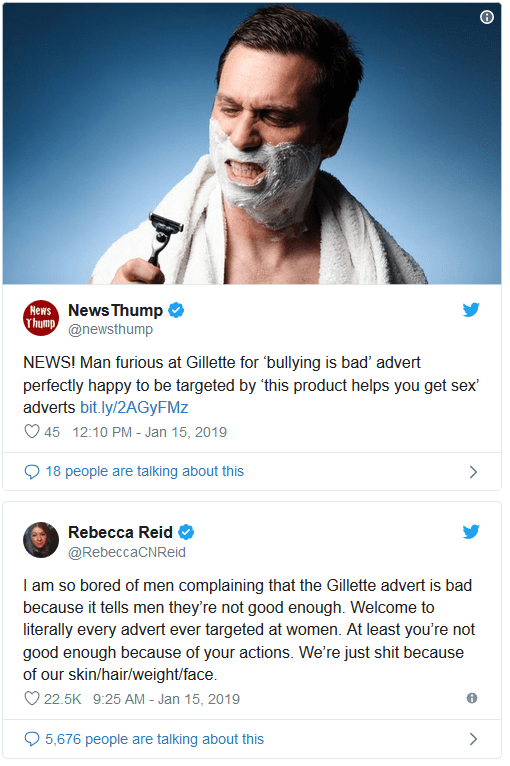
And finally, here are a few choice tweets outlining the public’s reaction to the work.
Social analytics data from Meltwater measured the effectiveness and impact of the campaign found that the work had accrued 284,452 mentions on social media. The main keywords were ‘bad behaviour, stadium, razors, women, boys, toxic masculinity, and good’. Audience gender breakdown was 70% men and 30% women, and the lead markets were the USA, UK, Canada.
Ad blocking, which caused mild hysteria in 2016, no longer grabs as many headlines but is still a substantial threat on a publisher’s bottom line, encouraging companies to diversify revenue sources and collaborate across the industry.
Multiple studies show the growth of ad blocking on desktop has steadied while the number of blocked impressions on mobile is growing, although slowly. Partly this growth is due to the number of ad impressions served on mobile growing as traffic migrates this way, but there are also new ad blocking entrants in the mobile market.
“It definitely feels to me that ad blocking took a back seat in terms of publisher priorities last year, due to the impact of GDPR, but it shouldn’t be forgotten,” said Nick Flood, managing director of digital at Dennis. “This threat certainly won’t be going away.”
What ad blocking has thrown into stark relief is the need for publishers to spread their bets. Future Publishing hit peak ad block concern in November 2017 when 54 percent of desktop impressions on its gaming sites were blocked, according to Zack Sullivan, chief revenue officer at the publisher.
Now, rates across Future’s portfolio have stabled to between 7 percent and 11 percent on desktop. Mobile is showing slow growth of 1 percent up to 7 percent, he added. The most effective way of getting people to interact with Future’s ad-block messages was by offering as many options as possible — such as whitelisting the site, disabling the ad blocker, becoming a member or viewing a video ad — with the messages written by the editors in the style of the site.
“The hysteria around ad blocking has subsided a little, but the problem is still there,” said Brian Kane, co-founder and COO at Sourcepoint. “The most successful strategy involves engagement of the consumer, offering choices; that’s the most respectful option.”
Gaming sites have always been ad-blocking magnets, where audiences are more savvy about technical workarounds. One company that offers publishers ad-block solutions said that it has seen mobile ad-block rates rise from 6 percent to 10 percent in a year on a gaming site, which the company didn’t want to name. By comparison, non-gaming sites see mobile ad-block rates hover at around 2 percent.
For French news publisher Le Monde, ad blocking on desktop is stable at 25 percent, but mobile, 15 percent, is growing. But rather than reduce this, the publisher is focusing on driving reader revenue instead. “[Ad blocking] used to be the main priority two years ago; now we have one word: subscriptions,” said Pierre Buffet, head of digital at the publisher. “We have a more narrow scope, and we don’t want to lose energy trying to get people to turn off an ad blocker.”
However, Buffet believes these figures to be lower than the reality since ad blockers are blocking the publisher’s tracking scripts, and it’s highlighted another problem in untraceable traffic. “My concern is more about this ‘ghost’ traffic, which is clearly on a structural upward trend.” Increasing concerns over privacy from high-profile media cases, like Cambridge Analytica, are partly to blame. Just how much traffic and revenue are lost is hard to prove; in the coming months Le Monde plans to recover this traffic through working with its web analytics partners, AT Internet, and recover between 5 and 15 percent of pageviews
Ad blocking conversations have broadened out to be part of the wider discourse around ad quality and data privacy. Publishers like Dennis have integrated ad-block messaging into their GDPR consent management platforms. More focus on industrywide problems has led to closer collaborations. “Ad-block solutions companies are making louder noises to being publisher partners, rather than creating solutions that say this will have an impact on the bottom line,” said Richard Reeves, managing director of the Association of Online Publishers.
Despite the industry’s best efforts — last week, the Coalition for Better Ads announced last week it will adopt ad standards globally, and Google Chrome’s ad filter will be expanding globally July 9 — collectively millions in annual revenue is still being lost by U.K. publishers as a result of ad blocking, according to research from the Association of Online Publishers, which counts members including Condé Nast, ESI Media, Global, the Guardian and The Telegraph.
Partly, this is because ad blocking is a blunt tool. All publishers will get punished for bad actors, and there will always be cases of bad actors: Google has only needed to filter 1 percent of the millions of sites it has reviewed, but that ripple effect is vast.
Still, Google’s size has helped move the industry forward, said Sullivan. Google recognizes why publishers are suspicious of its motivations, but publishers are hungry for more details that the company isn’t able to share yet, such as about how it will work in practice and how it will impact the wider industry.
“Everyone gets it when you have that conversation [on ad standards], brands, agencies, SSPs, DSPs,” he said. “It’s been industrywide, but Google can help implement and police it; that’s their big gift to the industry.”