A few weeks ago, I saw a tweet with an unusual text in it. It displayed a company that automated tweets for a popular blogger who has been one of my mentors.
I tweeted back to that tweet but never received an answer back. That really got me thinking.
Do we get so busy that we become disengaged with our audience? Are using social media tools making us less engaged and not a good practice?
I quickly went back to scheduling posts on Facebook itself and the engagement level went back up! Now part of that is because Facebook wants us to spend time on their network. You can’t blame them for that!
Of course I loved the Buffer because it saved me time over the years. But is time everything when it comes to social media marketing?
Testing Agorapulse Social Media Tool
Next, I began testing out Agorapulse. I love this social media tool today! Not only does it give me great analytics to share with clients, but I can schedule tweets and it doesn’t show their name in them like the Buffer displays on Twitter. Agorapulse is also great for scheduling Instagram posts which can result in making less errors and saving you time. (You know typing on your mobile on the go sometimes can be tricky!)
Here is Mike’s Response to Me About Agorapulse and Social Media Engagement:
“We’ve done extensive testing of “Reach” because that’s something that’s easily tested, measured and compared. If you post very similar posts, the same way, at the same time of day, day after day… that’s comparable and you can draw conclusions from the data.
Agorpulse tested posting natively to all of the networks vs. using 3rd party tools and not only does the data show that there is no penalty, it’s suggestive that using a tool actually helps – though we think that’s an anomaly.
There really shouldn’t be any difference. A post is a post as far as the networks are concerned.”
Engagement is Something Else Entirely According To Mike!
“We sometimes schedule content for the reach tests that purposely avoids encouraging engagement so as not to skew the results. But crafting a series of posts that are supposed to get the “same” amount of engagement every time, and then schedule some using a tool to see if there’s a difference, seems impossible to reliably manage.
Which means the only conclusions others might reach are purely anecdotal or uncontrolled. “We started posting using Sprout Social and our engagement went down.” Really? What else might have changed? Did you post more or less? What were you talking about? What else was going on? Were you posting the same kinds of posts about the same topics? Did you stop doing something else? – So many clarifying questions which would have to be asked.”
Recently, I have started sharing some social media tips on Facebook, Twitter, and Instagram. I am a big believer that you need to engage with your audience. Why just throw things up on the wall and leave? I see many social media management companies doing just that. They take blog posts that are canned and post them time after time. That’s it!
Now, I believe it is called SOCIAL media for a reason, to be social! Talk, engage, share, comment, etc. Do something, don’t just be passively throwing stuff up on the wall or feed on the social networks.
“The top professionals own the best gear. It’s the same with anything — sports, music or business. When it comes to Social Media; you can’t keep up with the trends if you don’t have the support of automation on your side…
It just isn’t practical to sit there all day posting manually!
However, that doesn’t mean 100% automation is a solid strategy.
(Far from it).
Always blend automation with the human touch — it’s a winning combo — and people will otherwise notice any imbalance.
I always say:
“If you’re on Social Media but not engaging, then you’re just media!”
Wisely choose your tools for the most time-heavy tasks, and perfect their application (while consistently researching new vendors).
It doesn’t matter how many you use — as long as it’s all sensibly balanced with your budget, business type, and level of interaction.”
“I think too many automation tools is not only a bad idea, but for many reasons. One, if you’re trying to game the social media sites you will get caught eventually. Two, if something bad happens in the world you might have an inappropriate and untimely post that you missed because you didn’t remember where you put it.
I only use two. First, I use Tweeten for Twitter (of course) because I hate using browsers for things like this. Then, I can pre-post articles and such on there and it works great. I also use Buffer, but I only use it for LinkedIn, since you can’t pre-post there. If you have a business page on Facebook you can pre-post there, so there’s no need to use any other automation services. I know some people use it for Instagram, but it’s problematic sometimes.
Finally, if the only thing you’re doing on a social media site is posting stuff and not engaging anyone, you’re missing out on the opportunity to actually meet potential customers. You don’t have to do it a lot, but having people see that you sometimes talk to others humanizes you and people will get comfortable with you.”
“Automating every aspect of your social media marketing can make you look like a spam bot, helping you lose contact with your audience.
On the other side, liking, following, commenting and engaging on every mention of your brand or social media post can be overwhelming and absorbing all of your time.
I think the right strategy should be somewhere in between.
Depending on your goals, try using some automation tools to increase your reach, while keeping authenticity by engaging with your community, every time is necessary.”
Use Social Media Tools to Engage Your Audience, Not Put Them to Sleep!
I believe finding the right blend as others suggested here on the blog is key to balancing your social media. I always tell clients you have to spend time or money. It’s either one. You must invest your time or money with social media marketing today.
Finally, be sure the social media tools you use today don’t put your audience to sleep. Be sure you have a way to respond to others when questions are asked in a timely manner. I go on each of the networks for at least 5 minutes to start the day. Not only on my own channels but those that I manage.
Then, I check notifications mid day and again before hitting my pillow. This can be done with Agorpulse too and they even have an app for it!
What do you have to say about the use of social media tools and engagement? Do you use tools only post to social media? I’d love to know more in the comments below!
Lisa loves helping others to thrive online through Content Marketing with Social Media, Blogging and SEO. What good is knowledge if you cannot share it with others? She has 30+ years experience in marketing/advertising with 8 years experience in content marketing, social media, blogging and SEO. Check out her latest eBook “How to Tweet and Thrive on Twitter” now on Amazon.
Looking for Best VPN (virtual private network) service for protecting Internet Privacy? Here this post we discuss How to choose a Best VPN service provider to protect your online privacy (Where we look things Encryption and Protocols, Logs Policy, Speed, Global Coverage, Cross-Platform Support, Customer Support and the most important is Cost.) Before go ahead for them Who don’t aware about VPN service, it’s typically a paid service that keeps your web browsing secure and private over public Wi-Fi hotspots. In other words:
A virtual private network (VPN) is a technology that creates a safe and encrypted connection over a less secure network, such as the internet. VPN technology was developed as a way to allow remote users and branch offices to securely access corporate applications and other resources. Along with VPNs can also get past regional restrictions for video (Netflix) and music-streaming sites and help you evade government censorship restrictions.
The VPN server is operated by a VPN provider, and the connection between your computer ( smartphone, tablet, or similar) and the VPN server is encrypted.
You still need an ISP to provide your internet connection, and that ISP can still see how much data you consume.
But Your ISP cannot see what data you consume, however. This is because it is securely encrypted.
As the VPN server acts as a proxy, No one (include your ISP) cannot see which websites you visit on the internet. Your ISP can only see that you have connected to an IP address belonging to a VPN provider. It cannot see which websites you visit after that.
How VPN works?
The best way to think of a VPN is as a secure tunnel between your PC and the destinations you visit on the internet. Your PC connects to a VPN server, which can be located in the United States or a foreign country like the United Kingdom, France, Sweden, or Thailand. Your web traffic then passes back and forth through that server. The end result, As far as most websites are concerned, you’re browsing from that server’s geographical location, not your actual computer’s location.
And Once you’re connected to the VPN and are “inside the tunnel,” it becomes very difficult for anyone else to spy on your web-browsing activity. The only people who will know what you’re up to are you, the VPN provider (usually an HTTPS connection can mitigate this), and the website you’re visiting. For better understand you can see image below How VPN secure your Data Between you and internet.
When you are connected through inside the tunnel, it’s very hard to stealing your login credentials or redirecting your PC to a phony banking site Along with your internet service provider (ISP) And it’s near impossible to figure out which websites you’re visiting. With this, you can also get the benefits of spoofing your location And access regionally restricted websites and online services such as BBC’s iPlayer or Sling TV. Include Netflix (fighting against VPN) the American version of Netflix when they’re really in Australia or anywhere.
Which VPN Should I Choose, Paid Vs Free?
Still, now I am sure you are clear about VPN (virtual private network) And how this Service works and Secure your Internet privacy. Now let’s discuss Which VPN service you should choose Free Or paid VPN service.
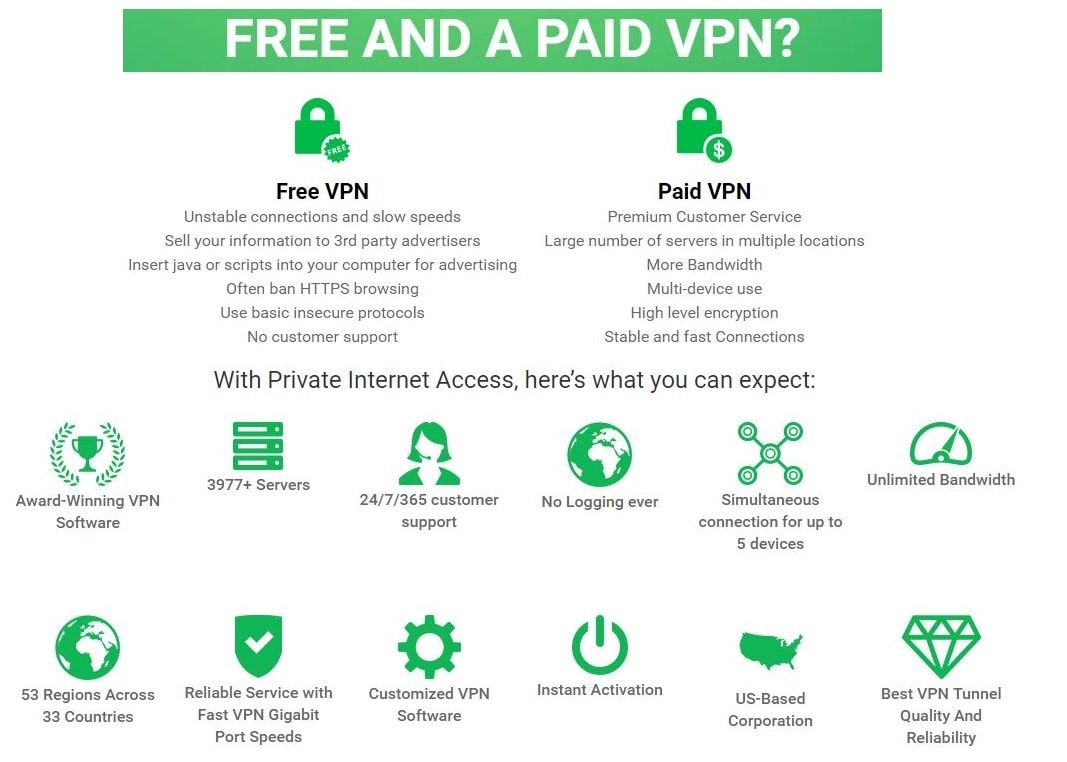
Free VPN
For them who thinking about Free VPN, There are tons of free options from reputable companies, but these are usually a poor substitute for the paid options. Free services usually allow a limited amount of bandwidth usage per month or offer a slower service.
And the most important drawback is the low level of security. Most free VPN services provide only PPTP VPNs, which is insecure. Paid VPN providers allow you to use PPTP, L2TP/IPSEC, OpenVPN, SSTP and even SSH to tunnel your connections securely.
Free VPN-services create to attract a huge number of users, without thinking about the security of their service. Often, if not always, the traffic of users of these services is transmitted in clear form, making it available to everyone.
Any free VPN service is just a cover for a paid and perfectly working project. Therefore, you will always be shown paid VPN advertising. Perhaps even the use of VPN will be limited by time or traffic, motivating you to purchase a paid version of VPN, on which these restrictions will not be. We believe that advertising when using VPN is annoying, so we do not cooperate with advertisers in any way.
Paid VPN
And when you go for a paid VPN they primarily take care of your privacy. Where you get high-level security and allow you to use PPTP, L2TP/IPsec, OpenVPN, SSTP and even SSH to tunnel your connections securely.
Paid VPN providers normally invest a decent percentage of their profit on bandwidth and servers, so you will get a very good internet speed with unlimited Bandwidth.
support is one of those things you pay for. When you choose a paid VPN service, you should expect someone to answer your tickets and do his job, while free services are usually provided “as is”.
Choose A Best VPN service for you
Things matter while Choose the Best VPN Service Encryption and Protocols, Logs Policy, Speed, Global Coverage, Cross-Platform Support, Customer Support and the most important is Cost. And after reading lots of comments on forums, a number of posts about “Best VPN service 2018” with user feedback review Finally I End up with ExpressVPN – A Fully featured, privacy-friendly VPN service. Here what impressed me
With best-in-class encryption and a strict policy to keep no activity logs and no connection logs, ExpressVPN comes to #1 Trusted leader in VPN with High speed, ultra secure, and easy to use.
ExpressVPN
Number of servers: 1800+ | Server locations: 148 | IP addresses: 30,000 | Maximum devices supported: 3
Based in the British Virgin Islands, ExpressVPN ensures a totally private browsing experience. They keep no logs of your activity and are outside the jurisdiction of major nations. With a full suite of security features including military-grade encryption, perfect forward secrecy, a kill switch, and leak protection, you can be sure that nobody can see what you do online.
ExpressVPN applies strong encryption method AES-256 the military encryption standard, which can protect your data 360º completely. Multiple protocols including OpenVPN TCP, OpenVPN UDP, SSTP, L2TP/TPsec and PPTP are provided for you to choose from.
ExpressVPN operates thousands of servers in 148 VPN server locations in 94 countries and offers apps for all devices and platforms, like Windows, Mac, Android, iOS, Linux, and routers, in addition to browser extensions like Chrome, Firefox, and Safari. Also, ExpressVPN runs its own Zero-knowledge DNS on every server. That means your personally identifiable data is never stored on any server.
Superior performance with excellent speeds and reliability throughout the VPN server network.
High-security applications with maximum encryption (passed all privacy/security tests).
Excellent offshore jurisdiction and company policies to protect customer data and user privacy (which were recently verified with the server seizure in Turkey).
Still works with Netflix and other streaming services.
Huge selection of apps that are well-designed and very user-friendly.
Top-notch customer service with 24/7 live chat support and a 30-day money-back guarantee.
Does ExpressVPN work with Netflix?
Yes. ExpressVPN is one of the few VPN providers that continues to work with Netflix, no matter where you’re located in the world. If you get any kind of proxy error with Netflix when you are connected to an ExpressVPN server, just contact ExpressVPN’s chat support and they’ll tell which server to use instead. Plus, ExpressVPN is the only VPN service that lets customers use SmartDNS to unblock Netflix on
Also, ExpressVPN a solid choice for torrenting that offer
High-performance (premium) server network with exceptionally fast speeds and great reliability.
Overseas jurisdiction that is not subject to DMCA requests or copyright violation demands.
High-quality applications that will keep your data and anonymity secure while also protecting you against leaks and vulnerabilities (WebRTC).
No bandwidth limitations or traffic restrictions whatsoever.
That means using ExpressVPN you can Unblock almost every popular online services
Unblocks popular online services
ExpressVPN No log policy confirmed
ExpressVPN does not possess any customer connection logs that would enable that to know which customer was using the specific IPs cited by the investigators. As the company explains we were unable to see which customers accessed Gmail or Facebook during the time in question, as we do not keep activity logs. ExpressVPN issued a statement on their website, here is a brief excerpt:
We do not collect logs of your activity, including no logging of browsing history, traffic destination, data content, or DNS queries. We also never store connection logs, meaning no logs of your IP address, your outgoing VPN IP address, connection timestamp, or session duration.You can find more information on the ExpressVPN website (see Privacy Policy)
ExpressVPN encryption
ExpressVPN offers a very high level of encryption that is considered unbreakable by current standards. For encryption, ExpressVPN uses an AES 256-bit cipher with a 4096-bit RSA key and SHA-512 HMAC authentication. Additionally, ExpressVPN utilizes Perfect Forward Secrecy negotiated through Diffie-Hellman key exchange. If you want more information on ExpressVPN’s encryption implementation, you can find that on their website.
ExpressVPN split tunneling feature
Split tunneling allows you to select which apps will go through the VPN tunnel and which can bypass the VPN to the regular (unencrypted) internet. And ExpressVPN offers a split tunneling feature with their applications for Windows, Mac OS, and routers. By default, all traffic and applications are routed through the VPN. But you can manage this In the settings, select three different options:
All apps use the VPN
Do not allow selected apps to use the VPN
Only allow selected apps to use the VPN
If you click the second or third options, a pop-up window appears, allowing you to select the specific apps.
ExpressVPN network lock (kill switch)
ExpressVPN refers to their kill switch as the network lock that keep your data secure by blocking all traffic if the VPN connection drops. This ensures you are always protected. Once you are reconnected to the VPN server location, Network Lock restores your internet traffic automatically.
ExpressVPN Discount
ExpressVPN offers $12.95 per single month, while a yearly subscription cuts it down to $8.32 per month. However, through this discount link, you can now get ExpressVPN for $6.67 per month, which drops the VPN price significantly.
ExpressVPN Alternative
If you are looking for ExpressVPN Alternative, Then you can go for NordVPN.
Number of servers: 3500+ | Server locations: 60+ | IP addresses: N/A | Maximum devices supported: 6
NordVPN features
Privacy and Logging Policy, Where NordVPN states that they have a strict no logs policy. And the kill-switch feature available which is basically supposed to protect against revealing your real IP in case the VPN connection drops. It’s very useful in some cases and we understand the need for it. Along with this NordVPN offers some solid features to enhance user privacy and security. Let’s take a look at a few of these features.
NordVPN CyberSec
NordVPN CyberSec is a new security feature that includes a malicious sites filter and an advertisement and tracking blocker. It blocks DNS requests based on a real-time blocklist of harmful websites that may host malware. As such, it should shield you against malware, help prevent botnet control, and block many intrusive web ads.
NordVPN kill switch
NordVPN offering two different kinds of kill switches. A kill switch is important because it blocks traffic if the VPN connection drops, which protects you from de-anonymization and your regular traffic being exposed.
In the screenshot below you can see the two different kill switches:
Internet Kill Switch – This will block all traffic if the VPN connection drops (recommended).
App Kill Switch – This will close applications if the VPN connection drops, but will not block any traffic.
NordVPN kill switch
Double VPN (multi-hop)
Using a multi-hop VPN chain offers many advantages over a standard VPN setup (single server). If a server were to be targeted (monitored), a multi-hop VPN configuration would add further protection by helping to conceal incoming and/or outgoing traffic.
NordVPN currently offers 18 double-hop VPN configurations, which they list on their website. The drawback here is that these are not self-configurable. In other words, you can’t create your own custom multi-hop configuration.
Works Great for Torrenting and Netflix
Since NordVPN has a lot of servers they also work well with Torrenting and bypassing geo-restrictions on certain sites like Netflix. While use VPN together with Netflix it seemed to work: But not all servers are working with Netflix because we all know how Netflix fight against VPN services to crack down certain IPs that belong to VPNs.
Torrenting is safe and fast too, NordVPN has made special “P2P servers” that are solely meant for keeping your torrenting activities safe and private. You can access the P2P servers via “specialty” servers list on their application.
Nord does operate a large number of individual servers at over 4,000 Over 60 countries all over the world. So that you will not struggle to find a suitable location. Europe and the Americas are served very well, with the majority of countries covered, including a few options in South America. It’s great to see so many choices in the Asia Pacific region such as Indonesia and Taiwan, as well as several locations in Africa and the Middle East.
With Android TV app you can use it with devices such as Android TV, Amazon Fire TV and Fire Stick without any manual configuration. also use it with a range of other devices by connecting them to a configured router. This includes devices like AppleTV, Xbox360, Roku, Nintendo Wii, PS3, Sony SmartTV, Roku XDS, and many others.
NordVPN Offers proxy extensions for Chrome, Firefox and Safari. The add-ons for Chrome and Firefox are incredibly easy to download and add to your browser
Nord VPN offers a decent range of custom apps for various devices including Windows, Mac, iOS and Android. With NordVPN’s fully-featured service, double VPN, VPN over Tor, DNS-based malware protection, Smart DNS, and more, all part of the very reasonably-priced package.
Enjoy 2 years of online security for only $95.75!
NordVPN offers three different pricing options. A one-year plan costs $6.99 per month, while a 2-year plan is $3.99 per month. To get these monthly rates, you’ll have to pay for the entire term of service upfront ($95.75 for three years). It’s possible to buy into the service one month at a time, but you’ll pay a punishing $12 per month for the privilege. That’s $143.40 per year.
NordVPN Save 66% discount linkGrab a 2-year plan, just $3.99/month! (30-day money-back guarantee) Payment can be made through a number of options including credit card, PayPal, Bitcoin etc.
NordVPN offers one of the most generous refund windows in the VPN industry. With every subscription plan, they give you a 30 day money-back guarantee. If you aren’t completely satisfied with the VPN, simply cancel within 30 days to get a full refund (explained further on their website). Therefore if you purchase a subscription, use it for a few weeks, and then cancel within the 30 day window, you will have technically used a short-term VPN for free.
Currently, ExpressVPN and NordVPN both are the Top players on VPN market where both provide almost every feature and security which makes VPN service perfect. The only different the Quality of the service and features make the small extra cost for ExpressVPN. If you have already tried these services lets share your feedback on comments below.
Note: Both ExpressVPN and NordVPN offer (30 day money-back guarantee) If you are not satisfied with their service you can ask for a refund within 30 days.
Disclaimer: This post contains affiliate links, Where we earn a small commission for every sell which help us to pay to host, CDN, Developer charges to light up the site and serve free articles to you.
‘You’ll never have to talk to another telemarketer,’ the Google project manager said. (Which means for telemarketers: Bye-bye, business model!)
Google just announced it has come up with a new way to thwart telemarketers–heck, to completely destroy their business model. It’s brilliantly simple, and it seems like it will actually work.
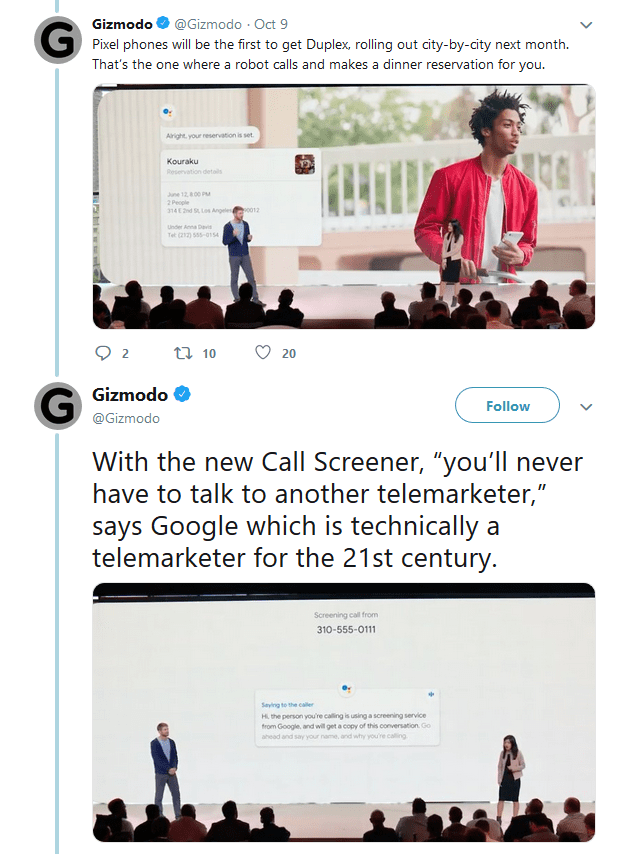
Here’s how Google’s solution works–introduced at its hardware event in New York City on Tuesday. It’s called simply “Call Screen,” and it’s built into Android on the Pixel 3.
When you get a call from a number you don’t recognize on an Android device, click “Call Screen” on your device.
Google Assistant answers the call, with a greeting like, “Hi, the person you’re calling is using a screening service from Google, and will get a copy of this conversation. Go ahead and say your name, and why you are calling.”
The caller will either hang up–in which case it’s probably not important–or provide an answer, which will then be transcribed and displayed on your screen.
Then it’s up to you to decide whether to answer.
So if the message you receive reads something like, “Bill, this is your wife, I lost my phone, pick up,” you’d answer (I hope). But if it’s something like, “This is the IRS calling to say we will arrest you for not paying taxes,” you can just ignore it, since it’s absolutely a scam.
“Just tap the ‘Call Screen’ button and your phone will answer for you and ask who’s calling and why,” Google product manager Liza Ma said in announcing the new feature, followed by the eight most important words of her presentation: “You’ll never have to talk to another telemarketer.”
You can also mark spammy incoming calls as “Spam.” That way, if you ever get a call from that number again, it will come with a big red interface reminding you that you’ve previously pegged the number as suspicious.
That’s it. Call Screen won’t remove your phone number from telemarketers’ lists. But it could ultimately make the entire telemarketing industry unprofitable. If telemarketers can never reach anyone to pitch, they can never close a sale.
And, if it works as expected, expect the feature to go forth and multiply (meaning, coming soon to an iOS near you). And for telemarketers: Bye-bye, business model.
(Hat tip to Gizmodo for getting the cool shot of Google revealing this.)
This is pretty cool, and simple. It’s also very close to what your parents probably used to do back in the 1980s, when people had mechanical telephone answering machines, and they’d just let incoming calls go to the machine before they decided whether to pick up.
And it’s not far from the screening options that Google has been offering with Google Voice for nearly a decade–only you don’t get a transcription in real time.
For the Google Voice solution, just connect Voice to your cell phone, let a list of trusted numbers dial through to you directly, but prompt everyone else to state their name after the tone, and you’ll get the recording without answering.
You can even direct repeat offenders straight to voice mail without disturbing you–or else, my personal favorite, upload something like this recording that says your number is not in service, and get off their lists for good.
I’ve often wondered why most people don’t do this same thing–but the Google announcement today explains why. We are all ridiculously busy, so we need things like this to be simple, simple, simple.
It takes time to do all that setup I described on Google Voice. It takes no time at all to hit “Call Screen” when you have an incoming call you don’t recognize.
And that’s what makes this so simply brilliant. Or brilliantly simple. Whichever, you decide.
It was a Christmas advert that bosses at supermarket chain Iceland said would have “blown the John Lewis ad out the window”. But the major campaign for the discount store has been banned after it was deemed to have breached political impartiality rules.
The animated short featured an orangutan mourning the loss of his rainforest home, and was voiced by the actress Emma Thompson. Its contention was to show how Iceland has become the first major UK supermarket to remove palm oil – a major cause of deforestation – from all its own-brand products. However, regulators were concerned by the fact the 90-second film is actually a repurposed Greenpeace video.
“This was a film that Greenpeace made with a voiceover by Emma Thompson,” said Iceland’s founder Malcolm Walker. “We got permission to use it and take off the Greenpeace logo and use it as the Iceland Christmas ad. It would have blown the John Lewis ad out of the window. It was so emotional.”
Clearcast, the body responsible for vetting ads, said it was in breach of rules laid down by the 2003 Communications Act. One of the law’s stipulations is that a promotional campaign is prohibited if it is “directed towards a political end”. “Clearcast and the broadcasters have to date been unable to clear this because we are concerned that it doesn’t comply with the political rules of the BCAP [the broadcast code for advertising practice],” said a spokesperson. “The creative submitted to us is linked to another organisation who have not yet been able to demonstrate compliance in this area.”
Iceland said it will still be placing TV ads, but only 10-second clips that will highlight palm oil-free products. “We wanted [the Greenpeace film] to be our signature campaign,” said Richard Walker, Malcolm’s son, who has led Iceland’s environmental campaigning. “We have said repeatedly we are not anti-palm oil, we are anti-deforestation.”
Gartner Symposium was last week, and as they do each year at the event, the company has identified a top ten strategic technology trends for the year ahead. Gartner defines “strategic” as those technologies that will have significant disruptive potential over the next five years.” Here is a summary of the trends:
Autonomous Things
While artificial intelligence has been a consistent trend for several years now, as the technology advances, Gartner foresees a shift from stand-along intelligent things to a collaborative swarm network of intelligent things. Artificial intelligence is increasingly providing the brains for autonomous things such as robots, drones, and autonomous vehicles, empowering them to more naturally interact with both their surroundings and with people.
Augmented Analytics
Artificial intelligence can be used to augment human capabilities or automate them. Within the realm of augmented intelligence, Gartner sees augmented analytics, which it defines as the use of machine learning to transform how analytics content is developed, consumed, and shared, rapidly advancing through mainstream adoption. This will enable organizations to optimize decisions and actions of all employees, and not just those of analysts and data scientists.
Gartner Top 10 Strategic Technology Trends for 2019 Credit: PH
AI-Driven Development
As organizations increasingly leverage AI-enhanced tools and technologies during development, there is a growing need for easy-to-use tools that can be leveraged by application developers rather than data scientists. Indeed by 2022, Gartner predicts that 40 percent of new app development projects will include AI co-developers within their teams.
Digital Twins
Digital twins, or digital representations of real-world entities or systems, has been a growing trend as the Internet of Things has exploded. One of the most interesting aspects will be the implementation of digital twins of the organization (DTOs). DTOs are dynamic software model that relies on operational or other data to understand how an organization operationalizes its business model, connects with its current state, deploys resources and responds to changes to deliver expected customer value.
These days, when you think of marketing, your thoughts probably turn to digital marketing. You may be pouring your marketing budget into website personalization, social media marketing campaigns and more — and it’s likely that you’re reaping good results from them.
But a marketing campaign that’s all digital and no print is out of balance. Print marketing never went away — and in an age when every other email is pure spam, print is making a real resurgence. When you tie together your print and digital marketing, you create a campaign that builds on itself to reach customers effectively.
Who Needs Print Marketing in a Digital World?
Chances are, the answer is: You and your company. In the last couple of years, responses to print marketing have more than doubled. In part, that’s because of campaigns linking print and digital marketing — but that doesn’t tell the whole story.
When consumers only receive your marketing message through one sensory channel — as happens when they read something on a screen — their engagement with the message is light. When they can actually touch the paper the message is printed on, a second sensory channel is opened, and the brain moves into a new level of engagement.
And all those professors telling college students to take notes on paper instead of on their laptops have tapped into something profound: People remember what they read on paper far better than anything they read on a screen. With all the time and creativity you’ve taken to craft your marketing message, doesn’t it make sense to deliver it via a medium that helps people remember it?
How Print Marketing Complements Digital Marketing
All that customer information you’ve gathered through digital CRM tools comes in extremely handy when you’re building a personalized print marketing campaign. Whether it’s branding a brochure for new leads or delivering coupons targeted to existing customers, print campaigns can reach customers where they live — literally.
With the CRM data you’ve collected, it’s now easy to provide QR codes that link a prospective customer straight from your print piece to a personalized landing page or URL, or straight to the product they’ve been reading about. You can turn around and collect data on how effective your print + digital campaign has been through online analytics tools, making it a simple matter to tweak your campaign for greater reach and response.
In fact, providing that link between print and digital marketing is vital to connect to some customers, since in recent years, more than 50 percent of people responding to direct mail would rather do so online or in-store. That’s all the more reason to sync your print and digital marketing campaigns together.
In recent years, more than 50 percent of people responding to direct mail would rather do so online or in-store.
5 Ways to Build a Personalized Print Marketing Campaign
Consistency is at the heart of any personalized print marketing campaign, especially when you’re integrating it with your digital marketing. Keep your message consistent across channels, and use the same colours and fonts in your design work to reinforce your branding. Take a look at other ways to build a successful personalized print marketing campaign.
Add Digital Links to Printed Media
Include your Twitter hashtag, your Facebook page and your website address to all your print materials. This allows customers to connect to your company through their preferred channel.
Integrate QR Codes
Transport prospective customers directly to your website or to specific product pages through QR codes on your print materials. These codes can let you track leads created from each print marketing piece, so you know which campaigns your customers are responding to.
Utilize Variable Data Printing (VDP)
With variable printing, you can use the data you’ve collected through CRM to know what your customers have purchased previously and even what they’ve been browsing for on your website. With this information, you can print personalized marketing materials aimed directly at segments of your target audience.
Create Customized Catalogs
Your customers are unlikely to care about your entire product range. So why send them a bulky catalogue that they’ll only flip through and toss in the trash? Instead, you can create personalized catalogues for individual customers or targeted groups that speak to their specific interests and needs, based on the data you’ve collected regarding their browsing and purchasing habits.
Add Personalized Print Inserts
If you don’t want to create an entire personalized catalogue to send by direct mail, you can create personalized offers to include with other mailings or product deliveries. Consider creating coupons or time-dependent discounts to send customers to your website or your brick-and-mortar store, or send special offers to new customers who’ve made their first purchase with you. When customers realize you understand what they want and are treating them as something special, you deepen brand loyalty and customer engagement.
Consumers are increasingly frustrated by — and consequently immune to — digital marketing techniques such as pop-up ads and banner ads. In contrast, when you invest in personalized print marketing materials, you create a unique experience that can capture the attention of your existing customers and prospective leads.
A clever marketing campaign will only take you so far.
Tech is suffering from a fundamental imbalance. Everyone wants to be a visionary without realizing they need to be salesmen, too.
It’s a widespread and shocking oversight. We constantly bemoan the lack of technical talent, citing shortages of talent in fields like engineering and computer science, but don’t realize we’re facing a similar crisis in a role that essentially every business needs.
Think about it — when is the last time you met a great salesperson? And no, I’m not including selling “yourself” or “ideas” under this designation. The top MBA programs in the country offer paths in marketing, finance and entrepreneurship, but not sales (something they’d be good at given their adroitness in selling overpriced degrees). This gap in education is a symptom of misplaced arrogance that assumes anyone can be good at sales if they just give it a shot. What we finally need to realize is that sales is a hard skill. As such, it deserves the same training and serious study more lauded degrees like finance receive.
However, before I teach you how to overhaul your relationship with sales, it’s important to first look you in the eye and tell you a hard truth, entrepreneur to entrepreneur. Even as the social stock and real capital of “thought leaders,” “influencers” and “disruptors” grows, so too does the doubt around the impact and true value of these companies. Eventually this bubble is going to burst, meaning you need a better long-term strategy to success than a well-executed Twitter campaign or viral op-ed.
While I have long been a proponent of good marketing and branding, I am also painfully aware that they alone won’t save you or your business. Selling well is not a nice-to-have. It’s survival, and here’s how you stay alive.
Start with your culture.
In tech more than most industries (except for used cars, perhaps, though I’d say we’re giving them a run for their money), salesmen and saleswomen are the people everyone loves to hate. They often rank lower than politicians and bankers in terms of perceived trustworthiness, which is a hard hit considering today’s political climate. Some words that come to mind, according to a study by Daniel Pink in his renowned book, To Sell Is Human, are “pushy,” “difficult,” “annoying,” “sleazy” and, believe it or not, “ugh.”
Because of this stigma, organizations go to great, and often silly, lengths to disguise their salespeople. In 2015, Kate Spade New York rebranded its sales associates as “Muses.” Microsoft calls them “Advisors,” and Apple goes as far as to dub them “Geniuses.”
Call them what you will, but each of these Geniuses and Muses are hired for a singular purpose: to make your company money.
However, rebranding sales does more harm than good. All these cutesy titles have real consequences, and they aren’t good. When we refuse to call sales what it is, we perpetuate the negative stigmas around salespeople. In doing so, you cause real harm to every aspect of your business, from your bottom line to the beloved company culture.
After all, without salespeople, your customers don’t buy and your business doesn’t run. Businesses and customers alike need to stop treating them as lepers to be trapped in cubicles or doused in euphemism, and begin giving them the respect they deserve, for who they are.
The nature of sales is changing.
While I’ll fight day in and day out for the honor of the salesperson, it doesn’t change the fact that there is a necessary shift happening in sales. We’re in the midst of the evolution of sales as a skill that we haven’t fully embraced or even acknowledged.
There is still a common assumption that sales is dictated by a funnel, and the two ways to force people down that funnel are brute force or over-indulgent charisma. You should read my post on sales and customer service here, but the honest truth is sales is simpler: I is about identifying a need, fulfilling it and making sure that conversation doesn’t just end when money changes hands.
As the world has gone subscription — in both B2C and B2B — this has become even more potent. Instead of the one-and-done sale, salespeople must engage in a relationship that lasts far beyond when money exchanges hands the first time. Each month, customers have a choice to keep or cancel — and that decision can be directly influenced by a good salesperson.
The interesting thing to note about this paradigm is that the stereotype of the storybook egotistical salesperson fails in this model. In practice, good salespeople act more as humble guides or patient teachers. As a job, sales requires intimate knowledge not only about the product, but an innate desire (or at least a good ability to fake it) to continue to help, even when you get nothing in return in the moment.
As a company, it is imperative to build a system that supports your salespeople as they start a thousand new relationships with each of your customers.
It’s your job, too.
As a CEO, it is your job to not only create a culture and system conducive to actually making money, but also to lead by example. In my experience, this is where most CEOs fall short. They think they are too good to sell, or that it will tarnish their M.O. as the fearless leader if they bother with something as petty as a sales call.
The Achilles’ heel of the Silicon Valley startup is that people are very good at selling themselves, their vision, their culture, and very bad at selling anything else.
If you are not willing to knock on doors, put your ego aside and hear “no” again and again, and be at the front line of building a relationship with your customer, you’re on a quick path to becoming just another startup or failed company statistic.
In the book I mentioned above, Pink provides a compelling and emotional plea to respect the great art of sales. I respect his work greatly, but I would add a crucial addendum to his thesis. Selling is not just human; it is the life or death of your business.
Feature Image Credit: sturti | Getty Images
By Ben Lamm
Co-Founder, CEO and Executive Chairman of Hypergiant
Content marketing is a marketing strategy focused on creating and distributing valuable, relevant, and consistent content to attract and retain a target audience. The key words here are ‘valuable’ and ‘relevant’. Each content piece should communicate your message in a way that adds value to your readers, answers their real questions, piques and expands their interests, and makes them trust you and your brand.
As with any other marketing technique, the final goal of content marketing is to, also, convince readers and eventually turn them into buyers, but this is not the initial intention, rather the desired outcome. Still, content marketing turns out to be pretty profitable for all sorts of businesses promoting themselves online. 61% of U.S. online consumers make a purchase based on recommendations they’ve read on a blog, and 79% of them spend half their time researching their products.
If you’re still on the fence about the benefits of content marketing, even after these statistics, following are eight great examples of effective use of content to reach out and expand an audience, and how and why these companies’ strategies worked.
American Express
OPEN Forum, American Express’ website dedicated to the U.S. small business community, is one of the greatest success stories in content marketing.
It all started in 2007. Recognizing its position as one of the leading payment card providers for U.S. small businesses and its inextricable connection with their success, Amex decided to take a turn in a different direction. Their marketers started focusing more on what’s truly helpful for their large customer base, creating quality content on topics their readers are interested in. They were talking less about their cards and other products, and more about what actually helps the community thrive.
The efforts were recognized by businesses, and by 2010 OPEN Forum reached a million monthly visitors, and had over 11,000 new small business subscribers. The community continually grew through the years and is still a great place for small businesses to look for help and advice, as well as to speak out their mind.
Airbnb
Another mind-blowing example of top-notch content marketing is that of Airbnb. Their travel guidebooks and user-generated neighborhood guides are full of high-quality content, paired with locals’ advice and suggestions to make the most of your time in their city.
Storytelling is probably the greatest strength of Airbnb’s content marketing strategy and a fuel to its success. The website and app give travelers a chance to feel the local experience of the place they’re visiting, as well as share more in-depth information for those who want to know more. It’s a unique approach that triggers people’s excitement by seeing the places that make Airbnb what it is, in their true, authentic beauty.
In 10 years, the company has grown into a multibillion-dollar business, with more than 4 million listings and is now active in 190 countries worldwide. However, maintaining their brand community is still their highest priority.
Whole Foods
What makes Whole Foods different from any other supermarket chain is the way they’ve positioned themselves as a healthy lifestyle choice, embracing healthy and earth-conscious living every step of the way. And their content marketing strategy is geared in the same direction. Their efforts to bring this kind of lifestyle closer to their buyers, present it as a choice that everyone can make, and their honest desire to truly help their audience, can all be felt in their content.
Whole Foods’ Whole Story blog is full of healthy living tips and ideas how to make this lifestyle more inclusive, quality pictures and videos of delicious recipes being prepared in front of your eyes, and pretty much everything else you can think of that can make healthy choices easier, faster and less complicated for their audience. Their Healthy Eating menu features practical content on healthy cooking and useful products that both new and regular readers can appreciate, either as a resource or as a fact-checker.
In addition to this, they also host all sorts of contests and giveaways which have proven to drive even greater engagement for the brand. It’s not just the food they promote that is real, but so are the people behind the social networks who help humanize the business with their friendly and thoughtful comments and helpful ideas.
Direct Advice for Dads
The popular parenting portal dedicated to “the other parent” is a perfect example of how extensive research at early stages can drive the success of your content marketing. Direct Advice for Dads is a blog created by content marketing agency Mahlab Media for the Australian private health insurer HBF. They wanted to reach out and expand their audience of young families, but not necessarily through health-related content like most of the other insures, but to fill in an underserved segment among their key demographic, – soon-to-be dads and men who are already fathers.
Before it ran, the project spent a year in planning and research to understand the content, format, and style that appeals the most to their readers, and made sure that moms are involved too, knowing that they’ll happily share the content with their friends and partners. In just four years they gained over 75,000 Facebook followers and their efforts were rewarded with international recognition and awards.
The website features personal, first-person stories from real men facing the issues and finding solutions in a healthy way, and unlike most other, it does it with brutal honesty, confronting all the emotions, concerns and fears that come with fatherhood. While moms are over-flooded with information on parenting, men are often ignored, and their needs to learn and do better are left unrecognized. That is until DAD entered the scene.
Denny’s Restaurant
Another great example of content marketing based on solid audience research and knowledge is Denny’s Tumblr blog. For years they’ve faced bad press and law suits, until in 2011 Denny’s Restaurant decided to rethink their marketing strategy and get the familiar, warm “diner feeling” they’re known for, back in the brand. It resulted in an entire content marketing campaign that, surprisingly, breaks all the rules, – there’s no valuable content that serves customers’ needs and wants, there are no beautiful images that provoke their senses, there’s nothing to make them think or get serious, just pure fun and laughter. The blog is full with silly memes and cartoons, ranging from smart to totally weird, some of which many would consider even childish, and yet they’ve helped ignite the site’s biggest traffic growth in a decade.
The campaign was running mostly on Tumblr and Instagram, as these social sites best fit its purpose and audience. Still, the content was shared on Twitter and other social media as well, with fans and customers adding to the fun with their hilarious images and comments.
This kind of approach to marketing is a bit risky, as not every audience enjoys such a humor. It turned out successful because Denny’s understood their customers so well and knew why they’re coming to their restaurants. As their chief brand officer Frances Allen says “It all starts with understanding your brand DNA at its core and the role you play in your customers’ lives. You have to know why you matter to them”.
Cisco
Cisco is a top brand in the networking hardware industry and has always used content marketing and social media to great success. They successfully ran a series of videos called My Networked Life, with young professionals from around the globe sharing their personal use of technology to achieve their goals and dreams. Cisco also has a series of blogs on topics that their readers find relevant and valuable. The Network is their main hub for original content, driving most of the audience growth.
The marketing team at Cisco was already aware of the benefits social media brings to their brand when they launched their new Aggregated Services Router, and decided to use the product as a case study to more precisely quantify the ROI of their content marketing efforts and social media strategies. The result surprised the executives, saving them more than $100,000 just because they’ve used social media to market their new product. After that, social networking became part of every launch of the company, resulting in a 281% ROI over a 5-month period, and amounting to an annual cost benefit of over $1.5 billion, according to Cisco’s Social Media Listening Center.
It’s always important to measure the effectiveness of the campaigns you run, as well as every other metric that your data can give you. As the saying goes, you can’t improve what you don’t measure, and Cisco’s example shows how one single tested campaign can change the course of all that follows, when measured and understood well.
New York Times
The 167 years old newspaper giant and one of the leaders in print media, confronted with the reality of today’s digitally-obsessed world, but still trying to preserve the unique touch and feel of the written word, ran the NYTVR campaign in 2015 in collaboration with Google, combining the “old” print medium with new and progressive technologies in virtual reality.
Together with the latest New York Times newspaper, over a million of their subscribers also received in the mail their very own Google Cardboard. This original product let users experience the newly created VR app and dive into their favorite story, from walking on a planet three billion miles from the sun to standing alongside award-winning journalists at the center of the action, or talking about next projects with the famous street artist JR in his actual studio. It was a cool and new way of experiencing the news for readers, especially for those of younger generations. If you don’t enjoy virtual reality or don’t have the cardboard, you can simply download the free app and watch the 360-degree immersive videos on the screen, except not in 3D.
Nike
Nike is one of the most active brands online with literally hundreds of social media accounts for many of their different products and geolocations. Their content marketing and social media presence are impeccable, and they have so many interesting and engaging campaigns, it would take a whole other article to cover. Here, we’ll only talk about the way Nike runs their customer support.
Nike has a separate handle on Twitter – @NikeSupport – just for company-customer interaction regarding help and support when needed. And they’re super-fast to respond, always with thoughtful and genuinely helpful answers, often in a fun and playful way. They proactively interact with the following, asking for a shout if someone needs help. This kind of communication helps the brand feel a lot more friendly and approachable to their audience. And that’s one of the reasons Nike are almost synonymous with the sport today, worldwide.
Some of the companies mentioned here are well-known established brands, others are newcomers. However, both of them know the true value of great unique content to engage an audience and generate new leads. They do their best to get to know their audience, and then create content that people want to share and interact with, whether because it is useful, interesting, funny, or newsworthy, or just because it tells a personal story that readers connect with.
Get inspired by these examples and learn from their success stories to skyrocket your own content marketing efforts and set yourself ahead of your competition.
AGI doesn’t exist yet, but fictional depictions of intelligent machines eradicating or enslaving humanity abound. One startup is hoping it can use blockchain to develop AGI in a more utopian direction.
What is Artificial General Intelligence?
Artificial intelligence or “AI” refers to machines that can learn and perform tasks like a human. “Artificial General Intelligence” (AGI) is something different. It would be like combining all AI devices into a network. This network would be far greater than the sum of its parts because it would be able to generate a collective artificial general intelligence through the combined experiences of each machine, as well as the interactions of machines with each other.
Thus, AGI would combine the best of human-like thinking and reasoning with the advantages that computers have over humans — perfect recall and the ability to perform near instantaneous calculations. If AGI could also control robots as dextrous and mobile as a person, it would result in a new breed of machines that could take over any role performed by humans. While AGI doesn’t exist yet, experts agree its development is inevitable. The question is what direction will this development lead?
Dystopia or Utopia?
We’re all familiar with fictional dystopian depictions of intelligent machines eradicating or enslaving humanity, for example, The Matrix, 2001: A Space Odyssey and The Terminator series. Not everyone thinks such scenarios are far-fetched. SpaceX and Tesla founder Elon Musk calls AGI the “biggest existential threat” facing humanity and famous physicist and Cambridge University Professor Stephen Hawking said, “the development of full artificial intelligence could spell the end of the human race”.
At the same time, such dire predictions may go too far. An AGI equal to or better than humans could also help develop solutions to problems that seem intractable today, such as climate change and war. Nonetheless, at a minimum, we must worry whether AGI will merely empower the small group of powerful individuals that rule the world today with better means of mass surveillance and population control. Given that most of human history seems to reflect the principles of winner-take-all and might-makes-right, we (humanity) might only have one chance to get AGI right.
Blockchain and Decentralized Apps: One Startup’s AGI Solution
As overwhelming as the challenge of developing beneficial AGI seems, some innovators are aiming to do just that. Kassy.ai is a new startup with the goal of creating a community-developed open-source AGI. Kassy plans to do this by creating a “Knowledge as a Service” (KaaS) Blockchain to function as an infrastructure for a global AI computing system. The Kaasy network will offer a set of kits that developers can use to expand their software applications, better optimize processing times and access load balance computing. The open-source KaaS blockchain code can also be forked to create private knowledge blockchains, for tasks which may involve privacy concerns and other data restrictions.
On top of the KaaS blockchain, Kassy will build an AI algorithm marketplace. The marketplace will be distributed so anyone can use and add new algorithms. The AI algorithms can be optimized to run distributed calculations and power machine learning, thus producing AI skills usable by anyone using the platform. Applications include video processing, machine learning, molecular simulation, AI conversation partners, employee-as-a-service solutions, augmented and virtual reality solutions, and real-time robotic fleet management. The marketplace will also have a built-in compensation mechanism where contributors earn rewards when someone uses their algorithm. Skill rewards for complex skills are issued as a tree, where each complex skill payment is split between itself and the integrated simpler skills.
Building Blocks for a Beneficial AGI
In the short term, Kaasy’s plan consists of linking a global community of AI specialists within an ecosystem of projects that allows each to contribute to the direction they want AI development to move in. However, the technical features described above support Kassy’s long-term goal of using blockchain technology to make AI accessible in the simplest of applications and devices, which will in turn act as building blocks for a future global Artifical General Intelligence.
Disclaimer: I do not own KAAS coins and I have no plans to participate in the ICO. This is not investment advice.
With GDPR in force for five months, 56% of companies are still not compliant — and 19% say they will never be, according to the IAPP-EY Annual Privacy Governance Report.
Yet they are spending money on compliance — an average of $1.3 million to date, with an additional $1.8 million spend expected.
And some GDPR challenges do not seem as daunting as they did last year. Rated on a difficulty scale from one to 10, data portability has fallen from 6.3 to 5.3.
And gathering explicit consent has declined from 5.9 in 2017 to 4.6 this year.
However, U.S. firms are still struggling with some of those requirements. For instance, they rate consent as 5.5% in difficulty and the right to be forgotten as 6.6.
American firms are more daunted by deleting customer data and access requests.
Overall, 76% say GDPR has motivated them to delete data, and 21% plan to do so in the near future.
In addition, 75% have appointed a data protection officer, although 48% say this is to perform a valuable business function as much as it is to deal with the law.
Of the European firms, 89% have named a DPO, while 67% of the U.S. respondents have done so. But U.S. firms are more likely than their EU counterparts to have a chief information security officer.
Almost 60% of the privacy leaders at companies have taken on the DPO responsibilities themselves.
The research also found that 25% have changed data processors in response to GDPR, and 30% are considering future changes.
Of the vendors polled, however, only 7% say they have lost processing business.
Of the average GDPR spend, 33% has gone into staff, 22% to tech solutions, 18% to outside counsel, 15% to consultants and 12% to training. However, 79% cite training as their leading GDPR investment priority for this year.
Despite the GDPR spending, the average privacy budget has fallen from $2.1 million last year to $1 million.
This is largely due to large firms cutting back now that they have spent large amounts on the GDPR preparation cycle, the report states.
The study also found that full-time privacy staffs have grown to a mean of 10 people. Oddly, B2B marketers are more likely than B2C marketers to have full-time privacy professionals on board.
Of the companies polled, 83% report GDPR status compliance to their boards, but 68% report data breaches — down from 80% in 2016.
The IAPP surveyed 550 privacy processionals who subscribe to its Daily Dashboard. Of that sample, 76% feel their firms fall under GDPR.


 “We’ve done extensive testing of “Reach” because that’s something that’s easily tested, measured and compared. If you post very similar posts, the same way, at the same time of day, day after day… that’s comparable and you can draw conclusions from the data.
 “I think too many automation tools is not only a bad idea, but for many reasons. One, if you’re trying to game the social media sites you will get caught eventually. Two, if something bad happens in the world you might have an inappropriate and untimely post that you missed because you didn’t remember where you put it.
 I believe finding the right blend as others suggested here on the blog is key to balancing your social media. I always tell clients you have to spend time or money. It’s either one. You must invest your time or money with social media marketing today.