Author

editor

Browsing

By Phillip Smith

Back in 2004, I helped one of the early online environmental “blogs” undertake a big technical upgrade. At the time, this site had a staff of 10 people and their email newsletter list had about 60,000 subscribers. I remember thinking that was a sizeable list at the time, and much later learned how important it was to their non-profit business model.

Three years later I checked back in with them. They’d moved into a new office — a much bigger space to accommodate a staff that had grown to more than 20. I asked about their email newsletter list size: it was now 600,000+ subscribers strong, a growth of 10x. Their annual revenue, unsurprisingly, was much larger too.

In the years that followed, I kept a close eye on their business model because I felt like it provided a glimpse into the future of internet publishing and — more importantly — the strategies and tactics that might lead to sustainability for online journalism.

Case in point: this “blog” — Grist.org — has been publishing for 20 years now, employs 35 people and generates more than $3 million in annual revenue. In an industry where there’s stiff competition from corporate competitors like Discovery Communications and Gizmodo Group, they’ve become one of the most renowned voices in environmental media for their brand of  “Gloom and doom with a sense of humour.”

But the one detail of their story that I obsessed about the most was the exponential growth of their email list. And how they did that has lessons applicable to many news publishers.

In addition to helping the organization spread its coverage about climate change and environmental advice, their email list also drove substantial growth in revenue from donors, as well as sponsorship and advertising. It also increased the reach of their stories and engagement from their community.

There were many factors that drove that growth, but the one that surprised me the most was paid subscriber acquisition.

Here’s another fact that might surprise you: Today, many savvy digital-first newsrooms have seen this opportunity, too, and are investing thousands of dollars a month — sometimes tens of thousands — into paid acquisition campaigns.

And yet the second fact that surprised me all those years ago and still continues to is that so many publishers are choosing not to invest in this area, or simply aren’t even aware of it as an opportunity to grow their audience and membership. There are several reasons for this (detailed below), but the top two challenges are “resources to assist with campaign planning” and “available budget to invest.”

These challenges are particularly acute for news startups where it’s essential that these efforts are undertaken before their launch funds run out. It could quite literally be the difference between a journalism organization existing or not.

In this first report and in subsequent pieces I’ll share what I’m seeing as I attempt to answer the question: Can publishers who seek to grow their membership invest in paid lead acquisition tactics and predict with strong confidence the rate of return on their investment? [Editor’s note: Check out Spending Money to Make Money, Part II: Case Studies of Newsrooms Using Paid Acquisition.]

To answer this question, several organizations have worked together — the Membership Puzzle Project, Pico, and the Lenfest Institute for Journalism — with me, a 20-year veteran of the publishing industry, former CTO of an online news startup, and now entrepreneurship coach for journalists. Together, we’ve asked seven publishers across the United States to experiment with paid acquisition campaigns. These publishers cover a range that includes local news, regional news, and single-subject news. All but one are digital-first publishers:

  • Block Club Chicago (subscriptions): Block Club Chicago is a non-profit news organization dedicated to delivering reliable, nonpartisan, and essential coverage of Chicago’s diverse neighbourhoods.
  • BoiseDev (membership): BoiseDev is a community-focused journalism organization, bringing business news coverage to the Greater Boise area.
  • Brooklyn Eagle (engagement): The Brooklyn Eagle is journalism for curious, creative, and constructive Brooklynites.
  • Colorado Sun (membership): The Colorado Sun is a journalist-owned, award-winning news outlet based in Denver but which strives to cover all of Colorado.
  • Documented (patronage): Documented is a non-profit news site devoted solely to covering New York City’s immigrants and the policies that affect their lives.
  • The River (patronage): Real news for real people, in the Hudson Valley.
  • Sludge (patronage): Sludge produces investigative journalism on lobbying and money in politics.

Now, you have a front row seat to this research. Your questions will help guide where it goes next. And I hope that you’ll take these ideas back to your own newsroom, experiment, and contribute back your results to our growing community of “paid acquisition for news” nerds (you can find dozens of us in the #paidacquisition channel on the Let’s Gather Slack instance).

Let’s get to it, shall we?

The Opportunity for News Publishers and Journalism Funders

There’s an opportunity to simply fund email list growth and to walk away knowing that this is a leading indicator for subscriber, member, and donor growth, as well as increased revenue from sponsorships and advertising.

Larger email lists also mean more people reading an organization’s journalism, more people sharing, and more engagement with polls, surveys, letters to the editor, comments, and more. Email list size is a critical “North Star” metric for many digital-first news publishers, particularly because of the correlation between list size and audience revenue, a topic that we’ll explore below.

As demonstrated by government grant programs in Canada, this strategy is fairly obvious. However, it is not “sexy” per se and appears to be beneath the consideration of most of the larger journalism-focused foundations in the US. One possible reason for this might be funders’ distaste for operational scaling, something that is fairly common in other industries. But it’s not just the Canadian Government that believes this is a solid strategy. It’s also precisely the way that many venture capital investors work, too: They look for signs of a company’s early traction with users and then invest in helping that company find exponentially more users.

Growth these days is treated as a science with a profession of its own. This professionalization and the internet mean that never has it been easier to find people who might be interested in a product. Long-gone are the days of having to use the “spray and pray” approach offered by direct mail marketing. It’s now possible to micro-target just the right people, with just the right offer, and encourage them to take that first step of creating a relationship with a news brand. From there, it comes down — mostly — to math. A large number of cold leads in one end of the funnel, and a small number of paying customers out the other end … eventually.

And that is the one variable that is, perhaps, the most important thing to note: time.

It takes time to build a membership program, time to design the funnel that potential members will pass through, and time to test each step: to look at the data, to adjust, to iterate, to optimize. Most significantly, it takes time to build the relationship and trust needed to convert cold leads into regular readers, and then into paying community members.

Growth-oriented, tech-savvy funders and investors already understand this. In other industries, this idea isn’t verboten but embraced. I can only hope that the rest of the sector will come to the realization that investing in journalism is a long-term investment, and that underwriting activities like paid subscriber acquisition — activities that lead directly to growth — are far more important than finding the next shiny new thing.

The opportunity is significant: When I informally surveyed 20 American publishers with different coverage areas and list sizes, I found that only half are currently engaged in any kind of paid acquisition activities. And when looking at newsrooms with fewer than seven staffers, a size at which audience growth is often critical to survival, none were actively working on paid acquisition campaigns (more on this below). The majority of newsrooms with a staff of more than 20 staff people were engaged in this work, and yet — in most of those cases — the work was a subset of someone’s job, not a full position unto itself.

Paid Acquisition in a Nutshell

Whether called performance marketing, direct response, or the gag-inducing “growth hacking,” we define paid acquisition for this experiment as any form of paid marketing that seeks permission to contact the person again. Whether that’s by asking directly for an email address, a mobile phone number for SMS engagement, or a social profile for messaging, or indirectly by providing a free product trial, a contest entry, or even an inexpensive sale like a $1 time-limited subscription — as long as a publisher pays to get that information from a potential customer (or member, subscriber, or donor) — we consider those activities “paid acquisition.”

Often, permission to contact the person again would be followed up in the short term with information that provides some value to this new person (whom we’ll now refer to as a lead), such as a no-cost newsletter subscription or a no-cost guide on a frequently read topic. Down the road, the new lead would likely receive information about products or services provided by the publisher, such as a subscription offer, premium membership benefits, a variety of information products, or, in the case of a non-profit publisher, an appeal for support.

The math is fairly simple and has its roots in direct-mail marketing from long ago. Once a publisher has enough information to calculate the average lifetime value of a customer (my fellow MPP researcher Joe Amditis has written more on this topic as it relates to membership), it becomes relatively straightforward to determine how much to invest in acquiring a new customer. The objective is to spend less than the estimated customer lifetime value minus cost of service. Be sure to include hard costs, as Alexandra Smith described in this article by WhereBy.Us’ Anika Anand.

From there, a savvy publisher will experiment to determine the average rate at which new leads convert into paying customers, thus answering the sometimes-tricky question of “how much should I pay to acquire a new lead?”

Both of these variables, average customer lifetime value, and average customer conversion rate, will vary by the source of the lead. But once a publisher has this data, growth can become more predictable and can justify greater investment.

Anecdotally, I used to spend a lot of time at conferences aimed at the magazine industry. These conferences were filled with direct-mail marketing experts and circulation gurus. Inevitably, a magazine publisher would ask the question, “How many direct mail campaigns should I send to the same mailing list?” And the answer to this question is surprisingly simple: They should keep sending direct mail until they’re paying more for a lead than they might recoup in future revenue (minus costs of producing the product and/or delivering the service).

The same formula holds with paid acquisition. As long as the cost per lead is low enough to predict over a specific period of time, and that revenue from leads that convert into members is likely to be higher than the marketing expense of acquiring all the leads, one should keep investing and work to scale that investment until the formula no longer works.

Here’s a simple graphic that puts this plainly:
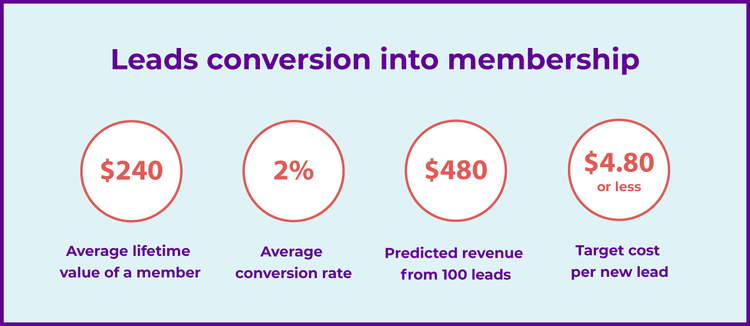
For example, if 2% of leads convert into paying members, that would mean two new members for every 100 leads. And if those two new members, on average, resulted in $240 each, say, or $10/month for two years, that would result in $480 in revenue. Thus, as long as all the leads were acquired, on average, for less than $4.80/each, the publisher would grow their subscriber or member base and break even on the cash investment (cost of labour is not included in this simplified example). The same would hold true for 1,000 leads and 10,000 leads.

This approach to growing customers is so established at this point that there’s a whole category of software dedicated to helping companies design and visualize their paid acquisition sales funnel, to predict changes in revenue based on what is invested in acquiring new leads, as well as an abundance of tools to help with improving conversion rates. For example, Geru helps to visualize funnels and estimate costs and revenue, services like Unbounce help to build landing pages and improve conversion rates, and products like Ad Espresso help to manage cross-platform campaigns.

Screenshot of a popular “funnel planning” software Geru.

And, beyond software, there’s a whole industry of professionals, agencies, and certifications that have become established brands in the field of growth, performance marketing, and paid acquisition. To avoid sending you down a very large rabbit hole, I’ll simply point you to this free online guide to growth by Julian Shapiro as a good place to start diving deeper, as well as this excellent essay by Aubrey Bergauer on audience development.

Experiments with Paid Acquisition

Even though the math is straightforward and there’s a whole industry dedicated to the science of growth, the question remains: How well does it translate to the world of journalism at large, and journalism membership programs specifically?

To answer that question we teamed up with Pico, a newsroom software company that provides “smart pop-ups and landing pages to turn readers into customers,” and asked several publishers on Pico’s platform if they would be open to experimenting with paid acquisition campaigns and letting us detail the results. Funding by a grant to Pico from the Lenfest Institute covered the hard costs of the acquisition experiments: platform advertising fees and stock photos. These hard costs are a figure that curious publishers will need to think about in calculations toward their own efforts.

The experiment design is relatively straightforward and consistent across most publishers:

  • The campaign is always promoting the publisher’s free newsletter. In some cases that’s weekly, in some cases daily. The ad campaign objective is a subscription to the publisher’s newsletter.
  • Once subscribed, new leads receive a three-part automated email series. The first message is a simple welcome, the second a short survey, and the third a gentle ask for financial support. The language and length of these emails was kept similar across publishers.
  • At the end of the series, I calculate both engagement and conversions across those leads. Specifically, how many opened the email series emails? How many unsubscribed? How many took the survey? How many became a financial supporter?
  • Over time, we’ll also be looking at email newsletter engagement and engagement on the publisher’s website.

There are two outliers in the sites in this study. One publisher is experimenting with United States Postal Service (USPS) marketing to potential members in their city. There we’ll be looking at how many people made the leap from postcard to website and eventually to paying members of the site. Another publisher will be testing a different kind of membership ask. In this case, it will be voluntary membership in a locally-focused “insight network” for that city, similar to American Public Media’s Public Insight Network.

These are exciting questions to be asking, and I’m keen to answer them, in part, with data. As is said, “math don’t lie.” And yet math doesn’t always reveal the entire truth either. The limitation of this research is the very short window of time that we’ll be looking at: just a few short months between June 2019 and January 2020, far short of the time necessary to see the full picture.

The Facebook Local News Subscriptions Accelerator Program has been looking at a similar question for just over a year now and recently reported that they’re seeing promising results across the metro newspapers in their program. Specifically, they’ve reported that publishers might “expect to convert five to 10 percent of your email subscribers to paid,” and went on to share that “most Accelerator publishers saw that range of free newsletter readers converting to paid subscribers.” When I asked Facebook Journalism Project’s Program Manager for accelerators, David Grant, to expand on these findings in terms of how long it took to accomplish that conversion, he clarified that “for all of these titles, it’s taken years.”

What I am hopeful to document objectively, however, are some starting points for publishers that are thinking about this route: what works, and what doesn’t in terms of ad copywriting and images, ad formats, and audience reach. And what to expect in the days, weeks, and months after new leads join a newsletter list. What to expect to pay for new leads across platforms. What to expect in terms of performance. And what signals to look for toward a longer-term outcome of a conversion to paid membership.

Early Results, Promising Signs

With funding through January 2020, it’s still early days for this research. And paid acquisition work requires an investment of time and attention that is challenging for many smaller publishers (more on that below). That said, I’m happy to report out some early results.

We are currently running paid subscriber acquisition campaigns on two platforms, Care2 and Facebook. The aim is to expand on these experiments and to investigate other lead-acquisition platforms, including the earlier mentioned USPS, as well as Google Adwords, LinkedIn, Quora, and Reddit.

Facebook’s “boosted posts,” a form of advertising with the purpose of getting people to react, share, and comment, are a relatively well-known commodity to most publishers. However, many publishers I’ve spoken with outside of our research group are not aware of the key differences between the various ad types that Facebook offers, which currently number more than 10. Our research focuses exclusively on the “Lead” ad type, which optimizes for subscriptions that take place on Facebook directly.

This is unique from the other types of ads that would typically require a publisher to direct the user to a landing page of some kind off of Facebook.

An example of a Facebook “lead” ad.

Care2 is relatively unknown to many publishers. It describes itself as a 21-year-old “network of millions of people around the globe, dedicated to building a better world.” Its core product is essentially an online petition service that is used by anyone from neighbours to global NGOs. The network boasts 45 million users with most of those in the US. To support itself financially, Care2 provides a pay-per-lead campaign service, which is what we’re testing with the publishers in this study. We are testing both issue-focused campaigns (environmental reporting) and geo-targeted (state-wide reporting) campaigns on the platform.

A Care2 petition for Sludge.

To date, these campaigns have delivered thousands of new email newsletter subscribers to some of the participating publishers. And, 12 weeks in, this is what we’re seeing across the subset of publishers who have undertaken Facebook and Care2 campaigns:

  • Engagement via open rate: Open rates for the email series range from 26% to 36%, and the average open rate across all emails and all publishers for new leads is 29%. This is higher than the MailChimp-reported industry average for “media and publishing” of 14%.
  • Engagement via survey: The rate of new leads who completed the short survey ranged from 2.7% to 7.8%, with an average across publishers of 4.7%.
  • Retention and churn: The unsubscribe rate, so far, has been between 0.8% to 6.4%, with an average across emails and publishers of 2.8%. In future updates, we’ll unpack how this compares to industry averages.

We’re also observing a consistent cost per lead of less than $3 across the two platforms we’ve tested. Care2’s pricing is set in advance, unlike Facebook’s, and varies based on how specific the audience criteria is. On Facebook, we’re seeing a range of scenarios play out, in some cases the average cost per lead is consistently below $1, in others it’s between $1.50 and $2.50, and we’ve yet to learn if these costs will stay consistent across tens of thousands of leads.

What we’re also still assessing is the quality of those leads, their engagement with the journalism, likelihood to stay subscribed and, eventually, to convert. Lead quality will likely vary by lead source, as will the cost per lead. For example, platforms like LinkedIn will be more expensive to advertise on, but we might find that they deliver a lead quality that justifies the larger investment. There’s still a lot to learn.

However, if Facebook’s own observations hold true — that news publishers are seeing conversion rates between 5 to 10% from free newsletter subscribers to a paid digital subscriptions and memberships — then these lead acquisition costs are a promising signal for publishers to take note of. At a 5% conversion rate, using the most basic of calculations like the one above, the prediction is that a publisher would generate a tidy 2.5x return on ad spend (ROAS). At 10%, that would jump to a 5x return, a number that would be the envy of many people in publishing and growth science, too.

My own observations from over a decade of working as a staffer and consultant for publishers in South America, North America, and the United Kingdom have led me to be more conservative in my predictions. And, having spent many years managing projects like this at The Tyee, I understand what it’s like to work in a resource-constrained newsroom. My hope is that this research will eventually provide the detailed data necessary for publishers to determine their own estimates of what they can reasonably achieve within a certain timeframe and with reasonable investments of time, energy, and money.

Resources, Staffing, and Budget

Three of the biggest challenges ahead for small-to-medium sized news publishers who are interested in setting up a paid subscriber acquisition effort are:

  1. The budget to invest;
  2. Availability of staff time and skill sets;
  3. And curated resources to assist with campaign planning.

Of the seven publishers in this research, less than half had invested in paid acquisition efforts over the last two years. And, combining the efforts of all of those that had invested, the total dollar amount invested was still very small. This highlights the first problem: many early-stage publishers simply don’t have the budget to invest in growth, which is a Catch-22.

More established publishers, with larger teams, struggled less with available budget and more with freeing up staff time. My observation is that publishers with six or more staff people or freelancers start to experience increased complexity in the work environment, leading to less nimbleness. In my experience this is usually due to the requirement of more clearly defined roles and management structures that are needed as team and audience size increases. This is another difficulty for those seeking to grow a digital news startup, where constant innovation is a likely part of the recipe for financial sustainability. (As Matt Thompson and Emily Goligoski wrote for this project, “membership cannot scale beyond an organization’s ability to serve its members. In some cases organizations are strategically limiting their growth to support members and ensure member value is not diluted. We think this has important ramifications for restoring the ‘human element’ to news.”)

The third big challenge lies in having knowledge or access to knowledge about where to start when trying to build effective paid subscriber acquisition campaigns. Most publishers in the study are actively engaged in using paid marketing to promote their content on platforms, but none had active paid acquisition campaigns underway when the research started.

This challenge was clear in a recent informal survey of 20 newsrooms, and the question “what do you believe to be the main challenges for your organization in committing resources to paid acquisition campaigns?” to which 70% of respondents answered “resources to assist with campaign planning.”

This isn’t entirely surprising given how quickly the landscape of lead generation advertising options shifts and how frequently the algorithms behind these systems change. It can be a full-time job staying on top of all of these shifts and changes: changes that can significantly impact campaign performance. That is perhaps the largest challenge here. Only the largest publishers have a dedicated resource focused on this; most others make do with this expertise being just a part of larger job description.

A related research question that we’ve surfaced is: how can early-stage, small, and mid-sized digital-first news publishers take advantage of the opportunities that paid acquisition presents?

So far we have clear patterns emerging in both the data that is being collected directly from participating publishers and from less formal data we’re gathering via literature reviews, interviews, and surveys.

Paid lead acquisition is an established path to new customers that is being leveraged by many growth-oriented businesses. It’s not just tech startups, online mattress firms, and companies that sell online courses; it’s being used by many small-to-medium sized businesses across the country, including everything from car dealerships, to plumbers, to real estate agents and more.

There are signs that larger, more digitally-savvy newsrooms are increasingly investing in paid growth of their email newsletter lists. Case studies are surfacing that report promising results toward converting free newsletter readers into paying supporters, like WhereByUs and the Seattle Times. And the data we’ve collected in this research so far indicates that new leads can be acquired for a low enough cost to provide a positive return on that investment over time.

I believe the question “can publishers who seek to grow their membership invest in paid lead acquisition tactics and predict with strong confidence the rate of return on their investment?” can be answered with “most likely; more data forthcoming.” It is clear that the tactics of paid lead acquisition do translate to the world of journalism — people do respond positively to the advertising campaigns, subscribe from social platforms, and stay engaged. And these strategies can be useful even if you have a paywall or patronage model.

To fully take advantage of these opportunities, I think the sector needs to further develop the following:

  • An easy-to-use spreadsheet template, or calculator, that does that math for publishers who are trying to justify the investment (to themselves, to investors, and/or to funders). It should quickly provide a detailed prediction for a range of possible outcomes based on a small number of inputs. And it should make the investment case clear, as well as defining the metrics that publishers will need to keep an eye on.
  • A playbook for how to get started with paid acquisition in the context of journalism and local news. This should be a resource that is frequently updated to stay current with the field, and it should aim to surface the best bets in the moment for publishers who are just getting started. Ideally, it would also provide detailed case studies from publishers who’ve led the way.
  • Most importantly, funding to help publishers get underway with this work, knowing that audience growth has the potential for exponential returns across several indicators. And for publishers who’ve already established their paid acquisition strategy, there’s a need for funding to scale their campaigns. The would ideally be in the form of “no strings attached” operational money, where a funder might say, “Show us you’ve got an acquisition model that works — money in equals more money out — and we’ll give you a grant to scale it.”

The simple act of getting started with these campaigns helps to deepen the publisher’s understanding of how it works. We’re seeing it boost their confidence in being able to continue the work independently. In the words of one of the publishers in the study, “It has been incredibly successful in terms of getting us new subscribers [and] a lot of insight on how to run a successful campaign. We’ll be interested to see the quality of these subscribers going forward, but it definitely proves that investment in lead acquisition can pay off if done correctly.”

Feature image credit: Margaux Savey / Momkai

This story originally appeared on the website of The Membership Puzzle Project, a public research project into membership models by the Dutch journalism platform De Correspondent and New York University’s Studio 20 Program.

By Phillip Smith

Phillip Smith is a veteran digital publishing consultant, online advocacy specialist, and strategic convener. He is the founder of the Journalism Entrepreneurship Boot Camp. If you enjoyed reading this, you can find him on Twitter.

Note: Jason Bade, Jessica Best, Burt Herman, Emily Goligoski, Ariel Zirulnick, and Margaux Savey contributed to this post.

Sourced from Global Investigative Journalism Network 

Four years after opening its doors in London, creative brand-experience agency Valentine has announced the launch of its St Stephen’s Green, Dublin office. Building on the agency’s success in the UK, where it has delivered major campaigns for brands including the Asahi Women’s Rugby World Cup, the move signals Valentine’s commitment to the Irish market, where local insight is essential to engaging audiences in one of Europe’s most dynamic and distinctive on-trade sectors.

Founded to cut through unnecessary big-agency process, Valentine delivers bold, brilliant work that creates chemistry between people and brands. With the launch of Valentine Ireland, the agency is set to bring this chemistry-driven approach to Irish brands, led by newly appointed Head of Live, Ireland, Iain O’Connor.

Sam Elliott, Co-Founder of Valentine, commented:
“Launching in Dublin is a really exciting step for Valentine. From day one, our ambition has been to create bold, brilliant work that cuts through the noise and connects people and brands in meaningful ways. With Iain leading the charge in Ireland, we’re bringing that same energy to a market that thrives on live experiences and cultural connection. We’re already seeing momentum here, and this expansion means we can be closer to our clients and the audiences they want to reach.”

Iain O’Connor, Head of Live, Ireland, added:
“Ireland’s on-trade and night-time economy is unique; you can’t apply London’s rules to Dublin. To succeed here, you need local knowledge, cultural understanding, and the ability to create experiences that really resonate with people. That’s why I’m so excited to be leading Valentine Ireland. We’re here on the ground, working alongside brands to build the kind of chemistry that sparks trial, advocacy and long-term loyalty.”

With Dublin as its base, Valentine Ireland will focus on live brand experience, activation, and integrated campaigns, helping clients stand out in competitive and fast-moving categories such as drinks, hospitality, and lifestyle.

About Valentine
Founded in London in 2021, Valentine is an independent creative agency, creating emotional connections between people and brands that shift behaviour and drive long-term loyalty. Its work spans brand experience, live events, and integrated digital campaigns, with clients including Asahi, JTI, SailGP, Honda, Black Lane and Campari.

Press contact:
Sarah Harrison, Client Partner, Valentine
+44 (0)7799 627471
[email protected]
www.valentineireland.com

By Chima Mmeje

Many extroverts can confidently walk into a room and strike up conversations with new people. For an introvert, it’s an entirely different experience.

“Networking was a nightmare for me. Anxiety, shaking legs, and sweaty palms were a common occurrence.” – Claire Taylor.

“The idea of working the room or talking to strangers used to have me planning my escape route before I’d even grabbed my name badge.” – Lyssa-Fêe Crump

Networking can feel paralyzing for many introverts. The pressure to make small talk, join conversations, and exchange LinkedIn details can be exhausting.

In this article, 21 introverts share the tips and tricks that helped them navigate networking and get more value from in-person SEO events.

21 tips to crush networking as an introvert

1. Get all the “shoulds” out of your head

Jade Pruett — Founder of HelloSEO

Stop piling pressure on yourself

In networking situations, I’m anxious about talking to people and feeling bombarded by everything I should be doing.

I should be meeting everyone in the room.

I should be able to strike up conversations with anyone.

But nothing fuels social anxiety like shame. The truth is that I don’t have to meet everyone. My career doesn’t depend on it, and if I only connect with one or two people, or no one, it doesn’t mean I’ve failed.

Give yourself permission to opt out

If you’re overwhelmed, it’s okay not to meet anyone. Grab a coffee, stand on your own, and take a breather. Usually, someone will approach you or you’ll naturally ease into the environment.

Use lines as natural conversation zones

Some of my best networking moments happen while standing in line at an event. Lines are great because you’re not interrupting a conversation, and there’s always something to talk about, like what coffee you’re getting or what looks good on the snack table.

2. Set manageable goals

Safia Marmon — Project Lead (Shopify e-commerce) at Sunbowl

I used to find it hard to start conversations at networking events. Most of the time, I’d end up standing alone in a corner. But I’ve slowly found a rhythm that helps me feel more prepared and confident.

Here’s what’s worked for me:

  • Research speakers or attendees before the event and make a note of who I want to talk to
  • Set manageable goals, like meeting one or two people
  • Prepare a few conversation starters in advance
  • Look for people who are by themselves or in small groups, as it’s easier to approach them
  • Use small details like name tags or books as natural openers

Most people are just as nervous as I am. Once I break the ice, the rest usually flows naturally. It’s still outside my comfort zone, but I’m having better conversations each time.

3. Plan for sensory overload before it drains your energy

Abby Mawhinney — SEO Manager at Blue Array

Sensory overload is one of my biggest challenges at conferences and meetups. As someone who works from home full-time, I’m used to a calm, quiet environment. Stepping into a crowded venue full of bright lights, loud voices, and uncomfortable clothes can feel overwhelming, and that’s before the event starts.

Here’s what’s helped me navigate networking more confidently:

Look for quiet spaces ahead of time

Many events now offer quiet rooms or chill-out zones. I always check event info or contact the organizers beforehand to ask if a quiet space will be available. Even if there isn’t, stepping outside for five minutes of fresh air makes a huge difference.

Pace yourself with intentional breaks

Networking events are marathons, not sprints. I remind myself it’s okay to take a breather, even for five minutes.

Use noise-filtering tools

One of my favourite tools is a pair of noise-reducing earplugs. They block out background chatter while letting me hear who I’m talking to. It’s perfect if you’re easily distracted or overwhelmed by multiple voices.

4. Look for people taking notes or standing on the edges during breaks

Caitlin Proctor Huston — Content strategist at Edit Ever After

I usually look for people taking notes during presentations or standing on the periphery of the crowd during breaks. They’re often introverted but engaged, like me. I’ll start a conversation about the speaker or the session to create a genuine connection.

Bringing a friend helps too. At large events, most people either know everyone or no one. It’s easier to join a conversation with a friend than to start one alone.

I also check the event hashtag and engage with people sharing insights. Starting the conversation online often feels easier, and it helps me stay connected after the event.

5. Pick one clear takeaway and ask someone nearby what they thought

Dena Warren — SEO Lead at Techquity

Before the event, I’ll post in Slack groups or check LinkedIn to see who’s attending. Then I send a quick message saying I’ll be there too and would love to say hi. It takes the pressure off once I arrive.

I try not to think about it as “networking” and instead focus on the content. After a talk, I pick one clear takeaway and ask someone nearby what they thought.

Sometimes, I’ll thank the speaker and share what I learned. It’s a more natural way to start a conversation and doesn’t feel forced.

6. Listening is better than any elevator pitch

Rewati Khare — SEO Specialist

I treat live events like strategic missions, not social free-for-alls. My pre-game ritual involves researching the speaker list, preparing two solid conversation starters, and scouting out the quietest coffee corner as my home base.

Instead of “working the room,” I aim for two to three meaningful conversations, and I’m thrilled if one of them isn’t with the barista.

Listening is an introvert’s superpower, and it makes a bigger impression than any elevator pitch. I might vanish midway through the after-party, but I’ll follow up with a thoughtful LinkedIn message that I’ve spell-checked and optimized with emojis.

7. Use grounding tools to stay present

Cassandra Parisi — Brand & Web Designer

Some people are born to work the room, but I’m not one of them. Regardless, I’ve found a few tips that help me feel grounded, less panicky, and more like myself at conferences and meetups:

  • Taking deep breaths and drinking water calms my nervous system and stops the spiral before it begins
  • Wearing an outfit and hairstyle I feel confident in, so I can focus on the conversation, instead of fussing about my appearance
  • Writing a few go-to conversation starters to ease the awkwardness
  • Take grounding tools like a pen and notebook to stay present when my brain wants to escape
  • Using Popl to avoid fumbling with business cards or typing out social handles under pressure
  • Taking breaks without guilt. I might step outside, skip a session, or just breathe in the hallway when it all feels too much
  • Redefining success as one or two meaningful conversations, not collecting contacts

Most importantly, I remind myself that I belong in the room, even if I’m not the loudest.

8. Go alone at least once

Meghan Pahinui — Sr. Content Designer & Marketer at Moz

One of the best things I did as an introvert was attend a conference alone. When I go with people I know, I tend to stick with them. But going alone gives me that little push to start conversations and join in.

I always start small with a quick “hello” to the person next to me or a compliment to someone in line. Some of my best conference chats started with “I like your sweater” or “Are you from here?”

I schedule breaks to recharge during the conference because I need downtime to manage my energy. It’s better to under commit and join in later than overextend and burn out.

If I’m not comfortable talking to someone in person or if they’re in a group, I’ll find their name and send a message on LinkedIn after the event. It’s a low-pressure way to connect and still have meaningful conversations.

9. Use props to remove the awkwardness of small talk

Sai Deshmukh — SEO Director

I’ve found three solid tips that improved my networking skills:

Take on a role to make networking easier

Volunteering at events (checking people in or moderating panels) gives me a purpose. I don’t have to force conversations or wander awkwardly. It’s a built-in way to meet people, especially organizers and speakers, without the pressure of a cold approach.

Spend more time listening

People love talking about themselves. If I listen and ask thoughtful follow-ups, they walk away thinking I’m charismatic, even if I said almost nothing.

Use conversation props to break the ice naturally

One trick I love is bringing a subtle “prop” that sparks curiosity. At one event, I wore a vintage fedora with a pin. Within minutes, someone asked about it, and we talked about retro fashion. Another time, I carried a pen shaped like a toy pistol. When someone laughed and asked, “Is that a gun or a pen?” it turned into a chat about quirky office gadgets.

10. Attend a smaller event the day before

Dani Leitner — SEO Consultant

Attending conferences as an introvert can feel scary, and that’s totally normal.

What helped me most was attending a workshop or meetup the day before the main event. It’s a smaller, more relaxed setting where I can get comfortable and meet a few people ahead of time. That shared experience gave me something in common, so when the main event starts, I’m not walking in alone because I already know someone, and they might even introduce me to others.

You don’t have to force yourself to walk up to random people just to have someone to eat lunch with. Having dinner alone one evening is a great way to recharge and enjoy some alone time.

11. Break the ice with small gifts

Jeanne Tan — SEO Strategist

Here are a few things that helped me network better at industry events:

Use a visual cue to stand out:

If people don’t remember my name, they’ll remember “the lady with the red hair.” It has proven to be a good conversation starter. I’ll say hello, and the first thing I usually hear is, “I love your hair.” As an introvert, it helps to let people come to me instead of making the first move.

Offer small gifts to make a lasting impression:

At international events, I bring small tokens from my home country like magnets or keychains with a sticker on the back that includes my name and social handle.

When I meet keynote speakers or big industry names, I gift them one and say, “I’ve been following your work, and it’s an honour to meet you.” Then I ask if I can send a connection request, and most say yes.

12. Prepare questions to avoid thinking on the spot

Claire Taylor — Co-Founder at TU Marketing

As someone who’s always struggled in group situations, networking was a nightmare. Anxiety, shaking legs, and sweaty palms were a regular thing. I’d often leave early or sit in a corner staring at my phone, pretending I had urgent work.

I still don’t love networking, but I’ve found a few tactics that help me manage it better:

Prepare questions to take the pressure off thinking on the spot

I carry a list of questions I can ask people. Having a few prompts ready makes conversations easier to manage.

Set a small goal to stay focused and grounded

I give myself a target, like talking to two or three people. It gives me structure without overwhelming me.

Head to the coffee station to ease into the room

I always grab coffee first because it gives me something to do and helps me spot friendly faces in the hallways.

Step into a role to take the pressure off being “yourself”

Sometimes I pretend I’m playing a character. It sounds silly, but it helps me loosen up and get out of my head.

13. Join supportive communities

Bengü Sarıca Dinçer — Search Engine Optimization Manager at Designmodo

I used to consider myself an introvert, especially when networking at live events. Talking to people I didn’t know felt overwhelming, but I also wanted to learn from others and grow my network.

Finding a supportive community changed everything for me. Groups like Women in Tech SEO made me feel safe and accepted. It’s a great space to find folks attending events, so you know someone when you walk in the room.

My advice for other introverts:

  • Take it step by step. Showing up is a win, and you don’t have to talk to anyone.
  • Try international events. They might seem intimidating, but I found them easier than local ones.
  • Start small. Even a simple “I liked your talk” or “Where are you from?” can spark a conversation.
  • Don’t fear judgment. Most people are kind, and if someone judges you, that’s on them, not you.

14. Wear something unique

Kari DePhillips — CEO at The Content Factory

My best tip for introverts networking at in-person events is to wear something unique. It could be a bold pair of shoes, standout accessories, or a cool blazer.

I’ve got a red leopard blazer that always does the trick. People walk up and comment on it, and that kicks off the conversation for me.

If you’re uncomfortable starting conversations with strangers, give them a reason to start one with you.

15. Seek speaking opportunities

Tom Winter — Co-Founder at SEOwind

I know public speaking sounds like the last thing an introvert would want to do, but hear me out.

As an introvert, being just another face in the crowd can be exhausting. Walking up to random groups and trying to “work the room” often feels paralyzing. But when I’m a speaker, the whole dynamic shifts and surprisingly, it suits me well.

Instead of forcing introductions, people approach me to say “great session” or ask questions. These are low-pressure, and often more meaningful than hours of mingling. I’ve had better networking moments ten minutes after speaking than I ever did just roaming the floor.

Even when I’m not speaking, I use the same strategy. I go to talks and approach the speaker with a thoughtful question or comment. It gives me a shared context and makes it easier to start a conversation.

16. Connect with others going to the event

Erin Simmons — Managing Director at Women in Tech SEO Community

I always do some pre-work before a conference to build predictable connections and feel more confident walking in.

Here are a few ways I make those pre-event connections:

  • Post on LinkedIn using the event hashtag, asking if anyone else is attending and wants a conference buddy or small group to connect with.
  • Check for any official pre-connection activities the event might offer.
  • Join professional communities where people are already talking about the event. In Women in Tech SEO, we create temporary Slack channels for events like WTSFest, MozCon, and BrightonSEO, so members can share tips, make plans, and feel supported before and during the event.

A few digital connections ahead of time can lower the barrier to in-person interactions. It’s a lot easier to walk in when you know someone’s already looking forward to seeing you there.

PS: You can see WTS founder Areej AbuAli live at MozCon London, where she will deliver a talk on how to launch, grow, and scale a community that supports your brand. Get your MozCon London tickets for only 350 GBP.

17. Do the groundwork before the event

Jasmine Jade — Freelance Content Strategist

If I followed the classic “just be yourself” advice, I’d show up to events and leave without speaking to anyone. So I’ve learned to be intentional before I even get there.

Here’s how I approach networking as an introvert:

When connecting with attendees

I start by checking who’s posting about the event. If there’s someone I want to meet, I’ll message them and say, “Hey! I saw you’re attending this event. I’ll be there too and hopefully we bump into each other.” Sometimes, they find me before I find them.

I also try to have an event buddy. A familiar face can boost confidence—someone to sit with, chat to during breaks (instead of doomscrolling), and yes, take your photos for social media.

When connecting with speakers

It’s the same idea, just with a bit more prep. I’ll ask a thoughtful question during their session, something that shows I’ve been following their work.

If I’m too shy to say hi in person, I’ll take a photo during their talk, post it with a short takeaway, tag them, and follow up with a message: “I was at your session and appreciated your insights. I just wanted to connect and say thank you.” It’s low-pressure but just as meaningful.

18. Use ChatGPT to ideate thoughtful questions and compliments

Nofisat Dopemu —SEO & Digital Marketing Strategist

For anyone who feels terrified about networking, here are a few things I’d recommend trying if you want to attend an event:

  • Start by taking the pressure off: I focus on attending and observing, giving me time to adjust to the environment before jumping into conversations.
  • Take a genuine interest in others: I look for someone sitting alone or in a small group, and start with a simple question or compliment.
  • Use ChatGPT for prep: I’ve used ChatGPT to generate thoughtful questions or compliments that feel natural and sincere.
  • Check in with yourself: Throughout the event, I pause to see how I feel. If I need to reset, I find a quiet space to recharge.

19. Arrive early before it gets noisy

Lyssa-Fêe Crump — Head of Marketing

As an introvert in marketing and tech, I’ve had to find a way around networking. The idea of “working the room” or striking up conversations with strangers used to have me planning my escape before I’d even grabbed my name badge.

Here are a few strategies that helped me:

Arrive early to ease into the room

Getting there early helps. It’s easier to start conversations before the room fills up and gets noisy. Being part of the first chats feels more natural than trying to jump in later.

Set one small goal

What’s helped me is lowering the pressure. I set a small goal to have a couple of real conversations. Not a dozen and not with everyone. Just a few meaningful moments, and then I retreat for a biscuit and a breather.

Build in quiet time

I always build in breaks like stepping outside, taking a lap around the venue, or hiding in the loos for five minutes of silence. I remind myself that I don’t need to be “on” the whole time. I’m allowed to show up just as I am: thoughtful, curious, and a bit quiet.

Give someone a compliment

One thing that always helps is giving someone a genuine compliment. Not to break the ice or be strategic but to be kind. It softens the moment, and it helps me make a real connection.

20. Find a quiet place to retreat when you’re overstimulated

Christy Correll — B2B SaaS Copywriter & Brand Messaging Strategist

As an introvert, or more accurately, an ambivert who leans introverted, budgeting my energy is non-negotiable. Setting realistic goals makes a huge difference, because if I try to build my network too quickly or say yes to everything, I’ll burn out fast.

Here are a few networking tips I’ve found useful:

Pack for recovery

I always travel with noise-cancelling headphones, earplugs, sunglasses, and an eye mask to manage sensory overload. I also scout out quiet spaces at the venue so I have somewhere to retreat if things get overstimulating.

Don’t try to do it all

I don’t need to attend every session, meal, or mixer, especially at multi-day events. Sometimes, I’ll skip an afternoon of talks to be fully present at dinner.

Avoid travelling during your regular sleeping hours

If your schedule allows, avoid booking flights during your regular sleeping hours. I don’t handle jet lag well, so I try to arrive early to adjust. It’s not always possible, but when I can, it makes a big difference.

21. Stick to small groups and have an exit strategy

Purna Virji  — Principal Consultant & Global Program Manager at LinkedIn

I’ve spoken at conferences worldwide but still need to disappear into a bathroom stall to recharge between sessions.

People are always surprised when I tell them I’m an introvert. I’ve just gotten good at being “on” during events, so good that people assume I’m naturally extroverted.

But that performance takes a real toll, so these strategies have become essential for me.

Find common ground

It could be a shared hometown, a similar role, or even a mutual frustration with a platform. Finding common ground makes things feel easier and helps me relax.

Take breaks

I schedule 3–5 minute “bathroom breaks” between networking sessions. Sometimes I sit in my car or find a quiet hallway. Just a few minutes of silence buys me another hour of energy.

Stick to small groups

I gravitate toward roundtables, smaller breakout sessions, or coffee with just a few people. It’s way less overwhelming than trying to work a giant networking mixer.

Have an exit strategy

When I feel my social battery getting low, I use a gentle excuse like, “I promised I’d meet someone at 3 pm.” It’s polite and gives me an easy way to leave.

I plan for recovery

After a big event, I block out 1–2 days with no calls or obligations. I use the time to rest, reflect, and recharge.

Your next SEO conference is right around the corner

If networking held you back from showing up, I hope this article helps to lift that pressure. You’re not alone, and you don’t have to “work the room” to make meaningful connections.

MozCon London was built with this in mind. It’s a smaller audience (250 attendees) focused on intentional connections and plenty of opportunities for 1:1 time with speakers. The revamped MozCon format is designed to help you get the most out of the experience, whether you’re introverted, ambivert, or just not into forced small talk.

If you’re ready to join us, we’d love to see you there. Use this discount code to get your ticket for £350.

By Chima Mmeje

I do content marketing and strategy for Moz, aiming to position the company as a leading source of truth in the SEO industry. I also host MozPod and The Practical Marketer Webinar Series.
In my spare time, I run The Freelance Coalition for Developing Countries — a UK non-profit providing free resources and training for BIPOC marketers globally. Learn more about me on my personal website, Zenith Copy

Sourced from MOZ

By Andres Tovar, Edited by Maria Bailey 

Trying to stand out on YouTube without turning it into a full-time job? These five beginner-friendly strategies use smart tools and content repurposing to help you build traction and grow your audience efficiently.

Key Takeaways

  • Discover beginner-friendly YouTube strategies that help entrepreneurs grow their audience without needing to go viral.

YouTube is full of opportunity, but also a lot of noise. For entrepreneurs looking to grow their brand, attract leads or build trust at scale, YouTube can be an invaluable asset. But getting started can feel overwhelming when subscriber counts and views don’t come quickly.

The good news? You don’t need to go viral or become a full-time creator to see meaningful results. With the right strategy, consistent execution and a willingness to learn as you go, YouTube can become a powerful tool for your business.

Here are five beginner-friendly ways to build traction — without spending all your time editing videos.

1. Develop a consistent content calendar

Consistency is one of the most important drivers of YouTube growth. While top creators often post several times a week, even beginners should aim for at least one video per week.

Start by planning a content calendar that aligns with your production capacity and your audience’s interests. Use keyword research tools to identify long-tail topics your audience is already searching for. This will help guide your video ideas and ensure you’re creating content that drives discovery.

A clear content calendar helps avoid gaps in publishing and keeps your viewers engaged.

2. Use tools to optimize titles, SEO and thumbnails

Small details — like titles, tags and thumbnails — can make or break your video’s visibility. YouTube’s algorithm prioritizes content that gets clicks and watch time, so optimization matters.

Fortunately, there are tools out there that can help automate this process. They let you test different titles, analyse thumbnails and suggest keywords based on performance data.

Creators who use these tools tend to grow faster. The right tools save time and help your videos perform better from the start.

3. Make the most of end screens

End screens are clickable elements you can add to the last 5 to 20 seconds of your video. They’re a powerful yet underused tool for boosting engagement and guiding viewers to your next piece of content.

By linking to other videos or adding a subscribe button, you increase watch time and encourage channel growth. YouTube rewards longer viewer sessions, so strategically linking your own content creates a positive feedback loop.

Always include end screens in your videos — it’s a simple, low-effort way to keep viewers on your channel longer.

4. Use YouTube Shorts to increase visibility

Shorts are YouTube’s answer to TikTok — and they’re one of the fastest ways to get discovered by new viewers.

A smart way to use Shorts is by repurposing clips from your long-form videos. Shorts that get more than 10,000 views typically generate 12 to 18 new subscribers. With their short runtime and high completion rate, they’re a low-cost way to grow your channel and introduce viewers to your brand.

5. Share your content across other platforms

Your Shorts and long-form videos can do double duty. By posting clips to Instagram, X and TikTok, you expand your reach and attract viewers who may not find you on YouTube alone.

Sharing repurposed video content across platforms builds brand awareness and funnels new followers back to your YouTube channel. This cross-platform traffic can also help your channel perform better in YouTube’s own algorithm.

And since the content is already created, it doesn’t require much additional effort—just smart repurposing.

Unlock growth without chasing virality

Growing a YouTube channel takes time, but it doesn’t require going viral or grinding out endless edits. With consistent effort, optimized content and strategic distribution, you can build a loyal audience and position your business as a trusted voice in your niche.

By Andres Tovar

Andres Tovar is the co-founder and managing partner of Noetic Marketer, a digital marketing agency specializing in the higher education, ecommerce and professional services industries. He is a growth consultant and fractional CMO for companies, small and big.

Edited by Maria Bailey 

Sourced from Entrepreneur

By Persy House

Oreos are a staple of any grocery store’s cookie aisle. Known as “milk’s favourite cookie,” the brand has used strategic advertising to stay relevant in the over one hundred years since its inception in 1912. Oreo’s marketing has always changed with the times, and part of the reason the brand is still relevant today is because it relies heavily on the internet and social media, a very easy and convenient way to target specific consumers.

As social media became more and more relevant, Oreo began to focus much of its advertising on online ad campaigns that played into popular culture. In 2013, Oreo responded to the lights going out during an NFL game with a X (then called Twitter) post saying, “You can still dunk in the dark.” In addition, Oreo began to collaborate with other popular brands and notable figures, including Supreme, Marvel, Sour Patch Kids, Post Malone, and Lady Gaga. At the time of this article’s writing, the brand’s site is advertising its Selena Gomez cookies, which are chocolate & cinnamon flavoured. These collaborations and creative social media posts keep the brand on the cutting edge of pop culture and draw in fans of certain brands and celebrities who may not usually buy Oreos. The brand has created a fun, playful image of itself, which helps to attract its desired customer base.

Oreo’s marketing historically

JRomero04/Shutterstock

Even before its current strategy of online marketing came around, advertisements were a huge part of Oreo’s success. While Oreo cookies may seem unique, they were actually preceded by Hydrox cookies, a treat that sandwiches cream between two chocolate wafers. They were created by Kansas City baker Jacob Loose in 1908. Loose ended up in a war against his brother Joseph, one of the founders of Nabisco, because Joseph had formed the company against his wishes several years prior. With Hydrox gaining popularity, Joseph created Oreo to compete against Hydrox and heavily marketed it in order to outsell his brother’s product.

Oreo brought in the brilliant marketing campaign of “twist, lick, and dunk” in 1923, which started to bring the brand more recognition. The brand continued to outperform Hydrox in marketing in subsequent years. While Oreos were originally cheaper than Hydrox at 30 cents per pound, in the 1950s, Oreo employed another innovative marketing strategy — making its products more expensive to seem like the superior, premium option when compared to Hydrox. This paid off, and Hydrox is now seen as a rip-off despite being the original cream sandwich cookie.

In 1991, the first Halloween Oreo was created, pioneering the idea of seasonal Oreos that is still relevant in its marketing to this day. Seasonal releases and frequent drops of new flavours keep customers coming back to Oreo, and some seasonal releases are still talked about years after being discontinued. Every time Oreo faces a hurdle, it seems to conquer it through clever marketing, and the brand will likely continue to succeed with this strategy.

By Persy House

Sourced from TastingTable

By Gidyon Thompson

Smart brands are ditching ads for immersive stories, cultural ecosystems, and deeper emotional connections.

I was at a marketing conference last year, sipping overpriced coffee, when a CMO from a legacy brand leaned over during a presentation on media engagement and whispered, “We spent $2 million on a Super Bowl ad, and our TikTok intern’s dance video got more engagement.”

And I’m not surprised. Audiences have evolved defence mechanisms against traditional ads, with about 763 million people using ad-blockers and 84% of Gen Z ditching ads in under five seconds. My 17-year-old nephew would rather sell his phone than watch a pre-roll ad, and he’s not alone.

Let’s get nerdy for a second. Traditional ads typically hit the prefrontal cortex, the analytical centers of the brain where we evaluate threats and make snap rejections. It’s why you skip that YouTube ad faster than you’d dodge a wasp. But a great story lights up the default mode network, which is the part of your brain that processes identity, meaning, and emotion.

When Red Bull drops a documentary about cliff divers, it’s not just entertaining; it’s triggering oxytocin release (per Dr. Paul Zak’s research) and chemically bonding you to the brand like it’s your best friend. That’s the power of narrative: It lingers, rewires, and influences behaviour long after a 30-second spot is forgotten.

Brands need to know that their efforts go way beyond clicks now—they’re seeking to colonize neural real estate. And this is a seismic cognitive shift. It means that the gatekeepers are dead, the rules are gone, and your brand is more akin to a media company now.

The infamous “brand authenticity” makes a comeback

As I thought about what that CMO told me, here’s what kept me up at night: in an era where your content is up against HBO’s Succession or a random TikToker’s viral skit, your brand’s personality is no longer a nice-to-have; it’s critical for survival. Authenticity will be your moat, thereby making inauthenticity a death sentence. 63% of Gen Z will pay to avoid brands that feel fake, and they can spot a poser faster than I can spot a bad Wi-Fi signal.

Think of a filmmaker like Wes Anderson. His quirky, pastel-soaked aesthetic is unmistakable.

Image courtesy of Big Picture Film Club

Your brand needs that same distinctiveness.

Are you gritty like Nike’s “Just Do It” campaigns? Heart warming like Airtel Nigeria’s “Data is Life” mini-series? Or maybe absurdly playful like Duolingo’s TikTok owl? Every choice you make, from your visuals, colour grading, music, tone, even font, must scream “you!”

It’s all about your brand programming

Forget “content marketing”. That’s just ads with better lighting. Brand programming is about creating a universe, a cohesive narrative that unfolds across platforms, inviting audiences to live in your world. Media theorist Henry Jenkins calls this transmedia storytelling, where each medium (video, podcast, social post) adds a unique piece to the puzzle. Disney does this with Marvel, but brands like Lego do it too, spinning off movies, games, and theme parks into a cultural ecosystem.

This isn’t just about production values; it’s about psychology. Ads trigger System 2 thinking, analytical and sceptical. Stories hit System 1—intuitive and emotional—making audiences open to influence. Nancy Baym’s concept of “relational labour” explains why this works: Authentic, ongoing interaction builds trust, not just attention. And it’s not only big brands.

Traditional advertising is like shouting at a party; people tune you out and focus on enjoying the party. Brand programming is like hosting the party, where guests show up because they want to.

The math checks out: Interruption-based ads get pricier as audiences resist, but invitation-based content compounds in value. Netflix’s library costs billions but scales infinitely, with each new subscriber adding revenue without new production costs.

Take Cluely, an AI startup I’ve been following on X. Their cinematic shorts showcasing product features through storytelling have racked up tens of millions of views. How? A network of “clippers” repost bite-sized versions of what works across X, TikTok, and Instagram, turning each launch into a cultural moment. No ad spend, just smart content architecture designed for shareability. This is the future: Content so good, it markets itself.

It’s time to build your media empire

Let’s make this concrete. Imagine a regional bank named First Coastal launching “The Dream Chasers”, a web series about entrepreneurs they’ve funded. They pair it with a Spotify playlist of uplifting local artists, curated by a community vote on X. They then host a pop-up meet and greet with these entrepreneurs for other young and up-and-coming business leaders, using the opportunity to market the original web series.

These elements work like a scaffold. Each piece amplifies the others, creating a self-sustaining ecosystem of meaning. And all of a sudden, First Coastal becomes a hub for ambition and community pride much more than just a bank.

At this point, it’s probably clear that thinking like a media company will change how your brand is set up for communication. Your marketing department, for one, needs to become more of a content studio, and that looks a little bit like this:

Your platform foundation

Your brand will need something more enduring than personality alone—it will need a brand platform. Think of this as the philosophical bedrock from which all your content programming emerges. While your brand’s personality determines how you tell stories (gritty like Nike, heart warming like Airtel, playful like Duolingo), your platform defines what fundamental human truth you’re championing across every piece of content you create.

This isn’t just another “big idea” that changes with each campaign; it’s the timeless manifesto that your chief content officer uses to ensure narrative coherence, that your transmedia producer weaves through every medium, and that your community rallies around. Without this platform foundation, you’re not building a media company—you’re simply creating expensive content that doesn’t compound. Your platform becomes the North Star that transforms scattered content into a cohesive universe where every story, playlist, pop-up, and post ladders back to a singular truth your audience can believe in.

This positions your brand platform as the strategic prerequisite that makes everything else in your media company framework actually work. It’s the foundation that prevents your brand from falling into the trap of creating content for content’s sake.

Your new roles

  • Chief content officer: A narrative architect who ensures your story unfolds across platforms with coherence. Think Ryan Reynolds at Maximum Effort for Deadpool-level brand storytelling.
  • Cultural moment reader: Someone scanning platforms and web trends to position your brand in conversations before they go mainstream.
  • Community leaders: Roles focused on building specific tribes rather than general followers, fostering connections among audiences across platforms.
  • Transmedia producer: Orchestrates stories across media. Think a podcast tying into a web series, an event, a coffee table book, and an X campaign.

Your multichannel ecosystem

Soon, you’ll begin thinking of new and interesting ways to plug in your always-on content, all while maintaining the core of your personality and message. You’ll probably have to, for example, stop licensing music and create your own. Coca-Cola’s “Taste the Feeling” campaign included original songs that lived on Spotify, reinforcing their brand sonically. You might choose to build a publishing arm for culture books or other editorial assets, like Dixon Baxi did. Or host events that double as content. Design TikTok challenges. Even merchandise can become cultural artifacts.

Your shareability by design

Every piece of content must be architected for natural amplification. This means understanding the psychological triggers that make people want to share, which according to Jonah Berger’s research, includes identity signalling, social currency, emotional resonance, and practical value.

Your new metrics

You’ll also need to forget impressions and click-throughs if you want to measure what matters. The following metrics require longer windows and tools like Brandwatch or Sprout Social, but they predict brand equity better than short-term sales.

  • Cultural penetration—Are people quoting your brand’s story in everyday conversations?
  • Ecosystem strength—How interconnected are your content touchpoints? Analyse cross-platform engagement (e.g., podcast listeners who also watch your YouTube series).
  • Narrative coherence—Does your story feel consistent across mediums? Use sentiment analysis to gauge audience perception.
  • Community vitality—Are fans engaging with each other, not just you?
  • Attention quality—Are audiences binging your content or scrolling past? Track average watch time or dwell time.

This shift to brand-as-media won’t happen without its obstacles, but each has actionable solutions. Brands that don’t have Red Bull’s budget can start small and scrappy. A local bakery could launch “Behind the Dough” on TikTok, sharing recipes and staff stories using free tools like Canva for visuals or AI assistants to brainstorm scripts. Sure, there might be fatigue on your audience’s part, but you can combat it by embracing hyper-specificity (rather than trying to appeal to everyone). Liquid Death, for example, succeeds by being unapologetically weird and metal, and not by trying to be everything to everyone.

Algorithm dependency threatens even the greatest of content, so mitigate risk by building owned channels. These could be websites, email lists, and even communities fostered on platforms where you control the conversation and community (think Circle or Obodo).

And if there’s one thing I leave you with, it’s this: Hire more storytellers than ad execs, create ecosystems before campaigns, and measure culture rather than clicks.

Your brand’s transformation starts now.

Cover image: Gorodenkoff

By Gidyon Thompson

Gidyon Thompson is a UK-based brand strategist who brings cross-cultural perspectives and strategic innovation to the global marketing scene. He’s spent years helping brands find their voice—from steering Nigcomsat and Icentra Limited through major transformations and training teams at MTN and Coronation Group, to launching memorable brand activations across Lagos, Dubai, and Accra. As co-founder of Brandversations Africa, he’s built a thriving community of over 250 brand leaders across 10 African countries, fostering collaboration and knowledge exchange in the industry. A firm believer in the power of strategic partnerships, Thompson helps brands forge meaningful collaborations that drive growth while making a positive impact. And when he’s not reimagining brands? He’s watching the tricky reds of Manchester United.

Sourced from Brandingmag

By Craig Millon

You thought the future was digital? Craig Millon of Jack Morton explains why experiential should form the backbone of any good campaign.

Today’s consumers don’t just want to see your brand. They want to feel it. They’re not passively scrolling; they’re leaning in. They want to be moved, surprised, and seen. They crave stories they can step into and share, not just ads they swipe past. This behaviour is accelerating the rise of the experience economy, with brands expected to show up not just physically, but emotionally and culturally, too.

And consumers are voting with their wallets. Millennials and gen Z consistently choose experiences over possessions, even amid economic uncertainty. That’s not a trend. That’s a truth. And it should shake the foundation of how brands think about performance.

Because here’s the reality: when your experiences are at the heart of your brand, every other marketing channel performs better. And when they’re not, you leave value on the table.

Not just garnish

Experiential marketing isn’t new. It’s just finally being recognized for what it truly is: the backbone of connection with your most ardent fans – and the ones you haven’t yet met.

Historically side lined as campaign garnish – parties, pop-ups, trade shows, ‘activations’ – experiential is now leading from the centre. The convergence of technology, data, and creative ambition has elevated it from a feel-good tactic to a foundational channel with real power.

Experiential lifts every other channel in the mix. It fuels social, multiplies earned media, supercharges content, and informs product and loyalty strategies. Brands including McDonald’s and Google are already doing this well, blurring the lines between physical, digital, and emotional engagement to turn experience into a competitive advantage.

Fully measurable

To fully claim its place in the marketing hierarchy, experiential must speak the language of CMOs and CFOs. That means tying experiences to bottom-line results and building business cases with the same precision applied to media or martech investments. At Jack Morton, we’ve built the models to do just that – and we’re helping clients turn experience into performance.

Today, thanks to smart tech, such as real-time analytics, CRM integration, sensor tracking, and attribution modelling, experiential can be measured with the same rigor as digital or media. Footfall. Dwell time. Sentiment. Leads. Sales. Loyalty. It’s all measurable now – and it matters. Brands that invest in the right measurement infrastructure can track, analyse, and prove experiential’s impact in hard business terms.

First, you must invest in the measurement infrastructure to do just that. For example, we tie experience design directly to KPIs, such as brand health, net promoter score (NPS), and purchase intent to bring credibility to the boardroom and confidence to the C-suite.

Last year, we worked with Cadillac at the US Open and partnered with shoe designer Surgeon to create the ‘Electrify Your Sole’ showroom. It attracted 158,000 visitors with a remarkable 950,000 minutes of engagement time, resulting in the collection of over 13,000 leads, including 86% from owners of competitive vehicles. The overall Cadillac US Open experience also produced a power shift in brand perception, generating double-digit lifts in opinion consideration and Cadillac as the ‘brand for me.’

Shaping culture

Metrics matter, but they’re only part of the story. What makes experiential marketing irreplaceable is its emotional impact. We know the most potent forces in anyone’s life are the cultures they belong to. Understanding this earns trust. It builds belief. It creates memories that become advocacy.

In a world of fractured attention and eroding loyalty, belief is the most valuable currency your brand can earn, and experience is how you earn it. No matter what kind of culture you want to reach, you can create an experience that drives the excitement of the most popular consumer fan fest.

It’s also how you manifest culture. Because the brands that win today aren’t just responding to what’s happening in the lives of their most committed communities, they’re shaping it. They’re meeting people with real-world experiences that reflect their values and invite participation.

Proving purpose

Experiential doesn’t live on the edges. It powers from the inside out.

The best brand experiences don’t stand alone. They multiply the performance of every other channel. They generate more engaging content, inspire more human PR narratives, shape more authentic influencer campaigns, and bring loyalty programs to life. They’re not touchpoints. They’re ignition points.

Experiential gives brands a stage to demonstrate purpose. To show, not just say, what they stand for. Whether that’s through sustainability, inclusion, innovation, or community, experience is how you make values feel real.

For example, 88% of women in the Middle East don’t feel comfortable swimming in public. To help change that, Adidas launched ‘The Liquid Billboard’, the world’s first swimmable billboard, inviting every woman to confidently get back into the water with their new inclusive swimwear collection. The experience reached 350m people, earned $6m in media across over 60 countries, and drove a 70% sell-through rate in just four weeks at flagship stores.

Building belief

Experiential has always been the soul of brand-building. Now, it’s the spine – holding together strategy, creativity, data, and connection.

It’s not the centre because it’s new; it’s the centre because it’s foundational. It’s where belief is built, value is proven, and performance takes off.

The question is no longer if experiential belongs in the mix. The question is: what’s it costing you not to lead with it?

Feature image credit: Jack Morton

By Craig Millon

Sourced from The Drum

By Gene Marks

A couple of years ago I attended an excellent conference in Seattle by a well known firm that provides online search and marketing tools. They had a line up of top notch speakers who are experts in digital marketing from the largest corporations, brands and agencies in the country. The theme was Search Engine Optimization (SEO) and how to drive the most clicks to a website, ecommerce store or content page.

The conference was basically all about Google. Why? Because, even in 2025, Google controls 90 percent of search in the world. To get found you need to please the Google Gods. So what advice did the greatest and smartest people in the online marketing world have for conquering Google search? They all pretty much said the same thing: “beats me.”

No one knows. That’s because Google’s search algorithm is a secret more closely guarded than the recipe for Coke or U.S. nuclear launch codes. Everyone there was trying to figure out what Google was going to do next, where Google may change its algorithm and how these changes would affect traffic to their site.

AI is now changing that. AI is already starting to save small business owners like me from Google’s monopoly on search. And it’s doing so in three ways.

More Options

For starters it’s giving our potential customers more choices to find us. Yes, studies show that Google still dominates search. But already you can see ChatGPT and others like it begin to make headway.

So far, even if ChatGPT’s 1 billion messages per day were search-related, its total share of the search market would be less than 1 percent. Google saw approximately 373 times as many searches as ChatGPT in 2024 and Google searches actually grew in 2024 compared to 2023.

But things are changing. Gartner predicts that by 2026, traditional search volume will drop by about 25 percent, with AI chatbots and virtual agents capturing a growing share of user attention and behavior Others project that AI-powered searches will grow annually by up to 35 percent starting in 2025, reaching an estimated 14 percent of search market share by 2028, with Google declining modestly to about an 86 percent share. I’m betting that decline will be more pronounced. But regardless it’s heading in the right direction.

I’ve tried Google AdWords and for a small business like mine it’s useless. My company sells customer relationship management software and the big players in this industry already have search results locked up. They spend more money than me. They buy up all the good keywords. People searching for products I sell won’t find me unless they click through to page 8 of their search results and no one does that. Of course, that doesn’t stop Google – the fox guarding the henhouse – from drawing down on my ad budget with their dubious claims of “impressions” and clicks. How can I even verify this? I can’t. They have the monopoly.

AI is solving this problem. As other chatbots take away search market share from Google I’ll be offered more ways for customers to find me. I predict that many small businesses – equally frustrated with the Google monopoly – will gravitate to these chatbots. ChatGPT and Perplexity have already announced their own browsers to compete with Chrome and collect data. Good for them. More competition means more choices and less costs for small businesses like mine.

Less Clicks, Better Clicks

Most have noticed that Google has introduced an “AI View” into their results where search answers are summarized. Some believe that this will result in fewer clicks on links to websites and they’re right. Smart marketing people, like Jason Rose – senior vice president of digital sales and marketing at HR firm Paychex believes that this will have greater benefits for small businesses like mine.

“People are reading the AI summary and kind of getting what they need and moving off,” he said. “But it’s not all doom and gloom because these visitors actually convert at a much higher rate.”

To date SEO has been all about getting visitors to your website. Websites are ranked based on their traffic. But how genuine is this traffic? In 2023, bots made up 49.60 percent of internet activity, almost catching up to human traffic, which was at 50.40 percent. Meanwhile we’re paying Google to send this nonsense to us. AI is fixing this too. It is changing the way people use the web for research, be it academia or shopping.

Rose is right. By reading an AI overview a visitor who clicks through to a website has given some thought to their action and is therefore a more qualified prospect, a better visitor. Google and others will likely charge more for this. I’ll pay. It’s worth it.

Content Creation Opportunities

To be included in an AI overview your content has to be relevant and useful. Unfortunately, a great deal of today’s content isn’t. At the Seattle conference I attended some of the sessions talked about SEO tricks and games you can play with content (keyword stuffing, hidden links, showing different content to search engines than what is shown to users) to get noticed by Google. AI will help to stop this. As it gets smarter it will be better able to root out this nonsense so that it’s displaying the best answers possible.

Which means that the best content will be included in AI overviews and the websites with the best answers will have a better chance of being found. No games. No tricks. Just good, valuable content. And not content generated by AI because AI will be able to figure that out too.

This will be an opportunity for quality content providers – writers, bloggers, creators, etc. – to step up their game and prove their value. The best ones will rise to the top, unburdened by the crawlers and spiders, that held them down. People worry that AI will replace content providers. It’s actually the opposite. It’s creating more opportunities for them.

“AI is reading the same content that the human would have and building summaries based off of that,” Rose said. “So again, you need great content. Content is still king.”

All of this is happening now. But we’re still early days. Google is still Google. ChatGPT and other chatbots are infants in the search world and still hallucinate too much. But you can easily see the future. And the future is a world where, thanks to AI, Google no longer monopolizes search. For a small business owner like me, that world can’t come soon enough.

Feature image credit: Getty Images

By Gene Marks

Find Gene Marks on LinkedIn and X. Visit Gene’s website. Browse additional work.

Sourced from Forbes

By Tom Goodwin

Tom Goodwin believes marketing has lost its way and that many of the ‘modern’ lessons are taking us backward. Here, he explains himself and shares what lessons we should salvage from the performance-heavy playbook.

I lost my temper on a podcast the other day. I was exhausted, jacked on espresso, and ended up ranting pretty hard about how messed up advertising has become.

Now that I’ve slept, petted a puppy, and bought a nice plant, I feel calmer.

But. I still stand by everything I said.

Now I just want to offer solutions to the chaotic mess I described.

No other industry has declined so badly in the past 20 years as marketing. I don’t think any other industry has so much fraud, as many lies, and as much general intellectual flimsiness as marketing.

If your doctor told you to try homeopathy, you’d laugh in their face, unless you were old and French. Yet at conferences, people parrot slogans like “people buy the why” or “working at the speed of culture” and get met with nods of gormless approval.

We’ve lost the plot.

The gap between what advertising promises and what it delivers is embarrassing. Be it automatically generated or not, there is an absolute sea of irrelevant ugly crap that we are served. It is a disgrace, and it seems, a growing problem.

But here’s the good news: brands aren’t dead—they’re more essential than ever. Marketing should be driving innovation, growth, and understanding. Instead, it’s become tactical, short-term, and aimless.

I don’t think any industry is as lost as marketing.

In the last 20 years, we’ve tossed out centuries of knowledge and replaced it with buzzwords, A/B tests, and shallow metrics. We worship data, even when it’s irrelevant. We change things constantly, but rarely stop to think.

The modern playbook is great if you’re a niche brand with a small budget and an online store. But for most companies?

It’s useless.

This playbook became the entire modern playbook. We have mass market brands that boast about the need to have one-on-one conversations with people at scale.

We have endless conversations about click-through rates in categories that are irrelevant.

We optimize against things that don’t matter.

We completely ignore the things that do, like whether humans see the ad, like it, remember it, or think it looks nice.

We are absolutely and tragically lost.

So, here are six ways to fix it:

1. Almost everything we knew about marketing in 1920 is still incredibly true today. If you write down a list of how to best do marketing: market orientation, targeting, positioning, propositions, target audiences, segmentation, the need for consistency, the need for salience, 99% of the rules are the same and absolutely vital.

2. Also learn everything in the “new marketing” playbook. Know how to retarget, create lookalike audiences, understand the power of retail media, understand attribution, creative optimization, programmatic audience buying, and play around with marketing dashboards.

3. Establish your personal criteria for success. Realistically, are you just trying to keep your job by utilizing bullshit data and helpful lies? Or is it important for you to grow your business via branding over the long term? Are you trying to be proud, flog a company, get a promotion to a tech startup, or know what you actually want to do?

4. Based on all of this, figure out what to take from the new and the old. Quite a lot of the new marketing playbook, and the stuff that people drone on about, is absolute nonsense. Most companies really don’t need that much data to target people well.

Most performance data is actually incredibly unhelpful. CTRs are irrelevant, ROAS is a lie, and attribution is the art of finding people who were going to buy, not creating success. Provably, most forms of advertising personalization are entirely ineffective. They waste money on data and technology and, at best, perform about the same. Almost all of advertising’s impacts take a really long time to happen, but they are lost a really long time.

The new marketing playbook was based on a complete lack of understanding about how advertising works. Advertising generally works on consistency. The new advertising playbook that wants to change copy 25 times, and see what works best.

Advertising generally works on a shared understanding, brands become cultural elements by being known by a large group of people, far beyond the target audience. Expensive advertising is far more effective; it conveys trust, confidence, and creates appeal.

Almost everything that companies are striving to do, from constant measurement to real-time agility, microtargeting, buying efficiency, and AI optimization, is the antithesis of what is successful for most brands that we work with.

At the very best, they do a fantastic job of taking credit for existing interest, converting efficiently and immediately from a tiny pool of people, while doing nothing to expand the brand appeal over geography or time.

5. Work around the incredible opportunities that new devices and new technology allow. We have the best screens we’ve ever had, we have the best contexts for marketing that we have ever had, we have the most sophisticated canvas of opportunity that we could imagine, and we have tended to replicate most easily things we’ve done before. Now is the time to re-imagine what marketing could actually be around the change parameters of this era.

6. Persuade your board to trust you. This is the hard part. The great tragedy of this moment in time is that the boards have been lied to and told that marketing is a science and can be measured precisely. We have an arithmetic culture, where data is valued more than experience and instinct.

If you are to do your job well, and to be proud of what you accomplished, you have to be prepared to go into the board and say trust me this will work, it will work for a really long time, it will work in a large number of ways, and its impact will not be easy to measure, and nor will it happen immediately, or directly.

Because that’s how advertising, most of the time, for most brands, and most situations, works.

So do we want to hide behind spreadsheets and point to precise ratios in a dashboard, or do we want to make work that we feel proud of.

Do we want to make a difference, call out bullshit, and make advertising feel great again?

Do we want to feel good about what we do? Do we want to trust our instincts?

Do we want to fight for what we know to be true?

Watch the full episode here.

Feature image credit: Adobe Stock

By Tom Goodwin

Tom Goodwin is a globally recognized expert in marketing trends, AI, and digital transformation. He is the founder of All We Have Is Now, author of Digital Darwinism, and a keynote speaker at events all over the world. His work emphasizes “nowism,” a pragmatic approach to futurism that advocates using existing technology to drive meaningful change.

Get in touch with Tom on LinkedIn.

Sourced from The Drum

By Jill Standish

Retailers are navigating relentless disruption—and nowhere is the impact more acute than in merchandising.

Merchandising is the heart and soul of retail—the bridge between product selection and customer engagement, shaping both sales and brand loyalty. From sourcing at the right price to planning where and how to sell, merchants partner with planning and inventory teams to forecast trends and position stock.

Historically, success was measured by margins, turns, and sales. Merchants won by reading seasonal trends, cultivating supplier relationships, and interpreting market dynamics.

At the same time, merchants face economic headwinds, geopolitical challenges, inflation, and supply chain disruptions that have shifted from exceptions to assumptions.

With more than half (54%) of consumers viewing uncertainty as the new normal (Accenture’s Latest Consumer Pulse Survey), retailers must build resilience and expand what “consumer-focused” means. It’s no longer just selling products—it’s building true consumer intimacy.

This demands that merchants immerse themselves in the whole person: their needs, their desires, their and their world. Because consumer behaviours shift quickly, static plans give way to real-time adjustments and rapid test-and-learn—ready to pivot when the unexpected happens.

With retail more complex than it’s ever been, and merchandising at the centre of it all, the question is whether the merchant role evolves—or is redefined entirely.

A New Way Forward: The ‘Consumer Visionary’

We’re already seeing merchants evolve into Consumer Visionaries—leaders who blend deep human understanding with technology to make fast, informed calls. They prioritize sustainability, know how to create engaging experiences and content, and build partnerships that go beyond traditional supplier relationships.

However, it’s not just what people buy—it’s why. Curiosity about psychology and culture, paired with technology, turns insight into action that benefits customers and the business.

Consider social commerce: platforms like TikTok Shop have erased the line between content and commerce. Feeds now feature live demos, shopping events, and creator recommendations.

The Dual-Mode Merchant

To succeed as consumer visionaries, retail merchants must excel at two complementary skills.

First, act as content curators, blending online and offline experiences to collapse barriers between merchant and consumer. It requires acting as an influencer—actively posting on social media about products and showcasing brand personality by sharing content to test new ideas, drive sales, and influence behaviour. It also means a closer, more symbiotic relationship with marketing, whether within the retailer’s own walls or through external partners.

Fully integrating across emerging platforms and payment methods, from third-party marketplaces to payment facilitators, delivers a seamless, cohesive journey from awareness to purchase and beyond. This requires carefully curating product presentation, experience touchpoints, and logistics into a single, seamless performance; delivering a unified brand experience that earns trust and inspires loyalty.

Second, orchestrate the ecosystem to manage the entire consumer experience from start to finish by using AI and other technologies to make teams more effective, while creating unique interactions that shape how people discover and buy products. This is more than just deciding what products to carry; it’s about coordinating suppliers, technology platforms, and partners to create experiences that feel seamless and exciting. It’s also about using live data and insights to adapt instantly to trend, market, inventory, and consumer factors—dynamically adjusting curated assortments, layouts, and pricing to enhance local relevance and customer satisfaction.

Four Pillars To Consider

Success as a consumer visionary comes down to getting four foundational areas right.

  1. Decode The Customer
    Reveal motivations, emotions, and jobs-to-be-done—not just purchases. Track emerging signals and anchor every decision (assortment, content, service) in what feels timely, relevant, and resonant.
  2. Automate To Elevate
    Use AI and automation to absorb routine work so merchants focus on strategy. Connect digital and physical journeys, and build data capabilities for real-time decisions on content, pricing, inventory, and experience.
  3. Orchestrate Connected Offers
    Craft value propositions that differentiate through engagement and emotion. Deliver a consistent brand across online, store, and social channels, with curated assortments that serve distinct missions and needs.
  4. Delight At Speed
    Adopt a continuous test-and-learn rhythm. Move fast on trends and signals, iterate quickly, and create breakthrough moments that surprise, delight, and build loyalty.

Making It Happen

As retailers prepare for the future, those that invest in developing these capabilities will create durable advantages beyond traditional differentiation.

Successful consumer visionaries will cut through complexity by staying anchored in consumer value. They blend data, imagination, and technology with an authentic grasp of human desire, and in doing so, position the future merchant to know what customers want—often before they do.

Feature image credit: getty

By Jill Standish

Find Jill Standish on X.

Sourced from Forbes