


By Ana Gotter
When Instagram Stories first launched in 2016, it introduced new opportunities for brands and users alike to be more authentic and creative on the platform.
Now this fleeting media format with a 24-hour lifespan has become a pillar in most Instagram marketing strategies, complementing the posts you publish permanently to your feed.
But there’s a powerful feature within stories that many brands still ignore: Instagram Stickers.
It’s easy to mistake stickers as mere aesthetic add-ons, but using the right Instagram Stickers at the right time not only makes your stories more fun, but can help you achieve a variety of your marketing goals, from reaching new audiences to promoting your products.
How to use Instagram Stickers: The basics
Instagram Stickers are dynamic graphic elements that can be added to both image and video stories. Some are animated, some are clickable, and others even allow users to interact directly with the story. Simply put, they make your stories more interesting, which makes users more likely to engage with them.
Stickers can be found after you’ve taken or uploaded your photo or video by tapping on the sticker icon in the top right corner of your stories’ editing options.

Once you tap on this icon, you’ll see a list of Instagram Stickers. Customizable stickers will show up first, including the Hashtag, Mention, and Location Stickers. All others can be found by scrolling down or by searching for what you’re looking for.
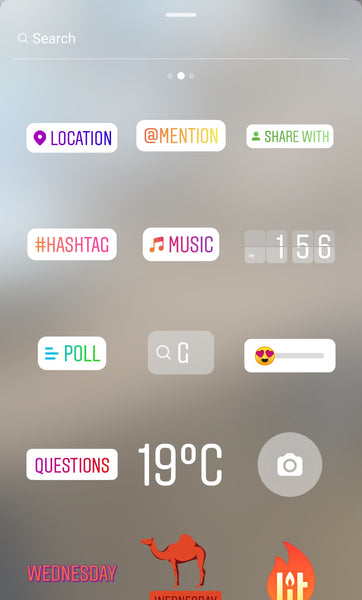
Once you’ve selected a sticker, you can layer it on top of your story, dragging it where you want it, pinching it to resize it, and tapping to cycle through different styles if they’re available.
The 10 essential types of Instagram Stickers
While some stickers help to make your stories more fun, others directly contribute to your Instagram marketing goals. There’s no shortage of options to choose from, but the following customizable stickers are especially relevant for marketing:
- Hashtag stickers add a clickable hashtag to your story to help you reach more users or promote your own branded hashtags. When users click on it, they’ll be taken to the hashtag’s feed, just like if they’d searched for it manually. You can also add clickable hashtags using the text box tool in your stories, but it won’t be as noticeable.
- Mention stickers tag another user in your stories, notifying them that you’ve done so. When someone taps on the sticker, they’ll be taken to the tagged user’s profile. You can also mention other users in your caption itself, for a similar but more subtle effect.
- Location stickers tag a location in your story to expand your reach. When users tap on it, they’ll see a feed of other content with the same location tag. You can only add one per story, so choose the most relevant one.
- Question stickers let you crowdsource ideas, feedback, and responses from your audience with an open-ended question. Answers can then be shared directly to your stories as a follow up post.
- Poll stickers ask users a question, and give them two answers to choose from. By default, you can ask a “yes or no” question, or you can change the responses to create your own either/or styled inquiry that lets users choose between two answers. Users click on the sticker to answer, and the results are calculated in real time. You can see who voted and what they voted for, giving you the opportunity to engage directly with them.
- Product stickers are available through the Shopping on Instagram integration. Business accounts with this sales channel enabled will be able to tag products in their stories. Users can tap to see the price, description, and product name, and tap again to go directly to the product page to purchase.
- Music stickers add background music to your images or videos, letting you choose a soundtrack from Spotify.
- Emoji slider stickers ask users a question that they can answer with a slider (i.e. on a scale of 1 to 10), such as “how much do you love our new line compared to last year.” You can choose an emoji to represent their response, and users will be able to see the average after they give you their vote.
- GIF stickers are looping graphics from GIPHY that you can add to stories. They’re not just fun and dynamic, but can be used to add animated calls to action to your stories (e.g. “Follow us”, “Swipe up”, etc.).
- Date stickers will show the date that the photo, video, or story was created. They can be used to post throwback content to reminisce about the past, or build hype for an upcoming event by displaying today’s date.
Naturally, you can mix and match stickers in the same story to layer the benefits on top of each other and maximize their impact.
Creative ways to use Instagram Stickers for marketing
1. Drive sales to your newest products
Instagram’s new Product Stickers don’t just raise awareness for your products—they help you convert that attention into sales. Users can tap on them to learn more about the featured product, and then tap again to be taken to the product page to purchase.

You can even feature multiple products in a single post to give your audience options and show off a collection of products.
2. Ask for feedback and test ideas
The temporary nature of stories make them great for soliciting feedback—after 24 hours, when you have the input you need, your story automatically disappears.
Poll Stickers, Emoji Slider Stickers, and Question Stickers each present opportunities for getting different types of feedback, depending on the type of survey question you want to ask.
You might use an Emoji Slider to ask your followers to rate something on a scale of 1 to 10. Or you could use the Poll Sticker to ask them to pick a side in a popular debate.
Not only can you learn more about your audience this way, but you can even use stories as a testing ground for new product and marketing ideas.
This Instagram Story from The Gap, for example, uses a fun emoji poll to learn more about their audience’s preferences, while showcasing some of their products.

3. Host an AMA to connect with followers on a personal level
Ask Me Anything (AMA) sessions give your followers direct access to you, the person behind the brand, in a way that most social media content doesn’t.
Using the Question Sticker, you can facilitate this Q&A format and pull back the curtain to offer your followers a chance to get to know you.
Your followers would likely love the chance to ask big questions that your About Us page doesn’t answer, like what products are coming up or what your favorite book is. Let people know that the best questions will be answered in your stories, and get ready to watch them come pouring into your notifications.

4. Share user-generated content and encourage others to create their own
User-generated content can be a powerful addition to your content mix, but only if others see it and recognize that it was created by a fan and not by you.
Using Mention Stickers, you can share UGC in your stories and then tag the creator so they get credit and a public thank you. This will show that you value your followers and encourage other users to share content, too.
Better yet, you can also add your branded hashtag to direct your audience to check out more UGC or contribute their own.
If you’re in a rush, a strategy that I often use is to ask permission from users to directly share stories that you’re tagged in. When sharing, I add a “📸credit” next to a Mention Sticker tagging the original poster. These posts generally have high engagement rates, and I’ve found they encourage more users moving forward to tag your brand in their stories, too.

5. Create more relatable stories by adding a soundtrack
Music Stickers can help establish a certain mood or feeling and effectively grab a user’s attention. From lip syncing along on video to playing holiday music over your photos, these Stickers offer a lot of opportunities to get creative with your content.

If you aren’t sure where to start, Instagram has its music sorted by “Moods” and “Genres,” in addition to letting you search for specific tracks, letting you add snippets of hits from big names like Drake, Cardi B, Fleetwood Mac, and other artists on Spotify.

Music Stickers can also help you express yourself as a brand and connect with your audience through your shared tastes in tunes.
6. Promote your branded hashtags
A lot of brands will try to harness the power of hashtags to get users talking about their brand in a way that is easy to monitor. They’ll use branded hashtags, or contest- or event-specific hashtags to generate awareness and encourage users to also post content using the same tags.
Since hashtags often get buried in your Instagram posts, stories are a great way to bring them to the forefront of your audience’s attention.

When you have a branded hashtag populated by content from your fans, you can even start using the Hashtag Sticker to direct your audience to this gallery of content. When Story viewers click on the Sticker, they’ll immediately see all the other posts containing the tag, which can serve as powerful social proof.
7. Tag locations of events you’re attending
Are you attending a tradeshow, a conference, farmer’s market, or other event? Whether you’re actively selling your products or just networking, post a story to show your followers that you’re there in person and make sure to add a Location Sticker.
This won’t just let your followers know you’re there, but also help others at the event discover you if they’re also browsing the location tag.
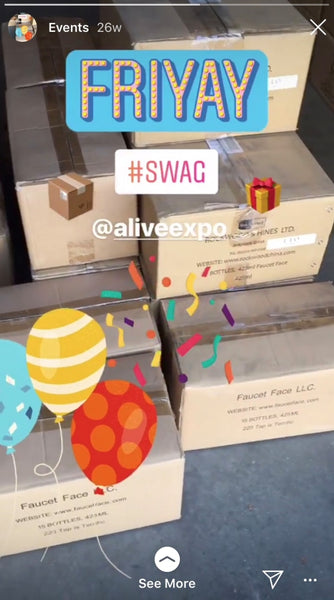
For good measure, you can also add specific instructions on where they can find you and the event hashtag as a Hashtag Sticker, which other attendees may be searching for.
8. Ask customers to choose between two products
Using Poll Stickers and asking customers to choose between different products is an excellent way to promote two items at once, share visible social proof, and learn about your audience’s preferences.
The ease of participating will work in your favor, and everyone else will be able to see the results live.

Many users will want to vote simply so they can see how others are voting, and once they see the results, it may even encourage them to purchase.
9. Use date stickers for flashbacks or to hype up events
Sometimes it’s fun to look back, which is why #TBT (#ThrowbackThursday) is such a popular hashtag. When you want to share content that happened in the past, this is a good way to do it. It establishes context and is particularly powerful for sharing stories about past events like anniversaries, conferences, or milestones.
When you select an old Instagram Story from your archive it will appear in the editor with the Date Sticker by default, making it easy to reminisce about and reshare these moments.
Date Stickers also work well if you’re counting down to a particular event, like a sale or a pop-up shop. Attach the date sticker to a sneak peak photo or behind-the-scenes video, and let users know how much time they have left before the big event.

10. Use the “Swipe Up” GIF sticker to get more click throughs
If you have the ability to add links to your stories—you need to have over 10k followers and a Business profile—it can be an effective way to drive traffic through your stories.
But sometimes users need a bit of a push to follow through on the action—especially since these subtle links are found at the bottom of your Story.
There are several “Swipe Up” GIFs available through the GIF Sticker that you can use to draw attention to the fact that your story includes a link.

Even if you don’t have the ability to add links to your stories, you can still use this strategy to draw attention to important parts of your story that you really want people to see. Maybe this is a URL or a date.
Animated arrows and flashing GIFs that read “Follow Me” or “Check it out” can also be used to add hard-to-miss CTAs to your content. Be sure to browse the GIF library whenever you feel your story could use an explicit call to action.
11. Use the “Sound On” GIF to get users to enable sound
One of the most understated uses for Instagram Stickers is to turn implied actions into explicit calls to action.
Since videos play without sound by default, the “Sound on” Sticker can make it clear that sound is an integral part of the content they’re viewing.
It encourages users to enable sound, even if they likely wouldn’t have thought to otherwise.
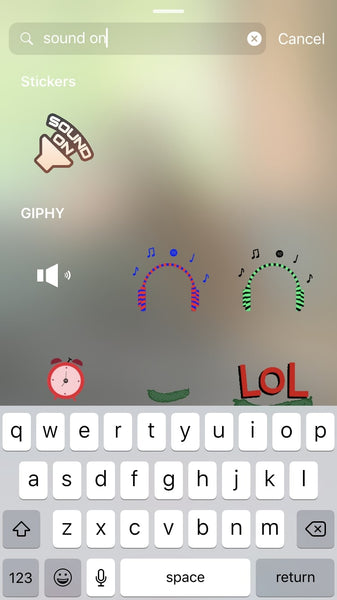
It’s a simple addition to your video Stories that can help you keep your audience’s attention longer.
12. Collaborate with other businesses
Sometimes building relationships with other brands is a smart way to market your business, and sharing some love on Instagram can benefit both of you—especially if they return the favor.

Shoutout exchanges are an easy-to-implement and effective co-marketing tactic, as long as you can find a complementary brand with a target audience that overlaps with your own.
Use either the Mention or Location Stickers to tag other businesses when sharing stories about them. They could be a vendor, an industry influencer, or just a complementary business. If you’re hosting or participating in a sale, event, or contest together, even better.
13. Get festive with seasonal Instagram Stickers
Whether it’s April Fool’s Day or Halloween or Thanksgiving, people love getting festive—especially when it comes to Stories. Seasonal Stickers will pop up at the appropriate time for almost every major holiday you can think of, making it easier for you to add a seasonal touch to your Stories without any extra effort.

Nothing suggests a possible Christmas gift idea quite like an animated Santa Claus walking across your stocking stuffers. Or that there’s a hot BFCM sale happening now like a flashing “15% off” GIF.
Tracking your performance with Instagram Stickers
Instagram stickers are a great way to get more engagement, traffic, and social proof out of your stories, in addition to brand awareness. In order to understand the effect that different stickers have on your content, however, and how effective they are overall, it’s important to monitor their performance.
The best way to do this is to carefully monitor your stories’ performance in Instagram’s Insights. Instagram’s native analytics report has a section under the “Content” tab dedicated specifically to stories, where you can view how each story performed based on certain key metrics.

These metrics include:
- Impressions: The total number of times your story was viewed
- Reach: The total number of unique accounts who saw your story
- Profile visits: The total number of times a viewer visited your profile from your story.
- Forward swipes: Users who skipped to different photos or videos within your Story
- Back swipes: Users who went back to different photos or videos within your story
- Exited Stories: Users who completely exited their stories after viewing yours.
- Replies: The number of users who replied to your Story
- Next Story: The number of users who swiped ahead to skip your Story entirely.
- Link Opens: The number of click-throughs on your Swipe Up links
For Instagram Stickers, in particular, you should definitely monitor Sticker Taps to see how many users are interacting with each sticker in each Story. This can tell you how compelling your stickers are to your followers and whether they’re having their intended effect.
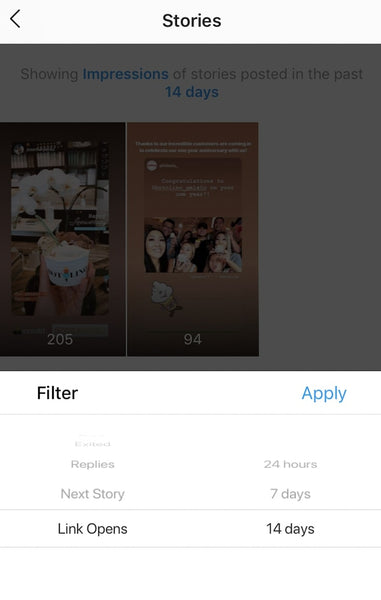
You can only track stories data in your native Instagram analytics for 14 days, so keep careful track of the data. If this feels like a hassle and you want a big-picture view, third-party tools like Snaplytics can you give the same information but store it for much longer periods of time.
Look for patterns here. If some of your Stories have record-high impressions and reach but very little engagement, take a look at why. Do certain stickers seem to have an impact on engagement rates, like replies or back swipes to re-watch a story? Are people ignoring your stickers because of the placement or size?
You’ll start to see how different stickers affect your stories’ performance, which can inform how you use them moving forward.
Instagram Stickers: A fun and functional feature
Instagram stickers are more than just a fun add-on that layers smiley faces onto your Stories. They can play an integral role in Instagram marketing, allowing you to generate social proof, engagement, reach, brand awareness, and traffic to your profile and even your site.
Best of all, they can be combined together in all kinds of creative ways.
Stickers are a valued part of your Instagram marketing toolkit and, with a bit of strategy, they can help you get more out of every story you publish.
Interested in learning more about Instagram marketing?
- How to Use Instagram Stories for Marketing (And Why You Should)
- Instagram Hashtags: Connect With Your Customers and Drive More Sales
- Instagram Marketing: Use Hashtags, Stories, and More to Grow Your Business
By Ana Gotter
Ana Gotter is a marketer, consultant, and writer specializing in content marketing and social media marketing
Sourced from Shopify Blogs

By
If you work with clients who are curious about inbound marketing you’ve probably heard them ask how long it takes. You might tell them that it takes a number of months before you actually start seeing a return. And, you might feel a little uneasy about giving them an exact date when they’ll start seeing some action because you don’t want to make promises you can’t keep.
So, maybe you tell them that the speed of the return is tied to the aggressiveness of the strategy. Understandably, you might feel like this is a little vague. Well, you’re not alone. Chances are the prospect feels the same way.
The good news is it’s vague for a reason. So, let’s pick this question apart and talk about a good way to answer it.
How long does inbound marketing take?
The Thing is, This Question is Vague, How Long Does Inbound Take to do What?
If a prospect starts talking about how long something’s going to take before that something has been determined, then we’re not off to a great start.
Remember this tweet?

To the prospects asking how long inbound marketing takes: Inbound Marketing isn’t the thing that “takes” any amount of time. It’s the goals that take time.
So the question should actually be “How long does it take to achieve X goal?”
If we at least know how to ask that question, we’re in pretty good shape. The next step will be figuring out how that goal will play with the current state of our website, lead generation, social media following, or whatever else is relevant to it.
Understandably, if we want to generate 100 leads per month and we’ve historically been generating 0, it could take a long, long time.
Alternatively, if the goal is to increase leads by 20% and we have clearly defined initiatives that have been generating them in the past, then we can accurately gauge how much of an increase in marketing velocity will be needed to support that goal. Consequently, nailing down a timeline will be much easier than in the first example.
Speaking of Nailing Down a Timeline, Here’s a Timeline of Marketing
Inbound marketing isn’t a practice that is ever completed. It’s not like you’re going to implement inbound marketing in a few days and think:
“Hey, we did it, we’re done. Nice work everyone. Let’s pack it in and go home.”
If this all sounds pretty basic, let’s look at some issues to avoid in goal setting. With that established, we can get on with setting goals, implementing a strategy that supports them, and launch and adjust to drive success.
Common Issues I See Early On with Goal Setting for Inbound Marketing
Here are a few of the biggest issues I see when setting goals with clients.
- We don’t have a starting point to base future growth because we don’t have conversion or customer data broken up by default channel group or campaign
- Filters aren’t in place to ensure the data we’re observing is relevant website traffic
- We simply don’t have any tag management processes set up at all
With issues like the ones above, our first set of goals will be to set up our website and backend tools to capture information that we can use for setting realistic goals in the future.
How Long does it Take to Be Ready to Set Up Goals?
This depends on how much needs to be done. For instance, if you need to rework your website conversion paths to support goals in Google Analytics, this could take a pretty long time to get spun up.
For most other projects, about a couple of weeks will be spent sharing access to tools and auditing them. Then, another few days will be spent configuring them and integrating them together. Lastly, we’ll need to generate data to base future goals upon. In this case, it will take at least one year to have rock solid data.
That said, you can start setting goals after a quarter, just be aware that if your industry is seasonal these goals will be somewhat anecdotal.
Bringing it All Together
From here, it’s a matter of adjusting our marketing to meet our goals. Quarterly goal setting should get better, quarter over quarter. We’ll uncover issues, align sales and marketing, push more leads, or push fewer but more qualified leads. We’ll stop doing certain marketing initiatives that aren’t paying off and have strong data to guide our strategy.
And our inbound marketing strategies will get stronger and stronger the longer we work on them.
So, to answer the question “how long does inbound marketing take?”, the answer is “it depends on how strong you want your strategies to be.
By
Lead generation marketer passionate about internet advertising, search engine optimization, conversion rate optimization, marketing automation, remarketing, database segmentation, dynamic or smart content, omnichannel marketing, closed-loop reporting, and aligning efforts with sales insights to drive high qualified leads to sales. … View full profile ›
Sourced from Business 2 Community

By Liam Tung
A new verification system for all tech-support advertisers aims to block scammers.
Google is rolling out a new verification system to combat a rise in misleading ads from third-party technical-support services.
Google announced it will implement new restrictions on all tech-support ads after the Wall Street Journal found that fraudsters have been buying ads from Google and posing as authorized service agents for Apple.
“We’ve seen a rise in misleading ad experiences stemming from third-party technical support providers and have decided to begin restricting ads in this category globally,” said David Graff, Google’s director of global product policy.
Google isn’t banning all third-party tech-support ads as Microsoft did for Bing in 2016. But rather it will use a verification program to ensure only legitimate third-party tech-support providers can use its ad network to reach consumers.
The new restrictions on this ad category apply globally while the tech-support verification program will be rolled out in coming months.
SEE: Cybersecurity in an IoT and mobile world (ZDNet special report) | Download the report as a PDF (TechRepublic)
It’s not clear what type of verification program it will roll out, but Google has existing advanced verification programs for local locksmith services and addiction treatment centers to prevent fraud. Google has previously banned some ad categories altogether, including those for short-term payday loans, and more recently bail-bond services.
The verification system was needed because Google found it increasingly difficult to sift out bad actors from legitimate businesses because the fraud takes place away from its platform.
This move could help close off one avenue tech-support scammers use to reach potential victims, but there are plenty more, including cold-calling, support-scam malware and spam with links to support-scam sites.
The overall goal of the scammers is to get victims to call a call center where an operator convinces them to install a remote-access tool, which allows the operator to display bogus error warnings.
Microsoft in 2017 received 153,000 reports from customers across the globe who had fallen for a tech-support scam. That figure was up 24 percent on 2016.
Previous and related coverage
Google robocall scam: We’re suing hustlers who pretend to be us, warns Google
Scam robocallers tell victims: call us now or your Google business listing will labeled closed.
Yet again, Google tricked into serving scam Amazon ads
At the top of search results for “Amazon” was a bad ad, trying to tricking users into falling for a tech support scam.
Windows Chrome users: Tech-support scams try new trick to freeze your browser
Get an ad-blocker if you want to dodge tech-support scammers’ latest rapid-download ruse.
Ransomware, tech-support scams or email fraud: Which cybercrimes cost victims most?
Not all online crimes are equal in their impact.
Microsoft to Windows 7, Windows 8 users: We’re about to end forum tech support
If you have a Windows 7 or 8, Office 2013, or Surface Pro problem, you’ll have to rely on the community for answers.
Microsoft: Tech support scams rose by 24% in 2017, costing some victims thousands of dollars TechRepublic
Social engineering scams make even the best security solutions useless, Microsoft said. It wants industry-wide collaboration to solve the problem.
How to avoid tech support scams CNET
Scammers are getting craftier, according to a new report. Follow these tips to keep your money and identity safe.
By Liam Tung
Sourced from ZDNet

If you were to look inside your Google Analytics right now, chances are that a majority of the traffic on your blog comes from 2-5 blog posts.
If you have goals set up in Google Analytics, and you’re measuring product or service conversions that come directly from content, chances are that a majority of your first-click and last-click conversions also come from a few blog posts.
What’s interesting though is rarely do the posts with the highest volume of traffic, have the highest volume of conversions.

So what’s the disconnect?
It’s that head terms or high volume queries are typically the terms that target the top of funnel for your product or service – they have more people searching for them, but less of the searches have purchase intent.
On average, keywords with lower volumes are typically the terms that target the middle or bottom of the funnel – they have fewer people searching for them but higher purchase intent.
There are cases where you can go after keywords that have both high volume and have purchase intent – those are optimal, but typically there aren’t too many to target.
While many companies are focused on ranking for high-volume keywords in their content marketing because of the traffic potential, we tend to prioritize lower-volume, high intent keywords because the conversion potential is much greater than going after high volume keywords.
For example, continuing from the screenshot above, here is the 16th highest traffic article in that time period, bringing in only 1,612 pageviews in that period, but an amazing 39 product signups for this SaaS company.

Additional benefits: the lower-volume, high-intent keywords are much easier to rank for, most of your competition is focused on the high-volume instead of high intent keywords, and they tend to outperform the highly competitive keywords from a conversion perspective (the main goal).
The following strategy is specifically for B2B SaaS businesses (some of the strategies can also work for services businesses as well). Ranking for high-volume keywords may work well if your main goal is to generate traffic (ad or impression based content sites – media), newsletter or email signups (personal or email list based blogs- course sites), or any other business where top of funnel traffic is valuable. So in this article, when we say “conversions” we mean product-related signup or form fills, not an email or newsletter opt-in.
In this post, I’m going to explain how we come up with SEO-driven content ideas that generate leads and signups by not going after high volume head keywords. I’ll share some examples of frameworks that tend to do well from a conversion perspective and I’ll share some examples from blogs that we run that show why we take this approach vs. the approach that most agencies and content marketers take.
Our Keyword Strategy = Pain-Point Driven Instead of Volume-Driven SEO
Let’s say that you’re doing content marketing for a SaaS company that targets salespeople as the customer (broad target audience, I know, but it’s just for the sake of the example).
Many marketers take a keyword-first approach to content marketing.
They research some keywords that they think salespeople would be interested in and end up coming up with a keyword list that looks something like this:

Then they prioritize what keywords to target based on which keywords have the highest volume (traffic potential) and which ones are easiest to rank for (low competition).
They do this because oftentimes their metric of success is a % increase in traffic, not leads/signups growth. The why behind this is a discussion for another post :).
Then blog posts start being produced that go after these high-volume keywords and if everything works you may notice that traffic starts to increase.
But what about the leads and signups from those posts?
Oftentimes, you don’t see a measurable amount of leads and signups coming from those blog posts topics because this strategy is designed to increase traffic, but doesn’t take the intent of the searcher into account.
We think this volume-based keywords strategy for content marketing is backwards.
Instead, the approach that we use to come up with SEO-driven content ideas is inverted. We start with the intent of a buyer (the pain point of a customer), then we find keywords and topics that discuss solutions to the problem the searcher is trying to solve.

By doing SEO from a pain point first approach vs. a keyword-first approach, we can map the intent of the search to the buyer’s journey and have a better predictor of which SEO posts will generate leads and signups, instead of just measuring which posts will generate traffic.
Our Process for Coming up with SEO Topics That Drive Leads and Signups
Now that you understand the differences between going after high-volume keywords vs. pain-point driven SEO, let’s dive into our exact process for ideating topics that generate leads.
The content frameworks we’ve found are the highest converting for SEO content
Before I explain how to come up with the ideas for your own company, I think it’s important to share the frameworks we use to create high-converting SEO content.
Here are the five frameworks (or article types) that we use. Below, I’ll explain how to come up with the ideas to prioritize for each of the article types.
- Comparison posts – this framework objectively compares your product or service to your top competitors. Here’s an example
- Best product or service lists – this framework helps searchers discover the best products or services in the category they’re searching for. Here’s an example
- Alternatives to X – this framework helps searchers discover alternatives to your competitors products. Here’s an example
- Articles that talk about pricing – This framework talks about pricing of your own product or service (if you have this hidden) – you could also do this for your competitors if they’re not forward about pricing. Here’s an example from a hubspot agency
- Product or Service Use Cases – this framework helps searchers figure out how to solve a problem they have and presents your product or service as a potential solution – ie. how to increase leads from content marketing (note the subtle tie-ins to SEMrush throughout the post).
Ideating on high-converting topics for SEO
Now that you know the frameworks that you should be thinking about, I want to share how you get the ideas that fit into the frameworks.
Essentially, all of the ideas should come from your prospects and your customers. If you’ve been a follower of our site for a long time, you’ll know our entire strategy starts with having a in-depth understanding of your customers. If you know your customers inside and out, you’ll be able to come up with content ideas that your competitors won’t target because they’ll be focused on traffic while you’ll be focused on helping your customers and future customers solve problems.
By knowing who your prospects/customers view as your competitors, what problems your prospects/customers think your product or service solves, what features or parts of your service your customers get the most value from, how your customers describe your product or service and the value they get from it, you should be able to come up with content ideas that convert 2x to 5x higher than other content.
Survey questions to ask to identify conversion focused SEO topics to write about
Here are some questions to ask your customers via in-person interviews, phone calls, and surveys to help you identify high intent keywords to target:
1. What was the problem you were looking to solve before stumbling across our product or service?
This question helps you identify what keywords to target when someone is researching for a solution to the problem that your product or service solves.
2. If our product/service were no longer to exist, what product/service would you use as an alternative?
This question helps you identify who your customers view as your competition.
3. How would you describe our product/service to a friend who knew nothing about us?
This question helps you identify how your customers would describe your product to a friend – maybe they describe what you do differently than you describe it – it’s important to figure this out so you can capture search volume for terms you might not be thinking of.
4. What are the top 3 benefits that you receive from our product/service?
This question helps you identify the top use cases and benefits that customers get from your product or service.
5. If you were to research our product or service, what would you search for?
This question helps you identify the terms that your customers would search for to find your product/service.
Make sure that all of these questions have open ended responses. You don’t want to lead people to an answer, you want them to share their thoughts with you. You should see a wide range of responses and then you want to prioritize responses that you get multiple times.
Once you have the answers to these questions, it’ll help you figure out the specific ideas to apply to each framework.
For example, if a majority of respondents say the biggest benefits they get from your product or service are increasing qualified leads to sales teams, increasing sales pipeline, and closing more deals, then you might want to create articles on those topics that walk people in-depth through various ways they can accomplish those things (your product or service might be one solution to their problem- you’ll need to include other valuable ones as well).
Another example, if a majority of respondents say that if your product was no longer to exist, they’d use Hubspot or Marketo, then you might want to create blog posts that compare your product to Hubspot and Marketo, and weigh the pros and cons of using your product vs. theres.
Hopefully you get how this works from here… (if not, feel free to leave a question/comment below)
Case Study: Going after long-tail high intent keywords beats out high-volume keywords
Now for some proof that this approach works.
Over the past year, we’ve been testing different frameworks across clients – narratives (stories), case studies, data posts, as well as the five frameworks above. Across multiple clients, we’ve seen these frameworks outperform some of the other content from a conversion perspective.
Because we started seeing these trends emerge, we thought we’d share the strategy with you.
The following analytics screenshot is from one of the SaaS companies we work with. This report is looking at organic traffic, the page that they landed on from organic search and the number of last-click conversions to that article.
To protect our client’s data, I’ve grayed out the URL of the article and in its place, I’ve put a description of the article.
All of the other numbers are left as is. 
Now what’s important to note here is that not all organic traffic is created equal from a conversion perspective. If you look at blog post #1 and #2 here, you’ll notice that they get almost the identical level of traffic, but #2 gets far lower conversions.
This is because the blog post #2 ranks for a keyword the target audience would search for, in this case a sales related keyword, however, the post doesn’t follow one of our five frameworks and the intent of the post doesn’t tie into the need or value that the product offers.
What’s also important to note is that to help increase conversions for each of our blog posts, we use in-article CTAs that are contextual to the post.
For example, if we were to write a post about best CRM tools, the post would have a CTA that says something to the effect of “Looking for a CRM tool for your small business? Try a free trial of X tool for 30 days, free.”
Another thing to note is that the highest converting blog post also has the lowest level of traffic, but that post uses one of the highest intent frameworks: comparing competitive products. When we originally did keyword research for this comparison term, multiple the SEO tools showed zero search volume behind the long-tail keyword.
Let me repeat this point because it’s important: The post with the largest number of conversions in the screenshot below targeted a keyword that tools like Ahrefs and Moz showed as having zero search volume.
Most marketers would just move on and not write a post on this topic.
But while the traffic doesn’t compare to the rest of the posts on the list here, the post dwarfs most others from a conversion standpoint.
Now, let’s look at GA’s model comparison tool to see the top converting blog posts that we’ve produced from January 1 – August 29th, to see which of the content frameworks yield the highest amount of new trial signups, when also factoring in first-click conversions.

We can see here that the highest converting posts use the frameworks above. Only three of the top 10 posts are what we consider “top of the funnel” articles and they make up only 10% of conversions.
That’s crazy. 90% of the conversions from these top 10 articles are from one of the 5 simple high-product-intent frameworks we listed above.
What you should take away from this
We’re not saying that you should only produce SEO content that falls within those five frameworks, but what we are saying is that we’ve noticed trends across multiple clients, that when you produce pain-point driven content that use those five frameworks to target long-tail keywords, we’ve seen conversion numbers that are much higher than other content that ranks.
Therefore, we think you should prioritize producing those pieces of content before going after terms that are high volume / low competition in your category or that your target audience would potentially be interested in reading about.
Once you feel like you’ve exhausted all of the potential long-tail keywords using the five frameworks, then it makes sense to take a broader approach to finding higher volume keywords in your category and that your target audience would potentially read.
In addition, using this strategy effectively also depends how strong your domain is. If you’re just starting out with content marketing, then targeting these types of posts may not work well for you because other sites with stronger domain authority will outrank you. If that’s the case, it may make sense to focus on building your site authority first, or producing these posts, and then simultaneously focusing on building domain authority.
When it comes to conversions, as you’ll see from the last screenshot we shared above, this is not the only type of content that will generate conversions. Even stories that we’ve produced that have nothing to do with the product or service you offer, but does tie in with the category, and has helpful advice has yielded conversions. So it’s important not to only focus on these content types, but to mix in various types of content frameworks – content that targets the top of funnel, middle and bottom of the funnel.
Sourced from Grow and Convert

By Anil Chawla
In the last several years digital transformation companies have not only realized the need to mine customer information but also to expedite internal re-engineering through powerful analytics tools.
The three-pronged process of Voice of Customer Analytics (VoCA) includes
- Collating structured and unstructured data.
- Analysing the data with powerful analytics tools.
- Transforming the insights through workflows.
Working towards a robust VoCA program can clearly separate customer experience leaders from laggards. According to Forrester, customer experience leaders grow revenue five times faster than CX laggards, drive higher brand preference and brand referrals. A Harvard Business Review article “How the Meaning of Digital Transformation Has Evolved” also backs the measurable value of a VoC strategy: Top performers in a (PwC) survey—those reporting revenue growth and profit margin increases above 5% for the past three years and expected revenue growth of at least 5% for the next three years—have a better understanding of the human experience that surrounds digital technology. These companies prioritize user experience specialists and creating better customer experience through their digital initiatives.
Infact, organisations don’t realise it yet but a vast majority of customer content is in their internal data- the e-mails, sms and voice calls. If you compare a call over a tweet- a five minute call entails 1000 words v/s 10 words over a tweet. More than 90% of the voice of customer analytics is internal data.
Our large-scale study of more than 36,000 consumers across 18 countries that challenges all of us to think about how we can deliver a customer experience that will truly engage customers from today into 2030 and beyond predicts-
- Customer service in 2030 will certainly rely greatly on machine learning, deep learning and deep reinforcement learning.
- Almost seven out of every 10 consumers (68%) want their service experience to be personalised which means that organisations need to deploy sophisticated speech, text, social media, sentiment analytics tools to be able to deliver data driven services.
As a case of successful VoCA implementation, the Bank Of Montreal analyses over a million calls each year to understand customer behaviour and sentiments. The bank also earmarked-
- Top five processes per line of business which were responsible for repeat calls.
- The Bank was also able to identify top digital challenges of the customers.
- Key detractors through campaign analytics.
Closer home Sutherland Global, a digital operations and digital transformation company, operating out of 19 countries and clocking 43 million transactions a month deploys speech analytics to help its customers in BFSI and telecom verticals to gain near real-time insights to fulfil-
- Collections’ compliance adherence
- Customer retention
- To move up their customers’ value chain
- Training needs of their of their agents.
Within 12 months of deploying multiple channel analytics a leading bank in UK observed-
- 12-15% reduction in customers’ switching channels
- 18% reduction in repeat calls
- 10-15% uplift in the use of self-serve channels.
Myriad customer feedback across multiple channels can be one of the top challenges to deploy voice of customer program as customer feedback can be-
- Solicited and unsolicited feedback (such as social media tweets)
- Structured and unstructured feedback (such as complaint calls)
- Direct and implied feedback (correlating behavior patterns such as a product purchase or cancellation)
- Overall brand perception and interaction-level feedback that evaluates perceptions for a specific interaction (such as check out or customer support)
VoCA integrated with predictive, prescriptive and descriptive analytics can help organisations to devise small loop and large loop processes. As a reactive tool, small loop actions taken after a customer provides a poor rating or reports a concern. Small loop processes are usually led by an individual or a small group. Large Loop processes analyze trends in small loop actions to determine the root cause. Once the root cause is identified, organizations may either reduce or eliminate small loop actions. Changes triggered large loop processes often involve new policies, processes, technology, pricing, and can span across organizational functions.
As Warren Buffet says “Don’t satisfy your customer delight them.” Voice of the Customer (VoC) programs empowers organizations to embrace a data-driven approach to improve the overall customer experience and building a customer-centric culture across the organization.
By Anil Chawla
Sourced from Analytics India

By
Intelligent apps are the ones that clearly understand the “why” behind “what”.
Mobility has transformed each and every aspect of human existence today. With more and more people relying on mobile apps for basic needs such as shopping, banking, entertainment, maintaining health and fitness, competition on the app stores has grown fierce than ever. Therefore, offering something extra is the only way left in order to stay cut above in the mobile arena.
Here comes Artificial Intelligence to the rescue. By now I assume that you have probably come across the concept artificial intelligence (AI) and how it’s gearing up to be the next big thing across the globe. The technology has successfully opened a whole new door and redefined the concept of human-machine interaction. Now have you ever come across the term intelligent app?
As the name implies, intelligent apps are the ones that clearly understand the “why” behind “what”. Data analysis and machine learning are popularly known as the cornerstone of the intelligent app ecosystem. Of course, it’s a new breed of apps primarily created as the stepping stone towards human-machine-interaction. The AI ecosystem allows humans to interact with machines/ computers and increase their efficiency to understand us. It offers these features but isn’t limited to:
- Study user content and preferences and predicting what they need
- Depend on AI to make more informed decisions
- Proactively respond on behalf of the user
- Automate tasks using the if/then commands
- Communicate on your behalf by predicting what you want to say and with whom you want to communicate
- Life becomes pretty easy by when we are able to predict the actions and save your customers from the long multi-step process execution route
- It can act as a personal assistant by doing necessary things at the right time without bothering you with notifications
This is how mobile AI will transform businesses
Incorporating AI in mobile app development has simply resulted in lots and lots of developers jumping on the bandwagon to cash in on this lucrative field. Although the opportunity has just kicked in recently, one requires to spend more and more time thinking in terms of how to collect, sort and store the data that their applications gather. After this, they can feed it into machine learning algorithms that do not change.
Don’t forget to add that personal touch, with AI effectively taking hold in a variety of industries- eBay, Amazon and other giants in the retail industry have already proved the success of bringing mobile apps featuring Artificial Intelligence. Data is the lifeblood of any business so there is no scope of lagging behind due to technical constraints. Try leveraging the data collecting via point-of-sale machines, online traffic, mobile devices, and more. These algorithms will successfully help in finding trends, adjusting apps in order to create a richer contextual and personalised experience.
For example- Starbucks has come up with “My Starbucks Barista” – An AI-powered mobile app that allows users to tell the app what they crave for and the app itself places the order. Another common example is Amazon Alexa. Being a voice-controlled digital home assistance, it allows end users to take control of regular chores of the user automatically.
Next, AI offers a better predictive reply. For those who have no idea, predictive reply is the communication between a user and the device where AI itself understands the message and responds precisely. For example, Google’s Gmail app offered the new feature of Smart Reply by using artificial neural networks to send appropriate responses to the email messages. The feature analysis all the emails and recommends quick, small size messages that you may want to send.
Another major factor includes the biggest impact of AI on social media. In the upcoming years, a severe rise will be seen in real-time personalised content targeting with the aim of creating increased sales opportunities. And this seems to be pretty obvious as AI can make the most out of effective behavioural targeting methodologies.
Security, fortunately, AI as a technology powers a bunch of fraud detection tools which enable businesses to protect against sophisticated fraud schemes by leveraging automation, machine learning engines, natural language processing, speech and video recognition, to name a few. For better security, one can integrate AI with other emerging technologies such as IoT and Blockchain. This will help fuel an explosion in innovation and consumer adoption.
Last but certainly not the least, with the help of machine learning algorithms it becomes pretty much easy to predict future trading decisions. Keep tracking the patterns on the regular basis and one can easily create full-proof strategies like never before. In addition to the decision-making process, AI aids well when it comes to business consolidate and integrate their business processes. When combined with enterprise resource planning solutions (ERP), it is able to take the fragmented working parts and combine them into a functioning whole by testing and analysing each piece of information. As a result, you will receive more efficiency, productivity, and revenue.
AI, a lifesaver in the world of app development
There has been observed an immense growth in businesses and user engagement, all thanks to AI technology used in mobile apps. However, there are certain devices/apps featuring a fixed algorithm and do not adjust on the basis of the user’s observed behaviour. While for others, here I would like to mention certain pointers that will guide you in overcoming such obstacles.
The technology successfully collects and stores data from the user by analysing the performance and usage pattern of the app.
Demographics such as user’s location, contacts as well as behaviour on the daily basis, considered by AI allows the app to serve the user in the best possible manner.
Over the past few years, it has been playing a significant role in the world of app development. Right from Siri to now empowering growth with its strong presence in app development. The technology has a long way to go!
Wrap it up
AI is not the easiest path to take, but it can quickly prove rewarding. Bear in mind that these forces are trajectories, but not exact destinies. They offer no predictions of where you arrive. They only tell you that you are inevitably headed in their directions. Let’s go!
Feature Image Credit: Enzozo / Shutterstock
By
Vikash Kumar, Online Marketing Manager, Tatvasoft.com.au
Sourced from IT ProPortal

Sourced from BRINGINGSMART.CO
Creativity is a process that cannot be forced but can be cultivated and allowed. Creativity must be allowed for the creation of innovative products and design of everyday things. You can stir up your creativity by getting serious about pen and paper again or you can also use apps as a guide.
Start keeping a journal too. Postpone judgment when you are in your creative mood and start allowing more silence in your life. Don’t put pressure on yourself, avoid creative deadlines when you can. Begin to ask questions about everyday products, ideas etc.
In the words of Masaru Ibuka–Creativity comes from looking for the unexpected and stepping outside your own experience.
These are 45 amazing creativity resources that can stir up your creative instinct. If you need inspiration and motivation to take your product or business to the next-level, you will find these resources, ideas, projects, designs, videos, predictions and innovations useful.
1. Co.Design— Fast Company’s Co.Design, where business and design collide.
2. Designbuzz — Design ideas and concepts.
3. House of the Future — Living Tomorrow’s vision of the house of the future.
4. Productivity Future Vision — Microsoft’s vision of the future.
5. Springwise — Your essential fix of entrepreneurial ideas.
6. Big Think — Blogs, articles and videos from the world’s top leaders and thinkers.
7. PSFK — A go-to source for ideas and inspiration.
8. The World in 2030 — Dr. Michio Kaku talks computers, medicine, jobs, lifestyle.
9. Wrist-Worm Techsessories — A video compilation by Trend Hunter.
10. DesignTaxi — Design, Art, Photography, Advertising, Technology, and Social Media.
11. VisualJournalism — 80% of the news in infographics.
12. trendwatching.com — Scans the globe for consumer trends, insights and innovations.
13. IdeaMensch — A community of people with ideas.
14. Concept Bug — Product design in the tech world. Forecasting the future.
15. Design Milk —F eaturing architectural designs, and modern house designs and technology.
16. Inkling — Prediction markets, idea evaluation, crowd forecasting and data insights.
17. Yanko Design — Modern industrial design news.
18. Life in 2050 — A discussion of almost-tangible realities from labs around the world.
19. Icon — Gives you a quick way to tap your crowd for ideas, knowledge and feedback.
20. Brainrack — Out of the box innovation that connects students with organizations.
21. 99U— -Insights on making ideas happen.
22. The 99 Percent — Insights on making ideas happen.
23. Get Addicted To — Daily mix of creative culture.
24. Creative Bloq — Daily inspiration for creative people.
25. TheCoolist — Web magazine about design, gadgets and more.
26. One Billion Minds — An amazing new way to discover and support innovation.
27. Visualizing.org — Data visualizations, challenges, community.
28. Fancy — Part store, blog, magazine and wish-list.
29. Cool Hunting — Highlighting creativity and innovation in design and technology.
30. FlowingData — Data visualization, infographics and statistics.
31. Paul Higgins — Futurist interested in technology.
32. Glen Hiemstra — Founder of Futurist.com, speaker, author, consultant.
33. Core77 — Industrial design magazine.
34. CoolBusinessIdeas — A blog that highlights promising new ideas around the world.
35. Trend Hunter — Technology trend spotting community fueled by a network of curious people.
36. TrendsNow — Future trends magazine.
38. Visua.ly — Infographics and data visualizations.
39. InnoCentive — Organizations can solve key problems through crowd sourcing.
40. Information Aesthetics — Data visualization and information design.
41. Bless this Stuff — Tech to drool about, for men.
42. Visual Complexity — A visual exploration of mapping complex networks.
43. oobject — Visual lists of man-made objects.
44. Brian David Johnson — Intel futurist, author and speaker.
45. Ray Kurzweil — Author, inventor and futurist.
Sourced from BRINGINGSMART.CO

By
Whether we are talking about paid search or organic SEO efforts, not all keywords should be treated equally.
If we apply the 80/20 Rule, which states that roughly 80% of the effects come from 20% of the causes, to your search keywords, we assume that 80% of all traffic to your website will come from just 20% of your keywords.
In truth, if your company is like the majority of others, the ratio is a bit more dramatic – closer to 90/10.
Prove It
At this point, some of you will not believe me. Others will have already heard this before.
Regardless of how you feel about the numbers provided above, it is important that you find out the truth for your business. And there are a number of tools available to help you do just that.
First, you can go to the person responsible for your SEO and PPC. Those may be two different people. They may be people outside of your company. Regardless, the tools that they use to track and optimize their efforts will have all the information necessary to judge what percentage of all the keywords they’re targeting bring in the majority of search traffic.
For those of you who are doing this for yourself, you can use Google Ads or Google Analytics reports to find the true ratio for your company. Look at the last 30 or 90 days and export a full list of the keywords that brought in traffic. Sort it from highest to lowest and then simply do the math.
How many keywords, out of all the ones searched, does it take to get to 80% of all traffic?
Why Does it Matter?
Now that you have proved to yourself, and your boss, that the majority of search traffic is coming in to your website on a limited number of total keywords, it’s time to let that inform your decision making.
A lot of efforts are focused on keyword expansion. And while this strategy is not misguided unto itself, the numbers above should suggest to us that this is not always the wisest initial option. The much bigger impact can be made by focusing your efforts on the keywords with the highest traffic.
You can capture even more traffic from those keywords – or acquire the traffic more efficiently – in a number of different ways.
- Why pay for the traffic if you can get it for free? If you know which keywords you’re spending the most money on in paid search, you should start targeting those keywords in your SEO efforts. If you can turn paid traffic into organic traffic, you save money that you can put toward other uses.
- Find out who is outbidding you. It’s likely your competitors are driving traffic from those very same keywords. But if you know who they are and what they are doing, you can compete and win a higher percentage of total search traffic.
- Rise up the first page. You may already be getting organic clicks to your site from high volume keywords if you are on page one. But that doesn’t mean your work is done. With each position you rise toward the coveted top spot, the percentage of total search traffic goes up almost exponentially. So don’t settle for page one, aim for position one.
What if Traffic isn’t the Point?
Traffic isn’t always the point. In fact, unless you are a publisher that derives their income from ad impressions, traffic is rarely ever the point.
Your aim is something else. Conversions.
Whether conversions mean leads, sales, donations, contacts, or anything else, you want traffic that takes action. And so instead of measuring which keywords lead to the most traffic, simply measure which keywords lead to the most conversions, using the same tools discussed earlier.
By gaining a deeper understanding of where your best traffic is coming from, you can refine your search efforts and spend your time on those activities that truly move the needle.
By
Sourced from Business 2 Community

By Danny Parisi
The global mobile wallet market is expected to reach more than $3 trillion by 2022, making mobile commerce for luxury brands a highly desirable prospect in the future.
Currently, the mobile wallet market is valued at more than $500 billion and is set to grow massively over the next four years, according to a report from Zion Market Research. Luxury brands looking to capitalize on mobile commerce, particularly in China, would do well to invest in mobile wallets.
“We are gearing up for a concerted sales and marketing campaign for Glance PayMe,” said Desmond Griffin, CEO of Glance Technologies, one of the mobile wallet companies surveyed in the report. “We are thrilled to begin introducing the world to Glance PayMe and believe that this will change our sales dynamics to allow us to take advantage of online marketing and help enable viral adoption.”
Mobile growth
Mobile wallets, programs and platforms that allow users to store, transfer and pay with money using their mobile devices are an incredibly popular form of financial service today.
The overall market is currently valued at $594 billion by Zion Market Research and is expected to grow at a compound annual growth rate of 32 percent, hitting $3.14 trillion by 2022.
Mobile payments are an important part of the multichannel retail world today.

Consumers value convenience for mobile shopping. Image credit: Neiman Marcus
These types of payments are especially popular in China, where a large majority of customers shop through mobile platforms such as WeChat.
For luxury brands that are seeking to engage with more consumers in China, making stores mobile wallet friendly and easy to navigate on mobile devices can help make that goal a reality.
Multichannel commerce
Mobile is an incredibly important part of the luxury world today.
As more shoppers buy online, a brand’s mobile presence can become a dealbreaker, with about half of consumers saying they have switched to a competitor after a poor experience.
According to a new report from Worldpay, consumers show an affinity for mobile applications that deliver a tailored, speedy, secure purchase path. In particular, India has outpaced the rest of the world in mobile app usage, with most consumers in the developing market willing to pay for more personalized, upscale service (see story).
Luxury brands across sectors have begun embracing the possibilities of mobile checkouts, mobile wallets and mobile shopping.

Genting’s quick pay service is meant to take the stress out of settling one’s bill. Image credit: Dream Cruises
For example, Genting Cruise Lines is making purchasing on board its ships simple and digital with the help of online payment company Wirecard.
Under the new partnership, Genting and Wirecard will work together to create a seamless universal digital payments system to be used across Genting’s many ships. With this platform in place, customers will be able to make all payments on board a ship, whether they be paying a bill or making a purchase, all through their smartphones (see story).
These efforts from luxury brands show that the luxury business at large is aware of the potential growth of mobile wallets and is embracing the possibilities afforded by stronger mobile options.
Feature Image Credit: Yoox