I’ve been going to meetings, with both B2C and B2B clients, for over 25 years now. Many things have changed over this time, from how we present (no more spray mounting physical work) to where we present (video calls are my new best friend). But one thing hasn’t changed, and that is the seemingly impossible task of getting people to focus on who really matters to their brand – the people that are buying it and buying into it. (Note; this isn’t all clients, just some clients)
Before you start to work on anything you are trying to ‘sell’ to your audience – be that the brand proposition, your organization’s offering, or your business’ actual product or service – you must, must, must define who you are hoping will buy it.
Always define your target audience first. Always.
Don’t Go Too Wide Or Too Narrow.
Now, defining your audience can be quite difficult (but it can actually be quite simple). If you set your net to reach as many people as possible, then there is a degree of ‘wastage’. You will be speaking to a good deal of people who will never convert to a sale, nor will they have any interest in your brand. But, if you go too narrow then if you’re not careful then you may miss out on people who could convert to a sale, or who could be brand evangelists.
Reach too many people and you’re wasting money. Reach too few people and you’re wasting opportunities.
Every business or organization is different, and so every one needs a bespoke analysis of their audience. But there are approaches you might take in order to define your audience.
Depending on your industry or offering, these people might be outsiders because they simply can’t afford what you offer, or they have a preference that’s opposite to your offering (eg meat producers and vegetarians), or even that them being associated with your brand would be detrimental to your brand (see Burberry and UK football hooligans). There are many valid reasons people might be ‘outsiders’ for your brand, both practical and emotional.
This is just one approach and will only be right for selected businesses or organizations.
S And T Before The P.
What holds true, whatever approach you take, is the fact that you need to do some targeting of your audience. There is a reason the old marketing structure of STP still holds true today. Because it is still right.
Are there specific demographics that are important?
What media do they consume?
Might you have one or multiple audiences?
What are their key characteristics?
What is their mindset and worldview and situation?
What information do they typically need to make decisions on purchase or involvement?
What factors might they compare when considering you and the competition?
What are they worried about (that your brand/product/service can fix)?
How might they like to be recognized?
How can they see that you understand them (that so many others don’t)?
One thing you don’t need to worry about is what they are called. If your audience identification is someone in your marketing department writing a lengthy bit of prose about your ‘audience profiles’ or ‘audience personas’, and then giving them catchy names or titles, please do stop.
Paul Bailey is Brand Strategy Director at Halo – a brand-first agency in the UK, who with bold strategy and commercial creativity improve audience experience and business performance through brand.
At The Blake Project, we help clients worldwide, in all stages of development, define or redefine and articulate what makes them competitive at critical moments of change. Please email us to learn how we can help you compete differently.
Branding Strategy Insider is a service of The Blake Project: A strategic brand consultancy specializing in Brand Research, Brand Strategy, Brand Growth and Brand Education
Creating content is an overrated way to build a business. Here’s a better way.
For every 18-year-old on social media who thinks they need a big following just to make a few sales, there are 100 silent business owners quietly earning more.
“The information economy,” according to journalist Oliver Burkeman, “is essentially a giant machine for persuading you to make the wrong choices about what to do.”
Creating content is an overrated way to build a business. So what’s better?
Treat your profile like a sales page.
To understand what that means, first consider this:
Snoop Dogg and Solo Stove once teamed up on a viral marketing campaign that earned 19.5 billion global media impressions. In it, Snoop said he was “Giving up smoke.” The smokeless firepit company gained 60,000 new social media followers. AdAge ranked it the eighteenth best advertisement of 2023.
Two months later, Solo Stove’s CEO resigned with this statement: “While our unique marketing campaigns raised brand awareness of Solo Stove to an expanded and new audience of consumers, it did not lead to the sales lift that we had planned.”
The lesson: A share doesn’t help business if nobody cares about the business
Stop obsessing over likes and shares
Think of your online platform as a savings account. Make investments when you have extra time and money. Improved brand awareness can be beneficial long-term so long as you don’t rely on it for your short-term success
Social media’s best thought of as a lagging, not leading, indicator of impact. It amplifies what’s already there. It’s the fuel, not the fire.
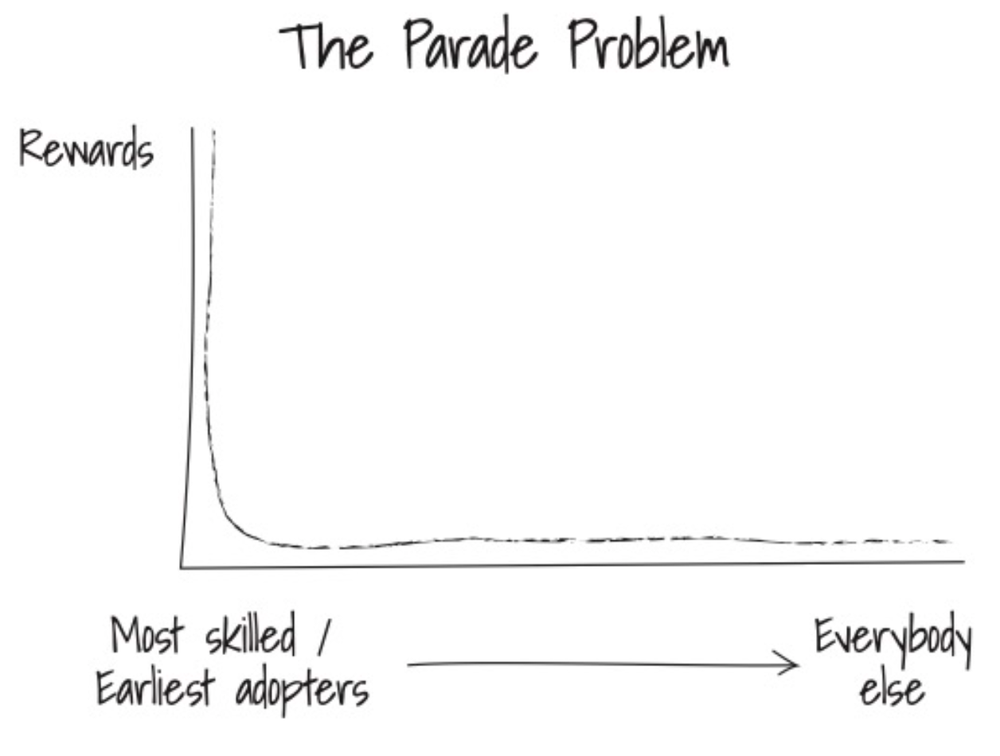
To appreciate how that works, imagine you’re at a parade. There are 30,000 people lining the streets. It’s packed; nobody can see. Then one person stands on his tip-toes, and has a good view for a few seconds… until everyone else stands on their tiptoes too.
Warren Buffett said it best: “Your view doesn’t improve, but your legs begin to hurt.”
Every time tech presents a new way to share information, collect data, advertise, create content, or market in any way, it seems like that tool is an immediate winner. By standard measures, the tool often appears better than whatever you were doing before: It seems like a more scalable way to reach people, an easier way to entertain, a new filter to be more attractive, or a better algorithm. The list goes on.
The problem isn’t that it doesn’t work. The problem is that it works equally well for everybody.
Viewed individually, the trendy thing right now often makes sense to use. But when everyone starts to use it, the impact neutralizes everybody else’s successes.
The more people playing the same game, the harder it is for anybody to win. What initially looks like an advantage unfortunately results in us all working more, benefiting less, and burning out in an endless cycle of one-upmanship.
It’s true that social media is an incredible way for you to reach people. It’s true for me, too.
It’s also true that technology allows you to precisely target potential customers with advertisements; me, too.
And, yes, it’s true that artificial intelligence is a fantastic way for you to create huge amounts of content; me, too.
For the earliest adopters and the most skilled, the rewards are huge. However, democratization of technology results in what can only be compared to a developing country’s economy: A few super-rich elites, no middle class, and the majority of the population working hard, yet poor, hungry, and hopeless.
The problem looks like this:
Image credit: The Obvious Choice by Jonathan Goodman
There’s currently 254 million posts with the hashtag #photographer on Instagram. Unsurprisingly, the solution to getting bookings is not to somehow outdo them all when you produce #photographer post 254,000,001.
We all start at the same parade. The solution isn’t to try to stand a bit taller. It’s to find your own parade. Or, simply make friends with somebody who has already found a good seat.
A Better Way to Use Social
Here’s a case study of how to do it right.
Jeff Steinberg runs an online community for parents. Once someone joins, he has no trouble converting them tino being clients for his paid Fit Parent Project offering. But he had a problem: Although he was creating content on social media, not enough people were joining his community.
This shouldn’t be a surprise. You don’t compete with other business owners when you create content. You compete for attention with full-time influencers.
Feeding the machine is exhausting. On top of running a business, it’s often too much. If you enjoy content creation, then, obviously, keep going. But most do not enjoy it. Most people tell me it’s a constant source of anxiety, frustration, and burnout, but they don’t know a better way.
Eventually, Jeff stopped trying to find customers by producing social media content. He instead did a search for mompreneurs with at least 10,000 followers. These women were already selling healthy products at premium prices to Jeff’s target market. And people who buy premium health products, buy lots.
One of those mompreneurs is Rhowena, who owns and operates Healing Mama Co. She makes pre- and postpartum kits for expectant mothers. Her Instagram page had 20,000 followers.
At the time, an Ultimate Labour & Postpartum Hospital Bag from Healing Mama Co. cost $288.88. Jeff bought one and did a collaborative giveaway with Rhowena on Instagram. To enter, people had to join Jeff’s Fit Parent Project online community (which is where the winner was announced). More than 100 people joined.
Most people view social media as a tool for generating attention. And it is. But you’ve got to be all-in on content creation — a game most business owners I speak to don’t want to play.
That’s why I wrote above: It’s better to build your account like it’s a sales page — with updates, case studies, and testimonials. Its job isn’t to attract attention; its job is to convert attention that was attracted elsewhere.
Jeff’s minimum coaching package costs $2,000. He could run seven promotions with Rhowena and get one client to break even.
Within six months of shifting his focus away from the content hamster wheel, his business grew to the point where his wife quit her unfulfilling job and joined him in the business. And Rhowena was happy too: She made a sale — without having to make more content.
Founder of the Personal Trainer Development Center. Jonathan Goodman is author of The Obvious Choice: Timeless Lessons on Success, Profit, and Finding Your Way. Over 200,000 coaches and small business owners in more than 120 countries have purchased business development materials from him. Originally from Toronto, Jon spends his winters exploring the World with his wife and two young sons.
Imagine for a minute the experience consumers encounter when grocery shopping. As they enter a store or navigate online, in any given category, people will contend with similar product stories and formulations or ingredient claims alongside similar product packaging. Given the continued proliferation of brands, flavours, and forms, it can be a bit of a blur, perhaps bordering on confusing.
Most of the brand messaging they see will be analytical and based on assertions of “better-ness” in the form of ingredient comparisons, quality assertions, or claims of formulation and taste superiority. What’s missing is the type of beneficial distinctiveness that sets a brand far enough apart that such comparisons become moot.
The battle for market share, sales velocity, and sustainable business results resides in the six inches of grey matter between both ears of your brand’s core and prospective customer base. Your real marketplace challenge is how to secure and maintain mental real estate.
Take the best-positioned brand in the beer industry. Much to the chagrin of all other large beer manufacturers, Corona is in a class by itself, having honed and invested in its association with beach, surf, sun, and vacation-in-a-bottle vibes. Even the lime ritual helps fortify the mental associations of wanting to relax in that sunny beach locale while enjoying a cold bottle of Corona. Notice the brand never talks about its liquid, brewing credentials, or quality of ingredients. It’s an emotional proposition and distinctively owned by Corona as a desirable lifestyle image association. This is positioning at its finest in a business where brands routinely fly over this important work by running a clever ad campaign featuring a catchy slogan.
Do you see where this is going when you rise above self-promoting product features and focus on the consumer and their lives and how you can operate as an enabler of their hopes and dreams. Suddenly, you find yourself in rarified territory, exploring a path to uniquely position your brand in a more powerful way – creating a meaningful correlation that can take root in the consumer’s brain.
Far too many brands don’t labour at this. Instead, they focus squarely on themselves — through a circular story about product bona fides and feature advantages. It’s important to consider that consumers no longer buy products. A purchase is now a flag and symbol of what they believe in, their values, and who they are. Want to have a deeper relationship with your core users? Then, imbue your brand with deeper meaning. Give them something larger than themselves to embrace and advocate for.
By doing so, you open an incredibly important strategic examination of how to create a memorable, sticky brand position. Consumers are naturally drawn to a brand with a higher purpose and belief system that aligns with their own.
Just be careful not to conflate a strong brand position with an advertising campaign. Creating emotional context around your brand and its “why” is a more demanding exercise. We refer to it as curating your Brand Stand — a decisive view about why your brand exists and its human-relevant purpose. It will serve as an anchor for every business decision coming after it, the value you create and how you do what you do.
We won’t devote space here to examining all the prescriptive details around brand positioning discovery. Perhaps the most important guidance we can offer is embracing uniqueness and differentiation—especially important in business categories where sameness (most of them) is a systemic problem.
What are your core customers’ beliefs and lifestyle aspirations? How can you further support and enable their hopes and dreams as your brand’s superpower? Suddenly, you are marketing something more vital to them than the table stakes expectation of a well-designed and produced product.
Positioning Is Most Effective When Trust Breaks Out
Values and beliefs – a higher purpose brand that has a belief system beyond transactional considerations is immediately trustworthy
Consistency – when the experience with your brand across all points of contact is reinforced through repeat performances, you earn trust
Keeping promises (walking the walk) – when earning trust, efforts to demonstrate dependability through actions and behaviours are more powerful than words
Social proof – validation and verification of your competence through the testimonials of real people is powerful affirmation of trustworthiness
Transparency – another form of validation is taking consumers behind the corporate curtain for an unfiltered look at what you do and how you do it. Showing extraordinary openness is characteristic of a trusted brand
Help rather than hype – If you truly care about your customer’s well-being and success, you will operate unselfishly as an enabler of their lifestyle goals and wishes, earning their trust along the way
A uniquely positioned and trusted brand is your organization’s most powerful business-building asset. Your devotion and energy to creating emotional connectivity and trustworthiness are the formula for rising above the competition and driving sustainable, profitable growth. Positioning creates a memorable place in the brain, while trust seals the deal. Together, they deliver a formidable and powerful business-building platform.
Contributed to Branding Strategy Insider by Robert Wheatley, CEO of Chicago-based Emergent, The Healthy Living Agency.
Branding Strategy Insider is a service of The Blake Project: A strategic brand consultancy specializing in Brand Research, Brand Strategy, Brand Growth and Brand Education
Your customers don’t think the way you think they do. These counterintuitive marketing tactics can help you connect.
Most of us think great marketing is all about closing the deal, but what if telling people they don’t have to buy is the real secret?
Maybe you’ve experienced this too, that moment when someone shares an idea that feels so against your instincts, you want to reject it outright. That’s what happened when my friend, behavioural scientist Nancy Harhut, introduced me to her counterintuitive marketing strategies last year at SXSW. Her suggestions initially felt weirdly unnatural—like wearing shoes on the wrong feet. But after digging into the research in her book, Using Behavioral Science in Marketing, I immediately knew these ideas could be the key to unlocking real results for modern business owners.
Here’s the thing: Sticking with the way we’ve always done marketing feels comfortable, safe even. But as Harhut pointed out during our conversation, it’s often those uncomfortable and unexpected moves that set you apart and create success.
Here are three of my favourite unconventional ideas from her behavioural science playbook that can transform your marketing strategy.
1. Tell customers they don’t have to buy
Wait—what? Isn’t the whole point of marketing to get people to buy? Yes, but telling someone they don’t have to can paradoxically make them more likely to do it. It’s all about autonomy bias, Harhut explains, a psychological need we all have to feel in control of our decisions. No one wants to feel pushed or cornered.
This is where the “but you are free” technique comes in. You make your ask, and then follow it with a simple statement like, “But you are free to decide.” Studies show this can double the likelihood that someone will say yes. Yes, double. Why? Because you’re giving people the freedom to choose, and that makes them more open to doing what you ask.
I’ll admit, this idea felt strange to me at first. With 14 years of sales experience, I’ve been trained to close hard, not back off. But research, like this study from the University of Bordeaux, proves that giving people a choice empowers them. It’s a small shift in language that creates big results.
2. Lead with loss, not savings
We love telling customers how much they’ll save. It’s Marketing 101, right? But Harhut flipped that script for me, reminding me of the concept of loss aversion and how powerful it is in our marketing messages. Simply put, people are twice as motivated to avoid losing something as they are to gain something.
Here’s a striking example: Researchers told homeowners they could “save 50 cents a day” by insulating their homes or “lose 50 cents a day” by not insulating. The second message resulted in 150 percent more people taking action. Same exact information, different framing.
If you’re running a sale, instead of saying “Save $20 today,” try “You’ll pay $20 more tomorrow.” It’s a subtle but powerful reframe that leverages people’s fear of missing out to drive immediate action. Yes, it might feel like you’re treading into fear-based marketing territory, but as Harhut stresses, the key is honesty. If the sale really does end tomorrow, you’re doing your customers a service by letting them know.
3. Start with your highest price
When listing prices, it’s tempting to lead with the lowest option to avoid scaring people off. But Harhut has learned that starting with your highest price can actually boost revenue. It all comes down to anchoring—our tendency to rely heavily on the first piece of information we see.
In one study, researchers tested this with beer prices in pubs. When menus listed beers from most to least expensive, revenue increased by 4.2 percent. “When you anchor on the highest price first, everything beneath it looks more attractive. It’s easier to get someone from $30 to $22 than from $13 to $22,” Harhut explains.
For founders worried about price shoppers, you should display all options clearly, starting with the highest. This way, customers see the affordable choices in context, making them feel like a better deal.
Embrace temporary awkwardness for long-term success
The truth is, trying these strategies might feel awkward at first. Telling customers they’re free to walk away? Framing losses instead of gains? Leading with your priciest option? These moves go against much of what we’ve been taught about marketing.
But I often remind leaders and sales teams that clinging to old habits can be the biggest mistake of all. “Periods of disruption make us cling to what we know, but that can be a mistake. Companies that embrace behavioural science tactics during these times are the ones positioned for greater engagement and response,” Harhut explains.
Behavioural science shows us that people don’t make decisions the way we think they do. If we want to connect with today’s savvy customers, we need to step out of our comfort zones and test what works.
When you’re willing to embrace the awkward and test the unexpected, you’re not just creating marketing—you’re creating results.
Mark Zuckerberg’s horrible changes for Instagram — and Facebook — have become untenable, writes Lennon Torres.
Mark Zuckerberg stood up in the Senate hearing room on Capitol Hill, turned around, and began to speak. It was hard to hear him over the camera clicks. I felt the room lift behind me as bereaved parents held up photos of their dead kids, lost to suicide or exploitation following exposure to Zuckerberg’s online platforms. I realized I was standing by the time I could make out any of his words. “I’m sorry for everything you’ve been through,” he said.
This deeply craven and dangerous reversal, ostensibly to reduce “censorship” from Meta platforms, will make Instagram, Facebook, and WhatsApp even more unsafe for LGBTQ+ users. That’s why, after 13 years on Instagram, amassing 80,000 followers, and having monetarily benefited from being an influencer, I am finally leaving Instagram.
I initially joined Instagram because it was what all of my friends were doing. As a young dancer featured on television shows, it was a place to build and maintain connections and community. It was also a business, a place where I could earn money for more dance training and raise awareness about causes and issues I cared deeply about. But over time, due to policy and content moderation decisions made — or not made — by Meta, it went from something fun and engaging to something that fuelled anxiety, took over my childhood, and ultimately caused harm to me and people I love.
At the end of the day, social media is a product of its environment, and the environment is getting worse. The rise in hate speech on social media has become a significant concern in recent years. Meta’s decision to end its fact-checking program and ease content moderation will only add to the increase in harmful behaviours, including harassment and hate speech, especially if Zuckerberg implements something similar to X’s community notes. Giving anyone with a valid phone number and six months of a clean record on the platform the status of “approved moderator,” a status kept anonymous, is not enough to keep harmful disinformation and hate speech from spreading.
That doesn’t mean members of the LGBTQ+ community should lose hope entirely. There are people fighting to hold technology companies accountable and to make online spaces better. It’s important that young LGBTQ+ people know that there are people, like my colleagues at Heat Initiative, fighting for Big Tech to clean up their act, so that isolated members of the LGBTQ+ community aren’t forced to turn to dangerous online experiences when their in-person community fails them. The unfortunate reality is that, right now, the LGBTQ+ community is harmed disproportionally more on these platforms than their peers. Zuckerberg’s actions will only accelerate the risks that young LGBTQ+ people face on Meta’s platforms.
Lennon Torres protesting an an Apple store for the Heat Initiative.Credit: Photo by Johnny Makes
But no one in the LGBTQ+ community should be under the illusion that social media or the newest technology will inherently increase connection or belonging. At least not without thorough protections. After I saw that even Apple CEO Tim Cook, a so-called LGBTQ+ advocate, donated $1 million dollars to the Trump Inauguration and sat directly behind the now president as he took the presidential oath, I was reminded again that technology CEOs are focused only on protecting their power. That unsettling realization and Zuckerberg’s announcement left me asking myself if I will keep using these platforms. Our LGBTQ+ community must come to terms with the fact that tech tycoons like Zuckerberg, Musk and Cook don’t have our best interests at heart. Ever.
Ultimately, we have to reckon with the fact that Meta’s new policies are just the latest in a long line of decisions that have put LGBTQ+ users at risk on their platforms. To know they have a ton of hate speech on their platforms, are building algorithms meant to addict young users to their products for life, and are actively moving to ensure less content safety, I can’t sit idly by and use their platforms. Zuckerberg is taking the company in a fundamentally dangerous direction.
It is so clear to me that the young and wild toxic relationship of my youth was not with a romantic partner or friend, but with Mark Zuckerberg and the products he has built to imprison and profit off of our attention. And like many exes do, he sticks around uninvited — and I am certainly done giving him a pass.
Feature Image Credit: Rob Dobi for Getty Images
By Lennon Torres
Lennon Torres is an LGBTQ+ advocate who grew up in the public eye, gaining national recognition as a young dancer on television shows. With a deep passion for storytelling, advocacy, and politics, Lennon now works to center the lived experience of herself and others as she crafts her professional career in online child safety at Heat Initiative, aiming to bridge the gap between online safety and LGBTQ+ representation through intentionally inclusive strategies. Lennon’s LinkedIn: https://www.linkedin.com/in/lennon-torres-325b791b4/
This is the sixth year that I’ve compiled a set of customer experience-related predictions for the coming year.
For each article, I gather together a set of predictions that have been sent to me over the preceding month. Last year, I received 263 different predictions from 140 different people.
This year, 208 different leaders in the service and experience space submitted 396 different predictions, which represents a nearly 50% growth in both the number of people who have participated in the process and the number of predictions they have submitted compared to last year’s predictions.
I then conduct an anonymized review of the predictions, select the ones that stand out and make the most sense in the current context, arrange them into themes, and add a bit of commentary.
I’m over the moon that so many people have taken the time to send me their predictions. And, it’s no small undertaking to whittle them down into what are, I hope, a coherent and useful set of themes and predictions. That being said, I always find the whole process incredibly rewarding and a great learning experience.
Before we get into the predictions, I’d like to thank all of the people who sent me their predictions.
But I’d also like to apologize to those whose predictions I haven’t been able to include. All I can say is that competition to be included gets more and more intense every year.
So, without further ado, here goes with 2025’s predictions:
Looking towards the horizon. getty
1. With more uncertainty on the horizon, economic conditions will remain tough for many consumers. Leading brands will respond by helping them manage their budgets and make smarter purchasing decisions.
“As economic conditions remain tough for the average consumer, we anticipate a significant surge in the adoption of brand-funded cashback offers. These can be either short-term campaign/UPC specific offers or ones embedded natively through a brand’s evergreen/loyalty platforms. To support the uptick in cashback programs, receipt scan technology usage will increase. The result of this will be a simplified, consumer-friendly experience that simultaneously provides brands with rich first & zero party insights on changing consumer behaviours. Ultimately, this will enable brands to make smarter use of their marketing dollars and empower consumers to make more informed purchasing decisions.”
“With the high likelihood of heavy tariffs on imports* taking effect in 2025, the consumer base should expect to see price inflation to match. Inflation leads consumers to buy smart rather than buy by impulse. With consumers being more price conscious and analysing purchases to ensure they are making the right decisions, artificial intelligence (AI) will come into play heavily as it caters the shopping experience to a consumer’s needs. Amazon has begun leaning into AI on their consumer platforms, making AI generated shopping lists based on a consumers purchase history and aggregating key insights from reviews to make a consumer’s decision easier. Amazon’s Rufus was just announced this year and is constantly being iterated on, using generative AI to enable consumers to ask specific questions and be given direct responses. As the tech learns more, this could be a play for the price conscious consumer to ask “what is the best deal on cordless vacuums today?” or “when is the best time to buy a TV on Amazon?” to help guide their purchase decisions.”
Editors note: This comment applies to the U.S.
Meanwhile, Angie Westbrock, CEO at Standard AI, highlights what is likely to happen in the offline retail space when she predicts:
“As inflation continues and economic uncertainty rises, we will see a decrease in consumer spending on non-essential services like food delivery in 2025. Consumers will turn to cost-saving alternatives such as home cooking or in-store pickup options. We will see grocery stores adjust to capitalize on this shift by promoting more ready-to-eat options as well as continuing to invest in in-store shopping technology for personalization and convenience.”
Comment: Many consumers have faced a tough time economically over the last few years, and this situation looks set to persist, with many commentators talking about slow growth and a potential recession in 2025. In previous years, many brands have used tactics like skimpflation and shrinkflation to protect their margins at a cost to consumers and their experience. Therefore, it is heartening to see brands lean into consumer concerns, realise that they are more discerning about who they buy from when things are tight and are increasingly focusing on helping them get the most out of their budgets. Here’s hoping that these tactics are adopted widely.
2. Generative AI is fundamentally changing how consumers discover and purchase products as well as how they find information and get answers to their questions.
“What’s particularly noteworthy is the shifts we’re seeing in how consumers discover and purchase products. The traditional search engine-driven journey is being bypassed, as more consumers are turning to marketplaces and platforms like Amazon and TikTok for personalised recommendations and trend-driven insights. With Amazon being the go-to platform for convenient eCommerce and Gen Z increasingly using social media as their primary discovery tool, this shift was inevitable. Amazon now accounts for 37.6% of e-commerce sales — the largest share in the industry.”
“2025 will mark the rise of the answer economy. Traditional search engines will no longer be the default way people get information or the answers to their questions. As consumers get used to the instant gratification of asking AI anything and getting an immediate response, using a search engine to look something up, scrolling through potential results, and clicking on pages of information to learn more will be a thing of the past. Already, 60% of Google searches in the US and EU result in zero clicks, as many people don’t want to click endlessly to find what they’re looking for. For marketers, this will mean shifting focus from search engine optimization to a generative engine optimization model, demonstrating how fast you can provide answers without expecting consumers to search through mountains of content.”
Finally, Adrien Menard, CEO & Co-Founder at Botify, highlights the some of the challenges brands will face in this new environment when he predicts:
“Brand visibility is undergoing a complete transformation. In 2025, we’ll see consumer behaviour shift from predominantly Google-first searches to emerging players like Perplexity and ChatGPT Search alongside existing players with new GenAI capabilities like Bing’s Copilot. By the end of next year, expect to see three out of ten visits come from outside of Google, with the volume accelerating to even higher numbers in the next five years. To accommodate this new reality and thrive in the GenAI search environment, CX leaders must develop governance strategies to manage AI bots’ role in driving brand visibility. Then, brands can focus on how often search engines visit their site and how fast their pages load, helping them reach consumers where they are – regardless of where they search.”
Comment: For the longest time, traditional search engines have dominated how consumers find and research products and services. Generative AI and other platforms are fundamentally changing this landscape. This will pose significant challenges for brands in terms of how they show up, help and are found in this new environment.
3. Changes in the search environment and saturation in other digital channels will see a resurgence in organic brand marketing.
“In 2025, brand marketing will be the growth lever that matters most. Why? Because algorithms have perfected the art of optimizing for every last click and conversion. Performance marketing has become a well-oiled machine that excels at capturing intent—but this fierce competition has driven costs up and now brands scramble to compete. With every performance dollar fighting for a shrinking pool of intent-based leads, it’s getting harder to stand out and generate incremental growth. Building a strong, memorable brand will be back in vogue as the way to create new demand and capture attention before consumers are even in a buying mindset.”
“I believe we are at a stage where businesses are heavily leveraging generative AI, levelling the playing field between small brands with limited budgets and large corporations with vast resources for branding, copywriting, marketing strategy, and communication optimization. While this presents an incredible opportunity for small businesses, I foresee a wave of saturation in ads that share the same ‘AI flavour’—polished visuals, compelling copy, and expected yet highly effective strategies. In this landscape, it will be crucial for companies to stand out by embracing highly creative, radical, and unconventional marketing approaches. Those who successfully break free from the predictable ‘AI flavour’ will have a profound impact, as customers increasingly crave authenticity and originality amidst the growing sameness.”
“As digital marketing channels grow more saturated, expensive, and subject to algorithmic changes, brands will shift focus back to organic marketing to reduce reliance on paid channels. Authentic, grassroots community-building strategies—such as user-generated content, influencer partnerships, and SEO-driven content—will make a resurgence. This organic approach will help brands de-risk bad data or inaccurate targeting issues that come with bloated digital budgets, providing a more stable, authentic path to customer acquisition and engagement.”
Comment: In the face of changes in the search environment, increasingly saturated and expensive digital channels as well as a potential tsunami of bland AI content that will make it hard for brands to stand out in a sea of sameness, it’s not surprising to countenance a resurgence in organic brand marketing. Personally, I’m excited to see how brand marketers will embrace this challenge and what they will come up with.
4. After the hype and excitement of 2024, the application of generative AI in the service and experience space will face some challenges in the coming year.
“2025 could be a tough year for generative AI. After a lot of hype, it is likely to drop into the ‘trough of disillusionment’ in the coming year, and might already be there. Gartner predicts at least 30% of generative AI projects will be abandoned after proof of concept by the end of next year, due to poor data quality, inadequate risk controls, escalating costs, and unclear business value. However, concurrently, it will start to prove its worth within the contact centre. In the coming year, we expect AI to shift from being perceived as a high-risk investment to a necessary tool for delivering personalized, efficient interactions at scale.”
“50% of AI projects will fail to scale in 2025. Here’s why: companies underestimate complexity and overhype the quick wins. The potential opportunity is enormous – for businesses that use these failures to pivot and rethink their approach. The winners will be the companies that bring in expert partners who can blend human intelligence with AI to create a scalable, resilient CX model.”
“In 2025, it will no longer be enough to just “adopt AI”—companies will need hard ROI metrics to prove its value. We’re now a couple of years into the generative AI boom, and I think it’s fair to say that the technology hasn’t yet lived up to its hype. CIOs and CTOs will demand concrete metrics before approving new AI investments. Going forward, companies are going to need hard ROI to justify spending on AI tools. Metrics like “80% of code now touches AI” or “50% of customer queries are resolved by AI” are going to be essential. It’s no longer enough to just demo an AI solution and assume it will add value. We need quantifiable outcomes. And the companies that can show hard data on cost savings or productivity gains are the ones that will actually see AI succeed in their business.”
Comment: There is no doubt about the transformative potential of generative AI, particularly in the service and experience space. However, with economic conditions remaining tight, new AI projects and investments are likely to face increased scrutiny in the coming year. That does not mean that we will automatically see a waning of demand. Rather, we are likely to see the mood switch from excitement to focused pragmatism.
5. Education and capacity building will help organizations ensure that their AI investments deliver value.
“2024 has been the year that companies have taken AI out of the playground and into production as they build on successful pilot projects and establish new ways of working that automates previously time-consuming tasks deliver huge productivity gains. In the field of customer experience and service, AI is a transformative force that can help brands scale their content creation to deliver true personalisation for their customers, as well as interrogate the vast amount of customer data they have to develop new and enhanced services.
Coming into 2025, organisations will need to turn their attentions to enablement and education, ensuring everyone across the business – from users to leadership and advisory boards – understands not just how AI and generative AI should be used to boost productivity and enhance the customer experience, but also where the guardrails are to ensure responsible and appropriate use. Those companies that put a focus on AI governance and education will be well positioned to deliver greater personalisation, higher productivity and enhanced service to customers at scale.”
“If we are going to see AI become a foundational technology, then investments in staff training will need to grow. Unlike other technologies, GenAI is unique in that you can give it the same input multiple times and receive different outputs. The way GenAI processes data is different and it requires skilled human assistance to navigate the nuances of its response, along with specific training in prompt engineering. Every member of an organization will need AI training and many can expect to see that in 2025 with 62% of digital organizations planning to make greater investments here. Organizations that exclude training to only specific roles or teams will struggle when it comes to AI adoption, scalability and ROI.”
“The adoption of AI is already revolutionizing how customer experience (CX) teams operate. Yet, not all implementations are driving the value that organizations expect. Our research indicates that many contact centre and CX leaders struggle to identify which AI technology best meets their business needs (37%), and more than a quarter (27%) don’t know how to measure the ROI of their AI investments.
To combat these challenges, we’ve started to see organizations form AI councils or hire chief AI officers – aimed at guiding procurement, implementation and full enterprise adoption. I expect these initiatives and hires to proliferate in 2025. On the one hand, educated adoption decisions can help ensure that your AI investments are delivering the value you expect, whether that’s improving CX, driving operational efficiency, supporting contact centre agents, or other goals. On the other hand, having an unnecessary number of decision makers involved can slow or even halt procurement processes, causing organizations to fall behind the AI curve. Organizations must find the balance between agility and responsible AI adoption if they’re going to remain competitive.”
Comment: After a couple of years of pilots and experimentation, organizations are starting to realize that to get the most out of generative AI requires a new set of skills and capabilities. Moreover, generative AI-powered software is unlike other traditional enterprise software and requires additional internal resources to operate, manage and develop it in order to get the best out of it. Dedicating these additional resources and developing the right set of skills and capabilities across organizations will be crucial to successful implementations and future developments.
6. Meanwhile, many organizations will move away from generic generative AI tools and gravitate towards more specialized solutions that are better able to address their specific objectives.
“In 2025, we will see more businesses choose or switch to trusted AI providers, built on a heritage of experience and owned rich data, in order to realise immediate business value from AI. Companies will move away from generic AI tools that lack the foundational industry-specific data and proper guardrails required to deliver accurate, relevant and appropriate results. Instead, they’ll gravitate toward AI providers with proven expertise in the CX domain that deliver a single, unified AI-powered platform able to automate every interaction and drive next-gen customer experience.”
“Next year, enterprises will shift their approach to purchasing AI solutions for CX departments—moving away from large, proprietary and expensive AI ‘copilots’ towards smaller, more efficient and customizable solutions. The increasing cost of AI deployments and limited ROI on existing AI investments has driven this shift. Smaller, customized AI solutions let enterprises address targeted challenges in their CX departments, without the overhead of massive, one-size-fits-all models. Smaller models can also easily adapt to changing business needs and integrate into existing CX workflows.”
“In recent months, we’ve seen the release of several AI agents from the big players – but these generalized “all-purpose” agents don’t serve the unique business, use case, or industry needs of enterprises and brands. In 2025, expect a rise in purpose-built AI agents, designed to address specific objectives. Companies will increasingly adopt these tools for a range of use cases, for example to enhance the customer experience, optimize operations, or manage risk assessment.
One of the biggest use cases for purpose-built AI agents will be ensuring compliance. As organizations grapple with increasingly stringent regulations, AI solutions that are specifically designed to optimize compliance across many processes (such as brand and content) will be vital.”
Comment: This prediction is an echo from one of last year’s predictions that suggested that we are likely to see brands gravitate to specialized providers to address specific issues. As the gloss fades from some of the generic solutions in the service and experience marketplace and as organizations take a more focused and pragmatic approach view, this trend is likely to gather momentum over the course of 2025.
7. In pursuit of being able to deliver a personalized and engaging experience, brands will shift their focus towards first and zero-party data.
“Despite the decision to keep third-party cookies intact, in 2025, we’re finally going to see a sustained shift away from this model toward first-party and contextual data instead. Why? Because first party data is the only way to accurately understand and predict customer needs. True, third-party cookies are in limbo, but even if they weren’t, those data lack the richness and the signals needed to provide truly personalized experiences. AI-powered CX will very soon be table stakes; gen AI is being rapidly adopted by marketers globally, but it’s not as simple as plugging your existing data directly into your gen AI. As we head into the new year, brands need to understand that messy, unchecked data will give you messy, unchecked results that can alienate, frustrate, or even offend customers when it underpins customer engagement.”
Michelle Hoffman, VP of Customer Experience at Snipp, agrees and adds:
“With businesses continuing to collect and analyse vast amounts of data and uncertainty surrounding the future of third-party cookies, brands and marketers will shift their focus toward first- and zero-party data. This will enable brands and marketers to build more direct relationships with consumers to deliver hyper-personalized experiences and offer tailored products, services, and recommendations. Through this approach, we will see businesses enhancing customer satisfaction and fostering stronger brand loyalty.”
Comment: Brands weaning themselves off third-party cookies has been a long time coming. However, in the face of the challenges they are facing due to the changes taking place across digital channels and in the search environment, as highlighted above, we are likely to see brands finally make a concerted shift away from a reliance on third-party cookies to first and zero-party data. Hopefully, this will help brands start to deliver against some of the personalization promises that they have long been making.
8. Brands will realise that the key to unlocking the potential of AI and delivering a stand-out customer experience lies in clean data.
As more companies experiment with generative AI, many find their projects fail due to unclean or inaccurate data. This is the constant challenge: without good quality data, AI projects cannot succeed. Proof of concepts often fall short because they aren’t based on real data and lack the time needed for proper training of the AI. The best planned AI initiatives are shifting from proof-of-concept to proof-of-value, focusing on solving real problems – and these are set to become more than just buzzwords in 2025. Instead of merely demonstrating feasibility, projects should start with a concrete challenge and use real data to address it.”
“In 2025, real-time analysis of customer interactions will provide insights to optimize support and marketing efforts, improve knowledge bases, and streamline agent workflows. Last year, we saw businesses and brands consider the importance of data for building Gen AI processes. However, many firms just threw the data into Gen AI and wanted the model to digest it and understand it for them. However, increasingly businesses are realizing that the LLM is still a machine-learning model. So, the focus will be on the growing importance of first-party data, particularly considering precision and privacy issues. Companies are realizing that despite advancements in AI, clean, well-structured data pipelines remain essential for compelling customer experiences.”
Guy Marion, Chief Marketing Officer at Chargebee, goes further and predicts:
“As we look toward 2025, customer experience will continue to be a key differentiator for businesses. In 2024, nearly half of companies reported they planned to invest in artificial intelligence (AI) for operational improvements. The success of these initiatives hinges on one critical factor: clean, reliable data.
In a time when personalized experiences are essential, “dirty data” can undermine efforts. For businesses relying on recurring revenue, having accurate insights into customer interactions and preferences is crucial. It’s essential to ensure that your systems—like CRM and ERP—are well-structured and capable of supporting your AI ambitions. Clean data enables AI systems to deliver hyper-personalized experiences, allowing companies to recommend products and services tailored to individual needs.
In 2025, we can expect several shifts driven by clean data:
– Proactive Engagement: Organizations will anticipate customer needs, proactively offering support and information, which increases loyalty and satisfaction.
– Informed Decision Making: High-quality data will empower businesses to make agile, informed decisions that directly impact customer satisfaction.
– Streamlined Operations: Clean data will reduce inefficiencies and errors, leading to faster service delivery and improved customer experiences.
– Sustainable Growth: Companies prioritizing data quality will leverage AI more effectively, creating a competitive advantage and fostering long-term growth.
The importance of clean data is clear. Investing in a solid data foundation today is essential for unlocking AI’s potential and driving exceptional customer experiences in 2025. Don’t wait—start prioritizing data quality now to ensure your business thrives.”
Comment: Getting your data house in order was one of the key messages in last year’s predictions. Building on that, this year’s prediction about clean data shows that there is still work to be done. However, there is no escaping this requirement. Garbage In, Garbage Out, as the old computer engineer adage goes.
9. Building and maintaining a foundation of trust with customers will be at the heart of leading brand strategies.
“In 2025, the customer experience landscape will shift dramatically. Consumer expectations are high, and there’s no patience for poor experiences – especially in essential services like banking and utilities. A single negative interaction can prompt customers to cut spending, seek alternatives, which risks stunting growth.
But it’s not just about offering more; it’s about building trust. Consumers prioritise accurate information over mere speed or convenience. They demand that companies fulfil their basic commitments and deliver on promises. Trust has emerged as the cornerstone of customer loyalty.
Organisations must return to basics: clear communication, setting realistic expectations, and consistent delivery. Trust isn’t granted – it’s earned through every interaction and every commitment honoured. In this environment, meeting heightened expectations isn’t sufficient; you must exceed them while maintaining unwavering reliability.
Those who neglect these basics risk being left behind in 2025 as consumers gravitate toward brands they can rely on. Looking ahead, the real differentiator won’t be the latest technology or the flashiest marketing – it will be the ability to build genuine trust.”
“In an era marked by increasing data breaches and privacy concerns, cultivating trust has never been more critical. Customers are becoming more discerning, demanding transparency and accountability from businesses. In fact, less than half of consumers (47%) agree that GenAI has the potential to improve the communications they receive, and two-thirds (66%) are concerned about its security or have expressed ethical concerns (63%).
To foster trust, organisations must prioritise data security, ethical data practices, and open communication with customers. There needs to be a level of transparency around the use of customers’ data in order to build a foundation of trust between the customer and the provider. By demonstrating commitment to these principles, businesses can build lasting relationships and earn customer loyalty.”
“AI has the potential to enhance customer trust through personalization, efficiency, and predictive insights, but the risks of data privacy, bias, and loss of transparency are challenges. To build and maintain customer trust in an AI-powered world, organizations need to prioritize transparent, ethical AI practices, ensure data security, and strike the right balance between automation and human interaction. Organizations that clearly communicate how their AI and automation solutions work, why customers should trust its output, and how data is handled will be able to earn and maintain trust in this AI-enhanced future.
By leveraging AI to provide faster support, accelerate time to value, deliver personalized services, and offer real-time insights, organizations can help customers unlock greater value. Prioritizing ethical AI practices and combining automation with human expertise will not only enhance customer trust but also foster deeper, long-lasting relationships. Organizations that strike this balance will stand out as trusted partners in an AI-driven world.”
Comment: Back in 2018, Forrester published some research that introduced the idea of the ‘privacy versus personalization’ paradox, where their research found that 75% of consumers expect a personalised experience, but 49% have privacy and data protection concerns. Since then, and especially in the last couple of years, we have seen an explosion in the capabilities of technology and software. This is only exacerbating those concerns in the minds of consumers with many sources suggesting that their default position seems to be one of mistrust. Brands would do well to not only recognize this but to do something about it if they want to build long-term trusting and loyal relationships with their customers.
10. Contact centres will emerge as real-time data and insight goldmines
“Service and support functions, traditionally seen as cost centres, will emerge as strategic growth engines. Enterprises will dismantle operational silos, aligning service with sales, marketing, and product to create seamless customer journeys. Organizations will realize that service data is no longer just operational—it’s the foundation for predictive customer insights, churn prevention, and cross-sell opportunities. Leaders who elevate service from a reactive to a proactive function will unlock new revenue streams and improve customer lifetime value.”
“It’s a reality that customer care teams spend more time with customers than almost any other department. Traditionally, customer care has been considered a cost centre, with most call centres focused on efficiency—reducing cost per contact and the number of interactions. But this tide is turning. Support contact analytics now quantify contact reasons at a granular level, making this data accessible to product, marketing, delivery, and other teams for actionable insights.
For instance, analytics can create alerts for issues such as login problems, notifying the responsible team when contact volumes exceed a specific threshold for a given topic. Data-driven decision-making based on contact reasons transforms a company into a customer-centric organization in no time. In this new paradigm, every contact is seen as valuable. Agents engage with customers to truly understand their needs—not just to meet KPIs—because they trust that each interaction is an asset to the company, not a cost.”
Michael Wallace, AWS Solutions Architecture Leader for Customer Experience at Amazon, goes further and predicts:
“By 2025, AI analytics will transform contact centre leaders into the corporate world’s crystal ball gazers. They’ll tap into a goldmine of customer insights, turning every conversation into actionable intelligence. From spotting emerging trends to fine-tuning product development and sharpening marketing strategies, these AI-empowered CX leaders will drive business growth from the frontlines of customer interaction. It’s not just about solving today’s problems—it’s about predicting and shaping tomorrow’s opportunities.”
Comment: Organizations, helped by advances in analytics software, are waking up to the fact that contact centres spend more time talking to customers than any other part of the business. As such, they are sitting on a goldmine of real-time data. This realisation has been a long time coming and, for leading and progressive brands, will see their contact centres play an increasingly important and integral part in their organization’s data-driven decision-making going forward.
11. This will be facilitated by a cultural shift that sees brands taking a more connected, collaborative and whole-organization approach to customer experience.
“This year, there will be less of a focus on how customer support leaders can find their way into C-suite conversations, and instead will focus on how the C-suite can seek out insights from their customer support leads. Customer service teams, and specifically customer service leadership, will play a much more central role in your business’s success in 2025. Leaders should be looking to their customer service team for insights from everything from product fixes to predicting customer churn. Customer service sits on a wealth of insights and a mostly untapped dataset. Figuring out how to turn this valuable conversational data into actionable insights for the organization can and will positively impact strategic decisions across all departments.”
Chris Morrissey, Head of Zoom Contact Centre at Zoom, goes further and predicts:
“An AI-first total experience that focuses on connecting agents with the broader organization will differentiate and elevate CX.
In 2025, the customer experience (CX) will be defined by a more connected, collaborative approach across the entire organization. CX will no longer be just the responsibility of the contact centre — it will be a company-wide effort, with every department playing a crucial role in shaping and delivering seamless, efficient experiences.
AI will continue to automate more issues, and businesses must recognize that when customers do need to engage with a brand, they require quick, personalized, and accurate answers. To address this pain point, organizations will need to unite their teams, both inside and outside the contact centre. This, in combination with AI, will play a pivotal role in breaking down silos, allowing agents to quickly and accurately resolve customer inquiries by connecting them with subject-matter experts from across the organization. This could include billing, product, or field teams. This collaborative, interconnected approach will enable faster problem-solving so customers get the answers they need in real-time, no matter how they engage with the brand.
However, while AI will be an important tool, it won’t be the sole differentiator. The true key to elevating CX lies in creating an environment where shared accountability and collaboration are embedded throughout the entire organization. This approach not only addresses customer needs but also helps agents feel more connected to the broader company. By fostering a sense of value and boosting morale among agents, organizations can deliver better experiences. As customer expectations continue to rise, the need for businesses to evolve into organization-wide CX teams will be critical in delivering a ‘Total Experience’—one that is seamless, personalized, and above all, responsive to customer needs.
By the end of 2025, businesses that embrace this shift will be the ones leading the way in delivering not just great service but also exceptional experiences that truly set them apart. They will successfully balance the efficiency of AI with the human touch so that when customers need to engage with a brand, they receive quick, accurate, and empathetic responses from well-supported and motivated agents.”
Comment: In February 2022, Accenture published a research report called End-to-Endless Customer Service. The report found that, at the time, only one in five companies surveyed viewed the contact centre or customer service as a value centre. In addition, those who do so experience more than triple the revenue growth of companies still managing service as a cost centre. The report goes on to say that making this move takes more than just investing more in the contact centre. It requires a “mindset shift around customer service – from treating it as a problem-solving function and a cost centre to viewing it as value creation function responsible for delivering memorable customer experiences.” However, mindset shifts are hard and can often take time and lots of effort. Here’s hoping that we are truly starting to see a shift take place towards a more connected, collaborative and whole-organization approach to customer experience.
12. Voice, as a customer engagement channel, will see a surge in popularity
“Voice as a customer engagement channel will make a big comeback: The pendulum is swinging back in the direction of phone calls/voice as a dominant customer engagement channel. Even younger consumers, who have been more likely to opt for chat or self-service portals, will be turning to voice in greater numbers.”
“Conversational AI and voice-activated services will continue to evolve, becoming more natural and sophisticated. Businesses will integrate these solutions across channels, enabling seamless, human-like interactions that let customers access services hands-free or chat on the go.”
“Voice AI will emerge as a mainstream solution for managing customer interactions during busy periods and outside of regular business hours. This technology will seamlessly integrate with existing omnichannel communication strategies, providing consistent experiences across both chat and voice interfaces.
Advanced natural language processing capabilities will enable Voice AI systems to handle complex queries and engage in more natural, human-like conversations. By 2025, we can expect Voice AI to manage up to 30% of calls in some contact centres, significantly reducing the workload on human agents. This shift will not only improve response times but also enhance the overall customer experience by providing 24/7 availability and consistent service quality.”
“Voice interaction will be a standard feature in mobile apps, enhancing convenience and flexibility in customer communication.
Voice interaction will become a common feature in mobile apps, allowing customers to engage with brands through natural, hands-free communication. This shift will be driven by advancements in voice models, which offer a more convenient and flexible alternative to text-based interactions. As businesses aim to enhance user experiences, they will integrate voice capabilities into their apps, making it easier for customers to perform tasks, ask questions, and receive support without needing to type. Before fully integrating these capabilities, companies will need to take a gradual approach, testing voice interaction features in certain scenarios to ensure they meet user expectations. The move toward multimodal communication — combining voice, text and chatbots — will improve accessibility and create more seamless, intuitive customer interactions.”
Comment: As part of my 2023 predictions piece, Colin Crawley, former CX Adviser at Freshworks in his prediction said “Voice memos are one of the most popular ways Gen Z communicates, with a third saying they prefer it over text messages. Gen Z makes up nearly 40% of the U.S. consumer base, so its key businesses jump on the voice memo bandwagon to meet the needs of this demographic.” Consumers, and especially Gen Z consumers, have been using voice, in the form of notes, as a means of communicating and finding out information (search) for years. The advancement in voice AI models is allowing brands to catch up, reply in kind in real-time and offer more sophisticated voice options that are better aligned with consumer behaviour, particularly that of Gen Zers.
13. Despite the challenges generative AI faced in 2024, AI technology will continue its rapid evolution, with leading brands embracing new tools like agentic automation, Large Quantitative Models (LQMs) and composite AI in the coming year.
“While Large Language Models (LLMs) dominate the current AI landscape, their role in delivering customer experiences (CX) is often limited to enabling human-like text or voice conversations. However, customer’s usage of technology to communicate goes far beyond just voice conversations. People use photos, videos, and other context-rich data—often through their smartphones—to communicate with their friends and family.
Large Quantitative Models (LQMs) will uplevel consumer interactions with the brands they shop at. By incorporating contextual details like photos of damaged items, IoT error codes, GPS data, or app session metadata, LQMs can make interactions more dynamic and personalized. For example, instead of a lengthy back-and-forth about a technical issue, a customer would simply upload a photo, enabling the system to understand the problem and troubleshoot faster and more accurately. This shift will help bring CX into the 21st century, making interactions seamless, intuitive, and more aligned with how we communicate today.”
“In 2025, AI will move beyond the fragmented, experimental phase that defined its rapid growth in 2023. Instead, we’ll see a shift toward unified AI stacks—platforms that seamlessly combine machine learning, generative AI, and agentic automation into one cohesive system. This approach will replace the patchwork of specialized tools with smooth, end-to-end automation that feels fully connected.
With unified AI, companies won’t just be reacting to customer needs but anticipating them, meeting customers not just where they are but where they’re going. Imagine a world where every interaction feels effortless, where businesses are so in tune that customers feel genuinely understood and valued. Unified AI stacks will elevate customer experiences, creating intuitive, predictive, and truly satisfying interactions that build lasting relationships.”
“Composite AI will help extend the AI revolution beyond 2025: “Composite AI, or combining multiple AI techniques, will emerge as the next step in extending the AI revolution. Because Large Language Models (LLMs) are starting to hit natural performance ceilings when used in isolation, technologists will turn to Composite AI architectures that use LLMs as the orchestrating layer, seamlessly integrating them with specialized AI components like knowledge graphs, symbolic reasoning engines, and traditional machine learning models. This hybrid approach will help overcome LLM limitations such as hallucinations, outdated knowledge, and inability to perform complex calculations or real-time analysis.”
Comment: The number of new AI applications and techniques that are emerging on a weekly and monthly basis is sometimes mind-boggling. However, that pace is not set to let up. I attended Pega’s customer event in June this year, and according to their AI experts at a roundtable at the event, we are currently only scratching the surface of the number of techniques that are potentially available to us or will become available to us in the coming years. In fact, it was posited that we are only using 3-4% of the possible tools and techniques that potentially are in the AI toolbox. Here’s hoping that the lessons from previous years can be learned to prevent the recurrence of familiar problems and that a quicker path to value and better outcomes can be quickly realized.
14. Despite rising calls for the regulation of AI, global alignment in 2025 will remain elusive.
“The AI industry reaches a critical juncture in 2025. While we’ve seen promising steps toward self-regulation, history — and especially tech history — teaches us one thing: Self-governance alone is insufficient. We need adaptive, balanced regulations that keep pace with rapidly advancing AI capabilities.
However, the current policy landscape is dominated by tech giants, side-lining smaller players and risking anti-competitive outcomes. As we approach this pivotal year, the industry must foster a more inclusive dialogue, bringing diverse voices — from startups to creators and artists — into the conversation.
In the coming years, we’ll see a shift toward more comprehensive, flexible regulatory frameworks. These will need to strike a delicate balance between encouraging innovation and ensuring responsible development. As a result, companies will increasingly seek ethical data licensing partnerships and prioritize transparent, accountable AI models.”
“Because of the prominence and popularity of AI-powered tools, the race for regulation has begun, though the finish line remains elusive. The EU has put forth a comprehensive AI act, but that won’t begin to take effect for a while still. However, meaningful global AI regulation faces a crucial geopolitical reality: without alignment between the U.S. and China, arguably the world’s current AI superpowers, any regulatory framework will struggle to gain traction. And, despite the many impressive strides that have been made in AI technology recently, this tech is still in its infancy. Regulating it too early could potentially hamper competitiveness and kill innovation before it has the chance to bloom. We’re likely to see a period of regulatory uncertainty in the coming year, but one thing is clear: effective AI governance will require not just technical expertise, but adept diplomatic manoeuvring between global powers.”
Comment: There is increasing agreement that some form of global AI regulation would be welcome. However, current geopolitical realities mean that global alignment and agreement on what sort of regulation is required and how it will be enforced is, as things stand, a distant prospect. In the meantime, regional efforts will try and plug the gap, but until they are in place, consumers will have to rely on organizations to govern and regulate themselves. How transparently they do this will play a key part in how, as mentioned earlier, they are able to build trust with their customers.
15. And, finally, customer experience in the B2B space is primed to take some big steps forward.
“CX will become a cornerstone for the industries that traditionally don`t rely on it.
One of the industries that surprisingly started to rely on CX is manufacturing. Servitization, the strategy where businesses shift from solely selling products to offering a blend of products and value-added services to meet customer needs, has become quite a trend recently, as it helps producers build long-term relationships with the clients, build better customer experience, and raise loyalty to manufacturers.
Take, for instance, Rolls-Royce’s “Power by the Hour” model for aircraft engines. Instead of selling engines outright or charging separately for maintenance, Rolls-Royce offers a service where airlines pay based on the engine’s operational hours. This model includes comprehensive maintenance, repair, and spare parts, ensuring optimal performance and reliability. By monetizing its engine health data, Rolls-Royce provides predictive maintenance for aircraft engines, generating over $5 billion annually and comprising over half of its Civil Aerospace revenue.
Adding a continuous customer experience component in the manufacturing business model through leveraging servitization could generate $1 trillion in additional revenues for global manufacturers by 2030, according to McKinsey.”
“B2B companies have always driven a majority of their revenues through a direct sales force or a partner ecosystem with sales representatives close to the customer. B2C companies have proven significant revenues can be driven through digital channels. B2B companies, under pressure to maintain or improve profitability, will begin to lean into digital channels such as product led growth (customer buys through the product) and digital sales agents.”
Comment: For too long, too many B2B firms have dragged their heels when it comes to investing in customer experience. That seems set to change given that according to recent Forrester research, Millenials and Gen Zers, who are largely digitally native, now represent more than 71% of B2B buyers. For these customers, as well as others, this change will not come soon enough.
That’s it for predictions from me this year.
Thank you to everyone who sent me predictions to consider.
If yours didn’t make it, I apologize. But I did have a long list to whittle down.
However, of the fifteen themes that have emerged, I think there are some decent bets in there.
Adrian Swinscoe writes about customer service, experience and engagement and what it takes to deliver the sort of outcomes that both customers and brands crave. He has been exploring these areas and themes on Forbes since 2013. Described as an experimental CX thought leader and visionary, in addition to his articles on Forbes and a long-running podcast, Swinscoe has authored several books, including a best-selling 2016 book called How To Wow, a genre-busting 2019 book called Punk CX, and an exciting follow-up called Punk XL at the end of 2021. Follow Swinscoe for continued coverage of the customer service and customer experience space.
After four years as an executive coach, Bazaar’s careers agony aunt Jo Glynn-Smith decided to take the plunge and start her own podcast. Here, she shares her journey navigating a new medium
When I decided to pivot my career and become a coach, I did it with one mission in mind: to help people find the clarity, confidence, motivation and energy to achieve their goals. Now entering my fourth year of this career chapter, I get to live this reality every day, and that makes me smile. But one thing I don’t get to do, since my job is confidential, is share all the fascinating conversations and insights I gather from these extraordinary entrepreneurs, founders and game-changers – conversations that could make a real difference to others.
That’s where the idea for the podcast came from. I wanted to speak to people who have successfully started a business off the back of a 20-year career to inspire and educate others who may be doing the same or thinking about making a change – and so, The Midlife Entrepreneur was born. I’ve long dreamed of having a podcast (I love to talk!) but since I didn’t have the budget to hire a production company, making the dream a reality was a much steeper learning curve than I ever imagined it would be. Here’s what I discovered…
1/ Get advice from the start from an expert
At the beginning, I tried to work it all out myself, but I simply didn’t have the time or the patience to know what good advice was and what wasn’t. So, I invested in a course (I used Fallow, Field and Mason) and am so grateful I did. They guided me through every step and held my hand when I got stuck (which I did, a lot).
2/ Be prepared to embrace tech like never before
I’ve had to learn it all, including Descript, my all-in-one audio and video editing software that allows me to edit, transcribe and publish my podcast and video content; Buzzsprout, the podcast-hosting platform that helps me upload, manage and distribute my show to directories like Apple Podcasts or Spotify; YouTube, where I host my video clips for LinkedIn; other social channels (Instagram, TikTok) where I promote each episode; and ChatGPT, which helps me create caption adaptions quickly. Learning new tech skills at my age isn’t at all easy, but once you’ve cracked them, it feels great.
3/ Be focused, and persevere with learning new skills
You need patience and a lot of practice – particularly when it comes to something like editing, which is hard, especially if you’ve never done it before. Most of my frustrations came from tech fear and not wanting to mess it up – but eight shows in, my confidence is growing and I love the creativity and satisfaction of producing something tangible.
4/ Don’t invite too many opinions
It’s great to get advice and support, but be careful not to overwhelm yourself with it, however well-meaning. In the end, whether it’s the podcast’s name, the creative, the theme music or the social posts – as long as you’re happy with it, that’s what matters. Trust your instincts and just go for it.
5/ Dial down the perfectionism
Having come from a marketing background, I know what ‘good’ looks and sounds like, which can be a blessing and a curse. I can see mistakes all over the show, but my new mantra is: if it’s good enough, it’s going up! I’ve learned that I can’t get too hung up on trying to make it ‘perfect’, otherwise I can wave goodbye to my evenings for the foreseeable future.
6/ Don’t be scared to approach potential guests
I was nervous about finding guests at first, but I’ve found that most people are delighted and flattered to be asked. It offers them an opportunity to showcase their expertise and experience, which is great content for them too.
7/ Know your ‘why’
Creating a podcast is hard work; you need to know why you’re doing it. Don’t do it because you see everyone else doing it, don’t do it for fame, and don’t do it for money – do it because you’re passionate about something that you think will resonate with other people, and hold on to that purpose as your north star.
People who are angry with the decision accuse Meta CEO Mark Zuckerberg of cosying up to the Trump administration at the expense of turning the company’s social media platforms into more of a hotbed for misinformation and polarizing speech than they already are. Zuckerberg’s remarks that the company’s third-party fact checkers were “too politically biased” for his vision of “free expression” probably didn’t help matters.
Since Meta’s announcement, many users have called out inconsistencies with Zuckerberg’s newfound commitment to free speech. Meta admitted in mid-January that it blocked links to Pixelfed, an Instagram competitor. And just days after Zuckerberg took a front row seat in President Donald Trump’s inauguration ceremony, Instagram blocked searches related to a number of political hashtags, including #democrats and #jan6th.
People outside the U.S. might be considering their options, too. Meta says it will keep fact-checkers in markets outside the U.S. “for now,” but things could change.
So if you, like countless others, have had it with Meta’s algorithms whipping you into a frenzy over [insert cultural or political issue here] and are tired of the company slurping up your data to train its AI or send you targeted advertising and political messaging, then read on.
How to download your Facebook archive
Image Credits:Meta
If you’re really set on deleting (and not just deactivating) your Facebook account, you should download your personal information from the Facebook archives, which includes photos, active sessions, chat history, IP addresses, facial recognition data, and ads you clicked on.
Note that these instructions require a computer and a web browser, not a mobile phone.
Here’s what to do:
Click the down arrow under your profile picture in the upper-right corner.
Go to Settings & Privacy > Settings.
Scroll down on the left-hand column till you get to Your information, and click Download your information.
You will be prompted to visit the Accounts Centre. Click Continue.
When the pop-up appears, click Download or transfer information.
You can choose information from which accounts, including your Facebook, Instagram, and Meta Horizon accounts, to download. Click Next.
Choose how much information you want to download, and click Next. Note from FB: “If you select Specific types of information, you will be able to choose which kinds of information you want to download, including data logs.”
Decide if you want to download your info to a device or directly transfer your info to a destination and click Next.
If you select Transfer to destination, you can choose the destination and schedule future transfers. Once you make your selection, click Start transfer and enter your Facebook profile password.
If you select Download to device, choose your file options. There will be a list that lets you create a date range, and you can download in HTML or JSON, and choose between high, medium, or low media quality.
Click Submit request.
How to delete your Facebook account
Image Credits:Meta
Note: If you do delete your account, you cannot regain access to it. Facebook delays deletion for a few days after it’s requested and will cancel your deletion request if you log back into Facebook during this time.
Also worth noting, some information like messaging history isn’t stored in your account, so your friends might still have access to messages you sent after your account is deleted.
With that in mind, here’s how to do it:
Click your profile picture in the top right corner.
Go to Settings & Privacy > Settings.
Click Accounts Centre at the top left of the screen.
Click Personal details, under Account Settings.
Click Account ownership and control.
Click Deactivation or deletion.
Choose the account or profile you want to deactivate.
Select Delete account.
Click Continue and follow instructions to confirm.
How to download your Instagram information
There are two ways to find the web page where you’ll download your Instagram information — you go through the Accounts Center or your Instagram Settings. For the former, navigate to Your information and permissions to find Download your information. To get to Instagram Settings, click on the three parallel lines on the bottom left of your screen, then click Your activity…
Either of those steps will take you to the Download your information page. You’ll need to click the profiles you want to download your information from and choose if you want to download it to a device or directly transfer the information to another destination.
If you select Download to device, you’ll have to pick a date range, notification email, format of your download request, and quality of photos, videos, and other media — the same as with downloading your Facebook info. Then click Create files.
Once you’ve made the request, it’ll appear as In progress under the Current Activity tab in the Download your information tool. Instagram will notify you by email and on the app when it’s ready to go, and you’ll have four days to download the information.
How to delete your Instagram account
Downloaded your info? Now you’re ready to permanently delete.
Once your account is deleted, you can sign back up with the same username if it’s still available, if you have a change of heart.
How to delete your Threads account
Note: If you delete the Instagram account associated with your Threads profile, that will also delete your Threads profile.
But to delete only Threads, you’ll need to go to the Threads.net web page on a computer, and follow these steps:
Click the two parallel lines in the bottom left of the page, then click Settings.
Click Account at the top, then Deactivate or delete profile.
Click Delete profile.
Follow whatever prompts show up, then click Delete Threads profile.
It’ll take 30 days for the deletion request to go through. And if you want to sign back up with the same Instagram profile, you’ll have to wait 90 days.
Feature Image Credits: Alex Wong / Staff / Getty Images
Differentiating the in-store experience is key to reigniting demand for in-person shopping, according to the BoF-McKinsey State of Fashion 2025. Brands can achieve that by empowering their store associates to reach their full potential.
Key insights
Store associates can be a key differentiator in customer satisfaction across regions, according to the BoF-McKinsey State of Fashion 2025 Consumer Survey.
75 percent of shoppers are likely to spend more after receiving high-quality service from store personnel, indicating upsell and cross-sell opportunities.
A 2024 study found that more than 20 percent of missed sales at a prominent US retailer were related to issues with store associates, such as suboptimal engagement or unavailability of staff.
Now that the post-pandemic flurry of customers returning to stores has begun to cool, in-store sales growth is forecast to be around 1 to 2 percent on average across key markets in 2025, compared to the last few years of high single-digit to double-digit growth.
This normalisation comes as store foot traffic is approaching pre-pandemic levels across regions. Some markets like continental Europe anticipated surpassing their pre-pandemic offline market size in 2024.
However, the role of the store has evolved globally. It is estimated that almost 70 percent of retail sales today are digitally influenced, making stores more of a destination for conversion and building brand loyalty than initial discovery. 54 percent of apparel shoppers say they prefer to buy clothing in brick-and-mortar locations versus online.
As store growth decelerates, retailers will need to further differentiate their store experience from the competition to convert customers in stores. While retailers have been focused on delivering digital innovations in store, in doing so they have deprioritised some of the basics that shoppers returned to stores for in the first place, such as the human side of sales.
Now that the post-pandemic flurry of customers returning to stores has begun to cool, in-store sales growth is forecast to be around 1 to 2 percent on average across key markets in 2025, compared to the last few years of high single-digit to double-digit growth.
This normalisation comes as store foot traffic is approaching pre-pandemic levels across regions. Some markets like continental Europe anticipated surpassing their pre-pandemic offline market size in 2024.
However, the role of the store has evolved globally. It is estimated that almost 70 percent of retail sales today are digitally influenced, making stores more of a destination for conversion and building brand loyalty than initial discovery. 54 percent of apparel shoppers say they prefer to buy clothing in brick-and-mortar locations versus online.
As store growth decelerates, retailers will need to further differentiate their store experience from the competition to convert customers in stores. While retailers have been focused on delivering digital innovations in store, in doing so they have deprioritised some of the basics that shoppers returned to stores for in the first place, such as the human side of sales.
75%
— of shoppers in 2022 were likely to spend more after receiving high-quality service
more than 20%
— of missed in-store sales were related to issues with store staff, such as poor engagement or unavailability
Store associates are crucial in differentiating the store experience
Non-human elements of the shopping journey and store characteristics tend to be must-haves or hygienic factors. These elements drive both high satisfaction when present and dissatisfaction when not present, but do not tend to differentiate the experience or increase sales.
Human interactions such as interactions with store associates tend to be key differentiators of the in-store experience. These boost shopper delight and are key drivers of conversion and loyalty, since these exchanges are only possible in stores.
Human interactions are particularly important to aspirational and younger consumers. The former are up to 2x as likely to seek styling advice from staff compared to value and mid-market shoppers, and the latter are 1.5x as likely compared to shoppers over the age of 50.
Solving human capital challenges is essential to retaining associates in today’s labour market
Shoppers are the least satisfied with human interactions in their store experiences, scoring as much as 25 percentage points below other aspects on average, including fitting rooms and checkout transactions and store atmosphere.
Satisfaction with store staff is lower in the US, UK and Germany compared to China, where shoppers are around half as satisfied.
While satisfaction is low across age groups, shoppers under the age of 30 show higher net satisfaction of 43 percent compared to 32 percent for those aged 50 and above. In contrast, older shoppers tend to be more delighted by the store atmosphere.
In 2023, 75 percent of global companies across industries reported operating without enough frontline employees.
The labour shortage is particularly pronounced in retail. As of May 2024, there were 2.5 million more retail job vacancies than job seekers in the US. More than 44 percent of US retail workers are planning to leave their jobs within three to six months.
This is also evident in the luxury sector, where some flagships in Paris reported operating with staff shortages of 20 percent in 2024. Industry leader LVMH forecasts it will need to recruit 22,000 new workers by the end of 2025, nearly two thirds being sales associates.
In the past few years, US retail wage growth has outpaced other sectors. Since the pandemic, retail hourly wages have increased by over 20 percent vs 11 percent in the private sector.
Retail pay growth in the UK continues to outpace other sectors. In August, pay was up 9 percent year on year. This was partially driven by the near 10 percent increase in the national living wage in April 2024, which impacted a significant portion of the frontline retail population.
Rising workforce costs are making the industry’s high turnover more costly. Losing a single frontline retail employee can cost a retailer $2,000 to $10,000 on average. Costs tend to be higher for managerial positions and more experienced employees. Multiplied by thousands of employees across multiple years, those costs can weigh on a retailer’s bottom line.
up to $10k
— the average estimated cost of losing a single retail frontline employee
Upskilling staff and investing in tech support tools will enable better customer interactions
Upskilling store staff
Upskilling and training store associates is the top priority for executives aiming to improve sales and customer engagement in stores in 2025.
Professional development of store associates has long been a priority for retailers, given the young and inexperienced workforce (more than 30 percent of all first jobs in the US are in retail). However, the focus on training is expected to increase in the year ahead.
As staff turnover continues to rise, retailers will need to increase the speed and cost-efficiency of training. Formats like AI-powered training and micro-learning, where content is broken into small chunks, will play an increasingly important role.
Training has a positive impact on employee satisfaction and retention. One large retailer that implemented college-level courses and skills certification found its employees were four times more likely to stay in their jobs.
In 2024, Reiss partnered with AI-powered learning platform Thrive to boost employee development by enhancing the onboarding process, celebrating internal achievements and creating a collaborative learning environment. Meanwhile, Aritzia has a “University” programme that includes onboarding for new hires and ongoing training for existing employees. This year, it reported providing >80,000 hours of formal training.
Optimising customer interactions with tech
More than half of fashion executives agree that the use of digital tools to facilitate omnichannel sales will be a key priority in the year ahead.
As store associates shift to focus more on customer interactions, it will be important to arm them with the tools and knowledge to meaningfully engage with customers. New customer relationship management (CRM) enabled technologies can help store associates get real-time information about the customer they are interacting with to make for a better store experience.
Luxury and non-luxury brands alike have begun using technology to track engagement and connect with customers after they leave the store, while others are providing staff with data-backed, personalised customer recommendations for cross-sell and upsell opportunities in store.
For example, Kering’s clienteling app, Luce, provides store associates with tailored product recommendations and personalised promotions for customers. The app has boosted the average order value by between 15 and 20 percent.
Similarly, in August 2024, Target rolled out a generative AI-enabled tool called Store Companion at its >2,000 stores. The tool improves store associates’ efficiency by providing live coaching and on-the-job answers to questions about processes.
Employee incentives should reward customer lifetime value and reflect modern shopping habits
Creating staff incentives that prioritise customer interactions and relationship-building can increase both sales and employee satisfaction. When incentives align with the parts of work employees deem meaningful, they can feel more fulfilled and appreciated.
For any sort of incentive, the key performance indicators of staff success need to reflect new ways of working. Changes might include rewarding staff based on onboarding new loyalty members or driving omnichannel sales, such as digital sales ordered in store.
Revised incentives are required to reward customer lifetime value over individual transactions and better reflect modern shopping journeys. Browsing in store remains an influential channel for learning about products, yet as of 2021 only 31 percent of businesses measured the contribution of stores to digital sales, and vice versa.
Among the companies revising incentives is Frasers Group, which hosts a festival for its employees every year and holds monthly peer-nominated awards for “champions” across divisions, where winners receive public recognition plus double pay for that month.
This can directly impact retention rates. Dior saw a 10 percent improvement in employee retention after launching a platform where staff could earn performance-based points redeemable for tailored experiences, such as luxury spa days and wine tastings.
Nordstrom associates can invite customers to receive “Style Board” emails where they can curate collections of products and still receive commission on those digital purchases. Even though it is not mandatory, the majority of employees use the feature.
Store staff should be freed up to focus on customer-satisfaction drivers
Retailers are increasingly adopting data-driven approaches to staff deployment, improving both how and where staff allocate their time.
Leading retailers are capturing data on transactions and footfall, including movements within store, to make better scheduling decisions. Aritzia store scheduling decisions are informed on a daily and weekly basis by traffic data, shopper-to-associate ratios and sales productivity expectations.
Additionally, companies are testing different approaches to understand where human capital is best deployed to drive incremental sales. For example, a US-based sportswear brand reworked its staff deployment model after learning that staff coverage of the fitting rooms was key to driving both sales and basket size through cross-selling and upselling. Faherty uses gig-style staffing during holidays and high-traffic times to support backend activities like steaming and stacking. Using the specialised gig platform Reflex, the company employs gig staffing for around 10 percent of hours per week.
Streamlining manual tasks
Retailers can leverage technology to automate and streamline activities such as digital task management, ordering and production planning, which can free up employee time for more customer-centric activities.
For example, BJ’s Wholesale automates inventory tasks by using Simbe Robotics’ robot, Tally, which Simbe reports can reduce e-commerce fulfilment time and improve worker safety by automating tasks like manoeuvring large pallets.
Although the technology is not new, unlocking the full value of radio-frequency identifiers (RFID) in store operations should continue to be a priority for retailers in the year ahead. Correct implementation of RFID across inventory-related store processes can lead to a 10 to 15 percent reduction in associated labour hours.
Additionally, brands are increasingly testing customer-facing RFID use cases that make the customer experience more seamless while freeing up store associate time. Though nascent, RFID self-checkout is set to expand in the coming year; Radar, a technology company that works with major apparel retailers such as American Eagle, plans to launch its RFID-powered checkout function in 2024.
Uniqlo’s self-checkout, where shoppers drop items into an RFID-enabled basket, is used in 70 to 90 percent of transactions across markets and is credited with cutting transaction times in half.
Employee experience is central to customer satisfaction
In retail, there are six main factors that impact employee retention. US employees plan to leave their jobs primarily due to concerns about career development, citing limited growth opportunities. Compensation issues rank second, influenced by macroeconomic pressures. Employees passionate about the industry, however, tend to cite these factors as reasons to stay, hence investments in career development and compensation can be a “win-win” for retailers looking to reduce the high costs of staff turnover.
This underscores the importance of defining a company-specific target employee profile, whether that be career brand enthusiasts, retirees looking for a store discount or part-timers seeking flexibility.
Improved employee experience can make for more satisfied, tenured workforces and more satisfied customers, too. Companies with top-quartile employee experience are twice as likely to have top-quartile customer experience.
Employees with high satisfaction tend to have a higher calibre of output as they typically are more tenured and make fewer errors on the job. Retail workers also value customer interactions, citing “relational” elements of the job as a key part of why they deem the work meaningful.
How should executives respond to these shifts?
1. Enable staff with training and tools to improve customer interactions
Upskill store personnel by arming them with the knowledge and tools needed to improve customer satisfaction and engagement. This can include training them on relationship management and product expertise, as well as providing them with tools and real-time customer analytics to improve product recommendations.
2. Motivate store associates with broader incentive structures
Extend both hard and soft incentives to drive conversion and longer-term customer value, rewarding associates who drive future digital purchases in addition to immediate, in-person ones. Have corporate and in-store management champion the goals to illustrate how they are valued by the entire organisation.
3. Optimise processes to refocus store personnel on high-value activities
Automate and digitise select manual processes, such as merchandising and returns, to rework the role of store personnel in a way that drives customer conversion. Identify where to deploy sales associates versus automated or self-service options by analysing the key turning points in conversion that will maximise return on investment.
4. Retain employees with coaching and one-to-one interactions
Make changes to employee benefits to attract and retain high-quality store personnel, tailoring changes to the target employee and their motivations. In doing so, career development pathways will be essential in driving retention and brand buy-in. Leading retailers can achieve this by offering academy-style courses that fully immerse their associates.
This article first appeared in The State of Fashion 2025, an in-depth report on the global fashion industry, co-published by BoF and McKinsey & Company.
Tech firms that speed up and automate brands’ partnerships with social-media influencers are becoming hot commodities as advertisers scramble to reach consumers online
ShopMy, a technology company that helps brands run their influencer marketing efforts, said it has raised a $77.5 million Series B funding round co-led by venture-capital firms Bessemer Venture Partners and Bain Capital Ventures.
The investment values ShopMy at $410 million, up from an $80 million valuation in its most recent round in March 2024, according to people familiar with the matter. Other investors in the new round, which closed in December, include venture firms Menlo Ventures, Inspired Capital and AlleyCorp, as well as YouTube star Camila Coelho and influencers Jett and Campbell “Pookie” Puckett.
The funding continues a wave of investment that has washed into the creator marketing business over the past 12 months. Spending on influencer marketing is predicted to grow 14.2% year-over-year in 2025, more than social media advertising or digital advertising as a whole, according to predictions from research firm eMarketer.
ShopMy offers a number of tools, including those that help advertisers manage their gifting programs, identify effective so-called micro-influencers and generate commerce links for influencers in its network to share with followers.
Influencers get commissions when followers make purchases via ShopMy links, while advertisers use the links to track how many sales each influencer generates. ShopMy charges advertisers subscription fees as well as its own cut of sales that come through its links.
Technology platforms catering to influencer marketers are attracting more investment and clients as they get better at measuring and tracking whether and how money spent on creators leads to cold hard sales, said Chris Erwin, founder of creator economy advisory firm RockWater.
“Influencer marketing always used to be essentially the top-of-funnel, where you can drive awareness around products and services,” Erwin said. “So affiliate commerce, where creators create these shoppable storefronts or shoppable links and then have the technology and tools to actually convert those fans and audiences into paid customers of products, became really compelling.”
Four-year-old ShopMy said more than 550 brands have active subscriptions with the company, and more than 100,000 creators have signed up. ShopMy has engaged in marketing of its own to lure influencers over to its platform, including a poster campaign and a party at the swanky private members club Zero Bond during New York Fashion Week last September.
The social commerce space in the past few years has grown competitive and contentious. Mavely, a similar platform, was bought earlier this month by influencer and social-media marketing company Later for $250 million, while 14-year-old LTK, a platform co-created by influencer Amber Venz Box, last year accused ShopMy of false advertising, trademark infringement and unfair competition in a federal court. LTK later dropped the suit, saying ShopMy had stopped running the ads in question.
ShopMy has focused so far on beauty, fashion and skin-care marketing, but plans to use the investment to expand into advertising categories such as wellness, maternity, family and food and beverage, according to co-founder Harry Rein. It also aims to expand its advertiser base internationally.
ShopMy’s founders predict that more advertisers will naturally gravitate toward influencer marketing as AI-generated visuals begin to creep into other ad formats.
“AI has not really infiltrated advertising yet in the way that it’s about to, and when that happens, our theory is that the human-connection recommendation systems are going to become even more dominant,” said Rein, who started the company with Tiffany Lopinsky and Chris Tinsley. “That’s when we’ll be well positioned to really become a major player.”
The affiliate marketing tech space is large enough for multiple businesses to survive, Erwin said.
“I don’t think this is a category where winner takes all,” he said, “but more likely, where winner takes most.”