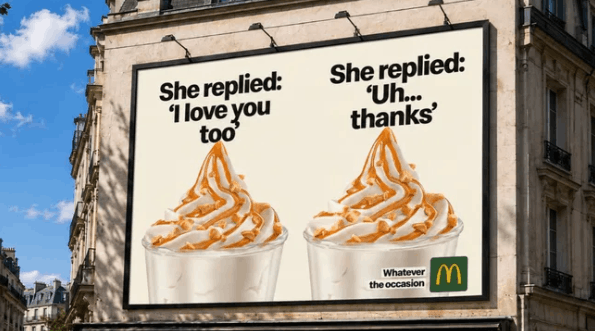
McDonald’s has dropped an ingenious new campaign that celebrates the joys of the humble McFlurry – no matter the occasion. From breakups to bad jokes, the simple billboard campaign is a perfect homage to life’s little moments, imperfectly perfect as they are.
In line with the best billboard ads, McDonald’s new campaign is a perfect blend of clever copy and bold, eye-catching design that shines in its simplicity. Quirky, charming and painfully relatable, McDonald’s perfectly nails the no-frills ad.
(Image credit: TBWA\Paris/ McDonald’s France)
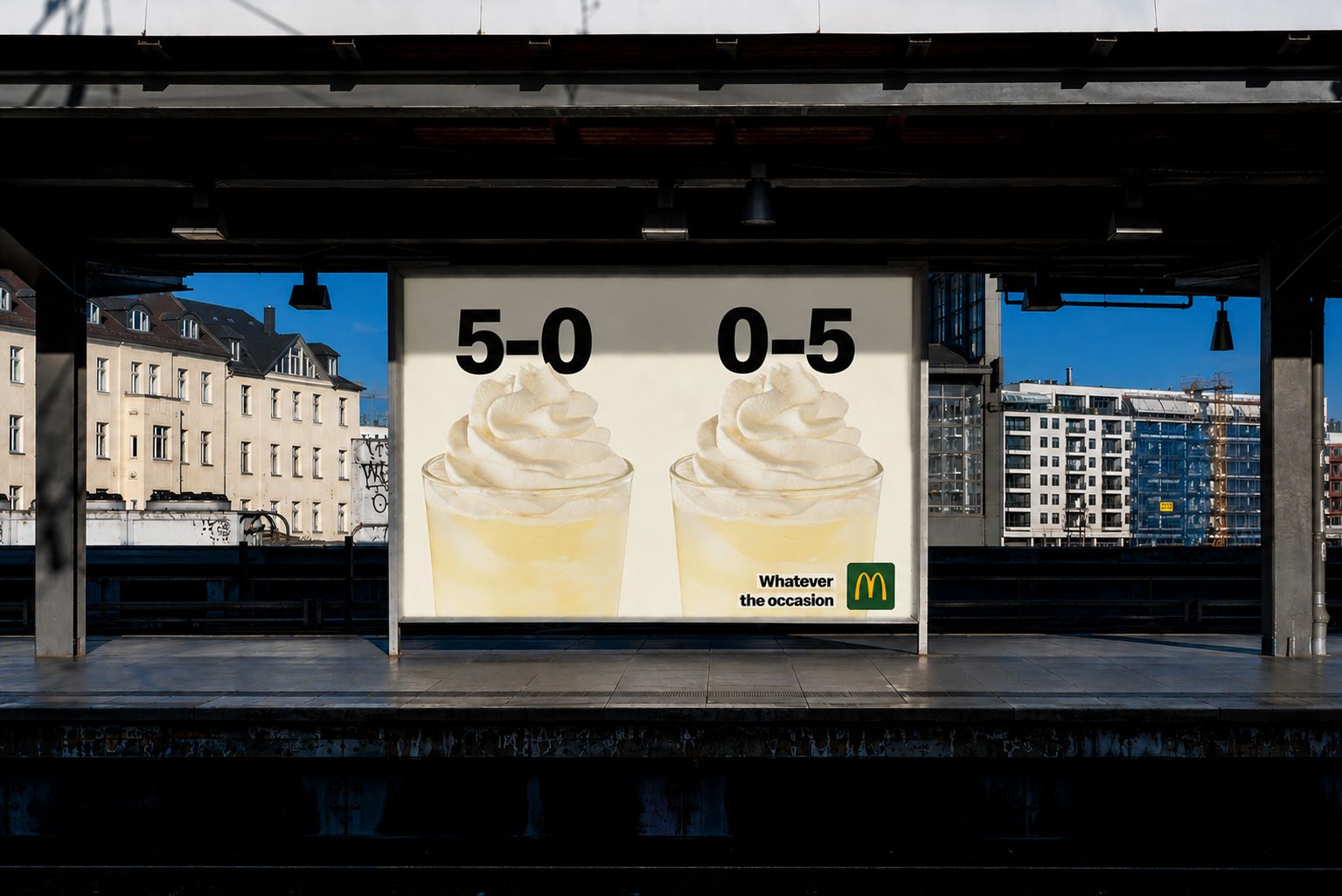
Created by TBWA\Paris and McDonald’s France, this quirky campaign is all about life’s contrasts. In one example, the billboard compares being the one who “tells the joke” vs “be the joke”, while another compares “pure beauty” to the awkwardness of “puberty”. There are even a couple of World Cup tie-ins like “5-0” vs “0-5” and “game winner” vs “game whiner”, proving the flexibility of this clever ad formula.
(Image credit: TBWA\Paris/ McDonald’s France)
But while each scenario might be different, one thing remains constant – the iconic McFlurry. Positioned as the perfect companion for life’s highs and lows, the ice-cold treat becomes not just a dessert, but a universal symbol of celebration and consolation. With simple visuals and a distinctly human personality, the billboard campaign is a prime example of how billboard advertising doesn’t need to be flashy to catch attention.
Natalie Fear is Creative Bloq’s staff writer. With an eye for trending topics and a passion for internet culture, she brings you the latest in art and design news. Natalie also runs Creative Bloq’s 5 Questions series, spotlighting diverse talent across the creative industries. Outside of work, she loves all things literature and music (although she’s partial to a spot of TikTok brain rot).
Employee-generated content is quickly becoming one of the creator economy’s fastest-growing marketing strategies
For years, brands have spent billions chasing influencers with massive followings. Increasingly, they’re realizing some of their most persuasive creators are already on the payroll.
In June, Starbucks announced a TikTok update to its ongoingGreen Apron Creators program, which will now pay select baristas to make TikTok videos through what the company says is the platform’s first custom Creator Network for a brand. In the pilot program, employees will receive creative briefs, create content for Starbucks’ TikTok presence, and share in advertising revenue — a notable shift from simply encouraging workers to post organically.
On its face, the program looks like another influencer marketing campaign. But it’s really a sign that brands are beginning to formalize employee-generated content as a core marketing strategy.
The timing isn’t accidental
For years, Starbucks has had a complicated relationship with Gen Z. The company became the target of widespread boycott campaigns amidst the Israel-Hamas war after what Starbucks called misinformation spread online about its political positions, while separate criticism surrounding its response to unionization efforts fueled additional backlash. Whether justified or not, the result was the same: Starbucks suddenly found itself fighting for credibility with a generation that increasingly values authenticity over polished advertising.
Now, rather than relying solely on outside creators, it’s betting that the people behind the counter can help rebuild that connection.
It’s a strategy that feels tailor-made for TikTok
Long before Starbucks announced Green Apron Creators in 2025, baristas were already making viral videos about complicated drink orders, secret menu hacks, and what really happens behind the espresso machines (especially when those limited-edition Bearista cups hit the shelves). Those posts often performed because they felt less like advertisements and more like behind-the-scenes access.
It’s the same phenomenon that turned everyday workers into unlikely internet personalities. A Staples Baddie explaining office supplies. Costco workers revealing hidden perks. Trader Joe’s crew members showing off their favorite seasonal finds. Audiences tend to trust people who actually do the job.
That authenticity has become increasingly valuable
Recent data from Sprout Social found that 61 percent of Gen Z discover products through employee-generated content, reflecting a growing preference for real people over highly produced influencer campaigns.
Starbucks isn’t alone in recognizing that switch.
Dell has spent years building an internal ambassador program through its Social Media University, training roughly 1,200 employee creators across more than 80 countries. Sprout Social’s employee advocacy program has grown from just six participants to roughly 100 employees, who accounted for nearly 30 percent of the company’s video impressions in 2025 while producing less than 8 percent of its content.
The economics make sense
Brands spent an estimated $32.55 billion on influencer marketing in 2025, according to Later’s State of Influencer Marketing report, but the industry is steadily moving toward smaller creators. eMarketer projects that micro- and nano-creators will account for nearly half of influencer marketing spending in 2026, and Mashable’s own survey data found that among those who follow creators, 62 percent are attracted to creators who feel like “real people.”
Employees often fit that profile perfectly. They already understand the brand, already have firsthand expertise, and don’t require expensive talent contracts. More importantly, they feel authentic and relatable — qualities audiences increasingly value over polished, highly produced marketing.
In many cases, they’re also creating the kind of content audiences actually want to watch.
In 2026, the creator economy is moving closer to everyday people. First, brands shifted budgets away from celebrities toward influencers. Then they embraced micro-creators over mega-influencers. Now they’re discovering their own employees may be among the most credible creators they have.
Starbucks’ Green Apron Creators program may be the clearest sign yet that the next frontier of creator marketing isn’t finding new influencers. It’s recognizing the ones already wearing the uniform.
Feature image credit: Jeffrey Greenberg/Universal Images Group via Getty Images
Crystal Bell is the Digital Culture Editor at Mashable, where she leads coverage of the creator economy, internet culture, and digital life. Her work focuses on the people, platforms, and communities shaping modern entertainment, from YouTube creators and livestreamers to fandoms, social media trends, and the evolving relationship between technology and culture. She also oversees the Mashable 101, the publication’s annual list recognizing the internet’s most influential creators.
Previously, she was the entertainment director at MTV News, where she helped expand the brand’s coverage of fan culture, K-pop, and the internet’s most passionate communities. Her work has appeared in Teen Vogue, Rolling Stone, PAPER, NYLON, ELLE, Glamour, NME, W, The FADER, and elsewhere on the internet.
She’s exceptionally fluent in fandom and will gladly make you a K-pop playlist and/or provide anime recommendations upon request. Crystal lives in New York City with her two black cats, Howl and Sophie.
It wasn’t that long ago when agencies encountered procurement executives during contract negotiations, and rarely beyond that. But procurement executives’ roles are expanding, and they’re more visible than they’ve ever been. You might be seeing them at more industry events, but you’re also seeing them in more meetings every step of the way. And that’s because the needs of marketers have evolved. AI is upending the industry, performance metrics are critical to success, and technology stacks are ever-changing. As marketing departments respond to these market changes, procurement executives’ scopes are evolving in parallel.
On the agency side of the equation, the business is under pressure to prove value, and the expectations for the quality and effectiveness of the work are only going up. Shops these days have an opportunity to work with procurement as a strategic partner, one that seeks to help marketing drive impact and one that can help agencies show that value and effectiveness.
Here are a few ways I’m seeing the agency-procurement relationship evolving, and how agencies can better work with an increasingly crucial client-side role.
Embrace value-based pricing.
Procurement leaders are increasingly in favor of moving away from billable hours and are keen to structure fees based on outcomes. The time-and-materials fee model is not going to be viable much longer, and despite widespread industry conversation, agencies have not adapted. It’s time.
Value-based pricing can mean different things depending on the client and the work, but agencies should prioritize these new models, whether that’s a fixed fee plus performance bonuses or pricing based on the value of each deliverable. When it comes to pricing by deliverable, it’s important to remember that each deliverable has a different level of impact. And in a world where AI is commoditizing some deliverables, there are still plenty that require human ingenuity and complex thinking. Those should be priced higher because they create more value in the end, while assets created with a heavy helping of AI can be a flat fee (oftentimes these are downstream production deliverables).
Charging hourly rates is outmoded; procurement is ready for next-gen pricing models that align with impact, creativity and technology-powered value, and value-based pricing is how we get there.
Be transparent about the details.
In the past, agencies sometimes didn’t talk a lot about the tools they used or go deep on their proprietary processes, mainly because clients cared more about what was produced in the end. But with the next wave of innovation coming from AI, and the proliferation of tools that use it, there’s a greater need for transparency with procurement executives. They want to know how you plan to use AI to propel shared ambition while managing risk.
This will ultimately play into your value-based pricing strategy. So when you’re discussing your use of AI, whether that’s for concepting or versioning hundreds or thousands of assets or some other kind of automation, procurement can see exactly what goes into your workflow. Transparency around your process and the tools you’re using will strengthen the relationship and enable you to charge a premium for your higher-value and more strategic deliverables, even if you’re making less on the lower-value ones.
Enable procurement to redefine its partnership with marketing.
Many procurement executives are looking to build stronger relationships with their marketing departments and agencies because it gives everyone a more comprehensive sense of the work, where agencies stand and where there is an opportunity to work more cohesively across scopes. In the past, procurement was included mainly in downstream executional work related to contracts and budgets. But in the future, they have the opportunity to be more involved in higher-level annual marketing planning and road map development.
In an effort to get a more strategic seat at the marketing table, some procurement executives are working toward taking on stakeholder-management roles, where they coordinate across all budgets, scopes, agencies and internal stakeholders. This can lead to their inclusion in more upstream strategic initiatives managed by the marketing organization.
And agencies can help them succeed in that. Agencies can help procurement executives strengthen relationships with colleagues by bringing procurement into the agency’s work early on, partnering with procurement and marketing to define growth, metrics and value at an engagement level.
At a more executional level, agencies can help procurement get in the weeds to define the needs of reporting, familiarize them with existing dashboards and provide client-side analysts access to data. They can also proactively keep procurement up to speed on project milestones and share case studies so procurement can then illustrate the value of the investment to their organization.
Ultimately, procurement executives are trusted partners, and building a stronger partnership with them is the key to unlocking more budget for bigger projects. As their role evolves further, agencies have the opportunity to better understand what procurement needs to be successful and the ability to help them achieve that success.
Michelle Douglas is a founder at Shophouse, an independent creative agency transforming brands, digital ecosystems, and retail experiences. Read Michelle Douglas’ full executive profile here.
For those of us who’ve spent our careers in affiliate and performance commerce, it raises a simple question: What took everyone so long?
Earlier this year, Publicis Groupe announced it would acquire LiveRamp, a global data collaboration platform, for $2.2 billion. The stated rationale was to accelerate what Publicis calls “data co-creation” for the agentic AI era. The goal is to connect identity infrastructure, activate data across the entire customer journey and tie every dollar of media spend to measurable outcomes. To anyone who has worked in affiliate marketing for the last decade, it reads more like confirmation that what we’ve been doing for years is indeed the right way to operate. What other industry can boast proprietary, transaction-level purchase data at the scale of performance creators and affiliates? None.
The holding company world is spending billions of dollars to build systems in which real identities, connected journeys and verifiable outcomes form the foundation of advertising. Affiliate marketing built exactly that model, not by vision, but by necessity, and it’s been running at scale for years.
What Publicis Is Really Buying
The LiveRamp deal didn’t happen in isolation. Publicis acquired Epsilon in 2019 to build a proprietary identity layer. In early 2025, it acquired Lotame to expand its identity graph capabilities. Now, with LiveRamp, which connects over 25,000 publisher domains and 500+ technology and data partners across 14 markets, they are connecting all the dots in their largest and most consequential move yet.
The logic is clear: Epsilon provides the identity foundation, LiveRamp adds data collaboration and clean-room capability across publisher and partner ecosystems, and Publicis’s Marcel agentic platform activates it all across enterprise marketing functions. This solidifies the use case Publicis keeps returning to: connected retail journeys powered by CRM data, loyalty programs, in-store signals, retail media inventory and partner data, unified in one place and activated to drive measurable outcomes.
Framed that way, this is an “identity-to-outcome” stack—a system designed to know who a consumer is, follow their journey across touchpoints and attribute results to spend, accurately, at scale, across a fragmented ecosystem. Doesn’t that sound familiar?
Affiliate Marketing Has Always Been The Data Layer
Affiliate marketing was born performance-first, built around a simple and unforgiving principle: you don’t get paid unless something measurable happens. No conversion, no commission for publisher or creator, no user points or shopper cash back. That structural reality created discipline around identity resolution and journey tracking that brand advertising spent decades avoiding.
Before data clean rooms entered the marketing lexicon, affiliate networks were stitching together click-to-conversion paths across devices and sessions to assign attribution. Before identity graphs became a boardroom priority, performance marketers were resolving user identity across fragmented digital touchpoints because their economics demanded it. And, if they didn’t do this, their creators and publishers wouldn’t get paid properly. Before the cookieless era became an industry crisis, affiliate networks were building server-side tracking infrastructure to maintain signal fidelity, because their publishers needed it to survive.
As privacy regulations tightened and third-party signals degraded, performance-based partnerships gained ground: 74% of brands are increasingly shifting to affiliate programs and 59% of marketers are dedicating over a quarter of their budgets to Creators. That shift is a recognition that the affiliate model—outcome-first, identity-resolving, journey-connected—is better suited to the marketing environment we now live in.
You can build the most sophisticated identity graph in the industry, resolve users across every device and channel, and still lose the sale at the last step, because the journey itself breaks. When a consumer clicks a link from a creator, publisher or affiliate partner and lands on a degraded mobile web experience instead of the app they have installed, the conversion is lost. That loss never shows up in the analytics. It will only track completed journeys. The broken ones are invisible.
As commerce media spend approaches $100 billion and 45% of advertisers cite performance as their primary objective, the gap between data sophistication and journey execution is widening, not narrowing. Knowing your customer precisely doesn’t help if the path you send them down is broken. Plus, many brand advertisers still don’t understand foundational linking, despite now being focused on outcomes.
Affiliates have scale. What it has historically lacked is the strategic standing to match, and the positioning to walk into a CMO conversation and say, “The model you’re paying billions to build? We’ve been running it.”
This is the moment to make that case. Not defensively, but confidently. The principles that define modern marketing’s ambitions, real identity, connected journeys, measurable outcomes and performance accountability, are the principles that affiliate and commerce performance marketing has operated on since its founding and has now revolutionized the creator economy. The vocabulary has changed. The infrastructure has gotten more sophisticated and the content creators have evolved dramatically, but the model has been right all along.
The question for CMOs and revenue leaders isn’t whether this model matters. That question has been answered, loudly and expensively. The question is: Is your organization giving its affiliate and commerce partnerships the investment and accolades they deserve? Now that the rest of the industry has confirmed their model was right, are you ignoring your most valuable marketing team?
Affiliate marketing didn’t need a $2.2 billion acquisition to become outcome-oriented and data-driven. It started there. The rest of advertising is catching up, and the gap is closing faster than most people realize.
Lauren Newman is CRO at Button, an AI-powered commerce platform optimizing creator and affiliate marketing performance. Read Lauren Newman’s full executive profile here.
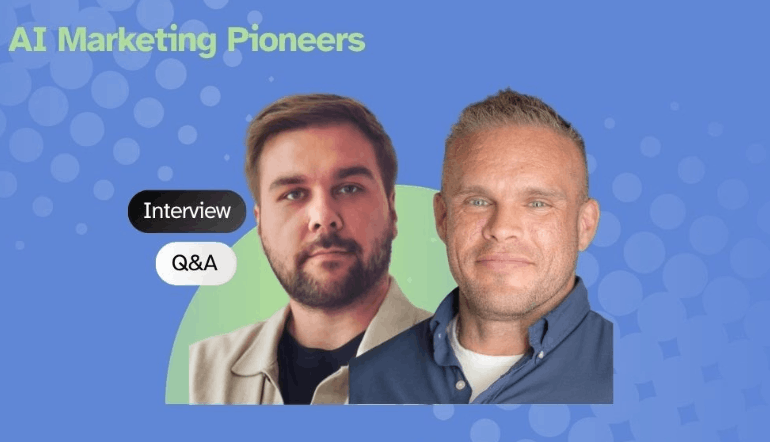
As AI continues to reshape the digital marketing landscape, companies are emerging that harness AI and promise not just incremental improvement but genuine structural change. NDA’s interview series,AI Marketing Pioneers, talks to leaders in this space to discover what they are doing differently.
In the latest installment, New Digital Age sat down with Thomas Ives, Founder of RAAS LAB, and Christian McAlinden, Programmatic Director at dentsu. Their conversation tackled the industry’s deep-seated reliance on legacy metrics, why traditional DSPs fall short on context, and how an innovative programmatic campaign for home improvement giant B&Q delivered 813,000 unique creative variants tailored to real-time consumer intent.
Moving past 2015
For nearly two decades, digital advertising has leaned heavily on easily quantifiable metrics like click-through rates (CTR), reach, CPMs, and viewability. Yet, as both Ives and McAlinden argue, those surface-level indicators belong to an earlier technical era.
“Clicks were a metric for a system which had limitations,” says Thomas Ives, Founder of RAAS LAB. “We should be past it now. We should be thinking more about the quality of the placement, the relevance of the placement, and being a lot more intelligent at that impression level.”
Historically, assessing contextual relevance was treated as a creative judgment rather than a measurable media variable because analysing every impression was humanly impossible.
“If you had a campaign which served nine million impressions, it would take 13 and a half years of one person sat at a desk analysing how well that web page matched each impression,” Ives points out.
Christian McAlinden, Programmatic Director at dentsu, agrees that standard industry habits have held buyers back. “Historically, relevance has been overlooked. Our industry measured what was easiest to measure, reach, CPMs, viewability, frequency, the basic metrics that we’ve always been able to report on,” McAlinden said. “The result was that campaigns could look efficient on paper, but still miss the nuance of whether the message, context, and consumer mindset were actually aligned.”
Speed vs. genuine innovation
While AI is often treated as a fast forward button for existing tasks, true innovation comes from unlocking completely new capabilities. Rather than relying on static site lists or broad keyword rules, RAAS LAB integrates directly into SSPs, scanning hundreds of thousands of incoming URLs per second to evaluate alignment before the ad is served.
“With AI, it’s the first time that we can possibly measure relevance,” Ives said. “There’s two ways that you can use AI. You can do things quicker, which everyone seems to want to use AI for, or you can do new things with it.
What we’re doing here is using AI to do something that wasn’t possible before.”
For agency leaders, evaluating context within the supply path provides a missing layer that standard buying tools can overlook.
“At the moment in the DSPs, we don’t have a relevancy score,” McAlinden said. “I can build out a site list, I can layer targeting in the open exchange, I know where the ads are going to run, but what are we missing? We’re missing a metric for relevancy.”
B&Q and 813,000 creative variants
The real-world value of AI-driven relevance is best illustrated by a recent campaign executed for retailer B&Q in partnership with dentsu.
Retailers with massive product ranges, B&Q carries over 500,000 products, face a major challenge matching creative messaging to diverse customer needs. A consumer researching shed assembly requires a completely different message than someone browsing blue bedroom paints.
“Every user’s needs are very different,” Ives said. “What we’ve deployed for B&Q across multiple campaigns essentially took in 813,000 unique creative variants that were deployed as part of that campaign. It really solves that problem which advertising’s always had: How do you bring together the creative and the targeting thinking?”
The results demonstrated the impact of context over simple reach. The campaign achieved click-through rates 4x higher than standard display benchmarks, maintained a content relevance score over 70%, and drove a statistically significant lift in brand consideration around ‘ease of shopping.’
Previous iterations of this relevance-first approach even generated higher physical store footfall than paid social efforts, said Ives.
The path to adoption
Despite clear performance gains, shifting an entire industry away from legacy habits takes time. Agencies play a critical role in bridging the gap and educating brand marketers who may be hesitant to stray from familiar metrics.
“It’s like everything in advertising, it’s reluctancy. You stick to what you know,” McAlinden said. “The education piece needs to come from the agencies. We need to be taking charge here, encouraging new strategies to move forward.”
With shortening attention spans in a fragmented media environment, Ives believes brands need a new approach to consumer communication.
“To get these attention-poor people to connect with you again is through being relevant,” Ives said. “It’s not just the message itself, it’s a message that matches the moment that the user is currently in.”
In this article, Laure Malergue of Displayce, explains how agentic AI can bring DOOH into planning earlier, make recommendations easier to defend and connect data, activation and learnings. She explores what makes a strong DOOH agent, why specialist data and workflows matter and how this approach could help the media secure a more influential role in media strategies from the very first planning conversation.
Walk along the Croisette during Cannes Lions, and advertising is everywhere in its most physical form: posters, digital screens, branded spaces and large outdoor moments. This year, another presence was just as visible: AI agents.
For the past two years, most of the AI conversation in advertising has focused on production. This year’s adtech announcements mark a shift from AI-assisted tools towards agentic systems able to make, coordinate and execute advertising decisions.
That shift raises a more important question for the industry: Will AI agents make media decisions better?
Media planning has always been a discipline of choices: Which audience matters most? Which context will make the message stronger? Which channel should enter the plan earlier? Which budget split is easiest to defend? These choices shape the campaign long before it goes live.
For digital out-of-home (DOOH), this could be a turning point.
DOOH is invited too late to the party
DOOH has many of the qualities brands are looking for today: real-world and brand safe visibility, public attention, contextual relevance with the ability to adapt to location, weather, time of day, audience flows and live events. Yet, it still lacks discoverability within the media mix.
Too often, it enters the media plan late, once the brief, strategy and main budget choices have already been shaped. DOOH is then considered at the execution stage, although its strongest value could have influenced the plan earlier.
The challenge is practical. DOOH requires strong knowledge of audience data, mobility patterns, local specificities, screen environments, formats, availability, pricing, context, timing and measurement. The value is clear, but turning these parameters into a confident recommendation takes time.
Programmatic DOOH has solved a large part of the activation challenge by automating the buying process. The next challenge sits earlier, when a media planner decides whether DOOH deserves a place at the table, how much budget it should receive and why one scenario is stronger than another.
Making DOOH easier to recommend
This is where agentic AI can change the role of DOOH in the media mix. The strongest agents will be judged by the quality of the decisions they support: can they explain why one scenario is stronger than another, help a planner defend DOOH in a wider media strategy and turn campaign results into learnings for the next brief?
This conviction comes from more than a decade building programmatic DOOH technology. Our goal is now to make DOOH easier to recommend, with specialist intelligence available inside the environments where agencies and brands are already building media plans.
This is why Displayce’s agents are available via Model Context Protocol (MCP). The MCP allows AI applications such as ChatGPT or Claude to connect with external data sources and tools. For agencies building their own agentic workspaces, this means DOOH intelligence can be accessed where planners already work. For Displayce, MCP is a way to bring specialist DOOH expertise into the existing media ecosystem, with more openness and interoperability.
What makes a good agent for DOOH?
A generic AI model can understand language, but it does not understand media by itself. For DOOH, a good agent needs to be built on a strong data ecosystem, expert workflows and simulation algorithms. This is the foundation behind Displayce’s agents.
The data ecosystem gives the agent access to the signals that matter: audience data, mobility patterns, inventory context, screen environments, local context and historical campaign performance.
The expert workflow helps the agent understand how DOOH planning actually works: the objective, the constraints, context, timing and budget, and the level of explanation a planner needs to defend a recommendation.
The simulation algorithm allows the agent to compare scenarios, test assumptions and understand why a city, venue type, screen, audience group, daypart or context is relevant.
Without these foundations, an agent can create a recommendation that looks convincing but has limited media value. With them, it can support stronger, clearer and more transparent DOOH decisions.
Make DOOH impossible to ignore from the very first media conversation
By bringing DOOH expertise into planning workflows earlier, Agentic DOOH can change how the medium is considered by agencies, brands and media owners.
For agencies, this means less time assembling data and more time shaping the argument. For brands, it means clearer recommendations and greater confidence in DOOH investment. For media owners, it means making local knowledge and premium inventory visible while the plan is still being shaped.
Human judgment remains central. Planners still decide what is right for the brand, the role of agents is to give teams better scenarios, stronger explanations and more time to think.
Agentic DOOH should be measured by one question: Does it help the medium earn a stronger place in the media plan? If the answer is yes, AI agents will help bring DOOH further upstream in the media decision-making process, at the moment when budgets are shaped, strategies are built, and channel choices are made.
These tips can support your workflow, save time and make the AI assistant’s responses much better
Claude has become one of the AI tools I use most often, whether I’m brainstorming, planning something, vibe coding, researching a topic or simply trying to make sense of a complicated question. But using an AI chatbot every day doesn’t necessarily mean you’re using it well
In fact, some of the habits that feel like they should make Claude better can have the opposite effect.
That’s what caught my attention when I came across a list of 27 Claude tips from AI consultant Ruben Hassid, who says he’s spent more than 1,800 hours using Anthropic’s chatbot.
Some of his advice goes against the way many of us have been taught to use AI. Keep everything organized in Projects? Maybe not. Keep correcting Claude until it understands what you want? That could actually make things worse. Spend 10 minutes crafting the perfect prompt? There may be a better approach.
Not every tip will make sense for every Claude user, and some of Hassid’s recommendations are based on his own experience rather than hard-and-fast rules. But several are worth trying if you use Claude regularly.
Here are five Claude habits worth breaking — and what to try instead.
1. Stop correcting Claude over and over
We’ve all had this conversation with an AI chatbot. You ask Claude for something. It gets it wrong and then you go back and forth trying to get the response you’re actually looking for — all while wasting your tokens in the meantime.
Want more AI news?
Sign up to the Tom’s AI Guide weekly newsletter summing up all the biggest AI news you need to know. Plus, analysis from our AI editors and tips on how to use the latest AI tools!
Even when you explain the problem in even more detail or add another layer of clarification, before long, you’re six messages deep trying to rescue an answer that wasn’t particularly good to begin with.
Hassid recommends doing something much simpler: go back and edit the original prompt. This is a feature that a lot of users overlook but it’s one of the best ways to avoid correcting every wrong answer, which in turn, keeps adding to the conversation.
That’s because every correction you add becomes part of the conversation Claude is working from. Instead of giving the model one clear instruction, you can end up with a growing trail of bad outputs, corrections and exceptions.
Editing the original prompt gives Claude another shot with cleaner instructions.
For example, imagine you asked:Plan a three-day trip to Boston.
Claude gives you an itinerary packed with museums, historical sites and early mornings. But what you really wanted was a relaxed weekend centered around food and neighbourhoods.
You could spend several messages correcting the itinerary.
Or you could edit the original: Plan a relaxed three-day trip to Boston centered around great food and interesting neighbourhoods. Include no more than one museum, avoid early mornings and leave plenty of unplanned time.
Same request. Much better context.
Try it: If Claude completely misses the mark, resist the urge to argue with it. Edit your previous prompt and regenerate the answer instead.
2. Stop keeping every conversation alive forever
(Image credit: Pexels / Eren Li)
This one is incredibly easy to do. Once Claude understands what you’re working on, abandoning that conversation can feel wasteful. So you keep going…and going!
Eventually the chat contains previous questions, rejected ideas, unrelated tangents, corrections and instructions that stopped being relevant 30 messages ago.
Hassid recommends starting fresh more often, arguing that very long conversations can eventually make Claude less effective.
There isn’t a magic number of messages where Claude suddenly becomes worse, and Claude’s context window is designed to handle a significant amount of information. But context isn’t the same thing as useful context.
Imagine using the same Claude conversation to plan a vacation for weeks. You’ve discussed five hotels, changed the dates twice, ruled out three destinations and completely changed your budget.
Claude may technically have all that information available, but you’re now asking it to distinguish between what you wanted two weeks ago and what you want today. Sometimes the clean slate is the advantage.
Try it: When a conversation starts feeling cluttered, ask Claude to summarize the important information and decisions you’ve made. Paste that summary into a fresh chat and continue from there.
3. Stop obsessing over the perfect prompt
The internet has spent the past few years convincing us that getting great AI results requires elaborate prompts. A few minutes on X or Instagram and you’ll be swamped with plenty of prompts.
But Hassid makes a compelling case for doing something considerably less polished: brain dumping.
Instead of spending several minutes turning an idea into the perfect prompt, simply tell Claude everything you’re thinking.
This works particularly well with voice input because we naturally provide more context when we’re talking. We mention what we’re trying to accomplish, what we’ve already tried, what we don’t like and the half-formed thoughts we might remove if we were carefully typing a prompt.
For example, instead of: Create a weekly meal plan for a family of four.
Try the prompt: I need dinners for the next five days. I don’t want anything that takes more than about 30 minutes, we’re trying to spend less on takeout, one person hates fish, I already have chicken and pasta in the house and Wednesday is going to be really busy, so that meal needs to be ridiculously easy. Help me figure this out.
The second prompt isn’t perfect, but it’s packed with useful information.
Try it: Open Claude and dictate your request as though you’re explaining the problem to a friend. Don’t organize it first. Let Claude organize it for you.
4. Stop telling Claude only what you want
(Image credit: The Motley Fool)
Quite often AI users will prompt an assistant with “Make this better.” “Give me something more interesting.” “Make this easier.” “Be more creative.”
And while they will probably give you answers, these instructions are incredibly subjective. Claude has to guess what “better” or “interesting” means to you.
Hassid recommends giving the model negative examples — showing Claude what you don’t want. Say you’re trying to come up with ideas for a 10-year-old’s birthday party.
Claude suggests a trampoline park, bowling, laser tag and an arcade.
Instead of responding: Give me more creative ideas.
Try the prompt: I don’t want trampoline parks, bowling, arcades, laser tag or other typical birthday-party venues. I’m looking for something the kids probably haven’t done at another birthday party this year.
Suddenly, “creative” has boundaries and it’s far more useful to Claude. The same technique works for recommendations, travel plans, recipes, gift ideas, schedules and almost anything else where personal taste matters.
Try it: When Claude gives you suggestions you dislike, tell it specifically what those options have in common and ask it to avoid that entire category.
5. Stop putting everything into Projects
Projects are one of Claude’s most useful features. They let you keep related chats, instructions and reference material together so you don’t have to repeatedly explain what you’re working on.
But that doesn’t mean every task belongs inside one. Hassid argues that fresh conversations can sometimes be better for creative work because accumulated context can steer Claude toward ideas and patterns you’ve already explored.
I’d treat this as a rule of thumb not something universal for Claude. Projects can be enormously useful when the model genuinely needs background information.
The question is whether that background is helping with the task you’re doing right now.
If you’re using Claude to help plan a major home renovation, for example, keeping your measurements, budget, preferences and previous decisions in one Project makes sense.
But if you suddenly want Claude to give you completely unexpected ideas for what to do with an empty room, you might get more variety by asking in a fresh chat without all those previous assumptions.
Otherwise, you risk asking Claude to surprise you while simultaneously surrounding it with everything you’ve already considered.
Try it: Use Projects when Claude needs context. Try a fresh chat when you want novelty. You can even give the same prompt to both and compare the results.
The takeaway
Sometimes the best thing you can give Claude is a clearer problem. So the next time Claude isn’t giving you what you want, don’t automatically add another paragraph of instructions. Try editing the prompt, start a new chat or tell it what you don’t want.
You may just find Claude understands you better when you give it less to untangle.
Do you ever wish you had a clearer picture of your audience on social media so you could create better content for them? Or better yet, just ask them directly what they want to see?
Most people think of social media polls as a way to boost engagement. And they are. But that’s only part of the story.
Used properly, polls and surveys give you something far more valuable. Real insight into what your audience actually cares about.
In this post, you’ll learn how to use social media polls and surveys to understand your audience and create content they actually want.
Let’s get into it.
1. Understand why audience research is important
You might think it’s enough to create any and all content that even remotely covers topics that relate to your niche, but this couldn’t be further from the truth.
Audiences are a lot more complex than that. Your niche likely has several audiences within it. That’s why it’s important for you to tailor your content to your target audience.
This could be members of your niche who are at a certain skill level (beginner, intermediate, advanced or expert) or who are mostly interested in a specific subtopic (“electric guitar” as opposed to the more broad “guitar” niche).
If you’re not sure who your target audience is, a few polls or a survey can help you identify it.
Audience research allows you to you uncover anything you think might help you create better content, including:
Subtopics your audience is interested in
What they think about certain topics
Social media platforms they use
When they browse social media
Why they browse social media
Whether or not they’re satisfied with your content
2. Choose a tool
You can run polls natively on a lot of social media platforms:
Instagram – Add polls to stories. It’s under the Stickers menu.*
Facebook – Add polls to stories.
Twitter (X) – Create poll posts.
YouTube – Create poll posts for the Community tab.
Bluesky – Not a native feature, but you can create polls with third-party apps.
Threads – Add a poll to a post.
LinkedIn – Create a poll post.
*You can only add quizzes to reels. Although they allow you to ask your audience a question, they make you designate one option as the correct answer to that question. Polls are opinion based. Therefore, they’re not meant to have a correct answer.
If you want to ask your audience more than one question at a time or get feedback from your TikTok audience, you’re going to need to use a survey.
Here are a few survey tools you can use:
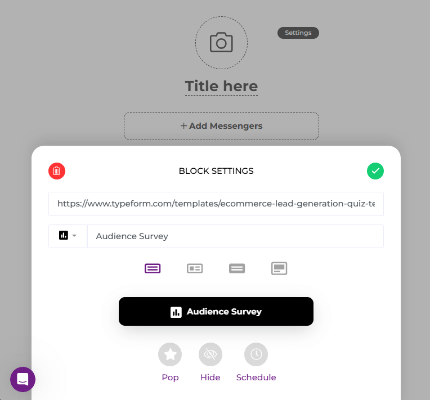
ConvertBox – Not technically a survey or poll maker, but it does have a poll-based opt-in form that allows your audience to segment themselves as they join your email list. This is a better option because you can easily capture leads when/if it makes sense to.
Google Forms – Free form tool your audience is likely familiar with.
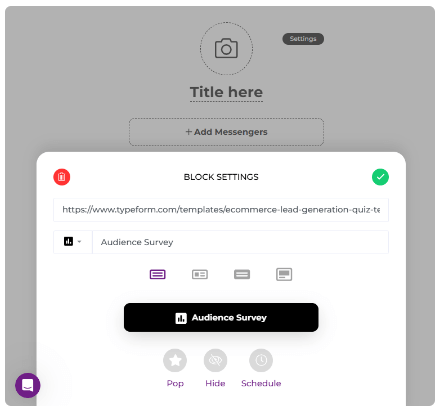
Typeform – A simple survey and poll maker. It allows you to create surveys that ask one question per page as well as polls where every option is visible. Comes with templates and plenty of marketing features.
SurveyMonkey – Simple survey and poll maker with templates, marketing features and insightful analytics.
SurveyPlanet – Simple survey tool that’s also great for creating surveys that show one question at a time. Comes with templates.
If you go the survey maker route, you’ll need to promote your survey link.
Here are methods you can use to promote links on social media:
Promote it directly in the post body itself. This is not an option on TikTok and Instagram.
Add the link as your bio link. This removes your current bio link.
Add the link to your link-in-bio page, a simple web page you can add several links to.
Shorby is a suitable tool for the third option. It’s very easy to use.
It is, however, a paid tool.
Alternatively, you could use Viraly. It’s primarily a social media scheduler but it offers a free plan that includes access to their link-in-bio page tool.
Their link-in-bio page tool also happens to be one of the best on the market.
Polls are great if you only need to ask your audience one simple question.
A lot of social media polls only allow you to add four options, but you can add unlimited options if you use a dedicated survey or poll maker.
The most important aspect of a poll is the way it only allows your audience to choose one option.
By asking your audience a simple question, giving them up to four options to pick from and only allowing them to pick one of those options, you can really learn a lot about their preferences.
Polls posted as Instagram and Facebook stories expire after 24 hours. This is because Instagram and Facebook stories themselves expire after 24 hours.
Twitter (X) allows you to choose a duration of up to a week. This means your audience has up to a week for the poll to show up in their feeds so they can respond to it.
Try using polls for the following purposes on social media:
Opinion – Ask your audience’s opinion about a topic.
Example: What is the most overrated electric guitar brand?
Insight – Learn more about your audience in general.
Example: What is your favourite electric guitar brand?
Analytical – Learn more about your audience’s habits.
Example: How often do you practice?
4. Create a multiple-choice poll
If you think your audience might have more than one preference, create a multiple-choice poll instead.
Your audience can only select one option when you use native social media polls, so you’ll have to use a survey tool and only add one question to it.
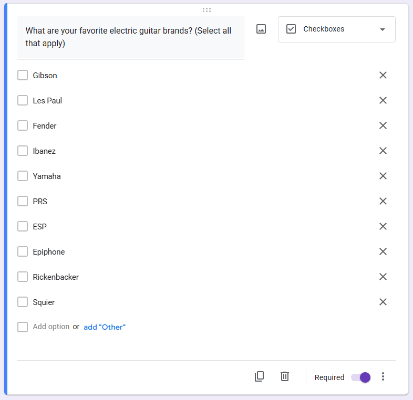
It’s best to use plural language in your question so that your audience knows they can select more than one option. You can also put a short notice in parentheses, such as “(select all that apply).”
In your survey tool, make sure you choose the Checkboxes option, and mark the question as “required.”
Here’s an example in Google Forms:
Use multiple-choice polls for the same purpose as you would a regular poll, but only use them when you want your audience to be able to select more than one option.
Stick with single-choice polls if you want to force your audience to be more decisive. This will give you more accurate data as your audience is likely to be more selective with their answers if they’re only able to choose one.
Once your poll is complete, add it to your link-in-bio page on Instagram and TikTok or as your bio link on these platforms before you promote it.
5. Create a multiple-choice survey
Surveys are fantastic tools to use to conduct audience research. They allow you to gain more insight into your audience by asking them a series of questions.
Social media content is fleeting, so it’s best if your survey is as well. Try to ask no more than five questions to increase your odds of receiving more completed surveys.
The most important thing is to make sure each question belongs to the same theme. If I ask my audience what their favourite guitar brand is, I shouldn’t also ask which guitarists they think is overrated.
The best part about using surveys is the number of question types you’re able to add to your survey. Specifically, the text-based question types where your audience can enter a short or long answer.
This is a fantastic option to include in case you’re worried that you forgot to include something as an option.
Another useful aspect about surveys are the conditional logic features they unlock depending on which survey tool you use.
Conditional logic is a feature that allows you to set up triggers and actions for your survey, or “if this, then that” rules.
For example, if your primary question asks your audience, “what is your favourite guitar brand,” and one of your options is Ibanez, you could ask a follow-up question that only appears if your audience selects the Ibanez option, such as “which guitar models do you own from Ibanez?”
Some survey makers, such as Typeform, have ranking question types that allow your audience to rearrange options based on how they’d rank them.
Overall, surveys are an effective way to expand on a question with additional questions, which ultimately leads to more data for you.
6. Use the data you acquire to optimize your social media marketing strategy
There’s quite a bit you can learn by asking your audience simple questions on social media.
If you’re in the guitar niche, knowing which brands your audience prefers lets you know which brands to focus on for reviews, unboxing content, product demonstrations and tutorials.
If you ask your audience about other social media platforms they use, you’ll know which other platforms you should be creating content for.
Polls and surveys help you align your social media content and overall marketing strategy with what your audience wants to see.
A lot of platforms have analytics you can view. There are even dedicated social media analytics tools out there. Plus, you can get a pretty good idea of your audience’s preferences by conducting keyword research and product research.
But it’s one thing to guess what your audience prefers or wants to see. It’s another thing to have them tell you outright.
Make a list of every piece of data you feel would help you understand your audience a little better. Then, come up with questions and answers that would help you uncover that information.
Final thoughts
When you’re just getting started as a blogger or content creator, there is a lot of guesswork involved.
But once you have an audience, no matter the size, you can start gathering qualitative data.
This is the data that matters most.
It’ll help you take a strategy based on guesswork and turn it into a solid strategy based on nothing but facts and hard data.
For more than two decades, digital marketing was built around one objective: get the click. Search ads pushed users to landing pages. SEO turned visibility into traffic. Social posts pointed people toward blogs, forms, product pages and downloads. The click became the visible proof that attention had turned into intent. But that logic is breaking.
Consumers now discover, evaluate and remember brands without necessarily visiting their websites. Google is moving from links toward answers. Social platforms reward content that keeps users inside the feed. Artificial Intelligence (AI) interfaces are training people to expect synthesis, not ten tabs of research. The result is a new marketing reality: influence often happens before the click, outside the website and beyond traditional attribution. This is the rise of zero-click marketing.
Zero-click marketing is not about abandoning websites, SEO or performance marketing. It is about recognizing that the first meaningful exposure to a brand increasingly happens inside a search result, short video, comment thread, community conversation or AI-generated answer. In that environment, the most valuable marketing is not always the content that gets clicked. Sometimes, it is the content that gets remembered.
Search is becoming an answer engine
Google describes AI Overviews as AI-generated snapshots that provide key information about a topic or question, with links for users who want to explore further. From the user’s perspective, that can make search faster. From a marketer’s perspective, it changes the economics of visibility. A person may get the answer, form an opinion and move on without visiting the original source.
The behavioral evidence is important. Pew Research Center analyzed U.S. Google users in March 2025 and found that when an AI summary appeared, users clicked a traditional search result in only 8% of visits, compared with 15% when no AI summary appeared. Links inside the AI summary itself were clicked in about 1% of visits.
This does not mean Google and the AI have killed traffic. It does mean marketers should stop treating traffic as the only evidence of value. Reuters reported in July 2025 that independent publishers filed an EU antitrust complaint against Google’s AI Overviews, arguing that the feature diverts traffic and revenue. Google responded by explaining that AI Overviews create discovery opportunities and send billions of clicks to websites. The disagreement is revealing: zero-click behavior is now a commercial, regulatory and strategic issue.
For brands, the question is no longer only, “How do we rank?” It is also, “Are we part of the answer?” Companies have to optimize not only for clicks, but for authority signals: clear explanations, original research, expert authorship, structured content, credible citations, distinctive points of view and brand mentions across the web.
Zero-Click Marketing is not posting more content
The most common misunderstanding is that zero-click marketing means publishing more on social media. It does not.
Zero-click marketing is the discipline of creating value inside the environment where attention already exists. A weak version says, “Here is a teaser. Click to learn more.” A strong version says, “Here is the insight. You can use it now.”
A LinkedIn post that explains a framework can build authority without requiring a blog visit. A YouTube video that solves a technical problem can shape preference before a demo request. A TikTok that demonstrates a product benefit can create cultural relevance without sending users to a website. The old model was built around traffic capture. The new model is built around trust creation.
The best “product story” may not need a landing page
One of the strongest consumer examples is Stanley. In 2023, a TikTok user posted a video showing her burned-out car after a fire. Inside the car, her Stanley tumbler had apparently survived, still containing ice. The product proof was visual, immediate, and native to the platform. Stanley’s president then responded publicly and offered to replace her car, turning an organic customer story into a brand-defining moment.
The lesson is not simply “go viral.” That is too superficial. The real lesson is that the strongest product message did not come from an ad, a landing page, or a product specification sheet. It came from a customer story, seen inside a social platform, amplified by a fast executive response, and understood without a click.
Stanley won because the audience did not need to be redirected to understand the value proposition. Durability was demonstrated in the feed.
That is zero-click marketing at its best: product proof, social credibility, and brand response compressed into a single public moment.
In social, the brand itself must become content
Duolingo offers a different example. Its green owl mascot became a social media character, not just a logo. The brand’s TikTok presence, humor and cultural fluency turned language learning into entertainment. TikTok for Business documented a Duolingo campaign that generated more than 90 million video views and a 1.400% increase in new followers.
The point is not that every brand should behave like Duolingo. Most should not. The point is that Duolingo understood something many companies still resist: on social platforms, the brand itself must become content. The audience did not need to click to a landing page to understand Duolingo’s personality. The download may come later, but preference is often built much earlier.
The B2B implication: buyers learn before they convert
Zero-click marketing is not only for consumer brands. In many ways, it may be even more important in B2B.
Business buyers often research silently. They read posts, listen to podcasts, attend webinars, follow experts, ask peers and evaluate companies long before they fill out a form. Much of that influence is invisible to attribution software.
This is where executive thought leadership becomes commercially relevant. A strong LinkedIn post, industry report, podcast appearance or expert commentary can shape how a buyer understands a problem before the buyer has entered the sales funnel. For B2B brands, the website may still convert the buyer, but it may not be where the buyer first learns to trust you.
What leaders should measure now
The biggest objection to zero-click marketing is obvious: how do you measure it? The answer is not to abandon measurement. It is to measure influence more intelligently. Sessions, leads, cost per acquisition or conversion rate still matter. But they should be complemented by signals that capture demand creation before the click: brand search growth, direct traffic, share of search, social saves and shares, community mentions, podcast and video engagement, newsletter growth, sales call references, executive profile visibility and pipeline influenced by content exposure.
The key distinction is between attribution and influence. Attribution asks, “Which click caused the conversion?” Influence asks, “What made the buyer trust us before the conversion?” In a zero-click world, influence often happens first.
The future is not Clickless— it’s Click-Optional
Zero-click marketing does not mean the click is dead. High-intent customers will still visit websites, compare products, download reports, request demos, apply to programs and make purchases.
But the click is increasingly a later-stage behavior. By the time it happens, much of the buyer’s perception may already be formed.
The companies that win the next era of digital marketing will not be the ones that obsess only over traffic. They will be the ones that create value where attention already exists, build trust before capture and become memorable before the customer is ready to act.
The click still matters. It is just no longer the beginning of the relationship.
TikTok is the latest platform to push back against AI slop
If you’re getting tired of AI slop on social media, you’re not alone. Even TikTok, which has spent the last couple of years rolling out AI creation tools, is now testing new ways to detect AI-generated spam and teaching users how to recognize AI content.
TikTok says it is testing improved detection systems to target accounts dedicated to posting AI-generated spam that “crowds out original creators”, and it is also creating a new guide that helps its users use AI tools responsibly. TikTok is launching a new in-app hub within the next few weeks where you can learn practical skills for spotting AI-generated content when you search for AI-related terms.
(Image credit: Future)
Is it really a moral stance?
We spoke to Donatas Smailys — CEO of Billo, the largest UGC creator marketing platform in the US — about the new tool. His take is that TikTok is fighting AI content because it doesn’t perform, and that hurts TikTok’s ad business too.
“It would be naïve to read this as TikTok taking a moral stance. The platforms can see in their own data what audiences respond to, and they’re quietly rebuilding their rules around real people.”
It strikes me as slightly ironic that TikTok, which has spent the last couple of years pushing AI creation tools, is now simultaneously educating people to recognize AI content and testing systems to suppress AI spam.
If TikTok’s own data suggests AI-generated spam is harming engagement or advertising performance, then it may be the saving grace for the rest of us who are tired of AI slop ruining the experience of social media. Frankly, at this point I’ll take anything that reduces the amount of AI videos that get served to me, for whatever reason.
What this means for the future
The wider issue here is that if TikTok is beginning to treat low-quality AI spam as a platform problem, then it should raise some red flags for advertisers who heavily rely on synthetic influencers and AI creators. If low-quality AI spam was improving the platform, TikTok would have little incentive to invest in detecting and suppressing it.
TikTok actually has pretty stringent rules on AI content on its platform already. It’s quite common to see the label “Contains AI-generated content” on TikTok videos.
It seems that regulators are moving in the same direction. “New York now requires disclosure of synthetic performers in ads”, says Smailys “with penalties for those who don’t comply. And my guess is that more states will follow. But the loss of trust is an even bigger risk here. Once your audience feels tricked, no disclosure label wins them back.”
While the rise of AI slop seems unstoppable at the moment, I wonder whether we’ll eventually look back at 2026 as the year platforms realized that flooding people’s feeds with AI-generated content wasn’t sustainable and that what users really wanted all along was more real people.
Graham is the Senior Editor for AI at TechRadar. With over 25 years of experience in both online and print journalism, Graham has worked for various market-leading tech brands including Computeractive, PC Pro, iMore, MacFormat, Mac|Life, Maximum PC, and more. He specializes in reporting on everything to do with AI and has appeared on BBC TV shows like BBC One Breakfast and on Radio 4 commenting on the latest trends in tech. Graham has an honours degree in Computer Science and spends his spare time podcasting and blogging.











In social, the brand itself must become content
Duolingo offers a different example. Its green owl mascot became a social media character, not just a logo. The brand’s TikTok presence, humor and cultural fluency turned language learning into entertainment. TikTok for Business documented a Duolingo campaign that generated more than 90 million video views and a 1.400% increase in new followers.
The point is not that every brand should behave like Duolingo. Most should not. The point is that Duolingo understood something many companies still resist: on social platforms, the brand itself must become content. The audience did not need to click to a landing page to understand Duolingo’s personality. The download may come later, but preference is often built much earlier.