Author

editor

Browsing

Sourced from Forbes

As a CMO, staying on top of industry trends is key to doing your job effectively. In addition to understanding current marketing strategies, keeping up with the latest technology advances and broader business trends allows CMOs to adapt to market changes and make the right decisions accordingly.

Below, the members of Forbes Communications Council share some of their tried-and-true approaches for CMOs looking to keep up with industry tools and developments. From subscribing to trusted experts to collaborating with industry peers and stakeholders, here’s how you can stay ahead of the curve.

1. Attend Networking Events And Groups

Networking is the best way to stay ahead of the latest trends and tools impacting our industries. As a marketing lead, you only have so much time to research and self-educate; attending conferences and events and joining groups like The CMO Club are excellent ways to connect with other leaders and learn about how their strategies are evolving. – Nandini Sankara, Suburban Propane

2. Take A Hands-On Approach To Learning Marketing Tech

Staying up to date with the latest marketing tech tools is essential not only to stay relevant but also to lead. I took a hands-on approach to AI by exploring its practical applications and documenting my experiences in book form. Writing my book helped me cement core underlying theories of which to evaluate the deluge of AI tools. – Cheryl Goodman, FindGood.tech – Technology Communications

3. Subscribe To Expert Publications And Forums

I subscribe to publications, blogs and newsletters like Harvard Business Review and Marketing Week, and I regularly follow and read social forums on LinkedIn to stay informed about martech trends. I’m a secret tech geek, so I like learning how I can use AI and automation tech to improve operational efficiency, boost production and enable effective data-driven decisions to hone and improve strategies. – Heather Stickler, Tidal Basin Group

4. Have Regular Conversations With Your Team

I follow some key martech and AI tool influencers and encourage my team to do the same. We regularly have conversations about what we’re seeing and what tools could potentially address friction or inefficiencies we’re experiencing. I then partner with my CTO and/or RevOps lead to selectively engage with vendors. – Whitney Cornuke, TalentLaunch

5. Look Outside Your Normal Zone

Identify what everyone reads in your industry or profession, and then find the news flow or events that are outside that zone. If you live in the U.S., follow what’s next in Asia. If you are a marketer, figure out what creative directors read. Go outside your normal zone and you will piece together innovation and your needs in new ways. – Bob Pearson, The Bliss Group

6. Join Industry Slack Groups

I keep myself ahead and up to date by attending weekly webinars and panels on emerging trends. I also joined Slack groups where peers from the industry share and discuss new tools and insights. This peer collaboration helps me stay up to date with the latest in marketing, technology and broader business trends. – Thomas Guilbert, Lambs

7. Connect With Other CMOs

Ongoing training is an absolute must for a CMO. Subscribing to trusted experts who are proven in their field is an efficient way to stay on top of the latest trends across multiple tools and technologies. Additionally, connecting with other CMOs in my network has proven invaluable for sharing insights and strategies. – Stephen Spratley, Marketing Armor

8. Foster Internal Innovation And Experimentation

I review my strategic plan to identify emerging tech tools and market trends, leveraging partnerships with vendors and my marketing network through associations, forums and subscribing to specialized media. Most importantly, I maintain an open mind, fostering innovation and experimentation within my team, and encouraging them to propose solutions to enhance our action plan and objectives. – Jorge Lukowski, NEORIS

9. Leverage Your ‘Marketing Army’

Lean on your teams. Regularly gather insights from them on what they’re seeing and hearing in social listening, customer marketing and community programs. The best way to keep on top of insights and trends is by leveraging the eyes and ears of your “marketing army” because, collectively, they can bring you many more insights than you could ever gather on your own. – Scott Morris, Sprout Social

10. Follow Marketing Execs, Leaders And Recruiters

Follow people you trust on LinkedIn. This should include CMOs and other marketing execs you know, as well as other functional leaders at companies in your sector and across verticals. I also find that recruiters are a valuable source. They talk to many like you, and the good ones often summarize what they’re hearing to help make prospective future clients even more marketable. – Joe Garber, Radiant Point

11. Combine Education, Networking And A ‘Test-And-Learn’ Approach

To stay on top of marketing, tech and business trends, I blend ongoing education, networking and a “test-and-learn” budget for myself. I attend yachting conferences, subscribe to newsletters and engage in online forums. This approach keeps me connected to the latest developments, providing fresh insights and ensuring my strategies remain innovative and aligned with emerging trends. – Josh Valoes, VALOES Yachting Advisors

12. Participate In The Flow Of Innovation

To stay up to date, I make sure to follow the flow of innovation—collaborating with tech founders, beta-testing tools before they’re public and accessing exclusive insights from top analysts. Actively engaging with thought leaders across industries means I’m not just aware of trends but I’m also shaping and using them before they hit the mainstream. This approach ensures an upper hand in every decision. – Vikas Agrawal, Infobrandz

13. Review Trusted Newsletters On Your Time

I rely on a few trusted email newsletters that help me stay current on technology news and business trends. I might not get to read them on the spot, but I review them together. This way, if multiple authorities are addressing a topic, I can get varied perspectives and also a sense that it’s a trend worth watching. – Jennifer Best, AAE Speakers Bureau

14. Have An Advisory Council

Because marketing and advertising agencies vigilantly keep up with industry and technology trends to remain competitive for their clients, I maintain an advisory council with strong agency representation. The council serves as a consolidated and streamlined reference point and resource for me, allowing me to stay updated on the trends and tools they’ve vetted without a colossal burden on my time. – Stephanie Bunnell, Aki Technologies

15. Prioritize Recap Outlets

Regardless of how busy my calendar gets, I always block off time in my morning to catch up on trends and news. That said, we know every day is a firehose of news and trends, so I prioritize great recap outlets like pop culture podcasts or marketing websites and newsletters. This allows me to stay up to date without having to comb through multiple social media platforms and websites. – Dixie Roberts, DKC/HangarFour

16. Read Software Update Articles

When software updates are released and there is a notification about what is new, one way I stay up to date is by actually reading the articles. These can give you tips on how the technology can work for you or tricks that you may not have known before. It seems so obvious, but it is often dismissed without any thought. – Sarah Lero, A.L. Huber

17. Add A Marketing Technology Officer To Your Team

Every CMO needs a marketing technology officer on their team. And it doesn’t have to be a senior role. One of the functions of the marketing technology officer is to be the super user of the tech, platforms or tools the marketing team needs to operate and be innovative. This role can not only help a CMO to keep up with the latest tools but can also support driving implementation and adoption. – Kerry-Ann Betton Stimpson, JMMB Group

18. Consume Content From Diverse Voices

A way that I stay up to date on larger technology and business trends outside of marketing is to follow diverse voices on social media that not only include women and men in various functions and industries but also represent different cultures, races and ages. The content I consume from these influencers encourages me to see the world a little more broadly than I naturally would. – Rekha Thomas, Path Forward Marketing LLC

19. Build Synergy With Tech Leaders

Technology is the key driver of modern marketing—almost a twin to marketing. CMOs have to be up on technology and find ways to build synergies with technology partners for generative AI tools and analytics and data-driven marketing approaches. A CMO has to be a good friend to the C-suite, including the Chief Technology Officer, Chief Data Officer and the soon-to-arrive (or already-arrived) Chief AI Officer. – Namita Tiwari, Namita Tiwari

20. Collaborate With Peers And Stakeholders

One way to stay current is by constantly collaborating with various stakeholders and peers within the industry. Learning comes from observing the work happening around you, both within the industry and beyond. Listening to different perspectives is one of the best ways to learn and stay updated, as it offers real-world examples that go beyond trends and tools. – Arnav Sharma, Tech Mahindra

Feature Image Credit: getty

Sourced from Forbes

Communications, PR, public affairs & media relations executives from Forbes Communications Council share firsthand insights.


Sourced from   The Signal
One of the latest advancements in AI for content material introduction is computerized writing, with platforms like Foxy AI  leading the way in generating high-quality, automated content. Tools like GPT-four and different language fashions can generate articles, reports, social media posts, or even innovative testimonies in a rely of seconds. These AI-driven systems examine big datasets to apprehend language styles, making sure that the content material they produce is coherent and contextually applicable.

The automated content material era is particularly beneficial for generating large volumes of standardized content material, which includes product descriptions, information summaries, or SEO articles. While AI-generated content material may additionally nonetheless require human oversight for accuracy and nuance, it dramatically reduces the effort and time involved in creating foundational content, liberating human creators to recognition of extra complicated, strategic duties.

2. Content Personalization

AI’s potential to analyse statistics and recognize consumer behaviour is remodelling how content material is personalized for audiences. By leveraging machine mastering algorithms, AI can analyse user alternatives, browsing history, and interplay styles to create tailor-made content material stories. This personalization extends to the whole lot from e-mail advertising campaigns to website content material and social media interactions.

For example, Netflix and Spotify use AI to advocate movies and tune primarily based on user behaviour, creating extra engaging and customized enjoyment. Similarly, marketers use AI to section audiences and supply customized content that resonates with individual options, growing engagement, and conversion prices.

3. Enhanced SEO and Content Optimization

search engine marketing remains a critical issue of content method, and AI is playing a vast role in optimizing content for engines like Google. AI-powered tools like Surfer search engine marketing, Clearscope, and MarketMuse help content creators pick out pleasant key phrases, examine competition, and shape their articles for optimum search visibility. These platforms use natural language processing to apprehend seek rationale and propose enhancements that align content with the brand new SEO developments.

Moreover, AI can optimize current content by using identifying gaps or outdated information, suggesting updates, and enhancing average clarity. This ensures that content no longer only ranks well but additionally provides ongoing cost to readers, keeping them engaged and coming back for greater.

4. Visual Content Creation

Beyond text, AI is making waves in the creation of visual content. AI-powered layout gear like Canvas Magic Resize and Adobe’s Sensei are allowing creators to provide expert-grade pictures, motion pictures, and animations with minimal attempt. AI can generate photographs from textual content descriptions, as seen with DALL-E and Midjourney, making an allowance for unprecedented creativity and speed in visible storytelling.

These gear are valuable for content material entrepreneurs who need to provide beautiful visuals without a committed design team. AI-driven layout gear democratizes content material advent, making it handy to people and small groups that might not have the sources for traditional design services.

5. Improving Content Accessibility

Accessibility is a developing subject in digital content creation, and AI is playing an important function in making content greater inclusive. AI equipment can routinely generate subtitles and transcripts for motion pictures, translate content into a couple of languages, or even convert written textual content into audio. This complements the accessibility of content for human beings with disabilities, in addition to folks who opt for ingesting content in extraordinary formats.

For example, systems like YouTube and Zoom use AI to offer actual-time captioning, making movies handy to viewers who are deaf or hard of hearing. AI-pushed translation tools, like Google Translate, are breaking down language obstacles, allowing content to reach a worldwide audience easily.

6. Predictive Analytics and Content Strategy

AI isn’t just transforming how content material is created; it’s additionally revolutionizing content material strategy via predictive analytics. AI algorithms can analyse full-size amounts of information to pick out content traits, forecast target audience reactions, and advise subjects that are probably to resonate with goal audiences. This records-driven technique allows content creators to stay ahead of the curve, crafting content that aligns with rising trends and audience interests.

Tools like BuzzSumo and HubSpot’s content method device use AI to provide insights into what forms of content material carry out great inside a given area of interest. By understanding what works and why, content material creators can make informed choices, optimize their efforts, and maximize their impact.

Conclusion

AI is reshaping the landscape of content introduction in profound methods, presenting equipment that enhances performance, creativity, and personalization. From automating mundane responsibilities to supplying insights that guide approach, AI empowers content material creators to produce higher-first-rate paintings with much less attempt. As the AI generation continues to conform, its position in content creation will best develop, opening new possibilities for how we create, consume, and interaction with content material.

By embracing AI, manufacturers and creators can live aggressive in a unexpectedly converting virtual surroundings, handing over content that no longer most effective meets but exceeds the expectations of their audiences.

Sourced from The Signal

By Sandy Carter

In the rapidly evolving landscape of artificial intelligence, we’re witnessing a fascinating transformation in the world of GPT (Generative Pre-trained Transformer) models.

GPT is a type of artificial intelligence model designed to understand and generate human-like text. Think of it as a very advanced autocomplete system.

Just as your phone might suggest the next word when you’re typing a message, a GPT model can predict and generate entire sentences or even long passages of text. It’s “pre-trained” on a vast amount of text from the internet, books, and other sources, which allows it to learn patterns in language.

The “generative” part means it can create new content, not just repeat what it has seen before. GPT models power many AI chatbots and writing assistants, helping them to engage in human-like conversations and produce coherent text on almost any topic. Most significantly of all, GPT has achieved the Holy Grail of AI: passing the Turing Test, where humans cannot tell that text has been produced ‘artificially’.

The advance of AI – both technologically and in terms of adoption – has been nothing short of phenomenal. According to OpenAI, there are more than 3M customer GPTs, and 77% of devices being used have some form of AI.

My provocative statement “GPT is dead. Long live GPTs!” encapsulates this evolution, highlighting not the demise of GPT architecture, but rather its evolution from text-only applications to even more capable and wondrous forms.

The Evolution of GPT

The early GPT models, with their singular focus on text, have given way to a new generation of more versatile and capable systems. While these text-centric models showcased remarkable abilities in natural language processing – generating human-like text, understanding context, and performing a wide array of language-related tasks with impressive accuracy – they were limited to a single modality.

So what’s dead? The notion that GPT models are confined to text alone. The GPT architecture, far from being obsolete, is very much alive and continuously evolving. As researchers and developers pushed the boundaries of what GPT could do, a transformation began to take shape. The latest iterations, exemplified by models like GPT-4, have broken free from the constraints of text-only processing. These advanced models have embraced multimodality, capable of understanding and processing both text and images.

For example, LegalGPT is multimodal GPT, allowing the processing of both text and image data. This feature enables the tool to handle tasks such as analysing legal documents, including scanned images of contracts or case files, while also providing detailed text-based insights. For example, LegalGPT can interpret complex legal documents and identify important clauses or issues, making it a versatile tool for legal professionals who often deal with both textual and visual information, such as scanned PDFs​.

This leap forward represents a fundamental shift in our relationship with technology. It is no longer merely a tool; it is now an extra pair of hands, with capabilities approaching and in some cases exceeding those of human employees.

Because GPT models do a good job on the “drudge-work” within so many professions, it enables humans to concentrate fully on what we do brilliantly. It opens up new horizons for AI applications, bridging the gap between different types of data and paving the way for more sophisticated, context-aware AI systems.

The death of text-only GPT has given birth to a new era of multimodal AI, where these models can interact with and understand the world in ways that more closely mimic human cognition.

The Rise of Multimodal AI

The evolution of GPT towards multimodality is part of a broader, exciting trend in the field of artificial intelligence. Multimodal AI systems, capable of processing and generating multiple types of data simultaneously, are revolutionizing how machines understand and interact with the world.

These systems can integrate information from various sources – text, images, audio, and even video – to form a more comprehensive understanding of their environment. This enhanced perception allows for more nuanced and accurate responses, mimicking the way humans process information from multiple senses.

For example, an interesting multimodal GPT in the music industry is AIVA (Artificial Intelligence Virtual Artist). AIVA uses both text and sound as input, allowing users to generate music based on specific styles or emotions described in text form. It can interpret these text prompts and output corresponding audio, making it useful for composers or producers looking for inspiration or quick drafts. AIVA has been used in creating background scores for films, commercials, and even video games, showcasing how multimodal AI can blend creative input across text and sound.

The implications of this shift are profound and far-reaching. In healthcare, multimodal AI that analyses medical images alongside patient histories is already being used to drastically improve the accuracy of diagnoses. One example of a healthcare-focused multimodal GPT is Med-Gemini, developed by Google. Med-Gemini builds on the Gemini family of models and is specifically fine-tuned for medical applications. It combines text, images, and even 3D scans to assist in clinical workflows such as generating radiology reports, answering clinical questions, and offering diagnostic support.

Med-Gemini has been benchmarked on tasks like visual question-answering for chest X-rays, report generation for 3D imaging, and genomic risk prediction. These multimodal capabilities are designed to improve clinical reasoning by integrating diverse data types, making it a powerful tool in radiology, pathology, and genomics.

In addition, there are so many more applications of multi-modal GPTs. Autonomous vehicles could make split-second decisions by integrating visual, auditory, and textual data. Creative industries might see an explosion of new forms of art and design, as AI assists in blending different media types. Perhaps most excitingly, multimodal AI has the potential to break down communication barriers, offering more natural and intuitive ways for humans to interact with machines. As these systems continue to develop, we stand on the brink of a new era in artificial intelligence – one where the lines between different types of data blur, and AI’s understanding of the world grows ever closer to our own.

The Importance of Multimodal AI

The shift to multimodal AI represents far more than just a technological advancement; it’s a paradigm shift with far-reaching implications across various fields and aspects of society. Remarkable as AI’s “autocomplete” capabilities are, you can’t solve all the world’s problems by text alone. By enhancing AI’s understanding of context and nuance, multimodal systems promise to revolutionize human-AI interaction, making it more natural and intuitive. This improved interaction opens doors to solving complex, real-world challenges that were previously out of reach for single-modality AI.

Moreover, this shift unlocks new realms of creativity and innovation, potentially transforming fields like art, design, and scientific research. The ability of multimodal AI to bridge different types of information also has profound implications for accessibility, allowing for more effective communication tools for people with disabilities.

Perhaps most excitingly, by integrating visual context with language processing, multimodal AI could break down language barriers, fostering improved cross-cultural understanding and communication on a global scale. Collectively, these advancements underscore how multimodal AI is not merely an evolution in technology, but a revolutionary force that could reshape how we interact with machines, process information, and ultimately understand our world.

Companies at the Forefront

Several tech giants and innovative startups are leading the charge in developing advanced GPT models and multimodal AI:

  1. OpenAI: Known for its GPT models, OpenAI has made significant strides with GPT-4, which can process both text and images.
  2. Google DeepMind: The company’s PaLM-E model integrates large language models with robotic control, showcasing the potential of multimodal AI in physical interactions.
  3. Anthropic and AWS: While less is publicly known about their specific efforts, Anthropic has been pushing the boundaries of AI capabilities and ethical AI development.

Innovative Startups

  1. Hugging Face: This startup has become a hub for open-source AI models, including many GPT-based and multimodal projects.
  2. Adept AI Labs: Founded by former OpenAI and Google researchers, Adept is working on AI models that can interact with software interfaces.
  3. Stability AI: Known for their work on Stable Diffusion (which, among its many uses, enables the creation of detailed images from text prompts), Stability AI is pushing the boundaries of generative AI across multiple modalities.

Measuring the Impact of GPT Evolution As GPT models evolve from text-only to multimodal capabilities, a crucial question emerges: How do we effectively evaluate these increasingly sophisticated AI systems? While expert benchmarks provide valuable technical insights, they may not fully capture the most important metric: end-user satisfaction.

Recognizing this gap, an open-source initiative led by Salman Paracha (an AWS alumni like me) and Katanemo‘s has launched a “human” benchmark study for Large Language Models (LLMs). This study aims to measure the quality corridor that matters most to end users when interacting with LLMs, including the latest multimodal GPT models.

The Katanemo benchmark seeks to answer critical questions:

  1. Is there a threshold beyond which improvements in LLM response quality no longer significantly impact user satisfaction?
  2. At what point does the performance of these models dip to levels that users find unacceptable?

By participating in a brief 30-second survey individuals can contribute valuable data to this community effort. The results of this study will help establish a standardized measure for LLM quality, empowering researchers, developers, and consumers to make more informed decisions about which models to use or further develop.

The Road Ahead

As we move from “GPT is dead” to “Long live GPTs,” we’re entering an era where these models are becoming more versatile, more capable, and more integrated into our daily lives. The evolution towards multimodality represents not just a technological advancement, but a paradigm shift in how we interact with AI.

However, with great power comes great responsibility. The development of more advanced GPT models and multimodal AI raises new ethical concerns and challenges, particularly in areas like deep fakes and privacy. It will be crucial for researchers, companies, and policymakers to work together to ensure that these powerful new tools are developed and deployed responsibly.

The future of GPTs is not about the death of an old technology, but the birth of new possibilities. As these models continue to evolve and incorporate multimodal capabilities, we can expect to see applications that were once the stuff of science fiction become reality, fundamentally changing how we interact with technology and the world around us.

Feature Image Credit: Getty Images

By Sandy Carter

Sourced from Forbes

By Oscar Quine

With seismic shifts underway in the media buying field, The Drum Network hosted a panel to discuss where the discipline is today – and where it might be headed.

Perhaps no area within marketing has felt the sands shifting in recent years more pointedly than the field of media buying. Industry figures have even suggested it may be the first casualty of AI. Privacy changes have exacerbated this squeeze as buyers have less user data to help them target advertising. The traditional marketing funnel is breaking down, while automation is putting the pinch on personnel.

It’s not all doom and gloom, though. There are new developments in measurement, while omnichannel advertising offers new opportunities aplenty. Some even say, whisper it, that the move to automation and AI might usher in a golden era for creative – but, we’ll get to that at the end.

Let’s start on a positive note. Liam Wade, director of performance at Impression, describes the current moment as a ‘really exciting time’ in media buying. “Never before have you had so many competitors that you can guarantee are probably trying to do the exact same thing as everyone else,” he explains. “So if everyone else is doing those things, then what can you do?”

Panellists worried that the industry was full of people trained in skills that might become obsolete in three years, but also argued that automation hadn’t completely rewritten the rulebook.

Mary O’Brien, programmatic media director at PMG, says the rise of universal campaign types, such as Google’s P-Max and those offered by Meta, could lead to a world in which: “we’re essentially siphoning off budgets by platform and then they’re auto-optimizing across their formats and the funnel. So I think that evolution is a little scary”.

However, she’s quick to add: “I think media buyers and planners alike are not ready to give up that level of control yet.”

Team design

For Claire Stanley-Manock, paid media director at connective3, this feeds into a wider question of team design. Explaining that her agency is only four-and-a-half years old, she says it had initially moved towards PPC and social specialist roles, before rolling resources back into one pool.

“It was making communication a lot trickier, and just wasn’t as effective,” she says. “So then we took the decision to roll it all back in again. And then, of course, you have the question around, like Jack of all trades, master of none.”

It’s worked out ‘brilliantly’, though, she adds. “We have a mixed team, which lends itself to demand gen, YouTube, advantage, plus meta, all those kinds of things. So we have one person managing all of it, and they can make the best decision for that client.”

Ang Dahir, vice president of media planning at Jellyfish says that client-facing roles are still indispensable. “Clients still want to be treated the same, the bigger that they get, so they want you to still speak their business and language. You still need someone to play that role. But your investment teams can be more focused and specialized on cross-channel opportunities, etc. The client service piece just becomes more critical in those cases.”

Chris Ebmeyer, senior vice president and director of media services at 160/90, says that while automation is indubitably changing team dynamics, it’s also opening up opportunities.

“I think you might start to see a lot of new competitors come into this space,” he explains. “Because you can take a team of five people and AI is going to now allow you to go into the marketplace with an offering that is almost as good as some of the larger shops because you just need specialists… I think it could be an interesting time in terms of agency offerings.”

New media avenues offer more cause for optimism, says Rachel Owen, senior director of client services at M&C Saatchi Performance. And, have surprisingly, helped introduce her team to more traditional channels too.

“There are more ways to buy those platforms digitally now,” she explains. “The team is upskilling across platforms that they’ve never had experience of working with before. We’re working with connected TV, digital, audio, and all sorts. It’s providing us with a more holistic media mix than we’ve ever had.”

Aengus Boyle, senior director of media at VaynerMedia EMEA, says this shift offers potential new routes for creative to come to life. “There’s a big opportunity now to be more socially led, and to start with relatively small creative bets,” he says. “As you see things gaining traction, you can scale those up so that by the time you get to something that’s a big production-value TV commercial, you have confidence that this will resonate with consumers.”

He gives the example of an idea for a client that began as a piece of TikTok content. After going viral, it was upgraded to run on connected TV and soon had outperformed all the client’s traditional TV advertising.

Essential creative

Ebmeyer had more to say on the changes underway to the traditional marketing funnel model. “Many clients we’ve talked to went very heavy into the performance space for a long time,” he says. “And I think what they started to see was brand awareness begin to drop slightly.”

The funnel was perhaps broken, he says – plus, people are human so ultimately they don’t behave in predictable ways.

“Brands are beginning to realize they need this holistic view, and they need a new way to measure it,” he explains. “That‘s where we‘re starting to see a lot more brand perception studies coming to market, looking at brand awareness and brand consideration. And those are starting to be the benchmarks that we‘re looking at.”

Wade says this context is increasingly important. “Brands starting to realize that they‘re part of a bigger system, and they can‘t just be reporting on Google Ads anymore. They need to be looking at the incremental impact of their channels. So, a lot more incrementality testing as well.”

Despite the fears around the damage AI might do to media buying, Boyle says a silver lining could be found in the area where human input is still essential – the creative.

“I think the key thing as we move towards more and more automation in the media space, is that creative is becoming the variable that we can control and optimize,” he says.

Feature Image Credit: Greg Johnson via Unsplash

By Oscar Quine

Sourced from The Drum

By

  • Anthropic has introduced ‘Workspaces’ to enhance AI deployment control for enterprises.
  • Workspaces offer features like monthly spend limits, rate management, and user permissions.
  • The feature aims to optimize API usage and is available to all Anthropic API users.

AI start-up Anthropic has launched a new feature called ‘Workspaces’ which targets enterprises directly.

Large language models (LLM) like ChatGPT are frequently used to complete tasks within organizations. Now, Anthropic, the maker of the Claude chatbot, is actively targeting businesses for deployments of its generative AI products.

The OpenAI rival has been backed by tech giants like Amazon and Google and just weeks ago introduced ‘Claude Enterprise’ which is its AI assistant for corporate use.

The announcement of ‘Workspaces’ on Tuesday (Sep, 10) marks another move towards cementing itself in the business AI market. In a blog post Anthropic describes the tool as being “unique environments that enable you to organize resources, streamline access controls, and set custom spend and rate limits on a more granular level.”

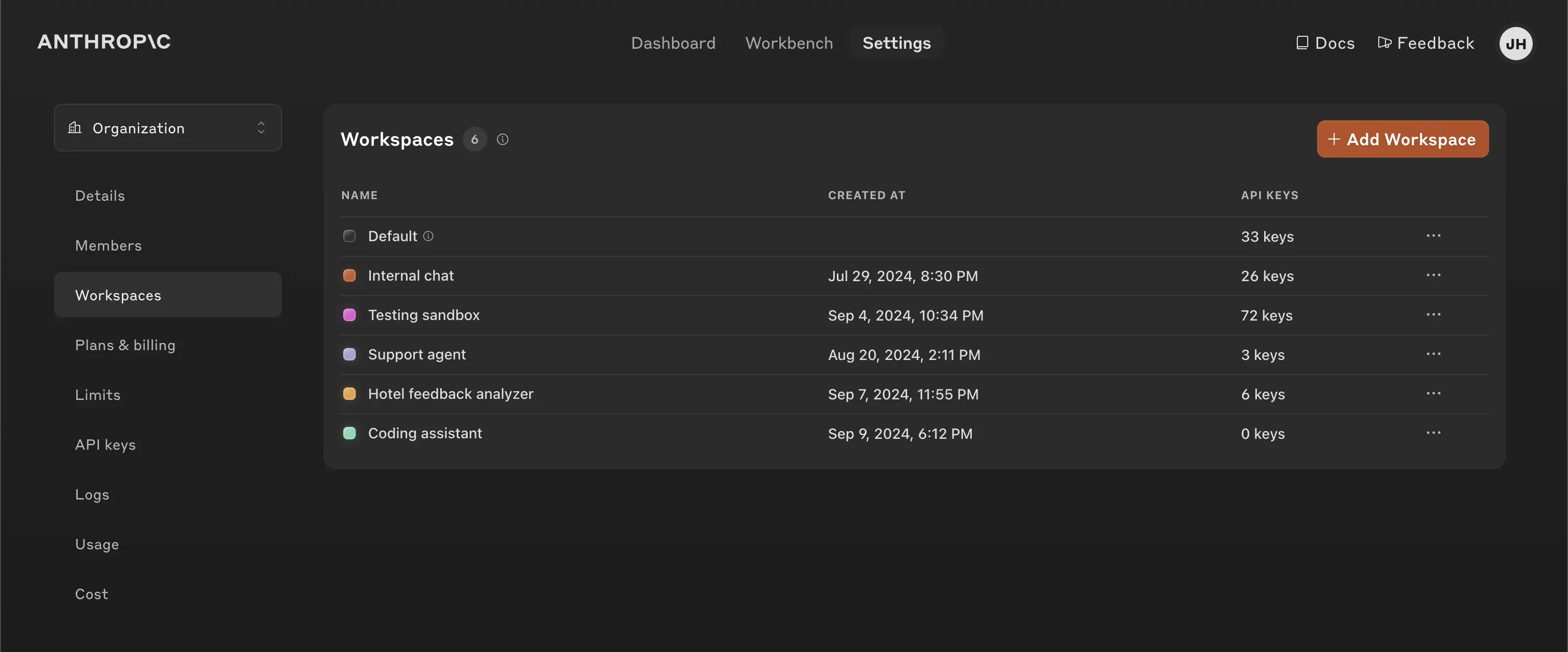
Product image showing different workspaces
Anthropic Workspaces.

What can you do with Anthropic’s Workspaces?

The Anthropic team has laid out five different use cases for Workspaces.

They say monthly spend limits can be implemented through Workspaces allowing businesses to have “fine-grained control over” API usage costs.

The managing of rate limits is also said to be possible now, with rate limits for each workspace being able to be independently adjusted while staying within the overall limit. This aims to help better manage the load across various deployments and departments.

Account security has been improved too, with user permissions able to be assigned at the workspace level. Each workspace can be monitored to gain insights into the API usage, with costs broken down too which could help with tracking and optimizing resource allocation.

API keys, usage data, and settings can be organized into “logical groups that align with your projects or environments” with the tool.

The feature has already been rolled out and is available to all Anthropic API users in the Console.

Featured Image Credit: Via ‘Workspaces in the Anthropic API Console’

By

Sophie Atkinson is a UK-based journalist and content writer, as well as a founder of a content agency which focuses on storytelling through social media marketing. She kicked off her career with a Print Futures Award which champions young talent working in print, paper and publishing. Heading straight into a regional newsroom, after graduating with a BA (Hons) degree in Journalism, Sophie started by working for Reach PLC. Now, with five years experience in journalism and many more in content marketing, Sophie works as a freelance writer and marketer. Her areas of specialty span a wide range, including technology, business,…

Fact Checked by Sam Shedden

Sourced from readwrite

By

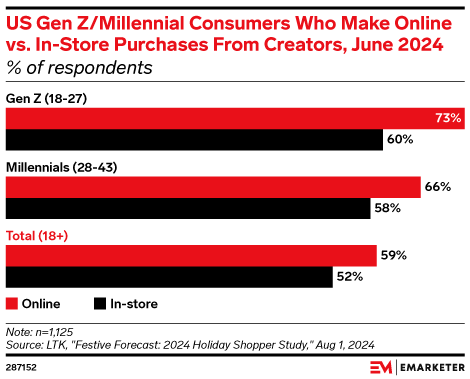
Key stat: 73% of US Gen Zers say they make online purchases from creators, compared with 66% of millennials and 59% of adult consumers overall, according to June 2024 data by LTK.

Beyond the chart:

  • Younger generations view creator-driven advertising, such as affiliate content, more favorably. Nearly 40% of Gen Z find affiliate ads at least moderately influential, per our “US Consumer Attitudes on Advertising and Privacy” survey.
  • US affiliate marketing spend exceeded $10 billion for the first time this year, and is expected to grow 11.9% next year, per our August 2024 forecast.

Use this chart: Advertisers looking to engage Gen Z or millennials can use this chart to advocate for greater investment in creators. Retailers and brands can also evaluate the value of creators in their in-store and online strategy.

By

Sourced from EMARKETER

By Joseph Green

Figure out how to make this technology work for you.

There are absolutely loads of AI and ChatGPT courses on Udemy. You can learn all about this exciting technology with these online resources, giving you the tools you need to truly harness AI and make it work for you. And better yet, some of the best courses are available to take for free.

We’ve checked out everything on offer and lined up a selection of standout courses to get you started. These are the best online AI and ChatGPT courses you can take for free this month:

These free online courses do not offer certificates of completion or direct instructor messaging, but that’s the only catch. You can still learn at a pace that suits you, so there really isn’t anything stopping you from enrolling.

Feature Image Credit: Getty Images

By Joseph Green

Sourced from Mashable

All products featured here are independently selected by our editors and writers. If you buy something through links on our site, Mashable may earn an affiliate commission.

By Dan Massimino & Evan Hovorka

Harnessing the magic of TikTok in retail media

In this episode of The Garage podcast, hosts Dan Massimino and Evan Hovorka are joined by Casey Hamlyn, North America measurement lead at TikTok.

Join them as they explore the world of retail media on TikTok, from the challenges of balancing content creation with advertising, to the importance of data hygiene and trust-building.

Hamlyn also discusses the future of the advertising landscape, and expands on how machine learning and AI are transforming TikTok ads.

“We ​provide ​resources across ​all ​of the ​paid ​ad ​side to ​help ​advertisers ​make ​quality ​creative. ​Because, ​frankly, ​whether ​it’s ​paid ​or ​not ​paid, ​it ​helps ​if ​advertisers ​are ​making ​awesome ​creative ​that ​people ​love,” he says on the podcast. “​And ​then ​the ​balance ​isn’t ​about ​paid ​and ​not ​paid. ​It’s ​about ​how ​many ​good ​TikToks ​do ​you ​have ​in ​the ​system that ​people ​want ​to ​watch ​and ​be ​entertained ​by.”

If you enjoyed this episode, don’t forget to subscribe and review on Apple Podcasts, Spotify, and Google Podcasts.

Key takeaways:

[15:07] In data management, it’s crucial to recognize that systems evolve over time, and new challenges continually emerge, especially with online transactions that weren’t initially considered. He uses the example of Nielsen, who emphasize sophisticated data quality checks and sustainable processes. They utilize a system of flags and notifications (e.g., yellow, green, red) to indicate the severity of data issues. Hamlyn offers a key lesson: Data hygiene deteriorates over time, requiring ongoing adaptation of data processes and sets to maintain accuracy. Continuous evolution and vigilance are essential for effective data management.

[19:00] TikTok balances content creation and advertising to ensure a seamless user experience by prioritizing high-quality creative content. The platform allows all types of content, whether paid or organic, to have visibility, which keeps users engaged. Senior-level decision-making oversees the equilibrium between paid ads and non-paid content, emphasizing long-term strategy and the importance of quality. TikTok supports advertisers by providing extensive resources and training to help them create compelling and engaging ads.

[26:57] TikTok is still in the early stages of establishing itself as a credible and reliable partner in the retail media space. Success in retail media requires dependable operations, strong relationships, and effective campaign management, including accurate measurement and negotiation. TikTok’s immediate goal is to prove its reliability and consistency in handling routine tasks before exploring advanced features and special projects. Hamlyn outlines how the platform aims to meet various levels of retail media sophistication, adapting to different capabilities and needs, while gradually introducing more innovative solutions as trust and credibility are solidified.

[32:16] Hamlyn anticipates significant advancements in the advertising industry, driven by reduced supply bottlenecks and enhanced creativity and processes. TikTok is leading this shift with its rapidly growing search and shop functions and new machine learning tools that transform traditional ads into engaging TikTok-style content. These tools speed up the creative process, helping marketers quickly adapt and optimize their briefs. These advancements are revolutionizing how marketers produce and manage high-volume ad content, marking a departure from traditional methods and setting the stage for unprecedented growth in the industry.

By Dan Massimino

Dan Massimino leads Communication and Learning and Development for Albertsons Media Collective, ensuring all marketing and messaging is on-brand and driving growth for the Retail Media industry and brands profitability.

Evan Hovorka

Evan Hovorka leads product development at Albertsons Media Collective, where he and his team design and build innovative marketing technology that drives profitability for brands.

Sourced from ADWEEK

By Jodie Cook

Everyone wants to scale their business but hardly any make it a success. Only 22% of new businesses launched in the past decade have pulled it off. 70% of startups struggle to scale, and half of small businesses don’t make it past year five. The odds don’t look good.

But here’s the thing. Two-thirds of the value created in new businesses happens during scale-up. Companies that nail their scaling are three times more likely to succeed.

It’s an important phase and the rewards are there if you can crack the code. Join the 22% with 7 ChatGPT prompts to help you scale.

Scale your business with ChatGPT: prompts for ideation, planning and success

Know when to make your move

“Adopt the role of a business analyst. What are the key indicators that suggest my business is ready to scale? Help me assess whether now is the right time to expand in [describe your industry/niche].”

Timing is everything. Don’t jump too soon, but don’t miss your window. Use this prompt to get it right. If you decide it is time to scale, move on to this next prompt.

Map out your scaling strategy

“Guide me through developing a scaling strategy that aligns with my current business model and market conditions. What steps should I take to prepare for growth? Ask 5 questions, one by one, about my business plan before providing a draft strategy [Include your business model and business plan]”

A solid plan is your roadmap to success. Without it, you’re just wandering. ChatGPT can suggest areas to explore that you may have missed.

Spot your scaling opportunities

“Acting as a growth advisor, help me identify potential scaling opportunities, such as new markets, products, or services. How can I evaluate and prioritize these options in line with the scaling strategy outlined. Here’s what we have tried so far: [describe that here]”

The right opportunity can skyrocket your growth. Get a list of ideas, discount those that won’t work, then choose a few and double down.

Prepare for the pitfalls

“What are some common challenges businesses like mine face when scaling, and how can I mitigate them? [Add more specific business details if required] Provide specific strategies for navigating potential pitfalls.”

70% of scale-ups fall short in at least one critical area, identified by McKinsey as being product & strategy, go to market, technology, people, operations, capital and governance. Cover all your bases.

Build your dream team

“Help me create a plan for scaling my team as my business grows, especially as I explore [specify the strategy you want to explore]. What roles should I prioritize hiring for, and how can I maintain a strong company culture? Here’s information about my team right now: [include that here]”

Your team can make or break your scaling efforts. Get a second opinion on the people you have in place, and build up with the best new hires.

Get your finances in order

“What financial considerations should I keep in mind when scaling my business as planned? Guide me through managing cash flow, securing funding, and planning for financial sustainability. First, ask me questions about my current finances so you have a deeper understanding of my situation.”

Successful scale-ups raise 250% more investment than anticipated. If you’re going for funding, be prepared for a windfall when you get this right.

Streamline your operations

“Assist me in refining my operations to support scaling. What changes should I consider in processes, technology, or partnerships to handle increased demand? First, ask me questions about my current operational setup and point out any areas of concern. Then move onto adaptations required for scaling.”

Efficiency is key. Make sure your operations can handle the growth, then throw everything at the top of the funnel. Without this step, your business could buckle under the strain of even your first efforts at scaling.

Scale smart, scale fast: ChatGPT prompts for insane business growth

Use these prompts to start your scaling journey with ChatGPT. Tailor them to your business for personalized advice and keep refining your plan until you’re confident in your scaling strategy. Get better as you get better.

You’ll know you’re ready to scale when the stats motivate you, not scare you off trying. Join the elite set of startups that successfully scale. Your scaling journey starts now. Make it count.

Feature Image Credit: Getty

By Jodie Cook

Follow me on LinkedIn. Check out my website or some of my other work here.

Founder of Coachvox AI – create an AI version of you. Forbes 30 under 30 class of 2017. Post-exit entrepreneur and author of Ten Year Career. Competitive powerlifter and digital nomad.

Sourced from Forbes

By Reuters

Shares in the EU hearing aid industry dropped.

Shares in European hearing aid makers slipped in early trading after Apple rolled out hearing aid features.

Apple said its AirPods Pro 2 could now be “transformed” into a personalized hearing aid via an upcoming software update that would boost specific sounds in real time, including parts of speech or elements within a user’s environment.

Shares in Italy’s Amplifon dropped as much as 7.2% earlier in the session and were down 5.7% by 0845 GMT. Other hearing aid makers, Sonova, Demant and GN Store Nord, fell between 2% and 4%.

However, Jefferies analysts said in a note that Apple’s move was not a concern for hearing aid players as over-the-counter (OTC) devices target a different population.

OTC hearing aids do not compete against prescription-based devices on either technological or service levels, despite their attractive price points, Jefferies added.

“The level of fitting does not suffice the need for those, that have severe hearing aid problems and as such, OTC devices are mostly used for those with mild hearing aid problems,” analysts from Vontobel wrote in a note.

Still, analysts said the news could be a positive development for the hearing aid industry, as it also raises awareness of the hearing deterioration problems.

Feature Image Credit: Manuel Orbegozo/Reuters, file

By Reuters

—Anastasiia Kozlova, Alessandro Parodi, Agnieszka Olenska and Amir Orusov, Reuters

Sourced from FastCompany