Elon Musk’s ownership of X (formerly Twitter) has not been without its challenges and criticisms.
Since buying the social media platform in 2022, Musk has been in the headlines over misinformation, buyer’s remorse, warring with advertisers, and more. Now, X has driven the nonprofit Global Alliance for Responsible Media (GARM) to close its doors after serving the nonprofit with a lawsuit over advertising on the platform.
In this episode of Yeah, That’s Probably an Ad, ADWEEK’s brand editor Rebecca Stewart and community editor Luz Corona are joined by Trishla Ostwal, AI and tech reporter, and Catherine Perloff, platforms reporter.
They discuss the ongoing controversy surrounding Musk’s ownership of X, its impact on the advertising industry, and what might happen next. They also talk about what they’ve heard from sources about X’s brand safety measures, and what buyers are really thinking.
To learn more, listen to the latest episode or check out key takeaways below.
This is an ideological issue
Ostwal and Perloff take us back to the start, highlighting Musk’s questionable comments on X and the subsequent backlash from advertisers. Advertisers initially started boycotting X due to concerns about brand safety and offensive content. Then, Musk’s free speech agenda clashed with brands’ desire to distance themselves from problematic content.
As a result, X’s revenue dropped and the number of advertisers on the platform decreased; ad spend on X dropped 20% year-over-year in 2024, from $788 million in 2023 to $628 million, per MediaRadar.
X’s lawsuit is like ‘Hershey’s suing people who don’t buy candy’
The relationship between Musk and advertisers has become antagonistic. Perloff likens the decision to sue GARM, Unilever, Mars and CVS for “conspiring to boycott X” to “Hershey’s suing people who don’t buy candy.” All this is creating uncertainty for ad buyers and raising concerns about the viability of advertising on X.
GARM was more helpful than harmful
GARM was a leading organization in establishing standards for what constitutes brand safety, although they weren’t the only one doing so (there are tech vendors that brands pay to help do this). GARM’s role involved setting guidelines for where brands should or should not advertise, often based on ideological considerations. This was crucial because brand safety measures can impact important journalism, since ads may be pulled from significant but controversial content.
Advertisers relied on GARM to know where to draw the line in a very complicated and fractured digital media ecosystem.
Advertisers have ongoing frustrations with X beyond brand safety
Among some advertisers, there have been concerns that anti-misinformation efforts are “too liberal-leaning,” said Perloff, causing hesitation and uncertainty. However, brands often return to large platforms such as X, since there are few viable alternatives.
Ostwal adds that marketers tell her they’re still frustrated with X due to poor sales support and communication. Agencies have reported difficulties getting reliable responses from X’s sales representatives, especially after Musk’s takeover, she said.
As we move further into the digital age, the opportunities for income generation continue to evolve. In 2024, ChatGPT, a powerful language model, has emerged as a valuable tool for those seeking to capitalize on various money-making ventures. This article delves into eight innovative strategies that harness the capabilities of ChatGPT to help you unlock wealth in the coming year.
1. Faceless YouTube Channels
One lucrative avenue to explore is the creation and monetization of faceless YouTube channels. With the advent of AI video creation tools, producing engaging content without the need to appear on camera has become more accessible than ever. ChatGPT can be instrumental in generating compelling video scripts that captivate your audience while delivering informative and entertaining content.
To maximize your earnings, consider implementing various monetization methods:
Ad revenue: Earn money through YouTube’s AdSense program by displaying ads on your videos.
Sponsorships: Collaborate with brands that align with your channel’s niche and create sponsored content.
Branded merchandise: Design and sell custom merchandise related to your channel’s theme or catchphrases.
Affiliate marketing: Promote products or services within your videos and earn commissions on sales.
ChatGPT can assist in drafting persuasive pitches for potential sponsors, crafting descriptions for your merchandise, and creating engaging calls-to-action to drive affiliate sales.
2. Ghostwriting for LinkedIn and Twitter
Another profitable venture is offering ghostwriting services for executives and CEOs on social media platforms like LinkedIn and Twitter. Many high-level professionals recognize the importance of maintaining a strong online presence but lack the time or expertise to create content consistently. This is where ChatGPT comes in.
By leveraging ChatGPT’s natural language generation capabilities, you can produce high-quality, engaging posts that reflect the executive’s unique voice and industry insights. This service helps them build their personal brand while providing you with a steady stream of income.
To succeed in this field:
Research the executive’s industry, target audience, and communication style to ensure the content resonates with their followers.
Use ChatGPT to draft posts that showcase the executive’s thought leadership and provide value to their network.
Maintain a consistent posting schedule to keep their audience engaged and grow their online presence.
3. Travel Concierge Services
The travel industry presents another opportunity for those looking to generate income using ChatGPT. By offering personalized travel planning and booking services, you can cater to the needs of discerning clients who value a seamless and stress-free travel experience.
ChatGPT can be a valuable asset in creating tailored itineraries based on client preferences, such as preferred destinations, activities, and accommodations. Additionally, ChatGPT can handle client communication, ensuring prompt and accurate responses to inquiries and requests.
To excel in this field:
Build a network of reliable travel partners, such as airlines, hotels, and tour operators, to provide comprehensive services.
Use ChatGPT to generate personalized travel recommendations and handle client correspondence professionally.
Offer value-added services, such as real-time travel updates and 24/7 support, to differentiate yourself from competitors.
By delivering exceptional service and leveraging ChatGPT’s capabilities, you can attract high-paying clients and establish a profitable travel concierge business.
4. Print on Demand
Print on demand (POD) has gained significant traction in recent years, allowing entrepreneurs to design and sell custom products without the need for inventory or upfront costs. ChatGPT can be a valuable tool in this venture, assisting in the creation of unique and appealing designs for products like t-shirts, mugs, and phone cases.
To get started:
Use ChatGPT to brainstorm design ideas and generate product descriptions that resonate with your target audience.
Partner with reliable POD services that handle production, shipping, and customer support, allowing you to focus on design and marketing.
Promote your products through social media, online marketplaces, and targeted advertising to drive sales.
By leveraging ChatGPT’s creative capabilities and the efficiency of POD services, you can build a profitable business with minimal overhead costs.
5. Creating and Selling eBooks
Writing and selling eBooks has long been a popular method for generating passive income. With ChatGPT’s assistance, the process of creating high-quality, informative content has become more efficient than ever.
To maximize your eBook sales:
Identify a niche or topic that aligns with your expertise and has a proven demand in the market.
Use ChatGPT to generate well-structured, engaging content that provides value to your readers.
Develop compelling landing pages and promotional materials using ChatGPT to drive sales and attract potential buyers.
Utilize online platforms like Amazon Kindle Direct Publishing or Gumroad to distribute your eBooks and reach a wide audience.
By creating high-quality eBooks and implementing effective marketing strategies, you can generate significant revenue and establish yourself as an authority in your chosen niche.
6. AI Business Optimization Consultant
As businesses increasingly recognize the potential of artificial intelligence to streamline operations and improve efficiency, the demand for AI business optimization consultants is on the rise. By mastering the art of prompting ChatGPT effectively, you can offer valuable insights and recommendations to help businesses achieve their goals and enhance their bottom line.
To succeed in this role:
Develop a deep understanding of ChatGPT’s capabilities and learn to craft prompts that elicit the most relevant and actionable responses.
Stay up-to-date with the latest AI trends and best practices to provide innovative solutions to your clients.
Collaborate closely with businesses to identify areas for improvement and develop customized strategies that leverage ChatGPT’s insights.
By positioning yourself as an expert in AI-driven business optimization, you can attract a diverse range of clients and build a profitable consulting practice.
As we look ahead to 2024, the opportunities for income generation using ChatGPT are vast and varied. By exploring these eight innovative strategies and adapting them to your unique skills and interests, you can unlock new avenues for financial success in the digital age. Whether you choose to create faceless YouTube channels, offer ghostwriting services, or become an AI business optimization consultant, ChatGPT’s powerful language capabilities can help you achieve your goals and thrive in the ever-evolving landscape of online entrepreneurship.
Transform Your Business with These Powerful ChatGPT Prompts for 2024
n the fast-paced world of 2024, leveraging AI for business growth has never been more essential. ChatGPT, an advanced AI language model, offers an array of prompts that can help you kickstart various business ventures and side hustles. If you’re looking to get rich quick, these 7 insane ChatGPT prompts could be your golden ticket. Let’s dive into how you can use these prompts and tools to create successful businesses.
7. AI Graphic Design Business Prompt
Prompt: “I am planning to launch a graphic design business that incorporates AI technologies. Provide detailed advice and a step-by-step action plan covering these key areas: Business concept and market analysis, business structure and legal, AI technology and integration tools, service offerings and portfolio development, pricing strategy and financial planning, marketing and client acquisition, product management and workflow, quality control and client feedback, and at last scaling and business growth.”
Getting Started: Launching an AI-powered graphic design business involves integrating advanced tools like Canva and Miro. Canva, known for its user-friendly interface, can be combined with AI-driven design suggestions to enhance creativity. Miro offers collaborative brainstorming and visual content creation, essential for developing innovative designs.
Key Steps:
Business Concept and Market Analysis: Understand the demand for AI-integrated graphic design services.
AI Technology Integration: Utilize tools like Canva and Miro to streamline design processes.
Marketing and Client Acquisition: Leverage platforms like LinkedIn and Medium to reach potential clients and showcase your portfolio.
6. Affiliate Marketing Business Prompt
Prompt: “I am planning to create an affiliate marketing blog. I need a complete guide that covers all the essential aspects, strategies, and best practices for launching and growing an affiliate marketing blog. Provide in-depth information and actionable steps on the following key areas: Niche selection and market analysis, blog setup and platform optimization, content strategy and creation, affiliate partnership and monetization, traffic generation and audience building, performance tracking and analytics, scaling and growth strategies, and at last long-term sustainability and adaptation.”
Getting Started: Affiliate marketing can be a lucrative side hustle if done right. Tools like Notion-AI and Google Docs can help in organizing your content strategy and streamlining the creation process.
Key Steps:
Niche Selection and Market Analysis: Identify profitable niches using tools like Google Trends.
Content Strategy and Creation: Use Notion-AI for idea generation and Google Docs for drafting and editing.
Traffic Generation: Implement SEO strategies and use LinkedIn for networking with other marketers.
5. Copywriting Business Prompt
Prompt: “I am planning to start a business focused on AI-driven copywriting services. I need a complete blueprint covering the essential steps, strategies, and considerations for launching and growing this business successfully. Provide detailed guidance on the following aspects: Market analysis and business planning, technology and tools, service and portfolio development, client acquisition and sales strategies, operational workflow and quality control, and at last business model and pricing.”
Getting Started: AI tools like Quillbot can enhance your copywriting efficiency, making it easier to produce high-quality content quickly.
Key Steps:
Market Analysis: Identify industries in need of quality copywriting services.
Technology and Tools: Incorporate Quillbot for paraphrasing and improving content quality.
Client Acquisition: Use LinkedIn and Medium to network and showcase your expertise.
4. Social Media Marketing Agency Prompt
Prompt: “I am planning to start a social media marketing agency. I need a detailed plan that encompasses all critical elements of establishing and operating a successful agency in this field. Provide in-depth guidance on the following key areas: The business foundation and niche identification, service offerings, package development, building a team and resource management, and at last, client acquisition and relationship management.”
Getting Started: Social media marketing requires creativity and strategic planning. Tools like Canva for content creation and Notion for task management can be invaluable.
Key Steps:
Niche Identification: Determine which industries you will serve.
Service Offerings: Develop packages tailored to different business needs.
Client Acquisition: Utilize LinkedIn and other social media platforms to attract clients.
3. Email Marketing Agency Prompt
Prompt: “I am in the process of establishing an email marketing agency. I need a detailed plan that covers all crucial components of creating and managing a thriving email marketing agency. Provide in-depth advice and strategies on the following key areas: Market analysis and defining services, the agency setup and legal considerations, building a skilled team, client acquisition and sales strategies, operational tools and technology, client onboarding and project management, performance measurement and analytics, and at last long-term growth and scaling the agency.”
Getting Started: Email marketing remains a powerful tool for businesses. SaneBox can help manage emails efficiently, ensuring that important client communications are not missed.
Key Steps:
Market Analysis: Research businesses that can benefit from email marketing.
Service Definition: Create service packages, including campaign creation and analytics.
Client Onboarding: Use SaneBox to organize and streamline client communications.
2. YouTube Content Ideation and Planning Prompt
Prompt: “You are a creative consultant for a [NICHE] YouTuber. Based on their target audience of [TARGET AUDIENCE] and their previously successful themes of [previous successful themes], please generate five unique video content ideas and a brief script for all of them.”
Getting Started: Content creation for YouTube requires a blend of creativity and analytical thinking. Tools like Miro for brainstorming and Notion for planning can be extremely useful.
Key Steps:
Content Ideas: Use Miro to brainstorm and map out content ideas visually.
Script Writing: Draft scripts in Google Docs or Notion for easy collaboration.
Execution: Plan the production schedule and optimize video SEO.
1. Detailed Podcast Topic Ideation Prompt
Prompt: “You are a podcaster using the [specific podcasting strategy model]. Your task is to create an episode plan for the upcoming episode titled [Episode Title]. This episode is aimed at [Target Audience]. The objectives for this episode are [Objective 1, Objective 2, Objective 3]. This episode should cover some key themes: [Theme 1, Theme 2, Theme 3]. Using the principles of the [specific podcasting strategy model], please create an episode plan including the following sections: a) Title: [Episode Title], b) Objectives: As stated above, c) Key Themes: As stated above, d) Episode Details: Detailed content ideas covering the objectives and key themes, e) Engagement Suggestions: Innovative ideas to engage your listeners during and after the episode, f) Evaluation Methods: Methods to assess the reception and impact of the episode.”
Getting Started: Podcasting is a growing field with a lot of potential. Using tools like Notion for planning and organization can streamline the process.
Key Steps:
Episode Planning: Use Notion to outline and organize episode content.
Content Creation: Draft scripts and detailed notes in Google Docs.
Engagement: Implement strategies to engage listeners and evaluate episode performance.
Tools Mentioned
Miro: A visual content creation tool that offers a freemium pricing model. Ideal for brainstorming and collaborative planning. Website
Notion: An all-in-one productivity and task management tool, priced at $8/month for an annual subscription. Website
Canva: A popular graphic design tool that integrates AI suggestions to enhance creativity.
Quillbot: An AI tool for paraphrasing and improving the quality of copywriting.
SaneBox: A tool to manage and organize emails efficiently.
FAQs
How to prompt ChatGPT for business? To prompt ChatGPT for business, clearly state your business idea and the specific information you need. For example, “I am planning to launch a graphic design business that incorporates AI technologies. Provide detailed advice on business structure, AI integration, and client acquisition.”
What is the prompt for generating business ideas in ChatGPT? For generating business ideas, use a prompt like, “Generate innovative business ideas that leverage AI technologies for the year 2024, focusing on emerging trends and market needs.”
How to start your business with ChatGPT? Starting your business with ChatGPT involves using it for market analysis, business planning, and strategic advice. Begin by asking ChatGPT for a step-by-step guide tailored to your specific business idea, covering aspects like market research, legal considerations, and client acquisition strategies.
ChatGPT offers a wealth of opportunities to kickstart your business ventures in 2024. By utilizing these 7 insane prompts, along with powerful AI tools like Canva, Notion, and Quillbot, you can streamline your processes and achieve remarkable growth. Whether you’re diving into affiliate marketing, social media management, or launching an AI-driven graphic design business, ChatGPT can be your ultimate guide. Start leveraging these insights today and watch your business soar!
In September 2021, when I was 27, I got laid off from my role as customer success manager after four and a half years working for a financial technology company. Luckily, I had been working on my side hustle since April 2020.
I started my money-coaching business The Wealthy Wolfe because I wanted to help what I knew first hand to be an underserved group of people: daughters of immigrants, who struggled with growing their wealth and were tired of advice from predominantly white male financial advisors who didn’t I don’t understand where they were coming from.
When I lost my job, I felt expendable and like I didn’t have any agency or ownership over my career. I didn’t want to go through that again. I realized there was no better time to go out on my own, so I took the leap.
I’m so glad that I bet on myself. At the end of 2020, I had made $6,300. It was a start. By the end of 2023, I had earned over $100,000 a year, for the second year in a row.
Here are three steps I took to turn my side hustle into a lucrative, full-time business.
1. I expanded my reach online
I knew that if I wanted to reach my ideal audience, I needed to meet them where they were. My online presence at the time was a very static Instagram page. Creating video content wasn’t something I was very comfortable with, so I decided to enlist an expert for help.
I hired a coach that specialized in marketing and TikTok, and started posting a minimum of two videos a day. I even recently had a video go viral. In it, I talk about the dynamics of lending money to immigrant parents and how that can affect your motivation to save for yourself.
TikTok leads have been responsible for 80% of my new one on one coaching applications. The other 20% of my leads come from Instagram, podcast interviews and writing about my personal experience with money.
Finding my niche, curating my content and getting my voice out there has helped me build trust with my audience and consistently bring in new clients. Between my Instagram, email list and TikTok, I currently reach a community of 44,000 people and counting.
2. I diversified my sources of income
Every month, I work with up to 15 clients in my three-month coaching program. My one-on-one coaching accounts for roughly 75% of my revenue, and I have two passive income streams with my digital workshops and my budgeting template.
I started taking on brand deals with several financial companies and running live corporate workshops about personal finance. Brands and corporate work aren’t always consistent, so I don’t rely on them as much as as the other incomes streams. But the exposure that has come from working with these organizations has definitely been beneficial for my business.
When it comes to conversations about money, women of colour are often missed by these big companies. I’ve found that this representation gap can lead to earning potential for creators like me in this space.
3. I focused on perfecting one service
Early on, I fell into a common side hustle trap, which was overdoing it and launching too many programs too fast.
In 2022, I started a group coaching offering after I had barely sold out my one-on-one coaching slots. It was confusing for an audience that was still getting to know me, and it was a lot of work to get it up and running.
Ultimately I stressed myself out, and I didn’t even have enough people to fill up the program.
Early on, I fell into a common trap, which was overdoing it and launching too many programs too fast.
I decided to cut my losses, and I removed the group coaching program entirely to focus on the one-on-one, and made sure to promote that one consistently throughout the year.
I have heard so many stories from my clients about the bad experiences they’ve had with financial experts who didn’t have the cultural context needed to make them feel seen and heard.
So when they sit down with me, the first thing I do is customize a plan that takes their lived experience into account, whether they need help budgeting, paying off debt or coming up with scripts to talk with their loved ones about money.
My one-on-one coaching brought in $100,000 in revenue alone last year, and I have worked with over 100 clients since starting my business. This tailored approach, and being able to focus on developing one signature program, has been crucial for my long-term side hustle success.
Parween Mander is the founder of the Wealthy Wolfe. She is a South Asian money expert on a mission to provide honest and relatable financial coaching for women of colour from immigrant upbringings through one on one coaching and mentoring. She is an Accredited Financial Counsellor in Canada and is a certified Trauma of Money Facilitator.
If there’s one thing I’ve learned as a lifelong entrepreneur, it’s that running a business is no easy feat.
Whether you’re starting a business or trying to expand your team, many challenges come into play, from managing customer demands to wearing multiple hats when you don’t have the budget to take on a team.
All of this to say: Is there any way that, as a business owner, you can maintain growth and compete with other major market players, all without spreading yourself too thin?
One thing that immediately springs to mind is marketing automation.
Defining A Marketing Automation Strategy
A marketing automation strategy is a process in which a business uses software to automate time-consuming or repetitive tasks, such as email marketing, customer segmentation, social media marketing or lead generation.
Choosing The Right Automation Platform
When you’re just getting started with marketing automation, the first and most important step is finding the right automation platform. Personally, HubSpot has been my go-to for many years. It has some of the most powerful automation tools wrapped up in a user-friendly interface. If you’re currently running marketing automation tools, it’s easy to integrate, in my experience.
If HubSpot doesn’t gel with you or fit the needs of your business, there are several other platforms I’d recommend, including:
• Marketo: Great for larger enterprises, as it’s very customizable.
• Pardot: Top-tier Salesforce and B2B marketing integration.
• Mailchimp: One of the best email marketing automation platforms for individuals or small-business owners.
Each platform has its strengths and weaknesses, so do your research to evaluate how your chosen platform will operate alongside your business.
For that reason, one of the key automation strategies I’ve implemented over the years is an automated customer satisfaction email campaign. Each month, our clients receive a friendly email packed with tips, updates and a link to fill out a short survey.
By being proactive, I’ve found I can collect valuable feedback, make sure my clients are happy and show them that I’m working to make their experience better.
The content you include in these emails will depend entirely on your industry and target audience. As someone who works in property management, I might include practical tips on property maintenance, updates on market trends or information regarding any changes in the services I’m offering.
Providing these insights shows your clients that you’re an authoritative figure in your industry.
The survey link is a crucial component for me, as it helps me gather feedback and address concerns before they become issues that are out of my reach.
All in all, since implementing my campaign, I’ve seen a noticeable increase in client satisfaction. My clients appreciate consistent communication and feel valued knowing that I’m consistently looking to improve. It’s a win-win.
Sales Sequences For Different Customer Personas
Sales sequences have become an equally crucial aspect of my automated workflow, as they help ensure no leads fall through the cracks. Plus, they keep our sales team on top of the most critical leads.
To make the most of your sales leads, it’s a good idea to tailor them to fit your different customer personas. Start by looking at your client base as a whole and segmenting any separate key personas into groups. That way, any content you send to those groups will be personalized to them.
For example, you might have a unique sales sequence for a first-time homebuyer compared to a real estate or commercial property investor.
The “sequence” aspect comes from the fact that there are several steps you must include, such as automated emails, follow-ups and any additional touchpoints that might be relevant. If the sales sequence is targeting an investor first, those additional touchpoints might include market trend updates or burgeoning investment opportunities.
Why? Because they’re more effective than they’ve ever been.
As you’ve probably guessed by now, one of the last main pieces of my automation strategy is my monthly newsletter. I’ve designed it in such a way to keep my clients and prospects engaged with what we’re doing and informed about the latest happenings in the real estate market.
Each newsletter contains a mixture of elements, including:
• A rundown of our monthly activities.
• Insightful market updates.
• Featured properties.
• Inspiring success stories from clients.
The idea of including all of this information is to ensure there’s something valuable for every reader.
Though writing and designing the newsletter is a manual, collaborative effort, we’re able to automate its distribution using our chosen platform, saving time and making for better consistency in our messaging.
Implementing Marketing Automation
Implementing marketing automation in your current strategy starts with setting clear goals.
What do you hope to achieve with automation, and how will you measure whether it’s successful once implemented?
It’s equally crucial to make sure any content you deliver using automation is relevant and valuable. Just because you’re saving bandwidth by cutting back on your manual work doesn’t mean you should let the quality of your content suffer.
Once you feel comfortable with more user-friendly email automation tools, try integrating automation into the other facets of your marketing strategy, including content and social media. By doing so, you’ll be able to maximize your impact and create a more cohesive approach. This can be especially beneficial if you don’t have the budget to hire separate marketing experts to take on these roles.
As a fellow entrepreneur, I encourage you to start exploring and implementing automation in your marketing strategies today.
Trevor Henson, Chief Marketing Officer at Beach Front Property Management, specializes in property investment and startup growth strategies. Read Trevor Henson’s full executive profile here.
Holiday email promos need a little dialling up — and dialling down — on standard tactics.
The Gist
Email relationships. Previous engagement boosts holiday email performance, increasing subscriber interaction and revenue during Cyber 5.
Social proof. Highlighting top search terms and popular products in holiday emails can inspire and guide subscriber purchases effectively.
Clear messaging.Simplify holiday email content with clear, direct messaging and seasonal imagery to capture hurried subscribers’ attention.
Everyone wants to have their seasonal email strategies stand out during the Thanksgiving-to-Cyber Monday time period, called Cyber 5. And for good reason. Based on an examination of email campaign performance among retailers and ecommerce brands using Oracle Responsys, campaigns sent during the Cyber 5 weekend routinely generate the highest revenue per email for the whole year — by far.
However, marketing emails aren’t ads. They’re not about shouting the loudest, flashing the brightest colours or being the most sensational or shocking. They’re also not about abusing trust with misleading or vague copy.
There are two components in the battle for holiday email marketing attention.
Seasonal Email Strategies: Half the Battle for Attention
The truth is that the battle for attention during the Cyber 5 is already half won long before your Black Friday or Cyber Monday campaign arrives in inboxes. That’s because seasonal email strategies are relationships, so previous engagement has a major impact on future engagement. If your email program delivers value to lots of subscribers during August and September, then they’re much more likely to engage during the holiday season. And the more frequent and substantial that engagement is, the better off you’re likely to be.
ZeroBounce research recently confirmed this, finding that 47% of people say they open a brand email not because of the subject line, but because that brand always sends them good emails.
In my book, “Email Marketing Rules,” I call this the zero stage of an email interaction. This is why sender names are more powerful than any subject line you can come up with. Your sender name brings to the surface all of your subscriber’s feelings about their recent interactions with your brand. If those feelings are positive, it leads to positive results.
The Other Half of the Battle
The rest of the battle is about your seasonal email strategies themselves. But here, brands sometimes have misconceptions, in part because subscribers behave differently during the holiday season. Consumers have different goals than the rest of the year, and they’re also generally much more pressed for time in the inbox, in part because they’re receiving more campaigns.
Here are some tactics to dial up and to dial back on during the holiday season to maximize performance.
Dial Back Personalization
Personalization is perennially among the top email marketing trends. And new opportunities that are fuelled by customer data platforms and advanced AI are likely to keep it at the top of marketers’ to-do lists for years to come.
However, during the holiday season, subscribers are (mostly) shopping for others, so the zero- and first-party data you’ve been collecting all year isn’t likely to be very useful for tailoring messages.
Dial up Social Proof
Instead of focusing on what each subscriber did months ago, focus on what your customers are doing collectively now. In your email campaigns, highlight:
Top site search terms, so subscribers can understand and be inspired by what others are looking for.
Most browsed product categories, which encourage subscribers to explore categories they haven’t shopped recently or ever.
Most social buzz, such as likes on Instagram or pins on Pinterest.
Most purchased products, which is probably the ultimate barometer of popularity.
Dial back Interactivity
Interactive emails bring common web experiences into the inbox, enabling product carousels, tabbed interfaces, hotspots and more. However, interactivity typically isn’t worthwhile during the holiday season because subscribers are in such a hurry. It’s also tough to do because it increases production times when marketers are creating more campaigns than ever.
Dial up Clarity
Even more than usual, clear and simple wins during the holiday season, because people are in such a hurry. Front load your subject lines with the most important words, and pay extra attention to your message hierarchy, ensuring your most important message points stand out from your less important ones. Especially if you’re promoting a strong offer (and I hope you have plenty of those), you don’t want to undermine it by having cluttered messaging or an overly busy design.
Dial up Scarcity
When something is in low supply or likely to sell out, let subscribers know. If you’re able to include real-time inventory numbers for the products featured in your emails using live content, that can be powerful.
But don’t fake it. Your most loyal customers will see that you’re lying to them if you perpetually claim something will sell out and it doesn’t or, worse, you’re faking real-time inventory numbers by manually including them. And it’s your most loyal customers that you can’t afford to offend.
Dial up Seasonal Imagery & Content
Let your subscribers know you’re in the holiday spirit and hope they are, too. Consider:
Adding holiday imagery to your header, including snowflakes, holly leaves or sparkles.
Add a “Holiday” or “Gifts” link to your navigation bar.
Add a gift services footer that highlights gift guides, gift return policies, gift wrapping options, order-by deadlines and other important holiday details and policies.
Dial up Automation
Triggered campaigns are likely the silent heroes of your holiday season. They’re quietly rescuing abandoned carts, following up on product category interest, notifying customers of back-in-stocks, welcoming seasonal subscribers and more. And their ROIs are through the roof.
Before the holiday season arrives, have a plan to ensure your triggered emails perform their best. If nothing else, make time to review and QA your automations, checking for out-of-date language, broken images and broken links. But also, consider adding seasonal imagery and content blocks to these emails, just like you would to your broadcast promotional emails.
The Big Picture
If you’re anything like our retail and ecommerce clients, you’re already well on your way to planning your seasonal email strategies, including your Black Friday and Cyber Monday emails.
But as you do that, recognize that the email experiences you create and the value you deliver to subscribers over the next couple of months will have a big impact on how your seasonal email strategies perform.
Best for creating email marketing campaigns: Pipedrive
Marketing CRM software is a sales solution that specifically aids businesses in creating and managing lead generation and nurturing through digital or in-person campaigns. Campaigns and strategies you can implement include email marketing, social media marketing, digital content marketing, in-person events, referral programs and so much more. Marketing CRM tools can manage all this, plus track how prospects interact with your content, all while promoting a positive perception of your brand.
Top marketing CRM software comparison
CRM providers typically offer marketing products in tandem with sales tools or they offer marketing features embedded into the sales CRM itself. If your business is looking for a CRM provider with advanced marketing functionality, key features to consider are content generation, such as email templates, integrations and general marketing automations.
Below, I review top sales CRM providers for their marketing expertise and capabilities. My list of the best marketing CRM software providers includes HubSpot, Salesforce, Zoho CRM and others. I list out pricing details, pros and cons, and identify ideal use cases for each to help you pinpoint which provider best fits your marketing needs.
HubSpot has a product called HubSpot Marketing Hub that offers both free and paid features. Within the free CRM tool, users can access email marketing, web forms, live chat, ad management and mobile optimization. If your business wants more marketing tools and is in a position to purchase a paid subscription, then multiple currencies, email health insights, social media integrations and adaptive testing are advanced features that are up for grabs.
Pricing
Free CRM: Free for up to five users with contact management, quotes, live chat and more.
Sales Hub Starter: $15 per seat per month, billed annually, or $20 when billed monthly. The Starter plan includes all free tools, plus simple automation, e-signature, conversation routing and more.
Sales Hub Professional: $90 per seat per month, billed annually, or $100 when billed monthly, plus a one-time $1,500 onboarding fee. This plan includes all Starter features and prospecting workspace, playbooks, forecasting and more.
Sales Hub Enterprise: $150 per seat per month, with an annual commitment and a one-time $3,500 onboarding fee. Users receive all Professional tools, plus advanced permissions, predictive lead scoring, conversation intelligence and lead form routing.
Marketing Hub Free: $0 per month for up to five users.
Marketing Hub Starter: $15 per seat per month, billed annually, or $20 when billed monthly.
Marketing Customer Platform: $15 per seat per month, billed annually, or $20 when billed monthly.
Marketing Hub Professional: $800 per month, billed annually, or $890 when billed monthly. This includes three seats with additional seats starting at $45 per month.
Marketing Hub Enterprise: $3,600 per month and includes five seats. Additional seats start at $75 per month.
A/B testing: Implement adaptive testing of different marketing strategies by receiving real-time feedback and insight into campaign success.
Web forms: Generate leads directly from your business website by building online forms.
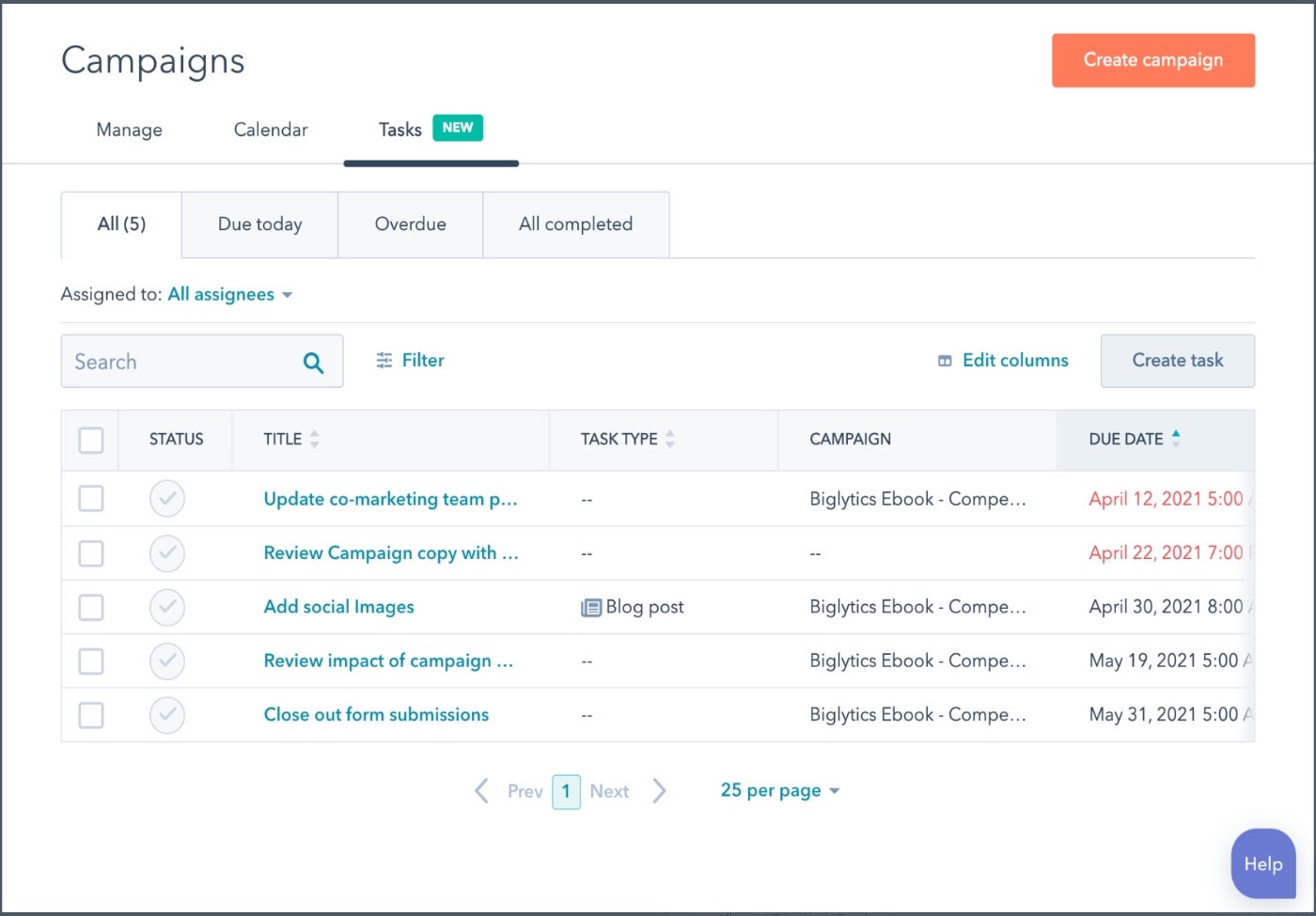
Marketing campaign management: Align marketing and sales teams by allowing collaboration in one central place.
Task tracker within campaign management tool. Image: HubSpot
HubSpot pros and cons
Pros
Cons
Users report easy platform setup.
No free trial for paid plans.
24/7 user support for paid plans.
No live support for free users.
Offers a variety of free tools and templates.
Users report lacking reporting features.
Why I chose HubSpot
HubSpot is the ultimate free CRM software for its rich marketing, sales and support features. As a popular provider thanks to its usability and user support, HubSpot can be a great choice for businesses that are new to using a CRM, want an affordable option or aim to level up their lead generation strategies.
HubSpot’s free CRM is extremely useful, but those upgrades can be costly for small businesses. For a free CRM with more affordable premium upgrades, I would recommend checking out Zoho CRM.
Salesforce: Best enterprise marketing and CRM solution
Star rating: 4.1/5
Image: Salesforce
Salesforce is enterprise CRM software built to handle the needs of large organizations. As one of the most flexible sales solutions, Salesforce allows enterprises to add niche elements and custom app integrations. It offers a marketing solution that can organize campaigns and assets and associate them with sales activities. This allows users to accurately communicate ROI to stakeholders and make strategy decisions based on campaign data history with reporting features.
Pricing
Starter Suite: $25 per user per month, billed annually. Users get account, contact, lead and opportunity management, as well as the mobile app, email integration and more.
Professional: $80 per user per month, billed annually. The Professional plan includes everything in the Starter Suite plus Sales Cloud, full offline functionality and more.
Enterprise: $165 per user per month, billed annually. This tier offers opportunity scoring and deal insights plus data synchronization and harmonization.
Unlimited: $330 per user per month, billed annually. The Unlimited tier includes all features mentioned above plus developer pro sandbox, lead scoring and five campaigns per opportunity.
Einstein 1 Sales: $500 per user per month, billed annually. This tier includes all Salesforce CRM features like collaboration tools via knowledge shares and Slack and more.
Marketing Cloud Engagement: $1,250 per organization per month, billed annually. Includes email marketing, content creation and robust analytics.
Marketing Cloud Account Engagement: $1,250 per organization per month, billed annually. This tier includes up to 10,000 contacts, lead nurturing and scoring, engagement history backboards and campaign reporting.
Marketing Cloud Growth Edition: $1,500 per organization per month, billed annually. This includes AI-powered emails and campaigns, multi-channel journeys and landing pages.
Data Cloud for Marketing: $108,000 per organization per year. These subscriptions unify data into a single customer profile with data ingestion, harmonization and insights and predictive analytics.
Marketing Cloud Personalization: $108,000 per organization per year. Includes web and email personalization, segmentation, rule-based decisioning, A/B testing and reporting and product and content recommendations.
Content creation and selection: Use generative AI that learns from your brand and campaign data to create copy and visual content.
SMS messaging: Manage and track SMS messages by sending alerts and transactional messages to customers using templates and a drag-and-drop interface.
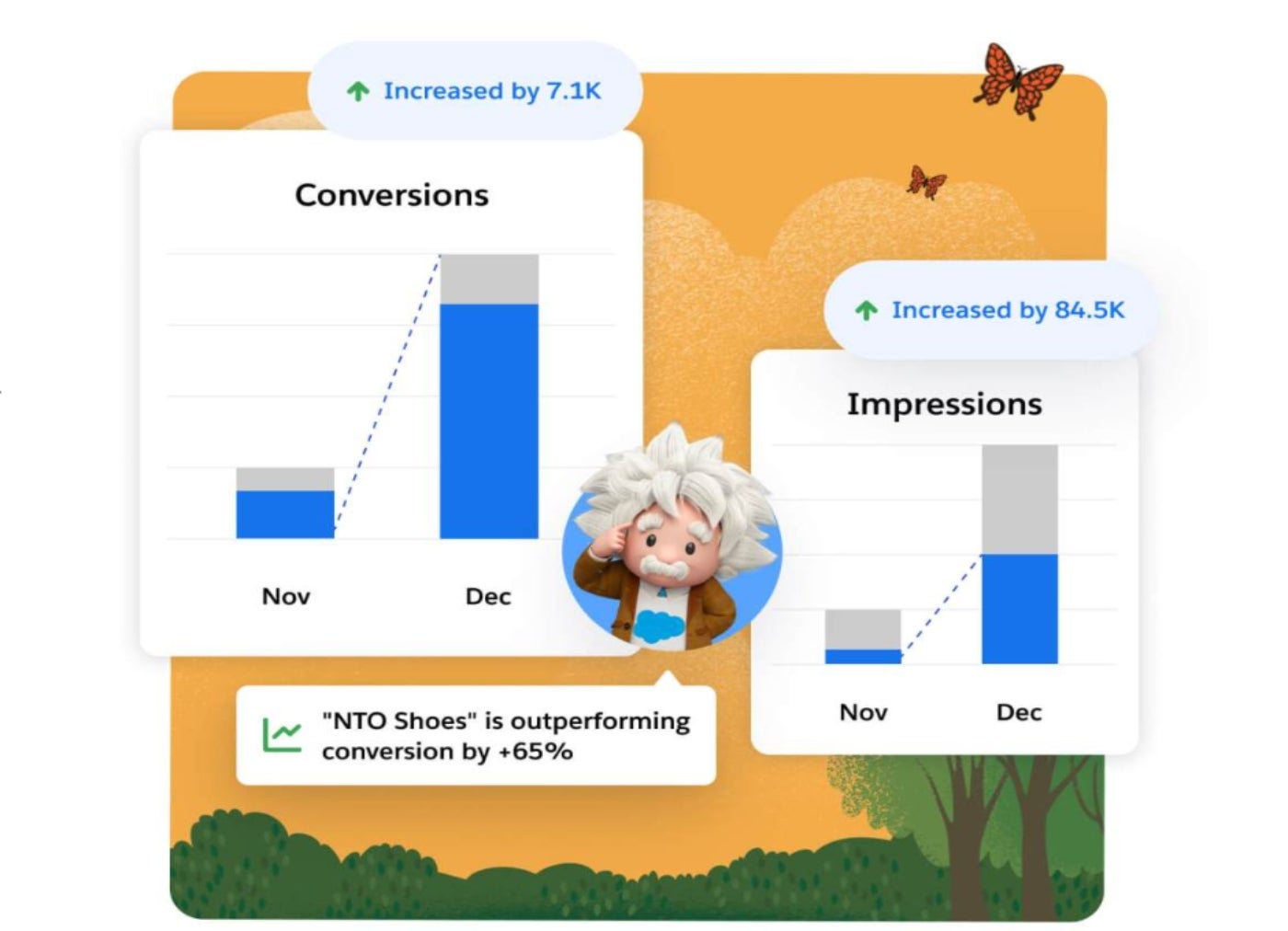
Marketing analytics: Optimize spend and customer engagement by unifying performance data, automate reporting and identify performance opportunities with AI-backed insights.
Einstein AI marketing insights. Image: Salesforce
Salesforce pros and cons
Pros
Cons
30-day free trial.
Users report time-consuming implementation and setup.
Provides customizable reports and dashboards.
Software might be too complex for small businesses.
Offers powerful automations for marketing and sales processes.
An extensive catalog of features and products can make Salesforce complicated.
Why I chose Salesforce
Salesforce is another popular CRM that is ideal for teams with complex sales cycles that rely on accurate data to make business decisions. Salesforce has the ability to generate custom CRM reports, display in-depth analytics and produce real-time forecasts. Additionally, its mobile CRM allows reps to access critical data on the go.
If cost is a bigger concern, Zoho CRM offers a fair amount of customization at a much more affordable rate. Though it’s not as flexible a platform as Salesforce, Zoho CRM costs between $14 and $52 per user per month, and a free version is also available. For this reason, Zoho CRM is an inexpensive alternative to Salesforce.
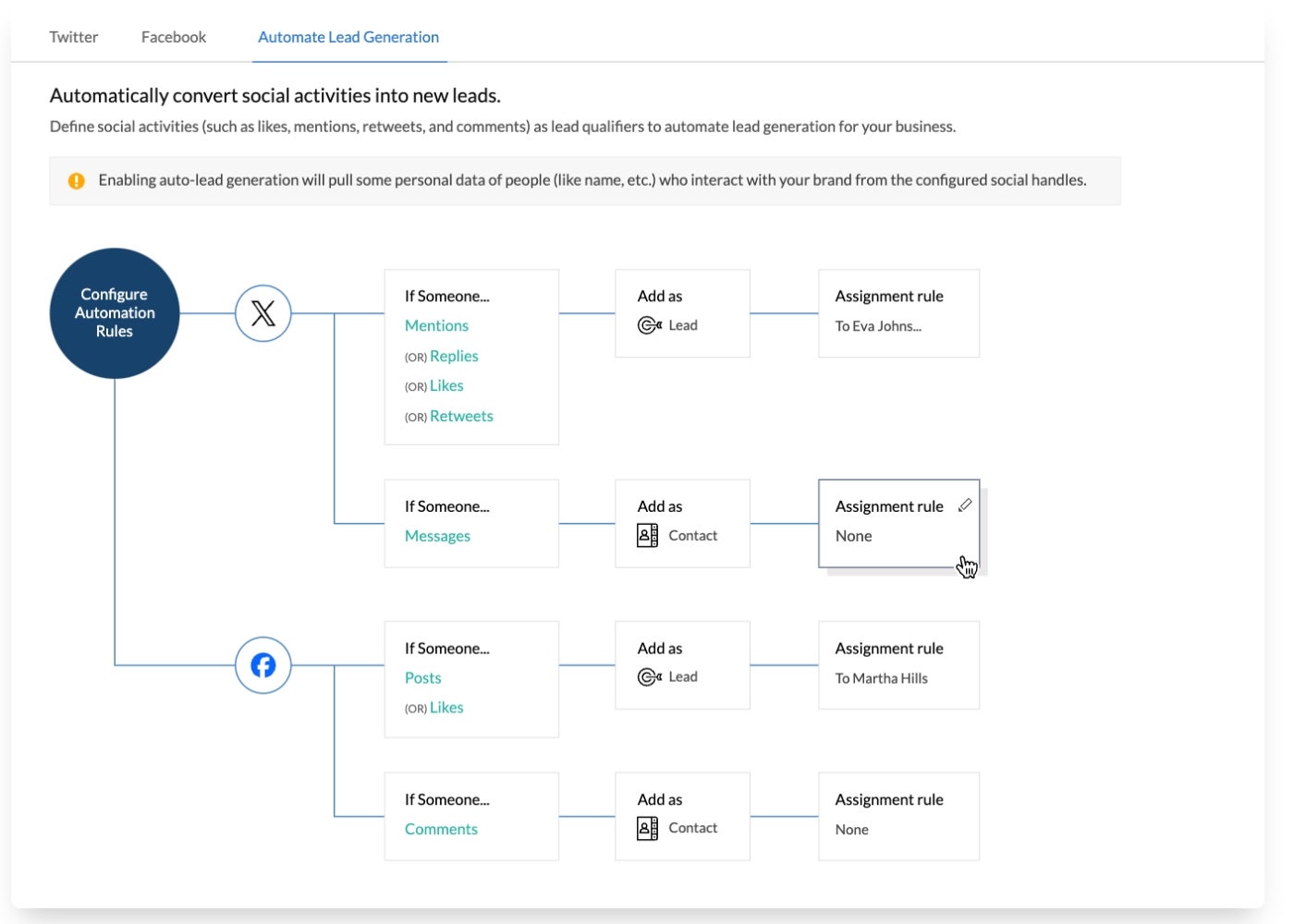
Within Zoho CRM’s omni-channel communication, users can combine the power of social media marketing with the existing sales process to increase brand awareness and build strong customer relationships. Users can monitor real customer feedback on social sites, add leads from social media back to the CRM and track social media interactions within the CRM. In addition to tracking engagement, users can also post directly to a brand’s social media accounts and get notifications. This can totally enhance lead generation strategies through digital marketing campaigns.
Pricing
Free CRM: Free for up to three users and comes with lead and document management and a mobile app.
Standard: $14 per user per month, billed annually, or $20 per user when billed monthly. Users can access email insights, sales forecasting and multiple currencies.
Professional: $23 per user per month, billed annually, or $35 per user when billed monthly. This tier includes all Standard features, plus assignment rules and unlimited custom reports and dashboards.
Enterprise: $40 per user per month, billed annually, or $50 per user when billed monthly. This plan introduces all AI-powered tools, plus email segmentation, auto-response and more.
Ultimate: $52 per user per month, billed annually, or $65 per user when billed monthly. Ultimate grants access to all mentioned features plus access to Zoho Analytics.
AI email predictions: AI assistant Zia can suggest the best time to contact each lead to get the best results, such as email open rates.
Real-time notifications: Receive real-time notifications for every client interaction by integrating any app to get all alerts on one platform.
Automated lead generation: Set up triggers to automatically add new leads or contacts from social media based on their interaction with your brand to cut out manual data entry.
Automate lead generation from social media. Image: Zoho CRM
Zoho CRM pros and cons
Pros
Cons
15-day free trial.
Users report inconsistent customer support.
High level of customization options throughout the dashboard.
Add-on features can get pricey.
Offers advanced team collaboration features.
Users report a learning curve with the platform interface.
Why I chose Zoho CRM
Zoho CRM is a leading CRM provider due to its multichannel marketing management, sharp sales tools and affordability. This makes it appealing software for startups or small businesses. If you’re a business already familiar with CRM software and are in need of a tool to help generate and nurture leads, Zoho CRM is a great choice for its moderate learning curve but strong customizations.
Since there are multiple user reports of the Zoho CRM interface being difficult to use, Pipedrive is a suitable alternative for those seeking simplicity. Even though PIpedrive is more expensive than Zoho CRM, all Pipedrive plans include AI sales tools and 24/7 customer support, in addition to an intuitive visual interface.
Head over to our Zoho CRM review for more information on this CRM provider.
monday CRM: Best for team collaboration
Star rating: 3.6/5
Image: monday CRM
monday CRM is a visual CRM platform that offers advanced collaboration tools and colourful dashboards that are simple to set up and use. Any user with permission and access can co-edit and comment in real time. With the clean interface, users can collaboratively organize deals, projects and campaigns on the kanban boards that include assignment tabs, color-coded statuses, document tracking and deadlines.
Pricing
Free version: Basic CRM offerings only available for students and nonprofit organizations after submitting an application.
Basic CRM: $12 per user per month when billed annually, or $15 when billed monthly. This tier offers unlimited pipelines, boards and contacts, as well as templates for lead, contact and deal management.
Standard CRM: $17 per user per month when billed annually, or $20 when billed monthly. This includes advanced account, contact and deal management, two-way email integration with Gmail and Outlook, and AI email generator.
Pro CRM: $28 per user per month when billed annually, or $33 when billed monthly. This tier includes Sales forecasting, email templates with custom parameters, mass emails and added integrations.
Enterprise CRM: Contact monday.com for a quote. This level of support offers lead scoring, team goals and advanced analytics.
Activity management: Log all lead or contact-related activity, such as calls, meetings, notes and more, to know where all communication stands.
Email composition and rephrasing: Create any type of email or use a template for professional emails.
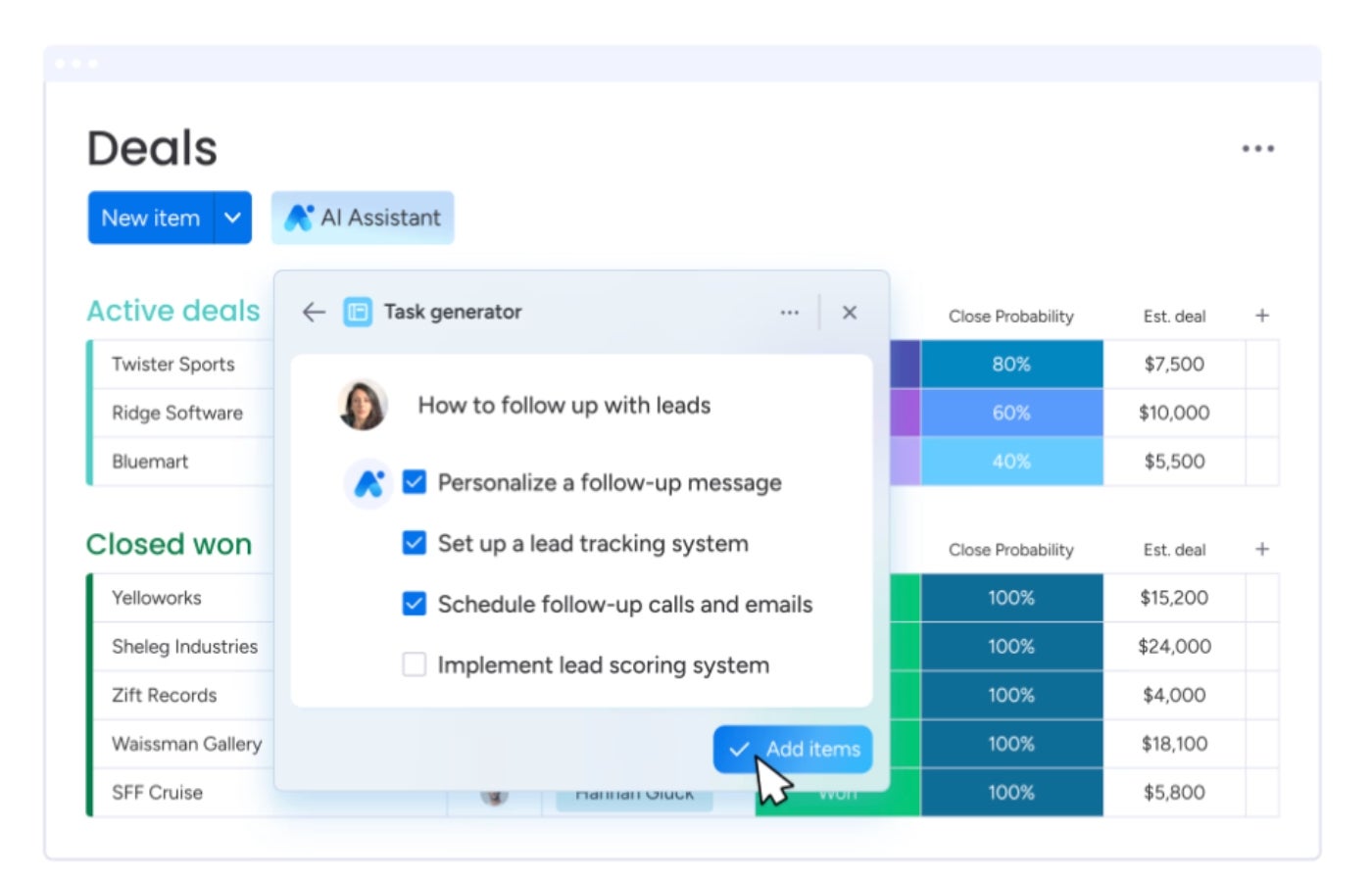
Automated task generation: Utilize AI to automate meeting outcomes or marketing strategies into actionable tasks.
Task automation generator. Image: monday CRM
Monday CRM pros and cons
Pros
Cons
14-day free trial.
HIPAA compliance is only available at the highest paid tier.
Can upload unlimited contacts.
Lacks more advanced marketing tools.
Offers unlimited custom pipelines.
Doesn’t offer live user support.
Why I chose monday CRM
Monday CRM is a fully customizable sales platform that can be built without coding knowledge. With its intuitive interface and robust automations, users can save valuable time by automating repetitive work. As a hub for all centralized client communication, reps can efficiently speak with customers through email integrations.
Similar to monday CRM, Pipedrive also offers robust industry specializations and intuitive dashboards. If you’re looking for a tool similar to monday CRM with user-friendly features plus additional email marketing capabilities, I encourage you to look into Pipedrive or Zoho CRM.
Read our monday CRM review for more details on pricing, top features and more.
Pipedrive: Best for creating email marketing campaigns
Star rating: 4.3/5
Image: Pipedrive
Pipedrive offers robust email marketing software that helps users send email marketing campaigns to effectively engage with customers. Pipedrive’s campaigns can capture the attention of your ICP with customizable layouts and additional tracking, analytics and filtering features. Users can access the same intuitive drag-and-drop element from the sales CRM to create custom layouts or use a premade template. Reps can see contact information in lead profiles and all email communications on one dashboard.
Pricing
Essential: $14 per user per month, billed annually, or $24 per user when billed monthly. The Essential plan includes people and organization management, product catalogue, sales assistant and more.
Advanced: $29 per user per month, billed annually, or $39 per user when billed monthly. The Advanced plan offers all Essential features plus automations, two-way email sync, group emailing and more.
Professional: $49 per user per month, billed annually, or $64 per user when billed monthly. This tier supports all Advanced features and contacts timeline, free Smart Docs add-on, automatic assignment and more.
Power: $64 per user per month, billed annually, or $79 per user when billed monthly. The Power plan includes all Professional offering plus phone support, 500 custom fields and more.
Enterprise: $99 per user per month, billed annually, or $129 per user when billed monthly. This tier offers all mentioned features plus up to 180 active automations, unlimited teams and unlimited custom permissions.
Email builder: Choose from free email templates, import pre-existing HTML or use a drag-and-drop editor to create an email from scratch or modify an existing one.
Email reporting: Dive into how your audience is receiving your emails with real-time reporting, including open rate, click rate, click-through rate and total/unique clicks.
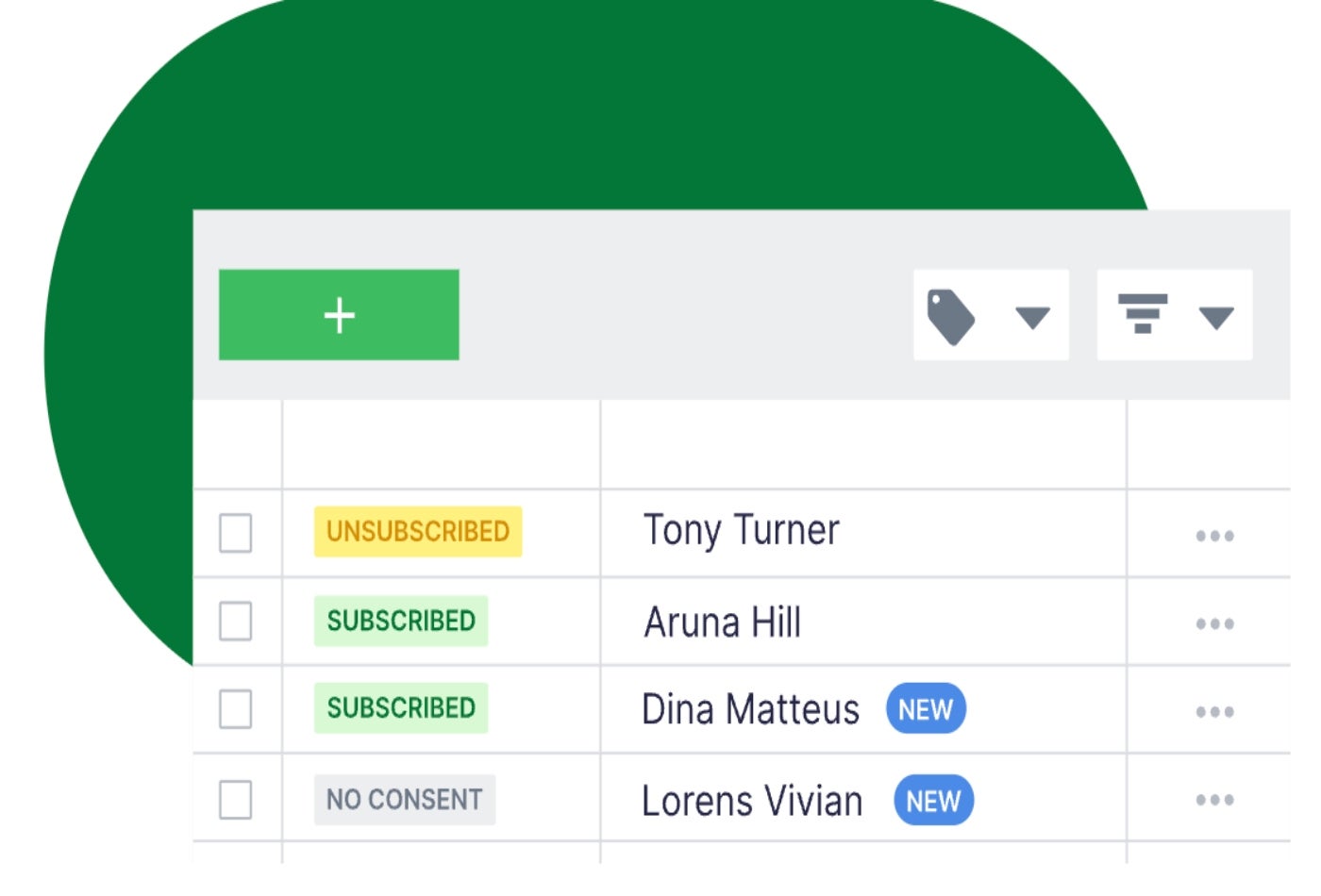
Email segmentation: Ensure the right customers are receiving the right email message by creating filtered recipient lists. Use built-in filters such as subscription status, email bounce reason, send data and more.
Email segmentation feature. Image: Pipedrive
Pipedrive pros and cons
Pros
Cons
14-day free trial.
Doesn’t offer a free-for-life tier.
Intuitive mobile app for iOS and Android.
User reports of limited analytics.
Offers 24/7 customer support for users.
No social media marketing tools.
Why I chose Pipedrive
Pipedrive is a top scoring CRM solution that has made its way onto several of my guides, and for good reason. It is a scalable tool for small businesses up to enterprise level organizations. It also offers extensive in-market expertise for niche industries like automotive sales, government, hospitality and more.
Even though Pipedrive’s premium plans are competitively priced for the mix of marketing and sales features, there is no free tier. If that’s a goal for your business to explore before committing to a paid subscription, I recommend looking into HubSpot or Zoho CRM first.
How to choose the best marketing CRM software for your business
Before selecting CRM software, I recommend following best practices to research the software in depth in order to determine if it can provide real solutions for your organization. Starting with the providers on my list, consider signing up for free trials or demos and mapping out each option’s onboarding process with their sales team.
Here are some questions to ask before committing to a paid subscription:
Does this CRM tool integrate with all of my existing tech tools?
Does this CRM tool offer the marketing tools that my business needs?
Are the core sales features offered by this software equipped enough to streamline my sales process?
How quick is the onboarding process to get started using this tool?
Can the CRM software scale up to adapt to my growing business?
Does this CRM tool have any in-market specialization in my industry?
Review methodology
To evaluate each provider’s marketing CRM offerings, I used my in-house rubric with outlined criteria of CRM industry standards. After running each CRM software through this rubric, an algorithm calculates an overall rating, scoring each out of 5 stars. I use those scores and major feature callouts to assign each software an ideal use case that best represents the software’s best offering.
Here’s the exact breakdown of my predefined scoring criteria:
Cost: Weighted 25% of the total score.
Core features: Weighted 25% of the total score.
Customizations: Weighted 15% of the total score.
Integrations: Weighted 15% of the total score.
Ease of use: Weighted 10% of the total score.
Customer support: Weighted 10% of the total score.
Frequently asked questions (FAQs)
What is a CRM model in marketing?
A CRM model in marketing is very similar to the general CRM model for sales and support. It’s a framework that helps users and businesses manage all aspects of customer relationships. A CRM model for marketing includes the processes, technologies and methodologies used to define an ideal customer profile, generate leads that fit that ICP and then retain them. This model will include a structured framework that displays all the steps and strategies from end-to-end sales.
Which is the best CRM for marketing?
HubSpot, Salesforce, Zoho CRM, monday CRM and Pipedrive are the best CRM options for marketing. From this list of providers, determining which can provide the best marketing solution for your business is ultimately up to you. If you want to optimize social media marketing, I would recommend Zoho CRM. If you just want strong email marketing campaigns, I suggest Pipedrive. If you’re looking for AI-powered marketing insights, I’d say Salesforce should be your go-to provider.
What is CRM in e-marketing?
E-marketing is an all-encompassing term for online marketing, which can include email, social media, influencer marketing, affiliate marketing, organic search and much more. A CRM that can monitor e-marketing will come with features such as omni-channel communication, lead segmentation and templates for copy creation.
Allyssa is a sales writer with a background in B2B sales and account management. After earning her degree in English and communications, she spent her selling career supporting Fortune 1000 IT and finance companies including Bank of America, Wells Fargo, and Credit Karma. As a lead writer for TechRepublic, her specialties include CRMs, enterprise data, and sales software topics. When she’s not writing or updating articles, you can find Allyssa writing poetry, traveling, or picking up any new creative hobby.
Email newsletters can be an important part of your business. Here’s how they can help—but there are a couple of caveats.
Whether you’re a knowledge worker with a point of view you want to share with the world, a high-profile executive who wants to build a platform, or a business owner interested in cultivating new revenue streams, you may have considered launching an email newsletter at one time or another.
And perhaps with good reason.
As social media saturation and the impact of artificial intelligence on search results grow, reaching your core audience becomes trickier. According to HubSpot’s 2024 “The State of Marketing” report, one in three marketers reports using email as a communication vehicle and 87% plan to maintain or increase their investment in 2024. A survey by software company Storydoc found that 90% of respondents subscribed to at least one newsletter and 38% subscribed to between four and 10. With many tools and platforms available to launch email newsletters, it’s relatively easy and inexpensive to get started.
But should you? It’s probably not surprising that Linda Lebrun, head of partnerships for finance and investing content at newsletter platform Substack, thinks so. When asked “who should start a newsletter?” she replies that good candidates may fall into three categories. “[T]hey have a desire to communicate with the audience. They may have a desire to monetize what they are doing,” she says. “And another thing is they may feel like they want to start a community.”
For several successful newsletter publishers, the benefits have been powerful, ranging from reinforcing their positions as thought leaders and credible experts to landing new business opportunities. Here are some of the reasons they devote the time and resources necessary to grow their email newsletters:
Building audience relationships
Sandra Beckwith is a book marketing consultant with a thriving Facebook community called the Build Book Buzz Book Marketing Group. She initially launched her email newsletter, which has grown to more than 10,000 subscribers, to promote her online courses. Over time, she realized that her newsletter was a valuable tool to build relationships with the people who needed her expertise—while also gaining valuable content insight directly from her readers.
“I get responses to my email. When I send my newsletter, people respond back to me, and I get to know them better, and we get these little conversations going,” she says. “We talk about what’s easiest for them, what’s hardest for them, where they need help, what kind of information I can help them with. But [my newsletter] really helped me get to know my target audience better in a way that is almost magical.”
To maintain control of your audience
While social media may be a popular way to build a following, it’s not without risks. Kris Bordessa started Attainable Sustainable in 2011 to encourage people to live more sustainably and self-reliantly. That blog has grown into a robust e-commerce site and an award-winning book entitledAttainable Sustainable: The Lost Art of Self-Reliant Living. Her Attainable Sustainable Facebook page now has an impressive 500,000 followers. But she also values her email list, which includes 15,000 people—a list she culls regularly, eliminating subscribers who do not regularly open her newsletter. She knows that she has more control over the content she can deliver to subscribers.
“Even with a half-a-million people on my Facebook page, just a small smidgen of people are seeing anything that I post. Facebook owns that,” she says.
Algorithms can also affect reach. Teresa Mears runs roughly 20 newsletters to help drive traffic to her network of On the Cheap websites, which promote deals and discounts in various locations. Each site is individually operated. The South Florida–focused newsletter she runs has more than 30,000 subscribers.
As a result, Mears says she promotes her newsletters “every way we can. Particularly as Google has changed its algorithm, the newsletters have become an even more important source of subscribers.” Her network uses pop-ups that encourage website visitors to subscribe. “Every once in a while I put up a Facebook post that says. ‘Facebook doesn’t show you everything. If you want to see everything, be sure to subscribe to our news,’” she says.
To establish your expertise
A newsletter offers another way to deliver customized content to your audiences. Bordessa has different lists based on reader interests, like gardening or food preservation. She also offers free content in specific subject areas in exchange for subscribing.
While Bordessa has well-established expertise in the areas about which she writes, you don’t have to be “the biggest expert” in a particular area to launch a newsletter, Lebrun says. “What [Substack has] found is that when people figure out the intersection, what they have some expertise in, what they feel, they can sustain writing about for a long time, they can go out and share with the world,” she says. “It’s not that you have to be the foremost world expert. You just need to be two steps ahead of your audience, and then they will come along with you.”
To support your revenue plan
Newsletters can help drive revenue in a number of ways, ranging from boosting website traffic to selling products, classes, or services. In some cases, email newsletters are popular or specialized enough that people will pay to subscribe. Lebrun says that some Substack newsletter writers put some content behind paywalls. And some larger newsletters have lucrative business models that include subscriptions and other methods of monetization.
Beckwith says the trust she builds with her newsletter is among the most important reasons to publish one, which is why she is careful about building her list and the content she offers. “If I was just always putting product-related content to people who’ve never heard of me, that’s a waste of my time and theirs because they’re not going to buy from me because they don’t know, like, and trust me,” she says.
Are there downsides? Possibly.
Mears, who uses her newsletter to promote new deals and drive traffic to her site, says building an email list and loyal subscriber base requires marketing; just as you promote your business, you’ll need to promote your newsletter. Lebrun says Substack data finds that consistency is important. “Being consistent with publishing at least once a week helps you create a habit with the reader,” she says. So, the newsletter will take time and resources.
Beckwith advises would-be email newsletter publishers to evaluate the many platforms and publishing tools available to them to determine which is best for their needs. They should also ensure that they abide by the rules governing email newsletters, such as disclosing affiliate links.
However, even with those demands, Mears says starting a newsletter “might be the most important thing you can do” to promote your business and its offerings.
Gwen Moran is a writer and author specializing in business and finance. Her work has appeared in many leading business publications and websites, including Entrepreneur, Kiplinger.com, Newsweek.com, The Los Angeles Times Magazine, and othersMore
Today’s online retailers face an important decision: which channels they should sell on. Should they only sell direct-to-consumer (DTC) via their website, rely on established marketplaces like Amazon or adopt a hybrid approach?
Though each channel offers pros and cons, what makes the decision more difficult is the emergence and unpredictability of other channels. Some social media companies have launched ecommerce capabilities, like TikTok Shops, but they also come with the unpredictability of regulatory bans, making it harder for brands to know which channels are worth investing in.
Choosing the right channel strategy can be the key to running and growing a successful online business. Drawing from my experience working with ecommerce marketing platforms, here are pros and cons to consider when deciding on the appropriate channel for your products.
Direct-To-Consumer (DTC)
The DTC channel involves selling products directly to customers via a branded website.
Pros:
• Complete Brand Control: When selling on a branded website, you control how your brand is presented, your messaging and your customer experience.
• Increased Margins: By eliminating middlemen, like Amazon, you can earn higher profit margins, which can make this strategy especially appealing.
• Building Customer Relationships: Because you control the experience and customer data, you can use personalized marketing, such as email and SMS, to foster stronger, direct relationships with customers, helping to increase brand affinity and loyalty.
Cons:
• Marketing Costs: Investment is typically required to increase web traffic and customer acquisition.
• Operational Costs: The costs of maintaining a website, ecommerce and marketing platforms, inventory and shipping and logistics can quickly add up.
• Customer Service: Brands need to take full responsibility for all aspects of customer service. This may be challenging for companies with limited staffing.
Who is it best for?
I have found that DTC often works best for brands focused on owning the customer experience. This strategy allows brands to build customer relationships through reliable, branded and high-ROI channels like email and SMS marketing. With an email marketing ROI of $36 per dollar spent, you can potentially maximize your profit while building long-term customer loyalty.
Online Marketplaces
Selling on marketplaces, like Amazon, Walmart and eBay, involves listing and selling products on third-party platforms, leveraging their existing infrastructure and customer base.
Pros:• Built-In Traffic: Marketplaces have an already established customer base, which can make finding customers easier than growing site traffic organically.
• Operational Efficiency: Marketplaces often handle the logistics, payments and customer service.
• Increased Credibility: While not fool-proof, marketplaces typically have a stronger reputation than brand-new DTC websites.
Cons:• Lower Margins: Marketplace fees, such as warehousing and per-transaction fees, can impact profit margins.
• Competition: Due to sheer volume, there is increased competition with other sellers on the platform. You may be forced to increase your on-platform ad spend to break through the noise.
• No Customer Relationship: Unlike a DTC channel, the marketplace owns the relationship and data. Communications are marketplace-branded, and individual customer purchase data is kept from sellers, making it harder to build customer loyalty.
Who is it best for?
Sellers who find the most benefit using a marketplace-only approach might include those with limited resources who need to leverage their infrastructure and can easily scale; those looking to borrow brand equity to establish their credibility; and those wanting to rely on the built-in traffic to increase sales more quickly.
DTC And Marketplace Hybrid Models
A hybrid approach combining DTC and marketplace channels allows brands to benefit from the advantages of each channel while mitigating some of the downsides.
Pros:• Diversified Risk: By not relying on a single channel to produce sales, you can shift your risk of flat sales.
• Increased Brand Awareness: You can access traffic from two sources and drive traffic from one channel to the other when it makes sense, such as when DTC inventory is low.
• Sales Insights: Performance changes on one channel can influence your strategies on the other.
Cons:• Operationally Intensive: Managing multiple channels requires more time, effort, logistics and potentially more staff.
• Price Conflicts: Maintaining consistent pricing across channels can be challenging, especially on marketplaces where consumers expect to pay less.
• Inconsistent Experiences: If customers have different experiences based on the channel, this can create a fractured brand experience.
Who is it best for?
A hybrid model may be best for companies looking to diversify their revenue streams and customer reach; those with budgets to allow for multiple forms of advertising; and those with enough resources to effectively manage both channels while mitigating inconsistent brand experiences.
Conclusion
The decision between DTC, marketplace or a hybrid approach depends on various factors, but there is no single right or wrong decision. Each has its pros and cons. However, in today’s ecommerce environment that includes social selling and potential platform bans, building brand-consumer relationships is as important as ever. If you’re looking to establish these relationships, take time to determine which of these three strategies will give you the greatest chance of success.
Rytis Lauris is the cofounder and CEO of Omnisend, a marketing automation platform built for e-commerce. Read Rytis Lauris’ full executive profile here.
It’s time to reframe the conversation around personal branding. Here are four of the top myths about personal branding, debunked.
Does the phrase personal branding fill you with dread? If so, you’re in good company.
I’ve been helping corporate leaders define their personal brands for years, and I have seen how often just the idea itself can elicit strong and negative reactions. Despite its long history and roots with management maven Tom Peters, or even when a compelling case for personal branding is made, many executives still view the concept with derision, discomfort, and doubt.
It’s not hard to see why. Culturally, we have a long legacy of discouraging individuality in the workplace. Our corporate norms dictate that we should blend in and keep our heads down, that humility at work is a virtue, and that our identities belong to our jobs and employers.
For working professionals who grew up in this paradigm, defining who we are and describing our value out loud can trigger cognitive dissonance. It feels selfish and egotistical to talk about ourselves like it’s something for the Tik Tok generation—not serious executives.
“I definitely came in carrying some ‘ick factor’ with me,” says Anna Silverstein, a senior communications leader from a global consulting firm who came to me for help with her personal brand. “The phrase ‘personal brand’ seems to exemplify everything there is to hate about the post-social media era. It sounds so transactional, commercial, shallow.”
Understandable though it is, this perspective has become outdated and problematic. Discouraging personal identities and suppressing diverse voices in the workplace has contributed to many of the systemic problems we face in corporate culture today, from burnout and depression to homogeneous C-suites and boardrooms across industries.
It’s time to reframe the conversation. To help, here are four of the top myths about personal branding, debunked.
Myth 1: Personal branding is selfish.
No, it’s actually an obligation. Especially as we build our careers and grow as leaders, it is up to all of us to take responsibility for knowing who we are and what matters to us, and finding the words to describe it.
“Now that I’ve done the work, I see it as a process of self-discovery and growth,” says Anna. “A brand is basically a well-designed shortcut for telling people exactly who you are and what you care about.”
If we don’t do this work, we pass the onus (and opportunity) to define what we want or need onto everyone else. That doesn’t help anyone—especially those from historically disenfranchised communities or with marginalized voices that need and deserve to be heard.
Myth 2: People with personal brands are loud and obnoxious.
Wrong. Personal branding is actually an inherently quiet and internally focused exercise. When it’s done well, defining your personal brand means taking the time to explore and define who you are, what you stand for, and what others need to know to support, benefit from, and work well with you. It should feel quiet, thoughtful, and authentic.
Ultimately, how you implement your brand is up to you. Some people choose to build a thought leadership platform or become an influencer, but for most, it is simply about becoming more deliberate interacting with others as you build your career.
Myth 3: Personal branding is fake and disingenuous.
Not when it’s done well. Defining your brand is about looking at who you’ve always been and how it has manifested throughout your entire journey, your experiences, your value, and the unique way you move through the world.
When I work with executives, one of the best tactics to unlock this insight is to look at early interests and aspirations and track how they evolved. One woman, a crisis communications advisor based in Canada, remembered her childhood dream of becoming Leonardo Da Vinci. She recalled how she loved the blend of art and science in Da Vinci’s work.
Though she never made it into a science field, and she ultimately dropped out of art school, what she started to see was how the blend of art and science continues to characterize the way she approaches the world. Her clients value the way these two perspectives come together in her work, and she has discovered a creative and authentic way to describe how she operates and why.
Myth 4: Branding is only for senior leaders and C-suite executives.
Definitely not. Personal branding can benefit everyone at all stages in their career journey by keeping us connected to what really drives us, where we offer the most value, and where we are trying to go. Having this knowledge will make it easier for others to help support you, throughout your career path.
“You need that clarity for any number of things, whether that’s to take the next big leap in your career, to supercharge a learning journey, or to make choices that will give your life more meaning,” says Anna.
Regardless of their role, industry, or experience level, people with a strong personal brand tend to be centered, intentional, and real. More importantly, encouraging their people to spend the time to understand their individual strengths, style, and value can help cultivate authentic leadership and greater space for diverse perspectives and personalities to thrive.