These four major marketing trends are set to explode this year.
very marketing professional today knows the rules of the game are shifting at the breakneck speed of technological innovation, making it harder to focus on the fundamentals that will maximize success.
Obviously, there’s never one secret sauce that guarantees big wins for marketers this year (or any other). But to my mind, there are four major technological and customer-preference megatrends that promise to build momentum in 2024 and beyond.
I believe embracing these accelerating trends as you adapt your organization’s marketing strategy will help ensure your budgets are smartly allocated and returns on investment are fully optimized.
1. The “Authentic Age”
Today, when marketers are increasingly required to quantify ROI based on complex data —such as cost-per-click and sales conversion rates—focusing on a “soft” concept like authenticity might seem irrelevant.
But thinking so would be a mistake, in my opinion.
Consider this: Merriam-Webster’s Word of the Year for 2023 was “authentic.” Explaining why, Peter Sokolowski, Merriam-Webster editor at large, said in an interview with the Associated Press, “We see in 2023 a kind of crisis of authenticity. We realize that when we question authenticity, we value it even more.”
Customer preference for authenticity has only accelerated now. In an information universe of inaccuracies, uncertain sources, and deep fakes, people crave authenticity more than just a year ago.
Related: 9 Key Tips for Navigating the Upcoming 2024 Marketing Landscape
2. Influencer marketing
With so much content and misinformation floating around, customers are more likely than ever to be influenced and persuaded by a real person than a brand. Influencer marketing has emerged as an essential component of the marketing mix.
The desire for authenticity among customers explains the growth of influencer marketing and creator economy, which is expected to be worth $24 billion by the end of this year.
While budgets today receive more scrutiny than ever, 67% of marketers surveyed by CreatorIQ reported increasing their investment in influencer marketing from 2022 to 2023. Among the brands that increased their spending in this direction, only 24% were working with a net new budget.
According to the survey, among brands that increased their influencer marketing spend, 76% diverted the funds from other marketing activities. In other words, the majority funded their influencer marketing by redirecting resources from other marketing functions—the most common source of which was paid advertising.
And no wonder the power of influencer marketing content, which is more organic, offers a greater possibility of going viral and gaining earned (not paid) media attention among highly relevant target audiences.
Related: 4 Tips to Avoid Influencer Marketing Catastrophes
3. Creator-driven B2B newsletters
Niche newsletters focusing on specialized areas such as AI, health tech, and finance have become pivotal sources for industry insights. Progressing into 2024, the growing interest in newsletters highlights a collective appetite for content curated by influencers and professionally enriching content.
The B2B realm is rich with newsletters designed for an audience that values quality and specialized knowledge. These independent voices offer a refreshing alternative to the conventional narratives found in most major trade publications. They provide insights that feel like exchanging insider information within a community of peers, enriching the professional discourse with diverse perspectives and expert knowledge.
Creator-led newsletters, exemplified by Morning Brew or my own company’s Presspool Insights, which covers AI marketing tech innovations and best practices, are revolutionizing information consumption habits and attracting a quality audience not seen in traditional ad platforms. The main reason is that the audiences are manually opted-in, engaged, and educated or highly interested in the topic they’ve subscribed to.
Platforms like LinkedIn have emerged as prime venues for B2B content creators, each providing unique advantages. Substack and other new platforms have simplified the newsletter creation process with ‘no-code’ solutions, empowering creators with ownership over first-party subscriber data — a major benefit as Google begins eliminating third-party cookie tracking data this quarter. I expect this trend to increase rapidly going into 2025 as the barrier of entry gets smaller and smaller.
4. AI-enabled, ROI-optimized campaigns
Coming full circle, leveraging the power of influencer marketing strategies through today’s creator-led newsletter distribution platforms enables the same type of KPI tracking associated with paid search ads like Google and Facebook for the last two decades.
At my software platform, Presspool.ai, for example, we track everything from impressions to total clicks, unique clicks and conversions. Everything is tracked and monitored in real-time to ensure full transparency into the data analytics while providing our customer with AI-enabled feedback on how to better optimize messaging for higher and higher ROI in their future newsletter campaigns. This falls right in line with ROI optimization, which I believe will become more and more essential in today’s competitive marketing landscape.
The bottom line is that traditional advertising and PR have grown over-saturated and, to be blunt, annoying to buyers. People don’t trust ads from brands or large corporations as much as they once did. Instead, they trust individuals who have a high level of authenticity and specific knowledge. Referrals from these influencers combined with the best technology for tracking and ROI optimization are the most potent form of customer acquisition, and it’s now possible to access platforms that do it all in real-time, at scale.
ENTREPRENEUR LEADERSHIP NETWORK® CONTRIBUTOR. CEO @ Presspool.ai
Jaxon Parrott is a marketing and AI expert based in Austin, Texas. He currently serves as the CEO of Presspool.ai, an ai-enabled marketing software touting a customer base of over a dozen unicorn and high-growth emerging tech startups.
In the fast-paced world of marketing, I’ve always approached creativity as an organization’s bread and butter, with innovation as the knife that spreads it. As the VP of marketing at Hootsuite, I’ve found an unexpected ally in this creative quest—artificial intelligence and, more specifically, ChatGPT.
I’ve incorporated AI as an integral part of my strategy and brainstorming process in the past year—transforming the way I think, create, and deliver business value for my organization. Here are five ways it’s made an impact.
REINVENTING THE CREATIVE BRIEF
My years in agency life at BBDO have ingrained in me a love for structured creativity. The “Get-Who-To-By-Because” brief has always been a staple in my toolbox. It helps zone in on who I am trying to target, pushes me to identify the pain point I am trying to solve, how I plan to solve it, the key message that I’m trying to drive home, and the why behind the entire campaign.
Recently I began using ChatGPT to reframe these briefs. By feeding it relevant information and asking for multiple versions of a brief within the “Get-Who-To-By-Because” format, I’ve been amazed by the unexpected perspectives it offers. This process has helped fuel my creativity. Coupled with my experience in the creative space and deep understanding of my customer, it ensures that the final output is both human-centric and insight-driven.
CRAFTING TARGET PERSONAS WITH PRECISION
We all know that data is king. But the interpretation of any data is the key to the kingdom. ChatGPT’s ability to dive into vast public data pools has been a game changer for developing customer personas.
For instance, I asked ChatGPT to define the core demographics of North American social media managers.
From there, I used that very demographic output as an input to a user persona framework. ChatGPT was able to create detailed user personas that captured everything from challenges and joys to the preferred technology stack, budget, and even their favored media outlets. These insights have been invaluable in refining my team’s content and paid media strategies.
ENHANCING RESPONSE-BASED ADVERTISING
In marketing’s creative landscape, a tactical approach is sometimes crucial. ChatGPT excels here, notably during a time-strapped holiday season. Tasked with creating a compelling email for a January webinar with little time and lots of folks on holiday, we used prompted ChatGPT with our holiday webinar theme “Supercharge Your 24 Social Strategy” and asked for it to help us craft a click-worthy email via the AIDA (Attention-Interest-Desire-Action) framework. The outcome was a remarkable 300% increase in click-through rates, showcasing AI’s power in strategic, responsive advertising.
ACKNOWLEDGING THE POWER OF AI EDITING
From crafting a Slack message to assisting with internal briefs, ChatGPT has been my go-to editor. Its ability to tailor certain messages to specific communication styles—such as being jargon-free—is nothing short of impressive. This has enhanced the clarity and impact of my communications across the board.
SERVING AS A CREATIVE ARCHIVIST
In preparing for a product launch, ChatGPT has served me well as a creative archivist—providing insights on past marketing campaigns from companies who have similarly launched disruptive products.
By getting specific around needing to understand the specific tactics that drove success, ChatGPT has helped shape our approach to generating fame and achieving widespread industry impact.
These are just a few examples of how I’ve used AI in the past year. It has played multiple roles—from a strategist and brainstorming partner to a copywriter and researcher.
Throughout all of this, it’s important to remember that AI is a tool and not a replacement for human creativity.
To me, AI provides deep insights based on what’s been done. But it’s our creativity that dreams up ideas that have never been done. As we continue to harness AI’s power, it’s our human touch that will continue to make a real difference in the world of marketing.
Customer relationships shouldn’t end after a sale. In fact, the best relationships never end.
The key to building a successful brand is to resonate with customers. That’s a challenge for any brand at any time. But in 2024, it will be even more difficult than usual.
For starters, the days of buying third-party customer data based on tracking cookies to re-target customers across social media and the internet are ending. Complicating matters is a 2024 political campaign season expected to crowd out most of the available re-targeting ad inventory. And finally, social media fatigue is setting in across the board.
But when one door closes, another opens. The challenges above merely represent the end of an old era, which means we’re at the beginning of a new one … one where brands establish authentic (and thus more powerful) relationships with their customers that build long-term customer loyalty.
The result is a win-win for all. Brands acquire better and more actionable data and insights about what their customers want. Applied correctly, this then means customers can get more relevant, timely and personalized offers through the channels they prefer.
And it’s all possible by following three simple steps — Find your audience. Get to know them. Make them superfans.
The best place to find your audience is to pay attention to those who visit your website. Turning visitors into customers is relationship marketing 101.
For too long, brands have relied on tracking cookies to accomplish this. But not only are cookies going away, customers don’t like them. However, they do like relevant offers based on their interests and preferences.
Consider the following insights from the Marigold Consumer Trends Index:
Indirect tracking tools like third-party cookies are considered “creepy” by 61% of customers. Yet, 68% say getting reminder emails about items they left in an online shopping cart is “cool.”
Getting ads from unknown brands based on location is again considered “creepy” by 64% of consumers. But 59% are fine receiving messages based on their interests (like hiking, running, etc.)
In other words … stalking is creepy. Conversations are cool. So, a far fresher strategy is to make each site visit an opportunity to connect. With on-site forms and interactive experiences, brands can directly collect the information needed to determine the right product-market fit with far greater granularity than just a note about which web page was visited.
By establishing interactive experiences on your site, you can analyze consumer interests, organize them into customer segments, and ultimately deliver personalized offers based on what you know they’ll like.
2. Get to know them
Once you’ve converted unknown visitors into established contacts, you can start engaging them with useful and interesting content to get to know them even better. After all, your customers have all the information you need to know. All you have to do is ask. Data acquired this way is called “zero-party data,” and it’s the most valuable information you can collect.
Of course, you must give them a reason to do so first. The vast majority of consumers are willing participants in a value exchange, where they trade personal data about themselves in return for something of value or interest.
The “value” in the value exchange can take several forms, according to the Marigold Consumer Trends Index. Saving money is a top incentive. A majority of consumers find value in discounts/coupons (91%), loyalty points/rewards (89%), early/exclusive access to offers (83%), a chance to win something (81%), unlocking content (60%) and brand community (55%).
But money isn’t the only incentive. Customers have data needs of their own — exclusive content like previews, eBooks, guides and other insights into your niche make the “cost of entry” participation in a survey, poll or quiz easy to collect zero-party data.
Surveys are one of the top formats for collecting zero-party data. These can take different forms, from new customer surveys to surveys about their experience with the products, thoughts on products they’d want in the future, or even why they stopped buying your products are all useful.
Just make sure the survey is executed properly. Our own global study found that 66% of consumers are more likely to complete brand surveys if they are easy to complete, while another 55% pointed to how the survey will be used as a factor (such as informing the development of new products or services).
Doing this right is important because once collected, zero-party data allows you to create highly personalized and dynamic content and product recommendations, coupon codes and promotions for your most loyal (and valuable) customers.
3. Make them superfans
Relationship marketing is more than just finding and getting to know your customers. It’s about keeping them loyal as well, and there are many ways to accomplish this.
To start, talk with your customers using the information you’ve collected in the steps above. Personalized email and text messages, delivered at the right time with the right actionable information, will make your customers feel heard and appreciated. Both are critical first steps to establishing customer loyalty.
According to theMarigold Consumer Trends Index, more than half (51%) of consumers still report frustration over receiving irrelevant content or offers. On the flip side, 85% of consumers say their favorite brand treats them like an individual, and 78% of consumers say they are likely to engage with a personalized offer tailored to their interests.
But unless your email/messaging platform is integrated with your zero-party data collection platform, that might prove difficult. Relationship marketing requires an integrated approach, with clear connections from the first step to the last.
Of course, creating personalized messaging with data collected from users requires being sensitive to privacy concerns. Respecting these concerns opens up another opportunity for brands to create customer loyalty and maintain it. According to the Marigold Consumer Trends Index:
77% of consumers cite data privacy policies as either important or critically important to maintaining their loyalty, second only to product options/availability, and above customer service and support.
Roughly half of consumers do not trust social media platforms with their data, and 68% are actively sharing less data with social platforms over concerns about how that data is used.
63% of consumers will pay more to shop with the brands they’re loyal to.
More than 70% of consumers cite the following as either important or critically important to maintaining their loyalty: customer service/support, offers/promotions, data privacy policies, product/service quality, options and availability.
Remember, loyalty is earned on multiple fronts — with every customer interaction. In other words, you have to build that loyalty through authentic and personalized communications, respect for customer privacy, and of course, a product that delivers on customers’ needs.
Like any good relationship, your relationship with customers is not a transaction. It’s not a journey from point A to point B that ends with just a sale. It’s a circle … an ongoing virtuous circle. Because the result of good marketing is to establish a relationship. And the best relationships never end.
In 2024, consumers are more empowered than ever. They can research a product or service, ask questions, compare notes with their peers and make informed purchasing decisions with the tap of a finger from anywhere in the world.
They’re keenly aware of their options, which puts the onus on marketers to create and sustain personalized, seamless shopping experiences across all channels.
Here are six shifts in strategy that may seem subtle but can make meaningful differences in capturing the attention of your target audience, building connection and inspiring long-term brand loyalty.
1. Embrace authentic engagement over sheer reach.
Large follower counts may translate into awareness, but not sales. A viral moment, for example, might attract a spike of attention, but it’s likely short term.
Rather than focus on reaching the most users, brands should prioritize reaching the right consumers. That means using analytics to determine their most valuable base—along with their platforms and preferences—then delivering highly tailored content, including social media posts, advertising, invitations to VIP experiences and related product recommendations. This demonstrates attention to quality, while also building a community and establishing the brand as the go-to in their category.
2. Prioritize data privacy and transparency.
Data privacy concerns are at an all-time high, especially as they relate to digital and social media activity, which means brands must be transparent about how they’re collecting information. Third-party data gathering has created distrust, which is why several major sites have disabled third-party cookies in the past few years. This, of course, poses a problem to marketers trying to tailor the consumer experience.
The solution: Invest in first-party data technology that remembers user behaviour but does not pass it on and, most importantly, communicate that process to the consumer. Maintaining trust is key. Shoppers should know they can make purchases without fear their information will end up in unwanted hands.
3. Invest in long-form, value-driven content.
Consumers are wise to sensationalism and clickbait, and misleading marketing breeds resentment. Original, informative content is becoming increasingly rare, making it all the more valuable and appealing.
I’ve found consumer attention spans are longer than you think when the content is compelling and useful. Consistent release of long-form content—like thought leadership, articles, blogs, information surveys and more—establish brands as industry leaders, which, in turn, encourages return visits. It also helps brands rise above the noise by improving search engine rankings.
4. Diversify advertising platforms.
Look for ways to reach your audience outside traditional platforms, which are likely already crowded with your competition. Take risks on emerging platforms or niche forums that, while small, may be rich in well-defined consumers. Diversifying across multiple channels also increases brand visibility and recall.
A crucial step: When diversifying your ads, make sure the content is native to each platform. Different platforms attract different audiences. It’s imperative to understand the demographics, interests and behaviour of each and the type of content that attracts them. From there, you can map out your creative plans accordingly.
5. Incorporate sustainability into brand messaging.
Consumers are increasingly drawn to brands that demonstrate a commitment to making a positive impact. Incorporating a purpose-driven initiative that aligns with the brand helps create a deeper connection with the consumer and makes them feel good about their purchase.
Plus, choosing the right social or environmental cause is in itself an effective form of marketing: It expresses the brand’s core values and lets people know where they stand on important issues. When consumers know the end goal is more than just profits, I’ve found they’re more likely to remain loyal.
6. Leverage AI for enhanced personalization and efficiency.
There’s no question AI will continue to give marketers an edge. Internally, it’s a valuable research tool for analysing consumer behaviour to help brands learn more about them. It’s also useful in predicting future trends and can help cut costs by automating administrative tasks.
Externally, it should be used wisely. While chatbots can offer round-the-clock customer support, consumers value and will remember positive human interaction. And while AI can suggest ideas and generate first drafts, quality content still demands the creative touch of a copywriter or creator.
Digital marketing is an ever-evolving and increasingly crowded landscape. Differentiating yourself means offering a consumer experience beyond the norm. The right approach to content creation and distribution can make the crucial difference between establishing your brand as an industry leader or getting lost in a sea of same.
Warren Jolly is CEO of adQuadrant, a leading digital marketing company, and has overseen millions of dollars in ad spending. Read Warren Jolly’s full executive profile here.
Digital disruption reshapes commerce across platforms, says Ward de Kruiff of EPAM Continuum. As new technologies create a pivot-point, success lies in cohesive omnichannel experiences.
A new paradigm is emerging in the sphere of commerce. The unification of disparate strands – spanning from e-commerce to the nascent realms of gaming and spatial commerce – particularly with the advent of platforms like Apple’s Vision Pro holds great potential for brands. Nowhere is this shift felt more than in the realm of luxury and fashion.
The key to success is crafting experiences that transcend physical and digital boundaries. Omnichannel excellence is no longer a buzzword but a baseline expectation. Consumers seek seamless experiences, whether scrolling through mobile apps, browsing in a physical store, or engaging with a brand in an immersive game environment.
E-commerce, m-commerce, and Gen-Z
The journey began with e-commerce, a digital revolution that turned the entire internet into a potential storefront. But e-commerce is not just about online transactions; it’s about an ecosystem that supports customer journeys with rich content, virtual try-ons, and personalized services. It’s a space where luxury fashion isn’t just displayed but can be experienced.
The proliferation of smartphones has given birth to mobile commerce (m-commerce) and social commerce, transforming smartphones into shopping assistants. In social and m-commerce, the luxury experience is literally in the palm of a customer’s hand. It’s instant, it’s personal, and it’s where digital-savvy customers are. The buzz yesterday was about building community with Gen-Z, hence brands entering the world of gaming commerce, a place where fashion often meets virtual reality.
Here, luxury brands are not just selling products but crafting experiences and stories. In-game fashion shows, virtual outfits for avatars, and interactive brand storytelling are the tip of the iceberg. Gaming commerce is about being present in a new market and also engaging with a new generation of consumers. With the introduction of platforms like Apple’s Vision Pro, spatial commerce will redefine how we perceive brand engagement.
The new frontier in commerce is spatial
Spatial commerce is about leveraging augmented reality, live-streaming, and socia-media platforms to create immersive shopping experiences. This combination can bring a level of interactivity and community engagement that traditional platforms might struggle to match.
The launch of Apple’s Vision Pro marks the cusp of a substantial transformation across many industries with the onset of Web4. Perhaps most excitingly, the new technology heralds novel methods for transactions and content creation, ultimately leading the way for enhanced use cases of spatial and social commerce.
Akin to the evolution of the App Store since its inception with the inaugural iPhone in 2007, the spatial computing digital economy of visionOS will take several years to fully develop. This time around, however, it’s different. The device disruption of wearables will be broad given the range of the new technology. And there will be lots of experimentation in translating the retail experience into spatial computing.
Marketers can be architects in this digital renaissance
We stand at a pivotal moment. The future for retail and consumer-packaged goods (CPG) brands isn’t just about choosing between e-commerce, m-commerce, gaming, or social commerce – it’s about unifying these channels into a cohesive, omnichannel strategy. This strategy should be built on personalization, immersive experiences, and a seamless customer journey. It shouldn’t just be about selling products, it should be about curating experiences and emotions as well.
The call to action is clear: embrace the completeness of digital commerce. Retailers and brands must understand that their customers do not differentiate between a physical store, a mobile app, a social-media platform, or a virtual world. They seek excellence, consistency, and engagement across all platforms.
As we forge ahead, let us be the architects of a new digital renaissance, where luxury meets technology, tradition meets innovation, and commerce becomes an endless realm of possibility. Let’s lead with creativity, courage, and commitment to customers, crafting a future that’s not only profitable but also profoundly inspiring.
What does social SEO actually look like? This post digs into examples of social search engine optimization and how brands are ranking in social search right now.
Social SEO means applying search engine optimization (SEO) strategies to social media:
Thinking of social platforms like search engines (and not solely distribution channels)
Identifying consumer search trends to inform your organic and paid social content
Creating content to satisfy search intent and rank for relevant social media keywords
Meanwhile, recent research confirms that platforms like TikTok and Instagram are peeling product searches away from Google and Amazon among younger consumers.
That’s why brands are scrambling to figure out how to improve social media SEO rankings ASAP.
Below we dig into real examples of social SEO to highlight how brands rank in social search.
3 Examples of Social Media SEO in Action
Good news for brands: there’s no one-size-fits-all approach to tackling social SEO.
Much like ranking in Google search, your social media SEO strategy should involve a variety of tactics. From uncovering keywords to creating search-friendly content, here are three real-life examples of social SEO to inspire brands.
1. Brands Targeting Social Media Keywords
Keywords are at the heart of traditional search optimization and social SEO is no different.
For CPG brands, it’s no coincidence that many of the most popular and frequently searched social SEO keywords are similar to what you’d see on Google. For example:
How-to keywords (ex: “how to remove stains from white clothes”)
Tips and advice-related keywords (ex: “ways to fall asleep”)
You can see the value of ranking for these respective keywords on TikTok or Instagram if you were a brand in the cleaning, parenthood or sleep supplement spaces, right?
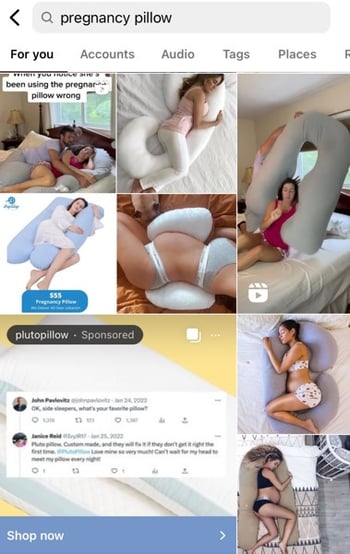
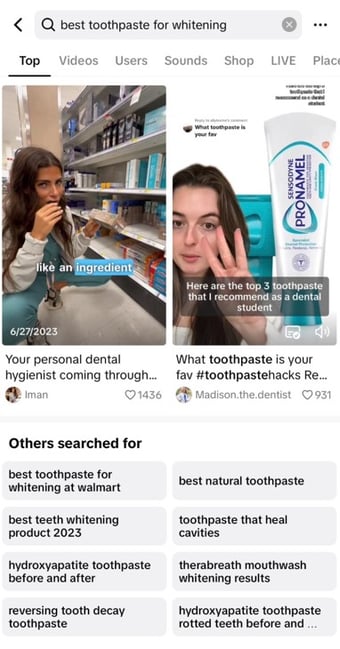
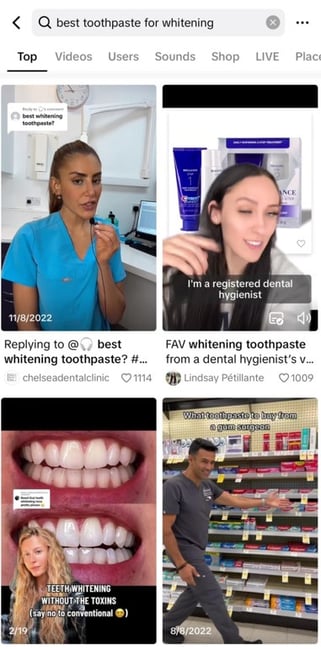
Look no further than how brands promote products on TikTok to see how product and pain-point social media keywords can be incorporated into short-form videos. The same applies to IG Reels and photos. The social SEO example below highlights why being above the fold is valuable for brands.
Brands that rank for keywords related to their products or industries make it happen through a combination of word-of-mouth and social media keywords.
That’s why UGC and influencer collabs are becoming more important as social SEO grows.
Social media keyword research is kind of an art and a science. You need a pulse on your audience, their challenges and how to speak their language. Coupled with social SEO software, you can confirm what your target audience is actually searching and build your social keyword strategy from there.
What do you do with these social SEO keywords, though?
Consider how you might sprinkle keywords in the title, headers and meta descriptions of a blog post.
With social SEO, you have options to include target terms in your content via:
Video descriptions
Captions
Spoken audio
Comments and replies
Much like you’re expected to naturally weave keywords into your content, the same rings true for social SEO. Keyword-stuffing social content is a recipe for tanking your engagement and potentially being seen as a spammer.
The takeaway? Think “less is more” when it comes to social SEO keywords.
Be strategic but subtle. Prioritize long-tail phrases and terms that could seamlessly be spoken or written in a video description by a creator organically. On the flip side, avoid rigid keyword phrases that feel robotic or unnatural.
2. Brands Ranking Within Social Media Hashtags
The role of hashtags in social SEO is crucial but often misunderstood.
Most consumers aren’t finding products in general hashtag searches. However, that doesn’t mean that hashtags are “dead.” Not by a long shot.
Below are some examples of how hashtags help your social SEO:
Hashtags help social algorithms understand “what” your content is. This goes hand in hand with greater discoverability and visibility, especially when it comes to TikTok SEO. When TikTok sees a video or account earning consistent engagement within a hashtag, it’s like candy to the algorithm. This results in higher rankings.
Hashtags help your content get served to a relevant audience versus random users. Food for thought: the #dryskin hashtag has over 4.7 billion views on TikTok. Hashtags related to specific customer problems or pain points or subsets of your audience are tags worth targeting.
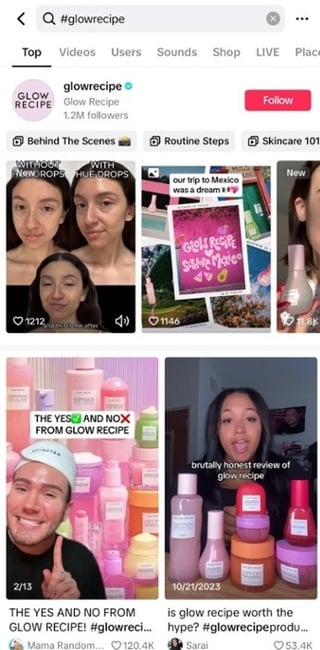
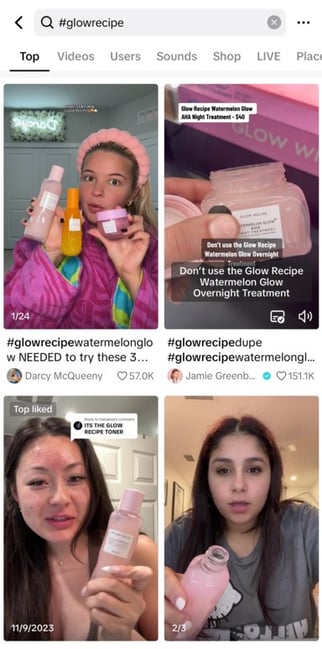
Hashtags can signal purchase intent. Branded hashtags are especially important here. Someone searching a specific brand (#Dove) or review-related hashtag (#DoveReview) is much more likely to make a purchase than someone browsing a general #skincare tag.
Again, the value of hashtags can’t be overstated for social SEO. Especially for beauty and skincare brands. Fact: beauty brands that consistently use TikTok hashtags rack up 3.5x more than the median industry engagement rate.
And since engagement impacts your social SEO rankings, a hashtag strategy does matter.
But just like with social SEO keywords, don’t overdo it!
TikTok and Instagram recommend between three and five as the “sweet spot.” Remember: you don’t want to distract viewers. A handful of tags is fair game for the sake of helping algorithms understand what your post is all about.
3. Brands Ranking with Search-Friendly Social Content
No surprises here. You can’t rank for social keywords and hashtags without content.
If you want examples of social SEO, look no further than content that’s already ranking for keywords. Here’s how you can mine for social SEO content ideas:
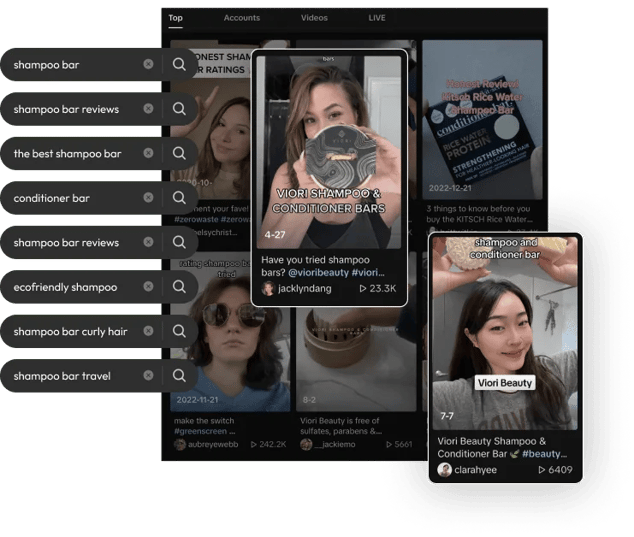
Check TikTok and Instagram’s autocomplete results for inspiration. These are real-life social media keywords that people are using already.
Look at what’s ranking for “best [product]” or “how-to [task]” keywords. These are prime keywords to tie to your future content.
Focus on pain points. What are the problems your target audience is hoping to solve? Think about struggles, challenges and common complaints. Anticipating customer questions and concerns is a goldmine for content ideas and social SEO keywords.
From here, you can brainstorm and start testing your content ideas for social SEO. In most cases, this involves a combination of education and entertainment (AKA“edutainment”).
Some common content formats that rank in social search include:
“Storytime” videos showing off products in action
How-tos and tutorials featuring products based on pain point keywords
Before-and-after videos that highlight a product’s positive results
Just like with traditional SEO, be ready to test and experiment to see what ranks and what doesn’t.
Whereas one blog post can grab the lion’s share of Google traffic with multiple keywords, social SEO is much more of a numbers game in terms of volume.
We’ve seen first hand how a high volume of influencer content can help brands rank for keywords faster. This makes sense given how social algorithms on both TikTok and Instagram favour UGC and influencer content over brand-generated content.
As a result, creators have more of a chance to “hit” with the algorithm and cement your brand’s social SEO rankings when they post on your behalf. Especially if you’re consistently partnering with a high volume of creators at once. This approach to influencer partnerships is becoming the norm for UGC advertising.
Creators can integrate both general and brand-specific keywords and hashtags while publishing relevant content ideas to help your brand rank even faster. These details can likewise feature in your brand’s creative brief so influencers hit the right beats.
How to Put These Social Media SEO Ranking Ideas into Action
Ranking in social search doesn’t happen by accident.
And so many brands are already cementing their rankings through consistent influencer collabs.
The good news? The best time to start growing your social SEO presence is now.
Making it happen is possible with a high volume of ongoing influencer partnerships and creators posting about your brand. The sooner you scale, the faster you can start ranking.
That’s where Statusphere’s micro-influencer marketing platform can help.
Our software matches brands with creators from our vetted network for collaborations at scale. With automated matchmaking, streamlined fulfilment and in-depth reporting, brands can generate more UGC and build their social SEO presence without waiting.
We’ve already powered 75,000 influencer posts on behalf of 400+ CPG brands.
Want to learn more about how our platform works? Get in touch with one of our experts to see how we can help you get more influencer content in a fraction of the time.
People who work in IT, software development, and advertising appear to be the most anxious.
Mass layoffs in the tech industry have made headlines nearly every week since late 2022. Combine that constant barrage with the rise of AI and uncertainty over the global economy and you have the perfect recipe for increasing anxiety across the American workforce when it comes to fears about job security.
Now a new survey out from online marketing firm Authority Hacker put some concrete numbers on just how many of the currently employed are worried about their job security in the years ahead. In a survey of 1,200 workers, Authority Hacker found that:
54.58% of full-time workers have increased concerns about their job security.
Men (62.87%) are more likely than women (47.53%) to fear for their job security, which Authority Hacker says may reflect the 3:1 gender ratio of male to female employees in tech firms.
The more a person makes, the more likely they are to worry about their job security. Those making $150,000 or more worry the most about their job security (72.48%), while those making $50,000 or less worry the least (50.26%).
The younger an employee, the more likely they are to worry about their job security, with 62.2% of 25 to 44 year-olds worried versus less than 50% of those over the age of 45 worried.
C-suite execs are the most worried about their job security at 79.31%.
But just 46.82% and 45.80% of non management staff and admin staff, respectively, are worried about their job security.
The larger the company is, the more likely employees are to worry about their job security. Authority Hacker found that 74.33% of those at companies that employ between 500 and 1,000 workers worry about their job security, while only 45.38% of workers at companies with 25 or fewer employees worry about their job security.
And when it comes to concerns by profession, workers most likely to fear for their jobs happen to be those whose industries are most at risk of being impacted by AI. Those professions are:
IT – Services & Data: 89.66%
Software development: 74.42%
Advertising: 70.00%
Finance and Insurance: 67.56%
Human Resources: 64.29%
To arrive at its findings, Authority Hacker surveyed 1,200 full-time workers in the United States aged 25 and above.
Michael Grothaus is a novelist and author. He has written for Fast Company since 2013, where he’s interviewed some of the tech industry’s most prominent leaders and writes about everything from Apple and artificial intelligence to the effects of technology on individuals and society. Michael’s current tech-focused areas of interest include AI, quantum computing, and the ways tech can improve the quality of life for the elderly and individuals with disabilitiesMore
As the sands shift around digital marketing, says Mike Wickham of Impression, it might be time to reconsider how we target customers online.
Good marketing should always be a win-win. The consumer should win because they’re being provided with a relevant option for whatever it is they’re in the market for. The brand should win by meeting that need and by providing its product or service to the right audience, hopefully, at the right cost.
As someone who navigates both the world of marketing and consumerism, I’m noticing a worrying trend towards fewer, less relevant options presented across paid media platforms.
The algorithm isn’t always our friend
Let me give you an example. I was recently on a quest to find the perfect pair of shoes. Versatile enough for all seasons, suitable for both smart and casual attire, and durable for years to come. Alas, I’m still searching, and not just because I’m incredibly fussy.
My customer journey began the same as most, with a broad search on Google, and I was served a range of options from boots to sandals. Not quite right, but after navigating to the shopping tab, I found a few items closer to what I was picturing in my head.
After clicking on a few options from different brands and browsing their catalogues I still hadn’t found the dream pair, but I had at least narrowed down the style I was looking for. So I returned to Google and provided a bit more detail for my next search (long-tail searches do still exist), only to receive virtually the same list of items in the carousel as before.
The results were pretty much exclusively from the three brands that I just visited. For the following days and weeks, browsing across the web provided me with limited new suggestions. I was re-served the same items time and time again. A poor use of frequency capping is partly at fault here, but the crux of it is, my behaviour gave signals that I was interested in these items, and so the algorithms pushed hell for leather to get me to convert.
I sympathize with these brands, and advertisers in general, who face similar challenges. With a shift towards larger audience definitions and a heavier reliance on machine automation, they’re a little at the mercy of the algorithms to distinguish who is the right customer.
How to identify the most likely customers
So what can we do to help differentiate between a person who clicks a visual ad of a product, engages with the website and decides the product isn’t quite right for them, versus a person who clicks a visual ad of the product, engages with the website and then decides that while they most likely will buy, they first want to compare prices elsewhere and wait for payday?
It ultimately comes down to developing a better understanding of the behaviour and psychology of your consumers. There are often more reasons not to buy something than there are to buy it, so we must begin to dig much deeper.
It starts with research. Understanding consumer behaviour to uncover the’why’ behind the engagement – as well as the ’why not’. Is it to do with affordability, a lack of urgency, or too much choice? Or is it down to concerns over compromise, distraction, likeability, trust, principles, ethics… and so much more? The list of conscious and subconscious reasons for not proceeding can be many and varied.
Behavioural insight often starts with old-fashioned methods, like actually talking to people. Focus groups, surveys and questionnaires are often seen as archaic to digital-first businesses, but they will provide the insights that will help you identify where to begin looking within the data.
Don’t chase every would-be buyer
We have to measure in different ways than before. Parsing small but significant signals of consumer intent, such as attention mapping, engagement depth, dwell time, and frequency of interaction, will help to build a clearer picture between a genuinely interested buyer and a passer-by.
By identifying and excluding those who have shown signals of dis-intent, we’re able to better place our energy into more qualified customers, while the same data informs how we adapt our customer journeys to capitalize on the ‘likely buyers’.
We ultimately need to be better at understanding our customers’ wants and needs. And a key part of this is knowing when to pursue them, and when to let them go. Algorithms have made it harder to do the latter, as they miss the context and the cognitive reasoning in the mind of the decision-maker.
Those are the gaps we need to fill, and it’s the combination of blending behavioural insights with your machine learning tools that will not only help the marketer become more effective with their advertising spend, but also help bring back the relevancy to the consumer.
This story is part of CNBC Make It’s The Moment series, where highly successful people reveal the critical moment that changed the trajectory of their lives and careers, discussing what drove them to make the leap into the unknown.
Amber Venz Box only wanted to earn a reliable income doing what she loved. She didn’t intend to help create an entire online industry.
The 36-year-old is the co-founder and president of LTK, a Dallas-based marketing company that connects more than 250,000 influencers and bloggers with over 7,000 retail brands with advertising budgets to spend. She’s credited as a pioneer of the creator economy with a business most recently valued at $2 billion, following a 2021 fundraise from Japanese investment holding company SoftBank.
In 2010, Box was an unpaid fashion blogger trying to promote her services as a personal shopper. She’d held some low-level positions in the industry: a fit model, an intern at Thakoon, an assistant buyer at a luxury boutique in Dallas.
When an article in The Dallas Morning News pointed readers to her blog, Box realized she’d made a mistake: Potential clients were reading her fashion tips and buying the clothes themselves. She wasn’t making a penny, and affiliate marketing — where blogs link out to retailers in exchange for a cut of sales — wasn’t yet commonly used in the fashion industry.
“That was an ‘aha moment’ of, I have to modernize my business so that I can actually continue to charge for the sales that I’m driving to my customers,” Box tells CNBC Make It. “That was the impetus for us starting [in 2011] what was RewardStyle, and is now LTK.”
She and her then-boyfriend, an electrical engineer and tech analyst named Baxter Box — they’re now married with four kids — adapted existing affiliate linking tech to fit her blog. Once she started making money, she realized she could sell the technology to other bloggers, who could benefit similarly.
Since launching, LTK has helped online creators earn at least $2.7 billion in pay-outs from retailers, according to the company. It has turned 240 influencers — all women — into millionaires, Box says.
Here, Box discusses the challenges of launching LTK, the risks of completely devoting yourself to an uncertain venture and where any aspiring entrepreneur should begin.
CNBC Make It: Can you describe the process of turning your fashion blog into an online business?
Box: [Baxter] saw me really struggling. We went for a walk one day, and he was like, “Anything’s on the table. How would you want to make money on this?”
My old business model [as a personal shopper] involved getting paid a commission. That seemed fair. That’s what I wanted to do here. So he researched and found some technology that we could apply back to this space.
I put between $500 to $1,000 towards engineering to get this going, and he did the same. I drew up, on PowerPoint, what I wanted it to look like. We met with this guy on the weekends and paid him piecemeal, hourly, to start coding it.
In 2011, we launched and I was able to start earning commissions.
Did starting a business feel like a big personal risk?
There was also almost no [financial] downside. I was in my early 20s, living at home, still eating my dad’s cereal. Worst case, this stays the same. Best case, you have a business where you get to do the things you want within this lifestyle that you wanted to create.
But there was a pressure of, “This better work, because I’m sacrificing everything to make it happen. And what if I do this for X period of time and it doesn’t? That’s going to just be this huge hole and pit in my life.”
I was spending 24 hours a day [on the business]. I was silencing phone calls. I was not spending time with friends. I abandoned a lot of relationships, and very quickly.
How confident were you that this would become a viable business beyond your own blog?
I was confident that people would be excited about it. Bloggers didn’t make money [at the time], and I knew that the second they made $100, that they would want to keep doing this. But I really didn’t know how we were going to pay the bills that we were incurring from hiring an intern, hiring an engineer.
One of the biggest challenges with retailers was getting them to believe that someone who had a website on the internet should be part of their marketing plan. The feedback I would often get was: “We work with celebrities or models. This is not part of our plan. We are a luxury brand, we are elevated.”
There were two key businesses at the time that were selling [luxury items] online, ShopBop and Net-a-Porter. I basically asked them to pay me a commission for the online sales that I was driving, and that’s when the business really took off.
You started LTK before most people knew the term “creator economy.” Did you feel like you were ahead of the curve?
No, I really didn’t even think of it as an industry. I struggled until 2015, when we fundraised for the first time, to try and explain the space that we were creating — articulate it in a way that investors were interested in.
I was talking about blogging, young girls on the internet, fashion. I was a young girl. This was my first business and I was from Dallas. It was very challenging to get investors excited about it and raise money around it. Most of the comments were like, “I’ll ask my wife,” or “I’ll ask my girlfriend.”
We raised $300 million [from SoftBank] in 2021. I think it’s probably one of the largest investments, if not the largest, in the creator space. That was when the industry, to me, really arrived.
What’s your best advice for recognizing a window of opportunity and deciding to commit to pursuing it?
The time isn’t “always now” — it’s always yesterday. If you have a real problem, then other people have that problem too. Solve it now, because someone is going to eventually be able to solve it.
It’s who gets there fastest, spreads the word and builds that community around it best. And that’s with almost every decision as a founder — you move with urgency to win.
This interview has been edited and condensed for clarity.
Feature Image Credit: Amber Venz Box, 36, is the co-founder and president of influencer marketing company LTK. Source: LTK
Social media content has become the lifeblood of online marketing and personal branding, serving as a crucial bridge between brands and their audiences.
This content encompasses everything from captivating Instagram posts and insightful LinkedIn articles to engaging TikTok videos and informative tweets, each tailored to captivate and engage a target audience.
However, to navigate the ever-changing social media terrain effectively, you must embrace the concepts of a content calendar, strategic content creation, and meticulous planning.
These elements work in harmony to ensure that every post, tweet, or story is not just a drop in the digital ocean but a strategic step towards achieving overarching marketing and branding goals.
Through this lens, we’ll explore how social media content can transform your digital footprint, enhance your brand’s visibility, and ultimately drive business success.
The Importance of a Social Media Content Calendar
A social media content calendar is an indispensable tool for any brand or content creator serious about their online presence. This calendar serves as a strategic blueprint for what, when, and where to post across various social media platforms.
It’s essentially a detailed schedule that outlines upcoming content, including posts, videos, stories, and any other social media activities planned for the future. By organizing posts in advance, the calendar aids in maintaining a consistent and cohesive brand voice across all channels.
Benefits of Using a Content Calendar Template
Consistency: A content calendar helps maintain a regular posting schedule, which is key to building a loyal audience.
Strategic Planning: It enables you to plan around key dates, holidays, and events, making your content more relevant and engaging.
Efficiency: By planning content in advance, you can batch-create posts, saving time and resources.
Collaboration: It facilitates better teamwork, allowing multiple team members to contribute, review, and approve content seamlessly.
Analysis and Improvement: Tracking the performance of scheduled content can provide insights that help refine future content strategies.
For those looking to dive deeper into the nuts and bolts of creating and utilizing a social media content calendar, check out our dedicated article.
Creating engaging and relevant content for social media platforms is both an art and a science. It requires a strategic approach, creativity, and a deep understanding of your audience’s preferences and behaviors.
Follow this step-by-step guide to streamline your social media content creation process:
Step 1: Define Your Goals and Audience
Start by clarifying what you want to achieve with your social media content. Whether it’s increasing brand awareness, driving sales, or engaging with your community, having clear goals will guide your content strategy. Next, understand your audience: their interests, pain points, and what they value in social media content.
Step 2: Use a Content Planner
A content planner is crucial for organizing your content creation process. It helps you visualize your strategy over time and ensures you cover a variety of content types and themes. Your planner should include key dates, themes, and the platforms where each piece will be published.
Step 3: Brainstorm Content Ideas
With your goals and audience in mind, brainstorm content ideas that align with your brand’s message and your audience’s interests. Consider using tools like social media listening platforms, competitor analysis, and trend research to generate fresh, relevant ideas. Encourage team brainstorming sessions for diverse perspectives.
Step 4: Create a Content Mix
Plan for a balanced mix of content types, such as educational posts, entertaining videos, inspiring stories, and interactive polls or quizzes. This diversity keeps your social media feeds dynamic and engaging for your audience. Ensure your content mix aligns with the platforms’ strengths and audience preferences.
Step 5: Develop and Schedule Your Content
With your ideas in place, start creating your content. Focus on quality and consistency, ensuring each piece reflects your brand’s voice and values. Use visuals, compelling captions, and strong calls-to-action to enhance engagement. Once your content is ready, schedule it according to your content calendar to maintain a consistent online presence.
Step 6: Monitor and Adapt
After publishing your content, monitor its performance closely. Analyze metrics such as engagement rates, shares, and comments to understand what resonates with your audience. Use these insights to adapt your future content, focusing on what works best and exploring new ideas to keep your audience engaged.
How to Create Content for Social Media
Here are practical tips and techniques for crafting visual content, written posts, and interactive media that can elevate your social media presence.
Creating Visual Content
Use High-Quality Images: Clear, high-resolution images are more likely to catch the eye of your audience. Use professional photography or high-quality stock images when original photos aren’t available.
Embrace Brand Consistency: Apply your brand’s color scheme, logos, and aesthetic to your visuals to enhance brand recognition.
Leverage Design Tools: Tools like Canva or Adobe Spark make it easy to create engaging graphics, even if you’re not a professional designer. Use templates and customize them to fit your brand.
Experiment with Video: Video content has a higher engagement rate. Create short, engaging clips that convey your message within the first few seconds. Tools like InShot or Adobe Premiere Rush can help you edit videos for social media.
Be Concise and Clear: Social media users tend to scroll quickly. Make your point clearly and succinctly to grab attention.
Use a Conversational Tone: Write as if you’re speaking directly to your audience. A friendly, relatable tone can make your brand feel more approachable.
Incorporate Storytelling: People love stories. Share behind-the-scenes glimpses, customer testimonials, or the inspiration behind your products to create an emotional connection.
Utilize Hashtags and Emojis: Use relevant hashtags to increase the visibility of your posts and emojis to add personality and emotion, making your content more relatable.
Creating Interactive Media
Polls and Quizzes: Use polls and quizzes to engage your audience directly and gather valuable feedback. These can be fun, related to your industry, or used to understand your audience’s preferences.
Live Streaming: Platforms like Instagram, Facebook, and Twitch offer live streaming capabilities. Use these to host Q&A sessions, product demonstrations, or simply to chat with your followers in real-time.
User-Generated Content: Encourage your followers to share their own content related to your brand, using a specific hashtag. This not only boosts engagement but also provides you with a wealth of authentic content to share.
Interactive Stories: Take advantage of the interactive features available in Instagram and Facebook stories, such as swipe-up links, question stickers, and polls, to engage with your audience dynamically.
Understand Your Audience: Tailor your content to the interests and needs of your audience. Use analytics to track which types of content perform best and refine your strategy accordingly.
Stay Updated on Trends: Keep an eye on current trends and adapt your content to stay relevant. However, ensure that any trend you follow aligns with your brand identity and values.
Engage with Your Followers: Make it a habit to respond to comments and messages. Engagement builds community and loyalty, encouraging more interaction with your content.
Creating content for social media is an ongoing process of learning, experimenting, and adapting. By employing these tips and remaining attuned to your audience’s preferences, you can produce content that not only resonates but also drives engagement and growth for your brand on social media platforms.
Crafting a Social Media Content Strategy
A well-crafted social media content strategy is the backbone of successful digital marketing efforts. It’s a comprehensive plan that guides the creation, delivery, and management of your online content, tailored to engage your target audience and achieve your business objectives.
Here are the critical components of a successful content strategy, along with insights on adapting strategies across different platforms.
Goal Setting
The first step in crafting your strategy is to define clear, measurable goals. Are you looking to increase brand awareness, generate leads, drive website traffic, or boost sales? Setting specific objectives will help you tailor your content to meet these goals and measure your success.
Audience Targeting
Understanding your audience is crucial. Develop detailed audience personas that include demographic information, interests, pain points, and social media habits. This knowledge allows you to create content that resonates with your audience, making it more likely to engage and convert.
Content Planning and Creation
Based on your goals and audience insights, plan the types of content that will best resonate with your followers. Your content plan should include a mix of formats (e.g., posts, videos, stories) and themes (e.g., educational, inspirational, promotional) tailored to each platform’s unique environment and audience preferences.
Platform Strategy
Each social media platform has its characteristics and user base, requiring a tailored approach:
Instagram: Focus on high-quality visuals and stories for a younger, visually-oriented audience.
LinkedIn: Share professional, industry-related content for B2B audiences.
Facebook: Leverage a mix of content types, including videos and curated content, to engage a broad demographic.
Twitter: Utilize timely, conversation-driven posts for real-time engagement.
TikTok: Embrace creative, trend-driven content to capture the attention of a younger audience.
Examples of Successful Social Media Content
Now let’s explore a few examples of successful social media content and dissect the elements that contributed to its success. By understanding these principles, you can apply similar strategies to elevate your social media content.
Example 1: User-Generated Content Campaign
Case: A lifestyle brand launches a hashtag campaign encouraging users to share their own photos using the brand’s products in their daily lives.
Success Factors: Authenticity, community engagement, and brand visibility.
Lesson: User-generated content not only provides authentic material for your brand but also fosters a sense of community and belonging among your audience. Encourage your followers to share their experiences with your brand, and feature their content on your platforms to boost engagement and trust.
Case: A tech company shares behind-the-scenes stories on Instagram, showcasing its team’s daily activities, product development processes, and office culture.
Success Factors: Transparency, humanization of the brand, and insider look.
Lesson: Giving your audience a peek behind the curtain humanizes your brand and builds a deeper connection with your audience. Share stories that showcase the people and processes behind your products or services to create relatable and engaging content.
Example 3: Interactive Polls and Quizzes
Case: A beauty brand uses Instagram Stories to run polls and quizzes about skincare routines and preferences.
Success Factors: Interactivity, personalized engagement, and valuable insights.
Lesson: Interactive content like polls and quizzes engages your audience and encourages them to participate actively in your content. Use these tools to gather insights about your audience’s preferences and tailor your offerings accordingly.
Case: A financial services company creates a series of short, educational videos explaining complex financial concepts in simple terms.
Success Factors: Value-driven content, simplicity, and shareability.
Lesson: Educational content that provides real value to your audience is more likely to be shared and remembered. Break down complex topics into digestible pieces to position your brand as a helpful resource in your industry.
Example 5: Influencer Collaborations
Case: A fashion retailer partners with influencers to create “day in the life” content featuring their clothing line.
Success Factors: Credibility, wider reach, and aspirational content.
Lesson: Collaborating with influencers who align with your brand values and aesthetics can introduce your products to a broader audience in a credible and aspirational manner. Choose partners who resonate with your target audience for maximum impact.
Case: A snack brand uses Twitter to engage with current events and trends, creating humorous and timely content related to their products.
Success Factors: Timeliness, humor, and brand personality.
Lesson: Leveraging current events and trends can make your brand feel relevant and engaged with the wider cultural conversation. Use humor and personality to make your content stand out and encourage sharing.
These examples illustrate the power of creativity, authenticity, and strategic thinking in social media content creation.
By applying these lessons—focusing on genuine engagement, providing value, and leveraging the unique features of each platform—you can craft content that resonates with your audience and drives meaningful engagement.
Becoming a Social Media Content Creator
Think you have what it takes to become a social media content creator?
At the heart of effective content creation lies the ability to tell compelling stories, engage with your audience, and adapt to the ever-changing digital landscape. Here’s a look at the essential skills, tools, and attitudes needed to succeed in this dynamic field.
Essential Skills for Content Creators
Creativity and Innovation: The ability to generate fresh, engaging content ideas that stand out in a crowded social media space is crucial. Creativity isn’t just about what you create but also how you present familiar concepts in new and exciting ways.
Strategic Planning: Understanding the big picture, setting achievable goals, and planning content that aligns with these objectives are vital skills for any content creator.
Technical Proficiency: Familiarity with social media platforms, basic graphic design, video editing, and analytics tools is essential to create, publish, and analyze content effectively.
Adaptability: Social media trends and algorithms change rapidly. Being adaptable and willing to learn and experiment with new content formats and platforms can set you apart.
Communication and Engagement: The ability to authentically engage with your audience, respond to feedback, and build a community around your brand is key to long-term success.
Final thoughts
When it comes to creating social media content, the keys to captivating and retaining an engaged audience lie in strategic planning, creativity, and consistency.
By embracing the strategies and tools outlined, content creators and business owners alike can elevate their social media marketing, turning casual followers into loyal advocates.
Whether you’re crafting your next viral post or planning a comprehensive campaign, remember that success on social media is a blend of artful expression and meticulous strategy. So, take these insights, apply them to your content creation efforts, and watch as your social media presence flourishes.


 As a result, creators have more of a chance to “hit” with the algorithm and cement your brand’s social SEO rankings when they post on your behalf. Especially if you’re consistently partnering with a high volume of creators at once. This approach to influencer partnerships is becoming the norm for


