Tag

Ad tech

Browsing

By

At its latest upfront presentation, the streamer unveiled new tools, capabilities and partnerships that span planning, buying and measuring outcomes of ad campaigns.

NEW YORK — At its latest upfront presentation, Netflix reminded advertisers what its combination of technology, entertainment and scale can provide to those looking to engage its attentive and growing audience. Executives on May 13 shared impressive statistics and unveiled new pilots and capabilities across programmatic, agentic AI and data-driven insights.

In between, there were appearances from stars including Florence Pugh and Millie Bobbie Brown and the usual dog and pony show theatrics — literally: The presentation featured three pups courtesy of the Westminster Kennel Club, which will broadcast its dog show on the platform in 2027.

“If the last couple of years were about proving we’re a durable player, this year is about establishing ourselves as a more formidable one,” said Amy Reinhard, Netflix’s president of advertising, during the presentation. “We’ve proven we’re effective. We’re expanding ads to more places, and we’re ready to compete with anyone.”

Netflix, which recently shifted to counting monthly active viewers, claimed it has 250 million monthly active viewers around the world. As that number grows, over 60% of sign-ups are choosing the company’s ad-supported plan, and nearly half of its members, 44%, who see an ad on Netflix never saw it on broadcast TV or other streamers, providing advertisers with unique audiences.

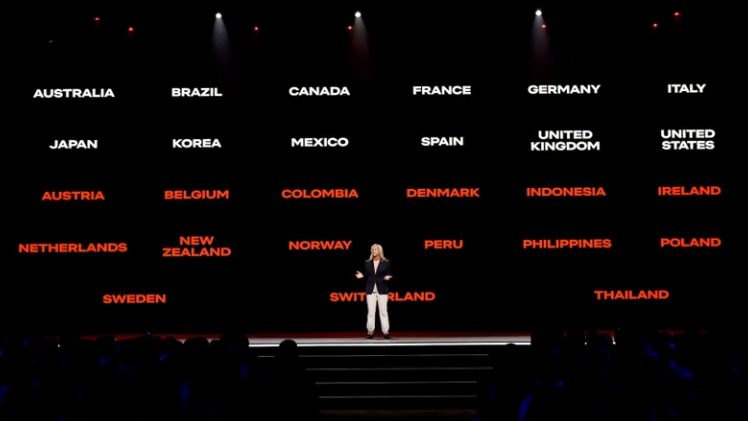
That audience is expected to grow in 2027 as Netflix expands its ads plans from its initial 12-country slate to 15 new countries: Austria, Belgium, Colombia, Denmark, Indonesia, Ireland, Netherlands, New Zealand, Norway, Peru, the Philippines, Poland, Sweden, Switzerland and Thailand. The platform will also open new ad inventory across podcasts and vertical videos globally in 2027, along with expanding brand partnerships with its official fan site, Tudum.

As discussed on its recent earnings call, Netflix is turning to artificial intelligence and machine learning tools that it has used for decades to help build out its ad business. DoorDash, Target and TurboTax have recently tested AI-powered capabilities that look to better match advertiser creative with the platform’s content — a capability that will be brought to every ad-supported region by the end of 2026.

The company is also testing AI agents to manage, optimize and purchase ads, in addition to the AI-driven tools that it already offers around developing and optimizing media plans based on brand objectives. Additionally, AI is being used to adapt assets for different formats, like vertical video or pause ads, and the company is testing new personalized ad loads and frequency caps that are dynamically adjusted based on viewing behaviour.

“On top of new inventory, we’re also marrying art and science better than anyone else,” Reinhard said. “AI is already making advertising with Netflix easier and more efficient.”

Simplified campaigns, driving results

Netflix during the presentation unveiled new tools, capabilities and partnerships that span planning, buying and measuring outcomes of ad campaigns. The offerings are part of the Netflix Ads Suite, which was deployed to all its ad-supported territories in the fall. Along with tapping the cast of “Emily in Paris” to detail its full-funnel solutions, the presentation featured Nicolle Pangis, vice president of advertising at Netflix, who joined the company after a stint as CEO of the cable ad sales company Ampersand.

“I know the pressure on every dollar is higher than ever, and I also know that you’re looking for fewer, more strategic partners who provide high quality environments at the scale you need to streamline your buys and drive better results,” Pangis said during the presentation.

A new Audience Insights API helps advertisers learn about member characteristics and behaviours, while a Reach Curve API assists in forecasting campaign reach. The company has integrated with partners including Snowflake and Amazon Web Services around data clean rooms, and will add InfoSum as a partner by the end of the year. Netflix also works with Dentsu, Horizon, Omnicom, PMG and Tinuiti on solutions like planning APIs and clean rooms.

Additionally, Netflix is expanding programmatic capabilities to Live and Pause Ads using Dynamic Ad Insertion tech, allowing clients to buy through their preferred demand-side platform partners — first in the U.S. and Canada this summer before expanding more widely by the end of the year. The company will also enable programmatic audience targeting for all ad-supported countries on Amazon DSP by June 1 and Yahoo DSP in the months after, providing a timeline for previously announced partnerships.

While the battle over audience measurement continues, Netflix has joined the list of publishers working to prove outcomes, not just impressions. Campaigns on the streamer drive almost two-times the TV norm on long-term brand building, and perform 23% above benchmarks for purchase intent compared to competitors, per data shared by Netflix.

Dove, which partnered with the company around hit show “Bridgerton” for a campaign that spanned consumer products and custom spots, notched more than 1 billion impressions across seven markets and saw an almost 60% increase in new shoppers for products. Meanwhile, a partnership between Airbnb and “Nobody Wants This” around the booking platform’s experience offerings boosted awareness and purchase intent, delivered a return on ad spend more than double the industry benchmark and helped drive bookings.

“It’s no surprise that ads on Netflix drive greater attention, more brand awareness, higher engagement and more search and web visits, but they also drive higher sales, lift purchase intent and return on ad spend, compared to our competitors,” Pangis said.

Feature image credit: Dimitrios Kambouris / Staff via Getty Images

Amy Reinhard speaks onstage during the 2026 Netflix Upfront at Sunset Pier 94 Studios on May 13, 2026 in New York City.


By

Sourced from Marketing Dive

By Nikhil Nanivadekar

The shift toward AI is not just about producing ads faster, it’s about giving creative capability to everyone, writes Amazon’s Nikhil Nanivadekar.

The following is a guest piece written by Nikhil Nanivadekar, principal engineer, consumer ad experiences at Amazon. Opinions are the author’s own. 

Advertising has always celebrated creativity, but for many brands, it came with real constraints. Big ideas required big budgets, specialized teams and long production cycles. Speed was a luxury, and experimentation carried risk. For too many businesses, the gap between a great idea and a great ad felt impossibly wide.

Artificial intelligence is breaking down these barriers. When the barriers to experimentation fall, creativity rises and more innovative storytelling becomes possible for everyone. This is not a distant promise. It is happening right now, across industries and businesses of every size.

The rules of advertising are being rewritten in real time. According to the Marketing AI Institute’s “2025 State of Marketing AI Report,” 74% of marketers now say AI is very important to their success over the next 12 months, up eight percentage points from 2024. That momentum is only accelerating.

This shift is not just about producing ads faster. It is about giving creative capability to everyone. Mom-and-pop shops can now be seen and heard in ways once reserved for the biggest brands. The challenge has never been a lack of ideas. Small businesses have always had compelling stories to tell. The barrier has always been bringing those ideas to life at a level that competes for attention. AI is changing that equation, putting sophisticated creative capabilities in the hands of businesses of all sizes and letting their stories finally shine.

Amplifying creativity and agility

One of the biggest shifts is how creative work gets produced. Small and mid-sized brands that once relied solely on simple product-shot ads now use AI to transform product images into lifestyle scenes, convert detail pages into audio ads and develop simple ideas into full TV commercials, all with a single prompt. What once required weeks of production planning can now happen in minutes.

But agentic AI tools are changing the game, letting teams test wildly different approaches in minutes instead of weeks. Customers report spending less time on administrative work and more time on big ideas.

For example, when Molly’s Suds set out to create a streaming TV ad, they didn’t start with a storyboard, an agency brief or a production crew. Instead, they experimented by using Creative Agent — Amazon Ads’ new conversational, agentic AI tool.

Creative Agent analysed the images, product copy, reviews and brand details from the product detail page to understand Molly’s Suds’ tone, customer value proposition and visual style. From there, the tool guided the advertiser through brainstorming, script development, scene planning, voice over selection and final video production.

This is one example of AI tools turning a difficult and expensive process into a streamlined, exciting new creative possibility.

Democratizing the advertising process

While increased speed and efficiency delivered by AI is important, it’s the access and breaking down barriers that is perhaps the most important change AI is driving.

Brands once side-lined by constraints are now stepping into creative spaces as active players, bringing fresh perspectives and diverse voices that make advertising richer for everyone. This momentum is visible among Amazon sellers themselves. By the end of 2024, nearly one in five Amazon sellers were using AI-powered creative tools, with the majority being small businesses discovering for the first time what it feels like to compete at the highest level.

The impact is not just philosophical, it is measurable. McKinsey’s “State of AI in 2025” report shows that revenue gains from AI appear most commonly in marketing and sales. We believe broader access to creative capabilities translates quickly into real business outcomes. When more businesses can tell their stories effectively, everyone wins.

AI-powered creative tools are now foundational for brands of all sizes. They accelerate production, enhance storytelling and deliver a level of sophistication that once required massive budgets and large teams. But beyond the efficiency gains and the impressive statistics, what excites me most is what this means for the future of advertising itself. The result is a more level playing field, one where imagination becomes the most valuable currency, and where any brand with a great idea and a great story has a real chance to be heard.

Feature image credit: peshkov via Getty Images

By Nikhil Nanivadekar

Sourced from MarketingDive

By

The tool developed by Sightly and Vurvey Labs helps brands quickly respond to news developments that could affect perceptions of campaign messaging.

Dive Brief:

  • Horizon Media is testing a new artificial intelligence solution from marketing intelligence company Sightly and AI research firm Vurvey Labs that detects cultural shifts mid-campaign and adjusts media decisions accordingly, per details shared with Marketing Dive.
  • The solution, which is being piloted within the HorizonOS partner ecosystem, pairs real-time human sentiment from Vurvey Labs with cultural and contextual media data from Sightly. The effort is the result of a partnership between Vurvey Labs and Sightly announced Monday.
  • Other agency players, including Dentsu’s Carat, are also experimenting with the AI capability. Horizon Media continues to focus on growing its AI know-how while agencies at large face pressure to move beyond dabbling with the technology to deliver more tangible outcomes.

Dive Insight:

Horizon Media’s pilot of Sightly and Vurvey Labs’ new AI-powered solution offers a way to adjust campaigns on the fly in response to changing cultural trends. Agencies face growing pressure to implement AI solutions that provide demonstrable results, with many undergoing acquisitions and substantial restructurings along the way.

With Vurvey Labs and Sightly’s audience tool, Horizon Media can perform with greater precision, said John Koenigsberg, executive vice president and head of platform partnerships at the agency. The capability is being piloted through the HorizonOS partner ecosystem, an open ecosystem introduced in December that enables clients to create marketing products with a variety of different vendors.

“The challenge for agencies isn’t access to more data, it’s knowing which signals are worth acting on,” Koenigsberg said in a statement. “This is exactly why we launched HorizonOS — to foster a community of emerging technology partners who can innovate through intentional, curated collaboration.”

The audience tool integrates Vurvey Labs’ AI-driven People Model with Sightly’s Brand Mentality platform, allowing brands and agencies to create custom audiences informed by cultural signals and always-on human insight across social platforms.

In a hypothetical use case provided by the companies, an athletic apparel brand launches a campaign with a “no excuses” messaging — language that historically performs well — before a major college football program falls under fire for abusive conditioning culture. While a traditional programmatic system wouldn’t process the risk until purchase behaviour changes, Vurvey’s People Model captures real human sentiment from the campaign’s target audience, including live responses signalling that the emotional posture around “toughness” messaging has shifted. In turn, Sightly’s Brand Mentality platform layers that human signal against contextual signals already in the market, including news coverage and brand risk indicators, and surfaces the conflict to the agency.

Along with Horizon Media, Dentsu’s Carat is also piloting the integration. Similarly to Horizon Media, Dentsu has also looked to build its AI capabilities. In January, the company launched Generative Audiences, its own audience intelligence solution that leverages people-based data against AI-driven signals to simulate real audience groups.

As agencies race to advance their AI expertise, some analysts are sceptical about how far those bets can go, with half of agencies’ proprietary AI platforms expected to either wind down or become obsolete by 2029, Gartner predicts. Open-source platforms are expected by Gartner to support more than 75% of enterprise AI deployments on the client side by 2028, per the researcher.

Feature image credit: Getty Images

By

Sourced from Marketing Dive

By Kayleigh Barber

BuySellAds is a small ad tech company that has found a way to stand out on the Lumascape — by buying publishers.

The advertising marketplace for publishers and marketers last week scooped up Pando, a tech news site formerly known for its strong opinions and a membership model that had fallen by the wayside, following its purchase 18 months ago of digital news aggregator Digg. The bet, according to Todd Garland, CEO of BuySellAds: Use these sites to prove out BSA’s model of being a one-stop monetization shop for media publishers.

This is something of uncharted territory for ad tech, which normally plays a middleman role. It’s not unheard of, as the biggest player in ad tech, Google, owns and operates media. The Washington Post and Vox Media are both publishers who license monetization platforms.

Garland said that BSA is still very much in the vision-and-mission phase and hasn’t yet released the products to its clients; however, Pando’s acquisition is the next step in the testing process. The newly acquired brand will be moved onto the publishing platform that was created for Digg and will be used as a test case before opening the platform up to clients.

“Part of our general premise is that the big ad tech companies have stopped innovating, and we’ve seen our customers looking for new revenue sources,” said Garland. Therefore, his goal is to transform BuySellAds into a revenue tech company in order to figure out how to create monetization tools for its publishing clients beyond programmatic ad sales and direct ad buys.

While Digg is profitable now, Garland said that the goal of buying the site was never to earn revenue off of it. Instead, it’s a testbed for creating a publishing platform that he can be licensed to other publishers. It’s a model that carries echoes of Say Media, which started as a video ad tech company before scooping up publishing brands.

When Pando launched its membership product in 2015, former co-founder of Pando Paul Carr said that the small, in-house team had to invest a lot of time and money into building the current CMS. Garland’s goal is to remove the financial and time burdens that go into producing the system, so that journalists and publishers of any size can create profitable platforms for their content.

Similar to what the Washington Post created with its Arc Publishing and Zeus platforms, which give publishers ad optimization and other publishing tools, BuySellAds is focused more on journalists and smaller publishers that want to build profitable platforms for their journalism without having to sink tons of money into multiple vendors or web developers.

“Not everyone has figured out how to successfully monetize digital media,” said Garland, which is why he sees “an opportunity for small to midsize folks to get the tools they need to have successful businesses and operate successful platforms.”

With Digg, Garland said that BuySellAds was also able to learn about the struggles that its partners are dealing with firsthand and he noted that operating Digg has been a challenging experience on par with the general struggles of the industry.

A former employee of Digg said that immediately after the acquisition, half of the roughly 30-person staff — the technology team — was let go, and the sales and business-side staffers were absorbed into BuySellAds. From there, the staff’s video editor, general manager and two original content editors were laid off over the course of the following 11 months. In addition to the layoffs, other editorial members departed and currently the brand’s entire staff consists of five full-time employees and one part-time staffer.

Pando’s former owners, Carr and editor-in-chief and CEO Sarah Lacy, both departed the staff and not including the two recent posts announcing the sale of the publication, only eight articles had been published on the site this year. Garland said that the company will be relying on freelancers and outside contributors to provide content for the site.

“I’m not trying to enrich myself directly with these properties but trying to figure out how to enrich others,” said Garland.

“We know [Pando had] been stale for a while, but we didn’t want to start from scratch,” said Garland. “We wanted something workable that we could experiment with as well as learn to build better tools for publishing clients.” And similarly with Digg, the media brand had been in desperate need of money, according to former employees’ accounts, who said that when the brand was acquired in April 2018, it wasn’t profitable.

Garland and BuySellAds have been aiming to learn more about the media business for some time, but it doesn’t appear that the editorial staff at Digg was aware that this was the driving reason for the brand’s acquisition in the first place.

By Kayleigh Barber

Sourced from DIGIDAY

By

Google has confirmed to Ad Age that an industry trade body tasked with deciding which “annoying” ad formats web browsers should block largely used its data and research methodology to do so. The trade body, known as the Coalition for Better Ads, last year publicly presented the material in full with Google and 18 company employees’ names removed, describing it as “the Coalition’s research.”

By not crediting the search giant for its research, the Coalition had until now effectively insulated Google from potential new unwanted attention to its influence over the web, which could raise questions of transparency at a critical time for the search giant: The company was hit with a $21 million fine last Thursday after the Competition Commission of India said it abused its dominant position in the online ad search market.

And in August, after Google said its Chrome browser would block ads according to Coalition criteria, European Commissioner for Competition Margrethe Vestager said her organization “will follow this new feature and its effects closely.”

After first sourcing its foundational research methodology to unnamed “members,” the Coalition has also confirmed that the work originated at Google. It emphasized that a broad group of members oversees the research and standards it adopts, and that further research has been done by others.

“The Coalition obtained the rights to publish the underlying research methodology from Google and to use it for ongoing research of consumer ad experience preferences in global regions,” the Coalition said in a statement. “This research effort is overseen by the Coalition’s Standards and Research Committee which includes a cross-section of Coalition members.”

Google said in a statement that it conducted research in April 2016 into poor consumer experiences on the web. “In October 2016, the newly formed Coalition for Better Ads asked member companies to share any research that had been conducted,” it said. “Google along with Facebook, Teads, the IAB Tech Lab and Washington Post, submitted their existing research as requested. In late 2017, the Coalition conducted additional research to define which ad experiences online were acceptable and unacceptable. In March 2017, the Coalition announced the initial Better Ads Standards based on this body of research. In addition, the Coalition has a dedicated Standards and Research Committee, which includes both companies and industry trade groups. Google is a member of this committee.”

When asked last week why its name wasn’t on the research on the CBA’s website, a Google spokeswoman said, “The Coalition for Better Ads made the decision as to what to publish and not to publish on their website.”

Chrome will gradually begin enforcing the Coalition standards starting Thursday.

Once enforcement is fully enacted, the browser will block all ads on websites—including those that aren’t “annoying”—should the publication be found in violation of Coalition standards and thresholds. The Coalition will grant publishers that volunteer to participate a period of time to defend themselves or address potential violations before ads are blocked.

Although the Coalition is devising standards for any participating browser to follow, Microsoft is the only other Coalition member that also has a browser. It told Ad Age last week that it has no plans to follow in Chrome’s footsteps. Firefox and Apple are regarded as longshots to join the Coalition, according to several high-level executives familiar with those conversations.

Blocking the blockers

Marketers, ad buyers, publishers and tech companies including Procter & Gamble, GroupM, Facebook, the Washington Post and Google announced the Coalition in September 2016 as a collective effort to undermine consumer demand for ad blockers.

The plan was to eliminate the worst ad experiences for users—like videos that play automatically with the sound on—in order to reduce the siren call of blocking software that lies outside the industry’s control.

“The Coalition’s research identifies the ad experiences in both North America and Europe that ranked lowest across a range of user experience factors, and that are most highly correlated with an increased propensity for consumers to adopt ad blockers,” it said in its initial press release, which did not bring up Google outside a roll call of members in the boilerplate. “These results define initial Better Ads Standards that identify the ad experiences that fall beneath a threshold of consumer acceptability.”

Public eye

Google knows many people are wary of its sway over digital media, says Nick Lee, a professor of marketing at Warwick Business School.

“They are very worried about perception when it comes to that kind of stuff—the perception of not just actual power, but that they are starting to control the data around these issues,” Lee says. “And maybe that is something they don’t want to be necessarily known for.”

Industry members say they embrace the fight against intrusive ads and consider Google’s research approach sound. Before sharing its research with the Coalition, Google sought feedback from the Interactive Advertising Bureau, publishers and ad-tech vendors after making them sign non-disclosure agreements, according to people familiar with the process.

When the Coalition asked members to submit any research they had, not just Google but Facebook, The Washington Post, Teads and the IAB Tech Lab complied. Coalition members ultimately chose to start with Google’s work.

“It’s as if they are caught between a rock and a hard place,” Lee says. “No matter how much of a good job they think they are doing, they don’t want the world to think they are controlling everything.”

Rivals in the digital ad ecosystem could cite Google’s influence as a reason to question the Coalition’s standards.

It remains unclear whether regulators would take an interest in the Coalition, says James Speta, a law professor at Northwestern University who specializes in internet policy and telecommunications.

“If it can be shown that Google manipulated the standard setting process, that would be a concern to the Federal Trade Commission,” Speta says. “The underlying issue in cases like these is how transparent is the trade body, and how fair is it? Was everyone able to see what was going on?”

Feature Image Credit: istock

By

Sourced from AdAge

By

There are so many ads for sale on the web that ad tech firms can barely even handle it.

Many ad tech companies promise software designed to process thousands of ad transactions in real time. But thanks to header bidding – a tech hack that has leveled the playing field in programmatic ad space over the past several years – ad tech can’t process all the ads that are out there.

That’s according to Tom Kershaw, chief technology officer at the embattled ad tech firm Rubicon Project. The surge in popularity in header bidding, which allows web publishers to open up their ad space to multiple potential buyers simultaneously, has led to such an explosion in inventory that it is straining the current infrastructure, he contends.

That’s why Rubicon just spent $38.5 million to acquire the two-year-old startup nToggle. The company’s technology is designed to make it easier for ad buyers to sift through millions of ad impressions at a given moment.

The very premise of ad tech is that software can evaluate and buy thousands, if not millions, of digital ads with a level of speed, sophistication and precision that humans can’t replicate. Dozens of companies have launched promising to help media buyers avoid having to directly make deals with thousands of websites, instead allowing them to use all sorts of data to target individual web users in milliseconds with a few clicks of a mouse.

Ad buying software companies like DataXu and The Trade Desk, known as demand side platforms, or DSPs, are supposed to be good at doing solving for the challenge Rubicon is describing. But ever since header bidding took off, these companies are dealing with five times the number of ads, said Kershaw.

Previously, when an ad on a publisher’s site went up for sale via various programmatic channels, potential buyers took turns. Google’s ad exchange might get the first chance to bid on that ad, and if that exchange passed, another buyer, like AppNexus might get a shot.

But with header bidding, publishers can let multiple ad buyers all get a chance at their ad inventory all at once. Which means that DSPs are seeing potentially all the same ads on all the same publishers again and again.

“DSPs see tons more traffic than they used to,” said Kershaw. “Now every exchange has access to all the impressions. Buyers see see same ad slot 10 times.”

That dynamic is straining ad tech companies’ infrastructure while adding to their costs, he said. “Something had to give.”

That’s where nToggle comes in. The startup had been selling its tech to publishers, helping them avoid having to dig through every single ad impression on the planet by using a proprietary algorithm and compression technology. Rubicon plans to bake it into its ad exchange.

“Buyers will only see requests they want to see,” said Kershaw.

The acquisition comes at a pivotal time for Rubicon Project. The company has had a rocky time every since it went public in 2014. And executives have acknowledged that the rise in header bidding has impacted the company’s business negatively. It’s stock price has hovered around $5 for a while.

Rubicon’s founder stepped aside from his CEO role earlier this year, and the company was reportedly looking for a buyer, according to the Wall Street Journal. Meanwhile, Rubicon is being sued by the Guardian, which alleges that Rubicon did not disclose certain fees.

By 

Sourced from Business Insider UK