Tag

ads

Browsing

Sourced from Buffer

Effective Strategies for Organic Growth and Battling the Rising Cost of Ads on Instagram this Shopping Season.

Introduction

Window shopping used to take place in malls and high streets, but now, increasingly, product discovery — and purchase decisions — happen online, especially on Instagram.

And with planning for the busiest retail period of the year getting started, we wanted to dive a little beyond best practices to learn how successful brands and marketers are taking on two of the biggest challenges on Instagram this shopping season:

  • Standing out organically in crowded feeds
  • Battling the rising cost of ads

For this report we spoke with marketers from Stance, tentree, Blenders Eyewear, The Hundreds, and Shoelace. Keep reading below to see how they’re approaching Instagram during the 2019 shopping season.

500M
daily stories users on Instagram
1B+
monthly active users on Instagram
45%
of Instagrammers say the platform is influential for shopping over the holidays

The value of organic content

Instagram is essential for retail brands that want be culturally relevant and build strong communities of customers. Here’s how direct-to-consumer marketer Nik Sharma sees it:

“For consumers who rely heavily on Instagram for their news, info, and updates, Instagram is the first place they’ll go to look up new brands,” says Sharma. “If you don’t have a proper profile, you can’t be taken seriously in today’s market. I believe every brand should have its own Instagram presence, whether or not their only goal is using the platform to acquire customers.”

For consumers who rely heavily on Instagram for their news, info, and updates, Instagram is the first place they’ll go to look up new brands.

But with algorithm tweaks and reach becoming somewhat unpredictable, how are brands navigating organic posting on Instagram this shopping season? And why does organic content still matter?

Strategy #1: Create a two-way relationship with customers

There might not be as much buzz around organic posting due to the explosion of advertising on Instagram, but one thing is clear: Organic content plays a key role in helping to build strong communities and brand equity.

For Noelle Bates, SVP of Marketing & Communications at Stance, organic content is a cornerstone of marketing strategy, and it plays a key role in helping the brand to build strong relationships with customers. Organic posting is the foundation of our Instagram strategy and our marketing strategy overall, says Bates. “We’re lucky in that we have ‘grown up’ with Instagram and began building a community long before there was any such thing as paid content, so connecting with people was, and still is, the foundation of our marketing. And that really happens through our organic posts.”

Stance has grown its audience to over 1.4M on Instagram, with a further 500K followers across other accounts including Stance Basketball, Running and Baseball.

Even though our retail presence is growing, social is predominantly the only place where people can have direct back and forth with our brand on an ongoing basis. Interacting with our customers via social is really important to us, whether that means acknowledging them, answering DMs, or engaging with their content, it’s important they know we are listening to them and we appreciate them. No good long-term relationship is one-sided.

Noelle Bates, SVP of Marketing & Communications, Stance

Strategy #2: Use Stories to drive awareness of products, sales and promotions

500 million people use Instagram Stories daily, and people enjoy using Stories as a way to connect with brands and discover new products.

In a Facebook study:

  • 62% of respondents said they have become more interested in a brand or product after seeing it in Stories
  • 69% of respondents said that brands using Stories is a great way for people to get to know new products or services

“Instagram Stories play a huge role in many of our campaigns,” says Grace McLaughlin, Marketing Manager at Blenders Eyewear. “For promotions, we’re pumping stories the entire day to make sure we’re in front of everyone and all viewers are aware of the latest Blendz News. Not only do these organic Stories stoke out our followers, they consistently bump up traffic to our site and increase sales.”

Not only do these organic Stories stoke out our followers, they consistently bump up traffic to our site and increase sales.

For products, we leverage stories to give people the ability to sign up for first access for upcoming releases. The goal is to hype them up for whatever we have coming out while simultaneously growing our email list.

Grace McLaughlin, Marketing Manager, Blenders Eyewear

Strategy #3: Showcase your catalog

The visual nature of Instagram makes it the perfect place to showcase products during shopping season. Scrolling up and down the Instagram feed has become second nature for shoppers.

For Los Angeles-based streetwear brand The Hundreds, organic Instagram posts help to keep its products top-of-mind. “In between seasons or big releases is our slow period,” says Sandy Mosqueda, Editorial Assistant at The Hundreds. “Organic posts help us remind the people of existing pieces in the collection.”

The Hundreds also sees the bio link as a key part of its Instagram profile and uses Buffer’s Shop Grid feature to help its audience buy products featured on its profile: “Because the Shop Grid looks identical to our Instagram feed, it allows the user to feel more comfortable when shopping.”
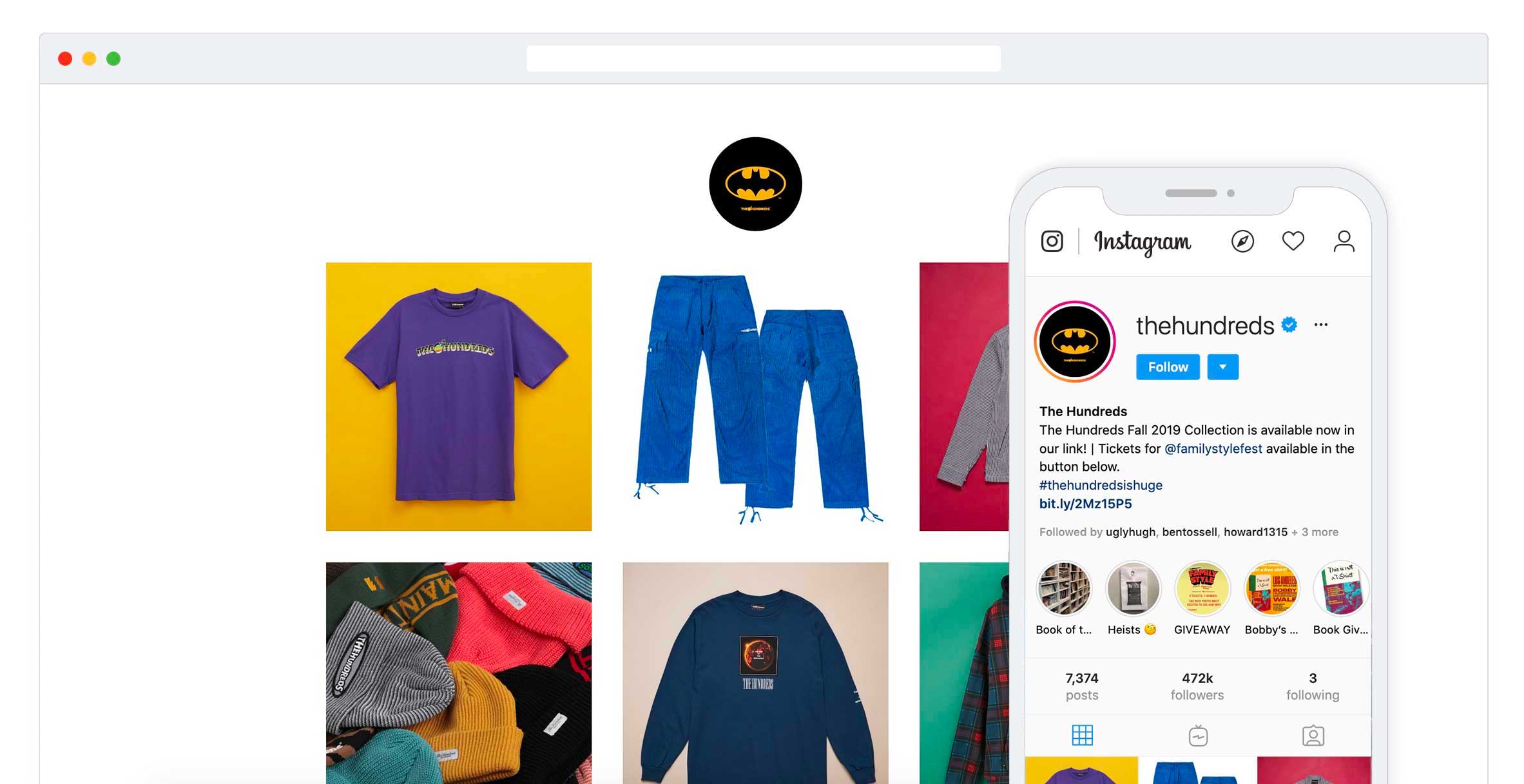
Shop Grid enables The Hundreds to link Instagram to its online store.

User-generated content is another key strategy that The Hundreds uses to showcase its products and drive traffic to its store: “Fans send us photos of them wearing our stuff in hopes that we’ll repost,” says Mosqueda. “Say if it’s a recent piece, we can use that as an opportunity to [use a] product tag in hopes that they click on the tag, and the tag directs them to purchase.”

Instagram can drive offline sales too

The eCommerce industry continues to grow, but in 2018 the $3 trillion generated from online sales made up just 15% of total retail sales. So it’s important to also think about how building your brand and showcasing products online can drive offline sales.

By using its Instagram page as a “lookbook” or “storefront” to showcase products, tentree has been able to create demand for its featured products in store:

We have always found there to be a direct correlation on what people see on tentree’s Instagram to what is purchased online and in stores. We have heard on countless occasions of people going to a store that sells tentree with a screenshot of an item found from our Instagram.

Victoria Harding, Performance Marketing Manager, tentree

Strategy #4: Take your audience behind-the-scenes

Consumers seek connection with brands, and one of the best ways to start building relationships is to use Instagram as a way to bridge the gap between your business and consumers.

For Blenders Eyewear, this means creating content that brings consumers into their office and shares engaging narratives about the people that run the company and athletes that advocate for the brand: “We leverage organic as a way to tell our brand story,” says McLaughlin. “We balance highlighting product with spotlighting our athletes, giving people an inside look at HQ and providing content that pushes others to live life in forward motion.”

We balance highlighting product with spotlighting our athletes, giving people an inside look at HQ and providing content that pushes others to live life in forward motion.

Not only does this approach help to create lasting consumer relationships for Blenders, it also helps to encourage word-of-mouth sharing from brand advocates. “Humanizing our brand allows us to build a loyal community that is willing to positively talk about their experience with us and our product,” says McLaughlin.Free marketing is the best type of marketing.”

At a time when brands are all competing for the real estate in social feeds, it’s important to create a reason that people follow along closely.

NIK SHARMA, DTC Marketer

Instagrammers have become accustomed to shopping on the platform and more than 130 million Instagram users tap to reveal product tags in posts each month.

Battling the rising cost of ads

Instagram ads opened up to everyone in late 2015, and now over 2 million businesses are advertising on the platform.

“Pretty much every brand is doing paid social today,” says Reza Khadjavi, co-founder of Shoelace. “The heavy competition for a limited number of ad spots has driven up the cost of acquisition radically over the past few years.”

The heavy competition for a limited number of ad spots has driven up the cost of acquisition radically over the past few years.

With rising ad spend front of mind for many brands during the holiday shopping season, what can marketers do to ensure they get the very most from their advertising dollars?

Strategy #1: Take a brand-first approach to advertising

When you think about your advertising budget, it’s easy to focus on the bottom-of-the-funnel and direct conversions. But in the long run, it might be better to focus on a brand-first approach.

“Think companies like Apple, Nike, and Lululemon. Their audiences live and breath their products, and are the first in line when a new product is released,” says Khadjavi. “If these organizations took a sales-first approach rather than building genuine connections with their audience, this surreal amount of brand spectacle would not exist.”

When every other retailer is pushing sales and discounts, it can be tempting to join the pack and focus on cashing out quick sales to audiences that are craving deals. But this could have a negative impact on your brand, warns McLaughlin: “During the holiday season, it’s easy to lose your brand while strategizing aggressive marketing techniques. While this may lead to the obvious short-term positives, it can also lead to expensive one-time purchasers and potentially manipulate your loyal customer base.”

During the holiday season, it’s easy to lose your brand while strategizing aggressive marketing techniques. While this may lead to the obvious short-term positives, it can also lead to expensive one-time purchasers and potentially manipulate your loyal customer base.

This viewpoint is shared by Stance, too. “We are not interested in one-off customers,” says Bates. “We want people to engage with our brand for the long-term, which goes well beyond a one-and-done purchase.”

“Don’t rely strictly on discounts and sales to capture your audience during the holiday season,” says Khadjavi. “Instead, ask yourself how else you can convey value through your advertising experiences. This means interlacing your conversion-focused ads with content and media that will stand out to audiences when they are trying to figure out what their loved ones will appreciate the most.”

When a brand focuses too much on conversions, they risk alienating their audiences and scaring away potential lifetime customers.

REZA KHADJAVI, CEO, Shoelace

Strategy #2: Using organic insights to fuel paid strategy

Posting organically generates a wealth of data and analytics that marketers can use to fuel their growth strategies and paid acquisition plans.

tentree is always keeping an eye on its data to spot opportunities as they arise. “We ensure to pay close attention to strong-performing images and Stories on our Instagram page,” says Harding. “If we see a post driving significant engagement or traffic we will look to test it on Facebook Ads Manager.”

tentree often showcases its products on Instagram and promotes
strong-performing posts using ads.

Stance also uses its organic performance as a way to decide what content should be promoted. “If it works really well on organic it will work on paid,” says Bates. “Although we don’t – and wouldn’t – purposefully architect our organic feed as a proving ground for what we do on the paid side, we can still utilize the insights to help us select what content should be promoted.”

We watch the analytics on a piece of content for a few hours after we post, then apply paid dollars to promoting the very best content. Because we post so much organic content we have a much bigger pool to glean insights from in terms of what’s resonating with people and can use those insights to help create better acquisition creative.

Noelle Bates, SVP Marketing & Communications, Stance

Strategy #3: Pay close attention to frequency and sequencing

When you’re running advertising campaigns for shopping season, it’s important think about how frequently your target audience will see each of your ads.

“In short, frequency is an estimation provided by Facebook as to how often the average visitor sees a particular ad,” explains Khadjavi. And at Shoelace, the team recommends that frequency should be no higher than 1.5 times per day to avoid upsetting the consumer.

Frequency should be no higher than 1.5 times per day to avoid upsetting the consumer.

In order to create engaging ad experiences, Khadjavi and Shoelace also focus on a process they call “day sequencing.” In short, this means breaking down the ad retargeting experience to show some of your audience particular ads in the initial period of time after they leave your site, and then different ads the period afterwards.

Day sequencing has enabled Rhone to increase conversion rates by 12% and decrease cost-per-action by 19.3%.

There are a couple of key benefits to day sequencing:

  1. It allows merchants to leverage a mix of ads with unique objectives to build a retargeting experience that tells the story, while driving sales.
  2. You can expose your audience to more value propositions with your brand and products than you would be able to do with a single ad.

We might show a user a dynamic product ad in the first three days after leaving the site to drive conversions, and then – if they have not converted – show them a video ad for the next three days to build brand awareness.

Reza Khadjavi, CEO, Shoelace

Strategy #4: Promote products across channels

Instagram is a key channel for many retails brands, but it’s not the only channel. For both paid and organic campaigns, it’s important to think about how Instagram fits with your overall strategy.

In order to maximize sales and revenue during shopping season, Blenders takes lessons from Instagram and applies them to other channels. “Paid is just one step in the funnel,” says McLaughlin. “If a product is crushing it on paid, we highlight said product in our organic social posts, email campaigns, as well as our site.”

If a product is crushing it on paid, we highlight said product in our organic social posts, email campaigns, as well as our site.

tentree uses a similar approach by syncing its Instagram Stories content with email marketing: “We generally create 1-2 product-focused Instagram Stories per week, in tandem with our email marketing calendar,” says Lindsay Derer, tentree’s Digital Community Lead.

When it comes to preparing your marketing for the holidays, it’s best to start early — Facebook found that consumers begin planning for the holidays as early as November 1st.

Executive summary

As Instagram continues to grow, its influence on the world of eCommerce increases too.

Since the early days of Instagram, brands have used it as a digital storefront to showcase their products and brand. But now, Instagram is becoming a key source of traffic and sales for retailers.

Every retail brand is going to want a slice of the action this shopping season, so there will be plenty of competition across the Instagram feed and ads. “To be heard, it is critical for a brand to create an advertising experience that captures a bond with the customer,” says Reza Khadjavi.

Don’t rely exclusively on sales and discounts, instead focus on what differentiates your brand from the competition. “So you have a discount on this product – that still does not tell your audience why they should buy from you rather than the other hundred brands that are trying to sell to them,” explains Khadjavi.

Approaching shopping season with a brand-first mindset will help you to win lifetime customers, rather than one-and-done purchasers.

Approaching shopping season with a brand-first mindset will help you to win lifetime customers, rather than one-and-done purchasers.


Sourced from Buffer

Sourced from The Economic Times

Facebook exerted more control over Instagram over the last two years.

If you have been seeing more ads on Instagram this year, you are not alone. Parent company Facebook reportedly instructed Instagram to increase the number of ads in the app towards the end of 2018.

According to The Information, Facebook exerted more control over Instagram over the last two years, including the move to rename the app, Mashable reports.

Facebook plans to bring Instagram’s revenue number closer to its own app, and will heavily rely on commerce to achie ..

Click HERE to read the remainder of the article

Sourced from The Economic Times

By John Boitnott

You need to know your audience, formats, and competition to really get people to visit your site and buy your product.

As the second-largest search engine in the world, YouTube can be an effective way to generate interest in your startup as well as to drive traffic to your website. It doesn’t matter whether your company is B2B or B2C: YouTube Ads provide an engaging way to reach your target customers, and give you an opportunity to work with a channel that consumers trust.

Here’s how I and others got started and made the most out of YouTube ads, as well as how you can use the social media platform overall to help grow your company.

Familiarize yourself with various YouTube targeting options.

To maximize the return on your YouTube ads, you’ll need to know how to target your specific audience. You can understand your audience better as well as how to target potential customers by learning and using these options:

1. Remarketing

Remarketing, often called retargeting, offers a way to go after those non-converting visitors by sending an ad to other places they visit.

I used to work for a startup that used this strategy quite a lot. I and other members of the marketing team noticed that visitors would leave before buying our services. We worked with a company specializing in this form of marketing (top options include Outbrain, Adroll and ReTargeter) to incentivize people to return to our site, even months later–and it worked.

2. In-Market and Affinity Audiences

These are traditional audience targets. These audiences align with Google’s pre-defined segmentation model, based on previous knowledge Google has gathered. Affinity audiences are those that have a strong interest in a specific topic, while in-market audiences are those currently researching a certain product and are ready to buy.

3. Life Events

Google created this target specifically for YouTube. It focuses on reaching a target audience based on upcoming life events like graduation, moving, and marriage.

Get to Know YouTube ad formats.

Making the most out of YouTube ads also means developing a format that catches peoples’ attention. Here are the main types of ads.

TrueView In-Stream ads play before a video. They offer a way for audiences to reach your website. Audiences can choose whether or not to skip them. They’re often effective during remarketing campaigns and can help bring more subscribers to your YouTube channel.

TrueView Video Discovery ads appear on the right-hand side of the video view page, search results pages, and as thumbnails on an individual’s YouTube homepage. This format works well for traditional search campaign ads, as well as for prospecting and remarketing campaigns.

Finally, there are bumper ads. They’re under six seconds long and appear prior to a video. Impressions drive the cost of these ads, which also often work well for remarketing campaigns.

Know the competition and your other marketing efforts.

Before designing and producing your ad on YouTube, make sure you know what your competition is up to. You don’t want to end up looking just like them and blend in too much with the crowd.

Your YouTube ad campaign should align with your other marketing efforts. This promotes brand consistency, which in turn can build brand awareness. To get started on framing your campaign, make sure you first have a Google AdWords account. This is where you will start your YouTube ad campaign.

Create a visually compelling ad around one value-add point.

Keep the video ads simple by focusing on one way you can add value rather than trying to cram all your benefits into one ad. Select the most relevant value-add point to catch the audience’s attention and focus on explaining that benefit in a visually compelling manner.

Develop content and SEO opportunities.

Be sure to include relevant written content like the ad title and description by using keywords. This is where YouTube’s search engine capability can provide a significant advantage. Plug in your own search terms to see what appears, and use those results to help shape keyword usage and content to improve ranking for your video ad.

Don’t forget to include a “call to action” in that description. Be sure to include links to your site so potential customers can find your website, improving conversion rates.

Build out your YouTube channel.

Before visiting your website, those target audience members may want to see what other video content you have available on YouTube. To get the most out of your ads, make sure you have first developed a channel that offers relevant video content.

By engaging with your audience in multiple ways beyond a single YouTube ad, you can deliver more value, enhance your credibility and drive higher returns on your YouTube ad investments. This may also inspire your target audience to visit your site and make purchases.

Review and assess your YouTube ad results.

Continue refining your campaign efforts, leveraging Google AdWords. You can use this analytics tool to assess response rates to your YouTube ad, providing valuable information for your company. While these tips help you master YouTube ads, you’ll still be able to learn as you go, improving along the way.

Feature  Image Credit: Getty Images

By John Boitnott

Sourced from Inc.

This handy app can help you create ads with impact but with very little effort.

By MediaStreet Staff Writers

An app called Plotaverse helps marketers to create great ads without the dreaded and costly content creation process. Quickly bypassing established app giants, the young startup’s iOS app made the list of Facebook’s top 10 mobile apps.

The photo app’s animation features allow businesses of any calibre to create impactful ads fast and on a budget. More or less, you can choose from many artistically appealling gifs and put your message over them. The artwork on the site is truly eye-catching.

But how did Plotaverse’s 8 months old mobile app manage to disrupt visual advertising, going up against 8 billion video views a day on Facebook alone?

Images animated with Plotaverse, formerly known as Plotagraph, are the key to its success. The app ads movement to any single still photo. This creates ads that stand out in saturated media feeds.


Brands like Coca Cola, Wella, Chevrolet and Red Bull were seen boosting their brand with captivating Plotagraphs. There is no need for video, multiple photos or video editing skills to turn a photograph into a Plotagraph. Users of any skill level can quickly animate and post uniquely moving images to their business and social page.

On Instagram and Facebook, Plotagraphs have proven to attract up to 5 times the amount of views and engagement than surrounding images.

Every day, 4.5 million business pages on Facebook are trying to cut through 1.32 billion daily active users according to WordStream. As expected, Adobe’s titan apps, Photoshop Express and Spark Post head Facebook’s list of Photo Enhancing apps. But the tiny startup’s photo animation app has unexpectedly spearheaded the looping content industry.

To check it out, click here


Do you supply services to the Irish Media Industry? Have you listed your company in our Media Directory? It’s free! Everyone’s favourite price! Click here to do it now.


A new experiment suggests that pop-up ads can have an adverse effect on consumers’ perceptions of the content.

By MediaStreet Staff Writers

Scrolls ads, a newer style of advertisement designed for mobile screens, show signs of being more effective than older forms of digital advertising. This is according to a new experimental study conducted by The Media Insight Project, a collaboration between the American Press Institute and The Associated Press-NORC Center for Public Affairs Research. This new research has significant implications for a news industry that is constantly searching for new revenue models to finance journalism.

(For the unitiated, a scroll ad is an interactive ad format which is adapted to the reading behavior of your visitors. The ad opens at the bottom right only when the visitor scrolls down. This ad format will close automatically or can closed directly from the visitor.)

An example is here:

“Banner and pop-up ads have been the standard way to advertise online for decades, though they have met consumer resistance, especially in mobile,” said Tom Rosenstiel, executive director of the American Press Institute. “Our research into online advertisements finds that formats designed more recently, and with mobile in mind, strike users as less intrusive and more pleasing. To our surprise, compared with ad formats designed for other web environments, scroll ads can also improve recall of the product being advertised and enhance trust in the article where the ad appears.”

These are some of the results of the online survey experiment conducted with 1,489 participants between November 9 and December 6, 2016, using AmeriSpeak, NORC’s nationally representative survey panel. The online panel interface allows respondents to see and respond to content presented to them digitally, something that is not possible with traditional phone surveys.

Key findings:

  • The experiment finds that people are more likely to recall the product accurately if it appears in a scroll ad than if it appears in either a pop-up or static ad. Indeed, 34 percent of users accurately recalled the product from the scroll ad versus 26 percent in static ads and 25 percent in pop-up ads. The differences were even more pronounced if you take just those people who say they noticed the ad at all. The majority of all respondents, 57 percent, fell into this group.
  • People are no more likely to notice pop-up ads than they are scroll ads (61 percent vs. 62 percent for scroll) and are less likely to recall the product in pop-up ads, just 41 percent versus 55 percent in scroll ads and 53 percent in static ads. Pop-up ads also have several negative effects. For instance, 61 percent of people say pop-up ads make the article more difficult to read (vs. 37 percent for scroll ads and 19 percent for static ads).
  • When readers are interested in the topic of the ad, they are more likely to express some positive evaluations of the article and engage with that article. Overall, people who are interested in the topic of the ad provide more positive evaluations of the article, including that it provides diverse points of view (28 percent vs. 19 percent) and that it is entertaining (32 percent vs. 25 percent). However, those interested in the subject of the ad are no more likely to say the article got the facts right, had a professional appearance, that it was easy to find important information, or that the information was trustworthy.

“Scroll ads should play an even bigger role in online advertising because they appear to be more effective on a range of metrics than pop-up ads and static banners,” said Trevor Tompson, director of The AP-NORC Center. “These ads optimised for mobile produce benefits to the advertiser and the news outlet compared to older styles of digital advertising.”


Be careful with the size of your smile.

By MediaStreet Staff Writers

A new study that includes a University of Kansas researcher has found that the level of smile intensity in marketing photos influences how consumers perceive the marketer’s competence and warmth, which can lead to different results depending on the context.

“We found that broad smiles lead people to be perceived as warmer but less competent,” said Jessica Li, a KU assistant professor of marketing in the School of Business. “We ask how that can influence consumer behaviour and in what situations might marketers want to smile more broadly.”

The study by Li and her co-authors was published online recently and will be in the January issue of the Journal of Consumer Research, one of the leading journals on marketing academic research.

Participants in the study viewed images of marketing photos that depicted the marketer either smiling broadly or only slightly. The researchers found that in advertisements for services that carry higher risk, consumers were more likely to assign competence to marketers that smiled only slightly rather than more broadly, which was associated with warmth but not necessarily competence.
Credit :Journal of Consumer Research


The researchers conducted experiments in which respondents viewed marketing images that included marketers with either broad or slight smiles. Also, they conducted a content analysis of postings on a crowdfunding website, Kickstarter.com, where people commonly seek donations for causes or business ventures.

Past marketing and psychological research has focused on smiles leading consumers to perceive people as being friendly and viewed in a more positive light. However, Li said the research team’s new study shows that is true but that there can be a trade-off in how a smile might elicit action from a consumer.

Li said one consideration is the context of the service the marketer is providing and whether or not there is potential risk associated with it.

The intensity of someone’s smile in a marketing image elicits two fundamental dimensions of social judgements – warmth and competence, the researchers found.

Li said broader smiles that tend to elicit more warmth seem to be more effective in promotional ads for a service that would carry less risk. But photos with a slight smile did better in marketing scenarios where services were higher risk, such as a medical procedure, legal representation or investment in a startup company.

“If I see an ad with a heart surgeon who smiles really broadly at me, I might think she is really warm, but not choose her to be my doctor because she seems less competent than a surgeon with a slight smile,” Li said. “If the risk is really low, such as going to the store to get a new shirt, then the competence of the salesperson isn’t as important and I respond more positively to the broad smile.”

In their analysis of Kickstarter.com, when the page creator’s profile photo exhibited a broad smile that tended to elicit perceptions of warmth, the total amount of money pledged decreased by more than 50 percent, and the average contribution per backer was 30 percent less than when the creator’s photo included only a slight smile.

“Project creators with a slight smile are perceived as more competent,” Li said. “More people wanted to donate to their project because they believe this competent person is able to deliver the product.”

However, a more intense smile does appear to elicit more buzz on social media or other low-cost behaviours. Profile photos with a broader smile received twice as many Facebook shares than someone with a slight smile.

“It’s intuitive that if you seem to be friendly but not competent, people will want to help you in low-cost ways but not necessarily be willing to give you a lot of money,” she said.

The study could be valuable for marketers as they strategise on how to best elicit a response for their products. “Warmth and competence are such important judgements,” Li said. “We want to make sure we are giving people the right signal.”


By 

  • Millennial attention spans require ads that are just 5 to 6 seconds in length, according to a new study by comScore.
  • Millennials spent 61 percent of their online time in smartphone apps, 8 percent on the mobile web, 25 percent on desktop, and just 5 percent on tablets.

If you’re an advertiser who wants to market a product to millennials, you’re going to have to make it quick.

A new study by comScore revealed online ads targeted toward millennials have to be around 5 to 6 seconds to be effective, a sharp contrast from the traditional 30-second commercial seen on TV.

“The length of time of an episode or a viewing period is really important and has got to be short, otherwise you just won’t keep the attention of millennials,” comScore CEO Gian Fulgoni told CNBC’s “Squawk Alley.”

The format of advertising may have to be radically changed to reach millennials, he suggested.

“You’re going to have to make your case literally in a matter of seconds and make sure you grab somebody’s attention, Fulgoni said.

Millennials are spending the majority of their online time on mobile, according to the new study. Millennials said they spent 61 percent in smartphone apps and 8 percent on the mobile web. A quarter of their time was on desktop, and just 5 percent was spent on tablets.

As many other studies have shown, Snapchat was found to be extremely popular. Two out of 3 millennials were using the app, with 80 percent of the youngest millennials surveyed on Snapchat. It was also growing in popularity among older millennials.

Still, Facebook was the leader, with 95 percent of millennials surveyed on the platform.

“It’s going to be interesting to see what happens over time, especially as these millennials age into the older segment,” Fulgoni said.

By 

Sourced from CNBC

By MediaStreet Staff Writers

When choosy parents choose Folláin jam and sports fans who call themselves sports fans subscribe to SkySports, identity marketing is hard at work. But what happens when this type of advertising misses the mark?

According to a study in the Journal of Consumer Research, when a person’s sense of ownership and freedom is threatened they are less likely to respond positively to identity marketing campaigns.

“While people may be drawn to brands that fit their identity, they are also more likely to desire a sense of ownership and freedom in how they express that identity. Identity marketing that explicitly links a person’s identity with a brand purchase may actually undermine that sense of freedom and backfire,” write authors Amit Bhattacharjee (Dartmouth College), Jonah Berger (Wharton School of the University of Pennsylvania), and Geeta Menon (New York University).

The researchers ran a series of five studies that compared two types of identity marketing, messages that simply referenced consumer identity or messages that explicitly tied consumer identity to a brand purchase. Participants were first asked to answer questions about the importance of a given identity in their overall life. They then viewed an advertisement for a brand that appealed to that specific identity. The advertisement used a headline that either referenced the identity or explicitly linked it to a brand. Participants then rated their likelihood to purchase a product from within the brand.

Study results showed that explicit identity marketing messages backfired with consumers who cared about the specific identity and resulted in a lower likelihood to purchase the product. This information may help brands understand why some people react negatively to products used in important areas of their lives.

“Contrary to the traditional thinking about identity marketing, our research shows that people who care deeply about an identity are not receptive to messages that explicitly communicate how a brand fits with their lifestyle,” the authors conclude. “In fact, to restore their sense of freedom, some people may avoid purchasing a product that otherwise appeals to them and fits with who they are.”

There you go marketers. You can suggest your product to your customer using their identity, but not tell your customer that if they are a certain type of person that they will buy it for sure. Humans: we hate being told what to do.


n the mid-1990s, Ethan Zuckerman worked for Tripod.com, one of the first free web-hosting services for creating personal websites. Zuckerman, now director of the Center for Civic Media at MIT, believed deeply in the ethos of the early internet, a global public square where every voice had equal footing. But keeping Tripod free to users meant that revenue had to come from somewhere else. Like millions of other web companies, they chose advertising.

Soon Tripod was selling online ad space directly on Tripod-hosted personal websites, which worked fine until a major car company noticed that one of its ads was posted on a site celebrating anal sex. Zuckerman, believing he was acting in the best interest of both the advertiser and internet users alike, wrote some code to display the car ad in a separate browser window instead of on the kinky sex page.

Zuckerman had just invented the pop-up ad.

Pop-up ads spread across the nascent internet like a plague. Pop-ups were beloved by advertisers because they flung the company’s message in front of as many eyeballs as possible. Even better, users had to physically close the window, which forced them to interact with the ad, if only for a second. Blinded by the novelty and blanket exposure of the pop-up format, advertisers didn’t foresee the user backlash.

It didn’t take long for pop-ups to become the most universally hated part of online life. By the early 2000s, pop-up blockers were standard on most web browsers and the worst of the pop-up era was over. But that doesn’t mean that advertisers stopped looking for “creative” ways to grab our attention online.

Why Annoying Ads Work

While old-school pop-ups are rare nowadays, there are plenty of ways that advertisers still hold us hostage for content. There are “prestitial” ads that block the whole screen as a website loads, forcing you to wait 15 seconds before clicking “continue to site.” There are “interstitial” ads that display after you visit the site. Some preloading ads on videos can be skipped after five seconds, others can’t (has 30 seconds ever felt so long?). And there are videos that expand — with sound! — if you accidentally hover your mouse over the ad.

Why would advertisers and content providers continue to risk alienating users with ads that most people try to skip or close as quickly as possible?

One reason is that they work. In general, “rich media” ads that contain video or other interactive elements are more engaging to online consumers, says John Dinsmore, a marketing professor at Wright State University in Dayton, Ohio. That expanding video screen that launches when you hover your mouse over an ad for two seconds is called a lightbox ad or hover ad. Google, which created the lightbox format, claims that they are “six to eight times more engaging than a static video box,” says Dinsmore.

One study showed that the top 10 highest-performing pop-up ads had an impressive conversion rate of 9.28 percent (conversion rate means a person took action — such as going to the advertised website — after viewing the ad). One marketing expert found that adding a hover ad to his site increased sales by 162 percent and newsletter subscriptions by 86 percent.

The Better Way to Do Internet Advertising

Michael McNulty is the product marketing manager for rich media for Sizmek, a marketing company that gives advertisers a huge selection of online ad formats to play with, from standard banner ads to full-screen “expandables” (ads that expand to cover the whole screen when clicked on) and “pushdowns” (ads that push the site content down as they expand).

As with any piece of technology, McNulty explains, there are smart ways and careless ways to deploy it. It starts with targeting. Like it or not, your every move on the internet is likely being tracked and sold to advertisers. By analyzing your search terms and browsing history, for example, Google might know that you’re in the market for a new vehicle, preferably a hybrid SUV that can seat seven. While McNulty would never advise a carmaker to blast a flashy video ad at every random web user, in your specific case, a high-impact ad for a seven-seater hybrid SUV could really pay off.

“If you have marketing agencies that go the extra mile to know what users want and what they respond to, you’re giving them a reason to watch something you’re putting in front of them whether it’s obtrusive or not,” McNulty says.

McNulty says at Sizmek, the default setting for all rich media ads is to only launch if it’s user-initiated. Meaning, the user has to click “expand” before the interactive video window will launch — no videos that automatically play or pop-ups. But ultimately, he doesn’t control what the client and their creative team want to do with the tools that Sizmek provides. Those settings can be tweaked to deliver whatever ad experience the client wants, including the bad kind.

Annoying, untargeted, unwanted ads poses a big threat to the future of the entire ad-supported internet. Instead of just turning on pop-up blockers in their browsers, more people are installing ad-blocking software that kills all ads, even the relatively benign ones.

If a content website can’t serve you ads, it can’t pay the bills. And that could mean less “free” internet and more charges for consumers to access a website, read a blog post, or watch a video.

Sourced from How Stuff Works


By MediaStreet Staff Writers

Social media marketing is currently a very popular practice for businesses. But it isn’t all success and roses. A recent Temple study shows that businesses must find a proper balance in order to avoid negative results. So for businesses who currently rely on social media marketing to attract new customers, listen up.

While the potential for social media marketing seems almost limitless, a study led by Ph.D. candidate Shuting Wang and senior associate dean of research Paul Pavlou reveals the exact opposite. The Temple professionals recently conducted a study which looked to determine the specific value of social media marketing in relation to data from WeChat and a Chinese shoe retailer.

The study revealed that while social media advertising had a positive impact on increasing customer sales in the short term, it actually created a negative impact on the business in the long term.

When looking at the specific figures, the business witnessed a 5% increase in sales on the same day following a social media post. However, this same post increased the chance that customers would unfollow the business by 300%. Within five months, the retailer experienced a 5% decreased in sales paired with a 20% loss of online followers within a year.

With regard to these findings, Shuting Wang notes that people often “get annoyed” by a company’s post in the long term compared to the short term. “In that case, they will unfollow, which will lead to a long-term decrease in purchases,” Wang said.

sales, marketing, social media, online sales, social media marketing

Researcher Paul Pavlou believes this phenomenon can be contributed to the way in which companies often “over-do” social media.

“They see that the more posts they put out there, the more sales they’re going to see,” Pavlou notes. “Companies should be more careful with this and focus more on their long-term goals. Social media marketing is so quick, so immediate that companies say, ‘Well, let me leverage this as much as possible in the short term,’ and they may actually miss the big picture.”

While the study findings support the idea that too much social media advertising can hurt a company’s sales production, there are contextual factors which also play a role. Professor Paul Greenwood notes that these factors include, “What time of day it is, and where people are located.” In addition, the professor notes that people in large cities “Unfollow a lot faster…and if you post during rush hour, people unfollow a lot faster, but if you post at off-peak hours or smaller locations, that effect seems to go away.”

While the full extent of social media marketing trends have yet to be identified, Greenwood believes that future research will look to address whether dissatisfied customers go to competing firms or simply stop purchasing in general. This information will drastically help businesses fine-tune their social media strategies going forward.

While the Temple study revealed the potentially harmful effects of social media advertising, it is important to note this only took place when attempting to sell products. Businesses who have a balanced social media approach, or one which incorporates potential sales with public relations, are much more likely to create productive customer relationships in the long run.

For some interesting case studies on this topic, click here.