Tag

AI-generated

Browsing

By Eve Upton-Clark

Aitana Lopez is part of a growing wave of AI-generated influencers attracting millions of views as brands race to cash in on virtual creators.

At first glance, Aitana Lopez could be any other influencer. Her Instagram feed is a mix of Pilates workouts, model shoots, and photos posing in front of Coachella’s iconic Ferris wheel and inside the Alo gym.

The 27-year-old is a Scorpio. Her long hair is dyed a soft shade of pink, with dark roots coming through. She also doesn’t exist.

Lopez is a “virtual soul”, or at least that’s what her creators at the Barcelona-based tech agency The Clueless call her. Aitana was created using artificial intelligence, and behind her social media platforms, which have a combined following of nearly 400,000, is a team of eleven people.

Aitana is part of a new wave of digitally created avatars emerging from the attention economy and influencer culture. The technology can be so convincing that one viral MAGA influencer, Emily Hart, reportedly raked in several thousand dollars a month through subscriptions and merchandise featuring bikini photos and pro-Trump content before being exposed as an artificial creation built by a 22-year-old Indian medical student.

Influencer marketing is now a $32.55 billion industry, giving AI influencers a massive market to enter. U.S. influencer spending is expected to hit $12.17 billion in 2026, and six in 10 marketers already use AI in influencer campaigns, according to a new report from Sociallyin, a social marketing agency. A 2025 survey from the social and influencer marketing agency Billion Dollar Boy found that roughly 79% of senior marketers surveyed said they are increasing investment in AI-generated creator content. Brands are showing interest, and creators are cashing in on the demand.

The Clueless team developed Aitana’s content strategy by treating her like a real person. “The most important thing for Aitana is that she has a backstory,” says CEO and cofounder Diana Núñez. “We give her a family, a pet—she has a cat—she has a zodiac sign, a favourite movie. Her crush is Jacob Elordi.”

With anti-AI sentiment on the rise, you might assume artificial content would be met with rejection. The data suggests a more complicated picture. One in three Gen Z consumers now make purchasing decisions based on recommendations from AI-generated influencers, and nearly half of college-aged Gen Z consumers follow at least one AI influencer, according to Whop.

AI influencer content has already generated 216.7 million views across TikTok, YouTube, and Instagram, according to data from Virlo.ai, which tracked 1,300 videos from 959 creators. There is now even an “Oscars for AI influencers,” with Aitana serving as an official ambassador and a $90,000 prize fund up for grabs. The AI Personality of the Year awards, hosted by OpenArt and Fanvue with backing from AI voice company ElevenLabs, score entries on quality, inspiration, brand appeal, and social clout using a points-based system. Bonus points are awarded for having the “right number of fingers and thumbs.”

(At present, there is no legal requirement to disclose the use of AI in sponsored posts unless the content depicts real people or is presented as news, The Clueless explained. Still, they said they prefer to be transparent with fans. “We know there’s some debate on whether all AI content should be labelled AI, but we think that as long as that tag doesn’t affect the algorithm then it should not matter,” the company tells Fast Company in an email exchange. “Something being AI should not be equivalent to something being bad or harmful.”)

Just as influencers first emerged online, commanding attention, loyal followers, and lucrative brand deals from under celebrities’ noses, AI influencers may represent the next phase of a world where the line between real and artificial keeps blurring.

“No one really cares about the content,” says Núñez. “But we’re consuming a lot of it regardless.” The difference with AI influencers, she explained, as opposed to someone like Kim Kardashian, is Aitana can reciprocate a much closer relationship with her fans.

Aitana responds to comments and interacts with other profiles. She messages fans, who pay to chat with her through the subscription-based platform Fanvue. “If someone wants a photo with Aitana, we reply,” says Núñez. “Obviously there are guys trying to flirt with her, and we don’t answer those.”

For brands, the benefits are clear: AI influencers don’t need to pause to sleep, eat or breathe. “We can make a whole month of content in one morning,” Núñez says.  “With AI, it’s about volume.”

Meanwhile, a recent study of more than 500 North American influencers found that 62% report burnout, though much of that can be attributed to the financial instability of the profession.

Hire an AI influencer, and they can become whoever or whatever a brand needs them to be. Aitana has partnerships with Amazon Spain, Fanvue, footwear brand Gioselin, and swimwear brand Berlook. Her average rate for a paid post ranges from $6,000 to $8,000, while her overall business, which includes brand deals, sponsored posts, and her bespoke “skincare” brand Vellum, a software program designed to enhance the skin texture of other AI avatars, generates roughly $50,000 to $80,000 per month.

As AI becomes increasingly accessible, more creators are following the money. Many of these digital characters, including Aitana, also promote courses on how to build AI influencers. “She’s moving from just being an influencer to being someone who inspires people to learn something,” Núñez says.

Should human influencers be worried? That depends. According to a report from Twicsy, which analysed the earnings, revenue streams, and audience engagement of 11,514 virtual and human influencers, sponsored posts from human influencers still generate 2.7 times more engagement than those from AI influencers. Human influencers are liked 5.8 times more and earn 46 times more than their AI counterparts.

Influencers who have built their brands around personality, storytelling, and genuine connection with followers likely have little to fear, if the Twicsy report is to be believed. Those who rely primarily on highly aesthetic, easily replicable content may want to watch their backs.

Núñez believes it is only a matter of time before AI influencers catch up. “We’re not trying to replace jobs. Right now we have 10 people behind Aitana,” she says. “We’re trying to show a different type of content and create more possibilities with AI.”

As for Aitana, while she looks uncannily human, what The Clueless are building is essentially a brand. “The fundamentals are very similar—identity, voice, and audience,” Nunez says. “Aitana is a brand, like Kylie Jenner is a brand.”

Feature image credit: Screenshots: @fit_aitana
By Eve Upton-Clark

Sourced from FastCompany

By 

AI speeds up advertising, but without strategy it risks making brands forgettable

That matters because most ads are not competing in a vacuum. They are fighting for attention in crowded feeds, against endless lookalike content, in front of audiences who have become highly skilled at filtering out anything that feels generic.

When brands use AI without a clear point of view, they do not just risk making weaker creative. They risk making work that disappears on contact.

The problem is not AI, it’s the way many businesses are using it.

Patterns & performance

Most generative AI tools are built on patterns. They are good at producing what is probable, what is familiar and what already resembles successful marketing. That can help with speed, but it also creates sameness.

Similar phrasing, similar structure, similar claims, similar tone. After a while, entire categories begin to sound like they were written by the same person for the same audience, regardless of who is actually selling the product.

For brands trying to grow, that is a serious commercial issue.

When advertising starts to blend in, performance usually follows. Ads that feel vague or formulaic tend to attract less curiosity, fewer clicks and weaker engagement. Businesses then spend more trying to force results from creative that never had enough edge in the first place.

The waste is not always obvious at first, which is partly why the problem is spreading. A campaign can still be technically competent while quietly underperforming where it counts.

Over time, that gap compounds. Budgets get allocated based on surface-level performance rather than true effectiveness, and teams double down on what feels safe instead of what actually works.

The result is more output, more spend, and very little movement in terms of brand recognition or recall.

For SMEs, the stakes are even higher.

Solving the wrong problems

Big brands can sometimes get away with forgettable advertising because they already have reach, recognition and budget on their side. Smaller businesses do not. They depend far more heavily on clarity, distinctiveness and trust.

Their marketing has to do more with less, which means the brand itself needs to be sharper, not flatter. If AI strips out the character, specificity or conviction that made a business memorable in the first place, it starts eroding one of the few real advantages that smaller brands have.

That is the irony in all this. Many businesses are using AI to save time and strengthen output, only to end up producing ads that weaken the very thing they are trying to build.

Solving the wrong problem

The issue usually starts long before anything goes live. Too many marketers are asking AI to solve the wrong problem. They are using it to generate finished ads before they have properly defined what the brand wants to say, who it needs to resonate with, or why anyone should care. When the strategic thinking is thin, AI does not improve it. It simply accelerates it.

That is why so much AI-assisted advertising feels hollow. It fills space nicely, but it rarely lands with force. It often says the sort of thing a brand should say, in the sort of tone a marketer expects, without ever arriving at something sharp enough to be remembered.

There is also a growing risk around brand dilution. When multiple teams, agencies or founders rely on similar prompts and tools, the outputs begin to converge. Without strong internal direction, even well-intentioned campaigns can start to blur together, weakening long-term brand equity in ways that are difficult to reverse.

Taking a clearer position

The brands getting this right are taking a more disciplined approach. They are not handing the whole process over to a tool and hoping for the best. They are using AI to support execution while keeping the core thinking firmly human. That means using it to test routes, speed up production and explore variations, but not to define the message.

They are also investing more time upfront. Clear positioning, sharper audience insight and stronger creative direction are doing the heavy lifting, with AI acting as an amplifier rather than a substitute. That shift alone is often the difference between content that performs and content that fades.

Good advertising has always depended on knowing what makes a business distinct and then expressing it clearly. That has not changed. If anything, it matters more now. In a market flooded with passable content, originality has become more valuable, not less.

AI can help marketers move faster, but speed only matters if you are moving in the right direction.

We’ve listed the best email marketing platforms.

This article was produced as part of TechRadar Pro Perspectives, our channel to feature the best and brightest minds in the technology industry today.

The views expressed here are those of the author and are not necessarily those of TechRadarPro or Future plc. If you are interested in contributing find out more here: https://www.techradar.com/pro/perspectives-how-to-submit

Feature image credit: Getty Images

By 

SEO & Digital PR search specialist at Cupid PR.

Sourced from techradar.pro

By

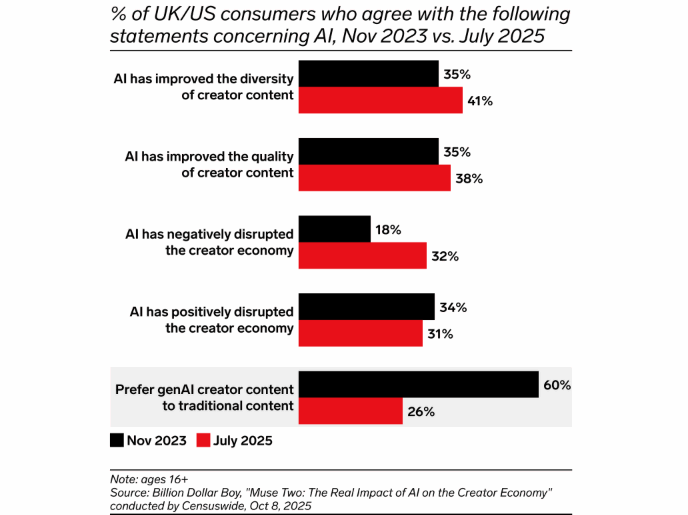
Key Stat: 32% of US and UK consumers say AI is negatively disrupting the creator economy, up from 18% in 2023, according to July 2025 data from Billion Dollar Boy.

Beyond this chart:

  • Gen Z’s AI tolerance depends on the use case. Some 54% prefer no AI involvement in creative work, but only 13% feel this way about shopping, according to an August 2025 Goldman Sachs survey.
  • Coca-Cola is betting big on AI ads despite the backlash. The brand released its second AI-generated holiday campaign this season, even though 31% of consumers say AI in ads makes them less likely to pick a brand, according to a July 2025 CivicScience survey.

Use this chart: Marketers can use this chart to look for a performance gap between human-first content and AI-assisted posts, and continuously track consumer sentiment around AI content.

By

Sourced from EMarketer

By Jada Jones,

No ad budget? Try this tool – all you need is a URL to get started.


ZDNET’s key takeaways

  • Pomelli is an experiment from Google Labs and Google DeepMind.
  • It can create AI-generated ad campaigns for your business.
  • It’s only available in English in select countries.

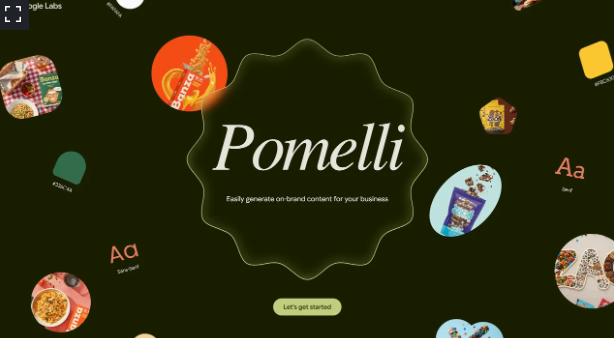
Finding the budget, time, and resources to properly advertise as a small-to-medium-sized business (SMB) can be a daunting task. Pomelli, an AI experiment from Google Labs in collaboration with Google DeepMind, provides AI marketing tools to assist small businesses in creating social media campaigns.

Pomelli uses AI to create campaigns that are unique to your business; all you need to do is upload your business website to begin. Google says Pomelli uses your business URL to create a “Business DNA” that analyses your website images to identify brand identity. The Business DNA profile includes tone of voice, colour palettes, fonts, and pictures. Pomelli can also generate logos, taglines, and brand values.

After you’ve created a Business DNA, Pomelli generates ad campaign ideas. In a blog post, Google says this feature eliminates the laborious process of brainstorming unique ad campaigns. If users have their own campaign ideas, they can enter them into Pomelli as a prompt.

Finally, Pomelli will generate marketing assets for social media, websites, and advertisements. These assets can be edited, allowing users to change images, headers, fonts, colour palettes, descriptions, and create a call to action.

Pomelli is available as a public beta experiment in the US, Australia, Canada, and New Zealand in English only.

Similar products to try

Pomelli joins several recent releases from major tech companies that aim to use AI for advertising, including an AI agent from Amazon that makes ads start to finish. Adobe’s AI Foundry, released earlier this month, aims to manage copyright concerns by letting companies fine-tune Adobe image and video generation models with their own IP for a more personalized output.

Feature Image Credit: Screenshot by Jada Jones/ZDNET

By Jada Jones,

Sourced from ZD Net