

Bottom Line: Understanding which pricing strategies cause buyers to progress through buying processes in a downturn still isn’t completely understood, but AI-based pricing can help remove blind spots in how pricing drives more sales during recessionary times.
The Struggle To Make Quota Is Real
Even in stable, healthy economic conditions, just 42% of sales professionals are making quota based on Salesforce’s State of Sales Report. Only 16% will be over 100% of quota in a given year. In an economic downturn, these numbers shrink, making the struggle very real to make quota in a recession. Here’s what it’s like to compete on pricing during a downturn:
- Go-to pricing strategies that worked in better economic times fall flat and don’t generate 10% of what they before, with B2B-based selling teams seeing this most often.
- Sales reps’ email in-boxes are either silent or filling up with requests for lower pricing, price protection, discounts, stock balancing or worse, returns.
- Many CEOs, senior management teams, and sales reps’ initial goodwill calls to the top 20% of customers offering their complete support are now turning into returned calls asking for price breaks and permanent re-negotiated pricing.
- Low-priced competitors surviving on single-digit margins continue their price wars, trying to keep production operating with orders while trimming staff.
- Videoconferences are keeping deals alive in B2B pipelines, but when it comes to pricing, deals often stall as CFOs and their staffs review every new expense, introducing new members of the buying process at the last minute.
CROs say that sales cycles vary by industry, with automotive being the slowest and medical device manufacturing, medical plastics including PPE production, and consumer packaged goods manufacturers being the fastest. Getting pricing right has never been more critical or challenging, according to the CROs I’ve had conference calls with. When asked where AI is making a difference, several said automating special pricing requests, taking the drudgery out of managing co-op reimbursements, or researching sales prospects using automated services. Generating fully-priced quotes faster than competitors is where AI is most paying off according to the CROs I spoke with and is contributing to more won deals.
5 Ways AI Can Help Close More Deals In A Downturn
It’s counterintuitive to consider a downturn as a good time to find new ways to improve margins with more effective pricing. But that’s just what distributors, discrete and process manufacturing CROs are looking to accomplish today. A 1% price increase can deliver a 22% increase in EBITDA margins and a 25% uplift in stock price according to McKinsey’s recent pricing research provided in the article, Pricing: Distributors’ most powerful value-creation lever. CROs are looking at when, how, and if they will increase prices on the most price-inelastic products they have. The logic behind prioritizing price-inelastic products is that selling on quality, availability, and build-to-order flexibility for customers buying these products is the goal to stabilize and grow margins. The smartest CROs I’ve met realize that engaging in price wars on price-inelastic products cost everyone margin, and no one wins. They’re also benchmarking their recovery efforts using EBITDA. The following graphic illustrates why pricing is so powerful, especially for distribution-centric businesses. Source: Pricing: Distributors’ most powerful value-creation lever. McKinsey & Company, September 16, 2019
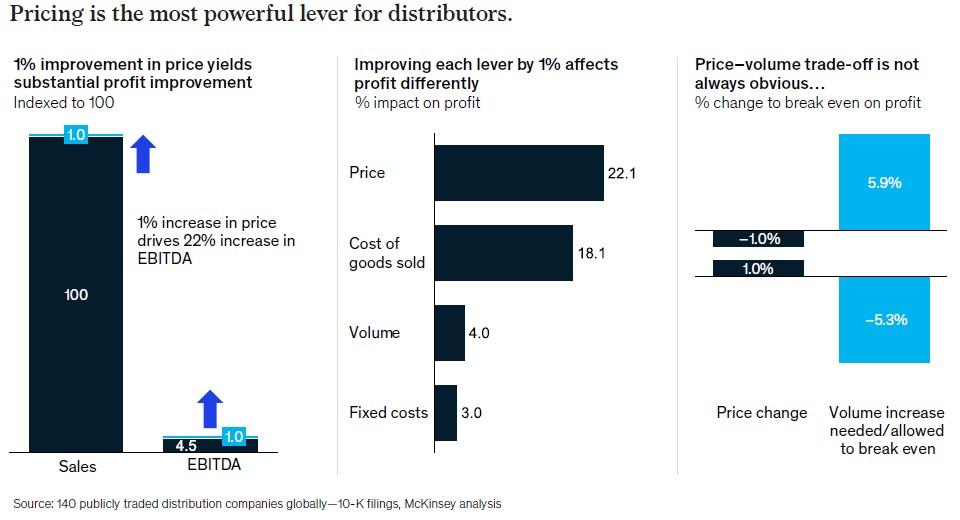
SOURCE: PRICING: DISTRIBUTORS’ MOST POWERFUL VALUE-CREATION LEVER. MCKINSEY & COMPANY, SEPTEMBER 16, 2019
The following are five of the many ways AI can help close more deals in a downturn:
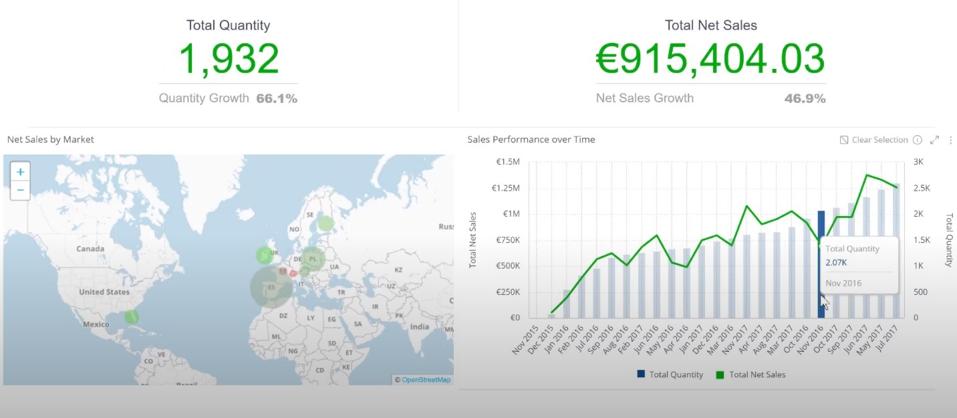
1. Knowing why specific pricing strategies succeed or fail on a deal-by-deal basis in a downturn often defies easy explanation, which is why commercial analytics are so important now. Combining traditional win/loss deal analysis and AI-based commercial analytics provides new insights into what’s working in a downturn. Commercial Analytics suites that are the most effective combine transactional analysis with product and service mix, price, and volume analysis. Vendavo’s approach to providing commercial analytics is noteworthy for its streamlined, intuitive interface design that supports drag-and-drop report customization, real-time configurable alerts, integration to the price management module, pricing localization, and more. The following is an example of how Vendavo’s PricePoint works:
ISTOCK
2. By using AI’s supervised and unsupervised machine learning algorithms to improve risk scoring, only pursue opportunities that show the greatest margin growth and least downside risk. CROs see the potential for AI to improve the cognitive functioning of sales, sales operations, and pricing working together to price and win the most profitable deals that have the least risk. The challenge is to take into account entirely new buying groups comprised of personas sales teams haven’t interacted with that much in the past. The pandemic and resulting downturn have completed changed group buying dynamics and introduced new risk factors into sales cycles not seen before. When the data is available, it’s possible to quantify the impact of risk factors on margin, price, and revenue gains.
3. Help sales teams be more effective by improving Deal Price Guidance with AI, reducing the heavy cognitive load many are dealing with as pricing changes happen several times a week, along with new bundles and promotions. No one is talking about how sales teams are struggling to make sense of the many pricing, promotional, and bundling offers that are increasing today. Chances are your sales teams are overwhelmed with pricing reports, new pricing updates, promotional programs, rebates and bundles as many are. In good economic times, sales reps are sending, on average, 27%, nearly a third of their week, on internal administrative activities according to a recent Forrester/SiriusDecisions study.
4. Tailoring up-sell and cross-sell recommendations for each customer using AI to define the optimal series of options and alternatives increases the average deal size and only presents the most buildable, profitable products to them. AI-based product recommendation engines integrated with CRM, e-Commerce, ERP, and pricing systems recommend the products and services that have the highest propensity of being purchased. The most advanced AI recommendation engines take into account previous buying behavior and buying patterns in making their recommendations.
5. Knowing how price, volume, and mix decisions over time impact sales across product lines, sales teams, and business units is another area where AI is helping to improve sales in this downturn. It’s common to find groups of Sales Analysts crunching this data using Excel, which is a time-consuming, iterative process that’s a perfect candidate for AI-based automation. Imagine if the many Sales Analysts crunching data had more time to analyze it and see why pricing decisions by product, region, business unit, and geography are outperforming median sales and profit levels? Finding the reasons why pricing decisions are working in a downturn is how every CRO I’ve known defines a recovery plan. Vendavo’s recently-announced Margin Bridge Analyzer is an example of how AI can be used to understand better what’s hidden in the thousands of Excel spreadsheets organizations use for tracking pricing effectiveness.
Conclusion
Achieving commercial excellence in a down economy needs to start by improving pricing effectiveness that delivers solid gains to EBITDA margins over time. Of the many ways AI is improving selling, pricing, and margin performance, the five key areas helping distributors, discrete and process manufacturers the most are discussed in this post. McKinsey finds that the best short-term/high-impact an organization can make is concentrating on pricing and promotions shown in the graphic below. Improving sales in a downturn is possible when AI is used to decipher the data this recent downturn is producing and find new margin opportunities fast.
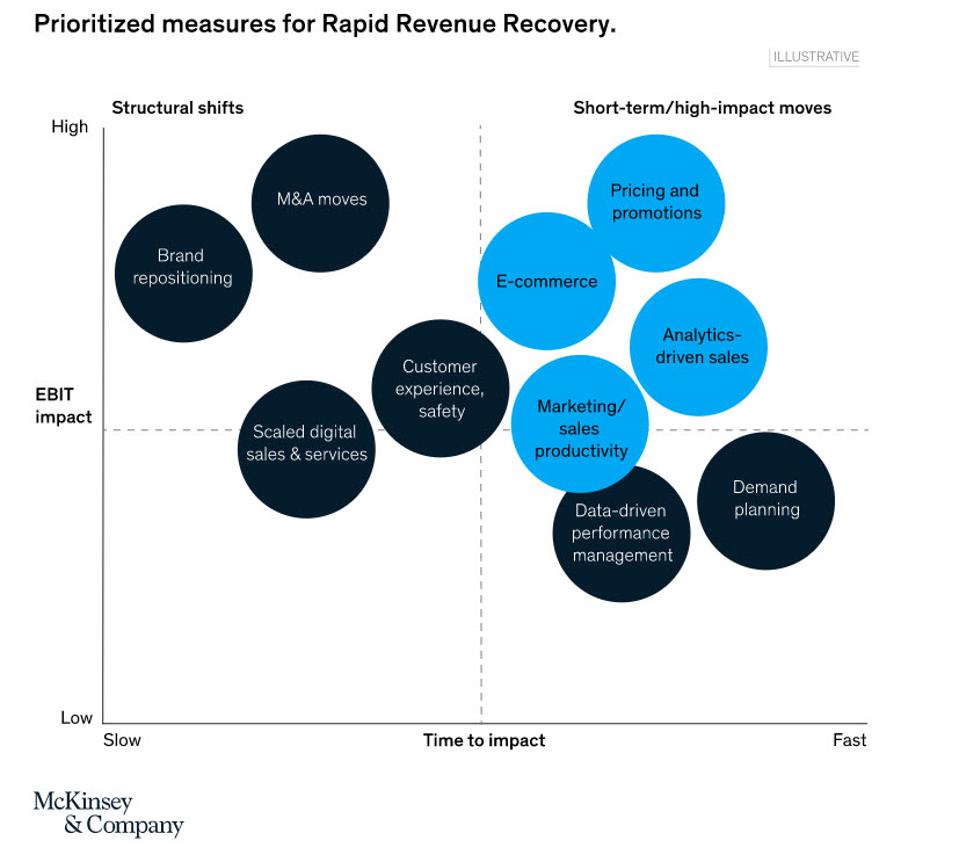
SOURCE: RAPID REVENUE RECOVERY: A ROAD MAP FOR POSTCOVID-19 GROWTH, MCKINSEY & COMPANY, MAY 7, 2020
Source: Rapid Revenue Recovery: A road map for postCOVID-19 growth, McKinsey & Company, May 7, 2020
Feature Image Credit: ISTOCK
By Louis Columbus
I am currently serving as Principal, IQMS, part of Dassault Systèmes. Previous positions include product management at Ingram Cloud, product marketing at iBASEt, Plex
…





By Starr Rhett Rocque