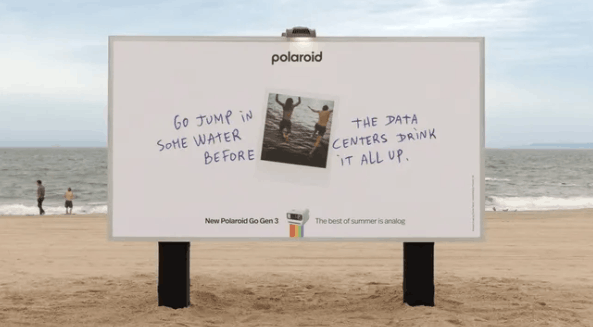
Polaroid has been on a mission to bring back the joy of analogue, embracing back-to-basics branding that reminds us to touch grass and unplug from the digital world. Continuing this trend, the brand’s latest campaign, ‘The best of Summer is Analog’ is perhaps the most provocative yet, promoting the launch of the Go Generation 3.
In an increasingly online world, Polaroid’s simple yet poignant anti-design campaign is a wonderful example of how stripped-back visuals and powerful copy can be just as effective as a gaudy ad campaign. Equal parts provocative and poignant, Polaroid’s new campaign is a refreshing voice among the digital noise.
(Image credit: Polaroid)
Taking a stand against over-digitisation, Polaroid’s campaign centres around a large billboard situated on Coney Island beach, reading “Go jump in some water before the data centers drink it all up”. With its handwritten-style font and candid Polaroid snap, the design has a signature human warmth that counteracts its subtly foreboding message.
The campaign will continue across New York, South Korea and London, with a station overtake at King’s Cross, alongside placements across Bethnal Green and Hackney. Celebrating the joys of an unplugged existence, statements including “You can’t bask in blue light”, “Dance like nobody is recording” encourage audiences to live in the moment, while playful sarcasm comes through with billboards bearing “What a glorious day to stare into various screens for hours on end”.
(Image credit: Polaroid)
“When we stopped asking ‘How do you make instant cameras appealing to Gen Z?’ and started asking ‘Why should Polaroid exist at all in an AI era?’ we knew we were on to something,” says Patricia Varella, creative director at Polaroid. “For Polaroid, the simple act of existing is already an act of rebellion. While our campaigns are provocative and challenge our relationship with technology, we’re not anti-digital. We know we have to live alongside it, but we’re deeply pro-human, and know what humanity gives us. And we know what we stand to lose if we don’t protect it. That’s a fight worth fighting.”
Natalie Fear is Creative Bloq’s staff writer. With an eye for trending topics and a passion for internet culture, she brings you the latest in art and design news. Natalie also runs Creative Bloq’s 5 Questions series, spotlighting diverse talent across the creative industries. Outside of work, she loves all things literature and music (although she’s partial to a spot of TikTok brain rot).
Do consumers have digital advertising and marketing fatigue? Recently there has been talk of a return to ‘analogue’ marketing, such as snail mail, brochures and face-to-face engagement, and away from digital marketing.
CMO asks marketing experts to discuss their views on the subject, and how they’re striving to strike a balance.
It’s challenging to find evidence consumers have digital fatigue. However, it has been proven many times over that the two single most impactful drivers of campaign effectiveness are reach and highly engaging creative.
Credit: Austereo
Nielsen data proves that getting the creative right and delivering this with maximum reach, can account for over 65 per cent of sales attribution. And reach is everything when it comes to the campaign resonating with as many new and existing audiences as possible.
It’s an incredibly important factor for brand growth and market share. This would point marketers towards high reaching, accredited channels such as TV, radio, video and audio streaming and out-of-home, with independently measured online used alongside these more traditional mass media.
A final consideration on reach and campaign effectiveness is targeting, which is becoming more accessible in all media. In stream addressable advertising in audio for example, delivers hyper targeted mass campaigns. These increasingly sophisticated main media targeting capabilities ensure wastage is minimised and frequency is capped.
Therefore, ‘cut through’ is delivered by impact from great work on a targeted, mass scale. It this approach that will set campaigns up to deliver business results.
Martin Wilkins
Marketing manager, The Tax Institute
One common mistake many marketers make in a digital-first environment is forgetting to listen to what their customers really want when it comes to authentic, personalised engagement.
Credit: The Tax Institute
We’ve listened to our members and stakeholders and understand digital marketing tactics, such as emails, ads and retargeting aren’t enough, in isolation, to build trust, create an emotional connection, and deliver the experience they expect from an institution such as ours.
For instance, events are a very big part of what we do to enhance engagement and offer our members more relevant and interactive experiences, where they can gain knowledge, insights and feel part of a broader community of like-minded people.
And while we do have a robust digital marketing engine that supports our marketing function, we’ll still invest in printed collateral such as brochures and booklets, and these have an educational look and feel which our audience base expects.
For example, at our upcoming Tax Summit in March, while we have invested heavily in digital marketing and inbound strategy, we also have prepared a traditional, printable brochure, as well as a comprehensive, printed prospectus.
In essence, we believe a strategic ‘hybrid model’ of traditional and digital marketing is appropriate for our particular audience segment. The challenge of course is finding a healthy balance between the two. This means our marketing team is constantly collaborating with internal and external stakeholders, to ensure our marketing mix remains agile, responsive, effective and relevant.
Zane Sabré
Co-founder and managing director, Maison de Sabré
When running a business, it’s important you’re reaching your customers via the channels they already use. Considering more than 73 per cent of households shopped online in 2018, it’s essential for businesses to be online as well.
As online shopping tools and platforms continue to grow more technically sophisticated, the way consumers make online purchases is continuously evolving, meaning the opportunities to reach specific audiences, at the right time, is also increasing.
Credit: Maison de sabre
Offline marketing, such as snail mail, brochures and street hawkers have become dated marketing strategies purely due to their limited reach in today’s digital age. They also limit the opportunity for accurate performance tracking, meaning it can be difficult to know if the time and money spent has paid off.
Credit: Red Havas
However, just as they had largely been deserted, it became apparent that it had left a significant amount of white space for many to capitalise on, representing a full cycle in generating cut-through. Analogue marketing transformed from the disrupted channel to the disruptor.
And it is all based on a simple truth: Physical marketing represents the ability to reflect a multi-sensory experience. Consumers crave the touch and even the smell of a fresh catalogue, with the buzz of rifling through to see the hottest new items to buy. Letters – which once had ‘bad PR’ around their speed of delivery – have had a resurgence. The emotional and nostalgic connection people receive from letters make this innately more personal than an e-mail.
So what was once seen as a one-way channel is now leveraging that very notion to maximise its effectiveness and create one-to-one, somewhat intimate, experiences with consumers to get messaging across. Analogue from its previous definition has now become a ‘progressive’ channel in some ways.
And in a world of personalisation and marketers’ constant quest for uniqueness, it is time to embrace the physical world once more. Except this time, with the helping hand of new technologies, they can explore how they maximise their available real estate in a different – and importantly, far more sustainable way than before to deliver an all-round win-win for marketer and consumer.