Tag

Apple

Browsing

By

  • Facebook and Google worked together to circumvent Apple’s privacy measures, 12 state attorneys general argued in an updated legal complaint from 2020.
  • Apple’s privacy tools have made it harder for other tech companies to pinpoint users for their ad auction model.
  • Regulators and other tech companies have targeted each other in a larger antitrust battle over user privacy, ad technology, and market dominance.

Google worked with Facebook to undermine Apple’s attempts to offer its users great privacy protections, 12 state attorneys general alleged in an update to an antitrust lawsuit against the search engine.

“The companies have been working together to improve Facebook’s ability to recognize users using browsers with blocked cookies, on Apple devices, and on Apple’s Safari Browser,” the amended complaint states. “Thereby circumventing one Big Tech company’s efforts to compete by offering users better privacy.”

The lawsuit was first filed by the attorneys general in December 2020, accusing Google of engaging in market collusion, and focused on claims that Facebook and Google had agreed to cooperate if their pact ever came under regulatory scrutiny.

The attorneys general also accused Facebook and Google of engaging in an illegal advertising deal, with the latter leveraging monopoly power over its adtech business by helping Facebook make better bids in ad auctions, which would make it easier for Facebook content to appear in more Google Ads.

“Facebook has long supported fair and transparent advertising auctions in which all bidders compete simultaneously, and the highest bidder wins,” a Facebook spokesperson said in an emailed statement. “Facebook’s non-exclusive bidding agreement with Google and the similar agreements we have with other bidding platforms, have helped to increase competition for ad placements.”

According to a discussion between Facebook employees in 2019, the complaint says, the company was having trouble matching users on Apple’s Safari browser. Google said Facebook’s user match rates were the same as other ad auction parties, but Facebook employees noted that the search company was willing to use Javascript to help Facebook better recognize those users.

The attorneys general claimed Facebook essentially baited Google into the deal, but Google denies the lawsuit’s claims.

A Google spokesperson told Insider: “Just because Attorney General Paxton asserts something doesn’t make it true. This lawsuit is riddled with inaccuracies. In reality, our advertising technologies help websites and apps fund their content, and enable small businesses to reach customers around the world. There is vigorous competition in online advertising, which has reduced ad tech fees, and expanded options for publishers and advertisers. We will strongly defend ourselves from his baseless claims in court.”

Apple in recent years has ramped up its user privacy efforts. In 2018, Apple installed privacy protection measures into its products, like Safari, which required websites to request tracking privileges from users and discard cookies if a site had not been visited in 30 days.

This summer, Apple rolled out its App Tracking Transparency tool, which prompts users to opt in or out of tracking on different applications — which largely impacted companies like Facebook. A Safari privacy report also detailed how websites track users.

The three companies have been at the center of several antitrust discussions, facing action from government regulators and each other. The Federal Trade Commission filed a lawsuit against Facebook claiming the company had monopolized power in the social networking market, but the suit was dismissed by a federal judge in June. Facebook was also reportedly preparing an antitrust lawsuit against Apple in regards to its App Store rules, saying Apple was stifling third-party app developers.

Congress also introduced five tech regulation bills in June, specifically directed at the “Big Four” — Facebook, Google, Apple, and Amazon. The bills would equip regulators with more methods to check tech firms from holding too much market power.

(This story has been updated to reflect in the third paragraph that it was Facebook and Google who reportedly agreed to cooperate, not Apple).

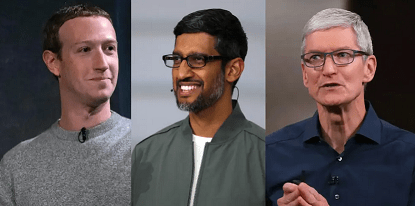
Feature Image Credit: Facebook CEO Mark Zuckerberg, Google CEO Sundar Pichai, and Apple CEO Tim Cook. Daniel Leal Olivas/WPA/AP, Justin Sullivan/Getty Images, & Karl Mondon/Digital First Media/The Mercury News/Getty Images

By

Sourced from Insider

By Jack Wallen

After a disastrous Pixel 6 pre-order experience, Jack Wallen shares his thoughts on what Google can learn from Apple.

The Pixel 6. The mere mention of the name gives me equal parts excitement and frustration. I haven’t been so excited for the release of a phone in a very long time, while simultaneously feeling as though I might forever shake my head at how a release went down. Google absolutely failed the release of its latest flagship phone, the Pixel 6, which should go down as a historic shame (at least within the realm of the tech sector), but will barely register as a blip on the radar of consumers around the world.

Let me explain.

The day of the Pixel 6 release was upon me. I watched the Google event because I had to report on the details of the new phone. During the event, I shifted between the Google speakers and the Play Store, hoping I could be one of the lucky ones to pre-order the exact Pixel 6 I wanted.

I don’t remember at which point it happened, but Google unlocked the metaphorical doors and allowed people to start pre-ordering the Pixel 6.

In theory.

What unfolded was an absolute disaster for Google.

I attempted to place the phone in my shopping cart, only to receive a 500 error. At first, I thought it was that Google hadn’t actually made the pre-orders officially available and I just needed to double down on my patience. But the error persisted.

And then morphed.

And then returned.

Eventually, the error vanished, only to reveal most of the devices had already sold out. I was able to finally place a 128Gb unlocked device (not the phone I was hoping for) in my shopping cart, only to receive yet another error.

I kept at it. No luck. I did some quick searching to discover the problem was global.

This was an embarrassment.

The company that is supposed to be the heart of everyone’s internet experience couldn’t deliver on a simple e-commerce solution on what should have been one of its biggest releases to date.

At some point, the wife and I had to run some errands. I asked her to drive, so I could continue trying to get Google to take my money (this time on my Pixel 5) yet the company persisted in failing to do so.

It wasn’t until I got home and tried again (some three hours after the event was over) that I was able to get the phone into the shopping cart and make the purchase.

Once this event was over, it gave me time to reflect on my experience and similar experiences with previous Pixel releases. A conclusion was drawn.

Apple absolutely kills Google on hardware releases. In fact, there’s absolutely no reason to compare the two.

Apple succeeds.

Google fails.

The “meh” approach

Apple spends the money necessary for proper marketing and is capable of getting consumers seriously hyped about a new product. It’s what Apple does best. And in this case, it’s astonishing how large the gap is.

During the lead-up to the Pixel 6 release, I think I saw maybe two commercials for the device, and those commercials were less than exciting (to say the least). Prior to the latest iPhone release, I couldn’t escape the advertising. It was everywhere. So prevalent was Apple’s iPhone hype, it had me wondering, “It’s been years since I had an iPhone. Is it time I try one again?”

On the contrary, Google’s Pixel 6 hype had me like, “Meh. Whatever. I’ll get one.”

That always seems to be Google’s approach to marketing hardware. “Meh, it’ll work.”

Thing is, the Pixel 6 looks to be one of the best phones on the market (once they start arriving in the hands of the users). So why the company approaches marketing with such a blasé attitude is beyond me.

Consider this: The Pixelbook Go is one of the finest Chromebooks on the market. Do you remember their marketing efforts? Neither do I. When the original Pixel Chromebook was released it was a work of technological art. It redefined mobile screens, keyboards and trackpads. Hype? Nada. Android 12 might well be the finest iteration of Google’s mobile platform ever released. PR? Scant.

If you’ve ever wondered why Android market share lags far behind iOS in the United States, it’s because of this very thing. You cannot turn your TV on without seeing iPhone ads or placement. They are everywhere. When was the last time you saw an Android phone in a television show?

I know it might seem silly, but product placement works … very well. People see celebrities using a product and they’ll feel inclined to want that product. You just don’t see celebs sporting Android. It’s all iOS all the time.

Apple knows this and uses it to its advantage. And when a new iPhone release is upon us, Apple inundates the media with incredibly effective advertisements that actually work to build hype around their product. Apple is the true master of marketing.

And until Google can bridge this gap, Android will continue to fall behind in the U.S. and Japanese markets (both markets where image is important). Google needs to markedly refine its lead-up to releases, shore up its e-commerce solution, and then hire a marketing team that understands precisely why Apple constantly succeeds (even when its product might be inferior to what Google has to offer).

If Google doesn’t fix this problem, it’ll have to accept that the Pixel market consists of previous Pixel owners and mobile device users who have grown tired of the iOS way of things. If that’s the company’s marketing plan, then all I have to say is, “Meh.”

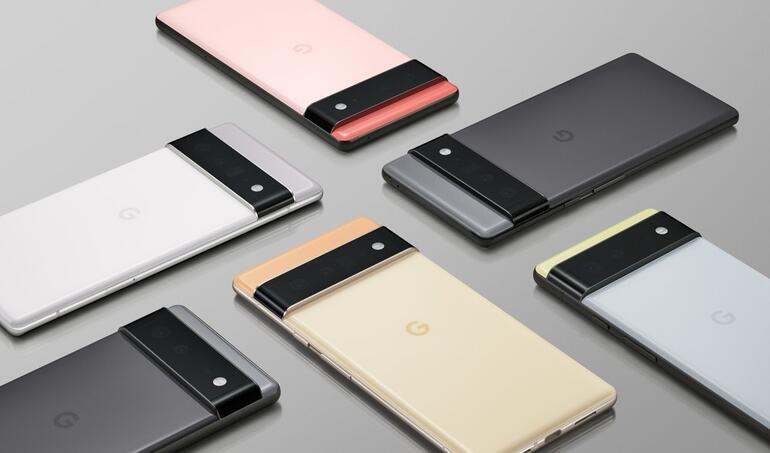
Feature Image Credit: Google Pixel 6, Image: Google

By Jack Wallen

Sourced from TechRepublic

By Cal Jeffrey

Some of that perceived growth could be from and overall market shrinkage on Apple devices

In context: Facebook predicted that there would be an “adocalypse” after Apple began enforcing its App Tracking Transparency earlier this year. I don’t know if that’s actually been the case since ad-supported apps still pound me with advertisements that seem no different than before. However, one analyst firm says Apple has greatly benefitted from the new ATT rules.

Apple’s on-device advertising platform, Search Ads, reserves spots at the top of App Store queries for developers to advertise their apps in relevant search results. For example, when searching for Telegram, a user may encounter a paid Twitter banner at the top of the results page (below).

The Financial Times notes that data from mobile marketing analysis firm Branch indicates Apple’s mobile advertising market share has tripled over the last year. Search Ads only held a measly 17 percent of the iPhone advertising market a year ago. As of last month, it commands a majority share of 58 percent, with most of that growth coming in the previous six months.

“It’s like Apple Search Ads has gone from playing in the minor leagues to winning the World Series in the span of half a year,” said Branch Product Marketing Head Alex Bauer.

Analyst group Evercore ISI predicts that Apple’s advertising platform is likely to clear $5 billion in fiscal year 2021. Researchers see growth over the next three years, reaching $20 billion annually.

“[Apple’s privacy push] significantly altered the landscape,” Evercore reported.

Apple began requiring developers to ask users for permission to gather and use their data for ad targeting earlier this year, after a nearly four month delay. As expected, many users have opted out of tracking on most apps. As a result, Facebook’s “Audience Network” and Google Ads were severely hobbled when users began denying permissions to track.

The Financial Times suggests that this mass exodus is what led to Apple’s ballooning advertising growth. However, this might be a bit overstated. For one, Apple’s Search Ads platform is an exclusive feature of the App Store and does not engage in first-party advertising within its apps.

Additionally, analyst Eric Seufert points out that the data Branch used in its analysis excludes gaming apps, a dominant subsector of the broader app market. He mentions that Branch only looked at “mobile app install ads spending and not mobile web ads spending,” which further skews the analysis. Also, the actual values used in the study are unknown.

“This data is presented as a percentage of total attributed installs,” Seufert said. “Given that these figures are percentages and not absolute values, the total market size of iOS installs is a relevant consideration which is omitted here, ie. if the total market shrank, Apple’s increased share might not be indicative of increased revenue or scale.”

Seufert said that without solid numbers, it is hard to put the study into context. In other words, Apple’s advertising growth came at least in part because of an overall market shrinkage caused by the new transparency rules.

Indeed, several mobile advertisers have adjusted their advertising budgets in favor of the Android platform. Analysts at Singular say that advertising between Android and iPhone markets was split nearly 50/50 toward the beginning of 2021. As of June, advertising dollars spent now favor Android 70.3 percent to 29.7 percent.

So, it is hard to determine how much of Search Ads tripling go market share was actual growth without knowing the absolute values used to calculate those percentages.

By Cal Jeffrey

Sourced from TECHSPOT

By José Adorno,

With Apple’s App Tracking Transparency having been available for several months now, advertisers have begun shifting their spending patterns. A new report indicates that the prices for mobile ads targeting iOS users have dropped, while prices targeting Android users have increased.

When Apple released iOS 14.5 with the new App Tracking Transparency feature, a report by the Post-IDFA Alliance showed that two weeks after that, advertisers have started spending more on the Android platform.

Now, according to a report by the Wall Street Journal, “the prices for mobile ads directed at iOS users have fallen, while ad price has risen for advertisers seeking to target Android users.”

Digital advertisers say they have lost much of the granular data that made mobile ads on iOS devices effective and justified their prices. In recent months, ad-buyers have deployed their iOS ad spending in much less targeted ways than were previously possible, marketers and ad-tech companies say.

Digital-ad agency Tinuiti Inc., for example, says its Facebook clients went from year-over-year spend growth of 46% for Android users in May to 64% in June. Its iOS clients, on the other hand, saw a corresponding slowdown from 42% growth in May to 25% in June.

Research director Andy Taylor explained that “Android ad prices are now about 30% higher than ad prices for iOS users.” The report also shows many advertisers have shifted their spending on Facebook’s owned-and-operated app as well.

“Instagram and its namesake social network, which form the core of its business, Mr. Taylor said. Spending to reach iOS users on Instagram and Facebook also slid since Apple’s change, he said, but by less than on third-party apps.

Since the switch, Facebook has significantly altered its Audience Network, which has relied heavily on device identifiers. The company told advertisers in an email last week that it was adding the capability to place contextual ads—which consider factors like time of day and the app’s content—as a way to continue providing relevant ads when certain identifiers aren’t available.

In May, Flury Analytics data provided the unsurprising evidence that vanishingly few Americans were choosing to allow apps to track them, although it has risen from 4% at that time to 9% now.

The ad industry was afraid that users would largely opt out as a matter of course, and this data does suggest that’s the case.

9to5Mac reader poll also showed that almost nobody is opting -in for App Tracking with all apps, while a fifth of readers are letting trusted apps track them while blocking others.

BY José Adorno

Sourced from 9 to 5Mac

By ,

After rolling out beta releases for four months between the release of iOS 14.4 and iOS 14.5, Apple stepped on the gas with its latest update, launching iOS 14.6 to the general public just four weeks after iOS 14.5 arrived. Although iOS 14.6 is a significantly smaller update than iOS 14.5 — which added App Transparency Tracking, Unlock with Apple Watch, support for PS5 and Xbox Series X controllers, and more — there are still plenty of reasons to update right away.

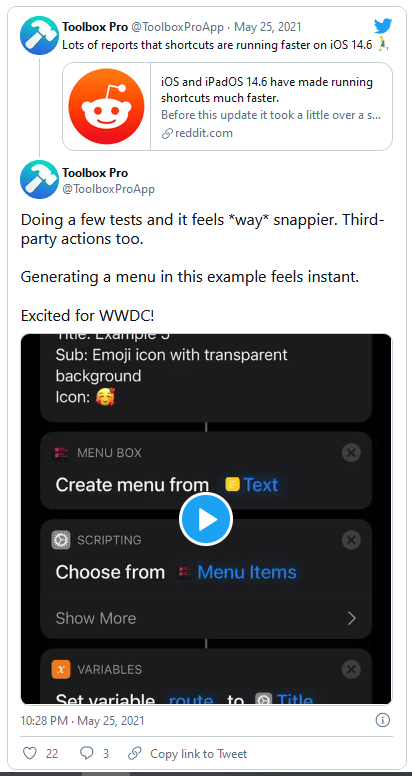
Of course, there are obvious reasons, such as security updates and bug fixes that could keep your data safe from attackers, but we are also discovering new reasons to install iOS 14.6 as iPhone users get their hands on the software. As spotted by 9to5Mac, some users on Twitter and Reddit claim that actions in the Shortcuts app are running faster on the latest version of iOS.

“Before this update [iOS 14.6], it took a little over a second to run the “Night Mode” shortcut I made that contains only seven different simple Settings actions,” said Reddit user jasonefmonk on Tuesday. “I’ve noticed after the update that it now runs in approximately 1/4 second! It is very noticeable and a welcome fix for something that should be quite quick.”

Another user in the thread claimed that their 700 action shortcut used to take 30 seconds to run on iOS 14.5 and earlier, but now completes in just 13 seconds. Others saw more modest gains, but pretty much everyone who tested their shortcuts seemed to confirm the speed boost.

In order to further corroborate these claims, 9to5Mac did tests of its own and saw improvements on both iOS 14.6 and the first iOS 14.7 beta, which began rolling out to developers and public beta testers last week. That said, the site only began to notice significant gains on shortcuts that involved “dozens or hundreds of actions.” In one test, 9to5Mac ran a shortcut with 380 actions. On one iPhone running iOS 14.5.1, the shortcut completed in 8 seconds, but on another with iOS 14.6, it took 4 seconds.

Apple usually highlights all of the biggest changes in the release notes for its software updates, but for whatever reason, faster shortcuts didn’t make the cut for the iOS 14.6 release notes. Nevertheless, all evidence points to shortcuts being faster, so if you’re an avid shortcut user, update today.

Of course, you really shouldn’t need any additional reasons to update your iPhone, because Apple released a security notice about iOS 14.6 on Monday covering the dozens of security flaws addressed by the update. Spend just a minute or two scrolling through all of the dangerous exploits that Apple patched in iOS 14.6 and iPadOS 14.6, and I can all but guarantee you that you will be installing the update on every device you own as quickly as possible.

By ,

Jacob started covering video games and technology in college as a hobby, but it quickly became clear to him that this was what he wanted to do for a living. He currently resides in New York writing for BGR. His previously published work can be found on TechHive, VentureBeat and Game Rant.

Sourced from BGR

By Margaret Taylor.

Apple’s iOS 14.5 update has triggered an unstoppable collapse in Facebook’s ability to collect user data

It is not unusual for the bosses of Apple and Facebook to be at loggerheads with each other over privacy. Back in 2018 Facebook chief executive Mark Zuckerberg accused his Apple counterpart Tim Cook of being “extremely glib” for making scathing remarks about Facebook’s involvement in the Cambridge Analytica scandal. Weeks later Apple introduced privacy controls that hampered Facebook’s ability to collect user data via Apple devices.

Things moved up a notch at the end of last year after Apple revealed that app-tracking transparency would be installed as part of its latest system update. Until iOS 14.5 came along, apps like Facebook could automatically track what people were looking at on their phones and sell targeted ad space accordingly. The update was designed so users were asked their permission for the tracking to happen first.

Facebook responded to the move by taking out full-page ads in the New York Times, Washington Post and Wall Street Journal accusing Apple of posing a threat to the “10 million businesses [who] use our advertising tools each month to find new customers, hire employees and engage with their communities”. Cook retaliated by tweeting that users “should have the choice over the data that is being collected about them and how it’s used”.

It may have looked like little more than a war of words between two rivals, but Facebook – which warned of the “headwind” posed by iOS 14.5 in its 2020 accounts – was right to be concerned. Since the update went live last month iPhone owners have been opting out of data tracking in their droves. According to Flurry Analytics, 85 per cent of worldwide users clicked ‘ask app not to track’ when prompted, with the proportion rising to 94 per cent in the US. Apple did not respond to requests to comment.

For an organisation like Facebook, whose entire business model is based around collecting, analysing, selling on and profiting from data about its users’ likes and dislikes, such numbers could be devastating.

“It’s a huge blow for Facebook,” says Jake Moore, cybersecurity specialist at ESET UK. “They have major issues when another huge tech firm such as Apple comes along and says privacy is important. When Apple is asking users not to track – and that language is important – if anything it’s sticking a couple of fingers up at Facebook.”

This strategy is important for a business that wants to position itself as being above the privacy concerns that have dogged the technology industry. Lawyer and data privacy specialist Heather Anson, director of Anson Evaluate, says that for a company that can make money from its hardware regardless of regulatory constraints, it’s reasonably easy for Apple to score points over its rivals by doing that. “Apple is very good at using these types of issues to make itself look better,” she says. “There was a case in San Bernardino where a guy shot his co-workers and the FBI wanted to get the log-ins to his iPhone. Apple said no because it would weaken security, but that was technically more of a publicity stunt than something that was legally binding, they could have handed it over.”

By taking this stance now, Anson believes, Apple is pre-empting strict data protection laws that have been mooted in US states including New York and Virginia as well as in the European Union. As with the EU’s Draft Digital Services Act, the US proposals, which are modelled on an existing Californian law, would require user permission to be given for data to be used. It is a carbon copy of what iOS 14.5 has already introduced.

While that puts Apple ahead of the curve, it creates an even bigger problem for Facebook. That is in part because it will further restrict its ability to target ads to individual users, but also because the more these rule changes are spoken about the more it shines a spotlight on exactly what it is Facebook does with user data.

Facebook still makes billions from advertising. But the world in which it operates is changing fast. How Facebook attempts to keep pace will be telling. Depending on take-up, Facebook’s digital currency diem, which will be piloted later this year, could also create masses of data due to the way digital transactions are logged by the technology that powers them. Meanwhile, WhatsApp, which Facebook acquired in 2014, is to start gradually switching off functionality for users who refuse to let it share information with Facebook about the businesses they have communicated with.

Even taken together, they are likely to be a poor substitute for what Facebook will lose if the iOS 14.5 opt-outs continue apace. For now, Facebook is continuing to frame the advent of the Apple update as an affront to the smaller businesses that benefit from its platform. The impact on its advertising revenues will, it says, “be much less than what will befall small businesses” that rely on its algorithms to promote their wares. “Many small businesses won’t grow, continue hiring or even survive as a result of an impact of this magnitude,” it says.

Similar to Apple’s strategy of proclaiming itself a privacy champion, it is a smart tactic for Facebook to put itself on the side of the little guy, particularly as laws such as the EU Digital Services Act remain in their infancy. “The EU act will be lobbied and debated over and won’t be passed for another couple of years then it will be another couple more before it comes in,” says Anson. “By that time Facebook will have done what it needs to do to comply and it will have bullied the EU by lobbying to get something it likes.”

It’s clear that Facebook needs that time to come up with a strategy that will allow it to thrive without unfettered access to data at its core. David Wehner, the social media giant’s chief financial officer, wrote in the company’s fourth quarter 2020 earnings report that “over time, we hope to help businesses by providing more on-site conversion opportunities through initiatives like shops, and also click to messaging ads”. A blog posted on Facebook’s corporate site last month says it is “important to acknowledge that the ways that digital advertising collects and uses data will evolve” and that Facebook is “investing in new approaches to privacy-enhancing technology and building a personalised advertising ecosystem that relies on less data”.

Less data is not no data, though. The problem Facebook now faces is that as time passes and developments like iOS 14.5 make users more aware of how their data is used to manipulate them they might not want to give any of it up at all.

“Over the next five to ten years people will start to learn the importance of privacy and keeping their data,” says Moore. “Facebook’s business model is all about tracking – they are not a social media company, they are an advertising company and if they can track you they can make more money. Apple has got nothing to worry about, but Facebook could be gone in ten years.”

By Margaret Taylor

Sourced from WIRED

By Jason Aten

Apple put the M1 in the new iPad Pro and it’s ridiculously good.

I’ve been such a big fan of my 2018 11-inch Pad Pro that I couldn’t find a reason to upgrade last year when Apple added a slightly better processor and a LiDAR sensor. If you don’t know what a LiDAR sensor is, well, then you understand why it wasn’t something I felt like I just had to have.

I do love my iPad Pro, however, and it’s often my preferred device for work for a lot of reasons. It was already the most powerful tablet you could get, and it was faster and more powerful than most laptops you could buy, even with a three-year-old processor inside.

null inline image

Courtesy company

Now, Apple just made it even better, and not by a little. In fact, Apple made the new iPad Pro so good, it’s hard not to think it’s just showing off at this point. Here are just a few of the reasons why:

M1 Chip

You only need to know one thing about Apple’s M1 processor–it’s one of the most powerful and efficient chips you can get inside a computer. Except, now you can also get it inside an iPad. That means that the iPad Pro is more powerful than almost any PC you can buy that isn’t a highly customized setup that will also certainly be power-hungry and expensive.

Apple has no business putting this chip in a tablet. The only reason it did is simply because it could. The M1 isn’t just powerful, it’s also extremely efficient, which means it can run off an iPad’s battery and still handle anything you can throw at it. It also can run just fine in the small enclosure of an iPad, without a fan.

null inline image

Courtesy company

It is fair to point out that Apple didn’t talk much about battery life. It only described it as “all-day,” which is certainly open to interpretation. Still, I’ve been using a MacBook Air with an M1 for months, and I regularly make it through a day of working unplugged with 60 percent or more battery life remaining. That’s just showing off.

Liquid Retina XDR Display

The display got a big upgrade as well. Apple is using MiniLED technology, which it calls Liquid Retina XDR, though it will only be available on the 12.9-inch model. Apple says it uses 10,000 LEDs, grouped in 2,500 local dimming zones, in order to provide “a stunning visual experience that reflects what can be seen in the real world by capturing the brightest highlights and the most subtle details in even the darkest images.”

Thunderbolt

This might be the most absurd thing Apple added to the 2021 iPad Pro, and I don’t mean that in a bad way. The Thunderbolt port gives the iPad Pro up to 40Gb/s of bandwidth. That’s enough to support a 6K HDR display, and 10GB Ethernet, meaning that the iPad Pro is capable of handling almost any pro workflow. You can also connect it to a Thunderbolt dock to give the iPad Pro even more connectivity.

That makes me optimistic that we may see some very interesting changes to iPadOS at Apple’s upcoming Worldwide Developers Conference in June. Adding better windowing support would make using an iPad with an external display that much more useful, especially with the ability to connect external drives and other peripherals via Thunderbolt.

Feature Image Credit: Getty Images

By Jason Aten

@jasonaten

Sourced from Inc.

By

– Apps need your permission to track activity across different apps in iOS 14.5, iPadOS 14.5, and tvOS 14.5

(Pocket-lint) – Apps that track you across other apps and websites on iOS, iPadOS and tvOS will now have to ask your express permission to do so. The move marks a shift in how apps can operate on Apple’s mobile operating systems and how apps can target you

All apps now have to detail what they track on the App Store (in a section called App Privacy). If they haven’t submitted details for this yet, they will be mandated to do so when they next submit an app update to Apple.

This is coming as part of the new iOS/iPadOS/tvOS 14.5 update. Apps have been able to ask for this permission in earlier versions of iOS 14, but now it will be mandatory.

Apple calls this App Tracking Transparency and it means users will now have to opt into their devices giving over information on their use. You’ll see a pop-up message like this when loading apps after they’ve been updated.

Apple

The new requirement has stoked the ire of some, especially Facebook, who rely on tracking to target ads. Your Apple device tracks what you do in apps using an anonymised Identifier for Advertisers (IDFA) – this means that Facebook can serve you ads for the item you’ve just searched for on eBay.

Google has a similar thing called Google Advertising ID or GAID. These essentially tie your activity together in a way that means you can’t be personally identified. They make ads more effective for advertisers but should – in theory – also make them more relevant to you. Facebook argues tracking gives you a “better ads experience” but it has already warned investors that Apple’s move could hurt its advertising business.

App Tracking Transparency means apps now have to ask for permission to use that shared information. Of course, you could still be targeted by the information you provide such as searches or previous purchases within a particular app – so you’ll likely still see ads personalised for you.

Apple

Apps can’t circumvent having to ask for this permission according to App Store rules, nor restrict app functionality depending on whether you’ve given permission to track. Equally, they’re not able to pass on other information, such as an email address or username to others.

Apple’s own apps will also comply with these rules, but as per Apple’s privacy policies, it doesn’t share information it collects about you with other companies.

Users have previously been able to access per-app Privacy settings, but have not been asked permission. You can also globally disable tracking for a period should you wish to.

How to disable ad tracking on your iOS/iPadOS device, either per app or globally.

Go to Settings > Privacy > Tracking. You can then see a list of apps you have enabled for tracking and toggle any one of them off.

Apple

At the top is a global setting – you can turn off Allow Apps to Request to Track. This means you won’t see any pop-ups from apps and will stop any new apps from asking for permission to track.

If you have already given permission to some apps to track you, you’ll then be asked whether you want to continue to allow them to track or stop them from that point onwards.

Apple

By

Sourced from Pocket-lint

By Jason Aten

Colour is back on the iMac.

Feature Image Credit: Getty

By Jason Aten

@jasonaten

Sourced from Inc.

By Jason Aten

It isn’t about tracking, but about giving you a choice.

Feature Image Credit: Tim Cook. Getty Images

By Jason Aten

Sourced from Inc.