Tag

Branding

Browsing

As a nation, we came together for a few brief hours. We set aside our political, cultural, economic, and demographic differences, and although we were sharply divided over who we wanted to win, we applauded the process wholeheartedly. Together we laughed, we cried, we cheered, and we feared.

Of course, I am talking about the most recent Super Bowl. Not the game, but the commercials.

The Super Bowl’s commercials are anticipated as much as the game itself. The super-expensive, highly condensed stories are designed to evoke a strong emotional reaction, which is supposed to make viewers feel favorably about the brand being advertised, and ultimately, purchase those products.

But does a television commercial that makes people laugh or cry actually help a company sell more products? Let’s dive in and find out.

Emotional advertising aims to influence behaviors and evoke responses. According to a 2009 study titled “Emotions, Attitudes and Memorability Associated with TV Commercials,” as consumers are exposed to these messages their feelings about products or brands shift.

“Advertisers try to create positive attitudes by evoking a favorable or positive emotional state in the consumer,” according to the study’s authors. The researchers concluded consumers prefer advertisements that elicit a positive feeling such as love, joy, or nostalgia. They also found advertisements that evoke emotions are more likely to be recalled.

In an article in Fast Company titled “The Rise Of Sadvertising: Why Brands Are Determined To Make You Cry,” the author wrote marketers believe consumer decision-making is driven by the unconscious instead of logic, because “most of the business of life happens through our emotions,” and “a good cry” has become “an engine of social sharing.”

Ultimately, any advertisement will be judged on whether it motivates consumers to purchase the product being advertised. So why is appealing to the heart and not the head in advertising so effective?

It is interesting to note the word “motivation” and “emotion” share the same Latin root, movere, which means to move. By soliciting an emotional response, consumers are unconsciously moved toward taking action.

In other words, feeling, not thinking, is key to advertising success.

Advertising executive and author Douglas Van Praet believed we don’t think our way to logical solutions; we feel our way to reason. “Emotions, not words, are the universal language of humans,” he wrote

Van Praet had a hand in creating the “Darth Vader” commercial for Volkswagen, which elicited such a strong emotional response that it became among the most shared Super Bowl ads ever, amassing a staggering 56 million views on YouTube and earning a reported 6.8 billion impressions worldwide and more than $100 million in earned media.

Not coincidently, it helped VW achieve its best market share in thirty years.

In an article in Psychology Today, author Peter Noel Murray, Ph.D., wrote, “Most people believe the choices they make result from a rational analysis of available alternatives. In reality, however, emotions greatly influence and, in many cases, even determine our decisions.”

Furthermore, research indicates consumers’ emotional response to an ad has a far greater influence on their intent to buy a product than does the ad content—by a factor of three to one for television commercials and two to one for print ads. This “emotional branding” helps differentiate companies from their competitors and creates deep intrinsic relationships between brands and consumers.

The concept was summarized best by a fictional character. In the television program Mad Men, advertising executive Don Draper talked about how a product can create a deep bond with consumers by using one of the most powerful emotions: nostalgia. “It’s delicate, but potent,” he said. “In Greek, nostalgia literally means ‘the pain from an old wound.’ It’s a twinge in your heart far more powerful than memory alone. It takes us to a place where we ache to go again; to a place where we know we are loved.”

And love, after all, is the most powerful emotion of all.

Feature Image Credit: Image: Sandor Szuhoterin / Shutterstock.com

By Randall Huft.

Randall Huft is president and creative director at Innovation Agency, an advertising, branding, and public relations firm specializing in the cannabis industry. While working with blue-chip companies including AT&T, United Airlines, IBM, Walgreens, American Express, Toyota, and Disney, he discovered what works, what doesn’t, and how to gain market share.

Sourced from mg Magazine

By Nicholas Morpus

The world today moves at a breakneck pace, so what worked for your brand one day might not work the next. A brand audit will give you the insights that you need to stay on top of your market demands.

hen Toyota created Scion, their brand position was to sell these cheaper and smaller vehicles to younger buyers. However, after a couple years into the brand’s lifespan, Toyota realized that their Scion vehicles were more sought after by older buyers despite the intentions of their marketing plan.

This was the perfect example for the need of a brand audit. Building a brand is difficult and will require many revisions as you learn more about your target audience. Obviously, you don’t want to needlessly spend money when it isn’t producing the results you were hoping for.

That’s just marketing 101. That’s why a brand audit will give you the opportunity to realign your branding and marketing tactics to where they’re most needed.

Overview: What is a brand audit?

Simply put, a brand audit is an in-depth look into your business’s current market position and effectiveness when juxtaposed against the competition. It is an evaluation of your efforts in the eyes of your audience for the purposes of pointing out shortcomings, inconsistencies, and gaps in your market strategy.

Should your small business perform a brand audit?

Yes. It doesn’t get any simpler than that. Even if your business is experiencing tons of success, there is always room for improvement. In fact, when you’re succeeding is a fantastic time to perform a brand analysis in order to ensure that you’re not getting comfortable while potential competitors are addressing new market demands.

If that hasn’t convinced you, here are three key benefits of performing a brand audit:

1. Discover flaws in your brand

A thorough brand audit is likely to turn up all sorts of inconsistencies and issues in market targeting that are affecting your sales, website conversions, page views, or any other metric of success you’re currently tracking.

At worst, your branding might be way off the mark, and at best, you’re only dealing with minor perception issues. Either way, a brand audit will bring these problems to your attention.

2. Pave the way for improvement

Once you understand a problem, it is much easier to contemplate a solution. Brand audits give you the opportunity to fix the issues that are dragging down the perception of your brand and provide you with honest feedback on what your target audience is looking for.

3. Provide insights for future development

Brand audits not only highlight pain points in your brand perception but also open the door for new ideas and developments in your business efforts. Perhaps the brand assessment will inspire a new product, service, or idea based on the feedback you received from your target audience.

How to perform a brand audit

Now that you understand the invaluable benefits of this process, here’s a simple five-step brand audit checklist to help walk you through the process.

Step 1: Conduct an audience survey

Starting out, this is where you’ll probably have to invest some money into auditing your brand. While some of the steps in this list require you to make some best-guess efforts to narrow your branding focus, an audience survey is the perfect way to get a direct insight into the mind of your market.

In order to net the best results, it’s best to hire an outside company to conduct market research for you.

Tips for conducting an audience survey

There is nothing more valuable in business than understanding your audience. Without these insights, you are running into the market blind and will inevitably waste tons of money and time. Here are a few tips for conducting an audience survey that’ll benefit your brand targeting efforts.

  • Know your target market: Surveys are only useful if they’re conducted on your target audience. If you’re looking to sell a product to customers in the United States between the ages of 22 and 45, then it does you no good to include Australian teenagers in the data pool.
  • Aim for a large sample group: Surveys are only useful when the group is large enough to eliminate the wide swinging results of potential outliers. Make sure your survey sample size is large enough to provide meaningful results.

Step 2: Audit your analytics

Google Analytics is an extremely powerful tool that you can use to understand your business website traffic once you know how to harness its full potential.

First off, your traffic analysis will give you an idea of which countries are most likely to visit your website, which sources are driving traffic to your website (Google searches, social media, etc.), and the quality of that traffic (are they converting?).

Tips for auditing your analytics

There are so many tips for using Google Analytics that I could write an entire guide on the subject. However, these are the two most important tips for getting the most out of your website marketing metrics while conducting a brand audit.

  • Take your bounce rate seriously: Sometimes it’s not your product or service but actually your website itself that’s causing the problem. Your bounce rate (the metric determined by those who visit your site and leave immediately) is affected by all kinds of factors. Make sure your page load times are quick, your landing pages are relevant, and your website content is compelling in order to combat high bounce rates.
  • The right market: Your website analytics will tell you where your traffic is coming from, including the geographic location of your traffic. If you’re seeing traffic spikes from countries you aren’t looking to market to, then there is obviously an issue you have to address. Traffic spikes are useless if it isn’t quality traffic from a source you hope to convert.

Step 3: Audit your social media

Not only is social media a godsend for small business marketing, it’s also treasure trove for consumer research. Performing a social media audit will give you an insight into not only your likes, shares, and referrals, but also audience insights such as age ranges and gender ratios.

This information will help you further narrow down where you should increase your efforts and where they are wasted.

If you’re interested in more information, you can read our detailed guide for auditing your social media accounts that’ll walk you through each step.

Tips for auditing your social media accounts

If this is your first time ever auditing your social media accounts, here are a few tips to help you smooth out the process.

  • Use an audit spreadsheet: Conducting a social media or brand audit isn’t a one-time deal, so it’s important to maintain a record of your progress. Here’s an audit spreadsheet template that’ll help you keep track of all of your social media marketing KPIs for comparisons during each regular audit session. This data will help you build out your future social media content calendar tailored to your audience insights.
  • Where to find the data: While it is possible to gather all of this information individually from each platform’s proprietary marketing analytics tools, for the sake of convenience, a social media management tool is perfect for tracking your metrics. In fact, some tools like Sprout Social or Hootsuite are capable of gathering data that Facebook or Twitter don’t usually track.

Step 4: Evaluate your competition

If your business is dealing with any direct competitors and you see them succeeding where you’re falling behind, it’s time to evaluate what they’re doing differently. The great thing about competition is that it not only incentives you to improve, but also opens the door to new ideas that you would’ve never thought of otherwise.

Tips for evaluating your competition

While you can hire a professional market intelligence expert to evaluate your competition, it’s entirely possible to learn quite a lot through some research of your own. Here are a couple tips to get you started.

  • Find the comparative advantage: Evaluate how your competition markets to their audience, how they treat their customers, what services they provide, and how their website functions. Try to find what they’re better at and make improvements based on those advantages.
  • Check their SEO: There are lots of analysis tools out there, like Brightedge, SEMRush, and Ahrefs, that analyze your competition for organic keywords. Use one of these tools to assess the SEO of your competitor’s website to see what keywords they are targeting and how to maximize your website content based on their actions.

Step 5: Make adjustments to your brand

Now that you understand all of the issues plaguing your brand, be it audience targeting, website function, customer service, or any combination of shortcomings, it’s time to take those lessons and make improvements.

But once you’ve made these improvements, your work isn’t over. It’s important for you to monitor these changes and take note of any fluctuations in business, web traffic, and customer response.

Tips for making adjustments

This step isn’t as simple as making the changes to your brand and forgetting them. Here are a couple tips for making the most of your efforts.

  • Consider running your potential changes through focus groups: You started off this process with consumer input, and it’s best to end it the same way. A focus group is the perfect way to get feedback on your changes and make the final tweaks before implementing your brand shift.
  • A/B test every change: Once you’ve made the adjustments, it’s important to A/B test all of your core metrics to see if there are any improvements to your business, website traffic, etc.

The Blueprint will help you get your branding and marketing on track

Success in business doesn’t begin and end with a comprehensive brand audit. There’s lots more you’ll have to do to ensure your marketing efforts are reaching the right audience, and we at The Blueprint want to help you supercharge your business.

By Nicholas Morpus

Sourced from the blueprint

By Christina Crawley.

More than ever, teams need to be able to rely on digital tools and strategies to work together. As remote and geographically dispersed teams increase, the benefits of in-person collaboration need to find their place within the digital realm. Various combinations of tools support this approach; however, smart use of internal email marketing is key to keeping employees focused and informed so that they can do their jobs effectively.

Email marketing generally focuses on external audiences. It aims to encourage individuals to click, engage or buy. Its approaches are, however, still very much relevant for internal teams, both large and small.

As you look to either strengthen or launch your internal email outreach to your digital teams, here are a number of trusted approaches that you’ll want to be sure to include.

1. Create (and stick to) a schedule.

Employees can more easily retain info that they both recognize and expect in their inboxes. A companywide or teamwide update email that comes in unexpectedly may leave individuals confused as to how they are supposed to respond or move forward. Consistent, expected email updates provide structure and a sense of routine that they can quickly apply to their work.

Some updates may be more relevant, appreciated or acted upon than others, but their consistent frequency will make them far more likely to be applied to teams’ everyday work. Consistency creates habit, which then becomes part of your employees’ working routines.

2. Apply formatting and branding.

While it may seem like internal audiences don’t need branding and formatting, a visually clear structure goes a long way in getting employees’ attention and engagement. Your staff’s inboxes are just as packed with incoming mail as your external audiences’ are. Visual cues and flags allow your internal teams to effectively understand and scan what you are sending their way.

Deliberate formatting, from familiar subject lines to consistent body topic blocks, allows staff to quickly scan what they’ve received and pick out what applies to them. For teams that are waiting for a certain piece of information, or are focused on other emergencies, this formatting allows them to quickly grab what they need and move on.

Branding allows your staff to immediately recognize and differentiate email communications, such as a new staff announcement versus a product launch. It makes it easier to know what attention is expected of them, and how it affects what they are doing.

Email templates that incorporate branding and formatting for different types of messages can help your messages stand out from regular, nonformatted internal emails.

3. Personalize your content.

Whether you are communicating to thousands of employees worldwide or a small team locally, being aware of your audience segments and what you need from them helps to avoid your emails being ignored. Create content that is relevant to those who receive it. Otherwise, it risks being seen as unimportant and ignored.

Personalization ranges from individual departments to specific roles. For example, the length and detail of your content may be short when providing a brief companywide update on an issue, compared to a small team update on the same issue that dives deeper and includes tasks and action items. Calls to action (CTAs) that you lay out may also differ from one group to another — for example, including buttons and/or links to take action outside of email versus requesting a direct reply or follow-up discussion.

4. Create engagement and interaction.

Generally speaking, we know that if people engage directly with something (in this case, email content), they are more likely to remember it over time. Creating an intriguing or playful interaction opportunity within an internal email is an easy way to achieve this. Examples include launching a feedback poll, asking a trivia question connected to the issue you’re communicating, encouraging engagement with the company’s social media or sharing a relevant video to break up the act of simply reading.

Interaction with your internal emails not only helps employees to better retain the information you’re sending, but it also brings them closer to one another and creates opportunities for further collaboration and support. This is especially valuable when they don’t have the opportunity to connect in person.

5. Don’t spam your internal teams.

When developing an email strategy that engages teams and encourages employees to pay attention and take action, there is a real concern that too many internal emails can have a negative effect on productivity. The general rule of thumb is to focus on content that pertains directly to employees’ roles. If your emails are relevant to their working day, then they will be received as valuable and worth the time to read or scan.

Emails unrelated to employees’ work run the risk of being nothing more than distractions, which may negatively affect employees’ output. This is not to say that you shouldn’t be sending emails about upcoming social events and personal news, but be aware that those should be done at a minimum and/or in a way that avoids distracting or pulling them away from their work.

Looking Ahead

Email is an asynchronous form of communication, so your teams are able to engage with your email outreach when it makes the most sense for their workloads and schedules. As you launch and update your internal email strategy, pay close attention to the engagement data, and make tweaks and changes as necessary. What works today may not next year. The key is to provide consistent content that is essential in supporting your team’s success and productivity.

Feature Image Credit: Getty

By Christina Crawley

Director of Marketing at Forum One, leading global marketing and outreach to the world’s most influential nonprofits and foundations.

Sourced from Forbes Billionaire

By David Meltzer

Phillip Stutts discusses the branding and marketing lessons he’s learned from working in politics for the past two decades.


Phillip Stutts, founder of Go Big Media and Win Big Media and author of Fire Them Now, shares his thoughts on why the five-step process for branding a politician is the exact same as branding a person, product or service in any other industry. He also shares why customer data is so essential when putting together an impactful advertising campaign.

Stutts and The Playbook host David Meltzer chat about the importance of testing your advertisements before launching a campaign, why businesses should operate with a giving and abundant approach and why they believe in giving prospective clients a free assessment in order to get alignment.

By David Meltzer

Sourced from Entrepreneur Europe

By Micah Bowers.

The days of crafting brands without incorporating a CX design mindset are drawing to a close.

One of the hardest things about design is keeping track of the terminology. There are many words to learn, and definitions frequently overlap. But don’t think for a moment that any two terms mean the exact same thing. Distinctions abound. Abbreviations matter.

So it is with user experience and customer experience design, or UX vs. CX. The two disciplines are so closely related, their differences so murky, that they are sometimes used interchangeably.

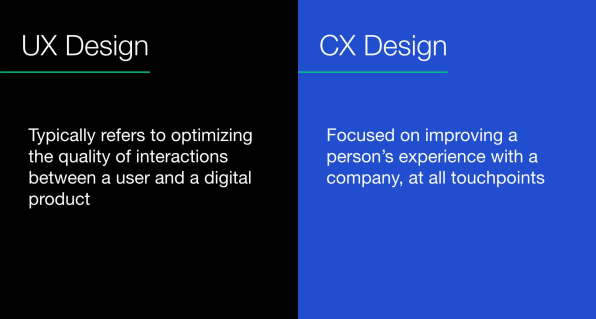
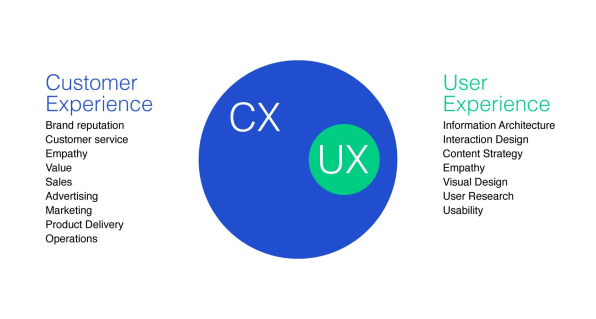
Originally, the UX umbrella was meant to cover every facet of an individual’s interplay with a company, but our distinctly digital age complicated things. UX is now associated with the quality of interactions between a user and a digital product, and CX design has come to encompass all the other encounters that a person has with a business.

All other encounters—the scope is enormous.

[Image: courtesy Toptal]

Today, UX designers typically focus on a series of goal-driven tasks and the overall quality of interactions; for instance, “How can we improve mobile navigation so people can find things more easily?”

To create cohesive experiences, UX designers must also be aware of the ways in which their work impacts existing features. “Does changing our navigation improve discoverability and speed up our purchasing process (or increase our conversion rates)?”

Zoom in with UX. Zoom out with CX. It’s a natural pairing.

But what about other design disciplines? How do they fit into the CX design equation? More specifically, what impact does brand design have on the customer experience? At the very least, it seems like brand designers ought to be aware of all the ways in which their clients interact with customers.

[Image: courtesy Toptal]

Avoid a myopic brand

Brand designers have an uncanny ability to pinpoint the attributes that make companies special.

  • What do they do best?
  • How are they different than the competition?
  • Why should anyone care?

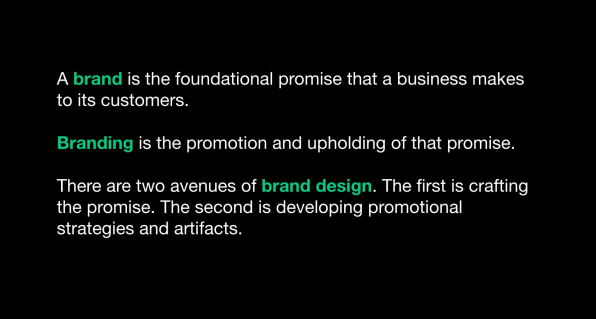
With these insights in hand, brand designers unify the most essential truths into a promise between company and customer.

This promise, the brand promise, has few words but permeates every aspect of a company’s activities. It names a common goal and inspires everyone involved to move with a shared sense of mission.

[Image: courtesy Toptal]

But, a brand promise can be restrictive—especially when a brand designer doesn’t appreciate the full scope of a company’s touchpoints (aka any interaction that has the potential to change a customer’s feelings toward a business). For example, a design team lands a contract with a grocery chain and goes all-in on a strategy that makes digital interactions top priority. They define a compelling brand promise and outline a companywide mindset that emphasizes high-quality digital tools and content. Unfortunately, the team doesn’t give the same level of care to the grocer’s brick-and-mortar experience, and they fail to develop a plan to infuse in-store interactions with the updated brand sentiments. A crucial aspect of CX design and customer engagement has been ignored. With time, customers grow frustrated because the glossy rebrand they encounter online doesn’t translate to the real world. In-person interactions with the grocery chain didn’t become markedly worse, but they feel slow and dated in contrast to the lofty expectations set by the rebrand.

CX apathy causes irrelevant brand collateral

Visual identity design builds on brand design. A brand promise is the foundation, brand values are the frame, and the elements within a visual identity are the fixtures and finishing touches. They embody the most important aspects of the brand in visual form and serve as aesthetic benchmarks for a host of promotional collateral.

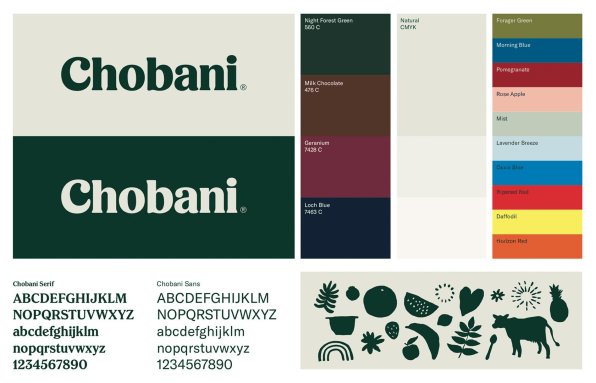
Chobani’s visual identity was designed so that the brand, despite being a household name, would be perceived as a small, humble craft company (like its early days). [Image: courtesy Toptal]

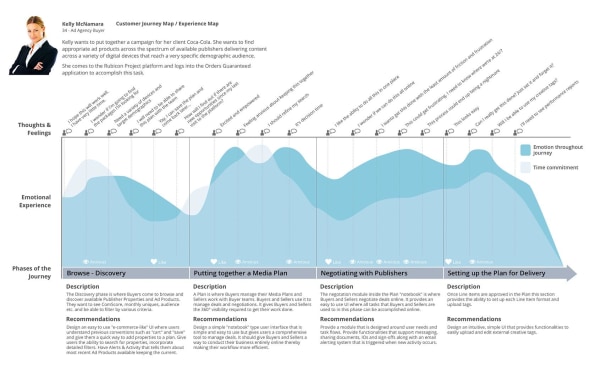
To create an effective visual identity, it’s crucial that a brand designer have big-picture knowledge of a company’s customer journey—all the ways customers interact with the company and perform tasks over time. Why is this so important? Designing promotional collateral for brand channels isn’t like creating a responsive interface for different screen sizes. It’s not enough to recycle and resize the same design elements over and over. Every channel has unique constraints and content demands. Time, scale, distance, environmental distractions, and user expectations are just a few factors that come into play. It’s not necessarily the brand designer’s job to create promotional collateral, but it is their job to design a visual identity that is adaptable to multiple scenarios. Let’s expand on our example from earlier—the brand team that goes all-in on digital.While building out the grocery chain’s visual identity, the brand team decides to outline a set of photography guidelines that will give the grocer a more intimate and human feel. The intentions of the team are good: They want to cultivate a more relatable web and social presence by showing happy people enjoying the grocer’s goods.But the human-centric photos don’t account for the chain’s past success promoting products out of home—where ads must be interpreted in the blink of an eye. When a new set of billboards, bus wraps, and kiosks are designed following the brand team’s guidelines, they are visually attractive, but the photos of smiling people don’t fully communicate the deals the grocer is offering. The ads fail to grab the attention of motorists and pedestrians, and the campaign fizzles.

Brand designer keys to omni-channel awareness

Brand channels are unique and evolving

Every channel that a company uses to communicate with customers has its own idiosyncrasies. What works on one channel isn’t guaranteed to work on another.

Some channels are structured for highly personalized interactions—others less so. One channel may be geared toward in-depth videos while another is known for short audio clips.

Channels aren’t static either. Features, popularity, and demographics are always in flux. Just when everyone thinks they have a handle on “where users are spending their time,” a new channel emerges and disrupts everything.

The paradigm can’t be controlled. Flexibility is paramount.

There’s no way to dominate every channel. Fit is crucial.

Consistency is the lifeblood of engagement

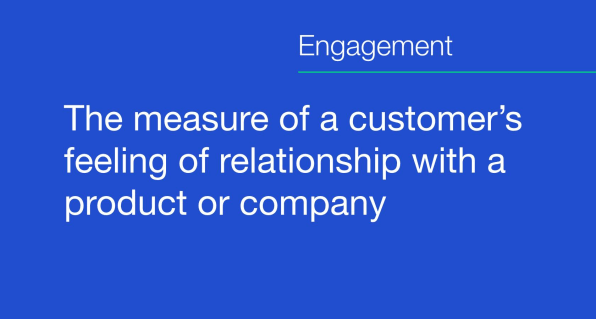
Engagement measures a customer’s feeling of relationship with a product or company. Feelings and relationships may be fickle, but they thrive on consistency.

The takeaway for brand designers? Consistency encompasses more than visual design decisions like logo placement and color use. Every touchpoint makes an impression. Every interaction impacts perception. No part of the customer’s journey is inconsequential or dismissible.

[Image: courtesy Toptal]

The customer experience is interconnected

Customer experience design is a web of interconnected interactions. Touchpoints don’t exist independently of one another. They’re all part of the same story, all linked to a brand’s core promise.

A purchasing experience on mobile doesn’t end. It extends into unboxing, setup, and regular use. It continues through ad campaigns and customer support. It endures on social media. Finally, it breathes new life with the choice to make, or not make, another purchase.

Click here for a larger version. [Image: courtesy Toptal]

CX strengthens brand relevance

Branding is dead? Hardly. It’s stronger than ever, but that doesn’t change the fact that a crummy interaction completely undermines even the most inspiring brand promise. Can brand designers control what happens at every touchpoint? No, but they can design brands that are disconnected from reality—brands that make big promises but don’t deliver when it counts. When such a disconnect exists, customers tend to look elsewhere.

Branding isn’t dead, but the days of crafting brands without incorporating a CX design mindset are drawing to a close.

Feature Image Credit: Toptal

By Micah Bowers.

Micah Bowers is a senior designer at Toptal. Follow him on LinkedIn and Dribbble. This article was originally published on the Toptal Design Blog.

Sourced from FastCompany

By

Are you using Instagram Stories to its fullest potential? Want to make your stories more consistent and engaging?

To explore how to use Instagram Stories for your brand, I interview Sue B. Zimmerman on the Social Media Marketing Podcast.

Sue is an Instagram marketing expert and author of The Instagram Strategy Guide. Her online course is called Ready, Set, Gram.

You’ll find tips and techniques for using Instagram Stories to help your business stand out, and discover how to use the new Create features that just dropped.

Click HERE for the remainder of the article.

By

Sourced from Social Media Examiner

By

Startups take risks, something all organizations should do

Today, large CPG brands are feeling even greater pressure in an expanding world of new go-to market strategies. Subscription services, ecommerce “anti-brands” and sustainability-driven challengers are changing the paradigm of how people shop and consume.

Brands like Hims have linked a suite of products to address top-of-mind men’s issues such as hair loss, erectile dysfunction and anxiety. The online subscription model offers a discreet (no face-to-face medical consults) and holistic solution for guys that otherwise might not seek help through normal channels.

Truman’s combines both a subscription and sustainability model to deliver mix it yourself nontoxic cleaning supplies to your door. The reusable spray bottles and small refill cylinders make shipping and storage easy.

These are two of many current startup examples. They challenge key assumptions of how products are formulated, how they work and how they’re delivered to consumers. To win against these anti-brands, marketers need to learn to take risks like a startup.

For many startups, the irony is that they are risking everything including savings, homes and the investment of close associates and family. This is not simply a professional risk from which to rebound from, but also a risk to current life and future.

So how do they find the resolve to take risks? By understanding the risk, defining the potential return, outlining the strategies to mitigate and communicating all of this clearly to internal and external stakeholders.

To win against these anti-brands, marketers need to learn to take risks like a startup.

Here are five fundamental questions that need to be answered to help you get ahead of the conversation, assess risk and build a solid case to leverage with internal/external stakeholders while putting your own mind at ease.

How certain are you that the consumer wants the product?

If you think you’ve identified a clear missing need in the marketplace, have you done the simple task of talking to potential consumers about a product that solves this need? As simple as that sounds, many teams haven’t, and a series of short conversations can not only help you confirm that need but may help you sharpen your product offering.

Can you link your innovation efforts to a parallel success in a different category?

Perhaps your product is a new enough proposition that it is difficult for consumers to understand. Can you identify something in a different category where the leap has been made and reapply some of the thinking? For instance, protein first hit shelves in the snack bar category for consumers that were using bars as a no-prep source of protein for fitness routines. Recently, marketers saw the behavior of these products being incorporated into less rigorous lifestyles and began to bring protein into juices, cereals and even coffee creamers. It was a logical reapplication to adjacent breakfast choices.

What needs to be true for product success (quality, efficacy, flavor, credentialing, price point, etc.)?

Every category has a shopper decision tree, which is the sequence of choices a shopper works through to find the product for them before they choose and buy. Identify this for your product. Once the key “Who am I?” “What am I?” questions are answered, what is the differentiating aspect of your product that communicates why it’s right for that consumer.

For some food categories this is nutritional credentialing, for others it’s simply a flavor choice. Be clear on what that is for your product before you start to create the packaging or develop supporting communication. This will also be a key part of your customer sales story.

What is the minimum level of confirmation you need to launch?

If your launch is national, does it start with test markets in partnership with a key retailer? If not, what is the minimum data set you need for launch confirmation? This can be as narrow as multi-city qualitative with 40–60 consumers if your confidence in the product is high, or as expansive as a full quantitative with thousands of respondents. A research professional can help you understand the right level of clarity and the costs involved.

How quickly can you course-correct based on market response?

This is something most large CPG companies don’t like to think about but that almost all entrepreneurial enterprises expect to do. Quick adjustments based on real market response and customer feedback is crucial. Not only are you honing your proposition in the real environment where it lives, but you are building a stronger relationship with your customer by working together for success. Plan for a measure and adjust milestone after launch, price point, support and even design if necessary. Perhaps you won’t need it, but if you don’t, the conversation is a happy one to have both internally and externally.

In the end, willingness to risk is very personal and tolerance for risk within organizations is a difficult thing to change. Assessing your proposition carefully by using the questions above is a good start to building a strong plan for launch, support and (if needed) adjustment.

Feature Image Credit: Tolerance for risk within organizations is a difficult thing to change. Getty Images

By

Chris Lowery is president and CEO of Chase Design Group.

Sourced from ADWEEK

By Douglas Montague

How rethinking brand expression influenced Microsoft products and vice versa

Imagine a sheet of paper with a couple dozen tiny dots spread out on it. Their placement doesn’t seem random. You can sort of make out a shape, but there’s no obvious way they go together.

Now imagine a sheet with identical tiny dots, only each one is numbered. The dots may still look like a jumble, but the numbers indicate how they link together. You draw a line from one to two, two to three, and so on. Oh look, you’ve drawn a seal balancing a beach ball on its nose! Gold star.

Working for a big company sometimes feels like staring at thousands of dots and having little idea how to connect them. I’ve been with Microsoft since 1995, but I don’t think I understood how these dots could work together until 2015.

That’s when we changed our marketing strategy. Before, the product design team would build and design the experiences, and the marketing team layered a brand identity on top to sell it. With the 2015 change, branding was no longer a “layer” of marketing disconnected from the product experience. Instead, branding became directly tied to and influenced by the product. And maybe, just maybe, the brand could influence the product in return.

In the heavily siloed world of giant corporations, that was practically crazy talk.

One dot at a time

Simplicity became our mission. We first needed to build brand principles and the brand story (in other words, why we exist in the world). Then, we’d figure out how the principles and story inform the product experience. We theorized that connecting experience and expression among product, brand identity, and marketing, and extrapolating those principles into meaningful guidance across the company, would create a better experience for customers.

Numbers started to appear next to those scattered dots staring me in the face. The trick was getting other people to see them, too.

To show people the value of brand creative teams in marketing, we needed to have a lot more conversations with product design. First, we needed to understand what they were building and where they were headed. Second, we needed to create a visual identity closely tied to the product’s visual language, which a worldwide marketing organization could later implement.

Easy enough, right?

Thankfully, our senior leadership encourages us to work together for the greater good of the company, pushing away our own egos as much as possible to bring success to all. We call this One Microsoft. Particularly in our area, acting as One Microsoft is a necessity: we have a tiny creative team and can’t succeed without the assistance of other great creatives, so we need to understand each other’s business and create together. When it works, it’s magical.

Case study: transforming Microsoft Office

Rebranding Office was one such magical example. For the first time, we looked to product teams for cues to lift the brand identity and create simple, scalable guidance. We worked directly with product design, an approach that we’d take later with Azure and HoloLens 2.

Our approach had five steps:

  1. Create the brand story working across brand strategy, engineering, and marketing, including a deep dive into product design principles and future principles.
  2. Conduct an end-to-end visual audit of the entire customer journey.
  3. Identify visual patterns and cues from the product, and from the parent Microsoft brand, to create a visual identity for the brand expression.
  4. Build creative principles and theories around color, illustration, typography, and photography, then stress test across all communication touchpoints in the marketing funnel.
  5. Create a simple design system that designers could scale worldwide without much creative oversight.
Three large black boards with print outs of the current Office branding.

Three large black boards with print outs of the current Office branding.

Boards from one of the many visual audits done in 2016 for Microsoft Office.

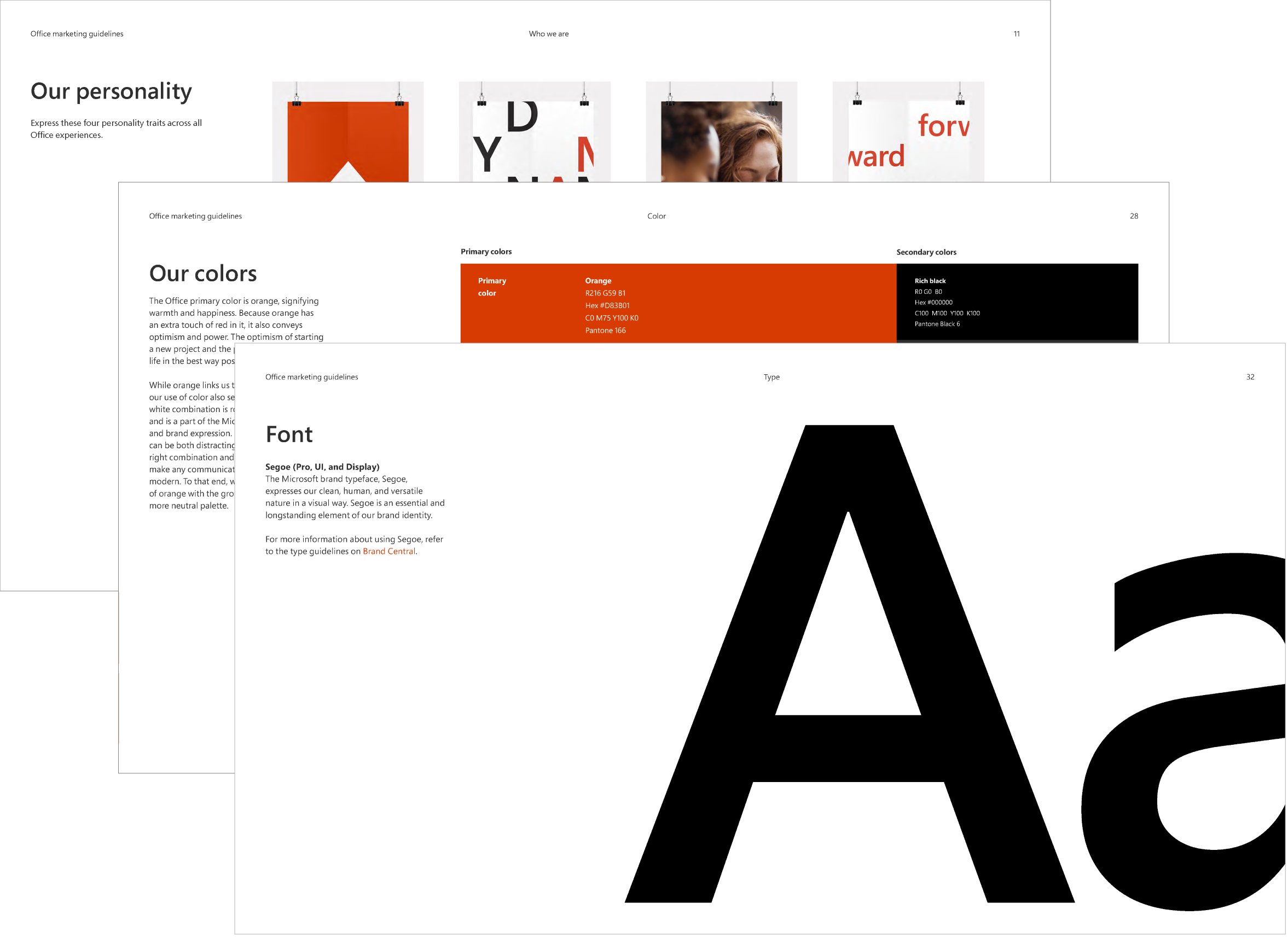
Our audit concluded that Office needed a more sophisticated yet simplified visual identity connecting our product experience and marketing communications. The marketing teams were doing their best; they followed the Microsoft brand guide for reference, but the broadness of the guide and visual system made it difficult to implement. We pared down the brand system in the name of simplicity.

Office brand guideline examples including personality, colors, and font.

Office brand guideline examples including personality, colors, and font.

Pages from the Microsoft Office Brand Guidelines.

Our collaboration effectively linked the pre-purchase marketing communications to the post-purchase ones. For example, we used our marketing expertise at engaging users to improve the first-usage experience (for example, the “how to” videos that introduced users to Office online). In that space, the product team focused more on UX, not the kind of branded moments within the product where you can tell a story.

The fifth step in that process was perhaps the toughest, simply because of scale. Several hundred marketers worked on Office, each with their own budget, each choosing their own creative. Because of that, and their concern that we’d just scold them for doing things wrong, none of their work went through a creative review process. We not only had to change how people worked, but we also had to assure them we had their best interests in mind.

In time, people from other teams understood that we weren’t focused solely on creative, that we wanted to help them meet their business objectives and performance metrics. Again, it comes back to that One Microsoft principle of trusting each other and helping each other succeed. Product teams started seeking out our involvement, and marketing trusted us to make more things on their behalf.

Keeping a good thing going

We emulated this turning point elsewhere. We worked directly with principal designers Paul Cooper and Lance Garcia to build creative principles (for everyone keeping track, that’s step 4) that ended up changing the patterns and UX of . Functionality informed brand choices, which reflected back on the site itself.

The front page of the Azure.com website.

The front page of the Azure.com website.

Azure.com

The same goes for HoloLens 2, which was perhaps our most daunting task. The product team had worked on it for two years by the time we stepped in to begin branding, so we had catching up to do. (Yes, not ideal.)

HoloLens 2 works in mixed reality, a new medium for most users. Because of that, people need more than product photography or UI to understand how it works. So, I partnered closely John Nguyen and David Wolf from the product design team to come up with a solution. We were inspired by prismatic light in holograms and by the way the product sensors understand the world and generate a 3D map. We believed that this prism and map would tie the marketing and the product experience together in a beautiful way. The product experience largely informed the elegant brand we created for HoloLens 2 and subsequent marketing materials.

Four expressions of the HoloLens branding.

Four expressions of the HoloLens branding.

HoloLens 2 Prismatic Color Blend used in illustration, full-bleed backgrounds, and HoleLens 2 wordmark logo.

These marketing materials turned out well — so well that they influenced the product. Romiro Torres, the creative director for HoloLens 2 UX, was working out the visual expression and experience of how the device maps a room. He integrated the same visualization into the product experience, so users see the same visualization we created for marketing when HoloLens 2 maps the room they’re standing in.

HoloLens 2 Room Mapping from the launch announcement in Barcelona

Chances are that doesn’t sound like a big deal to you, but it felt huge — that “maybe, just maybe” moment I mentioned earlier. If you listen closely, you can hear silo walls cracking.

Those are the kinds of moments we strive to create every day. They become a lot more likely when teams spend the time to truly understand each other. Branding makes that easier. It provides that layer of customer clarity, connecting the dots so that marketing and product can take a step back, look at the lines, and say, “Wow, a seal balancing a beach ball!”

By Douglas Montague

Microsoft Brand Creative Director. I don’t believe creative that has commercial success tags it with an odious suggestion that is stinks. Views are my own.

Sourced from Medium

By Chanakya K.

In today’s business-savvy world, it has become vital for ventures and brands to set themselves apart from their competition. Businesses nowadays face a daunting task of presenting themselves in the virtual world in such a way that they attract more customers. Creating brand awareness and doing so in a way that it not only attracts customers but also builds a pool of prospective clients is the crux of running a business online.

There are many key components to building a stable and attractive brand image to run your business. In this blog, we will go through the 5 major components that will help your venture skyrocket its brand image and utilize the potential of online marketing to its fullest.

1. Branding

Branding your business is more than taglines and logos and flashy posters or ads. Finding the purpose of your business and conveying it to the customers is called branding. Creating brand awareness is perhaps one of the most important components of running a successful business.

The more innovative and reachable your branding strategy is, the more people will get acquainted with it. For creating a branding strategy, businesses often rely on a good digital marketing to elevate their brand image. Hence, vetting and engaging with a good digital marketing company that can take care of developing comprehensive strategies for online marketing and coming up with innovative ideas to expand your brand’s reach is imperative for this component.

2. Segregating features and benefits

Contrary to popular belief, highlighting the benefits of your business will attract customers to engage with your business. Features your business has are just attributes, but the benefits your business provides your customers are the real shining star in attracting them. Highlighting benefits will retain your already existing customers. It will also bring in a slew of new customers who would want to reap the benefits of your business. This component plays a key part in digital marketing, and often includes client testimonials and customer reviews.

3. Customer experience

What is a business’ purpose other than catering to their customers’ needs? The focal point of any business is keeping its customers satisfied. A customers’ journey starts with your business as soon as they book an appointment or enter your premises. From that point, until they leave your premises and use your products/services, you must keep in mind to heed to everything the customer is feeling or saying.

Using a Customer Management System is imperative in tracking customers’ activities and takes their feedback, so you can keep them satisfied throughout their engagement. Moreover, this increases customer loyalty and improves your brand image, which makes customer retention easier. This data can be leveraged for digital marketing and attracting new customers.

4. Consistency

Aiming to provide services that are consistently good makes sure that your brand shines brighter than your competitors. If a customer is returning to your establishment, they are not doing so because of your product, but your service. Big brands make it their goal to present their customers with a journey that they will remember every time they use your product.

Leveraging this consistency by highlighting it in your online marketing is the best strategy your business can adapt. An established and good digital marketing company knows how to present customer experience as an asset of your brand to the new audience, which persuades them to engage with your brand and experience your exemplary customer journey themselves.

5 . Promotions and scale

Once your business has built up a loyal customer base, you have to set it up for an upward trajectory if approached in the right way. Using targeted strategies like promotions can help elevate your brand and also attract a multitude of new customers who were engaging with your competitors. You need to make them see that engaging with your brand would be more beneficial for them.

This would also help your business build potential partnerships with various other businesses which will further help in increasing your customer base.

Once this is done, all you have to do is serve these new customers as you did with your loyal customers, and you will attain a colossal mass of promoters of your brand who would vouch for your brand through reviews and testimonials.

Conclusion

Working with an efficient digital marketing company can help you majorly scale up your brand image and business in a lesser time than handling everything yourselves, which leaves many rooms for errors that can affect your brand negatively.

A professional and expert digital marketing company can help you navigate through the digital world and increase your brand awareness by a huge margin. Taking your brand and converting it into a luminary in the marketplace is the sole purpose of your venture’s marketing strategy, and hiring a good digital marketing company like SEMrush where you get all your Marketing toolkit under one platform can take you a long way in the digital world and elevating your brand image to the highest standards.

By Chanakya K.

Sourced from TechGenyz

By William Arruda

What’s your story?

The most successful brands aren’t created, they are unearthed. Successful branding is based on authenticity. So how do you reveal your own brand? First, by searching yourself for answers to questions like these: What do you do better than anyone? What are you most proud of? What makes you lose track of time?

In Digital You: Real Personal Branding in the Virtual Age, branding authority William Arruda describes the 21st century world of personal branding and guides you to define, express, and expand your personal brand for the virtual world. Branding is not about being famous, Arruda explains; it’s about being selectively famous. It’s about more than social media excess. When you understand the true value of personal branding, you can use it as a serious career development strategy.

Digital You offers a deep dive to understanding and defining your unique promise of value—making a great first impression, mastering multimedia, and, ultimately, expanding your network and promoting thought leadership. You’ll learn how to develop, design, and sustain a personal brand throughout the fluid movements of any career. Understand how to be clear about your digital brand and your unique promise of value so you can increase your success and happiness at work and in life. It’s time to stop worrying about career extinction and start crafting a brand of distinction.

By William Arruda

Dubbed “the personal branding guru” by Entrepreneur magazine, William…Full Profile

Sourced from atd Association for Talent Development