Tag

brands

Browsing

By Douglas A. McIntyre

Brand value and loyalty studies have become a major part of the American marketing industry. Several of these studies involve brand value. Interbrand is the best known of these. It considers 100 brands, based on its own mix of criteria. Not surprisingly, tech brands such as Apple and Microsoft are in the lead with brands worth well into the hundreds of billions of dollars.

Another take on brands is based on reputation. Among the most well known of these is the Axios/Harris study, which ranks 100 companies on reputation. Grocery, retail and food brands tend to be near the top, with Trader Joe’s in first place. The Trump Organization is at the bottom.

Still another cut at brand research is the Brand Keys Loyalty Leaders, another list of 100. Its yardsticks are the companies that have the “best-practice guidelines for creating and nurturing customer loyalty.” The study covered 1,624 brands in 142 categories.

One of the points of the study is that brand reputation results have moved back to “normal” after some distortion over the COVID-19 pandemic’s first two years. Robert Passikoff, Brand Keys founder and president, commented: “The significant re-distribution of loyalty identified in the 2022 loyalty rankings are leading indicators of what a return-to-normalcy marketplace will look like.”

The study looks at brand loyalty rank and how much this has changed year over year by brand. The top brands on the loyalty rank list are Apple and Amazon, which typically rank high in all the brand studies. They were followed by Domino’s and Disney+. Although still considered a brand to which people are loyal, Tesla was at the bottom of the list.

In terms of brands that gained and lost the most in the study, State Farm rose 25 places on the list. MSNBC was second, rising 19 places.

The brand that lost the most ground was Purell, which dropped by 52 places. Clorox fell by 41. The only reasonable explanation is that when the COVID-19 pandemic was at its worst, these were products people used to protect themselves from the spread of the virus.

By Douglas A. McIntyre

Sourced from 24/7 Wall St

By John Long

Three ways to rediscover a critical brand asset

So many brands today sound exactly the same. And that’s because the advertising industry has mostly abandoned one of the most powerful assets a brand can have: a distinctive brand voice. Pick up almost any brand style guide, turn to the tone voice section, and I bet you’ll find some variation of these attributes:

FRIENDLY
OPTIMISTIC
CLEAR
HELPFUL
GENUINE

All that’s missing from this insipid list is “useless.” Who would intentionally craft a brand that’s rude, pessimistic and phony?

Another “tone of voice” steer that pops up a lot in brand guidelines is this classic:

“We’re like that trusted, smart friend who always gives you great advice.”

Sorry, that’s not a brand voice—that’s a content strategy.

Everyone speaking in the same CLEAR and OPTIMISTIC tone giving HELPFUL, FRIENDLY ADVICE is making the work less effective. As Amy Kean observed, to their detriment, brands are all parroting the same vapid marketing speak. And this mind-numbing sea of sameness is obviously the opposite of what strong brands do. Because how a brand sounds is just as important as how it looks.

But there are a few brands that still understand how effective a tool brand voice is. And they’re getting noticed for it. Take Oatly.

Oatly is milk made from oats—it’s a bit of an oddball product. So they leaned into that weirdness and struck an irreverent, playful, somewhat sarcastic tone. And it’s worked. Whether it’s your cup of tea or not, it certainly stands out. And it’s pretty hard to argue with these results.

Now I’ll toot my own horn a bit—or I should say, David Abbott’s.

When I was leading creative at The Economist Group, I was determined to bring back AMV’s great “white out of red” campaign in social and digital. I couldn’t think of a reason why the iconic brand voice Abbott created for the brand—distinctly British, witty, and confident—wouldn’t work just as well as Instagram posts or banner ads. And sure enough, it did.

So how does one avoid the robotic pablum that’s taken over the industry and create a fresh brand voice? Here are three things to try.

  • A former ECD of mine, Cameron Day, had a particularly ingenious method. To create a brand voice, he combined two familiar, but distinct, personalities. A good example of this is the brand Cam came up with for a gourmet grocery store: “Dr. Seuss meets Dr. Frasier Crane.” So imagine a person who is deeply knowledgeable about fine foods—but delivers it with a dash of whimsy. Here’s what that sounded like. Delicious, yes?
  • Let’s go back to that helpful friend, the one always giving you good advice. To give that imaginary confidant a real voice, you have to ask yourself questions such as:

    Is your friend a man or a woman?
    Is she from New York or New Orleans?
    How old is she?
    Does she have a sense of humour? And is it the smart kind or a bit juvenile?

    In other words, you have to imagine an actual person. Brands are like people, and what makes people memorable and likable works for brands, too.

  • Replace that milquetoast tone of voice list with attributes that will give the voice some real character. And keep the list to two or three, not five. Doesn’t a brand that strives to be “irreverent, playful, and sarcastic” immediately seem more impactful than a brand that’s just “clear, friendly, and genuine”? Of course, you can’t just force random attributes on a brand. You have to unearth something about it that makes the voice seem inevitable. This is harder for some brands, to be sure—especially in certain categories—but it’s worth the effort.

Finally, I’d argue that brand voice is especially important in an era in which the business is more and more reliant on stock photography. If everyone is using the same pool of imagery, one way to stand apart from the pack is to give your brand a unique voice. Don’t settle for FRIENDLY.

By John Long of HS Ad

Sourced from Muse by CLIO

By Christine Hall

We’ve all seen a product on social media that looks interesting, so you click the “shop now” button and are taken over to a new site. But wait, you weren’t finished on the social media site, and when you go back, everything has refreshed.

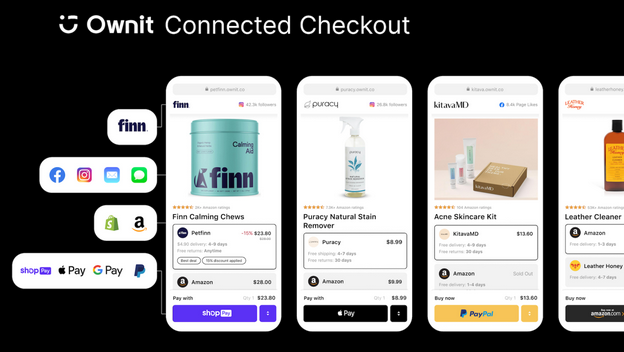
Ownit unveiled a checkout experience today, after testing with 10 companies, that gives direct-to-consumer brands a way to sell their products without that interruption. Its technology connects social, commerce and payment options at the point of discovery so consumers can buy in one tap via an “Ownit Connected Checkout link.”

From the link, consumers go to a web page interface on top of the app and can make purchase choices from their favourite commerce site, including Shopify and Amazon, and pay with Apple Pay, Google Pay, Shop Pay or PayPal — features not often available because some social media sites don’t often play well with certain payment options, Ownit co-founder and CEO Payman Nejati told TechCrunch.

Nejati started San Francisco-based Ownit less than a year ago with Evan Shiue and Joel Tan, and all three have vast experience in checkout. This is Nejati’s fifth startup, and most of his experience is in grocery checkout, while Shiue has a background in autonomous checkout at Standard Cognition and Walmart, and Tan in conversational checkout with Amazon’s Alexa.

The global pandemic was the driver for many people to start an e-commerce brand, and while many tools enable them to start easily, Nejati says the right tools haven’t been there to help those companies grow as easily. In addition, brands still deal with challenges, like cart abandonment rates of 75%.

Needless to say, they’ve thought a lot about what’s going on at the point of purchase, even going so far as to boast that customers will double sales conversion or pay nothing. They knew they were on to something as they saw checkout companies like Bolt, Checkout.com and Rapyd collectively raising over $3 billion investments in the past 18 months.

Ownit

Image Credits: Ownit

“We knew checkouts at the point of purchase will explode, but we wonder if the user was going to the storefront, and is the company investing in sending them there from another platform, like social media,” Nejati added. “At the same time, the new iOS was making those costs unbearable. So we thought, what if you don’t have to go there, but we could capture someone at the point of discovery — that was the lightbulb moment.”

Proving that checkout continues to be a hot area for investors, Ownit itself announced initial funding Monday, an $8 million seed round from Caffeinated Capital, SciFi VC, GGV Capital, Abstract Ventures and a group of angel investors that include founders and executives of companies including Meta, Pinterest, Honey, Product Hunt, Standard Cognition and Anycart.

Nejati explained Ownit is like the “Plaid of e-commerce;” what it is doing is a “heavy tech lift,” involving connecting people, merchants and payment options seamlessly. The ultimate goal being to become the merchant of record by going after capital to get everything squared away correctly from the beginning versus taking shortcuts that make it difficult to scale.

As such, the new capital will be deployed into what Shiue called “the three Cs”: conversion, which he considers “the North Star for its brands;” customer onboarding; and connections to deepen the three pillars of its tool suite of social, commerce and payment platform relationships.

The company has 11 employees currently and Shiue expects to be at 30 by the end of the year.

Among Ownit’s 10 early beta customers are consumer packaged goods companies, cosmetics and nutrition. Customers were encouraged to test sales through Shopify versus through Ownit, and Shiue said initial results have been positive, showing campaigns saw an average of two times the conversion lift via text marketing and three times conversion via email marketing.

Feature Image Credit: Ownit

By Christine Hall

Sourced from TechCrunch

By Andrew Konya

Brands invest millions of dollars in creating an external identity that reflects their mission, values and product. A good brand identity is instantly recognizable, reliable and clear on what your company stands for. That doesn’t make it strong or lasting.

Having a strong, durable brand comes from brand authenticity. Today’s consumers view their spending cash almost like a psychological investment, and want to believe in what they consume. In fact, recent reports show that 90% of consumers say authenticity is important when deciding which brands they like and support.

What It Takes to Create an Authentic Brand Identity

Creating a genuine and impactful brand goes beyond a visually appealing social media account, or a funny Super Bowl commercial. It’s about connecting with consumers on a deeper level and taking actions to live out your brand’s values or support issues that matter. Great brands now honour their customers.

We’ve seen brands do this well. Patagonia recently shared why it doesn’t use the word “sustainable” in its marketing. The decision stems from an awareness that, despite its best efforts, the company is still part of the climate change problem. Ben and Jerry’s is another example. Historically known for taking an unapologetic stance on social issues, its co-founders were arrested for activism work in 2016. By putting themselves on the line, leadership at Ben and Jerry’s showed their support of social issues is unwavering. These choices aren’t made for publicity — they’re the result of years of groundwork aimed at building a trusting, transparent relationship with consumers and honouring the issues that matter most to those who purchase their products. At the end of the day, consumers want to trust and be proud of the brands they support.

Cultivating an authentic brand identity doesn’t happen overnight — it requires time, consistency and empathy. Here are a few key takeaways and simple strategies for getting brand authenticity right.

Start With Your Internal Culture, Then Work Your Way Out

Brand authenticity starts with building a positive internal culture that’s rooted in transparency. Make sure all employees — whether they are in a corporate office, a store location or a distribution centre — feel supported, engaged and heard.

Increasing transparency can take several forms, one of which is having frequent, open conversations with employees. By creating this space, you’re not only giving room for people to express their concerns and values, you’re also building community among your staff. Another way to positively impact internal culture is by incorporating employee feedback into your overall mission, asking your employees questions like: What social issues matter most to you? Are there any organizations you wish we were supporting? Incorporate this feedback into your overall mission and day to day activities, and your employees will feel more empowered and supported by your brand. They are your best advocates, and shape your brand every day through their actions.

To take this a step further, identify and acknowledge the weak spots in your company culture. Employees who feel overworked and burnt out won’t be putting their best foot forward. Likewise, companies lacking policies to foster connection among remote employees may find their staff disengaged and unmotivated. It’s important to remember that employees are a brand’s number one asset, and that they are people first and workers second. Address the pain points and make an active effort to increase everyone’s sense of belonging within the organization. By empowering employees, they’ll organically spread your message to potential customers, driving business value for the company as a whole.

Related Article: The Intersection of Employee Experience and Customer Experience

Talk Less, Act More

According to consumers, brand authenticity is less about overt messaging, and more about communicating through mission and action. Today’s consumers are spending consciously and increasingly seeking out brands that actively support causes that align with their own personal values.

Evaluate your corporate spending to ensure the organizations and causes you support align with your brand’s values. Don’t assume people won’t notice where your corporate dollars are being spent. The past two years we’ve seen people hold businesses more accountable than ever. Don’t just attach your name to every trending movement or cause, and stay out of conversations where your brand is irrelevant. Instead, facilitate open conversations with your consumers to eliminate the guessing from your efforts, and find opportunities to leverage your brand’s resources within your community.

There’s ways to do this well — for example, during a disaster in 2017, Budweiser began canning water instead of beer to aid hurricane victims, using its resources in a moment of need. It’s since continued this practice, developing a partnership with the Red Cross to provide support when it’s needed.

Integrity Counts, in Good Times and Bad

Make sure your brand voice is clear, genuine and consistent 100% of the time. Customers are increasingly sensitive to inauthentic branding, so avoid using emotional manipulation techniques in your marketing.

Similarly, own your mistakes. It’s almost guaranteed that your brand will not get it right every single time — no one does. Consumers will take notice of these moments, but they’ll likely be paying even closer attention to how you respond, and whether you learn. We recognize authenticity in humans through traits like honesty and humility. By owning any missteps and learning from them, people will recognize the authenticity in your brand, too. Of course, do your best to keep these moments far and few in between. And be sure to make things right with individual customers when needed. After all, how you correct a problem or mistake is just as important (if not more important) than the issue itself.

These three strategies are a stepping stone to creating an authentic brand consumers know and love. Having a strong, genuine identity builds trust and loyalty, which ultimately drives repeat purchases and leads to lifelong customer relationships. Authenticity is not created overnight — it takes years of consistency to establish yourself as a reliable, reputable, household favourite. But once you put in the time and effort, you’ll create a strong customer base of fierce brand advocates who align with your mission and spread goodwill alongside your brand.

Feature Image Credit: Eduardo Soares | unsplash

By Andrew Konya

Andrew Konya is the CEO and co-founder of Remesh, an agile market research platform that sparks meaningful conversations between decision-makers and the populations they serve, transforming the way organizations operate and driving more informed, empathetic choices. He began his career as a theoretical physicist at Kent State University, applying machine learning and supercomputing to understand emergent phenomena in complex systems.

Sourced from CMS Wire


There are quite a few people who believe that the latest paradigm shift for the internet is already well underway: the metaverse, they say, is almost here. When companies investing in a space and the media declare a moment, it’s reasonable to take a beat and see whether the reality can live up to the hype. But, if this is the “meta” moment — that is, if it offers something that people really want — it is safe to assume that a lot of companies are wondering what the metaverse really is and whether they should be a part of it. For brands thinking about how to navigate this new frontier, even knowing where to start can be daunting.

The basic idea of the metaverse isn’t complicated. Put simply, the metaverse includes any digital experience on the internet that is persistent, immersive, three-dimensional (3D), and virtual, as in, not happening in the physical world. Metaverse experiences offer us the opportunity to play, work, connect or buy (and just to make things extra fun, the things we buy can be real or virtual). It is also perhaps a misnomer to say “the metaverse” as if it were a monolithic, connected, or even interoperable universe, because it is not. Each entity that creates a virtual world does so with its own access, membership, monetization rights, and formats of creative expression, so the business and technical specifications vary widely. The metaverse refers more to the concept across these individual worlds and experiences and the acknowledgement that we are entering into a more substantive, immersive landscape than ever before.

A handful of businesses are already shaping the landscape, with entertainment and gaming companies leading the way. Major console and PC gaming titles, such as Fortnite, from Epic Games, have normalized playing and socializing with people in virtual settings. Newer gaming platforms, such as Roblox, allow people to create and play across immersive worlds created, and often monetized, by users. Decentraland is an entire 3D virtual world owned by its users, allowing them to create virtual structures — from theme parks to galleries — and then charge users to visit them, all powered by Ethereum blockchain technology. Other companies, such as MetaVRse and Unity, are creating engines to power brand and gaming studios and accelerate development of AR and VR content creation.

The immersive environment of the metaverse isn’t just an opportunity for consumer-facing companies, however. From training future surgeons to rolling out product demos to retail employees, there are plenty of business applications. For example, the leadership of tech company Nvidia believes that investing in metaverse simulations of such things as manufacturing and logistics will reduce waste and accelerate better business solutions. And Microsoft is positioning its cloud services to be the fabric of the metaverse, using its Mesh platform to enable avatars and immersive spaces to thread into the collaboration environments, such as Teams, over time. With post-Covid hybrid or remote working environments, many of these more creative virtual business experiences are likely to become even more relevant to how companies connect to their people and to their customers.

For companies still waiting on the side-lines, it is important for each brand to find its place and balance the risk-reward equation. Doing so requires grasping what is possible, and the companies that are leaning in fast can both offer inspiration and act as test cases. For example, there are plenty of brands taking full advantage of the gaming part of the metaverse with branded experiences that are essentially virtual and immersive sponsorships. While Nike is a highly established brand, it is certainly leading the charge at the assertive end of the metaverse spectrum, filing for patents for virtual goods and the opportunity to build virtual retail environments to sell those goods, as reported by CNBC. More recently, they acquired a company called RTFKT that creates virtual sneakers and collectibles for the metaverse.

The commercial applications of the metaverse are even further heightened by the new behaviours that are surging around buying products and services directly from social experiences, also known as “social commerce.” Social commerce is becoming a larger percentage of U.S. e-commerce over time and is projected to be $36 billion in 2021 alone, following growth patterns like those in China.

In response, the social media landscape is keen to capitalize on the intersection of where people connect and buy not only in a traditional internet context, but also in a 3D, immersive metaverse. Virtual showrooms, fashion shows, and dressing rooms suddenly have the potential to shift from fringe experimentation to mass adoption. And people aren’t just selling physical goods — in fact, Sotheby’s recently announced its own metaverse gallery for curated virtual art, housed in Decentraland. New business models for influencers, virtual goods — including non-fungible tokens (NFTs), which are one-of-a-kind creations traded and secured on a blockchain — and commerce on physical goods purchased in virtual worlds will all emerge in importance as capabilities scale.

Brands should always be in a test-and-learn mode, and the digital landscape in particular requires intellectual curiosity. The metaverse is potentially the next iteration of how humans use the internet to connect, communicate and transact — sitting on the side-lines too long is not likely to be an option.

Here’s what brands can do right now:

Pick your targets.

Think about how much your target audiences/customers are spending time in the metaverse and calibrate your speed of attack appropriately — brands focusing on younger demographics, for example, probably don’t have the luxury of sitting out the metaverse for long. Who are your target demographics, and what behaviors are trending with your current and prospective consumers right now that are indicators of how fast to move into the metaverse?

Watch the competition.

Start talking about moments when peer companies do things in the metaverse — like a showcase at a leadership meeting just to get the conversation going across the executive team. So much of the space can be intimidating, particularly when seemingly indecipherable concepts, such as NFTs or blockchain, are involved. Can you create a champion for these topics to bring approachable, tangible examples to every meeting?

Look for applications.

See whether the metaverse gives you opportunities as a company to not only try new things, but also to accelerate your purpose or long-term goals like sustainability, which is well suited to many applications of the metaverse. Almost every CMO already has made, or will soon make, a public commitment to sustainability-related ESGs, and they will soon be measurable. What can you pilot in the metaverse that allows you to test more sustainable approaches to serving your customers?

Plan your entrance.

Ask your agency team to begin formulating a point of view on how your brand should show up in the metaverse and when it might make sense. Holding companies and independent agencies are both keenly watching mass media behaviours and emerging trends, so it’s a great opportunity to ask them what they are seeing across their client portfolio. What tests could they put in place to enable you to get your brand exposed to the metaverse comfortably?

Keep your balance.

If you are already in it, prepare for the fact that all new spaces present risk and reward; manage accordingly, knowing that it may be super-unpredictable and lacking in standards. The good news is that the recent pandemic made us all way more agile than ever before. To state the epically obvious, there will be experiments that fail. Second Life offered the promise of the metaverse years ago and did not take hold, but the risk for the brands that participated was not significant or long term. So, if this is the right time, it’s important to consider how to be there.

***

Most importantly, people in brand marketing or leadership roles should start thinking about how to unleash their creativity and their storytelling. If the creative palette expands dimensions in the metaverse, we should be excited to create experiences at any point in the customer journey, from acquisition, to engagement, to transaction, to customer support, which have the potential to be both spectacular and stickier than before. And, someday, we will likely want to move from real to virtual worlds seamlessly. That will be the next frontier.

The views expressed are those of the author and do not necessarily represent the views of Ernst & Young LLP or any other member firm of the global EY organization.
Feature Image Credit: Artur Debat/Getty Images
Janet Balis leads EY’s consulting professionals in the Americas focused on the customer agenda and revenue growth, including commercial excellence, customer experience and product innovation and also leads EY’s CMO practice. She has also served as a partner at Betaworks, publisher of The Huffington Post, and EVP Media Sales and Marketing at Martha Stewart Living Omnimedia. Balis is on the global board of the Mobile Marketing Association and the International Television Academy of Arts and Sciences, and she is also an advisor to the Harvard Business School Digital Initiative. You can follow her on Twitter: @digitalstrategy.

Sourced from Harvard Business Review

By Glenn Matchett

When considering the future of branding and brands, it is important to properly understand that Communications is now a fractured, complex, and diverse discipline. The challenge for a PR and brand team – and, indeed, for an entire business – is to get everyone working as one. The overarching task is to impart and nurture genuine empathy and understanding for what a brand stands for, along with the overall business goals. The next step is to plan on how that gets communicated effectively to the outside world.

In Communications, working in silos doesn’t cut it anymore. It requires complex, interwoven, and often co-dependent messaging played across advertising, branding, packaging, PR, digital, customer service, and more. Symbiotic, interlocked, and constantly evolving, there is no solitary lens for PR. Instead, there is a brand kaleidoscope that acts as an ever-changing window into how a brand is perceived through the entirety of its communications.

Social media perfectly illustrates how interlocked communications channels can be for brands. A misplaced tweet or a tone-deaf post can quickly catch fire as a PR disaster that can lose customers or have a negative commercial impact on a business. When Dulux became the sponsor of Tottenham Hotspur Football Club this year, one of the first things the paint brand’s social media manager did was engage in some Twitter banter about the club’s lack of trophies. This quite quickly whipped up into a PR storm about how a new commercial partner was making a major faux pax by denigrating its new partner. There were questions asked about the suitability of the partnership and it has resulted in the commercial relationship getting off to an unsteady start.

With an improved lens on PR, the brand would have anticipated the potential problem here. In a future, more perfect world, PR fails can be mitigated by ensuring those who are in charge of social media are adequately briefed and aware of the power of social as a communications channel.

In a future world, this sort of mistakes would be stopped at the source because companies would understand how interlocked all their messaging is with the perception of their brand. A misjudged post on social media has the potential to be just as damaging as Gerald Ratner’s quip in 1991, that the jewellery he sold was “total crap”. His tongue-in-cheek remark in front of the Institute of Directors promptly wiped £500 million from the jeweller’s valuation and nearly took the company to the wall. Reflecting on the incident in 2021, Ratner tweeted, “It is 30 years today when I made ‘that’ speech. It seems like yesterday. I wish it was tomorrow. I would cancel it.” A PR blunder can have a lasting impact. Lessons for the future are often gleaned from what has happened in the past.

In a perfect future vision, PR would always have a board-level seat at any business – helping inform and shape decisions as they are made. PR is not an afterthought. PR is not the red phone to ring in a panic when the shit is about to hit the fan further down the line. Nor is it a cherry to stick on top of a cake with a positive business announcement or new launch. It is not enough to position PR and marketing at the end of a business process. That does not work anymore and brands who do it will often come unstuck or fail to properly connect with their customers.

Another great example from the world of football this year is the abortive launch of ‘The Super League’. As the breakaway scandal unfolded, it was revealed that the organizers only decided to appoint an agency to look after PR on the day of the announcement. What they fundamentally misunderstood is that PR cannot be an afterthought. It’s not about managing a few negative headlines with the belief that today’s newspapers will be tomorrow’s chip papers. PR is vital to monitor the pulse of a brand or an idea. It is about fully understanding and communicating effectively with your customers.

PR is a pre-emptive tool that is as much about anticipation as it is about activation. Like the tip of an iceberg, with PR there is much more to it beneath the surface than you end up seeing in public. As soon as the tsunami of negative responses hit, The Super League brand was dead in the water. If the clubs had effectively engaged PR earlier in their process they would have realized the whole shebang was a bad idea a lot sooner. This whole episode serves as a lesson on why engaging with PR early is a necessity for any brand.

In recent years, technology has seen brands become more and more efficient in how they target their audience. Data-driven intelligence hoovered up from our online activities means that advertisers often seem to know us better than we know ourselves. In the early days of this tracking technology, this was hailed as new nirvana. We’d be served better because we’d get shown what we want rather than things that weren’t relevant and of interest to us. We were heading to a perfect world of branding and advertising. With minimum wastage for advertisers, you would only see the products you’re interested in.

More recently, however, that dream has turned somewhat sour. The dystopian vision in Steven Spielberg’s Minority Report, of being relentlessly targeted with ads, looms larger like a tangible reality. Documentaries like Coded Bias, The Great Hack, and The Social Dilemma each portray a dark and damaging heart at the center of this technology, purely focused on milking and manipulating consumers for all that they are worth.

From a PR point of view, consumers are waking up to how their data is being used and brands need to be mindful of this. Customers don’t like it and the resulting bad PR for their brands may be commercially damaging. From a brand perspective, we may end up shifting in a different direction, with more organic, transparent, and authentic connections being a prerequisite of brand communications. Privacy controls will be placed back into the hands of the customer and, as a result, the PR wildfire that is burning about privacy and data may start to recede. We’ve already seen this come to light with Apple’s new privacy feature, intended to put the brakes on the sharing of customer data across multiple sites. By preventing the targeting that is the bread and butter of many brands online, its introduction may be a catalyst for a dramatic change in the entire online advertising industry.

From a brand perspective, we may end up shifting in a different direction, with more organic, transparent, and authentic connections being a prerequisite of brand communications.

Brands need to continue to adapt and change in step with the world in which we live. Many cultural commentators believed that, after COVID-19, the consumer’s relationship with brands might change dramatically. Our values would shift away from a disposable, frivolous culture and brands would need to follow. The jury is still out on whether this will, in fact, come to pass. If the queues at the UK’s high-street stores, when the lockdown was lifted in April, is any barometer of a new consumer consciousness, it may not, in fact, be the case at all. The hunger to spend on a wide range of goods still appeared to be firmly intact.

It is fair to say though that brands continue to become more socially aware. As part of a brand strategy, CSR is often now firmly embedded into many companies. However, CSR is only really effective when it is integrated properly and not just used as a PR badge to appease a target market or drive sales.

In the future, unpicking the relationship between CSR and PR will be a great step forward for brands. If you consider a brand like Dove, which has ‘body positivity’ at the heart of its brand purpose, you can see how powerful this can be – not just part of a marketing strategy but an entire business philosophy. It’s not just a PR badge adopted in order to shift their products.

In summary, I feel that it is worth addressing the elephant in the room.

“What is the perfect future version of branding and brands?”

Well, there isn’t one, of course. We live in an imperfect world and nothing ever stays still. When Brandingmag launched, 10 years ago, the world was a very different place. Fast forward 10 years from today and I expect, fuelled by technology, that change will be even greater. PR, as a profession, continues to evolve and it is now part of a larger, more integrated, communications ecosystem. The days of fluffy ‘Ab Fab’ PR – with boozy lunches and ‘it’s not what you know, it’s who you know’ dynamics of doing your job – are long gone. The future vision for perfect PR and brands is to refine and adapt to the broader, interlinked way in which communications operates. It’s also imperative for PR to be positioned at the heart of every business operation. Perfect? No, it will never be perfect, but that’s what keeps the craft of communications such an engaging challenge.

By Glenn Matchett

Sourced from Brandingmag

By Alain Sylvain

Since at least the 1920s, brands have steered our cultural zeitgeist. They’ve done this by seeding ideas into the minds of consumers until, ultimately, they become conventional wisdom. Think about it—a brand established mass agreement on what Santa Claus actually looked like (at least, in Western popular culture). A brand also convinced us that breakfast was the most important meal of the day. Another one told us that “diamonds are forever,” cementing the idea of the modern engagement ring.

Brands dictated what was culturally important and helped establish our social rituals.

And then, the internet came along and empowered consumers. They could search for their own world view, and didn’t need brands in the same way. Instead of dictating culture, brands started playing defense against it, pandering to its fleeting trends and scrambling for relevance in an increasingly mercurial world. We see this shift in at least three ways, through brands’:

Change in tone

  • Wendy’s, for example, has fully aligned its social media personality with the trending meme economy.

Aesthetics

Self-identity

  • Impossible Foods specializes in creating meat substitutes, but according to its founders it thinks like a tech company that is evolving into a food platform.
  • Victoria’s Secret stubbornly championed a narrow, aspirational vision of femininity for decades, but has since backpedaled as the body positivity trend becomes more mainstream.

Why the shift in approach?

We live in a disposable cultureP

There’s a constant influx of “new” now, and it all comes and goes at breakneck speed. Brands that once told us what was relevant are now struggling to keep up with what relevance even is. With more options than ever before, the power dynamic has shifted, and it’s resulted in a cacophony of brand voices desperately calling out to consumers who do not care to hear them through the noise.

From social media trends to fast fashion to viral news, there’s always something newer, better, and more exciting that steals our attention. And the covid-19 pandemic has further amplified this, with global online consumption doubling in just one year. Digital culture, including digital commerce, is warping our sense of how fast things need to happen. And it’s changing a lot about human societies. Namely, we’ve become accustomed to constant novelty.

With all of us stuck in a never-ending cycle of producing, consuming, and reacting to content, our brains are overworked and overwhelmed. It’s becoming harder for people to focus, and as a result, harder for brands to be relevant. In one survey, 78% of consumers reported that they feel brands never emotionally connect with them. Companies are flailing in a disposable culture because it’s virtually impossible to find strong anchor points in the chaos.

Enough with the nostalgia marketing

In attempts to keep pace with disposable culture, brands are tapping into one of humanity’s most reliable emotional levers—nostalgia—to humanize brands and to create a visage of “everlasting” by intimately bridging the gap between consumers’ experience of the past and present. We see Pepsi tapping modern pop stars for a retro, Grease-inspired commercial. We see Apple turning to nostalgia in its product design by bringing back the colored iMacs of the 1990s. We see Burger King rebranding with a logo that resembles the one used from 1969 to 1994. It’s everywhere, from the Super Bowl to the socials.

These tactics are meant to inspire comfort and warmth. But consumers are becoming wise to the ways in which brands seek to emotionally manipulate us. Our memories, in particular, feel like something that brands should not touch. Once a blissful brand dance, nostalgia now seems overused and inauthentic.

If nostalgia can no longer be relied upon as a consistent tool for navigating disposable culture, then what can be?

As our choice of which brands and products to consume becomes ever wider and our collective interest fleets ever faster, how do brands create lasting significance?

Instead of defaulting to nostalgia, brands can emotionally connect with consumers in ways that avoid exploitation and even add value:

If you own a business or play a role in building or managing a brand, consider these questions to get you started:

  1. What cause can your brand embody that reflects its authentic self and its aspirations for the future?
  2. How can your brand add an element of mystery in order to captivate your audience’s imaginations?
  3. How might your brand use a worldly perspective to challenge everyday assumptions?
  4. When, where, and how can your brand surprise people when they least expect it?

Brands may never again be the cultural leaders they once were. But brands that adapt by connecting with consumers through something more than a tiring air of nostalgia have a good chance of staying afloat (and maybe even standing out) in our disposable culture.

Feature Image Credit: Reuters

By Alain Sylvain

Sourced from QUARTZ

This woman was influencing me across social media platforms for the best part of a decade. She once influenced me to buy a Fitbit that I never used. I watched her relationship form and marriage crumble and was influenced to feel a great deal of sympathy for her. I saw her decorate her house in meticulous detail, reminding me that I too wanted to one day buy a property, and influencing me to feel shameful about the fact I can’t (and to also make a mental note that I need a Smeg fridge).
Then she posted a video like many others have – women in particular – about “influencer” being a shameful word and that she didn’t want to associate with it. What a curious thing to say, I thought, when I couldn’t think of a better word to describe her. 

You’ve probably seen crotchety British Gen Xers on social media say a variant of “everyone’s an influencer now”. What they really mean is that everyone is too online and has a personal brand, always pushing something, whether it’s their opinions or their work; a persona that’s only loosely related to the person you know or suspect them to be in real life. But it’s also true that “influencer” is now a sweeping term that is used to mean anything from “aspirational career path to riches”  to “talentless internet shill for brands”, depending on how old or how online (or not) the individual using it is.

“‘Influencer’ is a weird term in that it both works perfectly – in that the direct connection online celebrities and creators have with their audience makes them more influential and able to affect the likelihood of purchases – and is also essentially so broad as to be meaningless,” tech journalist and author Chris Stokel-Walker tells me. Does it mean your sister who recently signed up to an MLM business flogging essential oil blends, or your Dad sharing anti-vax memes with all his Facebook friends? The way people use the word colloquially now, who can say?

I suspect much of this amorphousness is down to the power of the word “influencer” in the first place. It says “I can make you do what I want”. It has clout and energy. You can also “influence” anyone in any manner of ways – emotionally, psychologically. In 2019, the year the Mirriam-Webster Dictionary added “influencer” to its lexicon, its editor-at-large Peter Sokolowski explained to AdWeek that “all of us are consumers, even if all we are consuming is information”.

We’re not just being sold influencers’ ads – we willingly sell our attention and engagement in increasingly obtuse but intense ways. As Stokel-Walker points out: “In the dictionary definition of the term, people who have clout with their audience are influencers – in that they can influence people to do things, or to buy products if they choose.” It’s little wonder we throw the word around so carelessly.

Influencing has existed as a concept for as long as Western capitalist culture. Influencing is the reason the advertising industry exists; it birthed seismic tomes like Dale Carnegie’s How To Win Friends And Influence People. The valorisation of influence in American culture is the bedrock of the entrepreneurialism that all young people seemingly now have to partake in.

At the end of 2011, an updated version of Carnegie’s book was published: How to Win Friends And Influence People in the Digital Age. The following year Emily Hund, a social media and influencer researcher then working in the magazine and publishing industry, watched the blogging phenomenon begin. It was an exciting time, Hund recalls, when names like Susie Bubble and Fashion Toast were launching incredibly successful careers off their influence.

“No one planned to create this industry,” explains Hund. “It happened by accident. People fell backward into it, because of this perfect storm of events; of the advent of these different technological platforms; and the crumbling of legacy media and creative industries, where there were a lot of people who were trained in or interested in creative jobs who weren’t getting traditional jobs. There was this glut of people who were turning to the internet at a time when the internet was gonna save everybody.”

In the early 2010s, people were referred to by the platform they were famous on: YouTubers, Viners, YouNow stars. “You saw the rise of this new group who were true multi-platform creators and there needed to be an agnostic term for them,” New York Times tech reporter Taylor Lorenz says. That term couldn’t be ‘creators’, because that word was synonymous with YouTubers. “This was also when brands really came into the picture and did bigger brand deals. ‘Influencer’ was the word that the marketing industry applied to creators, and people started using it.”

For years, Lorenz battled to even use the word “influencer” in her day-to-day work as a reporter for one of the most respected publications in the world. “I’ve had literally hours of arguments and conversations with editors at literally every place I’ve ever worked,” she says, “to try to describe people accurately and in a way that will be accessible to all audiences, and that old people and young people will both understand who you’re talking about.”

As Lorenz points out, these arguments about language happen with any emerging journalistic beat, but the reluctance to name influencers speaks to the fact that the industry felt both terrifyingly new and yet evolving and changing at an exponential rate.

A shift occurred in 2017 and 2018, when “influencer” took on a new negative connotation. Hund ties this to a wave of new influencers following what had previously been financially successful for their predecessors and ushering in repetitive content and trends – all of which was obvious to audiences. Think millennial pink, brunches and girlbossery but also spon con.

“People started to sense that the influencer class maybe was losing their edginess that maybe they had in the very beginning – and then also it started to become more clear that people that influencers were selling something,” says Hund.

Similarly, Lorenz notes that most people weren’t paying attention to the influencing industry until around 2017, and associate “influencer” with the creators from that era: female, hyper-curated, millennial. “There’s a charge that comes with the word influencer and a lot of it is sexism,” she says. “Someone will say ‘I’m not an influencer’, but if you ask them what an influencer is, they’ll say it’s a beautiful young woman that they see as vapid and shouldn’t be building their brand and doing sponsored content.”

At exactly the same time, “influencer” became an aspirational word to Gen Z. The youngest creators self-identify as influencers, and for the wannabes or future influencers, the word translates to the lifestyle and income of mid-to-top-tier creators.

Whether a slur or dream career, the word now reflects how the majority of us present and graft online. I always feel an uncanny jolt whenever I see people tagging brands in their Instagram stories of items they’ve bought themselves – as if that either makes them appear as an influencer or as if they assume that’s how friends and colleagues engage with their “content”.

“Everyone is sort of adopting this mindset of the advertising industry or the media industry logics that have existed for a long time,” explains Hund. “Now, they’re kind of being applied to the individual, where it’s like, ‘OK, now my M.O. is to influence.’”

We’re all using influencer tactics, from the celebrity actresses turned cookery range floggers (acting like influencers but not technically influencers, according to Lorenz) to you sharing other people’s work in the hope of one day getting reciprocal shares on your own.

So do we need new words to name the actual influencers? What actually is an influencer? “My feeling is that influencers – and creators – are a subset of entrepreneurs,” says Lorenz, adding that what is important is that we have a term at all so that people can recognise and understand the industry. To say we’re all influencers makes it difficult to talk about or critique influencer behaviour and the ways in which they sell and or behave as an extension of the brands they make deals with.

When I ask Stokel-Walker, he says, “There needs to be a term for digital-first – and largely digital-only – ‘influencers’, for whom the stakes are higher if they misstep and therefore are more likely to follow the rules around disclosure and more carefully protect their online brand, versus the traditional celebrities who get bunged a few quid every few months to plug a product online and are doing it as a bolt-on to their income, so aren’t necessarily as careful about how they do it.”

The issue with making language more specific is that it would show the problem with the latter: “What we think of as a more authentic way of marketing products isn’t authentic when you’re not that bothered if your Instagram audience turns away from you, because you’ve still got your TV presenting gigs.”

Interestingly, the drive to re-define these terms is coming from influencers themselves. In a recent bid to legitimise their jobs and standardise practices and rates, they hope to unionise. “They’re upfront, saying ‘we create our own content, but we’re here to work with brands and do it in a professional way’,” says Hund, “They’re trying to really clean up the field and normalise it.”

If our favourite influencers – the ones who’ve influenced us the most – insist they don’t really relate to the dirty word, this is a chance for them to reclaim it. Or, at least, use their social currency to become someone new.

Feature Image Credit: Owain Anderson 

By Hannah Ewens

[email protected] Features Editor at VICE UK. Author of ‘Fangirls: Scenes From Modern Music Culture’.

Sourced from VICE

BY SONIA THOMPSON

Over the past year, a lot of brands have started to do a much better job when it comes to representation in their marketing. Whether it is in diversifying the speaker lineup at conferences or ensuring the visual imagery portrayed in ads and photography looks more like the people who are attending the conferences and or consuming the content, there is a noteworthy positive change.

For instance, a few months ago, I talked to the chief marketing officer of one brand whose team had even gone so far as to put clear metrics in place as to what representation should look like, by matching it to the latest population demographics of various groups from an ethnicity standpoint, and noting that negative stereotypes should be avoided.

Even though there is plenty of progress happening on the representation-in-marketing front, there are some common mistakes being made that prevent the brands creating them from getting the results they seek.

1. Including the token diverse person

When you’re looking through a conference lineup, and you see the same usual speakers and then one person who is part of an underrepresented group, it feels like the brand did it to check their “diversity and inclusion” box. As a consumer, it feels kind of insulting.

Same goes when you’re looking at the makeup of a brand’s internal team, and they’ve got one person who looks different from all the rest.

If you really want to signal to your customers that they belong with you, particularly your diverse and niche consumers, don’t make representation feel like an afterthought or something you have to do.

Instead, focus on diversifying your network and circle of influence so you’ve got plenty of diverse talent to feature for events and to work with on your team.

2. Thinking that photography is enough

I recently conducted a representation-in-marketing research study with more than 1,000 consumers. One thing that came through loud and clear was that consumers want more than just representative photography from a brand.

Your customers want features, storylines, and more in-depth content from people who look like them and have backgrounds similar to theirs.

That may mean featuring more diverse experts in your educational content, spotlighting the stories of your customers from a number of different backgrounds in your ads and social media content, or showcasing testimonials from your diverse and niche consumers on your sales pages.

Photos can be bought, but real stories and expertise from real people cannot.

If you want to make diverse and niche consumers feel like they belong with you, go deeper than the photos. David’s Bridal does a great job of this. They feature a lot of user-generated content on their social channels that features a broad variety of customers. And on their website, they feature the wedding stories of an impressive cross-section of their diverse customers.

3. Not building a truly inclusive brand

Increasingly, consumers are looking beyond just a brand’s marketing in terms of the products, services, and experiences they deliver to determine whether or not they are truly representative.

They are turning their attention to the internal teams and board of directors to see if they are representative as well. If representation only matters in your marketing, and not in your team building, then consumers get the signal that diversity, inclusion, and belonging aren’t as important to you as you would have them believe.

The fix is to build an inclusive brand from the inside out. Your customers, particularly diverse, niche, and marginalized consumers, want to spend their money with a brand that aligns with their values. They prefer to steer clear of the brands that are only being representative in their marketing just to get diverse and niche consumers to spend money with them, and those they don’t feel truly value or care about those who are a part of their community.

Representation matters. More and more, this is becoming accepted. But not all representation is created equal. Avoid the mistakes above to ensure your representation efforts are seen as authentic and by the customers you want to serve.

Feature Image Credit: Getty Images

BY SONIA THOMPSON

CUSTOMER EXPERIENCE STRATEGIST, CONSULTANT, AND SPEAKER@SONIAETHOMPSON

Sourced from Inc.

Sourced from Forbes,

Facebook and Instagram have been incredibly effective marketing channels for quite some time. Now, brands can also leverage the Stories feature on both platforms to create deeper connections with users. Stories often offer more interactive options than regular social posts, and companies can use this to their advantage by creating unique content that captures the attention of consumers as they scroll through their feed.

As with any social media marketing, coming up with a solid strategy is the key to seeing the strongest returns on investments in this particular area. When it comes to utilizing the Stories feature on either platform, brands have a wide spectrum of effective approaches to choose from. Here, 10 members of Forbes Agency Council explore some of the most innovative ways companies can leverage the content they share via Stories to better connect with consumers.

1. Maintain The ‘Human Touch’ To Make Stories More Approachable

The key to making the most of Stories is maintaining the “human touch.” With so many interactive features, such as polls, questions, custom stickers, etc., Stories can be more approachable and fun than an average post. You can also get away with toning down your brand voice and introducing a more laid-back vibe, while still delivering eye-catching and informational content. – Russ Williams, Archer Malmo

2. Use The Shopping Feature And Post Time-Sensitive Promotions

Instagram now allows brands to use a shopping feature on their Stories. It will let the audience see the product details and price, and if they press it, it will take them to the page on the website where they can purchase the product. Stories disappear after 24 hours, so brands can post time-sensitive content, such as promotions that their audience can’t miss. – Jonas Muthoni, Deviate Agency

3. Create Stories That Enhance Your Online Customer Relationships

If you think of Stories as an extension of the relationship you have with your customers on Facebook and Instagram, note the things that attract the most engagement on your pages. Use this information to create Stories that serve as “teaser” content to increase the fun factor or to show one aspect of your brand in a playful way. Or, cross-pollinate Clubhouse activity with your Instagram stories. Authenticity is key. – Megan Devine, d.trio marketing group

4. Use Paid Advertising To Extend The Reach Of Your Stories

One great way for a brand to leverage Facebook and Instagram Stories is to create and post vertical-friendly content as their Stories, then promote those Stories to larger audiences using paid advertising. In doing so, the brand’s Stories are not only available for longer than 24 hours, but can also then be shown to new, relevant demographics. – Jonathan Durante, Expandify Marketing Inc

5. Use Interactive Features To Gain Audience Insights

Stories are an effective way for brands to connect with their audiences in real time. Instagram and Facebook Stories have features that allow brands to gain insights directly from their followers. Try using tools such as polls, question stickers and quizzes to gain an understanding of your audience and immediate feedback on their preferences and insights. – Jason Wulfsohn, AUDIENCEX

6. Expand On Other Social Posts To Extend The Life Of Creatives

A Facebook or Instagram story can be used to expand on other social posts from the brand to extend the life of a single creative. If the original post is about an article, a story can highlight multiple text excerpts from the article with imagery to add more description. A story can also show a sequence that led up to the final image of the highlighted post and provide context and background. – Jessica Hawthorne-Castro, Hawthorne LLC

7. Let Influencers Collaborate On Or Take Over Your Stories

Stories are like a conveyor belt of content. What starts out as innocent scrolling through a friend’s content quickly turns into a steady flow of Instagram Stories and advertisements that can be viewed with just a swipe up. Influencer collaboration and takeovers are a great way to use Stories, along with polls and questions that encourage interaction. – Joe Gagliese, VIRAL NATION

8. Tell Unique Stories Through Carousel Ads

Using carousel ads in the Stories format on Facebook or Instagram is a great way to tell a unique story through three back-to-back images or videos. Businesses can use these to share three parts of a story or follow an “attention, benefit, action” format to increase performance. Story ads work amazingly because they appear in vertical format and take up the entire mobile phone screen, ensuring that the ad is seen. – Brian Meert, AdvertiseMint

9. Chop A Larger Piece Of Content Into Smaller Pieces

Take a larger piece of content and chop it into smaller pieces. For example, a recorded Facebook or Instagram Live stream could be chopped down into a Reel on Instagram, Stories on both platforms and even a regular News Feed post. As far as specific content for Stories, posting inspirational quotes, customer testimonials, quizzes, polls and other peoples’ relevant content can all work to create a solid narrative. – Christopher Tompkins, The Go! Agency

10. Give Viewers A Behind-The-Scenes Look At Your Culture

Facebook and Instagram Stories offer a great way to show a behind-the-scenes look into what’s happening at the company. This will give viewers a look into your company culture and give them a sense of belonging and transparency. You can take it one step further and start your own company show on Stories with live streams. – Stefan Katanic, Veza Digital


Sourced from Forbes