Silicon Valley’s leading artificial intelligence weighs in on how you can make your business more resilient to economic downswings.
Entrepreneurs everywhere always have to look out for the dreaded “r-word.” They come around every so often and wreak havoc on businesses by reducing sales, dropping revenues and cutting employment. Of course, we’re talking about recessions — a natural, but certainly painful, part of the economic cycle.
While there’s no way to completely insulate a company from the effects of recessions, there are steps you can take to help mitigate them.
As a marketing and technology entrepreneur, I was curious to learn more about how to “recession-proof” my businesses. That’s why I asked ChatGPT, the world’s leading large language model (LLM) and the artificially intelligent darling of Silicon Valley.
Below, I’ll share my conversation with ChatGPT about how entrepreneurs can protect their businesses from recessions and, ultimately, share my own thoughts on these ideas.
The prompt
I opened our conversation by asking the following question in the form of a written prompt:
How can I make my business recession-proof?
Then, ChatGPT responded with the following steps after providing a brief disclaimer that no business can completely protect itself from inflation.
ChatGPT’s “recession-proof” entrepreneurship formula
Below are, verbatim, the seven recommendations offered by ChatGPT to help businesses weather the storm during recessions:
Build a strong cash reserve.
Diversify your offerings.
Focus on efficiency.
Maintain good customer relationships.
Keep an eye on your finances.
Prepare for the worst.
Stay flexible.
My thoughts on ChatGPT’s formula
Personally, I think ChatGPT’s advice is excellent, and I generally agree with each point. However, I have slight qualifications for some. Below, I’ll share my thoughts on each:
1. Build a strong cash reserve:
To make it through down periods, you need to have cash saved for a rainy day. This is as true for businesses as it is for your personal finances. However, I’d go a step further and recommend holding non-cash savings as well to protect against inflationary effects. An asset such as gold and other precious metals, or even real estate, can serve as highly resilient stores of wealth during recessions — although they’re far less liquid than cash on hand.
2. Diversify your offerings:
This is a big one. Ensure you don’t count on a single product or service to carry your business. Diversify your revenue streams by offering several products or services so that if one gets hit badly by the recession, another can keep your business afloat.
For example, a car dealership could diversify its offerings by adding commercial vehicles and trucks to its pre-existing line up of passenger vehicles.
3. Focus on efficiency
This one deserves a caveat. Prepare for a lean, hyper-efficient operation if economic circumstances require it, but don’t single-mindedly focus on efficiency by automating, downsizing and streamlining each and every task. Sometimes customer satisfaction and product refinement require a larger crew and more time dedicated to non-core functions, so allow space for that as well.
4. Maintain good customer relationships
This one is a given. Longstanding, loyal customers are far more likely to stick around during recessionary periods if you offer friendly, high-quality service. I suggest adding deal-sweeteners and discounts to repeat customers to keep them coming back.
5. Keep an eye on your finances
Create a budget, and stick to it. ChatGPT emphasizes the importance of monitoring your cash flow, and it’s right. If cash inflows aren’t leaving enough left over to cover all expenses while saving for a rainy day, you need to reevaluate your expenses and re-budget accordingly.
6. Prepare for the worst
Actively plan for an upcoming recession. In modern history, recessions have occurred every 3.25 years on average. Good entrepreneurs should use this as a baseline for when they should anticipate periodic business slowdowns, and contingency plans should account for these. This way, you can respond quickly if economic events lead to decreased sales.
7. Stay flexible
Always be willing to adapt. Market conditions can change suddenly, and savvy business owners need to be prepared for that by being flexible and able to pivot when necessary.
Overall, ChatGPT presents a great set of principles to abide by if you want your business to be more resilient to recessions. But it’s worth reiterating that no business strategy is “recession-proof” as deep, economy-wide events can and will have unmitigable effects on businesses of all kinds.
Yet, keeping a flexible and responsible approach to business management — as ChatGPT suggests above — would certainly make your company more likely to survive an economic downturn than one that doesn’t.
This could disrupt the way software is created, distributed, and used, VCs and startup founders say.
However, the death of the traditional SaaS company still seems a long way off.
While ChatGPT has been wowing the public, behind the scenes investors and technologists are beginning to talk about a deeper disruption to the inner workings of the established software industry.
A new potential framework for software, whose earlier iteration was coined “malleable software” by researcher Philip Tchernavskij, describes a future where generative AI and humans work together to customize tooling and even create entire applications.
“No-code was the first step,” said Matt Turck, a partner at venture capital firm FirstMark. “This is the final chapter of software eating the world, where a bunch of people can create enterprise software within the enterprise.”
This would represent quite a reversal for the industry. Software-as-a-Service companies have been the disruptors for a decade, not the disruptees. They have sky-high valuations because investors are betting their subscription revenue will continue steadily rising for many years to come. If generative AI really catches on, though, that future may look very different.
Democratizing tech creation
Venture capitalists and startup founders have been obsessed with the idea of democratizing tech creation for years, as seen by the rise of low-code and no-code startups like Airtable, last valued at $11 billion, and Webflow, which landed a $4 billion price tag last year.
Some technical knowledge was still required to build most software. Now, though, the emergence of generative AI tools like GitHub Copilot has opened up the ability to generate code using just natural language, Ethan Kurzweil, a partner at Bessemer Venture Partners, told Insider.
For Jake Saper, a general partner at Emergence Capital, the use cases that stand to be disrupted first are simple, low-risk tasks and applications in small and midsize businesses. These instances offer the lowest chance of business disruption and require the least cross-company coordination, he said.
Vertical software companies taking existing technologies and making them easier to use in antiquated industries could also be under threat of replacement if their value-add is more around convenience versus actual product differentiation, Fika Ventures senior associate James Shecter said.
Some later-stage tech startups are trying to get ahead of the curve by sharing the power of creation with their customers. One example can be found in knowledge base startup Guru’s AI writing assistant, which lets customers create their own custom tones of voice using generative AI. This challenges the traditional idea of software as a rigid tool with a fixed set of available actions for users, Guru cofounder and CEO Rick Nucci told Insider.
“We’ve talked about ‘platforms’ in the SaaS world for a long time, the idea that someone can create a set of foundational building blocks that customers can configure and shape to be what they want,” he said. “This is a step change that’s actually happening.”
A new era for software
Some VCs and founders believe that generative AI could not only transform the way we create technology but also the way we interact with it through ultra-personalization.
For instance, new generative AI technology could help startups create user interfaces customized to each person’s exact preferences, Bessemer partner Talia Goldberg said. Already, ChatGPT is showing early signs of this by choosing to provide certain responses in data table format, even when users don’t specifically ask for that, she explained.
In more extreme cases, entire tools could be generated by AI on the fly to replace common actions a user takes, CRV principal Brittany Walker said.
In the long term, VCs like NEA partner Vanessa Larco and investor Elad Gil believe that autonomous AI agents, rather than humans, will be the main entities interacting with software. One potential scenario could be a world where individuals have a primary AI agent that coordinates and manages a number of “micro-agents” capable of doing everything from text messaging to scheduling dinner reservations, Larco told Insider.
These types of connections and interactions — the technical plumbing that currently makes different software programs work together — is the bread and butter business of many SaaS companies. If generative AI models can do this work automatically, what will happen to these SaaS businesses?
A ‘healthy pressure’ for traditional SaaS providers
To be sure, the death of the traditional software company still seems a long way off.
First, the choice between building software yourself or buying from a third party brings with it a substantial opportunity cost.
“I don’t necessarily want to sit on my computer for 10, 12, 15 hours developing this when I can go and find something that’s ready out-of-the-box,” CRV’s Walker said. “The barrier would need to drop very low for a critical mass of people to start creating their own bespoke software.”
Additionally, paying an outside software vendor helps people put the burden of safety, maintenance, and accountability onto a third party, Emergence Capital’s Saper said.
However, even skeptics admit that the threat of generative AI to traditional SaaS will push established software companies to prove their worth.
“It’ll probably be healthy pressure because the ‘build’ decision may be more tempting because it’ll be theoretically easier to do,” Saper said. “It’s going to put pressure on software vendors to really deliver value.”
Contact Stephanie Palazzolo using a non-work device on encrypted messaging app Signal (+1 979-599-8091), email ([email protected]), or Twitter DM @steph_palazzolo.
ChatGPT SEO: Can you really use this tool to boost your results in search engines? And how does SEMrush come into it? Let’s find out!
ChatGPT is an amazing tool that can understand and respond to queries just like a human, thanks to its AI-powered technology. On the other hand, SEMrush is an all-in-one marketing platform that offers various tools for SEO, social media, content marketing, and more.
The great news is that these two tools can be used together to supercharge your SEO efforts!
By combining ChatGPT’s natural language processing capabilities with SEMrush’s data analysis tools, you can get valuable insights and ideas to optimize your website and boost your search rankings. Sounds awesome, right? Let’s dive into how to do it!
When it comes to SEO, ChatGPT can be a valuable tool for generating content ideas and optimizing your website. You can use ChatGPT to create SEO-friendly content by providing it with relevant topics or keywords, and it will generate high-quality content that is optimized for search engines.
ChatGPT can also be used for answering common customer queries on your website, which can improve user experience and help boost your search rankings.
With ChatGPT’s advanced natural language processing capabilities, it can understand the intent behind a user’s query and provide relevant and accurate responses.
What is SEMrush?
SEMrush is a comprehensive marketing platform that provides a variety of tools for businesses to improve their online presence. It is used by SEO professionals, digital marketers, and content creators to analyse data, optimize websites, and improve their marketing strategies. SEMrush’s capabilities are vast, and include keyword research, backlink analysis, site audit, competitor analysis, social media management, and more.
One of SEMrush’s primary uses is for SEO. The platform offers a suite of SEO tools that can help you conduct keyword research, track your rankings, and analyse your competitors.
By using SEMrush’s keyword research tool, you can discover high-ranking keywords that are relevant to your business and optimize your content around those keywords. The site audit tool helps you identify technical SEO issues on your website and provides recommendations on how to fix them.
You can also track your rankings on search engine results pages (SERPs) and monitor your competitors’ SEO strategies to stay ahead of the game. Overall, SEMrush is a powerful tool for any business looking to improve their SEO efforts and stay competitive in the digital landscape.
How can you use SEMrush and ChatGPT for SEO?
Start by heading over to ChatGPT and asking it to generate a list of keywords. For this example, we’re going to ask ChatGPT for keywords that a social media marketer might want to rank for.
So you’ll literally type in ‘Give me a list of keywords that a social media marketer should be targeting in blog content etc’
Let’s see what ChatGPT came up with.
Now that ChatGPT has given us our list, we can pick one of these keywords and take it over to SEMrush. For this example, let’s go with “Audience targeting”.
Once on SEMrush, toggle over to the Keyword Magic Tool and paste in your chosen keyword. Hit enter. Next, you want to look at the search volume and the keyword difficulty. Now obviously “Audience targeting” is a very broad term, so we’ll want to find a related keyword that isn’t as difficult to rank for with our content.
You can toggle the results in SEMrush to find easier keywords to rank for, you’ll want to make sure that there is a decent amount of search volume too and that the keyword is relevant to your target audience.
In the screenshot above we can see that the keywords ‘target audience analysis and ‘audience targeting tools’ are reasonably easy to rank for at the moment, but the search volume is very low, so these keywords may not be worth creating content around.
Once you’ve found a good keyword using SEMrush, head back over to ChatGPT to decide on the topic of your article. For example, you might ask ChatGPT, ‘What are some topic ideas for an article targeting the keyword ‘audience targeting tools’?
From there you can pick a topic, ask ChatGPT to create an outline and then write your whole article for you using SEO best practices!
Best practices for SEMrush and ChatGPT SEO
When using ChatGPT with SEMrush for SEO, there are a few best practices to keep in mind to ensure that you are getting the most out of these powerful tools.
Set clear goals and objectives
Setting clear goals and objectives is essential for any SEO campaign. Before using ChatGPT and SEMrush, it’s important to have a clear understanding of what you want to achieve. Whether it’s improving your search rankings, generating more traffic to your website, or boosting your online visibility, having a clear goal will help you focus your efforts and measure your progress.
Provide detailed information
Providing detailed information and context to ChatGPT is also important. While ChatGPT is capable of generating high-quality content and insights, it still needs detailed information and context to provide accurate and relevant results. When providing ChatGPT with information, it’s important to be specific and clear about your objectives and requirements.
Review and refine results
Reviewing and refining results is crucial when using ChatGPT with SEMrush. While ChatGPT can provide valuable insights and ideas, it’s important to review and refine the results to ensure that they are accurate and relevant to your needs. This can involve editing the content generated by ChatGPT, fine-tuning your keyword research, or adjusting your optimization strategies based on SEMrush data.
Check accuracy and relevance
Ensuring accuracy and relevance of information is also critical when using ChatGPT with SEMrush. While these tools can provide valuable insights and ideas, it’s important to ensure that the information is accurate and relevant to your specific needs. This can involve cross-checking the results with other sources, verifying the accuracy of SEMrush data, and ensuring that the content generated by ChatGPT is optimized for your specific target audience.
By following these best practices, you can effectively use ChatGPT with SEMrush to improve your SEO efforts and achieve your goals. With a clear focus on your objectives, detailed information and context provided to ChatGPT, and a commitment to reviewing and refining the results, you can ensure that you are getting accurate and relevant insights that will help you optimize your website and improve your search rankings.
Wrapping it up
Using ChatGPT with SEMrush can provide a powerful combination of tools for improving your SEO efforts. By leveraging ChatGPT’s natural language processing capabilities and SEMrush’s robust data analysis tools, you can gain valuable insights and ideas for optimizing your website and improving your search rankings.
These tools can help with various SEO tasks such as keyword research, content creation, on-page optimization, link building, and competitor analysis.
So, if you’re looking to improve your SEO efforts and stay ahead of the competition, we encourage you to give ChatGPT and SEMrush a try together. You might be surprised at how much these tools can help you achieve your SEO goals!
Are you struggling with email marketing? Do you want to increase your conversion rates and ROI? Look no further than ChatGPT for email marketing.
With email marketing boasting an average ROI of $38 for every $1 spent and 81% of SMBs relying on it as their primary customer acquisition channel, it’s a strategy you can’t ignore.
However, navigating this marketing channel can be confusing, leaving many businesses lost in the woods without a clear map or compass.
In this blog post, we’ll guide you through using ChatGPT to create killer email content that speaks directly to your audience’s fears, anxieties, hopes, and dreams, helping you move the needle.
Benefits of ChatGPT for Email Marketing
What are the benefits of using this AI chatbot in your email marketing efforts? Let’s take a look.
Subject Line Generation
Did you know that the average office worker receives a whopping 121 emails a day? With so many emails in their inbox, having a subject line that grabs attention is crucial.
Studies show that 47% of email recipients open an email based solely on the subject line. Luckily, ChatGPT can generate subject lines that are eye-catching and relevant to the email content.
Body Copy
According to HubSpot, personalized email messages can improve click-through rates by 14% on average and conversions by 10%. With ChatGPT, you can generate personalized and engaging body copy that resonates with your target audience.
A/B Testing
A/B testing is a must. It lets you identify the elements driving conversions and optimize your campaigns accordingly. Studies show that A/B testing increases open rates by a whopping 29%. With ChatGPT, you can quickly create different versions of an email to see which performs best.
Ask ChatGPT for Critiques
This powerful tool can provide valuable insights and recommendations for improving your email marketing efforts. For example, ask if your email draft contains any spam trigger words!
Golden ChatGPT Email Formula
If you rely on ChatGPT to do all the heavy lifting, you will end up with thin, generic content that won’t resonate with anyone.
Who am I talking to? What do they do for a living? What are their interests and pain points?
What action do I want this person to take? Do you want them to book a consultation? Or subscribe to your list? Download a free e-book?
What does this person need to know or believe in to take action? The benefits of the new product, how it compares to similar products, and why it’s worth the investment. What biases or objections might they have about your service? Is it the cost? The time commitment? The trustworthiness of providers they’ve had in the past?
These are essential questions that every email marketer should be asking themselves before they even start writing.
To use the Golden ChatGPT Email Formula with ChatGPT, feed the information into ChatGPT as context before you ask it to generate outputs.
The Most Important Thing in Email Marketing
The secret sauce in email marketing is knowing your subscriber like the back of your hand.
If you want your subscribers to feel like you really get them, you’ve got to talk to them about their fears, anxieties, hopes, and dreams. Maybe they’re struggling with acne, their weight, or their finances. Maybe they absolutely love Pomeranians!
And not just any old way, but in their own words.
That’s how you build trust and empathy, which gets your emails eagerly anticipated, opened, and acted on.
But you can only do that if you know your subscriber like they’re your best friend.
So how do you get to know them?
The best way is to talk to them directly via a survey.
Email Survey ChatGPT Prompt
Here’s a great ChatGPT prompt for this:
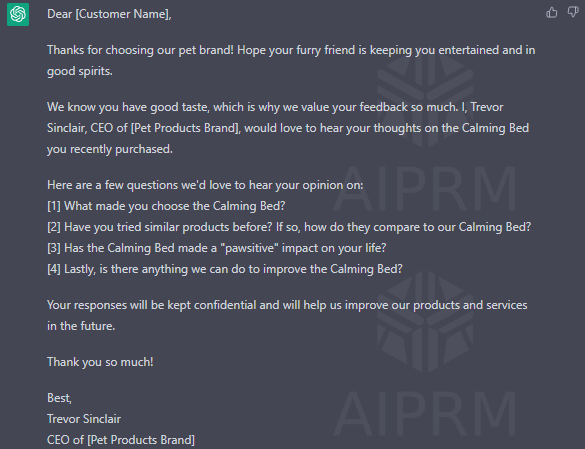
“Imagine you represent a [niche] brand that wants to improve its products based on customer feedback. Compose an email to a customer who recently purchased an [Offer] from [Brand]. In the Email, cover the following points:
Thank the customer for their recent purchase and express your appreciation for their support.
Ask the customer to share their thoughts on the product.
Ask the following questions in the email:
What made you choose [OFFER]?
Have you tried similar products before? If so, which ones and how do they compare to [OFFER]?
Has [OFFER] made a positive impact on your life? If so, how?
Is there anything we can do to improve [OFFER]?
Assure the customer that their responses will be kept confidential and will help you improve your products and services in the future. Lastly, thank the customer for the feedback. Use [niche] puns and write as if you’re talking from friend to friend.”
The Ultimate ChatGPT Subject Line Formula
Here’s a powerful formula that can significantly increase the chances of your emails getting opened:
Curiosity + Self-Interest = lots of opens.
John Caples, a legendary copywriter, and author of Tested Advertising Methods, introduced this formula.
Next, we’ll discuss how you can apply this formula to your email subject lines.
ChatGPT Subject Line Generation Prompts
Here are some email subject line prompts you will love.
1. Deconstruct + Repuporse
If you already have a list of effective subject lines, you can ask ChatGPT to repurpose them for your niche + audience.
I got my hands on these:
At-home workouts don’t work, unless…
Top 4 beginner workout “errors” revealed
Maybe the laziest way to double your fitness results
Add This to Your Coffee for Health
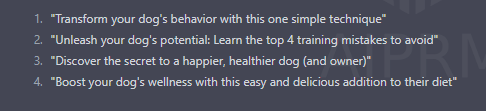
Next, I asked ChatGPT to repurpose these subject lines for a dog audience (and what they care about). This is where you insert the expertise we gathered from the survey!
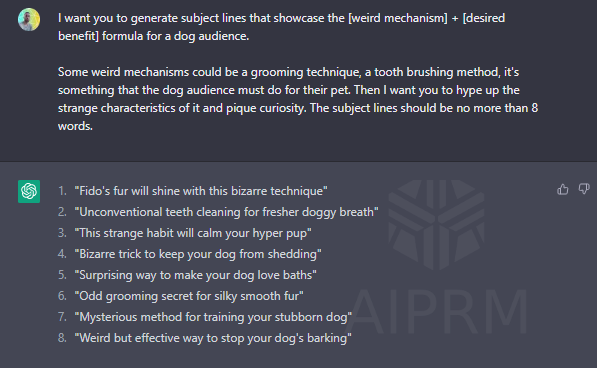
2. Weird Mechanism + Desired Benefit
A weird mechanism is an unconventional way to achieve a desired benefit. For example, when people encounter something unexpected or unusual, they’re more likely to take notice and investigate further.
Here are some examples of subject lines that showcase the [weird mechanism] + [desired benefit] formula for a dog audience:
“Weird doggy treat banishes bad breath (and improves their mood)”
“Tibetan method trains dog to clean up their toys”
“Strange Tibetan secret gets your dog to love crate”
Next, use this formula to instruct ChatGPT to generate subject lines for your niche. Again, it’s best to prompt ChatGPT with relevant examples to your audience.
Lastly, emphasize the goal to pique curiosity, and voila!
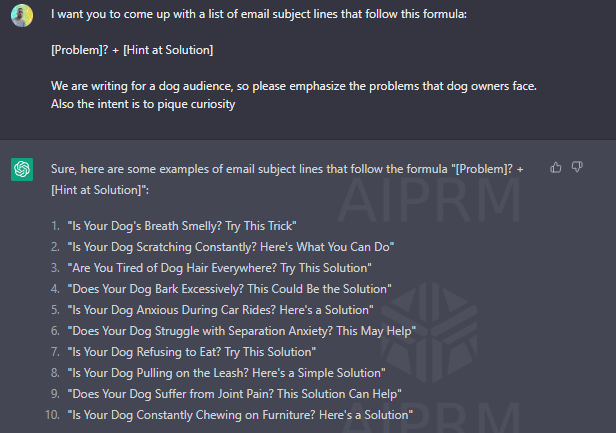
3. Problem + Hint at Solution
This classic space ad formula is one of my all-time favourites.
Here’s how it goes: you start with a specific problem and then drop a hint at the solution. After that, it works like a charm.
Sure, you might see a dip in open rates, but the specificity of the problem can lead to more clicks and conversions.
Here are some examples:
Tired of being tired? Natural cure
Can’t focus? Do this!
Now, you can instruct ChatGPT to follow the formula I’ve provided.
Make sure to add context surrounding the following questions:
Who are you writing for?
What do you want to emphasize?
What is the intent of the email subject line?
How To Hook Email Readers with ChatGPT (From The First Word)
You can have all the opens in the world, but if your readers aren’t hooked from the first word, they don’t read the rest of your email. They aren’t going to buy anything, either!
So, what’s the secret to getting your readers to dive right in? That opening line has got to be on point.
Here are a few rules to hook more readers:
It should be congruent with your subject line
Keep it short and sweet
Stimulate curiosity or promise a benefit, or better yet, both!
1. Open with a Surprising Fact
First, try opening your emails with a surprising fact; ChatGPT can help you. Facts can capture readers’ attention and pique their curiosity, making them more likely to read on. (We go into detail on how to find facts with ChatGPT).
2. Lead with an Irresistible Story
Next, ask ChatGPT to craft an irresistible story, but ensure it’s centered around your subscriber. For maximum impact, the story should demonstrate how your reader can gain a desired benefit or avoid pain or problem they fear.
Using ChatGPT for Email Marketing (Prompt and Email Ideas)
Here are some ideas for you to try with different types of emails.
1. Re-Engage a “Dead” List
Do you have an email list that’s been idle for a while? I have a template that can help you out.
Before you blast emails using these ChatGPT prompts, re-engage your “dead” list.
The power of this template is to make your email heartfelt.
Begin by admitting, “Hey, I know I haven’t honoured my end of the bargain,” so that your subscribers know you’re a genuine person who realizes you haven’t delivered the emails your subscribers signed up for.
From there, emphasize the value (or the promise of value soon) you’ll provide. It could be new product launches or exclusive tips and tricks that your subscribers will appreciate.
However, giving subscribers an easy way out is crucial if they prefer to opt out. This shows that you respect their time and inbox and empowers them to take control of their relationship with you.
So look at the template below, customize it, and let’s revive your email list!
Start with a greeting and introduce yourself.
Acknowledge the lapse in communication and apologize for it.
Emphasize the importance of consistency and engagement in building relationships.
Reiterate your content’s value and express your commitment to providing more of it.
Offer either new content/resources or a question to engage the subscriber and encourage a response.
End by thanking the subscriber and offering an opportunity to unsubscribe if they are no longer interested.
2. The Welcome Email
Your welcome Email is the workhorse of your business emails. It’s like a first date that determines the course of your relationship with your subscriber. Will they see you as a trustworthy friend or leave you in their inbox with hundreds of others?
Don’t forget to include all of these ingredients in your Welcome Email to make sure it’s a success:
Make a great first impression
Set expectations
Request action
Polarization
Be bold and come out and say what you stand for (or against). Alexander Hamilton stated, “Those who stand for nothing fall for everything.”
If some people unsubscribe at this stage, that’s a great thing! The objective here is to build a list of people who are aligned with your core values and feel a strong connection to you.
Here’s a prompt to get you started:
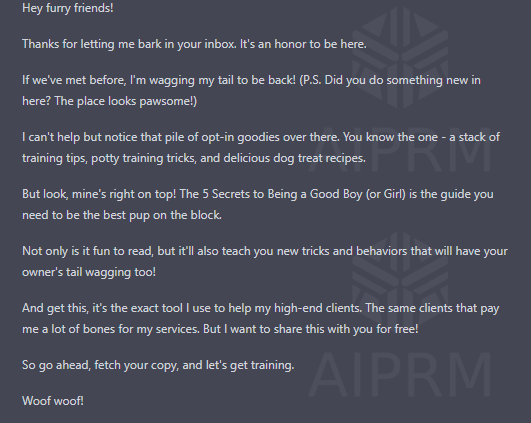
Briefly acknowledge and compliment the recipient on inviting you to their inbox, making them feel good about their decision to invite you in.
Acknowledge any previous interactions with the recipient and express excitement to continue the relationship.
Here’s where you mention your freebie. Use this section to overcome the major objection we all must overcome: recipients downloading “freebies” and totally ignoring them.
Use authenticity, storytelling, humour, and tone to connect with the recipient and make your message memorable.
Reinforce the benefits of the content or resources you’re offering and how they can help the recipient achieve their goals.
End with a clear call-to-action, directing the recipient to consume the resource.
And here’s the output!
If you’re struggling to tweak the prompt, don’t be afraid to take my output and use the “Deconstruct + Repurpose” method I highlighted in the subject line section above!
3. The Hold my Hand Email
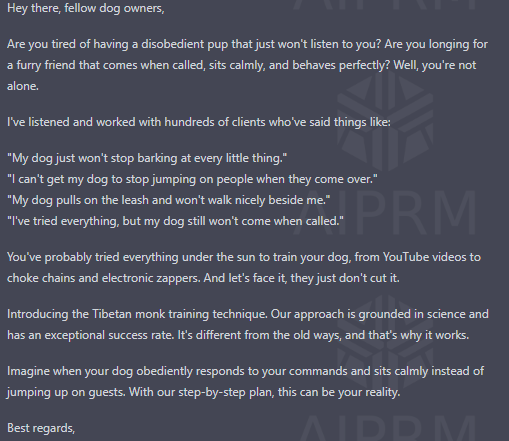
Now, let’s write a killer “Hold My Hand” email that speaks to those sceptical, jaded, and burned-out subscribers. These prospects want results but feel overwhelmed and confused about how to get there.
Now, the conflict between desire and doubt is something that many buyers face in any market – whether it’s weight loss, dating, business, dog training, or beyond. It’s a tough nut to crack, but it’s not impossible.
The “Hold My Hand” Email is your secret weapon in this battle.
Here’s the structure:
Reaffirm the benefits your subscribers want to achieve. What are their hopes and dreams? What motivates them to make a change in their life? Or what pain are you helping them avoid?
Acknowledge the roadblocks to success that your subscribers have faced in the past. What fears and anxieties have held them back? By acknowledging these roadblocks, you can show your subscribers that it’s not their fault they haven’t achieved the results they want.
Use your subscribers’ words to show that you understand their fears and anxieties. This is a powerful way to build rapport and establish trust.
Amplify their desire by using future pacing to paint a vivid picture of what your subscriber’s life will be like. Use “Imagine If” statements to help your subscribers visualize the positive outcomes of their hard work and dedication.
Finally, link to your offer (program, coaching, etc.) and promise a step-by-step plan or method to help your subscribers achieve their goals. You’ll want to show your unique process, so things will be different this time.
ChatGPT A/B Testing Prompts
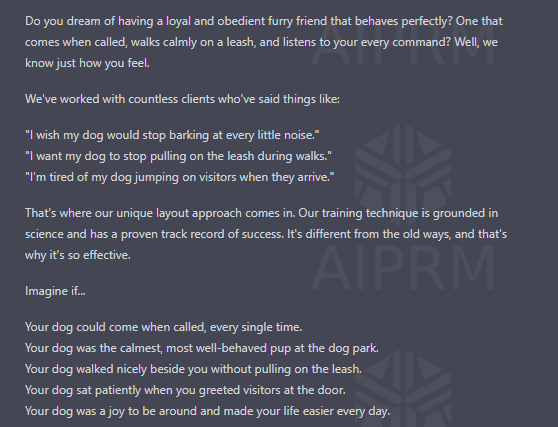
Remember my “hold my hand” Email? Well, I asked ChatGPT to give me a variation.
Specifically, I wanted to test a different layout structure and add some “imagine if” statements to get the reader to visualize the desired result of their dog behaving perfectly.
So I kept adding more “imagine if” statements until I had a total of 5!
You can also refine an email by switching up the tone.
While you could ask ChatGPT to switch the tone to “persuasive” or “witty,” aiming for the best in the business is even better.
And who are the best in the business? This list identifies the top 20 copywriters who make the most money. Names like Joe Coleman and Laurence Blume are at the top of the list.
Using AI Templates (With Jasper)
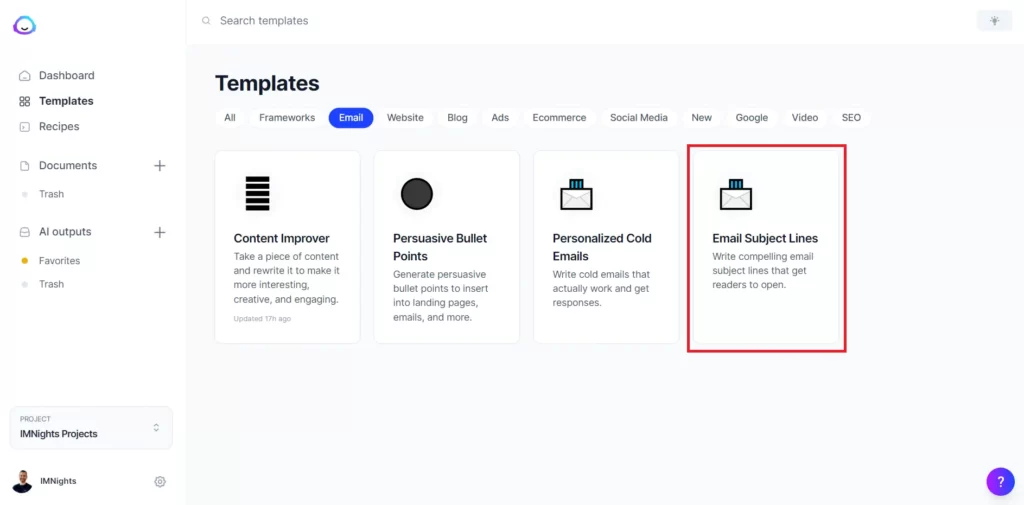
With Jasper, you can forget about spending hours brainstorming and crafting the perfect email copy. Instead, you can leverage its pre-programmed templates to create killer emails in minutes.
I know what you’re thinking: “But Trevor, what about ChatGPT?”
Well, my friend, while ChatGPT is great for generating original content, Jasper’s templates can save you precious time and effort.
It has specific templates you can leverage for both subject lines and email!
Jasper also has an awesome document editor and Boss Mode, so you can write and switch between templates in one place.
ChatGPT For Email Marketing (Feedback and Compliance)
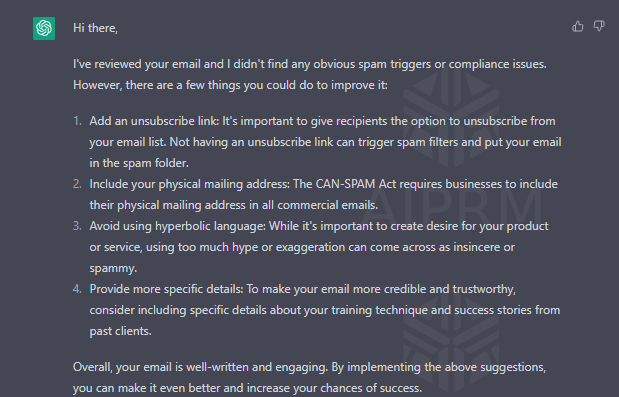
One of the best ways to get feedback on your writing is by using ChatGPT. For email marketing, this can be especially helpful to ensure that your emails are not triggering any spam filters or violating compliance issues.
Simply provide ChatGPT with your Email and ask for suggestions on improving it.
For example, I asked ChatGPT, “Can you please look at this email and point out any spam triggers or compliance issues that might be contained within it? How could I improve it?”
ChatGPT For Email Marketing – Final Thoughts
While ChatGPT can be a valuable tool in email marketing, it’s important to remember that it’s not a substitute for understanding the fundamentals of email marketing, copywriting, and your audience’s needs.
It’s important to remember that ChatGPT is only as good as the information and guidance it’s given. You will be head and shoulders above the average email copywriter using the tips I’ve provided in this article.
So, use ChatGPT wisely and clearly understand its limitations, and you’ll be on your way to crafting successful email campaigns that resonate with your audience.
Koo, a social media app developed in India that pushes itself as a Twitter replacement, is deploying ChatGPT smarts to prop its appeal. The company says Koo is the “first microblogging platform in the world” to integrate ChatGPT to boost the creative flow. Koo follows in the footsteps of Snapchat in deploying ChatGPT for some cutting-edge AI bragging rights.
At the moment, the ChatGPT integration is only available to creators with a sizeable following or those with a verified badge. However, it will soon be available for everyone without any follower count restriction. So far, the company hasn’t said anything about charging users for the feature, or whether it might be moved to a premium tier in the near future, considering the fact that OpenAI’s viral tool is embracing the API route for commercial usage.
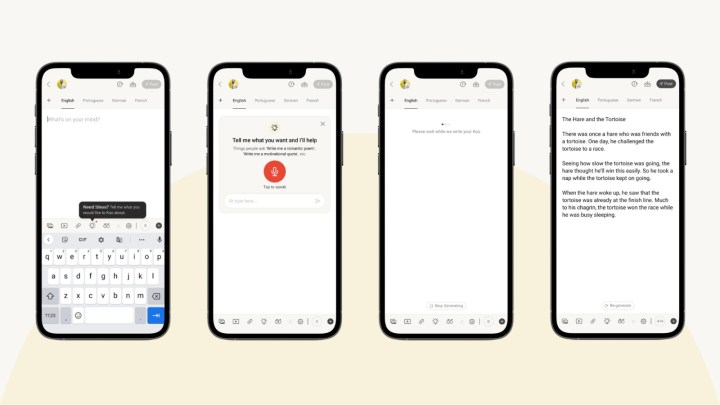
Koo
Aside from text prompts, Koo users can also use the voice dictation feature to interact with the AI. The draft section of Koo app will let users accomplish tasks like “finding the top news of the day or asking for a quote from a well-known personality or even asking for the post or a blog to be written.” The latter is worrisome, which I’ve briefly discussed below. There’s also some precedent for that out there with apps like Paragraph AI doing everything from generating content in various styles to taking over even your messaging app conversations.
Koo is pushing itself as a Twitter alternative and says it has accumulated over 50 million downloads … but hasn’t disclosed the number of users. However, it looks like the Koo is trying to boost its appeal by recruiting the hottest new tool on the internet, one that will also be immensely convenient to churn out human-like thoughtful content in bulk — which is again the easy route to grabbing more eyeballs.
The diminishing human touch
Dall-E / OpenAI
Social media is inherently a place for communication, but over the years, it has blossomed into a content juggernaut that is driving billions in revenue. And it’s not solely multimedia content like videos that are pulling in serious money, but it’s also text-based content (such as threads as well as newsletters) that is attracting some sizeable revenue.
With generative AI tools like ChatGPT coming into the picture, it is only a matter of time before text content generated using ChatGPT will flood social media platforms. The likes of Twitter, Instagram, and Facebook are already brimming with AI-generated artwork and videos. Worryingly, with tools like ChatGPT, even the barrier of copy-paste will vanish.
Social media platforms — despite all their perils like hate speech, harassment, and outright misinformation — are still a place where one can marvel at the results of human creativity. Be it jokes, puns, or just some good old-fashioned commentary, we at least get a few chuckles at the result of real human ingenuity.
With creators churning out content using ChatGPT — as Koo is advertising — it seems we are entering a new age of social media where it would be nigh impossible to discern if the joke you are laughing at is a human creation or AI-generated. For the latter scenario, it seems like a deception to me, especially if such content is shared without explicit disclosure.
ChatGPT is AI’s version of the Wright Brothers’ first flight. It has completely changed our perception of what technology can do. Suddenly, it’s possible to ask a computer complex, and often very esoteric questions, and receive a response that strongly resembles the work of another person. But it’s an imperfect tool and businesses should not rely on it to write website or blog copy, thought leadership articles or other content.
All artificial intelligence systems work the same way. They are ‘trained’ with a sample of data that they categorise using rules. ChatGPT has been trained with a massive set of data and about 175 billion parameters. It differs from other AI models because it also uses human feedback during its training so the risk of harmful, false, and biased outputs is reduced, although it’s not completely removed. This makes it more accurate than other AI models — but it’s not perfect.
Here are five reasons why it might be dangerous for your business to rely on ChatGPT as your new copywriter:
1. ChatGPT lacks style
While this all sounds great — and it is a massive step forward — we need to remember what ChatGPT can’t do. Because it’s been trained with a specific set of data, the answers it can give are a reflection of that data. So, you could ask ChatGPT to write a sonnet in the style of Shakespeare, but it can not create its own style. If you want your words to sound like they come from your business, are consistent with your brand messaging, tone and identity, you’ll need to write them yourself.
2. Contextual awareness
When you’re writing copy for your website, a blog article or for publication with the media, specific context matters. While ChatGPT has probably “read” more data than any one person could in a lifetime, it doesn’t understand the context of those words, where they have been used or where they may be used in the future. ChatGPT’s understanding of context is based on how frequently words occur close to each other rather than real situational awareness. ChatGPT is not cognisant of shifts in social expectations and may offend sections of the community, leading to your business being embroiled in a controversy that impacts your reputation negatively.
3. It makes mistakes
ChatGPT may seem all-knowing but it’s not infallible. The Stack Overflow website, which is used by coders to answer questions about programming, has banned answers from ChatGPT because they are often wrong. The big problem, according to the site moderators, is “that while the answers which ChatGPT produces have a high rate of being incorrect, they typically look like they might be good”. While ChatGPT may be useful for initial research, it is not 100% trustworthy. There have been many examples where ChatGPT makes up facts and cites fabricated research. ChatGPT’s “facts” have to be independently cross-referenced to ensure you are not releasing content that is found to be fake, wrong or misleading as this can make your business look incompetent or worse untrustworthy and a proponent of fake news that lead to legal issues.
4. Jack of all trades…
The saying “Jack of all trades, master of none” applies to ChatGPT. While ChatGPT has an approximate knowledge of many things, it is not a subject matter expert. The people in your business are the experts in specific fields. When writing content to support your business, you will lean into your understanding. This will often go beyond facts. Great writing is a reflection of experience as well as information. ChatGPT can give you facts, with varying degrees of accuracy, but it doesn’t have your experience.
5. Sources and a legal unknown
ChatGPT is based on another AI tool called GPT-3. This was trained with millions of books as well as data from internet databases and other sources. According to its creators, OpenAI, it has learned by reading about 300 billion words. When ChatGPT returns an answer you have no way of knowing what sources it used and, unless you do some follow up, whether its responses are actually original. This could lead to legal issues like those Dall-E, the image processing equivalent of ChatGPT, has faced.
ChatGPT can be a helpful tool. Like Wikipedia and other online resources, it can be a useful starting point for research or to get ideas. But it can’t replace the creativity, awareness and experience that human writers bring.
Anthony Caruana and Kathryn Van Kuyk are co-CEOs of Media-Wize.
One of the hottest topics on the net right now is how to make money with ChatGPT. Our article discusses 13 simple ways to use the AI tool to make money. And we’ll provide a few practical examples of what to do to get what you want from the AI.
Open AI, co-founded by Elon Musk and headed by CEO Sam Altman, created ChatGPT based on GPT-3.5 (Generative Pre-Trained Transformer) technology. The AI chatbot is remarkably capable of engaging in real conversations and responding with astonishingly human-like text.
ChatGPT is exciting and opens up endless possibilities for how we interact with technology.
Our List of How To Make Money With ChatGPT
A large language model can predict the next word and generate written content.
ChatGPT learns to follow instructions and provide appropriate responses to humans using RLHF (Reinforcement Learning with Human Feedback). RLHF is a fantastic extra training layer. ChatGPT is a great example of how the field of NLP (Advanced Natural Language Processing) is advancing exponentially. This new natural language model allows users to have real conversations with a machine more intuitively and naturally.
Keep in mind the importance of crafting clear and detailed prompts when using ChatGPT. It’s not so much that you have to train the AI bot. Rather, you have to train yourself in what you should ask it to do, how you phrase your requests, how much detail you need to provide, etc.
You’ll need to carefully review what ChatGPT writes and then review the instructions you’ve given it. Keep adding or changing until you get the correct answer. You can also use a great tool called Originality.ai (still in beta at this stage) to check your work. It helps by assessing the text for % AI-generated content and plagiarism.
ChatGPT is a very powerful and large AI system, yet some generated information may be inaccurate. Edit anything and everything it produces and check the facts.
1. Create Videos Using ChatGPT
You can combine ChatGPT with other technologies to create videos you can sell to make money. Use these programs together and cleverly to make excellent videos.
Below are some examples of these technologies.
Pictory, Murf.ai, Speechify, etc., use AI technology to automatically turn long-form text and video content into short videos. Short videos are great for social sharing, product recommendations, explainer videos, product demos, or other marketing videos. And ChatGPT is the perfect tool to create the right scripts or video instructions.
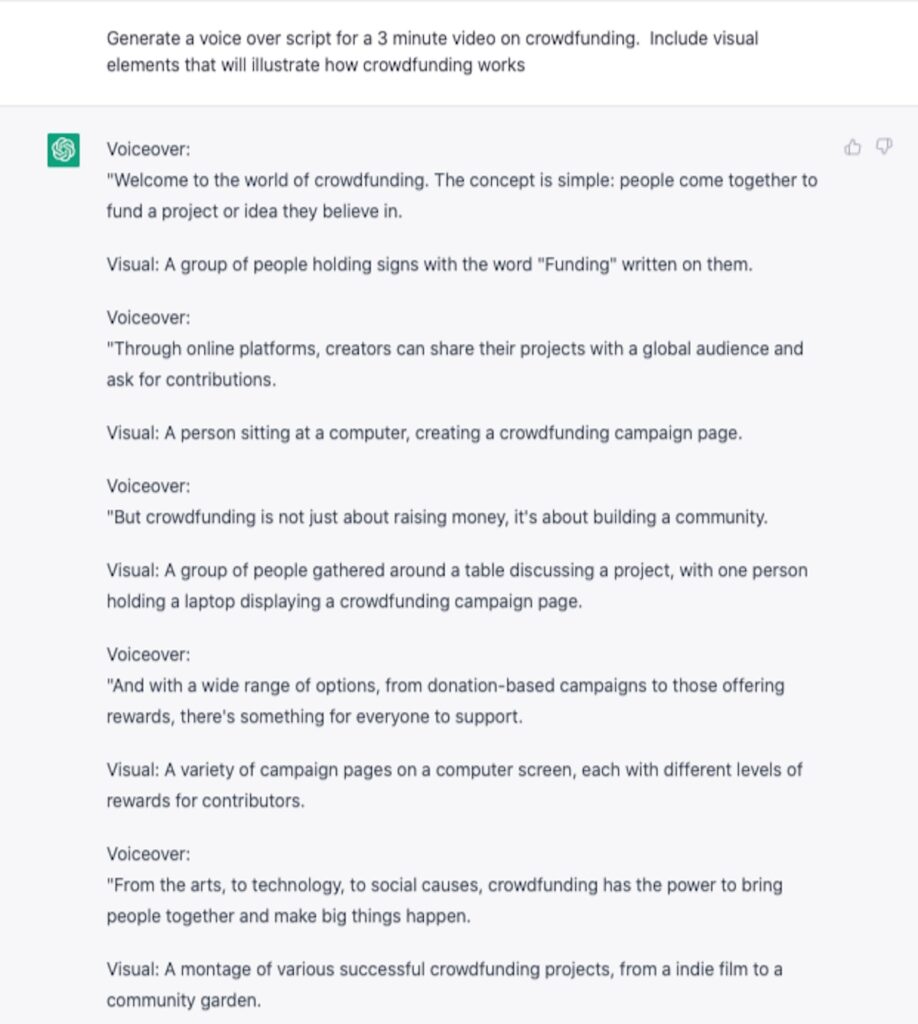
Once you’ve created your video, you need voice-over. ChatGPT can create voice-over scripts. And text-to-speech technologies can transform them into the voice-overs you want.
How to make money online with ChatGPT? You could use ChatGPT to generate scripts or instructions to create visual elements of the videos and scripts for professional-sounding voice-overs.
Below is an example of a voice-over and video script that took seconds to generate. Adding more detailed instructions will get the best results. You can also add the keywords you’ll need for SEO.
Video production is always in demand; people generally prefer watching rather than reading.
2. Update Video Descriptions
YouTube gives us about 5000 characters or around 500 words for video descriptions. It’s usually the first 150 characters that will show in your search results. This is the part that has the most impact on what the audience does, and YouTube classifies it for SEO purposes.
Copy and paste your existing video description in the ChatGPT prompt and instruct it to rewrite. Make sure ChatGPT uses the simplest language possible, writes no more than 150 characters, and includes what the video is about from an SEO standpoint.
YouTube’s default sorting algorithm is by relevance. So the more relevant you can make the title to the search query, the more likely it is to appear in a search.
Once you get used to the instructions you need for ChatGPT to update YouTube video descriptions, it can almost become your virtual assistant. You can offer your services as a description updater and SEO optimization specialist.
Bear in mind there are billions of videos on YouTube; if you market your services well, you should get plenty of work.
3. Offer Copywriting Services
Copywriting can be tedious, especially if you have to write day in and day out. I find that ChatGPT helps with inspiration or writer’s block. A content creator crafting persuasive and effective copy that will convert often just needs a push or a new direction.
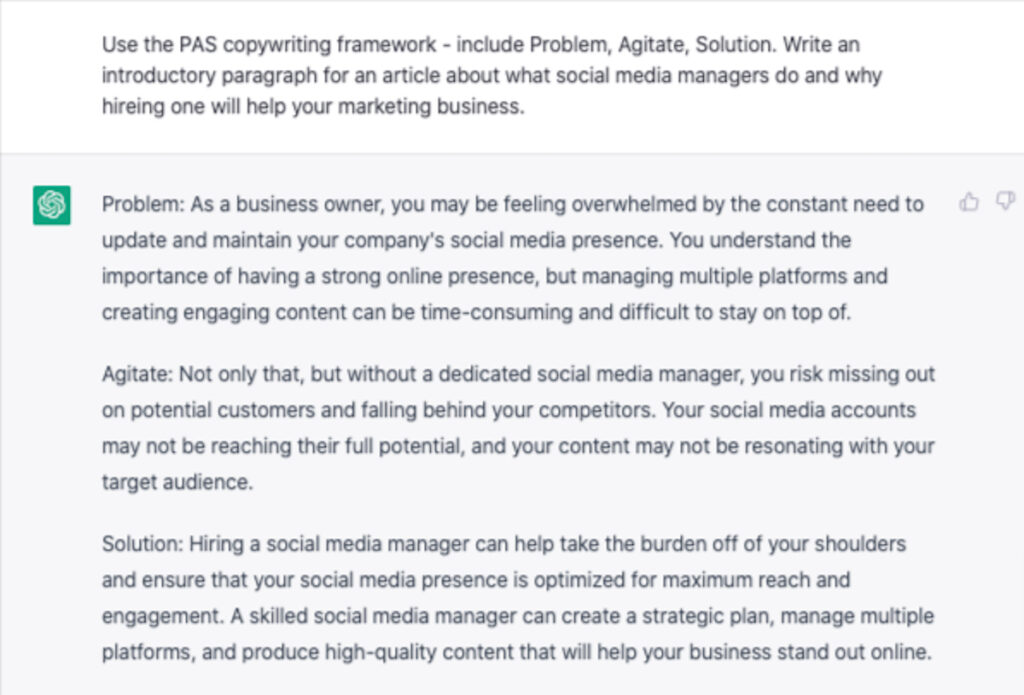
You can instruct ChatGPT to write using specific copywriting frameworks like PAS, AIDA, and BAB. For example, use prompts such as:
Generate a PAS (Problem, Agitate, Solve) for this written content.
Write a BAB (Before, After, Bridge) about this topic.
Create an AIDA (Attention, Interest, Desire, Action) for this article.
Get the AI to rewrite till you get something close to what you can use. Then you can offer professional copywriting services, whether it’s website copy, product descriptions, or ad copy.
By using ChatGPT to assist you, you can generate copy much faster.
4. Write and Self-Publish E-Books
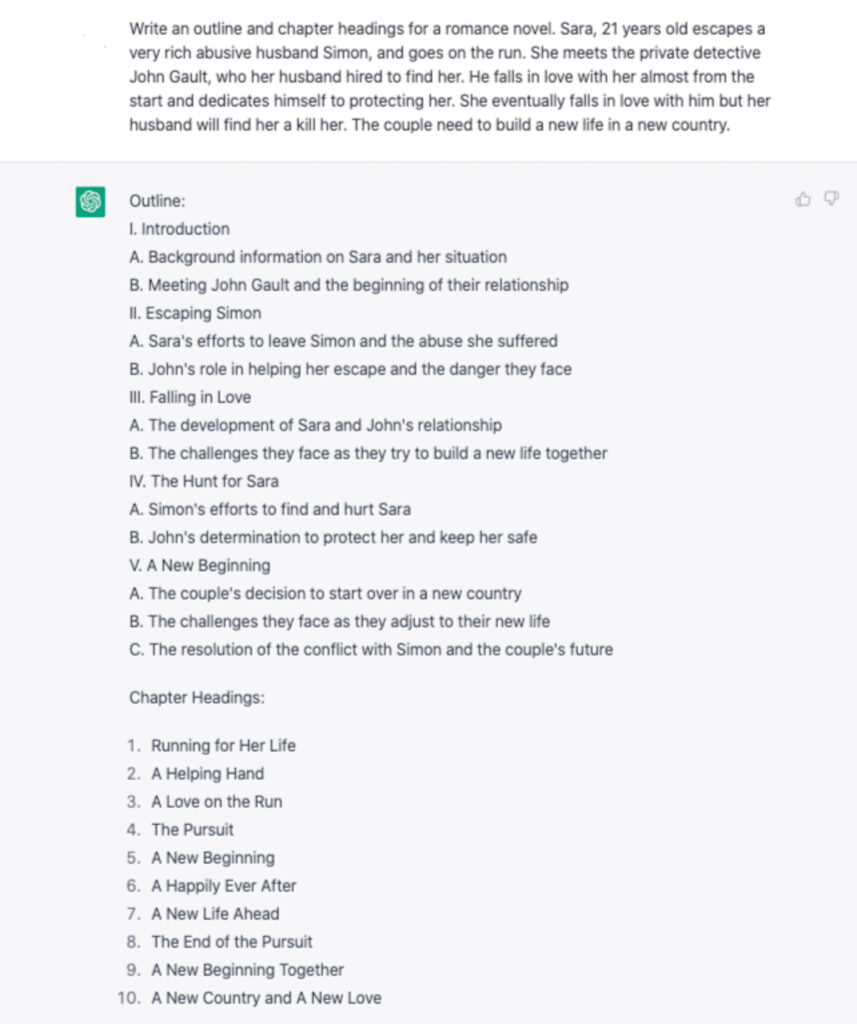
Trying to get ChatGPT to write a full-length fiction novel is a time-consuming process. You need to work with the AI to get what you want and keep refining your prompts. Below is an example for a standard romance novel.
Romance novels are great sellers and are pretty formulaic. Once you get used to the formulas and which person in the novel is the hero, you can quickly write and sell romance books.
Keep going with ChatGPT. If you’re persistent, prepared to do the work it can’t, and patient, ChatGPT may be the answer to making money faster in writing E-books.
5. Offer Translation Services
Language translation seems straightforward, but there is much more to it than meets the eye. To successfully translate text, you have to consider cultural subtleties, technical words, purpose, audience, etc.
Since ChatGPT is a machine learning model, you can train it to translate all the subtleties in languages. But it would cost a fortune and take time.
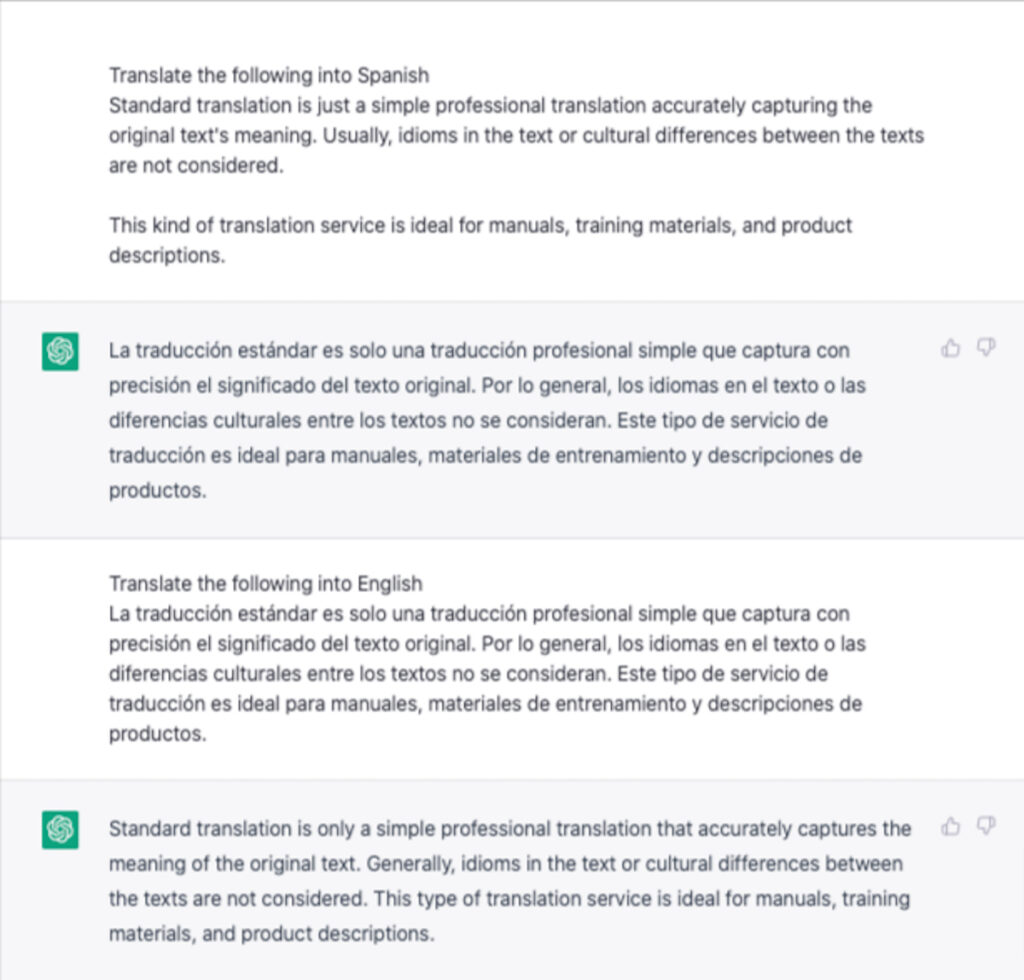
The fastest way to make money providing translation services is to offer the simplest form of translation. Standard translation doesn’t need idioms or cultural differences in the text. So you can use ChatGPT to translate manuals, training materials, and product descriptions which are massive areas of opportunity.
For example, if you want to test ChatGPT’s abilities, choose a paragraph that’s easy to check. In the example below, a paragraph on standard translation written in English is translated into Spanish.
To check the accuracy of the translation, you could check with Google Translate or ask ChatGPT to translate the generated Spanish back to English and compare the two.
If you look at the example below, the comparison was perfect, with only one word different from the original. This means you could do standard translations without knowing the languages at all.
6. Generate Business Names and Slogans
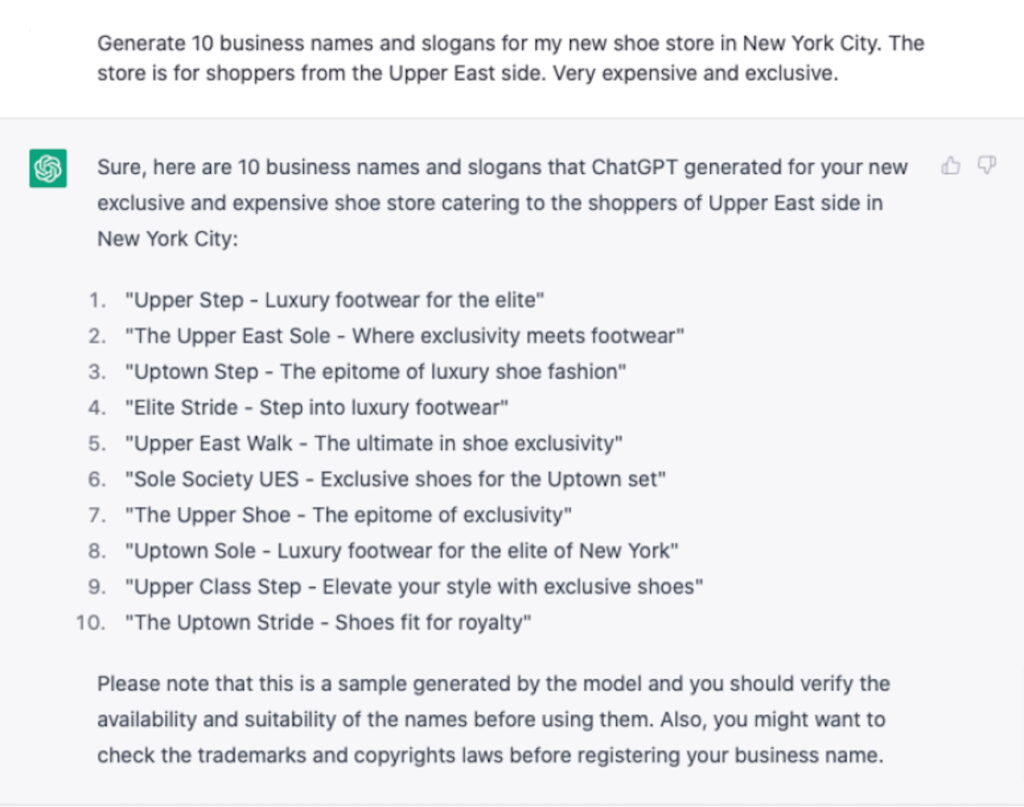
It is relatively easy to generate business names and slogans using ChatGPT. You could always follow a guide like how to name your business. But you could also prompt the AI model with details on what you want, who the name and slogan are for, location, financial demographic, etc., and it will generate suggestions based on its training data.
For example, ask it to generate ten business names and slogans for a new shoe store in New York City.
It only took a few seconds, and it generated ten suggestions. Test them on Google first to see if there’s anything similar. Then search social media platforms for variations to see if it might already be taken. And you can do a national trademark search online for free or search state by state.
Fiverr is the best place to sell business names and slogans; finding something fresh and new with ChatGPT could help you make some money.
7. Use ChatGPT to Write Code for Simple Web Tools
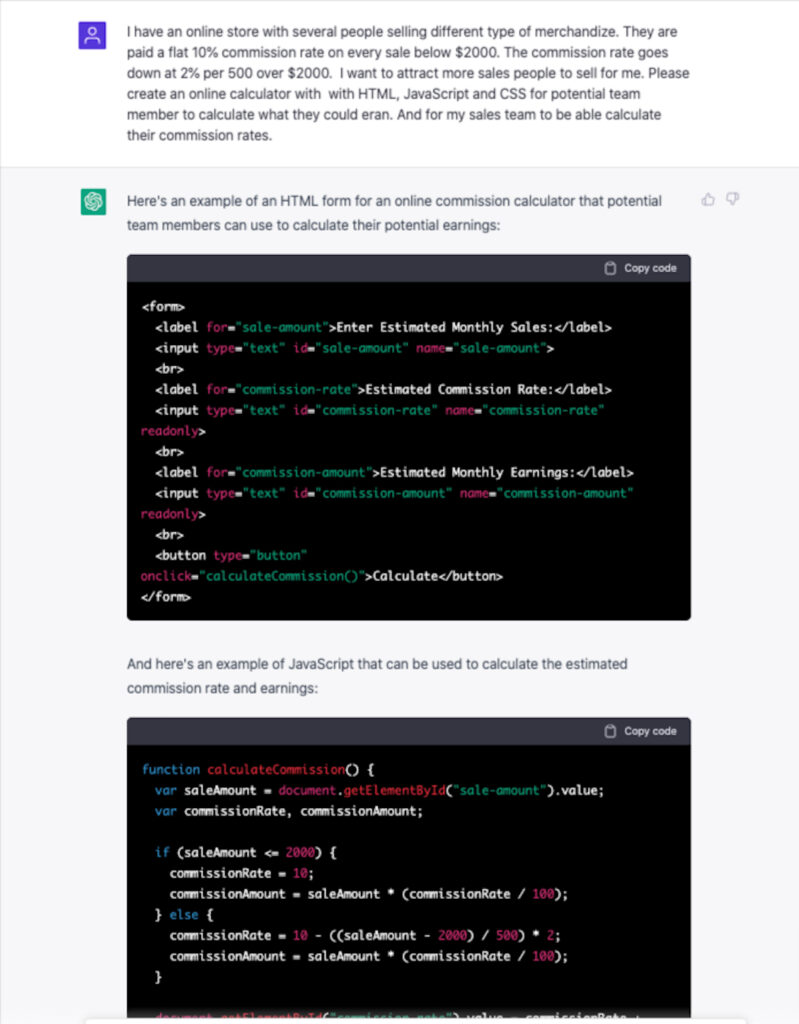
ChatGPT can do more than generate human-like text. You can use it to design web tools for your website. For example, if you need a calculator that your sales team can use to calculate commission, ChatGPT can create one for you. And if your commission rates change, it takes very little time to change them without paying someone to do it.
8. Blogging
As we all know by now, clear, detailed instructions are necessary for ChatGPT to produce high-quality content that is more likely to be highly original or adopt a certain point of view. You’ll need to include the angle you want to take on the article and any relevant background information.
You have to make the blog your own though, with your own unique voice and perspective. Here you can put Originality.ai to good use by checking the percentage of AI text and plagiarism.
This one’s a bit easier since you’re not asking the AI to write new content for you but only to update existing blog post content to increase traffic. You’ll have to research SEO and decide which keywords to include. Copy and paste and let ChatGPT do the work for you.
As usual, you’re not going to get perfect output, but it can save a lot of time, especially if you need to rewrite or update multiple blog posts. Updating blog posts is essential and needs to be done often, so offering your services to do this may be highly lucrative.
10. Write Social Media Content
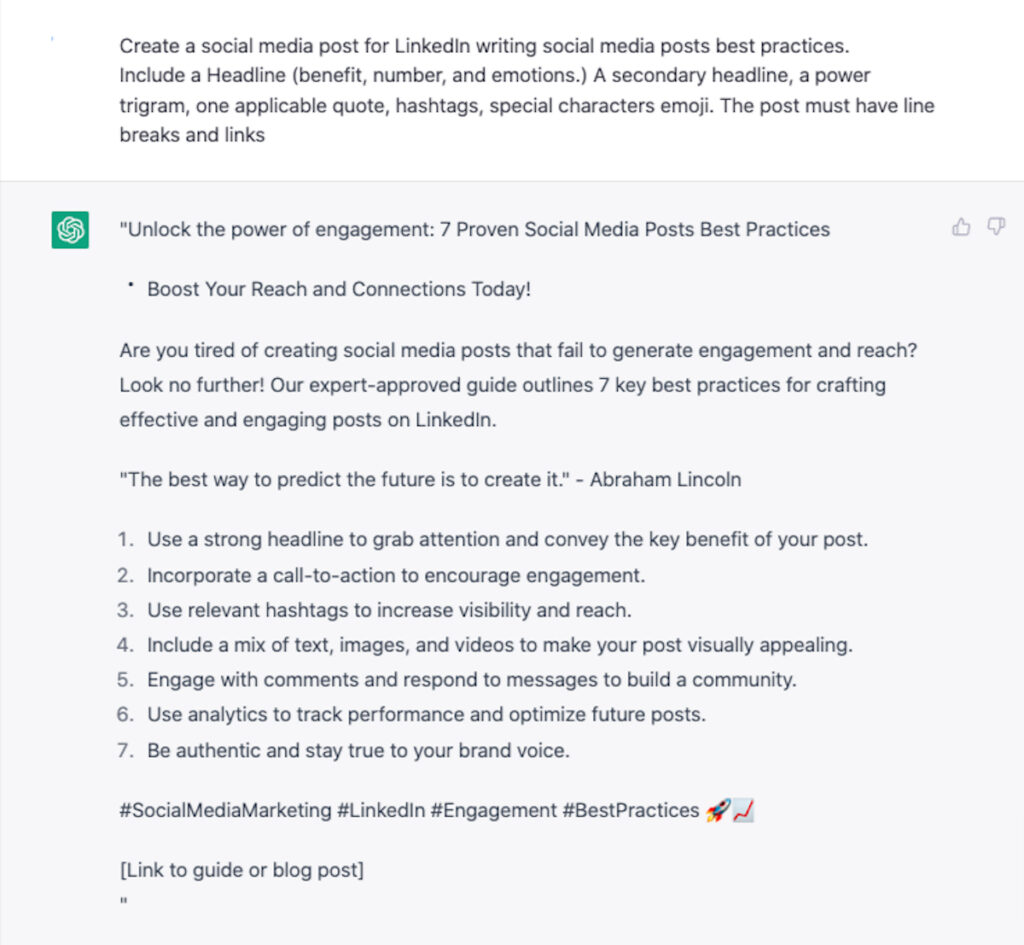
Social media posts are where ChatGPT is really impressive. Short tweets, Instagram captions, lengthy articles and postings on LinkedIn, replies, retweets, comments, and scripts from TikTok, Facebook Messenger, and YouTube Shorts are all examples of social media content writing. The shorter the post, the better the output, and it’s so fast!
Below is an example of a recent post for LinkedIn showing how much detail was needed in the query. And you’ll have to keep adding and revising.
At first glance, the output looks quite good. But ChatGPT tends to offer the same sorts of intros, such as “Are you tired of..” etc. It needed editing and personalizing but what ChatGPT gave was a good start.
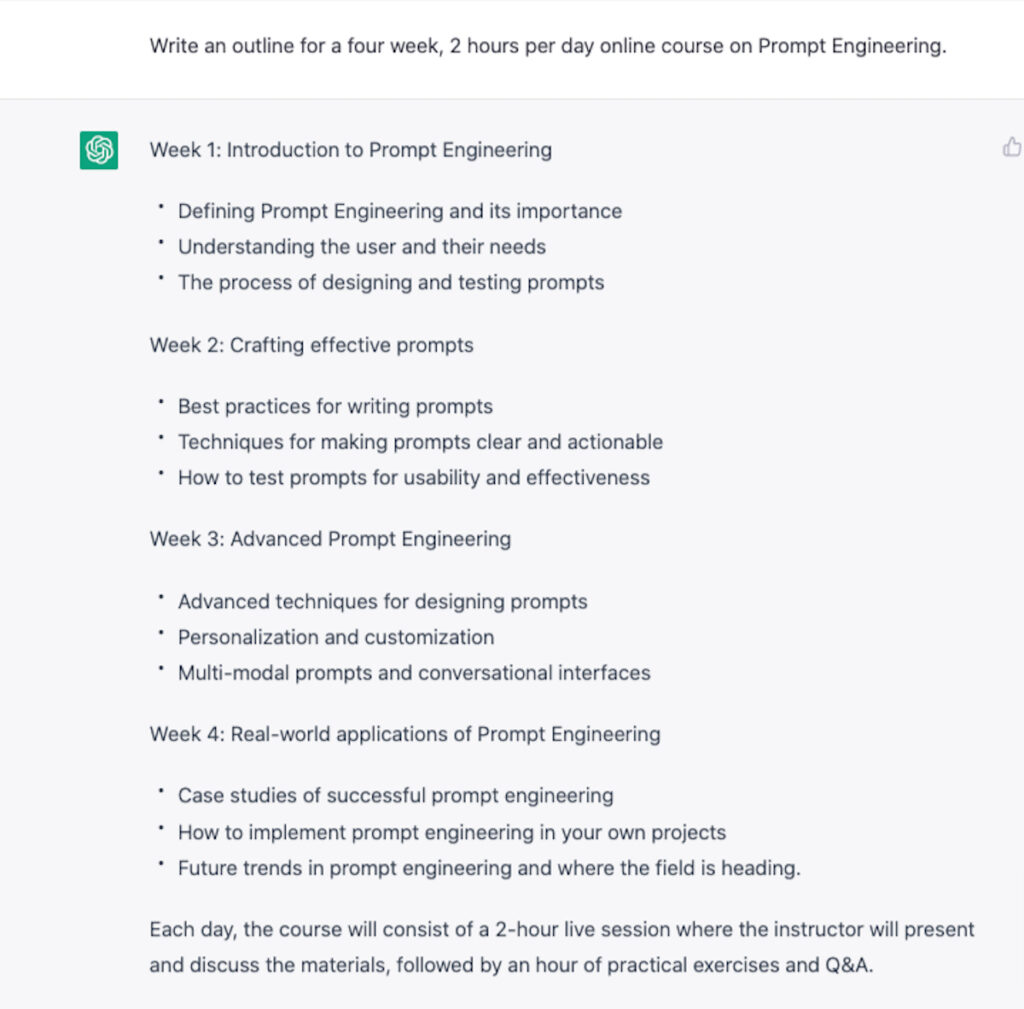
11. Create a Course and Sell it on Online Learning Platforms
Create a course using ChatGPT and video generation platforms like Synthesia, and sell it on platforms like Udemy, Skillshare, Thinkific, etc.
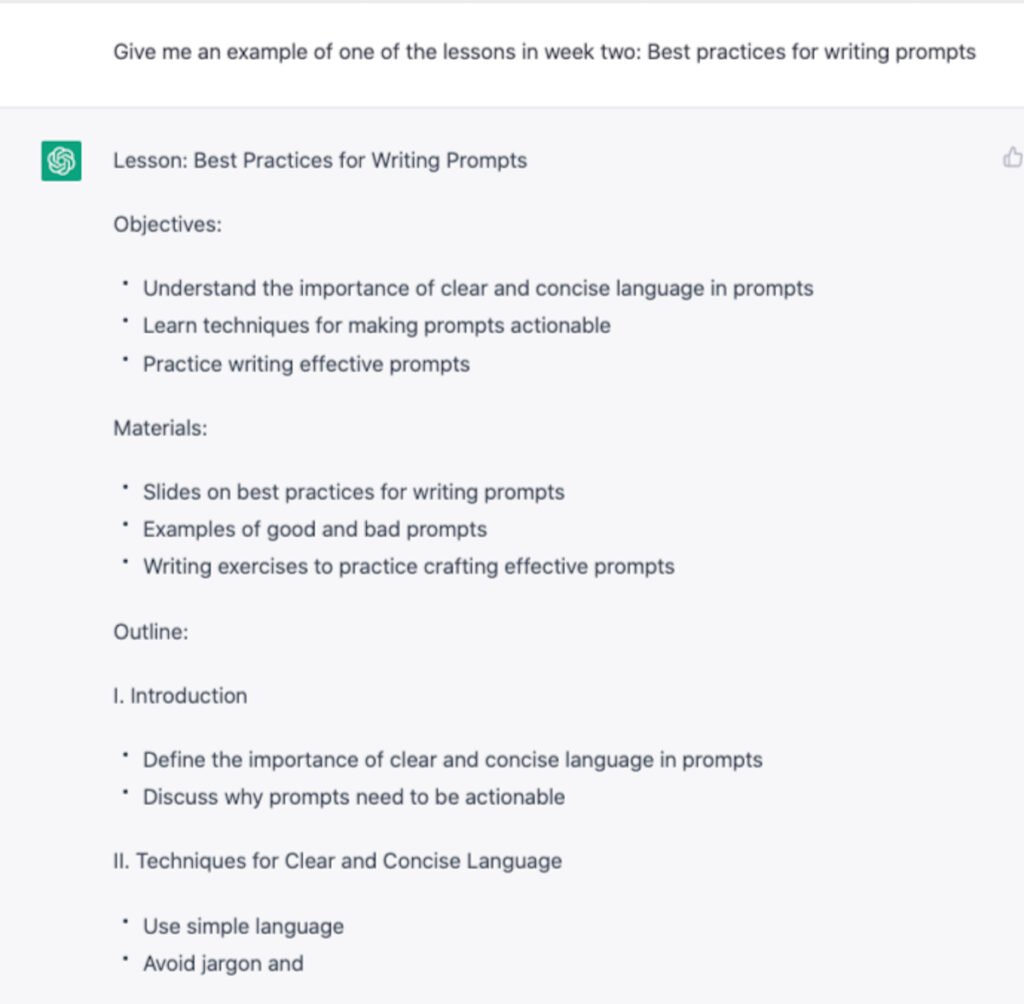
ChatGPT is great for structuring your courses. It will generate course outlines and advertising copy for you to promote your course. Use Synthesia to create multimedia content to make the course more engaging.
Below is an example of a ChatGPT outline for a 4-week – 2 hours per day course on Prompt Engineering.
12. Write Resumes and Bios
It can be exhausting to look for a job. Just the preparation you need to do before applying can feel a bit like a full-time job. You may need to:
Optimize and update your LinkedIn and other social media profiles
Update your resume
Modify your resume and short bio for each job you apply for
Use ChatGPT to write your resumes, bio, and cover letters and sell your services as an expert.
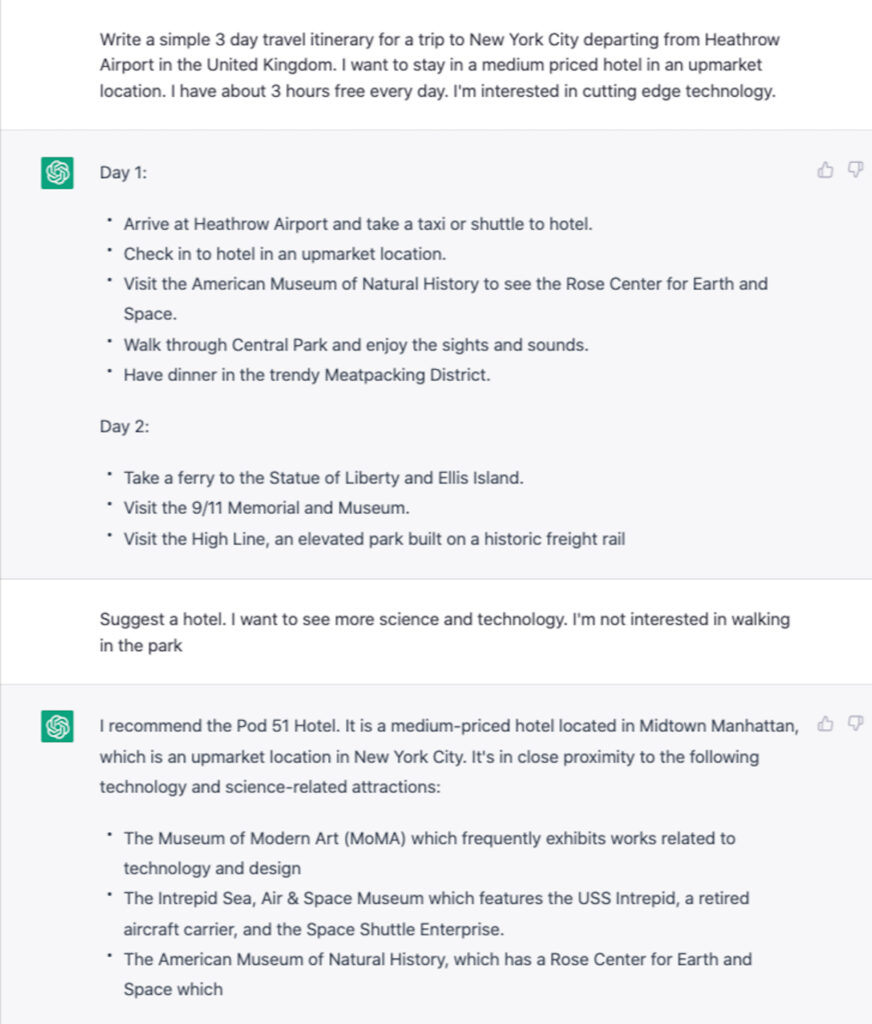
13. Offer Services Planning Travel Itineraries
Bear in mind, ChatGPT only scrapes data up to 2021. So it’s not current, and the information may not be entirely accurate.
ChatGPT is ideal for itinerary planning because of its extensive knowledge of the world’s nations, cultures, and general geography. Based on your input into the chat, ChatGPT can create and improve an itinerary with an easy level of interaction.
You can use the output as a starting point and add current logistical and price data. The results are outstanding and almost ready to use. This is a great way to use ChatGPT to make money planning travel itineraries.
Wrapping Up: How To Make Money With ChatGPT
Our article just scratched the surface of how to make money with ChatGPT. The possibilities are endless, and you can be creative about how you use it.
As always, new technology can be scary for many people. The first thing to worry about is: will the AI take my job. In some areas, yes, it will, just like any new machine that can move humans out of the way. However, it opens a whole new world of possibilities and paves the way for new job descriptions. For example, prompt engineering is already an in-demand skill set.
ChatGPT is far from perfect and what it generates often needs more editing and input than it’s worth, but it’s getting there, and you can already make money with it.
Read our article on the anticipated release of GPT-4 and how advancements in AI could help your business.
Finally, while using it is free right now, very soon, it will be monetized and expensive to use; after all, it cost billions to develop. According to the Wall Street Journal, Microsoft Corp. (an early investor in the OpenAI startup) intends to integrate ChatGPT and other artificial intelligence capabilities into its products and make them accessible as platforms for other companies to build on.
Amy is a content writer specializing in SaaS and B2B topics. When not writing, she runs a few small niche websites with her husband. They are both accomplished artists and love to travel.
In case you’ve missed the buzz, OpenAI just publicly launched its latest language generation robot, ChatGPT. ChatGPT is a powerful language model that uses deep learning techniques to generate human-like text. In other words, the robot is capable of answering all of your questions and prompts like an intelligent human would.
The model can be fine-tuned for specific tasks, such as language translation, summarization, and question answering. Here are 10 different ways you can use ChatGPT to do work for you and increase your productivity.
1. Write emails
Are you the kind of person who spends too much time thinking about what to write in emails? Say no more (to ChatGPT). By giving a simple prompt such as “write a cold email introducing myself and my company and inviting someone for a meeting,” ChatGPT will give you an example that will work just fine. Didn’t like the output? No worries, you can modify your prompt a little and ask again. The model almost never creates two identical answers.
2. Read faster
Did you forget to read important documents before a meeting? ChatGPT has your back. Copy and paste the document into the chat and ask the model to summarize the most important points for you. No one would ever suspect.
3. Summarize your own documents
Do you need to write a summary version of an article you’ve been working on? ChatGPT can summarize it. If you think the summary misses any details you find important, just say in your prompt what you want it to include.
4. Review your code
Did you spend an entire day coding but now you’re too tired to go back to review everything? Just ask ChatGPT to do it. You can ask the model to spot any possible mistakes in the code and to better organize it.
5. Comment on your code
This is probably one of the most mind-blowing things ChatGPT can do. If you give it a piece of code and ask it to make comments to explain what each block is doing, ChatGPT will give you a commented code. I know it sounds perplexing, and it is.
6. Translate research documents
If you’re a researcher like me, you sometimes find articles that seem interesting but they are in languages that you don’t speak. If you want to be sure that the article contains what you’re interested in, simply ask ChatGPT to summarize the document in the language you want.
7. Study efficiently
If you’re a student, you can use ChatGPT for your own learning. Let’s say you’ve spent the entire afternoon studying about the French revolution and now you want to test your knowledge. Ask ChatGPT to give you 10 questions about the French revolution. You can even ask it to correct your answers!
8. Create content
Content creators out there: Use ChatGPT in your favor! Simply ask the model to create content about the subject you want. Maybe the output won’t be exactly what you want, but it’s always good to have a place to start from. Take advantage of it, since everyone else is.
Personal Uses
9. Have philosophical discussions
Maybe you’re really into a niche topic but have no one to talk to, or you have a deep philosophical question but have no idea who has written about it before. ChatGPT can be your new mentor. Ask broad questions and wait for comprehensive answers. For instance, you can ask “Is there meaning in life? What are some philosophical stances on that topic?” I’m sure the answer will entertain you for at least an entire afternoon.
10. Play games
The games ChatGPT can play are still unknown territory. But you can always explore. Users have reported successfully playing tic-tac-toe and chess with the model. I have played a version of Akinator, a game to try to guess which character the other person is thinking of by asking questions that can be answered only with yes or no. Can you think of other games that the model might be able to play?
Everyone’s asking ChatGPT to do something for them — which is no surprise, since artificial intelligence is expected to be a game changer for business in 2023.
If you’re unfamiliar with the tool, imagine typing a question into Google’s search bar, but rather than sending you to a highlighted answer followed by pages of search results, it talks back in a private chat window. It uses stored information from books, articles, and websites to give you an answer, in complete sentences and paragraphs.
ChatGPT may be able to write an English essay, but there are some things it can’t do, like help you start a business.
While it’s very smart, ChatGPT is only a chatbot; I knew it couldn’t physically start a business for me. But I wondered if it would at least walk me through the initial steps.
So I asked this AI program a series of questions about starting a business.
Here’s how it went.
8 generic steps for starting a business
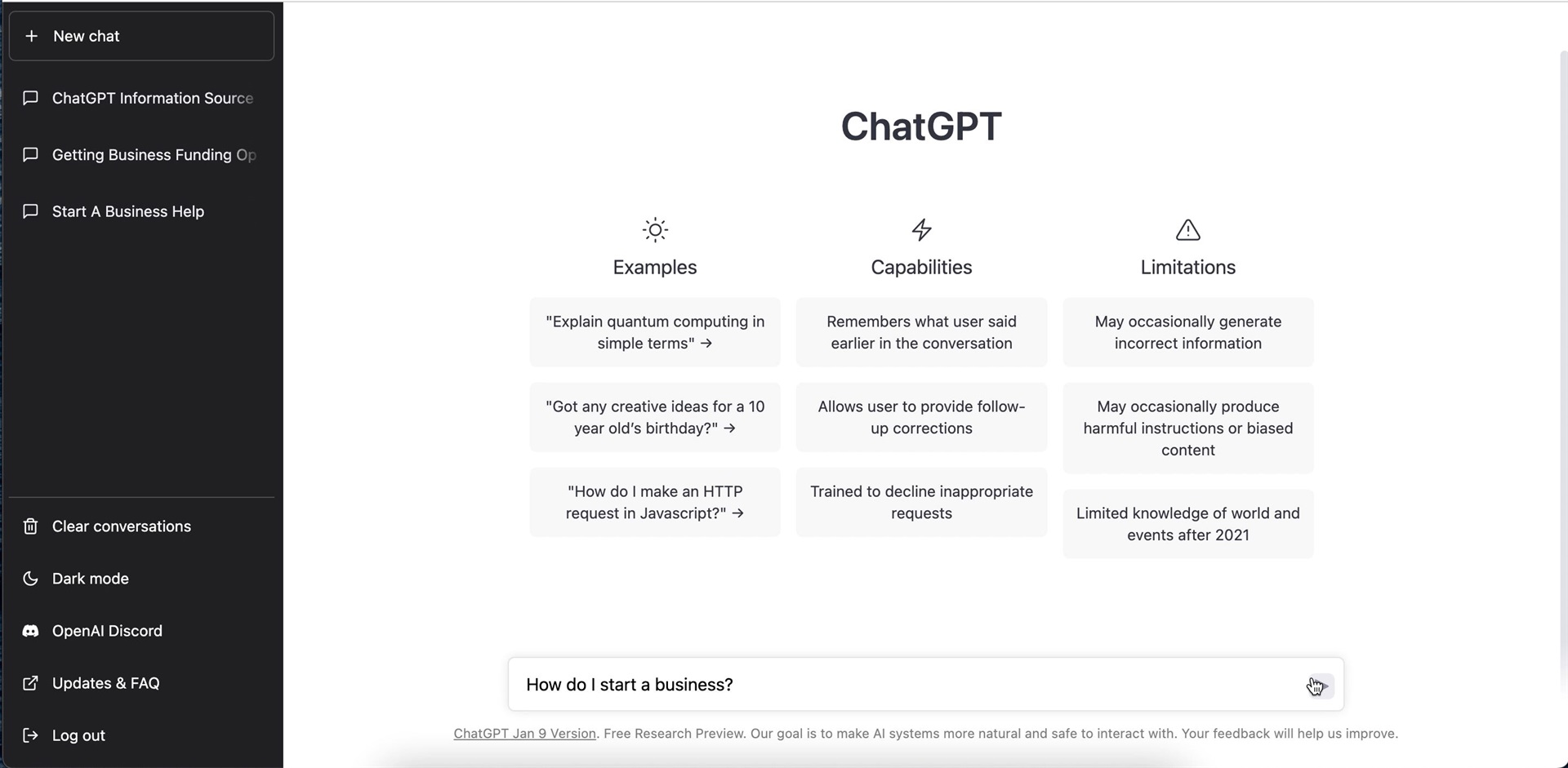
The main page where you can ask ChatGPT for information.
ChatGPT
When I initially visited the site, ChatGPT served me a 404 page — regular outages are a side effect of its sudden popularity. I refreshed the page a few hours later and was finally able to log on.
ChatGPT doesn’t do much heavy lifting. Its responses tend to be formulaic and broad, lack inspiration, and leave out a lot of useful information.
When I asked ChatGPT how to start a business, it gave me the following eight generic steps:
Starting a business can be a challenging but rewarding process. Here are some steps to help you get started:
Develop a business idea: Identify a problem or need in the market that your business can solve. Conduct market research to validate the demand for your product or service.
Create a business plan: Develop a detailed business plan that includes financial projections, marketing strategy, and a plan for setting up your business.
Raise capital: Determine how much capital you will need to start your business and secure funding through investors, loans, or personal savings.
Register your business: Register your business with the appropriate government agencies and obtain any necessary licenses and permits.
Build a team: Hire employees or contractors to help you run your business, if necessary.
Set up your business operations: Establish your business’s legal structure, obtain any necessary business insurance, and set up your accounting and financial systems.
Develop a marketing plan: Develop a marketing plan that outlines how you will reach your target market and promote your business.
Launch your business: Launch your business, and be prepared to adapt your business plan as you learn more about the market and your customers.
Starting a business requires hard work, dedication, and the ability to adapt to change. It also requires a good understanding of the market, the competition, and the legal requirements. It’s important to have a solid plan, a clear vision, and the right team in place to increase your chances of success.
ChatGPT can cater its answers to the type of business
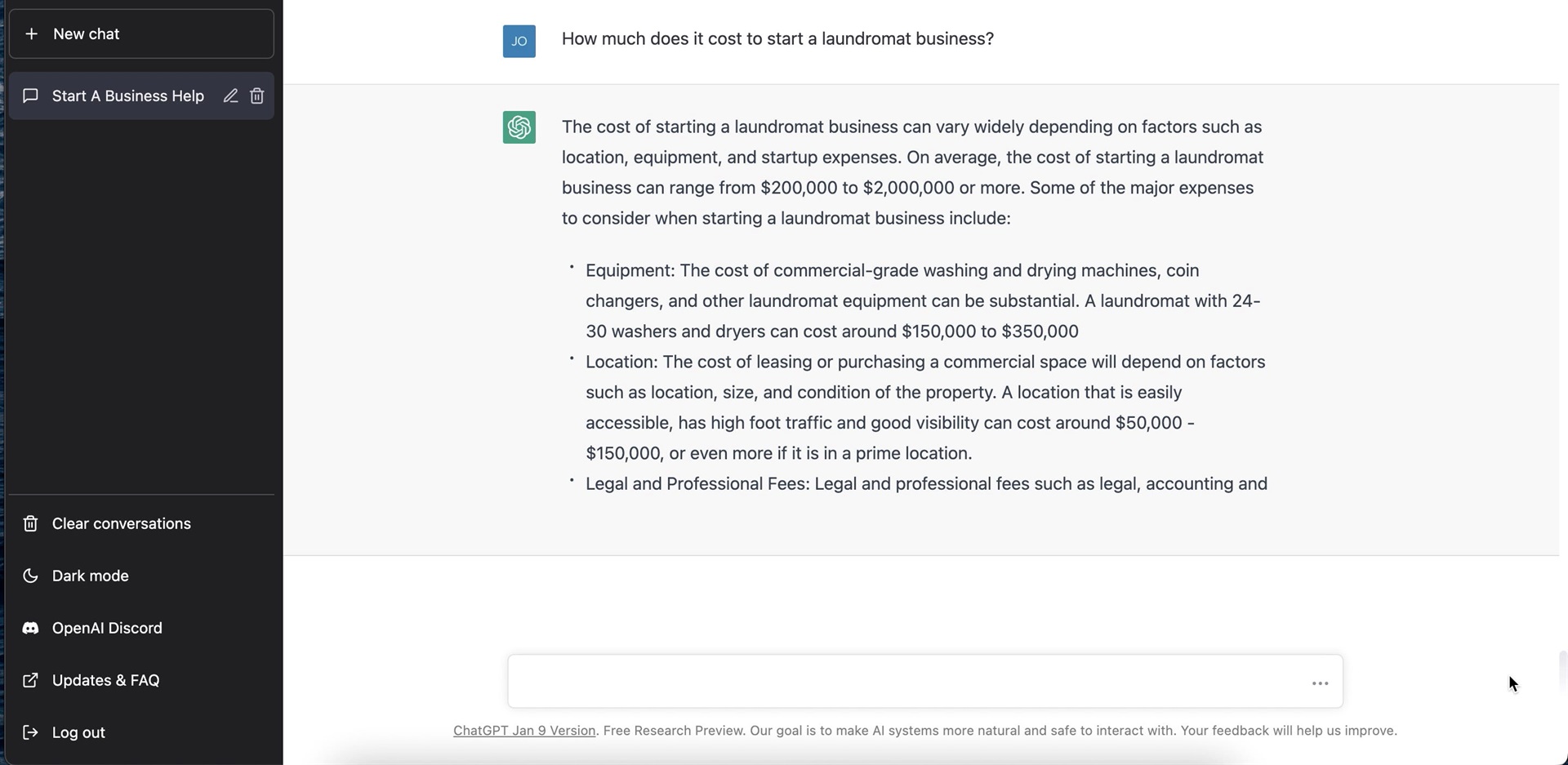
ChatGPT answering how much it costs to start a laundromat business.
ChatGPT
After asking the chatbot how to start a business, I tried more specific questions, like “How do I start a vending-machine business?” and “How do I start a laundromat business?”
These prompts led to slightly more detailed answers catered to the type of business, though they still fit within the same eight-step format. It suggested identifying potential locations for the vending machines and hiring staff for the laundromat.
Finally, I tested ChatGPT’s knowledge of startup costs. It outlined six overhead costs such as equipment, legal fees, and renovation.
In conclusion, ChatGPT is not a great source for answers to your deepest business questions, but it could be a helpful starting point to gather ideas, get cost estimates, and outline your business plan.
Here’s why you’ve been hearing so much about ChatGPT.
A few weeks ago, Wharton professor Ethan Mollick told his MBA students to play around with GPT, an artificial intelligence model, and see if the technology could write an essay based on one of the topics discussed in his course. The assignment was, admittedly, mostly a gimmick meant to illustrate the power of the technology. Still, the algorithmically generated essays — although not perfect and a tad over-reliant on the passive voice — were at least reasonable, Mollick recalled. They also passed another critical test: a screening by Turnitin, a popular anti-plagiarism software. AI, it seems, had suddenly gotten pretty good.
It certainly feels that way right now. Over the past week or so, screenshots of conversations with ChatGPT, the newest iteration of the AI model developed by the research firm OpenAI, have gone viral on social media. People have directed the tool, which is freely available online, to make jokes, write TV episodes, compose music, and even debug computer code — all things I got the AI to do, too. More than a million people have now played around with the AI, and even though it doesn’t always tell the truth or make sense, it’s still a pretty good writer and an even more confident bullshitter. Along with the recent updates to DALL-E, OpenAI’s art-generation software, and Lensa AI, a controversialplatform that can produce digital portraits with the help of machine learning, GPT is a stark wakeup call that artificial intelligence is starting to rival human ability, at least for some things.
“I think that things have changed very dramatically,” Mollick told Recode. “And I think it’s just a matter of time for people to notice.”
If you’re not convinced, you can try it yourself here. The system works like any online chatbot, and you can simply type out and submit any question or prompt you want the AI to address.
How does GPT even work? At its core, the technology is based on a type of artificial intelligence called a language model, a prediction system that essentially guesses what it should write, based on previous texts it has processed. GPT was built by training its AI with an extraordinarily large amount of data, much of which comes from the vast supply of data on the internet, along with billions of dollars, including initial funding from several prominent tech billionaires, including Reid Hoffman and Peter Thiel. ChatGPT was also trained on examples of back-and-forth human conversation, which helps it make its dialogue sound a lot more human, as a blog post published by OpenAI explains.
OpenAI is trying to commercialize its technology, but this current release is supposed to allow the public to test it. The company made headlines two years ago when it released GPT-3, an iteration of the tech that could produce poems, role-play, and answer some questions. This newest version of the technology is GPT-3.5, and ChatGPT, its corresponding chatbot, is even better at text generation than its predecessor. It’s also pretty good at following instructions, like, “Write a Frog and Toad short story where Frog invests in mortgage-backed securities.” (The story ends with Toad following Frog’s advice and investing in mortgage-backed securities, concluding that “sometimes taking a little risk can pay off in the end”).
The technology certainly has its flaws. While the system is theoretically designed not to cross some moral red lines — it’s adamant that Hitler was bad — it’s not difficult to trick the AI into sharing advice on how to engage in all sorts of evil and nefarious activities, particularly if you tell the chatbot that it’s writing fiction. The system, like other AI models, can also say biased and offensive things. As my colleague Sigal Samuel has explained, an earlier version of GPT generated extremely Islamophobic content, and also produced some pretty concerning talking points about the treatment of Uyghur Muslims in China.
Both GPT’s impressive capabilities and its limitations reflect the fact that the technology operates like a version of Google’s smart compose writing suggestions, generating ideas based on what it has read and processed before. For this reason, the AI can sound extremely confident while not displaying a particularly deep understanding of the subject it’s writing about. This is also why it’s easier for GPT to write about commonly discussed topics, like a Shakespeare play or the importance of mitochondria.
“It wants to produce texts that it deemed to be likely, given everything that it has seen before,” explains Vincent Conitzer, a computer science professor at Carnegie Mellon. “Maybe it sounds a little bit generic at times, but it writes very clearly. It will probably rehash points that have often been made on that particular topic because it has, in effect, learned what kinds of things people say.”
So for now, we’re not dealing with an all-knowing bot. Answers provided by the AI were recently banned from the coding feedback platform StackOverflow because they were very likely to be incorrect. The chatbot is also easily tripped up by riddles (though its attempts to answer are extremely funny). Overall, the system is perfectly comfortable making stuff up, which obviously makes no sense upon human scrutiny. These limitations might be comforting to people worried that the AI could take their jobs, or eventually pose a safety threat to humans.
But AI is getting better and better, and even this current version of GPT can already do extremely well at certain tasks. Consider Mollick’s assignment. While the system certainly wasn’t good enough to earn an A, it still did pretty well. One Twitter user said that, on a mock SAT exam, ChatGPT scored around the 52 percentile of test takers. Kris Jordan, a computer science professor at UNC, told Recode that when he assigned GPT his final exam, the chatbot received a perfect grade, far better than the median score for the humans taking his course. And yes, even before ChatGPT went live, students were using all sorts of artificial intelligence, including earlier versions of GPT, to complete their assignments. And they’re probably not getting flagged for cheating. (Turnitin, the anti-plagiarism software maker, did not respond to multiple requests for comment).
Right now, it’s not clear how many enterprising students might start using GPT, or if teachers and professors will figure out a way to catch them. Still, these forms of AI are already forcing us to wrestle with what kinds of things we want humans to continue to do, and what we’d prefer to have technology figure out instead.
“My eighth grade math teacher told me not to rely on a calculator since I won’t have one in my pocket all the time when I grow up,” Phillip Dawson, an expert who studies exam cheating at Deakin University, told Recode. “We all know how that turned out.