
By Reuters
Google parent Alphabet missed Wall Street profit and revenue expectations, and AI spending accelerated its cash burn, sending its shares down more than 10% in extended trading.
Capital expenditures, driven by AI, will increase significantly in 2027, said Chief Financial Officer Anat Ashkenazi, adding that this year’s capex forecast was unchanged. She said she also expected near-term margin pressure from the use of third-party cloud capacity.
The tech giant reported negative free cash flow of $9.07 billion, compared with analyst expectations that it would come close to breaking even, according to data compiled by LSEG.

The results reflect the huge costs of the AI buildout, with investors in the sector concerned both by potential overspending and the risk of falling behind rivals by not spending enough.
The quarterly cash burn is an increase from $5.9 billion in the prior quarter, which was the first time the company went into the negative in its 22-year history as a public company.
Alphabet’s cash burn was driven by spending to boost cloud capacity and fund AI research. It reported a $7.66 billion operating income loss in “Alphabet-level activities,” which it said primarily reflected expenses related to AI research and development.
The tech giant’s total revenue for the third quarter was $127.6 billion, short of analysts’ estimate of $128.2 billion, according to LSEG data.

The revenue miss was caused by Google’s core advertising business that reported $82.01 billion in revenue, about $1.41 billion short of expectations.
Net income available to common shareholders fell 25% to $26.17 billion, and adjusted earnings per share of $2.67 missed Wall Street targets of $3.02.
Earlier on Wednesday, Google sought to pre-empt its results and counter the perception it had fallen behind in the AI race by announcing its new Gemini 4 Carbon model, which CEO Sundar Pichai told analysts during the earnings call meant it was again “leading at the frontier.”

Cloud influence grows
Revenue at Google Cloud exceeded estimates and more than doubled to $30.71 billion in the third quarter ended September 30, but was not enough to make up for the ad-side performance.
Cloud chief Thomas Kurian made his debut on an earnings call, a sign of the enterprise-oriented business unit’s increased influence within a traditionally consumer-dominated company.
Kurian said sales of Google’s tensor processing units (TPUs), which compete with Nvidia’s GPU chips, had become a meaningful contributor to his business unit.
The third-largest cloud services provider globally, behind Amazon Web Services and Microsoft’s Azure, Google Cloud has continued to expand enterprise commitments, supported by multi-year cloud and AI infrastructure deals across cybersecurity, retail and financial services.

Alphabet, Microsoft, Amazon, and Meta are projected to collectively spend well over $700 billion in 2026 to expand AI data centre footprint, chips and high-performance networking capacity.
While industry-wide supply bottlenecks for advanced silicon and data-centre power have persisted, Alphabet’s investments in custom tensor processing units alongside third-party GPUs have helped expand its service delivery capabilities.
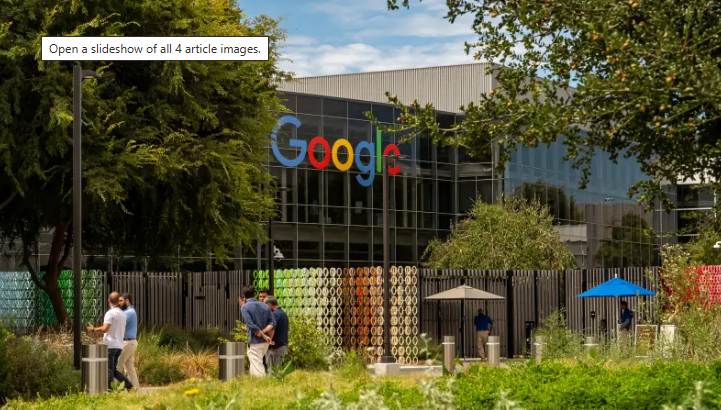
Feature image credit: Bloomberg via Getty Images
