By Josh Tilley
Social media has been a key marketing channel since its conception and has increasingly played a role in how people shop. But up until now, shopping behaviour was limited to discovery and consideration, with purchase taking place off-platform on a brand or retailer website.
Today, social platforms look poised to ’close the loop’, meaning users will be able to browse, shop and purchase seamlessly and entirely within one connected social media experience. This development has the potential to fundamentally transform the way we buy online.
Welcome to the future of ‘social commerce’.
To better understand shopper behaviours, attitudes and beliefs in this space, we polled a nationally representative audience of UK shoppers, discovering that nearly two-in-three people would be more likely to purchase from a brand if they could browse and shop entirely within a social media platform.
From this, the evidence is clear: the winners of tomorrow will be the brands that embrace social commerce as a real tool for customer acquisition and retention. For those that fail to act, loss of market share could become a tangible concern. In a social world, learning how to navigate these waters is no longer just a ‘nice to have’.
The rise of social commerce
According to the latest research, social commerce is a market with a remarkable growth trajectory, with analysts projecting it could be worth $600bn in the next seven years.
As we’ve seen in the past year, Covid-19 has accelerated existing trends in shopper behaviour. The latest figures suggest an extra £5.3bn will be spent via e-commerce in the UK alone in 2020 as the fallout from the pandemic has forced more people online than ever before. Early figures suggest this behaviour is set to stay as we emerge from the pandemic.
Although shoppers are flocking online, social commerce is still a fairly nascent market in the UK and US. In fact, studies suggest that only 6% of UK consumers have purchased directly on a social platform, in part due to the lack of in-platform purchasing options in these markets.
In more advanced countries like China, however, social commerce is an integral part of the online shopping experience. Tencent’s WeChat delivered $115bn in social commerce sales in 2019 alone, while Pinduoduo, a group-buying app where friends can purchase together on social media, has grown from an innovative startup to China’s second most valuable online retailer.
As US platforms look to replicate some of this functionality, China provides us with a model of how social will likely evolve for commerce in the west.
Shopper thinking will be crucial to navigate social commerce
Today, brands have more opportunities to interact with people than ever, across an increasing number of digital touchpoints. Digital and social platforms have succeeded at meeting new customer expectations, with values such as convenience, ease of use, customisation and control redefining the shopping experience.
It’s not surprising, then, that social media is uniquely positioned to deliver on these needs. Based on our research, however, social will remain a nuanced and highly intricate channel. Careful consideration of different shopper motivations and barriers, as well as brand experience across the shopper journey, will be key to maximising shoppability across brands’ social media channels.
Consumer behaviour in this channel is anything but homogenous; in fact, our research suggests adoption of social commerce will differ by age. Being able to buy within platform would encourage 75% of 21- to 34-year-olds to purchase with a brand, suggesting that demographic differences will necessitate careful persona planning.
Price also seems to be a determining factor in whether or not someone would purchase on social, with our research suggesting that big-ticket items such as travel and luxury are much less popular than more affordable items.
Different categories also differ in their appeal, with respondents ranking fashion, beauty, wellbeing and grocery as the categories they would most like to shop for on social.
Taken as a whole, these findings are representative of a shift towards social media as a new and growing e-commerce channel, but they also demonstrate a need for smart planning. For brands, understanding where, when and how to activate a social commerce strategy as part of a connected shopper experience will be key as we move into 2021.
Social platforms at different levels of readiness
Another consideration is that the platforms themselves are at different levels of ‘readiness’ when it comes to social commerce.
Instagram, for example, has beta-tested its Checkout feature, which allows users to search and shop directly within the app. The mass rollout of this feature will transform how people shop with brands online, making it more convenient to shop not only directly from a brand’s posts, but from influencer posts too. These platform changes will make the social shopping experience on Instagram feel effortless and seamless – all the way from discovery to purchase.
The rollout of Shops across Facebook, meanwhile, allows brands to create digital storefronts, with links to purchase products either on the retailer’s website or directly within Facebook itself.
Even YouTube and TikTok are experimenting with social commerce. YouTube Shopping allows customers to make purchases directly on-site by browsing through catalogues offered by sellers, while TikTok’s partnership with Shopify allows merchants to create and show shoppable content on the platform.
Even before these functionality considerations, each platform lends itself differently to the shopping experience and users’ openness to brand advertising. Instagram, for example, feels like a natural fit for commerce as its highly visual nature emulates a glossy magazine, where products feel native and premium.
This was validated in our research findings, which showed nearly half of all shoppers (45%) would prefer to shop on Instagram, with Facebook (41%) coming in a close second.
These two platforms appear, at the moment, to be far ahead in terms of delivering on shopper expectations, with YouTube (9%) and TikTok (5%) capturing a much smaller percentage of shopper interest.
The sophisticated targeting options available to brands through Facebook Advertising (which includes Instagram) and Google (YouTube) also present opportunities for personalisation and disruption along the shopper journey.
Moreover, social commerce is a particularly exciting development for brands that sell exclusively through retailers, since it presents an opportunity to provide shoppers with a more personalised experience (in lieu of a true direct-to-consumer offering).
We spoke with Joseph Harper, e-commerce marketing manager at Kellogg Company, who notes: “The way people shop in the future will be totally different – it will be completely interactive and personalised.
“We know that retailers are starting to see themselves as media platforms and media platforms are starting to see themselves as retailers. That, in essence, is the crux of social commerce.”
Creating a connected experience for consumers
For a marketing channel with considerable upside, social commerce looks set to have a significant impact on the way shoppers discover, browse and buy. E-commerce has already lowered the barriers to entry, enabling new digital startups to burst on to the scene while forcing legacy brands to rethink existing strategies.
Social looks set to do the same again, challenging traditional brand and retailer relationships and ways of marketing to consumers.
But for the forward-thinking brand, success will come from more than just taking advantage of new platform innovations. Brands need to build connected experiences across all touchpoints that deliver on the values of a new generation of shoppers.
Whether researching on Amazon, being inspired on Instagram, watching adverts on TV or unpacking an order at home, there’s an ever-expanding ecosystem of places shoppers can engage with brands.
Marketers need to focus on optimising the customer journey and include social commerce as a key touchpoint in this. In doing so, brands can take one step closer to delivering a truly connected omnichannel experience.
Feature Image Credit: Initials advise marketers to better optimise the customer journey using social commerce
By Josh Tilley
Josh Tilley, senior strategist at Initials.





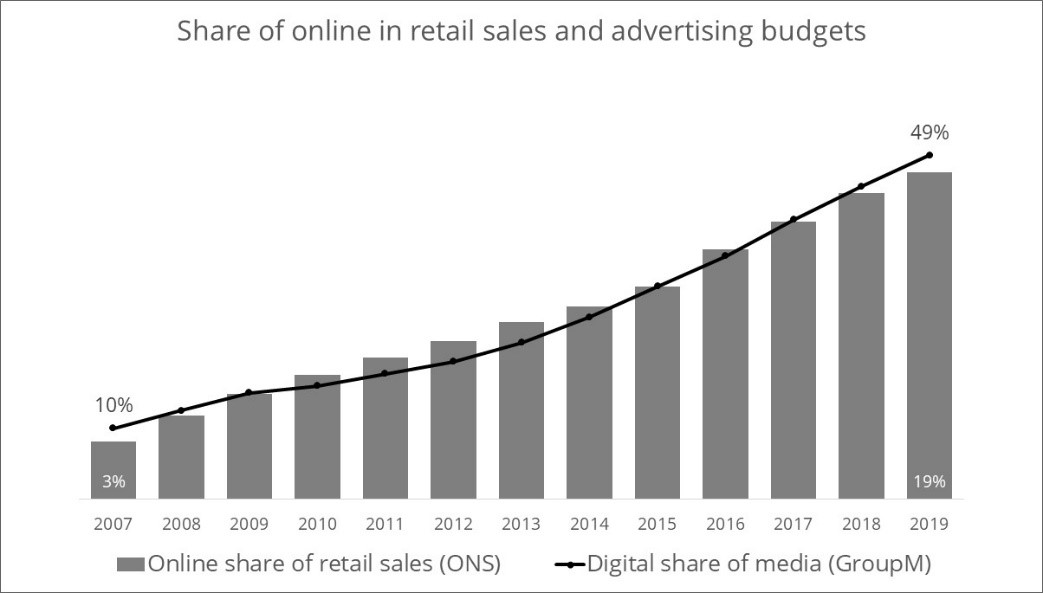 Ah, but correlation is not causation, a sceptic might argue. The chart fits other explanations too. For example, both ecommerce and online advertising rely on the same technologies, so of course they grow together. Or perhaps ecommerce and online advertising are both superior to their offline versions and people have simply begun to use them both more over time.
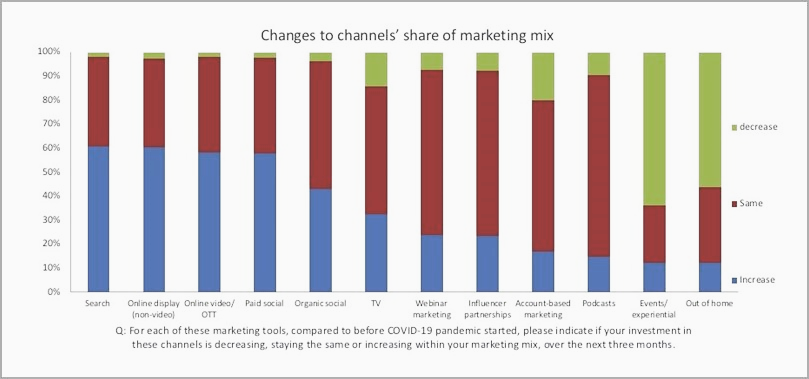 Some of this change in the media mix is driven by lockdowns and reduced available reach from channels like out-of-home and events, but some is also because more and more people are shopping online, and that makes the second task more important.
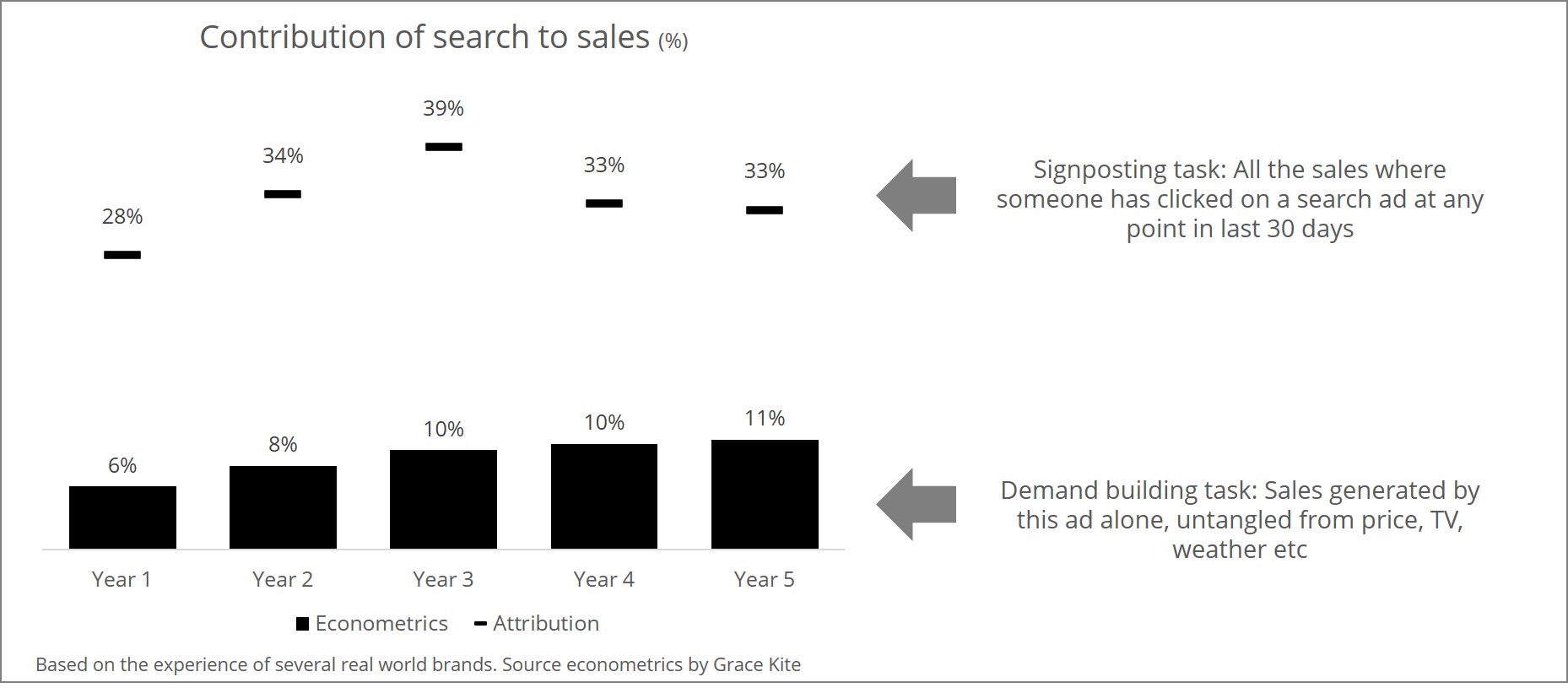 In the chart, the proportion of total sales driven by search ads is around three times bigger in Google’s attribution tool than it is in our econometric modelling. The reason is that in two thirds of customer journeys that involve a search click, the ad didn’t actually generate the sale, it acted as a signpost, helping someone who had already made their decision to complete their purchase.
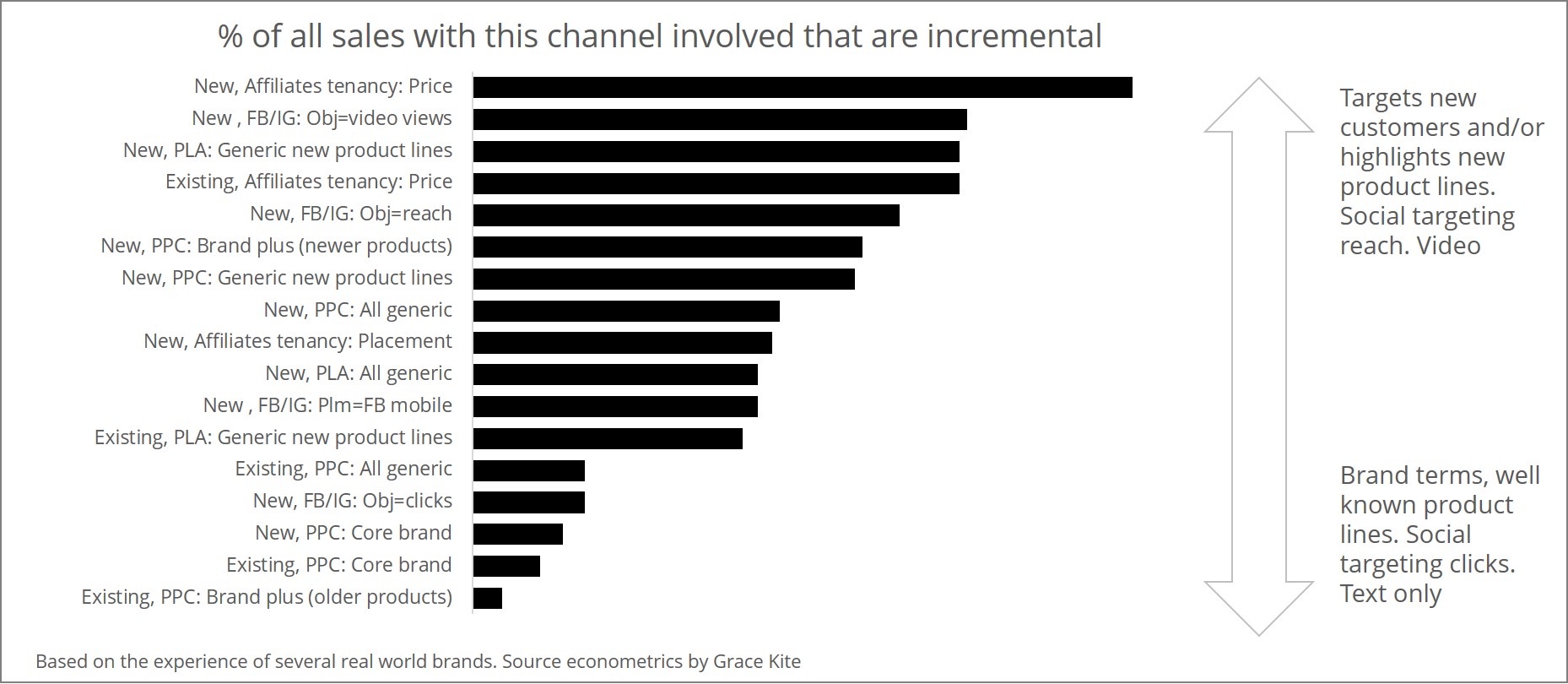 There is still a lot to learn in this area, but the above chart is typical of our limited experience. The online ads that are most often an investment into future sales are those that target new rather than existing customers and reach rather than engagement. They typically have richer creative, particularly video, and they highlight newer or less well-known products.
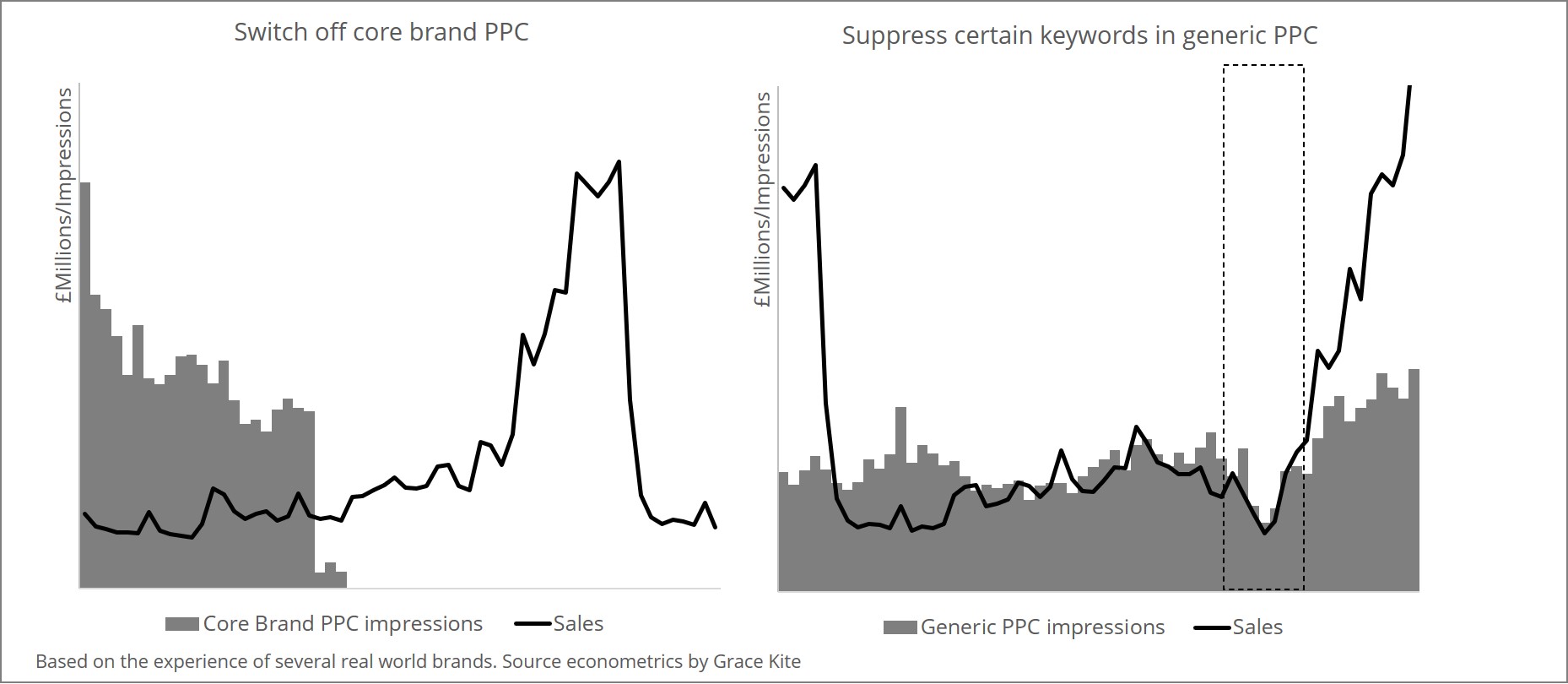 In other cases, the signposting job is revealed to be critical. In the right panel, the switch-off revealed that without a presence in generic search for these keywords, even a customer who had already decided to buy could be diverted and fail to arrive safely.