Tag

Digital Marketing

Browsing

Sourced from Vancouver Magazine

Starting a business can be daunting, and there’s a long list of things to do to get it off the ground. We asked an industry expert for the top tips on how to kick start your small business and make the most of your online presence.

Choose the Right Domain

For many people, registering their domain name is one of the last things on the list and it shouldn’t be, says Anne De Aragon, vice-president and country manager, GoDaddy Canada. “A domain name is an important annual investment as it is the hub of your business’ website,” she says. “Much like a physical sign, it marks the location of your business on the web. This makes registering a domain name one of the most critical business decisions you make.”

Some business owners prefer their full business name as the domain name while others prefer an abbreviation. Business owners also need to consider this important fact: According to the Canadian Internet Registration Authority, Canadians are 4x more likely to shop on a .ca website over .com as it taps into the patriotic desire people have to support local businesses. “Taking a minute to think about your business, your goals and how you want to present yourself will allow you to decide on the best domain name for your business,” De Aragon says.

Create a Website that Looks Amazing

A mobile-friendly website is essential for a business to ensure it is easy to access and use for today’s mobile-first environment. This means your website looks its best and performs stress-free for the user since the text is readable, images are optimized and fitted to screen sizes, and there is no need for horizontal scrolling.

For example, GoDaddy’s Websites + Marketing tool allows business owners to create a modern, mobile-friendly website for free and with no technical knowledge required. The tool has hundreds of already-designed templates, which allow business owners to control the look and layout of their website.

Leverage Digital Marketing

Digital marketing can deliver strong results at a fraction of the price of traditional marketing. Think of your website as a hub from which consumers access your various channels. De Aragon recommends being selective, always keeping your business goals in mind. “You should incorporate a variety of channels, but you don’t need to be on every platform,” she says. “It has to make sense for your business and your target audience.”

No matter what channels you choose, make sure you have high-quality visuals. Entrepreneurs can engage a design professional or take advantage of content design applications, such as Over by GoDaddy. These applications allow entrepreneurs and small business owners to easily create impactful visuals which can be leveraged on social platforms, websites, and email marketing campaigns.

Make Your Email Shine

Since email is often the first consumer touchpoint, it is important for your email address to be professional. “A professional-looking email address gives your business more credibility when you’re corresponding with existing and potential customers,” De Aragon says. “To set up a professionally branded email address, you need to have registered a unique domain. From here, setting up a professional email account can be done quickly and easily.”

Learn more at GoDaddy.ca.

Connect at Instagram | Facebook | Twitter

Sourced from Vancouver Magazine

By Darya Jandossova

Every day, billions of people use the internet and smartphones. Because of this, digital marketing has become one of the most important aspects of an organization’s overall marketing strategy.

What is digital marketing?

Digital marketing can mean slightly different things to different people. For example, the tactics used by an e-commerce platform will be different from bricks and mortar businesses.

The most common types of activity encompassed within digital marketing include:

Content marketing

The shift towards content marketing has been significant over the last decade. Creating and distributing valuable content to your target audience to build awareness, trust, and inbound leads.

Content marketing can take the form of blogs, whitepapers, video content, case studies, infographics, and podcasts.

Social media marketing

There are a number of social media platforms used by brands in order to drive traffic and engagement. While much of the activity on social media can be classed as content marketing, the chance to listen and engage with an audience makes it a viable marketing channel in its own rite.

Social media continues to evolve as new platforms emerge. The most popular being Facebook, Twitter, Instagram, YouTube, Snapchat, WeBo, and TikTok.

Search engine optimization (SEO)

Gaining quality organic traffic through major search engines such as Google and Bing. Strategies can include optimizing websites, building backlinks, and SEO friendly content.

Search engine marketing (SEM)

The other side of the search engine coin to SEO. Search engine marketing refers to the paid activities used to increase search engine visibility and drive traffic through Google Adwords or Bing Ads.

Affiliate marketing

This particular form of marketing is becoming extremely popular. Affiliate marketing is when a person or company is paid a set commission for every sale or traffic they generate for another company. This particular form of marketing is popular with bloggers and solopreneurs, who can pivot content quickly in order to showcase affiliate links.

Every year Amazon pays out hundreds of millions of dollars in affiliate fees and is one of the most popular programs of its kind in the world.

Pay per click (PPC)

Similar to paid search, you pay a pre-set amount whenever someone clicks on your ad.

Email marketing

The granddaddy of digital marketing. Every year we hear that email marketing is dead, but it is still a staple of a solid digital marketing strategy. When it’s done properly, regular or automated email marketing is still a powerful tool, especially combined with personalized marketing techniques.

Instant messaging and bots

WhatsApp, Facebook Messenger, and WeChat have, between them, billions of users all around the world. That is an unmissable opportunity for brands looking to get their messages out there.

The use of bots, in particular on Facebook, is a great way of interacting with your audience in a scalable, on-brand way.

What does it mean to outsource digital marketing?

Outsourcing your digital marketing means that you are using a person, company, or companies to take care of those aspects of your overall marketing strategy. This could be for a number of reasons including a budget, lack of internal resources, or being too big or too small to be able to have the necessary resources in the house.

What does in-house digital marketing mean?

An in-house team will plan, execute, and report on all digital marketing activities using a team employed by the organization.

What are the benefits of outsourcing digital marketing

There are many reasons that you might want to outsource your digital marketing, including:

Budget  – smaller businesses know that they need to implement some form of digital marketing to grow, but cannot afford to hire a team full time to do this. Instead, they will use third-party/parties to plan and implement digital marketing on their behalf. Types of outsourcing could include web design, social media, SEO, and so on.

Knowledge – because digital marketing companies make their money from just that, they need to keep their knowledge, skills, and technologies on the leading edge at all times. You can benefit from this continuing development without having to put yourself off your team through the recommended training or costs.

What are the cons of outsourcing digital marketing?

There are some potential downsides to turning over your digital marketing to a third party.

Less personal – by handing over your marketing strategy to someone else, you might find that your brand begins to develop in different ways in order to attract new audiences and customers. If you’ve been responsible for your brand and marketing to date, it can be difficult to let go.

Finding the right team can be difficult – while working with the right team can fundamentally change your business success for the better, choosing the wrong team can be damaging.

It takes time to find the right people. You need to work with those that you connect with and work hard for you. There are plenty of horror stories out there that put people off hiring an outside agency.

You need to commit to a strategy – in order to create a comprehensive digital marketing campaign, you need to commit to a budget, and strategy at the outset, as well as have. It is unfair for you to move the goalposts frequently. You’ll also need to sign something along the lines of a digital marketing proposal and it’d make sense to get acquainted with one prior to signing it.

You are one of a number of clients – your business may not be as important to them as you’d like it to be. That’s not to say that you won’t be treated professionally, but you cannot always expect to be a top priority.

What are the benefits of in-house digital marketing?

Dedicated to one client, you – there are no other clients vying for your marketing team’s attention, so you know that your company always takes top priority.

Quicker response times – if your marketing team works with others within your organization on various tasks, having a team on-site, dedicated to you can cut out a lot of red tapes. For example, if a certain department has an idea for a campaign or would like something promoted at short notice, you don’t have to try and negotiate with an outsourced team to try and bump your request to the top of the list.

Better brand knowledge – because the team is part of your organization, they live and breath your brand every day. This can then be translated seamlessly into your campaigns.

What are the cons of in-house digital marketing?

Costs – as covered earlier in the article, digital marketing encompasses a lot of different specialisms. Recruiting and training people in all of these areas can be very expensive. In addition to salaries, you also have to consider recruitment costs, benefits and ongoing training needs.

Skill levels – each area of digital marketing could be done by one person full time. But it is usually down to a few people who are expected to do everything. They often end up gravitating towards the areas they prefer, or never developing in-depth knowledge in a number of areas.

Potential to be overworked – if you hire a single person to do all of your digital marketing, as well as your traditional marketing tasks, you run the real risk of burning them out quickly.

Fewer contacts and special deals – digital marketing agencies can often have great contacts and deals in place with other sites or providers. In house teams often don’t have the time of the financial clout to do this.

Less strength in depth – if you are using an agency and someone is out sick, then there are usually other people who can take over the project at short notice. This usually isn’t the case with small in house teams. If someone in your team leaves, you are without any skill in certain areas until they are replaced.

Does it make sense to combine the two?

Many businesses find a good balance between in-house teams and outsourcing. It usually works best when there is an experienced marketing point person who can lead on the strategy development and then recruit and oversee the people or companies who will then actually implement the digital marketing campaigns.

This works well for a number of reasons. Having a single point of contact who has overall responsibility for digital marketing helps to streamline planning and decisions. Small in-house teams can also take care of some of the days to day digital marketing tasks that need doing and respond to in house requests quickly.

From a digital marketing agency perspective, it is always easier to deal with someone who knows what they are doing when it comes to leading a marketing function within a company and has realistic expectations.

For those companies who are deciding whether or not to recruit an in-house team, or outsource, this article provides some of the pros and cons of each course of action. Remember, what works for one company will not always work for another. It might make sense to outsource your digital marketing requirements at the beginning, then move towards a blended team as you scale up. Alternatively, if you are large enough to recruit a full digital marketing team, then you will have an entire department dedicated only to your organization.

Photo by Campaign Creators on Unsplash

By Darya Jandossova

Darya Jandossova Troncoso is a photographer, artist and writer working on her first novel and managing a digital marketing blog – MarketSplash. In her spare time, she enjoys spending time with her family, cooking, creating art and learning everything there is to know about digital marketing.

Sourced from noupe

Sourced from Small Business Trends

By Adam Feiner

Business to business (B2B) digital marketing provocatively communicates your unique value proposition in different formats, to different segments, and across several channels to gain awareness and earn consideration. Consider a company engaging in B2B marketing without first-party data, like a start-up or a business entering a new market. Where would they present their brand and value proposition to gain awareness? What content would they reveal and to whom? How would they respond to interactions with their brand? How would they capture and organize data?

The answers to these questions will define your digital strategy and illuminate your target audience. First-party data, like intent data, reveals information about your prospects that can help you earn consideration and win deals by delivering increasingly relevant content to your audiences. Accumulating first-party data requires that you elicit a response and add it to the profiles of your prospects to enrich personas. This enriched data is used to determine what content to present next. Email, mobile, social and website interactions (i.e., clicks, downloads and demo requests) and self-identified preferences are your opportunities to acquire first-party data. Data is perishable. It takes patience and persistence to build and maintain first-party data.

Website Experience

Your website reflects your digital strategy. Effective website design naturally guides visitors toward information they seek in as few clicks as possible. This requires a customer-centric perspective acknowledging user experience and customer journey focused on need, value proposition and solution rather than products and capabilities. Your prospects should see themselves as they navigate and consume content.

In 2008, the Nielsen Norman Group estimated that visitors will read only 20% of the text on an average page, so sharpen your writing and create engaging videos. Less is more when it comes to web design, and too much information risks confusing visitors and losing their attention. Clearly articulate your value proposition on your homepage to support your keyword strategy, create a site map that simplifies navigation, and make sure your CTAs are present but not intrusive. Your website should capture visitor data with cookies to identify first-time and repeat visitors and employ gated content to enable direct marketing. Once prospects reveal interest and share their email or mobile number, your odds increase. Because Google said in 2016 that over 50% of searches come from mobile devices, optimize for mobile.

Whether you’re creating or refreshing a website, tools like Google Analytics can help identify best- and worst-performing pages. Google Search Console can reveal technical problems skewing results, and you can use visualization techniques (i.e., heat maps) to illuminate how visitors see your site.

Search Engine Optimization (SEO)

SEO strategy is designed to help website pages rank higher on search engines like Google and Bing. Focus on keywords that decision-makers search. Target low volume keywords with high cost-per-clicks (CPCs), publish highly tactical content for key decision-makers, and leverage social media to amplify content distribution and cover a wider audience.

There are several steps to create and leverage a B2B SEO strategy. First, know your buyer and build personas of individuals inside the companies of your target verticals. Second, understand how they search for what you sell and know the keywords they use. To uncover keywords, utilize available free crowdsourcing applications, search engine auto-complete suggestions and SEO tools (such as SEMRush and Ubersuggest) that search competitors’ keywords to uncover their strategies. When bidding on keywords, do not shy away from high CPCs. Those are likely the words that prospects use when they’re ready to buy. Third, identify the topics and content to share with your audience. This is your chance to differentiate and illuminate your solution. Successful outcomes might include capturing an email address or being mentioned on social media, which takes patience and time. Fourth, use on-page SEO to optimize each webpage for terms that indicate buying signals. Keywords in short URLs, latent semantic indexing (LSI) keywords and long content publications help search engines understand what you do and increase SEO rankings. Fifth, publish high-quality blogs to increase your landing page rankings. For best results, select related topics that are impacted by your solution. “Shoulder” topics can draw more links to content. Finally, while it is not easy and takes time to get quality backlinks for your B2B business, they are important. With all the content and research required, this could easily be a full-time job.

Social Media

A successful social media strategy communicates your unique value proposition to your followers by sharing compelling content that resonates. Your brand’s story should be told to spark interest and engage the right audience. Maintain an active presence to stay current and shape industry dialogue. Social media in your marketing mix can amplify awareness, generate demand and improve content marketing campaigns. No other channel can provide the same immediate impact.

Listen to and monitor your social channels. By listening to your potential customers’ daily conversations, you can begin to see topic patterns, momentum and current market concerns. You can help guide the conversations as the subject matter expert who understands customer challenges and delivers positive outcomes. As you monitor specific prospect activities, respond to unique questions they post to establish credibility and trust.

Centralize your social profiles onto a single platform that enables monitoring and listening simultaneously. Create alerts to keep apprised of instances where your brand is mentioned directly or indirectly. Listening effectively will help you anticipate future campaigns and improve messaging. Listening can keep you ahead of your competition, help you construct an effective influencer program and even build more impactful brand partnerships.

Conclusion

Effective digital marketing authoritatively communicates your value proposition to an identified audience, guides them toward your unique content and website and educates and differentiates. Purposefully present your brand and value proposition where your audience will gain awareness of it. Become a trusted partner with relevant content and help search engines understand what you do. Listen to your audience and guide the conversations by responding to questions as a subject matter expert. Enrich your first-party data by eliciting responses and capturing information that can help you deliver more relevant content. Gain awareness, earn consideration and find in-market buyers for healthy digital pipelines.

Feature Image Credit: getty

By Adam Feiner

Follow me on LinkedIn. Check out my website.

VP Sales at Loyalty Builders, accurate and affordable pioneering predictive customer intelligence for retail and wholesale marketing. Read Adam Feiner’s full executive profile here.

Sourced from Forbes

By

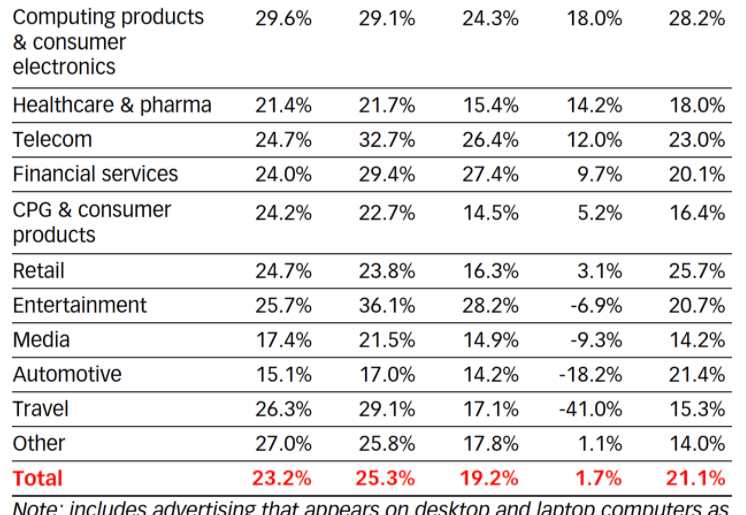
The healthcare and pharma industry has been slower to embrace digital marketing compared with other US verticals we track. Heavy regulation makes ad targeting more difficult, which has kept traditional media buys and in-person marketing popular. However, the coronavirus pandemic restricted many of these in-person touchpoints, which caused both the B2B and business-to-consumer (B2C) aspects of the healthcare and pharma industry to further embrace digital advertising.

We expect the US healthcare and pharma industry will spend $9.53 billion on digital advertising this year, up 14.2% from 2019.

With a public health crisis serving as the single biggest factor impacting advertising this year, it shouldn’t come as a surprise that healthcare and pharma will be among the fastest-growing industries in digital ad spending, coming second only to the computing products and consumer electronics vertical (whose spend will grow by 18.0% in 2020).

While healthcare and pharma digital ad spend has grown faster in previous years, its 2020 growth is substantial, as the total US digital ad market is expected to grow by only 1.7%.

By

Sourced from eMarketer

Sourced from AAI Association of Advertisers in Ireland.

On behalf of PwC and the AAI, we’d like to invite you to attend a briefing and roundtable discussion about the future of digital marketing in a post cookie world.

This builds on the award winning ISBA/PwC study into programmatic advertising, which generated major press coverage on its release earlier this year.

Our event will quickly recap key study findings and then move on to the question: what happens next?

By the end of 2021, third party cookies will be history, so how can marketers leverage data and technology to retain and enhance the benefits of targeted marketing?

The format will be a short briefing by PwC, and then a Q&A with our expert panel to explore the future of data, technology, and digital marketing.

Date: Thursday November 12th
Time: 10:00 – 11:00am
Venue: Virtual – where else?

Please register to attend the zoom briefing and feel free to direct any questions in advance to [email protected]

By

If you’re a business owner, people have probably been talking to you about digital marketing for ages — whether it’s a well-meaning friend or an ad agency on the prowl, you’ve heard endless suggestions on everything from SEO to PPC and every other three-letter acronym. And all that was in a pre-pandemic world. The sudden, jarring shift to an audience more frequently online will leave behind many lasting effects on how businesses reach their target audience.

In a post-pandemic world, 56% of business leaders that utilize digital tools report that at least half of their sales occur online. While many businesses plan on decreasing spend, depending on the channel anywhere from 40-59% of large national brands intend to increase their ad spends across digital channels. That’s just the big guys.

But with all the financial stress facing small business owners, you may be worried about adding yet another cost to your budget. And marketing agencies can often seem like sharks circling businesses.

However, you don’t need a dedicated agency or a large advertising budget to make your mark in the digital realm. Here are some digital marketing tactics that all businesses, regardless of size, can benefit from:

Update Your Google My Business Listing

To some, this suggestion may seem obvious; in fact, if you otherwise don’t do anything else on the digital front, you most likely still maintain your Google My Business listing. But how quick are you to update your listing when you make changes to your business?

Of course, if you’ve changed your hours of operation, address, phone number or website, you need to update your listing right away. Google My Business is also a great place to show off your menu (for restaurants) or products and services. And don’t forget to update your photos. If you don’t maintain your photo section, your listing will be at the mercy of uploads from random visitors.

Bolster Your Social Media Presence

Everyone, even B2B companies, stands to gain from an involved social media presence. Of course, it’s important to utilize the correct platform. For example, a Main Street clothing boutique might find little use for a LinkedIn profile, while a steel bar fabricator might feel out of place on Pinterest. Make sure your message is appropriate to the platform you’re using and the audience you’re reaching.

Much like with your Google My Business listing, you need to keep your social media accounts current with any changes in your operations. You also need to be sure to have quality, high-resolution imagery for logos, banners and other photos.

And if you’re in a visually driven industry such as food, cosmetics or clothing, or have a younger target audience, you may want to experiment with platforms like TikTok or Instagram.

Respond To Reviews — Properly

Reviews are crucial to a small business’s existence, and a stream of poor reviews can be crippling to an upstart business. Conversely, positive reviews are one of the best ways for a business to organically grow their clientele. But there are a few things you should keep in mind when responding to reviews, including timing and messaging.

When you receive a positive review, you should respond right away. An immediate response shows your customers how much you truly appreciate their patronage, and reinforces the quality of their experience.

On the other hand, when you receive a negative review, you need to respond soon — but not too quickly. While you can’t let it linger and give off the impression that you’re ignoring the customer’s experience, you still need to give it enough time to show that you’ve considered their feedback. You also need the time to craft your message properly; too much emotion is off-putting, but a generic response is insulting. About 24 to 48 hours is an appropriate length of time for a negative review response.

And whatever you do, do not incentivize positive reviews. That may seem like an easy way to generate a large swath of positive feedback, but you’ll find that platforms like Yelp, Google and Facebook penalize accounts that are reported for incentivizing reviews.

Digital Marketing Is Here To Stay

While social distancing will eventually relax and foot traffic will pick back up in stores, digital marketing will have a lasting place in the business world. If you want to keep up with your competitors or even remain an active part of your community, you must maintain an active, involved digital presence. If you intend to hire a firm to manage your marketing, that’s fine — but by using these simple tips to improve your online presence, you’ll have a better understanding of what a firm brings to the table and will be more prepared to take the next step.

Feature Image Credit: GETTY

By

Follow me on LinkedIn. Check out my website.

Zohaib Hassan is the CEO/Founder of SnapWeb Services, an ROI driven, data-obsessed full-services digital marketing agency. Read Zohaib Hassan Patoli’s full executive profile here.

Sourced from Forbes

By Anna Luo

Covid-19 has not only drastically changed the way we communicate with each other, but the economic impact of the pandemic has forced many brand marketing teams into a corner — charged with increasing revenue contribution while facing budget cuts. In fact, according to a recent Gartner Inc. survey, 76% of marketing leaders expected budget cuts as a result of Covid-19. These teams are being asked to improve business outcomes with fewer resources.

Bringing Life To Personalization

Brands executing a digital-first or direct-to-consumer strategy must move beyond a one-size-fits-all approach to digital marketing and create messages that are relevant to a consumer’s moment and context. To move the needle in sales, it is important to message more granularly. For example, creating messaging for individual consumers’ interests in specific products (like models or colors) and locations (like open locations vs. curbside pickup).

It is equally important to design specific content relevant to individual consumers regardless of where they may be — like Facebook, Instagram, streaming media or email. This means brands are in need of creating many variations of the content to fit new advertising formats and deliver personalized experiences that appeal to consumers. According to a report by IAB, “50% of digital device consumers will make a purchase and become brand loyal if they receive personalized brand content.”

Right now, many brands are leaning on production teams or agencies to manually design and build creative variations, which can be costly due to the hours it takes to do so by hand. While this method of creative production used to be a brand’s only option, it also meant that the creative outputs were not built in a way that could be easily modified and customized with language and product changes for local brand teams. Automation, however, paves a way for brands to quickly and efficiently spin up new creative variations that add an extra layer of personalization to marketing campaigns.

It Isn’t Just About Spending Less; It’s About Doing More

Automation isn’t just about spending less on production costs. It’s about creating endless possibilities with ad and content variations. It’s a powerful tool that lets us achieve tasks that weren’t humanly possible 20, 10 or even five years ago.

For example, at my company, Jivox, advancements in automation have allowed us to scale personalization for our clients while dramatically reducing production costs. This is done by automating creative versioning across all digital marketing channels (paid and owned) and enabling real-time dynamic assembly, re-sizing and delivery of creative assets. We optimize the best performing creative and the highest performing audience segments to increase the return on investment.

When it comes to personalized digital marketing and advertising, automation through dynamic creative optimization (DCO) technology allows brands to create millions of creative options — versus the hundreds possible through manual creation — that better speak to their audiences on an individual level. This means individuals will receive hyperpersonalized recommendations on products based on context, such as time of the day, weather, location, interests, real-time behavior and many more factors that make them the unique person they are. This increases brands’ chances of converting, selling and creating brand loyalty with those individuals.

How To Get Started With Automation For Personalized Digital Marketing

For marketers stepping into the world of automation for the first time, to those who are comfortable using creative management platforms to automate versions, and possibly using one or two data triggers to personalize creative, there are a few things to consider before taking a leap of faith:

1. Do a self-assessment.

No matter where a brand starts its creative journey, the goal should be to consistently achieve omnichannel personalization using automation. To figure out your maturity level, start with an assessment like the following:

• Are you A/B testing creative without using much data? Are you optimizing a few variations of the ads in the rotation?

• Are you personalizing the creative based on genders, age groups, geographical regions? Do you also mostly use behavior data from your website for retargeting?

• Are you using the creative management platform (CMP) for creative versioning, and data management platform (DMP) for prospecting? Do you run your campaign using more than one channel?

2. Home in on three key ingredients: data, channel and optimization.

There are three key ingredients to effective DCO: in-depth data, a broad array of channels and artificial intelligence (AI)-enabled optimization. True personalization should rely on more than just basic demographic information like age and gender. Establishing in-depth data points, like first-party data and data from your customer relationship management (CRM) software, or contextual data, is key.

When it comes to distributing those personalized messages, it’s also important to create a consistent experience across a broad array of channels — like display, social, video, website, email and more — versus taking a siloed approach to reaching potential buyers. Once you have the right data and channels in place, the last key ingredient is AI-enabled optimization that allows you to evolve your campaigns based on in-the-moment performance, not just when the campaign is over.

3. Choose a partner that’s focused on the future.

The demise of third-party cookies has been a hot topic for what seems like years now. As this change evolves, it’s critical for marketers to choose an automation partner focused on what happens after third-party cookies are phased out. One way to determine if a potential partner has these future changes top of mind is to ask how they’re currently using first-party data to replace third-party cookies, such as data from first-party-based identity.

We can’t expect things to return to the way they used to be, but automation creates a beacon of hope for brands, allowing them to increase output while decreasing the budget needed to get them there to adapt to this new age of business. The way I see it, automation is the key to keeping personalized digital marketing alive.

Feature Image Credit: GETTY

By Anna Luo

Anna Luo is VP of Customer Innovation & Marketing at Jivox, telling global brands’ stories with data, metrics, and business impact. Read Anna Luo’s full executive profile here.

Sourced from Forbes

By Brian Schofield.

Digital marketing consultant at Market 8, specializing in search engine optimization. He is mainly focused on the SaaS industry. 

Growth-minded SaaS companies need to find strategic ways to stand out online. And while it seems like many marketers tout “the next best thing” when it comes to software-as-a-service (SaaS) marketing, I find that there are a few tactics that are routinely underrated.

It’s become all too common to see SaaS companies getting caught up in the “shiny object syndrome” of the latest growth hacks. Although some of these “hacks” can produce results, it’s important to remember the basics.

In fact, having stood the test of time, these tactics prove that it’s not always necessary to reinvent the wheel. So here are five marketing strategies that we leverage for our B2B SaaS clients at Market 8 and that I find most software companies ignore — tactics that could be the difference between being overlooked and winning over new customers.

1. Leverage searchability around competitor brand names.

With such stark competition in the SaaS space, companies need to find a way to elevate themselves above their competitors. This often means positioning your software against your competitors’ software in a way that acknowledges yours as the superior choice.

To get in front of prospects looking for your competitors, you can target your competitors’ branded keywords through Google Ads (or Bing Ads, depending on the market). Then, direct these prospects to a landing page that showcases why your solution is best.

What’s great about these landing pages is that they often attract organic traffic, especially if you’ve included comparative keywords such as “Brand A vs. Brand B” in the meta page title and header tags.

2. Fully optimize your review listings.

It might seem obvious, but this one is often overlooked.

Be sure to claim and optimize your review listings on G2, Capterra and similar directories. This means thoroughly filling out your company description, specifying the categories you do business in, and adding high-quality images and demo videos.

Next, you’ll want to make sure you have an ongoing plan in place to collect reviews, especially on the directories that your target audience is routinely browsing. Lastly, address any existing negative reviews in a tactful way to show that your brand values and listens to customer feedback.

While doing all of this will most certainly improve your brand’s reputation, it may also improve your search engine optimization (SEO) on and off the directory website.

3. Become more visible in the search engine results page (SERP). 

Schema markup is a type of code that can be placed on webpages to help search engines better understand what a page is about. This code also allows search engines to display rich snippets in the search results.

FAQ markup and AggregateRating markup are two types of structured data that our agency is seeing great results with right now, simply because the click-through rate of these listings goes through the roof. It makes sense — if users are able to get their most important questions answered right away while seeing your company’s glowing reviews, they’ll be more likely to click your listing than your competitor’s.

4. Extract more value out of existing content.

Many SaaS firms are so focused on creating new content that they forget about their existing content. To get the most out of what you already have, revisit your blogs, and optimize based on data you find in Google Analytics and Google Search Console. Update, remove or add sections of content, and add a new lead magnet to the page.

The same can be done for your important product or service pages. Add power words, modifiers on keywords and conversion-focused long-tail keywords to attract targeted users and convert that traffic into buyers. Highlight your strongest selling points, and add compelling calls to action (CTAs) to entice users to click, buy or subscribe right away.

Updating existing content improves user experience, but what it also does is provide “freshness” signals to search engines, improving your rank in search results.

5. Focus new content on customer retention, not just acquisition. 

Build your content strategy with the goal of retaining users, not just acquiring new ones.

It’s a well-known fact that retention is less expensive than acquisition, so why do many SaaS businesses focus on acquisition as a top growth strategy?

Having a retention-focused content marketing strategy could set you apart from the vast majority of your competitors. Successful SaaS firms that do this have “learning centers” on their sites, answering every question users could possibly have and addressing any confusion users might have about their products.

A great example of a company that does this incredibly well is Ahrefs. Its content acquires new customers, but it also creates product experts out of existing customers, too. These customers go on to be brand advocates who direct even more customers to the software.

Conclusion

While it may be tempting to chase the next best marketing “hack,” it’s important not to forget the fundamentals. The above B2B SaaS marketing strategies routinely generate amazing results for SaaS companies that implement them on a regular basis.

Brand positioning, reputation management and having a retention-focused content marketing strategy are all tactics you can use to increase your online visibility, even in a highly competitive industry. What is your SaaS company doing to stand out in your market?

Feature Image Credit: GETTY

By Brian Schofield

Digital marketing consultant at Market 8, specializing in search engine optimization. He is mainly focused on the SaaS industry. Read Brian Schofield’s full executive profile here.

Sourced from Forbes

By Phil Laboon.

I opened my first digital marketing company in 2001, and it was one of the first of its kind. We didn’t offer web development, graphic design or even hosting — we just did digital marketing, and we did it well. As word got out, we quickly started growing with agencies all over the state and had them calling to white label our services to their clients. At the time, I couldn’t believe how lucky I was to generate new weekly clients without any real effort. Some of the larger traditional marketing agencies were giving more than I could handle, and we had to upgrade offices three times in two years.

Everything was great until a larger client asked me to jump on a call and help him with an unhappy client who was threatening to quit. I didn’t want to upset the reseller, so I spent an hour preparing all the research and data to show them how we helped increase search engine rankings, conversions and almost every other measurable metric. I presented everything to the client and thought, “There is no way they can complain about the results.” And then the client said something I’ll never forget: “I’m sorry, but this isn’t worth the $30,000 I spent in the last three months.” You see, we were only charging the agency $1,000 a month, and unbeknownst to us, the agency was charging a 1,000% premium to the client.

That day I sat with my employees and told them we were no longer going to white label but were focusing on owning the entire relationship. We tripled our prices, ramped up sales materials and never looked back. From my years of owning a white-label digital marketing company, here are the top ways I learned a small to medium-sized business can reduce their marketing costs while actually increasing performance.

1. Go Straight To The Source

Every agency I have ever worked with has outsourced much of the heavy lifting, whether it disclosed it or not. While its team may have organized or handled the high-level items, the majority of work was done via freelancers or outsourced overseas. If you bring in your own specialists, you can avoid paying $150 to $200 an hour for the same work you can get for $15 to $20.

2. Set Up Tangible Key Performance Indicators (KPIs)

Most digital marketing companies will tell you it takes time to generate sales on a new campaign, which is 100% true — but what they leave out is that there are many other metrics you should be watching to make sure the campaign is scaling. Here are some of the things you want to monitor every week:

• Search engine optimization (SEO): Organic rankings, page views, bounce rate.

• Pay-per-click (PPC)/search engine marketing (SEM): Engagement, cost per lead, cost per click, quality score.

• Content marketing: Social shares, time on page, off-page clicks.

3. Use Independent Reporting

Most digital marketing agencies cherry-pick the metrics and data so there is always something positive to show the client. I highly recommend everyone install their own independent reporting so they can see what is really happening on the account. Even if you just use free options like Google Analytics, you will have a much better understanding of the effectiveness of the campaign.

At the end of the day, digital marketing is not an exact science, and there are many variables as to why some campaigns succeed and some fall flat on their face. However, if you are willing to follow the simple suggestions above, you should have a much higher chance of success on your next campaign.

Feature Image Credit: Getty

By Phil Laboon

A serial entrepreneur and currently the CEO and co-founder of the fast-growing performance marketing company Growth Stackers.

Sourced from Forbes

Young Entrepreneur Council (YEC) is an invitation-only, fee-based organization comprised of the world’s most successful entrepreneurs 45 and younger. YEC members represent nearly every industry, generate billions of dollars in revenue each year and have created tens of thousands of jobs. Learn more at yec.co. Questions about an article? Email [email protected].