Tag

facebook

Browsing

Facebook recently launched Brand Collabs Manager, a platform designed to connect influencers with brands. The platform will collect influencer information such as influencer age, gender, location, language, type of posts, topical interest area, content focus and other metrics, as well as links to existing branded content and an insights section which will detail the influencer’s reach and interaction with followers. It will all be presented neatly in an online media kit of sorts.

Brands will be able to input their desired campaign and promotional requirements and then conduct a search using a collection of criteria and filters to arrive at a list of influencers who best meet the needs of the brand and the campaign. Search results pages will display a list of influencers based upon the search criteria, a percentage match to the influencer’s followers and a link to the aforementioned media kit which contains everything the brand needs to know about the influencer.

At this point, there is no charge to either the advertiser or the influencer to use the service, though Facebook will certainly benefit from any resulting partnerships that include paid ad campaign activity on Facebook. There are many players in the influencer marketing space. With influencer marketing set to become a $5-10 billion market segment (according to MediaKix), each and every player will, no doubt, do their best to garner the most from this growth.

With that in mind, it should come as no surprise that there is, quite likely, far more to the launch of Facebook’s Brand Collabs Manager than its current iteration as influencer/brand matchmaking tool.

In a way, social media platforms are somewhat held hostage by their own influencers, users and brands. Most platforms have no control over — and no way to monetize — the organic activity which occurs on their platforms either within posts or buried in comments. Sure, there are guidelines in place that require disclosure but those guidelines only capture a fraction of actual activity.

If Facebook — and every other social media platform — had its druthers, every last post, comment, like, favorite, etc. would be monetized. Since this isn’t and won’t be the case anytime soon, other approaches to monetization must be considered.

It’s clear Facebook would like to capture and monetize as much of this organic activity and the ongoing side deals which occur between brands and influencers as it can in the same way Google wanted in on all the side deal action that was occurring in search. For all intents and purposes, Google has its has its hand in most every element of search. The launch of the Brand Collabs Manager tool just might be Facebook’s first foray into sewing up ownership of the influencer space.

Right now, the tool only pairs brands and influencers within the Facebook platform. Instagram, which Facebook owns, could easily be added into the mix. And while Facebook doesn’t own Twitter, Snapchat and other platforms, there’s no reason the tool — either through acquisition of other, already existing tools or through other methods — couldn’t aggregate all influencer data and offer up a full-fledged tool which would serve the entire influencer space; sort of the way Google now serves pretty much the entire search space.

Yes, there are other, smaller players which provide portions of this solution, but Facebook being Facebook, it’s easy to see this as a first step toward further capitalizing on every possible element of brand/influencer interaction in the space.

While Facebook acknowledges it’ll never be able to directly monetize every last social media interaction, it can certainly indirectly capitalize on a large percentage of brand and influencer activity by becoming the single major platform that connects brands with influencers across multiple platforms.

Would advertisers pay for a tool that easily connected their brand with every possible influencer, no matter their preferred platform? Would content creators pay for preferential placement within the tool thereby increasing their chances of being matched with a brand? Do advertisers and content creators pay Google to increase their chances of connecting with consumers? Yes. Yes, they do. It should be no surprise then that Facebook likely envisions themselves as the Google of influencer marketing.

Feature Image Credit: Shutterstock

By 

Serial AdTech and Martech entrepreneur, writer and speaker. CSO/CTO of Pepperjam, an AdTech performance marketing company.

Sourced from Forbes

By Marc Schenker 

Facebook ads are one of the most cost-effective ways to get attention on your brand these days. Not only are they affordable, but the potential reach is huge.

Unfortunately, though, not many small businesses are getting the most from their Facebook ads! A survey released by website builder Weebly indicated that 62% of small business owners feel their paid ads on Facebook are missing their target. That’s not a very comforting statistic when you consider how many small businesses currently use and advertise on the platform.

The potential is there, however, for small business owners to harness the power of these ads to reach billions of people across the world – and, more importantly, the specific segments of people who would be most likely to become your next customer. While it can be challenging, at first, to get the hang of things, once you do it’s more than worth it.

This cheat sheet is meant to help you get the most from Facebook ads in an easy-to-understand format. It will cover basic Facebook advertising guidelines including:

  • Facebook ad types
  • Facebook ad costs
  • Facebook ad targeting
  • Facebook ad copy and creative
  • Staying competitive on Facebook
  • Analyzing your Facebook ad results

Types of Facebook Ads

It’s vital to have an understanding of what you’re working with when getting started with Facebook ads. To that end, let’s start with the different ad types available to you.

According to Facebook, there are 11 basic kinds of ads available on the platform. These include:

  • Video – Video ads that feature sound and motion (more on Facebook video ads here)
  • Image – High-quality but simple visual ads (more here)
  • Collection – Ads that showcase products from your store’s catalog
  • Carousel – Display up to 10 videos or images in the same ad, each with its very own link (more on Carousel ads here)
  • Slideshow – Ads that use sound, copy and motion to tell brand stories
  • Canvas – Mobile-optimized and full-screen experiences for your customers, directly from ads (more on Canvas ads here)

  • Lead Generation – Carousel, image or video ads that present your leads with a form, after they engage with your ads (more on Lead Ads here)
  • Offers – Ads offering discounts
  • Post Engagement – Ads meant to boost page posts to obtain more engagement
  • Event Responses – Video or image ads designed to drive awareness and responses for events
  • Page Likes – Ads intended to drive page likes and engagement

Which ad type you choose will, naturally, depend on your business type and what your marketing goals are, so be sure to establish your goals first.

Facebook Ad Costs

Facebook is outrageously popular for businesses, even in the wake of bad press about how it handles your data. Much like the auction for Google ads, there’s a bidding process to determine where your Facebook ad appears and how much you pay per click. You’ll indicate how much you want to hand over for precise actions on any given ad, such as views, conversions, clicks, etc. You can manually adjust it or have Facebook automatically make calculations for you, based on your specifications.

Various factors can affect your Facebook ad costs, including the following:

  • When your ad campaigns run (time, date, during peak hours when competition is fiercest)
  • Your specific audience
  • Your Relevance Score
  • Ad placement
  • Your bidding method (set a bid limit on every unique bid or just set your average bid)

As you can probably guess, ad costs therefore can vary quite a bit.

Still, if we look at the averages, we can see some interesting information.

WordStream analyzed hundreds of client accounts to calculate the average cost per click (CPC) and cost per action (CPA) on Facebook for eighteen different industries. They found that the average across all business types was $1.72 per click and $18.68 per conversion.

These are averages, so yours, based on your unique campaigns, could well be different.

What if you’re outside the US? AdEspresso performed a study where it looked at 2017 data to gauge average ad costs in the U.S. and other areas. Here are the findings, in US dollars:

  • CPC average for all countries – $0.97
  • CPC average targeting those 65 and up – more than (Q1) $0.70
  • CPC average targeting those between 13 and 17 (Q1) = $0.11
  • CPC average of Instagram ad placement (Q4) – $1.15
  • CPC average of Facebook ad placement (Q4) – $0.50
  • CPC monthly average – $0.40
  • CPC average on Sundays – $0.40
  • CPC average on Tuesdays and Thursdays – $0.50
  • CPC average of targeting women (Q4) – $0.64
  • CPC average of targeting men (Q4) – $0.50
  • CPC average of optimizing for link clicks (Q4) – $0.44
  • CPC average of optimizing for impressions (Q4) – $3.79
  • CPL (cost per like) average for page like campaigns – $1.08
  • CPL average targeting those 55 and up (Q4) – $0.33
  • CPL average targeting those between 13 and 17 (Q4) – $0.04
  • CPL average per month – $0.12
  • CPL average per week (Q4) – $0.14
  • CPL average cost for women – $0.16
  • CPL average cost for men – $0.11

Looking at ad costs on the platform helps you get a sense of how much of your budget Facebook marketing will eat up. There are, of course, always ways to adjust your targeting and other strategies to lower your Facebook ad costs.

Facebook Ad Targeting

Now it’s time to delve into ad targeting. Here’s where you identify your audience and ensure that the ad content you serve up to them actually appeals to them.

How well you’re able to identify your audience will have a meaningful impact on how much you spend on ads, your ROI, and their overall effectiveness. It pays to spend extra time to accurately define whom you’re targeting.

Facebook lets you go pretty deeply into the traits that define your audience. The extensive targeting options include (but are by no means limited to):

  • Gender
  • Age
  • Location
  • Language
  • Interests
  • Behaviors
  • Life events (such as “recently married”)
  • Education
  • Job title
  • Income
  • Political affiliation

These demographic qualities help you narrow down who will see your ads.

For example, if you’re trying to market to teens on the west coast who speak different languages and are interested in entertainment products, your ad-targeting breakdown might look something like this:

  • Male/female
  • 13 to 19
  • Washington/Oregon/California
  • English/Spanish
  • Entertainment > Live events > concerts

Naturally, narrowing down your audience to those more likely to be in market for your offerings gives you better results than just showing your ads to anyone.

Facebook Ad Copy & Creative

Facebook advertising is just like any form of advertising: the quality of your ad copy and creative goes a long way toward determining your ROI.

One of the most important skills you can master in advertising is the art of persuasion. Famous psychologist Robert Cialdini’s 1984 book, Influence: The Psychology of Persuasion, laid out six unique principles to help marketers convince and convert with greater success. They are:

  • Reciprocation
  • Social proof
  • Commitment and consistency
  • Scarcity
  • Authority
  • Liking

It’s a good idea to infuse your Facebook ads with some of these timeless persuasion principles. For that, you have to consider how you can grab your audience’s attention and persuade them to click using various elements of your ads, such as:

How can you use the principles of persuasion in your Facebook ads? For example, reciprocation can be as straightforward as telling people they can get a free report or ebook if they complete your lead form, while social proof can be something as simple as the number of reactions, shares and comments your ad racks up over the course of its run. More creative, engaging ads tend to get more likes and shares.

Here are some more tips on writing great Facebook ads.

Outdoing the Competition on Facebook

It’s always fair game to see what your competitors are doing—and try to best them. After all, if you can deliver better content to your customers, then you attract their attention and more.

Your competition’s Facebook ads are a goldmine of inspiration for what you can do better in your ads. Simply analyze what their ads are doing right and where there’s room for improvement. Then, implement that in your own ads, especially if you’re competing for the same audience.

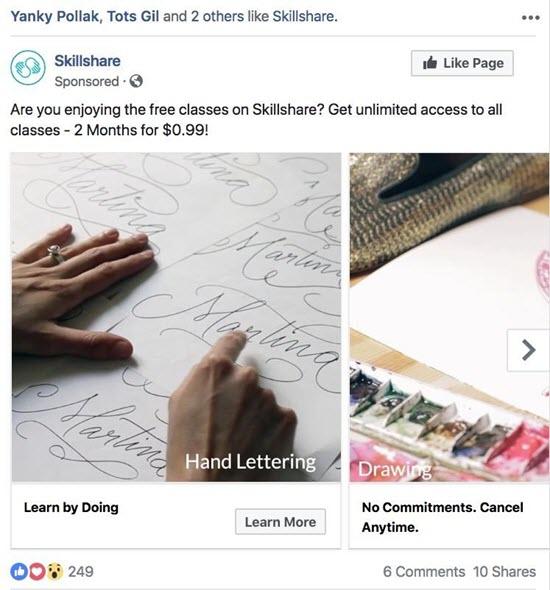
Case in point: Skillshare and Udemy are both online learning platforms where courses and how-to videos are available.

Whereas Udemy has an ad touting lifetime access to one course with a 100% money-back guarantee, Skillshare touts unlimited access to all of its courses, all for the price of just $0.99 for two months.

Checking out your competitors’ ads might give you ideas for new value props, CTA’s, or emotional angles to test in your own Facebook ads.

Learn more strategies for competitive advertising on Facebook here.

Facebook Ad Reporting

After you’ve gone through all this trouble to familiarize yourself with how Facebook ads work and hopefully implemented some campaigns, you can’t just expect them to do all the work for you while you sit back. You have to take an active role in your campaigns even when they’re underway, so that you can ensure that you’re getting a good ROI from your ad spend and efforts.

Start monitoring results as soon as you’ve launched one of your ad campaigns. Don’t wait until the campaign has run its course to determine if it was hitting all the right targets or not.

Just head to your Facebook Ads Manager to look at your ads’ performance in real-time. The beauty of monitoring in real-time is you can also respond in real-time by adjusting underperforming ads. Within the Ads Manager, you can easily edit your ads to tweak them to reach better performance.

For example:

  • If an ad’s engagement level is disappointing, try improving the copy or the visuals used in the ad to make it more stimulating and persuasive
  • If an ad’s reach is lower than you expected, try to expand the audience in your targeting parameters
  • If an ad’s conversions aren’t where you want them to be, try improving your call to action by using a more action-oriented verb, or working to improve your Facebook ad landing pages

A final note on tracking Facebook performance: Instead of putting an emphasis on vanity metrics like engagement and the like, you should be focused on tracking the metrics that really matter: sales and ROI or return on ad spend (ROAS). If your ad campaign gets you a lot of reach, clicks and conversions, but you’re actually losing money per sale when you figure in all your expenses, then the campaign’s no good.

That’s why you need to track ad performance and sales first and foremost during the course of your campaigns.

You Can Make Facebook Ads Work for You

Facebook ads have a proven track record of success for small businesses. The fact that they’re cost-effective makes them business-friendly and is just another reason to use these ads. However, not many business owners are using these ads to their full potential—not even close!If you decide to jump headfirst into Facebook ads, you have to have a solid grasp of how the entire platform works, how much you’ll likely spend, the different ad types, optimization strategies, and the need to monitor your ads closely.

Only then will your business get the most from this great platform.

By Marc Schenker 

Sourced from Business 2 Community

By Lora Kellogg

As any franchise leader knows, developing and expanding your brand isn’t easy. Traditional methods of franchise development, such as working with franchise brokers and using public relations, can be successful. But they’re much more effective when paired with newer methods, such as digital marketing.

Social media platforms provide great lead generation options for advertising. Consumers already feel comfortable engaging on social platforms, and platforms such as Facebook have lead generation-specific ads that provide outstanding targeting options. Users can submit their information on Facebook or Instagram without having to leave the app or website, which makes the process easier for mobile users and delivers more leads to your franchise development team’s inbox.

Brands with an active social media presence already understand the benefits of social platforms. Users interacting with brands on social media aren’t looking only for promotions and discounts; they also are looking for business opportunities.

Brands hoping to interact with potential franchisees should take note. Leads generated through social media are highly motivated. Here are four ways your franchise can increase leads generated from social media platforms.

1. Increase overall brand awareness

Want more consumer interaction on social media? Start by telling your brand story. Tell customers what your company stands for and what it has to offer through articles, videos, and other posts on social media. Seize this opportunity to introduce your brand to potential franchisees on platforms where they’re already comfortable engaging.

Approximately 68 percent of American adults use Facebook — which towers above adult user statistics for other platforms. YouTube takes second place, with 40 percent of adults using it regularly. Talk to your franchisee candidates on the platform or platforms of their choice.

2. Develop lookalike audiences on Facebook

Facebook engagement reigns supreme among adults on social media platforms, so take advantage. Develop new leads by uploading an existing email leads list and using Facebook to create a target “lookalike” audience based on common characteristics shared by members of your email list.

Similarly, you can develop an audience by examining which people have visited your franchise development website. These potential franchisees have shown a clear interest in your brand and already are being served your remarketing ads. Create a lookalike audience based on these users to find similar leads to add to your remarketing list.

3. Create personas among your target demographic

Even among your target demographic, there are a lot of variations. Millennials, for example, share similarities, but they can be subgrouped into young married people with kids, young married people without kids, single college graduates in their first jobs, and other categories. Develop personas within your preferred demographic to more clearly define your target audiences.

Take inventory of the traits you look for in new franchisees to divide your target demographic into desirable categories, then take advantage of hypertargeted social media ads to talk to each persona differently. Recent college graduates are looking for something different from young married people with children. Provide messaging that forges authentic connections with each persona in your audience.

4. Take advantage of Facebook’s new lead-gen ads

Using Facebook’s hypertargeted lead ads can point your qualified audience members to a landing page. This page should offer relevant gated content in exchange for an email address. The content could include an e-book, webinar, or promotional offer.

Once you have collected this email list of qualified leads, target them with remarketing ads. This list also can be used in an email drip campaign. Despite all of Facebook’s offerings, don’t forget to follow up in real life. Digital platforms can’t replace the personal touch, after all.

Growing a franchise is a challenge every franchisor must meet. But in this digital-first world, social media provides a strong tool for lead generation. Follow these four simple tips to ensure your team is getting the most out of its social endeavors.

By Lora Kellogg

Lora Kellogg is president and CEO of Curious Jane, an ad agency specializing in franchises. With nearly 15 years of experience and a portfolio of top brands, she and her team work with established and emerging franchises to grow sales, increase traffic, build brand awareness, and generate leads.

Sourced from Franchising.com

By Myles Udland


Recently, British regulators fined Facebook (FB) 500,000 pounds (about $660,000) for breaking data protection laws that led to the Cambridge Analytica scandal in March.

The fine totals about 7 minutes worth of the Facebook’s revenue.

The fine was so small because the company violated a 1998 data protection law that capped penalties at 500,000 pounds. Under the newly-passed General Data Protection Regulation (GDPR) regulations that took effect in Europe in May, however, the company’s maximum penalty would’ve been up to 4% of annual global revenue, or around 1.4 billion pounds. Not nothing, but still not the kind of financial penalty that would cause much more than a quarter of analysts “looking through” a one-time charge that impacts GAAP profitability.

And, as regulators increasingly look to take on big tech companies like Facebook and Google, more regulation will entrench these companies’ dominant positions in the online advertising industry. Which means that rules aimed at reining in tech giants will merely ensure their dominance in markets lawmakers already think the companies have too much control over.

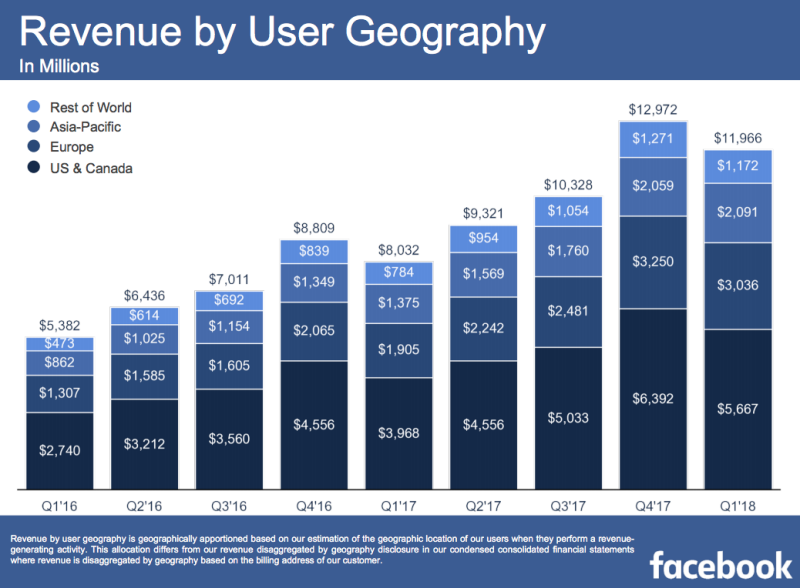
Facebook’s revenue in the first quarter of 2018 was just under $12 billion, a nearly 50% increase over the same quarter last year. This week, British regulators fined the company the equivalent of seven minutes worth of revenue. (Source: Facebook)

“As history has shown, we believe that regulation will embolden the incumbents and increase their market share at the expense of smaller tech firms,” said Mark Kelley, an analyst at Nomura Instinet in a note to clients on Tuesday.

“We draw comparisons to the financial services sector post Dodd-Frank, where there has been a clear decline in new banks formed as regulation created higher barriers to entry, likely the result of the outsized impact of compliance costs on smaller banks versus that of larger institutions.”

Kelley cites data from the Minneapolis Fed that shows reported compliance costs at banks with less than $100 million in assets pose a burden that is four times that faced by banks with between $1 and $10 billion in assets.

“This disparity in the financial burden of compliance would likely be replicated in the tech sector, punishing smaller firms and reducing competition to the benefit of the incumbents,” Kelley writes.

“With this as a backdrop, we believe the big players such as Facebook and Google are best positioned to handle the heightened operating costs from regulation and will also benefit from increased barriers to entry.”

The fine levied against Facebook this week — which could be potentially fatal to a tech startup that runs afoul of regulations — illustrates the extent to which tech’s biggest players can swat away regulatory action.

Kelley and his team also think that worries over GDPR regulations neutering the ability for websites to track users’ activity online are overblown.

“Anyone on the internet can go to an EU website to see what the new cookie disclaimers and privacy policy notices look like now that GDPR is in effect,” Kelley said.

“In our opinion, to an unsuspecting consumer (which is likely the majority of consumers), clicking ‘okay’ to the new cookie use policy — which grants the site permission to collect data to be used for tracking purposes — doesn’t look much different than what it looked like in a pre-GDPR environment, if at all.”

Kelley’s note marked the firm’s initiation of coverage on the U.S. internet sector, with the firm putting Buy ratings on shares of both Facebook and Google’s parent company Alphabet (GOOGL).

“Overall, we think there is still some room for growth in digital advertising for the foreseeable future — led primarily by digital video and social (and TV budgets making the transition to digital), and primarily on mobile devices,” Kelley writes.

“As a result of slowing user growth and already high internet penetration, the growth will likely be led by pricing, rather than volume, and the consistent shift away from offline to online media.”

And to the benefit of Facebook and Google.

By Myles Udland

Myles Udland is a writer at Yahoo Finance. Follow him on Twitter @MylesUdland

Sourced from Yahoo Finance

By Baishali Mukherjee

It is now a reality to use groups for positioning yourself, acquiring new customers, and many things more

Today, most of us are part of one Facebook group or another. But have we considered using the groups for business growth? Probably not! But it’s high time we start doing it effectively. Leveraging a Facebook group for business can yield delightful results. But before you create a group and start inviting others; it is important to know certain things, so that the group and its activities, create desired impact.

Wondering how to promote your brand in Facebook groups? You can do it either by creating your own Facebook group or by joining one managed by others. It is now a reality to use groups for positioning yourself, acquiring new customers, and many things more.

Scroll down to know more from experts about how to use Facebook groups to support and market your business.

According to Skannd Tyagi, founder, E Info Solutions, Facebook groups are a pool of people with common interest areas. “By joining such a group you have access to people who match the profiles of your target audience. These groups will provide numerous opportunities to create awareness about you and your brand simply by being proactive and helpful. To explore such opportunities, just write the keyword in the search section at the right-hand menu of the group’s page, and get going,” he shared.

Pramod K Maloo, founder Kreative Machinez, a digital hub for business promotional and marketing, believes, there are multiple benefits for entrepreneurs who are part of Facebook groups. He enumerated six of them-

Discussion – Facebook groups are sort of like the new kind of online forum. They have great features like polls, and large-format status updates to encourage group members to interact with your content. You will get regular updates on what is going on in the page, other social media handles.

Polls – Polls can be used to get customer insights and to understand what the customer wants and to receive immediate feedback from polls. Groups are a great source of immediate feedback, and if you build a niche group from the beginning, the feedback you receive will be extremely valuable.

Selected People, group – People who have been in constant interaction with a business page are definitely the ones who are interested in the services they provide. Therefore, making a group of those selected people and giving them the required content and information for what they usually look at. Drive these people to get engaged with the call to action, via campaigns, contests, takeaways etc.

The credibility of the brand – Having groups can help increase the credibility of the brand. The discussions that happen in the groups can also be used as answers or questions in Quora. By doing this we will increase engagement and presence on other social media handles.

Reach – It’s a viable way of building a highly engaged community of individuals who are likely to be interested in your business. You can reach out to masses without spending on Facebook ads.

Economical– If you can reach out to the masses plus targeted masses without pinching your pocket, it`s a great deal. So remember to always provide value to the customers and give them reasons to stay in the group.

Maloo also advised against talking about one’s business and products every time. “Sometimes small talks are important to make your products worthy. If you keep on talking about your products, things will be monotonous and people will lose interest. Also add company employees in the group, to increase the number of positive reviews about the services/ product offered,” he advocated.

Potential to Attract Future Customers Absolutely Free

Ajay Mittal, Founder, Kolkata Clean Air and Mera Workshops, has over the last few months, spent time talking to individual business owners to understand about how they generate business. Interestingly, one of the top platforms for them was Facebook and Whatsapp groups which were helping them attract more customers. He found that these groups can really help grow all business, be it, small or large, B2C or B2B.

The point Mittal wants to make is the sheer potential of Facebook group in attracting thousands of members, many of whom could be your customers, absolutely free. “If you compare this with any other marketing techniques, and the cost of reaching out to 10k eyes balls which are mostly targeted as potential audience having one or more common factors, and you will understand the immensity of the potential. That is not all, Facebook group posts allow easy communications and response which results in much higher engagements,” he opined.

Another interesting thing is that the posts stay in the groups forever so many people who view these posts can always search back when they are in need of the requirement, even months after the post was made.

Starting a Facebook group could be a great strategy if you are ready to do some hard work in building a successful group as Facebook Group Admin has much higher visibility and privileges than any other members. Mittal maintained that if you are into a business that has potential to take a community along you, should start building a group today.

Engaging successfully in a Facebook group

To engage successfully in a Facebook group you must make interesting posts. Now, what is engaging to a Facebook group might be very subjective and it depends on the target audience. It also matters what is the time you have made that posts.

There is no real secret to what makes a post successful, but a few things that you can consider as tips from Mittal’s observation:

1) Keep it short, easy to understand and very clearly highlighting the value proposition.

2) Most responsive posts are that are linked to a current event for e.g. Posts on beautiful hampers on Valentine’s Day or Mother’s Day will attract more response around those days.

3) Ensure you have a completely updated and active Facebook profile as that is important for people to trust you before enquiring or buying from you. Most people after reading a post will visit your profile before connecting with you to buy.

4) Make sure you engage in other posts but somehow connecting your comment with the post and not randomly posting your comment on every post. Best is to read through comments and reply to people who you see as your target audience.

Isn’t it a great opportunity for business owners to grow their business using these free techniques? All one needs is to be consistent and explore more and more groups to discover platforms that help to generate business, find ways to engage with target audience. What is even more interesting is that it is not limited to just B2C business; in fact B2B businesses have much higher potential but with a totally different strategy of selling directly but through education based marketing and engaging communities by sharing tons of value to appear as an expert in your domain.

Feature Image Credit: graphicstock

By Baishali Mukherjee

Sourced from Entrepreneur

While YouTube continues to frustrate creators by continuing to demonetize their videos based on the nature of their content, Facebook is looking to attract more videomakers with promises of prosperity. The social giant has announced several new and expanded monetization options for its creators, including the launch of a marketplace that connects brands to like-minded influencers.

The marketplace, titled Brand Collabs Manager, had previously been available to a small group of users but will now be opened up more widely. It gives brands the opportunity to search for creative partners with whom they can make deals. It’s a tool that sounds a lot like other branded content matchmakers on the social web, such as Google-owned FameBit.

Facebook has also announced expansions of both its ad breaks and fan subscriptions features. The former tool, launched last year as an answer to YouTube’s pre-roll ads, are now being offered to a larger group of creators in the US, particular those who specialize in long-form content. The recently-launched fan subscriptions, which let buyers unlock additional features on creator channels by paying a $4.99 fee each month, will be rolling out to more hubs as well.

By developing both of those features, Facebook is offering multiple monetization solutions in order to meet the needs of a growing and diversifying creative community. “We want to provide different ways for creators to make money on Facebook, so they can choose what makes sense for their content and community,” reads a blog post co-attributed to Facebook VP of Product Fidji Simo (pictured above). “For example, creators with longer content that fans come back for can monetize effectively through ads. Creators with super-fans or niche content can earn money directly from their audience through fan subscriptions or digital goods.”

For creators who, according to the post, upload “longer, authentic content that brings people back, that are focused on building a loyal community of fans, and who meet our monetization standards and follow our content guidelines for monetization,” Facebook is launching the Facebook for Creators Launchpad, a program that will help those videomakers further their digital careers. Applications for that program are available here.

By announcing all of these new ways to make money on its platform, Facebook is sending a clear message: If you’re a creator who is dissatisfied with YouTube, come to us. To hammer home that point, the social giant is expected to have a big presence at VidCon, where some of its top stars will hold court at a booth on the Exposition Floor.

Sourced from tubefilter 

By

If you’ve followed the media lately, you would think Facebook has crashed and burned. You’d be under the assumption that millions of users have run for the hills by deleting Facebook, and that advertisers are questioning how they are going to continue to reach their customers. Surprisingly, that isn’t the case and, honestly, Facebook has even strengthened its position and remains at the top of every advertiser’s list.

Leverage purchase behavior to shift the risk to Facebook customers. 

Facebook isn’t removing the ability to target by using purchase behavior; they are just putting the risk of using other people’s data onto you, the advertiser. Facebook knows how they collect their first-party data by keeping track of what users do on Facebook. But, they cannot control the data they purchase. Instead, they transfer the risk to you through the purchasing process.

Facebook will soon launch a custom audience verification tool that allows advertisers to use purchase behavior from another third party, But, if you upload it as a custom audience,  Facebook just wants you to say, “Yes, I purchased this data legally and in good faith. If not, you can say it’s my fault, not yours.” I see this type of data getting more competitive and, as an advertiser, third-party  companies are going to try to lure us in to use their data.

The user base is still on Facebook. 

Facebook released a stellar Q1 earnings report with revenue from advertising up 50% YoY and daily active users up 13% YoY. When asked about advertisers being weary of Facebook, Sheryl Sandberg, said they have not seen a meaningful trend in advertisers leaving. Per Facebook, one in every four minutes on mobile is spent on Facebook. Even if there were to be a small drop, the efforts Facebook has made in regaining trust will be evident as the users and the advertisers will come back, maybe even twofold.

So with the competitive landscape increasing, how do you continue to differentiate? We have found that by using influencer content while leveraging paid targeting we can place highly relevant, highly clickable content in a user’s feed at CTRs 2-3x Facebook’s average of .9-1.00 percent CTR. This content is genuine and much less “ady” than your traditional ads.

You can still create custom audiences despite the changes.

Another major change to Facebook’s structure is custom audiences. As mentioned, you can still get access to user purchase data either through owned data or purchasing from a third party and uploading via custom audiences. But one thing that was briefly mentioned is the ability to share custom audiences across business accounts.

This is a common practice among media agencies — sharing lookalikes to other media companies that are focused on different parts of the funnel. Company A is for brand awareness and Company B is for direct response “click here to buy now.” How do these two work together? Since the sharing of audiences has changed, the workaround would result in multiple pixels on your page owned by each company. We’re still waiting for Facebook for further instructions, so stay tuned.

Finally, this is an opportunity to look at how you collect your own data. 

Tis the season to look inward. Since Facebook is shifting the risk to its user base, everyone has taken a deep look at how they collect their data. As everyone is walking on eggshells at the moment, it’s best to make sure your audience trusts you.

By

Sourced from MediaPost

By

AppNexus is looking to take on the Facebook-Google ‘duopoly’ with a tool it has claimed will give advertisers “100% viewable buying at scale”.

The product, dubbed ‘guaranteed views’ will give brands the chance to purchase only ads that they classify as ‘viewable’ against their own standards across the web, offering a solution to the typically complex process brands and agencies often have to go through when setting up threshold viewability targeting online.

Allowing clients to target “the entire open internet” AppNexus’ latest feature will let buyers use viewability as a given outcome. The company didn’t reveal which buyers had been testing the guaranteed views, but said clients “typically” see improvement in cost-per-view, unique reach, click-through rate (CTR) and cost-per-click (CPC).

AppNexus, which has been vocal about the “considerable strain” it believes to have been placed on the industry through the dominance of the duopoly, said it believes this fresh tool “will help reverse the disproportionate flow of advertising dollars going to walled gardens like Google and Facebook.”

Viren Tellis, senior director, marketplace management, AppNexus claimed a point of difference for guaranteed views was that instead of layering multiple optimization types, “buyers can assume viewability is a given” and focus on achieving the performance KPIs advertisers care about.

While the move from adtech firm doesn’t guarantee buyers 100% in-view ads; instead giving them the option to purchase their inventory only against their measurement standards, it comes amid ongoing discussion between advertisers about what exactly that standard should be.

Just months ago, the Incorporated Society of British Advertisers (Isba) launched a 100% viewability standard in the UK, calling for brands to be given the facility to buy digital display ads in 100% view.

Key industry figures are split on what exactly the viewability standard should be. Unilever’s top marketer Keith Weed, for instance, subscribes to the 100% view. Others like rival Procter and Gamble (P&G) believe in the standard set by US-based body the Media Ratings Council (MRC) that ads should be at least 50% in view.

According to the World Federation of Advertisers, in the UK alone almost £600m per-year is believed to be wasted on non-viewable ads, with 63% of members saying they are now only investing in viewable impressions which meet industry standards.

Facebook currently offers buyers 100% viewability on some products in tandem with Moat. Google, meanwhile, lets advertisers, agencies and publishers using its active view product to see custom metrics that allow them to go beyond transacting on the Media Ratings Council (MRC) defined industry standard for viewability (which is 50%).

By

Sourced from The Drum


By 

  • Facebook CEO Mark Zuckerberg testified before Congress for over five hours on Wednesday, where he answered questions from senators on a broad range of subjects.
  • During an exchange with Senator John Cornyn, Zuckerberg laid out a simple explanation for how Facebook makes money with user data.
  • Zuckerberg’s explanation is a concise walkthrough of how your data is turned into profit.

You’re forgiven if you didn’t watch all five-plus hours of Facebook CEO Mark Zuckerberg answering questions during a joint Senate Judiciary and Commerce Committees hearing on Tuesday.

Even if you were watching, it’s entirely likely that you missed a crucial, brief segment around the two-hour mark, where Senator John Cornyn asked Zuckerberg about how Facebook handles ex-user data.

Though somewhat unrelated to what Senator Cornyn asked, Zuckerberg’s answer was a fascinating, concise look into how Facebook turns its vast quantity of user data into profit.

“There’s a very common misperception about Facebook — that we sell data to advertisers,” Zuckerberg said on Tuesday. “And we do not sell data to advertisers. We don’t sell data to anyone.”

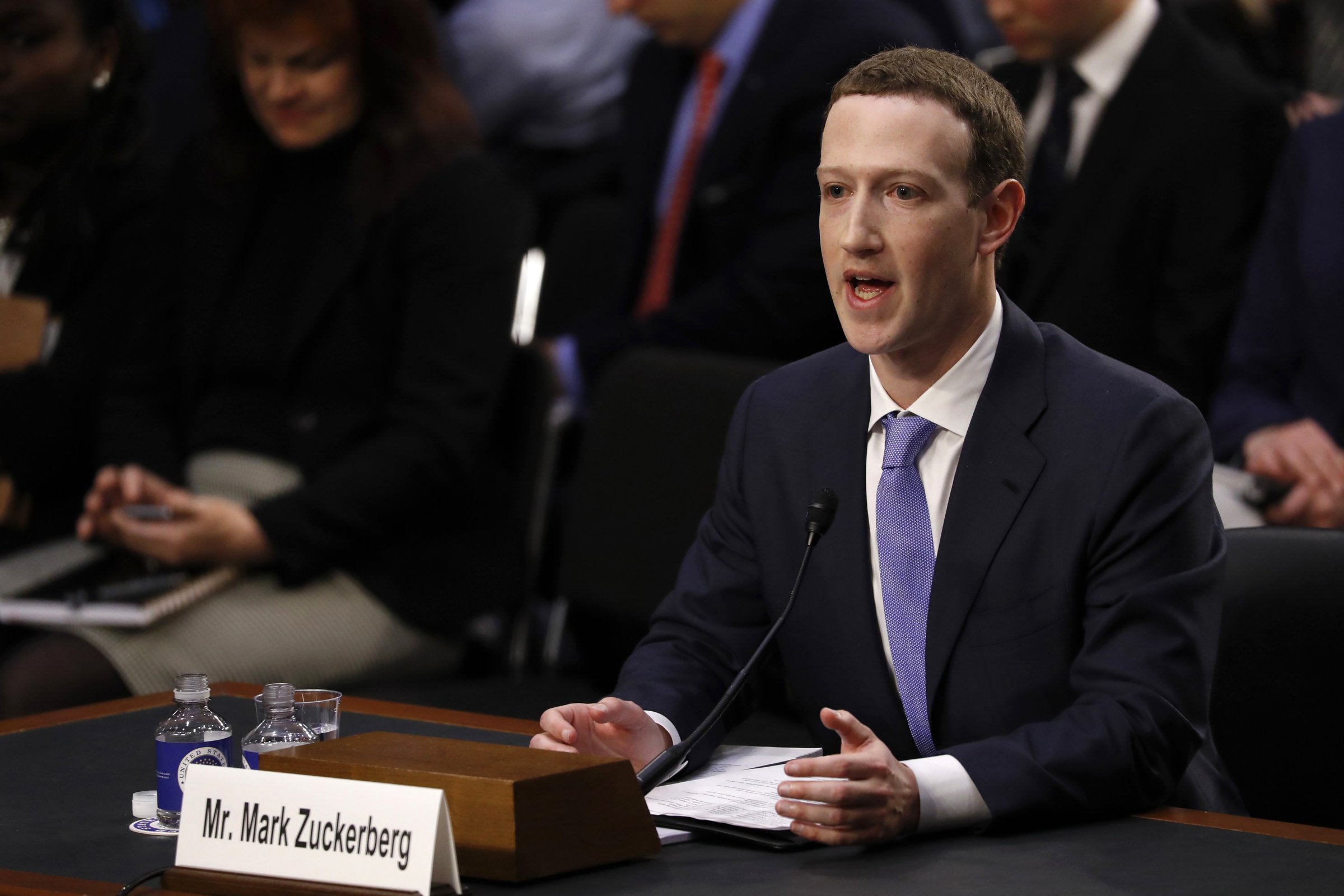
Mark ZuckerbergFacebook CEO Mark Zuckerberg is surrounded by members of the media as he arrives to testify before a Senate Judiciary and Commerce Committees joint hearing regarding the company’s use and protection of user data, on Capitol Hill in Washington, U.S.Reuters/Leah Millis

Indeed, Facebook makes it money through advertising. Facebook doesn’t provide data to advertisers — it does the work for them.

Here’s Zuckerberg explaining it to Senator Cornyn on Tuesday’s Senate hearing:

“What we allow is for advertisers to tell us who they want to reach, and then we do the placement. So, if an advertiser comes to us and says, ‘All right, I am a ski shop and I want to sell skis to women,’ then we might have some sense, because people shared skiing-related content, or said they were interested in that, they shared whether they’re a woman, and then we can show the ads to the right people without that data ever changing hands and going to the advertiser.”

In the wake of the Cambridge Analytica scandal, which revealed that at least 87 million Facebook users had their data used without consent by a political firm to influence elections (including the 2016 US Presidential election), general users, celebrities, tech executives and politicians have begun openly questioning Facebook’s handling of user data.

Facebook now admits fault for allowing third-parties to access user data inappropriately, which is what led to companies like Cambridge Analytica possessing user data in the first place. The company has since shut down loopholes in its social media service that allowed third-parties to “scrape” data from its users.

All that said, Facebook still directly relies on user data to make money — it’s just not in quite the way you may have thought.

Feature Image Credit: Facebook CEO Mark Zuckerberg testifies before a joint Senate Judiciary and Commerce Committees hearing.REUTERS/Aaron P. Bernstein

By 

Sourced from Business Insider UK


By Emily Tan

Spurred by the recent outrage over the misuse of Facebook’s data by Cambridge Analytica, Adblock Plus has introduced a feature that lets users disable social media buttons.

These ‘like’ buttons allow Facebook to track users’ browsing behaviour beyond its walled garden, even if users do not touch them.

“What most people don’t realise is that buttons used to share content on social media platforms such as Facebook, Twitter, Google Plus and others are placed on almost every website that you visit,” Ben Williams, director of operations at Adblock Plus, said.

“Even if you don’t click them, these buttons send requests to the social network’s servers, which then uses the information to create a profile based on your browsing habits. This is one of the key ways that social media sites such as Facebook are able to access consumers’ private data.”

Adblock Plus promotes this feature as a way for consumers to have more control over their online data, without having to quit social media altogether.

“For consumers, this scandal highlights how easy it can be for their information to be gathered and misused without their consent. The social media giants’ policy of self-regulation is clearly not working as it should, and is making users’ data more vulnerable; it has therefore never been more important for consumers to demand their power back,” Williams added.

By Emily Tan

Sourced from campaign