Tag

Feminism

Browsing

“We have given social media unlimited power and every day we can see how dangerous this is.”

For years, human rights monitors have been outraged at the selective policing of content on Meta’s social media platforms like Facebook and Instagram. The company’s latest enforcement action is hardly shocking at this point, but it provides a crystal clear example of the kinds of things Meta will — and won’t — allow on its apps.

In a bizarre case of digital censorship, Meta’s content moderation system stepped in to stop a local theatre in Barcelona from promoting a stage adaptation on the grounds that it violated a rule on promoting “social topics,” per the Guardian.

The production in question is an adaptation of “A Room of One’s Own,” a book by the legendary English author and feminist Virginia Woolf. According to the Teatre Raval, planned promotional posts about the show were blocked on both Instagram and Facebook, likely by an automated content moderation system.

After reaching out to Meta about why the promo campaign had been stomped out, the company replied that “any mention of civil rights, feminism or social reform are usually classified as ‘social topics’ by our automatic system,” and therefore rejected.

According to the Guardian, the company then cryptically recommended the Raval remove “key words” related to social activism, so the promo campaign can pass the automated censor — though the company failed to explain what, exactly, its content system objected to.

“We don’t know if the publicity has been rejected because of the name of Virginia Woolf or because of the word feminism, or both,” Clara Sanchis, who stars in the one-woman show told the Spanish newspaper La Vanguardia, per the Guardian, which translated the comments.

“In any case, it’s a way of erasing from the map advances that have taken centuries to achieve,” Sanchis continued. “We have given social media unlimited power and every day we can see how dangerous this is. It’s bias and manipulation.”

The automated rejection and the ensuing apathy from Meta come after some galling incidents where Meta refused to take down content significantly more radical than a theatrical performance about a literary figure whose books are read by high schoolers.

In August, Futurism reported that Meta was refusing to take meaningful action against a far-right influencer campaign to drum up support for a “crusader march on Dearborn” Michigan, organized by self-described “anti-Arab” extremist Jake Lang.

Though Lang’s initial post wasn’t “sponsored,” meaning he didn’t officially pay to promote his call-to-action as the Teatre Raval was trying to do, his post nonetheless garnered thousands of reactions, comments, and shares from his 274,000 followers. It also spawned a deluge of copycat posts extolling racism and Islamophobia, some of which contained explicit calls for violence which Meta refused to take down.

And earlier in September, Meta was found to be hosting a massive number of AI-generated videos depicting horrific acts of child abuse. Meta removed a tiny handful of videos after Futurism approached the company for comment — but refused to act on others, leaving the vast majority of violent AI Reels untouched.

In all, Meta has drawn a revolting line in the sand — with nominally progressive “social topics” on the verboten side, and base depictions of torture and calls for violence allowed sight unseen.

I’m a tech and labor correspondent for Futurism, where my beat includes the role of emerging technologies in governance, surveillance, and labor.

Sourced from Futurism

By

After a months-long marketing blitz, the much-hyped Barbie movie is released this week.

From a Malibu Barbie dreamhouse listed on AirBnB, an AI tool that transforms selfies into Barbie movie posters and multiple Barbie-themed brand collaborations ranging from nail polish to roller skates, Barbie is everywhere.

She has even gone viral as a fashion trend known as Barbiecore, exploding across social media with people embracing vibrant pink hues and hyper feminine aesthetics. A Barbie world is upon us.

Although some have criticised this saturation strategy, it is a very deliberate marketing ploy to revitalise and redefine a brand with a contested position and history.

As well as attracting adults who grew up with Barbie and are curious to see what’s changed, the reinvention is drawing in those younger fans swept up by the tsunami of marketing and merchandise.

Despite being one of the most trusted brands with a value of approximately $US700 million, Barbie has long attracted feminist criticism for fuelling outdated and problematic “plastic fantastic” sexist stereotypes and expectations.

The Barbie backlash

Only a few years back, Barbie was a brand in crisis. Sales plummeted across 2011 to 2015 against the cultural backdrop of a rise in body positivity and backlash against a doll that represented narrow ideals and an impossible beauty standard.

After all, at life-size Barbie represents a body shape held by less than 1 in 100,000 real people. In fact, she is so anatomically impossible that, if she were real, she would be unable to lift her head, store a full liver or intestines, or menstruate.

The backlash has also been in response to growing concerns about how she influences child development, particularly how and what children learn about gender. Barbie has been identified as a risk factor for thin-ideal internalisation and body dissatisfaction for young girls, encouraging motivation for a thinner shape that damages body image and self esteem.

And despite the multiple careers Barbie has held over the decades, research highlights that girls who play with Barbie believe they have fewer career options than boys. This speaks to the power of toys to reinforce gender stereotypes, roles and expectations, and how Barbie has imported narrow ideals of femininity, girlhood and womanhood into young girls’ lives.

Reinventing a long-established icon

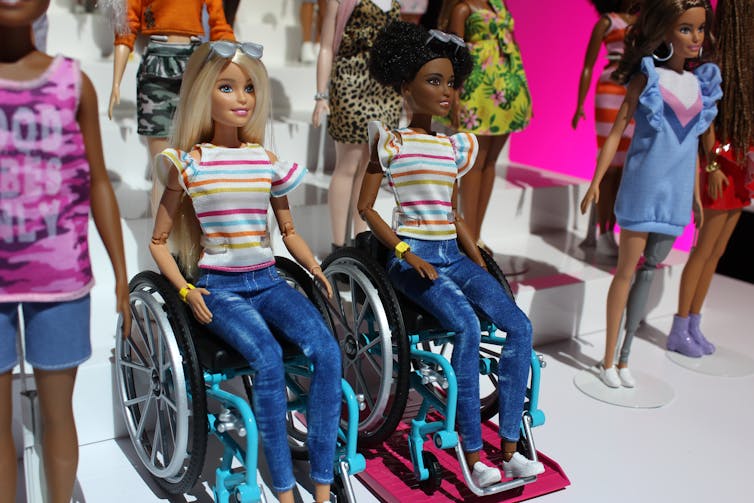
In response to this backlash, Mattel launched a new range of Barbies in 2016 that were promoted as diverse, representing different body shapes, sizes, hair types and skin tones. This was not without criticism, with “curvy” Barbie still considered thin and dolls named in ways that drew attention foremost to their bodies.

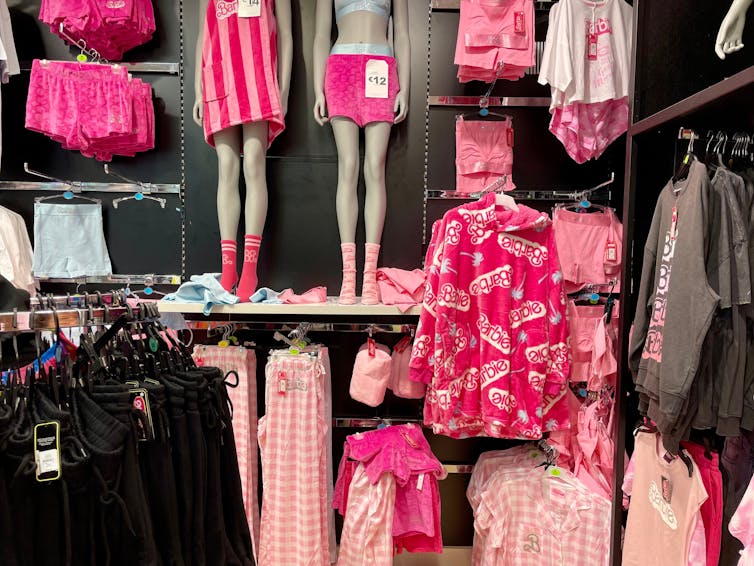
Hot pink dresses, shirts and other Barbie-inspired clothing on display in a shop.
Barbie merchandise on sale at a clothing store in Ireland. Shutterstock

From a white, well-dressed, middle-class, girl-next-door with friends of a similar ilk, Barbie has since been marketed as a symbol of diversity and inclusion. To signify the extent of the transformation, Mattel’s executives gave this project the code name “Project Dawn”.

Mattel – like many other brands joining the “inclusivity revolution” – knew that diversity sells, and they needed to make their brand relevant for contemporary consumers.

Diversity initiatives included a line of female role model dolls, promoted as “introducing girls to remarkable women’s stories to show them you can be anything”.

Barbie was also given a voice in the form of Barbie Vlogs, where she expressed her views on issues including depression and the sorry reflex. A gender neutral collection called “creatable world” was added in 2019 to open up gender expression possibilities when playing with Barbies.

Such efforts were crucial to undoing missteps of the past, such as a “Teen Talk Barbie” that was programmed to say “Math class is tough!”, or the compulsory heterosexuality that Barbie has long advanced.

The latest step in Barbie’s transformation

Barbie the film is simply the next step in an evolution to make brand Barbie inclusive. And with a rumoured film budget of $100 million, the supporting marketing machine provides a critical opportunity to reset the Barbie narrative.

Fair skinned and dark skinned Barbies sitting in wheelchairs.
Part of the range of Barbies introduced in 2016 to promote diversity and inclusion. Shutterstock

With Greta Gerwig, acclaimed director of female-led stories such as Little Women and Lady Bird at the helm, and a diverse cast of Barbies of different races, body types, gender identities and sexual preferences, the film and its creators have sought to assure audiences of the film’s feminist leanings.

Addressing the complicated history of Barbie is crucial for audiences who grew up and played with the doll and are grappling with introducing her to the next generation of doll consumers.

Yet, Robbie Brenner, executive producer of Mattel Films, has explicitly stated that Gerwig’s Barbie is “not a feminist movie”. Indeed, the main character still represents a narrow beauty standard – tall, thin, blonde, white – with diverse characters in place to support her narrative.

Which begs the question: are these inclusion initiatives simply emblematic of diversity washing, where the language and symbolism of social justice are hijacked for corporate profit? Or do they represent a genuine effort to redress the chequered history of a brand that promotes poor body image, unrealistic ideals and rampant materialism?

What is clear is that in today’s climate where brands are increasingly rewarded for taking a stand on socio-political issues, brand Barbie’s attempts to reposition as inclusive have paid off: sales are now booming.

Seemingly, Barbie’s famous tagline that “anything is possible” has shown itself to be true.

Feature Image Credit: Ryan Gosling (left) and Margot Robbie who play Ken and Barbie in the “Barbie” movie. Shutterstock

By

Sourced from The Conversation