Tag

Global

Browsing

By 

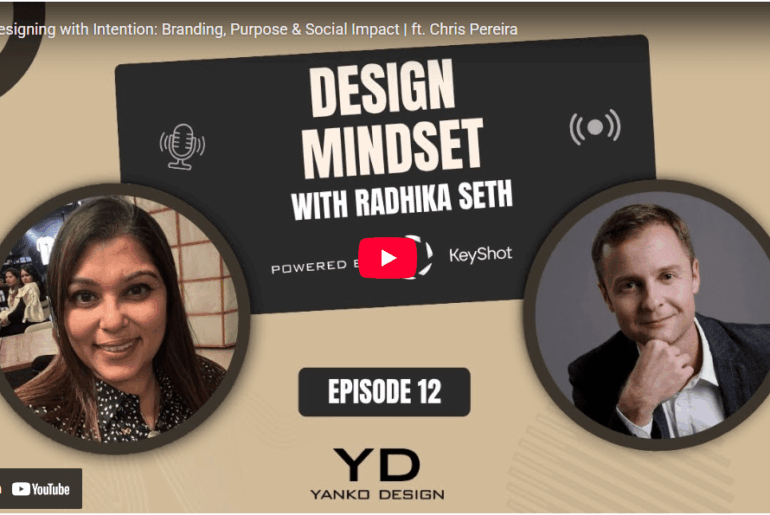
Every week, Yanko Design’s podcast Design Mindset powered by KeyShot brings you conversations with design leaders who are shaping how products, brands, and experiences connect with people around the world. Hosted by Radhika, the show explores the intersection of design thinking, strategic communication, and the human stories behind successful brands. Whether you’re a designer, entrepreneur, or simply curious about how intentional design shapes our world, this weekly series offers insights you won’t find anywhere else.

In episode 12, Radhika sits down with Chris Pereira, founder and CEO of iMpact, a China-Western communications and go-to-market firm based in Shenzhen. With nearly two decades in China, fluency in Mandarin, and a notable stint as a Huawei PR leader, Chris brings a rare perspective to the table. Named one of Forbes India’s Top 30 Globalization Innovators, he’s spent his career helping brands navigate the treacherous waters between cultural intention and reception. What emerges from this conversation is a masterclass in how design decisions carry meaning, whether you intend them to or not.

Download your Free Trial of KeyShot Here

When “On Brand” Goes Off the Rails

Chris opens with a stark reality check: “Design isn’t neutral, especially across cultures. A font, a color, a slogan that wins in New York can really backfire in Nanshan in Shenzhen, China.” The challenge isn’t just about translation in the linguistic sense, it’s about making intention travel across borders intact. Every design choice tells a story about your values, and Chris emphasizes this with a striking insight: “The question isn’t if your design will tell a story, but what story you’re telling. So it’s whether you’ll own that narrative or let it own you.”

When brands think they’re “on brand” with a global strategy, that’s often exactly when things break down in local markets. Chris shares a personal anecdote that illustrates the stakes: “I had a friend a few years ago in China and he always liked to wear a green hat… But in China, there’s a specific phrase. If you’re wearing a green hat, it means your partner is cheating on you in the relationship.” What’s an innocuous fashion choice elsewhere becomes a cultural faux pas in China. For brands, this translates directly to sales, green hats simply don’t sell in Chinese markets, regardless of how well they perform globally.

Why Respect Can Look Like Disrespect (and Vice Versa)

Cultural landmines extend far beyond colour choices. Chris recounts a dinner meeting where cultural respect signals completely misfired: “The Chinese host used chopsticks and before he ate he put food onto my client’s plate… But my business partner, my client, he got very angry all of a sudden. He said, I know how to use chopsticks. I’m not a kid.” The Chinese host was showing respect; the Western guest felt insulted. Both sides wanted to build trust, but the trust was actually eroded by the interaction.

These seemingly small details matter enormously for visual communication too. Sticking chopsticks upright in rice is a cultural taboo in China associated with funeral rites, an advertising image showing this would be deeply inappropriate, yet a Western creative team might not know to avoid it. Chris’s firm uses a systematic 10-item pre-mortem checklist that expands into roughly 100 specific considerations, covering everything from brand names and colour schemes to who appears in imagery and what scenarios are shown. The goal should be consistent across markets, Chris explains, but the methods must adapt: “The result or what we want to convey in every country is the same. We care about the local community… How we get there is very different.”

Stop Saying You’re Great (Get Someone Else to Say It)

Perhaps the most critical insight Chris offers is about trust-building through third-party endorsement. “If I sit here and tell you, Radhika, I’m really great. I’m amazing… Honestly, that’s not a good way to convince the other person. The better way is to say, this professor has given me a letter of introduction. I was on TV last week on that media.” From a brand perspective, advertising says “I’m great,” while third-party endorsement says “he’s great” or “she’s really trustworthy.” Chris’s advice is direct: “If you don’t have the third-party endorsement, you shouldn’t do advertising.”

He encourages brands to “stand on the shoulders of giants,” pointing to the “Intel Inside” label on laptops as a perfect example. Industry awards, professional association endorsements (like dental associations for toothpaste), and partnerships with established entities all build the trust foundation necessary before spending on advertising. For product launches, Chris advocates showcasing customer success stories: “Maybe we can donate some of our products while we’re doing our announcement. And they can come and say how much that means to them for their community.” This provides powerful, authentic validation that no amount of paid advertising can replicate.

What Huawei’s Crisis Taught About Winning Together

Chris’s time at Huawei during one of the most challenging periods in the company’s history taught him invaluable lessons about resilience and messaging. When he joined in 2016, the message was all about dominance: “We’re number one in this industry. We’re number two in this industry. We have a huge end to end supply chain.” That message made employees proud but scared competitors. “If you’re in the United States at your Apple or Google, you’re like, oh, crap, this is kind of scary. Right. And they’re going to take our business,” Chris recalls.

The lesson? “The importance of win win or finding ways to work together in a way that’s good for everyone in the community is important.” Huawei eventually shifted its messaging toward building an open ecosystem, helping everyone in the supply chain succeed together. Chris also learned about the long-term mindset necessary for trust-building. When the Meng Wanzhou crisis hit in 2018-2019, many questioned whether Huawei would survive. Yet the company had a record year recently, expanding into new sectors like automotive. This taught Chris the importance of resilience and “thick skin” for both brands and individuals, and that trust requires time and consistency to build properly.

Redefining Speed: Why “Shenzhen Speed” Isn’t What You Think

The concept of “Shenzhen Speed” came up multiple times, but Chris is careful to define it properly. It’s not about rushing business relationships or pushing for quick deals. Rather, “when we say Shenzhen speed, we’re not talking about the speed of your business development… the speed is response. So if you send me a message and I respond quickly, we close the loop quickly.” Trust, conversely, needs time.

As Chris puts it, quoting a German friend: “Going in the wrong direction very quickly is not efficient. So in other words, if you’re going in the right direction slowly, that’s actually maybe better than going super fast and going in circles.” This is especially true for Chinese companies going overseas. Chris identifies cross-cultural communication as the primary challenge: “They all have great products, but they still lack a ability to communicate in a cross-cultural setting.” And crucially, human connection matters more than technology: “Get on an airplane and be on site at a trade event, visit your clients in person, have coffee with them. So none of that can be done by AI, interestingly.”

The Three Non-Negotiables Every Brand Needs

When asked about his non-negotiables, Chris identifies three foundational principles. First, compliance, “You need to follow the law anywhere you go,” he states simply. Second, authenticity: “If you’re not authentic, you will lose the trust of the local market.” Chris shares what he calls the 20-60-20 rule: 20% of people will always love you, 60% don’t really care either way, and 20% will actively dislike you. “When we’re doing our design work and business work, it’s important to bring your true self to the table because then you’ll attract the consumers, your customers, your partners, your friends who are like minded.”

Third, purpose beyond profit. “We’re not just doing business and doing design work and doing PR for money. I think we want to make the world a better place,” Chris reflects. For him, this is personal: “I have a nine year old son who’s half Chinese. So what we’re doing is helping Chinese companies and helping China tell their story in a more effective way overseas and building more trust and friendship.” In the rapid-fire segment, Chris crystallizes several key insights. His quickest litmus test for international success? “The team, the team behind the product.” The most underused asset in cross-border launches? “The actual relationships… in the local market.” And what beats beautiful design every time? “A brand mission. So a mission, a worthwhile cause to do something.”

Making Intention Travel

What emerges from this conversation is a fundamental truth: design is never neutral. Every choice, from fonts to colours to the people you feature in your imagery, communicates values. The challenge is ensuring those values translate as intended across cultural boundaries. Chris’s approach is both systematic and deeply human: use checklists and structured processes, but never forget that trust is built person to person, through authentic relationships and genuine commitment to local communities.

For designers and brand strategists working in an increasingly global marketplace, the message is clear: you can’t afford to be culturally naïve. What “works” in your home market may actively harm you elsewhere. But with the right approach, thoughtful localization, authentic partnership, and patience, brands can successfully make their intention travel across borders. Chris Pereira can be found on LinkedIn, and Design Mindset releases new episodes every week, bringing you more conversations with leaders who understand that great design isn’t just beautiful, it’s meaningful.

By 

Sourced from Yanko Design

By 

Does marketing have the power to change the world? The year 2020 has forced us all to redress the net result of the industrial revolution, which spurred mass consumption and throw-away consumerism. So, can our industry – with the abundance of talent, skill and creativity- champion for a better future for all?

The Drum and Facebook have partnered to bring together teams from brands and agencies across the globe to provide some answers to this very challenging question. The idea is to get together experts from the industry to find solutions to business and societal challenges to help create value for the people and the communities it impacts.

The creative brief

Uniting three markets under the theme of ‘stakeholder capitalism’ – with attention to inclusion and diversity – three separate teams in North America, EMEA and APAC were put together to answer the brief that involves a rethink of how small-to-medium size enterprises (SMEs) that are run by minorities operate, and how as an industry we can help create more resilient businesses especially in these unprecedented times.

Each of the three regions were given three separate briefs – The US (North America) team’s brief is to focus on women run SMEs. So how to overcome systemic social and financial challenges while starting and sustaining female-led businesses? Do they need to approach entrepreneurship differently?

For the London, UK (EMEA) team the theme was immigrant-led small business. Are immigrant-owned businesses the untapped potential? What are the challenges and opportunities of migrant founders and their businesses?

The theme for the APAC team is silver start-ups. A growing number of over-65s are now delaying retirement by starting their own firm, fueling a ‘grey business’ boom. What are their challenges, can we identify the most pertinent ones and solve those problems?

The first meet-up

Each of the teams kicked off their first virtual brainstorm session to find a campaign solution that would positively impact the lives of minority groups operating in the SME market. Each of the teams were also given mentors to help guide through the process.

Following is the list of the three teams:

Team US

  • Tom Spaven, brand director, Bombay Sapphire, North America (mentor)
  • Stephanie Walker, innovation marketing manager, Pepsico
  • Cassie Begalle, strategy and innovation brand Manager – U by Kotex, Kimberly-Clark
  • Iyanni Callender, junior art director, Strawberry Frog
  • Paola Ortega, associate strategy director, DDB Chicago
  • Michael Rodriguez, content strategist, 3 Leches Creative

Team UK

  • Arjoon Bose, marketing head- culture & brand experience (Europe-Australasia), General Mills (mentor)
  • Andre Campbell, partnerships lead, Mercedes-Benz
  • Fatima Diez, head of marketing, MunchFit
  • Shannie Mears, co-founder & talent chief, The Elephant Room
  • Jade Nodinot, former creative associate, BlackBook London
  • Emma Luxton, former senior account executive, Avantgarde London

Team APAC

  • Erica Kerner, SVP, marketing strategy & partnerships, ONE Championship (mentor)
  • Triveni Rajagopal, global digital director, skin cleansing and BPC, Unilever
  • Chandini Malla, senior manager, Diageo
  • Bryan Martin, social media executive, Reprise Digital
  • Adrianne Pan, planner, Havas Singapore

Team US: A fact-finding mission

Gender equality is at risk of being set back decades in the current climate – not just minorities in general, but especially women in it. In the US, the focus is on women-owned SMEs, looking at how female-led businesses can overcome systemic social and financial challenges, as well as addressing the different approaches that this cohort might have to entrepreneurship in order to succeed.

One such challenge was posed by keynote speaker Victoria Monsul Singolda, owner and creative director of Iris & Virgil, who discussed that though it might be true that for women-led businesses, their vulnerabilities as women and as small business owners are compounded, there needs to be a gender-smart approach because not all women-led businesses are the same.

“I never really thought of myself as a female business owner, I’m just a business owner. Maybe because my mother was very dominant in the household, she was a student, she was a business owner, she was a mum, we always saw her, we were always together. Maybe that’s why I never thought that there was something different or special being a girl.”

Headed up by mentor Tom Spaven from Bombay Sapphire, the team immediately honed into “resilience” and “impact” as the insights towards this gender-smart approach.

The team delved into discussions to align on common goals and objectives. The first step was to focus on the challenges in order to find the most creative solution – with three key take-aways that these women are lacking: Knowledge and resources to tap into; a community to help them venture into this new world; and platforms available to really share and have people learn more about.

The team then decided that the initial insight-led approach would begin with a fact-finding mission to assess the situation and the scale of the problem that the campaign needed to solve; followed by the consumer insight to understand the deep motivations and needs of the target to ultimately give the barrier they need to start to push against in order to solve the problem; and finally, culture listening around this topic – all of which would help to get a clear, sharpened brief about the real problem they are trying to solve.

Team EMEA: Move from ‘pivot to evolve’

On the other side of the Atlantic, Team EMEA, led by mentor Arjoon Bose from General Mills, tackled the untapped potential of ethnic minority and immigrant-owned founders, their challenges and opportunities.

“The last few months have been testing and I think we’ve all come up with a ton of learning. But I think we’re at that stage right now where we’re needing to move from pivot to evolve,” said Bose. “A growth mindset is what we’re going to have to need as we come out of this and prepare to get stronger and accelerate.”

After hearing from keynote speakers Sharon Jandu, director, Yorkshire Asian Business Association and director, Northern Asian Power List; and Steph Douglas, founder, Don’t Buy Her Flowers, it was clear that a heavy emphasis on networking, relationships and experiences, along with access to digital technologies, were key in bringing this community together.

“For an SME, they are so busy doing what they do that they don’t have the time or the capacity to think about what they can do – or they don’t have the networks to enable them to get the contacts to get investments or to get ideas. They are constantly running on a treadmill, trying to do and keep what they are doing alive. How can we stop them becoming so absorbed in their business that they can actually distance themselves and look at it from an aerial perspective?” asked Jandu.

The team identified the need to listen and learn directly from migrant-led business owners themselves to understand their experience, their struggles and challenges with direct feedback through focus groups and on-the-ground research. This would allow them to narrow down into one or two sectors that need the drive and support. They identified Facebook’s own small business community as a great place to start to create a questionnaire in order to gain invaluable insights to help shape their strategy.

“The opportunity that digital gives us to connect these immigrant-owned businesses with each other and provide each other with their own experience and their own knowledge can be a very valuable thing that we could leverage if it’s relevant to their challenge,” said Fatima Diez.

Team APAC: Reinventing and re-energising culture

With a growing number of over 65s now delaying retirement and fuelling a ‘grey business’ boom, the focus for Team APAC was on overcoming the challenges faced by the silver start-ups, particularly when it comes to navigating through the coronavirus pandemic.

Mentored by Erica Kerner from ONE Championship, the team was presented with a keynote talk by Jeremy Nguee, founder, Preparazzi Gourmet Catering; Batu Lesung Spice Company; who helped his mother set up Mrs. Kueh, a local sweet treat business. They touched upon some of the unique experiences and challenges of their business that they ran from home.

Hoping to learn from this experience and translate these lessons to help support silver entrepreneurs and home-based businesses through his volunteering role in the Hawkers United Facebook community, Nguee said: “I think this is going to be a very, very big market. There are a lot more home-based businesses coming up because of high unemployment in the market.”

Inspired by the talk, the team decided to focus on Singapore food culture and food service industry run by silver entrepreneurs, that has an international dimension throughout much of its history but continues to retain features firmly rooted in the locality so that the global and local are not always distinct. The team wanted to understand the different segments of businesses and the landscape in which they were working in.

“The complexities of Asia, the complexities of the segment, the types of digital, could become such a beast,” says Kerner. “My instinct is to start with the data. Starting a business now, no matter what your age is a challenge and a lot of small businesses are obviously struggling to survive. We’ve got a lot of things to think about. What aspect of this do we want to try to unbuckle?” asked Kerner. “In Singapore we are losing a lot of that Hawker culture and if we can find a way to re energise it, and bring more people back into it, it’s good for all of Singapore culture.”

The next steps

Over the upcoming weeks, the teams will continue to work on their campaign and then subsequently present the big idea for solving that problem.

The final ideas will be entered in The Drum Social Purpose Awards.

The Drum consulting editor, Sonoo Singh, said: I’m inspired to see the true power of marketing when used to promote issues that are critical to our societies, persuade a change in behaviours, and influence a positive shift in behavior that would benefit our environment. Having been involved with all the teams, I cannot wait to see the final outcome of this very challenging brief.”

By 

Sourced from The Drum