Tag

machine learning

Browsing

By Natan Pollack

Today we navigate our way across cities, pull up electronic tickets, purchase items, monitor our health, and, of course, stay connected with friends and family on our smartphones. The smartphone is one of those innovations that make us think,  “how did I ever function without it?” Smartphones revolutionized our personal lives, but there’s a megatrend set to disrupt the business world; it’s called augmented analytics.

Augmented analytics is on the cusp of becoming the business world’s next significant evolution.

Gartner identified augmented analytics as to the number 1 top trend for data and analytics technology in 2019, and market leaders are already starting to invest in this burgeoning industry.

SAP recently acquired augmented people analytics company Qualtrics for $8 billion, shelling out a price equivalent to over 20x the company’s current revenue. A newcomer to the game, Denver based startup Nodin raised $5 million in funding this past March, a month before even launching its platform.

The global market for augmented analytics is forecasted to reach $29.86 billion by 2025. But just what is augmented analytics, and what makes it such a hot new trend?

Data or die

According to a recent study by Forbes Insights and Treasure Data, only 13% of companies can be considered “leaders” in leveraging the full potential of their customer data. The full potential of the customer data is significant, as 55% of executives think these insights to be valuable in achieving disruptive innovation.

Companies must now collect, clean, and translate their raw data into insights they can use to build better products and reach target audiences.

In today’s fast-paced business world, data-driven decisions are no longer a nice to have; they’re a necessity to stay competitive and on top of market volatility. To get ahead, significant players from Booking.com to PepsiCo are relying on teams of data analysts to collect, clean, and analyze the surge of data now being generated.

SME’s are also leveraging their data to gain a competitive advantage in a sea of new competitors popping up every day. The problem is that data analysts are not only scarce in number; they’re also costly, especially for SMEs.

Even for companies that do have data scientists on board, the sheer volume of the data we’re now collecting through various platforms and tools means that they spend more of their time on activities like data preparation and visualization, leaving less time for actual analysis.

Augmented analytics harnesses the power of AI and machine learning to automate these tasks and generate insights.

Let’s say you’re an ecommerce store that’s seen a sudden decrease in sales on your Shopify account. To find out why you’d have to comb through your company’s data and find insights by:

  • Logging in to Google Analytics to analyze patterns in your website traffic.
  • Checking out the performance of your social media accounts and ad campaigns.
  • Reassessing your keywords on Google Adwords.
  • Investigating new competitors or changes in the market.

Instead, augmented analytics tools collect and analyze all your data together to identify potential causes and automatically generate reports with actionable insights.

Here are three significant ways augmented analytics will disrupt the business world:

We’re in a data race – the winner takes the money.

With most businesses adopting artificial decision-making capabilities, we’re now in a race to see who can make the faster, better business decisions. Our businesses are like data-guzzling V12 engines that need data to fuel growth. Automating this process, and using augmented analytics to spot growth opportunities in your data, before your competitors, means you win the race.

Gartner believes that by 2020, over 40% of data science tasks will be automated. The automation will allow data scientists to spend less time on repetitive tasks and more time on strategic analysis and decision-making. Not only does it take the manual labor out of their job, but it also does it faster and eliminates the potential for human error.

Bring together the whole picture.

At the moment, most company’s data lives on several different platforms – isolated. Only 34% of executives agreed they have one aggregated view of all their customer data points. Not only is this inefficient, but it also blocks businesses from making informed decisions. We shouldn’t be looking at how each part of the engine works separately but how it all works together.

Having data points integrated into a rapid reporting system, such as Aerialscoop or DataBox, allows you to track the entire customer journey on one platform, all the way from lead generation until earning your first Dollar from the client. It also provides for better cohesion and collaboration across the organization. It’s not just ‘how is my marketing team doing on their KPIs?’ — but how are the marketing team’s results directly impacting my revenue growth and retention rates?

Democratize your data analytics.

Meanwhile, for smaller companies that don’t have the means to hire a team of data scientists (currently the global average salary is $90k), augmented analytics will make data-driven insights accessible to the masses. The accessibility is expected to be a major wave of development for the next five years.

According to Gartner, through 2020, the number of citizen data scientists will grow five times faster than professional data scientists. This means everyone from executives to marketeers will have the power to make data-driven decisions, without having to rely on data science professionals to provide the information they need.

Having the information easily accessible to all opens doors for SME’s to accelerate their growth at an exponential rate across departments. If there was ever a time that smaller, more nimble start-ups were able to pose a real threat to major companies, the democratization of data analytics ought to be the catalyst.

Much like smartphones have become the tool we can’t imagine our lives without, augmented analytics will set a new standard for business growth.

Those who start to leverage this technology early on will reap the benefits that faster, aggregated, and accessible data can bring. Where will your company stand in the data race of the future?
By Natan Pollack

Sourced from readwrite

By Benjamin Obi Tayo Ph.D.

ata Science is such a broad field that includes several subdivisions like data preparation and exploration; data representation and transformation; data visualization and presentation; predictive analytics; machine learning, etc. For beginners, it’s only natural to raise the following question: What skills do I need to become a data scientist?

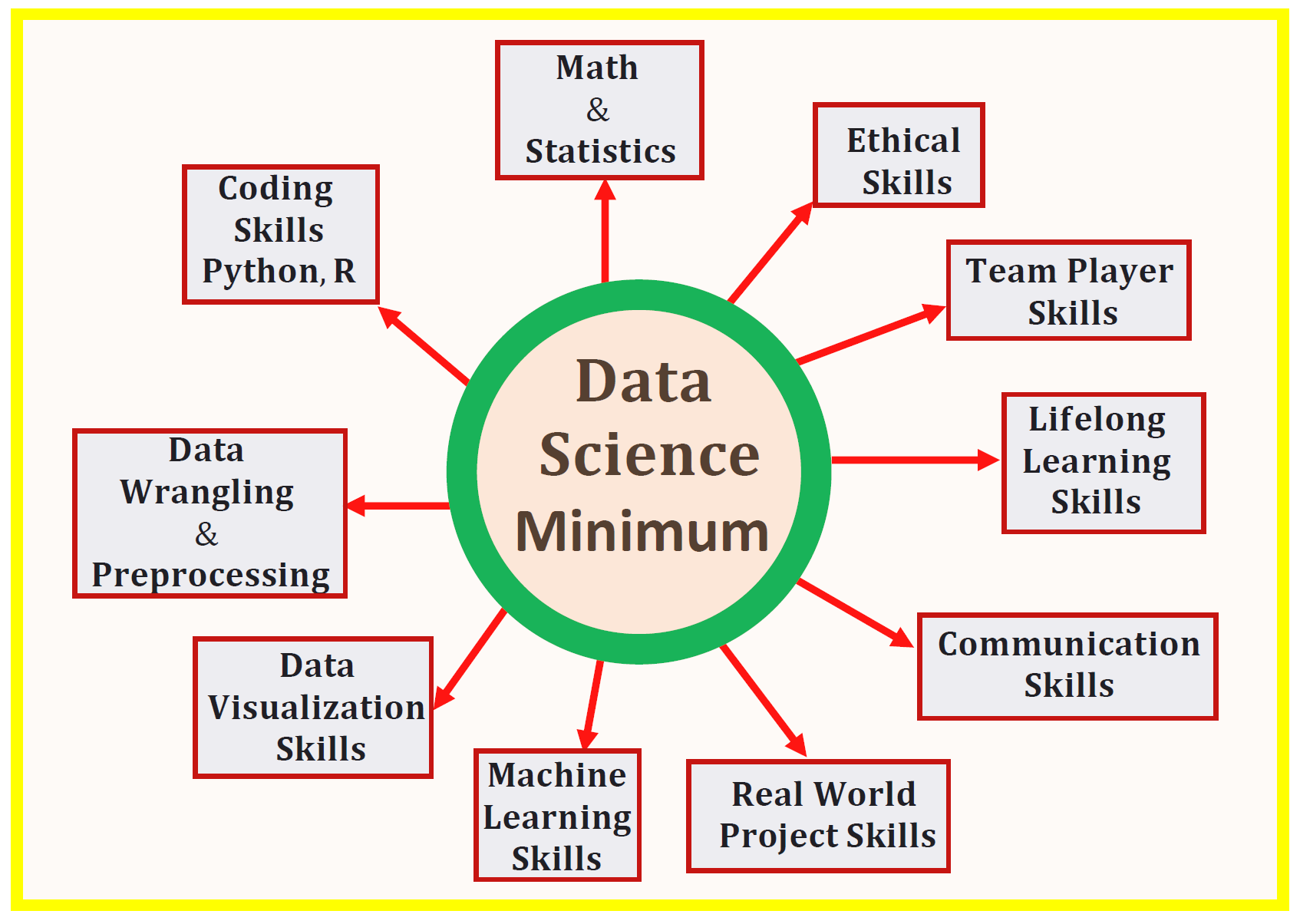
This article will discuss 10 essential skills that are necessary for practicing data scientists. These skills could be grouped into 2 categories, namely, technological skills (Math & Statistics, Coding Skills, Data Wrangling & Preprocessing Skills, Data Visualization Skills, Machine Learning Skills,and Real World Project Skills) and soft skills (Communication Skills, Lifelong Learning Skills, Team Player Skills and Ethical Skills).

Data science is a field that is ever-evolving, however mastering the foundations of data science will provide you with the necessary background that you need to pursue advance concepts such as deep learning, artificial intelligence, etc. This article will discuss 10 essential skills for practicing data scientists.

10 Essential Skills You Need to Know to Start Doing Data Science

1. Mathematics and Statistics Skills

(I) Statistics and Probability

Statistics and Probability is used for visualization of features, data preprocessing, feature transformation, data imputation, dimensionality reduction, feature engineering, model evaluation, etc. Here are the topics you need to be familiar with:

a) Mean

b) Median

c) Mode

d) Standard deviation/variance

e) Correlation coefficient and the covariance matrix

f) Probability distributions (Binomial, Poisson, Normal)

g) p-value

h) MSE (mean square error)

i) R2 Score

j) Baye’s Theorem (Precision, Recall, Positive Predictive Value, Negative Predictive Value, Confusion Matrix, ROC Curve)

k) A/B Testing

l) Monte Carlo Simulation

(II) Multivariable Calculus

Most machine learning models are built with a data set having several features or predictors. Hence familiarity with multivariable calculus is extremely important for building a machine learning model. Here are the topics you need to be familiar with:

a) Functions of several variables

b) Derivatives and gradients

c) Step function, Sigmoid function, Logit function, ReLU (Rectified Linear Unit) function

d) Cost function

e) Plotting of functions

f) Minimum and Maximum values of a function

(III) Linear Algebra

Linear algebra is the most important math skill in machine learning. A data set is represented as a matrix. Linear algebra is used in data preprocessing, data transformation, and model evaluation. Here are the topics you need to be familiar with:

a) Vectors

b) Matrices

c) Transpose of a matrix

d) The inverse of a matrix

e) The determinant of a matrix

f) Dot product

g) Eigenvalues

h) Eigenvectors

(IV) Optimization Methods

Most machine learning algorithms perform predictive modeling by minimizing an objective function, thereby learning the weights that must be applied to the testing data in order to obtain the predicted labels. Here are the topics you need to be familiar with:

a) Cost function/Objective function

b) Likelihood function

c) Error function

d) Gradient Descent Algorithm and its variants (e.g. Stochastic Gradient Descent Algorithm)

Find out more about the gradient descent algorithm here: Machine Learning: How the Gradient Descent Algorithm Works.

2. Essential Programming Skills

Programming skills are essential in data science. Since Python and R are considered the 2 most popular programming languages in data science, essential knowledge in both languages are crucial. Some organizations may only require skills in either R or Python, not both.

(I) Skills in Python

Be familiar with basic programming skills in python. Here are the most important packages that you should master how to use:

a) Numpy

b) Pandas

c) Matplotlib

d) Seaborn

e) Scikit-learn

f) PyTorch

(ii) Skills in R

a) Tidyverse

b) Dplyr

c) Ggplot2

d) Caret

e) Stringr

(iii) Skills in Other Programming Languages

Skills in the following programming languages may be required by some organizations or industries:

a) Excel

b) Tableau

c) Hadoop

d) SQL

e) Spark

3. Data Wrangling and Proprocessing Skills

Data is key for any analysis in data science, be it inferential analysis, predictive analysis, or prescriptive analysis. The predictive power of a model depends on the quality of the data that was used in building the model. Data comes in different forms such as text, table, image, voice or video. Most often, data that is used for analysis has to be mined, processed and transformed to render it to a form suitable for further analysis.

i) Data Wrangling: The process of data wrangling is a critical step for any data scientist. Very rarely is data easily accessible in a data science project for analysis. It’s more likely for the data to be in a file, a database, or extracted from documents such as web pages, tweets, or PDFs. Knowing how to wrangle and clean data will enable you to derive critical insights from your data that would otherwise be hidden.

ii) Data Preprocessing: Knowledge about data preprocessing is very important and include topics such as:

a) Dealing with missing data

b) Data imputation

c) Handling categorical data

d) Encoding class labels for classification problems

e) Techniques of feature transformation and dimensionality reduction such as Principal Component Analysis (PCA) and Linear Discriminant Analysis (LDA).

4. Data Visualization Skills

Understand the essential components of a good data visualization.

a) Data Component: An important first step in deciding how to visualize data is to know what type of data it is, e.g. categorical data, discrete data, continuous data, time series data, etc.

b) Geometric Component: Here is where you decide what kind of visualization is suitable for your data, e.g. scatter plot, line graphs, barplots, histograms, qqplots, smooth densities, boxplots, pairplots, heatmaps, etc.

c) Mapping Component: Here you need to decide what variable to use as your x-variable and what to use as your y-variable. This is important especially when your dataset is multi-dimensional with several features.

d) Scale Component: Here you decide what kind of scales to use, e.g. linear scale, log scale, etc.

e) Labels Component: This include things like axes labels, titles, legends, font size to use, etc.

f) Ethical Component: Here, you want to make sure your visualization tells the true story. You need to be aware of your actions when cleaning, summarizing, manipulating and producing a data visualization and ensure you aren’t using your visualization to mislead or manipulate your audience.

5. Basic Machine Learning Skills

Machine Learning is a very important branch of data science. It is important to understand the machine learning framework: Problem Framing; Data Analysis; Model Building, Testing &Evaluation; and Model Application. Find out more about the machine learning framework from here: The Machine Learning Process.

The following are important machine learning algorithms to be familiar with.

i) Supervised Learning (Continuous Variable Prediction)

a) Basic regression

b) Multiregression analysis

c) Regularized regression

ii) Supervised Learning (Discrete Variable Prediction)

a) Logistic Regression Classifier

b) Support Vector Machine Classifier

c) K-nearest neighbor (KNN) Classifier

d) Decision Tree Classifier

e) Random Forest Classifier

iii) Unsupervised Learning

a) Kmeans clustering algorithm

6. Skills from Real World Capstone Data Science Projects

Skills acquired from course work alone will not make your a data scientist. A qualified data scientist must be able to demonstrate evidence of successful completion of a real world data science project that includes every stages in data science and machine learning process such as problem framing, data acquisition and analysis, model building, model testing, model evaluation, and deploying model. Real world data science projects could be found in the following:

a) Kaggle Projects

b) Internships

c) From Interviews

7. Communication Skills

Data scientists need to be able communicate their ideas with other members of the team or with business administrators in their organizations. Good communication skills would play a key role here to be able to convey and present very technical information to people with little or no understanding of technical concepts in data science. Good communication skills will help foster an atmosphere of unity and togetherness with other team members such as data analysts, data engineers, field engineers, etc.

8. Be a Lifelong Learner

Data science is a field that is ever-evolving, so be prepared to embrace and learn new technologies. One way to keep in touch with developments in the field is to network with other data scientists. Some platforms that promote networking are LinkedIn, github, and medium (Towards Data Science and Towards AI publications). The platforms are very useful for up-to-date information about recent developments in the field.

9. Team Player Skills

As a data scientist, you will be working in a team of data analysts, engineers, administrators, so you need good communication skills. You need to be a good listener too, especially during early project development phases where you need to rely on engineers or other personnel to be able to design and frame a good data science project. Being a good team player world help you to thrive in a business environment and maintain good relationships with other members of your team as well as administrators or directors of your organization.

10. Ethical Skills in Data Science

Understand the implication of your project. Be truthful to yourself. Avoid manipulating data or using a method that will intentionally produce bias in results. Be ethical in all phases from data collection, to analysis, to model building, analysis, testing and application. Avoid fabricating results for the purpose of misleading or manipulating your audience. Be ethical in the way you interpret the findings from your data science project.

In summary, we’ve discussed 10 essential skills needed for practicing data scientists. Data science is a field that is ever-evolving, however mastering the foundations of data science will provide you with the necessary background that you need to pursue advance concepts such as deep learning, artificial intelligence, etc.

By Benjamin Obi Tayo Ph.D.

Sourced from Towards Data Science

Sourced from Forbes

Understanding how artificial intelligence (AI) and machine learning (ML) can benefit your business may seem like a daunting task. But there is a myriad of applications for these technologies that you can implement to make your life easier.

Through AI and ML, your business will benefit as it becomes more efficient at its operations and eliminates those mundane tasks that seem to be slowing you down. Additionally, AI-powered tools and automated systems can help your company improve the use of its resources, with visible effects on your bottom line.

Fifteen members of Forbes Technology Council discuss some of the latest applications they’ve found for AI/ML at their companies. Here’s what they had to say:

1. Powering Infrastructure, Solutions and Services

We’re leveraging AI/ML in our collaboration solutions, security, services and network infrastructure. For example, we recently acquired an AI platform to build conversational interfaces to power the next generation of chat and voice assistants. We’re also adding AI/ML to new IT services and security, as well as hyper-converged infrastructure to balance the workloads of computing systems. – Maciej KranzCisco Systems

2. Cybersecurity Defense

In addition to traditional security measures, we have adopted AI to assist with cybersecurity defense. The AI system constantly analyzes our network packets and maps out what is normal traffic. It is aware of over 102,000 patterns on our network. The AI wins over traditional firewall rules or AV data in that it works automatically without prior signature knowledge to find anomalies. – John SanbornRAA – Financial Advisors

3. Health Care Benefits

We are exploring AI/ML technology for health care. It can help doctors with diagnoses and tell when patients are deteriorating so medical intervention can occur sooner before the patient needs hospitalization. It’s a win-win for the healthcare industry, saving costs for both the hospitals and patients. The precision of machine learning can also detect diseases such as cancer sooner, thus saving lives. – Adam BayaaHeal

4. Recruiting Automation

With unemployment at historical lows, recruitment of qualified workers remains one of the most difficult challenges. By harnessing the power of recruiting automation, savvy employers are using AI-powered sourcing tools to find candidates who may not have been considered for roles in the past, not because they weren’t qualified, but because they weren’t surfaced in the first place. – Jon BischkeEntelo

5. Intelligent Conversational Interfaces

We are using machine learning and AI to build intelligent conversational chatbots and voice skills. These AI-driven conversational interfaces are answering questions from frequently asked questions and answers, helping users with concierge services in hotels, and to provide information about products for shopping. Advancements in deep neural network or deep learning are making many of these AI and ML applications possible. – Mitul TiwariPassage AI

6. Reduced Energy Use And Costs

We have used AI to cut energy use and reduce energy costs for drilling, crude and natural gas transportation, storage and petroleum refining operations. Until recently the industry has been looking at historical data points. The AI application we run can now learn and predict future energy load at levels as granular as a single blending activity. This opens up an entire range of opportunities to reduce waste, reduce peak demand and cut costs. – Jane RenAtomiton, Inc.

7. Predicting Vulnerability Exploitation

We’ve recently started using machine learning to predict if a vulnerability in a piece of software will end up being used by attackers. This allows us to stay days or weeks ahead of new attacks. It’s a large scope problem, but by focusing on the simple classification of “will be attacked” or “won’t be attacked,” we’re able to train precise models with high recall. – Michael RoytmanKenna Security

8. Becoming More Customer-Centric

We’re using AI to better analyze customer responses to surveys and activities over time. This enables us to understand not only the feedback they provide but whether or not there are specific qualities and attributes that correlate to their response rate and likelihood to engage. This information will allow our customers to alter their own client survey strategies.   – Alan Pricevisioncritical.com

9. Market Prediction

We are using AI in a number of traditional places like personalization, intuitive workflows, enhanced searching and product recommendations. More recently, we started baking AI into our go-to-market operations to be first to market by predicting the future. Or should I say, by “trying” to predict the future? –Tim RendulicThomson Reuters

10. Accelerated Reading

AI is accelerating our understanding of written text. Simply put, humans cannot read fast enough, and cannot mentally mine and structure the vast quantity of data that is available. We have developed advanced AI that reads and understands life science articles, helping researchers to accelerate the discovery of cures for diseases and the development of new treatments and medications. – Daniel LevittBioz

11. Cross-Layer Resilience Validation

We continually hear from our customers that existing testing methodologies fall short when relating to predicting misconfigurations in-between different IT layers. We invest significantly in research and development of cross-layer dependency mapping and cross-layer validation techniques, utilizing both knowledge-driven analytics and ML. Our validation technology goes beyond detecting what is broken now into predictive resilience risk detection. – Gil HechtContinuity Software

12. Accounting And Fintech

AI is affecting many industries. Accounting and fintech are no exceptions. After years of working closely with professional accountants, I’m noticing a growing trend — they’re utilizing AI to streamline their professional routines through practices like automated data entry and reporting. And it’s not just accountants, the entire financial services industry is embracing automation. – Nick ChandiPayPie

13. Advanced Billing Rules

Our organization has added machine learning-powered billing rules to maximize our credit card processing success rates for recurring billing. By identifying trends in declined credit cards (for example, cards being declined more often on a Sunday evening compared to a Wednesday morning), and fraud patterns that lead to chargebacks, we’ve been able to raise revenue with little human interaction. – Jason GillThe HOTH

14. Understanding Intentions And Behaviors

Bad actors follow specific communication patterns — for example, colleagues spreading malicious rumors tend to be pretty chatty. Advanced AI has the distinct ability to not just identify these patterns, but leverage behavioral analytics to understand the intention behind communication. Using AI to spot bad behavior is something we use to empower customers across various industries. – Brandon CarlDigital Reasoning

15. Proposal Review

We found an exciting use of AI for our application that saves incredible time and improves quality for customers. When a facility manager receives a proposal from a contractor, machine learning analyzes the scope, the pricing, and the contractor’s historical performance, to determine if the proposal is the right cost and will be done at the right quality level. It’s a huge win for our clients. – Tom BuiocchiServiceChannel

Forbes Technology Council is an invitation-only, fee-based organization comprised of elite CIOs, CTOs and technology executives. Find out if you qualify at forbestechcouncil.com. Questions about an article? Email [email protected].

Sourced from Forbes


By

Machine learning and artificial intelligence (AI) will change the way search marketers do business. In the latest article in his multipart series on PPC and AI, columnist Frederick Vallaeys shares his strategies for keeping your agency successful in a world of AI-first PPC.

Artificial intelligence (AI) and machine learning have long been part of PPC — so why are AI and machine learning all of a sudden such hot topics? It is, in part, because exponential advances have now brought technology to the point where it can legitimately compete with the performance and precision of human account managers.

I recently covered the new roles humans should play in PPC as automation takes over. In this post, I’ll offer some ideas for what online marketing agencies should consider doing to remain successful in a world of AI-driven PPC management.

[Read the full article on Search Engine Land.]

By

Sourced from Marketing Land