Tag

marketers

Browsing

By 

After years of holding the data close to its vest, Google has begun to give advertisers more data to help them make better decisions and run successful campaigns. Earlier this month, Google confirmed that it would run a small-scale rollout of an Insights analytics report in Google My Business that shows business owners the most popular search keywords that people use to find listings.

On Friday Google announced that the Search Analytics API found in the Search Console now allows advertisers to retrieve 25,000 rows of data per request, up from 5,000 rows previously. Marketers can query all their search analytics data without exceeding their quota by running a daily query for one day’s worth of data.

Marketers need to choose the information requested, such as search types — web, image and video — along with the dimensions such as page, query, country, or device and whether to group results by page or property.

Along with the news, Google published a guide to take marketers through data retrieval. It includes an overview and describes how to group results by page or property and the dos and don’ts for the process, as well as defaults and nuances of how the queries work.

Google also notes that impressions, clicks, position, and click-through rates are calculated differently when grouping results by page rather than by property.

Earlier this week, Google announced the integration of Hotel Ads into the Google Ads platform with the introduction of a new type of campaign and a new dashboard for managing hotel price feeds.

Although Hotel Ads have been around for about eight years — initially in sponsored listings in Google Maps and then in Google Search — they were managed in a separate ad platform.

Now all the data resides in one place. Overall, it means marketers gain more data from one dashboard to support campaigns across the board.

By 

Sourced from MediaPost

By Shareen Pathak

In-house agencies are all the rage, but most marketers still struggle with taking their advertising and media entirely within their four walls — leading to more brands favoring a “hybrid” approach.

Marketers of all types have made it a mission to talk more directly to their customers, take media planning and strategy, if not the actual buying to their own teams and overall, do more themselves. That means agencies are now doing far less big-picture planning and more execution.

For example, Marriott chief marketing officer Karin Timpone recently launched a new unit, part of the marketing team, called “global marketing optimization” group, which handles everything from overall customer strategy, media and marketing, as well as performance and media buying. This is new, and the group is in charge of also a new media group that handles all global media buying.

The brand also works with Publicis, which created a dedicated team called Marriott One Media to service the account earlier this year. The agency group handles execution while strategy and planning is done internally.

There’s also more media buying done internally, especially at the local-individual-hotel-property level, mostly in search. The brand’s internal agency also is working directly with platforms, like Facebook, on how to buy media there that Timpone said “couldn’t have been done with an external agency partner.” Once the plan is set, the agency can come back and put Facebook in the overall plan — more executional, rather than strategic. “The strategies of what you need for our business, you can’t ever farm that out,” she said.

Timpone declined to say how many people work inside that group but said it was born out of an understanding that marketers needed to be much more in control of their customer journeys than they have been in the past.

In-house agencies, while touted by some like JP Morgan Chase CMO Kristin Lemkau as being more efficient, are also difficult to create: They have expensive startup costs and require a high level of internal buy-in. Plus, agencies still remain, according to CMOs, a place for expertise on new trends and new technologies, which are too difficult for an internal team to stay on top of.

At Northwestern Mutual, chief marketing officer Aditi Gokhale said she isn’t a big believer in outsourcing everything to agencies. “But frankly, from an efficiency perspective, it’s not super efficient to build out a big in-house agency either.”

What’s changed at NM, said Gokhale, is that she and her team now define media and media spend. “The agency doesn’t define it for me, which historically they have,” she said. “I take control of it, the agency executes.”

Ann Billock, partner at Ark Advisors, which advises CMOs about agency partnerships, said that most brands are now using a “hybrid” approach because creating teams in-house is expensive — and talent is often an issue. As Digiday has reported previously, everything from cultural fit issues, to brand marketing talent needing to adapt to a different way of working, to finding people outside the coastal cities can be an issue.

Companies struggle especially to recruit media-buying experts for the client side, with 62 percent of marketers in a recent Digiday survey saying hiring talent is a challenge for bringing media buying in-house. One hurdle when recruiting media buyers for the client side is convincing them that there’s a path for career progression.

That’s what’s creating a movement where more brands are doing more in-house, but few are entirely eschewing agencies. Marc Speichert, chief digital officer at GSK, who said he doesn’t have plans to take everything in-house, said that what is happening is a clearer understanding of the marketer’s internal capabilities and how to increase them — and expect very different things from its agencies. “We have to make sure we push hard,” Speichert said. “As we elevated our own internal capabilities, we are asking much tougher questions of agencies. We have much higher expectations.”

“The most effective partnerships happen when the brand teams do, indeed, handle the strategy but recognize that the brand strategy still needs to be translated into a communications strategy by the agency,” said Billock.

By Shareen Pathak

Sourced from DIGIDAY UK

By John Gerzema

When I started out (around the time Duran Duran roamed the planet), business-to-business (B2B) marketing was confined to the domain of the literal. The customer was deemed rational and analytical, so the messaging was bland and unimaginative. B2B meant “boring-to-boring.” All the communications felt like PowerPoint presentations. We spoke in the native language of sales collateral and trade show jargon. And a bulk of the work seemed dependent on sales teams’ connections and cold calling target clients.

Yet, over the past decade, we’ve seen B2B marketing evolve into “business-to-beautiful” marketing — marketing that illuminates the beautiful stories behind businesses today, expressing their visions and values in society. Suddenly, some of the best work is aimed at procurement executives through thought leadership, branded content, social media and content marketing strategies that drive a wonderful overhead appeal to shareholders and lovers of great narratives.

The shift was inevitable, in my opinion, given the rise of the internet and social media. What we’ve realized through social is that businesses are inherently emotional beings, they are creations of our imaginations, rivers of human growth and determiners of where we build our future communities. B2B marketing is no longer isolated in the ivory tower, creating empires unknown by the general public. Instead, “B2Beautiful” marketing has made the connection between B2B storytelling and our human growth potential. These B2Beautiful stories captivate our imaginations and trigger emotional resonance — key ingredients in building that residual stickiness factor in an attention-deficit world.

My company, The Harris Poll, recently released the Reputation Quotient study (registration required), which reports that contemporary drivers are found in today’s consumer desires, and many of the storytelling strategies employed by B2C marketers are becoming increasingly applicable to B2B marketing.

We see brilliant examples of brands implementing B2Beautiful campaigns today and engaging communities even in functional, low-interest categories. Maersk, for instance, is humanizing logistics services by personifying its giant cargo ships and documenting their travels through stunning visual images on Instagram. Cisco’s award-winning documentary, The Network Effect, highlights telecom development stories, while companies such as Salesforce and The Mosaic Company have created engaging podcasts. The Mosaic Company’s podcast, “The Great Yield Mystery,” featured a dramatic audio play about two farmers trying to understand why their harvest came short — it even offered listeners clues to solve the mystery and win prizes.

These companies understand that brands are stories in and of themselves and every aspect of who they are — from their work culture, logistics, products and services, to how they think and operate behind the scenes — is essential to creating an effective B2Beautiful marketing strategy. Their strategies provide five crucial takeaways that marketers should keep in mind while creating B2Beautiful marketing, regardless of if you’re a startup or a large corporation.

1. Pinpoint Your Story 

Use your mission and objectives to frame your values and use those components to create your story. Interestingly, The Harris Poll’s RQ survey also shows that there is a new market opportunity for B2B companies to take action on social issues. A new class of what we call “humanity brands” — companies that stand up for what they believe in and walk their talk. These brands are solving social ills, despite their political affiliation.

Successful B2Beautiful marketing, especially in the age of consumer activism, involves being able to identify issues that resonate with your brand and weave them into your story.

2. Weaponize Your Culture

A 2015 FORTUNE Knowledge Group report showed that corporate culture is incredibly important to building B2B relationships. Furthermore, 59% of executives surveyed rated knowing what a company stands for as more important when choosing a partner to work with, ranking higher than market dominance and innovation.

Depending on its mission, each company’s culture is unique. Once you know who you are and what you stand for as a company, you can then find engaging ways to share those convictions through the right media platforms. WeWork, for instance, uses its Instagram account to showcase their offices around the world, with photos of workers doing yoga or wearing stormtrooper helmets. They are motivating people around their motto to “make a life, not just a living.”

3. Don’t Be Constrained By Your Category 

At its core, B2Beautiful marketing involves building emotional equity. Every story you set out to tell about your company should be crafted to evoke empathy. This is how you inspire B2B buyers, (who, by the way, are consumers just like you and me) to be emotionally invested in your brand.

Some of the most emotionally engaging and brilliant work is coming from a few of the lowest-interest categories. In fact, it’s there where the biggest white space is found.

4. Diversify Your Channels And Forms Of Content

As a 21st-century business, there are key owned-media platforms that are imperative for B2Beautiful marketing — a blog for brand storytelling, social media platforms (LinkedIn, Instagram, Twitter, Facebook, etc.) and a newsletter. However, in addition to those channels, there are other platforms such as podcasts, videos, infographics and even gifs.

Work with creative partners to determine the right channels to use, depending on the stories you want to tell about the company, its products and services and core truths.

5. Ensure Your Strategy Is Buyer-Focused

We still are selling, after all, so be mindful of your target audience (B2B buyers) when you create your B2Beautiful marketing. What are their needs? Not just the tangible ones in terms of products or services, but also their values, triggers and unmet needs. What are their goals and how can you help them meet those goals?

Think about how your services amplify their missions, visions and values. Through your strategy, you can even educate buyers on ways to better connect with the end consumer and build substantial relationships that grow over time.

In the coming years, B2B marketing will, inevitably, continue to evolve in this direction. Therefore, it is important for marketers to adapt to these rules in order to differentiate their brands and remain attractive and relevant in the eyes of buyers.

By John Gerzema

CEO of The Harris Poll (Harris Insights & Analytics), a public opinion, corporate & brand reputation firm. NYT bestselling author.

Sourced from Forbes

More personalization is in the cards with Google Feed

Google has always dominated search, but it has not done so well with social as evidenced by the perceived failure of Google+. So, capitalizing on its strengths, it set up a feed for users that uploads items of interest based on their own signals, rather than on what their friends shared or Twitter connections posted online.

Back in December, Google introduced an app update that promised “load your life’s interests and updates” with just “a single tap” that can bring up “useful cards.”  Seven months later, Google proclaimed “Feed Your Need to Know,” announcing that — thanks to machine learning advances — the algorithms that direct the feed can “better anticipate” the type of content that an individual would want to see.

Google promises a personalized experience that improves  with use. In addition to giving users updates on the topics they choose to follow, it will take cues from a user’s viewed videos on YouTube, their search history, and their location: “Now, your feed will not only be based on your interactions with Google, but also factor in what’s trending in your area and around the world.”

In other words, it is bringing together your own signaled interests with real-time trends that are linked to your location. That sounds like a potential big win for marketers.

The same data mining that is used to form a comprehensive profile of Google users could easily be directed to create a consumer profile. As much of the information that Google draws on in customizing a person’s feed would not constitute what it calls “sensitive personal information,” its privacy policy, would allow it to share information (at least in the US; the EU tends to be much more stringent on privacy rights).

What makes this so powerful for marketing is that it brings together the same kind of data connections Amazon and Netflix use so effectively to offer customers recommendations, along with deeper knowledge about them that comes from seeing which types of news stories and outlets they favor as well as their actual location identification. With all that information about an individual, marketing can become much more personalized and targeted.

Someone who sets their Feed to supply news on renewable energy, fashion, and organic options would likely be receptive to marketing that shows a new line of organic goods in their local supermarket, for example, or clothes from the Zara Just line.  Someone with a flight booked could be shown attractions in the destination city, ads for transportation options there, and travel accessories. People who have added articles on parenting young children to their Feeds may get directed to children’s programming, toys, college funds, and preschools in their area.

Of course, Google doesn’t say that it’s rolling out the Feed as a tool for marketers, but then again, Facebook didn’t admit that its social network was geared toward ads either. I’m sure we’ll be seeing marketers make use of this feature in the near future.

By Ariella Brown

Sourced from DMN Data. Strategy. Technology.

By 

Data, in combination with technology, drives much of the revolution happening in business today. For marketers who are often at the epicenter of acquiring, understanding, translating, and leveraging data, it can have a significant impact on their jobs—what they do, how they do it, and the challenges that they face. Below, I talk with Tom Benton, the CEO of the Data & Marketing Association (formerly known as the Direct Marketing Association) about the impact that data is having on marketers.

Kimberly Whitler: How is data changing the CMO Role?

Tom Benton: Data hasn’t just changed the CMO Role. It has disrupted it. CMOs were traditionally communications and campaign-focused. Now, there are many more aspects to it. Today’s data-inspired CMOs must not only be marketing communications experts, they must also be user experience experts. They have to understand ecommerce. They have to understand the totality of the holistic customer journey.

I view data as fundamental to marketing. It has a horizontal impact across the organization, cutting across media, advertising, innovation, and everything else. Think about just one element—video. It used to be stationary and was primarily driven by TV. Now, media is ubiquitous, mobile, and interactive and so it’s generating a tremendous amount of data. Historically, we didn’t have high quality data but now we do. And so the question is: how do you take data and transform it into actionable insight? The consequence of this is that the increased amount and substantially better quality of data makes the marketer’s job more complex. This can affect what they do and the challenges that they face.

One way to think about this is that there is a mashup of roles—the CTO, CIO, CDO, CAO, CMO. But marketing is typically the front line when it comes to using data and, more importantly, generating actionable insight from it. And so what the marketer has always done – integrating disparate data and making sense of it – on one level hasn’t changed. What has changed is the amount of data they have to integrate, the number of functions they have to work with, and the complexity associated with making sense of the data. What they do—using data to make better strategic marketing decisions—hasn’t changed. But how they do it, with whom they work, and the processes through which they do it is all changing. It’s more complex.

Whitler: Can you provide an example of how data is changing what marketers do?

Benton: The sheer amount of data from a near-infinite combination of media, devices, platforms and channels allows marketers the opportunity to deliver 1-to-1 customer experiences at a massive scale. If these are leveraged adeptly, a business with a million customers can deliver an experience just as tailored as a business with a dozen customers. But that also means today’s marketers have a range of questions to ask themselves: What is the right technology to work with to meet our business goals? What untapped data sources should we be exploring? Are all of our datasets coming together to inform each other, or are they siloed into different departments and databases? These are versions of the questions marketers have asked themselves for decades, but they have become more complex as scale and velocity of information grows.

The exponential growth of the programmatic media industry during the past 10 years is a perfect example of how data is the currency that is underwriting 21st century marketing. No longer satisfied with one-dimensional reach and frequency scores, or hang-time on websites, marketers are looking for real, measureable performance from their investments. Data-inspired marketers are using data to make real-time decisions on marketing and media allocations that just couldn’t have been possible in the past.

Whitler: You mentioned that data is also impacting the nature of the challenges that marketers face. Can you provide an example?

Benton: There is a whole host of challenges—from attribution modeling to cross-device ID to serious public policy concerns. One of the most important is properly protecting your data and securing it from hacking as you can see from the unprecedented Equifax breach affecting more than half of the U.S. population. We understand that the best marketers and brands hold a special trust for consumers and they must follow the best standards and practices as keepers of this important trust. Data is quite powerful but it is also sensitive and it needs to be managed responsibly and ethically. We want to use data to identify the interests and needs of consumers so that we can transform their lives. But we have to be responsible. We have to protect the data and remain vigilant. Another challenge is the annoyance factor. The best marketers don’t want to annoy consumers with irrelevant messages. If we leverage data responsibly and authentically, we have the opportunity to build lasting relationships with consumers because we are creating real value for them.

Whitler: When I talk to C-level marketers, I consistently hear about how difficult the job is—the pace of change, the way in which the role is changing, and the need to acquire contemporary skills. What advice do you have for CMOs who want to improve their skills but don’t have a lot of time?

Benton: Marketing roles are exciting because new opportunities and challenges are surfacing every day due to the new data-driven economy. Things like facial recognition: 1) Is it OK to market to you if I use facial recognition data to find out that you are at a Pearl Jam concert? 2) Is it OK to sell that information to a third party that might use it to market music to you? DMA members routinely come together to tackle issues like these as they develop and enforce DMA’s Guidelines for Ethical Business Practices. At DMA, we believe we should act as a filter for our members—to simplify a complex world. We do this by bringing people together to discuss these issues. We host conferences, webinars, regional roundups, training events, and even VIP cocktail sessions. Through these events, marketers can hone in on pertinent issues and find solutions most relevant to them.

We tend to focus on four pillars: advocacy, innovation, education, and connection. The most successful marketers are intellectually curious, they perpetually challenge the status quo seeking improvements. Our members strive to compound their knowledge and build on their own ideas by learning about what actually works. They recognize the power of tapping collective wisdom and they’re laser-focused on transforming data into actionable insight. Technology and techniques are changing so rapidly that no individual alone can keep pace. While we all individually contribute to the data & marketing community, successful people realize that the power of our community does not come from individuals alone, rather it comes from tapping the collective knowledge of our community, which is exactly what we facilitate at the Data & Marketing Association.

Our goal is to leverage data and technology to help marketers become more effective in a way that is responsible and relevant.

Feature Image: DMA CEO Tom Benton at DMA’s 2017 Dynamic State of Data event

By 

Sourced from Forbes

By  Jana Barrett 

People tend to see customer service as the hallmark of customer experience, but marketers play a major role in modern customer relationships. They design inroads for new business and mold customer expectations from the get-go. This goes for the content that marketers create too. Click or no click, when people consume your messaging, they form an impression of your brand.

But unlike customer-facing teams, marketers don’t always hear directly from the people they’re speaking to. Instead, they rely on metrics and intuition to understand the end consumer. Good data and marketing chops go a long way, but they don’t tell you everything. If you’re not tapping into your audience for feedback, then you’re leaving insights (and revenue) on the table.

In this post, we’ll cover the benefits of collecting content feedback and share some tips on doing it well.

Collecting content feedback with audience surveys

Unless you’re hyper-engaged with your target audience, it’s hard to nail down why some messages work and others don’t. But as marketers, it’s kind of your job to figure it out. That’s why focus groups and market research studies have long been used to gather consumer insights.

However, as we head deeper into the digital age, those methods become less realistic. If you’re an agile marketing team that needs to learn and adapt quickly, then you can’t afford clunky solutions. You need quick answers and quality feedback as you go.

Audience surveys are a great way to get that. Unlike traditional market research surveys, these quick, contextual questions capture content feedback in the moment. If someone is reading your blog post (meta, right?), watching a webinar, scanning your pricing, or just staring blankly at your homepage, you can ask them for input.

Below are a few ways you can seamlessly integrate audience surveys into your digital marketing program.

Use lightbox website surveys to engage visitors and capture info.

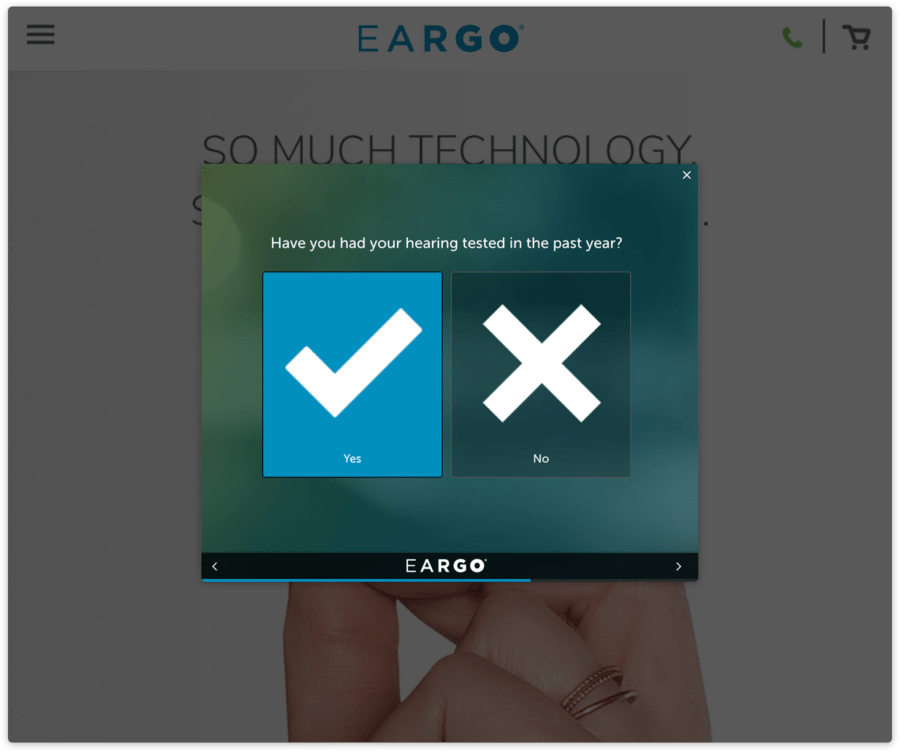
Website surveys are simple lightbox windows that you can include on your landing pages. They function a lot like live chat windows, giving visitors the perfect way to engage without leaving the web experience. You can use website surveys to collect content feedback and visitor information, invite readers to subscribe, or even automatically create leads in Salesforce.

How to set up a website survey and start collecting responses immediately:

  1. Build your website survey. Keep it short and sweet to avoid diverting visitors’ attention too much. Stick to essential questions about their current experience or ask them what they’re looking for. Focus on questions that will help your content strategy and eliminate the fluff.
  2. Configure your survey. After you’ve built your survey, make sure to think through its placement and design. In the GetFeedback survey builder, you can choose where your website survey appears on the page, set colors and icons, determine when it’ll pop up, and more.
  3. Add the code to your website. Place the Javascript snippet onto pages of your website before the closing </body> tag. Make sure you’ve specified which pages the survey should appear on. As soon as you do, any active website surveys will begin appearing on your site.

Ask for contextual feedback on web content with embedded surveys.

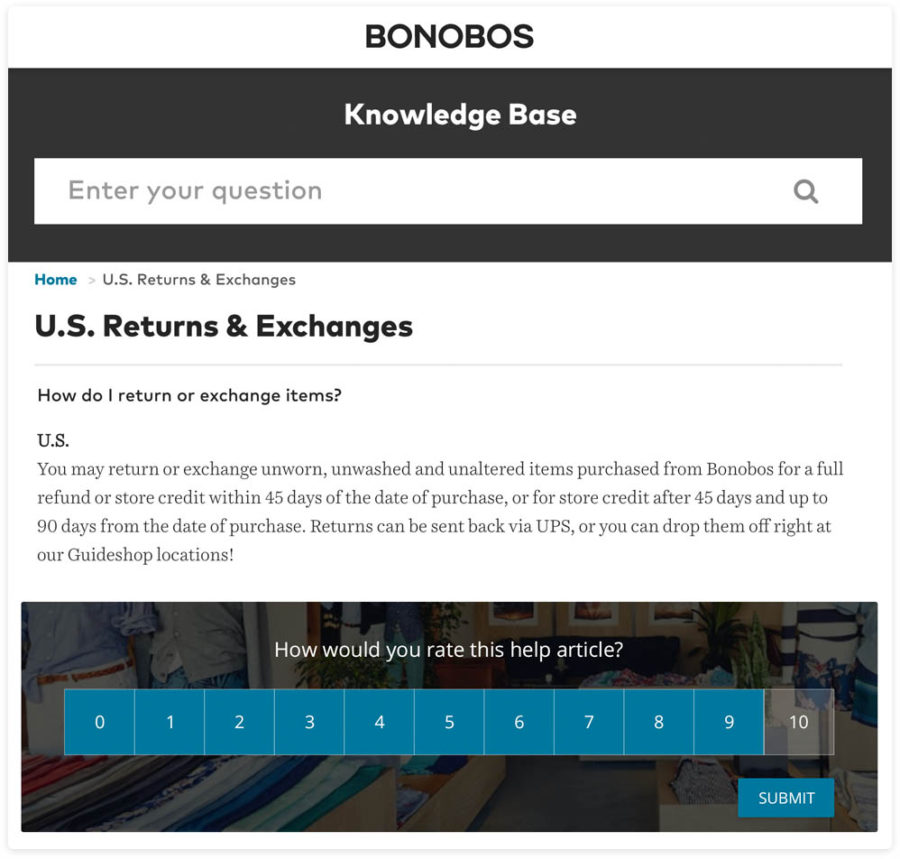
Sometimes lightboxes aren’t the right experience for your web visitors. If you’d rather weave surveys into the content itself, then you can embed surveys into landing pages or articles. It’s a non-intrusive way of asking for feedback in the moment. This works especially well for blog posts, knowledge base articles, and FAQ pages. With just a couple questions, you can find out what visitors think of your content and what you could do better.

How to embed a survey into your page:

  1. Build your survey. Before you write your questions, think about where you’re placing the survey. If it’s in the middle of the page versus at the end, you’ll probably frame your questions differently. Try to include one quantitative question (like “How helpful was this article?”) so you can track performance over time.
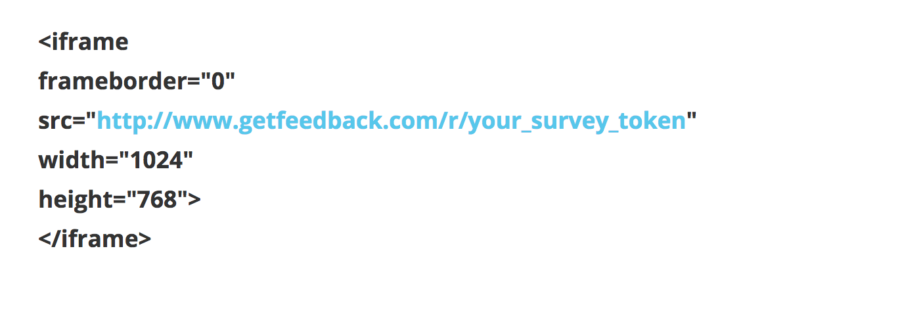
  2. Embed your survey. Once your survey is created, you can generate an embed code to add it to your page. With GetFeedback you can simply replace the URL in the src element (in blue below) with the URL of your live survey, then adjust the dimensions based on your preferences. Read more about embedding surveys on web pages.

Collect campaign feedback by embedding survey questions into marketing emails.

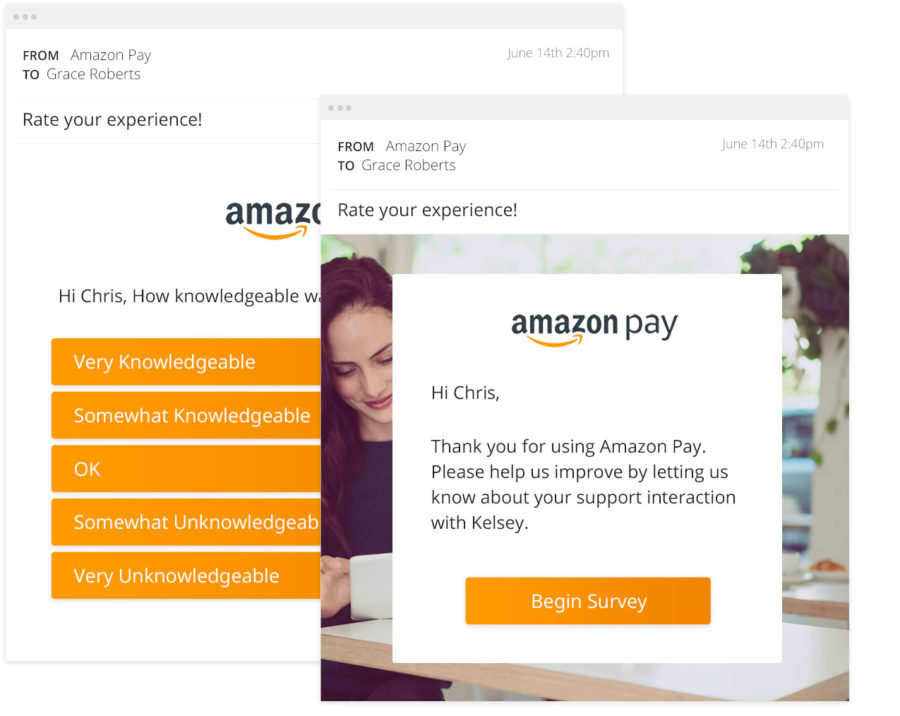
Last but not least, if you want input from your current subscribers, then email is the perfect place to include an audience survey. Whether it’s a new campaign, a monthly newsletter, or a nurture series, email works seamlessly with surveys. And by embedding survey questions into emails rather than just including a hyperlink, you can drive engagement and provide an all-around better experience.

Here’s how to embed a survey question into a marketing email:

  1. Build your email survey. Start with the question you care about most. That’s the one you should include in the email. When subscribers click a response, the rest of the survey will launch in a new window. Make sure the survey design matches the email design. Consistency is important.
  2. Add the survey question to your email. When you’re ready to go, you can generate the HTML code and embed your chosen question within the email. Or, if you’d rather send your email from GetFeedback, you can do that using our built-in email functionality. This allows you to create and distribute beautiful survey emails without relying on a 3rd party.

Wrap-Up

Today, customer experiences don’t just affect one customer relationship. They can impact potential business too. People share their stories all the time, online and offline. And thanks to social media and review sites, consumer voices are amplified. BrightLocal’s Consumer Review Survey found that 85% of consumers trust online reviews as much as personal recommendations.

For businesses, this means online reputation management is critical to success. If you’re not tuned into customers’ needs and preferences, you risk losing their business—and the business of everyone they reach. As brand stewards, marketers can use content feedback to tune in and grow along with their audience.

By  Jana Barrett 

JView full profile ›

Sourced from Business 2 Community

By Mike Krings

Spend any time online or browsing social media, and you’re likely to come across branded video content. Advertisers and marketers want people to not only see their content but to enjoy it so much that they share it with their friends. A new study from the University of Kansas has found that the prominence of the brand and the advertisers’ decision to disclose whether the content is branded can heavily influence how people view and share the video.

The study is forthcoming in the Journal of Interactive Marketing and was co-authored by Dongwon Choi, Bart Wojdynski and Yen-I Lee of the University of Georgia and Kate Keib of Oglethorpe University.

Bang, who researches digital advertising, marketing, consumer engagement and how individual traits moderate media effects, said the study provides both information for how marketers can better reach potential audiences and how consumers can protect themselves. Native advertising, or branded content made to look like it was produced by individuals, can be deceiving. Federal Trade Commission guidelines state branded content must be labeled as such.

“When people are exposed to native advertising such as branded content, they can be influenced without even knowing they are viewing advertising,” Bang said.

There are no laws on when branded content must be labeled, or how heavily the brand can be featured. The research project measured branded content’s effects by having participants view content for Red Bull energy drinks in four different ways. Disclosure was made at the beginning of the video, but the brand’s placement during a YouTube video of extreme sports set to music was either prominent or subtle. Disclosure was also provided at the end, and placement was either prominent or subtle.

Researchers used eye-tracking software to gauge if viewers were paying attention to the videos and questioned them after viewing if they would share such content.

“When is given at the beginning, it activates consumers’ defensive mechanism against the marketing content, thus they try to intentionally avoid such content,” Bang said. “As a result, it could also reduce their intention to share. However, if it was disclosed subtly, and there was not much brand placement in the video, the activation of defense mechanism is kind of faded out, thus people are more likely to share.”

When measured alone, if disclosure was at the beginning or end, it made little difference in viewers’ intention to share. But if disclosure was made at the beginning and brand placement was prominent, they were much less likely to share. The same was true for heavy brand placement videos with disclosure at the end. Videos in which brand placement was subtle had the highest rate of attention and were more likely to be shared, the viewers reported.

“In cases of the subtle brand placement, the timing of disclosure did not make differences in terms of visual attention,” Bang said. “However, in case of highly prominent brand placement, the post-disclosure attracted way more visual attention compared to the pre-disclosure.”

The study also measured participants’ persuasion knowledge. The factor, or accumulated knowledge about marketing and awareness that content was advertising, correlates highly with viewers’ intentions to share branded content. The findings, along with sharing intentions, provide scientific evidence as to which types of disclosure and branded content can be most effective.

“The reason we chose sharing intention as our main variable is because the goal of this type of video is to make it go viral,” Bang said. “That’s why we wanted to know more about how other variables such as disclosure timing and brand placement affect sharing intention.”

But the findings can also be valuable for consumers, providing information about what type of branded content viewers are not as likely to discern as advertising. In future research, Bang plans to measure viewers’ physiological reactions to branded content and what effects they may have on favorability toward the content. In the meantime, marketers will continue to produce videos touting their brands with different levels of disclosure and brand prominence in hopes of scoring the next viral hit.

Feature Image: A fireman rescues a kitten from a burning house in a still image from a YouTube video by camera company GoPro. The video is a successful example of a branded content marketing piece in which the marketer disclosed the marketing nature early and was subtle in its company placement. It has more than 38 million views. Credit: GoPro, YouTube.

By Mike Krings, University of Kansas

Sourced from PHYS ORG

A travel company has managed to stir up a lot of viral traffic with their hashtag. Watch and learn, people.

By MediaStreet Staff Writers

What do a dream wedding in New York, an adventure through the mountains of Sri Lanka and a family’s search for their roots in Scotland all have in common? All saw a hospitality professional going out of their way to make or save someone’s trip. And a holiday booking company use this mushy sequence of events with a hashtag to fire up social media views and get a great repsonse from them.

Booking.com call themselves the global leader in connecting travellers with the widest choice of incredible places to stay. Established in 1996 in Amsterdam, Booking.com B.V. has grown from a small Dutch start-up to one of the largest travel e-commerce companies in the world. Part of The Priceline Group (NASDAQ: BKNG), Booking.com now employs more than 17,000 employees in 198 offices in 70 countries worldwide.

So, what are they doing with their social media marketing? They are riding hastags like a showjumper would a prize horse.

They have had some great success with their recent hashtag #BookingHero. They asked people to share their travel stories using the hashtag. The best story won travel prizes and big kudos online.

Following thousands of submissions via social media, Booking.com selected the three most touching and inspiring accounts of hospitality professionals going above and beyond to create unique and unforgettable travel experiences for their guests.

The customers were then flown back to say thank you to the person who saved their trips. Here are the stories.


The point isn’t the stories though. The point is that real people’s journeys made the hashtag come alive and generate traffic for booking.com. In fact, the call out for submissions via social media has been so successsful that Booking.com is now using the hashtag to extend the social media campaign with long-form video content that extends the #BookingHero message, with TV to follow.

According to recent research conducted by Booking.com across 25 markets in 2017, a personal connection is essential for many travellers with 29% saying that an accommodation feeling like home is key and 24% sharing that a welcoming host is a make or break factor during the first 24 hours of their trip.

Said Pepijn Rijvers, Chief Marketing Officer, Booking.com. “These stories beautifully demonstrate that an amazing trip is about more than simply finding the right destination or the perfect accommodation– it’s also about the people you meet along the way which truly make for an unforgettable journey. And that’s what travel is all about.”

And for the company, it is about finding the right hashtag and getting it to go viral.


Do you supply services to the Irish Media Industry? Have you listed your company in our Media Directory? It’s free! Everyone’s favourite price! Click here to do it now.


This handy app can help you create ads with impact but with very little effort.

By MediaStreet Staff Writers

An app called Plotaverse helps marketers to create great ads without the dreaded and costly content creation process. Quickly bypassing established app giants, the young startup’s iOS app made the list of Facebook’s top 10 mobile apps.

The photo app’s animation features allow businesses of any calibre to create impactful ads fast and on a budget. More or less, you can choose from many artistically appealling gifs and put your message over them. The artwork on the site is truly eye-catching.

But how did Plotaverse’s 8 months old mobile app manage to disrupt visual advertising, going up against 8 billion video views a day on Facebook alone?

Images animated with Plotaverse, formerly known as Plotagraph, are the key to its success. The app ads movement to any single still photo. This creates ads that stand out in saturated media feeds.


Brands like Coca Cola, Wella, Chevrolet and Red Bull were seen boosting their brand with captivating Plotagraphs. There is no need for video, multiple photos or video editing skills to turn a photograph into a Plotagraph. Users of any skill level can quickly animate and post uniquely moving images to their business and social page.

On Instagram and Facebook, Plotagraphs have proven to attract up to 5 times the amount of views and engagement than surrounding images.

Every day, 4.5 million business pages on Facebook are trying to cut through 1.32 billion daily active users according to WordStream. As expected, Adobe’s titan apps, Photoshop Express and Spark Post head Facebook’s list of Photo Enhancing apps. But the tiny startup’s photo animation app has unexpectedly spearheaded the looping content industry.

To check it out, click here


Do you supply services to the Irish Media Industry? Have you listed your company in our Media Directory? It’s free! Everyone’s favourite price! Click here to do it now.


Facebook is now the most popular places that advertisers are putting their video ads, even beating YouTube.

By MediaStreet Staff Writers

Top marketers know that digital video is one of the most powerful tools to increase consumer engagement and brand loyalty. In fact, according to a new study from Clinch, brand marketers are ramping up their production of digital videos with an emphasis on creating campaigns specifically for Facebook and YouTube.

The study found that 78 percent of marketers plan to increase their production of video ads in 2018, while only 43 percent of marketers plan to increase their production of static banner ads this year.

Social is Video

When it comes to digital video campaigns, Facebook reigns supreme, representing 46 percent of all video ads produced. When adding Facebook-owned Instagram into the mix, this number leaps to 74 percent. YouTube comes in a close second at 41 percent.

Says Oz Etzioni, CEO of Clinch, “It’s no secret that Facebook and YouTube dominate the digital media landscape and we don’t expect this to slow down, particularly with the Facebook algorithm change which requires brands to pay in order to be seen. In 2018 brands will increase spend and leverage the rich data that these platforms provide. However, the data and platform are just two pieces of the puzzle. Creative is the critical third piece. If brands aren’t uniquely tailoring their creative specifically for each platform and by audience, opportunities will be missed and ROI will be lowered.”

Nearly three quarters of marketers are adopting online video from their TV commercials. 44 percent indicated that they don’t shorten commercials for each platform’s suggested length. While TV ads remain a critical source of video content, the user experience of each social platform is very different than traditional TV. For example, TV ads are 15 to 30 seconds long but Facebook and YouTube recommend six-second videos.

Etzioni continued, “We were really surprised to learn that marketers were taking a one size fits all approach to video. In 2018, marketers will awaken to the fact that investment in creative will increase ROI and personalisation at scale, and will become the norm for digital video as it has become for static ads.”

Defining Social Personalisation

While 50 percent of respondents say they personalise their video campaigns, brands can be doing a lot more. Those that are personalising their creatives based on data are seeing big results. Nearly 90 percent of respondents who have customised Facebook or YouTube video ads reported seeing benefits. Furthermore, 70 percent of those who customise said that they have seen improvements in their key performance indicators (KPIs).

According to Etzioni, in the next few months, the definition of personalisation will change. “Rather than creating a handful of versions – one for men, one for women, one for the East Coast and one for the West Coast, we expect brands to be using data insights to personalise at scale. This means hundreds if not thousands of versions of videos where the message and creative is tailored to their specific needs and interests. This will create a more meaningful experience for the consumer and transform video campaigns from simply brand awareness to direct response opportunities,”

The full report, “How Leading Brand Marketers are Using Personalised Video to Drive Sales,” is available for download here.


Do you supply services to the Irish Media Industry? Have you listed your company in our Media Directory? It’s free! Everyone’s favourite price! Click here to do it now.