Tag

marketing

Browsing

By .

In 2019, Hallam, Google’s Premier Partners Growing Businesses Online 2019 award winners, published one in a series of eBooks: The Future of Digital Marketing: 2019 and beyond. Covid-19 has ground the world to a halt, but has accelerated digital marketing, taking it down paths that have not been ventured before.

The team at Hallam recognises that and we’re at a stage where there is even more to add to this eBook. The Future of Digital Marketing 2.0, contains interviews with several industry experts and aims to break down exactly what the future of the industry looks like, and highlights what businesses and brands need to be prepared for ahead of digital marketing’s next big shift…

An introduction from Julio Taylor, CEO at Hallam

The latest change to digital marketing is something we have been building towards for some time now, and there are several factors behind that.

There is a massive generational change in the workforce, with 70% now millennial or younger.

We’re living in a world where, for the first time in history, the vast majority of the population is born into a digital world as standard. Digital transformation, for me, is the absolute priority and the audience is demanding it.

Because of that, there is a huge amount of complexity when it comes to digital marketing and the skill required to deliver deep and meaningful impact. You need expertise in all areas to make that happen, whether that be UX, SEO, PPC, PR, advertising, content marketing, strategy, or technical.

There is also the pace of change to consider. Factors like technology, automation, and user expectations are moving incredibly quickly. The things that were groundbreaking just a couple of years ago are now old news. Some of the topics that were hot just four years ago are now expected.

Within that, the demand for privacy is growing exponentially – partly because of the Cambridge Analytica situation, and partly because audiences are just getting smarter with it.

That has led to changes in legislation, which is restricting the use of third-party data and cookies but has also led to changes in browser design and the technology of devices – meaning it is more difficult to advertise to people, compared to how it was a couple of years ago.

Everybody is advertising, so it’s going to be about what makes you and your brand different from everybody else. That is going to be determined by the creative and the experience.

For me, it’s about precision and persuasion. That’s something we always talk about, and both are important. They are two sides of the same coin. They are extremes. But we’re heading towards an age where both need to be applied effectively.

There is so much more to this topic than the six we have outlined. We will be updating and re-releasing our Future of Digital Marketing eBook very shortly and these six key themes give you a flavour of how much our industry is going to be changing…

ePrivacy will shake the industry up

Arianne Donoghue, our strategic consultant, says: the reality is that advertising has become so focused on data and being able to target users easily that it’s really hard to see how it is going to change.

The issue now is that it may be forced to. What impact will there be if cookies disappear? Cookies, by no means, are the only solution.

There is a technique out there called browser fingerprinting, which takes so many elements of data from your browser like the fonts on your machine, the time zone and the screen resolution. It even looks at little things like the emojis a user uses.

All that data can be pulled through to form a digital fingerprint of who you are. It’s more reliable than any cookie out there. For those interested, there are a number of different sites you can use online to have your fingerprint assessed to see how unique and traceable you are around the internet. This data can also be tracked through your VPN (Virtual Private Network).

The whole point of a VPN is to store your internet history so it is harder to find and track you, but a browser fingerprint can circumvent your VPN. While somewhat terrifying, a lot of this is covered under GDPR and the ePrivacy regulation that is likely to come into force in 2021.

What does that regulation mean for digital marketing?

If cookies disappear, the industry as it has worked for the last 20 years, will just fall over. The reliance there has been on targeting users is not going to be available anymore.

So, for marketers, it is about figuring out what is next. There have been discussions about how contextual advertising is yielding good results in the market space dominated by big players, but we’re not seeing that filter down to the average advertiser.

I’m sure Google and Facebook have a plan and maybe we will see the first steps of that when IOS 14 is released later this year. It feels like we’re waiting for the ‘big five’ to lead and the rest will follow.

A zero-click and visual change to the future of search

Strategy director Ben Wood believesGoogle wants to give the best possible results. But they also want to give the best possible experience on their platform, which is essenially their search results page.

What we will see is that it is going to get more difficult to gain clicks from search because Google is wanting to bring everyone’s content on to their results pages wherever possible.

Take holiday bookings, mortgage calculators, or finding recipes, as an example. Zero-click search will be much more impactful in these areas because you will be able to book flights or tables on Google, demolishing the traffic those websites would otherwise be getting.

Others, like B2B software, will be totally different because Google won’t be able to replicate everything that is on their website. The levels at which clients will be impacted by some of these trends will vary depending on the industry but these features just go to show how susceptible businesses are to the evolution of Google’s search product, and highlights the importance of a diverse traffic acquisition strategy.

Something else we need to be wary of is visual search, which is still not being taken as seriously by SEO’s in the way that I expected.

Visual search has been on the rise for years with platforms like Pinterest evolving their features with a focus on lens technology. Google has latched on to that idea and invested in piloting Google Keen – a new visual way of building boards to track interesting topics.

What I think will be a game changer for many industries is lens/image recognition technology, which allows you to take a picture of something and search for it. Visual search is much easier than manually typing out and, as a service, I think that will continue to improve especially in retail, fashion etc.

Visual search and optimisation should be considered as a key part of SEO and right now, that’s not the case. We will see that grow a lot over the next two years and for more SEO’s to take image optimisation seriously and invest in adapting web usability to cope with new features such as visual search functionality for ecommerce just like larger retailers such as Macy’s have started to do by partnering with Pinterest to use their lens (visual search) technology.

Development is no longer just for building websites

Jon Martin, our technical director, says that one of the big things taking shape right now in the digital marketing community is the programming language, Python.

Only a few years ago it was all about PHP because it was open-source, anybody could use it and you didn’t have to pay to learn it. Python, however, is now becoming the go-to tool because it’s nice to work with, easy to learn, and is allowing SEO professionals to do what they want to really quickly.

Developers and SEO professionals need to have a strong understanding of Python, but also have a holistic view of the landscape and understanding of SEO and PPC. Certainly in the future, developers are going to be important in helping businesses and brands automate things that were previously manual.

UX is becoming a ranking factor, but that doesn’t necessarily mean you need a new website

Joe Powell, our creative director, explains thatUX is one of the most important elements of digital marketing and underpins everything we do as an agency. The demand for UX consultancy has been increasing through the need for user-ability testing from our clients to validate their theories and mitigate risk before making a decision.

User testing allows us to learn where things have gone wrong, so we’re not making the same mistakes again. A typical flaw of businesses is that they have objectives they want to achieve, but they don’t consider what impact that will have on the consumer. It’s a delicate balance between representing the stakeholder and the users’ needs.

The less resistance you add to the user experience on any platform – whether that’s in-store, on a digital interface, website, or even a book – the easier it is to use, the more intuitive it is, and the higher the probability that it will convert into a sale or enquiry.

There’s a common misconception that improving UX means you need a new website build. But that couldn’t be further from the truth. UX can be practised on a single page or a website and you can make conversion-focused enhancements to existing websites.

There are other options, however. If you’re happy with your current website’s design, but want to increase engagement, then our advice would be to review the experiences of certain areas and make ad-hoc changes to those sections to improve the offering.

A lot of sales teams are interested in getting new websites, but sometimes smaller changes can make the world of difference to CRM.

UX is an immensely important thing to get right. It’s not something that can just be picked up. It is acquired through years of experience and moving through different disciplines, like brand, design, copywriting, development. Every decision has to be made with one question in mind; does this add value? If it doesn’t, it’s not worth pursuing.

SEO and PPC are evolving and will face some challenges

Charlotte Tomlinson, media director, explains:SEO and PPC, for a long time, have been very separate disciplines. There has been a big effort across the industry this year to address that because the results, when the disciplines are combined, are clearly better.

What we’re going to see is SEO and PPC come together to form integrated search and shared data campaigns, which will, ultimately, save money for businesses and brands in the long run.

A great, but simple, example of this is taking the data from a business’ paid campaign to make decisions around what SEO should be optimising in order to drive conversions.

What we’re seeing, quite often, is that what businesses didn’t think was important is actually becoming more so, allowing the teams to pivot accordingly to target audiences and keywords that hadn’t been considered before.

The relationship between businesses and their PPC agencies is also going to change significantly, and that is down to the growth of automation. PPC is going to become very strategic, creative, and consultancy-focused, rather than manual.

There needs to be an education piece around that. Google is at the forefront of that automation and PPC professionals will face a lot of questions by clients when it comes to value for money. It is down to us to deliver that value that in-house teams simply cannot get.

Again, though, that comes back to down integration; design teams and PPC working together to create awesome creative that is going to make advertising more successful than it has been before.

Headless will be the future of web development for the next decade

Martin says that while it has been around a while, Headless, including its various platforms, including Ghost, is a concept that lets you decouple the back and front end of a website.

For example, this allows you to have a WordPress driven website, but your front end looks completely different and you’re not reliant on the WordPress templates to do that. This gives you a huge amount of flexibility when coding, but the big benefit is around speed, performance, and usability of the site.

Essentially, you’re cutting a lot of the time that would be spent loading up WordPress and, instead, focusing on these small, nimble, pages that take far less time to load. This is predicted to be the future for the next decade of web development in the same way responsive web design was previously.

We’re only touching the tip of the iceberg when it comes to the influence of AI

Kieran S-Lawler, head of marketing, explains: This is a topic that gets spoken about a lot. AI has got a big role to play in the forecasting of data-driven content. It is still learning – doing so at a supernatural rate – and it will get to a stage where it’s finding patterns and analysis far faster than we ever could.

That forecast might not be 100 percent accurate, but it will give you insight into what life for a particular sector could look like. It’s also got a big role to play with interactive content, too, and how marketers use AI systems to engage and interact with customers.

We’re seeing it with bots already. Bots are not AI, but it gives you a flavour of what we can expect from AI in the future. On the flip side, there’s a general feeling that marketers and content creators are going to be redundant because of the advanced technology, but, for me, that’s far from the case.

Someone is going to be required to feed that AI and inform them what is right and wrong. It will make our life easier and provide us with data and insight that we would otherwise have to spend multiple hours trying to find.

I think we’re only touching the tip of the iceberg with what is achievable with this technology. There’s a lot more to come. Right now, it’s not totally accessible and it isn’t in a format that is easily digestible for marketers to truly use and understand.

Final thoughts

Just as marketers are only touching the tip of the iceberg for AI, we’re also only touching the tip of what the future of digital marketing looks like. The industry continues to develop at a rapid rate and from the future of Google and privacy, to the next steps in platform advertising, data, automation and content, it will all be covered when Hallam releases its new eBook, The Future of Digital Marketing 2.0, this autumn.

By 

Sourced from The Drum

By Molly Townley.

The marketing landscape has been in a constant state of change for decades – from print ads and billboards to radio, television, and then moving online to digital marketing. It seemed like all there was to say had already been said, and then – social media popped up on the scene.

It didn’t take long for marketers to realize its huge potential. These platforms reached millions, and connected everyone to…well, everyone. Anything you had to say was visible, available, accessible, and sharable to everyone else in a matter of seconds. Then came the true marketing revolution.

Here are 5 ways social media changed marketing forever.

  1. A wider reach than ever before

There are 3.8 billion users on social media, according to recent statistics. That means 3.8 billion people that one can potentially reach through social media marketing.

Never before have brands been able to capture an audience this size, or their audience’s attention for as long as they can now. Marketing used to be limited to opportunities for it – ads in a magazine, on a billboard, on TV, in-person sales pitches – and the limited amount of customers were exposed to it sporadically, only under certain circumstances.

Nowadays, social media practically allows for non-stop marketing, all day, all the time. According to statistics, people spend, on average, just over 2 hours on social media every single day. That’s 2 full hours that marketers have a user’s attention throughout the day. Imagine how many TV ads a viewer would have to watch to achieve the same kind of impact.

The marketing never stops because it’s always there, with every use, and regardless of platform. Whether it’s a post on Facebook, an image on Instagram, or video ads on YouTube, marketers can reach their huge audience at any point, and on any platform.

  1. Unique opportunities for engagement

The most effective way to get someone’s attention and create an emotional response to your brand is to engage with your audience. Since the advent of social media, it’s easier than ever before to connect with customers and followers.

The more you engage with your audience, the more you can grow user engagement on your page. That is going to achieve a couple of things. First, it establishes a degree of relatability that people enjoy in a brand. It allows them to form an emotional connection to a company and its marketing, which in turn, creates brand loyalty.

Second, it helps tremendously with “shareability” – i.e. how likely people are to share your content with others. When you’re responsive, insightful, witty, creative – that gets people’s interest, they appreciate it, and they share it. That increases your audience and your reach.

  1. The ability to target specific audiences

In the past, targeting audiences was still possible, but more limiting. Ad placement during certain TV programs and movies was – and still is – common, to capture the attention of certain audiences. Say, running ads for beer during the Superbowl, or pantyhose during daytime soaps.

Social media helps make this type of specific targeting easier, more precise, and more sophisticated. It’s possible to target specific demographics according to the platform they’re active on, the groups they’re part of or even the hashtags they post in.

A company will know that if they are targeting Boomers, they need to place on Facebook, if they want Millennials, they go to Instagram, and they use Snapchat or TikTok to capture the attention of Gen Z. They can even access interest-specific groups, like wedding groups on Facebook, in order to address users directly.

  1. Seamless marketing

And speaking of non-stop, very precise marketing, marketing on social media also enables one to do so in a very seamless way.

  • Ads

Traditional ads are still present on social media, but they’re integrated into the user interface in such a manner that they look like regular posts. You can pay for actual ads, but there are other, more subtle ways to market, as well.

  • Posts

You can also make your own social media posts marketing your product or service. The bigger your audience and your reach are, the more users will be exposed to your messaging.

  • Influencer posts

Otherwise, you can take advantage of so-called “influencers”. Over the last decade or so, marketing has transformed thanks to the rise of influencers.

They are an exceptional marketing opportunity because the content they produce is not an overt ad. It’s framed as a review or opinion coming from real people that used the products or services and are offering their genuine opinions and experiences.

To gain exposure, a brand may send PR samples for consideration. Or they may pay for a sponsorship. Influencers have large followings of loyal, trusting users, so exposure on a platform like this can be very valuable and lucrative.

  1. More effective tracking

Marketing online and via social media also has invaluable advantages when it comes to tracking and measuring effectiveness. You are likely to see the effects in real-time, by taking a look at the interest and engagement you get on a post, as well as receiving and listening to customer feedback.

You can also track what is being said about your brand specifically, to gain awareness of audience opinions and interests. Following and tracking data this way is called social listening, and it enables you to pay attention to what audiences – and competitors! – are saying and incorporate it into your marketing to increase effectiveness.

In addition, you can plan posts according to what is likely to get maximum engagement and conversions, based on the data you’ve been able to collect, either actively or passively.

Tracking clicks, conversions, and revenue on social media is much easier than with traditional marketing avenues, such as billboards or print ads. You can use tracking software for a detailed breakdown of who is exposed to your marketing, for how long, or how effective your campaign is, and adjust your marketing efforts accordingly.

Final thoughts

Social media took the world by storm in a million ways and changed the way we socialize, and the way we market. Marketing has been made easier, quicker, more effective, more precise – and its full potential has not yet been reached.

Both social media and marketing are constantly changing. Every new platform or feature brings innovation and new opportunities for marketers to leverage and create clever, inspiring, effective campaigns. You have to keep up to stay relevant and retain the valuable attention of your audience.

By Molly Townley.

(email: [email protected])

By Ricky Ray Butler.

This year has ushered in a period of upheaval and recalibration. As consumers explore the societal issues surrounding them, a social reckoning has begun. Consumers are setting new standards for employers, brands and public figures and are closely watching who adheres to these expectations.

Simply sharing a statement is not enough. Instead, brands must promote change by putting their money where their mouth is. In some instances, this means significant donations or investments in diversity and inclusion within the organization. For others, it means re-evaluating partnerships with companies or individuals who have become complacent in the fight for social justice.

The #StopHateForProfit movement on Facebook is the latest example of this. On July 1, Business Insider reported that more than 500 brands had committed to the #StopHateForProfit movement, pausing ad spend on Facebook and Instagram in order to voice their concern over the spread of hate speech and misinformation on the platform. As of August 11, that number had more than doubled.

From my perspective, this movement is incredibly powerful and stems from the simple truth that companies today vote with their dollars. Where and with whom they spend their money exposes more about their social ethics than what they say. And paid media is arguably one of the biggest driving forces for how brands show up and support our digital world today.

This movement has aimed to inspire change within Facebook as a business. My company’s work with content creators and in influencer marketing has shown me, however, that some content creators could be negatively impacted as well. Aside from pausing ad spend with Facebook directly, I’ve observed that many brands have also stalled or pushed out influencer marketing campaigns, which has inadvertently affected content creators whose livelihoods depend on sponsored content.

There’s an important differentiation here that brands should consider: Most influencers today operate as small businesses, and Facebook is not a part of the transaction between brands and creators. So pulling money away from holistic digital marketing campaigns in this manner doesn’t end up affecting Facebook’s bottom line — only the creators’.

As we collectively work to adjust how platforms combat hate speech, from Facebook and beyond, I encourage brands to consider whether they can continue supporting and empowering creators who are spreading positive messages and bringing communities together on a daily basis. Influencer marketing offers an incredibly diverse ecosystem of backgrounds, interests, talents, lifestyles and audiences for brands to tap into. If you’re working with creators who align with your brand’s values, you can create a natural dialogue among consumers and products or services and tie it to the world around them.

Today’s content creators also have the power to drive awareness and action around pertinent societal issues and have the audience engagement necessary to incite real change and shape a better tomorrow. Yet, while the industry is on track to be worth up to $15 billion by 2022, I still run into the same misconceptions about how only certain brands are a fit for influencer marketing, how complicated the process can be and the ultimate return on investment.

At a base level, every brand is a fit for influencer marketing campaigns, as long as it’s partnering with the right creators. Although it’s mostly touted as effective for direct-to-consumer brands, there are a multitude of options for creators and platforms to reach even the most niche audiences, whether it’s small business and entrepreneurship tips, auto repair or human resources software solutions.

For more unconventional brands looking to pursue influencer marketing, it’s important to start by really understanding which channels your audience is on and partnering with the relevant creators from there. A younger audience looking for how-to videos might call for YouTube, whereas an entrepreneurial audience might call for LinkedIn or Twitter.

Another major benefit of influencer marketing is closer visibility into who is seeing your message and the content it’s integrated within. With automated advertising on social media and the internet more broadly, there aren’t enough checks and balances to ensure that your advertisements aren’t being placed against content that is deemed unsafe or unsuitable for brand safety guidelines. From my perspective, influencer marketing can help mitigate that fear because the message is integrated into the content directly and shared with a specific audience that is already tuned into that particular channel.

At the end of the day, I believe a campaign focused on disseminating helpful, timely information with the appropriate content creators is still a viable option for brands interested in partnering with influencers. This type of marketing gives brands the opportunity to bring together diversity in background, thought and interests. Instead of having a few blanket advertisements for different audiences, brands can leverage influencer marketing to communicate with audiences through the authentic voices of creators.

That said, when pursuing an influencer campaign, it’s essential to execute it thoughtfully. This will allow you to uplift the creative process for the content creators, as well as ensure that your brand is truly engaging with audiences in a genuine way and never forcing or disrupting the content itself.

Amid all the uncertainty, 2020 has inspired immense societal change and re-evaluation. Social media giants have work to do in mitigating the spread of misinformation and hate speech, and influencer marketing offers brands a powerful antidote by putting resources behind creators who are inspiring lasting, positive change.

Facebook is but one example of a platform on the wrong side of a controversy. These moments have happened before, with YouTube and “Adpocalyspe,” and I believe they will continue to happen in the future. Such challenges are inevitable — when the cards are on the table, brands must evaluate their responses and take decisive action.

For brands that have participated in influencer marketing in the past, I see now as the time to invest in more variety, support the small businesses and entrepreneurs we call content creators, and foster creativity and dialogue where we can.

Feature Image Credit: GETTY

By Ricky Ray Butler.

Sourced from AdAge

By Leah Pope,

As businesses work to reopen and adjust to the “new normal”—navigating changes across customer preferences and the economy—marketers continue to employ agile strategies to contend with the shifting environment. Marketers are working to stabilize their operations by becoming radically efficient with time, resources and budget while simultaneously planning for future growth and transformation.

With a marketing strategy founded in marketing intelligence, they are fully equipped to tackle this seemingly daunting journey. Yet each marketer and marketing team is at a different stage in establishing their marketing intelligence strategy. To best understand where to improve and shift focus, it is important to assess your maturity when it comes to the three main pillars of marketing intelligence:

1. Data integration

How connected are your data sources and how seamlessly and quickly can you access them?

Today’s marketers are using a vast number of channels and platforms to reach their customers, with high volumes of siloed data stemming from each. As a result, data integration—the process of unifying and connecting marketing data—is a challenge for many. In fact, 57 percent of marketers spend a week or more trying to unify their data.

Without accessible, consistent data and a holistic view, it’s difficult for marketers and their stakeholders to see which new tactics and campaigns are working and which are not. To fix this, marketers need to harmonize their data and structure their taxonomy. With these processes in place, marketers are able to see any data– such as social, search, display, programmatic, web, email and CRM data– all in one place.

2. Analytics and insights

Next, take a look at your insights—how are they being generated and what actions do they inspire?

With landscapes shifting faster than ever, marketers need to act more nimbly in order to keep up. Marketers need to gain insights from their data swiftly in order to engage customers with relevant and helpful content and ensure they are using valuable budget efficiently and effectively.

With all the information in one place, marketers can quickly gather insights at scale. The power of artificial intelligence (AI) can also provide marketers with always-on insights into important KPIs and suggested actions for optimizing campaigns. Currently, 80 percent of marketers don’t have access to daily or real-time reports, but marketers are keen to expand their use of AI tools, with 47 percent of marketers planning to do so in the next year.

With consistent reporting and insights across channels, marketers can identify where to spend and move budget across marketing campaigns and channels in real time. They can also adjust messages, content and tactics to account for any changes across customer behaviours to drive better customer experiences and impact long-term loyalty and brand health.

3. Alignment and collaboration

Marketers are constantly working across multiple brands, business units, teams and regions, and a majority of companies are now contending with remote working environments. Marketers need to understand whether they’re operating cross-functionally in a successful manner. Is the entire business aligned to a unified marketing strategy? Does everyone agree on KPIs, goals and benchmarks? Are key stakeholders receiving the information they need, when they need it?

With a single system of record, marketers can build customized data visualizations, personalized to different stakeholders. This way, each stakeholder will receive the exact data and insights they want to track, all in real time. With all teams working from the same set of facts, KPIs and taxonomies, the data-driven culture across the organization will become elevated, leading to smarter decision-making that impacts the customer experience and business success.

Marketing intelligence allows marketers to power true business transformation. But this doesn’t happen overnight. No matter where you are in your journey, now is the time to assess your maturity when it comes to current capabilities, progress and goals for the future. Marketers and their teams have the opportunity to reflect on these three key pillars and understand their marketing intelligence maturity—where they might be able to improve and rethink processes and maximize efficiency and impact.

Feature Image Credit: iStock

By Leah Pope

Leah Pope is a seasoned world traveller and marketing executive. Acting as chief marketing officer, Leah leads all strategic marketing activities at Salesforce Datorama, a global technology company that provides a marketing intelligence platform for enterprises, agencies and publishers. Leah has more than 15 years of executive experience successfully delivering software products and services to market, having held positions of worldwide marketing leadership at Synthesio, IBM, Lombardi Software and Inquisite. An accomplished writer, speaker and blogger, Leah also sits on the Forrester Marketing Leadership board. Leah holds a Bachelor of Arts degree in Psychology, Marketing and History from Boston University.

Sourced from AdAge

By Ethan Stine

The first time I told a room full of white-collar professionals about my ex-colleague’s near-kidnapping while we were promoting prize fights in Istanbul, I learned the real power of storytelling. And you’re paying attention now too, aren’t you?

It’s a true story that I’m usually excited to tell (mostly because we got him back in one piece), but what I came to understand from the first few times recounting the tale was that ignorance and boredom are potent poisons, and stories contain the antidote. So much of our lives are spent in routines and, when a window opens up and we get to peek through someone else’s lens, we can’t help but look. We want to understand, and we want to be entertained.

The Evolutionary Power To Move People

Whether or not it registers on a conscious level, for most people, stories are part teachers and part entertainers. They define our understanding of the world around us, functioning as a sort of series of dress rehearsals to help us build comprehension about things that we’ve never actually experienced. They’ve become so evolutionarily critical to us as a species that our brains have developed to release a series of chemicals in response to a good, character-driven story: Cortisol makes us sit up and pay attention, while oxytocin builds empathy and connection, and dopamine rewards us for keeping engaged with the narrative.

Let’s pause for a minute to consider the awesome power of that. We can convey information in a way that can move people to action. Without raising a finger, human beings can compel other human beings to feel and think in certain ways, and it’s because we’re programmed by evolution to do it. The ethical considerations are enormous. Despots frequently rise to power by positioning themselves as the leading characters in the story of our connected lives, portraying themselves as messiah figures who can “right the wrongs” of society. Good storytelling can be extremely dangerous when used by bad-faith actors.

Assuming you’re not a bad-faith actor, however, and looking at this through the lens of a communicator, is there anything more noble and powerful to learn how to do? Stories create new opportunities for us to learn from each other, and they motivate us to be better. They teach us about ourselves and serve as our escape from the mundane. A well-told story can be an enormous force for good, a vehicle to drive positive change and introduce innovation in our world.

An Industry-Agnostic, Evergreen Skill Set

Two years ago was when I really registered the pervasiveness of my hopeless addiction to stories. I was neck-deep in field interviews, collecting dozens of customer stories to feed to hungry sales and marketing teams at a newly minted business-to-business (B2B) unicorn, and suddenly it dawned on me: “I can’t get enough of this stuff.”

I was working alongside a team of delightfully qualified consultants, kicking whichever doors stood between us and a juicy narrative, documenting anecdotes and uncovering how some of the biggest and most innovative businesses in the world were using technology to overcome their prickliest challenges. How did a Fortune 500 cosmetics business shave weeks off the time it took them to get cash in the door from their biggest customers? What organizational shifts were happening among Europe’s largest manufacturers in response to the global demand for green energy? People I used to work with in the entertainment business asked me if I was bored in the corporate ecosystem, and I found myself surprised to tell them, truthfully, no. I was constantly learning and endlessly entertained. I was hooked on the story.

Today, I’m building out a fledgling (but supremely talented) marketing team at a series A venture that’s focused on supercharging productivity in the building industry, and you wouldn’t be surprised to know that the stories in this industry are also incredible. I’ve been fortunate in my career to have encountered a surplus of interesting people, and the stories I’ve heard from the folks creating our skylines from glass, steel and imagination are already contending for some of the coolest. Who wouldn’t want to go to dinner with the people who built the tallest towers in London and New York and hear about the challenges they surmounted along the way? Who wouldn’t want to meet the people building our skylines — universal symbols of human creativity, capability and progress?

The point is, there’s always something interesting worth knowing and sharing, no matter which industry you’re working in. The ability to get people to open up and translate their narratives into something that moves people is a totally evergreen set of skills that will serve any marketer for a lifetime.

The Power Of The Story-First Marketing Organization

When my team and I connect with customers, we proudly tell them that we’re a story-first marketing organization, and we tell them that we want to know ​their​ story. Our success as a team is dependent on more than just having successful customers — it’s contingent on us being able to unearth and understand their tales of struggle and success, and then our capability to shine a light on the good work they’re doing. We spend time thinking through media formats and delivery mechanisms. But without a good story to tell, a cause simply cannot be successful.

The imperative for those of us in marketing and communications roles? If you want to be successful in moving people, first always ask, “What’s the story?” Once you have the answer, put it at the heart of your marketing.

Also, don’t wander off with friendly strangers in Istanbul, but that’s a story for another time.

Feature Image Credit: GETTY

By Ethan Stine

Startup veteran, story purveyor and Global Head of Marketing at Disperse. Read Ethan Stine’s full executive profile here.

Sourced from Forbes

By 

Marketing holds a unique place in the modern world; it has the ability to challenge and shape perspectives, to inform culture and to kickstart movements.

Now, in a time of global crisis, we see more clearly than ever the industry’s ability to effect real change, by driving positive messages and offering platforms to those that need it.

It is in the spirit of this fundamental belief that The Drum and Facebook have teamed up to launch the ‘Marketers Can Change the World’ global initiative, which aims to unite and support the industry across three areas: EMEA, North America and APAC.

At its heart, Facebook exists to help create and sustain communities, even from a distance. Now, during Covid-19, that distance is felt more than ever. Pledging to donate $100mn to 30,000 small-to-medium size businesses (SMBs) across these markets, Facebook will support established and rising marketing leaders to rethink how these businesses are run and how we can make them more resilient in times of struggle.

Discussing the exciting new initiative and how marketing can effect positive change in the world is; General Mills marketing head- culture & brand experience (Europe-Australasia), Arjoon Bose, Bombay Sapphire brand director, North America, Tom Spaven, Facebook global industry relations and intelligence lead, Sylvia Zhou, and The Drum associate editor, Sonoo Singh.

What steps have been taken?

“You’ll have seen the Coronavirus Information Centre located at the top of your news feed from the start of the pandemic,” says Zhou. “This was introduced so that our users are up-to-date with news and developments, from a source they can trust.” Facebook has also offered free ads to public health authorities such as the W.H.O, created Community Help where people can support their peers and recently launched Facebook Shops to help users pivot their business online.

Spaven speaks of Bacardi’s commitment to their consumers during this trying period: “The bar and events industry was particularly impacted by Covid-19, so we wanted to give back to the businesses that have continually supported our business.” The project pledged $3mn in financial aid to bars and bartenders facing difficulty during this period, as well as offering up their platforms and marketing expertise for those that need it. For Bacardi, it was a case of serving those that serve them; an idea also seen at General Mills. With the enforcement of lockdown, Bose understood that it was essential to reiterate the kitchen as being the heart of the home and to promote the everyday products needed by families.

What more can bigger brands do to provide support?

“Now is the time to be bold and responsible,” Bose responds. Marketing has always been at the forefront of significant change. He argues that during these difficult times marketing gives consumers a reason to spend and a reason to hope. Now is the time to reiterate brand identity.

Spaven believes that going back to basics is the surest way to engage your consumer base. “The fundamentals of marketing, as well as of human behavior don’t change, only budgets and resources do.”

What are the objectives of the Facebook project?

The ‘Marketers Can Change the World’ global initiative supports small-to-medium size businesses (SMBs) across EMEA, North America and APAC and will focus predominantly on those run by immigrants, senior citizens, or women. “Statistics show that businesses run by these marginalized groups encounter more difficulties in acquiring resources and financial funding,” Zhou shares with us. The project will give rising stars in the marketing industry the opportunity to collaborate with senior mentors with vast experience in the field. Working together on a prescribed brief, the teams will create business policies that give value for the people and communities they impact. Facebook will provide essential training and access to tools that will allow these businesses to thrive both during and after the pandemic.

What knowledge will the mentors be able to impart?

Both Arjoon Bose and Tom Spaven express their sincere gratitude at having been asked to take part in the initiative as mentors. “This is a great opportunity to listen and learn from others, and to experience situations in a new way,” Spaven says. These views are echoed by Bose, who recognizes this opportunity to collaborate with different people and teams, as a teaching moment.

“I hope to be able to provide a fresh perspective to the team members and ask the right questions,” shares Spaven. This initiative lets teams combine the quick thinking of big brands with the even quicker movement of smaller, more centralised businesses.

At the heart of this, is our consumers- and their needs are changing rapidly. How are brands able to keep pace with this?

“Brands have to always be open to change,” states Bose. “Whether that’s remaining open to rethinking your retention strategy, trying out new tools or reprioritizing your products in line with consumer needs- we must be agile.”

Similarly, for Spaven businesses should always be thinking about their brand experience and how this meets customer needs. “Purpose is so important for every brand, but that doesn’t mean they all have to save the world,” he affirms. Understanding your brand’s mission and ensuring you deliver that, ethically and responsibly is enough.

Spaven adds that diversifying the industry needs to be a top priority if we are to truly meet the demands of today’s consumer; “It’s not about ticking a box, it’s about benefitting your bottom line- it’s just good business sense.”

Zhou agrees: “This mission is at the core of what Facebook wants to achieve in this initiative. By channelling our every effort into increasing the visibility of these groups, we want to create a ripple effect throughout the industry. This project will reveal the true power of marketing to influence for good and change the world for the better.”

By 

Sourced from The Drum

Sourced from yahoo finance.

Technology and new ideas often go hand in hand. The challenge is often to express new concepts clearly and eloquently. This is where effective marketing comes into play.

PR and Content Marketing

Getting professionally written editorial content for your brand is a key factor in your path to success.

PR is an ongoing effort throughout the lifecycle of a company. Before the launch, you need a strong, concerted PR and outreach effort to reach all the major crypto sites. But even after, you need to keep the community informed and engaged with interesting new developments, partnership announcements, background stories, and news.

Email Marketing

Email marketing is essential in blockchain. There is no better way to get to new users, investors and clients where you have the most of their attention: in their inbox.

Always track and measure your email marketing. Many companies claim to have hundreds of thousands of subscribers in their list, but if you look at their email open rates, they are often below 1%. On CryptoCoin.News, we have an average open rate of over 25% because our readers did sign up to receive interesting crypto news.

Video Marketing

In the digital age, content is king. Video content is particularly adept at building credibility and authority for your token sale.

Successful companies have typically two types of video:

  • Explainer animation to give some background of your industry and your solution.
  • Interviews with the founders and company presentations by third parties.

Influencer Marketing

Influencer marketing is a hybrid of old and new marketing tools. It takes the idea of celebrity endorsement and places it into a modern-day content-driven marketing campaign. Influencer Marketing works because of the high amount of trust that influencers have built up with their following and recommendations from them serve as a form of social proof to your brand’s potential customers.

In blockchain marketing, trust and authority building is a key component. That’s why Influencer Marketing is an important option in the marketing mix. Getting endorsed by the top YouTube crypto influencers can strongly influence buying and investing decisions.

Trust the Leading Crypto Marketing Agency

The team behind CryptoCoin.News has been active in online marketing for over 10 years, with experience in blockchain marketing since 2016. Trusted by over 150 clients, they know exactly which channels work for blockchain marketing. Paired with efficient, reliable and fast execution, CryptoCoin.News can be your partner for all blockchain marketing needs. Get in touch to schedule a free consultation at https://cryptocoin.news/advertise-with-us/.

Sourced from yahoo finance

By Evan Varsamis,

This year has been quite a roller coaster for marketers so far, and it’s still unclear how things will go in the next few months. However, when it comes to designing a marketing funnel, you can’t stick to your traditional methods anymore. You have to start thinking outside the box and picking up new techniques that can enhance your brand’s presence on the web. Online competition has grown massively over the last few years. It’s not just about being present on the web anymore. It’s about sustaining an omnichannel presence.

What Is An Omnichannel Presence?

Years ago, we used to think of online marketing as finding the platform that works the best for you and prioritizing your activities there. Today, with so many different platforms having unique structures, it’s even more difficult to figure out what works the best for your brand. It’s not about finding your best platform anymore. It’s about learning how to be present on every channel and make the most of it.

What works on Facebook won’t work on Pinterest. You have to figure out how to be present on both channels with equal effectiveness.

Now that you’re familiar with an omnichannel presence, let’s take a look at trends and online marketing tips that will help you sustain your business in 2020.

Cobranded Content

Every individual is loyal to a certain number of brands. As a marketer, if you can leverage that engagement by combining two brands, there’s nothing like it.

Sophia Bernazzani explained this concept beautifully on HubSpot: “One of my own beloved childhood memories was a product of co-branding: Betty Crocker partnered with Hershey’s to include chocolate syrup in its signature brownie recipe. There’s something brilliant about that co-branded product: It’s a fun way to marry two classic brands into one delicious experience for fans of baking and chocolate alike.”

So, to make your 2020 marketing work, you can connect with brands that appeal to you and use that collaboration as a marketing campaign. You could choose to go for video advertising or even audio influencing through podcasts or webinars. Either way, cobranded content can help you soar high with the help of loyal followers.

Micro-Influencer Marketing

If you have experience with influencer marketing, you’ll know why micro-influencers are the near future. Reaching out to big-time influencers is difficult, and you can’t expect them to review free samples that easily. So brands that are tight on budget can opt for micro-influencers who cater to their product niche.

These influencers have enough popularity to still be influential, and they also tend to have better engagement rates with their followers because they are less overwhelmed with sponsorship offers, which gives them the bandwidth to keep in touch with their followers. A study (paywall) from HelloSociety suggests that micro-influencers with around 30,000 followers have 60% higher engagement and are about 6.7 times more cost effective than influencers with more followers.

Nontraditional Social Media Marketing

Ever since we started social media marketing, we’ve primarily used Facebook, Twitter and Instagram. While these platforms continue to be the rulers in the industry, there are several others that are making their way up with the help of the younger generation. These platforms include Snapchat, Pinterest, Reddit and Medium.

So when it comes to planning a successful marketing campaign, you need to think outside the box and come up with ways to work on every platform instead of sticking to just one or two. In fact, it may seem far-fetched, but TikTok could work for your brand, depending on what you are trying to promote.

Contextual Targeting

When you throw random ads at people, you can’t expect the click rate you desire. That’s because not everyone will want to see the product you are showing them. Instead, with contextual targeting, you can showcase your ads on pages with related information. People who see your ads will have a higher chance of clicking them because they are already interested in your product niche.

Programmatic Audio

With podcasts and audio streaming apps becoming more and more popular, they’ve turned into avenues for online promotion. The advantage of programmatic audio promotion is that it enables you to place ads in the audio content.

Depending on your preference, you can opt for ad formats such as companion, ad pods, or pre-roll and midroll ads. Currently, companies including Google, Rubicon Project, SoundCloud and the BBC offer audio advertising features.

Video Advertising

Every social network is focusing on video content. Many are even looking for ways to implement product shopping directly from videos.

Consider using traditional video advertising methods by placing your ads on YouTube. You can even work with brands on Facebook and Instagram to promote your products in videos.

Mobile-Friendly Emails

As more people switch to primarily using their smartphones, the entire email marketing industry will change. Email designs need to be mobile-friendly and minimal, and they must have the call to action (CTA) button in a place where the user can easily find it. Another crucial point is to avoid too much content in your email. You can always opt for a drip email campaign to send out information sequentially.

Augmented Reality (AR) And Virtual Reality (VR

If you are an e-commerce brand, chances are you’ve already heard of implementing AR and VR for better product discovery. By implementing these technologies in your marketing funnel, you may be able to draw the attention of people who hesitate to purchase online. Give them the opportunity to try out products virtually before purchasing them.

Having said that, it’s also crucial not to forget the tone of voice you use while implementing all your marketing campaigns. The world is going through a massive change in 2020, and it’s important to understand the emotion of your audience before you try to promote a product or service to them. An empathetic and genuine tone can always take your brand a long way.

Feature Image Credit: GETTY

By Evan Varsamis,

An entrepreneur and Founder/CEO at Gadget Flow, as well as an investor and marketing advisor at Qrator Ltd.

Sourced from Forbes

By 

As brands continue to add their name to the growing list of companies boycotting Facebook, fresh research from the World Federation of Advertisers (WFA) has painted a sobering picture of how marketers view the social network and its rivals.

Volkswagen and Mars are the latest corporations to halt ad spend with Facebook over its handling of damaging content and misinformation. The car marque and food giant join Levi’s, Coca-Cola, Unilever and more in signing up to the ‘Stop Profit for Hate campaign’ which is backed by civil rights groups including the NAACP, Color of Change and the Anti-Defamation League.

The coalition has been calling on major corporations to put a pause on advertising on Facebook for the month of July, citing its “repeated failure to meaningfully address the vast proliferation of hate on its platforms”.

Some brands have gone further, pulling the plug on all investment for the foreseeable future across all social networks.

The WFA’s research has revealed a diminishing faith in not only Facebook, but also its bedfellows, to address the issue at hand.

What did the WFA’s research find?

  • The WFA’s members control nearly $100bn in global ad spend. Following on from the news of the Facebook boycott, the trade body asked members about their policies on social media ad spend. The WFA’s research asked advertiser views on all social media platforms.
  • 76 responded, representing 58 companies and $92bn in marketing dollars.
  • Almost one-third of these marketers (31%) said they will, or are likely to, suspend advertising on social media over platforms’ failure to police hate speech. A further 40% said they were also considering doing so.
  • 17% said they were unlikely to withhold spend. 12% said they had no plans to withhold spend.
  • Brands were also asked which other actions they’d taken or had considered. 53% said they’d already had direct conversations with social platforms about hate speech. 48% said their main approach was to work through industry bodies to deal with the issue. 32% said they weren’t taking action for now and 13% said they were taking other actions.

What does the data show?

  • If anything, the survey shows how divided the industry is on how to handle the issue. Some brands are set on pulling spend, where others remain undecided.
  • The WFA also released some anonymised qualitative responses as part of the research. Again, these are a mixed bag: one marketer laments that it’s “simply depressing” how much the platforms are still falling short and says they would “appreciate support with identifying and viable alternatives for investments”.
  • Another pointed out that neither the platforms nor the advertisers propping them up are perfect: “Advertisers may pull out of these platforms,” the brand marketer continues, “but consumers will not.

What’s next?

  • Hate speech and how brands inadvertently fund it is an issue that has been on the WFA’s radar for some time. Working with social networks to find a solution to the problem is already being prioritised by the trade body’s Global Alliance for Responsible Media (GARM).
  • For its part, Facebook has promised “new policies to connect people with authoritative information about voting, crack down on voter suppression, and fight hate speech”.
  • Actions include labelling posts that are potentially harmful and even in violation of the platform’s policies but are not censored by the platform because they are deemed newsworthy.
  • Facebook will also add a link to its voting information centre to posts that reference voting, including those made by politicians such as President Trump.
  • Speaking to the Financial Times earlier this week, chief executive of the WFA Stephen Loerke noted how this moment feels like a turning point amid the pressure of the ‘Stop Hate for Profit’ campaign.
  • “What’s striking is the number of brands who are saying they are reassessing their longer-term media allocation strategies and demanding structural changes in the way platforms address racial intolerance, hate speech and harmful content,” he explained.
  • The magnitude of the brand exodus won’t really be clear until Facebook releases its Q3 results in October.

Feature Image Credit: Volkswagen and Mars are the latest corporations to halt ad spend with Facebook over its handling of damaging content / Unsplash

By 

Sourced from The Drum

By Pia Silva

The past couple of months of this global pandemic have brought up no shortage of questions for entrepreneurs: “How long will it last? When can I go back to work? How can I keep working through this crisis? My cash flow has essentially stopped; how can I save money—and my business?”

I really can sympathize with all of the above, because I asked myself similar questions during the 2008 financial crisis. Back then, I was just starting to get my business footing, and when the economy came crashing down, I, like many entrepreneurs across the country, found myself staring at very slim pickings.

So this time, I want to address the elephant in the room during times of economic uncertainty: Should you keep marketing your business to an audience that may be struggling financially, and is it even worthwhile to market your services when people aren’t in a position to buy?

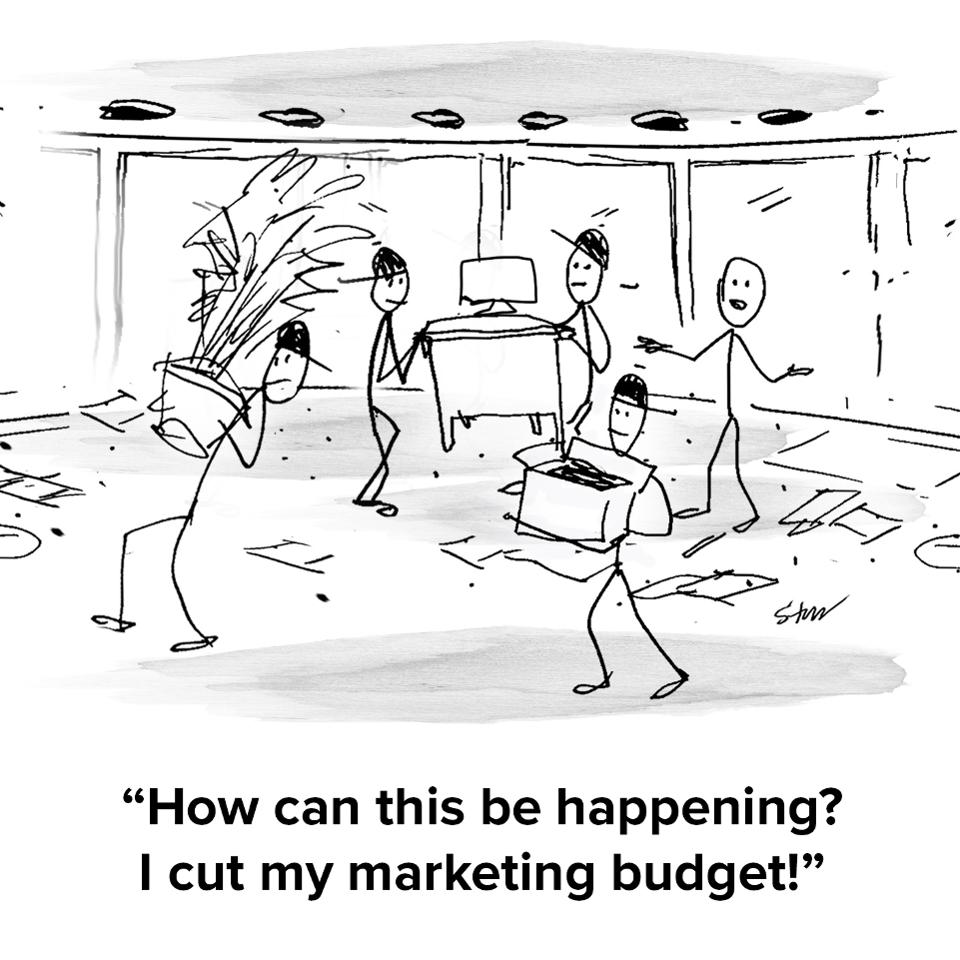
Feature Image Credit: “How can this be happening? I cut my marketing budget!”  STEVE WASTERVAL

By Pia Silva

I am a partner and brand strategist at Worstofall Design where we build brands that turn expertise into profit. Unlike most branding firms, we build entire brands in days instead of months, and only work for 1-3 person service businesses. Our unique process and niche positioning has helped us to overcome the hurdles we struggled with when we were starting our business, reliably attracting a steady flow of high paying clients and allowing us to enjoy the freedom that inspired us to become entrepreneurs in the first place. At Forbes, my goal is to clarify and simplify the elusive idea of “branding,” and share practical tips and tangible steps to help businesses find their unique brand voice that leads to profit.

Sourced from Forbes