While there could be many reasons built around why products fail, there have been products that have crossed these boundaries and had so many wrong ingredients in their failure sometimes becomes inevitable.
While these product failures do leave behind a lot of lessons to learn, it’s in the hands of managers to educate and engage with all the teams early on.
As brands and their marketing departments deploy strategies to capitalize on record ecommerce spending — which soared to $586.92 billion in 2019 — new research from leading provider of brand protection solutions, BrandVerity, has brought to light important findings and hidden risks pertaining to the journeys consumers are taking online.
In order to give brands a better understanding of the search experiences their customers are having and how they are impacting brand perception and customer experience, BrandVerity commissioned the “BrandVerity’s Online Consumer Search Trends 2020” research study in Q4 of 2019 to over 1,000 US consumers, balanced against the US population for age, gender, region, and income.
Amongst the many findings, three main themes stood out:
Consumers confused by how search engine results work
Only 37% of consumers understand that search engine results are categorized by a combination of relevance and advertising spend.
The other 63% of consumers believe that Search Engine Results Pages (SERPs) are categorized by either relevance or spend, or they simply “don’t know.”
Additionally, nearly 1-in-3 consumers (31%) say they don’t believe search engines (e.g. Google) do a good job of labeling which links are ads.
Consumers more inclined to click on the result that appears first
Without a clear understanding of how search results are served up, consumers are more inclined to click on the result that appears first, believing it to be the most relevant option.
With 54% of consumers saying they trust websites more that appear at the top of the SERP, this isn’t just an assumption.
Consumers feel misled by the websites they find in the search engine results
51% of consumers say that when searching for information on a product, they sometimes feel misled by one of the websites in the search results.
An additional 1-in-4 report feeling misled “often” or “always.”
Even further, 25% also say they often end up somewhere unexpected that does not provide them with what they were looking for when clicking on a search result.
“Against a backdrop where consumers have increasingly high expectations of the brands they do business with, and are holding them to equally high standards, companies must ensure that the entirety of the experiences they provide meet customer expectations,” said Dave Naffziger CEO of Brandverity.
“As these findings show, a general uncertainty of how search engines work, combined with the significant occurrence of poor online experiences, mean oversight of paid search programs is more important than ever for brands today.”
Top marketing innovators across industries share their predictions
Innovation never stops. But a new year—and a new decade—gives us a chance to pause, reflect and get excited about the possibilities. So we asked top marketing innovators from brands including Google, HBO, Hulu, Visa, Sony and Chipotle one question: What’s happening in marketing right now that you’re most excited about?
We’ve rounded up their answers, along with key trends that surfaced in 2019 and will continue to shape the industry, from emerging technologies to experiential to the impact of culture.
1. The Democratization of Content Creation
“2020 will be the year that we see the democratization of celebrity at scale. With new platforms in streaming and social media, we will see attention shift away from traditional media allowing new voices to be heard.”Nick Tran, vp of brand and culture marketing, Hulu
“The democratization of creative tools … has resulted in a marketplace full of talented content creators. In addition to external agency partners, [we have] an in-house creative team as well as a hybrid team made up of agency and in-house talent. We are also making content with influencers, media partners and content distributors of all kinds.” Brynn Bardacke, vp for North America content and creative excellence, The Coca-Cola Company
“I am most excited about the shift in content consumption behavior, which is creating opportunities and forcing businesses to rethink how and where they go to for ideas and content. Brands can no longer thrive by going to the same places they’ve always gone. If the business of content has completely changed, why hasn’t the way we go about making it? The industry needs to innovate and I say, ‘bring on the challenge.’” Tina Walsh, chief brand officer, Tongal
“Capturing content is now easier than ever. But VSCO users have taught us that providing tools for creation isn’t enough. They need safe spaces where they can express their own unique voice free of judgment. Creative democratization is best realized within supportive communities that are based on freedom of expression.”Tesa Aragones, chief marketing officer, VSCO
“Content creation has quickly moved beyond marketing and is now influencing product design in unique ways. With the right tools, consumer communities can now be given the keys to the products and experiences they love, which in turn changes their engagement with brands. It’s really exciting to see this beginning to take shape—it’s a whole new model of consumer ownership when you think about products that are designed and created in part by the community.”Jodie Antypas, vp of consumer insights and UX research, EA
2. Voice Technology and 5G
“Advancements in voice technology and ubiquitous computing will bring new levels of humanity to technology, simplifying how we use it and ironically helping us detach for it. Speaking is one of the most natural ways of interacting and will create whole new challenges and opportunities for brands, eventually redefining what ‘brand’ means in the future.”Marvin Chow, vp of global marketing, Google and one of Adweek’s 2019 Brand Genius honorees
“Voice technology is something that we’ve been working on for the past couple of years, and we were excited to partner with Pandora on understanding how consumers are interacting with voice technology while they’re in their daily routines. Conversational AI is certainly something that’s evolving and advancing every day.”Orchid Bertelsen, head of digital innovation, Nestlé USA
“Right now, I’m excited about what 5G will bring to the future of live entertainment. A faster, more powerful connection unlocks a more social, frictionless and immersive fan experience while presenting a powerful opportunity for deeper engagement between fans, artists and brands.”Kevin Chernett, evp of global partnerships and content distribution, Live Nation
3. The Impact and Influence of Culture
“We have a tremendous responsibility not only to our brands but also to our consumers. … We have the ability to bring people together, diminish divisiveness, and celebrate inclusion. And by amplifying those messages, we are in the driver’s seat to influence a culture that is truly about inclusiveness and connectedness.” Lizette Williams, head of U.S. cultural engagement and experiences, McDonald’s
“I get excited when I see brands willing to stand for something relevant and meaningful in the marketplace, even if it’s not universally accepted. … Brand marketing should be about more than providing products and services—it should be about changing our culture.”Karla Davis, senior director of integrated marketing and media, Ulta Beauty
“One trend I find interesting is how customers today have increased expectations of how and where brands show up and what they stand for. … The role brands play in culture is at an interesting point in time, and I expect we’ll start to see great brands emerge from the pack through remarkable storytelling, cultural relevance and more contextually relevant creative.”Lauren Weinberg, global head of marketing, Square
4. Increased Personalization
“We are able to develop a deeper relationship with consumers because we have access to real-time data, allowing personalization at scale. This is motivation to raise the bar for the communications we put into the world. Marketers who understand the power of insights and data use it as an accelerator to create value for consumers through their work.”Mary Yee, vp of global marketing for PlayStation, Sony Interactive Entertainment
“I am excited about our newfound ability to leverage customer data for building brand, and not just for driving sales. What defines you as a person goes deeper than how much you spend: It’s your values, tastes, friends, personal features and overall identity. These are the data points you want to create an emotional connection with your customers.” Benjamin Lord, marketing consultant (formerly executive director at NARS Cosmetics)
“A customer now expects you to know who they are, where they are in the world and what they value, and then orchestrate the service experience around them. … Through emerging tech like AI and near field communication (NFC), we can make the transaction totally frictionless and, more importantly, we can recognize you, greet you and provide an individualized service experience. That is the future of marketing.” Mark Berinato, vp of digital experience, Panera Bread
5. The Value of Experiential
“Young people respond to meaningful connections that support their values. I see an exciting movement in the experiential marketing space where authentic and innovative IRL consumer experiences are driving brand love.”Ivan Heredia, vp of marketing, The Walt Disney Company
“The move from the age of the customer to the age of trust. The sooner companies realize that in reality, it’s the customers who are the heroes and begin catering to their solicited and unsolicited needs with seamless experiences, the better chance they have at building a brand that creates a lasting and sustainable impact. After all, experience is the new product, and time is the new price.” Hussein Dajani, general manager of digital and CX transformation, Nissan Motor Co.
“For two years in a row at SXSW, we bucked the digital trend and developed experiential events. Similarly, earlier this year for Game of Thrones, we brought Westeros to Austin and gave fans the chance to step into the world of the show. We always have an eye on what’s next, but sometimes innovation means going left when everyone else is going right.” Zach Enterlin, evp of program marketing, HBO
“In the world of experiential, it’s been exciting to see brands streamline their teams and agency partners to work together on initiatives as opposed to the separate silos we’ve become accustomed to seeing. We’re happy to see more cross-functional planning where marketing, media, comms and experiential all have a seat at the table together so we can curate and execute really dynamic experiences.”Andrew Steinthal, co-founder and CRO, The Infatuation. CRO, Zagat
6. The Power of Data
“I am fascinated by the changing dynamic in the media and content landscape, and how consumers are starting to recognize that ‘free’ services come with a price tag—perhaps your data becomes a currency you are not entirely comfortable with. … These still embryonic shifts in perception combined with emerging regulation will, in my view, gradually reshape the landscape.”Adrian Farina, head of marketing for Europe, Visa
“Retention will be king. As data provides access to a deeper understanding of the customer’s experience and preferences, marketers will focus as much on retention as acquisition. I am really excited about the opportunity that CRM provides to engage with customers where they are at in their relationship with the brand.”Tressie Lieberman, vp of digital and off-premise, Chipotle
“There is a huge pendulum swing around these walled gardens of data—the Googles, the Facebooks, the Amazons—right now. I think the pendulum will swing back to where consumers have more autonomy and control over what brands collect, use and for how long they’re able to use it, more than ever before.”Jonathan Lacoste, president and co-founder, Jebbit
Feature Image Credit: We asked 21 executives across a range of industries what they see as the emerging trends of 2020. Julian Gamboa
The way you market your business can mean the difference between failure and success. If done right, you can increase revenue, attract new customers, and retain your current customers. If done wrong, you’ll be left screaming, “Ugh, I’ve made a huge mistake!” and trying to pick up all of the pieces.
To keep your business on the road to success, learn what marketing mistakes you need to avoid at all costs.
7 Marketing Faux Pas, And How To Avoid Them
If you want to avoid some of the biggest marketing blunders of all time, you have to know what they are and how to steer clear of them. Here are seven marketing faux pas you need to watch out for in your business.
1. Spending Too Little Time On Marketing
How much time are you spending on your marketing efforts per week? Some of you might say a couple of hours. Others might say diddly-squat. Spending too little time on marketing can spell doom for your small business.
If you want to avoid this faux pas, start devoting more time to your marketing efforts. Just like with anything else in life, you have to work hard at marketing if you want to see results.
Set aside more time to build, implement, and analyze your marketing campaigns. Use that entrepreneur determination I know you have in you to boost your marketing efforts and spend more time marketing your business.
2. Failing To Track Results
I get it—you’re a busy business owner who gets caught up juggling a million and one tasks at once. So, tracking your company’s marketing efforts and conversions might not always be at the forefront of your mind. I’ve been there, too. But, failing to track marketing results is one faux pas you don’t want to make.
If you don’t track your marketing tactics, you’ll never know what does and doesn’t work. Not to mention, not tracking your marketing mistakes can lead you to make the same mistake time and time again.
Here are a few things you might want to (or need to) track at your small business:
Website users
Conversion rates
Pageviews
Blog or social media subscribers
Organic traffic
Social media followers and engagements
At my accounting and payroll software company, Patriot Software, our marketing team tracks various goals in a spreadsheet. At the beginning of each month, they meet to discuss whether or not they’ve reached their monthly goals and how they can improve moving forward.
3. Picking The Wrong Target
Ah yes, you just started your new business. Everything is sunshine and rainbows. Is that a butterfly over there? I remember those days. The days where you think “Everyone can be a potential customer!” If you’re still in this mindset, I’m going to kick you out of it right now.
One avoidable mistake plenty of amateur business owners make is thinking that everyone is a potential customer. Because they believe this, business owners around the world get their target market and audience all wrong.
While it might be true that your offerings appeal to a broad audience, they absolutely won’t appeal to everyone.
When it comes to marketing, you need to narrow down who you’re going to target. Instead of trying to sell to everyone, do some research to hone in on potential customers as well as their needs, interests, and demographics.
You’ve come this far. Don’t make the mistake of not getting to know your target customer inside and out.
4. Not Setting Yourself Apart
When it comes to being a player in the market, you have to be willing to set yourself apart from the competition. Otherwise, why else would your target market choose your business over another?
One big blunder is blending in with other businesses. Don’t blend into a market. Instead, diversify your business and stand out.
Take a look at your competition. How do you differ from them? What makes you stand out from the crowd of competitors? Use your answers to these questions to build on what makes you different.
Tell your target audience and potential customers what makes your business unique from all of the other ones out there. Take things to the next level and create a USP (unique selling proposition) for your business. Your USP should make your business shine and attract buyers based on your selling points.
Put yourself in your target market’s shoes when you think of your USP. What’s going to benefit them the most? What will appeal to their emotions?
If you want to avoid this rookie mistake and diversify your business, come up with an effective USP that your market can relate to.
5. Blowing Your Budget
As you’ve likely learned by now, money does not grow on trees. So, don’t start acting like it does when it comes to your marketing budget.
According to one source, you should devote 2-5% of your sales revenue to marketing. A blunder many business owners make is blowing their business budget on unnecessary or even spontaneous marketing tactics. Now don’t get me wrong. I do enjoy a little spontaneity every once in a while. But, I don’t blow through my business’s budget just for the thrill of it.
If you want to avoid this faux pas, establish a clear marketing budget, do some research on different marketing options and strategies, and track what does and does not work for your company.
Organize your budget in a document or spreadsheet. Record how much you spend—and for what—and track the results. If a marketing strategy doesn’t work for your business, don’t keep rolling with it. Instead, use your hard-earned cash to invest in calculated marketing efforts.
6. Not Having A Marketing Plan
As an entrepreneur, you know how important it is to have a plan in place. When you started your business, you likely created a business plan (or multiple business plans) to get your startup on the right track. But, have you taken the same steps with your marketing efforts? AKA, have you created a marketing plan for your company?
Solid plans are roadmaps that can lead your business to success. If you want to be the best, you have to establish a plan and (try to) stick to it. One major mistake small businesses make is writing off the idea of a marketing plan.
Take a look at this scary statistic: 50% of small businesses do not have a marketing plan. That means half of you are already making this major marketing mistake!
Let’s play a little game of “Did you know?” Did you know that a marketing plan can:
Help you analyze marketing strategies
Create a set of brand standards
Provide marketing direction
Measure marketing success
Help you understand your target audience and market
As you can tell from above, creating a marketing plan has a lot of perks. The solution to this marketing blunder is easy enough: write up the dang marketing plan!
7. Ignoring Your Competition
Sure, you might not like them. In fact, you probably despise them. After all, they’re going after your target audience and customers. Wait … who are we talking about again? That’s right: your competitors.
Even though you can’t stand them sometimes, your competitors can sure teach you a lot. There is a ton of information (and business lessons) you can learn from scoping out your competition. Instead of ignoring them, pay attention to what they’re doing right and wrong.
Keeping up with your competition can only help you in the long-run. Rather than steering clear of your competition altogether, conduct some research and dive deep into your competitors’ strengths and weaknesses. That’s right, folks. I want you to revisit the SWOT analysis. But this time around, use it to dissect your competition.
What are your competitors’ strengths? Do they have any threats in the market? How can you use your competitors’ weaknesses to benefit your business?
If you want to avoid this marketing mistake, stop letting your competition slide by and start doing your research now before it’s too late.
Feature Image Credit: Getty. Keep your business on the path to success by avoiding major marketing mistakes.
I’m founder and CEO of Patriot Software, LLC. I have over 30 years of entrepreneurial experience across five startups. I started Patriot Software in the basement of a factory and grew it into a multi-million dollar company that serves small businesses all across the United States. I know what small business owners and entrepreneurs face because I’ve faced it myself. For more information, please visit Patriot Software or Follow: @PatriotSoftware on Twitter.
News publishers have reaped the early rewards from paywalls and are increasingly turning their focus on the overall consumer marketing challenge of marketing their products beyond the most hard-core loyalists.
Part of that is bringing in new talent. Witness Condé Nast hiring former Stitch Fix marketer Dierdre Findlay to be its new chief marketing officer. And part of that is more robust marketing strategies that move people down the funnel to purchase a subscription by emphasizing the product benefits.
“When we look at the number of readers who’d encounter a paywall or encounter an offer from us, it is a very small percentage of our total audience,” Washington Post CMO Miki King said. “And while I think that the public understand to some degree that the Washington Post is a paid news product, there are many people who won’t necessarily encounter a paywall. We are trying to find ways to introduce the commercial aspect of our business in ways that are not intrusive.”
Over the summer, The Washington Post assembled a 12-person team tasked with improving the way that content is marketed and delivered to subscribers, King said. The team includes members of the Post’s newsroom, marketing, audience, product and engineering, whose goal is “to translate everything we’re doing across the organization into ways we can deliver things to subscribers,” King said. That group, which was assembled from existing staffers who still report in to their respective lines of business, coordinates to ensure that big stories are promoted in a more extensive, timely fashion.
For example, when the Post released “Where the Pain Pills Went,” a large editorial project around where prescription opioid medications were distributed across the United States, the Post’s team had a several-days head start creating messaging around the project for the Post’s subscribers.
Whereas in the past the Post’s consumer marketing team would largely have to rely on marketing stories after they had come out, coordination among the new team ensured that the Post was able to create several emails’ worth of marketing messages around several of its largest projects this year, including its opioid database.
King said at the Post, a newsroom representative keeps the group apprised of stories or projects that could work, ideally giving the marketing and product teams a chance to develop messaging and schedule promotions that can go out at the right time.
But the sensitive nature of many newsroom investigations limits the amount of coordination possible. For example, The Guardian’s blockbuster story about Cambridge Analytica was one of The Guardian’s biggest drivers of reader contributions and subscriptions, said Mark Rice-Oxley, the Guardian’s membership editor in the U.K. But the story was a closely held secret even within The Guardian’s newsroom, which required the contributions team to develop messaging and chatter around it after the fact.
“Ninety-nine percent of editorial didn’t even know about Cambridge Analytica,” Rice-Oxley said.
New publishers’ impulse to tailor messages about how much consumer revenue is valued must be balanced with an impulse to create messages that are broadly applicable. The Guardian, for example, tries to frame its requests for revenue and messaging around subscriptions in ways are “clear over clever,” said Amanda Michel, The Guardian’s global director of contributions.
“We have to write these things in a way that translates regardless of someone’s first language,” Michel said.
Publishers’ recent focus on consumer marketing are designed to support ambitious subscription targets that many news publishers have laid out. The Guardian plans to double the number of people directly contributing money by 2022, to 2 million; The New York Times has vowed to amass 10 million paying subscribers for its portfolio of products by 2025.
“We’re telling the story of our work,” Michel said.
As the decade draws to a close, Marketing Week looks back at the defining moments of the 2010s from the News of the World phone-hacking scandal to the launch of Instagram and the dawn of influencer culture.
2010 – The coalition government and start of austerity
Given the seismic ructions seen in politics in the years since the 2016 referendum, it’s easy to forget how significant the first government of the decade was.
After 13 years of New Labour, the country wanted change. The electorate, however, wasn’t entirely sure what the alternative was. The election of May 2010 was indecisive. David Cameron’s detoxification of the Conservative brand had helped the Tories become the biggest party, but shy of the requisite number of MPs needed to form a government.
Whether out of a sense of duty, or a naked pursuit of power, Cameron acted quickly and agreed with Liberal Democrat leader Nick Clegg to form the UK’s first post-war coalition. It was a government that would define politics, the economy and in many ways marketing for the next 10 years.
In 2010, the UK and world economy were still reeling from the financial crash, bank bailouts and subsequent monetary crisis in the eurozone. Consumer confidence was low, the deficit high and business brittle.
The response was brutal. To restore confidence in UK PLC, the coalition government prioritised debt control. A huge programme of cuts was unveiled.
Spend on marketing activity was immediately frozen, and then reviewed and cut by half in the coalition’s first year. The Central Office of Information (COI), the government’s marketing agency, was no longer the UK’s biggest advertiser and wouldn’t be long for this world.
Public information was an unnecessary cost. The language was unhelpful to the perception and standing of marketing.
Once shorn of much of its budget, its responsibilities were passed to the Cabinet Office. It left many agencies scrambling to fill the tens of millions they earned from being on the COI’s roster. Some suffered serious damage. Others reportedly worked for smaller margins in order to stay in line when the crumbs were being thrown.
The narrative around marketing communications was pejorative, with statements suggesting the government was taking decisive action by ridding Whitehall of the profligacy of marketers. Public information was an unnecessary cost. The language was unhelpful to the perception and standing of marketing.
Elsewhere, the coalition furthered the spread of brand purpose. Its flagship ‘Big Society’ initiative aimed to spread responsibility for societal advancement by marrying business, community and the benevolence of people.
While the Big Society was flawed and ultimately retired, the concept of brands having a wider role took deeper root. Corporations sensitive to the sense of injustice people felt following the near-collapse of the financial system at the end of the previous decade felt a growing need to do their bit.
The biggest act and legacy of the coalition, however, is austerity. The downsizing of the government’s marcomms operation was insignificant compared with other cuts to central and local government spending.
Although the economy stabilised through the decade from its 2008-2009 nadir, it remained in a perpetual state of uncertainty through to the end of the decade.
At the same time, those that bore the brunt of public sector cuts grew angry and frustrated. A sense of injustice that arguably played its part in triggering Brexit and yet more economic uncertainty. Marketers, as spenders of cash that would be otherwise returned to shareholders, were forced to tighten their belts. RP
2010 – The publication of How Brands Grow
Although the commercial viability of the printed word has undoubtedly lessened in the 2010s, one type of book appears to be in rude health – marketing theory.
Feeding the anxiety many marketers feel about their capabilities in wake of some of the big macro shifts seen in the decade, tens of such books appear to be published every month – with transformation, agile, disruption and customer experience particularly popular among publishers, at least.
Given the volume and often generic subject matter they are often sent for donation to charity after a short period as a talking point sat on your boss’s office desk. One very notable exception came right at the decade’s start: Byron Sharp’s How Brands Grow.
“The first book in a decade to say anything new about brand strategy,” according to Mark Ritson, How Brands Grow cut through a lot of the theory, and indeed practice, that had become common in marketing to that point.
In very brief summary: penetration should be key for marketers, with more sales from more people reached through mass marketing being demonstrably more effective than targeting a segment of a brand’s potential buyers. A focus on distinctive assets such as colours, tag lines and logos trumps differentiation.
There are few other marketing books launched in the decade that would be as known, as consumed and as polarising as How Brands Grow.
“Sales growth won’t come from relentlessly targeting a particular segment of a brand’s buyers,” Sharp asserted.
Ally this “mental availability” with the “physical availability” of being on sale in as many places as possible and you have a recipe for success, the book argued. With the Ehrenberg Bass Institute at his back, the professor is unwavering in the belief that he and his book are right. This wasn’t finger in the air theory, Sharp argued, it was science.
As the decade wore on so did the momentum behind the high-profile converts. Unilever, Procter & Gamble, Pepsico and Mars have all at times underpinned activity for some of their brands with takeaways from How Brands Grow.
One thing can be guaranteed, the book and/or its author will be mentioned at some point during any marketing conference, anywhere in the world.
Ubiquity also attracts criticism. There are plenty that reject Sharp’s blanket conclusions. Indeed, Ritson has argued strongly against Sharp’s dismissal of targeting and differentiation, memorably in a debate at The Festival of Marketing in 2017. And despite its influence on some, the movement towards micro-targeting and the quest for ever deeper engagement has grown exponentially in the decade since How Brands Grow was published.
Whether it is used or not to inform brand strategy, whether you flinch at or favour its findings, the book’s conclusions are parked in marketers’ minds.
At a recent conference, I asked the audience if they had heard of How Brands Grow, most hands went up. When I asked how many had read it, only a few went down. When I asked whether they agreed with its findings, the audience was split.
There are few other marketing books launched in the decade that would be as known, as consumed and as polarising. Or as influential. RP
2010 – The launch of Instagram
Instagram began life in 2010 as a micro-blog for sharing photos. It was created by two college friends, Mike Krieger and Kevin Systrom, with Krieger posting the first image on the platform – a lopsided shot of South Beach Harbour, San Francisco, with no caption. Later that day Systrom posted a pic of his dog and then girlfriend’s foot, with the word “Test”.
By October of that year, Instagram was available to download as an app and was gaining a following among a young, digital-native crowd. Just two years later Facebook bought the platform for $1bn (£700m).
At the time, Facebook CEO Mark Zuckerberg described the acquisition of Instagram as an “important milestone” as it was the first time his company had purchased a product or company with so many users. He added: “We don’t plan on doing many more of these, if any at all.”
The gamble of Instagram quickly began to pay off. By the end of 2012, Instagram boasted around 90 million active users and within two years of the Facebook buyout, the app was valued at $35bn (£26.5bn).
Instagram hit just as a more emotionally-entangled celebrity culture was taking hold, one that first surfaced in reality television.
Brands, attracted by a visual platform with a younger, predominantly female demographic, quickly started moving in. The fashion industry loved it, with Nike and Gucci among the Instagram early adopters.
Ads started appearing on the app in 2013 and, although never designed to be an ecommerce site, small independent sellers used artful images and caption info to direct users to their latest products.
Instagram hit just as a more emotionally-entangled celebrity culture was taking hold, one that first surfaced in reality television. It opened up the daily lives of TV and pop stars, not just from the back of a limo or getting ready for their close-up in a make-up room, but also hanging out in the kitchen or kicking off their heels in an airport lounge.
If a celeb’s daily life was increasingly being lived out on the platform, soon regular users behaving in an attention-grabbing way began to enjoy a certain type of fame. So influencer culture was born.
Hired by brands as a shortcut to users, seduced by images of their favourite Instagrammer posing in a new pair of shoes or sipping a poolside drink at a newly-opened hotel, the influencer’s bankability was measured by the number of likes they generated.
However, times are changing. The ‘Checkout on Instagram’ function now allows users to buy directly from brands within the app, while ongoing experiments around hiding the ‘like’ button – or deleting it altogether – will undoubtedly have a big impact on influencer culture as we know it.
Then there’s the credibility issue. In 2018, then Unilever CMO Keith Weed called on platforms like Instagram to take “urgent action” to rebuild trust amid accusations of influencer fraud around fake followers, bots and “dishonest business models”. Couple with this intense criticism regarding concerns about online bullying and peer pressure on the platform.
The issues around credibility and brand safety aside, Instagram remains a buoyant, creative space and with in excess of 1 billion users looks set to surpass Facebook usage in the years to come.
And to think, Zuckerberg very nearly opted to buy Foursquare instead. MB
2011 – News of the World shuts
It was the story that had everything. Espionage, power struggles, crime and punishment. The kind of story that would make the front page of Britain’s biggest selling Sunday newspaper, the News of the World.
Except in the summer of 2011, the newspaper was the story. What had been brewing for five years was brought to a dramatic, and sudden, conclusion when The Guardian broke the shocking news a private investigator working for the newspaper had hacked the voicemail of the then missing teenager Milly Dowler, who was later found murdered.
Celebrities were one thing. Dowler, whose disappearance and death had resonated deeply with the British public, was quite another.
Attuned to public opinion and fearing reputational damage through an association with the toxicity surrounding the tabloid, advertisers began to pull their patronage. Without the support of the public or brands, the newspaper was doomed. The stories that had given the News of the World brand salience became its undoing. It closed on 7 July.
The paper’s closure was significant. Even though sales were past their peak, the newspaper was still read by more than 2.5 million people just before its closure. The arrival of The Sun on Sunday just seven months later was evidence the market still existed. Indeed, it has been argued the extension of Murdoch’s favoured red top was something, if not planned, then welcomed.
Aside from the implications on the News Corporation newspaper empire and the liberty of editors Rebekah Brooks and Andy Coulson, the scandal also scuppered Murdoch’s plans to widen his UK broadcast empire.
The stories that had given the News of the World brand salience became its undoing.
News Corp’s bid to buy the remaining 60% of BSkyB was shelved two days after the closure of the News of the World. The company was bruised and therefore fair game for emboldened MPs who were preparing to pass a Commons motion to wreck the deal. Despite further attempts, the takeover never happened.
Rupert Murdoch had been irrevocably damaged too. Prime minister David Cameron launched the Leveson Inquiry to formally investigate the phone-hacking scandal. Up until then, politicians had courted Murdoch’s favour and the public perceived him as all-powerful. His appearance at the Select Committee hearing in front of unforgiving MPs may not have established any wrongdoing on his part, but it did at least reveal him to be fallible.
“This is the most humble day of my life” said Murdoch, the very least expected by way of contrition, doing nothing to redeem him in the minds of the public.
As a demonstration of the power of brands to force the hands of media owners, marking the beginning of the end for Murdoch’s stranglehold on British media, the events of July 2011 would resonate through the rest of the decade. RP
2011 – The John Lewis Christmas ad
It seemed the stars aligned when John Lewis revealed its Christmas TV ad in 2011. Suddenly the department store group was hot property, gaining social media shares and tabloid coverage for The Long Wait, by agency adam&eveDDB, which showed an excited boy waiting to give a present to his parents.
Most of the ingredients for success had been in place for a while. John Lewis ran its first Christmas TV ad in 2007, with a spot that used products to create shadow pictures, and followed it with a series of ads that focused on the range of gift products available in its stores.
All of the ads had some familiar features: a popular song, performed at a slower tempo and in a different key to the original – nostalgia, middle-class families, cute children.
Rival advertisers followed suit, making big budget Christmas adverts a fixture in the festive schedule.
What changed? In 2011, the retailer moved from a focus on products to broader brand building. This allowed more emphasis on story, without the need to squeeze in a bunch of products. And the brand timed the change well, picking up on the Christmas-shaped snowballing of social media participation.
The 2011 ad received such a positive response that subsequent John Lewis ads have been keenly awaited and commented upon ever since. The debut of the annual John Lewis Christmas advert is now promoted in advance, supported by product tie-ups and broadcast deals.
Rival advertisers followed suit, keen to capture some of that sparkle, making big budget Christmas adverts a fixture in the festive schedule. The Christmas advertising period has been extended and – like the Super Bowl in the US – there is as much discussion about the campaigns as there is about the big day itself.
Christmas ads are reviewed on mainstream breakfast TV shows and there is a growing tradition for low-budget independent ads to be touted as ‘even more heart-warming than John Lewis’. Spoof John Lewis ads are awaited almost as keenly as the real thing.
For its part, John Lewis has nurtured its theme carefully, not straying too far from a successful formula. The ingredients have remained the same, with a distinctive cute animal or fantasy character (or Elton John) taking centre stage. Audiences have now been charmed by dragons, monsters, dogs and a randy penguin. And, all the while, audiences wait to see what will be next. MV
In a fundamental way, a target market is like a galaxy. Both seem like comprehensive, discrete entities, complete unto themselves, until we look closely. But ultimately, a galaxy is an aggregation of micro-phenomena – stars, planets, comets – each with its own discrete existences and properties.
This is true of target markets as well. A target market is a personification of the audience we think is most likely to buy our product. But the reality is that all members of this “market” have unique characteristics, and they often respond to different stimuli.
The New Age of Exploration
Ultimately, then, if we really want to understand either a target market or a galaxy, we need to zoom in and focus on the individual objects and phenomena that compose it. The good news is that just as powerful telescopes and discoveries in physics have allowed us to see into the depths of our galaxy and predict cosmological events, advances in tracking, ID resolution and data science allow us to expand and refine our vision of our audiences, enabling us to understand – and thus better serve – the entire range of people who might be interested in what we have to offer. In this way, we significantly expand our potential universe of consumers, while improving every communication and interaction.
Marketers have historically determined the most likely buyers for their brand by defining the demographic and behavioral patterns of their best customers. This has involved researching preferences, understanding passions, examining purchase motivations, and more.
But there are known flaws with this approach. Specifically, we see time and again that stated purchase intent has been shown to have low correlation to actual sales. And the limiting nature of a lowest common denominator target segment is an even bigger problem. We know there are always people who don’t fit neatly into our target market, but who would still be interested in our product.
The Expanding Universe
Now that computational processing power and data science techniques can simultaneously make sense of the thousands – or millions, or billions – of data points we have about the members of our audience, we have opened up a much more robust form of marketing intelligence; one where there are really no limits to whom we market our products to. This enables us to move past the limitations of targeting to a handful of segments. With all of this data, why not open up the potential to acquire all audiences that we can responsibly identify, reach, and profitably convert?
To test the idea of a single audience versus multiple audience approach, marketers will need to experiment more with pitting traditional research directly against behavioral data targeting. While traditional research may show that an audience is performing well, automated testing with multiple undiscovered audiences may perform just as well – and often exponentially better.
The Final Frontier
As we move into what is conceivably the end game of marketing – a future where a target market is a segment of one, where virtually every individual can be precisely targeted with highly relevant messages (albeit anonymously and with appropriate permissions) – brands need to begin executing at the intersection of data science and creativity. This means rethinking the relationship between disciplines – branding, media, creative, production and data science – If we are to leverage our new, expanded consumer pool. To operate in this new world order, we need to recalibrate how all of our marketing disciplines adapt to enable the individualization (as opposed to personalization) of communications.
For companies of all sizes, new audience identification modeling can generate significant new revenue. The time to experiment with marketing to many audiences is now. By doing so, we can more deeply understand and better communicate with an entire human galaxy of individuals who find value in our brand.
In marketing and business, good insights are like Fabergé eggs — rare, fascinating and, in many ways, mythical, says Claire Denham-Dyson, head anthropologist at Demographica.
The strongest strategy does not evolve without a powerful insight to lead it, and robust research backing it up. Anthropologists in B2B marketing spend hours with decision-makers in the B2B world, speaking to them about their worlds. They also observe their workplaces, how they engage with products and the social dynamics between the client (sales) and their client (the ‘buyer’).
While today there is material that explains what an insight is, very little of it explains how you get to one, or just how daunting the task can be.
As anthropology is a descriptive human science that uses detail and subjectivity to understand people, culture or dynamics, anthropologists are in a great position to illuminate the world of the target market. However, even the greatest researcher can be useless if they cannot distill their work and leverage all this information.
Here are five tips on how to identify an ‘insight’:
1. Be aware
There are many types of insights. There are psychological insights that reference what people are feeling on an unspoken but emotional or psychological level. There are also cultural insights that dictate why certain rituals, practices or social norms have come to have power. And finally, there are behavioral insights that provide a compelling understanding of why and how people do the things they do.
This list is not exhaustive, nor are the types/kinds of insights closed — as most of the human world, they are messy and can overlap or reference more than one aspect of human existence. Remember that what you came to find will greatly influence how you perceive what you find.
2. Immerse yourself
You need to spend time in field. You need to speak to people, ask difficult questions and shadow them. You need to be a stalker, an empath and incredibly curious and detail-oriented.
The discipline of anthropology teaches you to deeply immerse yourself in the world of the target market — this means using all your senses (all 21 of them) to become present. Document everything.
3. Make sense of the data
After the many hours immersed in your target’s world, collecting ‘thick/rich’ data and compiling archives of transcriptions, photos and maps, you can begin to ‘sensemake’ the data.
Sensemaking is a fancy term for trying to understand the way the world works for the consumer. This means a second immersion — but this time, you deep dive into your data.
In this second immersion, you should identify fragments of knowledge, critical moments, meaningful observations and times when you felt confused or emotional. Your subjectivity is part of the sensemaking process, and digging deeper into why both your target market (and you) felt or acted the way you did.
4. Start your insight beating
The word ‘beating’ is used because identifying an insight is a process of pain, growth and discomfort. This part requires an ability to locate contradictory or compelling tensions.
It involves long working sessions of picking up and dropping ideas until you feel yourself seeing the bigger picture. Often, you know you have an insight when you literally feel it.
Insight is just a new perspective, and there is a feeling that accompanies this new realisation. You should feel the ‘a-ha’ — that tiny surge of positivity or optimism in your body that clicks the argument into place.
5. Land it
Once you finally have the insight, you can backtrack and build the stories that got you to it. This involves using evidence (quotes, images, stories or observations) to lay out the landscape and set up the tension through contradictory or deepening information that describes and isolates the problem.
This should set you up to reveal the insight. The insight should solve the tension. It should explain what people are feeling or being motivated by on a very deep level. It also should provide a fresh, informed and vigorous angle on the problem.
At this point, you have shared knowledge. You have taken a lot of information, unpacked and challenged it, and then you have synthesised it in such a way that has a purpose.
Whatever industry you work in, being insightful is as valuable as having experience. If you can be comfortable in the diversity of experiences people have, you will be well-poised to shape and locate insights. Within our vast continent, there are a wealth of insights waiting to be uncovered and leveraged in meaningful ways.
With a strong insight, a campaign can go from being a communication effort to a truly reciprocal experience for both the buyer and the brand. Brands evolve when they truly understand their market.
Equipped with a good insight, you can help your client solve a real problem that often has nothing to do with the product, but everything to do with the buyer’s world. Unsurprisingly, highly connected buyers are the most valuable ones.
This form of testing can yield important insights.
With the amount of competition you face to get your email seen by your target market, you need to eliminate the noise by grabbing your audience’s attention. People are attracted to different options for different reasons. A/B split testing will tell you what your audience prefers, so you can create successful email campaigns.
A/B testing is when you compare and test two different versions of your email to see which brings in higher conversions and why. This allows you to create future campaigns that increase engagement and expand reach, because you’re giving your audience exactly what they want.
Consider testing your subject line, call-to-action copy, call-to-action button color, color scheme, and images. It’s important to test only one element of your email at a time; otherwise, it will be difficult to track why conversions went up or down, because there are multiple variables to consider.
From my perspective, it seems like most marketers are making the same mistakes – common funnel-draining mistakes that are fixable over just a few weeks or maybe months.
Are you converting as many people as your product is capable of converting?
It’s a question I think about a lot when I’m working on my marketing projects. Is there a gap between the quality of the product and the quality of my marketing? Is my marketing funnel underselling a phenomenal product?
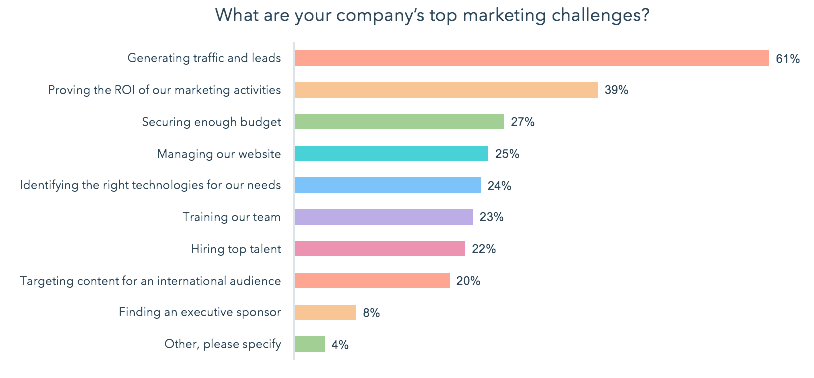
It might seem like a silly question, but it’s something many marketers struggle with. Some 61 percent of marketers list “generating traffic and leads” among the top challenges they face, and 39 percent select “proving the ROI of our marketing activities.” And those are challenges that cripple the very core of a marketer’s purpose (to generate leads and improve ROI).
Image source: https://www.stateofinbound.com/
But from my perspective, it seems like most marketers are making the same mistakes – common funnel-draining mistakes that are fixable over just a few weeks or maybe months.
From my experience, these are three of the most common snafus.
1. You’re ignoring the facts (AKA data)
Perhaps no industry changes as quickly as the marketing industry. The psychology of why people buy doesn’t change, of course, but the methods do. Not long ago, for instance, only deluded marketers would have hedged their bets on the lead-generating prowess of LinkedIn. Now, it’s a platform representing 500 million members with tips emerging from every corner of the web with a quick “generate leads on LinkedIn” Google search.
Facebook advertising, SEO best practices, and even the up-and-coming Tik-Tok have changed and are consistently changing the marketing environment.
If you stop paying attention, you fall behind.
But that doesn’t just apply to the marketing space as a whole, it applies to your market specifically – the people who stand to benefit most from your products.
Every company is different, and so too is every market. And if you don’t pay close attention to how your prospects are interacting with your marketing touchpoints, you’ll convert less people than you could – it’s that simple.
Sadly, 74 percent of marketers admit that they don’t know how to track their data. Don’t be one of them. Install and fully understand Google Analytics, use a heatmap and A/B testing tool like VWO or CrazyEgg, and use UTMs to track links clicks. Your lead generation volume will thank you.
2. People are entering your funnel for the wrong reason
The bottom of your marketing funnel is going to leak like the Titanic after a long voyage if you don’t put the right people in that funnel.
From my experience, the reason that people sign up for your email list should be very similar to the reason that they buy your products, or at least related. If they sign up for your email list because they want to win a free trip to the Caribbean and then you try to sell them enterprise-grade IT automation software, it might not be the best fit.
Similarly, I’ve found that using PR to get mentions on sites relevant to your target market (i.e. where your prospects spend time) and working with influencers who already have a following full of your ideal customers are two great ways to ensure you’re attracting the right people to your funnel.
This point is well illustrated with the power of the Facebook pixel, as explained in this case study. Paleo Bakehouse was a modest home business based in Miami.
Looking to boost sales, the couple behind the business sought the help of Juice, a digital advertising agency, which changed up the way that Paleo Bakehouse was running their Facebook ads. Simply by switching campaigns to the conversion ad objective, adding a Facebook pixel to the client’s website, leveraging lookalike audiences, and retargeting stickier website visitors, they were able to make sure their paid media reached people who had already demonstrated interest in Paleo Bakehouse’s products. This change alone resulted in a 260 percent increase in purchases and over $311,000 in revenue lift.
Of course, that’s just one example of what can happen when you focus your time and energy on converting people who have signalled interest in your products. But this simple truth applies to all of your marketing efforts and your funnel as a whole. Attract the right people to your funnel in the first place, and they’ll be far more likely to buy your products when the time comes.
3. You don’t understand your ideal market (but you think you do)
It’s easy to assume that you understand your target market – that with some quick visualizations and inference-making, you’ll create a useful customer avatar.
And to some degree that’s true. There’s certainly something to be said for putting yourself in your target market’s shoes.
The problem is, 80 percent of consumers don’t feel understood by the average brand. Which means that you have to be the one that really gets them. But you know the most surefire way to understand your market?
Ask them what they want, what they fear, who they are, what they do, how many kids they have, why they’re on your list, and lots of other revealing questions. The more you really know about your market (rather than just think you know), the better you’ll be able to cater your marketing materials specifically to those people and their needs.
Surveys work wonderfully. So too does calling your customers, spending time in the forums where your target market hangs out – even looking at competitors who are trying to communicate with a similar market can help you understand the people you’re trying to convert.
ConversionXL is proof of this. After launching CXL Institute, the company watched as purchases and engagements plummeted month after month for a full quarter. As a final hail mary (before calling it quits), CXL used surveys to try and figure out why people weren’t engaging with the new product like they had expected. Eventually, they found out that people weren’t buying for two primary (and easy-to-fix) reasons: the price was too expensive and they didn’t have time to actually use it.
With that, they changed their targeting for the product to focus on bigger businesses with more generous budgets, and now, according to a case study from Hotjar, the CXL Institute’s business is healthy and sustainable. But they never would have known how to fix it if they didn’t take the time to understand their market.
Fixing your leaky funnel
The reality is, most funnels leak for only a few reasons – the same reasons. And it’s rarely because of a bad product (even a terrible product can sell like hotcakes with the right marketing) or lack of product-market fit. More often, it’s because you’re ignoring the data, people are entering your funnel for the wrong reasons, or you don’t fully understand your ideal market.
Fortunately, plugging those holes is relatively simple. Pay more attention to the data (and set up tracking if you don’t already have it), create interest consistency across the entire customer experience, and send surveys to your past customers.
With that, you’ll be head-and-shoulders above most other marketers.
By Ben Jacobson
Ben Jacobson is a marketing strategy consultant based in Israel. His specialties include social media and branded content for the B2B sector. Ben can be reached via Twitter @osbennn.