Do you know what ‘on-SERP SEO’ means in the marketing universe? You’re not alone, but you are missing an opportunity.
Can you believe it’s almost 2020? When I began my marketing career over a decade ago in 2009, I could hardly imagine what I’d be doing today as a marketing leader at an enterprise organization …
… especially with technology. But each year, new and disruptive technological innovations are forcing marketers like me to evolve our best practices. Digital marketing, once the only game in town, has given way to multichannel marketing; and today, we are rapidly approaching the omnichannel marketing age.
And that can be overwhelming: As the rate of marketing innovation continues to accelerate, most organizations are having a hard time keeping up. But the good news is that new ways of doing things bring new opportunities. Here are four major marketing trends I see developing among organizations for 2020 and beyond:
1. Optimizing for on-SERP SEO
Ever hear of zero-click results? You’ve probably seen them. A zero-click result is a search result in which Google automatically provides the answer to the search query in the form of an automated snippet.
For example, if you type in ,“What is the temperature in San Francisco?” Google will automatically provide you a result it generates on its own. You’d actually have to scroll down to see the Adwords results and organic search results.
Google auto-populates search results for much broader queries, as well. Everything from “What is a cryptocurrency?” to “How do I create a marketing funnel?” has a snippet that may prevent a searcher from scrolling down to see more results.
Why is this significant? Because 61.8 percent of search results in Google are now zero-search results, according to data from Jumpshot. As a result, more and more keywords are becoming less profitable.
While the automatic snippet sometimes comes from a website that ranks somewhere on page 1 of the search engine results page (SERP), companies are unsure how to optimize their content so that Google chooses them over anyone vying for the same spot. Needless to say, this is a concerning development for any business that markets or advertisers on Google.
Opportunity:The brand that figures out on-SERP SEO first will have a huge competitive edge.
2. Advertising on smart speakers (and optimizing for voice search)
Another major development in recent years has been the proliferation of smart speakers. In 2018, around 56 million smart speakers were sold to consumers, according to Social Report.
Yet despite the growing number of households asking Alexa, Siri and Google Home questions, smart speaker marketing and advertising opportunities have been scarce. But this seems to be changing.
In 2017, for example, Google Home users noticed that a universal ad for Disney’s Beauty and The Beast began playing shortly after scheduled morning announcements, called flash briefings. These types of ads were rare and infrequent at the time, but are now growing in popularity.
In 2019, we’re seeing better, less invasive, examples of branded advertising on smart speakers. One of the most customer-friendly ways to advertise on smart speakers is to make what’s called a “branded skill.” For example, if you tell Alexa “Ask Patrón for a cocktail recipe,” Alexa will respond with a diverse selection of possibilities, courtesy of the premium tequila maker. This strategy works:. Patrón gets more than 6,000 queries a month for its Alexa skill, according to Digiday.
Opportunity: Try the “branded skill” approach for your branded advertising, for a more customer-friendly tone.
3. Optimizing for voice search
Granted, most brands may not be ready to explore smart speaker advertising just yet. But in the meantime, they should explore optimizing their content for voice search.
Needless to say, it probably makes a lot of sense for all businesses to start optimizing their content for voice search, not just big enterprises. There’s a lot of advice from marketing experts on how to do this, and it seems that the consensus is that making content more conversational does the trick.
Opportunity: With most search happening on smartphones, optimize for voice search.
4. More chatbots and, yes, even more content!
Finally, as I’ve explained before, written content isn’t going anywhere anytime soon. Not only is it predicted to be the marketing activity that will make the largest commercial impact three years running (according to Smart Insights), but written content is also the main throughput of chatbots, which are expected to see increased usage in 2020 and beyond.
According to a recent study by Juniper Networks, as AI-powered chatbots grow in popularity and sophistication, retailers can expect to cut costs by $439 billion annually and increase sales by $112 billion, by 2023. With numbers like that, it’s not too hard to see why large organizations will continue investing in newer and more helpful chatbots.
But chatbots aren’t useful just for big business. Any business that has a website with traffic can benefit from a simple chatbot that answers the most common visitor questions and helps convert visitors into warm leads.
Opportunity: Chatbots will help you cut costs.
Marketing is changing, and marketers must change with it
When I first got my feet wet in the marketing world, I couldn’t have imagined that I’d be helping run digital marketing transformation programs. But that’s what it takes to stay competitive in the world of 21st-century marketing.
It’s almost 2020; have you looked into any new and innovative ways to spend your marketing dollars? Or how to double down on the marketing channels that work best for your business?
Because if you haven’t, I guarantee your competitors have.
While the practice of content marketing has been around for decades, it’s only started to come into its own as a recognized and respected form of marketing in the last decade. As the practice has proliferated globally, so has the introduction of dedicated, content-centric staff within corporate marketing organizations. Among the most common new titles we see these days is the Content Marketing Manager.
According to Google Trends, the term “content marketing manager” was rarely searched until around 2013. Interest in this new role rose steadily over the following two years and has remained steady since 2015.
But what exactly is a content marketing manager? Do you need one? To understand these questions, you first need to have a clear picture of what content marketing managers do on a day-to-day basis.
A Content Marketing Manager’s Role
A content marketing manager is ultimately responsible for managing a company’s content marketing operation, and the overall success of content marketing initiatives. They guide content marketing strategy, facilitate ongoing content planning, manage day-to-day content creation, editing and promotion, and report on the results of each content marketing initiative.
Skills & Experience
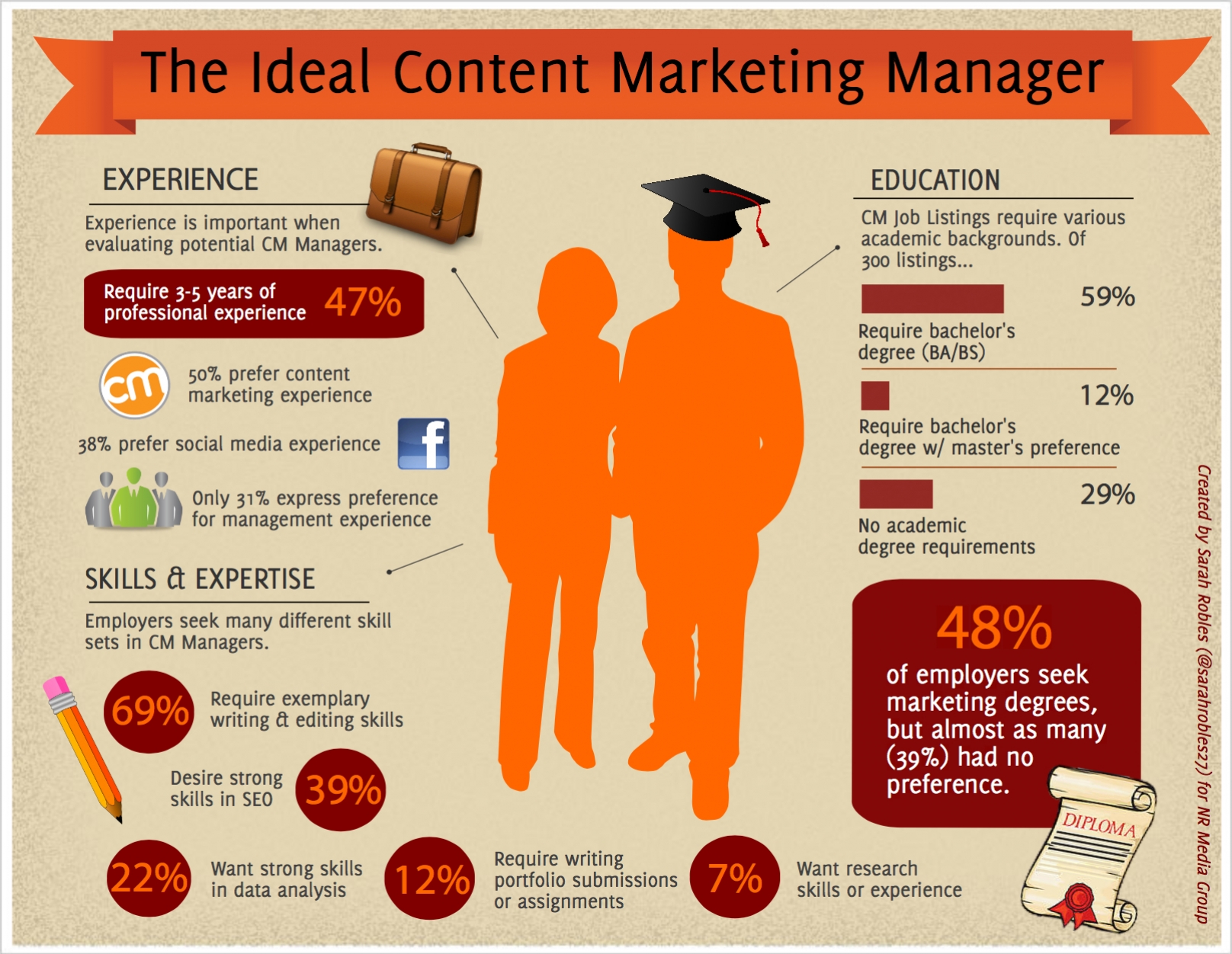
In a recent study, researchers scoured more than 300 “content marketing manager” job listings from Indeed, Glassdoor and LinkedIn to examine the qualifications requested by companies. This infographic by Sarah Robles sums up their findings nicely.
Here are the eight strategic initiatives that most content marketing manager will be responsible for developing.
1. Research and Competitor Analysis
The content manager’s main aim is to successfully carry out the business’ content marketing strategy by publishing and promoting content that achieves the goals set out in the strategy. It’s impossible to create an effective content marketing strategy and plan without initial research. This research helps the content manager and creators to understand their target audience better and decide what types of content to create and which topics to cover.
This research might involve:
Analyzing competitors’ content, messaging and distribution tactics
Identifying target audiences and their key demographics, interests, and online behavior
Surveying current customers to understand and validate strategic and tactical decisions (template below)
Facilitating internal stakeholder interviews to identify business objectives and subject matter experts
Keyword research
Research to define appropriate subjects and topics
Looking into content tools and software that can help them to create and promote content
2. Preparing Content Marketing Plans
After an initial research phase, the content marketing manager can start working on one or several content marketing plans. Depending on the size of the company and scope of their offering, multiple content marketing plans will often be needed to define strategy and tactical execution for individual brands, business units or channels. For example:
A bank may have one content marketing plan for their consumer offerings, and another for their commercial offerings
A software company may have an external content marketing plan aimed at generating new business, and a separate content marketing plan designed to retain and up-sell existing customers.
Each content marketing plan should be informed by the overall content marketing strategy (which is usually created with the help of the wider marketing team) and should define the exact goals for each initiative and identify how the content manager will achieve these goals with content.
Content marketing plans should include (at a minimum):
Specific, measurable goals with a timeline in which to meet them
A general budget with estimates for staff, creative resources and paid promotion
The types of content that will be created (ex: blog posts, ebooks, white papers, infographics, etc.)
The topics that will be covered (and why)
The channels that will be used to distribute the content
A plan for paid promotion of the content
An execution plan outlining the publishing frequency, production workflow (creation, reviews and approvals) and ongoing maintenance of the content
Your content marketing manager may also create individual content marketing plans for specific campaigns, an overall plan for a set time period (such as the next quarter or year), or a combination of the two.
3. Creating an Editorial Calendar
Once a content marketing plan has been flushed out, content marketing managers can now plot deadlines for creation, publication, and promotion on a content calendar so the whole marketing team can see at a glance what content is planned for the coming weeks and months.
Having a visual editorial calendar helps your content manager align content publication and promotion with key dates that are important to your business and other marketing campaigns. It’s also important to build slack time into the schedule to allow for any delays in content production and to allow for last-minute, real-time marketing opportunities.
4. Content Creation
After the content plan has been created and approved by all relevant stakeholders, it’s time for the main responsibility of the content manager – actually creating the content.
This being said, not all content managers will physically produce and publish each piece of content. Many content marketing managers will be dictating production workflows and overseeing a team of creatives. However, it’s vital that your content manager has excellent writing and editing skills as they’ll hold the ultimate responsibility for what is finally published.
As well as researching and writing content, content marketing managers may need to source photographs and illustrations to accompany written content, format content, and add meta information.
5. SEO
It’s not enough for online content to read well and be free of spelling and grammar errors. Content marketing managers must also have search engine optimization skills to make sure that web searchers can find their content and that it appears on the first page of Google and other search engines.
If you have an entire digital marketing team at your disposal, you may have already employed an SEO specialist. Alternatively, you may be outsourcing your SEO needs to a specialist agency. Despite this, it’s still important that your content marketing manager understands at least the basics of SEO in order to carry out an effective content marketing plan.
6. Editing and Ensuring Adherence to a Style Guide
When a content marketing manager has a team of writers to manage, their editing and proofreading skills are essential. They also have to be able to give constructive feedback.
It’s vital to maintain a consistent brand voice in your content and this can be challenging when there are several writers working on your content. A style guide is essential for this reason. Your content marketing manager should create this style guide, which might include information about brand personality, writing styles, punctuation and grammar preferences, SEO best practices, and guidelines to aid in selecting images.
As well as making sure that each piece of content is proofread and edited before publication (if not personally, then by a dedicated editor), your content manager must also ensure that all content adheres to this style guide.
7. Publishing and Promoting Content
After each piece of content is produced and approved, it’s the job of the content marketing manager to ensure it gets published and promoted to the right people in the right place at the right time. They might do this manually themselves or leverage technical staff to load content into a web CMS, email marketing or social media automation tool.
Once published, a pre-defined promotional strategy should be executed, often including automated social media posts or other tactics that fire at times selected for the best engagement. This type of content automation is an effective way to speed up your content production without having to grow your team.
Your content marketing manager must also integrate your content strategy with the rest of your marketing campaigns and identify other channels for online and offline promotion.
8. Content Performance Monitoring and Analysis
Your content marketing manager’s job doesn’t end once they’ve published a piece of content. One of the most important parts of this role is continual monitoring and analysis of published content so they can see what’s working and what isn’t working. These insights will inform future marketing plans and provide intelligence for your overall marketing strategy.
Content analytics software can help to make this task a straightforward one, but it’s important that your content manager still takes the time to interpret the data, make suggestions and draw actionable conclusions based on it.
You’ll also need to monitor engagement with your content, reply to comments and questions, and note suggestions for future content. All this comes under the umbrella of the content marketing manager’s responsibilities, although they may outsource some or all of these tasks.
Do You Need a Content Marketing Manager?
Certainly, many of the tasks outlined above can be outsourced or delegated to other team members, freelancers, or agency partners, so it can be tempting to think that you don’t need to fill this role at all.
However, this line of thinking is unwise. The job of your content marketing manager is to ensure your content marketing strategy succeeds. If you don’t have a passionate, talented person in this role, it’s easy to get lost in the day-to-day grind of simply churning out content.
Content marketing managers tie together all the individual parts of your content strategy – writing, SEO, promotion, analysis, and optimization – with a clearly defined content workflow.
Hiring someone to manage your content marketing strategy might be a big investment, but you may not get a return without it.
Traditionally, sales and marketing — both important in their own right — have operated as separate silos. Sales is a direct process, requiring one-to-one interaction with customers, whether it’s using email, the phone, in-person meetings or social media. Marketing, on the other hand, drives leads through brand or product awareness with potential customers as a group and is a more holistic process.
Something as simple as developing a capabilities presentation demonstrates how sales (direct) and marketing (holistic) can be at odds. Marketers may create a presentation that ensures the message is on target and consistent across customers, but the sales team may deliver it directly to specific customers. Here comes the push-pull relationship.
This may seem like a simple example, but it is indicative of the dynamics behind the sales and marketing relationship. Both entities, while seemingly at odds, have much to gain by learning to work together in a cooperative way. After all, both want to increase quality leads, reduce sales cycles to close more leads, and generate more revenue.
While the sales process has not changed significantly over time, marketing methods and channels have evolved dramatically over the last decade. Today’s marketer relies on content marketing, pay-per-click (PPC) ads, email marketing, search engine optimization (SEO), organic traffic and influencer marketing.
Another significant shift is in the buying process, which has undergone a major transformation. Customers often spend more time educating themselves before purchasing and are looking for more information. Indeed, according to Forrester, “Today’s business buyers are increasingly self-directed: 60% prefer not to interact with a sales rep as the primary source of information; 68% prefer to research on their own, online; and 62% say they can now develop selection criteria or finalize a vendor list — based solely on digital content.”
This change in the purchase process puts more power in the hands of the buyer, and more weight on marketers to guide the buyer through the buying journey.
Sales and marketing have also historically had different processes, different software — customer relationship managers (CRMs) versus marketing automation platforms (MAPs) — and different goals, resulting in a competitive, rather than collaborative, relationship. Even further, marketing has been responsible at the beginning of the customer life cycle, with sales involved later.
But customers don’t care about where marketing and sales begin and end — they expect one seamless experience. This means that the two departments need to foster a parallel relationship where both co-own the lead and the ongoing process to qualify that lead. There is one customer pipeline and it belongs to both marketing and sales.
How do sales and marketing make this push-pull relationship work successfully?
Learning how to communicate is a critical step. What often happens is that marketing will talk to sales, but sales won’t listen, and vice versa. You need to establish a regime for communicating, and the best way to do that is to find common ground and acknowledge what you are both trying to accomplish. Sometimes there are multiple issues at stake, and you have to untangle them one at a time. That may mean putting the other issues on hold until you reach an agreement on one. Then you’ve proven you can work things out, which sets you up to succeed at resolving the next topic.
It should be noted that working in tandem is ultimately best for the customer. If marketing and sales are synched up on messaging, it facilitates the customer’s understanding of the value you provide today and where you’re headed. It makes it easier for the customer to work with you.
It’s also important to understand how sales and marketing are going to work together — akin to establishing a sales and marketing service level agreement to state each department’s role and clear definitions on things like buyer personas and ideal leads. This starts with determining who they are going to target together and creating a coverage map. If marketing sends leads to follow up on and sales doesn’t act on them, then money has been wasted on leads. You have to create a model together that defines how to cross-sell and up-sell opportunities together, how to acquire new customers together and how to retain your current customers together.
Adding to these complexities is the fact that each department has its own budget. Sales has to meet one key performance indicator (KPI) while marketing has a different KPI, and conflict can arise as a result. Instead of fighting a marketing and sales war, cooler heads are needed to prevail, and that means coming together and establishing an agreement. Reaching an agreement requires a give and take by both parties.
In the end, it comes down to honest communication and arriving at a set of agreements that define how to work together.
Working more in collaboration can have immediate benefits, but I still find that most organizations have separate sales and marketing teams with their own leadership and targets. Changing the structure and mindset of those teams requires strong leadership at the top of the organization. Leaders need to set the vision and ensure that the reasons for change are understood by all.
In my next article, I’ll continue to address the “push-pull” aspect of the sales and marketing relationship and how leaders can bring about this much-needed alignment from the top down.
Feature Image Credit: Getty
By Kay Kienast
Chief Marketing Officer for True Influence, responsible for all company marketing including data, demand generation, SEO/SEM and PR.
With thousands of marketing technology vendors to choose from, most companies are using multiple products to meet customers where they are — whether they’re scrolling through Instagram, doing a Google search, checking their email or entering a store. As a result, marketing stacks today may consist of dozens of different technologies and potentially thousands of data streams.
This fractured landscape makes it difficult for companies to get a holistic view of their customer data and analyze marketing performance, but finding a solution is imperative. Visibility is critical to the success of today’s marketing teams — that’s what allows them to optimize strategies, course correct if needed and achieve campaign goals.
Companies have sprouted up to address this need. As the chief marketing officer (CMO) of one such platform that provides a single source of truth for integrating customer data, tracking marketing performance and analyzing return on investment, it is clear that these marketing intelligence tools are entering the mainstream. However, I have found that some marketers remain unclear about their long-term uses.
As customer expectations for personalized engagement evolve, CMOs need to understand how influential trends will affect the way they evaluate the effectiveness of their marketing and how marketing intelligence can help them stay one step ahead. Here are the five trends that I believe are shaking up the marketing industry.
1. Artificial intelligence is moving beyond the hype.
Artificial intelligence (AI) tools are now capable of doing the heavy lifting in processing massive amounts of data. For example, marketers can create continuous data source connections and automatically organize data in real time without specialized technical skills.
When asked “which activities marketing analysts spend the majority of their time on, data wrangling topped the list, along with data integration and formatting,” according to Gartner’s “2018 Marketing Analytics Survey.” Marketing intelligence tools can help leverage these AI capabilities specifically for marketing use cases, without marketers having to build tools from scratch or adapt general enterprise solutions for their needs.
These tools enable marketers to integrate all of their data, have visibility into it in real time and take action to pivot journeys or campaigns as they’re happening. I believe AI will soon get even better at not only surfacing insights but also at providing smarter recommendations and empowering marketers to take action on them.
2. Marketing analytics is becoming democratized.
Barriers to entry are dissolving when it comes to marketers accessing data insights. The technology solutions emerging today are leaning into marketers’ skill sets, allowing them to focus on analytics without requiring the technical know-how to create complex models.
Marketers can use marketing intelligence to acquire a deeper level of insight by connecting the dots across all customer engagements, including email marketing, paid advertising, web traffic and more, rather than being limited to data from a single channel. With these tools, you can gather recommendations about how to structure programs and spend budgets based on historical data from your own company and industry benchmarks.
3. Martech and adtech continue to converge.
As marketers have sought ways to create a seamless experience throughout the customer journey, marketing and advertising technologies have begun to merge. This trend has been happening for quite some time, but analytics has remained a challenge. Marketing intelligence tools are bringing all of that information from across the customer journey — from paid advertising to email and e-commerce — together in one place.
Regardless of whether an ad platform is part of a larger enterprise marketing technology solution or is a standalone vendor, brands can leverage marketing intelligence to bring everything together in one place to analyze performance, from first-party data about known customers to anonymous data and from the granular to the aggregate.
4. Brands and agencies are banding together.
Traditionally, brands allocated a budget for agencies to spend on advertising, and the brand would take it from there. These days, I find that brands want more transparency into where their ad spending is going and a better grasp of how it’s performing. Brands and agencies are often taking joint ownership of data and working together to drive customer engagement not only through advertising but also throughout the entire sales cycle.
As agencies and brands become strategic partners, they are also converging on the technologies they use. Marketing intelligence can help provide a single source of truth for both agencies and brands in order to collaborate on a standardized platform.
5. Customers are demanding personalization.
Companies that sell products directly to customers are known as business-to-consumer (B2C), while those that sell to other companies are known as business-to-business (B2B). Many companies are both. For example, Ticketmaster sells tickets for live events directly to customers and also has business relationships with venues, entertainment agencies and sponsors.
(Full disclosure: Ticketmaster is a client of Datorama.)
In the past, business buyers didn’t require the same level of personalized engagement as consumers in the market for shoes, chairs and TVs. Now, B2B marketers are expected to step up their personalization strategies. That means reaching beyond traditional demand generation sources, like a company’s website, to channels like LinkedIn and Instagram.
In light of this shift, I believe it’s more important than ever for B2B brands to employ marketing intelligence in the same way as B2C companies do. These companies can gain a unified view of their data, connect every part of the sales funnel and enable highly personalized marketing campaigns.
The Next Competitive Advantage
Marketing leaders who feel overwhelmed by the challenge of unifying disparate data streams are in good company — this is the same quandary many of the largest brands in the world are tackling. While it’s easy to succumb to analysis paralysis, companies that get ahead of the pack in achieving true visibility are often better poised to win.
CMOs already invest nearly a third of their budgets on marketing technology. Now it’s time for marketers to make sure they’re able to make sense of all the data they collect.
Social media has turned out to be a powerhouse for the data on the internet. Social media marketing as a concept is getting popular and trending day-by-day. It enables small businesses to engage their customers, interact with them, and reach a vast network of potential customers in lesser time.
The majority of businesses do social media marketing on an ad-hoc basis. They know they should do something engaging about social media, but they really don’t understand where they exist and what they should do. If you are not attracting the desired customers, sales and leads even by using social media, then there may be the reason behind you’re not using the right social media strategies. So, in this article, we’ve summarized the most effective social media trends, strategies & tactics that will help you grow your small business in 2019.
Boost Your Small Business in 2019:
Before we move ahead, it’s worth pointing out there is no fixed approach that will work for everyone. The key is in finding the right one for your business. The one that is more likely to align with your targeted audience in a limited period of time is social media marketing. Social media marketing is not as complicated as it seems if you know the right strategies and tactics.
If you can master its insider secrets, you are good to go. Using social media to market your small business will not only help you get more money from your existing customers but also help to acquire new ones. However, failures to have an effective social media strategy can be harmful to your small business.
While you may not think of the lack of social media presence is always having a great impact on you today, it will eventually be laid down your business to a distorted path. So, don’t wait until it’s too late, get started today with the latest social media trends & tactics.
Follow Social Media Marketing Tactics we’ve outlined below & set your small business up for sustainable growth.
Create Engaging Profiles on Different Platforms:
If you have an account on Facebook, that you are headed in the right direction. But Facebook alone won’t be enough to grow your small business. You need to make a strong social media presence on top-rated platforms, including Instagram, Snapchat, LinkedIn, Twitter, YouTube, etc. Before you rush to create profiles on these channels, it’s important you understand your targeted market analyzes the latest Social Media Trends.
Regularly Post Content:
Once you have made an engaging profile of the different social media, your next task is to post quality content on a daily basis. Suppose if someone stumbles upon your page and your recent posts about 2 weeks ago, then they for sure no longer will follow you on that platform. So, you have to do regular social media optimization as it is the best opportunity for you to stand out from the crowd. Each time you update new content, it reminds your follower that where your brand exists and how it can be so helpful for your small business
Build Relationship with Social Influencers:
When it comes to social influencers, celebrities & athletes will quickly appear in your mind. But partnering with athletes or celebrities may won’t fit within the marketing budget for your small business. So, you should search for social influencers who are more cost-effective than an athlete or a celebrity like micro influencers. Micro influencers have stronger engagement matrices with their followers and can increase productivity in an enhanced and faster manner.
Employ Automation Tools:
We know how you are feeling right now that everything we discussed above is time-consuming. But as an owner of small business, you need to manage multiple tasks throughout the whole day. And at the end of the day, you’re left with no more working hours to plan for the next day. This is where automation tools can help you out. Automation tools will enable you to schedule your posts in advance. You just need to take time once at the start of your week to set the date and time for your posts in the future.
Motivate User Generated Content:
This Social Media Marketing trend will help you build a strong presence and optimum brand awareness in a few clicks. Your small business can be exposed to a wider audience. Anybody who follows people who enter the contest will see your brand/products being promoted, even though if those people don’t follow you. So, user-generated content is the best way to get more followers and then turn those followers into potential buyers.
Give People a Reason to Follow you:
In order to run a small business, you need to have strong social media visibility and followers. Without these two, nobody is going to follow you. Once you made your strong social following, it will be easier for you to convert your followers into potential customers. Because people are more likely to buy things, that they follow on social media. So, organize a contest, give discounts and promote flash sales.
Conclusion:
To stay at the top of the competitors, you need to make use of social media marketing tactics, no matter your business is small or large. Just having a Facebook account isn’t enough to boost your small business worldwide. It requires a strong web presence on highly usable platforms that people like to use. So, you just need to post fresh content daily on your social media accounts, give consumers the discount, sales offer and maintain relationships with the industry’s leading influencers. Best of all, following the right trends can give your small business a good turnover and excellent ROI.
Stephen Forde is the CEO of Media Fortress, a digital marketing & web hosting firm. He helps clients grow their web visibility through all aspects of digital marketing.
Marketing consultant must be in a position to take care of any issues or problems that may come up during your advertising campaign quickly and efficiently.
Marketing consultant must be in a position to take care of any issues or problems that may come up during your advertising campaign quickly and efficiently. You want to discuss with a professional marketing and advertising consultant who can help you find your own strengths and weaknesses and help you position yourself in the industry. An excellent marketing and advertising consultant must be a specialist in many different advertising and marketing practices and strategies. An advertising consultant is a person who truly understands that marketing is vital to business success and penetration. He is the person who can helps a company decide how to best engage existing clients. A growth promoting consultant may be a great idea for your company.
Online marketing is a multifaceted game and societal media is part of the entire game. The Marketing Process An advertising consultant will use a step-by-step procedure to help create a productive advertising plan. Plenty of search engine marketing requires the utilization of relevant keyword phrases as well as the usage of relevant backlinks.
To get the most out of your associations with copywriters and consultants, you want to understand what they both do best-and when you require each. You should first assess the consultant’s experience so as to guarantee superior support. Now, an individual cannot just assume he or she is able to turn into a Multi Level Marketing consultant. It is essential that as a Multi Level Marketing specialist, you will have the ability to advise people or other network companies on how they’ll have the ability to meet success and how much time it will take.
Marketing consultants provide valuable insight into your company. Moreover, your advertising consultant personally designs an approach to fix your problems. An advertising consultant looks at the present business model and after that, using analytical tools, considers the industry potential and develops a strategy to attain larger goals. He can help your business create marketing plans and marketing strategies. Business advertising consultants are usually talented enough to think of a business plan which will attract attention and will guarantee potential clients. They can be a great service to your business. When hiring business advertising consultants, make sure to assess your candidates thoroughly to make sure you’re choosing the very best person for the job.
In the event the consultant isn’t asking questions, there is an enormous chance he isn’t understanding your problem. He will also discuss how your marketing ideas will affect your business and which parts of the plan you should fine-tune. So before you employ any sort of SEO consultant ask for a completely free site audit. A search engine optimization consultant will look after the entire course of action. If you’re going to employ a professional search engine optimisation consultant, make sure you check his credentials carefully. The very good search engine marketing consultants will also let you know what you have to ask a search engine optimization company so you will not to be fooled into paying too much. Timing A superior local search engine optimisation consultant will always complete his job punctually and won’t extend the time limits to provide you your preferred service.
Brand Playbook looks at best practices for using copyrighted music—and how to avoid snafus.
Indoor cycling company Peloton pedaled into some legal trouble in March—to the tune of $150 million—when the brand was sued for trademark infringement by a group of music publishers representing the likes of Lady Gaga and Bruno Mars. For Peloton, which has made a name for itself by selling a fitness experience built on music, the lawsuit exemplifies a larger issue that newer brands face as they grow from scrappy upstart to seasoned marketer.
“The small startups may get away with using music without a royalty for a couple of reasons: They’re unknown to musical artists or their publishing houses, or they’re just too small to be bothered with,” says Scott Rogers, a partner in the copyright and trademark litigation group at the law firm Ulmer & Berne. “But as companies grow, continued use of unlicensed music certainly has the potential to be a real problem for them.”
When Peloton debuted seven years ago, it was relatively small and unknown. But the brand has exploded in popularity in recent years, investing more in marketing and introducing a new treadmill product as it prepares to go public this year. While it eventually removed classes featuring songs by the popular artists in question, it has also changed tactics, recently counter- suing the group of music publishers, alleging anticompetitive behavior.
“Very often there’s a cavalier attitude toward licensing music, even though music is a big part of what they’re doing,” says Owen Sloane, partner in the entertainment, media and arts department at law firm Eisner, noting the risks could include complaints from brand investors.
Experts say there are several strategies marketers can employ to avoid musical snafus—as well as the unwanted press that goes along with them—and also get the most bang for their buck. Some tactics could even improve brands’ use of music in their marketing by encouraging more consumer engagement.
“Brands that incorporate a good music strategy play a role in the consumer’s life beyond the product,” says Eric Sheinkop, author of the book “Return of the Hustle: The Art of Marketing With Music,” and an executive board member of SoStereo, a company that provides sonic identities for brands.
Try a cover
Marketers that might not be able to afford the costs of securing licenses from all of the creators involved with a song—writers, publishers and
artists—could opt for a cover version of the song instead. In this strategy, the brand only needs to get rights from publishers and, in some cases, from others, but covers are much cheaper options, experts say. Brands could also personalize cover songs for different markets—an Italian version in Italy, for example.
“It gives you the ability to localize anthems or campaigns by doing covers,” says Sheinkop.
Experiment with shorter terms
When Budweiser aired its Super Bowl spot earlier this year, it paid top dollar for the rights to Bob Dylan’s “Blowin’ in the Wind” to promote its use of wind power—but those rights were only for a limited time, compared with the typical three-to-six-month minimums. Anheuser-Busch InBev had the Dylan rights for two weeks before turning to a rerecorded version of the song by the Cloves for future broadcasts. Using short-term rights is a smart way to save money but still make a big splash, experts say.
Do it in stages
Some music publishers are willing to work on alternative plans for startups short on cash, according to Sloane. He says that startups could devise a contract with a publisher that starts with a less expensive license, and builds to something more lucrative as the brand becomes more successful and has more money to allocate to music license fees. While this practice is not widespread, it could work for marketers like Peloton, which start small and grow more popular.
Mix it up
Some brands have found success in both avoiding lawsuits and keeping costs low by using a mix of music sources. Zumba, the global fitness brand based in Hallandale Beach, Florida, creates one-third of its music in-house as exclusives; sources one-third from lesser-known, independent artists; and licenses hits from established, popular musicians for the last third. The formula has worked well for the company, which can also claim it “discovered” several musicians who went on to larger success and recognition, such as Jenn Morel and Don Omar. Zumba works with thousands of artists.
“The Zumba experience has many different elements,” says AlbertoPerlman, CEO at the 18-year-old brand, noting switches from Reggaeton to hip-hop to salsa, for example. “When we can’t find the right song we say, ‘Let’s create one.’”
Consider tapping technology
There’s also more technology available to help marketers find the best music mix for their brands. Sheinkop’s company SoStereo has developed an AI tool that will create music in the vein of popular songs already in existence.
“It’s not all or nothing,” Sheinkop says, referring to the choice between expensive big-name artists or bland elevator music. “There’s a lot of opportunity in-between.”
A reporter with Ad Age since 2015, Adrianne Pasquarelli covers the marketing strategies of retailers and financial institutions. She joined Ad Age after a dozen years of writing for Crain’s New York Business, where she also focused on the retail industry. Over the course of her career, she has won awards from the Society of American Business Editors and Writers, the National Association of Real Estate Editors and the Jesse H. Neal Awards.
Facts are funny things. Myths go hand in hand with them. It is deciphering what is which that is sometimes the hard part. But, their separation is necessary to understand how to market at an optimal level.
Myth Busting
More content, more traffic! False – Content creation is a requirement for success, but quality outweighs quantity. Speaking in an expert voice is a better draw than words for word’s sake. The inbound framework consists of web design, SEO contextual keywords of value, social media, email marketing, and building trust with an audience.
Thinking the inbound traffic framework is merely a fad.False – Internet fads do exist. However, many people do not like change in marketing and believe inbound strategies will fade away like most Internet trends. Business coaching and mentoring are available for people who find the changes startling.
Return of Investment, or ROI, cannot be deciphered using the inbound traffic strategy. False – The myth about ROI’s has existed since the beginning of inbound Internet marketing.Automated Marketing Platforms began its existence so that businesses could track the ROI easier than ever.
Digital Media costs too much and get nothing in return.False – The particular myth is entirely backward. Digital Marketing creates revenue, not the other way around. Online digital content has no expiration date. Eyes over a never-ending expanse of time mean more for the buck in the long run.
Having only a website is enough! It does not have to be cellphone accessible. False & False – People are not going to visit a website randomly. Thousands of companies are competing with each other at any given moment, regardless of industry. And without a mobile accessible site, the chances of inbound traffic is even lower.
Word of mouth is magic and will do all the work. False – Entire industries continue to *only* use word of mouth. The old school approach is a habit hard to break because there was a time when it was all a business had to gain new patrons. The method integration into a marketing strategy framework is available, but no one should rely on referrals and word of mouth even if it were the most gainful means. Facebook advertising is proof that word of mouth and social media methods go hand in hand.
In the about section of the website, a simple paragraph and photograph are fine.False – The first giveaway that it is a myth is the fact no SEO exists when throwing a call to action paragraph on a website. The simplicity of the approach does not draw search engine attention through Google, or any other search engine. Quality content is indispensable.
Food for Thought
Over eighty percent of online marketing are small businesses using the Internet Marketing strategies. The decision to change methods of marketing is huge, but the integration is a requirement in the era of online marketing.
Businesses that utilize inbound marketing see their ROI triple compared to outbound marketing. Workshops are available to even those who work from home.
Inbound marketing strategies are here to stay.It is better for consumers and companies alike to deploy a modern marketing plan.
Melissa is a mother of 2, lives in Utah, and writes for a multitude of sites. She is currently the EIC of HarcourtHealth.com and writes about health, wellness, and business topics.
At the time, buyer demographic and behavioral data was difficult to find, marketing campaigns were more expensive to launch and harder to track, and market pulse was tougher to discern.
All that has now changed.
Replacing the old world of B2B marketing is a new landscape that is highly favorable to creative and strategic marketers. Instead of creating big and expensive ad campaigns, marketers are creating thoughtful content that attract inbound customers.
Generating quality inbound leads is the key to the success of B2B marketing. Not only does it help accelerate your sales cycle – it also creates happier sales reps, and bolster revenue growth.
We developed this playbook to help you accelerate sales cycle velocity, and retain and expand its existing client base. Let’s dive in.
The Organic Inbound Marketing Playbook for B2B Companies
The thrust of this playbook is simple: launching an inbound B2B marketing strategy does not need to be expensive.
It doesn’t require tons of money for Google AdWords and PPC. Neither does it require that you spend hundreds of thousands of dollars on large-scale events and sponsorships.
However, it does require the implementation of thoughtful content that truly engages your buyer. To do this, use the nine techniques we share below to help you build recurring organic inbound traffic.
Technique #1. Dial into your target audience
Every great inbound marketing strategy starts with a perfect understanding of your target audience – your ideal client profile.
If you don’t have a clear picture of your target audience or ideal client profile (ICP), use these two simple tactics to master and understand your ICP:
Make a list of your existing client base, enrich their data, and map their buyer journey.
Interview your best clients and ask them about their specific use cases, needs, and experience with your product.
Phase I. Account-level research
This research starts at the account level, where you need to identify insights about the companies that buy you and start building a list of target accounts. It includes a few steps:
The Basics – Businesses often overlook tremendous value in determining their ideal customer profile by neglecting to dig deeper. Within this space, you’re only discovering topical information such as employee count, revenue, location, or industry. This is just a starting point, not where your research should end.
Account-Based Research – Here is where you determine what are key strategic priorities for the accounts you’re targeting. You’ll also want to ask questions such as: how does your solution help them achieve their goals? What can the technology stack of your target customer tell you? Account-based research gives you an extra level of targeting above and beyond company size, revenue, and industry.
Buying Triggers – Here is where you’ll want to find out about your customers: which activities inside an organization indicate your solution could be a fit for them?
For example; at OutboundView, when organizations are hiring inside salespeople, it typically means our services could be a fit. When a new VP of Sales is hired, that is a good time for our team to reach out and discuss their lead generation strategies, because they’re typically reviewing new sales processes. If we can tell a company isn’t getting any inbound traffic, that tells us that the target needs outbound marketing.
Identifying the triggers that drive organizations to buy is absolutely critical for top of funnel targeting. Finding target accounts that are showing “buying triggers” for your business should be the highest priority for your top of funnel outreach efforts.
Phase II. Buyer research
Who’s your buyer? Not ideal company – we’re talking the customer writing the checks or using your products. We think about buyer personas in two main categories: Decision Makers and Doers.
Decision Makers are the individuals focused on high-level, strategic outcomes, and are usually writing the check for your product or service.
Doers are your users focused on the day to day tactics supporting your product or service.
Why is this an important distinction? Each requires different strategies to spark interest in your product or service; but most importantly, each requires a different messaging to initiate a discussion.
Buyer personas outline the specific value proposition, thought-provoking questions, and resources needed to lead efforts toward an opportunity for each type of Doer or Decision Maker.
Here is a simple list of steps to follow when building your buyer personas:
Start small with a goal of 2-3 buyer personas.
Think pain points – What makes your customer’s job difficult? Keep in mind these pain points need to be related to their overall job, not just pain points your solution solves for.
Perform customer interviews and ask your buyer the tough questions, don’t just make assumptions.
Make them tangible! Create bio pages for “Bill the Buyer”, ”Sally Seller” and have fun with it!
Think “Personally” and “Professionally” – How does your solution help your buyer reach their goals, both personally and professionally?
Create a unique value proposition for each type of persona.
End with messaging – As the last step in the process, build messaging that aligns with the customer’s pain points and helps differentiate your solution.
To see who is engaging with and responding to your content, create an updated database of people who are following you on social media and subscribed to your email list.
This includes adding calls-to-actions for your blog, events, and gated content on your website to passively capture emails over time. Then, use tools like Clearbit or DiscoverOrg to enrich the data you collect with detailed firmographic information about who your audience is and how well they fit your ideal client persona. Or, have someone curate the list for you by hand.
Doing so will enable you to build an audience over time and get maximum return-on-investment for your publishing efforts.
This may take a little bit of work, but it will pay huge dividends in the short-term and long-term. You’ll learn which topics and personas to lock in on and focus your future efforts appropriately.
But your time and resources are precious – so we recommend fixating content on one of two areas: thought leadership on your philosophy and storytelling about client success.
What is thought leadership, you ask? Two things:
An annoyingly-named and often-abused piece of business terminology.
Content that explains the philosophy behind the product or service you offer.
Once you find your target audience, you should use BuzzSumo or Ahrefs to find topics relevant to your buyer that have high Google search volume and a high volume of social media mentions.
Why use thought leadership? Because like Simon (Sinek) says, “The best way to inspire action is to ‘start with ‘why.’’”
Think back to Mitch and Murray’s favorite acronym: AIDA.
Lastly, recall that people buy products and services (especially expensive B2B solutions) from brands they know, like, and trust. Thought leadership builds trust and awareness and table-sets future action from your buyers.
The second type of content you should create is flywheel storytelling: telling client stories in evocative fashion by placing them on the Hero’s Journey.
In these stories, your client (note: not your product) is the hero. They are facing a challenge or obstacle to overcome, and your product aids their success.
Here, it’s important to build up your client as a subject matter expert in their field. This means establishing their credentials, backstory, philosophy, challenges, and how they discovered your product or service.
From there, you can chart their path to success and use their words to describe your product or service’s role in getting themfrom A to B.
Technique #3. Package content for maximum distribution
The idea here is expediency. Rather than churning out a bunch of unique, disjointed pieces of content, you can turn one epic piece of content into a multi-purpose series of articles, videos, and podcasts.
Remember – not everyone consumes content in the same format. The beauty of this method is that you can create content in the format of best-fit for your entire audience.
To gain maximum exposure for your content, focus on the best distribution channels. For B2B, a solid email newsletter featuring valuable thought leadership, industry research, and client-led insights is a great way to connect with buyers and build trust.
We also advise supplementing email with social media posts on LinkedIn, Twitter, Facebook, Instagram, et cetera, depending on how much time your ICP spends on those networks.
Finally, we recommend uploading video, audio, and presentation content to social media networks like YouTube, SoundCloud, and SlideShare. Optimize the content for SEO so that it can be found via search and gain the maximum visibility over time.
Technique #4. Create trust and credibility with consistent output
We found similar value in the concept of leveraging content to create and enhance authentic relationships with clients and audience.
An important best practice for this method is customer storytelling.
You should foreground your clients in your content as much as possible. Make them the heroes of articles and case studies capturing their success story with your product or service in grand detail. Explain their background, philosophy, challenges, success path, and subsequent gains from choosing you as a vendor.
From there, you should map the distribution of these stories to the audience of best-fit. If the hero in your client success story is a VP of Sales for a SaaS company, then route that story to similarly-situated prospects and clients in your sales, marketing, and client success funnel.
The bottom line is – you should always seek to route content to your audience of the best fit. Use data and well developed personas to make this happen.
Technique #5. Leverage content to build authentic relationships
Once you commit to a content-driven inbound marketing game plan, it’s important to know that you’re playing the long game.
Content publishing pays back exponentially over time. It may take months or years – but you’ll see it. Provided you commit to publishing steadily and consistently.
Let’s say you publish 3 articles per week – and two out of three posts feature a client or a key ally in your industry. You’re setting yourself up for success.
Think of it this way – publishing 2 articles each week that cross-promote a client or peer leads to 104 goodwill relationships over the course of a year, possibly more if you publish content that features multiple clients or peers.
Content creation is a long-term investment with escalating payoffs in the form of heightened SEO, a strong database, referral-minded channel partners, and powerful press relationships.
These, in turn, lead to increased qualified lead velocity from content you’ve already created.
Technique #6. Build your brand on what others say about you
Every brand needs to cultivate reviews and testimonials that describe their value.
Creating a committed campaign that incentivizes happy customers to review your company is an incredibly powerful, worthwhile investment in this day and age. Whether it’s Google Reviews, Yelp!, G2Crowd, or another vendor, it’s important to have your clients affirming your value publicly on the internet.
The second component to building your brand is creating clear statements of philosophy, or why you exist. This can be accomplished through published mission statements and consistent thought leadership output that dials into your purpose as a company, which we covered in Technique One.
Last and not least, always be aware of what is being said about your brand across the web and social media. This means using a powerful media monitoring tool to help you stay on top of real-time mentions.
Technique #7. Serve the entire customer lifecycle
Content should serve the entire customer lifecycle – from first touch to renewal.
This ensures maximum value from your publishing efforts and total artillery coverage for sales development, account executives, and customer support.
Again, we look back to Technique One. The goal is to provide content with the breadth and depth to add value across as much of your audience as possible. This includes:
Cold prospects
Warm prospects
Lost prospects
New clients
Long-term clients
Lost clients
The broader the scope of impact a piece of content has, the better it serves your bottom-line. If you are only creating content designed to impact the top-of-funnel, you are vastly under-serving your audience, your company, and yourself.
Technique #8. Track and analyze the entire funnel
This technique is a critical component that should be applied to everything you do.
To get the most benefit from your content-driven inbound marketing efforts, you should use a tool to analyze what content and channels drive results.
Invest in a marketing automation system – HubSpot, Marketo, and Pardot (especially if you use Salesforce) are all great options.
Devote a few dollars to a content tracking tool like Guru to build your internal knowledge base.
Use Outreach, Cirrus Insight, or SalesLoft to send trackable content at scale and give your sales reps the ability to see what messaging, links, and attachments get prospects to respond.
Keep track of the data-driven insights these tools give you. Then triple down on what is working and fix areas that need improvement.
Technique #9. Emphasize process, details, and fundamentals
The final technique is also a ‘must apply’ for all aspects of the content-driven inbound marketing playbook.
The key mantras here are to:
Create transparent, consistent workflows.
Strike balance between speed and quality control.
To accomplish the former, use a project management tool like Asana or Trello to keep your team on the same page. These tools will also help you strike the balance between speed and quality control.
Being detail oriented when is comes to content means doing every little action that will help you maximize SEO.
This includes adding alt titles to your images, using the proper text formatting with headers, et cetera, and using an SEO tool (we love Ahrefs) to discover the best keyword opportunities for high Google rank.
Here’s a high-performing blog post whose title was chosen specifically for its high search volume (400 per month) and low keyword difficulty (less than 5 backlinks were needed for a top search ranking).
Going the extra mile is as simple as emailing a partner or client you feature prominently in a piece of content to:
Give them a heads up they are being recognized.
Gently ask if they can share it across their channels.
The biggest driver of content is the willingness to do these two things. Once you do, you can guarantee a sound return-on-investment in your content marketing efforts to drive inbound leads
When it comes to building a brand and marketing a business, social media is a powerful tool that all businesses need to be taking advantage of. Because 70 percent of Americans have at least one social media account, according to Lyfe Marketing, and because social media is considered the most relevant advertising channel for half of Gen Z and nearly half of millennials, social media marketing’s benefits for growth are obvious.
Not to mention that, according to the Sprout Index,58 percent of consumers prefer content that focuses on the visual, making social media the perfect place to advertise and build a brand.
Although social media marketing understandably gets a lot of focus when it comes to building a brand and business, it’s not the only way to build a brand, so it’s not the only tactic businesses should be using. In fact, it may not even be the most effective brand building tactic for your business, depending on the type of business you run, your industry, your target market, and so on.
When it comes to building a brand, the more diverse your strategy is, the faster, better and more effectively you’ll be able to build the brand you want to. So, in addition to social media marketing, you may want to consider one or all of the following effective brand building strategies:
1. Really know your target audience.
Although knowing your target audience well doesn’t by itself build your brand, it is extremely important if you want to be able to build that brand effectively. So, whether you’re drop-shipping phone cases and other accessories or selling your personally designed, handmade clothing line through an online store, knowing your target audience can help you market more effectively and get a better return on investment in ads and other strategies.
To really get to know your audience, first consider who your ideal customer is; but just knowing that teens ages 14 to 19 tend to have cell phones isn’t enough.Instead, you should basically build an entire imaginary “persona” for your ideal customer — from where this person lives to what he or she likes to do for fun. Then you can really narrow down your marketing and start building and establishing your brand with the people most likely to purchase from you.
2. Build a blog.
Blogging helps build your brand; and not only is it easy and free, but when done right, t it can also be extremely powerful (businesses that make serious blogging efforts are 13 times more likely, according to Hubspot, to see a positive return on investment).
You can use your blog to do everything from notifying customers of an upcoming or ongoing promotion and educating customers on how to use your product, to improving SEO and, of course, establishing your brand and persona with your business’s own unique voice and value. Blogging does so much more than just act as a journal, and if you aren’t blogging already, you should start now.
3. Create an email subscription.
Offering an email subscription is a great way to build your brand, whether you want customers and potential customers to receive a monthly newsletter or simply get regular updates on sales, promotions and giveaways.You can not only interact with and engage customers but also personalize messages to establish a strong brand connection with customers on an individual basis.
4. Focus on customer service.
Customers are what make any business a success — without them, no business would make it past the first few stages of development. Although quality products, effective marketing, a good active presence and a likable content “voice” are all important aspects of a brand, customer service plays a part as well.
Customers greatly value positive experiences with a company, and less-than-great ones are enough to cause them to never shop with a company again. After a good experience, however, not only are they more likely to stay loyal, they’ll likely tell their friends and family about your company, helping you gain more customers and an enhanced brand reputation.
5. Make your brand visually memorable.
Many people think of logos and slogans when they think of branding, so visuals can be important. Your logo, including the colors and fonts you choose, all have an impact on how your brand is viewed and how recognizable it is. It only takes 10 seconds for a customer to form a first impression of a brand’s logo, so it’s important to do all you can to make your brand visually memorable.
In addition, you can make your brand more visually memorable by selling or giving away custom-branded merchandise. The more you can get your name out, the better. The goal is to make your company’s name recognizable at a glance, and creating a memorable logo and other consistent visuals can help build your brand.
In conclusion
Brand-building consists of many different aspects; however, a lot of focus is placed on social media marketing. Although social media marketing plays an important role, there are other things that you can do that are just as effective in building your brand.
Which of the steps outlined above are you currently following to help build your brand?