Tag

marketing

Browsing

Consumers believe a product is more effective when images of the product and its desired outcome are placed closer together in advertisements, according to a study in the Journal of Consumer Research.

By MediaStreet Staff Writers

“Merely changing the spatial proximity between the image of a product and its desired effect in an advertisement influences judgment of product effectiveness. Consumers tend to judge the product to be more effective when the two images are closer versus farther apart,” write authors Boyoun Chae (University of British Columbia), Xiuping Li (National University of Singapore), and Rui (Juliet) Zhu (University of British Columbia).

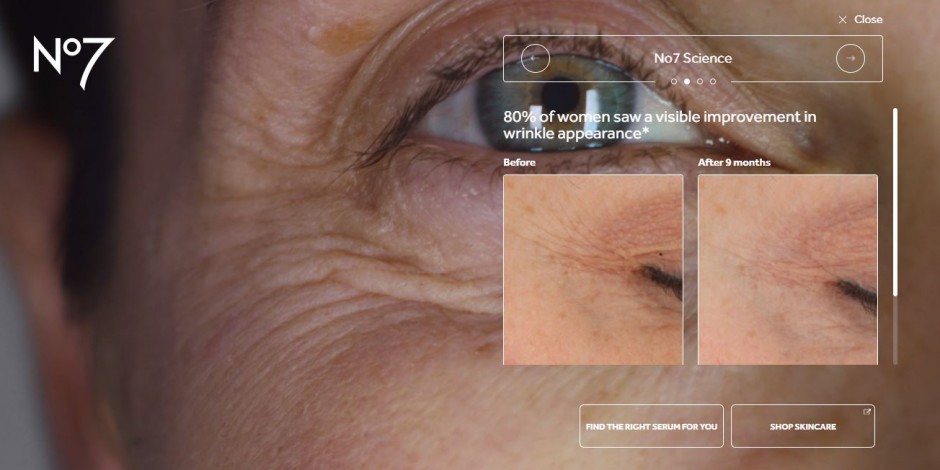
Advertising done right: The “problem” (wrinkles) and the solution (Wrinkle cream effectiveness) in very close proximity.

Many advertisements promoting the effectiveness of a product show both a product image (anti-wrinkle cream) and an image of the promised results (a face without wrinkles). Objectively, the distance between the two images should not affect how consumers judge the product’s quality.

This advertisement is done so well, the text about the product’s effectiveness is actually touching the face of the model.

In a series of studies, consumers were asked to judge the effectiveness of a variety of products promising specific results (acne cream, pain reliever, nasal allergy spray, bug spray, fabric softener). Consumers tended to assume a product was more effective when its image was placed closer to that of its promised effect. The proximity of the images was more influential when consumers were less knowledgeable about a product category or when the results were expected sooner rather than later.

Here we see there is some distance between the product (a razor that gives a perfect shave) and the outcome (Mourinho’s perfectly shaven face).

Companies should understand the subtle effect that spatial proximity between images has on consumer judgment of product effectiveness. When companies want to promote the immediate effects of their products, images of the product and its desired effect should be put closer to each other in an advertisement.

“The spatial proximity between visual representations of cause and effect in an advertisement can influence consumer judgments of product effectiveness. The closer the distance between an image of a product (an acne treatment) and that of its potential effect (a smooth face), the more effective consumers will judge the product to be,” the authors conclude.


Do you supply services to the Irish Media Industry? Have you listed your company in our Media Directory? It’s free! Everyone’s favourite price! Click here to do it now.

It’s all about the reviews, so make sure yours are good.

By MediaStreet Staff Writers

More than three quarters of travellers use review sites such as Yelp and Trip Advisor to conduct research prior to booking services.

This is according to a survey conducted by The GO Group, an international ground transportation provider.

Travel GIF by Evan Hilton - Find & Share on GIPHY

The respondents were asked about site usage for accommodations, activities, events and ground transportation.

When asked about use of sites for hotels and other accommodations, 13% of respondents said they always check sites; 31% said they do so frequently, 34% said sometimes and 22% said never.

Fifteen percent said they always check sites for reviews about tours and activities; 25% and 34% said they do so frequently and sometimes, respectively. The results for checking on attractions and venues were similar were about the same.

Fewer people use review sites for ground transportation. Only 10% percent said always they did so; 23% said frequently and 40% replied sometimes.

The survey also asked how many people post on review sites. Just three percent said they always posted on the sites, nine percent do so frequently; 40% post sometimes and 26 % responded they have never posted on a review site.

“In addition to or even in lieu of obtaining information and referrals from close friends and family, more people are opting to use content generated by strangers as a guide for booking travel experiences, says John McCarthy, president, GO Group. “As reliance on online review sites continues to grow, it behooves all of us in the travel-related industries industry to regularly review and respond to posts, and monitor them for potential customer services issues.”

Angry Always Sunny GIF by It's Always Sunny in Philadelphia - Find & Share on GIPHY

The GO Group LLC is the nation’s largest airport transportation provider, offering shared rides, private vehicles, sedans, charters and tours, serving some 90 airports in North America, Mexico, the Caribbean and Europe and transporting more than 13 million passengers per year.

This study shows just how much babysitting and care you need to put into your online reviews. Like you don’t already have enough to do!

Have you listed your company in our Media Directory? It’s free! Everyone’s favourite price! Click here to do it now.
Nearly 90% of retail marketers will increase marketing spend this year.

By MediaStreet Staff Writers

RetailMeNot has released result of a study showing how retail marketers will expand their content, use their marketing spend and what they are planning in 2018 to better engage and convert consumers.

This year, 9 in 10 retailers will increase marketing spend, and marketers will spread their increased budget almost evenly among marketing channels such as social, mobile, brand and display. This move reflects the need to ensure that every customer is receiving information in the channel of their choice. Interestingly, 93% of mid-sized retailers (between US$500 million and US$1 billion in annual revenue) are increasing their budget compared to 86% of large retailers (more than $1 billion in annual revenue) indicating an increase.

“Retail marketers are no longer thinking in channel silos. They are approaching commerce holistically with an understanding that consumers are channel-agnostic,” said Marissa Tarleton, CMO, RetailMeNot. “Delivering an experience that meets the consumer in the moment across the shopping journey will be the pathway to success for brands.”

Tackling New Trends and Challenges

While trends like virtual reality are still an exciting frontier, most retail marketers have their sights set on more realistic forward-looking trends. More than half of retail marketers surveyed believe improving mobile web checkout capabilities (52%) and offering exclusive promotions for mobile app users (51%) will positively affect sales growth in 2018. Additionally, voice-assisted shopping is an area that 39% of retail marketers plan to implement, with many retailers hoping to capitalise on increased use of smart home systems and smart speakers.

About 50% of retailers indicated they will use multi-touch attribution in order to better monitor the quality of traffic from their advertising investments. Further, retailers will become more bullish on advertising fraud as they look to ensure that their marketing is reaching the highest quality audience. More than 6 in 10 retail marketers (63%) will increase their direct media buying in 2018 in order to better monitor the quality of their traffic from advertising investments.

Holistic Approach to Increasing Sales

Retail marketers are wisely embracing mobile as a conduit for sales both on the phone and in physical retail stores. Based on our survey, retail marketers believe mobile is the key priority for positively affecting sales growth, and 72% will use mobile marketing to drive in-store sales. Further, 82% will rely on mobile marketing to drive in-app sales.

As marketers look to increase revenue in the coming year, their team structures and channel approaches will evolve to become more cross-functional. In fact, 50% of retail marketers say that their mobile marketing team falls under digital marketing within their organisation, up from 41% in 2016.

Finally, promotions continue to be top-of-mind for driving sales. Most retailers (76%) plan to increase the amount of promotions they are offering in 2018, and 86% will partner with websites and apps that focus on deals, cash back and loyalty programs.

“The convergence between physical and digital shopping will blend even further this year,” said Tarleton. “As retail shifts continue, delivering seamless shopping experiences—be it in-store or online—are critical to success.”

RetailMeNot is a savings destination connecting consumers with retailers, restaurants and brands, both online and in-store. The company enables consumers across the globe to find hundreds of thousands of offers to save money while they shop or dine out.


Have you listed your company in our Media Directory? It’s free! Everyone’s favourite price! Click here to do it now.


By

Abbie Oguntade, the vice-president of UK and Northern Europe for dating giant Match.com, has said brands already “respectful” in the way they handle consumer data shouldn’t be fazed by the impending General Data Protection Regulation (GDPR) laws.

Recent studies have suggested that as many as 60% of European businesses aren’t prepared for the legislation, which comes into force on 25 May. And where brands like Lloyds have overhauled their entire digital marketing strategies, Oguntade believes that data-driven businesses like Match won’t face much of an undertaking.

Though agreeing that there are likely to be “teething problems” as marketers grapple with how to incentivise consumers to share data without compromising user experiences, Oguntade said: “Companies have always had an obligation to protect consumers and to respect the use of their data,” adding that it was then only right that any changes required as a result of GDPR were implemented.

“If you’re a company that is respectful of that then it shouldn’t be too difficult to get around it,” continued Oguntade.

But there is evidence to the contrary. The hack of distinct affair-enabling app Ashley Maddison cost the company $11m in fines after the data of up to 37 million users was leaked.

In some cases, dating services (much like social networks) know more about consumers and their behaviour than users do themselves. These platforms have access to personal and potentially sensitive data, voluntarily offered up by users.

A recent investigation by The Guardian into how much data Match’s sister company Tinder holds on subscribers, illuminated the lack of user awareness around how this information is stored and used. The journalist who requested her dataset from the company as part of the report was sent back an 800-page opus containing everything from her Facebook likes and every single ‘match’ she’d scored on the service. A data scientist described the contents as “horrifying but not surprising.”

But the assurance of security is the lifeblood of dating and personals sites.

So, come May it’s likely that a spotlight will be shone on Match and its competitors to see exactly how they are handling GDPR, and responding to any related data requests.

Oguntade iterated that tenets of the directive like data protection and consent are already a highly important part of Match’s business. While she acknowledged that the dating giant is “hugely aware” of the implications of the EU rules, she was clear that this doesn’t mean it hasn’t committed significant resource to ensure it’s on the right side of the law come May.

“We have a hefty and experienced team, that have been working hard on it to make sure our policies and programmes will be compliant with the new standards,” she noted.

“While it’s something we’re ensuring we’re absolutely on point with, I have to be honest and say it’s not a huge undertaking because we have always taken the privacy stuff seriously and I genuinely mean that.

Match, part of the same group as OK Cupid and Plenty of Fish among other dating brands, is having its GDPR efforts spearheaded by its global privacy director Idriss Kechida, and has also enlisted the business leaders of each region to get involved in strategy meetings and to help implement plans.

This GDPR team includes a dedicated data privacy lawyer who works across Match’s global markets – including those outwith the EU who will also be affected by the directive.

In addition to this, Match has conducted interviews with any departments which “touch data” to ensure that there’s full awareness on the EU’s regulations and what they entail.

In Oguntade’s words, the company will be “ready to roll” by the time GDPR is implemented in the spring.

However, it’s clear that while it is prepared, the brand isn’t getting complacent in the face of fines for non-compliance. As per GDPR guidelines these could clock in at $20m (£18m) a pop or 4% of annual turnover; which for Match Group as a whole would be a $44m slice of the $1.1bn yearly revenues it recorded in 2016.

Feature Image: Recent studies have suggested that as many as 60% of European businesses are underprepared for GDPR

By

Sourced from THEDRUM

Social media preferences differ by generation, but most users spend their time consuming – not creating – content on social media apps.

More than half of millennials (53%) say they check Snapchat daily, which is three times more than Generation Xers (18%) and eight times more than baby boomers (7%), according to new data from The Manifest.

Baby boomers prefer Facebook over Snapchat, and they check Facebook more than millennials. More than 9 out of 10 of baby boomers (93%) open the Facebook app at least once a day, compared to 85% of millennials.

The findings indicate that preferences for certain social media apps differ by age group. However, Facebook’s overall dominance – with nearly 90% of all social media app users saying they check it at least once a day – demonstrates how Facebook made its platform appealing to a variety of users.

“Facebook invested considerable resources over the last 10 plus years in making an experience where everyone can find value in the platform,” said Josh Krakauer, founder and CEO of Sculpt, a social media marketing agency.

In contrast, Snapchat’s emphasis on short-lived content and the camera as a communication tool attracts younger users, and millennials in particular, who want a more personalised and unfiltered social media experience.

Snapchat appeals to younger generations who are used to getting the specific information they want, when they want it. Older social media app users may be more comfortable consuming content television-style, where what you see and when you see it is partially decided for you.

“As Facebook has catered to everyone in the world, Snapchat has doubled down as being a place that still feels raw, unfiltered and personal,” Krakauer said.

What Are Smartphone Users Doing on Social Media Apps?

While users spend a lot of time on social media apps, they don’t often publish content. The largest percentage of respondents (36%) say they most commonly use the “like” or “favourite” features on social media apps.

This finding correlates to the “90-9-1” rule of internet content, say experts. “[The rule] says that 90% of the time we just consume content, 9% of the time we interact with content, and only 1% of the time we actually share something,” said Sheana Ahlqvist, lead UX researcher at PhD Insights, a user research agency.

Simply liking or favouriting content on social media is a relatively seamless behaviour, requiring little motivation. The easier an online action is, the more likely a user is to complete it.

“The liking and favouriting is like saying ‘bless you,'” said Alex Levin, co-founder of L+R, a Brooklyn-based creative agency. “You can do it in an action that isn’t offensive.”

In addition to exploring app user behaviour, the survey helps businesses interested in building an app learn from the success of social media apps.


Have you listed your company in our Media Directory? It’s free! Everyone’s favourite price! Click here to do it now.


By

German based hotel price comparison site Trivago has a billion reasons for celebration after posting a healthy 37% rise in revenues to €1.04bn, equivalent to £920m.

The lodging portal has gone from strength to strength on the back of investment in technology and advertising, helping it to pair back losses from €51.4m last year to just €13m this year. When factors such as tax depreciation, amortization and earning before interest were taken into account the firm posted a profit of €6.7m – significantly below the €28.2m it took home in 2016.

Chief executive Rolf Schroemgens boasted: “At the end, it’s all about having the best product.

“The majority of our efforts were in setting the infrastructure for the product up in a way that we can cope with the requirements of the future.”

Trivago’s hunger for growth has seen it snap up machine learning startup Tripl and swamp London Underground with endless pictures of the ‘Trivago girl’ who followed commuters’ every move in a widely mocked campaign.

Feature Image: Trivago hits billion-euro revenue milestone on back of tech and advertising push

By

Sourced from THEDRUM

If you have a sales event coming up, like the end-of-season sales, then here are the tips you need to know.

By MediaStreet Staff Writers

The actual benefits of designing commercial strategies around events like America’s Black Friday or China’s Singles Day improve market platforms and strengthen the domestic economic market because it’s a great opportunity to encourage consumption and sales.

On Black Friday, for example, thousands of companies from different industries tag along with the commercial event and offer large discounts on their goods and services. However, competition is rife. An offer can lose its meaning when another company offers a better one, and what’s more, businesses must not only participate in Black Friday, but really know how to stand out and attract consumers.

So how do you as a marketer get your business to stand out?

Here are some tips from Adext. They deploy and optimise online advertising campaigns on Google, Facebook, Instagram and thousands of websites to increase the sales of SMEs that have limited resources for the activities.

1) Plan a strategy: It’s not enough to offer irresistible discounts on events like Black Friday… You need a promotion strategy with a clear action plan and execution dates. You must be clear on what discounts and incentives you’ll promote, how you’re going to put them across, the digital platforms you’ll use, who you’ll target, when and why. The what, how, where, when and why questions are key to developing any action plan. Come up with answers to them while always keeping the goal you want to achieve in mind. In this case, it’s sales.

2) Research your competition and make sure to offer something really attractive: You could offer a 10% discount, but if your main competitor offers 25%… You can imagine the outcome. If you want to take the lead, look at what they’re doing and ask yourself how you can beat their discount and/or add more value (without affecting your profit margins). You could give your prospects something of value like a gift for their loyalty, or an extra incentive for them to buy more. Also, don’t forget to let your imagination roam and build your offer or promotion around a creative concept.

3) Build Anticipation: Teaser campaigns are wonderful for building your target audience’s curiosity. Don’t reveal your discounts, offers or incentives too soon… Let your prospects discover what they are as anticipation builds. They should be interested and intrigued to find out what you’ll offer them on your sales event day. There are several examples of clever, catchy strategies where they invite their prospects to go to Snapchat to discover what the 10 star products reduced to €10 are.

4) Send your prospects emails: You can send a few emails before the big sales day (to build anticipation), and other reminders before the day arrives.

Here are three tips to make your email marketing campaign a success:

  • Make sure to add an attention-grabbing title or subject line to your email. An email subject line you see all the time, like “Check out our discounts!” will go unnoticed. But if you can entice the reader with something like “I don’t want to freak you out, but you’ll regret it if you don’t take advantage of this” will definitely pique their curiosity and make your open rates go up.
  • Once they open your email, there must be something of interest for them to look at and read… The body of the email must be pleasant to look at, and easy to read and scan. Use short paragraphs, bold letters, headlines, subtitles, vignettes, images, and of course: good copywriting.
  • Add a CTA (Call-To-Action), where you specify what you want the reader to do once they’ve read your email. For example, you might write: “Our discounted products will be available in store until we’re out of stock. We’ll be ready to serve you when you arrive” or “Buy your Christmas gifts NOW and make sure you don’t get burned in January”. This action-oriented copy should stand out on the page. And if you have an online store, add a link to it.

5) Take advantage of the power of social networks: There is no doubt that you need to be where consumers spend most of their time. Where’s that? In this digital world, it’s on social media. Join the conversation and interact with your audience. Include the most relevant hashtags (e.g. #Black Friday or #SinglesDay or #Summersales) on your posts, so that prospects looking for discounts and deals can easily find you.

6) Let digital advertising bring you the clients you need: Digital advertising no longer has to be complicated. And it can give you the results you’re hoping for. Adext is the first Artificial Intelligence platform in the digital advertising space that can automate the entire process of creating, managing and optimising your ad campaigns on Google, Facebook and Instagram.

Have you listed your company in our Media Directory? It’s free! Everyone’s favourite price! Click here to do it now.

The new study highlights that the huge economic impact is just “tip of the iceberg” with independent creators.

By MediaStreet Staff Writers

So here it is, another study from the USA about the power of the new economy. While it doesn’t feature what Europeans are doing, we can use the information to see just how fast the new creative economy is moving. Put it this way: that horse has bolted.

The new report released by the Re:Create Coalition finds that 14.8 million independent, American creators earned a baseline of almost $6 billion from posting their music, videos, art, crafts and other works online in 2016. The research is only a snapshot of the entire New Creative Economy, analysing just some of the biggest online platforms: Amazon Publishing, eBay, Etsy, Instagram, Shapeways, Tumblr, Twitch, WordPress and YouTube.

Despite the study being conducted in the USA, YouTube’s top earner is British. Daniel Middleton (DanTDM) brought in $16.5 million in 2017 alone. 26-year-old Dan, otherwise known as TheDiamondMinecart, posts daily reviews and gameplay videos plus some other silliness that kids love.

“Before the internet, a creator was forced to rely on traditional gatekeepers like movie studios and the recording industry to be successful. Today, anyone with a creative idea and a wifi signal can be successful and make money on the internet, reaching millions of people around the globe almost instantly,” said Re:Create Executive Director Joshua Lamel. “This analysis is just the tip of the iceberg when it comes to understanding the full economic impact of the New Creative Economy. However, its findings demonstrate that millions of Americans rely on the balanced copyright policies that support internet platforms like YouTube, Instagram and Etsy in order to earn billions of dollars from their creative work.”

Selena Gomez is the number one person on Instagram, with close to 70 million followers, more than any other celebrity.

Said study author Dr. Robert Shapiro, “The development of this multi-million user network and multi-billion dollar ecosystem for independent new creators reflects the power of the internet. Even with these highly conservative estimates, this study demonstrates the economic power of the new creative economy and its enormous potential for continued growth.”

For each platform, only a single component of how users can earn income was studied, due to limited public data and insufficient information. Independent creators earn billions of dollars each year online through website ads, sponsorship/influencer compensation, social media traffic, direct sales and other methods, but this study analysed only one revenue-sharing model per platform.

For the full report is here.


Have you listed your company in our Media Directory? It’s free! Everyone’s favourite price! Click here to do it now.


If you are marketing anything in the tourism game, this is what you need to know.

By MediaStreet Staff Writers

For those that are lucky enough to get away on holiday or go on an extended travel stint, we can predict what actvities you might be doing after a new study has been published by Hotels.com

The company have used a data-crunching bot to track what people are hashtagging the most on their sojourns. More than five million brags globally were analysed using a combination of Tweet data, Instagram posts and travel keywords and destinations mentioned on other social media. So here are the results.

Worldwide travellers are all about the culture: they enjoy musing around museums (300,000 brags), old-town charm (170,000 brags) and a spot of sunshine (130,000 brags), but they can also be found in floating restaurants, erotic museums and night markets.

TOP 10 GLOBAL THEMES

  1. Museum
  2. Rooftop bar
  3. Old Town
  4. Modern Art
  5. Opera
  6. Sunshine
  7. Olympic Games
  8. Cathedral
  9. Gallery
  10. Ballet

This travel bragging trend echoes the findings from the recent Hotels.com Mobile Travel Tracker report, which revealed that one in six travellers search social media before their trip to plan the photos they’ll take. And 56% of people surveyed admit to spending more than an hour a day on their smartphones while on holiday.

While travellers naturally brag about taking in the tourist hotspots and cultural offerings, more people than ever are sharing foodie ‘grams, shopping stories and luxe posts.

#Foodporn
You’re never more than an Insta-scroll away from #FoodPorn and the brag lists are brimming with culinary treats. Cakes in Stockholm and curry in Toronto spice up the brag lists, and New York steak and pizza both made the cut. Perhaps more surprisingly, enchiladas proved twice as popular as modern art in Mexico City, ice cream scooped 10% of all San Francisco brags and Jumbo Kingdom floating restaurant in Hong Kong took second place in the Hong Kong chart with more than 20,000 brags.

Shop ’til you drop
Shopping is a must-do for most travellers. Those visiting Paris brag more about the Rue Vieille du Temple, famous for its boutiques, than Le Louvre! Other top shop-spots included Bal Harbour in Miami, the Harbour City mall in Hong Kong, vintage shops in Melbourne and the stylish Cecile Copenhagen fashion brand made the Danish capital’s top 10.

Five-star luxury
When travellers check into a posh, luxury hotel they naturally want the world to know. The stunning 5-star Ritz Carlton in San Francisco topped the city’s brag list, the Four Seasons in Singapore proved brag-worthy and the Park Hyatt came in at number one in Seoul – most likely for its awe-inspiring rooftop pool.

Scott Ludwig at Hotels.com said, “Bragging about your travel experiences on social media has become the norm – if you didn’t get social kudos out of it, it didn’t happen!”

Have you listed your company in our Media Directory? It’s free! Everyone’s favourite price! Click here to do it now.

Sourced from TechGenYZ

Running a successful business and making and maintaining its place in the market is a really difficult task to perform. Some people are such skilled that they perform this task with ease and without any assistance but those who do not possess such skill happens to create that skill in them by adopting and learning about the basic principles of marketing and learning about the applicable and effective strategies which can help a businessman to run a successful business.

There is a whole wide range of stuff in the market which is sold or bought through different kinds of businesses. The most basic problem which we face is that many of the things in the market are not authentic or even overpriced at some place but now we have a perfect solution for this problem. Now you can have all the information you need to know about the latest gizmos and stuff in the market by simply checking out AmaTop10. They have all the information about the latest products on the market. In this article, we will provide you all the important information about the best and most important four principles of marketing strategies you should know about because these principles play a key role in making and maintaining a successful business.

We will provide you all the essential points and the techniques in which these principles of marketing strategies are used to increase the chances of success of your business. We will also tell you the working of these principles and result of them when you apply them in your business. We will enlist all these four best principles of marketing strategies so that you can easily know them and follow them to run a successful business. So here are the top used principles of marketing strategies which can help you to be a successful businessman and take your company to the next level.

Define the Goals:

The first and foremost principle of designing amazing marketing strategies is to define a goal or set a milestone of the plans where you want to take your business in the market. When the goals are set and defined, executing them and finding resources for them becomes a lot easier. In this brutal market where no progress is a dead end for the business and when you define your goals, it helps you to be more progressive in the market and maintain a stable position among the best businesses in the market.

Marketing communication:

This is the second thing which you need to ponder in marketing strategies. It is also the most important strategy because even if you have the best stuff but if the people will not know about it then you will never be able to sell anything, not even your products or your services. Different marketing strategies are adopted to target accurate consumers for your product to increase the progress of your business.

Think Before Investing:

You should always learn and gather information about the things on which you are investing and learn about all the advantages and disadvantages of the products or places in which you are investing your money. Investment is not easy to come, you should take every precaution to make it safe.

Differentiation:

The fourth principle of business marketing is that you have to be different and better than all your competitors so that the consumers should get more attractive towards your products and the services you are providing.

Business is nothing without strategies a good and successfully running business is a mixed combination of tireless work and trustable and organized business strategies. So these are some of the best and top four principles of marketing strategies which you should know in order to start a successful business.

I am sure you will love this article because it contains all of the useful and essential content which provides the top four principles of marketing strategies which are really necessary for taking your business to the new level. I hope this article will clear all the doubts which were present in your mind before reading this article because of the useful and authentic information in it but if there is still something left unclear then there is no need to worry about because you can ask us anything you deem necessary to know.

Sourced from TechGenYZ