Tag

SEO

Browsing
By Michelle Hawley
Stay up-to-date on the latest in search engine optimization. Learn about SEO strategies, best practices and the latest updates to Google’s ranking factors.

The Gist

  • SEO best practices still matter. To show up in search engine results pages (SERPs), following search engine optimization (SEO) best practices is necessary.
  • Still Google’s world. Google dominates the global search engine market with 84% market share, making it crucial to consider in an SEO strategy.  
  • High-quality content. On-page SEO involves optimizing visible elements such as content, which should be relevant and high-quality, with expertise, authoritativeness and trustworthiness (E-A-T) guidelines in mind.

When someone wants to search for a product, look at videos or read about a topic, they go directly to their preferred search engine. And if you want to show up in said search engine results pages (SERPs), you’ll need to follow search engine optimization (SEO) best practices.

As we delve into best practices as of February 2023, our primary focus will be on Google. Why? Because it has dominated the global search engine market since its inception in 1997.

As of December 2022, Google held 84% of the search engine market — with runner-up Bing claiming nearly 9%.


The necessity of considering Google in an SEO strategy, whether for a single blog post or entire website.


Google doesn’t share its search volume data. But experts around the web estimate the search engine sees anywhere from 40,000 to 99,000 search queries every second. For one day, that could amount to more than 8.5 billion searches.

SEO, which companies use to maximize content marketing efforts, ultimately breaks down into three categories:

  • On-page SEO
  • Off-page SEO
  • Technical SEO

Let’s take a look at some core components of these three categories and how SEO professionals can aim to follow best practices.

On-Page SEO

On-page SEO, also called on-site SEO, refers to the optimization of elements that you can see on-page, such as:

Content

Content is at the core of on-page SEO, and it’s what many people focus on when first optimizing their SEO strategy.

Relevance and quality are more important than any other Google ranking factor.

Google actively penalizes thin content that offers little to no value to searchers. While in the past it used to consider pages as a whole, it now looks at and ranks subsections within pages to match queries.

When you’re working on your content creation strategy or overall SEO strategy, consider these questions to determine if you’re headed in the right direction:

  • Do you have a target audience in mind that will find your content useful if they come directly to you?
  • Does your content demonstrate expertise that comes from firsthand experience?
  • After reading your content, will someone feel they’ve learned enough about the topic?

If you’ve answered yes to these three questions, you’re on the right track.

Some content worst practices to stay away from include:

  • Creating content specifically to attract people from search engines
  • Utilizing extensive automation to produce lots of content on a variety of topics
  • Summarizing what other content creators have said without adding additional value
  • Writing to meet a particular word count or because you’ve heard Google’s algorithm prefers a specific word count (it doesn’t)
  • Creating content that promises to answer a question that has no answer (for example, suggesting you know the release date of a movie that has no confirmed release date)

E-A-T Guidelines

E-A-T stands for Expertise, Authoritativeness and Trustworthiness. This concept became a core part of Google’s algorithm in August of 2019 and continues to play a significant role today in evaluating content.

In Google’s Search Quality Evaluator Guidelines, E-A-T specifically refers to:

  • The expertise of the creator of the main content
  • The authoritativeness of the creator of the main content, the main content itself and the website
  • The trustworthiness of the creator of the main content, the main content itself and the website

E-A-T plays a part in websites of all types, including gossip columns, satire websites, forums and Q&A pages. How a website meets E-A-T guidelines will depend on the type of website. Some topics or industries will require less formal expertise than others.

For example, a news website with high E-A-T articles will convey journalistic integrity, contain factually accurate information and utilize robust policies and review processes with included sources.

A site containing scientific topics, on the other hand, should be created by people or organizations with the appropriate scientific knowledge or expertise and represent established scientific consensus.

When it comes to establishing E-A-T for your content, think about the page’s topic and what expertise is needed to achieve the purpose of that page.

Search Queries

Search queries are the words and phrases people use when using search engines or smart assistants. These words and phrases shift based on the search intent — the “why” behind the action.

Types of search intent include:

  • Informational: The searcher is looking for information, wants to answer a question or learn how to do something. The best way to target an information query is to develop high-quality, SEO-focused content that provides helpful and relevant information to the user. Position yourself as a source of information people can trust.
  • Navigational: The searcher is looking for a particular website or page. For example, they might type “YouTube” or “LinkedIn.” You can’t typically target navigational queries unless you own the specific website or page the person is looking for. But you can make sure you claim the top results spot for your brand’s own navigational query.
  • Transactional: With this search intent, the user wants to make a purchase. The query might include a brand, product or service name or a generic item, such as “coffee maker.” You can target these search queries with optimized product or service pages. You can also use pay-per-click (PPC) campaigns to target these search terms.

By understanding search intent — which might include keyword research to best understand which words the target audience uses — companies can better craft content to meet needs and win more readers.

Links

You should include two types of links within your website or web page content: internal and external.

Internal links redirect to another page or piece of content on your website. For example, on an article about the latest chatbot trends, you might link to a related article about how chatbot technology works.

External links direct readers to a page that is not yours. These links should be highly relevant webpages or sites with high expertise, authoritativeness and trustworthiness (E-A-T).

Link building is also important — getting other websites to link back to your website or piece of content. These links signal to Google that your website is valuable enough to earn a citation, allowing content to rise in search rankings. We’ll talk more on these later, in off-page SEO strategies.

Visuals

Visuals (videos, gifs, pictures, infographics, etc.) are a large part of online content.

If you plan to use visuals on your site or pages, you’ll want to ensure that they’re:

  • Large and high quality (beware of large image file sizes, however, which can cause slow loading)
  • Relevant to the content
  • Shareable
  • Placed high on the page
  • Have a relevant file name
  • Have alt text, which aids visually impaired users

If you’re using video content, include a video transcript. Not only will a transcript make your content more accessible, but it will also make videos more “scrapable” by search engine bots.

Meta Title & Meta Description

Your meta title (the alternative title that shows up on Google) tells search engines and searchers what your content is about and what keywords to focus on. This title should be relevant to your content, include at least one word or phrase from your keyword research and be no longer than 60 characters.

Search engines don’t factor meta descriptions into your ranking — but that doesn’t mean you should ignore it.

The meta description is the ideal place to let Google and searchers know what your page is about. As a result, you’ll see higher click-through rates.

URL & Slug

Including your keyword within the slug of the URL — the last part of the URL that identifies the unique page — is a small bonus to SEO. However, if you can’t do so in a sensible way, it won’t be a big hit against you.

Ensure that your slug matches the title of your content. For example, if your blog post is about customer experience, your URL might be: www.yourwebsite.com/blog/all-about-customer-experience

Another thing to keep in mind is that shorter URLs receive high click-through rates than longer ones. A shorter URL comes across as more trustworthy and authoritative to users.

Other best practices for URLs include:

  • Avoid using dates in your slugs (for example: “2022-customer-experience-best-practices”
  • Use the hyphen between words in your slugs

Off-Page SEO

Off-page SEO refers to optimization strategies that don’t involve the content on your website. Some of the most vital off-page SEO tactics include:

Link Building

As mentioned above, earning backlinks from other authoritative sites can position your website or web page as trustworthy and increase your rankings on Google.

You don’t want to get backlinks from any site. In fact, getting backlinks from link farms — a group of websites that all link to one another to increase organic search rankings — can result in a penalty from Google. Google also penalizes any site that gets caught paying for links.

Some link-building tips to turn to instead include:

  • Create high-value content that others want to share
  • Promote your content via social media, which leads others to sharing it
  • Submit your website to business directories
  • Promote your content via paid campaigns, which may lead others to link to it
  • Look for relevant content on other sites that contains broken links, and send an email with the suggestion to use your content as a replacement
  • Ask people in real life to share your website or content on social media

Brand Building

Google rewards well-known brands. And branded searches (your company’s name, domain name searches and product searches) will lead right back to your website.

Google offers a great tool, Google Trends, that allows people to track interest in a topic, such as a brand, over time. SEO professionals can also use this tool to track searches for specific products or services.

Social Media

Social media plays a big role in how people learn about brands, websites and content. As of 2022, there were 4.59 billion social media users worldwide — a number expected to grow to 5.85 billion by 2027.


Social media usage and its role in the SEO world.


You should have a presence on the social media channels that matter most to your target audience.

Some of the most popular social media platforms, as of 2022, include:

  • Facebook: More than 2.9 billion monthly active users (MAU)
  • YouTube: More than 2.5 billion MAU
  • Instagram: More than 1.4 billion MAU

Not only should your profile include pertinent information about your brand (what it does, where it’s located, contact methods, the website, hours for in-store operation, etc.), but you should also post original and engaging content regularly.

For instance, if you offer a specific product, you could create educational content on how to use that product or answers to frequently asked questions. You can also encourage user-generated content from your community.

Encourage users that read and engage with your social media content to visit your website or web content to learn more.

Technical SEO

Technical SEO is exactly what it sounds like — it refers to the technical aspects that play into your website and web pages, like page load speed and responsiveness.

Google Search Console is an ideal tool for monitoring and maintaining SEO health. It can measure traffic, generate reports, including a technical SEO report, and fix issues.

Technical SEO includes:

Site Speed

Loading performance is part of Google’s Core Web Vitals, which measures different aspects of the user experience. A website or page should only take 2.5 seconds or less to load the page’s main content.

To ensure fast website load speeds, you should:

  • Choose a fast hosting option
  • Choose a fast domain name system (DNS) provider
  • Keep the use of scripts and plugins to a minimum
  • Use small image files (without creating pixelization)
  • Minify your site’s code
  • Compress your webpages

Mobile-Friendliness

As of the second half of 2022, mobile traffic accounted for more than half of global web traffic. Not only does a mobile-friendly design make for a better user experience, but it’s a significant ranking factor for Google.

If you’re unsure of your website’s mobile accessibility, you can use Google’s Mobile-Friendly Test.

Most brands accomplish mobile-friendliness by using a responsive web design, which adjusts itself automatically depending on the type of device a person is using.

Google also offers a guide on customizing website software for companies that use content management platforms (CMS) like WordPress, Joomla or Squarespace.

Beyond using a responsive design, companies should also pay attention to how content and assets behave on-page for mobile users. Layouts that shift when a person is trying to read content or interact with the page are a significant part of Google’s Core Web Vitals.

SEO professionals can monitor these movements with a metric called cumulative layout shift (CLS), which measures visual stability and quantifies how often these shifts occur. Core Web Vitals recommends that pages maintain a CLS of 0.1 or less.

XML Sitemaps

An XML sitemap helps search engines understand your web pages while crawling them. It tells them:

  • Exactly where each page is
  • When a page was last modified
  • Which pages hold the most priority
  • How frequently a page is updated

Some hosting platforms create an XML sitemap automatically. If your chosen platform does not, you’ll want to look into using an XML sitemap generator.

Site Indexing

Google Search Console allows you to submit your website’s XML sitemap for site indexing. (Bing also has a version of this tool called Bing Webmaster Tools.)

These tools also track the general SEO performance of your site, allowing you to:

  • Test your site’s mobile-friendliness
  • Access search analytics
  • View backlinks to your site

Search in 2023: SEO Strategy Remains Top Priority

People want content that is high-quality and relevant to them. If you want to appear in their search results, it’s essential to pay attention to changing SEO trends and tactics.

Google continually updates its algorithm, meaning how they rank your site or content will depend on your use of the latest SEO strategies. With the latest tips above, you can ensure your content meets essential Google ranking factors and shows up in search results for your target audience.

By Michelle Hawley

Michelle Hawley is an experienced journalist who specializes in reporting on the impact of technology on society. As a senior editor at Simpler Media Group and a reporter for CMSWire and Reworked, she provides in-depth coverage of a range of important topics including employee experience, leadership, customer experience, marketing and more. With an MFA in creative writing and background in inbound marketing, she offers unique insights on the topics of leadership, customer experience, marketing and employee experience. Michelle previously contributed to publications like The Press Enterprise and The Ladders. She currently resides in Pennsylvania with her two dogs.

Sourced from CMSWIRE

Sourced from TechMagPK

Do you know The Latest Top 3 Types Of SEO in 2023? Let’s look at three different forms of SEO services. SEO stands for Search Engine Optimization, and its main goal is to improve the number of visitors to your website by raising its ranking on Google SERPs for relevant keywords or phrases connected to your domain.

Businesses that provide SEO services are extremely important in today’s digital world. They provide an essential service in assisting businesses in remaining competitive and visible on the internet. SEO (Search Engine Optimization) is an important technique for businesses to use in order to reach their target audience and acquire new consumers. In this article, we’ll look at what SEO services are and the numerous sorts available. Everything you need to know will be covered in depth so that you have a thorough understanding of the services provided. What Exactly Are SEO Services?

SEO services assist businesses in increasing their online presence and driving more organic web traffic via search engines. SEO is an efficient approach for increasing website visibility in search engine results pages (SERPs). Google is the most popular search engine, thus it is essential to any SEO plan.

Types of SEO Services

Understanding the many forms of SEO services is critical for any organization that wants to grow in the internet realm. Ignoring this could result in missed chances. On-page optimization, off-page optimization, and technical SEO are the three types of SEO services. Each category provides a distinct set of approaches and ideas to aid in increasing your website’s visibility in search engine results pages (SERPs). Understanding the various sorts of SEO services allows you to know what questions to ask an SEO service provider to ensure they are delivering the greatest results for your company.

On-page SEO services

The Latest Top 3 Types Of SEO in 2023

On-page SEO refers to the changes that businesses can make to their websites to boost their search engine exposure. Some of the most significant on-page SEO variables are as follows:

Title tags

Title tags are HTML components that define a web page’s title. They are visible in search engine results pages (SERPs) and are an important aspect of on-page SEO. Companies should make certain that their title tags adequately represent the content of their web pages and include important keywords.

Meta descriptions

Meta descriptions are HTML elements that provide a concise summary of the content of a web page. They appear in the SERPs as well and can impact whether or not consumers click through to a website. Companies must make certain that their meta descriptions adequately explain their web pages and include important keywords.

Header tags

Header tags (H1, H2, H3, etc.) are HTML elements that define a web page’s headings and subheadings. They aid in the organization of a web page’s content and make it easier to read. Companies should make certain that their header tags appropriately represent the content of their web pages and include important keywords.

URL structure

The organization of URLs on a website is referred to as URL structure. Companies should make their URLs short, descriptive, and include relevant keywords.

Keyword optimization

Keyword optimization is the practice of identifying and incorporating relevant keywords into the content of a website. Companies should ensure that their content includes relevant keywords that represent their products or services appropriately. Services for off-page SEO

What is Off-Page SEO?

The Latest Top 3 Types Of SEO in 2023

Off-page SEO refers to all of the operations you perform away from your website in order to boost your search engine rankings and online presence. It entails improving your brand’s online reputation, constructing backlinks to your website, and advertising your content across multiple channels.

Off-page SEO is crucial for any website since search engines utilise it to determine the authority, reliability, and popularity of the site. The more websites that connect to your site, the more valuable your material is considered to be, and the higher your website will rank in search engine results pages (SERPs).

The Benefits of Off-Page SEO

Off-page SEO provides various benefits that might assist your website in growing and succeeding online, including:

1. Increased Website Visibility

Off-page SEO aids in the discovery of your website by more people seeking for the products or services you provide. When you create connections to your website, you make it easier for search engines to crawl and index your content, which can boost your search engine rankings and organic traffic.

2. Improved Brand Authority

Off-page SEO can help you develop your brand as an industry authority. When other websites connect to yours, search engines understand that your material is relevant, valuable, and trustworthy. This can assist you in improving your brand’s reputation and credibility, as well as attracting more clients to your website.

3. Increased Referral Traffic

Off-page SEO can bring referral traffic from other websites and social media platforms to your site. When you generate high-quality content and distribute it across several channels, you enhance the likelihood of people clicking on your links and visiting your website.

Off-Page SEO Strategies and Techniques

Here are some of the most efficient off-page SEO strategies and techniques for increasing your website’s internet visibility:

1. Link Building

The practise of obtaining backlinks to your website from other websites is known as link building. Backlinks are an important ranking factor for search engines since they indicate that other websites think your content is significant enough to link to. You can create backlinks by doing the following:

  • Guest post on other websites, with a link back to your website in your author bio or article.
  • Ask other websites whether they would be interested in connecting to your content.
  • Generate shareable, high-quality content that other websites will want to link to.

2. Social Media Marketing

Social media marketing entails advertising your brand and content on sites such as Facebook, Twitter, LinkedIn, and Instagram. Social networking can assist you in the following ways:

  • Raise brand awareness and reach a larger audience.
  • Interact with your audience and create a community around your brand.
  • Attract traffic to your website with social media posts and advertisements.
3. Influencer Marketing

Collaboration with influencers or industry leaders who have a huge following and authority in your sector is what influencer marketing entails. Influencers can assist you in the following ways:

  • Increase your brand’s exposure by reaching a larger audience.
  • Develop trust and credibility with your intended audience.
  • Increase the number of backlinks and social shares for your article.
  • Technical SEO services

What is Technical SEO?

The Latest Top 3 Types Of SEO in 2023

The process of optimising a website for search engines from a technical standpoint is referred to as technical SEO. This includes ensuring that search engine crawlers can quickly crawl and index your website, as well as optimizing it for speed, mobile friendliness, and user experience.

Technical SEO duties include optimizing website structure and navigation, assuring correct header tag use, adopting schema markup, increasing page speed, and optimizing for mobile devices.

The Importance of Technical SEO

Technical SEO is just as vital as on-page and off-page SEO in any SEO plan. Technical SEO, in fact, serves as the foundation for both on-page and off-page SEO.

If your website is not optimized for technical SEO, it might have a negative impact on its ranking in search engines. Websites that are easy to crawl and index, as well as those that give a great user experience, are favoured by search engines such as Google. Technical SEO ensures that your website fits these standards, which can result in higher ranks and more organic visitors.

Technical SEO Best Practices

When it comes to technical SEO, there are various best practices that organizations should follow. Some examples are:

  • Developing a logical and transparent website structure
  • Organizing material with header tags (H1, H2, H3)
  • Image and video optimization for faster page loading
  • Using schema markup to assist search engines
  • comprehend the information on your website
  • Ensure that your website is mobile and responsive.
  • Making certain that your website is safe (HTTPS)
  • Monitoring and correcting any broken links or inaccuracies on your website on a regular basis

Technical SEO Services

It can be overwhelming to try to optimize your website on your own if you are unfamiliar with technical SEO. This is where technical SEO services may help. These services are intended to assist businesses in optimizing their websites for technical SEO and increasing search engine rankings.

In conclusion

Finally, in today’s digital age, having a decent SEO plan is critical for the success of any organization. An SEO agency may assist you with a variety of services that will improve your online exposure and presence. Partnering with a professional SEO service will give you with several benefits that you can employ right away. They can assist you get the most out of all of their services, from optimizing your website to enhancing keyword rankings.

Sourced from TechMagPK

By Adrien Levinger

Launching a website for your business can be a mountainous undertaking. There are so many factors to consider to build a website that will serve your business, from content to SEO and, of course, making sure it all works together.

After you’ve done all that work, the last thing you want is to have to go back and fix what didn’t get done right the first time. So I have compiled a list of things you should absolutely take care of before your website goes live to save yourself headaches in the future.

1. Choose the right content management system. Will your website be more content oriented or e-commerce oriented? Will you build it yourself or leverage an agency? What traffic and volume are you expecting in the first year? Your answers will determine which CMS is best suited for your website framework. Choosing the right CMS in the beginning will save you endless frustration and even a complete rebuild of your website later.

The difference between a content-oriented and an e-commerce-oriented CMS is as stark as buying a dump truck versus a race car: They’re just made to do different things. A content-oriented CMS makes it easy to add and manage content, while an e-commerce-oriented CMS makes it easy to add new products, make sales and track inventory. Decide the ultimate purpose of your website before you start building, and you’ll set yourself up for ease of use later.

2. Activate Google Analytics 4. Google Analytics 4 is the latest version of Google Analytics. It is taking the place of the current Universal Analytics, which will sunset in July 2023. Any data collected by Universal Analytics will not transfer into GA4, so if you’re launching a new website, go ahead and install GA4. This way, you start gathering user data as soon as your website goes live, and you won’t have to deal with making the switch later.

3. Optimize for search engines. SEO is what drives users to your website when they’re searching on the web. But that doesn’t happen by accident. Implementing a solid SEO strategy from the beginning will help Google understand what you offer and send users to your website when they search for a certain word or phrase.

If you’ve got the budget for it, hiring an SEO expert to optimize your website can save you an immense amount of time and deliver faster results. But if hiring an expert isn’t in your budget, you can learn to do SEO yourself with proper study. There are lots of online courses that can help.

4. Make sure everything is properly organized from the beginning. In the rush to get your website live, you may be tempted to get something up as fast as possible and tweak it later, but this is a strategy for future pain. So many things about websites are very difficult to fix later, and you’ll save time and stress by doing it right rather than doing it twice.

Some things you’ll want to pay special attention to because they are difficult to fix later include:

  • Naming your images correctly for SEO and ADA compliance. Correctly named images are key to both SEO and ADA compliance. It is a time-consuming headache to go back through your site and rename every image after your site has launched. Instead, name your image files correctly when you save them, and input the correct alt text as soon as you add them to your website.
  • Input meta descriptions and titles correctly the first time. These are not necessarily visible on the front end, so it’s easy to forget until you’re served with an ADA compliance lawsuit.
  • Create organized SKU numbers. Don’t wait until you have 1,000 products to realize you need SKUs that identify release date, colour, manufacturer and other identifying information you will need later for tracking, inventory and management. Create a naming convention that helps you identify and sort items from your very first product.

5. Make sure your website is ADA compliant. Did you know that your website is required to be ADA compliant just like a brick-and-mortar business? Making sure your website is ADA compliant from the start is a good way to avoid learning an expensive lesson when you’re served with an ADA compliance lawsuit.

The ADA’s web content accessibility guidelines require your website to contain features that allow people with visual, mobility and neurological impairments to use it at an optimal level. These features can include:

  • Keyboard navigation for those with mobility issues who may have trouble moving a mouse
  • Appropriate text contrast so visually impaired people can easily read your website content
  • Descriptive alt text on images so a screen reader can describe images to a visually impaired user

Many other features are required for your website to be considered ADA compliant. You can find out more on the Americans with Disabilities Act website.

A Little Extra Work Now Will Save You Stress Later

It’s easy to think that you’ll have more time or money to work on your website later. The problem is, “later” never seems to come. When you set your website up right the first time, you can avoid a future of frustration and set yourself up for website success right out of the gate.

Feature Image Credit: getty

By Adrien Levinger

Founder and CEO of FAV Solution, Adrien Levinger is an eCommerce expert with more than a decade of experience scaling brands online. Read Adrien Levinger’s full executive profile here.

Sourced from Forbes

By Erik Emanuelli

If you want your website to rank higher in Google, you need to start paying attention to your SEO copywriting.

In this blog post, we will discuss ten tips that will help you build content that ranks better in search engines.

By following these tips, you can skyrocket your site’s traffic and improve your business’s bottom line.

Contents:

  • Use Bucket Brigades
  • Focus on Search Intent
  • Include Related LSI Keywords
  • Leverage Topical Authority
  • Create Rich Media
  • Use the AMSR Formula
  • Optimize Meta Tags
  • Gather Industry Data
  • Answer the Audience’s Questions
  • Avoid Mistakes and Misspellings

Use Bucket Brigades

Bucket brigades are short sentences that grab the reader’s attention and encourage them to continue reading.

The bucket brigades usually consist of two or three words, such as “but wait,” “check this out,” or “here’s the bottom line.”

Also, questions like “have you wondered why?” can be used as bucket brigades.

By strategically placing these types of phrases throughout your SEO copywriting, you can keep your readers engaged and improve the time they spend on your pages.

Focus on Search Intent

When building new content, it is important to consider search intent. This means understanding what the user is looking for and how they want the information presented.

There are three different search intents:

  • Informational
  • Navigational
  • Transactional

Before starting writing, it is essential to find out which type of search intent the user has and structure the content accordingly.

For example, if someone searches for a product review, they’re probably looking for pros and cons as well as a detailed analysis of the product.

By understanding the user’s intent, you can tailor your copy to match what they’re searching for.

Include Related Keywords

Including related and long-tail keywords in your copywriting will help search engines better understand the context of your content.

Using related keywords also helps Google determine if a page is relevant to a given query.

For example, if someone searches for SEO tips, using related words such as “Search Engine Optimization” or “Google ranking” will signal that the page is relevant.

You can find these keywords by using tools like Google Keyword Planner or Ubersuggest.

Leverage Topical Authority

Topical authority refers to the relevance of a website in relation to a particular topic. SEO copywriting can be used to increase topical authority and improve rankings.

When creating content that is focused on a specific subject, you are more likely to rank better if you try to cover everything about that topic.

For example, if you write about medical subjects, you should show your expertise by creating content that will answer every user’s questions related to medical issues.

Create Rich Media

Using rich media such as images, videos, and infographics can help engage readers and improve the time they spend on your site.

The addition of multimedia elements helps search engines discover the purpose of the page and its relevance to certain queries.

Try using original media, such as custom images and videos, to make your copy stand out from the competition.

There are tons of free image creation tools online to help you create custom visuals with ease, such as Canva and Adobe Spark.

Using the AMSR Formula

The Attention-Motive-Solution-Result (AMSR) formula helps copywriters create compelling content that is optimized for search engines.

It consists of four steps:

  • Attention: Grab the reader’s attention with an engaging headline or opening sentence
  • Motive: Explain why they should care
  • Solution: Provide them with a solution to their problem
  • Result: Show them the result of using your product or service

Optimize Meta Tags

Meta tags provide search engines with information about a web page, including its title, description, and keywords.

By optimizing meta tags, you can ensure that your content appears in search results for relevant queries, thus improving SEO rankings.

To increase the chance users click on your title in SERPs, use these tips:

  • Keep your titles concise – a maximum of 65 characters
  • Include the focus keyword
  • Make it descriptive and enticing
  • Write something catchy

Gather Industry Data

Adding industry data such as statistics and metrics to your copies can help users better understand your content.

This can also improve rankings by signalling to search engines that the page is relevant to certain topics or queries.

You can use surveys such as JotForm or Google Forms to collect industry data and incorporate it into SEO copywriting.

Answer the Audience’s Questions

Providing answers to the audience’s questions through copywriting is another way to improve rankings.

You can find these questions by using tools such as AnswerThePublic or Ubersuggest.

Or focusing on the “People Also Ask” section in Google SERPs.

By writing compelling and informative content, you can provide readers with the valuable information they are looking for.

Avoid Mistakes and Misspellings

Poorly written copies, including typos and misspellings, can harm your rankings as it signals a lack of quality control.

To ensure SEO success, always double-check your work for mistakes before publishing it online.

Use free tools such as Grammarly or SEO Spellchecker to identify errors and correct them quickly.

Final Words

With these ten copywriting tips, you can skyrocket your Google rankings and improve your marketing results.

By optimizing content for search intent, using related keywords, creating rich media, leveraging topical authority, and gathering industry data, you’ll be able to drive more organic traffic to your website.

So what are you waiting for?

Start copywriting today, and get ready to see your rankings soar.

By Erik Emanuelli

Erik Emanuelli is an online marketer who has been blogging since 2010. Be sure to check his website for free SEO resources.

Sourced from readwrite


By Liliana Benzel

Top-quality SEO writing is the lifeblood of the internet and the heartbeat of all successful websites.

Whether you’re a blogger, an e-shop owner, or you operate a brick-and-mortar business with an online component, quality SEO content is the key to search engine success.

But what’s SEO writing? Why is it essential for online performance? And how do you write well enough for SEO that Google will rank your content well?

For anyone new to the world of online content writing, these questions can be a significant obstacle, obscuring the path to clicks, conversions, and revenue for your website.

Thankfully, we’re here to help you break the barriers and learn the intricate art of SEO content creation.

Below, we’ll cover over a dozen top-tier SEO writing tips that every beginning SEO content writer should use for their online content.

Let’s jump in!

What is SEO Writing?

Before you can understand what SEO writing is, you need to understand SEO itself.

SEO, or Search Engine Optimization, is the specialized process of ensuring your website’s content meets the standards of a search engine’s algorithm.

For example, Google’s algorithm likes quality content that:

  • Is easy to understand
  • Displays a level of expertise, authoritativeness, and trustworthiness
  • Effectively addresses people’s search queries

So, SEO writing, or “writing for SEO,” is the creation and optimization of written content to please search engines enough that they’ll rank your work well in results pages.

But why does SEO matter so much for search engines?

Why is it Critical for Quality Content Creation?

Online success depends on how many readers you can attract to your content.

However, the number of people you can attract depends on which page of the search results you rank on and how high your ranking is on the page.

For example, did you know nearly 30% of all clicks go to the #1 ranking site on the first page of Google’s search results? That’s almost a third of all traffic for a search query!

Because high Google rankings are so critical to online success, millions of blogs and websites compete for the top spots on Google’s first page.

As an online creator, producing top-quality SEO writing is the only way you’ll have a chance at ranking.

Whether you’re a casual fan of SEO copywriting or a freelancer providing clients with an SEO content writing service, it’s essential to understand the basics of SEO writing if you want to conquer online.

SEO Writing Basics: Key Terms to Note

SEO writing a man's arm and notebook with SEO bulletpoints.

Before we delve into the tips that beginners should know, there are several important terms to note…

Keywords

Specific phrases and words people look for in search engines and what you build your SEO content around.

Long-tail Keywords

A phrase or string of keywords that are more specific than normal keywords.

Organic Keyword Difficulty

A (1–100) score of how hard it is to rank for a keyword.

Search Queries

Words or phrases people look up in search engines.

Search Volume

The total number of times people search for a specific term in a month.

Search Engine Results Pages (SERPs)

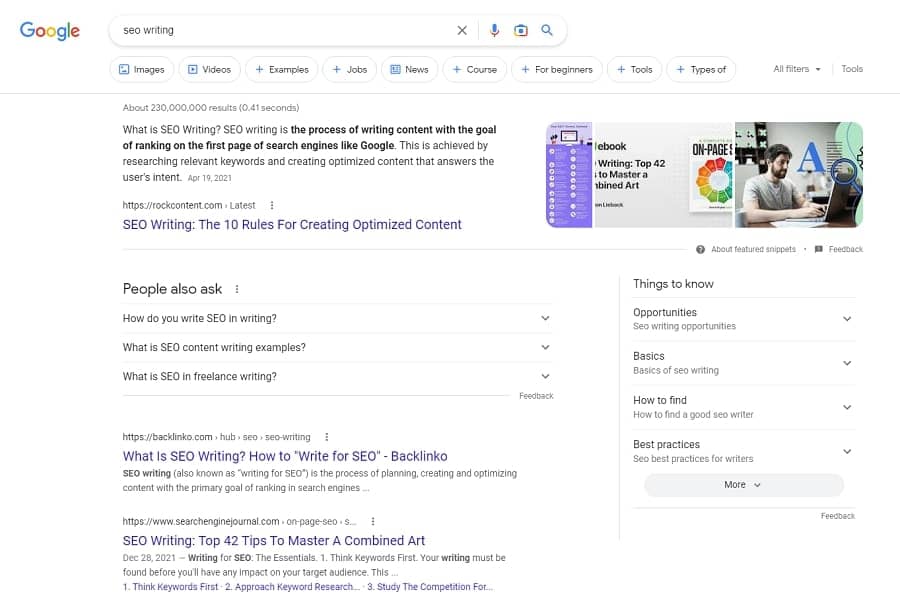
SEO writing a Google results page.

The pages containing search results within search engines, like Google.

SERP Position

The ranking of a page within the SERPs.

Ranking Factors

Components search engines use to decide page rankings.

Backlinks

A hyperlink that directs web traffic to an external page.

Anchor Text

Phrases or words containing a hyperlink.

Organic Traffic

The number of visitors coming to a site from SERPs.

Conversion Rate

The percentage of people who complete an action (like clicking a link) divided by the number of people who visit a page.

Click-Through Rate (CTR)

The percentage of clicks on a page in the SERPs relative to the number of times searchers saw the page in the SERPs.

Meta Description

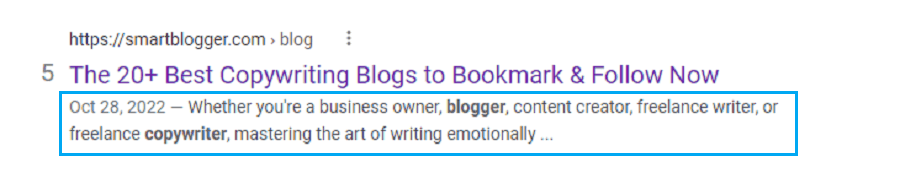
SEO writing a Smart Blogger meta discription on Google.

A short summary of a webpage displayed in SERPs.

Structured Data (Schema)

The formatting of elements like keywords, metadata, and HTML on a page to aid search engine crawling and indexing.

Page/Domain Authority

A (1–100) score indicating the authority of a page or site.

Pageviews

The number of times a specific page is viewed.

Dwell Time

The amount of time a person stays on a page.

Bounce Rate

The percentage of people who leave a site after viewing one page.

Click HERE to read more

By Liliana Benzel

Liliana Benzel is a Smart Blogger Certified content marketer, SEO strategist, and editor with a passion for writing blog posts that rank on Google. She’s helped several writing agencies develop engaging content and is always looking for the next big challenge. You can connect with her on LinkedIn or explore some of her work on her Freelance Writer Profile.

Sourced from SmartBlogger

By Kaloyan Gospodinov

These strategies will help you win and position yourself and your company in the best way this year.

A marketing strategy is the “plan identifying what marketing goals and objectives will be pursued to sell a particular product or product line and how these objectives will be achieved in the time available.” Keep in mind that you need to consider the following three pillars in your marketing strategy plan before execution:

  1. Core audience demographics
  2. Pricing and marketing budget
  3. Business goals

The following seven marketing strategies are vital for connecting with your target audience, achieving your marketing goals by promoting products and services, increasing brand awareness and engaging with your target audience through various channels.

1. Email marketing

Email marketing is an old concept that will be very relevant in 2023. Having lists of targeted audiences with a differentiated email structure for each can provide you with a great and “cheap” way to showcase the developments in your company and sell your products.

Here are three examples that you can implement in your email marketing. The first one is to increase your email interactivity. People are used to social media and the engagement they can give when reading or viewing content. Add videos, sliders, games and carousels of images that people can swipe.

The second one is the use of storytelling in your email copy. People are looking to connect to a brand’s values, and one of the best ways to do that is to tell your brand’s story. Tell them your origin story, show your personality, the company’s culture and team. Use videos, quotes and memes to build a relationship with your subscribers.

The last one is personalization. Personalization in the email body can improve your open rate by 13% and can increase the clickthrough rate by 28% while reducing the bounce rate by 18%.

Email is still thriving as you control how you approach your audience based on your marketing objectives without the need to comply with rules imposed by the platform you use.

2. Social media marketing

Social media marketing is here to stay, and we need to find the right platform for us to create content, connect with our audience and show our expertise or products. This will be dictated by your target demographics and where they spend the most time at.

It is also important to note that Business-to-Business (B2B) and Business-to-Consumer (B2C) companies will have specific platforms that can be used for their business model. For example, LinkedIn for B2B and TikTok for B2C. Remember that your audience can move to a different platform down the line.

One thing that you can integrate into your social media marketing strategy is to think of ways to incorporate user-generated content. This can be in the form of reviews, unboxing, tutorials, and product reviews. According to Stackla, 88% of consumers specify authenticity and relatability as crucial decision drivers to complete in-app purchases and increase their brand engagement.

The most important thing is to use your authentic voice and showcase the people in your company and their expertise, values and personalities.

3. Public relations (PR)

Another old-fashioned concept that still has a place in your marketing toolbox, especially in 2023. PR is relevant and can help you increase awareness around a milestone you’ve achieved or a product/ initiative you are launching. Media mentions will also help you with the SEO of your website/ brand name and how you rank in searches as you get authoritative websites mentioning your company.

According to Statista, the PR industry is expected to be worth $129 billion by 2025 or an increase of 68% from 2020, worth $88 billion.

4. SEO

Search engine optimization (SEO) is a must-do strategy in 2023. SEO aims to increase the searchability of your brand name and specific keywords relating to your offers while helping you grow traffic and sales.

Organic SEO can help you rank your content for specific keywords. I recommend learning how to do the basics of SEO in your content and focusing initially on long-tail keywords, as it will be easier for you to rank.

The main pillar in your SEO strategy should be creating high-quality content and targeting your customers’ needs and questions engagingly while targeting keyword phrases. Create evergreen content that will help customers understand your company and products better.

SEO can be integrated with paid ads so your articles can show on top of the search results.

5. Influencer marketing

Collaboration with influencers can help you scale your business in a short period by increasing your brand awareness and reputation. The key here is to research and get numerous quotes from different influencers so you can decide on the best deal.

I’d say that it’s not always beneficial to go for the biggest names in a particular niche, as your business might not be prepared for that growth. A better strategy will be to find smaller accounts with a more engaged audience so both parties can grow simultaneously and be more sustainable.

One growing trend in influencer marketing is live stream shopping, which means that potential customers can buy products through a live video. Influencers can showcase products, give opinions and answer questions from their followers about the product they are presenting. Instagram introduced Live Shopping in September 2022, which allows users to purchase products from Instagram Live directly, so expect this to be prioritized on the platform in 2023.

6. Virtual events

Virtual events are here to stay, especially after the last couple of years when travel was almost non-existent. Showing your expertise and value through online events can help you increase your brand awareness and reach. The list of attendees can be reused and segmented in your email communication, which will benefit your company in the long run.

Another strategy is to attract experts in the industry you are operating in and create an event where they talk about various subjects related to your company. The event videos can also be reused on social media in long and short-form videos.

7. Video marketing

The most important strategy in the last few years is video marketing. Closely related to hosting virtual events, video marketing can help you present your company from various perspectives.

People from your company can have topics they are working on and record video presentations for the world to see. Behind-the-scenes and company events can showcase the human side of your team, and the sky is the limit regarding creative ways to create video content.

Authenticity here is key as your willingness to open up in front of the camera so people can connect with who you are and what your company stands for.

Short vertical video content will be one of the biggest trends in video marketing in 2023. According to Zippia, 85% of U.S. adults own a smartphone as of 2022, and on average, Americans spend 5 hours and 24 minutes on their mobile devices daily. As vertical video content can take more real estate on a device and people are using TikTok, Instagram Reels and YouTube Shorts, you need to focus your time and creativity to investigate that type of video content.

The world is moving towards personal branding, and video is one, if not the best, way to open up to your audience.

Win with marketing in 2023

To summarise, test and see what works for you and your company. Do not focus and do all the strategies mentioned here simultaneously — experiment with what resonates with you as a personality and your business niche. Adapt and develop the best marketing mix for your desired outcome that will help you win in 2023.

By Kaloyan Gospodinov

Entrepreneur Leadership Network Contributor. CEO and Founder at Aezir. Kaloyan is an entrepreneur with global experience. Past successes include 1m+ app downloads, six figures from Amazon FBA, and managing a million-dollar crypto project. Currently, he advises Swiss biotech and runs a London marketing agency. His motivation is helping people pursue their dreams.

Sourced from Entrepreneur

By Christopher Jan Benitez

Search engine optimization (SEO) enterprise tools perform a host of functions. These tools can be invaluable in your marketing slack, from keyword research to site error detection.

But which among the platforms available in the market suits your organization’s unique digital marketing needs?

Answering this question as part of a large organization is important. You need a platform that considers your company’s size to help you launch and implement a well-coordinated SEO campaign.

So, if you’re facing the same problem in your organization, this post is for you!

It lists the enterprise SEO tools that can help you create a well-developed SEO plan from the ground up, no matter how big your company is.

Semrush

semrush, one of the best seo enterprise tools

Semrush is one of the most recognizable names in the SEO industry, and it’s easy to see why.

Its vast array of highly versatile enterprise SEO features will help solidify your digital marketing strategy. But don’t take our word for it. PCMag ranked it as “excellent.” And actual users on TrustRadius, have given it a cumulative score of 9 out of 10.

Features

With the Semrush enterprise SEO platform, you get immediate access to 55+ nifty tools that have been carefully designed to accomplish various tasks, such as:

  • Keyword research – It helps you find the best and most relevant keywords. Next, filter them according to search volume, difficulty, and others. You can also see which keywords your competitors are ranking for.
  • On-page SEO – Run a website audit to spot issues so you can fix them immediately. It also tells you how to improve the SEO score of your site pages to improve their rankings.
  • Competitor analysis – Find out how much organic traffic your competitors are getting. Also, monitor how the competition leverage paid search and social media to their advantage. Then use the gathered data to help you make better marketing decisions.
  • Content marketing – Brainstorm content topics and create optimized content for each. Then manage your content strategy by filling out your editorial calendar with these topics.
  • Local SEO – Automatically distribute your business data to reputable local online directories. And optimize your Google Maps listings for local search.

Pricing

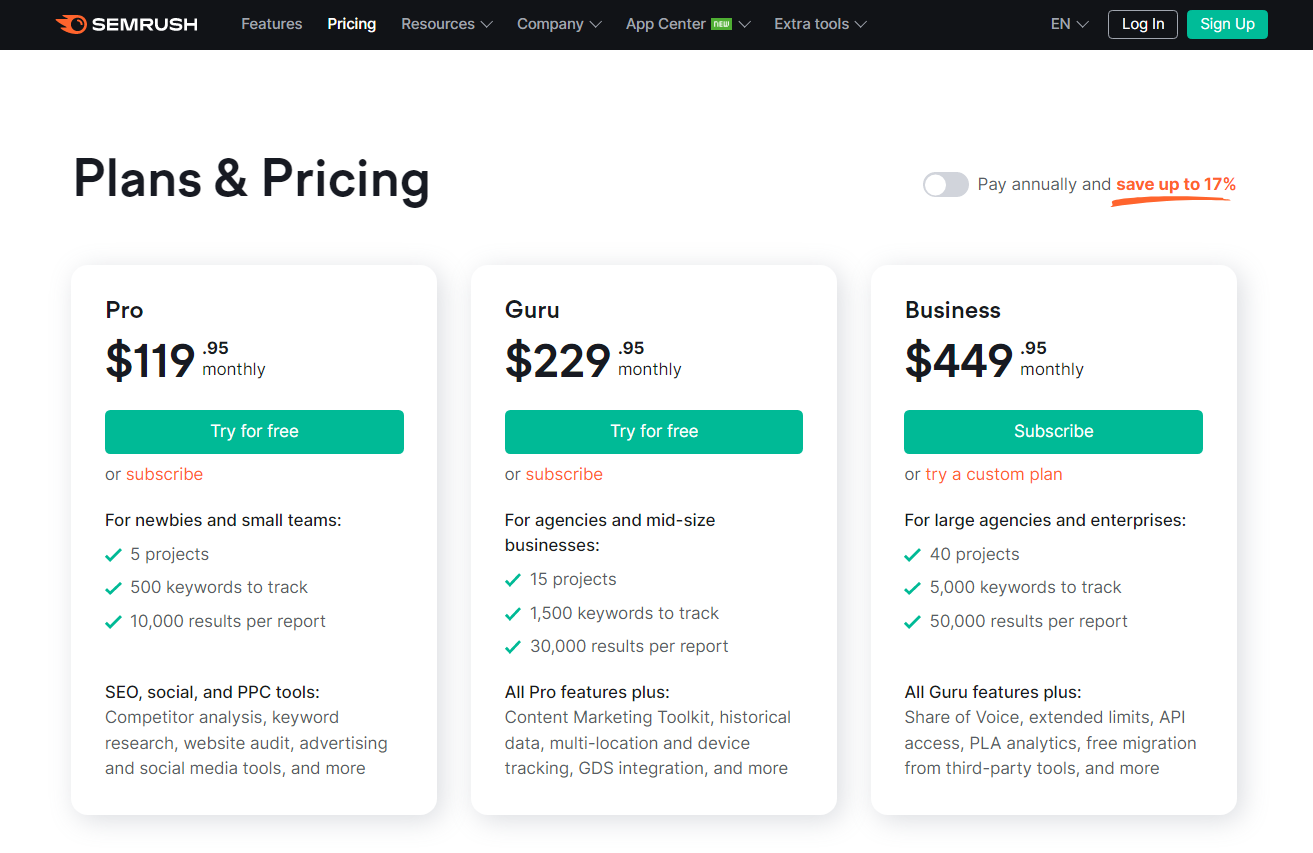
semrush pricing

Subscription to Semrush starts at $119.95/month. The enterprise SEO Business plan, priced at $449.95/month, is available to large enterprises and agencies. It includes 40 projects, 50,000 results per report, and 50,000 keywords to track.


Frase

frase homepage

Frase is an AI-powered enterprise-grade SEO platform allowing content creators to create briefs and optimize content quickly and easily.

This enterprise SEO software also helps content teams create SEO-focused content in half the time. This is because its AI content features expedite the research, writing, and optimization process for you.

Features

Frase helps teams amplify the effectiveness of their enterprise SEO efforts with these features:

  • Question research – Frase removes the need to spend hours researching questions on Reddit, Quora, forums, search engines, and other resources. You type in a keyword, and Frase returns a list of questions within seconds.
  • AI-generated content briefs – Unwilling to spend copious amounts of time creating briefs? Don’t know how to create a content brief? No problem! Frase can automatically create a content brief based on your search queries in seconds.
  • Templates – Frase offers various templates to help expedite the writing process. These include Content Brief, Best Post, Listicle, Alternatives, and more.
  • Answer engine – Frase Answers is a chatbot that helps deliver content to site visitors asking questions on your website. It crawls and analyzes all your site’s content and shares them as answers to their questions.

Pricing

frase pricing

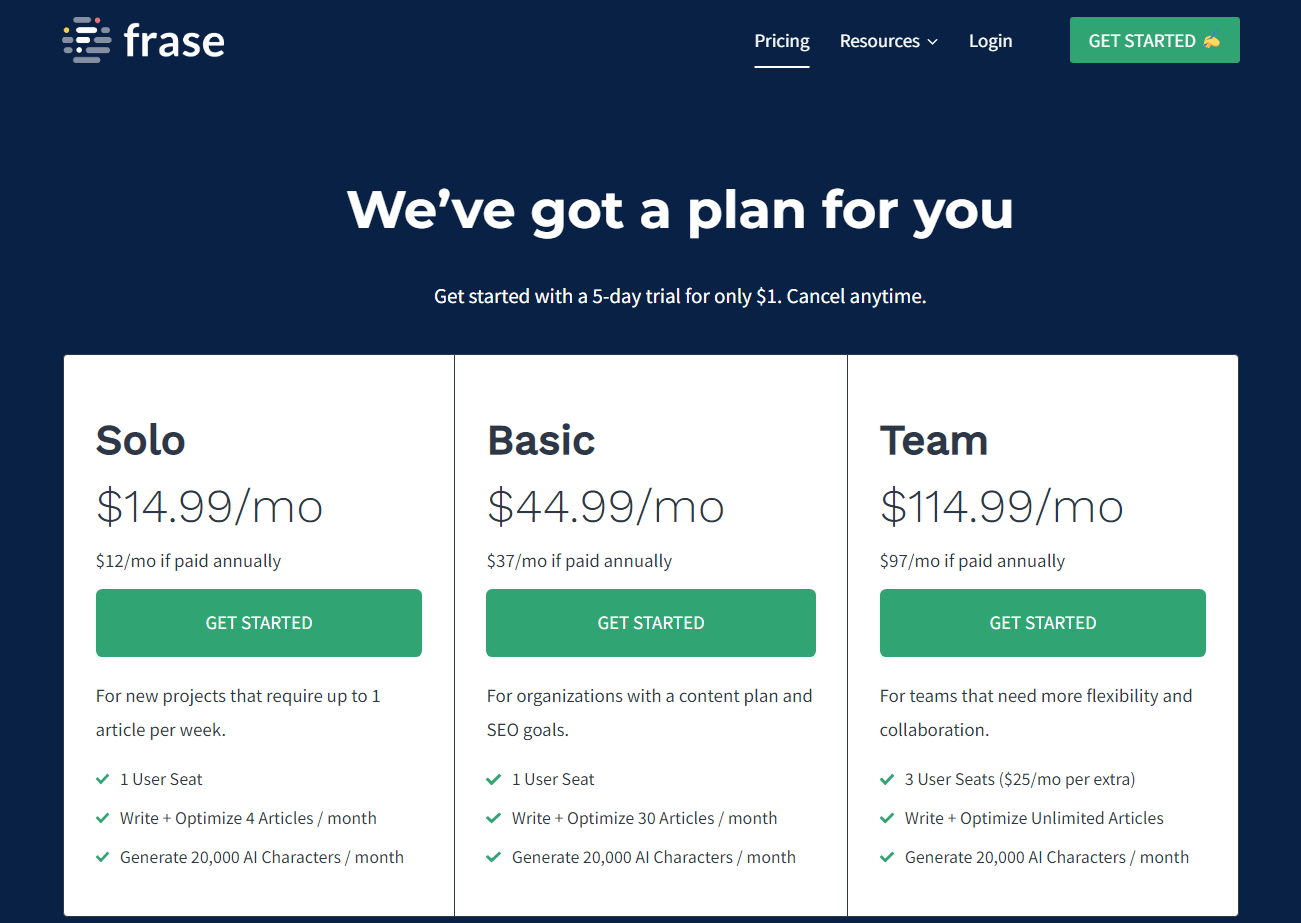
Frase has three pricing tiers. All three include an AI writing plan that can generate up to 20,000 characters per month:

  • Solo – $14.99/month, one user seat with the ability to write and optimize four articles.
  • Basic – $44.99.month, one user seat with the ability to write and optimize 30 articles.
  • Team – $114.99/month, three user seats with the ability to write and optimize unlimited articles. Each extra user seat is an additional $25/month.

You can also get the Pro add-on for $35/month to unlock more features, such as:

  • Keyword search volume
  • Search engine results page (SERP) data enrichment
  • Unlimited access to the Frase AI writer

MarketMuse

marketmuse homepage

MarketMuse is an enterprise SEO platform that boosts website ranking in search engines through data-driven content optimized for your target audience. It uses patented artificial intelligence (AI) technology to accelerate content research and development.

Features

To help your SEO team create remarkable content, MarketMuse offers the following features:

  • Automated inventory collection and audit – You can automatically collect, organize, and analyze your pages for better accessibility.
  • Content metrics – MarketMuse offers AI-powered metrics such as Authority, Content Score, User Intent, and Personalized Difficulty. These help enterprise SEO and content teams identify and leverage the best content opportunities.
  • Content briefs – No more guessing which types of content get the most search traffic. With MarketMuse’s content briefs, your team can confidently produce comprehensive content that addresses user pain points.
  • Optimization – With MarketMuse’s AI-powered text editor, content creators get real-time feedback on content quality and how well they cover a topic. This way, you produce content that search spiders would want to index.

Pricing

marketmuse pricing

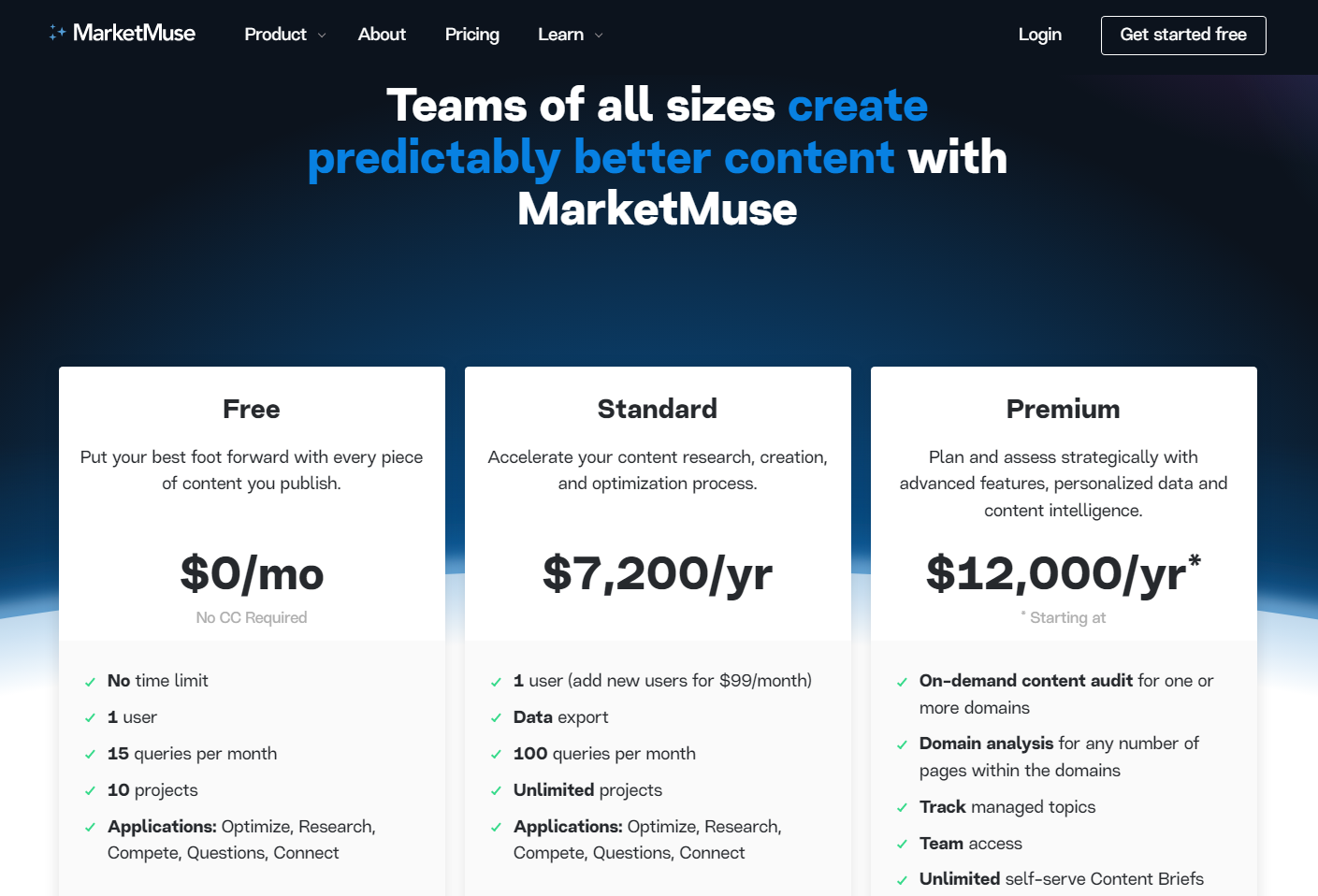
MarketMuse has three subscription tiers. And Optimize, Research, Compete, Questions, and Connect are available applications for all tiers.

  • Free – At $0/month, one user can execute 15 queries per month and work on 10 projects. A query happens whenever you enter a URL or focus topic into a MarketMuse application and press “Run.”
  • Standard – Priced at $7,200/year ($600/month), this subscription plan allows one user to export data, perform 100 queries per month, and complete an unlimited number of projects. Each additional user costs $99/month.
  • Premium – This plan starts at $12,000/year ($1,000/month). It comes with on-demand content audit capabilities, managed topics tracking, domain analysis, unlimited queries, unlimited projects, a dedicated account manager, and workflow/platform training for teams.

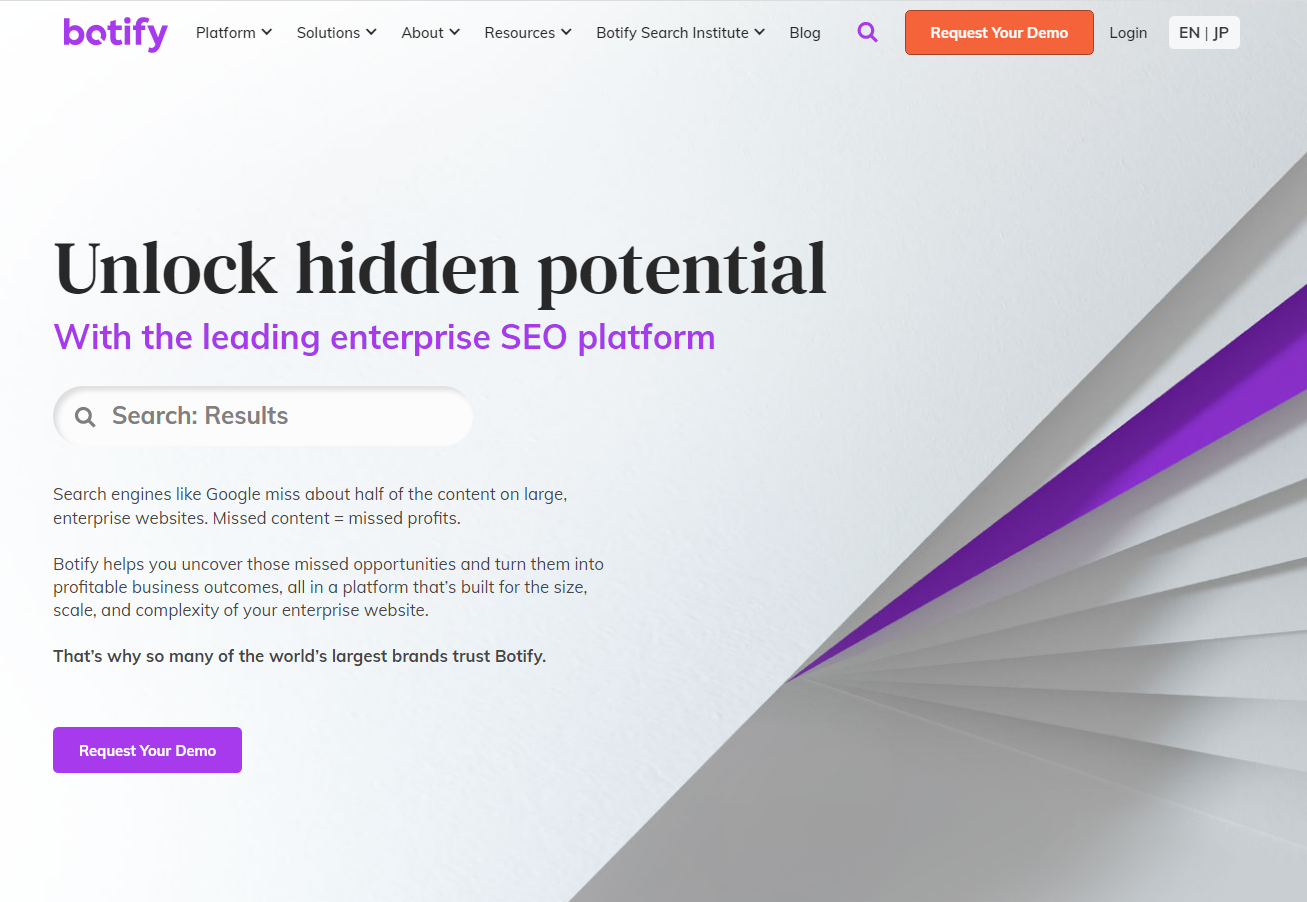
Botify

botify homepage

Botify is another enterprise SEO platform worth considering. It enables executives, content teams, and technical SEO professionals to prioritize the SEO tasks that yield the most impact. It can be leveraged for various use cases, including:

  • Keyword research
  • Keyword tracking
  • Site migrations
  • Mobile SEO
  • JavaScript SEO
  • Content analysis

Features

Botify offers essential enterprise SEO features that can maximize the potential of your online assets:

  • Botify Analytics – All the data you need about your websites from various search phases—crawl, render, index, rank, and convert—is available here. There’s also an option to import log files for additional crawl insights. From here, you can analyze your site’s bounce rate, conversions, and other SEO metrics.
  • Botify Intelligence – Powered by machine learning, the tool lets you identify technical SEO and content opportunities prioritized by impact. It also has an early warning system for catching SEO issues before they become real problems.
  • Botify Activation – Faster, autonomous implementation of SEO initiatives such as quick and easy submission of new and updated pages. This allows for faster content indexing.
  • Professional Services – Need help making the most of Botify to power your SEO strategy? You can tap its SEO professionals for various enterprise SEO services, such as site migration, understanding how JavaScript impacts your website, and more.

Pricing

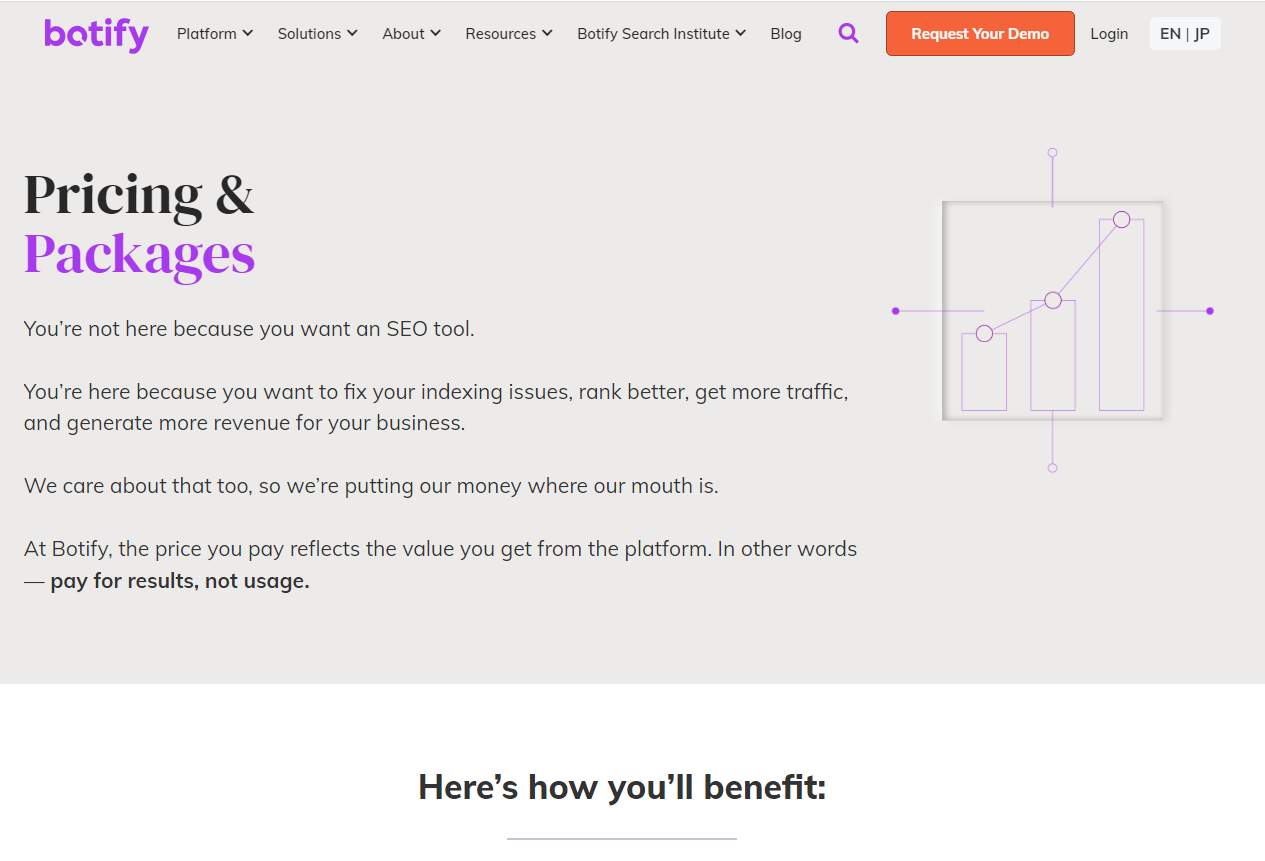
botify pricing

Botify offers three subscription plans:

  • Essential – For websites that want end-to-end SEO data plus prescriptive recommendations for better performance
  • Pro – For organizations that get the bulk of their revenue from organic search
  • Enterprise – For organizations with complex, large, or multiple websites

Botify doesn’t list pricing on its website, as each package is unique to each customer’s needs. Reach out to their sales team for a custom quote.


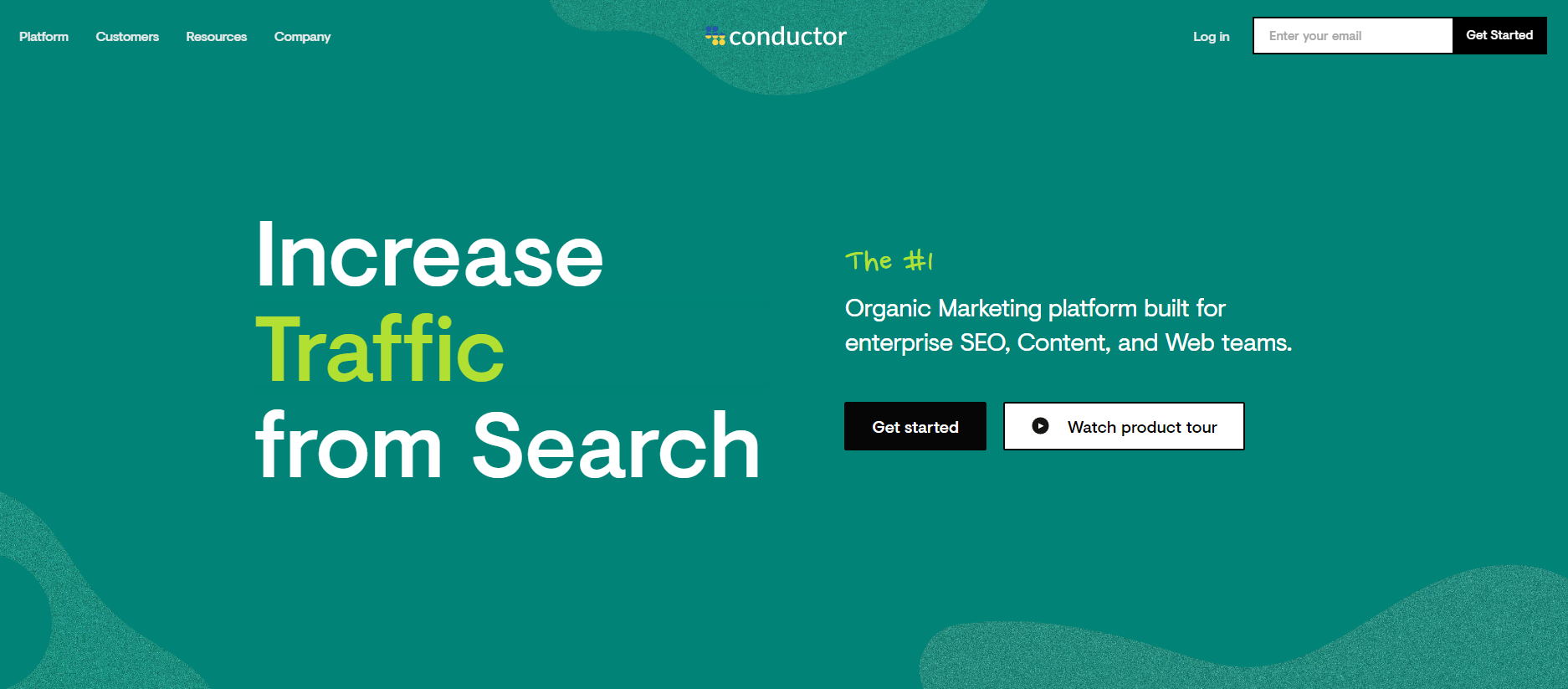
Conductor

conductor, one of the best seo enterprise tools

Built for enterprise SEO, web, and content teams, Conductor tracks search and content performance. It is a search engine optimization tool that integrates with a wide range of technology tools, including:

  • Analytics tools such as Google Analytics and Adobe Analytics.
  • Project management platforms such as Asana.
  • Consumer intelligence tools like Talkwalker.
  • Other SEO tools, such as Semrush.
  • And so many others!

Features

This enterprise SEO software offers powerful features such as:

  • Keyword explorer – Helps with research into keywords (organic and paid), topics, demographic insights, audience sentiment, competitive research, social insights, etc.
  • Content guidance – Provides AI-powered recommendations for creating content that resonates with your target audience.
  • Digital presence tracking – Monitors the visibility of your digital assets across channels. This includes search engines, social media, press coverage, owned content, and earned media.
  • Technical SEO – Assists with ensuring your website is technically sound and provides the best user experience possible. Choose between ContentKing or Lumar for real-time technical monitoring.
  • Chrome extension – Free SEO tool that delivers advanced SEO intelligence about any page. Insights include page fundamentals such as metadata, media, technical SEO, and many more.

Pricing

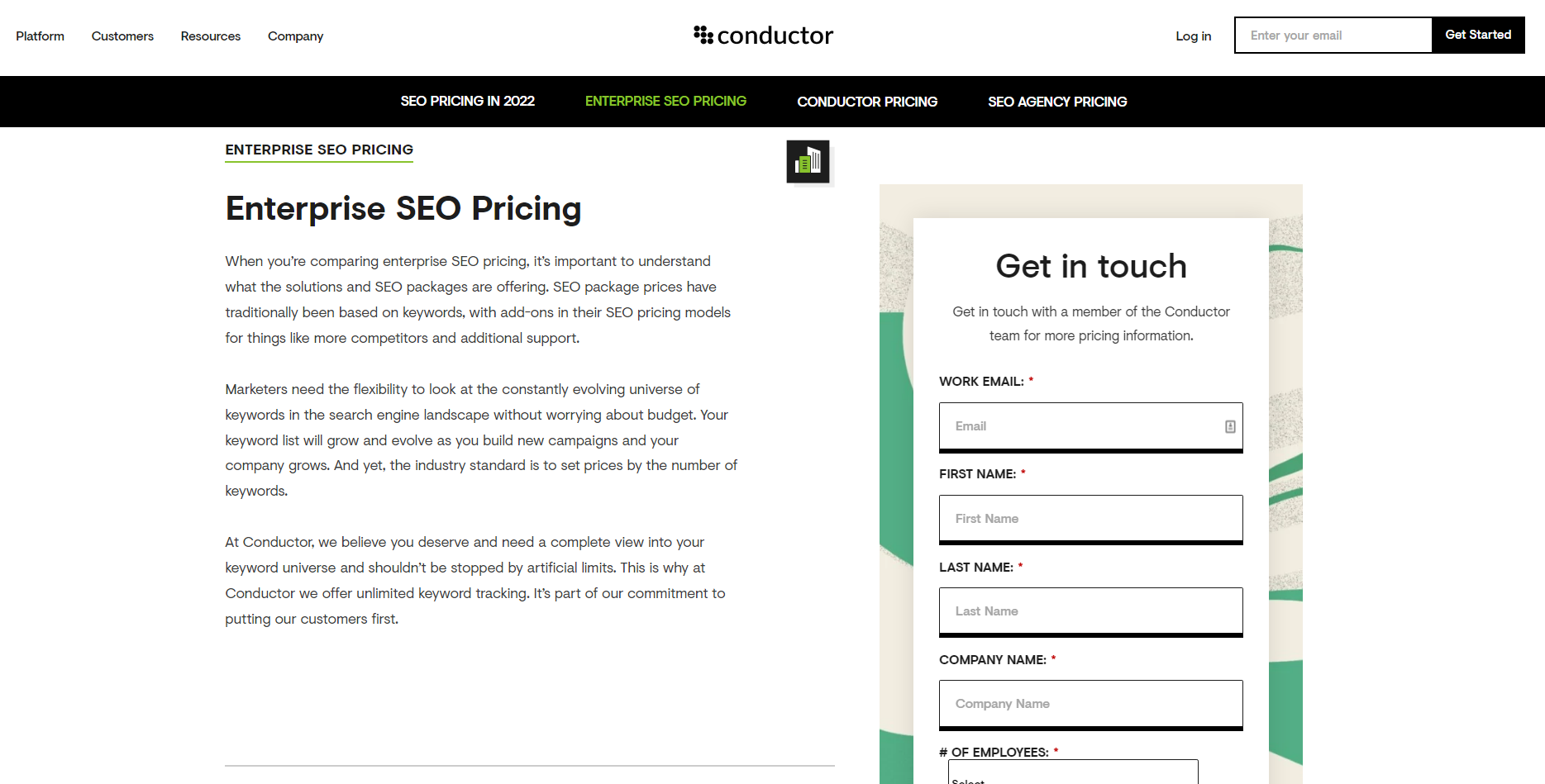
conductor pricing

Conductor builds unique enterprise SEO subscription packages according to your needs and budget. Contact their sales team for a custom quote.


BrightEdge

brightedge homepage

BrightEdge is a comprehensive enterprise SEO tool offering an impressive set of features from search, content, social, and local. It provides SEOs and digital marketers with the actionable insights necessary to boost website visibility and increase search traffic.

Features

This enterprise SEO software provides the tools your SEO team needs to more effectively and quickly optimize website content. Below are other things it can do:

  • Demand discovery – Create a list of target keywords that delivers the best results. You can then determine which search queries generate the most organic traffic to your site.
  • Content creation and optimization – Receive SEO suggestions on boosting content relevance and visibility. And you can monitor existing pages for potential errors and fix them before they become critical issues.
  • Content performance prediction – Identify which content type ranks for a search term before writing it. Then estimate the impact of your content initiative so you can better prioritize tasks and campaigns.
  • Results measurement – Generate website performance reports to help communicate to stakeholders for high-value keywords and best-performing content.

Pricing

Pricing information is not available on the BrightEdge website. Call their sales hotline to get a custom quote.


Linkdex

homepage of one of the best seo enterprise tools, linkdex

Another enterprise SEO tool that deserves its place on this list is Linkdex. It aggregates insights from various channels like search engines, social networks, and influencer marketing. This way, all the data you need is available via a centralized enterprise SEO platform.

Features

Linkdex carries many features to help enterprise SEO and marketing teams maximize their SEO efforts. These include:

  • Visibility and crawl analytics – Compare multiple domains using domain and keyword filters. Crawl thousands of pages, even your competitors, to uncover performance issues and opportunities to optimize your pages.
  • Ranking intelligence – Get better insights into your (and your competitors’) keyword rankings. Then analyze the search traffic value and ranking of any page to gauge how you’re faring against competitors.
  • SEO reporting and forecasting – Using Linkdex data, create smart, insightful SEO reports with just a few clicks. Next, turn data into smart forecasts to better communicate your content marketing and SEO efforts.
  • Author discovery – Using targeted keywords, find influencers and the people behind high-ranking content. Reach out and build relationships with topical influencers to boost your website’s authority.
  • Content strategy – Comb through various SEO data like technical SEO, analytics, social, rank, and link. This way, you can create content that’s highly shareable and link-worthy.
  • Smart SEO alerting – Create custom alerts through email or in-app so you know immediately when to take action. Fix lost or broken links, investigate significant traffic drops, enact appropriate changes, etc.

Pricing

linkdex pricing

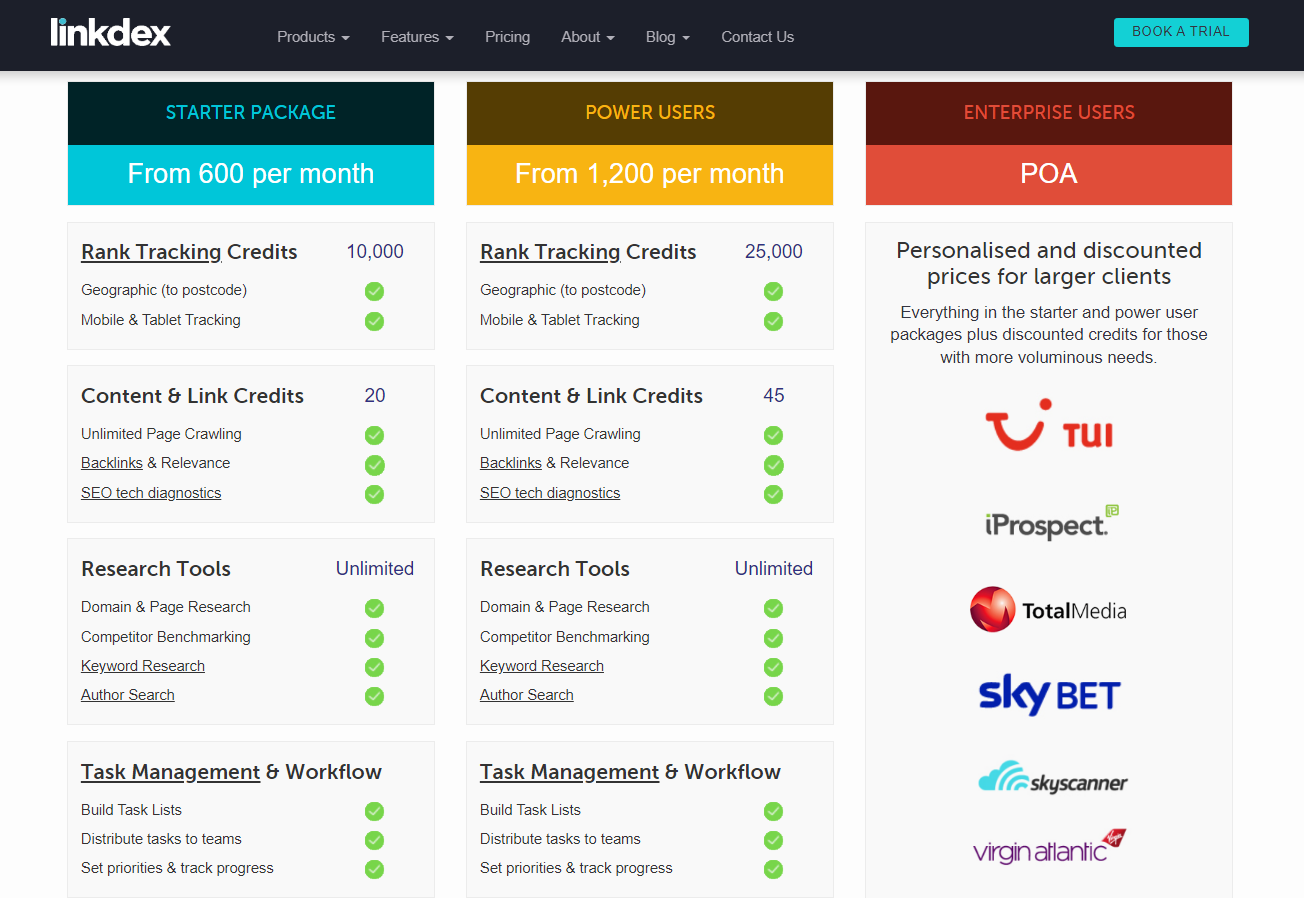
Linkdex offers three subscription plans:

  • Starter Package – For $600/month, you get 10,000 rank tracking credits and 20 content and link credits. Linkdex SEO tools for research, task management, and workflow engine are also unlimited.
  • Power Users – This plan has the same features as the Starter Package but with more credits. It includes 25,000 rank tracking credits, 45 content, and link credits. Starting price is $1,200/month.
  • Enterprise Users: Discounted custom plans are available for enterprise users. Contact the sales team for more details.

Pitchbox

pitchbox, the best link building tool among the seo enterprise tools in this list

Looking for an enterprise SEO platform to help you build quality backlinks, boost visibility, and increase credibility? Then, Pitchbox is for you.

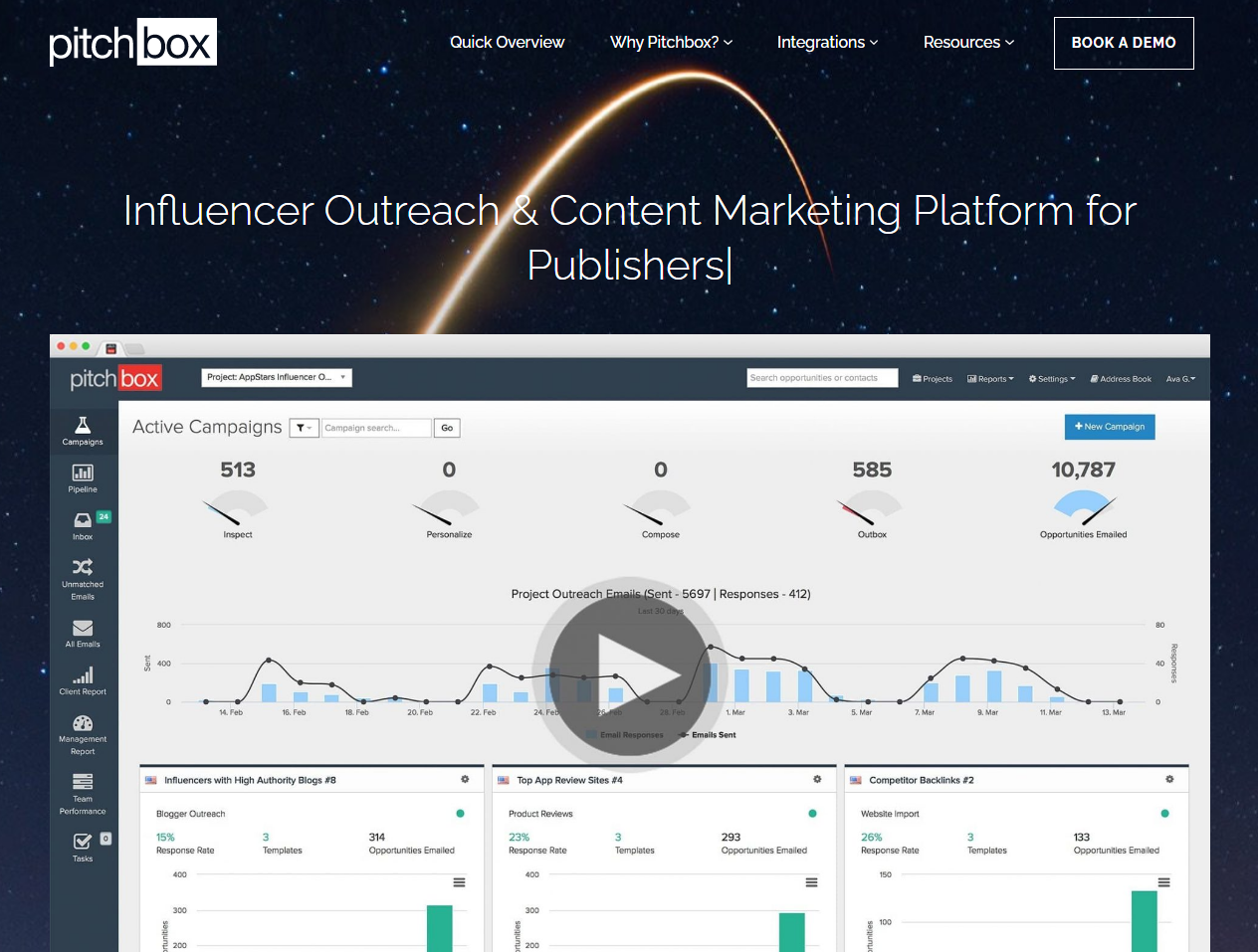
Pitchbox is an email outreach platform for building backlinks using various link building strategies more effectively.

It’s an end-to-end link-building and prospecting tool that increases team productivity.

Features

Pitchbox enables enterprise SEO teams to build links at scale through the following features:

  • Prospecting – Take advantage of built-in targeting and prospecting features to identify the best link building opportunities in less time. Find relevant blogs and articles in any niche. You can also import domain lists and other data from other SEO tools.
  • Outreach and follow-up – Reach out to prospects at scale using smart templates. You can also schedule your messages and follow-ups to reach prospects’ inboxes at the right time. This way, you receive more responses and close more deals.
  • CRM – Aggregate all link-building and prospecting data and information in one place. Segment leads by relationship status, SEO metrics, age, etc. This allows you real-time visibility into your pipeline, making it easier to turn opportunities into wins.
  • Reports – Pitchbox reports provide deep-dive insights into the performance of your campaigns and how they’re progressing. Track team activity and identify monthly, quarterly, and yearly trends.

Pricing

pitchbox private demo page

Pitchbox doesn’t provide pricing details on its website, but some review sites say plans start at approximately $500/month. Contact their sales team for more information and a private walkthrough.

Quattr

quattr homepage

Quattr is an AI-driven enterprise SEO tool that empowers digital marketing teams. With it, they can leverage data-driven SEO insights to boost their search rankings and capture highly targeted traffic.

If you need help maximizing the tool’s power, Quattr’s SEO Concierge team is available for personalized consulting.

Features

Features you get when you subscribe to Quattr include:

  • Competitive trends – Quattr identifies which pages on your website are underperforming and provides optimization suggestions. It gives you real-time visibility into your market share and how much traffic competitors are getting.
  • Ranking factors – This enterprise SEO platform tracks your site’s ranking based on various SEO factors. Plus, it shows how you’re doing against competitors. And if you identify any problems, you can fix them directly from the Quattr platform.
  • Prioritized keyword recommendations – Quattr’s recommendations let you optimize your content to rank them higher in SERPs. You can then preview how your changes improve your site’s search performance. If the results are positive, only then should you implement them.
  • Usability recommendations – Unlock the technical insights necessary to improve your site. To do this, fix any issues surrounding accessibility, performance, and mobile-friendliness.

Pricing

Quattr has not provided any pricing details. The amount you pay will vary greatly depending on your enterprise SEO requirements. Contact their sales team for more information.
SearchMetrics

searchmetrics, one of the seo enterprise tools to look out for

Another notable contender on this list of enterprise SEO tools is SearchMetrics. It helps enterprises:

  • Identify market opportunities to increase sales from organic search using actual data from the search engines.
  • Build comprehensive plans tailored to boost search engine rankings and visibility.
  • Implement and monitor those plans.
  • Perform competitor analysis for benchmarking and outranking them.
  • Track performance and tweak as needed.
  • Create reports for management to justify SEO spending (and get funding increases, if necessary).

Features

The SearchMetrics Suite allows organizations to take control of their search revenue via features such as:

  • Research Cloud – Run a competitive analysis to identify content gaps and factors enabling winning content. Then launch real-time ranking performance monitoring and search visibility auditing to uncover more SEO opportunities.
  • Content Experience – You can create topic-aligned briefs to help write your content. Refer to its real-time Content Score to further optimize your content. There’s also Topic Explorer, a WordPress plugin to help you identify the topics people are searching for.
  • Search Experience – Enterprise SEO users like yourself can track top-performing keywords and ranking dips and analyze URL performance and competitor search features.
  • Site Experience – This web crawler alerts you and other enterprise SEO agencies to risks and opportunities for improving site performance.

Pricing

searchmetrics quotation page

The SearchMetrics website doesn’t provide pricing details. A PCMag review, however, says their plans start at $69/month. But this was from 2019, so the amount may no longer apply. Contact the SearchMetrics sales team for more details.

seoClarity

seoclarity, one of the best seo enterprise tools

Last but not least on our list of market-leading SEO platforms is seoClarity. As its name suggests, it provides clarity and visibility into your SEO efforts through AI-powered insights.

It does the following:

  • Crawl data
  • Deliver ranking and search demand insights
  • Provide content optimization recommendations
  • Perform technical SEO analysis
  • One-click automated SEO execution
  • Create and send automated reporting

Features

Get the following features and capabilities when you subscribe to seoClarity:

  • Daily rankings – Manage site performance on organic search by knowing where your site ranks for its target keywords. You can also find insights on securing the Google featured snippet to position your website on top of SERPs.
  • Technical and on-page optimization – Crawl pages to identify and remedy site errors. Analyze log files to get the bigger SEO picture about performance, rankings, and search bots. From here, you can optimize your web pages to improve their crawlability and indexability.
  • Insights from real-time analysis – Leverage advanced AI analysis to help you provide actionable items. You can also compare your sites with competitors based on SEO metrics to benchmark their performances. Finally, determine if you have a healthy link profile through constant link analysis and monitoring.
  • Content ideas and gaps – Identify content gaps and opportunities using People Also Ask datasets. From here, you can write compelling, authoritative content to answer their questions using seoClarity’s AI writer.

Pricing

seoclarity pricing

seoClarity offers multiple subscription options:

  • Essentials – Price starts at $750/month. Essentials provide daily rank tracking, live chat, and email support.
  • Core – Price starts at $3,000/month. Core offers daily and weekly rank tracking, a dedicated success manager, and an SEO advisor.
  • Professional – Price starts at $4,500/month. It gives you everything Core provides, advanced technical SEO tools and the highest level of support.
  • Agency: This subscription tier includes all the elements of Core plus an unlimited number of users. Get a custom quote by contacting the seoClarity sales team.

How to Choose an Enterprise SEO Tool from the List Above

There’s a lot of feature overlap among the SEO enterprise software above. This makes choosing the right one for your corporation much more difficult.

But to help with the selection process, below are the things you must do:

Determine Your Needs

Start by looking at what you expect from an enterprise SEO platform based on the needs of the business. Create a list of all the features you want, the must-haves and nice-to-haves.

Any vendor that doesn’t offer the features your SEO and digital marketing strategies can’t live without is not a good fit.

Schedule Demos with Applicable Vendors

Once you’re ready with a shortlist of vendors, it’s time to schedule demos. When on the demo call, ask questions if something isn’t clear. And be sure to watch out for the following:

  • Presence of critical features.
  • The vendor’s understanding of your marketing and business needs.
  • Ease of use.
  • The type of after-sales support you’ll be getting.

Negotiate Contract

Enterprise SEO software providers generally don’t advertise that they’re amenable to negotiating contracts.

Not only can you get the best pricing and discounts for multi-year contracts. But you can also negotiate the support facilities available, warranties, backups and recovery plans, service level agreements (SLA), etc.

Which Among the Enterprise SEO Tools do I Recommend?

So there you have it—our list of some of the best enterprise SEO platforms on the market today.

And since we know you’re expecting us to suggest a tool or two, here are our top picks:

  • Semrush: It’s an all-in-one solution and, therefore, ideal for large SEO and content teams. Plus, it’s a household name in the SEO industry—meaning it’s reliable.
  • Conductor: Want high-performing content? Take Conductor with you. Most tools on this list help drive content that converts, but Conductor’s ability to integrate with various business tools makes it stand out.

As mentioned above, however, the needs of your business come first. Determine your must-haves and choosing the best fit should be smooth sailing.

By Christopher Jan Benitez

Christopher Jan Benitez is a professional freelance writer who provides small businesses and startups with content that aims to grow their engagement and conversion with their audience. To learn more about Christopher, you can follow him on Twitter.

Sourced from Niche Pursuits

SEO is one of the most popular branches of online marketing today. And there’s a good reason for that – SEO continues to produce great results and the ROI is incredible, especially compared to paid media.

But with the growth of SEO, many businesses became interested in using SEO to grow their companies. With that interest came a challenge for agencies… How do you present the work you’ve done for your clients and which SEO metrics do you choose to showcase your success?

Having worked with hundreds of agencies, we know the exact SEO metrics you need to show your clients to prove that you’re getting them the results they seek. And in this article, we’ll reveal what those SEO metrics are!

Organic traffic

There are plenty of vanity metrics in SEO, but organic traffic is not one of them. Simply put, if your agency is doing its job well, your client’s organic traffic should be increasing steadily each month.

Of course, you should let your clients know that they cannot expect meaningful results after just one month of content marketing and SEO.

However, beyond 2-3 months, your clients will expect a steady increase in organic traffic and this is a KPI you should always include in your reports.

With the average conversion rate hovering around 2% depending on the industry, the difference between 10,000 and 100,000 website visitors can make a huge impact on your client’s bottom line.

It doesn’t take a marketing expert to know that more people on your client’s website usually translates to higher profits. This brings us to our next point.

Conversions from organic traffic

If you set up your SEO reporting tool properly, tracking this metric is a breeze. Clients want to know the immediate impact of SEO activities on their bottom line and this is the easiest way to show them that.

With each new conversion that came in from organic search and content marketing, you can show your clients the exact value and effectiveness of SEO as a strategy. The key here is to do two things.

One, set up proper attribution so you and your clients are on the same page when it comes to what a conversion is. Two, set up a baseline so you can compare organic traffic conversions compared to PPC, social media and other channels.

Keyword rankings

Even if your client knows nothing about SEO, they likely understand the value of ranking well for their desired keywords. Even without an SEO expert, they know well enough which keywords they want to rank for and which of them brings in new revenue.

First off, make sure to report on keyword movements for existing keywords, especially the money keywords that bring in conversions. If there are any movements at all, they’ll want to know about them.

Moreover, update your clients about the total number of keywords they’re ranking for. While not the ultimate SEO metric, this is a pretty good signal that your SEO and content marketing efforts are going in the right direction.

New and lost backlinks

If your client is fairly new to SEO, understanding the importance of backlinks for their website and SEO is crucial. Make sure to educate your client base about what a backlink is, how it influences search engine results and what differentiates a good from a bad backlink.

The problem that often happens with backlinks is that they cost a lot of money to do right. White hat link building requires lots of hands-on work and many times, there are hidden costs involved, such as paying writers, editors and people in charge of outreach.

When you want to report on backlinks, be sure to include both new and lost backlinks in your report, especially in correlation with new pages that are ranking. This is a surefire way to convince any client about the importance of backlinks for SEO and overall business growth.

Bounce rate from organic traffic

A bounce happens when a visitor lands on a page and leaves it without going any further or taking any action. A bounce in itself is not a bad thing, but it usually signals that the visitor found nothing of value on the page and decided to leave.

A bounce rate is a good signal that you need to work on your content and provide a meaningful, engaging experience for your visitors. Make sure the content is structured well, with plenty of internal links to help them move on to other pages on your website.

More importantly, a high bounce rate is a ranking signal for search engines such as Google. Your clients should be aware that a high bounce rate can significantly impact not just their rankings but also their revenue. This is a metric that belongs on every SEO report.

Page load speed

It doesn’t take much to figure out why a fast website matters in 2022 and beyond. A website that loads fast provides a great user experience and makes visitors want to stay and click through.

Your website page load speed is more of a technical website issue but it should be included in your monthly or weekly SEO report. If you see a sudden slump in page load speed, this means that there’s a technical aspect of your client’s website that needs to be addressed.

More importantly, page load speed is another major ranking factor for Google and other search engines. If a website takes too long to load, the visitor will bounce immediately after opening a link, resulting in high bounce rates and short session duration. The end result? Poor user experience and a drop in rankings.

Wrapping up

With so many buzzwords and mysteries surrounding SEO, focusing on what really matters can be difficult. And when you’re dealing with clients who have little understanding of internet marketing, you really need to be proactive and choose the metrics that make an impact and are easy to understand.

Mile Zivkovic is the Head of Content at Whatagraph, the ultimate marketing reporting tool for agencies and in-house marketers

Sourced from Jeff Bullas


By Dave Colgate

Search Engine Optimization (SEO) often has a reputation for being a cheap marketing strategy, but high-value work can require substantial investment. Dave Colgate of agency Vertical Leap looks at how to invest properly.

Unsure how much you need to spend on search engine optimization (SEO)? Let’s look at how to set the right budget, considering how much other companies are spending; the factors you need to budget for; and the minimum recommended spend for small businesses just starting out with SEO.

How much do companies spend on SEO?

Marketing budgets suffered from Covid-19, but industry reports show companies are on their way to returning to pre-pandemic levels. According to Oracle’s top marketing trends report, 64% of companies planned to increase their budgets in 2022.

Meanwhile, Gartner’s State of Marketing Budget and Strategy 2022 shows companies are spending 9.5% of revenue on marketing this year, up from 6.4% in 2021.

The same study shows companies are spending 8.5% of their marketing budgets on SEO, topping the list of “unpaid channels”.

Gartner’s insights are largely backed up by The Marketing Budgets Report 2022 from StrategiQ, which finds companies spending 10% of total revenue on marketing in 2022. It also finds companies are spending 10.5% of their marketing budgets on SEO, up from Gartner’s 8.5%.

StrategiQ’s report found that small companies dedicate a greater percentage of revenue to marketing.

StrategiciQ includes fewer channels in its report than Gartner. This is an important point because the fewer channels you spread your marketing across, the greater percentage you’ll spend on SEO. So, if you’re not spending any marketing budget on live events, digital audio advertising, or other channels, you could spend far more than 10.5% of your marketing spend on SEO.

What does your SEO budget get spent on?

When you’re setting an SEO budget, it’s important to understand how your spend will be spread across key activities:

  • Analytics: The insights that inform every part of your SEO strategy and reveal your biggest opportunities.
  • Content production: Every piece of content you create and optimize to rank in search engines.
  • On-page SEO: Optimizing your web pages and content to maximize search visibility.
  • Off-page SEO: Optimizing off-page signals with link building, content placements (eg: guest blogging), reviews and other factors outside of your website.
  • Technical SEO: Optimizing and maintaining the technical performance of your website (loading times, link profiles, URLs, etc).
  • SEO tech stack: The tools you use at every stage of your SEO strategy: analytics, competitive research, content planning, content production, etc.
  • Agency/consultancy fees: SEO services you require from agencies or consultants.
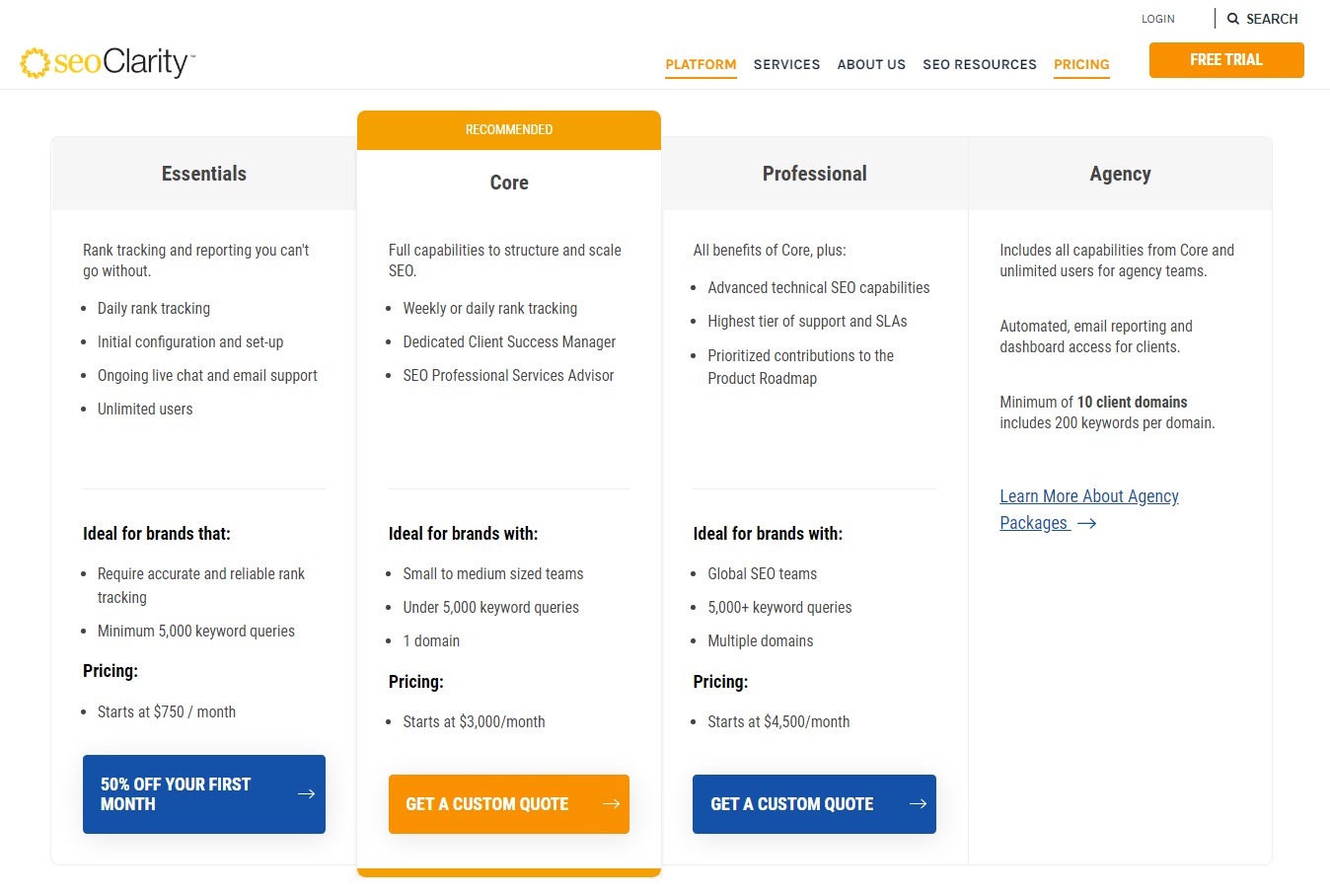
  • Outsourcing: Tasks you outsource to freelancers or external talent, such as content creation, copywriting, web design, etc.

That Oracle report found something else: 82% of companies were planning to change their marketing tech stack in 2022.

In today’s data-driven marketing environment, this is one of the most important aspects of your SEO budget. With the right tech stack, you can drastically increase the ROI of your SEO spend by improving the quality of insights, automating tasks and seizing opportunities before your competitors.

If you don’t have the budget or resources to build a competitive SEO tech stack, it’s worth looking at agencies that have already developed their own. By partnering with the right agency, you can tap into class-leading SEO technology at a fraction of the price.

Maximizing ROI with a high-impact SEO strategy

In 2019, Backlinko published a survey asking US business owners about their experiences with SEO services. The survey revealed that companies spending a minimum of $500/month were 53.3% more likely to be “extremely satisfied” with the results.

As a rule, we advise smaller companies that it’s difficult to gain meaningful SEO traction for anything less than £800/month (about $1000). This doesn’t stretch too far when you consider all of the expenses we looked at in the previous section (analytics, content production, SEO tools, etc.).

Obviously, larger companies should expect to spend significantly more but it’s not simply a question of spending more for better results.

Spending wisely is just as important as setting the right budget. Every business can maximize ROI with a high-impact SEO strategy using data science to identify and prioritize opportunities.

If you want to increase your visibility online, we can run a free analysis of your current SEO status and provide a quote. Click here for more information.

Feature Image Credit: Souvik Banerjee/Unsplash

By Dave Colgate

Sourced from The Drum

By Frank Wazeter,

Creating content that people want to read needs to be your priority.

Every business owner wants to rank on page one, spot one on Google. SEO can be a massively worthwhile investment that can single-handedly transform your company’s ability to reach more customers more easily and cheaply than your competitors. Using a combination of SEO and social media, I’ve helped companies grow from $300k a year to over a million in seven months and changed how multi-billion-dollar industries do their marketing.

Yet, for all that, I spend a lot of time talking people out of SEO. The reality is, until you’ve got about $50,000 a year to invest in it, you’re probably not going to get the result you want, and despite good intentions, the typical professional you find won’t be able to deliver on their promise. Even worse, for most, if you get the ranking you want and the traffic you desire, you still probably won’t get the actual sales conversion you’re hoping for.

Fortunately, what matters most to make SEO work for you is also what makes for a highly effective website and increases your online sales dramatically. It’s all summed up in one word: value.

Make value-driven content that’s compelling, wins your readers’ attention, and wows them.

The most important ranking factors never change, everything else does.

By far the most important ranking factors that Google considers are how many people visit your site directly, how much time they spend reading it, and whether or not they visit multiple pages. People visiting your website directly tells Google that you must be credible because people are visiting the page all on their own. The other two are all oriented around the quality of your content and whether or not it actually delivered value to the reader.

Google’s prime directive to make its search product better is to provide the most suitable answer to a searcher’s question. The better you answer the questions people are looking for, the higher you’ll rank and the more your conversion will be. That means that insightful, compelling, and valuable content that’s different from your competitors is always going to be the primary driver of search results.

SEO is about editing and promoting content, not ranking.

There are hundreds of optimizations that are all technical. Think of these as edits, similar to how a proof-reader edits an article. All that’s being done is optimizing and changing the language a little bit and adding metadata, schema (JSON-LD), and other technical aspects to “tweak” how an algorithm processes the data of the content.

The other piece, commonly blasted out as backlinks, is really just another way to say promotion. The more people reference your content, the higher over time it will rank because it’s valuable. People try to cheat the system by buying backlinks that are of questionable quality, which means that when a big Google algorithm hits, they start losing all the things they worked for because Google starts eliminating bad “backlink” sources.

An editor can’t make bad content good and a promoter can’t make bad content popular. That means even with the technical factors involved in SEO, the universal answer is: Make good content that people actually find valuable enough to read.

Forget keywords, write content based on customer questions instead.

The easiest way to focus on what people actually want to read is to do what you do as a professional anyway: Answer questions that matter to customers. When you create content focused around the things that your customers actually ask you, and answer them in the way that you actually do in person, a funny thing happens: You get content that people actually want to read because it matters to them.

If all you did was get in the habit of writing down or recording the questions your customer asks, answer them in the way that works for you in person, and turn those into articles, you’d be miles ahead of the competition in search engines because you’ve created valuable and insightful content to drive the whole thing.

Feature Image Credit: Getty Images

By Frank Wazeter,

Sourced from Inc.