Tag

Social Media Marketing

Browsing

By 

When I think about social media, I start to sound a lot like somebody’s cranky grandma.

Back when I was starting out in marketing, we didn’t have all this Twitter or LinkedIn or Facebook. If you wanted to run an ad, you bought a classified. In the newspaper! Which people had to pay for!

Did I mention we had to walk to school in the snow, uphill both directions, even in May?

The internet, and the free social platforms that have been developed for it, have given us genuinely amazing tools to connect with other humans. Those tools have accomplished a lot of good … as well as some harm.

Today, social platforms are critical to content marketing and digital business. They help us find potential customers. They act as amplifiers for our content. They help us connect with people and learn more ways to help them.

So if social media is so important, how come so many small digital businesses are doing it so wrong?

It’s one thing if your local bank is a bit … unsophisticated in its use of social media. They’re supposed to be slow to change.

But digital businesses like yours and mine? We should be good at this. Let’s look at some of the things that hold us back.

Bad habit #1: Spreading yourself too thin

It can be depressing to realize how many different social platforms are out there. And for every one, large or small, someone will tell you that you simply have to be there.

I’m telling you that you do not simply have to be there.

You should probably have a presence on the social platform that matters the most to the audience you serve. But it makes no sense to try to have a viable, meaningful presence on every platform you think might have some customers.

If you need someone’s permission, I’ll give you mine. You don’t have to be on every “important” social platform. You probably shouldn’t be.

Focus on one or two. Show up, pay attention. Make fewer, better connections.

Bad habit #2: Consistently ignoring context

Social scheduling tools are fantastic. The Copyblogger team certainly benefits from them. But schedulers can also create very weird juxtapositions.

Your Twitter feed might be blowing up with a serious or even tragic event … and there are your scheduled posts, blathering on about your launch.

We all miss things sometimes. And most people understand that social media schedulers can make us a little tone-deaf … temporarily.

But it’s hard to care about a social media presence that has clearly been put on permanent “set and forget” mode.

When I see a small digital business — particularly one that revolves around one individual person — who never seems to notice what’s going on in politics, sports, current movies, hit TV shows, or anything else … it’s hard to feel like there’s any connection happening there.

Bad habit #3: Talking more than you listen

One thing about those “set and forget” accounts is they don’t seem to do a lot of listening. (Which is why they’re so oblivious to whatever is blowing up around them.)

Failing to get onto the platforms and listen to what people have to say about your topic is a terrible wasted opportunity.

Product-to-market fit is the cornerstone of any successful business. If you can figure out what your audience wants, and the value they put on it, you can shape your offers to meet their needs.

Social platforms give you an incredibly user-friendly listening post. Don’t squander it.

Bad habit #4: All chit-chat, no strategy

Okay, real talk for a moment.

It’s so much more comfortable to chit-chat on social media than it is to actually work on your business.

You can spend every second of every day sharing memes, squawking about trivial outrages, and letting the social media noise make you feel like you’re doing something.

That’s about as productive as spending 18 hours a day sitting on a barstool with the other bar flies.

Maybe you actually do have the insights that would solve all of the world’s problems. But unless you get your ass out of that bar and into the world, no one will ever benefit from them.

Bad habit #5: All strategy, no chit-chat

On the other hand, if everything you do is part of a carefully choreographed sequence of funnels and trip wires and optimized squeeze pages leading to upsells and downsells and cross-sells … your audience starts to wonder if there’s a human being anywhere in there at all.

No one wants to feel like they’re just fuel for your marketing machine. The whole point of doing business with you — with a smaller, more personal business — is that your customers can make a connection with a human being.

Not the “brand voice” concocted by an ad agency that they get with their bank. And not an “internet cash machine” designed to suck money out of their wallet.

Social media platforms are where we hang out. They’re where we get silly.

If you don’t ever post something random or conversational, just because you feel like it, then your social media presence is just another collection of ads.

And in 2018, we’re all very, very good at ignoring ads.

Finding the right balance for your situation

We have to find that smart middle ground.

Not spending all of our time yakking on Facebook and thinking that’s “business.”

But also not setting up soulless automated “funnels” that ignore the social context. (Especially if your business is you — your name and your face.)

Copyblogger is a brand that has a pretty curated Twitter feed, although we do have kind, friendly humans who listen and respond to conversations.

But we also have a Facebook group where we can have more in-depth, human conversations about business, writing, clients, sales, and the finer points of English punctuation.

And “Sonia Simone” is a human who also has a business, and who makes conversation on social media about business stuff and personal stuff. The techniques that make sense for the larger brand aren’t nearly as effective for the individual human.

How about you … where are you on the chit-chat/strategy spectrum? Do you think that’s the best place for you to be? Let us know in the comments …

By 

Sonia Simone is co-founder and Chief Content Officer of Rainmaker Digital. Get more from Sonia on the CopybloggerFM podcast, or connect on Twitter.

Sourced from copyblogger

By

If you’ve spent any time in marketing discussion groups, you’ve probably heard how difficult it can be to get Facebook to approve your ads … depending on which industry you’re in.

You may have thought: “Zuckerberg sure seems like a tyrant who hates marketers.”

But when you look at ads from Facebook’s point of view, things seem a lot more reasonable.

When you understand this perspective, you will see how seemingly small nuances in your writing can make the difference between ads that run and get you results … and ads that no Facebook user will ever see.

By the way, just so we’re clear: I am not a representative of Facebook. The advice I’m giving you here is completely from the perspective of a marketer who writes ads for their platform. And the copy examples are just to show the concepts — don’t take them as word-for-word prescriptions.

Also, I’m not really going to talk about “tricks.” Instead, I’ll show you a few ethical, effective strategies that I’ve seen work well.

Cool? Okay … let’s do this.

What Facebook needs to optimize for

As every United States senator now (hopefully) understands, Facebook makes money by running ads.

The more time you spend on Facebook, the more ads Facebook can show you.

The more comfortable you are on Facebook — the better your “user experience” — the more time you’ll spend on the platform.

Think of Facebook as an online cafe.

People are consuming a product, but they’re mainly just hanging out.

Now, imagine some guy going into a cafe, walking up to customers, and starting really invasive conversations.

To one customer, the man asks, “Are you sick of your embarrassing acne?”

The customer, who was feeling great before, now feels embarrassed — called out for the acne they’ve been struggling with and hoped people didn’t notice.

To another customer, the man asks, “Do you hate your love handles?” and follows up with, “I know how frustrating it is to struggle to find clothes that help you hide that stubborn fat.”

The customer instantly feels horrible. They were having a good time. Now they can’t stop thinking about their weight struggles.

To another customer, the man asks, “Are you a 35-year-old woman living in Denver? Are you worried that you’ll never find love or have children?”

The customer is totally creeped out. How did this total stranger know that she’s 35 years old, lives in Denver, and is single without kids?

If you owned this cafe, how long would you wait before you banned this intrusive jerk from your establishment?

You’d bounce him as soon as you caught wind of this, right? Because if you didn’t nip this in the bud, your cafe would become known as a place to feel uncomfortable or even insulted.

Clearly, this could drive people out of your cafe … perhaps never to return.

The big difference, of course, is that on Facebook, the advertiser is the paying customer. But if people stop showing up to hang out, business will dry up.

Advertisers optimize for conversions, website clicks, page post engagement, and other business goals.

Facebook needs to optimize for retention.

They need people to enjoy their time on Facebook enough to keep coming back again (and again).

Allowing advertisers to make users uncomfortable and feel terrible about themselves would be a very dumb move on Facebook’s part.

“Good” copy can be a bad idea … when it’s used in the wrong context

A lot of marketers struggle with writing ads that get approved because they treat Facebook like a more traditional copywriting venue.

They follow classic copywriting advice like:

“I need to dive deep into their pain!”

That can be a great idea if they’re on your turf — maybe reading your sales page or attending your webinar.

But Facebook isn’t your turf. So when you interrupt someone’s news feed and start making assumptions about them on a sensitive topic, it comes across as invasive and insulting.

It can also mean your ad will be disapproved.

The more sensitive your topic is, the more finesse you need to apply to avoid making the user feel singled out.

“Don’t like hot weather? Come check out one of our swimming pools!” is a pretty neutral topic — and a lot less invasive than “Sick of your ugly belly fat? Come in for a weight loss consultation today!”

Since it’s more difficult to get ads for sensitive topics approved, you’ll see incorrect statements circulating like, “the word ‘you’ isn’t allowed in Facebook ads” or “weight loss ads never get approved.”

These mistaken notions arise from people not understanding why their ad wasn’t approved, and not having a good set of troubleshooting strategies when an ad gets disapproved.

It’s not that the words “you” or “weight loss” are outlawed. It’s that when you avoid them, you are by default less likely to write an ad that comes across as invasive.

But the inclusion of those words doesn’t necessarily make an ad invasive. And memorizing a list of “forbidden words and phrases” isn’t the ideal solution to getting more ads approved. It ties your hands creatively and limits the angles you can test in your campaigns.

When I write ads for my freelancing clients, I aim to strategically strike a balance between saying what I need to say and preserving a positive experience for the Facebook user.

Below are some ways you can do this in your own ads. As you will see, there is some overlap between the different methods.

Use these approaches if you’re promoting offers that are difficult to get approved, or you’re having a hard time troubleshooting an ad that gets disapproved. I’ll use mostly health and fitness examples to show you what I mean.

Method #1: Make it about yourself

I know, I know. Writing too much about yourself usually makes for bad copywriting. I think so, too. But hear me out on this one.

This tactic has been used heavily by coaches and personal trainers in the form of “Huge Opportunity” ads. I’m not sure of the original source, but I first heard of them from copywriter James Hepburn.

Depending on how you handle them, these ads can sometimes be a bit over-the-top and hypey. But when written well, they’re often highly effective — assuming your audience hasn’t already been exposed to them ad nauseam.

Here’s the key: By describing your quest for people in your target market, you can call out that target market in great detail without being invasive.

For example, instead of calling out your audience with, “Are you a busy mom in Denver who wants to lose weight?” … you would say something like this:

“ATTN: Denver.

I’m looking for 8 busy moms in Denver who want to slim down and tone up for summer (and who are ready to put in the work to make that a reality).”

Your writing for this type of ad should put a velvet rope around your offer. You’re not trying to sell somebody on your offer, you’re presenting the ability to take part in your program as a beneficial opportunity.

Every aspect of your ad and funnel needs to maintain this velvet rope or it loses credibility.

To solidify the framing of this velvet rope, you would also describe the benefits of your offer as requirements.

Here’s an excerpt from an ad I wrote that demonstrates this:

“You must be willing to put in the hard work required and you must want to accomplish at least 3 of the following …

  • Feel stronger in daily life
  • Reduce stiffness, aches, and pains
  • Move better with greater ease and mobility
  • Be healthy for life
  • Experience the anti-aging benefits of fitness (rather than look for a short-term ‘quick fix’).”

See?

The bullet points are the benefits of your product or service. The person responding to the ad needs to want those benefits in order to qualify.

Another way to apply this method is to simply describe the results your company, product, or service will deliver.

For example, instead of saying, “Rev up your metabolism in our Cardio Kickboxing class!” … you might describe the class as being a “calorie-torching workout.”

Method #2: Make it about someone else

By describing the challenges others have encountered or the benefits they’ve attained, you can go deeper with your copy without being invasive.

For example, avoid something like, “Frustrated by those last 10 lbs? I know how hard it is for you to lose weight after having kids.”

Instead, you could write:

Lisa was frustrated by those last 10 lbs.

No matter what she tried, she just couldn’t lose weight.

She was worried that having kids might have damaged her metabolism and she’d never feel confident wearing her old ‘skinny jeans’ again.

But then …”

You can also use this approach to talk about how your offer helps your target audience at large.

For example:

“Seniors all over Long Island are loving waking up without back pain.”

Method #3: Make it more about the idea or topic

This is an approach I originally learned from ad expert Mike Heath.

With this approach, you write the ad from an educational angle, speaking to the reader’s interest in the topic, rather than calling out any problem they have.

For example:

“FACT: 95% of people who go on diets fail to keep the weight off.

But what about the other 5%?

It turns out there are 3 simple behaviors that separate the 5% from the 95%.

Curious what they are? I’ll be talking all about them in my free 3-day video course, ‘The 3 Secrets of Successful Dieters.’

Click below to learn more.”

You can also apply this in a more straightforward, direct-response style by making it more about other people (as in Method #2).

A great way to do this is to highlight the results of using your product or service.

For example:

“ATTN: Boston Area

We’ve helped more than 244 men in Boston free themselves from back pain and improve their golf swing.

Want to learn how? Click the link below now.”

Method #4: Beat around the bush a little

So far, this article has focused on ways to talk to a Facebook user about sensitive topics without making them feel singled out. This has been done by strategically avoiding “you” language.

But what if you really do want to talk directly to that reader?

Depending on your offer and topic, you might need to talk about benefits or challenges in less abrasive terms.

The simplest way is to focus on the positive. Instead of “get rid of acne,” you might say “get clearer skin.”

You can also frame your message in a way that imbues vague language with additional meaning.

For example, let’s take a relatively bland benefit: “get healthy.”

That could mean any number of things, right? Lower blood sugar, improved heart health, weight loss, etc.

But take a look at this:

“Had enough of your friends talking about the keto diet? I’ll give you my top 7 secrets to get healthy without counting calories or swearing off carbs.”

In that case, the references to being annoyed by hearing about the keto diet and not wanting to count calories or swear off carbs creates a context. Within this context, the vague benefit of getting healthy now has a more distinct meaning of losing weight.

You can also use words or phrases that act like a “secret code” for your target audience. For anybody else, they’ll fly under the radar. But the right person will pick up the context for the message you’re conveying.

For example, if you were targeting people who have been unsuccessful with Weight Watchers, you might say something like:

“Learn how to reach your goals without counting ‘points’ or going to annoying meetings.”

For someone who hasn’t tried Weight Watchers, that sentence will be relatively meaningless.

For someone who has, they’ll know exactly what you mean without you having to say, “Sick of Weight Watchers? Here’s how you should lose weight instead.” (Which is copy that’s nearly guaranteed to get disapproved.)

Setting yourself up for long-term success

Facebook ads are a distinct form of copywriting with their own set of challenges. But you can navigate those challenges when you understand Facebook’s perspective and write your copy accordingly.

Facebook’s rules are always subject to change. Individual phrases that are fine today might result in ad disapprovals tomorrow.

But their objective is steadfast.

Facebook optimizes for the user experience. They want to create the kind of great user experience that keeps people coming back.

By staying mindful of the potential impact your language may have, you’ll have an easier time writing effective ads that get approved … and troubleshooting them when they don’t.

By

Sean Flanagan is a Copyblogger Certified Content Marketer specializing in Facebook advertising and copywriting. He works primarily with coaches and businesses in health, fitness, and wellness, both B2B and B2C.

Sourced from copyblogger

By 

Contributor Peter Minium explains how connections are formed on social media, the purpose of these connections and how they can be leveraged to win the social media marketing game.

Thousands of years ago, clans gathered around fires to share their day’s experiences and to tell stories that established group norms and shaped social organization. Today, the fire’s embers have been replaced by the glow of internet-connected devices, but the communal exchange of stories and perspectives remains a fundamental force in social development.

From a business standpoint, a few important differences emerge from this evolution. Social media users can now publicly discuss their experiences with brands or products, forming large coalitions of interest that exert vast social pressure on brands and other organizations. From the presidential election to the newest cereal, everything is now a matter of public interest.

The essential principle, however, of shaping our world by sharing stories remains the same. The connections we build with others around us are the infrastructure of social change. Understanding how these connections are formed on social media, the purpose of these connections and how they can be leveraged is foundational to social media marketing.

Understanding social mechanics with game theory

Though the need to participate in social exchange is obvious, it has proved challenging to effectively model how social systems work, especially when considering the impact of new media and technology on societal discourse. Game theory, a mathematical evaluation of competition and cooperation between interested actors, is a promising solution.

Despite what its name may suggest, game theory has little to do with “games” as we might typically think of them. It seeks instead to understand how rational participants, bound by a set of rules, respond to different stimuli. The application of game theory to social media can help us identify the objectives of social media users, and how they work to achieve them.

The “players” of the social media “game” are clearly the users — brands and consumers alike. Brands use social media to reach new customers, build a loyal audience and respond to consumer reviews, while the private social media user wants to keep up with friends, stay current and participate in social conversations about matters large and small.

Gaining powerful allies in the social media status game

Brands and consumers have different objectives, but how they achieve their ends is the same: social influence. All social media users compete for a limited supply of influence, clamoring for their voice to be heard. The mistake that many brands make is to see consumers as targets, or even enemies, instead of the powerful allies they can be.

If brands cooperate with consumers, assisting them in achieving their objectives, both can win the social media game. Above all, this means brands must provide social media users with the tools they need to increase their status, and thereby their influence on the conversation. By doing so, brands can proliferate their messaging and gain the vocal support of a vast audience.

Social status is at the core of every human interaction, and one of our most central drives. Its significance has recently been underlined by the discovery that changes in status are processed by the striatum, the same part of the brain that processes money. Researchers found that an increase in social status triggers a definite and quantifiable neurological reward.

Increasing and measuring status with game mechanics

In conversation, we largely seek to increase our prestige, which can be done in one of three ways:

  • Creating new content.
  • Sharing content.
  • Challenging content.

Each of these adds value to the conversation, introducing a new perspective, supporting, or critiquing an existing perspective, which in turn increases our status.

These avenues are built into most social media platforms, with “likes,” “shares” and “comments” all enabling us to quantifiably assign status to others and evaluate our own. Like points and levels in a video game, these features allow us to measure how popular we are in a community, and our brain rewards us each time we win a point — or punishes us if we lose.

In terms of game theory, these features should be thought of as game mechanics, which leverage our:

  • Desire to accumulate.
  • Preoccupation with social standing.
  • Appreciation of feedback.
  • Interest in connecting.
  • Enjoyment of personalization.

By tapping into deeply embedded psychological drives, these mechanics make social media engaging and rewarding.

Brands help themselves by giving consumers a voice

Each time brands elicit feedback from consumers or release content that is exciting or interesting, they give social media users another opportunity to score social points.  Making a witty comment or sharing a fun video will increase a user’s status in their community. This is clearly a win for the brand, just as much as it is for the consumer.

It is equally important to avoid disapproval as it is to build support. Social media can magnify consumer condemnation as easily as it can bolster approval. Many brands have found themselves the targets of social media callouts when consumers chastise brands for an unsatisfying product, an ill-phrased comment or a poorly timed campaign.

Game mechanics are only part of the picture

The dangers of social media are exemplified in Pepsi’s 2017 ad featuring model Kendall Jenner, which referred to recent protests against police brutality. Though it portrayed Pepsi as a reconciliatory force, bridging the gap between opposing factions through the unifying power of its product, an irate public condemned the ad as tone deaf on social media.

Pepsi’s ad failed for two important reasons. Despite the brand’s intentions, audiences found the ad inauthentic, feeling it did not align with the brand’s purpose. More importantly, the ad did not respect the seriousness of the conflict, whose racial overtones and mortal significance demanded a great degree of sensitivity in the eyes of the public.

A winning application of game theory

In stark contrast, Heineken’s Worlds Apart ad won widespread acclaim the same year. The ad depicted ideologically opposed pairs working together to build a bar, before electing to share a beer and discuss their differences.  Though Heineken’s ad responded to the same social climate and expressed a similar theme of unity, it could not have been more differently received.

It is possible that the public saw beer as a more genuine point of unison over such serious issues, but the real difference lies in Heineken’s treatment of social concerns. Rather than positioning itself as a heroic savior in a trivialized conflict, it showed itself facilitating participants in their individual struggle to have their voice heard and to improve their world.

We can look at Heineken’s ad not only as a case study in sensitive and authentic messaging, but also an effective example of game theory in action. Heineken allied itself with social media users, providing them a platform from which to express themselves. In doing so, it enabled them to become heroes in their own story, winning likes, comments, and shares in their own networks.

Winning the social media marketing game

To win the social media marketing game, brands are increasingly using the behavioral insights offered by game theory to craft effective social media strategies.

While brands and consumers have seemingly different objectives, they share the same drive for social influence. By recognizing this and enabling buyers and prospects to enhance their social status, brands can create a win-win situation for consumers and shareholders alike.

By 

Peter Minnium is President of Ipsos Connect, where he leads the US team in helping companies measure and amplify how media, brands, and consumers connect through compelling content and great communications. Prior to his switch to market research, Peter was Head of Brand Initiatives at the IAB focused on addressing the under-representation of creative brand advertising online.

Sourced from Marketing Land

By Joshua Nite

Time moves faster on the internet. Last month’s memes are about as relevant as a 1920s vaudeville show. Even a bona fide viral phenomenon from just a few years ago seems quaint and dated.

Twitter and Facebook are only 12 and 14 years old, respectively. But they’re aging at internet speed. And right now they’re having a midlife crisis. Instead of buying a sports car and taking up craft brewing, though, that crisis is manifesting as existential dread and intense soul-searching.

The people who run the platforms are publicly examining their purpose and societal impact. More importantly, the people who use the platforms are asking tough questions:

What am I getting out of my time spent here?

Who is this platform structured to benefit?

Should I be trusting my data with this platform?

Is this a positive or negative thing I have let into my life?

As marketers, we have to ask ourselves the same questions. And we should add one more: Is our social media marketing valuable to our audience?

If we’re not adding value, we’re adding to the problem.

Social media is in crisis right now. But that doesn’t mean marketers should abandon ship. It means we have to do our own soul-searching. We need to take our social media accounts off of autopilot and approach them mindfully. Here’s what marketers should consider as we weather the social media midlife crisis.

How Does Your Social Media Marketing Make People Feel?

A recent Hill Holliday report found that a majority of 18-24 year olds were at least considering abandoning social media. Over a quarter said that social media hurts their self-esteem or makes them feel insecure. Thirty-five percent said there was too much negativity, and 17% said they were considering quitting because social media makes them feel bad about themselves.

Connecting with your brand on social media should make a person feel better. They should feel that your brand shares values with them, is paying attention to them, can help meet needs and solve problems.

It’s worth evaluating what your brand is posting on social to make sure it’s helping spread positivity. The old days of scaring or shaming people into buying a product are more than over. The overarching message of any brand on social media should be some variant of: “This is what we’re like. If you’re like that too, you’re awesome. Here’s some help you didn’t even know you needed. Here’s something to make your day a little brighter.”

Connecting with your brand on #socialmedia should make a person feel better. They should feel that your brand shares values with them, is paying attention to them, can help meet needs & solve problems. – @NiteWrites Click To Tweet

Is Your Brand Using Social Media to Be…Well…Social?

Let’s be honest with ourselves, shall we? No one opens their Facebook app saying: “Gosh, I hope I have some satisfactory brand interactions today.” People use social media to connect with other people — you want to see if your high school best friend had her baby, check out your uncle’s kitchen remodel, or see pictures of your parents’ second honeymoon.

Most brands on social media have been pretty lousy at giving people that type of person-to-person interaction. Which explains why people are moving their conversations out of the public eye, into private groups in apps like Facebook Messenger and WhatsApp.

How can brands be more social on social media? It starts with transparency and honesty. I love Wendy’s’ sassy Twitter account as much as the next jaded Gen X’er, but snark only takes you so far. Use your social media posts to introduce the people behind your brand and the values they stand for. Then aim for meaningful interaction: When someone reaches out to the brand, make sure the reply is prompt, personal, and useful.

How can brands be more social on #socialmedia? It starts with transparency & honesty. – @NiteWrites Click To Tweet

Is Your Brand Connecting with People Your Audience Trusts?

At the heart of it, there’s a limit to how well your brand can connect with individual people. Even when you’re honest, transparent, and engaging, a brand is still not a human being.

The relationship dynamic will always be a little strained.

That’s one of the many reasons why influencer marketing works so well. Influencers can co-create content with you and amplify it to their audience on a much more personal basis than your brand could manage on its own. Find the people your audience already follows — in other words, the ones they want to interact with. Then work with these influencers to bring their audience great content that only your brand could have helped create.

Working with influencers helps put the personal, social touch back into social media marketing. It puts the emphasis of your brand interaction where it belongs: person to person.

Working with influencers helps put the personal, social touch back into #SocialMediaMarketing. – @NiteWrites Click To Tweet

Getting Beyond the Crisis

When social media platforms first launched, most of us jumped right in. We found our high school classmates. We connected with friends from college. We added co-workers and family members and friends of friends, and we shared everything. Over time, we developed routines. Now, people are finally starting to analyze just what social media means to them. Most will keep their accounts open — but the majority will change the way they interact with the platforms.

Sound familiar? Most brands jumped headfirst into social media, developed routines, and then many of us went on autopilot. Now it’s time to question what we hope to get out of social media, and whether our tactics are getting us closer to those goals. And most importantly, making sure our goals match what our audience wants from us.

By Joshua Nite

Sourced from Top Rank Marketing

B

If you want to improve your small business’s sales, you can go about it a lot of different ways. You can change the way you approach sales calls, you can focus on increasing online sales using SEO, or make use of any number of other strategies. Here are some thoughts about some of those options from members of the online small business community.

Apply Analytics to Your Sales Calls to Dramatically Increase Sales

If you want to improve sales for your small business, you might be able to use hard data and analytics to make your pitch really resonate with prospects. In a post on Smallbiztechnology.com, Marc Prosser shares some strategies you can use to apply data to your sales calls.

Learn About the Voice Search Revolution from These Queries

Voice search is becoming a lot more common for everyday consumers. So that means it’s something that’s going to impact small businesses quite a bit in the coming years. Bryson Meunier dives into some voice search queries to examine what businesses should learn a recent Search Engine Land post.

Consider the Worth of Social Media Marketing

Plenty of small businesses use social media without having any idea what the investment in time and resources is actually worth to them. In a recent Prepare 1 post, Blair Evan Ball examines the worth of social media marketing for businesses.

Use These Online Brand Guidelines for Small Businesses

No matter what you do to market your business online, keeping your brand image in mind should always be a top priority. To keep a firm grasp on your brand online, take a look at the guidelines listed in a recent CorpNet post by Barbara Weltman.

Take Advantage of Low Cost SEO Strategies

SEO doesn’t have to be an expensive strategy for marketing your business. If you don’t have the resources to dedicate to a massive undertaking, you can take advantage of the low cost strategies in a recent Pixel Productions post by Chris Hamil. Members of the BizSugar community also commented on the post.

Improve Your Twitter Hashtag Research with These Tools

You probably already know that hashtags can be a great way to improve your visibility on Twitter. But if you’re not using the right hashtags, they won’t have as much of an impact. You can make better choices by researching your hashtag options using the tools included in a recent Social Media Examiner post by Lindsay Bartels.

Choose the Best Colors for Your Brand

Colors can make a major difference when it comes to designing your brand. And different colors tend to carry different meanings and connotations. So it can be beneficial to have a grasp of the psychology of color. Kelly Morr elaborates in a recent DIY Marketers post.

Overcome the Challenges of Being Your Own Boss

Being your own boss might sound like a dream come true for a lot of people. But as seasoned entrepreneurs know, it also comes with a lot of challenges. Katie Lundin explains how to overcome some of those challenges in a recent CrowdSpring post.

Look Forward to These Email Marketing Trends

Email marketing has been a mainstay in the marketing strategies of small businesses for years. But though the format remains, some of the trends have changed over the years. Ilma Nausedaite of MailerLite offers some trends to look forward to in email marketing this year. And the BizSugar community offer some thoughts as well.

Use Google Trends to Improve Your SEO Strategy

Having a firm grasp on the topics that are trending online can help you gain visibility for your business through social media and SEO. And Google Trends is a great resource for examining some of those topics. Get some tips for using Google Trends in a recent Noobpreneur post by Ivan Widjaya.

If you’d like to suggest your favorite small business content to be considered for an upcoming community roundup, please send your news tips to: [email protected].

Image Credit: Shutterstock

By

Sourced from Small Business Trends

By

The days when marketers could reach customers through a single channel are over. Multi-channel marketing has become the norm in almost every industry. Merging social media and email marketing is one of the best ways to grow your brand.

However, marketers are having difficulty integrating their social media and email marketing campaigns. Polls have found that 95 percent of marketers recognize the importance of multi-channel marketing, but 51 percent admit they lack the tools and expertise to set up these campaigns.

If you need direction on combining social media and email marketing, you should follow these tips.

Use influencer marketing to earn trust

Email subscriber rates have collapsed in recent years. The biggest reason is that unscrupulous marketers have abused email to spam potential customers. They are very cautious about subscribing to email lists of brands that they do not trust.

Many black hat marketers use spam tactics to try building their email lists with social media. This has hurt the credibility of legitimate marketers trying to earn email subscribers. You need to earn their trust before driving them to your opt-in page.

One of the best ways to gain the trust of potential subscribers is by using social media influencers. Find social media users in your niche that people trust. People will be far more likely to join your email list if you have the endorsement of one of these experts.

Intertwine all channels

The primary focus of many marketers is to use their social media traffic to promote their email lists. Don’t limit yourself this way. Social media doesn’t lose its value as soon as your followers subscribe to your mailing list.

You should also try promoting your social media platforms with your email campaigns. Fruit of the Loom incorporates their major social media profiles into most of their emails, which has helped them expand their reach on social media.

Test both similar and custom opt in pages with your social media traffic

Facebook and other social media platforms offer a wide range of targeting options to reach new audiences. Many marketers have trouble figuring out how do you build their campaign funnels around different audiences.

Should you target eight different types of customers and reach them with the same ads and landing pages? Or should you build custom funnels for each of them? Both approaches have their merits, so you may need to improvise for each campaign.

In some verticals, different demographics respond very differently to certain marketing messages. Marketers in other industries find that there is a little distinction with the demographics that actually convert. Testing different ads and landing pages to optimize your results.

For example, you can create multiple landing pages for each demographic group you are advertising to and A/B test them to find what works best. Landing page software, like Wishpond, makes creating and testing landing pages simple while also integrating with third party email platforms.

Once a social media visitor is converted into a subscriber, use email marketing platforms like Campaign Monitor to create personalized email content based on the landing page message that got them to convert. If the landing page offered an ebook about a specific topic then your email copy should offer additional value on the same topic.

Use multimedia content and pinned posts to reach potential subscribers on Twitter

For many marketers, the term “social media marketing” is synonymous with “Facebook marketing.” Too many marketers overlook the potential of other social media platforms, such as Twitter.

Twitter can be an excellent site to build your email list. However, you need to work hard to make sure that your tweets stand out from all of the noise.

Kajabi has a lot of experience promoting campaigns on Twitter. They have found that using multimedia content and pinned tweet is a great way to build an email list.

Use social data to estimate demand for various lead magnets

Using a lead magnet is one of the most effective ways to build your email list. However, it is easy to invest a lot of time and resources building a lead magnet that appeals to a very small group of people. You must measure interest before investing in it.

You can use social media to identify lead magnet angles that appeal to a large base of potential subscribers. Try tweaking the targeting options with Facebook ads to see the size of different audiences. You probably don’t want to create a product that will resonate with 5000 people on the network.

Twitter doesn’t have the same audience estimates that Facebook does, but there are ways to test engagement for different ideas. Try running sponsored tweets for blog post that will be similar to your lead magnet page. You can use the number of retreats, likes and clicks to gauge interest in a particular topic.

Feature Image Credit: Shutterstock

By

ChamberofCommerce.com specializes in helping small businesses grow their business on the web while facilitating the connectivity between local businesses and more than 7,000 Chambers of Commerce worldwide. Chamber is focused on providing the latest business news, small business advice, and helpful tips and resources for small businesses, entrepreneurs and mid to enterprise level companies. Follow us on Twitter at @ChamberOnline.

Sourced from smallbiz technology

Want more traction in your marketing efforts? Then think births, deaths, and marriage.

Online social networking has revolutionised the way people communicate and interact with each other. This is despite all the annoying things that come with it (just think of all those articles complaining about the top ten most annoying habits on social media.)

Not only does social media make us happy and annoyed, there’s advantages to using it. For example, reconnecting and gossiping with old friends about babies, birthdays and baptisms/christenings.

A new study from the University of Notre Dame’s Mendoza College of Business examined the impact of major life events, such as getting married or graduating from college, on social network evolution. And the researchers say that the results have important implications for business practices, such as in marketing.

The study shows that major life events not only get more social media attention overall, but also bring long dormant connections back into social interaction.

Researches Hong Guo, associate professor of business analytics, and Sarv Devaraj, professor of business, and Arati Srinivasan of Providence College, specifically focus on two key characteristics of individuals’ social networks: indegree of ties and relational embeddedness. Indegree is the number of ties directed to an individual. Those with high indegree centrality are assumed to be the most popular, prestigious and powerful people in a network due to the many connections that they have with others.

“We find that the indegree of ties increases significantly following a major life event, and that this impact is stronger for more active users in the network,” Guo says. “Interestingly, we find that the broadcast of major life events helps to revive dormant ties as reflected by a decrease in embeddedness following a life event.”

Relational embeddedness is the extent to which a user communicates with only a subset of partners. Social networking sites allow users to manage a larger network of weak ties and at the same time provide a mechanism for the very rapid dissemination of information pertaining to important life events such as engagements, weddings or births.

“We show that major events provide an opportunity for users to revive communication with their dormant ties while simultaneously eliciting responses or communication from a user’s passive or weak ties,” Guo says. “Increased communication with weak ties thereby reduces the extent of embeddedness. We also find that one-time life events, such as weddings, have a greater impact than recurring life events like birthdays on the evolution of individuals’ social networks.”

So why does this matter outside of our social media circles?

“Knowing this, advertisers may better target their ads to major life events. For example, a travel agent marketing a honeymoon package can target a user who has shared that they just got married,” Guo says. “From the social networking sites’ perspective, various design features may be set up to enable and entice users to better share their life events, like how Facebook helps friends promote birthdays.”

So, you might want to think about your next marketing campaign. Does it tie in with big life events? No? Then get on that.


Posted on .

In the past, it was often difficult to accurately measure marketing methods to determine which methods were driving the highest levels of traffic. Today, we have access to a wide array of online marketing methods, including social media and influencer marketing. In fact, a study conducted by SocialChorus found that an influencer marketer campaigns can drive up to 16 times the engagement of owned or paid media.

Compared to traditional forms of marketing, social media offers the ability to create incredibly targeted marketing campaigns while also measuring an array of metrics to determine which methods drive the greatest return on investment (ROI). The same is also true of influencer marketing. Even so, in order to ensure the greatest ROI, it is imperative to track and measure the right metrics. Below, we explore five metrics your business should be using to measure the success of your influencer marketing campaigns.

1. Total Investment

First and foremost, you need to determine how much you are actually investing in influencer marketing before figuring out how much of a return you are receiving on that investment. The cost of your investment could include a variety of expenses, including researching influencers and even setting up an influencer campaign. Other expenses might include the cost of providing free product samples to your influencer and your audience. In the event that you need to set up demos or test areas, you will also need to include those costs for your company to determine the overall investment cost of the influencer campaign.

2. Reach and Ratio

This could actually be two different metrics. It is important to understand the difference between these two metrics and their importance to the success of your campaign. One of the biggest challenges that many businesses encounter when setting up an influencer campaign is trying to differentiate influencers. Not all influencers are the same. More often than not, businesses make the mistake of focusing on the number of followers that an influencer has. While a high number of followers could be advantageous, it does not necessarily guarantee the results you want. For instance, suppose an influencer has a large following but that following is not engaged with the influencer. In this type of situation, the response your brand receives from your influencer campaign may not be as robust as you would like. By comparison, an influencer with a smaller but much more involved and interactive following could drive far better results. Due to these differences, it is important to make sure that you are focusing on the reactions that an influencer receives when sharing your marketing messages as the true gauge of the success of the campaign. If you need help in measuring this metric, a number of tools are available, including Traackr.

3. Sentiment

The main reason that an influencer campaign can be so successful is that it rests on the ability of the influencer to obtain buy-in from the audience. Consequently, it is vital that you measure the sentiment regarding your businesses marketing message.Through evaluating the way in which your brand is perceived by your target audience, you will be better positioned to identify areas that may not resonate as well with your target demographic and adjust your marketing message accordingly. Along the same lines, you can also see which messages receive the most favorable reaction, giving you the opportunity to increase awareness around that message the influencer is delivering.

4. Brand Effect

Of course, ultimately, you need to determine what effect the message had on your brand. As part of the process of measuring brand effect, you need to evaluate such metrics as the amount of traffic generated to your landing page or website, the number of times your product or brand was mentioned online, the number of new subscribers received, or the number of new followers or fans added on social networks.

5. New Sales

For most businesses, the ultimate goal of any influencer marketing campaign will be the number of new sales directly attributed to a marketing message or campaign. Keep in mind that this number may not be readily available immediately following the campaign. The purchasing cycle for your product or service could actually extend far beyond the duration of your marketing campaign, so remember to continue measuring even after the initial campaign has come to an end.

Posted on

Sourced from Weigh Your Mind

By Bill Wagner

My own little small-sample case study.

Blogging is big business, and Google thinks so, too. Rand Fishkin of Moz has a series of YouTube video I highly recommend to anyone interested in deep dive into the deeper recesses of SEO. Check out his Whiteboard Friday series HERE.

Ranking high on search results is vital for smaller business in need of exposure. Blogging is the best organic method of achieving those results if done correctly. Throwing words on a page isn’t the answer. Quality is, and that means writing good stuff that gets shared over and over again.

A good social media automation tool boosts this process nicely. I use eClincher. You should, too.

I don’t have an AdWords account or fancy metric aggregators, nor do I need them. Social media is a storytelling platform that takes time. I believe in the process and sticking to the grind. In the end, quality wins the right people and the right eyeballs. This proves my point if only to myself.

The Test And Results

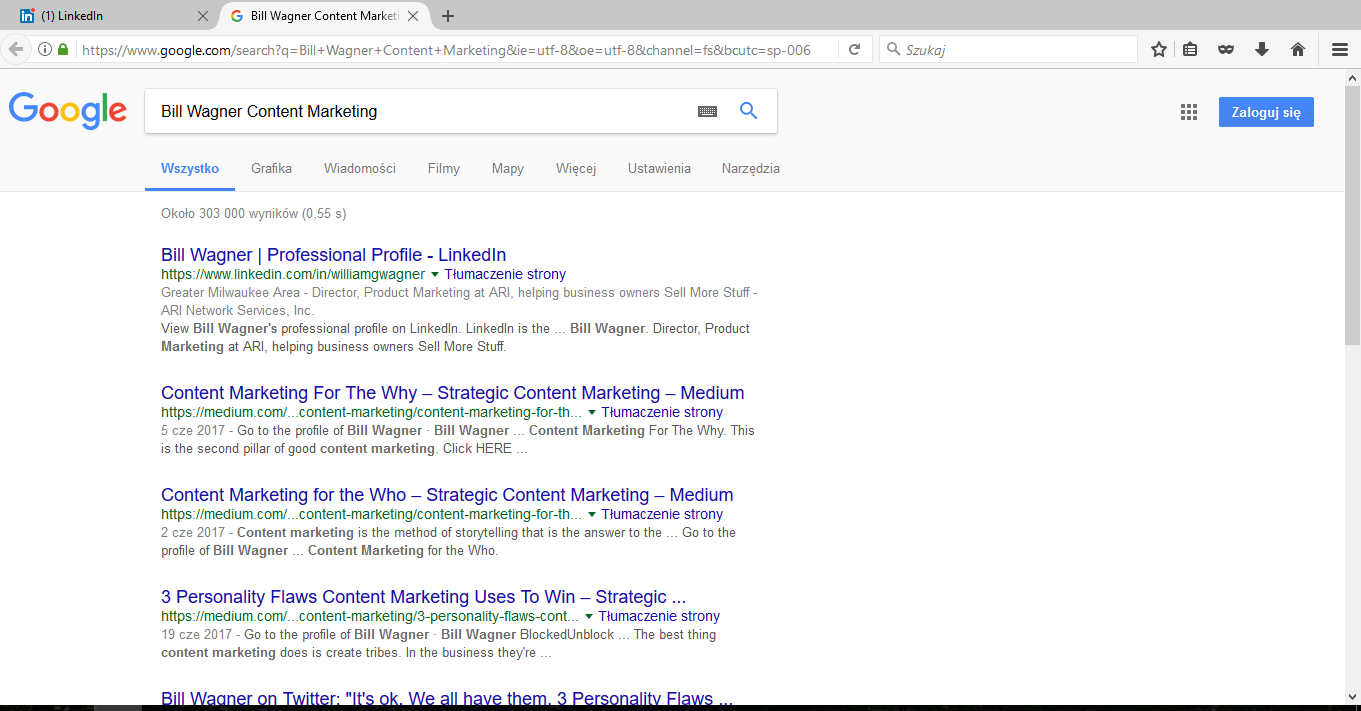
Using a long-tail keyword, I found my grind quite fruitful. I searched “Bill Wagner Content Marketing” and found my blog posts ranking on page 1 of results.

I was beyond happy. I actually clapped and giggled like a little kid at my desk. Then, of course, the skeptic in me raised his hand with a valid question: Were these results simply a by-product of searching on my own Google account?

That’s a good point. Let’s test that.

The benefits of social media paid off once more as I reached out to my LinkedIn network and Facebook friends for help. I asked for screen shots of their front page with the same long-tail keyword. Below is a sample of results. You can see more of them on my LinkedIn profile.

My social network is awesome!

Mobile searches yielded a few more paid results before my organic work showed up, but the data was clear. My blogging and automated sharing has paid off. A simple long-tail keyword is mine, all mine! (Cue the Dr. Evil laugh!)

Conclusions About The Process

Blogging works and this is proof. The secret sauce, the one thing you must do right now, the simple hack to make it all work? Time. That’s it. It takes time.

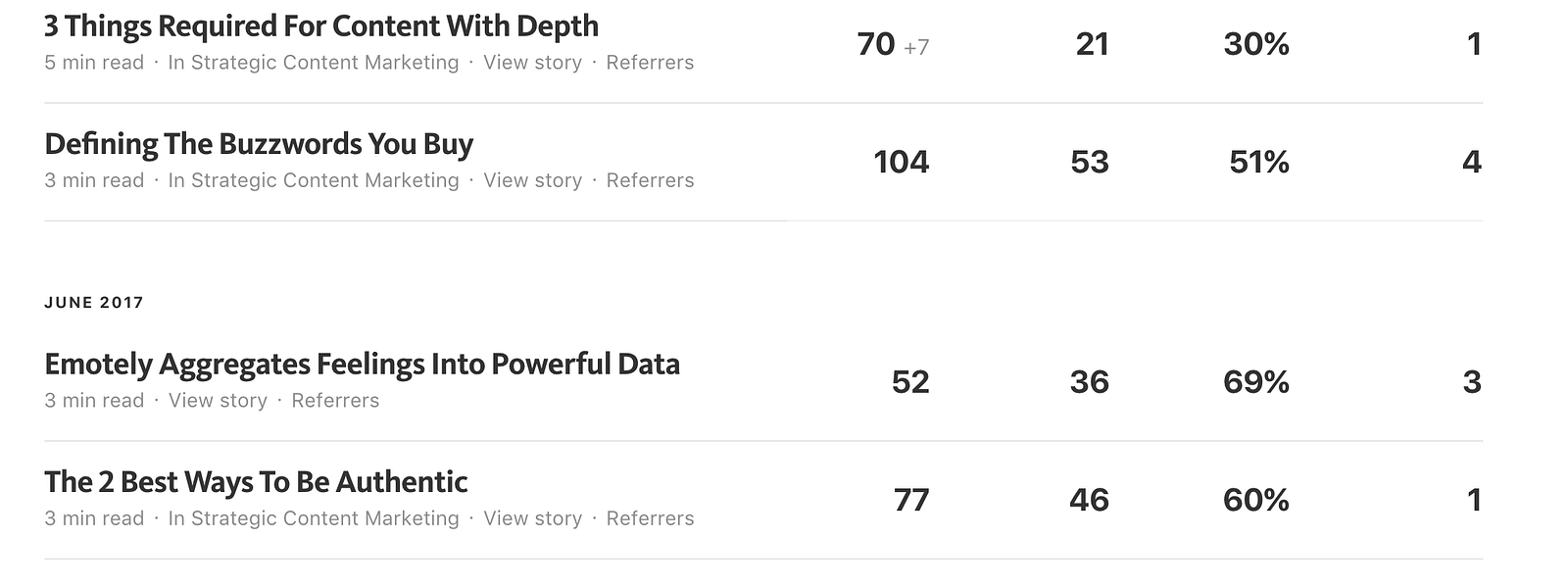
These posts were all written in June and July 2017. I shared them repeatedly over the last several weeks. The question you may be asking is how many clicks and reads does it take? Here are my Medium stats:

A big part of social media sharing is using the right platforms at the right times. LinkedIn and Google + are big parts of my strategy. Google + is very important for search because Google’s search algorithm prioritizes placement there.

The numbers speak for themselves. Obviously some of the stuff I wrote didn’t do as well as the rest. My personal favorite is Connecting With People Who Hate Your Shirt. Yet, my most popular post is about marketing buzzwords. There’s another one of those coming soon. Believe that.

My Beliefs Confirmed

I embrace the grind at my content marketing business Safe Strategies. Social media, blogging, graphics, videos, and all online content comes together to tell a multi-layered story that is your business.

This is just a tiny sample of how well-crafted content builds a great online presence. Let’s connect and chat about what you want out of social media and how Safe Strategies creates it. Increased engagement, better leads, and quality customer interactions are all things that happen when you invest time online.

Let’s chat. Connect with me on Twitter @LearningBill, on LinkedIn, or Facebook.

By Bill Wagner

Umpire and referee turned writer and coder. I delete more than I publish. I laugh at my own jokes, too. Follow my company on Twitter @SafeStrategies

Sourced from Medium.com

By Ayodeji Onibalusi.

It’s getting harder to get anybody’s attention. That’s why you can’t afford to stop trying.

Is social media marketing really dead? That’s one question business owners, marketers and leaders are currently struggling to answer. According to recent reports, social media platforms are losing their momentum, with the likes of Snapchat losing subscribers and Twitter losing the conversation appeal. This, in turn, is affecting the impact social media marketing has on business.

In a study of B2B buyers, only 19 percent of those surveyed said that social media played an important role in their discovery process. This report, among others from industry influencers, has sparked a new concern about the future of social media in business. But don’t be alarmed.

In reality, social media isn’t dead. In fact, it’s not dying anytime soon. It is very much alive and remains an effective tool for marketing your products and services. This is why 78 percent of companies have dedicated entire teams to social media and others have reported more than a 700 percent increase in social media sales from their efforts on social media.

If you are thinking of boycotting social media in your marketing efforts, think again.

1. When used right, social media helps reach a wider audience.

It’s undeniable the way we use social media today isn’t the way we used it a few years ago. Due to the fast advancement of technology, more people are now online, and the amount of information available is enormous. Users, bombarded with a never-ending flow of information on different social platforms, can only read a fraction of it.

As a business owner, you have a challenge to reach your audience in the midst of all this information. To succeed, you need to:

  • Know where your readers like to hang out
  • Understand the type of content they like
  • Strategically plan your content based on that information

It’s the only way you can guarantee readership and an increase in customer base. That’s why a company like TED, known for its TED Talks, is winning on social media. The company has managed to leverage its content by turning those long videos into short, easily shareable viral videos. They found their winning formula because they understood what their users were looking for.

2. It is only a promotional channel, not the end game.

To understand why you shouldn’t give up on social media, you need to understand how it works today. Some time ago, a business could easily go on social media to sell its products and services directly to consumers. Today, the landscape has changed.

People no longer appreciate direct sales on social media. They want to be enticed with interesting information or videos before they decide whether or not to buy what you’re selling. That’s why an informational blog post will be shared more times than an advertisement. By posting easily shareable content like videos, images or posts, you will:

  • Achieve better online visibility
  • Improve your credibility as an expert
  • Increase your customer base

3. Social media provides insights and helps convert leads into customers.

Through the data you are able to gather on different social media platforms, you can better understand the demographics of your followers, their preferences and their thoughts on your brand. This information can help you generate targeted content that will lead to improved readership, an expanded follower base and increased service inquiries — all of which are good for business.

In addition to providing valuable insights, social media is a great tool for converting leads to customers. When you respond to their concerns or make them feel special in some way, they regard your company as more desirable. They also become more loyal to the brand and are more likely to recommend your products or services to friends.

Through personalized customer service and regular interaction on social media, your business can gain new customers and retain existing ones very easily.

4. Social media helps increase website traffic.

In today’s digital era, the importance of website traffic cannot be overstated. More traffic to your website means more subscribers and more potential customers. You can later convert these subscribers into buyers, increasing sales.

While website traffic can come from different sources, including organic search and links from other websites, social media is a great component of it. When you post clickable content, people share it among their circles, and the cycle can be endless.

At a time when more people are online at one particular time, you can expect increased website traffic from increased social media presence.

Conclusion.

The reality is social media isn’t dead. I’s just changing and requires businesses to adjust accordingly. You have a shorter time than before to reach your audience, communicate your intention and draw them to whatever service you provide.

According to research, only 16 percent of your Facebook followers are able to see your company posts organically. And on Twitter, only 10 percent of your followers can see your tweet when it’s posted. To reach the right users, you need to make sure your content can be found. You can achieve that by sharing the right content at the right time and on the right platform.

The other reality is you cannot beat your competition without social media. Nearly 75 percent of companies using social selling report an increase in sales in 12 months. You do need social media in your business, and so do your users.

Image credit: erhui1979 | Getty Images     

By Ayodeji Onibalusi.

Ayodeji Onibalusi is an inbound marketing expert and advocate of high quality digital marketing. He has over five years of experience helping companies create winning content distribution strategies. You can check out his company…

Sourced from Entrepreneur