Tag

Social Media

Browsing

By

Twitter execs have outlined how they plan to bolster its ad business after missing Q3 revenue targets. It blamed the weak growth on bugs affecting its mobile product, which further hindered ad sales already weakened by the “seasonality” of a slow summer.

Revenues for Q3 were up 9% year-on-year to $824m. The US reported a rise of 10% to $465m, while international growth was slower at 7%, totalling $358m.

Sales fell short of the expected $874m. Growth slowed substantially since Q3 2018, when sales grew 32% year-on-year.

The results, which sent shared in the tech firm tumbling 20%, were explained by advertising “headwinds” driven predominantly by bugs in the company’s targeting system. In a letter to shareholders, Twitter explained the issue had affected its ability to target ads and share data with its measurement and ad partners.

The bugs reduced year-over-year revenue growth by at least 3% in Q3, Twitter wrote in a letter to shareholders.

Ned Segal, Twitter’s chief financial officer, explained the glitches in the legacy mobile application promotion (MAP) product meant information regarding users’ device settings was shared with Twitter for targeting purposes, even if they had asked it not to be.

“When we discovered that … we turned off the setting,” he said on an earnings call this morning (24 October). “That has a negative impact on revenue because it’s one less input you’ve got when you’re figuring out what ads to show people.”

Additionally, a bug meant Twitter was passing on data to measurement companies from users who explicitly asked not to be monitored in such a fashion.

“We stopped doing that, and although we are working on remediation, there isn’t remediation yet in place,” said Segal. “So, the effects of that will continue into Q4.”

Twitter recently faced criticism after it reported some users’ private email addresses and phone numbers had been exposed to its advertisers in a breach of its targeting system.

Aside from the technical issues, organic advertiser interest in Twitter dropped in the quarter, too. “Greater-than-expected” seasonality issues began in July and continued into August, due to what the company dubbed a “relatively lighter slate of big events” taking place when compared to the same period in 2018.

The sales slowdown occurred as Twitter continued to push its offer to advertisers on its global ‘#StartWithThem’ roadshow. The platform has a goal to double its ad business by 2020 and become advertisers’ most recommended partner.

Today, Segal outlined the company’s immediate and long term plans to bring more advertiser dollars into the business and appease Wall Street qualms.

He first stated the company will continue to actively market its platform to big advertisers. By way of example, he observed that while 38 of this year’s Super Bowl advertisers were on the social network at the same time as the game, there were eight “to whom we still need to make the case”.

“[We’re also] continuing to improve relevance, to continue to come out with better ad formats and improve versions of our existing ad formats,” he said.

He added Twitter could do a better job in monetizing smaller advertisers – an area it has not “prioritized” in the past.

“We’ve got to do the engineering work and make the case to them better than we are today, and right now we’re chosen to prioritize other things first,” he said.

Finally, he noted the Twitter ads experience could also be improved through better educating clients and working more closely with advertisers on their paid-for content.

“There’s also opportunity without selling one more ad to put better copy in the ads that exist today,” he said. “And we still have half of our video ads being served at longer than 15 seconds. As you can imagine on a service like Twitter, the completion rates for video ads that are six seconds are much better.

“That, along with continuing to improve relevance, better formats and moving down the funnel in terms of the types of advertising that’s available … are all things that ought to help us.”

Feature Image Credit: Twitter launched a consumer campaign in recent months / Jonathan Hokklo

By

Sourced from The Drum

By Jillian Kramer.

Before you post, ask yourself three essential questions.

Social media isn’t just a way to pass idle time (or to find inspiration for your next decorating project). It’s a valuable tool to tell your business’ story and build your brand. As Reena Goodwin, founder and director of Facteur PR, explains, social media gives business owners a direct line to current and potential customers. “By creating and sharing high-quality content and stories, social media opens a door to share a brand’s story on a deeper and more direct level,” Goodwin says. “When a brand shares its story on social media, that story helps build trust. And because a brand’s reputation is ultimately built on trust, it’s an important medium for any brand to harness.”

young man photographing French breakfast with croissants on the table in sidewalk cafe with smartphone in Paris, France
Alexander Spatari / Getty Images

What’s more, social media can be a free and useful resource for your business. “Its affordability is attractive to business owners,” says Goodwin. “The cost to launch a Facebook, Pinterest, or Instagram account is free, and your reach is dependent on the amount of resources you pour into it. Furthermore, the rich audience data is so helpful for businesses. By analyzing your followers’ behaviors, demographics, and interests, coupled with utilizing the various built-in survey tools, you can start to use the data to drill down audience personas, which can be very helpful when it comes to targeting your ideal client or customer as well as serving the ones you currently have.”

Here’s how to harness the power of social media to tell your story as well as build your brand.

Have a plan.

Goodwin advises against posting without a plan in place. A social media plan “makes sure that we are supporting the vision of our brand and helps manage expectations and resources,” says Goodwin. “It also ensures that we maximize our time strategizing upfront so we can devote our energies to executing our plan thereafter. A lot of social media management is spent reacting; with a plan in place in advance, we can be sure to allocate time and energy to the things that will ultimately help build our brand,” such as developing incentive opportunities and filming videos.

Before they post to social media, Natalie Denyse, owner of In Good Company PR, tells clients to ask themselves: “Why does this post matter to my audience? Does this photo show more than just a pretty scene? And, how is this post, both photo and caption, serving my community?” she says. “Feeling confident in those few areas will help crystalize the intention behind your voice.”

Respond to feedback.

Comments and messages left on your social media are opportunities to build your brand’s reputation, says Kathleen Reidenbach, chief commercial officer of Kimpton Hotels & Restaurants. When you respond in real-time—or as quickly as possible—shows excellent customer service, and gives you unique opportunities to interact with potential and current customers, Reidenbach explains.

For example, when Reidenbach found out through social media that a bride staying at a Kimpton Hotel property for her honeymoon had been stood up at her wedding, “the hotel quickly switched her room around to be more of a ‘we’re really sorry,’ party with chocolate, wine, and comfort food. It made her smile and she [told us] it made such an awful situation that much better and said she had an amazing solo honeymoon with us. That’s something that felt right to the hotel team and they acted in the moment, making for an incredible save-the-day story.”

Share high-quality content.

“Thanks to the instantaneous nature of social media, it’s widely believed that we must be posting content constantly,” says Goodwin. But that’s not strictly true. “By sacrificing the quality of content for the sake of speed, you could also be sacrificing the first impression your brand has on a potential customer,” she warns. High-quality content tells a better brand story, even if it means you post less often. “High-quality content is associated with a high-quality product or service,” Goodwin points out, “so it’s important to invest in content creation like professional photoshoots. I love batch-creating content to save time and money. You can hire a photographer on a quarterly basis to take updated photos for social media, or invest in a nice camera and snap your own.”

Show up on Stories.

Did you know that engagement on Instagram Stories is higher than on its newsfeed? It is—and that’s one reason why it’s essential to post regularly on Stories. “Stories is ideal for building your brand because in contrast to content on the newsfeed, it’s a space for less polished and more down-to-earth storytelling,” Goodwin explains. In fact, Denyse recommends to her clients that build their brands by showing the imperfect reality of being in business. “Real and raw video footage of brands actually building their business will continue to trump perfectly styled photos,” she says. “Don’t be afraid to get candid and show authentic moments of your creative process.

By Jillian Kramer

Sourced from martha steward

We know that exceptional content is what makes a brand. We also know that analysing our data to very specifically target audiences is crucial for great ROI. But we rarely put the two together and use the data available to actually analyse what content works – and why.

Yet knowing exactly why content works can give us that winning edge. And, luckily, the ability to see what indisputably resonates the most with our audience – and drives our bottom-line – is already in our hands.

The state of play

In the climate of the current ‘data boom’, audience targeting naturally takes precedence, with the majority (55%) of marketers saying ‘better use of data’ for audience targeting is their priority in 2019, according to Econsultancy.

It makes sense. On a daily basis, we’re faced with countless blogs, podcasts, speakers and everything in-between promising that if we perfectly optimise our targeting, our messaging will beat the daunting odds of the 0.9% CTR cited by WordStream. And so, we dedicate hours and hours every week to creating personas, hypothesising about audiences, segmenting users and running lengthy A/B tests to find the piece of content that our audience love. We add to our already-complex marketing stacks tools that tell us what messaging has been more successful, in order for us to optimise.

But when we do find that winner, do we know why it works? Do we know exactly what features caused the higher CTR? Do we know how we’re going to recreate it in our next campaign, to make it better, even?

This lack of knowledge – despite all the tools and techniques we use to offer insight – is what we at Datasine call the ‘black box’ because when it comes to understanding why, we are left in the dark. Just looking at results doesn’t give us the insight needed to truly understand content preferences in an actionable way.

Semantic content analysis

To crack open the black box, we need to start conducting in-depth semantic analysis of our content. Only then can we begin to truly understand why some content resonates and some doesn’t.

As experienced marketers, we come prepackaged with a deep understanding of – and fascination with – psychology and our audience, meaning we’ve already got the skills on paper to analyse our content. It’s simply a matter of breaking it down into parts. We’ll look at this in terms of images and text.

If you want to analyse your imagery, you can take all the image assets you’ve ever created and note down the particular elements you used in each, then check to see if there are any patterns which relate those choices to your ad performance.

For example:

  • Did you use a photo of your product outdoors? Or in the showroom?
  • Were people visible in the shot?
  • What was the size of the text, and the colour of any overlays or CTAs?

It may even be worth inviting a panel to judge your images on the emotions that they evoke, or photographers to assess the quality and composition of the shot.

You can do the same for text content, approaching this by categorising how you describe your product or service. For example:

  • Do you appeal to your product’s ease of use?
  • Are you emphasising your innovative credentials?
  • Do you use particularly casual – or formal – language?

With this process, we can see which types of content are receiving the most engagement. And we can use these features to keep creating great campaigns that we further optimise as our understanding of customer content preferences grows.

Scaling content analysis

If we have just a few campaigns on the go, content analysis is easier, but it gets harder as we scale. It stops being practical to expect humans to spend days, weeks, even months labelling what goes into each piece of content. Here’s where machine learning and artificial intelligence (AI) come to the rescue.

AI models can extract all of these elements in seconds by analysing image or text semantically to look at content like humans do. That way, we can cut back on lengthy, expensive A/B testing, and get rid of guesswork once and for all – a vision we at Datasine are working toward. Our AI platform Connect (formerly Pomegranate) automatically identifies the most effective content for your audience.

By embracing semantic content analysis and working collaboratively with AI, we can feel confident in understanding exactly what content is going to work before we hit send.

Sourced from The Drum

Sourced from eMarketer

Social media has become a hub of influence on many consumers’ shopping. Boomers, though, have been wary of this, whether via ads, postings by fellow consumers or the cajolery of “influencers.”

According to February 2019 polling by Oracle, social media ads inspire little credence from boomers. Fewer than one in 10 internet users ages 55 to 75 said they trust social ads for recommendations when shopping.

US Internet Users Who Trust Social Media Ads for Recommendations When Shopping, by Demographic, Feb 2019 (% of respondents in each group)

“It’s not just an aversion to straight-out advertising. Influencers are conspicuously uninfluential, too,” said Mark Dolliver, principal analyst at eMarketer and author of our latest report, “US Boomers 2019: ‘Aging in Place’ in Multiple Aspects of Life.

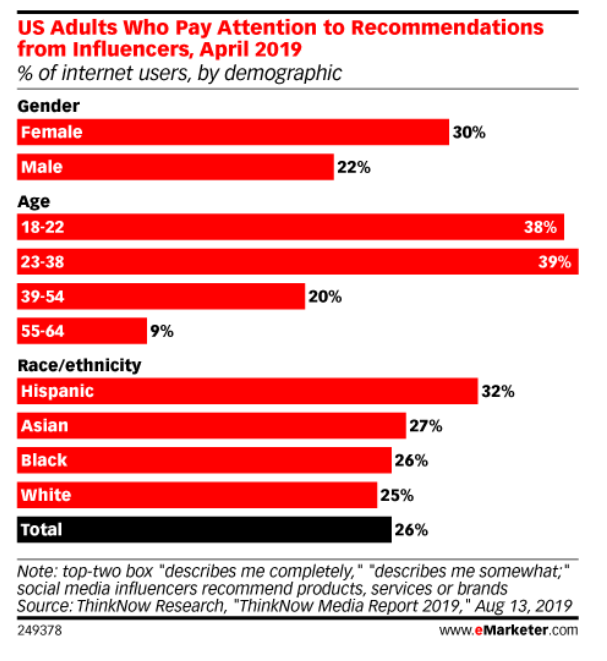
In Oracle’s polling, 96% of boomers (along with 90% of Xers and 79% of millennials) agreed that they “distrust influencers and bloggers.” Meanwhile, ThinkNow Research’s April 2019 survey found a mere 9% of 55- to 64-year-olds (vs. about four in 10 millennials) saying they heed what social media influencers recommend.

US Adults Who Pay Attention to Recommendations from Influencers, April 2019 (% of internet users, by demographic)

Boomers are also less likely than younger consumers to report being influenced by other peoples’ opinions online. In Oracle’s survey, 14% of boomers—vs. 22% of Xers and 28% of millennials—said they trust the recommendations of “fellow consumers online.” Similarly, a Charles Schwab survey in February 2019 found boomers about one-third as likely as millennials (16% vs. 49%) to say they are “likely to spend on experiences because of something they saw on social media.”

According to Joe Beier, executive vice president of GfK, there’s an important distinction between boomer attitudes toward “expert reviews”—those given by authoritative sources with credentials in a subject area—and reviews by everyday users. Boomers are less likely than younger people to find value in the latter. “What does Bill next door know that’s really going to enlighten me?” as Beier put it. But they do pay attention to the expert reviews. “Boomers have much more of an old-school view, ‘Ok, the experts are the ones that know what’s going on. And therefore they’re the ones I’m going to trust and look to help inform my decision.’ … If it’s just more of an anonymous pool of user reviews, there’s a certain skepticism about that,” he said.

While marketers view social media as a venue where they can bond with consumers, many boomers regard it as a place where companies invade their privacy. In March-April 2019 polling by CivicScience for the Internet Innovation Alliance, 79% of respondents 55 and older disagreed (62% “strongly”) with the statement, “I’m OK with online tech/social media companies that collect and use my personal data because it makes my online searches, advertisements and content more relevant to me.”

Few boomers are eager about social commerce. In the eMarketer/Bizrate Insights polling, about half of 55- to 65-year-olds said either that they haven’t made purchases via social and are uninterested in doing so (49%) or don’t know what that is (3%). Just 7% reported using it regularly.

Sourced from eMarketer

By

Australian publishers Seven West Media, Network 10, SBS, Foxtel Media, Pedestrian Group and Daily Mail have joined forces to launch a programmatic ‘Editorial Video Marketplace’.

The new marketplace, run by Telaria, aims to simplify buyers’ access to this professionally produced premium content with daytime audience reach and scale, as per the official statement.

Luke Smith, head of programmatic sales and audiences at Seven West Media said: “The demand from advertisers has been clear – that there is a need for quality video delivering high viewability and completion rates within brand safe editorial environments at scale.

“It is important that the premium value and impact of editorial video is able to differentiate itself from other forms of short-form like social video. This marketplace, available programmatically, will be a means to make that easily accessible for buyers and advertisers at scale,”

Flaminia Sapori, head of partnerships at media agency Cadreon said: “It’s encouraging to finally start seeing publishers working collaboratively to provide alternative independent options in this space — creating ease of access, and most importantly, a new narrative for editorial video, giving it the credit it deserves, and perhaps start influencing more social budgets being redirected to new premium ecosystems.”

The news comes after the Australian Competition and Consumer Commission (ACCC) released its final digital platforms inquiry report in July calling on the government to act against the tech giants.

ACCC had raised concerns, at the starting of the year, about the market power of Facebook and Google including the companies impact on Australian businesses, particularly their ability to monetize content, as well as outlined concerns about the extent that consumers data is collected and used by companies to target advertising.

Feature Image Credit:The marketplace aims to simplify buyers’ access to this professionally produced premium content.

By

Sourced from The Drum

By Dorothy Crenshaw 

Landing coverage in reputable news outlets is essential in this era of dwindling public trust. Skilled practitioners can seize the moment, with help from technology for metrics and scale.

Drastic changes in the media and cultural landscape have altered PR and marketing in recent years.

Challenges for PR practitioners include a faster-than-ever news cycle and what seems like constant political and cultural controversy. Combine that with an erosion of faith in government and private institutions, and it can make for a difficult environment.

How do we navigate the media landscape when “fake news” accusations are thrown around and the very business of media is under siege?

Yet the business of public relations is thriving. One reason is that PR is more relevant—and valuable—than ever. Here’s why:

1. Credibility is paramount.

According to the Cision State of the Media Report, 59% of U.S. consumers say they are suspicious of news content. On social media platforms, skepticism is far greater, as it should be.

This means the credibility of media outlets and other information sources is more important than in the past. The public values journalism, and people are moving to media channels they trust. Traditional news outlets like The New York Times and The Washington Post have reported double-digit increases, and cable news ad revenue is up a whopping 25%.

PR practitioners understand that a brand or personal reputation built through bylined content, executive speeches, legitimate user reviews and media profiles will earn the credibility that comes from implied endorsement by recognized third parties. That beats self-promotion every time.

2. PR drives SEO.

PR’s role goes beyond earned media coverage, but it’s still an essential piece of many PR campaigns. Established publications that link to a brand will boost search listings due to their domain authority, and ever since Google determined that brand mentions are “implied links,” they work harder to drive SEO. Anyone who has managed a content marketing program understands high-quality, “evergreen” content can live for years, pushing up page rank and attracting traffic for a brand or business.

3. PR generates influence.

Beyond earned media, typical PR tactics build relationships, engage influencers, and even help change public perception and behavior. PR skills once used exclusively in media relations are easily transferred to social community management, influencer relations, and content marketing. Word-of-mouth PR spread on social media platforms is not only cost-effective, but highly trackable and persuasive.

4. PR is (nearly) immune to ad blocking.

Publisher panic over ad blocking has largely receded, but the number of blocked impressions on mobile is growing as browsing migrates to mobile devices. What’s bad for digital content providers is also bad for the PR industry. Ad blocking cuts revenue for digital publishers just when they need it most. Yet PR programs that generate visibility through earned and owned content are more valuable than ever during times of digital marketing disruption.

5. PR is more measurable than ever.

Today, the outcomes of a PR program are more measurable than they’ve ever been, thanks to a concerted effort by the industry, but also to digital tools. Of course, metrics will always vary by program, but even with simple (and free) tools like Google trends and access to web analytics, we can often pinpoint the impact of earned and owned content and social sharing with a fair degree of accuracy. One digital business service has found that business profitability coincides almost perfectly with peaks in web analytics driven by earned media.

6. Goodwill has value.

What is more valuable than a brand (or personal) reputation? Many PR deliverables are powerful in building reputation over time, and social media accelerates and amplifies their impact. A glowing review (or unfortunate video interview) can blow up on social platforms in the time it takes to say, “Call the PR firm.” It’s hard to put a price tag on customer loyalty or positive perception, but in today’s unpredictable media environment, it’s like money in the bank.

7. Technology helps it scale.

What we do to generate earned media is not always efficient, and it has traditionally been hard to scale. Yet many agencies have added capabilities in content marketing, digital content creation and brand journalism that can amplify earned media or add to its impact through shareable content. Automation has changed intelligence gathering and data analysis, which often inform a PR program’s messaging and content.

By Dorothy Crenshaw 

Dorothy Crenshaw is CEO of Crenshaw Communications. A version of this post first appeared on the Crenshaw Communications blog.

Sourced from

By Julian Shapiro

We’ve aggregated the world’s best growth marketers into one community. Twice a month, we ask them to share their most effective growth tactics, and we compile them into this Growth Report.

This is how you’re going stay up-to-date on growth marketing tactics — with advice you can’t get elsewhere.

Our community consists of 600 startup founders paired with VP’s of growth from later-stage companies. We have 300 YC founders plus senior marketers from companies including Medium, Docker, Invision, Intuit, Pinterest, Discord, Webflow, Lambda School, Perfect Keto, Typeform, Modern Fertility, Segment, Udemy, Puma, Cameo, and Ritual.

You can participate in our community by joining Demand Curve’s marketing webinars, Slack group, or marketing training program. See past growth reports here, here and here.

Without further ado, onto the advice.

How do you sponsor YouTube influencers cost-effectively?

Based on insights from Bjarke Felbo of Rune (LinkedIn). Lightly edited with permission.

  • Influencers often expect compensation proportional to subscribers, but conversions happen proportional to views. So go after the influencers with high views and low subscribers. That’s the trick.
  • We’ve had the best success with 30-60 second promo spots at the beginning of the influencer’s video.
  • We’ve seen success depend on the video it’s attached to and what time of day/week it’s posted, so we’re strict about setting rules around that. Or, we give them a bonus based on the video’s view count to incentivize them to put our spot on a high-quality video.
  • Be careful with repeat promotions with the same influencer. These haven’t yielded noteworthy returns for us — even after months. It’s likely that the audience becomes saturated.

For SEO, how much does link building really matter in 2019?

From Nat Eliason of Growth Machine. Lightly edited by Demand Curve with permission.

  • Links are still important, but their importance is decreasing steadily. Google is getting better at evaluating content quality, and it’s focusing more on that.
  • Consider this: Google doesn’t want to be gameable, and domain authority and link building are very gameable. But content quality is not. You can’t fake good content.
  • Many major blogs outside of high authority spaces have grown rapidly using less link-building. Much of their energy is instead spent on choosing the right keywords (low competition, but still acceptable volume) and writing useful content that satisfies the searcher’s intent.
  • However, link-building can still speed up the process quite a bit if you’re on a tight timeline, or if you’ve given content 3-4 months to rank and aren’t seeing the results you want.

Growth masterclasses kick off now

Today, the advanced growth masterclasses kick off. They’re all free.

These are rapid-fire, short, and advanced webinars. They’re not boring introductory lectures. This is some of the best content we produce. Don’t miss these, especially when they’re free.

Enroll here: demandcurve.com/webinars

What’s the best way to take over a Twitter account from an inactive user?

Based on insights from Andrew Ettinger of Atoms. Lightly edited with permission.

Someone has your brand name as their Twitter handle and their account is inactive. How do you get access to it?

  1. Create an ads account with an existing handle you want to swap for the one you’re trying to claim.
  2. Go to twitter.com/en/help
  3. Click on Account issues -> Claim an inactive username.
  4. Submit a case.

You’ll then want your Twitter ads account manager to escalate your case (give them the case #).

This is not guaranteed. Your best chance of claiming that handle will be to have an existing Twitter employee escalate your case.

Demand Curve’s Asher King Abramson will lead a growth marketing session where he’ll tear down your landing pages and Facebook/Instagram ads in front of a live audience. He’ll deconstruct how effective they are at (1) conveying what you do (2) and doing so enticingly — so that people click.

Feature Image Credits: Anueing / Getty Images

By Julian Shapiro

Julian Shapiro is the founder of BellCurve.com, the growth marketing team that trains startups in advanced growth, helps you hire senior growth marketers, and finds you vetted growth agencies. He also writes at Julian.com.

Sourced from TechCrunch

By Boni Satani

Are you in search of some great social media tactics? Do you want to drive exceptional traffic to your business website? Here we share with you some useful social media tips to convert your visitors to leads.

Let us first understand social media and traffic.

Social Media and Traffic:

The social media world is home to more than 3.4 billion active users. Social media is said to be the primary source for generating eCommerce traffic. Social media leads ahead of the traditional media in driving traffic to your website. They bring in ample of opportunities to gain the business visitors and convert into leads.

How do you strike a conversation? How can you increase the visibility of your social media posts? How to engage your audiences? How to generate leads through constant digital engagement?

In this post, we’ll show you how.

Strategies to Boost Website Traffic:

For a relevant and persuasive social media marketing strategy, here are some must-have strategies to boost website traffic for your online store.

1. Optimize Your Social Media Profiles:

Social media profiles play a crucial role in brand building and recognition. A good social media profile can drive a good amount of traffic to your website. Optimizing your social media profiles are as important as optimizing your website’s SEO. Ensure your social media biographies include relevant keywords. Also, make sure you do not miss any information while filling your profile details.

Your website SEO will rank good if you add its links in your social media profile biographies. Also, this is an essential rule for good SEO on your website.

Thus, social media profiles can be a great asset to brand awareness. For an optimized website, a streamlined social media profile with the right set of keywords and information is a must.

2. Engage with Your Target Audience Consistently:

Social media helps you connect to your target audience directly. You can interact with your audience, get feedback in real-time, and better your customer experience. Consistent engagement with your audience can boost traffic to your social media profile and website. This also improves the opinion of audiences in the company’s perspective.

One of the most vital aspects of social media management is to keep your audience consistently engaged. Digital engagement with your audience is a seamless process and should not be combined with self-promotion. For a successful audience engagement with your brand or website, you need to consider several points in mind:

  • Social media is not a one-way strategy. It is more of a two-way street
  • Do not ignore your audience. Keep them engaged. Or else you might lose them in the process
  • Only 11% of customers receive replies from online brands
  • Nearly 34% of customers prefer social media for customer care

One of the social media marketing strategies is managing your social media inboxes regularly.
Once, you learn the art of using social media management tools, you can stay at the top of the social game. Lead through your single-stream inbox with social events, and a niche content in your social feeds. Gaining your audience’s visibility will take time, but you need to put efforts to drive traffic continuously.


3. Post Consistently:

Every social media user desires to achieve accountability of a good list of followers. Posting regularly on your social media can help you develop an excellent social media marketing strategy. Posting frequency and the number of followers and likes you gain depends on certain factors like:

  • Region/Time zone
  • Target Audience
  • Days in a week
  • Content
  • Hashtags
  • Profile bios

According to stats, different social media have different posting frequency.

  • For Twitter, the minimum posting frequency is 15 tweets daily
  • For Facebook, the minimum posting frequency is one post daily
  • For Instagram, the minimum posting frequency is 1-2 posts weekly

For this, you must measure the best frequency with your audience. You can also monitor the posting frequencies of other brands and your competitors. This helps you define your frequency to increase social media engagement.

4. Create Viral Content like Memes:

The term “viral” is pretty much related to social media. Anything you find unique, enticing or relatable has the potential to drive more traffic. Viral contents are quintessential if you want to increase your site traffic. However, it is not an easy deal at all. Remember, not all your posts can be viral. For content to be viral, it is essential that:

  • People have a willingness to share your content
  • People spread your message to reach the maximum audience

Some instances of viral content are the most lively example.

  • Memes:

We all dig into content that contains humor or hilarious memes. All of us are enjoying them and welcoming them. Some are funny videos, gifs, or images with secure messages or funny captions. You can easily incorporate these memes to your brands or products. Make sure you use it for fun and publicity. Stay away from any sensitive issues that may get in the way of your brand identity or that may stir controversy.

  • Content that Appeals to Human Senses:

The viral recipe or food videos are taking over social media by a storm. These drooling videos and visuals make us want more. These viral videos have something in common. They are appealing to human senses, and things that make them more indulging are

  • Sight (videos with vibrant colors and effects)
  • Hearing (upbeat music)
  • Smell (imagining the scent or aroma of spices)
  • Taste (mouthwatering recipes)
  • Touch (when your mouth touches these mouthwatering food)

5. Focus on Sharing Visual Content:

As per the factual figures, visual content can get you more likes and shares than the ordinary content. Invest time in creating visuals that speak volumes about you, your brand, and your niche products. Make sure your visuals are too unique to get unnoticed. Later, focus on sharing the same with your target audience.

The main idea of creating visual content is to obtain social media visibility. To create the out of the box visuals, here are some key points to include:

  • HD photography
  • Vibrant colors
  • Well-designed layouts
  • Well-planned visuals that deliver to the point information
  • Visuals that tell stories
  • Visuals focusing on services and products

6. Post Actively and When your Audience is Active:

The key to increasing your follower count is consistent posting. For these businesses have to be proactive in their social media game. To increase the visibility of your profile, focus on regular publishing. Once you see a spark in your social media traffic, do not be lazy to post. It is a continuous effort that you need to make to shine in this challenging world.

To maintain a publishing schedule, you can use social media management tools available online. You can also use social media planner or calendar to optimize your publishing activity. These tools help you post regularly considering the location, time zone, and necessary factors. Take out the metrics of how much you post typically on each social site, and what is the time you publish your post?

Following these, you can see substantial growth in your social media traffic.

6. Run Q&A Polls and Social Media Contests:

Social media contests and polls are interesting and exciting ways to engage your audience. Such activities also help you improve the communication gap between you and your target audience. Running quizzes, polls, and contests can indulge your audience in sharing, talking, liking, and following. This also makes them aware of your brand, website, and products.

Here are some powerful tips on how to host such activities.

Instagram:

Instagram has powerful and interactive features that help you connect with your audience. Go live on your social media, create polls in your story and use hashtags. You can use hashtags, or ask them to follow or tag your profiles. However, more importantly, create links that link to your site. Remember, we discussed why backlinks are an important part of your social media strategy.

Twitter:

The Twitter poll is an interactive feature on Twitter that helps you conduct polls. This helps you interact with your audiences and know their opinions and thought process. Another exciting and engaging feature is Twitter Q&A.

These features encourage your community to connect with you. More importantly, they build brand awareness and promote your products.

7. Research Your Competitors Thoroughly:

An actual marketing strategy is understanding how well your competitors are performing. The same holds for any social media marketing strategy. You can leverage the online tools to get insights and performance metrics of how your competitors. The social media competitive analysis helps you deeply analyze your traffic. They help you gather ideas and key performance metrics of your opponent’s social posts.

Social media is a challenging world to live in. Before plunging into posting sessions, get in-depth insights of your competitors. This gives you a clear vision of how you can build your social family. Do not imitate your competitors; instead, understand their strategies to create your own. This helps you analyze your competitor’s moves, such as:

  • Most engaging social media channels
  • Successful post in a day
  • Types of content published
  • Strategies to engage more traffic
  • How often they indulge in activities like polls and quizzes

8. Participate in Social Groups:

Join active community groups where you find high chances of getting your target audience. You can find people with the same interests and identify their inclination towards your products. You can join these groups on Facebook, YouTube, Whatsapp, LikedIn, and Pinterest. These groups can help you potentially drive traffic to your site.

Jot down what interests, characteristics, and personalities, your target market is comprised of. For instance, if you are a retailer of sports shoes, your target audience should be sportsperson and youth. So, it would help if you found online groups which have the same audience. Join such groups as an individual and then promote yourself as an influencer. This way you can improve your products and introduce them to your online store.

This is a smart way to become an influencer and promote your products and business on a larger scale.

9. Get Inspiration from Influencers:

The social media influencers are creating a significant impact in this digital world. Influencers are often referred to as “online celebs”. They have a huge followers count and immense popularity on social media. They have the power to influence the way their followers think. They have a big network of followers through their channels like social media, blogs, YouTube, etc.

You must identify the top social media influencershttps://blog.wishpond.com/post/115675437703/guide-to-influencer-marketing to boost your sales. The key to building this strategy is to find the right influencer to endorse your brand and products. And then focus on establishing a good relationship.

Conclusion:

Patience and persistence is the key to staying alive in the social media world.

Social media marketing strategies are great, but they take time to come into effect. These proven strategies are sure to reap benefits in the long term. Being customer-centric is the only key for a successful social media marketing campaign. Remember, social media is a game changer only if you use it the right way.

By Boni Satani

Boni Satani is a T Shaped Marketer with a Huge Interest in SEO & Link Building. He is currently the Director of Marketing at Zestard Technologies, overseeing multiple digital marketing campaigns for clients.

Sourced from wishpond

Are retailers hearing the call of mobile?

A recent report by Forrester found that smartphones were used in more than one-third of U.S. retail sales in 2018, from product research to checkout. For retailers looking to convert greater mobile sales, they might want to reevaluate their social media advertising.

According to a Think With Google survey, 51% of smartphone users purchased an item from a different company than originally intended, due to messaging appearing exactly when they needed it. That suggests social media advertising campaigns could attract new customers, if deployed strategically. Designed to help retailers capitalize on this opportunity, marketing platform SmarterHQ launched an Ad Personalization program on Tuesday morning.

In order for brands to acquire and retain valuable customers, they must have a personalized, cross-channel strategy that spans ad platforms,” said Michael Osborne, president & CEO at SmarterHQ. “But until now, targeting within these platforms hasn’t been comprehensive enough. Syncing first-party data to power highly relevant ads often requires extra manual work and IT resources, which has hindered these efforts.”

The program builds on SmarterHQ’s existing behavioral marketing offering, which centers on collecting omnichannel data to inform brand messaging. Through Ad Personalization, the same omnichannel analysis can be integrated with the user’s Facebook and Google advertising to create individualized and customized campaigns. These can then work in conjunction with email, web and mobile pushes that the user already coordinates through SmarterHQ.

But SmarterHQ isn’t the only company taking advantage of the growing emphasis on social advertising and the new data technology available. At Pattern89, an artificial intelligence (AI) platform for digital marketers, data from all of its customers is anonymized and run through the company’s algorithms. This turns more than 100 billion impressions into 2,900 dimensions of analysis that are available to all users.

Pattern89 Computer screen
The Pattern89 platform is popular with e-commerce brands looking to roll out new campaigns every few days. This made possible by AI, which is able to process data and generate new recommendations daily.
CREDIT: Pattern89

“One footwear retailer wouldn’t see the results of another footwear retailer because the machine doesn’t look at the data in that way,” said RJ Talyor, CEO and founder of Pattern89. “Instead, it looks at all of the red shoes, or all of the ads that are targeting women between the ages of 17 and 23. It anonymizes all this data, runs the analysis and identifies where the biggest opportunities are for you.”

Users of the program are then presented with a daily to-do list to optimize advertising performance, which Talyor estimates can be completed in five minutes. A new feature introduced this week, Gemini, enables users to automate the daily to-do list by clicking a “do it for me” button. Then there is the Creative Planner program, which makes broader advertising strategy recommendations based on AI learnings.

Artificial intelligence is becoming more common in retail; Salesforce projects that the percentage of retail and consumer goods marketers that are leveraging some form of AI will increase to 70%, from 20%, in the next two years. It also found that, during the 2018 holiday season, AI-powered recommendations yielded 14% higher, on average, order value.

Nevertheless, many retailers are still resistant to AI findings. As Pattern89’s algorithm looks at data from across industries, users receive insights collected from unexpected places; the same customer might buy both a pair of shoes and a mattress, revealing trends that work across contexts. But these recommendations can seem counterintuitive or untrustworthy, such as when one woman’s brand was told it should target men in its advertising. The brand chose not to follow the suggestion, but Talyor believes that not trusting AI is a mistake.

“There’s no bias in the machine; it’s looking for the lowest opportunity,” said Talyor. “It requires humans to intervene — and sometimes humans are unwilling to part with their intuition and their experience. But others are and when they do, they find untapped pockets of opportunity.”

Want more?

How Chatting on Social Media Could Bring Big Business Gains

This Mobile Platform Wants to Help Everyone Become an Influencer

This Acquisition Means More Data and Actionable Insights for Retailers

Feature Image: Salesforce found that 87 percent of consumers begin their shopping journey with digital tools, such as smartphones.CREDIT: Glenn Hunt/EPA-EFE/Shutterstock


Sourced from FN

By Pam Moore,

Content marketing is the new yet not new buzzword. The truth is content marketing has been around for decades, since conversations and business has existed. Content marketing is not a new shiny object invented via social media.

Yet, content is at the core of everything brands and people do online. Without content and humans, social media and digital marketing wouldn’t exist.

The big question is… how do you actually use content marketing to grow your business. Keep reading and I’ll help you understand the exact qualities of amazing content marketing.

Is everyone really a content expert?

Every agency, marketer and consultant seems to be talking about content marketing. Unfortunately very few of them have ever done it themselves or really know how to help others produce, integrate or distribute content to drive real results.

If you are working with a digital marketing or social media marketing consultant or agency be sure to look behind the magic curtain.

Do they have a blog, podcast or video channel of their own? When is the last time they wrote or recorded really good content? Is anyone reading the content? Is the content getting shared? Is it integrated with the rest of their business or is it an add-on band-aid?

When is the last time they sent an email to the list of names they have been collecting via their blog the past year? What were the open rates? How is their content converting to real business?

Do they have an editorial calendar or any rhyme or reason to why and how they are using content marketing, if at all?

It’s similar to the concept of the Facebook page pushers of a few years ago who were bashing “strategy” telling customers all you need to do is tweet and get a Facebook page for $1k with a side of a website that tweets for another $2k.  Those same people are now often slingin’ Facebook groups or some random other shiny object telling you it is going to save your business.

It’s crazy how now overnight they are all “strategy experts” yet in checking their career profile you’ll find they have spent little time to none actually ever doing strategy for any real business, including their own.

You get what you pay for with any service or product. The best thing you can do is educate yourself the best you can and do your research. It doesn’t have to be more expensive or take more time to do it right. Chances are finding a resource with the right experience to help your business will save you money and bring a higher return than many of the fly by night social media operations.

Becoming a social business is not the same thing as doing social media or being social. Social business requires integration of processes, mindset changes and direct investment in specific goals and objectives.

What is content marketing?

Content marketing is an umbrella term encompassing all marketing formats that involve the creation and sharing of content in order to engage current and potential consumer bases. Content marketing subscribes to the notion that delivering high-qualityrelevant and valuable information to prospects and customers drives profitable consumer action. Content marketing has benefits in terms of retaining reader attention and improving brand loyalty.
*Source: Wikipedia

Content marketing is a marketing technique of creating and distributing relevant and valuable content to attractacquire, and engage a clearly defined and understood target audience – with the objective of driving profitable customer action.
*Source: Content Marketing Institute

I know what it is, now what?

I like to simplify where many want to complicate. Below are what I believe to be the top attributes for content marketing that will drive results.

If you have spent any time working in marketing then this should seem like common sense to you.

Bottom line you want to develop content that inspires and connects with your audience with a goal of bringing them closer to you and your brand. You want them to click, double click, share, and come back for more.

28 Qualities of Content Marketing that Rocks! 

1. Goal Driven – Set goals and objectives for each piece. Is the goal to inspire, educate, establish authority, generate leads? Should support higher level business and marketing goals and objectives.

2. Audience focused – Content must be focused on the reader more so than your own self promotion. Know your audience. Know what they want, need, desire. Get in their head and connect with them via content that helps them in business and/or life.

3. Findable – If your target audience can’t find it, it’s all for nothin’!

4. Shareable – Make it easy for people to share with their friends on Twitter, Facebook, LinkedIn, Pinterest, email, etc.

5. Simple – Shouldn’t require a PHD in rocket science to understand.

6. Authoritative – Author speaks and writes from knowledge, experience and authority.

7. Engages – People are inspired to click, double click, comment and become part of the community.

8. Actionable – Should be clear what action the reader should take to learn more, join community, contact you for further information, hire you, request proposal etc.

9. Real – Should have a healthy balance of transparency, authenticity and professionalism.

10. Believable – There should be no doubt that they can trust you and believe what you say. Many factors play a role with this including design & layout of site, source of content, grammar, quality of information, authority and more.

11. Validated – If facts, data, or stats are used the source is clearly provided and all can be validated as truth. This will also help establish authority and ensure content is believable.

12. Valuable – Provides reader with valuable content to help them learn, grow or be inspired.

13. Relevant – Should  be relevant to where the reader is in business or life.

14. Resonates – Should invoke a feeling of shared emotion or belief with the reader.  They should understand and be able to relate to the content, context and meaning.

15. Compelling – Grabs attention, unique enough to read, understand, persuade, change thinking and remember.

16. Integrated – Not stand alone information. You brand, expertise, experience, services offered should support the content to best establish authority, believability etc.

17. Educational – Provides value in regard to knowledge and teaching of a topic reader is interested in.

18. Passionate – Should be obvious the writer is passionate about topic and is not just writing to drive blog traffic or other objectives.

19. Positive – Who wants to read a blog that does nothing but complain? Not many people. Content should be positive and make the person feel better, know more and be inspired to do more whenever possible.

20. Forward thinking – Should not dwell in the past, old technology but should at minimum be present day and preferably forward thinking. Take people along with where you are going if you are visionary person.

21. Inspires – Inspire readers to learn more, do more, be more and become one with you and your brand.

22. Connects – Inspires the reader to connect with you and your brand. Your goal is to build and nurture a relationship with them.

23. Achieves – Helps the reader, viewer or listener achieve their goals. If you focus first on helping reader achieve their goals, you will achieve yours by default.

24. Purposeful – The content has a purpose, is not rambling, meaningless mumbo jumbo.

25. Brand loyalty – Content should help drive brand loyalty with reader. The content should be a good representation of your brand, personality and not a glossy piece of corporate collateral from the 1990’s that describes what you wish you would be when you grow up.

26. Quality – Content is of high quality. Should not be written in a hurry, have grammatical errors or read like it was written by a 5th grader.

27. Open – Author is open to other ideas, willing to enter into a healthy debate and genuinely listen to differing opinions.

28. Conclusive – It has an end. It doesn’t just ramble and ramble but it is clear when the content piece starts and ends.


Avoid the following: 

  1. Focusing too much on sales. You don’t want to sound like a used car sales person.
  2. Overly opinionated.
  3. Closed minded.
  4. Argumentative. Don’t bite the fingers off of your readers who may comment with a differing opinion. Be open to new ideas and opinions.
  5.  Egotistical.
  6. Self promotion.
  7. Random Acts of Marketing – If it’s not in the budget, not in the plan and not integrated then chances are it’s a RAM. RAMs will eat every last dollar of your ROI for lunch, breakfast & dinner. Avoid them at all cost!

Supporting Resources:

By Pam Moore

CEO / Founder Marketing Nutz, full service social media, digital marketing, experiential brand, conversion optimization agency. Ranked by Forbes as Top 10 Social Media Women and 10 Social Media Power Influencer. Keynote speaker, author, strategist, consultant, coach, & trainer. Helps businesses of all sizes integrate social media into the DNA of their business, connect with target audiences to nurture authentic customer relationships. 15+ years experience working with Fortune 500, Franchised corporations with 4000+ local franchises to entrepreneurs and startups.