Researchers from LUISS Guido Carli University have published a new study that examines whether and how subtle shifts in language arousal might shape consumer engagement and the way it affects perceptions of influencers’ trustworthiness.
The study, published in the Journal of Marketing, is titled “How High-Arousal Language Shapes Micro Versus Macro Influencers’ Impact” and is authored by Giovanni Luca Cascio Rizzo, Francisco Villarroel Ordenes, Rumen Pozharliev, Matteo De Angelis, and Michele Costabile.
Companies increasingly turn to popular social media personalities to promote their brands, products, and services. The influencer marketing economy was valued at $21.1 billion in 2023, and more than 90% of brands enlist influencers with a small audience (micro) or with massive reach (macro) to connect with consumers and achieve a variety of marketing goals, from creating awareness to increasing sales.
Influencers have the potential to diffuse marketing messages and drive actions, but it is unclear why some of their posts get a lot of engagement while others do not. One possibility is that consumers are increasingly aware that influencers get paid to promote products, raising questions about their motives. Additionally, anecdotal evidence suggests that when influencers use high-arousal language (e.g., “it’s totally amazing!”), it leads to questions about their trustworthiness, which in turn leads consumers to engage less with the content.
Micro vs. macro influencers
Consumers typically see micro influencers as regular people, so if they say something like “this shake is AMAZING!” consumers believe they really are excited about that shake and just want to share this discovery with their friends and followers. This belief in their sincerity increases consumers’ trust in micro influencers.
However, macro influencers do not seem like regular people. Consumers know these influencers receive substantial sums to say positive things about products, so they judge their posts as an attempt to persuade, just like any other form of advertising. Believing that someone has manipulative intentions tends to decrease trust. Yet the negative effect of high arousal posts by macro influencers could be mitigated if their posts offer more informative (vs. commercial) content or if the messages are more balanced.
The researchers collaborated with an influencer marketing agency to acquire a sample of 20,923 Instagram-sponsored posts across industries from 1,376 U.S. influencers. They measured engagement as the sum of likes and comments that a post receives. To measure language arousal, they combine a words-based lexicon (including terms like “hectic,” “amazing,” and “sensational”) with paralanguage (i.e., exclamation marks, capitalization, and emojis).
They used 100,000 followers as the cut-off to classify micro versus macro influencers. To measure how informative the post goal would be, they validated a dictionary with words like “explore,” “read,” and “watch.” Finally, more than 100 controls were employed, including details about the influencer, the text and images shared, and so forth. Combining the field data and controlled experiments led to some compelling results.
The researchers note, “For micro influencers, we find that a 10% increase in arousal is associated with a 5.4% increase in engagement, on average. Recommending a product by saying, ‘It’s superb’ rather than ‘It’s great,’ for example, would attract 49 additional likes or comments. However, our findings raise concerns for macro influencers. If macro influencers increase arousal in their posts by 10%, it reduces consumer engagement by 8.4%, on average.”
However, macro influencers are not completely forbidden to express excitement. Since signalling an informative goal is associated with a 1.8% increase in engagement, they can share informative rather than commercial posts. Also, admitting some concerns or noting some negative aspects of the promoted product can help macro influencers seem more genuine, which also increases engagement.
Finally, macro influencers can use high-arousal language if they also include words that signal trustworthiness (e.g., “learn,” “help”). Thus, brands and macro influencers should collaborate to make sure their posts include phrases like “that’s what I learned about this incredible product” rather than “that’s how to use this incredible product.”
From Instagram to TikTok
These findings are not limited to Instagram. The study provides evidence that language arousal also plays a role in TikTok, with relevant influences on its young target market. “We gauge influencers’ vocal cues and the level of pitch in their voices as proxies for arousal. A higher pitched voice can signal greater arousal, and in line with our Instagram study, we determine that a higher pitch, and higher arousal, voice exerts a negative effect for macro influencers,” the researchers say.
This research underscores the importance of aligning social media posts and language arousal strategies depending on the type of influencer. For micro influencers, using high-arousal language authentically can enhance engagement, but macro influencers should focus more on informative content to maintain their trustworthiness.
Exploring the impact of language arousal on emerging platforms like TikTok is especially crucial when it comes to targeting young, savvy consumer audiences effectively. This research could be extended to politicians, scientists, and other high-profile individuals and the statements they issue.
The convergence of ecommerce with social media influencers creates a dynamic symphony of trust, engagement, and sales.
The digital revolution in ecommerce has brought forth numerous innovations, with the role of social media influencers standing out distinctly. These online mavens, each with distinct flair and following, are crafting a new narrative in online marketing. Central to this transformation is social commerce, an innovative strategy that weaves shopping into the tapestry of social media.
Unpacking the phenomenon of social commerce
Social commerce signals a paradigm shift in how consumers experience online shopping platforms. Rather than the traditional browsing and searching, it offers a richer, more engaged shopping journey. Modern consumers, especially those in the millennial and Gen Z demographics, are tightly intertwined with their social media accounts. Platforms like Instagram, TikTok and Facebook aren’t just for entertainment; they serve as lifestyle compasses, guiding users in everything from pop culture to shopping choices.
In this digital landscape, influencers have carved a niche for themselves. Their content, genuine and relatable, shines bright amid the bombardment of traditional advertisements. When these influencers vouch for a product, it’s seen not as a sales pitch but as a sincere recommendation. Augmenting this is the allure of convenience that social commerce brings. The process is incredibly streamlined; one can spot a product on a post or story, swipe or click on it, and be led directly to an online checkout. The entire experience is swift, smooth, and satisfying.
The inimitable role of influencers
At the core of the social commerce machine are influencers. These individuals, with their varied followings, are more than just digital personalities; they’re pillars of modern marketing. Unlike celebrities who might endorse various products, influencers are selective, ensuring their endorsements often stem from personal experiences and align with their brand. This selective approach, combined with their domain-specific expertise, makes influencers trust magnets.
For instance, a beauty influencer’s tips on skincare are valued because they’re backed by experience, while a tech influencer’s gadget review is awaited for its depth and authenticity. Additionally, influencers prioritize engagement. Their interactions aren’t limited to broadcasting content. They chat, conduct polls, share snippets of their lives, and create a shared digital space with their followers. This two-way communication fosters a bond, a digital kinship that’s deeply valued. Another feather in their cap is their expertise in visual content. In an age where visuals dominate, influencers, with their compelling images, videos and stories, hold their audience’s rapt attention.
Strategic collaborations for mutual growth
The collaboration between brands and influencers is multifaceted. There is sponsored content, where influencers create posts or videos infused with their personal experiences with products. While promoting, they ensure transparency, often tagging these as #ad or #sponsored. Then there’s affiliate marketing, a performance-centric approach where influencers reap rewards based on the sales generated via their unique links.
Some collaborations transcend regular promotions. Think of a renowned beauty influencer launching a limited-edition product line with a major brand. Such initiatives blend the influencer’s personal brand with the product, promising authenticity and unparalleled quality. Beyond these, some brands envision a longer journey with influencers, turning them into brand ambassadors. This deep relationship ensures that the influencer becomes an enduring face and voice for the brand.
Enduring impacts and considerations
The synergy between brands and influencers leads to tangible benefits. Enhanced brand recall, exponential growth in sales and spikes in website traffic are common positive outcomes. On the trust front, influencers act as a bridge, lending their credibility to the brands they endorse. However, like all strategies, this one isn’t without pitfalls. Over-commercialization can dilute an influencer’s authenticity.
Moreover, ensuring that the influencer’s personal brand aligns with the corporate brand is crucial. Then, there’s the challenge of measuring the intangibles. While metrics like clicks, views, and sales are straightforward, quantifying trust or brand perception remains nebulous. It’s also crucial to remember that influencer marketing isn’t an unregulated frontier. Clear guidelines, especially about disclosures, exist, and both brands and influencers must adhere to them to maintain credibility and avoid legal pitfalls.
Conclusion
The convergence of e-commerce with social media influencers creates a dynamic symphony of trust, engagement, and sales. For consumers, it offers a shopping experience that’s rich, trustworthy, and interactive. For brands, it’s a golden ticket to visibility and authenticity in a crowded digital marketplace. Looking ahead, with innovations on the horizon, this partnership promises to redefine the retail landscape further. In a rapidly evolving digital world, the bond between e-commerce platforms and influencers is beneficial and essential. They aren’t just changing the game – they’re crafting a new one for the next generation of online shopping.
Founder & CEO Benevolent by nature, Kartik is a diverse man of diverse and unpredictable choices, a serial entrepreneur. One may find him not just reading stoics or seizing the present like jumping off a plane. He is pro skydiver/licensed scuba. He doesn’t speak in hypotheticals and lives life by doing.
It’s no secret that social media has become a very important part of our lives. It’s not just about connecting with friends and family — it’s also home to brands and creators building communities.
o far, we’ve all enjoyed free, ad-supported social media platforms, but that could be changing. Many platforms have seen their ad revenues drop due to several factors, and now they’re looking to make some changes to their business model.
Enter the subscription-based social media model. Today, let’s explore what this model looks like and how it could change the future of social media.
The problems with ad-based social media
Ad-supported social media platforms are focused on one thing: generating revenue through targeted advertising and sponsored content. Thanks to their large user bases and complex targeting algorithms, ads have made these platforms extremely profitable over the last few years.
However, this model isn’t without its issues, including privacy concerns, prioritization of sponsored content over more relevant content to users, and a lack of transparency regarding user data usage. This leaves many users feeling unsafe on these apps.
In response, Apple released its App Tracking Transparency feature, which allows users to stop social media platforms from tracking them. While this was a great tool for users, social platforms like Facebook announced that they would end up taking a major ad revenue hit as a result.
This was an existential threat to the ad-based social media business model, so it’s no coincidence that they all started introducing paid subscriptions before long.
Snapchat+, X Premium, Meta Verified and YouTube Premium — social media companies created these subscriptions to reduce their dependence on ad revenue. But what does this subscription-based model mean for marketers?
Understanding the subscription-based model
The subscription-based model is a mixed bag for marketers, with some distinct advantages for brands that subscribe and major risks as more users buy in. Let’s look at how this approach changes the digital marketing landscape.
Ads will be less effective — For users, one of the biggest selling points of these premium social media subscriptions is often that they reduce or outright remove ads. It’s great for users looking to free up some space on their feeds, but it could prove to be a major problem for marketers, leading to:
Loss of target advertisingwill make it difficult for brands to reach their ideal customers efficiently and could limit their ROI. When platforms begin to remove ads from social feeds, brands lose the ability to reach that audience, making it almost impossible for marketers to reach their projected KPIs for paid campaigns.
Increased reliance on organic reach — As audiences become harder to reach with paid ads, brands must rely more on organic reach to connect with them. This could get extremely competitive as it places brands on an even playing field with all other users on the platform. Tactics like influencer marketing will be key to reaching those premium users.
Challenges for small businesses with limited resources — Smaller brands may not have the budget to invest in influencer marketing or sponsored content, meaning they’ll face an uphill battle to reach their audience.
Leverage unique features
One of the upsides to the subscription model? To make these subscriptions worthwhile, social media platforms have a new incentive to develop new features for marketers and creators.
Take X as an example. Before, verification check marks were reserved only for large, reputable accounts. Now, any brand subscriber can verify their account, unlocking longer character counts, formatting features, editing posts and more.
Of course, there’s a dark side to this, too. You may recall a few months ago when TweetDeck, now known as X Pro, became locked behind the X Premium subscription after years of being free for all users.
To stand out from the free versions of their platforms — these subscriptions need exclusive features such as verification, improved content moderation systems, enhanced customization options and more, even if that means making users pay for something that was once free.
The elephant in the room
That’s right, we have to talk about Elon Musk and his place in the subscription-model conversation. That’s because while many platforms have introduced premium subscriptions, X is the only one that seems to be considering charging all users for access. Is that where every social platform is headed?
Short answer… no.
It’s hard enough to convince someone to pay for something that’s always been free. Still, it’s hard to see most users coughing up the cash when that something is X. It’s true that the ad-supported social media model has weaknesses, but it’s still a winning formula for making money.
Beyond profit, there’s also an ethical argument against charging all users for access to the platforms where they communicate. Not everyone can afford to pay a recurring fee for access to a social media platform.
This raises questions about inclusivity and the risk of creating digital divides, where those who can’t afford subscriptions are excluded from online communities — further deepening existing societal inequalities. For better or worse, social media has become a vital part of people’s daily lives.
Any move towards charging users must be carefully considered and balanced with measures to ensure inclusivity and fairness. A subscription-based social media model has the potential to address many of the problems associated with ad-focused platforms, but it also has the potential to create entirely new problems.
The only constant in social media is change, and that’s still true now. Ultimately, the success of such a model will depend on its ability to deliver real value to users and build trust in a more transparent and ethical social media ecosystem.
Christopher Tompkins is the CEO and founder of The Go! Agency and an internationally renowned expert in digital marketing. With more than two decades of experience, he has turned The Go! Agency into a top-ten marketing agency in Florida and a top-25 digital marketing agency nationwide.
The digital landscape has shifted significantly, but your brand can still thrive on social media in today’s world. Here’s how.
In the dynamic digital landscape, the role of social media is continually evolving. Today, an estimated 4.9 million people globally are on social media platforms, but the way we consume content, plus the content itself, has shifted significantly since the boom of these platforms in the late 2000s and early 2010s.
Today, some argue that with the surge of influencers, brands may no longer hold their once-celebrated place on platforms like Instagram, Twitter or TikTok. Going a step further, with the substantial increase in advertising and sponsored content, many users have learned to tune out brands selling their products or services through social media.
I’ve been helping my clients leverage social media for the past 15 years and have seen first-hand the shift in what kind of content performs well and what strategies and metrics actually translate to a higher ROI.
Ultimately, in this multifaceted digital playground, there’s no denying that it’s becoming harder and harder to capture an audience’s attention. However, when brands can understand the platforms and how each user base reacts — and create authentic, relatable content — they can maximize their reach, improve brand awareness and perception, and build a consumer base that not only trusts your content but is excited to see it.
Metrics that matter: Going beyond follower count
To optimize your content, you first need to understand your objectives and what metrics are important for evaluating the success of your strategy. In the early days of social media, follower count was the main — if not, only — metric that brands cared about and agencies tracked consistently. Even just a few years ago, despite the rise of bot followers and purchased likes, a brand’s clout could still be relatively gauged by its follower count.
Today, however, this metric is becoming increasingly obsolete. Since TikTok came onto the scene with its personalized approach to user “For You” feeds, other platforms like Instagram and Snapchat have followed suit, integrating similar features into its platforms and mimicking TikTok’s algorithm. With this shift, users no longer needed to be following an account to see its content — instead, the platform itself sorted through millions of posts to present a perfectly curated page of content for each user. These discovery pages often now have the highest user traffic and have ultimately reduced the user’s need to “follow” individual pages.
With the rise of these personalized recommended feeds, other metrics like views, engagement and reach have become better measures for audience resonance and brand perception overall. While followers will always be a relatively important measure of a brand’s clout, understanding how your users are finding your content will help you tailor your posts for both new and existing followers.
Creating your home base
Consider this: If someone hears about a brand, where’s the first place they’re likely to look? More often than not, they go to social media. A strong, consistent presence can legitimize a brand, enhancing its credibility. It’s where customers come to “window-shop” — to learn more about the brand, its ethos and its offerings.
In a 2021 survey by Sprout Social, they found that 68% of consumers have actually purchased at least one product directly from social media. With the shift to “for you” pages as previously mentioned, social media is also becoming increasingly effective at introducing new products and brands to shoppers who otherwise wouldn’t know about it. Plus, with the rise of affiliate marketing and social media shop features, a brand’s social media profile has become an actual digital storefront, as your audience can purchase products directly through the app.
In essence, social media profiles have become a brand’s digital home base. As such, a poorly managed profile or one with just a few low-quality posts can raise red flags for potential customers and actually de-incentivize a purchase. Ensuring your social media pages are well-branded, consistently managed and polished will improve your chances of attracting and retaining customers long-term.
The way forward: Authenticity and collaboration
Ultimately, a brand’s social media strategy should revolve around developing engaging content that provides a direct value to your target audience. These days, with hundreds of thousands of brands and creators all fighting for views, it can be difficult to know what to post. So, how should brands navigate this transformed landscape?
Storytell, don’t oversell: Traditional advertising monologues won’t cut it. While you can, of course, have posts about the benefits and details of your products, brands need to foster conversation and go beyond ad posts to build an actual persona that consumers want to connect with. Engage with followers, respond to comments, and be part of conversations that your audience is having.
Collaborate authentically: Partner with influencers who genuinely align with the brand. It’s not about getting the creator with the most followers, but about finding those whose audience will genuinely resonate with the brand’s message and who will create high-quality content that your audience will love.
Diversify content: Go beyond the up-close, photoshoot-quality product shots. Share genuine behind-the-scenes glimpses, customer testimonials or even relevant industry news with your brand’s perspective. The goal is to offer value and keep the audience engaged with a variety of on-brand content that won’t seem repetitive.
Harness user-generated content (UGC): In the same way as word-of-mouth marketing, UGC is a valuable tool to provide credibility for the brand. In fact, a report by Stackla found that consumers were 2.4 times more likely to view UGC as authentic compared to content created by brands. Reposting and encouraging UGC not only provides authentic testimonials but also fosters community and shows customers that they’re valued.
While the landscape has shifted, counting brands out of the social media equation would be premature. Instead, the onus is on brands to evolve, re-strategize and leverage the platforms in ways that align with today’s digital dynamics. By focusing on authenticity, building genuine collaborations and establishing a consistent digital presence, brands can not only remain relevant on social media but thrive.
Entrepreneur Leadership Network® Contributor. Founder & Managing Partner of BLND PR. Bryanne DeGoede is the Managing Partner of BLND PR. With 15+ years of experience in marketing & PR, Bryanne has managed media for hundreds of companies, including Fortune 500 brands. With a proven track record of delivering results, BLND PR is one of the most successful boutique firms in the US.
Social media offers a level playing field for startups to build their brand presence, but the high competition necessitates a strategic and streamlined social media branding approach.
Did you know that there are over 4.62 billion active social media users worldwide? With such a massive audience, it’s no wonder that startups are leveraging social media branding to create a strong online presence and grow their businesses. But the competition is steep, and you must apply a strategic approach to stand out and make heads turn! So, let’s delve into the world of social media branding for startups. We’ll explore how to build a strong image and thrive in the digital landscape.
The power of social media branding for startups
Social media branding offers numerous benefits for budding startups. It’s not just about creating a logo or a catchy tagline; it’s about creating a unique recognition and following online that resonates with your audience.
First, increased brand awareness is surely one of its biggest benefits. Startups can harness social media platforms for branding by actively responding to customer feedback, initiating meaningful conversations through targeted content and hosting interactive sessions like Q&As or live streams to engage directly with their audience. This proactive approach fosters trust and builds a loyal community around the brand.
Enhanced customer engagement is another unique advantage of social branding. Platforms like Twitter and LinkedIn provide a unique opportunity for startups to interact directly with their customers and build lasting relationships. On Twitter, startups can engage in real-time conversations, respond to feedback, and address concerns, while LinkedIn allows for professional networking, sharing industry insights and fostering community discussions.
Similarly, startups can create community groups, host live sessions and run targeted ads to foster engagement on Facebook. With its visual-centric approach, Instagram allows brands to showcase their products, share behind-the-scenes content, and collaborate with influencers for wider reach.
But it’s not just about engagement and awareness. Effective social media branding can drive more traffic to a startup’s website through quality content, increasing sales and revenue. This is especially effective with video content, as 61% of customers are convinced to purchase based on the brand’s video.
Are you ready to leverage the power of social media platforms to elevate your new brand? Here are some tips to help you apply social media branding for your business effectively.
1. Establish a consistent brand identity
A strong brand identity is crucial for a startup’s success on social media. To create a consistent brand identity, define your brand’s mission, vision, values and target audience. Next, develop a unique brand voice and visual identity that resonates with your target audience.
Consistency is key, so ensure that your logo, colours, fonts and messaging are uniform across all social media platforms. Most importantly, always ensure your brand’s messaging is laser-focused on your target audience.
2. Choose the right platforms
Not all social media platforms are created equal. Each platform has unique features, demographics, and content formats; understanding these nuances is the first step in mastering social media branding. For example, LinkedIn is a hub for professionals and B2B marketing, while Instagram thrives on visual content, making it ideal for lifestyle and fashion brands.
To ace social media branding, it’s essential to identify the platforms that align with your startup’s target audience and objectives. Researching and understanding the demographics of each platform will guide you in selecting the ones that resonate with your brand’s voice and goals.
3. Create engaging and valuable content
Content is the backbone of social media branding. To create a strong brand presence, producing engaging and valuable content that addresses your audience’s needs and interests is crucial. Share a mix of informative, entertaining, and promotional content regularly to keep your audience engaged and showcase your brand’s expertise. And don’t forget to use eye-catching visuals and incorporate your brand’s unique voice and identity in all content. The final aim is to perform effective social media storytelling to build a loyal audience and customer base for your brand.
4. Leveraging user-generated content
User-generated content (UGC) is a powerful tool for social media branding. You can foster trust, credibility, and engagement by encouraging your audience to share their experiences with your brand. Feature customer reviews, testimonials, and user-generated photos or videos on your social media profiles to showcase your startup’s success and create a sense of community among your followers. UGC not only amplifies your brand’s voice but also adds authenticity. When potential customers see real people enjoying your products or services, it creates a more relatable and trustworthy image for your brand.
5. Implementing hashtags and influencer marketing
Hashtags and influencer marketing can significantly boost your startup’s social media branding efforts. Use relevant and branded hashtags to increase your content’s visibility and reach. For example, creating a unique hashtag for a specific campaign can help you track its success and engagement. Collaborate with influencers who align with your brand values and have a strong following among your target audience. Influencer partnerships can help you reach new customers, increase brand awareness, and drive conversions. By choosing the right influencers, you can tap into their established trust and credibility, making your brand more appealing to their followers.
6. Tracking and analysing performance
For effective social media branding, it’s essential to monitor and analyse your startup’s performance on each platform. Use social media analytics tools to track key metrics, such as engagement, reach and conversions. Analysing this data will help you identify trends, measure the success of your campaigns and make data-driven decisions to optimize your social media branding efforts. Regularly reviewing these insights allows you to understand what resonates with your audience and what doesn’t. It’s not just about numbers; it’s about understanding the behaviour and preferences of your audience, enabling you to tailor your content and strategies for maximum impact.
Applying effective social media branding for startups in the competitive online space requires a strategic approach and consistent effort. It’s not just about crafting creative campaigns but understanding your audience deeply and making data-driven decisions catering to their needs. By establishing a strong brand identity, choosing the right platforms, creating engaging content, leveraging user-generated branding content, implementing hashtags and influencer marketing and tracking performance, you can create a powerful online presence that drives growth and success for your startup.
Vikas Agrawal is a Strategic Marketing Consultant, and Crypto Advocate. With a passion for visual marketing and branding, data privacy and emerging technologies, Vikas leads Infobrandz.com and empowers companies to thrive in the digital era.
Growing an audience on a social media platform is essential for bloggers. So should you get started on Instagram? Or is Pinterest the better option?
When you begin blogging, you’ll likely need to wait months or years before search engines begin to rank your website properly. However, you don’t need to sit around twiddling your thumbs until that happens. Social media allows anyone with engaging content to expand their audience.
Instagram and Pinterest are two platforms that many beginner bloggers turn to when trying to grow their online presence. Both have benefits and drawbacks, and choosing the right one will allow you to dedicate more energy to attracting website traffic. So let’s compare them.
Monthly Active Users
When looking at monthly active users, Instagram is much bigger than Pinterest. According to Statista, Instagram has around 1.35 billion people using the platform each month. And by 2025, that figure is expected to reach 1.44 billion.
Meanwhile, Pinterest had—according to Statista—463 million monthly active users in the first quarter of 2023. This is down from its peak in Q1 2021 when the platform had 478 million. However, it’s still not a bad audience base, and you could argue that finding your target audience will be less competitive.
Learning Curve
When choosing a social media network as a blogger, you need to think about whether you can continue using it as your audience grows, or if it’ll reach a peak saturation point. You must also consider what the learning curve is like.
The benefit of a bigger learning curve is that you’ll grow more over the long run. But on the flip side, you might become discouraged if it’s too steep in the beginning. In terms of app usability, Instagram is arguably easier to understand than Pinterest.
Instagram is quite an intuitive app. With Pinterest, you’ll need to learn a few extra things—such as how to design engaging pins and create boards. If you’ve decided that you want to use Pinterest, consider learning how to design a Pinterest Pin in Canva.
Growing Your Account
Social media can benefit businesses in many ways, and if you’re planning to monetize your blog later down the line, using social media is worthwhile. It’s hard to grow on most platforms, but some are easier than others. So how do Instagram and Pinterest compare in this respect?
Pinterest
Pinterest operates more like a search engine. Users look for topics that interest them, and they can do so using the search bar or checking their home feeds. If you publish consistently on the app, you can increase your monthly viewership—which may lead to more outbound clicks.
Gaining followers on Pinterest is sometimes challenging, but your follower count doesn’t really matter. Statistics such as saved pins and outbound clicks are more important for bloggers.
Instagram
Getting noticed on Instagram is quite challenging, especially as a beginner. Although you’ll see a lot of advice about how often you should post and the types of content you should publish, you’re better off being authentic and posting when you need to. In that respect, you might want to build your blog audience first and let them naturally find your Instagram page later.
Content Diversification Options
Before picking your preferred social media platform as a blogger, understanding what types of content you can share is a good idea. Not only will you be able to determine what you should prepare in advance, but you can also pick a platform with a form of media that you like.
Instagram
3 Images
Instagram has evolved from being a simple photo-sharing app. Of course, you can share still images—and you have the choice to include up to 10 in a carousel post. However, since the introduction of Reels in 2020, video content has become more popular. If you want to stand out on Instagram, consider trying a selection of Reels ideas.
On Instagram, you can also share Stories in the form of both photos and videos. You can add stickers, along with encouraging your audience to ask questions and much more.
Pinterest
Pinterest also allows you to share videos with your audience, but these aren’t as much of a core experience as they’ve become on Instagram. You can also share carousel-style posts, but you’re limited to a maximum of five images.
If you like still images more than video content, you might want to think about using Pinterest over Instagram. At a later point, you can expand onto Instagram if you feel like you want to explore video content more.
Character Limits
Even if you don’t start a blog on Instagram, knowing how to write engaging content both there and on Pinterest can help you build the audience you’re looking for. But prior to doing this, you should understand what the character limits are on each network.
When sharing a Pinterest board, you can only write a maximum of 500 characters. With that in mind, your descriptions should be brief and give users an idea of what to expect when they click on your link.
Instagram, on the other hand, lets you type up to 2,200 characters. But while you have more room to share your captions, you should still try to keep your writing as succinct as possible.
Adding Links to Specific Posts
The main goal of using social media as a blogger is to drive traffic to your website, and ideally, to also increase your newsletter sign-ups. Removing as much friction as possible can help in that respect.
Instagram lets you add links to specific posts, but you can’t use hyperlinks. As such, someone would have to copy and paste the link into their web browser. However, you can add links to your Stories and bio.
On Pinterest, you can add outbound links in each pin. Moreover, you have the option to include a link in your bio and claim your website.
Will You Choose Instagram or Pinterest?
Both Instagram and Pinterest offer several benefits to beginner bloggers, and you can scale with both of them as more people discover your work. Pinterest is an excellent tool for helping others find your content, especially if your site still doesn’t rank highly in search engines.
Instagram is arguably a better choice for more established bloggers, and it’s worth letting your audience find your account from your site—rather than the other way around. But you can build a close connection with your audience on Instagram, and you may find that it’s an ideal option for encouraging newsletter sign-ups.
Danny enjoys exploring different creative disciplines, especially photography. He has a degree in Sports Journalism and has been writing professionally since 2016.
These tools and apps have features that can help small-business owners automate marketing tasks and track the success of their efforts.
Marketing tools can help small businesses maximize their marketing efforts to reach customers, build their brand and drive sales. These tools — including online marketing services, digital platforms and apps — can provide automated features to improve efficiency, plus analytics and reporting to monitor your return on investment. Here’s a look at some of the best marketing tools.
Email marketing tools
Email marketing can be a cost-effective way for a small business to promote its brand, develop relationships with new customers and increase sales. Software can simplify the process through features such as email templates, A/B testing options, lead capture forms for your website, and reports. There are a lot of email marketing software platforms to choose from, but here are our top picks:
Mailchimp: Our pick for best overall email marketing software, Mailchimp’s paid plans offer templates, testing, landing pages, forms and reports as well as access to creative design tools and 24/7 support. Paid plans start at $13 per month, and there’s a free option with limited features.
Constant Contact: If you’re looking for a free trial, Constant Contact has one of the best — 60 days with no credit card information required. In addition to solid email features, it can help with social media marketing. Plans start at $12 per month.
Campaigner: For businesses that want a more advanced platform, Campaigner offers features such as a full code editor, conversion tracking, a Facebook audience builder and a getting started video tutorial. Plans start at $59 per month with a free 30-day trial.
Content marketing tools
Well-written, engaging content is key to a successful marketing campaign. These tools, which use artificial intelligence, can help you write content for blogs, newsletters, videos and social media posts to get the attention of your audience:
Simplified: Simplified offers free features such as a content rewriter tool, a company bio generator and an AI writing assistant, plus additional paid features that can help you create content for your website, blog and social media.
Grammarly Business: Grammarly can help you write mistake-free content for your website, social media, documents, messages and emails. The free plan offers basic features. Sentence rewrites, word choice options and other advanced features are available in the business version at $15 per month per person.
SMS marketing tools
Short Message Service, or SMS, marketing is a way for small businesses to share product information, promotions and upcoming events with their customers via text message. SMS marketing software can automate the process with design tools, website forms and other features. Here are our top picks:
SimpleTexting: Unlimited contacts and keywords, a graphic generator tool and template options are just some of the features that make SimpleTexting our top SMS marketing tool. Plans start at $29 per month with a free 14-day trial.
SlickText: For small businesses that want to use SMS for promotions, SlickText stands out for engagement features such as contests, surveys, promo codes, coupons and loyalty reward options. Plans start at $29 per month with a 14-day free trial available.
TextMagic: If a pay-as-you-go plan is better for your marketing budget, TextMagic lets you skip the monthly subscription fee and purchase prepaid credits that can be used when you want. Pricing starts at 4 cents per outgoing text, and a 30-day free trial is offered.
Website analytics tools
Understanding the behavior of visitors to your website allows you to optimize your content and reach your marketing goals of retaining customers, attracting new customers and increasing sales. The best analytics tools can help you look at key metrics such as page views and conversion rates and even offer details about competitors:
Google Analytics: Google Analytics offers free analytics and optimization tools to help you monitor the activity on your website. This includes acquisition, engagement and monetization reporting.
Lucky Orange: Lucky Orange is an optimization tool that provides analytics, but it also includes heat maps of user behavior, session recordings, surveys and visitor profiles at every plan level, including the free version. Paid plans start at $18 per month.
Semrush: For businesses looking for features such as competitor analysis and keyword research, Semrush offers them along with advertising and social media tools. Plans start at $119.95 monthly, and a free account is also available with limited features.
CRM tools
Customer relationship management, or CRM, tools do more than just store your contact database. The best CRM software can help you organize your contacts and collect information on potential customers interested in your products and services. Some software also has features that can help you manage a sales team.
Zoho CRM: Our top CRM pick offers features to help you collect and sort data, schedule tasks, manage sales pipelines and generate reports. Plans start at $20 per user per month, and a free version with full features is available for teams of three or fewer.
Salesforce CRM: This is a platform that can grow with your small business and includes features such as lead management, automatic data syncs and customizable reports. Plans start at $25 per user per month, and free trials are available at most plan levels.
Freshsales by Freshworks: For small businesses working on a tight budget, Freshsales’ Growth plan is free and allows for up to three CRM users. It includes solid features, such as personalized messages, contact scoring and sales management tools. Paid plans start at $18 per user per month with a 21-day free trial.
Digital marketing tools
When you’re using digital marketing methods to promote your small business and brand, software can help you automate your efforts and also track your return on investment.
Constant Contact: In addition to email marketing tools, Constant Contact also has features to assist you with social media marketing, digital ads and engagement reporting. Plans start at $12 per month.
Hubspot: After purchasing a plan, you’ll have access to email marketing tools, a landing page builder and an online form builder along with features that help you track performance. Marketing Hub plans start at $50 per month.
Keap: For businesses that want dedicated support, Keap offers customer-success managers at all plan levels to help you meet your digital marketing goals. Plans start at $189 per month.
Social media marketing tools
When you’re using multiple social media platforms to engage customers, reach new audiences and generate brand awareness, digital tools can make the management of your efforts easier through features such as automated scheduling, calendars and channel boosting.
Buffer: For businesses on a tight budget with three or fewer social channels, Buffer’s free plan may be the right fit for you. Post scheduling, calendar view, Instagram tagging, Twitter hashtag suggestions and Facebook page mentions are some notable features. Paid plans start at $6 per month per channel.
Zoho Social: If you’re managing one brand on 10 or fewer social media channels, Zoho Social offers multichannel publishing, content scheduling, an image editor, a publishing calendar, user tagging and summary reports. Plans start at $15 per month, and there’s a free version for one user.
Hootsuite: If you want an app with few limits and advanced features, check out Hootsuite. Notable features include unlimited posts, unlimited scheduling, a social content calendar, recommended publishing times, content curation tools, post boosting and analytics. Plans start at $99 per month, and a 30-day free trial is offered.
Design tools can make it easier to create visually appealing graphics and videos for your marketing efforts. The best tools offer templates, image libraries and photo editing.
Canva Business: With built-in tools like a drag-and-drop editor, customizable templates, AI-powered design tools and free photos and graphics, Canva is a top pick. A free plan is available, and paid options start at $12.99 per month per person.
Adobe Lightroom: If you’re taking photos of your product or team to share on your website, social platforms or other marketing materials, Adobe Lightroom offers editing tools, tutorials and cloud storage. Plans start at $9.99 per month.
Direct mail marketing tools
While not as popular as digital marketing, sending postcards, flyers, catalogs and other types of direct mail marketing materials through the U.S. Postal Service to a customer’s physical mailbox can help your business stand out from competitors. Here are some tools that can help you do it:
USPS: The Every Door Direct Mail, or EDDM, tool can help you plan your mailing of postcards, menus and flyers. It offers filtering options and the ability to map routes and select delivery addresses — plus, postage discounts are available for most businesses.
Mailchimp: With an address finder and direct mail campaign automation, Mailchimp can help you send postcards to promote events, announce deals and provide other information to customers and potential buyers. Cost per card (with postage) ranges from $1.03 to 79 cents, based on quantity.
Click2Mail: If you want more than postcards for your direct-mailing efforts, Click2Mail offers flyers, letters, notecards, booklets and brochures, plus tools that can help automate the printing and mailing process. Price varies depending on mailing.
Project management tools
Project management software can help you manage your marketing projects from start to finish. The best ones help you break marketing projects into manageable tasks with assigned deadlines and offer customizable dashboards to track progress.
Jira: For businesses with small teams of 10 users or fewer, Jira’s free plan offers unlimited project boards and customizable workflows, plus reporting and insights. Paid plans start at $7.75 per user per month.
Monday: Designed for marketing and creative work, paid Monday Work Management plans offer unlimited dashboards and items to track tasks, projects, customers and any other information you want. Paid plans start at $8 per user per month, and a free version supports two users and limited items.
Asana: If you want to track more than marketing projects, Asana can help you manage a variety of different projects with list, board, calendar and timeline views. Plans start at $13.49 per user per month, with a free option available with basic features.
Ready to get started with YouTube marketing but don’t know where to begin?
Tons of social media competition and short attention spans make standing out on the world’s second-largest search engine seem unattainable.
But for social media mavens, content marketing gurus, and online business owners like you, mastering YouTube can be your golden ticket.
Whether you’re a seasoned marketer or a business newbie, this short, sweet, and complete guide will help you create a successful YouTube marketing campaign that gets your YouTube channel (and business) noticed.
Ready?
Let’s do this!
What is YouTube Marketing?
YouTube Marketing is the practice of using a dynamic set of tactics on your YouTube channel to boost your products, services, or brand via the power of the YouTube platform.
Far more than just making random video uploads, a YouTube marketing strategy employs research, social media insights, and data to help make decisions about every detail of a YouTube campaign.
Think on-brand channel art, SEO-savvy video descriptions, intentional partnerships with YouTube influencers, and smart YouTube ad placements.
The goal?
Grab attention, spark engagement, and lead viewers to take action — like clicking to your site or making a purchase.
It’s blending creativity with data insights to help you become a YouTube rockstar!
Do You Really Need a YouTube Channel?
Spoiler alert…
YES.
If you have a business in 2023, a social media presence is no longer an option. It’s a necessity.
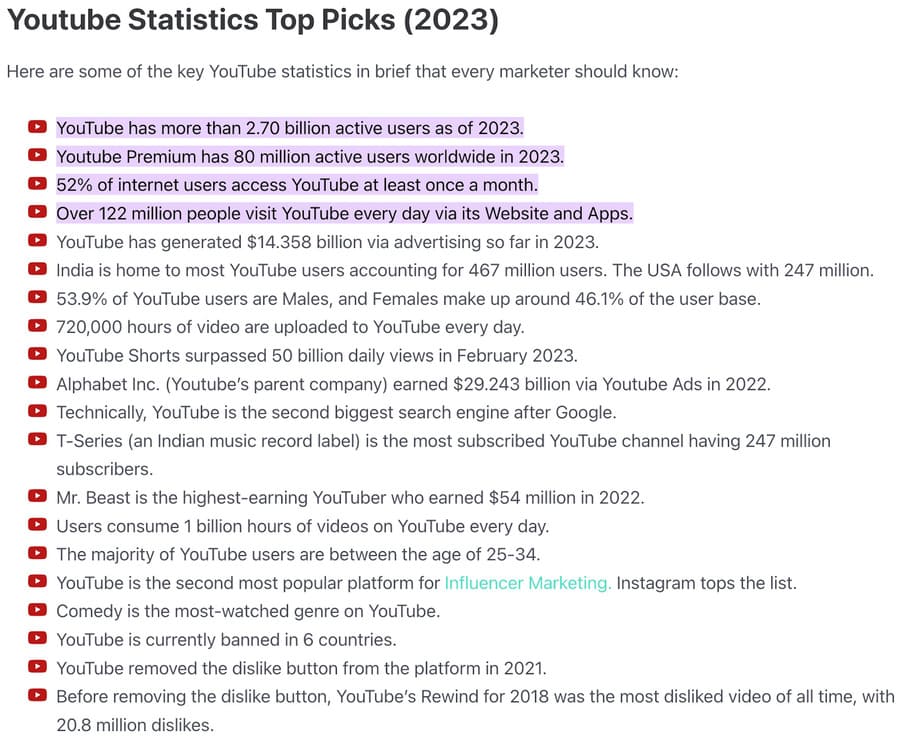
YouTube is no exception. Boasting over 2.7 billion logged-in monthly users, it’s a dynamic social media platform that spans demographics and geographies. Multitudes of YouTube viewers are out there looking for exactly whatever it is you’re selling.
And if growth and greater brand awareness are on your agenda, YouTube is where you need to be to help them find it.
Nearly every statistic underscores a truth: a thriving YouTube channel is a goldmine. If you don’t have a YouTube channel, you’re sending your customers to competitors who do.
This is How to Create a Kick-ass YouTube Marketing Strategy in 13 Steps
If you want to harness YouTube’s gargantuan potential, you won’t do it with random, inconsistent uploads to your YouTube channel.
Are they corporate mavens? Female biohackers? Social media marketers? Quirky DIY enthusiasts? Passionate plant parents?
By defining their interests, age range, habits, and pain points, you tailor your video content to resonate, making your videos feel like they were made just for them.
Because, well, they were.
By understanding who you serve, you can tailor YouTube video content that resonates, engages, and converts.
So, before you dream of social media fame and viral videos, lock in on your target audience. It’s the cornerstone of your YouTube castle!
2. Create Engaging YouTube Video Content. Consistently.
The heart of any YouTube strategy? Targeted video content.
Once you understand your target audience, identifying topics for your YouTube video is the easy part.
You’ll also need a compelling story, an intro that hooks, an on-brand background, great sound, and video quality. A catchy voiceover or soundtrack can also elevate your video’s engagement factor.
And consistency? It’s king.
Regular uploads create a rhythm, building anticipation and trust among your YouTube subscribers. Think of it as your favourite TV show — if it aired sporadically, you’d lose interest.
Just like any social media strategy, building your brand identity is a key component of an air-tight YouTube marketing plan. So it’s important to align your brand elements across your channel.
This goes far beyond your video content.
Think colours, fonts, intros, tone, vibe, background music, and anything else that conveys the personality of your channel.
Every banner, playlist, and video thumbnail on your YouTube channel should scream your brand.
Imagine throwing a themed bash at your place. Would you slap on Star Wars décor and expect folks to feel the 1920s Gatsby vibe? Heck, no!
The channel icon? That’s your front door.
And oh, that channel description? Think of it as the catchy invite getting folks hyped up for the festivities.
When brand elements align, the right visitors can’t help but resonate more deeply with your content.
And that’s when YouTube visitors become YouTube subscribers.
4. Utilize YouTube Tools
YouTube wants you to be awesome at YouTube marketing.
In fact, YouTube’s magic treasure chest of tools can vastly enhance your video content marketing.
From in-depth analytics to subtitle generators, the platform offers a myriad of easy-to-use options to amplify your content’s reach and appeal, all without the expense of a digital marketing agency.
In addition to YouTube Studio, various third-party apps can bring the power of a small Hollywood studio and mini-marketing agency to your video creation.
A cornucopia of tools exists to help you make amazing videos easily.
Learn to use them!
5. Keep YouTube SEO in Mind
YouTube SEO amplifies reach, ensuring that your meticulously crafted content doesn’t get lost in the digital abyss.
Although your content should always be audience-first, integrating SEO strategies can help you get discovered!
Suppose your channel covers Canadian hiking. You can make stunning videos of Canada’s top hikes, but without using the right keywords, your target audience won’t find you.
Pave a path to your channel with relevant keywords in video titles, descriptions, taglines, and scripts.
Learning YouTube SEO basics can help you stand out, and your future fans will thank you for helping them find you!
6. Optimize For Voice Search
When it comes to any kind of content marketing, we can’t talk about SEO without also discussing voice search.
Well, there are differences between how people search using text vs. voice.
When searching with voice, most people use natural language, which means long-tail keywords and questions.
Makes sense, right?
On the other hand, text search is short, and search engines provide more options for users to choose from.
This difference has ginormous implications for you and how you implement SEO on your YouTube channel.
So, pack in those long-tail keywords, construct your content like it’s a Q&A session, and keep your scripts sounding natural and chatty.
7. Refine Your Video Thumbnails & Descriptions
First impressions matter.
Your video thumbnails and descriptions are the storefronts of your channel, and their appeal determines whether a viewer strolls by or steps in.
When you create a YouTube thumbnail, make sure it’s vibrant, clear, and compelling.
Pair it with a video description that is catchy, informative, and packed with SEO-friendly keywords that guide search engines and viewers alike to your channel.
This isn’t mere beautification; it’s a strategic move that can dramatically boost your click-through rates, video views, subscribers, sales, income, and more.
To tap into this, craft your content as narratives. Instead of just listing features of a product, tell the story of how it solved a real problem.
Use behind-the-scenes videos to share your company’s journey, personal anecdotes to foster connection, or customer testimonials as authentic, captivating tales.
By weaving your content into stories, you’re inviting viewers to gather around your digital campfire, sparking not just video views, but engagement and trust.
Stories build connections, and sharing yours can forge deeper viewer relationships.
Use YouTube’s story feature to showcase short, engaging snippets, offering a personal touch to your brand narrative.
Even a relatable YouTube short could result in new subscribers!
9. Harness Cross-Promotion
Think of cross-promotion as the ‘you scratch my back, I’ll scratch yours’ of YouTube marketing.
In a space as vast as YouTube, your solo voyage to stardom could be a slow sail.
Why go it alone? Partner up!
Find creators or brands that align with your values and audience but aren’t direct competitors.
Share their content on your channels and let them do the same. Collaborate on a video project or share a video ad that appeals to both your viewers.
It’s a win-win; you gain exposure to their audience and vice versa.
Imagine this as trading golden tickets with fellow adventurers; together, you’re unlocking broader vistas of potential viewership.
The secret of influencer marketing is out. These social superstars come with their own eager audience, and inviting one to collaborate on your content instantly boosts brand credibility.
Partner with someone who resonates with your brand’s values and message, whose values align with yours, and who speaks to an audience that you want to connect with.
Whether it’s through a candid conversation, a shared project, or a product review, this partnership is your introduction to a new sphere of potential customers, many of whom could be the next members of your tribe.
Want eyeballs on your brand or clicks to your site? Your goal shapes your strategy.
Next, target like a pro.
YouTube lets you aim your ads at specific ages, locations, interests, and more.
Budget-wise, start small. Test, learn, then adapt. A YouTube ad is less expensive than a Google ad, and overall, a better bang for your buck.
Crafting the YouTube ad is an art in itself — make it engaging, authentic, and, crucially, valuable to the viewer.
End with a strong call to action; tell viewers exactly what you want them to do next.
And here’s the golden rule: keep an eye on YouTube analytics. The numbers will tell you what’s working and what needs a tune-up.
12. Monitor Your YouTube Channel Performance
You’ve honed your YouTube content and advertising and maybe even dipped your toe into YouTube Live.
Next is YouTube Analytics. They’re your essential tools and guides, directing your path.
Make delving into YouTube Analytics a regular part of your process; it’s a rich source of data that shows which videos excel and which ones falter.
Views, watch time, audience engagement, and click-through rates — these are your benchmarks.
If one video gained traction, analyse it. Was its success due to the video title, thumbnail, or content?
And if another video didn’t quite hit the mark, adjust your approach. Refine your YouTube video marketing strategy and shift your focus to better results.
Staying attentive to your data and using it to adapt and refine your strategy is key to achieving greater success.
13. Track Your Competition
Standing out on YouTube means knowing what your high-ranking competitors are up to.
Competitor research is an underutilized YouTube marketing tool.
So, start by identifying your key competitors — those in your niche, with similar audience size or content style.
Now, be a YouTube detective.
Check their video titles and descriptions. What keywords are they targeting? Peek at their thumbnails; are they vibrant and eye-catching?
Dive into their posting schedule; when and how often are they uploading? Engage with their content; what kind of calls-to-action are they using? Do they utilize influencer marketing?
Don’t forget the comments section; it’s a goldmine for audience sentiment.
Now, here’s another opportunity to use the magic sauce: YouTube Analytics.
While you can’t access a competitor’s private data, tools like SocialBlade or TubeBuddy offer valuable insights. Track their subscriber growth, view counts, and engagement rates.
It’s not about copying, it’s about learning and strategizing. How can you differentiate? Use that intel to improve your own strategy.
Now Go Rock Your YouTube Marketing Strategy
Ready to turn your vision into viewers? It’s time to step into the spotlight.
Your stage is set, your audience awaits, and now, you have a 13-step script in hand.
Loree Hollander is a content creator, editor, and SEO strategist who specializes in psychology, health, wellness, and the intersection of science and spirituality. When not writing, reading, or traveling, she spends time with her husband in the woods and on the water in the beautiful Pacific Northwest.
As concerns over data privacy abound, Vero is doing social media a little differently
Unlike Threads, Vero has been focused on steady, rather than exponential growth.
When Mark Zuckerberg launched Threads as a competitor to Twitter, it broke ChatGPT’s record to become the fastest-growing social network in history, gaining 100 million users in just a few days. But in the weeks since its launch, Threads’ daily active user count has fallen by significant margins, dropping 82% as of July 31.
Vero, on the other hand, has been growing slowly and steadily for years, flying mostly under the radar as it seeks to build a strong base from which to change the social media landscape. The app, which now has a user base numbering about 6.5 million people, proposes a different, more real, version of social media, one that is importantly lacking the incentives for addiction and vitriol that are present on other platforms.
“People are becoming more and more aware of the problem of platforms mining their data, and then using that data, selling it to advertisers,” Ayman Hariri, the co-founder and CEO of Vero said in an interview with The Street. “We’re definitely seeing people that do come onto the platform organically come because of those concerns.”
Vero is ad-free, subscription-based
Vero was designed to be a completely ad-free, subscription-based social network. Though the company has yet to activate the subscription model – and hasn’t said when it will do so – the result of this ad-free network is a platform without incentives, and therefore, without an algorithm.
“When people talk about data and data mining, it’s really about having enough information on somebody to know what their habits are, and whether or not there’s a way to design things to fit within those habits,” Hariri said. “It’s a negative thing in that you can make the product more addictive. You can potentially manipulate people’s behaviour. And that’s a red line we don’t want to cross.”
These problems of algorithms and misaligned incentives were at the centre of Meta Platforms’ (META) – Get Free Report Facebook whistleblower Frances Haugen’s complaint against the company in 2021. The computer scientist said at the time that “Facebook makes more money when you consume more content,” adding that the platform designed its algorithms to prioritize profits in a way that incentivizes hate speech.
Vero has no such incentives.
“There’s no advertising. Therefore, it isn’t an algorithmic feed,” Hariri said. “Therefore, we’re not looking for content that gets any reaction. We’re not in that world at all. I don’t believe in it.”
It provides users with a chronological feed that, according to Hariri, gives people complete access to their entire following, something advertisement-based platforms have not been able to promise.
“There’s no place for hate speech on our platform,” Hariri said. “We’re not looking for people to be okay with that nor to train people that that’s okay.”
Vero currently employs a human content moderation team, but is looking into tools to bring that effort up to scale.
“I think that free speech and what X is particularly going after is a noble cause, but just the practicality of daily life makes it difficult to achieve something that will work for everybody,” he said. “We’re doing things in different ways.”
And where other platforms, such as YouTube and now X (formerly Twitter) incentivize their creators to make content by sharing percentages of ad revenue, Vero’s approach is necessarily different. There’s no ad revenue to share; the app, instead, will grant creators equity ownership in the platform itself.
Vero users own shares of the company
“If you choose to come to Vero and bring your following, you own shares in the company. It’s got nothing to do with discussions with me or anybody else,” Hariri said. “We’re looking very intently at the regulatory aspects and we’re making bold moves that nobody else has done because we truly mean what it is that we’re saying. We want to be different. And we want to have a different impact on people that join us.”
To that end, Vero acquired Tokenise Stock Exchange International in June, a regulated stock exchange for tokenised securities that was founded in 2018.
“It’s a challenge to go down the path of educating a market and selling to them,” Hariri said. “That’s why our product has to stand on its own two feet as a product that delivers you value. That’s what we’re focused on. That’s why it takes us so long.”
Ian Krietzberg is a breaking/trending news writer for The Street with a focus on artificial intelligence and the markets. He covers AI companies, safety and ethics extensively. As an offshoot of his tech beat, Ian also covers Elon Musk and his many companies, namely SpaceX and Tesla.
There are 8 billion people in this world. And of them, 60 percent, or 4.88 billion, are active social media users. In the U.S., that number jumps to 74 percent. This poses a great opportunity for brands to connect with consumers. However, there is a bushel of social media platforms. And the users differ for each platform based on age as well as the content they want to see. That’s especially true for Gen Z and millennials. For marketers, knowing the difference can make all the difference in connecting and capitalizing on social platforms.
YPulse data shows Gen Z and millennials are active on an average of six different social media platforms. And they’re going to each platform for different content.
“For brands, this means that content can’t be one size fits all,” states the YPulse Insights article. “They’ve got to pay attention to exactly what purpose each one serves for young audiences.”
Fully 81 percent of young consumers don’t want to see the same kind of content on every platform, according to the YPulse research. The firm also found 65 percent of young users don’t like when social media platforms create new features that replicate other social media sites—meaning, they want different content on each.
For example, in a YPulse survey of 13 to 39 year olds, users went to TikTok for memes and viral content (66 percent), content from online influencers (58 percent), random people they don’t know (57 percent), celebrities (49 percent), and their friends (46 percent). But when the same generations go to Instagram, they mostly seek content from their friends (66 percent), followed by celebrities (63 percent), online influencers (55 percent), brands/products (52 percent), and memes/viral content (51 percent).
The most popular social media platform for clothing ideas among Gen Z consumers is Instagram (74 percent), according to a 2023 Cotton IncorporatedLifestyle Monitor™ Survey. That’s followed by TikTok (71 percent), Pinterest (52 percent), YouTube (36 percent), Snapchat (18 percent), Facebook (13 percent), X—formerly Twitter (13 percent), and Tumblr (2 percent).
Among consumers ages 25 to 34, the top platform is also Instagram (78 percent), according to the Monitor™ research. That’s also followed by TikTok (57 percent), Facebook (51 percent), YouTube (43 percent), Pinterest (38 percent), X (22 percent), Snapchat (19 percent), and Tumblr (5 percent).
Simon Kemp, founder of Kepios, a strategy consultancy, and DataReportal, an online reference library, says social media user numbers continue to grow. He says his firm’s latest research shows social media adoption accelerated +1.5 percent over the past three months. Total social media adoption increased 3.7 percent since July 2022.
“This figure marks another momentous milestone along our journey towards universal connectivity,” Kemp said in a recent video when the company presented its quarterly digital report.
In the last quarter, DataReportal’s research shows females ages 16 to 24 spent the most time on social media, at 3 hours and 10 minutes per day. That was followed by females ages 25 to 34, spending 2 hours and 49 minutes per day on social platforms. Males ages 16 to 24 were next, at 2 hours and 35 minutes, followed by males ages 25 to 34 at two hours and 32 minutes. By comparison, men and women ages 55 to 64 average 1 hour and 40 minutes on social platforms per day.
That time spent on these platforms can translate into sales for apparel brands, especially among younger consumers. One-fifth (20 percent) of shoppers ages 13 to 24 say they have purchased a product directly from a social media post by clicking a link or image, according to 2020 Monitor™ research. The number increases to 23 percent among millennials.
Two-fifths (40 percent) of young consumers (ages 13-24) add that they’re likely to buy a product directly from a social media platform, according to the 2020 Monitor™ research.
Perhaps that’s why Pinterest is so popular with the younger set. YPulse research shows young consumers like that Pinterest offers in-post shopping where both creators and brands can tag the items they show, allowing users to purchase directly from the post. Gen Z and millennials put Pinterest in the number one spot for the kind of content they want from brands, including product recommendations that are linked within aesthetically pleasing pictures.
YPulse research shows the other top platforms Gen Z and millennials turn to for content from brands are Instagram, YouTube and Facebook. Where Instagram is concerned, 52 percent of young consumers say they want to see brands and products in the app. They like that social shopping also doesn’t waste their time or divide their attention by bringing them to another site. Also, these shoppers want to see niche or personalized content on Instagram, versus viral posts.
When it comes to advertising, young consumers are most open to watching it on YouTube (63 percent), followed by Instagram and Facebook, according to YPulse’s Social and Mobile Marketing Preferences report. And they’re open to content from online influencers on every platform except Facebook and Snapchat—two platforms where they prioritize posts from family and friends. Whether it’s a major celebrity or micro influencer, more than half of all young people (54 percent) say they have purchased something after it was touted by an online celeb on social media.
Social media holds the top spot for young shoppers when it comes to a source of clothing ideas. Over two-fifths of all Gen Z shoppers (43 percent) and 37 percent of millennials say they turn to social platforms for clothing inspo, according to 2023 Monitor™ research. That compares to 23 percent for Gen X and 7 percent for boomers. Celebrities also hold more sway with younger consumers. Among Gen Z, 17 percent look to celebs as a source of clothing ideas, as do 17 percent of millennials. That contrasts with 10 percent for Gen X and just 4 percent for boomers.
Finally, YPulse says Gen Z and millennial consumers love viral content, which explains why TikTok is so popular with these cohorts.
“Lucky for brands, this kind of content is easy to get in on if done right—and is yet another way to blend ad and brand content into their feeds,” YPulse states in its Insights article. Since 49 percent of TikTok users want to see humour from brands, funny content is one way to connect with them. “But even if a brand doesn’t think humour is part of their identity, there’s viral potential for everything—wholesome, lifestyle, DIY, you name it—and as long as it’s entertaining and personal, young consumers will be interested.”
The Cotton Incorporated Lifestyle Monitor™ Survey is an ongoing research program that measures consumer attitudes and behaviours relating to apparel, shopping, fashion, sustainability, and more.