
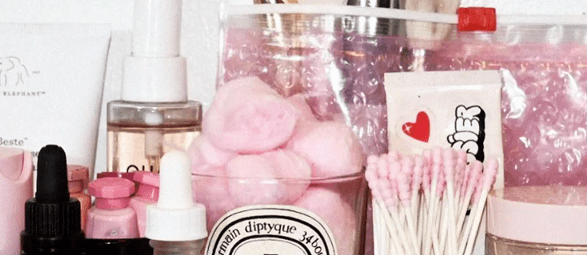
On TikTok, the most popular products are inexpensive, accessible, and…not exactly cute. So what does that mean for the future of the shelfie? We asked Gen Z’ers to explain.
When I opened TikTok for the first time, I never felt older. Many months of scrolling later, this unshakable feeling has grown as quickly as the app’s overwhelming influence. At 24, I technically straddle the line between millennial and Gen Z, but my connection to the former intensifies whenever I open TikTok and proceed to be visually pelted by frantic videos of gamer girls, dancing tweens, and slapstick comedy.
But among these clips of a kid doing a skateboard flip while wearing roller blades, countless teens filing their teeth for some reason, and Addison Rae doing whatever it is she does, I also started to notice videos that felt like they were speaking directly to me: The beauty products I saw TikTokers constantly gushing about were most definitely not the ones I was used to seeing in “shelfie” photos or in my own bathroom.
Growing up with print magazines and, later, YouTube and Instagram, I was trained that beauty products needed to be expensive, beautiful, and covetable enough to be proudly displayed on a shelf or social media. But TikTok tells a different story: The products that rack up the most views—usually in the millions—are affordable, unassuming, and—dare I say?—basic.
There’s a belief among brands that Gen Z is just as aesthetically minded as millennials, considering they too came of age in the Instagram era (take, for example, 16-year-old Millie Bobby Brown‘s pastel-packaged beauty line Florence by Mills), but scrolling through TikTok, it seems the ubiquitous “millennial” branding is almost nowhere to be found—much like actual millennials.
For example, the hashtag #telescopicmascara has more than 14.5 million views on videos singing the praises of L’Oréal Paris’s Telescopic mascara, and the brand’s Fresh Wear Foundation has a similar fanatic following. A video of a £1 depilatory cream has spread like wildfire, making teens and early-20-somethings ditch their laser appointments and razors—unless it’s the equally viral portable one—for a product that’s been around for 100 years. CeraVe cleanser has become so popular even CNN Business has written about its explosion in sales because of TikTok.
Compare this with Instagram, where, yes, these brands make an occasional appearance, but for the most part shelfies are dominated by picture-perfect mainstays like Glossier, Nécessaire, and Summer Fridays. These products work for many people, of course, but they also represent the millennial branding boom of the late 2010s—you know the vibe: sans-serif fonts, kitschy names, and pale colour palettes (usually pink)—as well as the post-2016-election skin-care-as-self-care explosion, along with a more-is-more mindset sparked by the stateside introduction to K-beauty’s 10-step routine.
One of the largest examples of this back-to-basics trend is the popularity of Hyram Yarbro, known on TikTok as Skincare By Hyram. Although he’s not a dermatologist or an esthetician, the 24-year-old “skinfluencer” educates his massive audience with quick, digestible videos on skin care. In addition to CeraVe, he also steadily features accessible brands like The Ordinary and La Roche-Posay, and focuses on a philosophy he describes as “skin-care minimalism.”
“I don’t believe you need an excess of products,” he tells Glamour. “I don’t believe you need to spend a lot of money on products, that you need products that have a fancy smell or a fancy texture or excessive packaging. In terms of achieving good skin, all you need is a simple, relatively affordable, basic routine.”
This less-is-more philosophy is clearly resonating with his audience, which skyrocketed from nearly nothing earlier this spring to his current fanbase of 6.6 million followers.
“I think particularly for a Gen Z audience—who is really trying to cut through all the marketing claims of an oversaturated industry—it’s beneficial for them to just hear the basics you really need in terms of functionality,” says Yarbro regarding why he thinks he’s had such success with younger consumers on TikTok.
This doesn’t mean young people are uninformed about skin care, though. In fact, Yarbro says it’s just the opposite. “I think brands underestimate the intelligence of Gen Z,” he says. “The thought process is: Oh, this is skin care specifically designed for teenagers, so we need to make it colorful, we need to make it fun, we need to make it smell really good. But really all these aesthetic-focused demands are opposed to what Gen Z is actually demanding, which is further knowledge, education, and simplicity.”
This education may be what makes TikTok so singular in its ability to influence. While Instagram and YouTube allow content creators to go more in depth by allotting them longer time frames to post, there’s no comparison when it comes to the exposure rate on TikTok. On other social platforms, a user needs to actively search for content relating to skin care, but on TikTok, the algorithm works like throwing spaghetti to the wall and seeing what sticks. Once a user actively likes a skin-care or beauty video, they’re served more of that kind of content until their feed is overrun by skinfluencers preaching the importance of barrier repair and the benefits of mandelic acid.
Juliette Cacciatore, a 22-year-old student—who, full disclosure, happens to be my sister—says that aside from topicals from her dermatologist, she never showed an interest in any sort of skin-care regimen, despite having dealt with acne since high school, until she discovered TikTok, and never followed beauty creators on any other platforms.
“It changed my entire routine,” she says. “I do feel like I know so much more. I’ve heard a lot of theories debunked, and a lot of ‘You should have never have used this.’ I didn’t know what a humectant was until someone told me on TikTok.” Among her favourite products are the CeraVe Healing Ointment, which she uses for “slugging,” Telescopic Mascara, and Good Skin Days C’s The Day Serum. Nothing costs more than £20.
Alessandra DeMarino, 23, agrees that a large part of the draw of TikTok—and the products she discovers there—is the emphasis on education: “It has definitely shifted my old Instagram buying habits, where I bought things more so based on aesthetics and claims.” DeMario says TikTok allowed her to see the results of items instead of just packaging, which in turn has influenced her to purchase.
The looming question: Why are younger people on TikTok seemingly rejecting what millennials are still obsessing over? According to Jenni Middleton, director of beauty at trend forecasting firm WGSN, a hallmark of Gen Z’s buying habits is scrutiny. “Gen Z want to be assured that what they are buying will work for their skin and hair, and that’s why we’re seeing this shift,” says Middleton. “Their scrutiny about ingredients stems from their comfort in the URL world, where they can do huge amounts of research.”
Charlotte Palermino, cofounder of Dieux Skin and a skinfluencer with 175,400 followers on TikTok —and, at 33, is a millennial—agrees. “We are absolutely in a post-truth society where consumers aren’t taking things at face value,” she says. “I feel like Gen Z can spot deep fakes and fake news better than boomers, so it’s not surprising seeing them question shaky skin-care claims. It’s a time when we have to question a lot, so seeing Gen Z ask for receipts makes sense. Increasingly, when I see an influencer or brand make a claim, I’ll see commenters ask, ‘Where does that claim come from?’”
In addition to having more knowledge than ever, there’s also the obvious fact that younger people tend to have less disposable income, so of course they’re going to gravitate toward less expensive products. “Almost all of my makeup is from the drugstore because I truly believe there are so many high-end makeup products that have very similar formulas to drugstore products,” says Rachel Rypma, a student who helped make the Telescopic mascara go viral. “The only difference is the name behind the product.”
“Cost definitely comes first,” agrees 24-year-old Lisa Antonelli about what she considers most important in a product. “I will splurge on some exceptions after either trying a sample or buying a small size first. Next come the ingredients, branding, and sustainability.”
This emphasis on cost is nothing new, as Palermino points out. “Skin care targeted to acne and younger demographics was never charging a high price point on the whole,” she says. Rather, the products have just become a little more sophisticated, she says, pointing to Curology and CeraVe.
However, with the popularity of the app, teens have gained a new power. Not only are they more visible than ever—they actually move product. A representative from L’Oréal Paris tells Glamour the brand has seen “explosive growth” on Telescopic thanks to TikTok, and while Cerave wouldn’t confirm exact sales stats, the brand confirms “TikTok has certainly helped expand awareness of the brand, particularly to Gen Z audiences.”
In turn, this new visibility is making more affordable products trickle up to older demographics, and could even dictate where beauty brands go from here.
“Gen Z’s attitudes will define beauty for the next decade,” says Middleton. “Gen Z is the most self-educated generation to date, with information and tutorials on any conceivable subject instantly available online at any time. Informed online communities continue to fuel demand for authenticity and transparency across the industry.”
Does this mean that luxury beauty and branding is done for good? Not a chance. Beauty will always be a sensorial experience, and everyone I spoke to said that even though they prioritise cost and ingredients, at the end of the day, they all viewed skin care as some form of self-care. They’re just a little more discerning.
“With Gen Z, there’s really a level of critique that I have never seen before, and it’s a response to the generations of marketing,” says Yarbro. “I think it’s exactly what the industry needed.”



![quaranti[m]e instgram stories IGTV](https://www.jeffbullas.com/wp-content/uploads/2020/05/quarantime-instgram-stories-IGTV-666x1024.png)


