Tag

YouTube

Browsing

By Sarah Perez

YouTube’s comments section has a bad reputation. It’s even been called “the worst on the internet,” and a reflection of YouTube’s overall toxic culture, where creators are rewarded for outrageous behavior — whether that’s tormenting and exploiting their children, filming footage of a suicide victim, promoting dangerous “miracle cures” or sharing conspiracies, to name a few high-profile examples. Now, the company is considering a design change that hides the comments by default.

The website XDA Developers first spotted the test on Android devices in India.

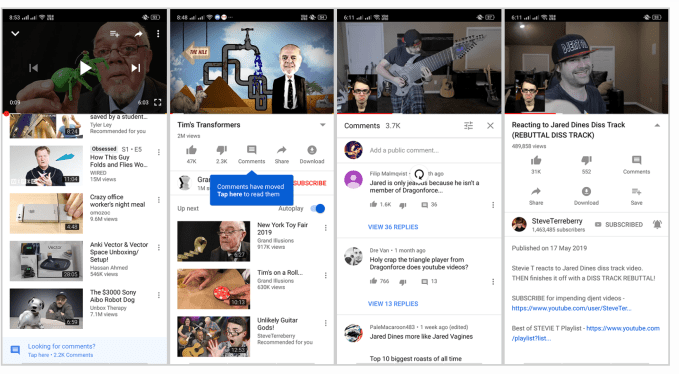
Today, YouTube’s comments don’t have a prominent position on its mobile app. On both iOS and Android devices, the YouTube video itself appears at the top of the screen, followed by engagement buttons for sharing, liking, disliking, downloading and saving the video. Below that are recommendations from YouTube’s algorithm in a section titled “Up Next.” If you actually want to visit the comments, you have to scroll all the way to the bottom of the page.

In the test, the comments have been removed from this bottom section of the page entirely.

Instead, they’ve been relocated to a new section that users can only view after clicking a button.

The new Comments button is found between the Thumbs Down and Share buttons, right below the video.

It’s unclear if this change will reduce or increase user engagement with comments, or if engagement will remain flat — something that YouTube likely wants to find out, too.

On the one hand, comments are hidden unless the user manually taps on the button to reveal them — users won’t happen upon them by scrolling down. On the other hand, putting the comments button behind a click at the top of the page instead of forcing users to scroll could make them easier to access.

As XDA Developers reports, when you’ve loaded up this new Comments section, you can pull to refresh the page to see the newly added comments appear. To exit, you tap the “X” button at the top of the window to close the section.

While it reported the test was underway in Android devices in India, we’ve confirmed it’s also appearing on iOS and is not limited to a particular region. That means it’s something YouTube wants to test on a broader scale, rather than a feature it’s considering for a localized version of its app for Indian users.

The change comes at a time when YouTube’s comments section has been discovered to be more than just the home to bullying, abuse, arguments and other unhelpful content, but also a tool that was exploited by pedophiles. A ring of pedophiles had communicated through the comments to share videos and timestamps with one another.

YouTube reacted then by disabling comments on videos with kids. More recently, it’s been considering moving kids content to a separate app. (Unfortunately, it will never consider the appropriateness of having built a platform where young children can be put on public display for the whole world to see.)

A YouTube spokesperson confirmed the Comments test, in a statement, but downplayed its importance by referring to it as one of many small experiments the company is running.

“We’re always experimenting with ways to help people more easily find, watch, share and interact with the videos that matter most to them,” the spokesperson told TechCrunch. “We are testing a few different options on how to display comments on the watch page. This is one of many small experiments we run all the time on YouTube, and we’ll consider rolling features out more broadly based on feedback on these experiments.”

Feature Image Credit: TechCrunch

By Sarah Perez

Sourced from TechCrunch

Amid a ferris-wheeling slew of scandals with respect to objectionable content across its air, YouTube has reportedly been developing a new algorithm to reward content of “quality.”

According to Bloomberg, YouTube has been developing two internal metrics over the past two years — one that is straightforward and gauges total time spent on the service (including posting and reading comments; not just watching videos) and a second that is slightly more nebulous, which the video giant is still working out. This second stat, per Bloomberg, is being referred to internally as ‘Quality Watch Time‘, and aims to identify content that is not only appropriate but constructive and responsible in some way.

Such an algorithmic development would presumably seek to help YouTube promote ‘quality’ videos — whatever that means — while marginalizing inappropriate videos and extremism. That said, the quality watch time metric could reportedly be used to calculate more than just video recommendations, according to Bloomberg, and is also being considered in realms like search results, ad distribution, and creator compensation. In prizing videos that are constructive and responsible, the metric would also help to combat the growing notion that YouTube is addictive and encouraging of mindless entertainment, according to Bloomberg.

YouTube has not finalized how quality watch time metric will be measured. And Bloomberg notes that coming up with a scalabe notion of ‘quality’ as ascertained by machine technology — or even human reviewers — feels like something of a herculean feat given the enormity of YouTube’s library and the variety of opinions out in the world.

YouTube told Bloomberg that “there are many metrics that we use to measure success,” but declined to comment on the development of either new metric.

YouTube implemented the ‘Watch Time‘ metric in 2012, replacing individual video views as its measurement of choice, despite the fact that critics both inside and outside of the company felt like such a shift could reward inappropriate and attention-seeking behavior, according to Bloomberg. YouTube declined to comment to the outlet about whether it might abandon watch time in favor of quality watch time.

Sourced from tubefilter

By Tim Peterson

YouTube is focusing this year’s upfront pitch on its most TV-like content in an effort to convince advertisers that it can compete with traditional TV.

YouTube has been able to attract some ad dollars away from traditional TV in recent years. But to more fully contend for advertisers’ budgets in the upfront ad-buying cycle, the digital video platform needs to overcome advertisers’ perceptions that it is complementary, not comparable, to TV. It also needs to address their continued concerns that their ads may be delivered against unsafe content or not soon enough to reach their entire target audience.

YouTube will now consider production quality and the likelihood that people will view videos on TV when selecting channels to include in its Google Preferred program, which packages the top 5 percent of YouTube channels into category-specific bundles that advertisers. Additionally, the company will break out its streaming TV service as a standalone inventory option and will start to premiere YouTube Originals shows on its free, ad-supported tier.

TV is the through line of YouTube’s upfront pitch for good reason. Many digital advertisers may not be able to afford or willing to agree to the large minimum spend commitments that YouTube seeks for its upfront deals, said an agency exec. A YouTube spokesperson declined to say how much money YouTube will ask advertisers to commit to spend on its platform this year; in 2015 YouTube’s annual minimum spend requirement was $2 million. TV advertisers, on the other hand, have large budgets, and TV ad buyers are getting antsy about finding cost-efficient alternatives to linear TV, where viewership is declining but ad prices are rising.

However, for YouTube to win more money from TV advertisers, it needs to prove that it can compete on the same level — as well as the same screen — as TV networks. “There is this idea that being on a big screen is more valuable than being on a video anywhere screen,” said the agency exec.

Google Preferred on the big screen
At the center of YouTube’s upfront pitch this year is Google Preferred, as it has been since the company introduced the program in 2014. “Google Preferred remains the heart of our upfront offering,” said Tara Walpert Levy, vp of agency and media solutions at Google. But YouTube is making tweaks to Google Preferred to make it more attractive to TV advertisers by highlighting its TV viewership.

YouTube uses what it calls a “P Score” to determine which YouTube channels should be included in Google Preferred. The P Score consists of criteria that all start with the letter “p,” such as the popularity of a channel (i.e. its viewership) and the passion of its audience (i.e. repeat viewership and viewers’ willingness to share a channel’s videos). Last year, YouTube added protection as a criterion following brand safety issues that led the company to have people review every video uploaded by Google Preferred channels. This year, YouTube is adding two more criteria to the P Score: platform and production, which means content watched on a TV screen, and higher quality videos.

In October 2017, the company said that people were spending more than 100 million hours per day watching YouTube videos streamed to their TVs. That figure has now surpassed 200 million hours per day, according to the company.

YouTube TV and TV-like shows on YouTube
In addition to arranging Google Preferred to deliver more ads on TV screens, YouTube is looking to sell more ads against TV-like and actual TV content.

As Digiday previously reported, YouTube will offer YouTube TV as a standalone option for advertisers in this year’s upfront, though they will need to buy Google Preferred in order to access the YouTube TV inventory. That separation will help advertisers to more easily align YouTube TV with their addressable TV buys, but YouTube is also doing something to make it easier for advertisers to align it with their national TV buys.

When advertisers buy YouTube’s YouTube TV inventory, they will be able to exclude specific shows from carrying their ads, either because they already bought ads against those shows from the TV networks or because they do not want to be associated with those shows. YouTube will also allow advertisers to target specific audiences within YouTube TV beyond viewers’ age and gender and will offer Nielsen-backed audience delivery guarantees to advertisers.

This means advertisers will be better able to use YouTube TV to fill in the gaps of their traditional TV campaigns in order reach audiences that may be more difficult, if not impossible, to find on traditional TV, said the agency exec.

YouTube is reportedly scaling back on some of its TV-show ambitions, though the company denied that it’s getting out of the scripted programming market.

YouTube will premiere its version of TV shows, YouTube Originals, on its ad-supported tier before putting them back behind its ad-free paywall, where they have historically been held. YouTube is still firming up for how long shows will be available on the ad-supported tier but Walpert Levy described the ad-supported window as “substantial.” The company declined to say whether advertisers will be able to buy ads specifically to run against YouTube Originals shows during that ad-supported window.

YouTube also plans to provide advertisers with more sponsorships opportunities to have their brands be part of the show by working with show creators on custom integrations and custom formats that will be similar to what’s possible on traditional TV shows, Walpert Levy said.

Brand safety and reach concerns
As YouTube takes aim at TV advertisers, it will have to contend with a couple of primary concerns this cohort has with advertising on YouTube: the safety of its platform and its ability to deliver large audiences in a short period of time.

Historically, YouTube has pitched Google Preferred as its most prized and brand-safe inventory. Since the brand-safety issues that initially came to light in March 2017 and led YouTube to step up its video review processes over the past two years, there have been “virtually” no brand safety issues related to videos within Google Preferred, said Walpert Levy.

However Google Preferred has not been entirely isolated from YouTube’s brand safety woes. In YouTube’s latest brand safety issue — when sexually suggestive remarks were discovered in comments left on videos of children — there was one video from a Google Preferred channel that featured such inappropriate comments. “There was nothing brand-unsafe about the channel. It was just a handful of comments,” said Walpert Levy.

Following the February comments controversy, YouTube disabled comments on videos featuring minors in an effort to assuage advertisers, such as AT&T, Disney and McDonald’s, that pulled their ads from the platform. “There were a few folks that paused, and there are a few folks who are left paused, but I think most of them have come back,” Walpert Levy said.

Despite broader outcries over YouTube’s brand safety issues, ad buyers have largely shrugged at the controversies. Nonetheless, brand safety remains a concern for clients. When another brand safety issue on YouTube comes to light, “we get requests from C-level teams on the client side for an immediate response and recommendations,” said the agency exec. These concerns can color into clients’ level of interest in striking upfront deals with YouTube because upfront commitments typically mean an advertiser pledging to run ads on a platform for 12 to 18 months, the exec said.

In addition to advertisers’ long-term brand safety concerns, there are concerns about YouTube’s ability to help advertisers reach a large number of people in a short period of time. Because of TV advertising’s broadcast model, advertisers are able to reach a large number of people relatively cheaply, which is why advertisers continue to spend there despite prices increasing. Because ads are served individually on YouTube, advertisers worry that viewers in their target audiences won’t see their ads in the time they need to reach them, said the agency exec.

To address advertisers’ reach concerns, YouTube conducted an internal experiment to compare reach on YouTube versus national TV by evaluating the two channels’ ability to hit a certain target rating point (TRP), which is a version of TV’s GRP that is limited to the advertiser’s target audience. In this case, YouTube’s target audience was adults 18 to 49 years old. The company set a ratings goal of 125 TRPs and ran two tests to evaluate its ability to hit that goal. For one week it ran ads on national TV but not YouTube, and then another week it ran ads on YouTube and not TV. According to YouTube, the ads on YouTube hit the reach goal as quickly as TV and surpassed the initial goal to hit 153 TRPs at a 10 percent to 15 percent lower cost than TV and with an average audience age that was eight years younger than the TV audience.

YouTube has been chipping away at the TV advertising market in recent years. Last year the platform was able to steal dollars away from TV networks, agency execs told Digiday recently. However, YouTube stands to siphon even more spend with linear viewership expected to continue to decline and advertisers pressured to redirect their dollars to keep costs in check — if it can prove to advertisers that it can deliver TV-level reach against TV-quality content on TV screens.

“I definitely think they’re positioning themselves to capture more of that [TV] spend, if not this year then in the next two years,” said the agency exec.

By Tim Peterson

Sourced from DIGIDAY UK

Sourced from MEN STYLE FASHION

The digital platform has led to the immense growth of social media. This has led to growth in a lot of areas on the internet including trade, advertisement and marketing. There are so many sites where you can advertise your brand, but which is the right one? It can get very confusing and overwhelming to make such a decision. Although some sites may not need too much investment financially, they can really take up your time.  One effective way to get to know the perfect site is to understand your audience, commodity or services and markets.

Here are some major social site and how they can do for your brand

Facebook

Facebook is a pretty old social media site and is among the most used among all generations. This is the safest choice when you want to market your brand. Statistics show that over 2 billion people across the whole world have active accounts on this platform. They also share videos, audio and other content types.

You can market your brand by creating your own page with your brand name and description. Getting followers on facebook is easy, you just have to send some follow requests to your audience and convince them to share them with their friends and family. Growing the page won’t be that hard also, as stated there is a numerous audience on this platform. Facebook also offers you the tools to target the audience specific to your brand and advertise to them.

facebook

Instagram

One fun fact is that Instagram is that it is owned by facebook. There close to one billion people who are active of this platform and they share posts, pictures, videos and stories. Statistics show that more than half of these people follow at least one brand. This is the best place to advertise your brand or sell your goods and services.

Instagram offers you the ability to showcase your products to your target audience while pinning the location at the same time.  You can use this visual platform to your advantage by personalising your brand and making it different from the rest.  You can also get followers who have a specific interest for your brand. There are some few methods you can use to give your brand more notice. You can choose to use the hashtag strategy, tag other followers in your posts or even pay for story advertisements.

If you’ve only created your Instagram business account, there is another way to get more followers. You can choose to engage different people through likes, comments or if you don’t have time you can get auto comment for your Instagram posts and let it do the work for you.

instagram

Twitter

Although this platform is more social than marketable, it can work as a real great advertisement.  For the most part, twitter is a platform for trending news, updates and opinions on everything.  Users on twitter follow accounts they would like updates on.  Your update is restricted to a number of updates, making it pretty short and precise.

The good thing is, you can use the hashtag to categorise your content with key words about your brand and what you have to offer.  Twitter will need you to be more engaged with your audience. You will need to tweet several times daily in order to reach a certain number of audiences, or just a target.  Most twitter users are critics and tend to be college educated, not every brand will pass in this platform.

Linked in

It is estimated that one person in every 4 or 5 social media users owns an account in linked in. It is probably not as popular as other platforms, but is a great marketing platform.  It is used equally by both genders and is a great platform for marketing any form of resume or job.  You can use this to find employees or get new jobs.

linked in

YouTube

This is one of the most popular social media platforms across the whole world.  You tube has an active user list of more than 1 billion users. It is estimated that most people who won social media account spend one third of the activities online watching videos on YouTube.  This is the widest platform when it comes to different cultures and languages. There are close to 80 different languages on this platform.

The advertisement and marketing opportunities in this social platform is outstanding.  Most people who own accounts on YouTube use it to promote themselves, and some products.  The audience is both old and young making it convenient for most types of products.

Pinterest

Like Instagram, this platform is mainly a visual platform.  One amazing fact is that Pinterest is preferred by more female compared to male. This means that if you want to use for marketing, you have to ensure your brand suits the target market.  This platform is also thought to likely to convert your marketing into a purchase compared to other social media accounts.  One amazing feature on this platform is that you can pin the purchase product on your photo and the buyer will get direct access.

Snapchat

I think we all agree that snapchat is the least expected for marketing, branding and business. At first, it was more appealing to teenagers and younger generations.  The application has very fun features and filters which draw the younger generations.  It has an outstanding 300 million users. It offers you a creative and fun way to advertise your products and services.  The filters are ever changing, making it exiting and alluring for the young.

Manage several platforms

Keep in mind that social media platforms are ever changing and require you to make changes as you go. Instead of advertising your brand in one platform, you can use the opportunity to your advantage by creating accounts with your brand in all these platforms. Ensure you have an idea of what brand will work well for the target audience before putting it out there.  If you are too busy, autolike applications or social media managers can do the work for you.

snapchat

Sourced from MEN STYLE FASHION


By  Omar Jenblat

Watching online videos already accounts for one-third of all internet activity. Video content is most definitely one of the most prominent online marketing trends out there right now. And it’s no wonder: Videos receive a 157% increase in organic traffic from search engines. Videos are a powerful marketing tool — even more so when they are posted on YouTube. Google seems to prefer YouTube videos over any other platform when filtering search results.

When YouTube was created in 2005, surely no one could have imagined just how important the video-sharing platform would become to marketers around the world. Just behind Google, YouTube is one of the world’s largest and most important search engines. This means a great video can not only attract new customers but also boost your SEO ranking as well as general online presence and prominence.

At BusySeed, we use YouTube as part of many of our clients’ social media marketing strategies. We love to use YouTube for clients that have products or services that can easily be incorporated into a storyline. When we are not helping clients to create their own videos to share on YouTube, we often use influencer marketing to raise hype around a product or service.

Although YouTube may not be the first social network that comes to mind when considering a social media marketing strategy, it is just as important as Facebook or Instagram. The video-sharing platform hosts over a billion users and should be especially attractive for businesses looking to reach a younger, hipper consumer base since YouTube reaches more people between the ages of 18 to 49 than any U.S. cable network.

While the statistics are convincing, actually developing and implementing a social media marketing strategy on the platform can seem overwhelming. The general idea may seem simple: create quality videos, post them on a regular basis and grow a larger consumer base. But 400 hours of content are uploaded to YouTube every minute of every day. It can be difficult to stand out from your competition, but there are steps that even small businesses can take. In my opinion, one of the easiest things you can do as a small business to effectively partake in advertising on YouTube is to partner with an influencer.

Influencer Marketing

Before making a purchase, only 33% of individuals do not research online. A lot of this research takes the form of watching videos like testimonials, reviews or product demos. On YouTube, a lot of this type of content is produced by online influencers.

There are a number of different platforms to help facilitate working relationships with companies and individual influencers. When trying to find the perfect influencer for advertising on YouTube, there are a few different things to consider. First of all, find an influencer that shows interest in your industry. For example, wellness brands will probably have a better match and see more results from a fitness blogger than a gaming channel would.

Before committing to one influencer, take a look at their content. Do they post regularly? How much interaction do they receive on their videos? How is their like-dislike ratio? If possible, take a look at one of their previously sponsored videos and see how their viewer base reacted.

Younger generations greatly prefer online social influencers over the traditional celebrity you may see on TV doing testimonials. Of teenage YouTube users, 40% say digital influencers know them better than their friends. And 60% of the same group reported that influencers have an influence on their purchasing decisions. Not to mention, more than 80% of people trust reviews online as much as personal recommendations.

If you do decide to partner with an influencer, there are a lot of different types of videos you can create to help increase awareness about your business as well as its products. Unboxing videos are certainly a craze on YouTube. These videos highlight influencers opening different packages and showing what’s inside while saying a few words about each product. There are currently more than 70 million that appear on YouTube when you search “unboxing.”

These videos are great for raising awareness about your brand and especially for boosting product sales. If your main priority doesn’t revolve around product sales but rather the general perception of your brand, consider featuring interviews with industry leaders, behind-the-scenes content or customer testimonials.

YouTube Ads

Businesses are also able to create normal advertisements that appear in search results as well as before and during YouTube videos. There are currently four main types of ads available for businesses on YouTube: TrueView, pre-roll, bumpers and display ads.

TrueView ads are skippable and pay-per-view. Pre-roll ads are non-skippable, pay-per-click videos placed before a regular YouTube video. And bumpers are non-skippable, pay-per-view ads placed before a YouTube video.

In addition to these ads, there are less common formats like overlay ads, which are semi-transparent overlay still ads that appear near the bottom of a video. Sponsored cards are the last option marketers have for ads on YouTube. Viewers are shown the card for a few seconds and have the option to click an icon in the right corner of a video to browse all cards.

Video ads are best for storytelling marketing geared toward generating more interest in your company. Still ads, like overlay ads or sponsored cards, are best if your business is focusing on increasing sales for a specific product or sharing a specific brand message.

Currently, only 9% of American small businesses have a YouTube presence. Get involved now, and stay ahead of all of your peers.

Feature Image Credit: Pexels

By  Omar Jenblat

President of BusySeed, Cofounder of BusySeed Deutschland UG and coffee connoisseur.

Sourced from Forbes

Sourced from FLIPBOARD

Facebook Inc.’s Instagram service is loosening its restraints on video in an attempt to pull younger viewers away from YouTube when they’re looking for something to watch on their smartphones.

The expansion announced Wednesday, dubbed IGTV, will increase Instagram’s video time limit from one minute, making it 10 minutes for most users. Accounts with large audiences will be able to go as long as an hour.

Video will be available through Instagram or a new app called IGTV. The video eventually would give Facebook more opportunities to sell advertising.

This is the latest instance in which Instagram has ripped a page from a rival’s playbook in an effort to preserve its status as a cool place for young people to share and view content. In this case, Instagram is mimicking Google’s YouTube. Before, Facebook and Instagram have copied Snapchat — another magnet for teens and young adults.

Instagram, now nearly 8 years old, is moving further from its roots as a photo-sharing service as it dives headlong into longer-form video.

The initiative comes as parent company Facebook struggles to attract teens while also dealing with a scandal that exposed its leaky controls for protecting users’ personal information.

Instagram Chief Executive Kevin Systrom said he hopes IGTV will emerge as a hub of creativity for relative unknowns who turn into internet sensations with fervent followings among teens and young adults.

That is what’s already happening on YouTube, which has become the world’s most popular video outlet since Google bought it for $1.76 billion nearly 12 years ago. YouTube now boasts 1.8 billion users.

Instagram, which Facebook bought for $1 billion six years ago, now has 1 billion users, up from 800 million nine months ago.

More importantly, 72% of U.S. children ages 13 to 17 use Instagram, second to YouTube at 85%, according to the Pew Research Center. Only 51% of kids in that group now use Facebook, down from 71% from a similar Pew survey in 2014-15.

That trend appears to be one of the reasons that Facebook is “hedging its bets” by opening Instagram to the longer-form videos typically found on YouTube, said analyst Paul Verna of the research firm eMarketer.

In addition to giving Instagram another potential drawing card, longer clips are more conducive for video ads lasting from 30 seconds to one minute. Instagram doesn’t currently allow video ads, but Systrom said it eventually will. When the ads come, Instagram intends to share revenue with the videos’ creators — just as YouTube already does.

“We want to make sure they make a living because that is the only way it works in the long run,” Systrom said.

The ads also would help Facebook sustain its revenue growth. Total spending on online video ads in the United States is expected to rise from nearly $18 billion this year to $27 billion in 2021, according to EMarketer.

Lele Pons, a YouTube sensation who also has amassed 25 million followers on Instagram, plans to launch a cooking show on IGTV in hopes of increasing her audience and eventually generating more revenue. “It’s like Coca-Cola and Pepsi,” she said. “You will never know what you like better unless you try both.”

IGTV’s programming format will consist exclusively of vertical video designed to fill the entire screen of a smartphone — the devices are emerging as the main way younger people watch video. By contrast, most YouTube videos fill only part of the screen unless the phone is tilted horizontally.

Snapchat began featuring vertical video before Instagram, making Instagram’s move another example of its penchant for copying rivals.

But Systrom sees it differently. “This is acknowledging vertical video is the future and we want the future to come more quickly, so we built IGTV.”

Sourced from FLIPBOARD

Article originally appeared in Los Angeles Times

By Rick Munarriz

Snapchat’s parent company is moving into soft-scripted documentary shows featuring a YouTube star — a recipe that hasn’t worked for Google before.

Snap Inc. (NYSE:SNAP) continues to go Hollywood. Snapchat’s parent company is dipping its feet into the soft-scripted docu-series niche, according to Variety. The move will expand its push into original programming to drive user engagement.

Endless Summer will star teen model Summer Mckeen, a beauty and fashion vlogger that has built up a huge following on Alphabet (NASDAQ:GOOG) (NASDAQ:GOOGL) subsidiary Google’s YouTube. Mckeen now has more than 1.4 million subscribers to her YouTube channel. Hitching one’s post to a young YouTuber on the rise seems like a no-brainer. The built-in audience is there, and the salary demands are modest relative to actual movie and TV celebrities. However, Google itself has stumbled in plucking its most magnetic YouTube stars in its own push for original content. Snap is hoping to avoid failing as well.

Snapchat's live video chat feature in action.

Image source: Snap, Inc.

Seasons change

Endless Summer will follow the 19-year-old model and budding entrepreneur as she moves out of her home to live on her own in Laguna Beach. The show is currently in production. It is expected to debut in September.

This won’t be a one-time thing. Snap has other docu-series shows in development. Endless Summer just happens to be the first entry in this niche. Snapchat has had some initial success by turning to cable networks and other established media companies for the Snapchat Discover platform, but that content traffic took a hit earlier this year with the site’s controversial redesign.

Banking too heavily on a YouTuber isn’t a guarantee for success, a lesson that Alphabet has painfully learned with Google’s YouTube push to go premium. YouTube Red — recently rebranded as YouTube Premium — hoped to get its freeloaders to pay up for its subscription-based service by casting popular YouTube personalities in studio-produced scripted and reality shows. It didn’t work. The same stars that had amassed tens of millions of YouTube subscribers weren’t enough to sway people over to the other side of the paywall.

A couple of those original YouTube Red stars would also go on to get into hot water for comments and actions in some of their videos, hurting YouTube’s credibility in tapping marketable stars. Instead of trying to bring more creators into the fold, YouTube alienated the community by doubling down on its biggest stars in February by dismissing smaller contributors from its monetization platform. The purge continues, as many new creators applying for monetization on YouTube have been waiting for months since registering for the perk. Even many of those cut loose in February — told that their readmission to the program would be automatically reviewed within a week or two of meeting the minimum requirements for monetization — continue to be left out in the cold. I should know. I’m on my fifth week.

Snap should still make this work. An important distinction between Snapchat Discover and YouTube Premium is that Snapchat’s platform for professionally produced content remains a free ad-supported offering. Folks that didn’t want to pay up for YouTube Red (and now YouTube Premium) will not have to worry about that particular tollbooth here. YouTube may have had the data on the stars it would go on to cast, but Snap is the one that has the right price in the eyes of its young penny-pinching viewers.

Alphabet (A shares) is not on our top “Buy” list, but these 10 stocks are
Investing geniuses David and Tom Gardner just released their best stocks to buy now — and it could pay to listen. Especially when you consider their average stock pick is up 353% vs. a mere 81% for the S&P 500.

They just shared what they think are the ten best stocks for investors to buy right now to members inside their service Motley Fool Stock Advisor… and Alphabet (A shares) wasn’t one of them! That’s right — they think these 10 stocks are even better buys.

By Rick Munarriz

Sourced from The Motley Fool

By Sarah Perez

YouTube hopes a new set of creative tools will help it win back advertisers who may have grown disenchanted with the video network due to its ongoing content scandals. The company announced this morning a suite of tools that will allow brands and agencies to test ads, target specific audiences with customized versions of the same ad, and tell stories over a series of ads.

One new tool, Video Experiments, offers AdWords advertisers a way to test video ads on YouTube’s site, as an alternative to using focus groups to determine the impact of creative on metrics brands care about like awareness or purchase intent.

The service, which launches in beta later this month, will allow marketers to shift funds usually put towards those focus groups and their “simulated ad environments,” to real ad environments.

The ads will run in cleanly segmented experiments on YouTube at no extra cost beyond the media investment, the company says, and turn around results in as little as three days’ time.

The idea here is to allow brands to test their video ad campaigns before committing the funds to roll them out more broadly – something that could help them to tweak the creative material, or even pull back on an ad rollout that could have ended up being a total misfire that draws consumer backlash.

That’s a critical factor to consider in today’s social media landscape, where one bad ad can spread virally beyond just those who directly watched it, leading to negative consumer sentiment and even brand boycotts.

Another new tool, Director Mix, was already announced last year, and is now being tested by brands like Kellogg’s in an alpha phase, ahead of its general availability.

This tool lets advertisers create many versions of their same ad using swappable elements. They can customize the text, while using the existing images, sound and videos across a variety of ads. These ads can be far more personalized to YouTube viewers, as a result.

For example, in a test with Campbell’s Soup, bumper ads appeared for those watching “Orange is the New Black” clips that said “does your cooking make prison food seem good? We’ve got a soup for that.” But the same ad customized for Beyoncé’s “Single Ladies” instead included the line “Dinner for One?”

McDonald’s had also used Director Mix in the past to create 77 pieces of content from one ad.

Related to this, a tool for Video Ad Sequencing, also in alpha, lets brands spread their story over a series of ads. The idea here is that YouTube viewers could actually follow along with a narrative of sorts, or just see a longer story told over several ads.

Ubisoft tested this to promote “Assassin’s Creed Origins,” which showed several different elements of the game’s trailer over different ads. 20th Century Fox is also now using this tool, along with experimentation.

YouTube didn’t offer an update as to when Director Mix or sequencing were exiting alpha or launching more broadly, however.

In terms of better understanding how ads are working with different groups of viewers, YouTube says it’s adding audience segmentation to retention reports. Later this year, it will also allow advertisers to annotate different parts of their video – for example, the part where the brand’s logo displays or a shot of the product – so they can then see what percentage of the audience saw those key moments.

Combined, this set of tools aim to give video advertisers a reason to continue spending on YouTube at a time when brands may have become hesitant to invest due to YouTube’s inability to properly police the billions of hours of content on its site.

While that’s clearly a hard problem to solve at YouTube’s scale, the fallout has been seriously damaging. Brands have found their ads displaying against extremist content, white nationalist channels, and other obscenities. And some even suspended advertising on YouTube entirely, at times.

Meanwhile, YouTube is facing increasing threats from Facebook, which has rolled out a video hub called Watch. Facebook is directly investing in video from news publishers, and has just launched a creative game show platform to capitalize on the interactive video craze. Facebook-owned Instagram, too, is preparing to roll out longer-form video in a new hub on its network, as soon as today.

Despite Facebook’s threat, YouTube is still a massive network for advertisers to consider with its 1.9 billion monthly users, and a shift in how people – particularly younger users – watch video content. A generation of viewers is growing up without linear TV, and is instead during to video networks and streaming services for entertainment.

Though some of YouTube’s tools have already been in testing, YouTube is today positioning the combination of resources as its “Creative Suite” with this more formal introduction.

By Sarah Perez

Sourced from TechCrunch

By Jason R. Rich

The following excerpt is from Jason Rich’s book Ultimate Guide to YouTube for Business. Buy it now from Amazon | Barnes & Noble | iBooks | IndieBound

Everyone who uses YouTube to promote themselves or their company has their own goals. The following is information about six popular ways YouTube can be used as part of your overall online strategy to achieve your company’s goals.

1. Promote Yourself as an Online Personality and Entertain Your Audience

One strategy small businesses use effectively to personalize their brand and build a rapport with the audience is to use YouTube videos to introduce their company’s leaders and position these people as spokespeople who appear in videos. Some company spokespeople have even achieved celebrity status from starring in YouTube videos to promote themselves, their products, and/or their companies.

If you’re a small-business owner with a big personality, consider starring in your own YouTube videos to help build your company’s brand, tell its story, and promote its message. Featuring the actual leader of your company can help personalize your business and build its credibility. You could also demonstrate products, speak authoritatively, and boost your company’s brand recognition and reputation.

2. Share Your Knowledge, Commentary, or How-to Information

One reason YouTube has become so popular is that in addition to watching countless hours of entertaining videos, people can quickly find informative and easy-to-understand how-to videos about any topic imaginable. As a business owner, chances are you have expertise that other people could easily benefit from.

YouTube offers an informal yet powerful way to communicate directly with your customers, in your own words, in a forum that gives you absolute control over the content. Using a bit of creativity, chances are you’ll come up with a handful of ideas about how your business could benefit from communicating directly with its customers (or potential customers) using YouTube. For example, you could create a product demonstration or product comparison video. Other options might be to showcase customer testimonials in a video or to create how-to videos that explain how to assemble, operate, or use your products/services.

One popular trend on YouTube is for companies or individuals to produce “unboxing” videos. Basically, someone takes a new (still packaged) product, then films themselves opening and using the product for the first time, as they share their initial impressions. These videos are watched by people interested in the product, but who haven’t yet purchased it.

In addition, many companies have dramatically cut costs associated with offering telephone technical support by supplementing printed product manuals and product assembly instructions (which people hate to read and find difficult to understand) with informative how-to videos that are highly engaging.

3. Introduce a New Product or Service and Direct People to Your Online Store

Showcasing products on YouTube is a low-cost yet highly effective way to demonstrate products to your customers, showcase features, and explain how to best use a product especially if you’re operating an online-based business or there’s an online component to your traditional retail business. In addition to showcasing a product’s features or functions, you can use YouTube videos to answer commonly asked questions.

Keep in mind, people who use YouTube don’t want to watch blatant commercials for your products or services. Consumers are already bombarded with advertising in their everyday lives. While your videos can certainly promote a product or service, and build awareness or demand for it, take a soft-sell approach that’s entertaining as well as informative.

4. Teach People How to Use a Product or Service

Many businesses have discovered that producing YouTube videos as an instructional tool can help improve customer loyalty, reduce returns, and allow a business to enhance its customer service efforts without putting a strain on resources.

How-to videos for a product offer a different approach than a product demo, yet both approaches can benefit businesses looking to promote and sell products. While a how-to video is designed to teach someone how to do something, a product demo simply showcases a product’s features or functions, and gives the viewer a chance to see a product in action. Either type of video can be used as part of a business-to-consumer or business-to-business sales and marketing strategy.

Instructional videos can help to reduce incoming customer service (and tech support) calls. You can produce instructional videos to teach people how to assemble and/or use a product, for example, plus help customers easily discover the true potential of a product, while eliminating their potential frustration. Your videos can also be used to highlight lesser-known features of or uses for a product that your customers might not otherwise consider.

5. Share Video Footage of Business Presentations You’ve Given

If you’ve presented a lecture, workshop, or some type of presentation, consider uploading the edited video footage of it to YouTube for your customers, clients, and the public to see. This will help establish you as an expert or authority, allow you to convey valuable information to potential customers and clients, plus help you build awareness of you and your company.

This information can be supplemented with an animated and narrated digital slide (PowerPoint) presentation that you post on your YouTube channel, and/or include a recorded one-on-one interview with you talking about something in which your (potential) customers or clients would be interested.

6. Provide Background Information about Your Company and Tell Its Story

Every company has a story to tell, as do the founders or current leaders of that business. By telling your story, chances are, you’ll be able to enhance your customer loyalty and brand awareness, while also educating the public about what your company does and its core philosophies.

Any type of behind-the-scenes videos can also be useful. For example, you can produce and publish a video that focuses on how your product(s) are made, provide a tour of your company, and introduce some of the people who work at your company within the video(s). If you’ve invented a product, you can explain where the inspiration for the product came from and why you’re personally passionate about the product.

Feature Image credit: wundervisuals | Getty Images 

By Jason R. Rich

Jason R. Rich, based in Foxboro, Mass., is author of more than 55 books on topics including ecommerce, online marketing, digital photography and interactive entertainment, as well as the Apple iPhone and iPad.

Sourced from Entrepreneur


By

At SXSW, YouTube chief executive Susan Wojcicki revealed that the site will begin using Wikipedia to try and curb the spread of conspiracy theory videos.

Conspiracy theory videos on the site will now include text from Wikipedia pages that users can click on to learn more about the topic in question. For instance, someone watching a video about chemtrails would see a “companion unit” featuring Wikipedia’s “Chemtrail conspiracy theory” page.

According to Wojcicki, the feature is set to roll out in the coming weeks. While she did not explicitly say how exactly YouTube plans to determine what is considered a conspiracy theory video, she did say that the site will be “using a list of well-known conspiracies from Wikipedia” to help it decide which videos should receive the additional information.

“When there are videos that are focused around something that’s a conspiracy, we will show as a companion unit next to the video information from Wikipedia,” said Wojcicki. “People can still watch the videos, but they actually have access to additional information.”

The move comes weeks after YouTube was criticized for letting a conspiracy theory video about last month’s mass shooting in Parkland, Florida take the top spot in its “Trending” section. The video accused David Hogg, a survivor of the shooting who has since spoken out for gun control, of being a “crisis actor.” YouTube eventually pulled the video for violating its policies.

Over the past year, YouTube has struggled to keep its platform free of extremist and offensive content. About a year ago, brands including Verizon and PepsiCo pulled advertising from the platform due to concerns that their ads were appearing next to videos that promote terrorist groups.

In December, the Google-owned video site rolled out a four-step action plan in hopes of curbing the brand safety concerns that have plagued it in recent months.

Feature Image: Conspiracy theory videos on the site will now include text from Wikipedia pages that users can click on to learn more.

By

Sourced from THE DRUM