By
Gen Alpha is often discussed as if brands can reach the generation by finding the right social platform, creator, or short-form video format.
The household data tells a more complicated story.
Amazon and Nike currently sit at the top among brands in U.S. households with Gen Alpha teenagers, according to early findings from the Gen Alpha Household Influence Study conducted by HarrisX and Allison Worldwide. McDonald’s ranks third with both teens and parents, while Walmart ranks fourth overall and performs particularly well with parents.
Those rankings are interesting, but they are not the most useful part of the research.
The bigger finding is that the purchase journey inside a Gen Alpha household does not move in one direction.
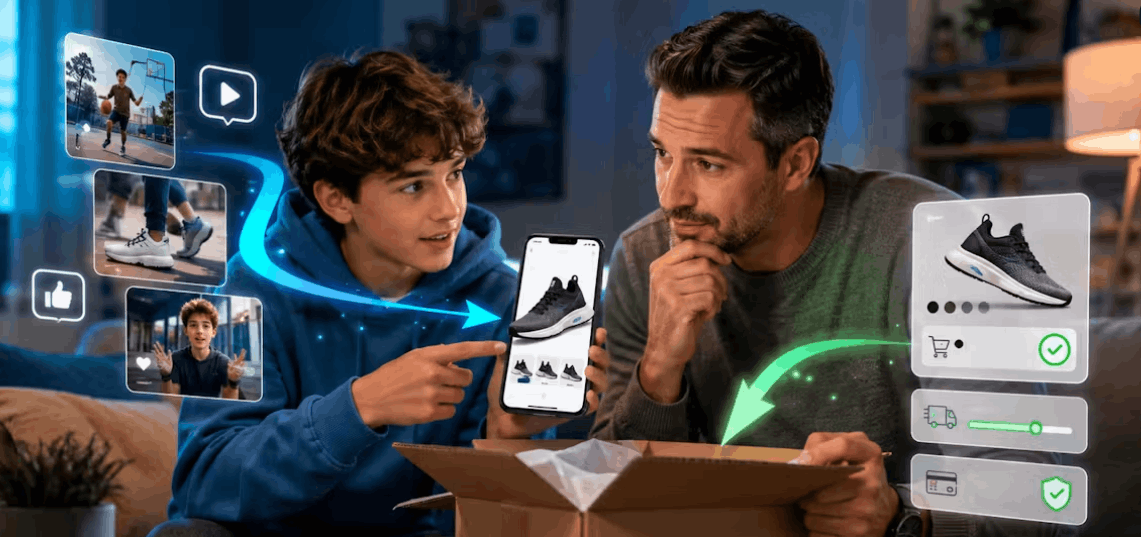
Parents shape what teenagers like. Teenagers shape what parents notice and buy. Different family members discover brands on different platforms. And the person creating demand is not necessarily the person completing the transaction.
For marketers, that changes the problem.
Gen Alpha Is Not Shopping Alone
There are roughly 67 million Gen Alpha children in the United States, including about 16 million between the ages of 13 and 16. Many of these teenagers are being raised by millennials, meaning both generations have grown up in environments where digital discovery, online shopping, social media, reviews, and algorithmic recommendations are normal parts of everyday buying.
But being digitally fluent does not make the teenager an independent buyer.
The study found that 80% of surveyed teens said their parents influence the brands they like.
The influence is even stronger in the opposite direction: 91% of surveyed parents said their teenagers influence the brands they like.
That makes the household less like a traditional parent-child purchasing hierarchy and more like a small recommendation network.
A teenager sees something on TikTok.
A parent checks the price.
Someone recognizes the brand from Amazon.
A sibling already owns something from it.
The purchase may happen at Walmart.
Trying to assign the entire conversion to the first platform in that chain misses much of what actually happened.
Attention and Purchasing Power Are Split
A lot of digital marketing is optimized around capturing the attention of one target customer and pushing that person toward conversion.
Gen Alpha households make that model harder to apply.
A teenager can create the demand without controlling the payment method.
That distinction becomes especially visible in beauty.
Nearly three-quarters of parent purchases involving Sephora and E.l.f. Cosmetics in the study were initiated by the teenager. Among the teenage girls surveyed, 60% said they would ask their parents for E.l.f. products. Teen girls were also more likely than boys to drive purchases made for them: 67% compared with 59%.
In situations like these, the teenager is doing work that marketers traditionally associated with the buyer.
They are discovering the product.
They may be choosing the specific brand.
They can introduce it to the household.
They can create the reason to purchase.
The parent may only enter later in the process.
That makes a simple question such as “Who is our customer?” less useful than it once was.
A better question may be: Who starts the purchase, who validates it, and who completes it?
Those can be three different people.
Mom Still Has More Influence Than TikTok
One of the more surprising findings has little to do with algorithms.
Among teenagers surveyed, 73% said their mothers influenced their brand preferences, compared with 58% who cited their fathers. According to the study, parental influence overall exceeded the influence attributed to social platforms, creators, or celebrities.
That does not mean social media has suddenly become unimportant.
It means discovery should not be confused with authority.
A creator might introduce a product. TikTok might create curiosity. YouTube might explain how something works.
A parent can still determine whether the product feels trustworthy, affordable, necessary, or worth buying.
This is particularly relevant for marketers who build an entire Gen Alpha strategy around youth-facing creative.
Getting the teenager interested may only solve the first part of the sale.
The parent still needs a reason not to say no.
There Is No Single Platform for the Gen Alpha Household
The media data makes the problem even less convenient.
Teen girls in the study leaned most heavily toward TikTok, at 42%, followed by Pinterest at 19%.
Teen boys were more likely to favour YouTube, at 35%.
YouTube also ranked first among dads, at 32%.
For moms, Facebook led at 24%.
A household can therefore contain several audiences occupying different parts of the internet at the same time.
That makes a “Gen Alpha platform strategy” a strange concept.
There may not be one.
A beauty product could first appear in front of a teenage girl on TikTok, become familiar through repeated exposure, get searched elsewhere by a parent, and eventually be purchased through a retailer that neither person originally used to discover it.
The media plan needs to survive that movement.
This is where marketers may need to think less about dominating one platform and more about making the brand recognizable when people encounter it again somewhere else.
The first impression gets attention.
The next impression may need to provide reassurance.
The final interaction needs to make purchasing easy.
Those jobs do not have to happen in the same feed.
Why Amazon and Nike Make Sense at the Top
Amazon and Nike occupying the leading positions is less surprising when viewed through this household lens.
Neither brand depends on one narrow cultural entry point.
Amazon is already deeply connected to how households search for, compare, order, replace, and discover products. A teen can want something without needing to create an entirely new purchasing behaviour for the parent.
Nike operates differently, but it also crosses generations.
It can exist simultaneously as sportswear, fashion, footwear, school clothing, identity, and a familiar household brand.
McDonald’s shows similar cross-generational strength, ranking third for both teenagers and parents in the study. Walmart, meanwhile, performs especially strongly with parents and ranks as the top brand among moms.
These brands are not simply attracting young consumers.
They already have infrastructure inside the household.
Recognition matters because Gen Alpha does not arrive at the purchase with a completely blank slate. Their parents already have years of experience with many of the same companies.
A brand can be new to the teenager while being old news to the person paying for it.
That familiarity can reduce friction.
Moms and Dads Do Not Play the Same Role Either
Treating “parents” as a single segment loses another part of the picture.
Walmart ranked highest with moms but third among dads. Wendy’s also performed particularly well with moms.
Among dads, Nike ranked first and McDonald’s second, with Adidas fourth and Samsung eighth.
There was another difference: 60% of dads in the survey said they introduced their teenagers to new brands, compared with 39% of moms.
So even within the parent side of the household, influence works differently.
One parent may be particularly important for purchase approval or routine household shopping.
Another may play a larger role in brand discovery.
The useful lesson is not that every campaign suddenly needs separate “mom ads” and “dad ads.” That would become mechanical very quickly.
It is that household roles should be investigated rather than assumed.
The Funnel Is Starting to Look More Like a Network
Traditional marketing funnels are convenient because they turn consumer behaviour into a sequence:
awareness, consideration, conversion.
Gen Alpha households do not necessarily behave that neatly.
Awareness might start with the teenager.
Consideration may move to a parent.
Then the parent encounters the brand independently.
The teenager brings it up again.
The family compares alternatives.
Another platform reinforces the choice.
Then somebody purchases it days later through a retailer.
Influence can travel backward and sideways.
For analytics teams, this creates an attribution problem. The last click can still be measured, but it may reveal surprisingly little about why the transaction occurred.
For brand teams, however, the situation is more interesting.
A company does not necessarily need to win every family member independently. It needs enough recognition, relevance, and trust to survive the handoff from one person to another.
What Marketers Should Take From the Data
The obvious response would be to add more channels.
That is probably too simple.
Running TikTok ads for teenagers, Facebook ads for moms, and YouTube ads for dads does not automatically create a household strategy. It can just create three disconnected campaigns.
The harder job is making those interactions support one another.
Youth-facing content can create curiosity without pretending teenagers have unlimited purchasing power.
Parent-facing information can answer practical concerns without feeling like an entirely different brand.
Retail availability can make it easy to act on demand that originated somewhere else.
And the message should remain recognizable enough that a parent understands which product their teenager is talking about when the brand moves from a screen into a real conversation.
That continuity may become more valuable as media consumption becomes more fragmented.
Gen Alpha Marketing May Really Be Household Marketing
The HarrisX and Allison Worldwide research was conducted from May 4 to May 12, 2026, using responses from 705 Gen Alpha teenagers aged 13 to 16 and 750 parents. Results were weighted across factors including age, region, gender, income, and race or ethnicity, with a reported margin of error of plus or minus 2.5%. The study is expected to continue quarterly.
It is one study, and brand rankings will change.
The underlying behaviour is more important.
Teenagers influence parents.
Parents influence teenagers.
Moms and dads do not necessarily play identical roles.
And those people are not consuming media in the same places.
For years, marketers have tried to understand younger consumers by asking which platform owns their attention.
Gen Alpha may force a different question.
Not where can we reach the teenager?
But how does an idea move through the household until someone finally buys it?
The brands that understand that movement may have a much better chance of becoming the Amazons, Nikes, and McDonald’s of Gen Alpha rather than simply becoming another brand that briefly appeared in their feed.
Source
Sara Karlovitch, “Amazon, Nike reign supreme with Gen Alpha teens: report,” Marketing Dive, published August 17, 2026. The article reports early findings from the HarrisX and Allison Worldwide Gen Alpha Household Influence Study.
By
Digital Marketing & SEO Professional | Tech Content Contributor | Exploring AI, SaaS, Social Media, SEO, and the evolving digital landscape.