Author

editor

Browsing

By Jodie Cook

2023 is a great year for the personal brand. Influential CEOs are securing investment, winning customers and grabbing the attention of the media. Thousands of dollars are flowing towards popular YouTubers, LinkedIn profiles and Twitter personalities. If your name isn’t well known by now, you might feel like you’re at the bottom of a steep hill. But that can change in an instant.

You might not need to jump on a call with a personal branding specialist. You may be able to utilize ChatGPT to get the answers you need. With these 7 clever prompts, you can get clear on your mission, vision and values and be ready to get famous for the sake of your business.

Use ChatGPT to develop your personal brand: 7 powerful prompts

1. Define your personal brand

Use this prompt to set the scene and uncover your unique value proposition. This is where you describe who you are and what you do, in as much waffly detail as you like. ChatGPT doesn’t care how coherent you are, it will take your words and make them make sense. It will wade through the details to find a catchy premise that you’re proud to get behind.

Here’s the prompt: “I describe myself as a [your professional role] and I help [specific target audience] achieve [main outcomes you help your audience achieve.] What are the key elements that define my personal brand and make me unique?”

2. Craft your brand story

Stories sell. A well-written story, with a catchy beginning, intriguing middle and exciting end will ensure you’re memorable for all the right reasons. Engage and connect with your audience by sharing your story in a way that compels them to work with you. As you’re defining your personal brand, get clear on the story that surrounds your message.

Fill in the gaps and type this prompt into the same chat: “Throughout my business journey I have faced these challenges [summarize any challenges you have overcome.] Given this information, what is the compelling story behind my personal brand? How can I craft a brand narrative that engages and resonates with my target audience?”

3. Establish your online presence

Not every platform will be right for you, and you shouldn’t waste your energy going in multiple directions. Choose one place and double down. Whether it’s TwitterLinkedIn or Threads, do it really well, and think about the others when you’ve nailed the first. Use this prompt in ChatGPT to help choose the right platform, prioritizing based on your audience and business goals. While you may not agree, it’s worth hearing the advice.

Here’s the prompt to retrieve this information: “Which online platforms are most relevant to my personal brand and target audience? Recommend in order of where my target audience are most likely to be. How can I establish a strong online presence on these platforms?”

4. Curate engaging content

Now you know your value proposition, your compelling story and where you should show up, prompt ChatGPT for the type of content you should share. Provide value and showcase your expertise, networking online with the types of people who will become your client or introduce you to their audience. Use what you have so far to expand the plan, and get ideas for engaging content that will work for you.

Use this prompt to start generating suggestions: “What valuable content can I curate and share with my audience to establish myself as an expert in my field? How can I consistently provide value and showcase my expertise?”

5. Engage with your audience

It’s not enough to share on a social network. To build your personal brand, you have to engage. You have to foster meaningful connections by talking to new people every day. You have to keep in touch with the people you meet. You wouldn’t arrive at a party, do a quick scan of the room then swiftly depart, and this is no different. Get ideas of how to engage to never be lost for words, and action them daily to watch your metrics increase.

While you’ll have your own ideas of how this should be done, add this prompt and see what comes up: “Using [the main social media platform you’ll focus on], how can I actively engage with my audience to foster meaningful connections? What specific strategies can I use to encourage interaction and conversation? Create an action plan of 3 things I should do every day.”

6. Leverage visual branding

The stage is set and you know how to perform. Now it’s time for your costume. Use ChatGPT to create a cohesive and memorable image of you as a professional, that represents your brand in its best possible light. Scruffy profile pictures, wonky headers and a colour scheme that doesn’t fit are not part of the plan. Use this prompt to be guided through your visual brand, based on who you’ve told ChatGPT you are so far.

“How can I develop a visual brand identity that aligns with my personal brand? What elements and design choices can I use to create a cohesive and memorable image?” Use the resulting recommendation to brief a designer or AI graphic design tool accordingly.

7. Monitor and enhance your brand

To break records, you have to make records. Make a note of where you are today and write it down. Number of followers or connections, monthly hits, average engagement per post. Keep the information somewhere safe to benchmark your progress. Your personal brand should continuously evolve and adapt. Over time, you’ll hit upon new topics. You’ll go down rabbit holes. You’ll learn more about what your audience wants and you’ll head in the direction of your interest and passion.

For ideas of how to improve, ask ChatGPT: “How can I monitor and assess the perception of my personal brand online? What steps can I take to enhance and adapt my brand as needed?”

Prompt ChatGPT to be your personal brand consultant

Get set up for success with your personal brand by training ChatGPT to be your personal brand consultant. These seven prompts might be exactly what you need to start the creativity flowing and get some ideas. Think of ChatGPT as less of a coach and more of an interactive journal. You know yourself, your vibe, and how you should show up. You have nudges in the right direction with some options for testing. All that’s left is to get on and do.

Feature Image Credit: GETTY

By Jodie Cook

Follow me on Twitter or LinkedIn. Check out my website or some of my other work here.

Founder of Coachvox.ai – we make AI coaches. Forbes 30 under 30 class of 2017. Post-exit entrepreneur and author of Ten Year Career. Competitive powerlifter and digital nomad.

Sourced from Forbes

Hundreds of sites serving up real ads over AI-generated text are causing headaches for users and advertisers alike.

A new wave of artificial intelligence tools like ChatGPT and Google Bard may or may not change the way humans interact with technology forever. But before it does that, it’s going to make the internet even more annoying. According to a new report, AI is being used to generate a huge amount of websites filled with random, garbage strings of text targeted at search engines, then plastered with advertising to generate revenue.

NewsGuard reports that AI text generation tools are being combined with software that auto-generates new sites, creating masses of domains filled with a huge amount of text. The sites are then filled with programmatic advertising slots, which serve up real ads over the fake content. It could be argued that the process is fraud, since advertisers are paying for ads in good faith that’s presumably written by humans. The combination of largely automatic advertising systems and websites that can be generated by the dozen with few clicks is creating a feedback loop, where AI-generated content with practically zero human input is being financed by advertising algorithms so vast and complex that barely any humans understand them.

AI-generated text can be difficult to distinguish from merely generic or bad writing — after all, filling up sites with low-quality content and selling advertising on top of it is hardly a new practice. To solve this problem, NewsGuard searched for telltale phrases that AI systems sometime return for queries, such as “Sorry, as an AI language model, I am not able to access external links or websites on my own.” That phrase was spotted in a headline for a jobs site…that was supposed to be Brazilian in origin. All in all, the investigation found over 200 “news” sites generated with AI text, one of which was publishing more than 1,200 new articles every day. And these were just the ones that were easily spotted with error messages.

Not every single one of these sites was serving advertisements, but over a quarter were, with 141 major brands paying for ads over garbage content. Major banks, sports clothing vendors, broadband providers, and streaming services are serving up ads aimed at web users in the US, Germany, France, and Italy, four of the most lucrative markets for web advertising. That likely means that the creators are getting enough revenue to justify their efforts, even if the majority of the sites and content generated are duds.

With AI being used to create everything from novels sold on Amazon, to fake political ads, to bogus legal citations used in a very real courtroom, it’s clear that easy access to massive amounts of auto-generated text and images is a growing problem.

Feature Image Credit: Markus Spiske/Pixabay

Michael is a former graphic designer who’s been building and tweaking desktop computers for longer than he cares to admit. His interests include folk music, football, science fiction, and salsa verde, in no particular order.

Sourced from PCWorld


Attributing results to particular channels or campaigns is arguably digital marketing’s most dogged problem, with an array of approaches mutating as platforms change. Here, The Drum Network experts’ quick tips.

Molly Deaville, Growth Director, Dept UK: “Measuring the impact of marketing investment is not a new challenge. There’s no silver bullet solution.

“For far too long, the digital industry has over-relied on attribution as a source of truth. Now data privacy has caught up with technology, and the industry is forced to find better (and more ethical) solutions to help us understand customer and their journeys, better than ever.

“My advice? Run a blended measurement approach, combining attribution with regular incrementality tests across paid and owned channels. Even better if you’re running marketing mix modelling (MMM) and brand studies too; these are often overlooked by digital-first brands. Build your results into a knowledge repository that can be used in planning cycles.

“Don’t just rely on media platforms to mark their homework. When did that become good practice?”

Matt Triggs, Head of Analysis & Modelling, Jaywing: “Attribution modelling has met criticism lately, particularly around its usefulness in measuring incrementality. The claim is that attribution models overestimate on low-funnel channels like PPC and underestimate the influence of upper-funnel or brand-led advertising. They also give little information about the incrementality of channels (as this would require a useful measure of baseline sales), which should be a measure of success.

“In some cases, especially rule-based approaches to attribution, this is undoubtedly correct. Simplified solutions like last-click, position-based or time-delay simply can’t factor in any baseline and are naïve in sharing credit between touchpoints. Modelled approaches using Markov Chains are more sophisticated when it comes to sharing credit, but still struggle with identifying a baseline (and so, incrementality).

“Jaywing’s approach of ‘exploding’ journeys into different combinations and using machine learning and AI to understand key drivers allows identification of a baseline and true, mathematical incrementality. Marketers should look to challenge their attribution providers to ensure that they’re measuring incrementality and providing the best illustration of the power of their marketing.”

Aaron Dicks, Technology Director, Impression: “It wouldn’t be a week in digital without a debate around the next step to take with digital attribution (whether or not we mention GA4). This is under constant review at Impression, and for good reason.

“Stitching together views and sessions for third-party ad platforms naturally falls into the purview of third-party cookies, which have been severely curtailed over recent years, and had their death sentence handed to them for 2024 when Chrome joins Safari and Firefox browsers in their removal.

“Advertisers have relied heavily on performance metrics from platforms that use this data for some time. In some ways, this has let us take our eyes off wider measures of success.

“For us, there are three areas of interest when it comes to attributing results and setting budgets for the modern customer journey – which is multi-platform, multi-moment, and multi-device, and therefore impossible to track from the point-of-view of a third-party.

“Our team is currently appraising: media mix modelling, conversion modelling, and third-party all-in-one attribution platforms. Tools worth checking out include SegmentStream and Triple Whale, depending on your tech and ad stack, and your approach to attribution.”

Kevin Joyner, director of data strategy, Croud: “Our industry has a new-found respect for privacy choices, and a new-found… resignation when it comes to zealous, privacy-protecting browser and OS technologies. These disruptions have thrown conventional digital attribution out of the limelight and into an important, supporting role. The new magic word in measurement is ‘incrementality’. Deservedly so, but as causal inference and machine learning models grab our imagination, there’s a more old-fashioned phrase that mustn’t be forgotten: business impact.

“Machine learning-enabled automated budget optimization will be game-changing, for a business that’s ready to use it. Before commissioning your data science team, ask yourself: are we producing real analysis from the data we already have? Is it resulting in any meaningful action? We must deliver the analytics that will impact your business, even if it’s not yet the new solution our industry’s in love with.”

Harry Daniel, technical marketing strategist, Rawnet: “With the sunset of GA3, we now turn our full undivided attention to GA4 and data-driven attribution modelling as standard in Google Analytics. Data-driven attribution constantly updates how it understands conversion probabilities based on assessing how likely specific user paths are to lead to a conversion or an exit. Data-driven attribution modelling also compares user data to randomized control trials, allowing it to understand and better calculate the conversion probability of different user paths.

“It would be helpful to have visibility of these trials, and the conversion probabilities for different paths. This will improve how agencies report on specific user paths to clients, and give clarity to clients on what user journeys are more likely to drive conversions (and exactly why we use data-driven attribution modelling).”

Nick Elsom, Director, FourForty: “Attribution of what – directly measurable sales? Or maybe something a step removed; propensity, or awareness? And if our work doesn’t have influence over the whole journey, do we even want to ask too many questions? If it was clear-cut, we’d surely all be rushing for the payment-by-results door.

“Customer experience (CX) is about removing obstacles as much as creating demand, so start at the beginning, with a benchmark. The only benchmark that matters in measuring a great experience is: how near or far it is from your customers’ expectations? Without that, CX is just another name for what we do.

“Understanding expectations requires a shift away from total reliance on historic data to extrapolate a view of what customers will do. Demographic, behavioural, and attitudinal data is invaluable. We need to know who they are, what they did and possibly even why they did it. But knowing how your customers see their relationship with you in the future prevents CX being nothing more than a campaign looking for an objective.”

Ryan Green, senior vice-president of marketing and innovation, Coegi: “It’s not just GA4 that will upend your attribution models. The latest iOS17 update will reportedly strip link trackers from being passed through message, mail, and private browsing. It’s yet another action chipping away at the scale and effectiveness of last-click attribution and website analytics.

“We’ve been moving our clients towards incremental measurement for years, even before Facebook and Apple walled off their data. There wasn’t enough impression-level data to build an accurate model then; there certainly isn’t now.

“No single KPI can adequately identify success. Instead, we encourage every brand to develop a custom measurement framework, consisting of media data, business data, and advanced measurement studies – for example: lift in unaided brand awareness (45%) + location visits (20%) + clicks (10%) + sales (25%) = brand health score.

“Let’s start leveraging custom scoring models to evaluate leading indicators of success that are predictive and driving smart optimizations.”

Betsy Ray, director of marketing analytics, Kepler: “With Google’s impending cookie deprecation and the loss of UTM tracking coming with Apple’s iOS 17, it’s long past time for advertisers to move away from cookie-based and last-click attribution. There may be companies offering ‘silver bullet’ software, but most of these are just technical workarounds that may not pass a data privacy sniff-test.

“Rather than investing in short-term ‘hacks’, brands should commit to robust, future-proofed methodologies like marketing mix modelling. MMM software is increasingly more advanced and accessible for brands of any size and any channel mix. Advertisers looking to get started or upgrade their MMM should think about whether they want to build their own model in-house via open-source code, use a lower-cost but customizable self-service partner, or onboard one of the bigger players in the market for more hands-on support. MMM must be validated by a strategy of ongoing experimentation.”

Ebrahim Bakhtar, analytics director, RocketMill: “Touchpoint-based attribution has become an uncomfortably complex topic. Each ad platform and web analytics tool has access to different data and produces its own data-driven attribution models. Which should you trust? Should you build your own proprietary model in-house?

“While there are a slew of adtech solutions to improve tracking and ad attribution, touchpoint-based attribution will never give you the full picture of the performance of your media mix, particularly when it comes to cross-channel interactions or impression-based activity (let’s not talk about cookies).

“It’s become important to augment touchpoint-based attribution models with other techniques, like good old-fashion statistics, leveraging emerging libraries such as Facebook’s GeoLift or Robyn to gain analytics capabilities previously reserved for companies with big data science teams. Connecting these techniques requires a concrete framework where each business decision has a clear, defined method for measurement.

Naomi McAleer, digital marketing manager, Brandnation: “Integrated campaigns require a multi-touch attribution model. If you’re delivering a multi-channel campaign for a client, you need to be able to attribute results to channels. Last- or first-click won’t cut it and will unfairly give all the credit to one touchpoint.

“This gets trickier when you throw PR into the mix. PR, historically an offline channel, is now very much a digital channel in its own right – a positive where attribution is concerned. It’s now fully within a PR’s capability to track what impact their efforts are having on a campaign’s objectives. Enter urchin tracking modules (UTMs), which digital marketers are usually familiar with but are surprisingly not always used by PR and comms. These little snippets of code on the end of URLs create trackable links, picking up the source (the specific release or article). Now we can see this touchpoint in GA4 (and other analytics platforms) and can include this touchpoint in multi-touch attribution models to give PR activity the credit it deserves.”

Feature Image Credit: Edward Howell via Unsplash

By Sam Anderson

Sourced from The Drum

By Sarah Cha

Creating an effective brand awareness campaign feels like trying to solve a puzzle, doesn’t it?

It’s challenging, confusing, but oh-so-satisfying when the pieces finally fit.

The difference? There’s no picture on the box to guide you.

So, how about a selection of tips to help you assemble your perfect campaign?

With proven strategies and easy-to-follow advice, you’ll turn the confusion into a captivating campaign that resonates with your audience.

Let’s begin!

The Power of Brand Awareness Campaigns

If you observe the world of business, you’ll find a common thread that successful brands share: A deep, lasting connection with their audience.

The secret behind this connection? Potent brand awareness.

So, what exactly is a brand awareness campaign?

At its core, a brand awareness campaign is a concentrated effort by a business to increase the recognition and familiarity of its brand among consumers.

It involves using a variety of marketing channels — think social media, content marketing, partnerships, and more — to consistently and cohesively showcase the brand’s values, voice, and offerings.

But why does this matter? The answer lies in our minds.

As consumers, we are more likely to choose a brand that we recognize over one that we don’t. This cognitive bias, known as the familiarity principle, plays a critical role in our purchase decisions.

When a brand awareness campaign is effectively executed, your brand doesn’t just become an option to consumers, it becomes THE top-of-mind choice when they need your product or service.

The power of a brand awareness campaign lies not just in its ability to increase recognition but also to build trust and loyalty among consumers.

When your brand consistently shows up, delivers value, and resonates with your audience’s needs and desires, you’re not just creating awareness; you’re forging a lasting relationship and cultivating a community of loyal advocates for your brand.

In the upcoming sections, we will dive deep into 15 powerfully practical tips that will help you create a winning brand awareness campaign.

Ready to take your brand from being just another name to becoming the preferred choice?

15 Top Tips to Boost Brand Awareness

Let’s delve into the inner workings of a winning brand awareness campaign with our step-by-step playbook.

Each tip offers a unique approach to spotlight your brand, laced with practical examples of brands that have scored big using these strategies.

1. Craft a Compelling Brand Narrative

Telling your brand’s story is a powerful way to connect with your audience on an emotional level.

Brands like Nike excel in storytelling, inspiring audiences with tales of overcoming adversity, and making them want to participate by becoming Nike customers.

And it’s not just Nike. Even smaller brands can tell riveting stories.

For example, a start-up can share its journey from a small garage to the successful business it is today, instilling a sense of inspiration and relatability.

2. Promote Your Brand Offline

Sponsoring events can help extend your brand reach and create memorable impressions.

Red Bull, for example, sponsors extreme sports events aligning with their high-energy brand image. Or consider a pet food brand sponsoring a local dog show, setting up a booth and handing out samples.

The key is to choose an event that aligns with your brand image and product. That way you will be sure to pick up interest from people most likely to buy your product.

3. Gather Customer Testimonials

There’s no better advertising than happy customers vouching for your brand.

Customer testimonials not only establish trust but also provide real-life examples of what you offer.

Consider Airbnb, which effectively uses testimonials to showcase their service. Or visualize a local tutoring program, showcasing testimonials from students who rave about improved grades and test scores.

The more voices you have chiming in about how wonderful you are, the more likely you will win new and better customers for your brand.

4. Win Hearts with Authentic Connections

The power of influencers in shaping their followers’ perceptions is undeniable.

Which is why a partnership with influencers who share your brand values can send your brand awareness soaring.

For instance, Daniel Wellington, a Swedish watch brand, effectively leveraged influencer marketing, collaborating with influencers on Instagram, which significantly enhanced their brand’s visibility.

5. Insist on a Consistent Identity

Consistency is the crown jewel of branding.

It’s the coherence in your logo, colour scheme, and brand voice that fosters recognition.

A sterling example is Coca-Cola with its iconic red and white logo and distinct voice, making it instantly recognizable worldwide.

6. Use Social Media as a Digital Megaphone

Social media platforms are the modern-day marketplace, providing you with direct access to your audience.

For example, makeup brands like Sephora have effectively utilized platforms like Instagram and Twitter to interact with their audience, narrate their brand story, and foster a community around their brand, amplifying brand awareness.

7. Collaborate with Other Brands

The power of partnerships and collaborations can not be overstated.

By joining forces with other brands, you can broaden your horizons, gain new insights, and enjoy enhanced credibility.

For instance, a boutique coffee brand could partner with a popular vegan bakery to create a compelling cross-promotion, extending their reach to overlapping demographics.

This is a great way to promote both brands, for an epic win-win situation!

8. Utilize SEO & Content Marketing

The fusion of valuable content that answers your audience’s queries, and strategic SEO to help them find it, positions your brand as a trusted authority.

For instance, HubSpot has expertly used this dynamic duo to drive brand recognition and authority in the inbound marketing arena.

9. Create Branded Infographics

Infographics offer a visually engaging way to present information that resonates with our intrinsic preference for visual content. Their high share ability also broadens your brand’s reach.

Canva, a design tool platform, often uses infographics to illustrate tips and tricks, effectively expanding their brand recognition.

10. Empower Your Brand’s Secret Agents

Unleash the potential of your employees as brand ambassadors.

They can significantly amplify your brand’s online presence by sharing content and advocating for your brand.

Imagine a local craft brewery encouraging its passionate employees to share their experiences of making their favourite beer on social media. It’s like influencer outreach and content marketing combined!

11. Unleash the Power of Competition

Social media contests are a treasure trove of opportunities to generate buzz, supercharge engagement, and grow your follower base.

Remember, though, the prize should resonate with your audience’s desires.

Picture a tech startup running a contest where the winner gets early access to their innovative software. The fun of participating in such contests will bring in people who just might stick around even after the competition is over.

12. Try LinkedIn Publishing

social media jargon

LinkedIn isn’t solely a job-hunting platform; it’s a potent tool for disseminating thought leadership and industry insights.

Thinking about the platform in this way can enhance your brand credibility and reach. For example, brands like Microsoft frequently use LinkedIn publishing to share industry insights and enhance brand credibility.

But you don’t have to be a multi-trillion-dollar company like Microsoft to make a dent through LinkedIn publishing. By regularly sharing useful content in your niche, you can win serious attention from ideal customers.

13. Give Your Brand a Unique Personality

Your brand personality is your secret sauce.

Let it resonate in all your interactions, be it fun and quirky, or serious and professional.

Think about Apple, and how its innovation and sleek design comes through in every product.

Similarly, if you’re running a quirky novelty gift store, let that fun personality pop in your social media posts and customer interactions.

14. Try Podcasting

Podcasts are a thriving media platform, offering a unique opportunity to engage with your audience.

Hosting your own or being a guest on others can catapult your brand awareness to new heights. Companies like Shopify often use podcasts to share e-commerce insights and success stories, attracting potential customers with their knowledge.

Audio content is another highly effective way to let people know about what you do.

15. Experiment with Remarketing and Paid Social Advertising

Remarketing is your friendly reminder to customers about your brand.

Paired with paid social advertising, it’s a potent strategy to keep your brand at the forefront and re-engage past prospects.

Brands can use remarketing ads to remind their customers of items they left in their cart.

Visualize a SaaS company using paid social ads to remind users of their powerful features and offer a discount for subscription renewal. It can turn a moment of client hesitation or forgetfulness into a sale!

Measuring the Success of Your Brand Awareness Campaign

After you’ve rolled out your brand awareness campaign, it’s time to gauge the results.

It’s crucial to identify if the effort and resources invested have borne fruit.

But how do you do that?

By keeping tabs on your brand’s quantitative and qualitative metrics…

Quantitative Metrics

Start by examining the hard numbers.

Your website traffic, social media followers, click-through rates, impressions — these are all tangible measures of how well your campaign has reached and resonated with people.

Think of these as your campaign’s vital signs.

For instance, if your campaign’s goal was to drive website traffic, a surge in visitors would be a clear indicator of success.

It’s important to keep an eye on these numbers over time, as well, and not just one-and-done. That way you can notice patterns that can help you adjust your strategy, as needed.

Qualitative Metrics

Quantitative data is essential, but don’t neglect the human side of things.

How are people reacting to your campaign? Are they engaging, sharing, commenting? Are the comments positive, neutral, negative?

Customer testimonials, brand sentiment, and engagement rates tell you more about how your brand is perceived and how deep your connection with the audience runs.

Every retweet, share, or heart is a small victory towards stronger brand affinity.

Ultimately, what makes a brand awareness campaign click is a blend of understanding your audience, crafting captivating content, picking the right channels, and a dash of creative magic.

Keep in mind, there’s no universal recipe for success. What clicks for one brand may not for another. It’s about perfecting your unique brew, one campaign at a time.

Wrapping Up Your Brand Awareness Campaign Journey

Each brand awareness tip you’ve learned is a stepping stone towards a winning campaign.

But remember, no one has it all figured out on the first try. The magic happens when you learn, apply, analyse, adjust, and go at it again.

Consider every campaign as an opportunity to learn, to evolve, and to get better. It’s about not giving up until you’ve crafted your perfect strategy.

Just imagine the satisfaction when your brand starts popping up everywhere, when it becomes THE choice for consumers.

So, go out there and craft a brand awareness campaign that shakes up your industry!

By Sarah Cha

Sarah Cha is an avid writer, reader, and lifelong learner who loves making magic behind-the-scenes at Smart Blogger. When she’s not wrangling words onto a screen or page, you can find her strumming a guitar, tickling a canvas, or playing fetch with her favourite four-footed friend!

Sourced from SmartBlogger

By Jose Herrera

In a recent McKinsey poll, it was revealed that amid the Covid-19 pandemic, almost three-quarters of American consumers made changes to their buying habits, including trying out new brands, retailers or shopping methods.

A new era of consumption is upon us. According to the same study, it was found that Gen-Z and high earners are more likely to switch brands. Beyond decreasing brand loyalty, repeat customers’ transactions are increasingly challenging to obtain, and in fact, when looking ahead, “73% [of consumers] intend to continue to incorporate the new brands into their routine.” Bearing these fickle new shopping tendencies in mind, brands—both big and small—will need to shake up how they connect with their customer base beyond the status quo. One way to do this is through hyper-personalized customer experiences.

Even in times of crisis and recession, going above and beyond to make your customer feel understood can pay off. In fact, a 2022 Redpoint Global survey indicated that 74% of customers say their loyalty to a brand is determined by feeling understood and valued rather than being offered discounts or perks. Additionally, 64% said they’d prefer buying from a brand that knows them.

Hyper-personalized experiences have been proven to drive revenue and increase customer loyalty, even during unprecedented times. Here are a few ways to make sure that your customers feel uniquely seen and understood as a consumer.

Provide personalized reports or curated products of interest.

For customers who sign up for loyalty programs or newsletters, it is very easy to analyse their shopping tendencies and interests. In fact, a report from Accenture indicated that 91% of consumers polled said that they are more likely to do business with brands that recognize and remember them and present them with relevant recommendations and offers. One way to make a customer feel uniquely understood is to provide curated recommendations or services based on their browsing history or past purchases.

One example of a company that does a comprehensive and personalized follow-up for users is Grammarly, a free AI writing assistance program. Based on individualized data, Grammarly sends their subscribed users weekly reports that summarize exactly how they’ve utilized their services and lays a “story” about how their customers use the product. These reports not only help customers visualize and see specific insights into how their writing has evolved, but it also has an added bonus of reminding them of Grammarly’s capabilities. By adding this element of personalization and customized follow-up to your practices, you can give your customers the impression that they are not merely using technology but, rather, a service that caters to their individual needs.

Customize offers that honour personal milestones.

Who doesn’t love a free birthday coupon or free treat on their birthday? Many businesses in all different sectors—from fast-food chains to online retailers—honour their customers’ special days. However, in today’s highly competitive market, it behooves businesses to go above the standard day. By collecting data in the form of surveys or through other questionnaires, I believe businesses that can delight or surprise customers through unexpected giveaways that mean something to that particular customer will make a memorable impression in the minds of their consumers. For example, businesses that cater to wedding services may send a special day on anniversaries or even as a “one-year marker” of becoming a customer with a product or service. This latter example highlights the appreciation a company may have for loyalty and honour a unique relationship and timeline between the customer and the business. I find that loyalty programs that are unique and customized are not only good for rapport but also good for business. A recent McKinsey study found that customers who participate in high-performing loyalty programs are 59% more likely to choose that brand over a competitor and are 62% more likely to spend more with that brand.

Have a call to action for customers.

As the research above has proven, customers not only want to feel that they are not only seen by brands they frequent but also heard. One way you can successfully do the latter is to entice customers to offer their feedback and give opinions whenever possible. One company that famously does this is Zappos, the online shoe retailer, who, after sending personalized recommendations, gives a “call to action” to purchase for certain events.

Another example of seeking customer feedback that can then lead to purchases is when companies ask consumers about their preferences which can then lead to products. A candy company, Dum Dums, currently has a “vote for flavours,” and Dunkin Donuts famously asked fans to vote for new iced coffee flavours via Snapchat in 2018. Using the second campaign as an example, try asking for customer feedback and personalization in unexpected ways by meeting them on social platforms in which they feel most comfortable (rather than through targeted emails) to further can make them feel understood.

Conclusion

Customer experiences that are special are those that are memorable for your consumers. While it does require focused strategy, data-gathering and unique innovation, going above and beyond to get to know your customers can not only make them feel valuable but also help to ensure that your services or products are a special part of their lives and not just a one-time transaction. Your customers are complex with unique tastes and interests—through not only recognizing them but honouring them, your business can stick out from among the competition in today’s rapidly changing market.

Feature Image Credit: getty

By Jose Herrera

Follow me on Twitter or LinkedIn. Check out my website.

Jose Herrera, CEO & cofounder, Hire Horatio CX. Read Jose Herrera’s full executive profile here.

Sourced from Forbes

By Adam Petrilli 

Knowing how to score your company’s reputation can provide a clearer picture of how consumers see your brand and how you stack up against the competition.

These days, it’s crucial for every business owner to monitor their company’s online presence and know how their brand resonates with existing and potential customers. The metric used to measure this component of marketing (and brand) is often known as your reputation score.

Knowing your reputation score not only provides a broad overview of your brand’s online performance and sentiment but can create a powerful starting point from which to strengthen your image, generate leads, increase sales and develop that oh-so-critical social proof needed to build consumer trust.

Below, I’ve compiled a list of factors you can use to estimate your online reputation score and better understand your brand footprint across the web.

What factors should you consider when calculating your score?

While there is no exact formula for calculating your reputation score, you can gather data from various sources to shape and understand your brand’s total online impact. Here are five factors to consider when adding up your score and how to use them when measuring your more considerable branding efforts.

1. Customer reviews

Few things affect your score and draw more online attention to your brand than customer reviews. Search engines, niche industry-specific review sites, and general review pages are everywhere. Your score can vary drastically from page to page, and bad reviews are inevitable. How you handle them is far more critical.

Most consumers will comb through 10-15 reviews before taking the next step down the sales tunnel. So monitor your reviews closely and develop a review management strategy. The more you know about the customer experience with your brand, the more valuable feedback you have to improve it.

2. Employee ratings

Sites like Indeed and Glassdoor allow current and former employees to review your company anonymously. Many job seekers base their decision to apply on employee reviews. If they use this information to gauge your company’s reputation, so can you. Here are a few questions to consider when factoring employee reviews into your reputation score:

  • Are there more negative than positive reviews?
  • Can you find commonalities in the negative?
  • Does your current work environment reflect the comments employees left?
  • Do reviews bring to mind any areas that require a change in leadership tactics?

Transparency is a valuable company asset, and modern consumers will turn their back on a business accused of treating employees poorly. So, no business can afford to ignore employee reviews.

3. Local listings

Local listings significantly impact your company’s reputation score, particularly as it holds up against competitors in local search results. For example, if you own a salon, search for “get a haircut near me” or “hair salon near me” for a quick view of your visibility on local search pages.

How do you improve your local search ranking and, by extension, your local search reputation? Start with your local listings. Is the information up to date? How do the reviews look? Nearly all consumers click links appearing on the first search page. Therefore, your SERP position clearly indicates how you score across local search pages.

4. Long-tail search terms

Long-tail keywords contain between three and five words to attract consumers seeking answers to specific questions. Scoring well in a long-tail search can significantly impact your overall reputation score and conversion rates.

Scoring yourself on long-tail terms is as simple as typing questions or phrases relevant to your industry and common among consumers. Once you know how you score, you can develop SEO content to boost your ranking and position your brand higher in the industry.

5. Social media presence

Your social media presence often has an outsized impact on your reputation score. And in an era when so many consumers interact with brands on sites like Facebook and Tik Tok, it also tends to consume a big slice of the brand reputation pie. For example, a single viral complaint video or data breach can turn your business upside down in a moment. In addition, customers use social media to engage with companies and will not hesitate to make their experience public.

Your social media presence also provides a wealth of data. With an efficient analysis, you can paint a more comprehensive picture of the quality and quantity of attention your company generates. This is also a place for soliciting reviews and addressing issues you discover through them.

How can you improve your reputation score?

You can use collected data to compare your business with competitors and develop better outreach strategies. Consider some steps you can include in your approach to boosting your reputation:

  • Solicit more positive reviews by asking for them yourself or using a service to get them.
  • Reach out to your customers more often, showing them that you prioritize their experience over your profits.
  • Create quality content to drive convertible traffic to your website and social media.
  • Answer good and bad feedback professionally and promptly.

Your reputation score can change as quickly as your marketing strategies. Therefore, consistent monitoring is the key to maintaining control of your brand reputation and addressing issues before they become more credible threats.

Are you concerned about your reputation score?

Building a successful brand and influential online presence demands a multi-channel approach to improving the customer experience. Companies of all sizes can benefit from brand specialists and staff dedicated to online review management. When online engagement is up, and customers project excitement about your products or services, growth remains on the horizon. Monitoring your reputation score is an effective means to get you there.

By Adam Petrilli 

CEO & Founder, NetReputation.com

Adam Petrilli develops and executes winning strategies while inspiring teams to embrace change to promote business excellence. He thrives during challenging situations and in making high-risk decisions with a strategic revenue-focused perspective to generate growth.

Sourced from Entrepreneur

By Mark Zweig

Most, if not all, local small businesses in Northwest Arkansas that are struggling or have failed can be attributed to their lack of marketing and advertising efforts, which becomes evident once you delve into the complete truth about them.

I know of a business owner in Northwest Arkansas who says he will shut it down any day due to a lack of business, yet who still will not make even a single free Facebook or Instagram post. He also doesn’t do any internet, radio, billboard or television advertising, nor does he use hangtags for doors, send out direct mail, do email blasts, use SEO or sponsor a Little League baseball team. There is just no marketing whatsoever.

I don’t think this situation is that unusual for many small businesses. Why is this the case? There are several reasons, including:

  1. The owners of these small businesses think they can’t afford it. They see marketing and advertising as an overhead expense, like rent or insurance, and if they can avoid spending anything there, it is money they can put in their pockets and take home to their families.
  2. They don’t believe marketing and advertising work. My experience is that if you spend “X” on marketing and advertising, you will get a certain number of sales or dollar amount of sales from it. So spend X, and get X times 10 or X times 20. What will that kind of volume increase do in terms of business viability and profitability? Think about your own business. But for this relationship to work, it takes consistent activity and spending. I have often heard, “We tried advertising, and it didn’t work.” You can’t do it once or twice and expect that to produce results. It may not.
  3. These small business owners are hung up on the idea that “word-of-mouth is the best advertising,” so they do nothing. They forget that to get word-of-mouth, customers have to buy from the business or use it in the first place. Without marketing and advertising, you will never get the word-of-mouth flywheel going.
  4. They don’t know how to market. Most small business owners are good at something — they are good cooks, carpenters, sewing, or getting people to exercise correctly. That’s why they went into business in the first place. But what they don’t know anything about is marketing and advertising. So instead of going outside their business to find help, they give up. There are so many marketing companies and advertising sources that can help a small business, not to mention marketing students who would love the chance to work with a real business here in NWA, that there is no excuse for not being able to get help.

Let me conclude by saying that I am not someone who’s just done a lot of reading about this stuff and is now opining about it. In my businesses, I always invested in marketing. That’s how two of my companies got on the Inc. 500/5000 list — one of them three times. And today, the new and existing businesses I am involved with heavily invest in marketing and advertising and have a revenue growth curve that reflects that.

Contrary to what your CPA/tax advisor may tell you, a small business can be worth far more than what you can extract annually. The value of the business is directly related to the revenue growth rate, not to mention that a growing business tends to be more profitable than a stable (i.e., stagnant) business.

So now is the time for small business owners to stop handwringing and start investing in a consistent marketing and advertising program. Do it now before it’s too late.

By Mark Zweig

([email protected]) Mark Zweig is the founder of two Fayetteville-based Inc. 500/5000 companies. He is also entrepreneur-in-residence in the Sam M. Walton College of Business at the University of Arkansas and author of the award-winning book, “Confessions of an Entrepreneur.” The opinions expressed are those of the author.

Sourced from TB&P


By Jeff Haden

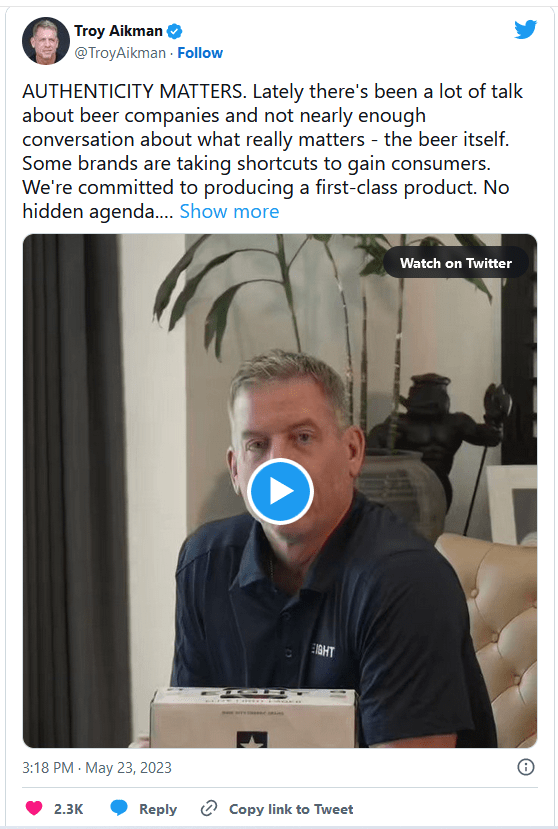
Eight co-founder Troy Aikman on brand positioning, marketing, and keeping your message as simple as possible.

Plenty of stories (including many I’ve written) describe start-up launches. But what you rarely see are stories about the middle stages of a company’s life, a period that in many ways is more difficult than the start-up phase. Achieving — and managing — steady growth. Expanding your team. Building a solid infrastructure. Creating the right culture.

For many founders, that’s when the leadership and business rubber really hits the road.

That’s why, starting in 2017, I regularly checked in with Vuori founder Joe Kudla. (If you aren’t familiar, Kudla turned $700,000 in “friends and family” seed money and a dream into a clothing brand valued at $4 billion.

And that’s why I regularly check in with Hall of Fame quarterback and ESPN MNT analyst Troy Aikman, the co-founder of Eight, a “better for you” beer made with organic grains and antioxidant-rich hops, and without adjuncts, fillers, or sugars. Eight is the most successful independent beer ever launched in Texas, and currently the top-selling beer in the “craft” segment.

But that also means one of the brand’s next challenges is avoiding a sophomore slump, when public attention generated by a product’s launch subsides and customers are often lured away by other product launches. (“New” is great, but by definition doesn’t last forever.)

Often, brands — “sophomore” as well as established — employ a variety of advertising strategies. Partnering with influencers. Targeting a specific market segment. Publicly embracing a particular social cause.

Aikman’s approach is juuuust a bit simpler.

“I like to pare things down to their simplest form and approach,” Aikman says. “That’s how I was as a player, and how I’ve been in business. All I know is we’re working our tails off to make a great beer, and we’ve done that. I’m proud of it, and the rest of it is just a lot of conversation that really doesn’t matter.”

“As a company that is young and hungry like we are,” he says, “the message is that if you want to align with a company that’s focused on one thing, making great beer, then come join team Eight.”

As for spreading that message — industry analyst IRI considers “better-for-you” demand an industry tailwind — the key is also simple: work even harder. While Aikman spends considerable time meeting with distributors, vendors, and customers, as well as attending industry events, his presence is the icing, not the cake.

“We’ve done a lot of testing as far as what resonates with people when they think of Eight beer,” Aikman says, “and what has hit home is that it’s not my involvement. It’s also not some loose association with the Cowboys. What resonates is that we are a low calorie, low carb, all organic beer. That was the best news I could have heard, because like any product, the beer has to stand on its own, especially as we move outside of Texas.”

As for expanding beyond Texas, six months ago Aikman thought the brand would expand to border states since infrastructure and fulfilment would have been relatively simple. Today he’s focused solely on Texas.

“As well as we’ve done in Texas,” he says, “our overall brand recognition in the state is only 15 percent, so there’s still tremendous growth potential. Distributors in other states constantly ask when we’re coming, and that’s great. But still: I’d much rather be pulled into markets, rather than pushing, and the better job we do in Texas, the more likely that is to happen.”

Which might be the best way for your startup to manage a sophomor slump. Sure, you can fuel growth through more — or more “creative” — advertising, but higher customer acquisition costs could result in unprofitable growth. You could fuel growth by spreading into new territories or markets, but that often mean starting over in terms of gaining brand awareness, something that is much harder than expanding from an established base.

Or you could forget what made you successful in the first place, and complicate what should be a simple message: the problem you solve or need you meet, in a way that makes you different from any other brand — because that’s what really resonates with customers.

Everything else? It could just be a lot of conversation that doesn’t matter.

Feature Image Credit: Troy Aikman. Photo: Arturo Holmes/WireImage

By Jeff Haden

Sourced from Inc.

Cross-media measurement continued to dominate industry chatter in Cannes – but are we one step closer to solving the measurement puzzle? Nielsen’s Deirdre Thomas gives us the lowdown.

The advertising industry has been gunning for better attribution and cross-media measurement solutions. With consumers now moving fluidly across devices, platforms and media, it’s been a long time coming for measurement to catch up – but that change is hard.

“It’s not just the measurement and the metrics that have to change – it’s everything from the way companies are organized to the way tools are built, processes are run, and cultures,” says Deirdre Thomas, chief product officer at Nielsen.

The way that the ecosystem has developed historically has created silos where digital may be in one place, television in another, and social in another place. But if marketers want to enable cross platform measurement, all those things must come together.

“That’s really what marketers want – to reach their audience fluidly across all the places they consume media, and the dollars have to flow that way,” says Thomas. “So really, to bring the measurement that way, all the other pieces have to change as well, and it’s a really hard journey.”

To help marketers piece measurement together, Thomas offers two pieces of advice: “Build for what you want to get and organize for what you want to achieve. Organizing teams, processes and buys in a way that actually reflects cross-platform is really going to help push us there.”

The next is a bit more tactical: enable the identification of the digital and linear pieces of a campaign. “That notion does not necessarily exist and it’s certainly not scaled or identical across the ecosystem,” explains Thomas. “As an industry, we need to lean in and make it possible to understand the campaign in a cross-media way so that we’re not trying to piece things together. We need to have an identifier of some form to enable that scale.”

So where does measurement go next? Nielsen announced a tie up with EDO in Cannes to integrate its Nielsen One audience measurement data with EDO’s outcomes measurement, which will enable mutual clients, starting with Disney, Warner Bros Discovery and Mediahub, to better plan and measure the impact of campaigns.

“It’s really the next chapter for Nielsen where we want our measurement to flow out into the ecosystem to underpin all kinds of innovation and measurement, and really create interoperability for the ecosystem,” explains Thomas.

By Jenni Baker

Sourced from The Drum

We Reveal Our Best Online Marketing Strategies for Small Business

Since Source Local Media was formed in early 2011, one of the core values of the company has been to willingly share best practices, including our best online marketing strategies for small business.

The average small business spends 8.11% of its total revenue on advertising.  B2B companies average more like 12%.

But determining your specific online marketing strategy and budget is as unique as you and your business.

How to Determine the Best Online Marketing Strategy for Your Small Business

Here is some insight into our process.  If you’d like to go through this process at no cost or obligation to you, just schedule a free initial marketing consultation with our team here.

We always build online marketing strategy on the foundation of our basic marketing formula:

TARGETING + MESSAGING + REACH = RESULTS

Targeting.  Who are we talking to?

Messaging.  What do we want to say to them?  How can we tap into emotion that will MOVE them in the direction we want?

Reach.  When and where is the right time to talk to them so they can (1) absorb what we’re saying, and (2) take the action we want?  How many impressions will it take to get our desired outcome(s)?

Results.  What do we need to track and report so we know whether we’re being successful or not?

Read More:  Marketing Strategy 101

online-marketing-strategy

How To Optimize Your Small Business Marketing

The beauty of the digital environment is that you can test just about any idea.  The curse of the digital environment is that you can test just about any idea.  🙂

That’s why we developed our Bullseye Method, which provides a structure for optimizing your strategy.  It’s an organized way to test the most plausible ideas, track results, and make a series of iterations until you hit the bullseye where you get the best, most reliable ROI with your marketing investment.

The best online digital marketing strategies must have an organized way to test, evaluate, iterate, and ultimately optimize performance.  Otherwise, you risk wasting time and money.  And no one wants to do that…

How To Calculate the Budget

So how much should your budget for your online marketing strategy be?  Here is an exercise we take clients through that will help you DIY your own budget calculation:

  • What is your average gross margin?
    • If your margin is 60-70%, consider a budget between 8-20% of revenue
    • If your margin is below 30%, consider a budget between 3-6% of revenue
  • How competitive is your business category?
    • The more competitive your environment, the higher you should be in the range
  • How aggressively do you want to grow?
    • New businesses should be on the higher end of the range

There are other factors that could drive your budget up or down.  If you’d like to talk budget, schedule a free consultation with our team.

We Created Our Digital Basics Plans Just for Small Business

How should you allocate your budget to create the best online marketing strategy for your business?  To help you understand our best practices, we’ve shared a link to an overview of our most common “Digital Basics” plans below.

We built these based on the most common budgets and goals our clients tend to identify.  Think of them as starting points, from which we frequently customize.

Comprehensive “Digital Basics” Online Marketing Strategies

We consider Digital Basics the minimum any business should be doing online.  And then we build extra emphasis into certain areas based on your business type (B2B, D2C, etc.), your competitive environment, and — most of all — your growth goals and marketing ROI expectations.

If you’d like to know more about any of the line items, including why we prioritize where we do, we’re always happy to talk you through our best practices.  Just schedule time with our team here.  There’s no cost or obligation to you.  It’s how we invest in potential clients long before they invest in us.

Sourced from Williamson County Source