Twitter employees sued the social media company claiming it refuses to pay 2022 bonuses, despite promises that they would be paid out at 50% of their target amounts.
Twitter has a cash performance bonus plan that is paid out annually and in the months leading up to Elon Musk’s acquisition of the company in October, executives, including former Chief Financial Officer Ned Segal, said the bonuses would be paid, according to the lawsuit filed Tuesday in San Francisco federal court.
“Twitter refused to pay employees who remained employed by the company in the first quarter of 2023 any bonus,” the employees said.
Since Musk took over, Twitter has lost more than half its advertising revenue as brands stopped trusting the site to remove violent, pornographic and hateful content. Twitter also shed more than 75% of its employees, through layoffs and resignations. The site has been roiled by technical difficulties, including during a recent launch of Florida Governor Ron DeSantis’ campaign for president.
The proposed class-action complaint on behalf of current and former Twitter employees employed in the first quarter of 2023 who didn’t receive their bonus was filed by Mark Shobinger, who was Twitter’s senior director of compensation until late last month. The job entailed overseeing executive and incentive pay and in November expanded his responsibilities to include employee compensation globally, according to the suit.
Twitter has disbanded its media relations department and doesn’t respond to requests for comment.
Since Musk’s acquisition, the company has been sued numerous times for allegedly failing to pay its bills, including rent, and by former employees for severance and back pay.
The social media company has traditionally set a target for its bonus plan, which is funded throughout the year and pays out at least 50% of the target annually, according to the lawsuit.
“Both before and after Musk’s acquisition was completed in October 2022, Twitter’s management continuously promised the company’s employees, including plaintiff, that their annual bonus for 2022 would be paid under the Bonus Plan,” the employees said in the lawsuit.
Because Twitter reneged on various promises to its employees, including its refusal to pay the bonuses, Shobinger said he quit. He sued for breach of contract.
As the digital landscape evolves, so do the tools and strategies needed to make businesses succeed online. Search Engine Optimization itself, as a business marketing strategy, has had its ‘death’ declared so many times because it felt like it was no longer relevant. Yet, it’s still here, more strongly than before.
More so, consider the AI revolution that’s currently taking place. Does that mean you should throw away all your old tools and start using AI for everything? It would have been cool if it were that easy.
However, managing a business is not. And search engine optimization is not easy either. That’s why we have reviewed five different categories of tools that your business must invest in to hit your SEO goals and enhance your presence online. Beginner or expert, these tools will make your life easier and your results better.
Keyword Research
Paying for Google Search ads is the fastest way to appear on top of the search engine’s results for relevant queries (if you have enough money). However, the most valuable way to get to the top and remain there is by organically matching the content on your website to the most common terms searched by users.
Data from keyword research tools are organized into lists of the most common keywords relevant to your website. Hence, they are great resources for finding new content ideas, connecting with your audience, and improving traffic.
When choosing a tool for keyword research, you should be okay with free tools such as Google Trends or Google Keyword Planner. However, they each have their limitations. Google Trends is geared toward general knowledge and shows you nothing besides trendiness. Google Keyword Planner, on the other hand, lies within the Google Ads system and is geared towards paid ads, rather than organic search.
As far as free tools go, you can’t do much more than data coming from Google itself. But paid tools take you steps further with improved results, clear insights, and seamless automation. Popular paid tools such as Ahrefs and Moz sit on the high end, costing upwards of $100 for subscriptions. More affordable ones include the Eye10 Keyword Planner, which starts at $39 and includes everything you should expect from a keyword tool: ideas and suggestions, monthly search volume, difficulty level, and the ability to export results.
Analytics
Search engines have an incentive to ensure that their top search results are relevant to the user. But this is not a static process and several (hundreds of) factors come into play.
When your business relies heavily on traffic coming from search engines, you can’t help the occasional jolting feeling when the search engine updates its algorithm such that your efforts seem obsolete. At other times, your efforts are indeed obsolete and you must have been doing something wrong once you notice that your ranking and traffic have taken a hit.
The point here is that, as far as SEO goes, there is always something to improve upon. Always. And how would you know that if you don’t have the right tool to analyze what’s happening? Sometimes, the website itself is the problem; at other times, user behavior may be shifting towards what your website is not yet optimized for. Still, search algorithms may just be doing their thing and it’s affecting you negatively.
Google is, by far, the most popular search engine. So, its Search Console tool is, without a doubt, the best free tool for monitoring your site’s presence in search results. It helps you troubleshoot any issues you might have and ultimately make informed decisions to enhance your website presence.
Content Creation
Everywhere you turn, there is a proliferation of blogs, podcasts, newsletters, videos, webinars, etc. Basically, it’s the content creation revolution and there is an emerging work field of ‘creators’, professionals who apply their creativity in crafting digital content that resonates with their audience.
The most popular creators are individuals, such as MrBeast and Khaby Lame but many businesses have found themselves increasingly locked into content creation because it is a great way to market their brands. Whether it’s a blog or a newsletter, ebooks, or whitepapers, creating content is the order of the day. What you should be thinking about is how to make it better. And there is a solid toolkit for that.
For creating written content, Grammarly is the defacto spelling and grammar checker although others such as the Hemingway Editor and ProWritingAid are excellent alternatives. Canva leads in the graphic design aspect as a highly user-friendly tool for creating social media posts, videos, infographics, presentations, and much more.
Capcut, Descript, Audacity, Buzzsprout, YouTube Studio, etc. are useful for editing, preparing, and distributing your video and audio content for your audience. And any collaborative task manager or workspace tool will help you easily manage your content calendar.
Link Building
Link building is a top-three tactic for getting ahead in SEO. Over the years, Google has developed an immense capacity at detecting and penalizing websites determined to manipulate its algorithm via unethical practices such as link farming and link spamming. The best way to build links today is to earn the backlinks as well as the authority that comes with them.
Ethical link-building opportunities abound but going at it manually can be daunting and frustrating, given the tough competition in the industry. Even something as ‘simple’ as requesting a guest blogging opportunity requires that several moving parts are working without friction. First, you have to publish linkable content, then conduct outreaches, optimize your links and anchors, find broken links and unlinked brand mentions, and monitor competitors. The whole time, you still have to track the effectiveness of your link-building efforts.
As far as link building is concerned, there is no all-in-one tool. It is more likely that you’d be using a combination of various tools to achieve different purposes. For finding link opportunities, SEMrush and Ahrefs offer very useful features. Pitchbox, Buzzstream, and JustReachOut help you to reach out to and collaborate with influencers. Eye10 Backlink Monitor is great for analyzing your backlinks to determine their impact and find issues.
Social Media Management
For many customers today, especially those of the younger generation, a business that lacks a social media presence is as good as not existing. Businesses have responded likewise, by not just establishing their presence on social media but assigning whole teams to control the narrative about their business online.
But social media is not just a PR or a communications tool; it boosts your SEO too when managed strategically. For instance, sharing links to your website increases brand exposure and provides extensive content distribution. Social media might not be an element of SEO ranking, but its benefit such as enhancing your brand recognition and reputation online can contribute immensely to your website traffic.
The entire cycle of creating, publishing, and monitoring content on social media requires strategic workflows, and there are tools that would help you save time and make it less overwhelming, particularly through automation. Buffer, Hootsuite, and Sprout Social help you manage several social media accounts in one platform, including scheduling your posts and accessing comprehensive analytics data. And for building simple landing pages, Linktree is hands-down the most popular tool.
Conclusion
Staying ahead of the competition in a field like SEO takes a lot of hard work. Plus, sustainability is hardly guaranteed; one wrong turn and your website and business are sinking. But these tools can help you to stay afloat when used properly. These are the aspects of SEO you should focus the most of your attention upon.
I’m a Professional Content Writer and Marketer, SEO and PR Expert. I’m the Founder of Digitage and Startup Growth Guide, results-driven marketing agencies. To create content and and improve your brand awareness, get in touch at [email protected]
Are you tired of your freelancing income plateauing? Do you dream of reaching new heights, unlocking your full earning potential, and making money through freelancing? Look no further! In this article, we unveil a treasure trove of strategies that will turbocharge your freelancing income and propel you toward financial success.
From mastering the art of negotiation to expanding your client base and leveraging passive income streams, we will explore the tried-and-true techniques that top freelancers use to scale up their earnings. Get ready to embark on a journey toward greater prosperity and unlimited possibilities!
Ask Previous Clients for Feedback
Many freelancers need more time, resources, and mental energy to dedicate to their clients. This can make it challenging to grow their business without taking on more clients or outsourcing.
Asking for feedback is one of the best ways to scale your freelance business. By asking for feedback, you can identify what your clients want more of and learn how to deliver it better. This will help you increase your profits and improve your overall quality of work.
When asking for feedback, focus on specific details necessary to your clients. For example, suppose a client mentions difficulty focusing on a task or scheduling meetings. In that case, you can use this feedback to develop a strategy to help them overcome these obstacles. This will help you provide a more valuable service to your clients and build stronger relationships. The more valuable you are to your clients, the happier they will be with your services.
Increase Your Rate
Unlike a traditional salary, your freelance rate isn’t guaranteed to increase yearly to keep pace with inflation. That means it’s important to reassess and raise your rates regularly as necessary and set money.
The best way to do this is by establishing a consistent schedule, like on a quarterly or annual basis, that will let your clients know you’ll be reviewing and possibly raising your rates to ensure you continue to offer value for their business. Providing this advance notice will help your clients be more prepared and accepting of the change rather than feeling surprised or resentful.
Also, build an emergency fund to safeguard against unexpected expenses and create a financial safety net. Prioritize your financial well-being as you scale up your freelancing career.
Take on More Projects
As you grow your freelance business, taking on more clients or projects may become necessary. However, you must be careful not to over-extend and burn yourself out. Setting realistic expectations and being honest with your clients about what you can and cannot deliver is essential.
Taking on too many projects can lead to poor-quality work, missed deadlines, and overall burnout. To avoid this, you should only accept projects that fit within your skill set and can be completed in a reasonable amount of time.
It’s also a good idea to focus on working with clients who value your expertise and pay you a fair rate. This will help you maintain a positive mindset and feel more confident about your work. You should also focus on reading between the lines to understand what your clients are asking for. This will allow you to improve your services and ultimately increase your rates.
Ask for Referrals
If you have clients that you enjoy working with and whose projects you have been able to deliver on, it’s a good idea to ask for referrals. Ensure you ask when the client has been happy with your work and is receptive to a request for more business.
A great way to ask is to email the client, express your enthusiasm for the project, and ask if she knows anyone who could benefit from your services. You can also include a smartly worded link or referral request as part of your invoices, in professional emails, or on social media.
Often, it is different from what you do, but who you know will determine your success in freelancing. Make it a priority to build your network of professional relationships, and the quality of your referrals will grow, too. For more tips on how to ask for referrals, check out this article by Megan Taylor.
Delegating Work
Delegating work is one of the best ways to increase your freelance income. It’s a skill that takes time to learn, but once you’ve mastered it, you can save yourself hours of unbillable work each day and focus on the tasks that will truly grow your business.
Hire contractors or assistants to handle repetitive, recurring tasks. This frees you up to take on more high-value projects and improve your overall quality of service. Also, this approach helps to spread the workload across different workers who can each do their own thing without the overhead of hiring someone to fill in the gaps.
You may only be an expert in some aspects of your business, so it makes sense to outsource certain tasks to people who can do them better than you can. For example, you might be a good designer, but you’re probably not a great bookkeeper.
Streamline your workflows
A streamlined process can make a massive difference to your business. A simplified process means you know what you need to do and how to do it, so no confusion or guessing games are involved.
Having a streamlined process also means you can work at your best because there are no mistakes or delays. You can spend more time focusing on your business and less time on tasks that aren’t essential to your company’s growth.
Creating an Online Presence
A solid online presence is a crucial way to boost your freelance income. This includes having a website, social media channels, business listings, niche directories, contributor platforms, forums, and Q&A resources.
This strategy can also help you land higher-profile clients. A well-rounded online presence showcases your expertise, which can lead to clients seeing you as a trustworthy choice for their project. It can also help you build likability with potential clients so they’re more likely to hire you in the future.
You can use a website to create a professional-looking online portfolio, a great source of leads and clients. Creating a YouTube channel or blog can also help demonstrate your skills and attract potential clients.
By implementing these strategies, you’ll be well on scaling up your freelancing income and achieving your financial goals. Remember, consistency, perseverance, and a commitment to excellence are key to long-term success in the freelancing world.
By Jane Du
Jane Du is a dynamic and passionate Outreach Manager at Joywallet.com, leading the charge in partnerships and link collaboration. With a sharp eye for identifying strategic opportunities, Jane forges impactful alliances with experts, influencers, and great companies, driving the company’s growth. Beyond her professional achievements, Jane finds solace in the beauty of nature, often exploring picturesque landscapes like Corfe Castle to Ballard Down with her loyal companion, Rio, by her side. Jane’s commitment to empowering individuals and her love for adventure make her a driving force behind Joywallet.com’s mission to revolutionize personal growth and success. Jane can be contacted at [email protected].
Authors have a unique need to connect with their audience in the places where they hang out: most notably on social media platforms. This can help grow an author’s audience and boost their engagement and book sales. There are tons of platforms out there that they can use to connect with their target audience. How do they decide which is the best social media for authors?
Instead of reinventing the wheel or trying a little bit of everything, here is what you need to know about the best social media platforms.
Let’s dive right in.
Creating the Right Facebook Page
For many authors, the first and most obvious solution is to choose the social media platform where they engage with most of their friends: Facebook. It’s a flexible platform that allows you to create social media posts that include text, images, or videos.
If your target audience is between the ages of 35 and 44, you’ll want to head straight to Facebook. According to Hootsuite, almost half of all people visit the social media giant multiple times a day.
The question is: what kind of Facebook page should you create?
Perks of Using Your Personal Facebook Page
Some authors want their audience to feel like they can personally connect with them. This is great during the early stages of your author career when you want to really make deep and lasting connections with your audience.
If you don’t mind not having a distinction between your writing business and your personal life, making them the same has benefits: for one, you don’t need to worry about keeping up with multiple pages.
Whatever you post is available not just to family and real-life friends but also to your readers.
Leveraging your personal Facebook profile for your writing career means that your audience will need to “friend” you before they can see your content. This might make things a little tricky as you’ll need to approve each new fan. This is why many people use an author page as part of their social media strategy.
Creating an Author Page
The social network also allows you to create an author page, which is very similar to a business page. Your author page caters to the business of bookselling, allowing you a platform that others can easily access to see upcoming events, details surrounding an upcoming book release, and more.
You can even use it to share book reviews that start rolling in as your audience grows.
Plus, people won’t have to friend you in order to gain access to your page. This makes it much more likely that you will be able to reach your audience without the hands-on method of accepting or denying requests from people that you don’t know in real life.
Utilizing a Facebook Group to Reach a Target Audience
A Facebook group is another way to start leveraging the best social media for authors. You can connect with readers in groups catering to your books’ topic and writing. Authors who can’t find a community or Facebook groups that cater to their niche audience can start their own.
The more engagement you get, the more likely you are to show up in the Facebook algorithm.
This means you’ll be more likely to show up in your audience’s feeds instead of forcing them to come over to your group to view new posts.
Instagram for Photos and Videos
Authors who don’t mind putting themselves in front of the camera will want to consider Meta’s other social media platform: Instagram. Designed for images and videos, you can leverage Instagram as part of a robust social media strategy.
Benefits of a More Visual Platform
This social network allows you to make a more personal connection with your target audience. Take them behind the scenes of your writing process with some of these ideas:
Take a photo of your workspace.
Publish a picture with a quote from your latest novel.
Take a video of your process while you work (similar to a vlog).
With more than 2 billion monthly users on Instagram, adults claim to spend at least a half hour a day on the social media platform. Plus, most users are younger, making this perfect for connecting with those ages 18 to 34.
Tapping into Bookstagram
Bookstagram is a popular offshoot of Instagram, indicating that you have an account dedicated solely to your love of books. To get started on Bookstagram, here are a few ideas that you can leverage as marketing tools:
Ask readers to share reviews of your writing skills and books.
Host giveaways for items related to your books or copies of your books.
Share pictures of what’s on your “to be read” pile.
Run a promotion specifically for users on Instagram stores.
All you have to do to tap into a very active audience on Instagram is to tag your posts with the hashtag #bookstagram.
Quickly Build a Twitter Following
With so many platforms, Twitter might not be the obvious first choice. However, it’s a great platform to connect with readers and to keep tabs on the publishing industry as a whole.
According to Pew Research, those who take to Twitter tend to be a younger audience with a higher degree of education. If this aligns with your target audience, you must get used to the fast-paced social media giant.
Perks of Keeping it Short and Sweet
Unlike social platforms like Instagram and Facebook, Twitter is designed to give bite-sized nuggets of information. You won’t need to spend hours writing paragraph after paragraph. Instead, a sentence or two is usually all you can fit into the character limit.
This means that you can post multiple times a day without having to spend hours writing fresh content.
While they have expanded their character limit, many people still prefer to keep it short and sweet, in line with the original intention behind Twitter. The writing world is varied and active on this social media platform, and writers will want to take note.
Twitter Etiquette for Building a Following
This social media for writers is a great option because it has a simple etiquette for growing your following. Namely, it would be best if you follow everyone who follows you. This may clutter up your feed, but it’s the polite thing to do to grow your audience and theirs.
You never know when you’ll find fresh content or a partnership with another author platform where you can share reviews, giveaways, and more for each other.
Booktok to Capture New Readers
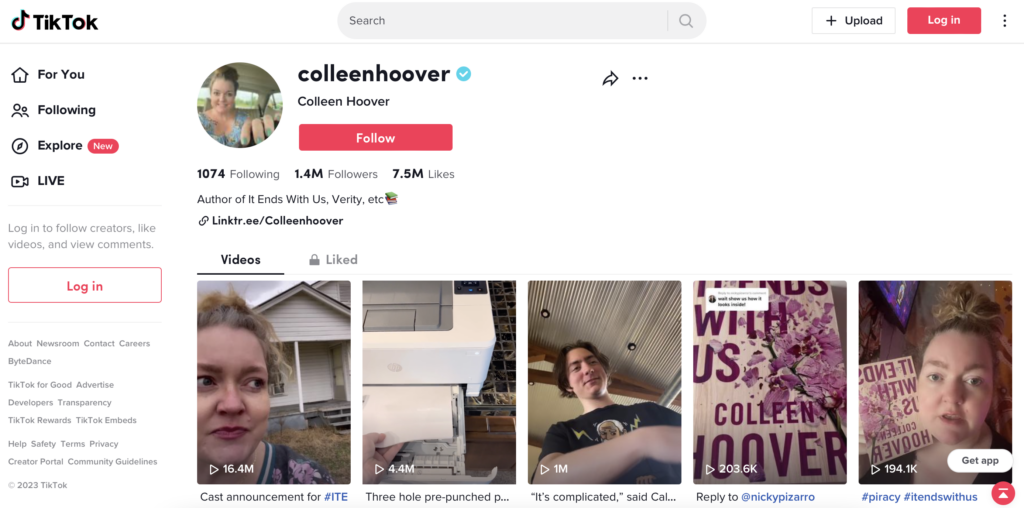
Much like Instagram has Bookstagram, TikTok now has Booktok. Popular authors like Colleen Hoover leverage this social network to reach more people in younger audiences, but all authors can make good use of it.
How popular is BookTok, and how is it influencing the role of reading in the lives of adults?
Some sources say that people read up to 50 percent more due to the referrals and recommendations they find on BookTok. This social media strategy inspires your desired audience to pick up a copy of your book today.
Making Video Content for Your Work
Unlike YouTube, which generally has focused more on long-form content (we’ll look at this in a minute), TikTok is primarily short videos that are easily consumed at a glance. You can’t upload any videos that are longer than three minutes.
Many writers are hesitant to put themselves in front of the camera, preferring to hide behind their words on the computer screen. But getting more reviews of your books and putting your face out there for people to get to know you could be worth it.
Ideas for TikTok Posts
Not sure what you would talk about on camera for a BookTok post? Here are a few ideas to get you started:
Quick and easy writing tips
Background information on your writing process
A behind-the-scenes look at your latest novel
Reading reviews from other platforms and readers
Sharing more about your own reading habits (pass the love along to your favourite authors!)
Goodreads Author Program
Readers often want to know what others say about a book before they’re willing to fork over $10 to $20 for their own copy. One of the most reliable places that they turn to rate and review books is Goodreads.
Readers can show others what they’re reading and what they think of it quickly and easily.
Protect Your Brand by Being Proactive
You don’t necessarily have to register for a Goodreads author account unless you want to maintain some semblance of control over your books. Goodreads is owned by Amazon, meaning that all books available on Amazon should also be found on Goodreads.
This is also a great place to advertise specifically to people looking for new books to read. It’s a great investment in your books instead of Facebook ads spread out to people who may or may not have been in the market for a new read.
You can earn money for advertisements featured on your channel when you reach certain requirements for their YouTube Partner Program by hitting a certain number of hours watched (4,000) and a base number of subscribers (1,000).
Ideas for Long-Form Videos for Authors
Once you get comfortable being on the other side of the camera, you’ll find tons of ideas for video content. Here are a few creative ideas to get you started:
Writing tips for aspiring writers or self-published authors
Interviews with other writers in your genre
A day-in-the-life vlog that shows your writing process
Story highlights that encourage people to read your whole novel
Reviews of books that you loved and hated (and why!)
Affiliate marketing for tools and software that you use in your writing world
Pinterest
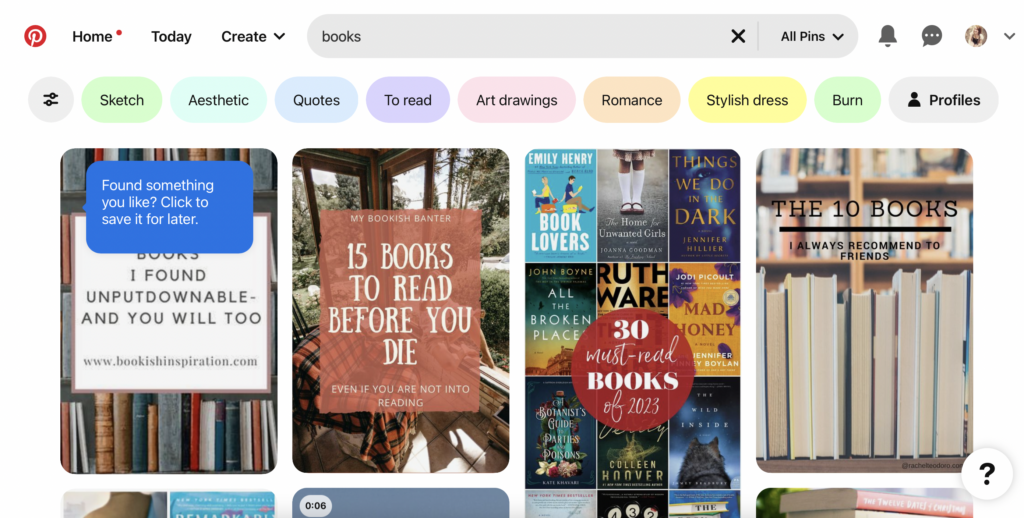
Last but not least, you might find it helpful to post regularly on Pinterest. Most people who use the platform are not authors, but using this visual search engine to create a following around your books can be helpful.
You can use Pinterest to post pictures of things that inspire you or things that influence your books. The best part is that most people aren’t looking for engagement from you in Pinterest in the same way that they might come to accept it from other social media for writers. Users rarely leave comments that warrant a reply from you directly.
Sharing Ideas Rather than Personal Images
If you hate putting your face on your work, you might want to consider Pinterest, as you can share visual ideas rather than personal images. For example, you could create a board based on the visuals that you use to create settings and characters for your book.
This gives people a behind-the-scenes look at your process without needing to attach your image to it — unless you want to!
Pinterest for Fiction vs. Nonfiction
Depending on what kind of author you are, you can approach Pinterest users in several different ways. Fiction writers might use social media platforms to post the images that inspire them or even the tools they use to keep their writing on the rails.
You can even use it to keep track of publications that you have all around the web if you happen to be a freelance writer as well as an author.
You can do something similar with non-fiction works. Post articles and research that you found interesting and influenced your writing process.
Final Thoughts: What is the Best Social Media for Authors?
The truth is that there is no one-size-fits-all solution when it comes to the best social media for authors. Instead, the most important thing is to select a platform you can keep up with and regularly engage with your audience here.
Select one or two of these social media platforms and go all in with them, engaging with your audience and posting content. Experiment to see which platforms work best for your writing career!
Ashley is an experienced freelance writer with an enthusiasm for finding creative ways to earn money online. She uses her passion for words to share what she has learned with the world.
She spends most of her time blogging for a multitude of websites and consuming everything she can get her hands on in relation to personal finance and side hustles.
Short-form video is on fire right now. From TikTok to Instagram Reels to YouTube Shorts, everyone is trying their hand at mastering split-second content.
When done right, those little videos can pack a big punch and, more importantly, make creators some real money.
Creators like Jade Beason are paving the way to success on YouTube with short- and long-form videos alike. Beason is one of many amazing creators in the HubSpot YouTube Network, the video destination for business builders.
Check out her video for a detailed step-by-step guide on how you can make money with YouTube Shorts today — and also look over the key takeaways below:
1. Choose Your Content Strategy
Before we dive into how to monetize your shorts, you’ll need to first choose a content strategy for the videos themselves.
There are three main strategies to choose from:
Repurposing viral content
The lowest-lift content strategy is to repurpose other creators’ content from platforms like TikTok or Instagram. While many YouTubers do build their channels this way, use this strategy cautiously if your ultimate goal is to build a personal brand.
Repurposing your existing content
For a more original tactic that still will save you time, you can repurpose your own content from other platforms. If you regularly post videos to TikTok or Instagram, you can recycle that content as shorts on your YouTube channel.
Tip: Make sure your repurposed content doesn’t have watermarks on it from other social platforms. You can use an app like SnapTik to remove watermarks.
Creating new content
The highest-effort — but possibly highest-reward — content strategy is to create YouTube-native content from scratch.
This will of course take more time than repurposing existing videos, but it will also increase the odds that the content performs well since it will be specifically designed for YouTube.
Regardless of which strategy you choose, monitor your channel’s analytics carefully to understand which type of content is performing well, and which is not.
2. Join the YouTube Shorts Partner Program
Once you’ve created your channel and established which content strategy is right for you, you can start exploring monetization options.
The YouTube Shorts Partner Program is a good option for any creator who meets the eligibility requirements of 1k subscribers and either 4k watch hours OR 10m views from the last 90 days.
Since brands pay YouTube to advertise in the space between shorts — the ads that play as a user scrolls through shorts — the platform makes money directly from those advertisements.
The Shorts Program pools all of that revenue and then divides among all its Partner Program members each month, allocating money based on the percentage of views each creator received. Creators then take home 45% of their allocated amount — YouTube takes 55%.
(If the total monthly ad revenue was $1k, and you earned 10% of all views in a given month, you would be allocated $100 and take home a total of $45.)
Joining the program is a good idea for any creator as there’s no downside: It doesn’t impact your performance or the audience experience — it just opens a new door for monetization.
3. Establish Brand Partnerships
When most creators think of making money on YouTube, they’re thinking about brand partnerships, also known as sponsorships.
This is when a brand pays creators for them to mention their product or service in their video content. Where things get tricky: Shorts are only 60 seconds long, and fitting sponsored-brand content can be challenging, especially when trying to make it natural.
Creators should aim at making these placements feel as organic as possible, as engaging your audience is always the No. 1 priority. It can help to look for brands who work with other short-form content creators because they’ll likely understand the challenges and restrictions more.
A way to make more money: Bundle your Short with another deliverable to make sure you earn a decent income from your partnership.
For example, you could offer YouTube community posts (which are essentially Facebook posts on YouTube) as another type of post to get more from a partnership once it’s in motion.
4. Use Affiliate Links
Affiliate marketing is when you promote a brand, product, or service in your videos and earn a commission on those sales.
For example, if you film every YouTube Short from a desk chair, and then link that desk chair on your channel, each time a viewer clicks on that link and buys the chair, you get a commission.
This is a great tactic for creators who are just starting out with short-form video as you don’t need any subscribers to use affiliate links — or to make money from them.
It’s also a win-win-win: The brand you’ve partnered with sells a product, you make a commission, and your viewer gets both a product recommendation, and, hopefully, a new item they’re happy with.
Whichever strategy you choose (or you can use them all) to make money from Shorts, it always comes back to the content. Focus on making content your viewers will want to watch, and the rest will fall into place.
Twitter was never a major traffic driver for publishers, but it’s driving fewer clicks than ever, Chartbeat says, especially for small news outlets.
Twitter’s role as a source of traffic to news publishers has been diminishing for years, according to data published by content analytics firm Chartbeat.
In April 2018, 1.9% of all traffic to news publishing sites came from Twitter, but in April 2023, the traffic amounted to 1.2%, and hit a low of 1.1% in February.
Small news publishers in particular have seen their Twitter referral traffic drop significantly. In April 2018, 486 small publishers (those with less than 10,000 daily page views) received 10.1 million page views from Twitter referrals. But last month, they received a paltry 186,930 views, a decline of 98%.
Meanwhile, as Press Gazettenotes, medium-sized publishers saw their traffic decline by 40% over the same period, with 3.7 million views in April 2023 compared to 6.1 million five years earlier. Page referrals for medium-sized publishers hit a brief peak in March 2020, when many nations locked down due to the pandemic, with 8.6 million views.
Facebook is still a larger source of referral traffic. News sites relied on the social media site for 12.68% of their total traffic last year. This compares to 11.96% in 2021 and 13.01% in 2020.
The statistics show that Twitter’s page referrals have been declining for some time, well before Elon Musk took over the platform in October 2022.
According to Press Gazzette, the news sites that have seen the largest drops in traffic from Twitter include the Kyiv Independent, falling 61% between September 2022 and April this year, while Buzzfeed.com saw a 60% drop since April 2021, and The Independent saw a drop of 56%.
Meanwhile, bucking the declining trend, British tabloid The Sun saw a 23% increase in page views since Musk took over Twitter and Fox News has seen a 54% increase since 2021.
Three principles of Apple’s branding and positioning in the market.
n the fast-paced world of technology, where innovation is constant, one company has stood out by saying no more often than yes–Apple. This idea of selectivity was recently emphasized by Eddy Cue, Apple’s senior vice president of services. It has become a core principle of Apple’s brand identity, contributing to its unrivalled success and reputation for excellence in design and technology.
Selectivity
Cue highlighted that as a company grows larger, it becomes easy to think it can do anything or everything, but Apple knows this is not true. Apple’s ability to say no to numerous ideas and opportunities is crucial to maintaining focus and ensuring quality execution.
Research supports the premise that selective decision-making is advantageous for businesses. Focusing on a narrow range of products can lead to improved profitability over the long term.
Discipline and focus
By practicing discipline and saying no to endeavours that don’t align with its core strengths, Apple demonstrates a focused approach to product development. This discipline allows Apple to allocate resources effectively and concentrate on delivering exceptional user experiences where it matters most.
Apple’s ability to stay disciplined and focused is crucial in a rapidly evolving market. Research published in the Harvard Business Review emphasizes the significance of disciplined execution in strategy, stating that companies that maintain focus and avoid unnecessary diversification tend to outperform their peers.
Quality over quantity
Apple’s brand identity is synonymous with premium quality, exclusivity, and attention to detail. By selectively choosing which projects to pursue, Apple can prioritize quality over quantity. Cue mentioned that an idea at Apple only makes it off the drawing board if it’s something the company knows it can execute well and if it’s something their customers really care about.
Research supports the significance of quality in shaping brand perception. A study published in the Journal of Consumer Research found that perceived quality positively influences brand evaluations and intentions to purchase. It’s true of Apple as well: A focus on quality contributes to brand desirability and loyalty.
The concept of saying no has proved to be a winning strategy for Apple. Research supports the advantages of selective decision-making, disciplined execution, and a focus on quality. In a world of continuous innovation and digital disruption, it’s hard for leaders and organizations not to follow the next shiny object. The world remains captivated by Apple’s products not because the brand breaks novel ground, but because it steadfastly stays on its course, as it has always done.
Networking has been described as “getting to rub elbows with people who like to geek out about the same things you do.” As accurate (and as fun) as that sounds, growing our network virtually often lacks this joy. Most people are repulsed by cold outreach — both the act of doing the outreach and receiving it.
This fear of cold outreach exists for a reason: it has a history of being done so poorly. On a daily basis, I receive terrible cold outreach emails via LinkedIn. Here are just a few examples I’ve received in the last few months.
Would you consider responding to this one?
Example of failed cold outreach
Leadership Story Lab
No. And here’s why: there’s no personalization or specification. What “transaction” is he talking about? The phrase “I appreciate meeting and networking with successful people,” is as vague as it is cringeworthy. It makes the sender sound desperate to ingratiate himself with successful people when he cares neither their business nor them personally. Further, half the message is about the sender’s assistant Alan. The forced formalities and phony “I’ll have my people call your people” language make it appear that the sender is parading around in attempts to sound important—important enough to have an assistant named Alan.
No thanks. There is nothing sincere or inviting about this message. So let’s look at another example that isn’t quite as generic as the one above, but that still earned the same treatment: complete disregard. Here it is:
Esther, Our businesses and passion for storytelling have a lot in common. You can learn more at <link to my website>. I would like to see if you have an interest in being on our podcast. My background is in pharma, coaching, teaching and I have a PhD. I look forward to connecting.
The first sentence, even though awkwardly phrased, does make an attempt to show some connection between the sender and recipient, but it’s vague. It’s almost like saying, “We both ate breakfast this morning, so we have a lot in common.” And then, painfully, it only gets worse from there. The rest of the message is all about the sender. Their website, their degrees, their podcast, their interests.
This message is cold and transactional. I need X, you have X, I’ve got credentials, so give me X. There’s no joy or geeking out. There’s no conversation. What’s more, the message is shallow; it’s likely this exact message was probably sent to every other person on LinkedIn who has used the keyword “storytelling” in their bio. Who would want to respond to this message?
Let’s look at one more example of a failed cold outreach email. This one attempts to be more conversational and makes gestures toward personalization, but it is just as poorly received as the prior messages.
Incredible. You are an incredible inspiration to me.
We are all human however when I started to write this I hesitated multiple times. You are a wealth of knowledge. Which you know. My story is one of great sadness and over doing. Would you have time for a call?
I’d love to learn from you. Hopefully we can connect. I had to ask you …. especially after reading your book.
In this message, the sender again fails to make a convincing case that they know anything about the person she is trying to connect with. “You are incredible” and “You are a wealth of knowledge” fail as flattery because there’s no follow up with specification. What is so incredible? How has the sender come across this wealth of knowledge? What on earth is she talking about?
The second failure (beyond the poor grammar and run-on sentences) is that the self-deprecation raises red flags. While humility is a virtue that helps people connect, proverbially slouching through LinkedIn removes any joy or desire for connection. Why would someone want to connect with a person who seems to value their own potential so poorly?
The third failure is the call to action, “Would you have time for a call?” is as vague and meaningless as the sender’s flattery. If someone were to respond to this LinkedIn message, what would the phone call even be about?
From these three examples, we’ve learned what not to do:
Don’t be vague
Don’t be transactional
Don’t be pompous, listing your accomplishments and your personal assistants
Don’t be self-deprecating, apologizing for bothering the person
The Secret to Successful Online Networking
Think of a time when you were waiting in line at the airport and you struck up a conversation with the person in front you. The conversation flows easily. You discover you both travel frequently for your jobs and you trade tips on which airports have the best food choices. When it’s time to go through security, you part ways smiling. What was so pleasant about that interaction? You felt seen and understood. This is the scenario you want to create when networking on LinkedIn. How can you make the person you want to connect with feel seen and understood?
Let’s look at some real examples of networking experiences that received responses. In a prior article, filmmaker Bryce McNabb, shared how he networks on LinkedIn by commenting on posts. He observes that authenticity is key to cold outreach: “I didn’t want to be seen as fake and trying to get something from you. You can totally feel that and it’s offensive. So I didn’t force it. I made a point to only ever comment if I genuinely had something thoughtful to contribute.”
Unlike the cold emails above, commenting on a person’s posts is inherently more conversational. By default, you demonstrate your interest in their subject matter by reading their work and expanding on it or asking a good follow up question.
Another successful example of cold outreach also highlights authentic interest in the work of the person being reached out to:
Dear Jennifer,
Last night I was elated to read about your book, We Need To Talk: A Memoir About Wealth in the NYT article by Paul Sullivan. Serendipitously, I’ve been working with a research partner the last few months interviewing twenty-two first generation wealth creators.
What’s remarkable about your book is that you’re telling your story openly, something that is extremely hard to find. My interviewees were all either trusted friends or trusted friends of friends. We promised confidentiality and anonymity. And even then they were tentative to talk about their stories involving wealth.
The one thing I have going for the research is that no one had ever asked them the questions I am interested in. So they’re intrigued and ready to reflect.
I just ordered your book and am so looking forward to reading it. You must constantly be pinged by people. I hope you don’t mind my outreach. I hope to learn from your story so that the research report can be all that more enriching for the public.
The differences between the failed examples and this example, which elicited a response within hours of sending the message, are drastic, but let’s take a look. Here’s why this cold outreach email worked:
The specificity demonstrates sincerity. It is clear the sender of the email has a genuine interest in Jennifer’s story. The sender compliments Jennifer, but it’s authentic, personalized and specific. The sender shows why her work is so meaningful to her own work.
It’s about relationship building, not transaction. The sender is not asking for her to be on a podcast or to give her a free consultation. The sender is simply reaching out to say, I see you and I appreciate what you are doing.
When the sender does share about herself, it’s neither pompous nor self-deprecating. Rather, she is demonstrating her own personal investment in the subject matter.
Let’s take a look at the third example of networking that is short and simple.
Successful cold outreach message
Leadership Story Lab
Like Bryce’s approach, this example of a cold-outreach email focuses on carrying the conversation forward, simply and briefly. She acknowledges the recipient’s work and provides her interpretation in a way that demonstrates what she appreciates about it. In just one sentence the sender makes the recipient feel seen and understood.
The secret to successful networking on LinkedIn is this: Be human.
Humans thrive on conversation that is meaningful, specific, and demonstrates genuine interest and authenticity. So don’t be afraid to geek out and share authentically with a person you really want to connect with. You won’t regret it: You may find a new collaborator or business opportunity, or even a new friend.
I believe we can create a thriving economy where story connects humanity. The key is grasping the essence of one another. How do you really know a person? And how can you trust that a company truly has your best interest in mind? My late father advised me this way: Listen to their words. Observe their actions. Understand their hearts. Leaders, and the companies they lead, must have a consistent way of communicating what’s in their hearts through words and action. I am the author of the book “Let the Story Do the Work” and the CEO of Leadership Story Lab. I teach classical storytelling to modern leaders through my own practice, Kellogg School of Management and University of Zurich in Switzerland. They, in turn, use their stories to communicate authentically, inspire others and create lasting impact that they previously considered out of reach. Follow me on Twitter or Facebook, or email me.
Spending is forecast to reach $727.9 billion in 2023, and increase 4.7% next year
Advertising spend is expected to grow globally this year, with inflation driving it to $727.9 billion and $3 of every $5 going to digital channels over the next three years. However, according to Dentsu’s latest biannual global forecast, digital spend is likely to slow to single-digit growth in the future.
Dentsu is predicting a 3.3% rise globally in ad investment this year—up $23 billion from 2022—followed by a further increase of 4.7% in 2024 and 3.8% in 2025. The growth forecast has been downgraded by 0.2% since last December’s report due to macroeconomic factors.
The forecasts are provided for 58 markets including the Americas, Europe, Middle East and Africa, and Asia-Pacific across digital, television, print, out-of-home, audio and cinema.
Putting on the brakes
The previous forecast from Dentsu revealed that following a period of record spend, the ad sector would see a slowdown this year and in 2024 it’s expected to accelerate again to reach $762.5 billion, partially due to the Olympics and Paralympics in Paris, the UEFA European Championship and the U.S. presidential election.
We still expect global advertising spend to grow despite the economic uncertainty.
Peter Huijboom, CEO of international media, Dentsu
Digital ad spend will grow to $424.2 billion this year and account for 58.3% of all ad spend, increasing to 59.1% in 2024. While digital ad spend will continue to grow, it is expected to at a slower pace, 7.8% this year.
Emerging digital channels such as retail media and connected TV will remain in high demand, while programmatic buying is also set to increase by 14.4% to reach 71.4% of digital spend in 2023.
In revealing the latest forecast, Peter Huijboom, CEO of international media at Dentsu said: “For years now we’ve seen the industry pivot toward digital, more than doubling investment in the last five years thanks in part to the almost unlimited potential to reach, engage and sell to individual consumers. It has been one of the big drivers for growth, but with finite marketing budgets available to brands—it’s clear we are now starting to reach a point of digital maturation within the campaign mix alongside more traditional channels.”
He added that markets such as India, where digital was still in its “adolescence,” would continue to witness rapid growth in spending. Tech and platform innovations, alongside new channels and changed planning behaviours, would also mean that digital investment would still see “consistent growth” worldwide.
“We still expect global advertising spend to grow despite the economic uncertainty,” Huijboom highlighted in the report. “However, media price inflation is the true driver of this increase and hides the more lacklustre reality: 2023 will be a flat year for ad spend.”
Asia-Pacific is projected to grow the fastest in 2023 by 4.6%, followed by the Americas by 2.9% and EMEA by 1.9%. Earlier this year, reports on the U.K. market indicated that advertising spend there would virtually stagnate, with growth in spend of only 0.5%.
The Americas will witness the largest growth in ad spend at $334.9 billion
Spending increases across most media
One of the categories set to decline will be TV ad spend (-3.1%) at $170.2 billion by the end of the year, with positive growth expected to return next year. Print advertising will also continue to decline by 4.8% to $48.4 billion.
Media channels set for year-over-year increases are out-of-home (3.8%), cinema (2.1%) and audio (0.8%).
Search investment will be up by 8.9% to $150 billion, with search behaviour expanding from traditional search engines to social media and commerce platforms through innovation powered by artificial intelligence.
The forecast had not yet researched the impact that generative AI could have on the advertising sector and the potential opportunities it could afford brands, but it was mentioned by Huijboom as something that will be monitored in the future.
“Of course, we’re excited about the impact generative AI could have on our industry with the arrival of new in-channel opportunities for brands to embrace, so we’ll need to see if it remains the case.”
Twitter is now worth just one-third of what Elon Musk paid for the social-media platform, according to Fidelity, which recently marked down the value of its equity stake in the company.
Musk has acknowledged he overpaid for Twitter, which he bought for $44 billion, including $33.5 billion in equity. More recently, he said Twitter is worth less than half what he paid for it. It’s unclear how Fidelity arrived at its new, lower valuation or whether it receives any non-public information from the company.
Fidelity first reduced the value of its Twitter stake in November, to 44% of the purchase price. That was followed by further markdowns in December and February.
Twitter has struggled financially since Musk took over. After saddling the company with $13 billion of debt, Musk’s erratic decision making and challenges with content moderation led advertising revenue to decline by 50%, Musk said in March. An attempt to recoup that revenue by selling Twitter Blue subscriptions has so far failed to take off. At the end of March, less than 1% of Twitter’s monthly users had signed up.
Twitter didn’t specifically respond to a request for comment.
Musk’s investment in Twitter is now worth $8.8 billion, according to the Bloomberg Billionaires Index, which uses Fidelity’s valuation to calculate the value of his holding. Musk spent more than $25 billion to acquire an estimated 79% stake in the company last year.
The latest markdown erases about $850 million from Musk’s $187 billion fortune, according to the index. Despite Twitter’s issues, Musk’s wealth is up more than $48 billion this year, largely due to a 63% surge in Tesla Inc.’s share price.