Author

editor

Browsing

By Andrew Dunn

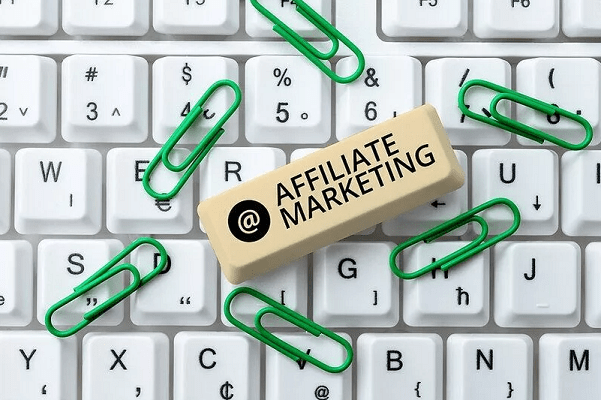
Affiliate marketing is quickly becoming a very popular way for beginner and budding entrepreneurs to make money online.

If you don’t know much about affiliate marketing, that’s OK. The affiliate marketing programs in this article are the easiest ones to use and feature products that are among the easiest to get clicks for.

So first, let’s ensure you know exactly what affiliate marketing is and how it works. Then we will dive into the 17 best affiliate programs for beginners.

What is affiliate marketing?

Affiliate marketing is performance-based marketing in which a business rewards one or more affiliates for each visitor or customer brought by the affiliate’s marketing efforts.

It is a process where you promote someone else’s product or service and earn a commission when someone decides to purchase by clicking on your link. The affiliate partner then rewards a payout for a specific result to the retailer or advertiser, typically a sale. But some affiliate marketing programs can reward you for providing them with leads, a free trial, user clicks to a website, or getting downloads of an app.

Most affiliate programs are usually free to join, and there are usually no high startup costs. If you have an effective affiliate marketing strategy, you can go from this being a side hustle to a profitable online business idea and earn a healthy monthly income.

What is an affiliate program?

Affiliate programs are a way for merchants to promote their products and services. Affiliates (or associates) are websites that agree to promote the merchant’s products and services in exchange for a commission on sales.

The commission can be based on several factors, such as the number of people the affiliate sends to the merchant’s site or people who buy something or perform some other action.

It is also known as an affiliate marketing program.

How do affiliate marketing programs work?

Affiliate marketing programs connect businesses with potential customers through online platforms such as social media, blogs, and email newsletters. When someone clicks on an affiliate link, they are taken to the business’s website. The affiliate gets a commission from the sale if they purchase a product or service within a specific timeframe.

Affiliate marketing programs offer you the chance to promote brands that sell online business tools such as VPNs and other software, pharmaceutical items, digital products such as e-books, and anything else you can buy online.

What is the commission rate?

The commission rate is the percentage of the sale that the affiliate receives. It can range from a few per cent to 50% or more. The average commission rate is around 20%. Some programs also offer recurring affiliate commissions and they pay you a commission for every month a customer uses their product.

What is the cookie duration?

The cookie duration is the amount of time an affiliate has to generate a sale for the merchant before the affiliate’s cookie expires. The average cookie duration is 30 days, but some affiliate programs have shorter or longer periods.

What are the 17 best affiliate programs for beginners?

Affiliate marketing is a great way to make some money. Even if you are a beginner, you can make some money by signing up to be an affiliate with an affiliate marketing program.

We have selected the most popular ones for beginners based on the size of the program, how popular it is, how easy it is to get clicks, and the size of the payouts.

ClickBank affiliate program

ClickBank is one of the oldest and most popular affiliate programs. It is a marketplace for digital products, such as e-books, software, and membership sites. Most of the products are in the digital information marketing and health supplement niches.

Pros

  • You don’t need to have your own website to promote programs
  • The average commission is high compared to many other affiliate marketing programs
  • There are many programs with recurring commissions
  • The pre-selling is already done for you by the merchant’s landing page
  • Digital products can be quickly promoted through email marketing and social media
  • Creating an affiliate link is easy

Cons

  • The Marketplace is functional but hasn’t been updated in nearly two decades
  • Some programs have resulted in high refund rates

Payment details

  • The commission rate varies
  • The cookie duration is 60 days

Rakuten advertising affiliate program

Rakuten Advertising

Rakuten Advertising is one of the largest affiliate networks, with over 12,000 affiliate programs. It has a wide variety of products and services, ranging from books and music to fashion and electronics.

Pros

  • The affiliate network is extensive and has many well-known brands
  • Affiliates can earn cash back as well as commissions
  • There are many tools available to help affiliates succeed
  • Handles over $100M a year in sales yearly

Cons

  • The user interface could be more user-friendly
  • It can take a long time to get approved for some programs

Payment details

  • The commission rate varies
  • The cookie duration varies

Impact affiliate program

The Impact affiliate program is a performance-based marketing platform that connects businesses with affiliates who promote their products and services. Impact offers various affiliate marketing tools to help affiliates succeed, including an affiliate network, tracking software, and creative resources.

Pros

  • Instant approval of brands
  • Wide choice of affiliate programs
  • Intuitive interface
  • Home to big-name brands
  • Choice of categories
  • Multiple ways to cash out earnings

Cons

  • Slightly fewer features than some other affiliate programs
  • It has a wealth of features, which is a good thing, but they can be too much for some beginners

Payment details

  • The commission rate varies
  • The cookie duration varies

Awin affiliate program

Awin is a global affiliate network with over 13,000 active affiliates. It has a wide range of products, including fashion, beauty, and home goods. It offers a vast selection of affiliate marketing programs, and with its accelerated payment system, you don’t have to wait long for payments.

Pros

  • The network is extensive and has many well-known brands
  • Affiliates can earn cash back, as well as commissions
  • There are many tools available to help affiliates succeed
  • Many big-name brands to work with

Cons

  • This program is top-rated, which means you will have a lot of competition
  • Operates mainly in the EU and UK, although it is a global company

Payment details

  • The commission rate varies
  • The cookie duration varies

Etsy affiliate program

Etsy

Etsy is an online marketplace where people can buy and sell handmade and vintage items, among other things. It has a wide variety of products, including art, home décor, jewellery, and clothing. It offers a vast selection of affiliate marketing programs.

Pros

  • Commission rates are high compared to other affiliate programs
  • Etsy offers a wide range of products that can be promoted
  • The site is well-known and popular, which could result in increased traffic and sales
  • Etsy is a trusted brand with a loyal following, which could result in higher conversion rates

Cons

  • Sometimes, they change the algorithm rules of the platform
  • Popular vendors sometimes leave the platform

Payment details

  • The commission rate is 4% per sale
  • The cookie duration is 30 days

eBay partner network affiliate program

The eBay Partner Network is an affiliate marketing program run by eBay. It offers various products, including electronics, fashion, and home goods. With over 12,000 active affiliates, the eBay Partner Network is one of the largest affiliate networks.

Pros

  • Wide variety of products to promote
  • Low barrier to entry, so it’s great for beginners
  • High commission rates
  • Global brand name
  • PayPal payments

Cons

  • Short cookie rate
  • Many knock-offs on their site

Payment details

  • The commission rate is up to 4% per sale
  • The cookie duration is only 24 hours

Fiverr affiliate program

Fiverr is an online marketplace for services. It has a wide range of services, including graphic design, web development, and video editing. It offers a vast selection of affiliate marketing programs.

Pros

  • You can make a lot of money through their high commissions
  • The interface is user-friendly and easy to navigate
  • They are a market leader, so there is no real competition
  • New services become available to sell all the time, so you’ll always have something to promote

Cons

  • You don’t get paid for sales to existing customers
  • Some of the popular programs leave the site

Payment details

  • The commission rate is up to $150 per sale
  • The cookie duration is for 30 days

FanFuel

Fanfuel

FanFuel is an affiliate marketing program for sports fans. It offers various products to make commissions on, including tickets, apparel, and memorabilia. FanFuel has a massive selection of affiliate marketing programs.

Pros

  • Commission on repeat customers for life
  • Real-time data
  • Retargeting campaigns and funnel optimization
  • Good referral bonuses

Cons

  • Not all countries can participate
  • It doesn’t associate itself with the offshore gambling websites

Payment details

  • The commission rate is 40% per sale
  • The cookie duration is 90 days

ShareASale affiliate program

If you’re looking for a well-rounded and reliable affiliate marketing program, ShareASale is a great option. With over 5,000 different affiliate programs to choose from, you’re sure to find something to match your interests and skills.

The interface may be outdated compared to some flashy programs, but it’s simple and easy to use. And most importantly, the programs offered through ShareASale are high quality and profitable.

Pros

  • ShareASale has a comprehensive database of products and services to promote, much larger than many other affiliate marketing programs.
  • It also includes more minor, unknown, but worthwhile affiliate programs that can be a great source of income.
  • The “Search for Merchants” function is far superior to Commission Junction, for example, in terms of usability and finding relevant programs.
  • Their “PowerRank” metric shows you where an affiliate program sits in the top 1000 on ShareASale, which is a valuable tool for determining whether or not a program is worth signing up for.
  • Payments are processed quickly and efficiently when you don’t have to wait months to get paid using ShareASale.

Cons

  • The interface is quite old
  • Its approval process for affiliate programs is unpredictable

Payment details

  • The commission rate varies
  • The cookie duration varies

FlexOffers affiliate program

If you’re looking for an affiliate marketing program with a massive pool of quality advertisers, FlexOffers is an excellent option.

They have 12,000 merchants to choose from but only consider 500 of these to be “premium” merchants. This gives affiliates access to some of the biggest brands in the world.

FlexOffers is one of the most reputable affiliate marketing programs, which helps build consumer trust.

Pros

  • Great way to monetize your website or blog traffic
  • Efficient and easy-to-use filtering system for finding relevant advertisers
  • Generous commission rates
  • The flexible Rev$hare program allows you to earn additional revenue from your sub-affiliates

Cons

  • Limited customer support options
  • They have a complex interface to focus on

Payment details

  • The commission rate varies
  • The cookie duration varies

Market Health affiliate program

Market Health

The Market Health Affiliate Program is a great way to monetize your health and wellness website or blog.

They offer a wide range of products, including fitness equipment, supplements, men’s health, teeth whitening, and skincare products.

Plus, the Market Health affiliate program is one of the most reputable programs around, which helps build trust with consumers.

Pros

  • The Market Health affiliate marketing program constantly adds new products to its lineup, so you’ll always have something fresh and new to pitch to your audience.
  • The team at Market Health has over two decades of experience in the affiliate marketing industry, so they know what they’re doing and are interested in helping you make as much money as possible.
  • You get a wide range of products to pitch
  • They have excellent commission rates
  • Are an established company with a proven track record

Cons

  • Cookie duration could be longer
  • They sometimes change the commission rates

Payment details

  • The commission rate is up to 60% or $75 per sale
  • The cookie duration is 30 days

CJ Affiliate network

CJ Affiliate is one of the oldest and most reputable affiliate marketing programs. They have a wide range of advertisers, including major brands like Nike, Target, and Best Buy.

Plus, CJ Affiliate is an excellent resource for finding high-quality affiliate programs to promote.

Pros

  • The intuitive user interface and dashboard make it ideal for affiliate marketing beginners.
  • Many big brand names are under one roof, leading to more commissions and opportunities.
  • Direct display advertising opportunities, which offer a flat fee or commission.
  • You can find profitable affiliate programs without guessing, as CJ Affiliate provides helpful support and tutorials.

Cons

  • There’s a revolving door with the big brands
  • It will take a bit longer to learn than some other programs

Payment details

  • The commission rate varies
  • The cookie duration varies

NordVPN affiliate program

NordVPN is one of the most popular VPN services on the market, and its affiliate program is a great way to monetize your website or blog traffic.

They offer a wide range of plans so that you can tailor your pitch to your audience. Plus, NordVPN is an established company with a proven track record.

Pros

  • The affiliate marketing program offers a 40% commission for all new accounts that sign-up through your affiliate link, but you can also earn 30% on renewals
  • One of the best VPN services on the market
  • Big influencers typically only promote products that convert well, i.e. they make money from the promotion.

Cons

  • Deep linking is not available
  • Only available in English

Payment details

  • The commission rate is 30% – 40%
  • The cookie duration is 30 days

Bluehost affiliate program

Blueshot

The Bluehost affiliate marketing program is a great way to earn commission by promoting one of the many web hosting companies operating under the banner of EIG.

Since 2003, this company has established itself as a solid choice for affiliates and small businesses looking for affordable hosting and a lucrative affiliate offer.

Bluehost is one of the best affiliate programs for beginners in this roundup by earning potential, paying at least $65 per referral. You’ll see Bluehost mentioned and recommended on many marketing blogs.

Pros

  • Associates earn $65 for each referral that signs up for a hosting plan, making it an excellent offer for bloggers and small businesses
  • A reliable web hosting provider that is ideal for beginner bloggers
  • Established and trusted name in web hosting
  • Their affiliate program converts lots of traffic into sales

Cons

  • There is a high threshold to getting paid
  • You need to make two sales and have $100 to withdraw funds

Payment details

  • The commission rate is $65 per sale
  • The cookie duration is 120 days

AppSumo affiliate program

If you’re familiar with online marketing, you’ve probably heard of AppSumo. It’s a site that offers deals on the latest tech products and ongoing discounted plans or packages for more established brands in the tech space.

This means you can get a lifetime license for a software product and pay a one-time fee instead of a monthly subscription fee.

This can save you thousands of dollars annually in membership and licensing costs for software that directly benefits your online or offline business.

AppSumo’s product offerings are varied. They have programs for products like marketing and analytics tools, stock photo sites, productivity tools, and much more. This makes it an excellent option for affiliates because there’s something for everyone.

Pros

  • Pay-per-sale on each initial transaction
  • You get a unique URL to track all of your sales and referrals
  • A custom dashboard with real-time stats
  • Unlimited commissions and a 30-day cookie

Cons

  • Lower cookie duration than other programs
  • Higher payout threshold ($100) than other programs

Payment details

  • The commission rate pays up to 100%
  • The cookie duration is 30 days

Semrush affiliate program

Semrush has an affiliate marketing program that rewards you with $10 for every referral that signs up for a free trial and $200 for any referral that chooses a paid account. This is a great way to make some extra money, and the program is simple to participate in.

They have a suite of tools to help you do everything from backlink and keyword research to optimizing your content pages.

Pros

  • They enjoy rewarding their affiliates with cash
  • The most successful affiliates claim to earn 6-figures monthly
  • One of the best SEO tools on the market, so it is a highly respected brand
  • One of the highest-paying affiliate programs

Cons

  • Limited payout options (PayPal and wire transfer)
  • At $99.95 for the lowest-priced option, it may be high for some people

Payment details

  • The commission rate is $10 per trial and $200 per sale
  • The cookie duration is 120 days

Shopify affiliate program

Shopify

The Shopify affiliate marketing program is an excellent way for people to earn income by promoting the Shopify platform. Participants in the program are given a unique referral URL, which they can use to promote Shopify.

The participant earns a commission through this referral link when someone signs up for Shopify.

Pros

  • Solid reputation as a global brand
  • A high commission rate of 200%, including up to 100% on the first two payments of a new customer
  • Recurring commissions available and bonus options
  • A simplified way to start an e-commerce store

Cons

  • Relatively short cookie duration compared to other programs
  • A bounty commission isn’t as good as a recurring commission based on a visitor’s high monthly subscription fee for a premium package

Payment details

  • The commission rate is 100% for the first two payments
  • The cookie duration is for 30 days

Wrapping it up

The best affiliate programs for beginners are ClickBank, Rakuten Advertising, Impact, Awin, Etsy, eBay Partner Network, and Fiverr. These programs offer high commission rates, lifetime licenses, and access to a suite of tools that can help you optimize your content pages.

Semrush also has a terrific affiliate marketing program that pays you $200 per sale and offers a 120-day cookie duration.

Shopify’s affiliate program is also a great option, with a 100% commission rate for the first two payments and a 30-day cookie duration.

NordVPN and Bluehost are also excellent choices, as they offer high commissions and unlimited monthly income potential.

In conclusion, these are the 17 best affiliate programs for beginners. Each program has its pros and cons, so be sure to choose the one that is right for you.

With so many great options available, there is no reason not to start making money today.

By Andrew Dunn

 Andrew Dunn is a serial business builder with over seven years of experience growing businesses. He is the founder of INDMND.com, providing valuable insights for business owners to leverage technology to 10x their businesses. He is passionate about scaling businesses using SEO, paid media, and remote teams.
Sourced from JeffBullas

OpenAI GPT models are coming to LinkedIn to help streamline the process of posting jobs and filling out your profile

LinkedIn is using generative AI to simplify the process of writing job listings, filling out resumes, and updating your profile, the company announced on Wednesday. The new feature will be similar to ChatGPT and the company said in a press release that it will “unlock opportunities” and “elevate your career.”

The AI option will provide suggestions in the “About” section and the “Headline” section on each profile, taking over for the user who would otherwise likely spend ample time trying to best describe their accomplishments. Although the new AI tool is meant to streamline the writing process, the company still recommends reading through the generated information and fact-checking it to ensure it reflects the intended theme and style.

LinkedIn is testing the AI tool with premium subscribers, consisting of “some of LinkedIn’s most active members,” a LinkedIn spokesperson said in an email to Gizmodo. She added the members “can provide feedback as we continue to iterate and evolve the tool” and will continue to roll out to the remaining premium user base over the next several months.

For premium subscribers who are listing job postings, the company will also make it easier to write and upload the job description. The process is marketed as a fairly simple one, requiring the user to provide basic information about the position, including the job title and the name of the company. The AI tool will then generate a job description based on the prompts provided and will allow the user to review and edit before posting the job listing.

Tomer Cohen, the Chief Product Officer at LinkedIn, said in the release, “I am excited to introduce new AI-powered experiences, leveraging the most advanced OpenAI GPT models, as we continue to look for ways to create more value for our members and customers.”

Cohen said the company is introducing a surprising addition to the company’s AI-themed news, saying the site will now offer more than 100 AI classes. The classes will be available to all LinkedIn users, free of charge, until June 15, 2023, and will include “What is Generative AI,” “Introduction to Prompt Engineering for Generative AI,” “Introduction to Conversational AI,” and Cohen’s course, “Generative AI for Business Leaders.”

The LinkedIn spokesperson said the courses will remain “available and free to all, regardless of if you subscribe to LinkedIn Learning or even have a LinkedIn profile.” However, after the period ends, the classes will continue to be available to LinkedIn Learning subscribers and will be included in the Premium subscription.

Cohen confirmed in the press release that the company will also roll out an additional 20 Generative AI courses to help users “stay ahead of the curve and acquire the skills needed to succeed in today’s job market,” and said LinkedIn will continue to learn, grow, and leverage AI and other technologies based on the user’s needs.

Feature Image Credit: Getty Image

By Nikki Main

Sourced from GIZMODO

Technology has changed the digital marketing landscape forever. We now have more ways than ever before to communicate company and product benefits. Marketers can improve on-site engagement and sales when they use the tools they have at their disposal.

Business leaders and marketers across all industries want nothing more than to connect with their readers and grow their brands. However, they face many challenges along the way. One of the biggest hurdles is convincing users to invest in a product or service. The simplified solution is to build engaging product landing pages.

The thing is, not all landing pages are created equal. You have to know how and when to connect with customers if you want to find success.

Technology has changed the digital marketing landscape forever. We now have more ways than ever before to communicate company and product benefits. Marketers can improve on-site engagement and sales when they use the tools they have at their disposal.

Now, let’s dive in and look at several actionable ways you can use tech to create high-converting product landing pages.

Show relevant lead magnets

Lead magnets are one of the best things you can do with your product landing page. Simply put, these are exclusive content and offers designed to generate leads and provide value to readers.

Common examples of lead magnets include:

  • Discounts
  • Case Studies
  • Infographics
  • Event Invitations

These offers are crucial for improving conversions because, on average, 40-70% of qualified leads are not ready to buy. If a customer leaves without interacting with your brand meaningfully, they will likely forget it exists.

On the other hand, if a user joins your email list, you have a direct line to stay in touch and build rapport through lead nurturing.

The key to getting people to click a lead magnet is to offer something the reader will find valuable. This concept will vary based on the intended audience. Segmenting visitors based on their unique interests, goals, and pain points can help you come up with inventive and effective lead magnets.

There are plenty of different lead-generation plugins that allow users to create attractive and engaging offers for product landing pages.

Make mobile-friendly product landing pages

Google has made it clear that they want business leaders to optimize their websites for mobile. When you consider that over 68% of the global population owns a mobile device, this shouldn’t come as a surprise, according to smachballon.com.

Online shoppers use smartphones and tablets to engage with brands, read reviews, and shop. Mobile apps are on the rise that allows consumers to do all of this and more. If your website or app, including your landing pages, is not optimized for mobile, you could miss out on significant traffic and clicks.

There are many ways to ensure your site is ready for mobile users. Here are a few tips to keep in mind:

  • Use a landing page builder that comes with mobile templates.
  • Reduce the size of images and host videos off-site for faster loading times.
  • Make sure buttons and navigation work with handheld devices.
  • Test your product landing page with multiple operating systems and devices.

You’ll find that putting smartphone users first in terms of page design and functionality can lead to a tremendous boost in conversions.

Optimize for voice search

While we are on the topic of mobile devices, let’s talk about voice search. Did you know that around 30% of all searches were conducted without a screen last year? In other words, people use smart speaker devices or voice assistant apps on their smartphones and computers to search for websites, information and products.

Websites not optimized for what a customer might say have a slim chance of appearing in the results for these types of searches. The good news is you can start making changes today to make your landing pages voice search-friendly.

We suggest including FAQs at the bottom of each product page. This seemingly small addition can significantly impact how people engage with your brand.

At face value, an FAQ section answers vital questions asked by your target audience. The option to see these questions and answers can guide users and help them determine if your product or service is right for them.

Behind the scenes, FAQs can help build your search presence, particularly when it comes to voice search. When someone uses voice search, they typically ask a question. If your landing page answers their inquiry concisely and accurately, Google may relay the answer you provided to the user.

You can also appear in the featured snippets at the top of Google for specific keyword searches. It’s worth mentioning that over 40% of voice results come from featured snippets.

It’s also a good idea to add schema markup to your website. Schema markup is behind-the-scenes code that allows Google to understand your intent better. Marketers use this SEO strategy to inform Google about product availability, prices, and more.

The bottom line is this; if you want to attract more visitors to your landing page, even if they aren’t using a screen, voice search optimization is a must.

Focus on user benefits

A fundamental mistake many business owners make when designing their product landing pages is they spend too much time focusing on features instead of benefits. The two ideas are similar but differ in one important way.

Features are what your products can do. Benefits describe how features will ultimately help the end user. For example, a social media marketing plugin might promote a feature called a social wall. Most potential customers, even those skilled in social media marketing, will wonder exactly what they mean and why they should care.

Now, imagine if, instead of promoting a social wall feature, the company stated that this feature allows people to share all of their social media feeds in one place, which can boost brand awareness.

The second description is more detailed and explicitly tells users how they will benefit from this feature.

When designing your product landing pages, keep your customers’ needs in mind. Instead of writing a bullet list of features like you’re in an investor call, spend some time thinking about your product from your customer’s eyes. Write benefit-oriented descriptions, and people are far more likely to engage with your business.

Show social proof

Social proof is an excellent way to improve your landing page conversion rate. If you’re unfamiliar with the concept, social proof is a psychological phenomenon that causes people to do things based on other people’s experiences. We all tend to trust people and businesses that are respected by others.

The most common type of proof is user reviews. Think about the last time you bought something from Amazon. There’s a good chance you scrolled to the bottom of the page to learn what other people thought of the product.

If you saw only 1-star reviews, you likely decided to pass and look for a similar product with better reviews. Similarly, a bunch of 5-star reviews may have prompted you to place an order.

Research shows that user reviews and other types of social proof can have a noticeable impact on conversions. In fact, surveys suggest that 83% (trustpulse dotcom) of people trust customer reviews over traditional advertising.

There are two primary ways to add reviews to your landing page. The first method involves placing an open-ended review form on your page, just like Amazon. Customers can review your products, and future visitors can see how others feel about your brand.

The other way to show reviews is to pull positive feedback from social media and surveys. You could include a section on the product page that reads, “see what others think of (product)!” A few glowing reviews can turn a prospect who is on the fence into a happy, paying customer.

You can also use live sales notifications and trust seals to capture visitors’ attention and convince them to take action.

Split test product landing pages

Much like the rest of your website, your product landing pages need to evolve with the needs of your customers. Split tests are a great way to experiment with new ideas and improve clicks.

Split tests, also known as A/B tests, involve changing a page, email, or social media marketing campaign for 50% of your audience. These changes can be subtle, like switching the verbiage on a call-to-action, or they can be something more noticeable, like a complete colour swap.

The objective of split testing is to see which version of the page leads to more clicks and sales.

Let’s say a marketing team decides to test their call-to-action by changing “subscribe now” to “subscribe and save.” After enough time has passed – we suggest two weeks to a month for each test – they look at the results.

If the subscribe and save option saw significantly more clicks, the team may use this new call-to-action on pages they want to improve.

It’s possible to test many different aspects of your pages, but it’s worth mentioning that tracking one test per page is the best option. Multiple tests make it hard to determine what led to better (or worse) results.

Final thoughts

Online businesses need product landing pages to generate leads, sales, and interest in their brand. Every industry is different, so it’s always a good idea to introduce new strategies slowly so you can figure out what works.

The tips presented today will help steer your product landing page in the right direction. The tools and resources you need to improve performance and connect with more customers are out there. The only thing left to do is get started.

By ReadWrite.com

Our mission: We are building the next generation of tech media companies focused on providing relevant information in a way that favors readers’ productivity instead of page views and time on site. Leveraging this new and efficient type of content, ReadWrite aggregates professional communities dedicated to specific subjects of interest such as connected cars, smart homes, AR/VR, fintech and APIs.

Sourced from Entrepreneur

By John Brandon

Remember the date of March 3, 2023.

It might be just another Friday on the calendar, but it’s actually the day a well-known social media company announced their own demise. It’s also the beginning of the end for all social media.

That’s right, March 3 is when LinkedIn announced a new “collaborative article” concept, which (if you follow AI trends and know how these things usually pan out) seems harmless enough at first. Prior to this, it was — a voicebot will always be available in your home or a robotic car will drive you to work. In the announcement, LinkedIn mentioned this innocuous phrase: “These articles begin as AI-powered conversation starters, developed with our editorial team.”

What’s really happening here? My guess is that LinkedIn is using AI to scan their own platform (what they claim is “10 billion years of professional experience”) to generate AI-created content. As humans, we’ll respond to these posts because they will be tailor-made to encourage a response and debate. How these posts will be labelled is still unknown. What’s clear is that there will be a plethora of AI-enabled content meant to encourage more engagement.

One report called this semi-automated social media. I tend to take a darker view. I recently wrote about how an AI chatbot is posting on Twitter, and that the commenters are often a bit confused about whether the account is powered by a real human or not. It’s a curious development. I’m in favour of AI helping us do our work. I’m not in favour of people thinking content created by a human is actually something cooked up by an AI, mostly because it means the entire experience will degrade, one post at a time. I’ve already experienced way more LinkedIn spam messaging of late, to the point where I now barely read any direct messages at all. The last thing I need is AI spam.

The question is where this all will lead. Once AI starts controlling the algorithm and posting content to lure us into more discussions, it’s just a matter of time before more and more accounts that appear to be human (with an AI-generated face and a fake location) start invading these networks, ruining the experience for all of us.

Imagine how this might work.

On a typical day, you might login to LinkedIn or Facebook, scrolling through your feed. You see plenty of comments and lively discussion. But it’s all a ruse. The social media platform has allowed and even enabled the AI accounts to create the discussions (and the comments), and they are geared for you — your interests and proclivities. The chats will always look appealing because the social media networks know what you like and what you usually follow.

On Instagram and TikTok, bots will know which photos and videos you like the best, but without the human element, it will all become nothing more than a way to grab your attention even more and keep you hooked longer on the apps, showing you ads that are also fine-tuned to your interest. Not to make it all sound too dire, but think of The Matrix and the moment Neo realized he was (spoiler alert for the five people who don’t know this) nothing more than a battery in a tube.

When we are all surrounded by AI bots acting like humans, looking at content that was not generated by humans and looking at ads powered by algorithms, it will feel about the same as The Matrix. None of it will seem real. And then one of it will have value.

With apologies to Elon Musk and Mark Zuckerberg, this might be when we reach behind our neck and pull the cord out. It might be when social media finally loses its grip on us and we realize it was all designed to keep us hooked to their advertising formulas after all. I hope we do wake up before that nightmare occurs.

Feature Image Credit: getty

By John Brandon

John Brandon is a well-known journalist who has published over 15,000 articles on social media, technology, leadership, mentoring, and many other topics. Before starting his writing career in 2001, he worked as an Information Design Director at Best Buy Corporation. Follow him on Twitter: https://twitter.com/johnbrandonmn. @johnbrandonmn

Sourced from Forbes

By

Google today announced several tools to allow businesses to use generative AI as a way to discover and use corporate data. It also showcased how its productivity suite, Google Workspace, will incorporate AI to help write emails in Gmail and create marketing materials in Google Docs. Other apps include Sheets, and Slides.

The PaLM API, included in the announcement, is a way to build on top of Google’s language models. The API comes with an intuitive tool called MakerSuite that lets developers prototype ideas and, over time, it will have features that prompt engineering, synthetic data generation and custom-model tuning. Select developers can access the PaLM API and MakerSuite in Private Preview.

“We’re now at a pivotal moment in our AI journey,” Thomas Kurian, CEO of Google Cloud wrote in a post. “Breakthroughs in generative AI are fundamentally changing how people interact with technology — and at Google, we’ve been responsibly developing large language models so we can safely bring them to our products.”

The latest Gartner data shows that Google held 13.7% share of the global enterprise email and authoring market in 2021, with $3.4 billion in revenue. The analyst firm also expects the email and authoring market to grow to $27.9 billion in 2023.

AI will provide a platform to start, but Johanna Voolich Wright, Vice President, Product, Google Workspace, wrote in a post that is the technology is no replacement for the ingenuity, creativity, and smarts of real people.”

A list of AI-powered features that will come to Workspace apps in the future include:

  • Draft, reply, summarize, and prioritize your Gmail
  • Brainstorm, proofread, write, and rewrite in Docs
  • Bring your creative vision to life with auto-generated images, audio, and video in Slides
  • Go from raw data to insights and analysis via auto-completion, formula generation, and contextual categorization in Sheets
  • Generate new backgrounds and capture notes in Meet
  • Enable workflows for getting things done in Chat

Google’s news comes in advance of Microsoft’s virtual Future of Work with AI event on Thursday.

Microsoft Germany CTO Andreas Braun said last week the event will likely include the release a multimodal GPT-4, which OpenAI released today, as well as a ChatGPT upgrade for Microsoft 365 applications such as Word and Outlook.

Some media sites have already reported that Microsoft GPT-4 will be “multimodal” to allow AI to translate a user’s text into images, music, and video. A call canter, for example, could use the AI program to automatically convert phone conversations between employees and customers into text, according to one report.

By

Sourced from MediaPost

By Terry Rice

Amina Al Tai, an expert on mindset and business coaching, shares tips and strategies to help you unlock your full revenue potential.

I help entrepreneurs build their personal brand and revenue. And although that may seem daunting, the process is relatively simple. You just need to leverage my A.T.M. model.

Actions – The activities you must perform to be successful

Tools – The applications and resources that increase the impact of your work

Mindset – The self-perception or belief you hold about yourself

Pretty straightforward right? Well, I’ve noticed most people tend to prioritize actions and tools while they almost ignore the importance of mindset. Here’s the issue with that; your mindset can tank your chances of success way sooner than any external challenges.

Sure, you might know you need to build your email list. That’s an action to take. And you may determine that you need an email marketing program to help you send and optimize your newsletter. As you may have guessed, that’s a tool.

But what happens if you start thinking “I’m never going to figure out how to use this email marketing program” or “I’m not sure if I have useful information to share”?

This is why mindset is so critical. It allows you to push through those self-limiting beliefs so you can take on new challenges and continue to grow on a personal and professional level.

And, that’s exactly what I chatted with Amina AlTai during this week’s episode of the Launch Your Business podcast. Amina is an expert on leadership, mindset and business coaching. And as you’ll notice, she clearly wants you to win.

During our conversation, which is full of techniques you can immediately apply, AlTai provides input on:

  • Developing a money mindset and charging your true value
  • Increasing endurance to push through extended challenges
  • Removing upper limits that decrease your impact
  • Identifying and capitalizing on your zone of genius

I’ll share one of my key takeaways from our chat below.

Your mindset can have a negative impact on your clients and revenue

Amina says that on a sales call, it’s not just about your money mindset. It’s also about the mindset of your prospective client.

Unfortunately, if your mindset leads you to believe you’re not good enough or you just want to get a “yes” out of the client, you’ll accidentally project lack or scarcity.

This is why you need to believe in yourself and your offer wholeheartedly. If you don’t believe that you can bring a transformation to your client, you need to dig in deep to understand where that story is coming from. Fortunately, Amina provides guidance on how to do so during our conversation.

Once you’ve developed your own money mindset, you can coach your potential clients through their potential fears and limiting beliefs. This will allow you to close more deals and deliver better results.

Next steps

Ready to learn more from Amina? First, listen to the full interview below.

Then, be sure to check out her new podcast Amina Change Your Life. She serves up bite-sized lessons and inspiration on career, entrepreneurship, ethical wealth building, and well-being.

You can also learn more from Amina by visiting her website and following her on Instagram.

Feature Image Credit: Laurel Creative

By Terry Rice

Sourced from Entrepreneur

By Trevor Sinclair

Are you struggling with email marketing? Do you want to increase your conversion rates and ROI? Look no further than ChatGPT for email marketing.

With email marketing boasting an average ROI of $38 for every $1 spent and 81% of SMBs relying on it as their primary customer acquisition channel, it’s a strategy you can’t ignore.

However, navigating this marketing channel can be confusing, leaving many businesses lost in the woods without a clear map or compass.

In this blog post, we’ll guide you through using ChatGPT to create killer email content that speaks directly to your audience’s fears, anxieties, hopes, and dreams, helping you move the needle.

Benefits of ChatGPT for Email Marketing

What are the benefits of using this AI chatbot in your email marketing efforts? Let’s take a look.

Subject Line Generation

Did you know that the average office worker receives a whopping 121 emails a day? With so many emails in their inbox, having a subject line that grabs attention is crucial.

Studies show that 47% of email recipients open an email based solely on the subject line. Luckily, ChatGPT can generate subject lines that are eye-catching and relevant to the email content.

Body Copy

According to HubSpot, personalized email messages can improve click-through rates by 14% on average and conversions by 10%. With ChatGPT, you can generate personalized and engaging body copy that resonates with your target audience.

A/B Testing

A/B testing is a must. It lets you identify the elements driving conversions and optimize your campaigns accordingly. Studies show that A/B testing increases open rates by a whopping 29%. With ChatGPT, you can quickly create different versions of an email to see which performs best.

Ask ChatGPT for Critiques

This powerful tool can provide valuable insights and recommendations for improving your email marketing efforts. For example, ask if your email draft contains any spam trigger words!

Golden ChatGPT Email Formula

If you rely on ChatGPT to do all the heavy lifting, you will end up with thin, generic content that won’t resonate with anyone.

But when you combine your knowledge of your audience with the power of ChatGPT for productivity and efficiency, the results can be incredible.

The formula is simple yet powerful: W + W + K/B

  • Who am I talking to? What do they do for a living? What are their interests and pain points?
  • What action do I want this person to take? Do you want them to book a consultation? Or subscribe to your list? Download a free e-book?
  • What does this person need to know or believe in to take action? The benefits of the new product, how it compares to similar products, and why it’s worth the investment. What biases or objections might they have about your service? Is it the cost? The time commitment? The trustworthiness of providers they’ve had in the past?

These are essential questions that every email marketer should be asking themselves before they even start writing.

To use the Golden ChatGPT Email Formula with ChatGPT, feed the information into ChatGPT as context before you ask it to generate outputs.

The Most Important Thing in Email Marketing

The secret sauce in email marketing is knowing your subscriber like the back of your hand.

If you want your subscribers to feel like you really get them, you’ve got to talk to them about their fears, anxieties, hopes, and dreams. Maybe they’re struggling with acne, their weight, or their finances. Maybe they absolutely love Pomeranians!

And not just any old way, but in their own words.

That’s how you build trust and empathy, which gets your emails eagerly anticipated, opened, and acted on.

But you can only do that if you know your subscriber like they’re your best friend.

So how do you get to know them?

The best way is to talk to them directly via a survey.

Email Survey ChatGPT Prompt

Here’s a great ChatGPT prompt for this:

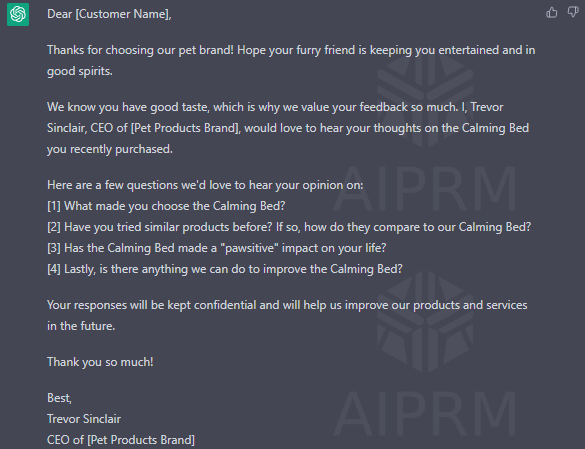
“Imagine you represent a [niche] brand that wants to improve its products based on customer feedback. Compose an email to a customer who recently purchased an [Offer] from [Brand]. In the Email, cover the following points:

Thank the customer for their recent purchase and express your appreciation for their support.

Ask the customer to share their thoughts on the product.

Ask the following questions in the email:

  • What made you choose [OFFER]?
  • Have you tried similar products before? If so, which ones and how do they compare to [OFFER]?
  • Has [OFFER] made a positive impact on your life? If so, how?
  • Is there anything we can do to improve [OFFER]?

Assure the customer that their responses will be kept confidential and will help you improve your products and services in the future. Lastly, thank the customer for the feedback. Use [niche] puns and write as if you’re talking from friend to friend.”

The Ultimate ChatGPT Subject Line Formula

Here’s a powerful formula that can significantly increase the chances of your emails getting opened:

Curiosity + Self-Interest = lots of opens.

John Caples, a legendary copywriter, and author of Tested Advertising Methods, introduced this formula.

Next, we’ll discuss how you can apply this formula to your email subject lines.

ChatGPT Subject Line Generation Prompts

Here are some email subject line prompts you will love.

1. Deconstruct + Repuporse

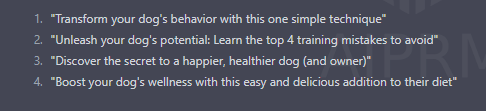
If you already have a list of effective subject lines, you can ask ChatGPT to repurpose them for your niche + audience.

I got my hands on these:

  • At-home workouts don’t work, unless…
  • Top 4 beginner workout “errors” revealed
  • Maybe the laziest way to double your fitness results
  • Add This to Your Coffee for Health

Next, I asked ChatGPT to repurpose these subject lines for a dog audience (and what they care about). This is where you insert the expertise we gathered from the survey!

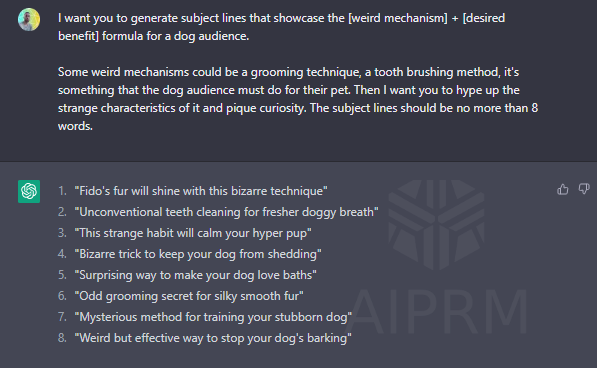
2. Weird Mechanism + Desired Benefit

A weird mechanism is an unconventional way to achieve a desired benefit. For example, when people encounter something unexpected or unusual, they’re more likely to take notice and investigate further.

Here are some examples of subject lines that showcase the [weird mechanism] + [desired benefit] formula for a dog audience:

  • “Weird doggy treat banishes bad breath (and improves their mood)”
  • “Tibetan method trains dog to clean up their toys”
  • “Strange Tibetan secret gets your dog to love crate”
  • “Little-known technique reduces separation anxiety”

Next, use this formula to instruct ChatGPT to generate subject lines for your niche. Again, it’s best to prompt ChatGPT with relevant examples to your audience.

Lastly, emphasize the goal to pique curiosity, and voila!

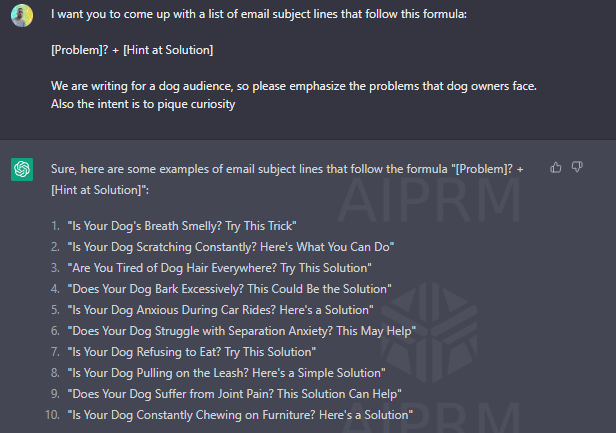
3. Problem + Hint at Solution

This classic space ad formula is one of my all-time favourites.

Here’s how it goes: you start with a specific problem and then drop a hint at the solution. After that, it works like a charm.

Sure, you might see a dip in open rates, but the specificity of the problem can lead to more clicks and conversions.

Here are some examples:

  • Tired of being tired? Natural cure
  • Can’t focus? Do this!

Now, you can instruct ChatGPT to follow the formula I’ve provided.

Make sure to add context surrounding the following questions:

  • Who are you writing for?
  • What do you want to emphasize?
  • What is the intent of the email subject line?

How To Hook Email Readers with ChatGPT (From The First Word)

You can have all the opens in the world, but if your readers aren’t hooked from the first word, they don’t read the rest of your email. They aren’t going to buy anything, either!

So, what’s the secret to getting your readers to dive right in? That opening line has got to be on point.

Here are a few rules to hook more readers:

  • It should be congruent with your subject line
  • Keep it short and sweet
  • Stimulate curiosity or promise a benefit, or better yet, both!

1. Open with a Surprising Fact

First, try opening your emails with a surprising fact; ChatGPT can help you. Facts can capture readers’ attention and pique their curiosity, making them more likely to read on. (We go into detail on how to find facts with ChatGPT).

2. Lead with an Irresistible Story

Next, ask ChatGPT to craft an irresistible story, but ensure it’s centered around your subscriber. For maximum impact, the story should demonstrate how your reader can gain a desired benefit or avoid pain or problem they fear.

Using ChatGPT for Email Marketing (Prompt and Email Ideas)

Here are some ideas for you to try with different types of emails.

1. Re-Engage a “Dead” List

Do you have an email list that’s been idle for a while? I have a template that can help you out.

Before you blast emails using these ChatGPT prompts, re-engage your “dead” list.

The power of this template is to make your email heartfelt.

Begin by admitting, “Hey, I know I haven’t honoured my end of the bargain,” so that your subscribers know you’re a genuine person who realizes you haven’t delivered the emails your subscribers signed up for.

From there, emphasize the value (or the promise of value soon) you’ll provide. It could be new product launches or exclusive tips and tricks that your subscribers will appreciate.

However, giving subscribers an easy way out is crucial if they prefer to opt out. This shows that you respect their time and inbox and empowers them to take control of their relationship with you.

So look at the template below, customize it, and let’s revive your email list!

  • Start with a greeting and introduce yourself.
  • Acknowledge the lapse in communication and apologize for it.
  • Emphasize the importance of consistency and engagement in building relationships.
  • Reiterate your content’s value and express your commitment to providing more of it.
  • Offer either new content/resources or a question to engage the subscriber and encourage a response.
  • End by thanking the subscriber and offering an opportunity to unsubscribe if they are no longer interested.

2. The Welcome Email

Your welcome Email is the workhorse of your business emails. It’s like a first date that determines the course of your relationship with your subscriber. Will they see you as a trustworthy friend or leave you in their inbox with hundreds of others?

Don’t forget to include all of these ingredients in your Welcome Email to make sure it’s a success:

  • Make a great first impression
  • Set expectations
  • Request action
  • Polarization

Be bold and come out and say what you stand for (or against). Alexander Hamilton stated, “Those who stand for nothing fall for everything.”

If some people unsubscribe at this stage, that’s a great thing! The objective here is to build a list of people who are aligned with your core values and feel a strong connection to you.

Here’s a prompt to get you started:

  1. Briefly acknowledge and compliment the recipient on inviting you to their inbox, making them feel good about their decision to invite you in.
  2. Acknowledge any previous interactions with the recipient and express excitement to continue the relationship.
  3. Here’s where you mention your freebie. Use this section to overcome the major objection we all must overcome: recipients downloading “freebies” and totally ignoring them.
  4. Use authenticity, storytelling, humour, and tone to connect with the recipient and make your message memorable.
  5. Reinforce the benefits of the content or resources you’re offering and how they can help the recipient achieve their goals.
  6. End with a clear call-to-action, directing the recipient to consume the resource.

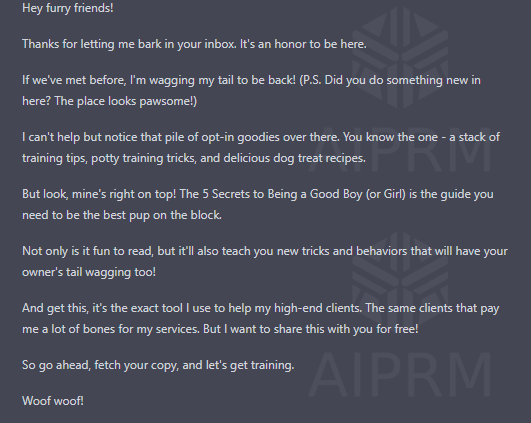
And here’s the output!

If you’re struggling to tweak the prompt, don’t be afraid to take my output and use the “Deconstruct + Repurpose” method I highlighted in the subject line section above!

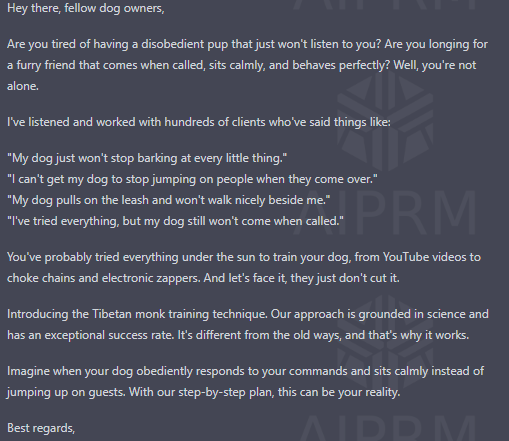
3. The Hold my Hand Email

Now, let’s write a killer “Hold My Hand” email that speaks to those sceptical, jaded, and burned-out subscribers. These prospects want results but feel overwhelmed and confused about how to get there.

Now, the conflict between desire and doubt is something that many buyers face in any market – whether it’s weight loss, dating, business, dog training, or beyond. It’s a tough nut to crack, but it’s not impossible.

The “Hold My Hand” Email is your secret weapon in this battle.

Here’s the structure:

  1. Reaffirm the benefits your subscribers want to achieve. What are their hopes and dreams? What motivates them to make a change in their life? Or what pain are you helping them avoid?
  2. Acknowledge the roadblocks to success that your subscribers have faced in the past. What fears and anxieties have held them back? By acknowledging these roadblocks, you can show your subscribers that it’s not their fault they haven’t achieved the results they want.
  3. Use your subscribers’ words to show that you understand their fears and anxieties. This is a powerful way to build rapport and establish trust.
  4. Amplify their desire by using future pacing to paint a vivid picture of what your subscriber’s life will be like. Use “Imagine If” statements to help your subscribers visualize the positive outcomes of their hard work and dedication.
  5. Finally, link to your offer (program, coaching, etc.) and promise a step-by-step plan or method to help your subscribers achieve their goals. You’ll want to show your unique process, so things will be different this time.

ChatGPT A/B Testing Prompts

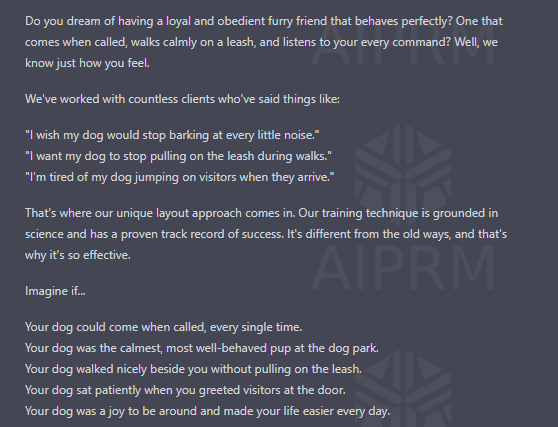
Remember my “hold my hand” Email? Well, I asked ChatGPT to give me a variation.

Specifically, I wanted to test a different layout structure and add some “imagine if” statements to get the reader to visualize the desired result of their dog behaving perfectly.

So I kept adding more “imagine if” statements until I had a total of 5!

You can also refine an email by switching up the tone.

While you could ask ChatGPT to switch the tone to “persuasive” or “witty,” aiming for the best in the business is even better.

And who are the best in the business? This list identifies the top 20 copywriters who make the most money. Names like Joe Coleman and Laurence Blume are at the top of the list.

Using AI Templates (With Jasper)

With Jasper, you can forget about spending hours brainstorming and crafting the perfect email copy. Instead, you can leverage its pre-programmed templates to create killer emails in minutes.

I know what you’re thinking: “But Trevor, what about ChatGPT?”

Well, my friend, while ChatGPT is great for generating original content, Jasper’s templates can save you precious time and effort.

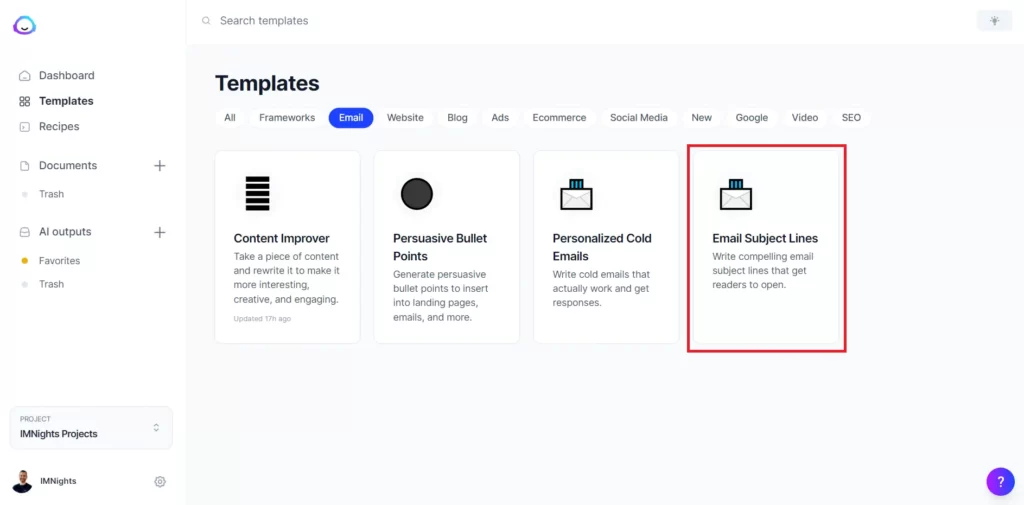
It has specific templates you can leverage for both subject lines and email!

Jasper also has an awesome document editor and Boss Mode, so you can write and switch between templates in one place.

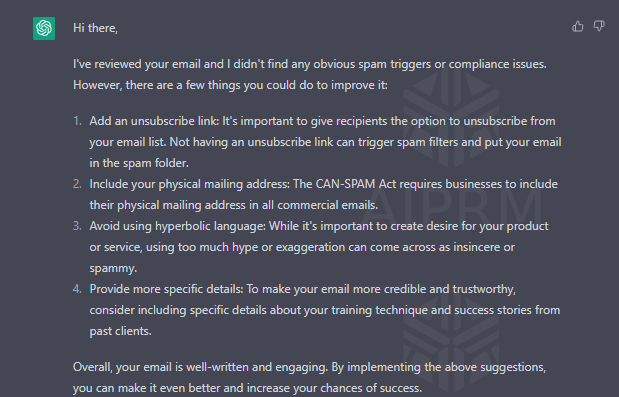
ChatGPT For Email Marketing (Feedback and Compliance)

One of the best ways to get feedback on your writing is by using ChatGPT. For email marketing, this can be especially helpful to ensure that your emails are not triggering any spam filters or violating compliance issues.

Simply provide ChatGPT with your Email and ask for suggestions on improving it.

For example, I asked ChatGPT, “Can you please look at this email and point out any spam triggers or compliance issues that might be contained within it? How could I improve it?”

ChatGPT For Email Marketing – Final Thoughts

While ChatGPT can be a valuable tool in email marketing, it’s important to remember that it’s not a substitute for understanding the fundamentals of email marketing, copywriting, and your audience’s needs.

It’s important to remember that ChatGPT is only as good as the information and guidance it’s given. You will be head and shoulders above the average email copywriter using the tips I’ve provided in this article.

So, use ChatGPT wisely and clearly understand its limitations, and you’ll be on your way to crafting successful email campaigns that resonate with your audience.

By Trevor Sinclair

Sourced from Niche Pursuits


Reader Interactions


By Sonia Simone

Sonia Simone was a founding partner of Copyblogger Media. These days, she helps content writers become fiercely creative and insanely productive. Check out her brand-new free report on 7 Things Prolific Writers Do Differently — written especially for content writers.

Sourced from copyblogger

By Sarah Perez

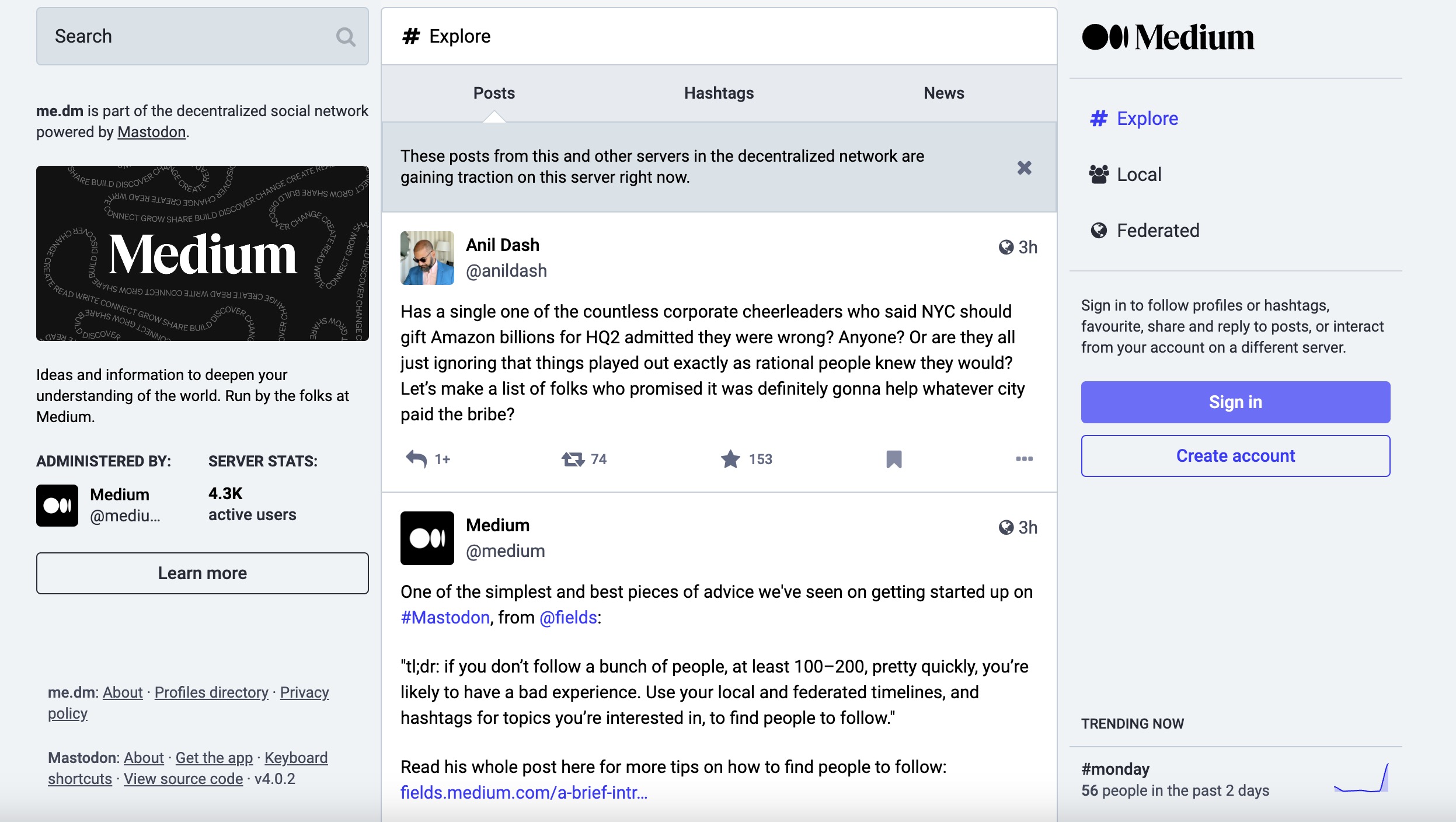
Publishing platform Medium is opening up its debut Mastodon instance, me.dm, to its members, the company announced today.

Last month, Medium first teased its plans around the Fediverse — the group of interconnected servers powering a range of open source, decentralized applications, including the Twitter alternative Mastodon and others. It said it wanted to make access to me.dm a perk included with Medium membership, offering a place for authors and readers to discuss the content published on its platform.

The company explained at the time that this would make for an interesting local feed — a reference to how Mastodon users can view a dedicated feed of just the conversations happening on their own instance (server), in addition to those happening more broadly across federated servers (those servers their local server knows about and is connected to).

In addition, Medium said it would tackle some of the onboarding challenges involved with joining Mastodon by making it easier for newcomers to find both the people and topics that matched their interests as part of its onboarding flow.

That’s an area others have begun to tackle, as well, as they aim to capitalize on the potential of the decentralized web. Last week, for example, the magazine app Flipboard announced it would launch its own instance on flipboard.social to address similar concerns. The new Mozilla-backed Mastodon mobile app Mammoth additionally features an onboarding experience that aims to simplify sign-up by sharing suggestions of who to follow from across different categories.

But while there are some similarities with these other Fediverse plays, Medium is the first major tech company to offer users a “premium” Mastodon experience — meaning access to the instance isn’t free as it is elsewhere when signing up directly. Instead, interested users would have to purchase a Medium membership, which currently runs $5 USD per month or $50 per year with its annual plan.

The company believes the exclusivity and the community it will curate on its instance will have immediate value. Already, it’s quietly onboarded 5,000 people from its waitlist onto the instance and is forecasting a community in the “six figures” in size at some point later this year.

Image Credits: Medium

“We want Medium to be the best place to read and write on the internet,” Medium CEO Tony Stubblebine tells TechCrunch. “We want to do it under a single subscription — I think people are tired of having dozens of subscriptions. And I think we’ve also found that ad-driven models have their own kind of corrupting influence,” he continues. “I think that’s why a lot of social media ends up toxic — because people are focused on engagement, rather than substance. So, in order to have the best place to read and write, you have to build the whole thing around an economic model for substance. For us, that means a subscription,” Stubblebine adds.

Plus, the exec points out, the instance will be among those run by an experienced tech company. That means it will run the instance on its own infrastructure and will have its own Trust & Safety team managing moderation. (Today, there’s one person dedicated to the task, but it could scale in time.)

Stubblebine notes, too, that instance’s domain name — me.dm — could have a draw.

“You have to share the domain along with your username in the Fediverse. To have a short domain is valuable,” he says.

Image Credits: Medium

Betting on a federated future

Coincidentally, Medium is announcing its Fediverse instance’s opening on the same day that Twitter was facing yet another partial outage.

However, the move also comes at a time when there seems to be a broader shift in Mastodon’s direction — and not just because Twitter has become unreliable.

Under Elon Musk’s ownership, there are questions about Twitter’s future — the company has lost advertisers and is in debt to creditors. But there are questions about the future of centralized social media, as well.

That’s further highlighted by the fact that Medium itself was created by Twitter co-founder Evan Williams. (Williams exited Medium as CEO last year, but remains chairman of the board.) Another Twitter and Medium co-founder, Biz Stone, also sits on Medium’s board.

Twitter co-founder Jack Dorsey, meanwhile, is backing Bluesky, another decentralized social concept but one that uses a different protocol than Mastodon. Its future, given its reliance on Twitter’s funding, seems questionable, though.

Stubblebine addresses the oddity of having so many Twitter founders now involved with companies building alternatives but says Medium’s impact on Twitter’s fate is not a huge consideration.

“We didn’t go into this year, thinking that we wanted to compete with Twitter or even that it was possible,” Stubblebine says. “But it seems obvious to me that there’s an exodus from Twitter — and enough of an exodus to create an alternative. We’re not particularly worried about whether or not Twitter lives or dies. We see it more as there’s going to be a new thing and maybe it lives alongside Twitter or maybe it completely replaces it. But regardless, it’s going to be important. And, regardless, that new thing is Mastodon,” he adds.

Medium plans to improve its Mastodon experience as it grows, hoping to provide a place for writers to find new readers for their stories and enable conversations, then roll out more features in time.

It’s not the first company to try to relocate some of the discussions that used to take place on Twitter to its own external community in the wake of Elon Musk’s Twitter acquisition. In addition to Flipboard and its own Mastodon instance, Substack late last year targeted Twitter with its launch of an in-app discussions feature, too.

Meanwhile, Tumblr owner Matt Mullenweg confirmed to TechCrunch that it’s testing the ActivityPub protocol that powers Mastodon and other Fediverse-connected apps, in addition to others, like Bluesky and Nostr.

Medium itself, by comparison, isn’t integrating with ActivityPub — it doesn’t think syndication of blogs to the Fediverse is the future; its focus instead is on proving a place for the authors to build a community.

Stubblebine also says he’s not worried that offering a premium instance will corrupt the potential of what’s, so far, been a free and open source social web.

However, he does admit there has been some pushback from the wider community about Medium going the premium route.

“Most of the pushback is based on a fear of — sometimes it’s expressed as a fear of capitalism, but, when you dig into it, it’s always a fear of monopoly. This is one of the things that I think is exciting about the Fediverse — there’s really no hope for anyone to monopolize it. So it just leads to healthier business ideas,” he explains. “This is just a business idea that will be one of many on the Fediverse…I think it’s new, so it will probably be a little bit alarming. But in practice, there’s just no way for it to pan out that way,” Stubblebine says.

“I think there’s this unbundling of social media going on right now,” he continues. “And what that gives us is the opportunity to be more opinionated. For me, that’s exciting — I don’t want to be a town square for the entire world. I want to be the town square for people that love reading and writing — and a certain type of reading and writing — thoughtful reading and writing,” he concludes.

Feature Image Credits: TechCrunch

By Sarah Perez

Sourced from TechCrunch

By Vikas Agrawal

A lead magnet is a free resource or deal offered by marketers to customers in exchange for their contact information. They are a tool for capturing leads and building a list of interested prospects. Lead magnets can take the form of e-books, white papers, webinars, free trials and more. By offering lead magnets, businesses can attract and engage with potential customers, ultimately increasing the likelihood of converting them into paying customers. In fact, businesses with a mature lead generation process acquire more leads and are said to generate, on average, 133% more revenue.

Let’s take a closer look at some of the other benefits of using lead magnets and discuss how you can use lead magnets—particularly e-books and white papers—in your own marketing efforts.

The Benefits Of Using Lead Magnets In Campaigns

There are many benefits to using lead magnets. They can help you:

Attract a target audience. When lead magnets provide value to the target audience, it can incentivize them to exchange their contact information, effectively attracting and capturing leads.

Build relationships. Lead magnets can help you establish trust and build relationships with the target audience.

Increase engagement. Lead magnets encourage potential customers to engage with the business’s content, increasing the likelihood of them becoming paying customers.

Qualify leads. Lead magnets help businesses determine the level of interest and engagement of potential customers, enabling them to prioritize and qualify leads.

Establish thought leadership. By offering informative content, businesses can establish themselves as thought leaders in their industry.

Boost brand awareness. Lead magnets increase brand awareness by promoting the business’s products or services to a larger audience.

Provide valuable insights. Lead magnets offer valuable insights into the target audience’s needs and interests, enabling businesses to tailor their lead-generation campaigns and marketing efforts.

Utilizing E-books And White Papers As Lead Magnets

E-books are comprehensive, educational content that can provide valuable information on a specific topic related to the business’s industry. They can be a guide, tutorial or case study and can be used to educate potential customers on the benefits of the business’s products or services. Moreover, my company surveyed marketers and 55.9% said that e-book samples generate the highest conversion rate in short-form written content.

Follow these steps to create and promote an effective e-book:

Identify the target audience. Start by identifying the target audience for the e-book and their needs and interests. This will help you create an e-book that is relevant and valuable to them.

Choose a topic. You want to be strategic and choose a topic related to the business’s industry.

Plan (and write) the content. Outline the introduction, main sections and conclusion before you start writing. Ensure the content is informative, educational and relevant to the target audience.

Design the e-book. Use design elements such as images, graphics and headings to make the e-book visually appealing and easy to read.

Publish the e-book. Publish it in a format that is easily accessible, such as a PDF.

Promote the e-book. Promote the e-book through a variety of channels, including email marketing, social media, advertising and landing pages on your website.

Measure the results. Measure the e-book lead magnet campaign results by tracking the number of downloads and conversions. Use the insights gained to improve future campaigns.

Unlike e-books, white papers are in-depth, research-based content that provides insights and solutions to specific problems related to the business’s industry. They often demonstrate the business’s thought leadership and expertise in a particular area. You can often use the same process and strategy above for a white paper, and by offering white papers as lead magnets, you can further establish yourself as an expert in your field and provide valuable information to potential customers.

Best Practices For Using E-books And White Papers As Lead Magnets

There are several strategies for promoting and distributing lead magnets to your target audience. Here’s how:

Choose the right channels. Carefully research the channels through which you will promote and distribute the lead magnet, making sure the channels align with the target audience’s preferences and behaviors.

Offer the lead magnet on landing pages. Create landing pages on your website specifically for the lead magnet and offer it in exchange for the target audience’s contact information.

Use email marketing. Promote the lead magnet to your existing email list and encourage them to share it with their network.

Utilize social media and influencer marketing. Use social media platforms such as Twitter, Facebook and LinkedIn to promote the lead magnet to the target audience. You can also partner with influencers in your industry to promote the lead magnet to their audience.

Offer the lead magnet through webinars. Offer the lead magnet as a resource during webinars or other events to encourage attendees to download it.

Utilize paid advertising. Use paid advertising, such as Google AdWords or Facebook Ads, to reach a larger audience and drive traffic to the landing pages for the lead magnet.

Monitor and adjust. Monitor the results of the lead magnet promotion and distribution strategies and adjust as necessary to improve the effectiveness of the campaign.

In conclusion, with the use of e-books and whitepapers, businesses can establish thought leadership, boost brand awareness and increase conversions by offering valuable and relevant content, delivered in a thoughtful, targeted manner.

Feature Image Credit: getty

By Vikas Agrawal

Co-founder at Infobrandz, an elite team of visual communication experts taking content marketing to the next level.

Sourced from Forbes