Find free courses from the likes of MIT, Google, and IBM.
TL;DR: A wide range of AI and ChatGPT(opens in a new tab) courses are available for free on edX. Enroll in the best courses from the likes of Google, IBM, and Harvard, without spending anything.
Artificial intelligence and chatbots like ChatGPT are not going anywhere, so maybe it’s time to learn something about this technology? The time is now.
edX offers online courses from the likes of MIT, Google, IBM, and Harvard. And better yet, some of the best online courses are even available for free. We’ve checked out everything on offer from edX, and lined up a selection of standout AI and ChatGPT courses that you can take for free.
These are the best free AI and ChatGPT courses as of July 18:
These courses are completely free, but you can receive a verified certificate of completion for a small fee. There’s no pressure to upgrade, but it might be nice to stick something on your CV.
All products featured here are independently selected by our editors and writers. If you buy something through links on our site, Mashable may earn an affiliate commission.
Joseph joined Mashable as the UK Shopping Editor in 2018. He worked for a number of print publications before making the switch to the glittery world of digital media, and now writes about everything from coffee machines to VPNs.
Establishing a robust online presence is imperative for businesses seeking sustainable growth and increased visibility in the ever-evolving digital landscape.
This comprehensive guide will outline eight crucial steps every business should undertake to improve its online presence. By implementing these strategies, you can position your business for success and outrank competitors in the digital realm.
1. Develop a User-Friendly Website
To captivate online visitors and enhance their browsing experience, it is paramount to have a well-designed and user-friendly website. Ensure your website is visually appealing, easy to navigate, and optimized for various devices, including desktops, tablets, and smartphones. Incorporate intuitive menus, clear calls-to-action (CTAs), and visually engaging elements to guide users seamlessly through your website’s content.ll
2. Create a Visual Aspect That Leaves a Lasting Impression
A visually captivating logo and a well-defined brand colour scheme are vital to establishing a solid and memorable brand identity. Let’s explore how incorporating these visual elements can enhance your online presence.
Design an Eye-Catching Logo
Your logo visually represents your brand and can leave a lasting impression on potential customers. It should be unique, easily recognizable, and reflective of your brand’s values and personality. Consider the following principles when designing your logo:
Simplicity: Aim for a clean and uncluttered design that is easily understandable.
Memorability: Create a distinctive and memorable logo, leaving a lasting impression on viewers.
Relevance: Ensure your company logo aligns with your brand’s identity, industry, and target audience.
Versatility: Design a company logo that can be scaled and adapted for various platforms, including websites, social media profiles, print materials, and signage.
Select an Appropriate Colour Scheme
Colours evoke emotions and play a crucial role in brand perception. Choose a colour scheme that resonates with your brand’s values, personality, and target audience. Consider the following factors when selecting your brand’s colour palette:
Brand Identity: Determine the emotions and qualities you want your brand to convey. For example, blue can signify trust and professionalism, while yellow can evoke feelings of energy and optimism.
Audience Preferences: Research your target audience’s preferences and cultural associations with colours. Different colours can have varying meanings across different demographics and cultures.
Colour Harmony: Select a harmonious combination of colours that work well together and provide visual cohesion. Consider using colour theory principles such as complementary, analogous, or monochromatic colour schemes.
Investing in a well-designed logo and a thoughtfully selected colour scheme can enhance your brand’s recognition, establish a consistent visual identity, and leave a lasting impression on your target audience.
Enhancing your website’s visibility in search engine results is crucial for attracting organic traffic. Optimize your website using targeted keywords relevant to your industry and niche. Furthermore, conduct thorough keyword research to identify high-value keywords your target audience will likely search for. Incorporate these keywords strategically within your website’s content, meta tags, URLs, and headings to increase your chances of ranking higher in search engine results.
a. Conduct Keyword Research
Keyword research is the base of successful SEO. You’ll want to identify words you will use throughout your content that are relevant to your customers and align with your industry. Check if your target audience uses search to find what they want.
Use keyword research tools like Google Keyword Planner, SEMrush, or Moz Keyword Explorer.
b. Optimise On-Page Elements
On-page optimization involves optimizing various elements within your website to make it search engine-friendly and user-friendly. Pay attention to the following elements:
Title Tags: Craft unique, concise, and keyword-rich title tags for each page. Place the primary keyword towards the beginning of the title tag to maximize its impact.
Meta Descriptions: Write compelling meta descriptions summarising each page’s content. While meta descriptions do not directly impact rankings, they influence click-through rates (CTR) and can drive more traffic to your website.
Headers and Subheadings: Organise your content using headers (H1, H2, H3, etc.) and subheadings to improve readability and help search engines understand the structure of your content. Incorporate relevant keywords in these headings to signal the content’s relevance.
Then, URL Structure: Create user-friendly URLs that are concise, descriptive, and include targeted keywords. Avoid using numbers, symbols, or generic parameters in your URLs.
Keyword Optimization: Incorporate relevant keywords naturally throughout your content, including in the opening paragraph, headings, subheadings, and body text. However, avoid keyword stuffing, as it can harm your rankings.
d. Build High-Quality Backlinks
Earning high-quality backlinks from authoritative and relevant websites is a fundamental aspect of SEO. Backlinks act as votes of confidence and signal to search engines that your website is trustworthy and valuable.
4. Create High-Quality and Engaging Content
Content is king in the digital realm. Producing high-quality, informative, and engaging content is a powerful way to establish credibility, attract visitors, and encourage repeat visits. Develop a content strategy that aligns with your target audience’s needs and interests. Moreover, regularly publish blog posts, articles, videos, infographics, and other forms of content that offer value and keep your audience informed and entertained.
5. Build a Strong Social Media Presence
Harness the power of social media platforms to amplify your online reach and connect with your target audience. Create and maintain active profiles on platforms such as Facebook, Twitter, LinkedIn, Instagram, and YouTube, depending on your business type. Regularly share compelling content, engage with your followers, and foster meaningful conversations to cultivate a loyal community around your brand.
6. Leverage Influencer Marketing
Influencer marketing has emerged as a potent strategy to expand your online presence and reach new audiences. Identify influential personalities, bloggers, or industry experts whose values align with your brand’s identity. Collaborate with them to create content, reviews, or endorsements highlighting your products or services. By leveraging the influence of these individuals, you can significantly boost your brand’s visibility and credibility.
7. Harness the Potential of Email Marketing
Email marketing remains a highly effective tool for nurturing leads, fostering customer loyalty, and driving conversions. Build a subscriber list by offering valuable incentives such as exclusive content, discounts, or free resources.
Craft engaging newsletters, personalized offers, and automated email sequences to deliver relevant and targeted messages to your subscribers. Segment your email list based on user preferences and behaviours to enhance the effectiveness of your campaigns.
According to oberlo.com (Email has made its way from simple messages between academics to widespread global usage. In 2022, the number of email users worldwide was forecast at 4.3 billion (Statista, 2021). This figure is set to grow to 4.6 billion in 2025, making up more than half of the expected world population.
8. Optimise for Local Search
For businesses with a physical presence, optimizing for local search is essential. Claim and optimize your business listings on prominent online directories such as Google My Business, Bing Places, and Yelp. Ensure that your business information, including name, address, phone number (NAP), and operating hours, is accurate and consistent across all platforms. Encourage satisfied customers to leave positive reviews, significantly influencing local search rankings.
9. Analyse and Adapt
Tracking and analysing your website’s performance and user behaviour is crucial to continually enhancing your online presence. Utilize analytics tools such as Google Analytics to gain insights into key metrics like website traffic, bounce rate, conversion rate, and user demographics.
Also, Identify areas of improvement, experiment with different strategies, and adapt your approach based on data-driven insights to optimize your online presence effectively.
Conclusion
In today’s digital landscape, businesses must prioritize their online presence to thrive and surpass competitors.
By following these eight essential steps – developing a user-friendly website, implementing SEO strategies, creating high-quality content, building a solid social media presence, leveraging influencer marketing, harnessing the potential of email marketing, optimizing for local search, and analysing and adapting.
you can strengthen your online presence, attract a larger audience, and achieve sustainable business growth. Embrace these strategies and unlock the immense potential of the digital realm for your business.
A seasoned professional specializing in digital marketing and blogging. With expertise in various approaches such as content marketing, SEO, SMO, and PPC, his experience in crafting informative and engaging blog content and strategy has proven instrumental in boosting business growth and driving increased traffic.
Wondering when is the best time to post on YouTube?
Being on Youtube is competitive, and you want to make sure your content reaches your target audience at the best possible time.
Whether you’re a vlogger, a business, or an educator, understanding the secret sauce of timing can transform your channel.
But how do you find out the best time for your channel?
Sit tight, and follow this guide!
Does Posting Time Matter on Youtube?
When we think about content creation on YouTube, we often pay attention to video quality, script, editing, thumbnail design, and, of course, the actual content.
YouTube, much like any other social media platform, has peak hours.
These are times when most users are actively engaging with content. Posting during these hours means your video has a higher chance of being seen, liked, commented on, and shared.
Imagine you’ve just created a masterpiece of a video, one that you’re convinced could go viral. But you upload it at 3 am, when the majority of your potential viewers are fast asleep.
By the time they wake up and log in, your video, now several hours old, may have been pushed down their feed by fresher content.
The result? Your masterpiece goes unnoticed.
Now, let’s flip the script.
Say you upload the same video at a time when your audience is most likely to be active on YouTube.
Your video is fresh on their feed, capturing their attention. They click, watch, engage, and share. Your content gets the attention it deserves, all because you hit the ‘upload’ button at the right time.
But in a way, YouTube is different from all other social platforms. How so?
While social media platforms like Instagram or Twitter prioritize recency, YouTube’s algorithm is more focused on viewer engagement.
Instead of prioritizing the newest content, it surfaces videos that viewers are likely to watch through to the end.
In other words, how well your video resonates with your audience matters more than when you posted it.
So if YouTube’s algorithm isn’t all about recency, does posting time even matter?
There’s been plenty of debate around this question. Some creators insist on the significance of timing, while others shrug it off as a minor detail.
Here’s the deal… while timing isn’t the be-all and end-all of YouTube success, it does play a role.
The likelihood of a video going viral increases dramatically during the first few hours after it’s posted. This is when your subscribers will receive notifications and your video will have its first shot at the ‘Trending’ page.
If you post when most of your viewers are active, you’ve got a better chance at those initial views, shares, and comments that can catapult your video into the viral stratosphere.
But if you don’t post when your viewers are most active, you reduce your chances of success.
By how much? That depends.
The point is, if you’re looking to optimize your Youtube strategy, timing is certainly a worthwhile factor to keep in mind!
Identifying the Best Times to Post on YouTube
Now, let’s get to the nitty-gritty. When is the best time to post on YouTube?
General wisdom suggests:
Weekdays during working hours (specifically Tuesday through Thursday, between 2 PM to 4 PM) when people are looking for a quick break from their tasks is a good time for Youtube posting.
Weekends (between 10 AM to 11 AM) are also great, because that’s when viewers are likely enjoying a more leisurely morning and have more time to engage with content.
But remember, these are just general guidelines.
What matters most is when your audience is online.
But when is that?
How to Find YOUR Best Time to Post on YouTube
Want to figure out the optimal time to post for your specific audience? YouTube analytics is your new best friend. Here’s a quick guide on how to use it:
Sign in to YouTube Studio and click on the ‘Analytics’ tab on the left menu.
In the ‘Overview’ section, you will see a graph of how many views you’ve gotten in the past 28 days.
Click over to the ‘Audience’ to the right of the Overview section, and scroll down. You will see a section called “When your viewers are on Youtube” that features a purple heat map. This heat map shows when your viewers are most active on the platform. The darker the colour, the more viewers are online at that time.
Don’t feel like crunching numbers? TubeBuddy, a YouTube-certified management tool, can do the work for you.
It offers a ‘Best Time to Publish’ feature that analyzes your channel’s data and suggests the best time to post for maximum engagement.
If you have Tubebuddy installed, this recommendation will show up right under “When your viewers are on YouTube” in your Analytics dashboard.
And you can use TubeBuddy for more than just data analysis.
It’s also an excellent tool for keyword research, productivity, and bulk processing. It’s particularly handy when you’re trying to gauge the best time to post on YouTube.
Once installed, TubeBuddy presents a ‘Best Time to Publish’ option in the main menu.
Selecting this feature includes a detailed chart displaying your subscribers’ active times throughout the week.
It also offers specific recommended upload times for each day. How neat is that?
But one thing to keep in mind…
Your channel needs to be fairly active, with enough activity for Youtube or Tubebuddy to crunch the numbers for you.
If you are a brand new channel with no viewers or very few viewers, you’ll have to wait until you accumulate more viewer data in order for Youtube and Tubebuddy to give you their reports.
Fine-Tuning Your YouTube Schedule
Remember, YouTube Analytics and TubeBuddy’s heat maps and recommendations are just that: Recommendations.
Don’t take it as an ironclad rule that you MUST post when they indicate. Instead, you need to figure out what actually works for you in real life through trial and error.
You need to post videos at different times and observe when they get the most traction.
For instance, you might try posting at 2 pm one week, then 5 pm the next, and perhaps 8 pm the week after.
Monitor the views, likes, comments, and shares each video garners. Note any patterns or spikes in engagement.
Do you get more views when you post in the afternoon or the evening? Do likes and comments surge when you post on a Wednesday compared to a Friday?
And remember that YouTube’s algorithm favours channels that keep viewers on the platform for longer. So, consistent posting and engagement with your audience is important.
A consistent schedule not only helps to establish a routine with your viewers but also sends positive signals to YouTube’s algorithm, potentially boosting your videos’ visibility.
Now, bear in mind, this isn’t a one-and-done deal.
The beauty (and sometimes, the challenge) of social media is that it’s always changing.
Seasons change, school years start and end, global events shift our daily routines — all these factors can impact your audience’s behaviour on YouTube.
To stay ahead, you’ll need to keep testing and tracking, tweaking your schedule as necessary.
While it may seem like a lot of work, this process has a significant payoff.
By aligning your posting schedule with your audience’s habits, you ensure that your videos get maximum exposure, leading to higher engagement and more substantial growth for your channel.
And remember to be kind to yourself. You’re not going to get everything right straight away. That’s why it’s crucial to keep testing different posting times, tracking your results, and adjusting accordingly.
Make testing and tracking a permanent part of your overall Youtube strategy, and that will go a long way into maintaining and growing your Youtube channel!
Why Posting Consistency Matters
Let’s take a moment to reemphasize the importance of consistency.
Think of your YouTube channel like a TV show. If your viewers know a new episode comes out every Wednesday at 6 PM, they’re more likely to tune in at that time each week.
Consistency does more than just build viewer habits, though.
It also positively impacts how YouTube’s algorithm perceives and promotes your channel. By consistently posting quality content that engages your audience, you show YouTube that your channel is active and valuable to viewers.
Besides, maintaining a regular schedule can help you avoid the worst times to post. If you’re always posting at consistent times, you’re less likely to post during those low-engagement periods.
It’s a win-win.
In the end, understanding the ins and outs of YouTube posting times is about more than just following general guidelines.
It’s about knowing your audience, experimenting with different strategies, and making use of the analytics tools available to you.
Unlocking the Best Time to Post on YouTube
Now you know how to decode the best times to post.
It’s not a one-time deal, but a continual process. And of course, it can be tricky to keep track of your analytics while keeping your content top-notch.
But remember, the power is in your hands. You’ve got the insights now.
With the knowledge you’ve gained, you’re ready to transform your channel and send your engagement rates through the roof.
Ready to conquer YouTube? Make this your year of unprecedented growth!
By Sarah Cha
Sarah Cha is an avid writer, reader, and lifelong learner who loves making magic behind-the-scenes at Smart Blogger. When she’s not wrangling words onto a screen or page, you can find her strumming a guitar, tickling a canvas, or playing fetch with her favourite four-footed friend!
The viral Maybelline campaign and the debut of the Sphere in Las Vegas point to a landscape dominated by immersive, interactive digital advertising.
The double-decker bus is a London icon, so when one of them appears to be putting on makeup, well, people are going to pay attention.
Late last week, Maybelline posted a video on TikTok of some new outdoor advertising work that essentially appeared as if giant mascara brushes had been attached to the side of a London building and inside a tube station, and a double-decker bus and a subway train passed underneath with giant lashes attached to the front.
The social media reaction was both instant and effusive, with comments like “this is literally the best ad ever” and “raise the salary of the employees who have [sic] this idea.” The coverage spanned not only U.K. outlets but global media as well.
Thing is, it was all fake. Created with artist Ian Padgeham, the project only looks incredibly real, but it is actually completely made with CGI. Padgeham specializes in making surreal fun out of everyday scenes and settings. Maybelline’s U.K. brand manager Lauren Chapman broke it all down on TikTok, saying that when working with a big brand, it can be difficult to make cool, weird work due to the often, um, robust approval process. “We had this idea of doing this, is it real or is it fake-type content. We wanted people to genuinely think that Maybelline’s actually managed to pull this off.”
The brand did something similar in New York for its Falsies Surreal Mascara the previous week, creating a very real looking bus shaped like the mascara’s tube, which has more than one million TikTok views.
Despite these projects’ success, brands should be mindful that there is likely a “Best Before” date on these kinds of stunts. Thanks to more and more IRL experiences such as the just-unveiled Las Vegas Sphere as well as 3D Times Square billboards that blend digital wizardry and physical presence, the public’s patience with fake fun will wane and our expectations will grow to the point that yes, Maybelline will actually need to pull off its brushes and lashes magic, for real.
At the dawn of digital advertising, old school media—print, radio, and outdoor billboards—were often dismissed for being too boring or basic. However, once the thrill of a microsite died down, these legacy platforms, particularly outdoor advertising, have witnessed a renaissance once marketers saw the potential of blending real-world magic with social amplification. All it takes is one social post to make one billboard on one block in one city to go fully global.
Back in 2016, long before Ryan Reynolds was considered the patron celebrity saint of creative advertising, he hilariously used a couple of Los Angeles billboards to make the most of 20th Century Fox’s marketing budget for his then-underdog superhero film. Thanks to social posts from comedian Patton Oswalt and Reynolds himself, these essentially became worldwide ads for Deadpool.
In November 2021, BelliWelli launched a campaign called “Hot Girls Have IBS,” with a single, static Los Angeles billboard, soon adding two more in Portland and New York (in, yes, Times Square). Within a few months, a TikTok video featuring the Portland billboard had two million views, and the company reported the billboards reached more than 2.8 million people on Instagram, and quickly drove an estimated $40,000 in product sales.
While a well-placed, witty billboard can still get plenty of attention, increasingly, brands are stepping things up with cutting-edge technology. New York’s Times Square and Tokyo’s Shinjuku Station have become a haven for anamorphic or 3D outdoor ads. At the latter last year, Nike brought to life an Air Max 1 sneaker. Last summer, BMW worked with agency Goodby Silverstein & Partners to create a 3D Times Square billboard to hype its collaboration with streetwear brand Kith on a new custom-edition BMW i4 M50. “I’d argue that a massive 3D billboard in the heart of New York City, with incredible sharing potential on social channels, is the most powerful way to launch [the car],” BMW VP of marketing Marcus Casey told Muse by Clio at the time. “So far, the strategy has paid off. There has been a huge amount of buzz, including over 11 million views on TikTok.”
Further boosting our expectations and standards of what constitutes a truly amazing amalgamation of experience and technology is the new MSG Sphere near the Venetian hotel in Las Vegas. At about 34 stories high and 516-feet-wide, the concert and event venue took seven years and more than $2 billion to create.
U2 guitarist the Edge told Rolling Stone that the Sphere will be a quantum leap forward in what a concert can be. “It gives you the opportunity to bring people back in time, and to worlds that are completely computer-generated, but completely believable,” he said. “It’s a new genre of immersive experience, and a new art form.”
This new genre of immersive experience is also a 34-story canvas for brands and event advertising, the likes of which we’ve never seen. And it’s in person.
For another creative perspective, I got in touch with Nils Leonard, cofounder and chief creative officer at Uncommon London (which made news earlier this week when Havas acquired a majority stake in the agency). Uncommon won the 2023 Cannes Lions Grand Prix for outdoor advertising last month for a British Airways campaign that put a witty twist on the usual “business” or “pleasure” travel questionnaire. It included 500 individual print, digital, and outdoor executions, as well as more than 32 short films.
[Image: British Airways]
Leonard says that outdoor is a stage now. “[It’s] precious space,” he says. “A destination for brands that want scale and power. The win when you do outdoor right is huge. The best work doesn’t just appear on the poster, but on the phones pointing at the poster.”
Work like Maybelline’s recent projects are a lot of fun, but they skip the crucial step of that in-person experience, only imitating the result of those phones pointing at the poster or billboard. Just as brands used to be able to get away with creating a fake stunt product for April Fool’s Day, but are now expected to actually make these gags and put them up for sale (see: The Coors Light), so too will they be expected to bring these cool, weird, fun ideas to life. “There is a fragility to a physical idea not made real, the world enjoys and respects endeavour,” says Leonard. “No matter how well-crafted the video, it just won’t live as long in the memory. No pain, no champagne.”
The Maybelline work has been a bonafide hit this week, but will undoubtedly seed a sense of doubt for any future work. I asked the brand how it might follow up on these recent CGI projects, but did not heard back by press time. Either way, brands need to embrace the extra endeavour Leonard speaks of, seamlessly combining physical space and digital wonder in order to match new expectations set by the likes of Vegas’ Sphere and 3D Times Square. Otherwise, the tagline might as well be, “Maybe it’s real, or maybe it’s Maybelline.”
Search Engine Optimization (SEO) is the practice of increasing visibility and traffic to websites by improving their rank in search engine results pages.
While there are multiple time-consuming strategies utilized to improve SEO, sponsored links offer a more direct route by carrying websites’ targeted messages directly into the top portions of search engine results with ads created from certain keywords.
Though it can be beneficial, there has yet to be an agreed-upon consensus regarding its effectiveness for SEO improvement.
This blog post examines auditing sponsored links as one aspect of SEO management by covering overarching benefits and drawbacks, important factors to consider before lowing budget resources on paid search options, and alternate strategies that should also be carefully incorporated alongside out paid methods for improved organic ranking and reach overall.
Sponsored links are displayed advertisements paying for prominent display on a search engine. They can take the form of either pay-per-click ads or flat rate fees and are placed separately from natural, organic search results with clearly designed headers.
In the link building realm, sponsored links are typically paid-for ads via a backlink that is (or should be) marked with a rel=”sponsored” tag.
Customers who click through sponsored link visits yield revenue to its creators while providing potential customers quick access to relevant content mentioned in the sponsored text link itself.
Companies relying on these timely linked pages typically experience faster acquisition of marketing leads, higher website viewership, and greater profitability from within their revenue streams gained though voluntary organic search means.
Differentiating sponsored links from organic search results
Sponsored links refer to online advertisements that appear on certain websites, usually displayed as a separate box of results below the natural search engine result pages (SERPs). They are identified by an accompanying notation or symbol stating they are an advertisement/sponsored link.
Ideally, sponsored links allow businesses and organizations to quickly present users with relevant solutions using keywords that match the interests or needs of the target consumers. In contrast, organic search engine results provide unbiased combinations of keyword matches based purely on relevancy algorithms unprompted by advertising efforts.
Popular platforms offering sponsored link opportunities
Sponsored links are advertisements that appear on search engine results pages alongside organic results. They can be differentiated from organic search engine rankings in a few ways.
Firstly, sponsored listings display visible extensions such as “Ad” and use language to identify them as paid promotions.
Secondly, sponsored links lead to paid content or promotional landing pages rather than traditional web pages with accumulated content.
Thirdly, depending on the platform utilized they may offer additional features such as increased size and more prominent placement. Finally, organic search ranks websites based on relevance to key phrases while sponsored listing allocations depend partially on chance and time intervals specific to buyer’s budget constraints.
Sponsored links present a unique opportunity to greatly increase visibility and exposure for websites, brand names, products and services. When employed strategically on popular platforms such as Google AdWords, companies are able to position their best-performing content above organic search engine results that would otherwise appear lower in the search rankings.
Increased visibility, therefore, works towards achieving higher click-through rates from users either actively or passively searching online using relevant keywords embraced through PPC optimizations which work in unison with SEO factors.
Increased visibility subsequently leads to boosted performance levels as well as enhanced reach throughout varying networks ensuring brands remain highly visible and tangible across multiple channels of communication.
Potential for targeted audience reach
Sponsored links allow businesses to develop a targeted campaign with specific messaging that prioritizes connections with users that would most likely show active interest in the product or service. Advertisers can target their audience based on location, habits and other attributes through sophisticated targeting options available through sponsored link campaigns.
Having an accurate advertising strategy helps to make sure certain messages are sent to only relevant audience and ads are intelligently displayed at opportune moments resulting in more predictive responses from customers.
In addition, by ensuring detailed targeting of ads potentially time-consuming manual labour required can be reduced significantly while simultaneously enhancing marketing results with various budgets.
Accelerated traffic generation
Sponsored links offer the potential to drive accelerated traffic generation, especially when it relates to targeting more specific audiences. Unlike organic long-term getting techniques like regular SEO strategies, sponsored link visibility can be achieved instantly with faster and direct results.
Additionally, clear direction is offered using location settings or advanced keyword searches which allows for a controlled influx of user volume. Through this method, advertisers are able to reach out to their ideal demographic group in real time with quick effective timing since many people are now online actively searching and browsing.
Improved brand recognition and authority
Sponsored links provide an excellent opportunity to leverage brand recognition and authority on a search engine. As noted by SEO experts, branded queries are great opportunities to generate leads and enhance conversion rates.
When done correctly with knowledge of keyword and marketing research, daily budget and market insights, sponsored links can often yield positive results that help businesses have higher SERP visibility via organic spot as well as get own share in the pricey paid search auction while competing against other bidder’s money bids for relevant keywords slots.
Cons of Utilizing Sponsored Links for SEO Improvement
When considering using sponsored links to improve SEO, cost considerations and budget constraints are key detriments. Utilizing sponsored link campaigns for SEO improvement requires substantial upfront costs as well as ongoing campaign maintenance fees which can quickly add up.
Additionally, industries with entrenched players tend to have much larger marketing budgets dedicated to paid advertising than smaller businesses due to the costly nature of performance bidding.
Cost is a particularly important factor to consider for digital marketing campaigns since insufficient funds due can result in ineffective initiatives leading to little-to-no return on investment.
Risk of dependency on paid advertising
Sponsored links are expensive and one could suffer from decreased ROI if their SEO requires extensive utilization of such services.
As more of the marketing budget is poured in sponsored links, it runs the risk of becoming a dependency that can become hard to sustain over time.
This may also cause an interruption in search presence for certain keyword queries when campaigns are paused due to Budget constraints, costing further organic visibility for SEO optimizations.
Ethical implications and potential negative user perception
Sponsored links can create ethical implications if utilized in a dishonest or misleading way. The use of sponsored links to promote or offer information, products, or services that may not align with the mission and values of an organization or brand might be viewed as deceptive.
Furthermore, consumers could develop negative perceptions about these practices, which could compromise their trust in the company promoting them. Sponsored links should never outshine appropriate organic SEO techniques as users value higher quality online content even more than visibility alone.
Uncertain long-term impact on organic search rankings
Sponsored links can provide short-term gains with increased traffic and improved brand visibility. However, the long-term impacts of relying heavily on sponsored links may be an issue to take into consideration.
Google algorithmologies are constantly changing and some major algorithm updates have resulted in a loss of organic search ranking for specific websites. It is difficult to predict future changes which could affected paid search performance, causing sites that rely heavily upon sponsored links for SEO improvement to see substantially reduced results.
Factors to Consider Before Employing Sponsored Links
Comprehensive analysis of SEO goals and strategy
Before beginning to use sponsored links for SEO goals, it’s essential to do a comprehensive analysis of the strategy in place. Start by evaluating existing content and appearing on how relevant and useful it is to the audience or demographic likely to answer your ad.
Furthermore, you need to predict possible outcomes of using sponsored links and make sure they would support the overall SEO goal through certain metrics such as website lead generation rate aimed activity increase after this channel implementation.
Evaluation of available budget and cost-effectiveness
When deciding to use sponsored links for SEO enhancement, it’s important to evaluate the available budget as well as cost-effectiveness. Knowing how much money can be allocated for Ads will help determine if managing a sponsored link campaign is feasible.
It’s also important to analyse how effective different channels and platforms are performance-wise in order to optimize the impact of each individual chosen Ad and maximize conversions given a specific budget.
Last but not least, ROI (Return on Investment) should be optimized from sponsored link campaigns – can enough money be earned back from sales or merely from brand recognition? Taking all these factors into account before opting in will save time, resources and provide better long-term effects from employing Sponsored Links.
Researching target audience and platform compatibility
Researching target audience and platform compatibility is an important factor to consider before employing sponsored links in enhancing your SEO performance. Understanding the needs, interests, and demographics of your visitors can help you determine where and how to best invest in sponsored links.
You should also research the platforms that offer sponsored link opportunities; learn what types of content formats they support, geographic availability and other technical requirements that may be necessary for each channel.
Balancing sponsored links with organic SEO techniques
Before investing in sponsored links to improve SEO, it is important to assess whether your strategy includes the correct balance of organic and paid techniques. It’s recommended you create a outline of expectations, organic keyword targets, and current performance gaps in order to focus on utilizing an optimal combination of both options.
To optimize performance outcomes, sites should connect their sponsored link campaigns with website analytics and measure perceived value versus costs accurately across ongoing goals. This data enables business improvements and adjustments so that a venue can consider making continual refinements going forward and achieve maximum promotional success.
Alternatives to Sponsored Links for SEO Enhancement
On-page optimization and content quality improvement
On-page optimization and content quality improvement are essential alternative strategies to sponsored links when it comes to SEO enhancement.
On-page optimization involves in-depth keyword research and the application of those keywords throughout the website (title tags, headlines, etc.) for better indexing by search engines.
Quality content is also important in that it communicates information effectively to users without looking spammy or automated and keeps them engaged over time. These methods do take longer than sponsored links but improve credibility with organic rankings in the long run.
Building high-quality backlinks
Building high-quality backlinks is an effective alternative to sponsored links that can be utilized for SEO enhancement. Backlinking helps send direct traffic to your website and sours further credibility with search engine algorithms improving rankings over time.
A mix of strong anchor texts, trusted sources, targeted audiences and varied link types should all be addressed when creating a successful backlink strategy. Additionally, finding internal link opportunities allows your own web pages to benefit from the increased SEO boost providing a more efficient use of time and resources.
Utilizing social media platforms and influencer collaborations
Using social media platforms for SEO enhancement means creating, sharing, and monitoring content. This includes optimizing website hierarchies with keyword placement, link building from quality external sources, and providing thoughtful posts and commentary – including the engagement of influencers.
Influencer collaborations open up entirely new channels for businesses to tap circles that were otherwise inaccessible or achieved with difficulties.
From organic reach among commenters on relevant feeds to actively timed sponsored posts related to the services a business has on offer – leveraging relationships between real people adds credibility and gold-lined star power that is tremendously useful when seeking potential customers’ attention away from paid advertising routes.
Conclusion
Depending on individual goals and strategy, sponsored links can be a very useful tool for SEO improvement if used correctly. Advantages include increased visibility and reach, accelerated traffic growth, enhanced brand recognition, etc.
However, such benefits have to be considered in the context of budget constraints/cost-effectiveness and ethical concerns. Therefore, an effective evaluation of available options is necessary before determining whether the use of sponsored links is worthwhile for any given SEO project in question.
Nate Nead is the CEO & Managing Member of Nead, LLC, a consulting company that provides strategic advisory services across multiple disciplines including finance, marketing and software development. For over a decade Nate had provided strategic guidance on M&A, capital procurement, technology and marketing solutions for some of the most well-known online brands. He and his team advise Fortune 500 and SMB clients alike. The team is based in Seattle, Washington; El Paso, Texas and West Palm Beach, Florida.
Because Meta owns Facebook and Instagram, these destinations have been able to grow their audiences quickly. Users login to Threads with their Instagram accounts and automatically follow the same people they follow on Instagram.
“We’re at about 10,000 right now. I would say a good 80% of that happened over the weekend,” said Paula Port, Destination Toronto‘s vice president of marketing. Visit Orlando has over 32,000 followers.
Instagram has over 1 billion monthly users worldwide, according to Insider Intelligence.
So far, posting activity on Threads by these groups is uneven. Some haven’t posted anything while others like Visit Orlando have been posting daily.
Threads doesn’t offer advertising at the moment, according to the Wall Street Journal. Facebook, Instagram, Pinterest and TikTok are the top spenders on social media advertising.
Destinations have been devoting fewer resources to Twitter. A new problem for Twitter has been the new blue check verification process, which requires a subscription. “We just kind of gone back and forth on what’s the value that we’re seeing there and it seems very unpredictable,” said Utah Office of Tourism Director of Marketing and Communication Ben Cook.
Destinations haven’t developed a strategy for marketing on Threads. Destination Toronto hasn’t posted much and is reusing the text-based strategy and repurposing content it uses for Twitter. Utah is experimenting with a more humorous voice.
“There is not a huge lift and we’re not going to put a lot of time into developing a huge strategy until we just sort of see where it goes,” said Cook. Audience engagement on the platform looks good so far, he said.
What strategies destinations come up with for Threads depends on the platform’s evolution.
“It feels like it wants to be Twitter, but everyone from Instagram is there,” Port said. “Is Threads going to reduce our need for that news-driven content or is it going to be more like Instagram, which is more curated and has more of a visual aesthetic?”
Despite racking up 100 million users just two months after launching — an all-time record — ChatGPT doesn’t appear to be having a noticeable impact on the many billions of searches that happen every day yet. However, it’s not hard to imagine it and other large language models (LLMs) taking a sizable bite out of search market share as they improve and become more reliable.
And improve they will. After all, Microsoft, Google and others are investing tens of billions of dollars into generative AI engines. Long dominating the search engine market, Google in particular is keenly aware of the enormous risk to its business, which is why it declared a Code Red and marshalled all available resources into AI development.
If you accept that generative AI will improve significantly over the next few years — and probably dramatically by the end of the decade — and therefore consumers will inevitability get more answers to their questions through zero-click engagements, which are already sizable, then it begs the question:
What should brands consider doing to maintain brand visibility and authority, as well as avoid losing value on the investments they’ve made in content?
Protective Measures From Negative Generative AI Effects
Brands have two major levers they can pull to protect themselves from the negative effects of growing use of generative AI.
1. Shielding Content From Generative AI Training
Major legal battles will be fought in the years ahead to clarify what rights copyright holders have in this new age and what still constitutes Fair Use. Content and social media platforms are likely to try to redefine the copyright landscape in their favour, amending their user agreements to give themselves more rights over the content that’s shared on their platforms.
You can already see the split in how companies are deciding to proceed. For example, while Getty Images’ is suing Stable Diffusion over copyright violations in training its AI, Shutterstock is instead partnering with OpenAI, having decided that it has the right to sell its contributors’ content as training material to AI engines. Although Shutterstock says it doesn’t need to compensate its contributors, it has created a contributors fund to pay those whose works are used most by AI engines. It is also giving contributors the ability to opt out of having their content used as AI training material.
Given all of that, brands can protect themselves by:
Gating more of their web content, whether that’s behind paywalls, account logins or lead generation forms. Although there are disputes, both search and AI engines shouldn’t be crawling behind paywalls.
Releasing some content in password-protected PDFs. While web-hosted PDFs are crawlable, password-protected ones are not. Because consumers aren’t used to frequently encountering password-protected PDFs, some education would be necessary. Moreover, this approach would be most appropriate for your highest-value content.
Distributing more content via subscriber-exclusive channels, including email, push and print. Inboxes are considered privacy spaces, so crawling this content is already a no-no. While print publications like books have been scanned in the past by Google and others, smaller publications would likely be safe from scanning efforts.
In addition to those, hopefully brands will gain a noindex equivalent to tell companies not to train their large language models (LLMs) and other AI tools on the content of their webpages.
Of course, while shielding their content from external generative AI engines, brands could also deploy generative AI within their own sites as a way to help visitors and customers find the information they’re looking for. For most brands, this would be a welcome augmentation to their site search functionality.
2. Building Stronger Direct Relationships
While shielding your content is the defensive play, building your first-party audiences is the offensive play. Put another way, now that you’ve kept your valuable content out of the hands of generative AI engines, you need to get it into the hands of your target audience.
You do that by building out your subscription-based channels like email and push. On your email signup forms, highlight the exclusive nature of the content you’ll be sharing. If you’re going to be personalizing the content that you send, highlight that, too.
Brands have the opportunity to both turn their emails into personalized homepages for their subscribers, as well as to turn their subscribers’ inboxes into personalized search engines.
Email Marketing Reinvents Itself Again
Brands already have urgent reasons to build out their first-party audiences. One is the sunsetting of third-party cookies and the need for more customer data. Email marketing and loyalty programs, in particular, along with SMS, are great at collecting both zero-party data through preference centers and progressive profiling, as well as first-party data through channel engagement data.
So, the disruption of search engine optimization by generative AI is just providing another compelling reason to invest more into email programs, or to acquire them. It’s hard not to see this as just another case of email marketing reinventing itself and making itself more relevant to brands yet again.
Chad S. White is the author of four editions of Email Marketing Rules and Head of Research for Oracle Marketing Consulting, a global full-service digital marketing agency inside of Oracle. Connect with Chad S. White:
Brands can create reliable revenue streams with the right affiliate marketing tools. Whether you’re a merchant or publisher, affiliate marketing is an excellent way to find success online.
Affiliate marketing is for everyone from mommy bloggers to mega brands. This win-win business model has grown to a $19B industry with more than 80% of online brands offering an affiliate marketing program. Naturally, affiliate marketing tools are increasingly being used to convert customers across the web. These tools can simplify workflows on both sides of the affiliate partnership and create trustworthy paths to purchase for shoppers.
The affiliate marketer’s toolbox should be equipped with marketing apps for SEO, email marketing, analytics, and content optimization. Whether you’re running a recipe blog or building a cutting-edge review site, you’ll need powerful marketing tools to reach your goals. Let’s explore eight tools you can start using today.
Best affiliate marketing tools for beginners and pros 2023
1. Post Affiliate Pro
Best overall affiliate marketing tool
Post Affiliate Pro
Pros: Excellent integrations, Powerful tracking tools, Loaded with features
Cons: High learning curve, No social sharing, Expensive
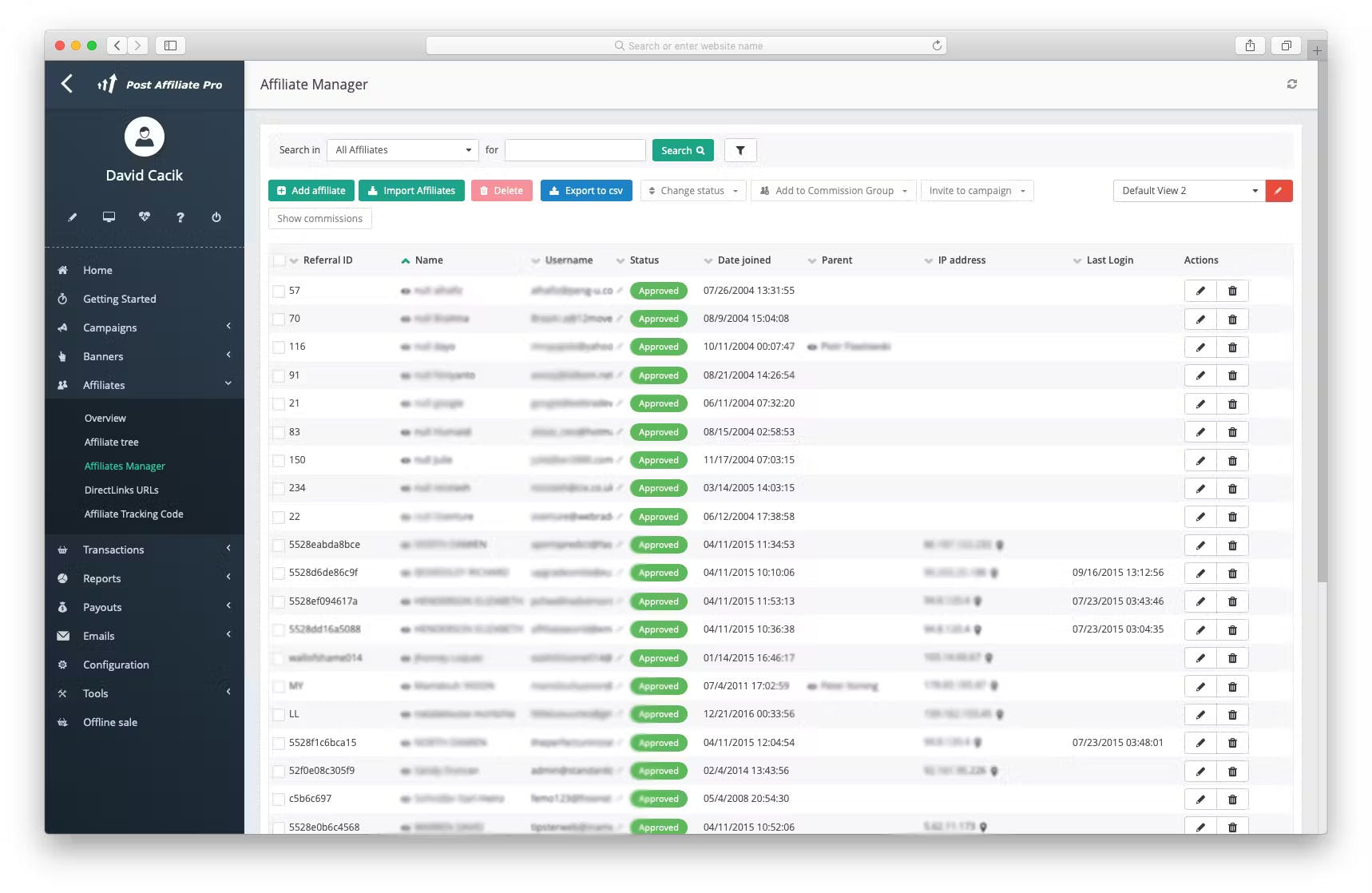
Post Affiliate Pro launched in 2004, a bonafide dinosaur in tech years. They are leaps and bounds more experienced in affiliate marketing than the competition and they’ve built a feature-packed platform to serve merchants. The platform hosts more than 30,000 customers worldwide and boasts 200+ integrations. Social sharing is notably absent from the tool but what it lacks there it makes up for in flexibility, enhanced tracking links, payment processing, and multi-level marketing options rebranded as Forced Tiers.
In Banner Manager, affiliate campaign assets are easily shared with publishers on the platform and banners come in all shapes and sizes. Empowering affiliates is one step and rewarding them is next. In Post Affiliate Pro merchants can award affiliates for all sorts of behaviors beyond just sales. Things like newsletter signups, registrations, and web traffic can all be monetized. There are also options for recurring commissions and split commissions between affiliates.
Pros: Database of affiliate programs, Advanced filtering, Search by earning potential, One-time access fee
Cons: No commission tracking features,
Features: Thousands of affiliate programs, SEO support, Trend data,
Cost: Starting at $149 for lifetime access
Affiliate marketing is a big, broad term. If you’re a beginner, it can be a lot of information to dig through to get started. Are you going to focus on tech, food, or the wide world of Amazon? Do you want to reach audiences on social media, buy Google ads, write SEO articles, or are you trying to be the next Wirecutter? Before you jump into making content, identify your niche with Affiliate Corner.
Affiliate Corner is not just another affiliate program database, but you’ll appreciate the search features to sift through 3000+ programs and 115+ niches. While it’s not the largest affiliate database, the pricing makes this option a winner. Pro users can unlock insights about how what makes each affiliate program unique, and you can easily filter by earning potential, average order value, and profession. You can also get access to trend data and SEO keyword research to give you a simple path to start promoting content and making sales. If you need additional support, you can make a one-time purchase to access their video course.
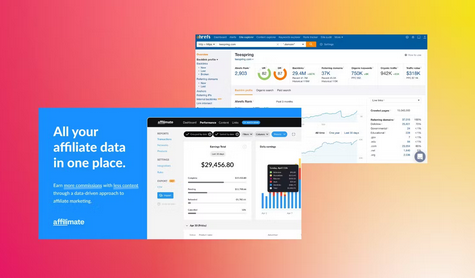
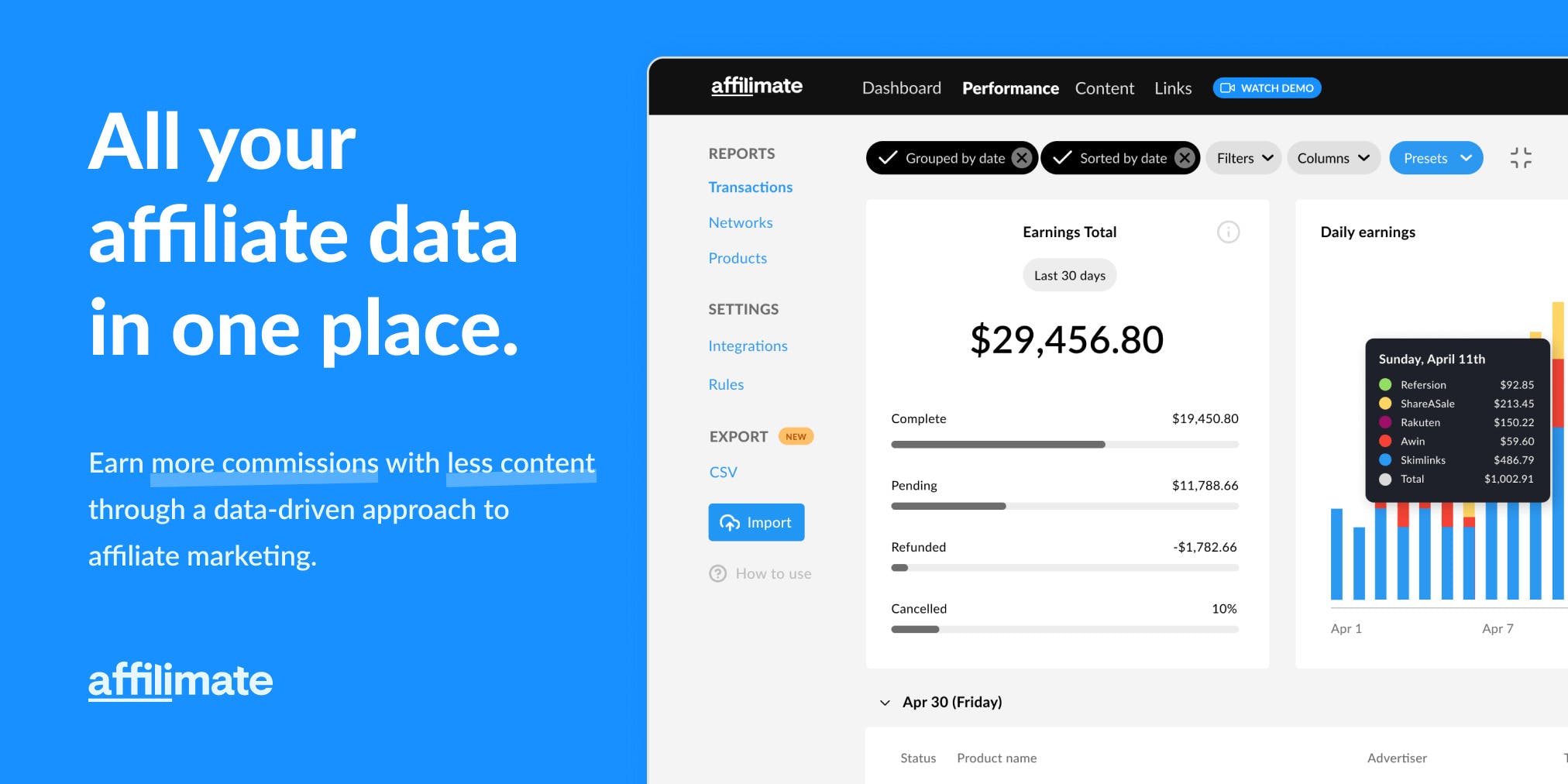
Features: Heatmaps, Integrates with top affiliate networks, Aggregates all affiliate link data in one platform
Cost: Plans starting at $82/mo
The list of affiliate marketing programs is growing every day, which means new opportunities to make money and promote a wide range of products. Affilimate knows that it can be messy to manage lots of different affiliate programs so they created a single clean dashboard to manage it all.
The tool integrates with 100+ affiliate networks to help affiliates visualize a complete overview of their campaign metrics. Eliminating this step in the program management process frees you up to focus on things that convert sales like digital marketing, content optimization, page SEO, and lead generation. The tool is packed with other features like content analytics, affiliate link management, revenue attribution, and revision monitoring.
4. Ahrefs
Best affiliate marketing tool for SEO
Ahrefs
Pros: Large keyword and backlink database, Data filtering, User-friendly
Cons: Expensive, Plan limits with overage fees
Features: Keyword research, Site auditing, Backlink analysis, Rank monitoring
Cost: Plans start at $83/mo
Every website needs an SEO strategy in 2023, and affiliate sites are no exception. Ahrefs is a digital marketing and SEO tool that helps you rank higher and get more traffic. There is no free trial but the company offers a free Webmaster Tools account for website owners. The tool offers ranking monitoring, keyword tools, link building, and a backlink checker.
Ahrefs has one of the largest databases of live links which gives them a competitive edge on backlink checking. Ahrefs puts a heavy emphasis on competitive analysis and offers strategies to beat those competitors in search rankings. This is important for any business but especially so for affiliate sites when you’re competing with the brands and other affiliates trying to convert the same customers.
Pros: Large affiliate and advertiser network, Advanced filtering, Easy-to-use dashboard
Cons: High learning curve, Long implementation, Sign-up fee
Features: Campaign management, Email marketing, Analytics, Social promotion
Cost: $50 per month
It’s easy to see why publishers flock to Awin to tap into its vast network of merchants and affiliate programs. Last year Awin affiliates earned a whopping $1.3B in commissions. Advertisers trust Awin to market their affiliate partnership opportunities to affiliates en masse. With more than 25,000 advertisers and 270,000 active affiliates, Awin is an obvious win for the best affiliate network. The platform is intuitive and easy to use and the support team is readily available to help users get set up. Publishers can easily find advertisers to work with and generate trackable links that are measured and reported in the analytics platform.
6. ThirstyAffiliates
Best affiliate plug-in
ThirstyAffiliates
Pros: Easy link management, Automations, Amazon compliance tools
Cons: WordPress plug-in only
Features: Link cloaking, Auto-link keywords, Geolocation links,
Cost: Plans start at $199.50 per year
ThirstyAffiliates is an affiliate link management WordPress plug-in that gives you total control of your affiliate links. The tool allows you to cloak your links, protect yourself from commission hijacking, and easily insert your affiliate links throughout your blog posts. Link cloaking works by redirecting your unique URLs to different destination URLs.
Not only do cloaked links look pretty, but they are also more trustworthy to customers and have higher conversion rates. International audiences have a great experience with links due to automatic geolocation links serving up shoppable pages. Hello, geo-targeting! Links can also be easily uncloaked to comply with Amazon’s affiliate program rules. All in all, it’s an affordable tool that is great for WordPress websites looking to monetize their content.
Websites and landing pages have two key differences. Websites are designed for open exploration while landing pages give customers a compelling focus. Focus is especially important for affiliate marketing when you are driving traffic for a specific product or service.
Enter Unbounce, a gorgeous landing page builder packed with landing page templates, AI writing support, and plenty of other features to boost your digital marketing efforts. You can add pop-ups and sticky bars to your landing page, A/B test creative, and connect to eCommerce platforms like Shopify and WooCommerce. Smart traffic features can also help users understand how pages are performing and identify behavior patterns in as few as 50 site visits.
Best affiliate marketing tool for tracking ads, referrals, and affiliates
AnyTrack
Pros: Track conversion across platforms, One-click integrations, No coding skills required
Cons: Learning curve, Price
Features: ROAS tracking, One tag for all your conversions, Google Analytics and Facebook API
Cost: From $50 monthly
Slogging through a sea of data to drill down on your affiliate link campaigns is time-consuming and tedious. If you need a simpler option, no further than AnyTrack! This all-in-one conversion tracking platform is excellent at attribution and helps users make sense of marketing metrics.
With AnyTrack, you can track conversions across all your channels – Google Ads, Meta Ads, Bing Ads, and more. That means no more trying to piece together your marketing performance from multiple platforms. AnyTrack also offers automated conversion tracking, so you can quickly discover insights and use them to generate better content. Plus, with advanced attribution modeling, you’ll know exactly which campaigns and channels are driving the most conversions. It’s like having a personal data analyst right at your fingertips!
What are the benefits of using affiliate marketing tools?
The affiliate marketing world is constantly growing. Upskilling and refreshing your toolset is a must if you want to stay ahead of the competition. The right tools can help automate and streamline many of the tedious and time-consuming tasks involved in managing an affiliate marketing program, freeing up time to focus on more strategic initiatives such as launching new marketing campaigns and finding new partners.
Whether it’s tracking and analyzing data, managing relationships with affiliates, or optimizing ad campaigns, there are a plethora of tools available on Product Hunt that can help marketers do their jobs more effectively. From comprehensive analytics platforms to powerful automation tools, the right affiliate marketing tools can help you save time, reduce costs, and ultimately drive more revenue for your business.
How much content are we creating and publishing? Facebook users post 1.7 million pieces of content in 60 seconds, Instagram users share 95 million photos in 24 hours and Youtubers upload 720,000 hours of video.
That’s a lot of noise!
Why headlines matter
Because there is so much noise (content), capturing attention and holding reader engagement is a tough gig. And the importance of a great headline to capture eyeballs and clicks is more important than ever.
In a world of AI-driven content generation, the attention bar is going to get higher and harder and the content creation growth will be exponential.
Why are headlines important?
It’s simple.
The job of the headline is to get people to read the first line. The job of the second line is to get people to read the third line. And so on.
It’s all about holding engagement to realize the goals of the content and article.
The other reasons a headline is vital include the following:
Building brand awareness
Educating
To convert attention into a lead (a name and email address)
Or it could be to create trust and credibility
To start the journey to sell a product or a service
Or maybe just to entertain
Attention first and everything flows from that.
Next, you need to understand the power of using human emotions. Tap into the latest neuroscience and the psychology behind the art and science of headline writing.
Understanding the psychology of headlines
There are many emotions you need to use and experiment with when writing great headlines. Also, you need to understand that it is an imperfect science and you will need to have some fun and test and experiment.
As a writer, it is always satisfying to see the headline you write go viral. It is almost addictive and can lead to an almost obsessive attention-seeking behaviour.
Writing a great headline often involves tapping into fundamental emotional triggers that resonate with readers.
These triggers can spark curiosity, evoke emotions, and drive engagement.
7 key emotional triggers
Writing a great headline involves tapping into the following fundamental emotional triggers that resonate with readers:
Curiosity: Curiosity is a powerful emotion that compels readers to click and learn more. Headlines that pose intriguing questions, tease a surprising revelation or offer a hint of the unknown can trigger curiosity and entice readers to engage further.
Fear or Concern: Headlines that address readers’ fears or concerns can grab attention by tapping into their emotions. Highlighting potential risks, warning of common mistakes, or offering solutions to pressing problems can elicit a sense of urgency and prompt readers to seek answers.
Desire for Improvement: People are constantly seeking ways to improve their lives, whether it’s achieving success, personal growth, or better relationships. Headlines that promise solutions, tips, or strategies for self-improvement appeal to the desire for progress and can attract readers who are actively seeking ways to enhance their lives.
Emotional Appeal: Emotional triggers such as joy, awe, inspiration, or empathy can be highly effective in engaging readers. Headlines that evoke strong emotions by sharing heart-warming stories, inspirational achievements, or relatable experiences have a greater chance of capturing attention and resonating with readers on an emotional level.
Exclusivity and FOMO (Fear of Missing Out): People have a natural inclination to be a part of exclusive or limited opportunities. Headlines that convey a sense of exclusivity, scarcity, or urgency can generate interest and create a fear of missing out. This trigger prompts readers to take action to avoid feeling left out.
Surprise or Shock: Headlines that promise unexpected or shocking information have the potential to capture attention. By defying expectations or challenging common beliefs, these headlines pique curiosity and compel readers to explore further.
Social Validation: Humans are social beings who seek validation and affirmation from others. Headlines that leverage social proof, testimonials, or expert endorsements can attract attention by tapping into readers’ desire for validation and credibility.
It’s important to use emotional triggers ethically and responsibly, ensuring that the content aligns with the promise made in the headline. Balancing emotional appeal with authenticity and value is key to creating compelling headlines that resonate with readers.
Crafting attention-grabbing headlines
So how do you start crafting these attention-grabbing headlines?
Well, we have already listed 7 emotional triggers. Now you need to find some words to help you create a strong hook to grab attention.
The words you need to have on your list for inspiration are called “Power Words”. You tap the emotional evoking powers that they elicit to get that initial attention.
What are “Power Words”?
In writing, the term “Power words” refers to words and phrases that carry strong emotional, persuasive, or attention-grabbing impact. These are words that evoke specific emotions, create vivid imagery, or convey a sense of urgency or importance.
Power words are carefully chosen to elicit a desired response from the reader and make the writing more compelling and engaging.
We all love an instant hit of pleasure, and when headlines go viral that drives a ton of traffic in a short time.
But that is a short game.
If you can write an irresistible headline that is also optimized for search engines you can get traffic for years.
That’s the patience of a long game.
So…if you were wanting to follow just the logical and data-driven science of search engine optimization so that Google can find a keyword – then your headline could be very boring and lacking emotional triggers.
What is also needed is some spice to add to the science. That’s emotion.
What is the role of search engine optimization (SEO) in headline visibility?
To kick this off the answer is simple. You include the keyword in the headline and then wrap it in emotional triggers that tap human emotional drives, wants, and fears.
Let’s say we want to use the key search engine phrase “email marketing software” in a headline that still ticks the SEO technical requirements.
Here are some headlines that you could use that use emotion and the key phrase.
Unlock Success with Powerful Email Marketing Software Solutions
The Ultimate Guide to Email Marketing Software
The 10 Best Email Marketing Software Solutions to Boost Your Lead Generation
Something to keep in mind is that as well as being emotional Google does like “recency” and including an up-to-date piece of content is also a good SEO tactic that caters to Google’s algorithms.
How do you perform keyword research for headline optimization?
There are a few ways and it could be as simple as using ChatGPT to give you a good start and if you want to get more technical then platforms like SEMRush and AhRefs are two great tools that you could use.
What are some successful headline formulas that professionals use?
Headlines are one of the easiest marketing tactics to test. Over the decades they have been used in direct marketing, email marketing, viral headlines, YouTube videos, and on social media.
10 top headline formulas for your toolbox
How-to Headline:
“How to [Achieve Desired Outcome] in [Specific Timeframe/Steps]”
Listicle Headline:
“X [Benefit/Tip/Idea] to [Achieve Desired Outcome]”
Question Headline:
“Are You [Desirable Outcome]? Here’s What You Need to Know”
Problem-Solution Headline:
“Struggling with [Problem]? Discover the [Solution/Method] that Works”
Secret/Revelation Headline:
“The Secret to [Desirable Outcome]: [Reveal/Discover] the [Method/Strategy]”
Comparison Headline:
“[Option A] vs. [Option B]: Which is the Best for [Specific Outcome]?”
Testimonial Headline:
“[Person/Brand] Shares How [Product/Service/Method] Transformed Their [Outcome]”
Controversial Headline:
“The Shocking Truth About [Topic/Issue] Revealed”
Curiosity Headline:
“Discover the [Number] Secrets to [Achieve Desired Outcome]”
Command Headline:
“[Action Verb] Your Way to [Desirable Outcome]”
Examples of successful headlines and their underlying formulas
The power of a numbered list (“20 Secrets”) is always a link clicker.
It promises a positive emotional outcome (“happier life”) and taps into the desire for self-improvement. The headline format offers a clear structure and signals easy-to-digest content.
Grabbing attention by challenging common beliefs (“The Truth About Weight Loss”) is a headline that should be used often.
It appeals to readers interested in weight loss and offers a promise of debunking myths. By creating controversy around a popular topic, this headline generates curiosity and prompts readers to engage.
This headline piques curiosity by highlighting a surprising connection between two seemingly unrelated topics (“Sleep and Productivity”). It suggests a valuable insight that can potentially improve readers’ lives and offers a compelling reason to explore further.
These case studies demonstrate how different headline formulas can be applied effectively to grab attention, generate curiosity, and provide value to the target audience.
Remember to adapt these formulas to your specific content and audience, and always ensure the headline accurately represents the underlying content.
Headlines for different media and content types
In the world before online video (pre-YouTube) and images (pre-Instagram) all we had to worry about was writing headlines for articles. Now we need to create headlines for different media.
This includes books, blog posts, and social media.
Here are five examples of potential great headlines for different types of content:
Book Headline: “Unleashing the Power Within: A Journey of Self-Discovery and Personal Transformation”. This headline evokes curiosity and promises a transformative experience, enticing readers to explore the book’s contents.
Blog Post Headline: “10 Proven Strategies to Boost Your Productivity and Conquer Your To-Do List”. This headline offers a clear benefit to the reader by promising practical strategies to enhance productivity, making it highly clickable.
Social Media Content Headline: “Discover the Secrets of Mindful Living: Embrace Balance and Find Inner Peace” This headline appeals to the desire for personal growth and introduces the concept of mindfulness, generating interest and engagement on social media platforms.
YouTube Video Headline: “Epic Travel Adventure: Exploring the Hidden Gems of [Destination]” This headline sparks excitement and curiosity, promising viewers an extraordinary travel experience while highlighting the specific destination.
Another YouTube Video Headline: “Master the Art of Photography: Essential Tips for Capturing Breath-taking Moments” This headline offers valuable expertise and promises to enhance viewers’ photography skills, making it appealing to photography enthusiasts.
Remember, great headlines are tailored to the target audience, highlight a benefit or promise, and evoke emotions or curiosity.
Headline toolbox
ChatGPT uses Artificial intelligence and it is a good tool for writing headlines but it tends to be a bit too formulaic and predictable. It can be used but use it mainly for inspiration rather than as your “go-to” tool.
So…when I started writing headlines I kept a range of headline tools and resources at my fingertips to inspire me and sharpen my skills. It might seem overwhelming at first, but as you practice and learn they will start to become part of your writing fabric and skillset.
7 tools and resources for your headline toolbox
CoSchedule Headline Analyzer: This tool analyses your headline and provides feedback on its quality, word balance, length, and emotional appeal. It offers suggestions for improvement.
Portent’s Content Idea Generator: Generate some catchy and creative headline ideas based on a keyword or topic. It helps spark inspiration and offers unique headline suggestions.
BuzzSumo: BuzzSumo allows you to research popular headlines in your niche or industry. By analysing the most shared content, you can gain insights into headline trends and find inspiration for your own headlines.
Headline Smasher: Headline Smasher generates variations of your original headline, providing different phrasings and word choices to enhance its impact and effectiveness.
Emotional Marketing Value Headline Analyzer: This tool evaluates your headline’s emotional appeal and rates it based on the Emotional Marketing Value (EMV) score. It helps gauge how likely your headline is to resonate with readers on an emotional level.
HubSpot Blog Topic Generator: While primarily focused on generating blog post ideas, this tool can also provide headline suggestions. Just input a few relevant keywords, and it will generate topic ideas and headline prompts.
Copyblogger’s Magnetic Headlines: This resource provides a comprehensive guide to headline writing. It covers various headline formulas, techniques, and examples to help you craft compelling headlines.
Remember to use these tools and resources as aids in your headline creation process, but also rely on your own creativity and understanding of your target audience to develop unique and engaging headlines.
Action steps
Headlines are your biggest source of attention whether you are posting on social media, creating Youtube videos, launching a book, or trying to get some leads and build your email list.
Use the headline formulas, take some of the examples, and have some fun experimenting and testing headlines.
So, keep creating, publishing, and sharing your headlines. But most importantly, have some fun!
He is the owner of jeffbullas.com. Forbes calls him a top influencer of Chief Marketing Officers and the world’s top social marketing talent. Entrepreneur lists him among 50 online marketing influencers to watch. Inc.com has him on the list of 20 digital marketing experts to follow on Twitter. Oanalytica named him #1 Global Content Marketing Influencer. BizHUMM ranks him as the world’s #1 business blogger.
Use these tips to get more eyeballs on your B2B emails and build higher engagement.
Growing a business-to-business (B2B) email newsletter isn’t easy. For starters, B2B emails notoriously get less engagement. Their average open rate is 15.1 percent compared to 19.7 percent for business-to-consumer (B2C) emails. That doesn’t mean you stop trying to exceed averages and create more buzz for your newsletter.
Here are five ways to do that.
To improve click rates, boost your email deliverability
A prevalent issue causing low click rates is poor email deliverability, which is the number of emails that reach the inbox. Several factors determine your email deliverability, including your email volume and sending frequency, your bounce rate, and spam complaint rate.
“To get more engagement for your B2B email newsletter, start by checking the health of your email list,” says ZeroBounce COO Brian Minick. “We see companies coming to us with a 19 percent bounce rate because they neglected their email list cleaning. Poor-quality data causes your emails to go to spam, but what’s more, your email service provider can block your account because of it. It’s not worth dealing with this problem when you can so easily prevent it,” the email pro adds.
With almost 2 percent of your email list churning every month, remember to validate your contacts every quarter. Thus, you’ll avoid bounces, weed out other subpar data, and give your B2B newsletter a chance to go to the inbox.
Segment your email list to send more relevant content
Once you make sure your email list is fresh, take a closer look at your content. How could you make it better? Your own inbox can inspire you. Ask yourself, what are the emails you tend to open, and what gets you to click?
Oftentimes, you’ll see that the emails you engage with feel especially made for you. The companies that manage to create this personal experience use segmentation. It’s what you should be doing, too. Instead of sending the same email to everyone, use available customer data to create emails tailored to each specific group.
For instance, you could create a segment of people who have just signed up for an account with your company but haven’t made a purchase yet. Another segment could include customers who make purchases sporadically–is there any way you could convert them to a subscription?
It’s easy to get creative with your segments. Communicating with smaller, specific audiences will also make it easier for you to create the right content for them.
Create a welcome email sequence
Your content can be just what your target audience wants, but if your subject line fails to capture it, your email won’t get opened. So, don’t rush to hit Send. Instead, pay close attention to your subject–it needs to convey your message and entice people to click.
“Keep your subject lines brief and relevant, and personalize them. It will grab attention and improve engagement. Also, maximize your preheader text, the little piece of copy following the subject. That valuable space is your last chance to encourage an email open,” says Simon Harper, founder of SRH Design.
The email marketing expert also points out that “B2B email content can be dull and too long.” So, instead of sharing an entire article in your newsletter, “keep it concise and use links to make it easy for subscribers to find your additional content.”
Finally, Harper suggests creating a welcome email sequence. “Welcome emails tend to get the most engagement, so they will accelerate your success and set the expectations for excellent standards in future campaigns.”