Author

editor

Browsing

By Shubham Sharma

The power of Networking: How to build lasting business relationships.

This article will explore the power of networking and how it can be leveraged to build lasting business relationships. We will discuss the benefits of networking, from making new contacts to establishing valuable partnerships. Additionally, we will examine the various strategies that can be employed to create a successful relationship. Finally, we will discuss the importance of maintaining and nurturing these relationships for long-term success. By the end of this article, you will have gained insight into the power of networking and the tools to establish and maintain meaningful business relationships. Together, we can unlock the potential of networking to build lasting connections and achieve professional success.

The Benefits of Networking

1. Increased Brand Awareness — Networking can help spread the word about your business and increase your brand awareness. Connecting with other professionals in your industry, attending trade shows and conferences, or engaging in social media can help you reach new audiences and create a buzz around your business.

2. Establishing Authority — Networking is an effective way to establish authority in your industry. Connecting with influencers and thought leaders can help you gain recognition and credibility. Participating in industry events, speaking engagements, and online forums can help you showcase your expertise and form meaningful relationships.

3. Finding New Clients — Networking can help you gain access to potential clients and partners who may be interested in your product or service. Developing strategic relationships with people in your industry can help you find new leads and stay up to date on market trends.

4. Learning From Others — Networking is an excellent way to learn from others in your industry and stay informed on the latest developments. Participating in industry events and dialogues can help you get feedback on your work, discover new ideas, and identify potential opportunities.

5. Maintaining Professional Relationships — Networking is a great way to maintain and strengthen professional relationships. Reciprocity and mutual respect are vital in building long-term relationships that can benefit you personally and professionally.

Tips for creating meaningful connections and utilizing networking platforms:

1. Attend Business Events: Networking opportunities can be found in various places; attending business events, conferences, and seminars will help you expand your network.

2. Connect with Relevant Professionals: Once you have identified your target audience, reach out to people in your industry who share similar interests or goals.

3. Challenge Yourself: Networking can be intimidating, so challenge yourself to step out of your comfort zone and connect with new people.

4. Follow-Up: After a conversation with someone, it’s important to follow up and ensure that a relationship is established.

5. Utilize Social Media: Social media is an excellent platform for making connections. Reach out to people in your industry on LinkedIn, Twitter, Instagram, and other platforms.

6. Make Quality Connections: Don’t just focus on the number of your connections; make sure that the connections are meaningful and build relationships.

Conclusion

In conclusion, networking is a powerful tool for building lasting business relationships. It is important to be open and honest in your conversations, take time to listen to others, and establish a mutually beneficial relationship. Networking can help you gain valuable contacts, discover new opportunities, and build a strong business foundation for the future. Taking the time to build relationships through meaningful conversations can help you create success for years to come.

Feature Image Credit: cottonbro studio on Pexels

By Shubham Sharma

Sourced from Medium

By Adam Tinworth

As if Monday couldn’t get any worse, here’s a video interview with me about newsletters…

The Future (and Past) of newsletters

Despite the closure of Revue, and Facebook backing away from newsletters, they still have a very healthy future in publishing and audience circles. At least, that’s the case I try to make to Ian Silvera of Future News and Tech, Power & Media in this interview:

(It’s an interview with me… illustrated with a photo of Andrew Sullivan?)

Ian’s written up his take on it, including summarising my reasons for eschewing Substack:

So, why didn’t Adam choose Substack like everyman and his dog’s favourite celebrity writer? Substack’s VC-backing (the company raised $65m last March in a Series-B round and is backed by Andreessen Horowitz) was a turn-off and so was another related factor: as Substack seeks to generate more revenue and make its users stickier, it has become more like a platform (rather than a simple email sender and list builder).

I’d love to know what you think of the interview. And yes, I know that I need to stop swivelling in the seat… 🤦‍♂️

WEF #Humblebrag with Ben Smith

This morning’s Semafor media email is almost the dictionary definition of #humblebrag:

My colleagues Liz Hoffman and Steve Clemons and I spent the last week in Davos (ugh I know, what an annoying way to open).

Ick, as the young people say.

LinkedIn pushing newsletters harder

An email dropped into my inbox this morning, letting me know that the LinkedIn-based newsletters I subscribe to will become public in a couple of weeks…

To aid in this discovery, we are making newsletter subscriptions visible to others, including on profiles. Starting February 11, 2023, you’ll be able to see which newsletters members find value in, the same way you can see your shared interests, pages, and groups.

This is a pretty clear swipe from Substack — but should aid discovery.

Quickies

Twitter and The Mirror in a tree, k-i-s-s-i-n-g

Here’s a question:

And here’s the answer:

Twitter is testing a new feature that sees verified journalists identified alongside a logo for their publication. Several Daily Mirror journalists on the platform now have a new symbol showing the Mirror logo next to their blue ticks linking to the brand’s own Twitter account. Parent company Reach said Twitter invited the Mirror to get involved in the trial run.

These are actually a newish variation on the Verified status called “affiliations”:

Remember my post from last year about the impact of the Twitter layoffs on journalists? Well, we have part of an answer to my final question: Twitter has some element of a news partnership team still functioning, doing deals like this.

By Adam Tinworth

Sourced from One Man & His Blog

By Brandy Shaul

Twitter allows users to turn on password reset protection to add an extra layer of security to their account.

Our guide will show you how to turn on password reset protection from within the Twitter mobile application.

Note: These screenshots were captured in the Twitter mobile app on iOS.

Step 1: Tap your profile picture in the top-left corner of the screen.

image

Step 2: Tap “Settings and Support.”

image

Step 3: Tap “Settings and privacy.”

image

Step 4: Tap “Security and account access.”

image

Step 5: Tap “Security.”

image

Step 6: Tap the gray toggle to the right of “Password reset protect.”

image

Step 7: Enter your Twitter password on the “Save account changes” window that appears on the screen. Then tap the “OK” button on the “Save account changes” window.

image

This guide was first published in August 2018 and was updated in January 2023.

Feature Image Credit: Twitter

By Brandy Shaul

Sourced from ADWEEK

By

Digital marketing has become an efficient practice for growing and established businesses to promote their products and services. More and more organizations depend on digital channels to connect with customers and generate a vast customer base.

Because of its growing popularity, different digital marketing trends will reign in 2023. If businesses can pay attention to these trends and curate marketing practices to align with them, they will have better opportunities to boost their growth and generate promising leads. Hence, growing businesses must familiarize themselves with the concept of ‘what is digital marketing,’ various forms of digital communication, and stay updated on the current marketing trends to stay competitive. Here’s a look at a few trends that one must watch out for.

8 Digital Marketing Trends for 2023

1. Zero Party Data

With the rise of extensive data practices, businesses will use zero-party methods, such as form building, to gather consumer data. It will be an excellent way for enterprises to understand their customers deeper and use the information collected to tailor marketing practices and improve their work.

2. Email Marketing for Product Launches

Email marketing is an efficient practice that will see a boost this year. It is an encouraging method that generates leads and builds customer loyalty toward a brand. Most businesses can use this channel to connect with consumers about new product launches, giving customers an exclusive feeling.

3. Rise of Marketing Applications

These applications focus on advertising different products and services. Brands can register on these apps with an ad for the product they want their customers to know about and use them to reach out to new audience segments and invite them to become paying customers. It is a simple yet efficient digital marketing trend that will see a rise in 2023.

4. Use of Real-time Messaging

Real-time messaging applications are becoming an excellent way for businesses to connect with customers consistently. These applications can send out promo codes, order updates, product news, and more. It is a cost-effective way for businesses to build their audience and a trend that will become more popular  this year.

5. Influencer Marketing is Here to Stay

Influencer promotion will increase this year as more and more businesses collaborate with influencers to market their work. It is an efficient practice for organizations to grow their audience base. Hence, it will grow more into widespread practice starting this year.

6. Higher Brand Gratification

Because of online marketing and delivery channels, there has been a decline in consumer patience. People want to get their hands on products instantly when shopping. A trend in 2023 will see more gratification methods that will allow businesses to keep customers engaged while setting up a reasonable product delivery timeline.

7. Use of Machine Translators

Some businesses provide international services, and such companies will need to be able to communicate with customers in multiple languages. One of the rising trends for 2023 will be the use of machine translators on brand websites that will allow customers to access information from any location in the world, as there will be no language barrier to stand in the way.

8. Chatbots

Another rising trend in 2023 will be using chatbots on business websites. It is an excellent marketing tactic that allows customers to quickly address queries without waiting for a response. Chatbots help boost customer engagement and invoke a feeling of reliability for new consumers engaging with the business.

Endnote

Digital marketing is taking over the marketing world due to its efficiency and ability to provide quick results. Each practice has the potential to boost business opportunities and contribute to building audience trust. However, businesses must pay attention to different trends in the market to tailor their methods for maximum results. Following digital marketing trends will allow brands to work efficiently toward building customer loyalty and boosting their growth in the industry.

By

Sourced from Data Science Central

By Kazuki Ohta 

Bye-bye cookies, hello customer-centricity… This is the year it all happens, writes Treasure Data’s Kazuki Ohta.

The ad business is approaching a transformative moment. New privacy rules enacted by both state governments and tech giants have made digital advertising more expensive yet less effective. Innovative strategies designed by marketers to overcome these hurdles have not yet made it into media plans. If 2022 was a year of reaction to dynamic forces, 2023 is set to be a year of assertive action. Brands should keep these data-related predictions in mind as they begin to consider annual budgets and map out their avenues of escape.

1. Campaigns will go completely cookieless

The impending death of third-party cookies has petrified nearly every advertiser. At this point, many brands seem committed to going down with the ship, relying on third-party identifiers until they are gone forever. While Google’s depreciation delay this year offered a reprieve, there have been some forward-thinking brands that pushed onward and are pioneering the post-cookie landscape.

These brands have already started to test the effectiveness of alternative identity solutions, which enable media buyers to transact based on pseudonymous identifiers rather than cookies. Cookieless campaigns have mostly been experimental to date, but early success that has come in the form of increased reach and click-through rates suggests that they are ready to go mainstream.

Trying to predict what the cookieless future will look like is not easy, as there are competing technologies and visions fighting to shape the ecosystem. Doomsayers believe that alternative IDs will fail to scale and that advertisers will just flock to the walled gardens once the cookie crumbles. This may ultimately end up being true, but brands are not going to give up that easily.

As opposed to walled gardens, an open web backed by universal identifiers can provide the interoperability necessary for cross-screen marketing opportunities. In an effort to preserve this vision, the majority of the top 100 US advertisers will be completely cookieless in their digital campaigns by the end of 2023.

2. Time will run out on the old privacy regime

The era of unrestricted customer tracking is coming to an end. Apple’s rewriting of digital ad tracking rules is just one omen. California, Colorado, Virginia, Connecticut and Utah have promulgated their own laws and regulations. Without comprehensive privacy legislation at the federal level, brands have been forced to adapt and comply through ad hoc measures. And because there are new laws and regulations being debated, it has become increasingly difficult to anticipate what the next set of rules will look like.

As stewards of customer data, advertisers cannot afford to continue down this uncertain path. Brands require a safety net so that they can stop worrying about costly violations and instead start focusing on improving the overall customer experience. Fortunately, many of the leading adtech solutions on the market today have built-in privacy controls and data governance capabilities. Privacy and security are no longer a technology problem, but rather a business one, requiring a top-down approach and continuous consensus building.

As a result, some brands will begin to voluntarily take their data governance to the next level by adopting internal data privacy policies and measures that are more stringent than some of the new rules being discussed. That way, marketers will have confidence knowing that their practices are compliant now and in the future.

Feature Image Credit: Adobe Stock

By Kazuki Ohta 

Sourced from The Drum

By Sam Anderson

Some brands have had recent success by narrowing their audience pool: one-day-a-week dating app Thursday, or no-January-sign-ups gym Equinox. Should more brands follow suit? We asked six marketers.

Nitin Sinha, vice president, head of paid media, Laundry Service

‘Brands that want to connect with generation Z need to be authentic.’ We’ve heard this repeated often enough to know that it’s exercised in a wide variety of ways: good, bad, and ugly.

One of these ways is something we might call ‘anti-targeting’: turning away potential customers in favour of unequivocally establishing your brand positioning. My favourite example is REI shutting down on Black Friday, asking customers instead to #OptOutside.

REI likely projected that the long-term revenue impact from #OptOutside would outweigh the short-term loss. But I like to think that the idea originated from a simpler place: REI encouraging its customers and employees to avoid Black Friday chaos.

Authenticity through marketing can be a paradox. How do you show that yours is the real thing? It’s not easy. Smart brands put their money where their proverbial mouths are.

Lavinea Morris, head of planning, EMEA, M&C Saatchi Performance

Targeting niche audiences can make sense but only if its data-driven and not assumptive. If used correctly, it can be an effective part of your marketing mix, driving performance by up-weighting activity toward your most valuable customers. For brands who are willing to consider lifetime value and return on ad spend over customer acquisition cost, it can make your spend stretch much further and build long-term success.

The problem emerges when you become so obsessed with these audience groups that you miss out on opportunities with new customers. When you don’t balance niche with broader targeting testing, you will oversaturate your existing audience base and eventually stagnate your growth and bottom line. Niche targeting may be tempting but you have to think about the impact on your marketing priorities.

Becky Simms, co-founder and chief executive officer, Reflect Digital

Humans are complex systems, and ultimately every ad or marketing campaign is a human. Niche audience groups and targeting rely on truly understanding your market, their motivations, needs and drivers.

Behavioural nudges are a fantastic toolkit for marketers looking to target niche audiences. One such nudge is the ‘self-reference effect’, which demonstrates that people are more likely to remember information that is more relevant to them. Therefore, if an ad is hyper-specific to a user’s interests or behaviour, it can lead to ‘unexpectancy’ (pairing interest with an unexpected third party) and can cause cognitive strain. This cognitive strain helps with memorability and brand recall.

Nudges with niche audiences are a great way to increase the potential for engagement, immediately and later down the line.

Helen Androlia, director of strategy, Canada, Momentum Worldwide

While advertising is usually thought of as ‘mass’, I believe that we have always been niche to a degree. Some of the biggest brands in the world aren’t speaking to ‘everyone’ but to a specific target audience that is clearly realized. Whole Foods and the affluent, health-conscious consumer, for instance, or Square and its focus on small business.

As mainstream social media struggles to keep users, younger consumers especially are spending more time in closed, interest-based communities. Many Canadians – in Toronto especially – are also using platforms outside of North America to connect with friends and families overseas. Leveraging these channels means you can have more focused conversations and interactions.

Ultimately, most brand experiences are about space and place, from social to shopper to out-of-home. While you may not speak to everyone when you go niche, you can be sure that who you are speaking to really hears what you have to say.

Carli Pring, marketing manager, Tug

Should marketers be targeting ever-nicher audiences? Yes and no. There’s no right or wrong answer, but there is a need for a strong marketing strategy. Niche audience marketing can be an effective way for brands to target specific groups who are more likely to be interested in their products or services. It can also be a more efficient use of marketing efforts and have a higher return on investment. However, while it’s important to find a core demographic, reaching out to a new or a sizable target market can also pay off.

In 1998, Netflix was a direct-to-consumer DVD service designed and limited to ‘hardcore’ movie fans. Now, it’s a subscription service that allows consumers to access movies and TV shows, streaming from all devices, with cartoons to original TV shows (including the likes of Wednesday) targeting a diverse audience demographic.

That’s not to say that niche marketing isn’t effective. Axe (or Lynx in some markets), the Unilever body fragrance has been advertising products to pique the interest of young males since 1983, with core messaging around the brand’s property of seduction. Recently promoting the new limited-edition Lynx AI with British rapper Aitch, the brand has remained consistent throughout the years with its niche target audience, remaining the go-to smell of male adolescence.

Feature Image Credit: Brady Bellini via Unsplash

By Sam Anderson

Sourced from The Drum

By Nick Hobson

You can start right away.

Feature Image Credit: Getty Images

By Nick Hobson

Chief behavioral scientist, Apex Scoring Solutions, BAD Sciences at Potential Project. @NickMHobson

Sourced from Inc.

By

Sometimes, you need to write, but you don’t have the time or energy to do it for yourself. But that’s okay. In 2023, we have AI writing generator tools to help you at work — no matter what you’re working on. With the rise of artificial intelligence being used in content creation, customer support and more, AI writing generator tools are becoming essential tools in helping stay competitive, efficient and thorough in your work.

Whether you’re looking to create a prompt for a project, write a business plan or simply answer an email, we’ve gathered the six best (and free!) AI text generator tools to use at work in 2023.

1. HiveMind

HiveMind

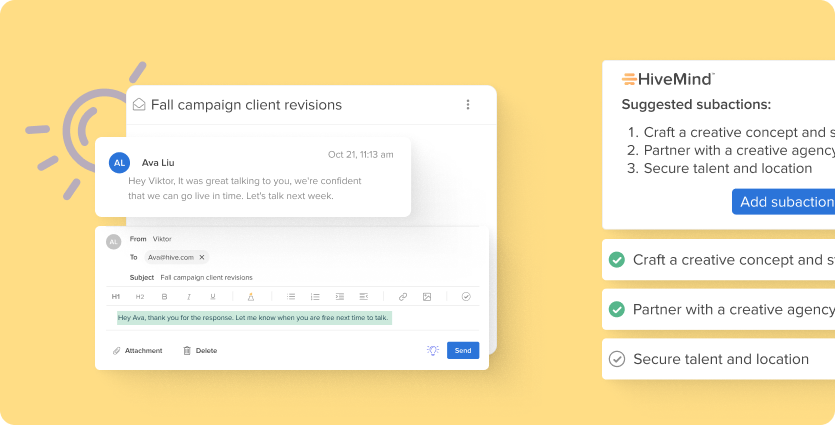
Looking to write a list of must-haves for a company party? What about a new article for your content calendar? HiveMind —Hive’s newest feature — has got your back. Using this innovative, free and brand-new tool, you can take full advantage of AI technology to make your workday run more efficiently, streamline your workflow, and best of all, write amazing content. All you had to do is write a prompt, such as: “Write an email back to John about meeting for coffee next Wednesday.”

Use HiveMind to:

  • Write amazing articles
  • Respond to emails automatically
  • Generate business plans
  • Create lists
  • Create original graphics to use on social media, your website, etc.

And more. In a matter of seconds, there you have it. This is truly a top pick for AI text generator tools that is easy, simple and extremely proficient in helping anyone write.

  • Cost: FREE

2. WordAi

WordAi is an AI writing generator that helps you create:

  • Quick and easy blog posts
  • White papers
  • Web content.

It uses natural language technologies to create human-quality content, ensuring that content appears more unique and professional. WordAi is also available in a range of languages, making it a perfect tool for companies looking to do business in international markets. 

3. Quillbot

Quillbot is an AI writing tool that allows users to produce high-quality content in just minutes. It uses a powerful algorithm to automatically generate personalized content. It can:

  • Provide accurate and interesting reading experiences
  • Offer potential customers an improved level of engagement with your brand

4. GPT-3

GPT-3 is an AI writing tool developed by OpenAI, a leading AI research lab. It provides a powerful writing assistant that can:

  • Craft content from scratch based on prompts from the user
  • Allows users to create more natural-sounding articles and blog posts with fewer grammatical mistakes

5. Automated Insights

Automated Insights is an AI writing tool that leverages natural language processing technology to generate insights from data. It can:

  • Generate reports, summaries, and insights quickly and accurately
  • Has the ability to take raw data and turn it into written insights that can prove to be very useful for a marketing or sales team

6. DeepCrawl

DeepCrawl is an AI writing tool that helps users create content that is optimized for search engines. It can:

  • Use natural language processing techniques to scrape content from the web and create content that is more relevant and visible in search engine results

As AI writing technologies become more accessible and affordable, they are likely to become indispensable tools in business operations in 2023. Are you ready to try it out an AI text generator for yourself? 

By

Sourced from Hive

By Rebecca Deczynski

On-platform checkout has reduced friction for online shoppers, but you’ll still have to strategize wisely to turn surfers into purchasers.

If you’ve got something to sell, it’s time to get social.

Social commerce — using social media to directly sell products or services on-platform — is far from a new phenomenon. But it is a fast-growing market: In 2023, social-commerce sales in the U.S. are expected to hit $56.2 billion, making up about 4.7 percent of overall e-commerce sales, according to an October 2022 report by McKinsey. Even if that percentage seems unremarkable, there’s still good reason to invest in this growing e-commerce channel.

Approximately 70 percent of all online purchases are influenced by social media, explains Jay Myers, co-founder of the Winnipeg, Manitoba-headquartered B2B e-commerce business Bold Commerce. “There’s huge promise, huge potential,” he says — if businesses can figure out how they can use social media to convert on-platform sales: “The reason why a lot of brands are not seeing success is because they just see [social commerce] as a shiny new tool. They think, ‘Well I’ve got followers, maybe they’re even engaged, so if I put a buy button somewhere it should just work.’ ” Unfortunately, it’s not that simple.

The best social-commerce strategies for your business will take into consideration a number of factors, including but not limited to your target demographic, your existing social-media presence, and what, exactly, you’re trying to sell. Sometimes, the best social-commerce strategy for a brand isn’t even purely social commerce: Social selling, the act of using social media to sell products or services on a separate site or channel, can be another great way to target customers, says Myers. What’s most important is figuring out what tactics will resonate most with your desired audience.

Here’s how you can make the most of on-platform checkout and social selling to meet your customers where they are: on social media.

Strategize your on-platform selling approach

Some products are easier to sell directly on social media than others. A low-cost product that doesn’t require a lot of research — cheap sunglasses, for instance — will have a much different buyer journey than a pricey pair of shoes. “Understanding the input that a customer needs to make a decision determines whether you should do social commerce,” Myers explains. Ultimately, not every product or service will be a fit for on-platform selling or even social commerce: A person is unlikely to book a hotel stay through Instagram, for instance.

Image Skincare's eye mask.

Image Skincare’s eye mask.Photo: Courtesy Company

But brands that push their most accessible products on social will likely see results. Image Skincare, a Palm Beach, Florida-based professional skincare line, found particular success promoting its $55 eye masks through on-platform shopping on Facebook, Instagram, Pinterest, and TikTok; the product drove 20 percent of all traffic from its social shops on Facebook and Instagram to Image Skincare’s own website. The product’s success on social platforms is likely a result of its accessibility, explains Image chief marketing officer Yaso Murray; a visual product, like an eye mask, requires a lesser degree of customer education than a more complex and expensive serum. Although Image has invested in expanding customer education on social media — the brand grew its social-media team to six people in 2022 — Murray says it’s no coincidence that products requiring a low level of research by customers tend to perform better when it comes to on-platform checkout. “Simplicity is one of our core pillars. On social, I think even more so,” she says. “So a cleanser is going to do well. You know?”

Because Image’s products are only sold direct-to-consumer and at select spas across the country, the brand faces an additional challenge securing customers. “Because we’re not a Sephora, for instance, we have to think extra hard about how we can reach customers in a way that’s relevant to them,” Murray says. “It’s a business-building endeavour to wrap our heads around how to market to Gen-Z, who are the largest consumer generation. But that’s going to provide a lot of lifetime value for both our brand and our spas.” Investing in social commerce, then, is a worthwhile investment.

Partnering with the right influencers

Influencer marketing — a tactic that has increased in popularity as brands have experienced decreased returns from paid social advertising — can also help brands expand their reach on social. Image, as a professional skincare line, almost exclusively taps estheticians for its influencer strategy. By partnering with influencers who can use their professional experience to increase customer education, the brand can more easily push sales on social media. “They have very organic advocacy and can speak authentically about the product,” Murray says. “When you use celebrity influencers, your reach may increase, but the trust and credibility that comes with estheticians is much higher.”

Mavely's mobile view.

Mavely’s mobile view.Photo: Courtesy Company

For some brands, though, the opposite approach may work just as well. Mavely, a Chicago-based influencer marketing platform, pairs more than 650 brands, including Gap and Honest Company, with over 25,000 “everyday influencers” who can freely share affiliate links for those companies on their social-media platforms.

That might sound like a recipe for disaster to brands that are used to having close control of their influencer relations strategy, but it’s actually proven hugely beneficial for retailers that have signed on to the platform, says co-founder and CEO Evan Wray. “A lot of brands have had very negative experiences with influencer marketing agencies because they’ll pay $100,000 and get five sales — that puts a bad taste in their mouth,” he says. “My view is that the future of influencer marketing is actually performance-based.”

A peer-to-peer social commerce strategy that taps people with authentic, relatable social media presences, he says, can turn into a massively scaled distribution channel for a brand — even if that brand has no control over the content that these influencers produce. And this form of influencer marketing isn’t just for “Instagrammable” DTC brands, either: Mavely’s top-performing brands are major big box retailers.

Finding your livestream shopping fit

Livestream shopping, a $423 billion market in China, led to $17 billion in sales in the U.S. in 2022, and is expected to triple to a $55 billion market by 2026. It’s a rapidly growing social-commerce strategy — but it’s not one that will work for any brand or product, says Aaron Levant, founder and CEO of the Los Angeles-based B2C live shopping platform Ntwrk. “A product has to have a lot of different attributes that can make it interesting enough for livestream shopping,” he says. Basic household commodities — which sell successfully on Chinese livestream platforms like Taobao — likely won’t appeal to U.S. consumers in the same context. Limited edition drops, collectibles, and products that benefit from some kind of live demonstration — like clothing and makeup — are better suited to the medium.

Where a brand decides to host its livestream also matters, Levant says. Although Facebook, Instagram, YouTube, Pinterest, and TikTok all offer livestream functionalities, he argues that smaller, more niche platforms could lead to better conversion: “I’ve done some experiments on [bigger] platforms, and their conversion rates are around 0.00003 percent. On a platform like Ntwrk, we get 5 percent conversion rates.”

The growing livestream market, Levant adds, may not be a winner-take-all industry, either: He sees just as much space for other livestream platforms, such as the beauty-focused app Flip, as he does for Ntwrk, which focuses on art, sneakers, and collectibles. “Intentionality is important, and niche communities assimilate together in different places,” Levant says. “Every platform has to speak the language of the community they’re speaking to, and I don’t believe one platform can be a catch-all for everybody.”

Feature Image Credit: Getty Images

By Rebecca Deczynski

Sourced from Inc.

By

The global pandemic caused a paradigm shift in the businesses conducted across all industries, this led to a majority of brick-and-mortar stores shifting online while also giving impetus to the growth of exclusive online businesses

“We set out to create a direct-to-customer (D2C) distribution network that eventually transcended into a live manifestation of the expression – ‘Steal the Deal’. Our ideology with Combonation has been quite rudimentary in the sense that we kept ourselves in the shoes of a common customer and observed the gaps they experience in retail shopping,” said Pooja Sodhi, co-founder and CEO of Combonation.

The global pandemic caused a paradigm shift in the businesses conducted across all industries, this led to a majority of brick-and-mortar stores shifting online while also giving impetus to the growth of exclusive online businesses. India’s e-retail market registered a CAGR of over 35% to reach INR 1.8 trillion in FY20, as per market insights. Easy, quick, and frequent transactions raising small ticket sizes in bulk have also been a significant contributing factor to the growth of e-commerce.

On this backdrop, while revealing the company’s smart move to scale up in the sector, the CEO asserted that Combonation works at a slightly different tangent than most of the e-commerce marketplaces, without disrupting existing distribution networks of brands and their pricing, we aim to curate combos that excite and delight our customers from personal care to beauty and wellness to home décor, etc.

She further disclosed that the company’s plan of scalability is not linear, but a dual approach that has both geographical expansion for targeted market penetration and enhancing the Combonation e- marketplace for a better customer shopping experience.

“Faster cart conversions, better API integrations, discount applications, and post-purchase experience are arenas where we are deploying the majority of our resources. We constantly work on making the website more user-friendly and also leverage big data to provide customized recommendations ensuring that our audience does not miss out on lucrative brand deals,” said Pooja Sodhi.

It is reportedly estimated that D2C brands in India are growing at a CAGR of 40% but there is no certain hack so to speak, value addition above all is the key for any business, not just e-commerce. It is also expected that some recent trends that will for the foreseeable future be prevalent in the D2C space are health and wellness-based commodities, adoption of an omni-channel approach, front-footing with social-commerce, and subscription-sales model among others.

Being asked on the secret recipe for success in the D2C sector, Pooja said that, “Brands can only thrive by being relevant to their respective target audience and perpetually giving customers something to look forward to; this is the philosophy followed in Combonation as well. It is crucial for brands to cope with the rapidly changing demands of the end consumer. By design the D2C market is extremely sensitive to trends and brands that are able to cater to such dynamic needs are surely going to come out on top. As expectations of customers from their favourite brands are rising across the country, D2C players are expected to dig deeper into their resources to provide more customer-centric solutions in 2023.”

When speaking about the key ingredients of a successful D2C brand, it is to be noted that marketing the product effectively plays a pivotal role in determining the success of a D2C brand. According to market studies, the high search volume from this year indicates that more brands want to choose a D2C marketing model. With reference to some approximate statistics, Indian D2C brands spent $157 million on advertising in FY21. Further, it was observed that the median advertising budget for top-funded D2C brands in India was $2.6 million in FY21.

As per Pooja’s words, a prerequisite to good branding and marketing strategies is to ensure the quality of products and services because that will surpass everything, once that area of business is sorted then companies should start building campaigns that are self-explanatory and intuitive but not misleading or shammy.

“We at Combonation have always had a customer-centric approach and given the D2C model of our business, this becomes all the more relevant. Our aim remains to make the shopping experience a delight for the end consumer regardless of the mode of purchase, be it online or offline. We ensure that our deals are never subject to a specific brand or a certain product portfolio,” she noted.

In the precariousness of the modern marketing landscape, brands across every sector are facing challenges. India’s 700 million internet users and 180-190 million online shoppers claimed to make it the third- largest market for D2C brands after the US and China. In 2020, consumer demand for most D2C brands via website said to have risen by 88% compared to the years before Covid-19. The Indian D2C market is currently believed to be worth $1.9 billion, about 1% of the domestic market for consumer goods, home goods, and consumer accessories.

“For D2C brands, product and marketing are the two biggest focus areas. They should explore outsourcing other functions to partners who have domain expertise. The challenges faced by D2C brands in the early breakthrough periods can hinder e-commerce growth from sales conversion to logistical delays. Within the Indian D2C ecosystems, factors such as – Cost of customer acquisition and maintenance of brand loyalty; hiring and talent management; bottom-line challenges; working capital management, and ESG obligation as well as other sustainability factors are areas where a lot can be done smatter and are also places where there’s a constant tussle. The success of D2C brands, therefore, depends a lot on tech-enabled fulfilment,” said Pooja Sodhi.

Keeping all these challenges in mind, Pooja Sodhi advised the beginners in the sector to have a UVP (Unique Value Proposition) or take notes from the precedents and build the best version of it. She also added that it is important to evaluate the market budget for a said company and then focus on how your D2C brand can achieve the first set of goals without exhausting a big chunk of resources.

“Be aware of the difference between pivoting and devoting; pivoting is change but deviation will only lead to purpose dilution and make your brand unstable,” said Pooja.

The D2C market in India is said to be growing at an incredible pace. In the D2C sector, consumer behaviour is said to be one of the common focuses of market theory. The market behaviour varies from place-to-place and time-to-time. Considering the Indian states’ behavioural pattern, according to reports, the top 2 cities Delhi and Mumbai accounted for $71 billion of the overall retail spending across different city types. Followed by the next 6 which are Bangalore, Chennai, Ahmedabad, Pune, and Kolkata, contributed $79 billion. The rest of the states and cities accounted for 685 billion USD. Therefore, one thing is very evident, even though the metropolis cities have contributed significantly to e-commerce growth, over the years, tier 2 and tier 3 states have also absorbed market trends and they now make up for a huge chunk of the Indian e-commerce market.

Referring to this scenario while explaining the competition in the D2C ecosystem, Pooja Sodhi elaborated that, “The Indian e-commerce ecosystem has been blessed with the influx of new players; approximately, there are more than 19,000+ e-commerce companies in India today. A majority of the new players are now discovering more niche market segments; whereas other players are now trying to pivot from what they were initially. E-commerce by nature is a very demand-sensitive domain and suppliers are often hyper-respondents to trends. Today’s competition goes beyond just the numbers but is more about who is more relevant in the long run.”

Though the competition is evidently high, with the right spirit and focus, Combonation plans to grow multi-folds in terms of their overall market presence. Dwelling more into the company’s vision, Pooja divulged that, “We are constantly in touch with brands to design the best possible deals and enlist new brands on our panel as well. We are actively deploying the best of tech-talent to enhance the Combonation website and make it an extremely user-friendly, fast as well as a secure place for all to shop without any apprehensions.”

“Additionally, our offline retail stores are also growing; with further geographical expansion across metro and non-metro markets, we will be able to reach more of our online customers while bringing on board a new set of customers too,” she added.

Feature Image Credit: Company handout, Pooja Sodhi

By

Sourced from Entrepreneur