Author

editor

Browsing

Sourced from The Clinton Courier

Making your products stand out from the competition is essential if you want to succeed in business. But how can you make sure that your products are truly unique? When it comes to product uniqueness, creativity is key! Here are six creative ways to make your products more unique and help them stand out.

1. Find Your Niche

Finding your niche is a great way to make your products stand out. Finding your business niche allows you to be creative and offer something unique that no one else can. It also helps customers easily identify what you’re selling and why they should choose it over similar products.

When looking for a niche to focus on, consider the market size and competition to determine whether or not it is worth pursuing. You will also want to research any potential customer needs in the space so that you can create an offering tailored specifically to them. Take the time to figure out how exactly you will differentiate your product or service from others on the market and tailor this to your target audience.

Finding your niche also allows you to create more personal connections with customers, as you can tailor your marketing and sales approach based on the needs of a specific niche market. You can build relationships with potential customers by showing them that you understand their wants and needs and offering an offering that meets those requirements.

The key to making your niche search work is focusing on one thing and doing it well instead of trying to be everything for everyone. It’s better to focus on a smaller number of products or services but do them exceptionally well rather than spreading yourself too thin across different sectors or markets.

2. Offer Personalization Options

Personalization options have become increasingly popular in recent years, and for a good reason. By offering personalization options to customers, you can make your products stand out from the competition by giving them something unique. Personalized products help make your offerings more creative and memorable, as each item is just for that customer.

In addition to making your products truly unique, excellent prints are a great option to add a touch of quality and sophistication to any product. Adding quality prints gives items like metals, mugs, or t-shirts an extra level of quality and detail while ensuring they’re completely customized with whatever text or image the customer chooses. These prints will last longer than other printing methods and create a special item that customers won’t find anywhere else.

3. Use Unusual Materials

Unconventional materials are an effective way to make your products stand out from the competition. By using unexpected materials, you can create innovative products that will set you apart from the rest. Unconventional materials often come with unique properties, such as textures, patterns, and colors that cannot be found in traditional materials. This makes them perfect for creating aesthetically pleasing items that capture consumers’ attention.

Furthermore, unconventional materials can be used to create products with higher durability than those made with traditional materials. For example, bamboo is a highly durable material resistant to water and mould, making it ideal for outdoor applications. Similarly, cork is known for its strong soundproofing properties and can be used to create items that are highly effective at muffling sound. Using unconventional materials, you can craft products that will last for years and offer superior performance.

4. Create Limited Edition Products

Creating limited-edition products is a great way to make them stand out from others on the market. You can do this by offering special discounts or bundle deals for certain time periods, or you can create custom packaging for certain items that will be released in limited numbers. This will help your product become exclusive and give customers an incentive to purchase it before it’s gone forever!

5. Re-brand Your Product

Another creative way to make your product more unique is by re-branding it with a new name, logo, design, or colour scheme. This can help it stand apart from other products in its category and give customers an extra reason to buy. Additionally, re-branding can help you attract a new audience and update your product to appeal to current trends and preferences.

6. Collaborate with Others

Finally, collaborating with other businesses or influencers in your industry is another great way to make your product stand out from the competition. This could involve sharing products, offering discounts for customers who purchase from both companies, or even creating joint marketing campaigns that feature both brands. Collaborating will not only help boost the visibility of both companies’ products but also create more interest and trust among customers.

sale


Regardless of your business type, finding creative ways to make your products unique is essential if you want them to stand out from the competition. By following these six tips, you can ensure that your products will be one-of-a-kind and attract more customers.


Sourced from The Clinton Courier

By

The billionaire drastically cut costs, which included massive job losses after taking control of the platform.

Elon Musk has finally lifted the veil on the workforce at Twitter.

After taking control of the microblogging website at the end of October in exchange for a check for $44 billion, the serial entrepreneur immediately embarked on an austerity cure to make the platform profitable.

It was urgent.

On the one hand, Musk had contracted a debt of $13 billion, which comes from interest payments of around $1.5 billion a year. This debt had been transferred to the company’s balance sheet.

On the other hand, Twitter faced an exodus of advertisers who had chosen to pause the promotion of their products and services while waiting to have a clear idea of ​​the content management policy that Musk was going to put in place.

Half the Jobs Cut in One Day

The tech mogul has always marketed himself as a “free speech absolutist,” meaning he believes any tweet is okay as long as it doesn’t violate the law. For many advertisers, this laissez-faire approach risked turning the platform into a “hellscape.”

The advertiser exodus had a big impact on Twitter’s finances, with Musk saying the company was losing $4 million a day. The billionaire then announced an unprecedented massive reduction in the workforce. He cut half the company’s workers, or 3,750 jobs, in one day.

A few days after these job cuts, the new owner of the social network then asked the remaining employees to work long hours or leave.

“Going forward, to build a breakthrough Twitter 2.0 and succeed in an increasingly competitive world, we will need to be extremely hardcore. This will mean working long hours at high intensity. Only exceptional performance will constitute a passing grade,” the billionaire wrote in an email sent to employees on Nov. 16.

“If you are sure that you want to be part of the new Twitter, please click yes on the link below,” he continued. “Anyone who has not done so by 5pm ET tomorrow  will receive three months of severance.”

It is difficult to know what response the whimsical and visionary entrepreneur expected from this ultimatum. More than a thousand employees had decided to leave, which had caused general chaos, forcing Musk to temporarily close offices of Twitter including the headquarters in San Francisco.

The Number Is ‘Incorrect’

Since then, there was a blur on the workforce of the company.

Musk has just clarified things after a CNBC article, citing “internal records,” indicated that the company has “approximately 1,300 active, working employees, including fewer than 550 full-time engineers by title.”

The billionaire claims that CNBC’s figures are false, at least those relating to the total number of Twitter employees.

“The note is incorrect,” the billionaire said on January 21, referring to the article. “There are ~2300 active, working employees at Twitter.”

To another Twitter user mentioning the article, Musk repeated: “It is actually not true. Employee headcount is almost double that.”

Basically, Twitter, which had 7,500 employees at the beginning of November, lost 5,200 employees in just over two months.

In addition, Musk took the opportunity to talk about the staff allocated to security while civil rights associations are concerned that the sharp reduction in staff has weakened the management of the platform’s content.

“There are still hundreds of employees working on trust & safety, along with several thousand contractors.”

Finally, the billionaire has appeared to respond to critics who accuse him of using employees of his other companies, including Tesla  (TSLA) – Get Free Report engineers, to work at Twitter.

“Less than 10 people from my other companies are working at Twitter,” Musk said.

Musk has also indicated that Twitter will be hiring this year but he did not say what functions or roles the company plans to fill.

“Will Twitter be hiring in 2023?” he was asked.

“Yes,” the Techno King, as he’s known at Tesla, answered.

He did not give further details, such as when the company was planning to start hiring.

The tech sector is in the midst of an austerity cure. In 2022, tech companies cut nearly 100,000 jobs, according to a recent report from outplacement services firm Challenger, Gray & Christmas. This was more than seven times the number of 2021, when 12,975 jobs were lost in the tech sector.

Over the first 20 days of 2023, more than 55,300 jobs have already been cut, including 12,000 by Google  (GOOGL) – Get Free Report and 10,000 by Microsoft  (MSFT) – Get Free Report, according to data startup Layoffs.fyi.

By

Sourced from TheStreet

By Anaya Gairola

Twitter CEO Elon Musk gave a statement that has the internet divided — and it’s about the prominence of the social media platform as a reliable “source of truth.”

What Happened: Musk took to Twitter to share an update about Community Notes, but before that, he said that the microblogging site is “arguably already the least wrong source of truth on the internet.”

Musk’s statement didn’t go well with many Twitter users, while others like Dogecoin

DOGE/USD-4.60%+ Free Alerts

co-creator Billy Markus, also known by his Twitter handle, Shibetoshi Nakamoto, said that “crowdsourcing is much better than a ministry of truth.”

Here are a few more reactions to Musk’s tweet:

This is how you can potentially earn extra income every single month..
Benzinga’s full-time trader Chris Capre is sending simple options trade alerts to traders like you. Click Here to get his trades for only $0.99!

Why It’s Important: Before Musk’s tweet, Community Notes’ official Twitter handle announced that the notes would also be shown on Quote Tweets. The feature is already live on the web app and will soon launch in iOS and Android versions.

Besides the Community Notes update, Twitter has been working on other features. Developer Alessandro Paluzzi shared a series of posts saying that the platform has discarded the downvotes features in the latest Android alpha release and is working on the long-format tweets.


By Anaya Gairola

Sourced from BENZINGA


By Ann Smarty

Business blogging is an interesting concept. Many businesses have a blog, and yet, in most cases, there isn’t much planning going into how those blogs fit into larger business goals. Someone on the team is just assigned to publish content regularly, and that’s what they do.

A business blog is usually an island within a company: There’s likely, not much measuring, so no one has any idea if it is generating any traffic, sales, or rankings.

And yet, despite a lack of planning or measuring, there may be some good traffic coming.

Blogging is a good way to achieve “aссidental rankings” (those you didn’t necessarily plan for) and discover more search-driven sales channels. But many business owners or marketing managers have no idea what their blogs are ranking for. Consequently, there’s no buying journey set up for someone who lands on a blog post.

Clicks may come, but a blog remains an island. So, how can you include your blog in your overall marketing strategy to convert those clicks?

Step 1: Identify your blog’s current rankings that may bring sales

In other words, let’s see if there’s anything to worry about in the first place. Normally, the good old 20/80 rule works for blogs as well: About 20% of your content will be bringing 80% of your traffic. So, you need to know what 20% of your blog content actually does bring traffic.

Here’s a quick way to do that in Google’s Search Console:

  • Navigate Performance > Create a filter to see all the pages that contain “blog” (or whatever domain or subdomain you have your blog at) and click on the “Pages” tab.

  • The list is going to be sorted by the number of clicks your blog is driving.

Don’t forget to use Moz Pro’s rank tracker to set up position monitoring of those pages that are driving organic traffic.

Step 2: Plan your buying journeys from your blog

Make sure your blog makes it clear that this is a business blog and you are selling something. Define the major conversion funnels for your readers to follow.

At the very least, there should be a site-wide call to action (CTA) inviting readers to check your product or products, but the best idea is to create contextual CTAs and lead generation forms, which could better align with the searchers’ intent.

Hubspot is a great example of contextual CTAs that differ in each article and engage readers by providing “upgrades” to the article content:

There are many more content-based B2B lead generation strategies, but contextual CTAs work in e-commerce and retail as well.

HomeDepot is another prime example of including contextual CTAs (and automating them). They always show related products right next to each of their guides. Not only are these products actually helpful for following the tutorial and solving the searcher’s problem, they also create the right expectation that this content has a business behind it:

Look at your blog and open any individual article. Do you offer readers ways from that blog to follow the sales funnel? You may also want to set up a heat-map and button click tracking to better understand what your blog readers interact with on your blog post.

Step 3: Revive lost rankings

An important reminder: Blogs inevitably lose rankings.

The essence of any blog is that the more content you add, the further your older content is moving down the archive, away from the home page. And gradually, but inevitably, that content is going to lose rankings.

Thus, checking your blog’s traffic and rankings should be done regularly because blogs tend to lose rankings over time. You can do that using the same tools. Search Console has a “Compare” option allowing you to see pages losing clicks…

Click the “Click difference” header twice to sort by pages that lost the most clicks. You can only go as far as 16 months back, though.

And again, once you set up tracking, the Moz Pro rank tracker will tell you exactly which keywords are losing rankings. You can compare your current positions to what you had when we first started recording any particular keyword.

So now that you have a list of articles that are losing rankings, what to do with those?

Is this something that can be saved?

First of all, figure out if this is something worth saving. There will always be rankings that you can just let go of. These include old news or press releases, articles that stand no chance of converting readers into buyers, expired product reviews or listicles, etc.

Update the content

If it looks like a page that is ranked for something with transactional potential, think about whether you should update that content to align it better to those keywords as well as relevant contextual CTAs. Maybe there’s a new video you created after writing that article, so now you can add it there.

Also, study your organic competitors to see where they might be better. You can use IMN’s Side-by-Side Tool to see the content of pages that gained rankings that you lost. The tool will compare various important on-page elements like titles, subheadings, keyword usage, etc. This will give you lots of clues about what needs to be expanded, added to, and improved.

SE Ranking on-page SEO checker is another great tool to see where your content needs to be updated and optimized better based on your competitor research:

Using SEO change monitoring, you can also be on top of your competitors’ content updates so that you can timely update yours and avoid losing rankings.

WebCEO is another cool tool that analyzes around 30 competing URLs for your target search queries and suggests what needs to be added for your content to catch up with your competitors:

I’ve also done a very detailed guide on identifying and refreshing your old content with many more tips and tricks, and here are even more tips on conducting a content audit.

Next, republish your refreshed content with a new date to push that article back to the top of your blog’s archive. For seasonal content, it’s especially important to time those content updates with the upcoming holiday or season.

Depending on those keywords (i.e. their relevancy and search volume), you may want to make that page more evergreen and prevent it from ever getting lost in your blog’s archives. Internal linking is one way to do that.

You can link to that page from relevant static landing pages that always remain at the same level in the site structure. Or include static site-wide or blog-wide “Featured guides” sections linking to those important blog posts. Here’s an example of a product category page linking to related guides:

Not only do these links help buyers make more informed decisions, they also help those linked guides maintain more consistent and long-term rankings.

What if your blog has no traffic at all?

But there’s another possibility, a bigger and broader one that probably deserves a separate discussion: What if your blog doesn’t rank at all, and there’s no organic traffic to convert? Sometimes those unexpected rankings never come, so what can you do?

Ask yourself why you have a blog in the first place and what you’d like to achieve with it. Is it sales? Then research your keywords and create effective contextual CTAs. If it’s links and connections? Then research journalists in your niche and what they are interested in, to better create content for successful outreach.

Researching your keywords and aligning your content to your goals is a huge topic, which is covered in-depth in Moz’s Keyword Research Master Guide, so start there.

Make your blog part of your whole company

The above steps help you revive and improve your blog’s rankings and utilize those clicks better. But without solving an underlying issue, you won’t see your blogging strategy succeed in the long run.

You need to integrate blogging into your company’s life and marketing strategy. Let your whole company submit content ideas for your blog, encourage everyone to share those articles that go live, and invite your current employees to write articles and create graphics for your blog.

Make sure your blog writers talk to your customer support and sales teams because those talk to your actual customers, so they will have a lot of insight into what those people are struggling with and how to help them. Give your blog writers access to your CRM to be able to assign certain clients’ questions and interactions to them as content ideas.

Keep an eye on your blog’s metrics and share important milestones with your company. A blog can make a big difference to your company’s bottom line, but only if you are taking it seriously.

By Ann Smarty

Ann Smarty is the Brand and Community Manager of Internet Marketing Ninjas, co-founder of Viral Content Buzz and founder of MyBlogU

Sourced from MOZ

By Todd Irwin

It’s not good to be Mark Zuckerberg these days. The CEO of Meta lost billions and laid off thousands due to an overinvestment in the metaverse. His big idea, that people will someday prefer to interact with one another in a virtual rather than real world, had a caveat – everyone still lives in the real one.

Zuckerberg’s concept of creating a virtual 3D metaverse is an extreme example of what can go wrong when your brand strategy is led by differentiation – going for something different from what everyone else is doing, trying to occupy a space in the market not occupied by competitors, but also, and most crucially, not yet wanted or needed by customers.

Leading with differentiation can be a dangerous approach. In most cases, an empty space in a market is devoid of competitors for a reason. Most of the time, it’s because innovation hasn’t yet created a solution that drives customers to it. Here lies Zuckerberg’s issue. He’s leaning into this concept as if it’s something the customer wants that hasn’t been created yet. He’s essentially trying to force it. The problem being, no one cares.

Differentiation, obviously, can be very effective, but it comes with real risks and costs when pursued with a muddy rationale. De-positioning – one of the most effective approaches to brand positioning – means highlighting something positive about you, a solution you offer that your competitors can’t or won’t, one that relieves customers’ pain points and satisfies their needs. It’s an approach that should be enacted first because, by definition, it forces you to focus on those customers’ needs and competitors’ weaknesses.

Apple’s iPod is an excellent example of successful de-positioning. The iPod was not an entirely new-to-market, first-mover concept. Before the iPod, there was the Walkman, Sony’s ultra-popular portable player with headphones. With it, people listened to music on the go, though they didn’t love having to carry cassettes or, later on, CDs.

But it wasn’t the iPod that followed the Walkman. As digital MP3 files started to replace CDs, in 1998, South Korea’s Saehan Information Systems created the first portable digital audio player, the MPMan. By the early 2000s, approximately 50 portable MP3 players were available in the U.S. – and no firm had achieved anywhere near the dominance that the Walkman had enjoyed 20 years earlier, as Ron Adner wrote in The Wide Lens.

The MP3 player market eventually consolidated around a dominant product, the Apple iPod, which launched three years after the MPMan as Apple addressed the major MP3 customer’s pain points.

Downloading an entire album was a multi-hour affair. Without the widespread availability of MP3s and broadband, the value proposition didn’t work. Steve Jobs knew this. On its own, the MP3 player was useless. Jobs understood that for the device to have value, other co-innovators in the MP3 player ecosystem first needed to be aligned. In October of 2001, when Jobs announced the iPod, Apple solidly put those pieces in place: MP3s and broadband became widely available.

At the heart of the iPod’s value proposition was its seamless integration with iTunes music management software. This also gave Apple an advantage when, in April 2003, it completed the evolution of this ecosystem by launching iTunes Music Store. This instantly made downloading respectable, as well as boosting its ease, reliability, and quality versus free downloads. And with people willing to pay 99 cents a song, the record companies signed on and accepted legal downloading as a lesser evil.

For an example of differentiation gone bad, consider LG’s mobile phone division, may it rest in peace. Back in 2013, the Korean company released a phone called the G Flex: its engineers used flexible technology to create a curved screen, apparently just because they could. The rationale the marketers offered was that this provided a more immersive experience when watching a movie on the phone, but for other purposes it was awkward and annoying. The product flopped, yet LG put out an unsuccessful sequel in 2015, the G Flex 2. The oddball phones no one asked for continued to emerge over the years, including 2020’s LG Wing – its main screen could turn, revealing a smaller screen underneath and creating a T-shaped smartphone.

Meanwhile, the company’s regular phones were indistinguishable from Samsung phones (except for problems with build quality that led to class-action lawsuits and notoriously inadequate support for software upgrades). After 11 years as a maker of Android phones and 23 successive money-losing quarters, LG closed the division in 2021. Even then, it was on the verge of releasing the LG Rollable, with a flexible, extendable screen.

Contrast that sort of flailing innovation with probably the central way Apple has de-positioned its competition. By focusing on seamless integration among all its devices and software as well as sleek design, Apple has created an ecosystem that provides intuitive ease of use, smooth sharing of music, photos and files among devices, and a high level of privacy. Customers are willing to pay a premium for this. Once they enter the ecosystem, they are loath to leave. (Apple’s tight control over its App Store, which has brought it an antitrust lawsuit, is one factor that adds to the ecosystem’s “walled garden” effect.)

Back to Zuckerberg. With the concept of the metaverse not well defined, Zuckerberg’s foray could be classified as a first-mover action. But, while Apple waited for everything to be aligned so it could solve the customers’ pain points, Zuckerberg, on the other hand, created pain. His platform can only be accessed with Meta-produced VR headsets, which are expensive and inconvenient, and people just don’t love wearing them.

In fact, other metaverse pioneers recognize the need for a better headset moving away from it. Roblox, Fortnite, and Minecraft all introduced flat metaverse versions available on browsers and mobile, which are becoming more popular than Meta’s 3D version. These solutions deliver the experience to a place where people feel comfortable and aren’t looking to leave. They’re enhancing the environment they already love.

So, Zuckerberg’s challenge is monumental and probably unattainable – getting people to fall out of love with something that works for them and move to a place they find uncomfortable and silly (wearing those headsets). The question is, why doesn’t he understand this? He’s no stranger to solving pain points. At its inception, Facebook de-positioned the clunky social environments of Myspace and Friendster by delivering a simpler place to connect and navigate. Making Facebook available on mobile was a big deal at the time. It delighted users. And then, after acquiring Instagram, he took it to the next level and delivered that connected experience on steroids.

Zuckerberg needs to take a lesson from his old self – great brands differentiate themselves and de-position competitors by understanding customers and solving their problems better than everyone else in the market. Creating pain will never be a solution to winning. Not now. Not then. Not ever.

Feature Image Credit: Glen Carrie

By Todd Irwin

Todd Irwin is the founder and Chief Strategy Officer at Fazer, a New York-based brand strategy and creative agency. His focus is to deliver competitive brand strategies directly to the visionary leaders looking for growth. Fazer is a new-model agency championing a revolution in the agency industry by having branding experts lead marketing, advertising, digital, PR, and all the other teams with the ultimate purpose of helping its clients win.

Sourced from Brandingmag

By Ashley Simpson

Helping your audience to find your best content is crucial to lengthening the time spent on your site. You want people to be able to find your most important content quickly and easily, which is where a featured post section can help.

Featured posts allow you to show people where your most helpful and popular content is at a quick glance. This section can be used regardless of what theme you use for your WordPress website.

If you want to add a featured post to your blog posts or sidebar, we’ll cover 3 easy ways to do just that. It’s so easy even beginners to the platform will be able to make their website more robust with this section of featured posts.

Let’s dive in and see why featured posts matter and how you can implement them quickly.

A featured posts list allows your audience to find your most important content quickly. Even if they don’t know what to look for on your site, you’ll be directing them right to your most valuable content. This is a great way to capture their interest, engage them with your top blog post, and hopefully establish yourself as an authority in your niche.

For website owners who have been blogging for a while, you might have so much information that it’s overwhelming for people to wade through.

With a featured post, you’re telling them where to start. It might be a timely piece, pillar content, or your most-visited blog post.

Once they find what they’re looking for, they might spend even more time perusing the rest of your featured post list. This can help with website trust signals, indicating that you should rank higher in the SERPs.

You can easily add a featured post or two to your website in one of 3 ways:

  • Adding a new list block
  • Adding featured posts to the sidebar
  • Using a plugin to display featured posts in WordPress

1. Add a New List Block to Your WordPress Website

Perhaps the easiest way to add featured content to your website is to simply add a new block. This will provide you with a list of featured content within the confines of another blog post. In the article where you want to add featured posts, you will need to follow these steps:

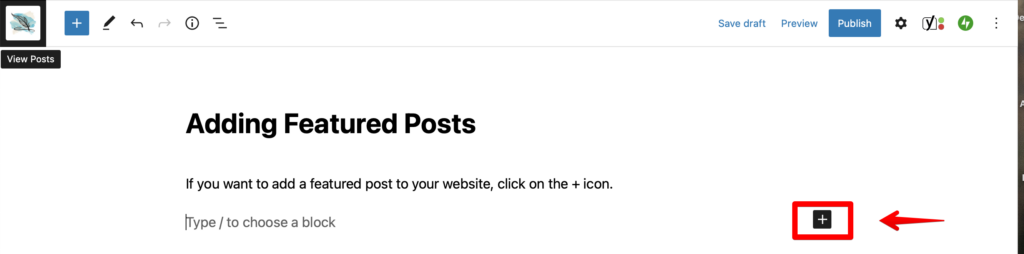
  • Click the “+” to add a new block.
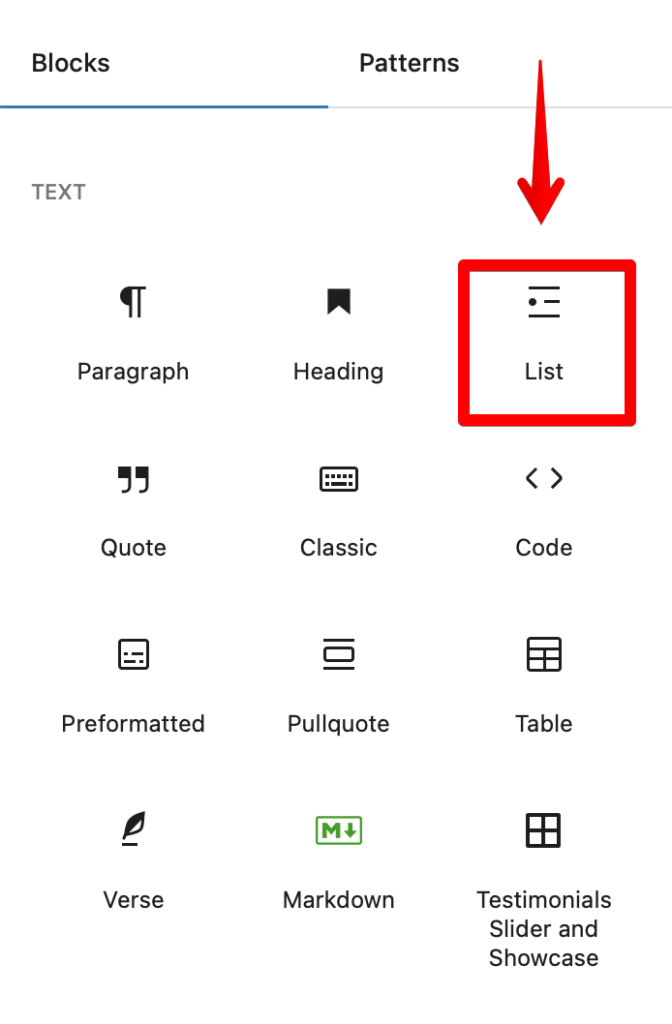
  • In the menu of options, click “list.” You may need to click “browse all” to see the WordPress sidebar to get to the list block.
  • Simply type in the name of the posts that you want to link. You can even use only one post, if you want. The number you select is up to you.
  • Highlight the post title and press CTRL+K (Command+K if you’re a Mac user). In the box, enter the URL of the featured post you want to link.

Here is an example of what the finished product will look like:

Creating a Reusable Block

If you want to use this block easily in several pages on your site, you might want to consider taking a few extra steps to create reusable blocks for your featured post section.

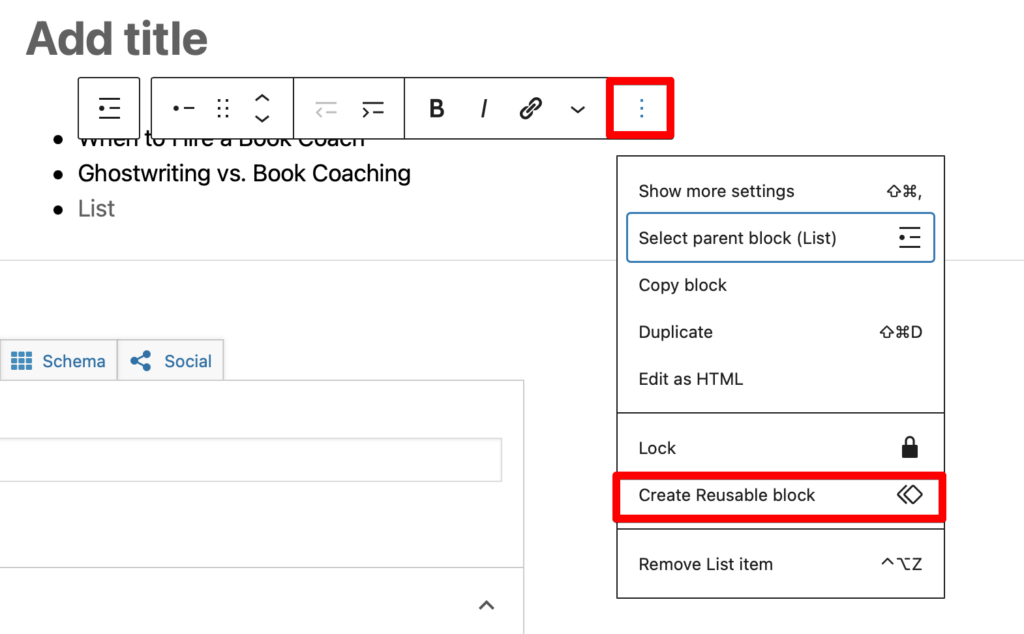
Once your list is made and hyperlinked, you can modify the block as a whole. Click the three dots to the right of the sidebar while in the block with your featured post list. This will open a new menu and you can select “Create Reusable Blocks.” Give it a name that you can remember.

From here, you’ll be able to add your reusable block anywhere you want featured posts to appear. Simply add a new block, scroll to the menu of options, and type in the name that you selected.

With this saved, you will be able to insert your new list with the featured post without having to hyperlink and type it out each time. This can be a huge timesaver, freeing you up for more important website modifications.

Adding featured posts to a WordPress sidebar is another great way to keep these posts front of mind for your audience. It takes a few more steps, but it can be worth it if you want it to be visible on each and every page of your site.

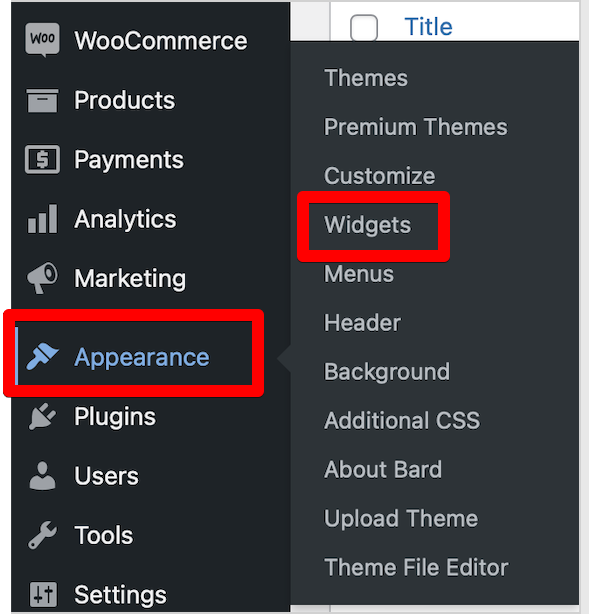
  • Head to Appearance on the left-hand sidebar of your WordPress dashboard. Select “Widgets” from the drop-down menu.
  • Choose where you would like your list to appear (right sidebar, left sidebar, etc.).
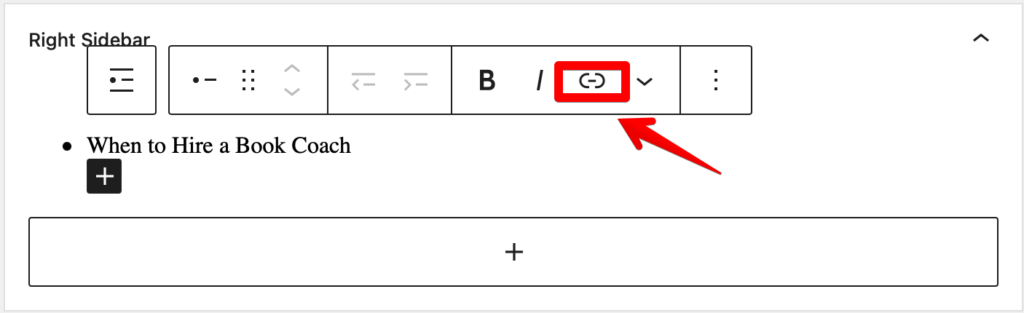
  • Click the “+” icon and add a list, similar to how you did in the last method.
  • Type in the name of the feature post you want to include.
  • Highlight the text (most likely your post title), press CTRL+K or Command+K to enter the URL of your WordPress post you want to include. Alternatively, you can click the link icon.
  • When finished, click the “Update” button in the upper right screen.

This will create a very simple text-only list of your featured posts. If you want more options like displaying a featured image with your titles, then you can opt for a paid subscription to a plugin like MonsterInsights.

3. Add a Featured Post with a Free WordPress Plugin

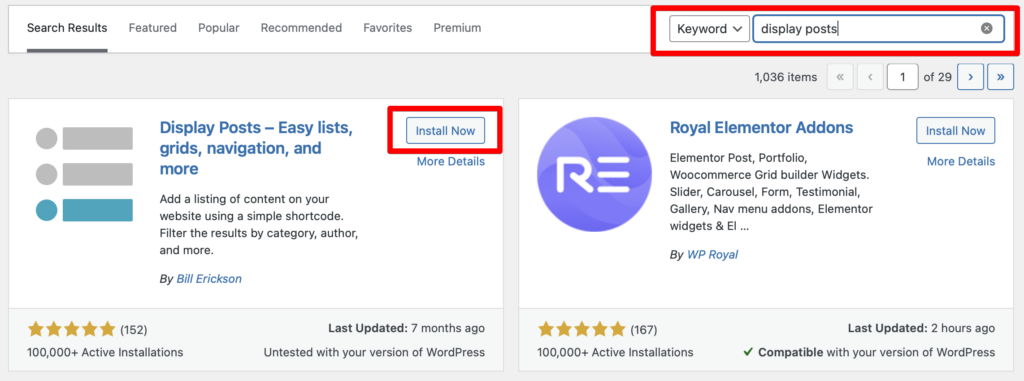
If you want something a little bit sleeker for your featured post section, then you might want to use a plugin. This requires just a few extra steps, but even beginners to the WordPress platform can learn to use it. In this post, we recommend using the free Display Posts plugin.

Here is how to add featured posts with this easy-to-use plugin:

  • On the lefthand sidebar, go to “Plugins” and “Add New.” Type “Display Posts” in the search bar to the right.
  • When it comes up, click “Install.” Wait for it to download, and then click “Activate.”
  • Under each article that you want to feature, add it to a “featured” category. You may have to create this category. (From the page editor of your blog, click the gear icon in the upper right corner. Scroll down to categories, add new, and label it “featured.”)
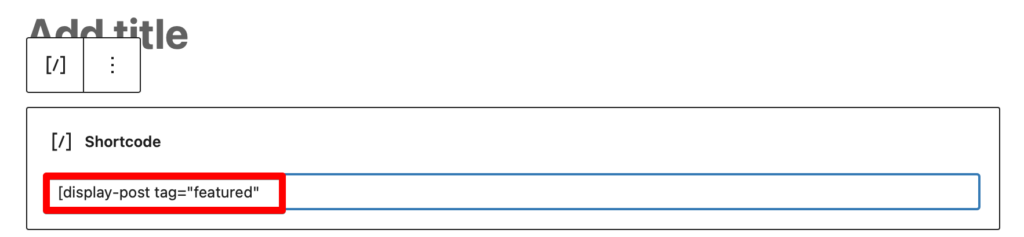
  • With the featured posts selected, you can now insert the shortcode to your pages. Click the “+” icon to add a new block. Click “Browse All” and search for “shortcode.” This will bring up a box where you can enter the code for your new plugin.
  • Type in [display-post tag=”featured”].

Alternatively, you can add featured posts with images using the same method. The only difference is the code that will be used in the shortcode box. To do this, you will enter the following text: [display-posts include_excerpt=”true” image_size=”thumbnail”]

The finished examples of the featured posts will look like this:

Adding Shortcode to a Sidebar

If you want to display featured posts in a sidebar, you can do so with a text widget using this plugin:

  • Head into your “Appearance” and “Widgets” area again.
  • Insert a “text” widget in the area where you would like your featured content to appear.
  • From here, you will follow similar steps to the above. Insert shortcode the same way with the same text.
  • Click “Update” to save your changes to the page.

Keep in mind that you will need to keep categorizing each new post if you want it to show up as a featured post in this section. How many posts you categorize this way is totally up to you, but you’ll need to refine these categories over time as you write more posts.

What to Include in Featured Post Sections

If you want people to find specific posts on your page, you need to know what to include. Generally speaking, there are a few types of content that you might include in this important featured post section of your website:

  • Time-sensitive material that involves a current event or news story
  • Your most important content that tells people how to connect with you
  • Answers to the frequently asked questions about your product or service
  • Most popular content

If there is a post that you want more people to engage with, it belongs in a featured posts section. Make sure that anything you include here is a decent length (usually recommended is 2,100 to 2,400 words but you can learn more in our article about how long should a blog post be) and is one of your best content pieces. It should engage your audience with relevant and useful details.

Final Thoughts: Adding a Featured Post Section

If you’re committed to giving your audience quick and easy-to-find content on your site, then you need to add featured posts. This allows visitors to engage more easily with your most popular or important content. Take some time to organize content to easily add it to your site.

It may require a one-time investment of your time and energy, but it will have far-reaching positive effects on your site navigation.

By Ashley Simpson

Ashley is an experienced freelance writer with an enthusiasm for finding creative ways to earn money online. She uses her passion for words to share what she has learned with the world.

She spends most of her time blogging for a multitude of websites and consuming everything she can get her hands on in relation to personal finance and side hustles.

Sourced from NICHE PURSUITS

By

  • Many Americans are looking for easy and entrepreneurial ways to make money.
  • Some are creating online businesses, which often have lower startup costs than brick-and-mortars.

  • Here are five of the easiest types to start, including content creation, coaching, and marketing.


Suss out the need for your potential online business

Businesswoman Working with Document
Conduct market and consumer research to determine what’s needed.
Morsa Images/Getty Images

It’s important for aspiring founders to ensure that the product or service is needed in the marketplace, said Cynthia Franklin, an entrepreneurship professor at New York University.

When deciding what type of business to start, “looking at where societal forces are heading and seeing if you can get ahead of the trend” is a good start, she said.

“Start with scratching your own itch,” Franklin suggests for aspiring online business owners. “Whatever you do, find something you care about because you’re going to need to put a lot of time and energy into making it succeed.”

Here are 5 of the easiest online businesses to start in 2023.

1. Content creation and social-media management

Lauren Mabra and Lauren Ferry
Lauren Mabra and Lauren Ferry founded the social-media content agency Lauren Labeled. courtesy of Lauren Labeled 

Content creation and social-media management can be simple and lucrative businesses to start. With many free or cheap platforms and editing tools, the field has low financial barriers to entry and is popular given social media’s prevalence. But popularity also means the competition can be stiff.

Lauren Mabra and Lauren Ferry are the Gen Z founders of the social-media advertising agency Lauren Labeled, which launched in 2021.

Their business helps other brands write, film, and produce social-media advertisements and campaigns. They specialize in marketing meant to reproduce the look and feel of user-generated content, or the kind of material an everyday social-media user might post from their iPhone, Mabra said.

“We saw that it was a broken system,” Mabra said. “Businesses either had to do it in-house — and a lot of teams are already short-staffed and overflowing with tasks — or they are going to influencers and paying $2,000 for one single video. How sustainable is that when you need new videos every single week?”

Before Lauren Labeled’s website launched, it already had a waiting list of customers, Mabra said. Now, the business regularly books five figures in revenue a month, documents verified by Insider show.

2. Coaching

Jessica Hawks (left) and Amy Lee (right)
Jessica Hawks and Amy Lee are virtual coaches. Jackie Sterna, P. Mastro


Online coaching has grown in recent years, whether entrepreneurs are offering virtual workout classes, leadership advice, or guidance on starting a business.

Amy Lee, for instance, is a life coach. She booked nearly $60,000 in revenue in her first 10 months in business, documents verified by Insider show.

There are no required credentials for life coaches, Lee said. While this can make some coaching communities seem like the Wild West, it also creates a low barrier to entry for professionals looking to enter the space.

Other types of coaches, like Jessica Hawks, seek to help their clients build startups.

Business coaching is an option for those who want to share their expertise in a certain field. Hawks started her online career as a virtual assistant, and when she realized her community was looking for advice on starting their own VA agencies, she launched her coaching program, the Digital Creatives Academy.

Hawks books seven figures in sales a year, documents verified by Insider show.

3. Blogging

Lisa Andrea, founder of The Financial Cookbook
Lisa Andrea, the founder of The Financial Cookbook. courtesy of Andrea

Blogging is another popular business avenue, especially for those who can share knowledge about a particular subject.

For instance, Lisa Andrea, the creator of The Financial Cookbook, started her blog as a side hustle in 2021. She shares tips on how to become financially independent and on investing, along with other money guidance. “The Financial Cookbook is a guide for everything they should have taught us in school,” she previously told Insider.

Her income streams include affiliate marketing and brand partnerships. She recommends other bloggers and digital founders take advantage of company affiliate programs by applying to be part of them online, as she did.

But it’s also important to stay authentic and work only with companies that align with your brand messaging, she added. That way, your community will stay engaged and be more interested in the links you’re promoting, which can help you earn more money.

Andrea regularly books $8,000 in monthly revenue, documents verified by Insider show.

4. Virtual assisting

Vivian Purcell
Vivian Purcell is a full-time virtual assistant. courtesy of Purcell


Vivian Purcell is a virtual assistant who lives in Canada. She started her online career as a freelance writer in 2016, seeking flexibility to travel and live wherever she wanted, she said.

“I did the switch into virtual assistant because I wanted to bring in more of my corporate experience and educational training into freelancing to offer something of higher value,” she said.

Purcell earned more than $132,000 in 2022 sales from her virtual-assistant work, documents verified by Insider show.

Virtual assistants can work with both small-business clients as well as major firms looking to hire contract or one-time employees, said Arun Sundararajan, a professor of entrepreneurship and technology, operations, and statistics at New York University’s Stern School of Business.

“It’s getting increasingly hard to hire full-time employees for anything,” said Sundararajan, who is also the author of “The Sharing Economy.” “So more and more businesses that didn’t consider gig work are now considering gig or freelance workers as an option.”

5. Marketing

Cody May
Cody May is a founder and a digital nomad. courtesy of May. 

Cody May is a digital-nomad founder who built his business entirely online. He runs SheridanSt., a marketing firm for real-estate agents.

SheridanSt. helps agents with tasks like lead generation along with call and email marketing. In 2017, he left his corporate role and applied his marketing experience to start StudioPTBO, the precursor to SheridanSt. Then, in 2021, he connected with his current business partner, who worked in real estate, to relaunch the company within the real-estate niche, he said.

He’s recruited most of his staff by offering a fully remote, travel-friendly workplace, he added. What’s more, online real estate is a hot sector: The National Association of Realtors’ 2022 Profile of Home Buyers and Sellers report found that 51% of this year’s buyers found the home they purchased online.

Feature Image Credit: lemono/Getty Images

By

Sourced from INSIDER

By

Do you wish your Facebook ads had a higher conversion rate? Looking for proven copywriting techniques that works?

In this article, you’ll discover how to write Facebook ads that move people to action—whether you want to generate leads, secure sales, or get prospects to take other key steps.

Technically, you could squeeze an entire blog post into the primary text section of your Facebook ad. Although Ads Manager gives you a ton of space to work with, it’s often better to keep your ad copy as concise as possible.

For most ad types, Meta recommends keeping primary text copy to 125 characters. The platform recommends keeping both the headline and the description to fewer than 30 characters.

Keep in mind that longer Facebook advertising copy gets buried behind a See More link. In fact, Facebook truncates primary text copy after about 115 characters. When you build campaigns in Ads Manager, use the ad preview to see how the copy will display for each placement. If it appears truncated, consider reworking it to display in full.

For example, the @repurpose Facebook ad below uses concise copy. Because it’s short and sweet, the primary text displays in full. To get the message across, the sustainable tableware brand uses other opportunities—including the headline and the video—to share features and CTAs.

Start With an Irresistible Hook

Between paid campaigns, suggested posts, and content from connected profiles and pages, Facebook feeds are packed with competing sources of information. Since the average Facebook user’s attention span lasts for 2.5 seconds or less, capturing interest right away is critical for conversions.

With a compelling hook, you can instantly draw in Facebook users, get them to read your message, and encourage them to act. Without a hook, your ad copy doesn’t give prospects a reason to keep reading, which can cause them to scroll past before getting to the sales pitch.

So how can you write irresistible hooks for your Facebook ads? Here are some ideas to test in your ad copy:

Click HERE to read the remainder of the article

By

Sourced from Social Media Examiner

By Ashley Simpson

Do you want to develop high income skills that will help you to earn a decent living with lots of flexibility? The best high income skills can be broken into two main categories: creative skills and technical skills. Both offer you the opportunity to earn a generous salary using the knowledge that you already have or are capable of working to refine.

If you’re ready to dive into the high income skills that can earn you a pretty penny, here are our top choices.

Creative High Income Skills to Learn

While creative high income skills may not pay as well as a more technical high income skill, there are still many benefits to exploring your creativity. They can give you an outlet for your ideas, help others create content that matters, and hone soft skills that will make you an ideal candidate in many fields.

SEO and Content Marketing Strategy

Search engine optimization (SEO) and content marketing strategy are high income skills that can give you endless freedom. Some people choose to work for themselves, running successful niche blogs that generate income. Others work for a roster of clients, creating page content and running a blog.

This high income skill is in high demand as it requires a delicate balance of skills ranging from creativity to generate content to the more technical skills required to rank higher on SERPs.

If you aren’t sure where to start with SEO or a content marketing strategy, you can easily take courses like those offered by Income School. Be sure to see our full Income School review here.

Average Salary: $50,000 – $75,000


Copywriting

Copywriting requires a much different skill set than creating engaging content. As one of the best high-paying skills, you must deeply understand what drives people to make a purchase. Instead of writing blogs, you will write marketing material to encourage sales.

There can be quite a bit of pressure with these high income skills because your success will be measured by how well your copy converts to sales. If you have the creative writing skills and the flexibility to understand what motivates people to make a purchase, this is a high income skill you can hone over time for a decent salary.

Learn more here:

Average Salary: $56,299


Video Editing

Maybe you don’t love the idea of being in front of the camera and starting your own YouTube channel or video content. That doesn’t mean that you can’t work in the field of video marketing though. Many people who record their own content are looking for video editing services so that they can move on to the next piece of content, making this another of the best high income skills.

Video editing requires you to have high income skills like deep knowledge of Final Cut Pro or iMovie, both of which are popular editing softwares. If you have the budget to spend on nicer software, many editors love Adobe Premiere Pro as well.

Average Salary: $52,672 – $66,368


Social Media Marketing and Digital Marketing

Both social media marketing and digital marketing will put your sales skills to the test. This high income skill requires social media marketers to master word smithing, a deep understanding of marketing, and a spark of creative genius. You should know what drives people to make a purchase or to engage with a brand.

Furthermore, it requires project management skills to keep all of your digital marketing campaigns running smoothly. A little bit of search engine optimization is also helpful to understand what terms people are searching for and how you can capitalize on those searches.

The only downside to high income skills like social media marketing and digital marketing is that you have to be available often to interact with customers and manage these campaigns.

Be sure to check out some of this related reading:

Average Salary: $97,772 – $111,845


Affiliate Marketing

Affiliate marketing is another high income skill that requires you to create your own content. For example, you could write a blog post that refers people to a particular product that you are reviewing. Using these high income skills, you will use a unique link and earn a kickback from each person who makes a purchase using your link.

Does it sound simple?

If you have a knack for writing persuasive content, then you might be a good fit for affiliate marketing. The important thing here is to be transparent with your audience about whether a product is a good choice and to only recommend things that you genuinely love.

Your audience may leave if they think that you’re in it just for a quick buck, but you can easily earn a six-figure income if you play your cards right.

Be sure to check out our other guides on getting started with affiliate marketing here:

Average Salary: $154,983


Online Course Creation

Another of the top high income skills, course creation can take many different paths. First, you might decide to cash in on your expertise in a given field. You can create a course that teaches someone how to follow your own skill on platforms like Teachable.

Set your own price for the course and start marketing your own business of online courses.

Other people prefer to take their knowledge of creating online courses to create content for other people. As a course developer, you would take the key skills you learned to create video and written content, structure an outline of an in-depth course, and then create and market it. There are lots of free resources that can help you get started with this valuable skill.

Here are a few reviews and free resources of some popular course creation platforms:

Average Salary: $92,160


Coding and Other Technical Skills to Learn

High income skills that are more technical like coding are constantly in high demand. If you have a mind for numbers and problem-solving, then these skills might be a good fit for you. The best part is that they are frequently high-paying skills as many people lack the technical knowledge of how to do these skills.

Coding is the first high income skill to think about learning. For those who specialize in coding, you will need to know how to build a website or work on apps. Coders are responsible for spinning something wonderful out of nothing but lines of technical code. You tell the computer or the internet what, when, and how to do something with this high-paying skill.

A college degree is often helpful in this field, but you may find free coding courses through sites like Udemy.

Average Salary: $73,473


Data Science or Analysis

If you have a strong mind for numbers, data science or analysis is one of the best high income skills to learn. This involves sifting through tons of data points to come up with a plan for what would drive the company forward. The goal is to sense unique opportunities that the brand can take action on immediately.

This can also play a role in digital marketing and determining if a campaign is worth the money that is being invested into it. You would comb through the data sets to decide how successful the endeavour has become, putting you in high demand.

Average Salary: $100,560


User Experience

Do you have a passion for helping people to interact with a finished product? User experience is a high income skill that focuses on understanding what end users truly want and what their experience of the brand is, which ultimately ties into how well a page will convert or keep people coming back.

These trade skills often work hand-in-hand with some of the other best high income skills like software engineering, coders, and data scientists. Any aspect that influences how someone is likely to perceive a website, app, or other end point would fall into the purview of a UX professional.

Average Salary: $95,580


Software Development

If you already have a background in coding as a high income skill, then making the leap to software development or software engineering isn’t that much of a reach. With these trade skills, you would move from conception to the final development of high-demand programs. You could be building a program for the computer or an app, depending on your specialized skills.

To be successful with these high income skills, software developers will need hard skills like math skills, the ability to problem solve, an understanding of programming languages, and good project management skills.

Average Salary: $120,730


Web Development

If software development isn’t where your talent lies, then you can branch into other high income skills like web development or web design. Instead of creating programs, you would be responsible for the creation of beautiful and functional websites. You will still need some knowledge of coding, sales skills, and digital marketing to make a robust website.

Having these in-demand skills will make your job search a breeze.

Web development is broken into two high income skills: front-end and back-end. Front-end web design focuses on the actual aesthetic experience that a user will have when visiting a given website. Back-end web design works with structure and code to ensure that every aspect of the website runs smoothly.

Average Salary: $82,330


Project Management

If you have some of the soft skills and income skills that allow you to work well with others and have excellent organizational skills and communication skills, then project management might be the right fit for you. This high income skill is in high demand, as everyone has a major project that they are working on.

A project manager will be responsible for helping people to conceive and plan their project, gain the necessary talent to execute it, and see it through to its completion. While you could go back to a local community college for a college degree for these high income skills, not everyone does.

You can also take online courses and earn a certification if you have the raw talent to be good in this arena and if you naturally have the soft skills to support it.

Average Salary: $84,038

Final Thoughts: Which High Income Skills are Right for You? 

Are you ready to start putting a high income skill into practice and earn a decent living? Even if you lack some of the technical know-how required from some of these best high income skills, gaining the experience is easier than ever with the internet at your fingertips. All you need are some great soft skills and you can transform your tech skills into something marketable.

Whether you want to pursue search engine optimization or software development, there is a high income skill here for you to learn and grow with. Which one will you choose to pursue?

By Ashley Simpson

Sourced from NICHE PURSUITS

By Robert Hellmann

If you’re a candidate for C-suite, Partner, or Board roles, you’ll be asked for a bio as part of the process. For some roles reporting to the C-suite, you may need a bio as well. Employers evaluating your candidacy want to see how your career story will look to prospective investors, clients, and employees when shared publicly. For more junior roles, a bio is usually not worth prioritizing, except when your story is especially unusual or compelling.

To create a resonant bio, write it in the third person and tell an impressive, concise story of your career accomplishments and personal qualities. Since your resume serves a different goal – to make the business case for an interview – it’s generally much longer and more comprehensive than a bio. Ideally, you’ll want to include all the elements of the bio on one nicely formatted page. If you can’t tell your story on one page, your bio is likely too detailed (and therefore less interesting), or contains irrelevant or redundant information.

Your bio should include these elements:

Your photo

An impressive photo enables a prospective employer to visualize how you would represent the organization. Dress like you’re going to a business meeting, smile into the camera (that is, at the reader), and convey an image that subtly says, “I’m someone with whom you’ll want to do business.”

A short statement summarizing your relevant experience

This statement, comprising one to three short sentences, lets readers quickly understand your responsibilities within an organization. For example, “Global Chief Operating Officer at X Company. Previously the Division Executive at Y Company. Board roles have included A Corporation and B Non-Profit.”

A short statement that differentiates you

List one or two differentiators in one or two short sentences: “Global COO and Board Director with experience in M&A and Business Transformations. Achieved over $100 million in savings across career, while creating a foundation for rapid revenue growth in every leadership role.” This statement should mirror the opening of your networking or interviewing pitch.

A list of key words and phrases

Use this section of the bio to quickly convey essential information in a brief scan of your document. Create a table or text box that groups these keywords and key phrases with headings such as “Areas of Expertise,” “Industry Experience,” and “Board Service.”

The Bio itself

The best bios are between 280 and 340 words in length, and five to seven short paragraphs. You want the bio to tell a compelling story about the value you’ve added in your career. To that end, write the first sentence of each paragraph so that if they were strung together, they would create a nice summary. In the example below, each of the six sentences leads off a sequence of six paragraphs.

Armando is the Global Chief Marketing Officer at WellKnownCo. A trusted advisor to the CEO and Boards, Armando is known for developing strategies that led to market share and profitability gains. Armando’s financial markets knowledge is founded on a 30-year Wall Street career, including 20 years leading Sales, Marketing, and Private Banking divisions. A sought after thought leader, Armando has been a featured speaker at three of the largest global financial services marketing conferences, including X. As a CMO guided by DEI principals, Armando has been recognized for “inspiring” leadership and the building of world-class teams at three organizations. Armando’s board experience includes two Board Director roles at X and Y.

Use the following as a checklist to ensure your bio contains all the information the reader seeks:

  • Where you fit within an organization, including your level and title and/or your most recent or current role
  • The substance of your previous experience
  • Your key differentiators
  • Very high-level, relevant accomplishments
  • A sense of the magnitude of the responsibilities with which you’ve been entrusted
  • Relevant board experience, if any
  • A sense of how others view you, possibly using quotes, e.g., “inspiring,” “groundbreaking,” “transformative”
  • Other experience that rounds you out as a person, for example, leadership roles in volunteer organizations, possibly education, certain differentiating interests

You may also want to bold key phrases in each paragraph, so readers can quickly scan the bio to get a sense of what you offer. Be sure to bold words and phrases very selectively. Otherwise, you diminish the impact of bolding as well as the visual appeal of your bio.

Follow these guidelines and you’ll create a bio that will get you noticed!

Feature Image Credit: Golden Dayz/Shutterstock.com

By Robert Hellmann

As president of Hellmann Career Consulting, I’ve helped thousands of individuals to define and reach their career goals, and dozens of organizations to achieve their outplacement, leadership development and LinkedIn/business development goals. I’m an executive coach, career coach, workshop leader, keynote speaker and previously a LinkedIn-certified Professional Recruiter. I lead dozens of seminars annually on the A-to-Z Job Search, LinkedIn, Presentation and Pitch Skills, Team-Building, Interviewing for Hiring Managers and more. As a certified GetFive Senior career coach, I’ve co-developed/led GetFive’s coach certification curriculum. The books I’ve authored include Advanced LinkedIn, PEAK Presentations and Your Social Media Job Search. I have contributed three chapters to GetFive’s Work Smarts: Be a Winner On-the-Job. My career insights have also appeared in The New York Times, The Wall Street Journal, The Washington Post, Money Magazine, The Chicago Tribune, NBC News, ABC News and more.

Sourced from Forbes