Author

editor

Browsing

By Emma Grace

Out-of-home (OOH) is often considered a paid media buy with ad agency-led creative. However, for PR agencies OOH is just another channel we can leverage to start a wider earned conversation around a campaign.

Creative OOH has long been a tool in the PR armoury. It’s like a comfy pair of slippers. We know they have been used to death, but we still pull them out.

OOH is a (comparatively) economical method of implying the bravery, scale & intent of an advertising campaign, without having to buy all the media spots. If done well (and some are not), one OOH media buy alone can be enough: the tenacious publicist and social media team will do the rest.

Captured with a bit of creativity (ideally some interaction from a blindsided passer-by i.e. someone from the office), the assets can then be used in paid, earned, shared and owned channels.

The average Joe doesn’t know that it was just one OOH site on a residential street that cost very little.

The PR filter

Creative OOH with a success metric of ‘talkability’ needs to be run through a PR filter. Is it meaningful to the consumer? Is it provocative? Does it add to a cultural conversation (or respond to the news agenda)?

There are two or three examples a year that really get the ‘I wish I thought of that’ respect of the industry. The first ones that came to my mind were a few years old, which goes to show their memorability (and the fact that their iconic status hasn’t yet been surpassed).

If PR-led OOH campaigns were Spice Girls, they would be…

1. Interactive Spice

These are the OOH activations that invite the audience to participate.

PrettyGreen once worked on a campaign to amplify billboard-size peelable cards for 10 free Nando’s meals. The promise of free Nando’s got many fans up ladders, peeling off the giant velcro vouchers Free Nando’s is news, as were the fans up the ladders.
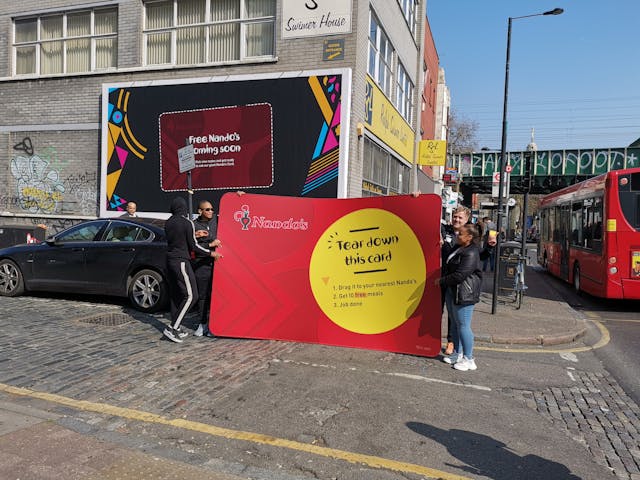
Nandos large novelty loyalty card

In a similar vein, Carlsberg’s ‘Probably the best poster in the world’ included a beer tap for free drinks. Mr Kipling’s ‘Better with cake’, an OOH campaign made of cake – respect to that production team.

2. Provocateur Spice

Think Relate’s wonderful ‘Joy of Later Life Sex’ campaign. Rankin’s shouldn’t-be-taboo-but-totally-were-images of older people getting it on were daring, beautiful and stopped people in their tracks when displayed on giant billboards.

Rankin

Similarly, Muslim dating app Muzmatch saw Birmingham Bachelor Muhammad Malik use billboards to seemingly “save me from an arranged marriage”. Media interest was huge, because it was seemingly an authentic story which tapped into a cultural insight – of course, it was later revealed as a PR stunt for the app.

3. Activist Spice

These are OOH activations used by brands to convey a punchy opinion. Nothing does that better than making it a big shouty 48 sheet billboard.

Brewdog is a dab hand; the latest Qatar World Cup shaming ad is a recent example which has since drawn criticism for being inauthentic, but the initial interest was there and their opinion adequately spikey.

BrewDog World Cup

Similarly, ‘Wave of Waste’ from Corona x Parley For The Ocean has its place in the OOH hall of fame. The 3D installation was a work of art and a sobering image of a surfer surrounded by plastic, showing Corona’s commitment to the marine pollution cause.

4. Newsjacker Spice

These are the campaigns that know exactly what is on the news agenda and respond accordingly. We have not been short on these this year.

Butterkist’s ‘Here for the Drama’, complete with a large demonstration outside 10 Downing Street during the Partygate controversy was low-fi and so on the money it got talked about.

Likewise, Burger King’s ‘Turns out there are too many Whoppers’ and Quorn’s ‘No more porkies’ when Boris Johnson resigned. The media are desperate for content to endlessly talk around big news moments; these activations delivered.
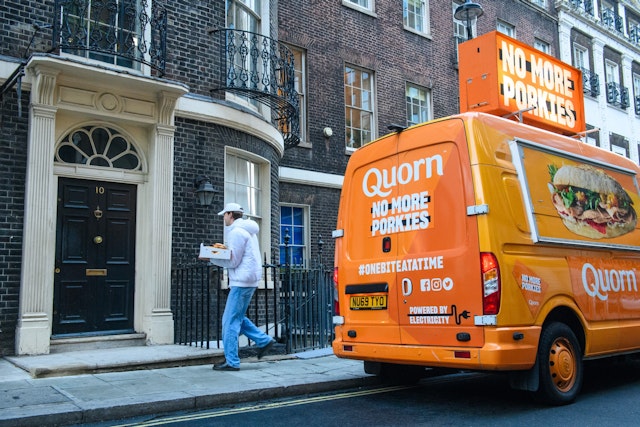
Quorn

5. Brand-led but gets away with it Spice

There aren’t many brands in this category: they demand consumer attention because of brand affection.

Marmite Dynamite fits in here: a Marmite lid smashed through a car window to launch the new chilli variant. The interaction of the product and its surroundings was funny, but not all brands would have garnered the same attention with the same activation. Marmite has done the hard yards to gain brand love. As it turns out, PR-led OOH is actually quite a science.

Can’t wait to see the next one.

By Emma Grace

Managing Director: PrettyGreen An Independent, Award Winning Agency for PR Less Ordinary ​

Find out more

Sourced from The Drum

By John Turner

Do you want to learn how to improve your email marketing return on investment and connect with your target audience?

Did you say yes? If so, you’re in the right place!

Email marketing is an extremely powerful tool that can help business leaders grow their brands. Once a visitor joins your email list, you have an opportunity to build rapport and highlight your value proposition. If done correctly, the results speak for themselves. Across all industries, the average ROI is $45 for every $1 spent. If you’re not quite up to this point yet, don’t worry!

Today, I’m going to show you several sustainable and effective ways you can increase your email marketing profits.

Set measurable goals.

The biggest mistake I see new business owners make is not setting measurable goals for their email marketing campaigns. If you have no idea what you hope to achieve with your strategy, you will likely struggle to grow your list and connect with subscribers.

Think of it this way: You can’t improve what you don’t understand.

I suggest coming up with a list of actionable goals and accompanying key performance indicators.

For instance, you may notice that your open rate is below the industry average of 31.50%. In this case, you could develop a list of content ideas that you think will resonate with readers. Since you’re tracking your open rate, you can easily tell if your new content is popular with your subscribers.

Here’s a little bonus tip: Don’t forget to track your progress over time. You don’t want to stop as soon as you create a clickable campaign. You have to continuously track your analytics and fine-tune your campaigns if you hope to boost your ROI.

Don’t forget about smartphone users.

As shocking as this sounds, over 6.2 billion people own smartphones. Many people prefer to check their email with their phone instead of a desktop PC.

If you don’t optimize for mobile devices, you’re not getting your full return on investment. Think about the last email you opened that was clearly designed for a PC instead of a phone. The best-case scenario is everything looked a little off. In the worst scenario, you could not read the message or engage with the brand.

You don’t want to create this same type of negative experience for your loyal subscribers.

Now, let’s look at a few mobile email optimization tips:

• Use a mobile-responsive template.

• Write short, impactful sentences and headlines.

• Choose benefit-driven calls to action.

• Don’t put the purpose of your message on an image (in case subscribers can’t see it on their phone).

• Send email tests to your team so you can test your messages across multiple devices and operating systems.

Personalize your emails.

Personalization is a fantastic way to boost your engagement rate and sales, which is how you improve your ROI.

People love interacting with businesses when they feel like the content, offers and emails are tailor-made to match their needs. Plenty of companies already use this strategy and have seen tremendous success.

The best way to start personalizing your emails is to segment your list into different groups. Each group has unique goals and pain points, which you can use to develop a conversion-worthy personalization strategy.

For example, the marketing team at an online pet store likely has two different campaigns for cat and dog owners. When you think about it, it makes sense. Cat owners have different needs compared to dog owners. Additionally, each group uses a specific type of product. The team likely wouldn’t send a promotion for potty training pads to a cat owner because they don’t need the product.

Experiment with split testing.

Lastly, let’s tie some of the other tips together while we talk about split testing. You’re likely familiar with this term. If not, a split test is an experiment that business owners and marketers run so they can improve conversions and learn about their audience.

A simple example that comes to mind is a call-to-action color change. If you’re currently using a green call-to-action with white text, you may want to consider showing some of your viewers a red or blue CTA so you can figure out which one results in more clicks.

You can run countless split tests, though some options are limited to your industry. I suggest coming up with ideas and running tests one at a time. Otherwise, you won’t know which change produced positive results.

You can experiment with your subject line, offers, images and much more. Feel free to make a few tweaks over time and see if you can turn a good campaign into something extraordinary.

If boosting your email marketing ROI is a top priority, the tips presented today should help you get started. It’s worth remembering that it takes time to grow your list and improve sales. Don’t get discouraged if things don’t go your way right away. Practice patience and persistence; you can do amazing things with your email marketing strategy.

Feature Image Credit: Getty

By John Turner

By John Turner, founder of SeedProd, a popular coming-soon page solution for WordPress used by over 800,000 websites.

Sourced from Forbes

Here’s why you’ve been hearing so much about ChatGPT.

A few weeks ago, Wharton professor Ethan Mollick told his MBA students to play around with GPT, an artificial intelligence model, and see if the technology could write an essay based on one of the topics discussed in his course. The assignment was, admittedly, mostly a gimmick meant to illustrate the power of the technology. Still, the algorithmically generated essays — although not perfect and a tad over-reliant on the passive voice — were at least reasonable, Mollick recalled. They also passed another critical test: a screening by Turnitin, a popular anti-plagiarism software. AI, it seems, had suddenly gotten pretty good.

It certainly feels that way right now. Over the past week or so, screenshots of conversations with ChatGPT, the newest iteration of the AI model developed by the research firm OpenAI, have gone viral on social media. People have directed the tool, which is freely available online, to make jokes, write TV episodes, compose music, and even debug computer code — all things I got the AI to do, too. More than a million people have now played around with the AI, and even though it doesn’t always tell the truth or make sense, it’s still a pretty good writer and an even more confident bullshitter. Along with the recent updates to DALL-E, OpenAI’s art-generation software, and Lensa AI, a controversial platform that can produce digital portraits with the help of machine learning, GPT is a stark wakeup call that artificial intelligence is starting to rival human ability, at least for some things.

“I think that things have changed very dramatically,” Mollick told Recode. “And I think it’s just a matter of time for people to notice.”

If you’re not convinced, you can try it yourself here. The system works like any online chatbot, and you can simply type out and submit any question or prompt you want the AI to address.

How does GPT even work? At its core, the technology is based on a type of artificial intelligence called a language model, a prediction system that essentially guesses what it should write, based on previous texts it has processed. GPT was built by training its AI with an extraordinarily large amount of data, much of which comes from the vast supply of data on the internet, along with billions of dollars, including initial funding from several prominent tech billionaires, including Reid Hoffman and Peter Thiel. ChatGPT was also trained on examples of back-and-forth human conversation, which helps it make its dialogue sound a lot more human, as a blog post published by OpenAI explains.

OpenAI is trying to commercialize its technology, but this current release is supposed to allow the public to test it. The company made headlines two years ago when it released GPT-3, an iteration of the tech that could produce poems, role-play, and answer some questions. This newest version of the technology is GPT-3.5, and ChatGPT, its corresponding chatbot, is even better at text generation than its predecessor. It’s also pretty good at following instructions, like, “Write a Frog and Toad short story where Frog invests in mortgage-backed securities.” (The story ends with Toad following Frog’s advice and investing in mortgage-backed securities, concluding that “sometimes taking a little risk can pay off in the end”).

The technology certainly has its flaws. While the system is theoretically designed not to cross some moral red lines — it’s adamant that Hitler was bad — it’s not difficult to trick the AI into sharing advice on how to engage in all sorts of evil and nefarious activities, particularly if you tell the chatbot that it’s writing fiction. The system, like other AI models, can also say biased and offensive things. As my colleague Sigal Samuel has explained, an earlier version of GPT generated extremely Islamophobic content, and also produced some pretty concerning talking points about the treatment of Uyghur Muslims in China.

Both GPT’s impressive capabilities and its limitations reflect the fact that the technology operates like a version of Google’s smart compose writing suggestions, generating ideas based on what it has read and processed before. For this reason, the AI can sound extremely confident while not displaying a particularly deep understanding of the subject it’s writing about. This is also why it’s easier for GPT to write about commonly discussed topics, like a Shakespeare play or the importance of mitochondria.

“It wants to produce texts that it deemed to be likely, given everything that it has seen before,” explains Vincent Conitzer, a computer science professor at Carnegie Mellon. “Maybe it sounds a little bit generic at times, but it writes very clearly. It will probably rehash points that have often been made on that particular topic because it has, in effect, learned what kinds of things people say.”

So for now, we’re not dealing with an all-knowing bot. Answers provided by the AI were recently banned from the coding feedback platform StackOverflow because they were very likely to be incorrect. The chatbot is also easily tripped up by riddles (though its attempts to answer are extremely funny). Overall, the system is perfectly comfortable making stuff up, which obviously makes no sense upon human scrutiny. These limitations might be comforting to people worried that the AI could take their jobs, or eventually pose a safety threat to humans.

But AI is getting better and better, and even this current version of GPT can already do extremely well at certain tasks. Consider Mollick’s assignment. While the system certainly wasn’t good enough to earn an A, it still did pretty well. One Twitter user said that, on a mock SAT exam, ChatGPT scored around the 52 percentile of test takers. Kris Jordan, a computer science professor at UNC, told Recode that when he assigned GPT his final exam, the chatbot received a perfect grade, far better than the median score for the humans taking his course. And yes, even before ChatGPT went live, students were using all sorts of artificial intelligence, including earlier versions of GPT, to complete their assignments. And they’re probably not getting flagged for cheating. (Turnitin, the anti-plagiarism software maker, did not respond to multiple requests for comment).

Right now, it’s not clear how many enterprising students might start using GPT, or if teachers and professors will figure out a way to catch them. Still, these forms of AI are already forcing us to wrestle with what kinds of things we want humans to continue to do, and what we’d prefer to have technology figure out instead.

“My eighth grade math teacher told me not to rely on a calculator since I won’t have one in my pocket all the time when I grow up,” Phillip Dawson, an expert who studies exam cheating at Deakin University, told Recode. “We all know how that turned out.

Feature Image Credit: Carol Yepes

Rebecca Heilweil is a reporter at Vox covering emerging technology, artificial intelligence, and the supply chain.

Sourced from Vox

By Jeff Haden

Even though research shows most of us tend to start with sharing the good news first.

I recently asked LinkedIn followers two questions:

  • “If someone has good news and bad news, do you want to hear the good news first or the bad?”
  • “If you have good news and bad news to share, do you tend to start with the good news or the bad?”

Oddly enough, most people said they want to hear the bad news first — even though most people say they tend to share the good news first.

Or maybe not so oddly. A 2013 study published in Personality and Social Psychology Bulletin found that most people prefer to share the good news first, a news-order delivery approach the researchers call “priming emotion-protection.” (Or in non-researcher-speak, “This will probably go badly, so I’d better ease into it.”

On the flip side, the same study found that people who receive good and bad news want to hear the bad news first.

That news-order receipt approach also makes intuitive sense. Much in the same way feedback sandwiches fail miserably, if only because the recipient feels manipulated, starting with the good news increases the worry factor.

If I know bad news is coming, I’m unlikely to pay much attention to — or even care about — the good news.

Which often isn’t particularly “good” anyway.

The Emotional Intelligence Factor

As Inc. colleague Justin Bariso writes, emotional intelligence means making your emotions work for you, not against you.

If you have bad news to share, it’s natural to seek to protect yourself from how other people may react, and easing into things can feel a little safer.

But hopefully the goal of delivering bad news is to create some sort of change. To alert others about a potential issue. To solve a problem. To change a plan or direction. Unless you’re just mean, delivering bad news starts some sort of process.

As the researchers write, “Perspective-taking … shifts news-givers’ delivery patterns to the preferred order of news-recipients.” So take a moment to put yourself in the other person’s shoes.

Remember, most people want to hear the bad news first. If you have good and bad news to share, think about what is most beneficial to the other person.

Take that approach, and you’ll put their needs first and lead with the bad news.

The Problem-Solving Factor

There’s another reason to always start with the bad news. Imagine your business makes electric bikes. The head of your purchasing department walks into your office.

“We have a problem,” she says. “Our supplier can’t deliver control units for at least a month, which means the majority of our current orders will ship at least five weeks late.”

That’s definitely bad news. But at least it’s out of the way, and she — and therefore you — can immediately shift to problem-solving. The good news?

  • She’s already alerted customer service and they’re working on a plan.
  • She’s alerted sales, and they’re already working on revising your website, and shifting your advertising mix from direct response to brand awareness.
  • She’s also trying to source components from other suppliers.

That’s good news. She could have delivered it first, and maybe you would have gotten to the same place.

But probably not as quickly, since your focus would have been less on solutions and more on waiting for the other shoe to drop.

The next time you’re tempted to lead with the good news, do what great leaders do and put other people’s needs first.

Not only will they appreciate that approach, but the eventual outcome is likely to be better, too.

Feature Image Credit: Getty Images

By Jeff Haden

@jeff_haden

Sourced from Inc.

Sourced from Association of Advertisers in Ireland

Join Ad Net Zero Ireland for an Information Session via Zoom on 17th January 2023 from 3 – 4pm.

During this session, you will learn more about what is involved & how to become a Supporter.

The Agenda will be:

· A Brief Overview of Ad Net Zero, how to become a supporter & what is involved – Elizabeth Sheehan, Chair of Ad Net Zero Ireland
· An update on Ad Net Zero Global – Anthony Falco– Ad Net Zero Global Consultant
· Overcoming obstacles to accelerating decarbonisation and positive behaviour change, adapting marketing practices & benefits of being an ANZ supporter – Sebastian Munden, Chair of Ad Net Zero Global
· Panel Discussion on being an active supporter of Ad Net Zero Ireland and what it means for business
· Q & A

The climate emergency is the most pressing issue affecting us all, and our advertising industry can play a huge role in driving positive change.
We want to help our industry deliver on its full potential to support businesses and people to deal with this emergency and build a more sustainable future. The climate emergency is a global matter, and as a global industry, we need global solutions.

FIND OUT MORE

Sourced from Association of Advertisers in Ireland

By

You’ve defined your content strategy, assembled a team or found a great outsourcing partner. Before you can start creating content your audience wants to read and share, you need to set up systems that guarantee quality over quantity.

How do you identify and ensure high-quality content?

Quality should always be your priority in content creation. Search engines value quality content when ranking websites; even more importantly, quality content significantly affects your readers and customers. But, you must apply reviewing and editing criteria to an article before publishing it.

Here’s how to make sure you’re producing quality content.

What’s at the core of quality online content?

You should always aim for a few core factors in your content production. Use this checklist to guide your writers and editors:

  • Originality: What does your content (in other words, your brand) offer that no other content does? How does it stand out from the crowd? What makes the perspective unique?
  • Readability: Does the article summarize and explain complex matters in an approachable way? Is it written engagingly?
  • Voice: Does the tone speak to the reader? Does it match your brand’s culture and message?
  • Relevance: Is the article meaningful to its intended reader? Does it help the reader’s purpose or answer their questions? Is it both timely and up-to-date?
  • Timelessness: Will the content still be relevant and exciting in a few years? Could it easily be updated if needed?
  • Grammar and spelling: Is the writing free of typos and grammatical mistakes?

As is the nature of our digital world, these criteria constantly evolve. This means staying on top of the latest content marketing research and analysis and adjusting your strategy as needed is essential.

Search engine optimization basics for content writing

Ensuring your content performs well online and achieves first-page ranking means adhering to specific rules set by Google (or other search engines) algorithms.

Critical factors for crafting optimized content include:

  • Length: 1,000 to 3,000 words is perfect for blog posts and articles. Landing pages or description pages perform better at 300 to 500 words.
  • Structure: Format your content using title (H1) and subheaders (H2 and greater) tags. Use keywords and phrases in your headers.
  • Links: Linking to internal and authoritative external web pages increases traffic and performance.
  • Keywords: Use relevant keywords, including long-tail keywords, phrases and LSI keywords.
  • Keyword density: While using relevant keywords is non-negotiable, a keyword density that is too high can result in keyword stuffing. This will lower your SEO ranking.
  • Meta title and description: A catchy meta title and description that includes your primary keyword or phrase attracts your readers and the Google algorithm.

Related: Here’s How to Create Quality Content in the Age of Social Media

Optimize quality control using online tools

A recent report found that, as of 2021, around 61% of businesses still review each piece of submitted content. This inefficient, “one at a time” strategy contributes to a significant loss of productivity.

There are various online tools designed to help you to optimize your workflow. One person can now achieve what once required an entire team and considerable time — and to the same standard.

Organizing your workflow

When it comes to setting up an efficient process, take advantage of tools that allow you to use filters to sort articles by your chosen review and quality control criteria. Applying the filters to incoming content will help you quickly decide which articles are ready for publishing and which may benefit from QCing, editing or rewriting.

Best of all if you can make this system available to any team member, allowing you to delegate tasks as needed.

Plagiarism

Plagiarism isn’t just an ethical or quality concern. Repeated content is down-ranked down by search engine algorithms.

There are a lot of plagiarism checkers out there on the Internet and some of them even use AI to detect plagiarized or paraphrased content within seconds. Use them to make sure your content is unique and offers real value to the readers.

Grammar, spelling and style

Ideally, you should hire an editor to proofread your content and catch typos, syntax, diction and grammar errors.

If for whatever reason you don’t have access to an editor, take advantage of online tools to help yourself. You can find a few AI-based online software that checks your grammar, highlights repetitive words and phrases and recommends style improvements.

Translation tools can also help you (broadly) determine if an article in a foreign language is insightful and informative. Using tools for that is now accurate enough to spot repetitive, irrelevant or inappropriate content.

Keyword density

The number of times a keyword is used in a text directly impacts how search engines like Google rank it.

Experts generally recommend a keyword density of around 1% to 2%. This means that a paragraph of 100 words should only contain a keyword once — or twice at most. Some content marketers recommend one keyword for every 200 words.

For efficiency, you don’t need to count the keywords in every paragraph manually. Remember that nowadays there are online tools that do that for you. All you need to do is insert the article URL or the text and a tool spits out a keyword density percentage.

Apply these guidelines to your writing today

Are you keen to start writing a few great pieces for your small business website each month?

The focus of any content creation strategy — big or small — should be on quality over quantity. Thankfully, it’s easy to craft quality content if you stick to a few simple guidelines, incorporate the latest SEO practices and use online tools.

So, what are you waiting for? Use these tips and best practices to guide your content team or put (digital) pen to paper today.

By

Sourced from Entrepreneur

By Lane Ellis

Why are B2B brands increasingly turning to influencer marketing?

B2B influencer marketing is the business-oriented cousin to the B2C Instagram entertainment and lifestyle influencer. In B2B, some influencers go by creators, subject matter experts, industry experts, or other terms that disassociate them from the B2C influencer.

Whichever term is used, B2B influencer marketing provides an ideal way to combat disintegrating brand trust, so it’s no wonder that by the end of 2022 the B2B influencer marketing vertical is expected to reach $11.7 billion in revenue, with over 38 percent of B2B firms exploring influencer marketing for lead-generation and more, according to AdAge.

B2B influencer marketing is a many-faceted digital diamond that when done well shines brightly, however brands need to be wary of treating it like its vastly different B2C counterpart.

Let’s take a look at 20-plus advantages that B2B influencer marketing holds over traditional marketing strategies.

B2B Influencer Marketing Offers Key Advantages

New analysis published in the Harvard Business Review has shown that average brand boost could reach 16.6 percent by properly utilizing influencer marketing, with influencer originality accounting for a 15.5 percent rise in return on investment (ROI).

B2B marketers have said that influencer marketing will be among their three top priorities in the next three to five years, as 59 percent of marketing leaders noted that they considered B2B influencer marketing a priority today, and 64 percent pinpointing it as a top priority over the upcoming three to five years, according to recently-released survey data from the Association of National Advertisers (ANA).

The academic world has also begun to take notice of the power of B2B influencer marketing, such as the comprehensive “B2B Influencer Marketing: Conceptualization and Four Managerial Strategies” study recently-published by Science Direct / Elsevier, including numerous citations to our own ground-breaking first industry B2B Influencer Marketing Research Report.

Social media publications are also increasingly becoming aware of B2B influencer marketing, such as Social Media Today’s recent article “15 Ways the B2B Influencer Marketing Industry is Changing [Infographic],” featuring our own latest infographic filled with data from our newest free 59-page 2022 B2B Influencer Marketing Research Report.

Influencer marketing has emerged as a key way that B2B brands can get the most marketing bang for their buck and help recession-proof marketing strategy. U.S. organizations are expected to spend $6.16 billion on influencer marketing during 2023, climbing from the $5 billion seen during 2022, as influencer marketing has been more resilient than other forms of marketing, with influencer marketing budgets staying strong, according to recently-published forecast data from Insider Intelligence.

Enduring Relationships & Increased Thought Leadership

B2B influencer marketing helps build successful and lasting relationships, as our CEO Lee Odden recently explored in a fascinating podcast with Justin Levy, director of social and influencer marketing at Demandbase, in “The Impact of Building Long-Term Relationships with Influencers with Lee Odden.”

42 percent of organizations with more than 1,000 employees work with influencers and creators, while only 28 percent of smaller businesses with under 100 workers do, according to Hootsuite’s newly-released annual social trends report. 2023 is likely to see more B2B organizations of all size either expand their existing influencer programs or beginning their first.

B2B influencer marketing helps improve brand reputation and awareness, as well as generating new leads, as diginomica recently explored in “Influencer Marketing – first, catch your influencer…,” also featuring data taken from our most recent research report.

B2B influencer marketing offers an ideal framework for successful content planning, creation, and promotion, as we covered recently in “Planning, Creation & Promotion: 5 Top Tactics For Creating Inspired B2B Content.

B2B influencer marketing can have a direct impact on building thought-leadership and executive influence, and the time to redefine influencer marketing may have arrived, as our own senior content marketing manager Joshua Nite has explored in “How to Create More Authentic Influencer-Driven Content to Attract Qualified Prospects.”

“In our survey, over half of respondents said they included internal executives in their influencer content. Nearly half said they included their employees as well. This is a clear opportunity to create more valuable content and build your organization’s thought leadership at the same time,” Joshua observed.

“It’s time to redefine influence. Your most valuable prospects are looking to industry leaders, practitioners and peers for advice. Your team can deliver all of the above with the right mix of influencers,” Joshua added.

“It’s time to redefine influence. Your most valuable prospects are looking to industry leaders, practitioners and peers for advice. Your team can deliver all of the above with the right mix of influencers.” — Joshua Nite @NiteWrites Click To Tweet

B2B Influence Creates Meaningful Brand Experiences & Builds Trust

When it comes to creating meaningful brand experiences and authentically connecting with buyers, B2B influencer marketing has found growing success. “In times like these, the importance of influence is critical for B2B brands that need to connect authentically with their buyers and create meaningful experiences,” Lee observed in our “2022 B2B Influencer Marketing Report: New Data, Insights, Case Studies, Predictions.”

“In times like these, the importance of influence is critical for B2B brands that need to connect authentically with their buyers and create meaningful experiences.” — Lee Odden @LeeOdden Click To Tweet

Social media platforms have proven to hold both influence and attention, while the influencer economy has gained precedence as a top form of customer communications, as B2B brand content creators increasingly become the faces of the brands they represent, as Talkwalker recently covered in its Social Media Trends 2023 Global Report.

“Content creators will become the faces of the brands they represent, especially in B2B. People trust people more than companies. Expertise is key to building trust with your audience,” Daniel Murray, founder of The Marketing Millennials observed.

“Content creators will become the faces of the brands they represent, especially in B2B. People trust people more than companies. Expertise is key to building trust with your audience.” — Daniel Murray @Dmurr68 Click To Tweet

Dispelling The Boring-To-Boring Myth & Boosting Engagement

The type of digital experiences that work so well within a B2B influencer marketing framework go a long way towards dispelling the longstanding notion of B2B being nothing but boring-to-boring, as Lee detailed in the recent “Break Free of Boring B2B with Influencer Content Ft. Lee Odden” episode of The Data-Driven Marketing podcast with host Mark Richardson, director of global content operations at Dun & Bradstreet.

The popularity of influencer marketing is on the rise, as 85 percent of respondents to our extensive survey expect activity to increase over the next year, with B2B marketers increasing their level of maturity and sophistication and shifting towards always-on, relationship-based influencer communities. You can take an eye-opening look at the future and power of B2B influence from 10 of the world’s top experts and influencers in our “10+ B2B Influencer Marketing Predictions From Top Experts & Influencers.”

(Click Through For More Predictions)

B2B influencer marketing also helps when it comes to boosting content engagement. In fact, 32 percent of marketers and influencers have said that influencer marketing has increased engagement, while 65 percent of marketers said that influencer marketing works more often than it fails, recent data has shown.

Additionally, 30 percent of consumers have reported that recommendations from influencers are among the most important factors in purchase decisions — more than the 27 percent who pointed to friends or family, while an upcoming greater reliance on influencers has joined greater adoption of virtual reality (VR) and augmented reality (AR), according to HubSpot’s look at the future of social media.

B2B Influence Will See Increasing Use Among Brands in 2023

via GIPHY

While this list of more than 20 of the reasons why B2B brands are increasingly moving to influencer marketing only scratches the surface, 2023 is certain to see new takes on B2B influencer marketing that we can’t yet set, however by keeping on top of the most recent industry shifts, we’ll be better prepared for what the coming years hold in store.

Especially with B2B influencer content, crafting award-winning B2B marketing that elevates, gives voice to talent, and humanizes with authenticity takes considerable time and effort, which is why more brands are choosing to work with a top digital marketing agency such as TopRank Marketing. Reach out to learn how we can help, as we’ve done for over 20 years for businesses ranging from LinkedIn, Dell and 3M to Adobe, Oracle, monday.com and many others.

By Lane Ellis

Sourced from Top Rank Marketing

By David Finkel

When it comes to running a business, there are a million different ways to get things accomplished. And if you have even a few employees, you know that if given the chance every employee will do things just a little bit differently. Which can not only cause confusion and difficulty in cross-training, but can really slow down your growth trajectory if left unchecked. So today, I wanted to talk a little bit about creating structure within your business and give you some tips on how to streamline the process for maximum efficiency.

The UBS

Within my own business and that of my business coaching clients, we teach them to create systems which we call UBS’s or universal business systems. Which is a fancy acronym for a set of documents, videos and guidelines for how we do everything within our business. It’s the structure that we use for meetings. It’s a structure for how you communicate with others on your team, clients and outside vendors. It’s a structure for how you share plans and do strategic planning. It’s a structure for how you hold each other accountable. It’s the structure for how you do compensation within your organization. It’s a structure for a shared sense of identity. Your mission, your vision, your values and your culture. And all these things collectively, are so important for your overall growth as a business and need to be documented.

Getting Started

Creating a library of UBS’s can seem intimidating at first, especially if you are starting from scratch. So the first thing I often suggest to my clients is that you start off by writing down the first five or ten systems that you would like to document and starting there. Then when those are complete, write out ten more and so on and so forth until you have your core set of documents created. And then as you go about your daily activities make it a habit to document the processes as they happen. If you start using a new program, have the person who owns the platform write out a simple document on how to login, where to find the key features of the program and other tidbits that would be helpful for others using the platform.

Create a Culture Around Structure

Another key thing to remember is that you shouldn’t create all of your systems and UBS’s yourself. Not only would it be impractical for you to spend your time doing so, but you would be missing out on key pieces of information that others on your team may possess. Instead, encourage everyone on your team from all areas to create UBS’s when they take on a new task or project. Have new hires create UBS’s as part of their training, and revisit them often for updates.

Over time with a little bit of planning and accountability you will find yourself with a robust knowledge base for all the systems within your business, which then frees up your valuable time to grow and scale the business. Good luck!

Feature Image Credit: Getty Images

By David Finkel

Sourced from Inc.

By Awards Analyst

Amplified Intelligence won Most Effective Use of AI Machine Learning at The Drum Awards for Digital Industries 2022 for the development of human attention metrics. Here, we uncover what makes the technology worthy of praise.

By and large, impressions are becoming less reliable as a currency in the advertising industry. This is partly because, until now, there hadn’t been a way to measure whether or not humans were even watching an ad.

Amplified Intelligence tackled this enduring problem. Its novel solution can tell if a human being is actually gazing upon an advertisement, all through machine learning.

If successful, this technology could greatly enhance the goal of all advertising: attracting people to a brand, having them remember it, and driving business growth.

The brief

The artificial intelligence developed by Amplified Intelligence combines eye-tracking technology with machine learning, innovative research design and marketing theory. The result is highly accurate.

According to the company, this formula not only answers fundamental marketing questions for the first time; it elevates the question of how effective advertising is, allowing brands to look at how an ad’s effectiveness varies in different conditions.

The idea

Amplified Intelligence’s proprietary technology delivers three insights: ‘active attention’ (meaning eyes on an ad), ‘passive attention’ (eyes near a screen but not the ad) and ‘non-attention’ (looking away from the screen).

These can provide granular details about human attention across sectors, be it gaming, mobile, television, audio, cinema or out-of-home.

The results

According to Amplified Intelligence, their product has helped customers develop their best advertising campaigns yet.

Using its data insights, agencies have strategically adjusted their media plans, mitigating waste and increasing its reach. Clients include indie agencies like Hatched and Kaimera, and OMG Australia. Irish National Lottery, the first northern hemisphere brand to buy Amplified Intelligence’s AttentionBuy Media Planner product, saw a 35% increase in their attention seconds.

This campaign won at The Drum Awards for the Digital Industries 2022. You can see all the winners here. The Drum Awards for Marketing are currently open for entry. Find out how you can enter now.

Feature Image Credit: Amplified Intelligence

By Awards Analyst

Sourced from The Drum

By Bryce Hoffman

For years, folks have been talking about the coming AI revolution, about how it’s going to change everything, and about how it is going to cost a lot of people their jobs.

Well, the future is now – and if you are a business leader, you need to start dealing with it today. But don’t take my word for it:

The AI revolution is transforming industries and organizations around the world. As a business leader, it’s important to understand the potential of AI and how it can be used to drive business growth and success. This means staying up to date on the latest developments in the field and learning about the potential applications of AI in your industry. It also means being proactive in incorporating AI into your business, whether through the adoption of new technologies or the development of internal AI capabilities. Finally, it’s important to consider the ethical implications of AI and to ensure that your use of the technology is responsible and aligned with your company’s values.

That passage was written by Open AI’s ChatGPT, a free research AI model that was opened to public last week. It was a response to my question, “What do business leaders need to know about AI?” and it took less than 10 seconds to generate.

It is also completely accurate.

So was its response to my request to write a blog post on the state of Agile in 2022. In less than 20 seconds, the AI generated a 453-word article that was 100% grammatically correct, cogent, and offered valuable insights – explaining that agile has moved beyond the domain of software development where it was born to drive broader business transformations while at the same time warning that those efforts often fail when not coupled to a culture that fosters collaboration and open communications between departments and functions.

That could put a lot of content creators out of a job, but bloggers are not the only ones who need to worry.

Last week, marketeer Zain Kahn asked the AI to perform the same series of tasks that an employee at a marketing firm might be asked to undertake for a client: create an SEO strategy for a website, develop a list of target keywords, write a content strategy for the website, develop 10 blog ideas, then write one of those blogs itself. He even asked the AI to create metadata and simple code for the website to optimize it for bilingual search.

Then he rated its performance.

“I’d rank it as a 5/10. The equivalent of an SEO marketer with 1-2 years of experience earning around $50k/year. Not excellent, but definitely more competent than an SEO intern,” Kahn wrote on Twitter. “All of this took me 5 minutes. In the real world, all of this would probably take at least 5-10 hours.”

In response, one witty marketer posted a revised version of his resume listing his only skill as “chatbot query writer.”

What else is this going to disrupt?

  • Search engines: Why go to the trouble of googling a topic, then clicking on a website to find the answer you’re looking for when you can just pose your question directly to the AI and get a comprehensive answer? I asked it who the greatest American general of World War II was and was told that Eisenhower, Patton, and MacArthur were all compelling candidates for that title, explaining the relative merits each commander.
  • Education: I am sure some fast-thinking (but otherwise lazy) students have already used ChatGPT to write their homework papers for them. I asked it to compose an 800-word paper on the key themes in the novel Of Mice and Men and it promptly produced an original essay discussing the American Dream, loneliness, and the bond between George and Lennie. How would a teacher or professor prove I hadn’t written it myself?
  • Consulting: Why hire Bain when you can type in “develop a business strategy to grow retail sales of diapers in India” to an AI and, in less than 30 seconds, get back a pretty comprehensive plan to “focus on increasing brand awareness, building customer loyalty, expanding the company’s distribution network, and developing a range of products that are tailored to the specific needs of the Indian market” while at the same time pursuing partnerships with local charities to provide free diapers to poor families with a portion of the revenue generated from sales to middle-class consumers. Obviously, there is a lot more to a good business strategy than that, but not as much as consultants would like you to think.

Is it any wonder then that more than a million people signed up to use this experimental AI last week?

Every leader should be asking themselves what this means for the future of their business.

So should songwriters. Before logging off, I asked ChatGPT to compose a rap song in the style of Eminem about how hard it is to write a good Forbes column:

Verse 1:

I sit down at my desk, ready to write

But the words just won’t come, no matter how hard I try

I’m trying to make this Forbes column the best it can be

But my mind is blank, and I’m starting to see

Chorus:

The struggle, the struggle to write a good Forbes column

It’s real, it’s tough, and it’s taking its toll on me

But I won’t give up, I’ll keep on fighting

Until I finally get this column right

Verse 2:

I stare at the screen, feeling the pressure

I need to deliver, or my readers will desert me

I know I have the talent, I just need to find the flow

But it’s like my mind is a blank slate, and I don’t know where to go

Chorus:

The struggle, the struggle to write a good Forbes column

It’s real, it’s tough, and it’s taking its toll on me

But I won’t give up, I’ll keep on fighting

Until I finally get this column right

Verse 3:

I keep typing, trying different approaches

But nothing seems to work, and I’m starting to lose hope

But then, out of nowhere, I finally hit my stride

The words start flowing, and I know I’m on the right side

Chorus:

The struggle, the struggle to write a good Forbes column

It’s real, it’s tough, but I finally overcame

I kept on pushing, and now my column is a hit

The struggle was worth it, and I’m feeling like a king

Outro:

The struggle is real, but I never gave up

Now my Forbes column is the talk of the town

I kept pushing, and now I’m on top

The struggle was worth it, and I’m feeling like a king.

Feature Image Credit: getty

By Bryce Hoffman

Follow me on Twitter or LinkedIn. Check out my website or some of my other work here.

I am a bestselling author, speaker and president of Red Team Thinking LLC. I teach organizations and individuals around the world how to see the truth, tell the truth and act on the truth – because I believe it is the lies we tell ourselves that hold us back. My books include Red Teaming: How Your Business Can Conquer the Competition by Challenging Everything and American Icon: Alan Mulally and the Fight to Save Ford Motor Company. I also lecture at U.C. Berkeley’s Haas School of Business.

Soured from Forbes