Author

editor

Browsing

Keep your phone private and block personalized ads on iPhone

It’s important to know how to block personalized ads on iPhone. In 2022, user data is a modern-day currency and even companies like Apple use iPhone owners’ usage patterns to personalize the ads they see.

While it’s not quite to the same extent as the likes of Meta, who are looking to track our every eye movement in the Meta Quest Pro, personalized ads tracking our behaviour might still be scary to some. It’s natural then to want to block ads on iPhone and, thankfully, privacy is something Apple is now championing. As such there is a super quick way to block personalized ads on iPhone. Here’s how.

Note: blocking personalized ads doesn’t mean ads will be blocked altogether, so you will still receive the same amount of ads. It’s just that your behavioural data won’t be used by Apple to tailor the ads to you. To block ads altogether, you’ll need one of the best ad blockers for mobile.

How to block personalized ads on iPhone

1. Open the Settings app and tap Privacy & Security.

(Image credit: Future)

3.  Scroll down then tap Apple Advertising.

(Image credit: Future)

4.  Toggle off Personalized ads.

(Image credit: Future)

And that’s all you have to do to block personalized ads on iPhone. Of course, there are plenty of other things you need to do to stay private online, using a VPN is a great way to do so but you could also consider a dedicated privacy browser such as DuckDuckGo.

Now that you’ve turned personalized ads off, you’ll want to consider other privacy mesaures. To start, learn how to stop iPhone apps from tracking you. Then, make sure you know how to stop spam texts on iPhone. If ads are getting to you on other devices, check out how to block ads on Chrome.

Feature Image credit: Tom’s Guide

Andy is Tom’s Guide’s Trainee Writer, which means that he currently writes about pretty much everything we cover. He has previously worked in copywriting and content writing both freelance and for a leading business magazine. His interests include gaming, music and sports- particularly Formula One, football and badminton. Andy’s degree is in Creative Writing and he enjoys writing his own screenplays and submitting them to competitions in an attempt to justify three years of studying.

Sourced from tom’s guide

By

In this post, you will learn to clarify business problems & constraints, understand problem statements, select evaluation metrics, overcome technical challenges, and design high-level systems.

LinkedIn feed is the starting point for millions of users on this website and it builds the first impression for the users, which, as you know, will last. Having an interesting personalized feed for each user will deliver LinkedIn’s most important core value which is to keep the users connected to their network and their activities and build professional identity and network.

LinkedIn’s Personalized Feed offers users the convenience of being able to see the updates from their connections quickly, efficiently, and accurately. In addition to that, it filters out your spammy, unprofessional, and irrelevant content to keep you engaged. To do this, LinkedIn filters your newsfeed in real-time by applying a set of rules to determine what type of content belongs based on a series of actionable indicators & predictive signals. This solution is powered by Machine Learning and Deep Learning algorithms.

In this article, we will cover how LinkedIn uses machine learning to feed the user’s rank. We will follow the workflow of a conventional machine learning project as covered in these two articles before:

The machine learning project workflow starts with the business problem statement and defining the constraints. Then it is followed by data collection and data preparation. Then modeling part, and finally, the deployment and putting the model into production. These steps will be discussed in the context of ranking the LinkedIn feed.

How LinkedIn Uses Machine Learning To Rank Your Feed 

LinkedIn / Photo by Alexander Shatov on Unsplash

1. Clarify Business Problems & Constraints

1.1. Problem Statement

Designing a personalized LinkedIn feed to maximize the long-term engagement of the user. Since the LinkedIn feed should provide beneficial professional content for each user to increase his long-term engagement. Therefore it is important to develop models that eliminate low-quality content and leave only high-quality professional content. However, it is important, not overzealous about filtering content from the feed, or else it will end up with a lot of false positives. Therefore we should aim for high precision and recall for the classification models.

We can measure user engagement by measuring the click probability or known as the ClickThroughRate (CTR). On the LinkedIn feed, there are different activities, and each activity has a different CTR; this should be taken into consideration when collecting data and training the models. There are five main activity types:

  • Building connections: Member connects or follows another member or company, or page.
  • Informational: Sharing posts, articles, or pictures
  • Profile-based activity: Activities related to the profile, such as changing the profile picture, adding a new experience, changing the profile header, etc.
  • Opinion-specific activity: Activities that are related to member opinions such as likes or comments or reposting a certain post, article, or picture.
  • Site-specific activity: Activities that are specific to LinkedIn such as endorsement and applying for jobs.

1.2. Evaluation Metrics Design

There are two main types of metrics: offline and online evaluation metrics. We use offline metrics to evaluate our model during the training and modeling phase. The next step is to move to a staging/sandbox environment to test for a small percentage of the real traffic. In this step, the online metrics are used to evaluate the impact of the model on the business metrics. If the revenue-related business metrics show a consistent improvement, it will be safe to expose the model to a larger percentage of the real traffic.

Offline Metrics

Maximizing CTR can be formalized as training a supervised binary classifier model. Therefore for the offline metrics, the normalized cross entropy can be used since it helps the model to be less sensitive to background CTR:


How LinkedIn Uses Machine Learning To Rank Your Feed 


Online Metrics

Since the online metrics should reflect the level of engagement of users when the model is deployed, we can use the conversion rate, which is the ratio of clicks per feed.

1.3. Technical Requirements

The technical requirements will be divided into two main categories: during training and during inference. The technical requirements during training are:

  • Large training set: One of the main requirements during training is to be able to handle the large training dataset. This requires distributed training settings.
  • Data shift: In social networks, it is very common to have a data distribution shift from offline training data to online data. A possible solution to this problem is to retrain the models incrementally multiple times per day.

The technical requirements during inference are:

  • Scalability: To be able to serve customized user feeds for more than 300 million users.
  • Latency: It is important to have short latency to be able to provide the users with the ranked feed in less than 250 ms. Since multiple pipelines need to pull data from numerous sources before feeding activities into the ranking models, all these steps need to be done within 200 ms. Therefore the
  • Data freshness: It is important that the models be aware of what the user had already seen, else the feeds will show repetitive content, which will decrease user engagement. Therefore the data needs to run really fast.

1.4. Technical challenges

There are four main technical challenges:

  • Scalability: One of the main technical challenges is the scalability of the system. Since the number of LinkedIn users that need to be served is extremely large, around 300 million users. Every user, on average, sees 40 activities per visit, and each user visits 10 times per month on average. Therefore we have around 120 billion observations or samples.
  • Storage: Another technical challenge is the huge data size. Assume that the click-through rate is 1% each month. Therefore the collected positive data will be about 1 billion data points, and the negative labels will be 110 billion negatives. We can assume that for every data point, there are 500 features, and for simplicity of calculation, we can assume every row of features will need 500 bytes to be stored. Therefore for one month, there will be 120 billion rows, each of 500 bytes therefore, the total size will be 60 Terabytes. Therefore we will have to only keep the data of the last six months or the last year in the data lake and archive the rest in cold storage.
  • Personalization: Another technical challenge will be personalization since you will have different users to serve with different interests so you need to make sure that the models are personalized for each user.
  • Content Quality Assessment: Since there is no perfect classifier. Therefore some of the content will fall into a gray zone where even two humans can have difficulty agreeing on whether or not it’s appropriate content to show to the users. Therefore it became important to combine man+machine solutions for content quality assessment.

2. Data Collection

Before training the machine learning classifier, we first need to collect labeled data so that the model can be trained and evaluated. Data collection is a critical step in data science projects as we need to collect representative data of the problem we are trying to solve and to be similar to what is expected to be seen when the model is put into production. In this case study, the goal is to collect a lot of data across different types of posts and content, as mentioned in subsection 1.1.

The labeled data we would like to collect, in our case, will click or not click labeled data from the user’s feeds. There are three main approaches to do collect click and no-click data:

  • Rank user’s feed chronically: The data will be collected from the user feed, which will be ranked chronically. This approach can be used to collect the data. However, it will be based on the user’s attention will be attracted to the first few feeds. Also, this approach will induce a data sparsity problem as some activities, such as job changes, rarely happen compared to other activities, so they will be underrepresented in your data.
  • Random serving: The second approach will be randomly serving the feed and collecting click and no click data. This approach is not preferred as it will lead to a bad user experience and non-representative data, and also it does not help with the data sparsity problem.
  • Use an algorithm to rank the feed: The last approach we can use is to use an algorithm to rank the user’s feed and then use permutation to randomly shuffle the top feeds. This will provides some randomness to the feed and will help to collect data from different activities.

3. Data Preprocessing & Feature Engineering

The third step will be preparing the data for the modeling step. This step includes data cleaning, data preprocessing, and feature engineering. Data cleaning will deal with missing data, outliers, and noisy text data. Data preprocessing will include standardization or normalization, handling text data, dealing with imbalanced data, and other preprocessing techniques depending on the data. Feature Engineering will include feature selection and dimensionality reduction. This step mainly depends on the data exploration step as you will gain more understanding and will have better intuition about the data and how to proceed in this step.

The features that can be extracted from the data are:

  • User profile features: These features include job title, user industry, demographic, education, previous experience, etc. These features are categorical features, so they will have to be converted into numerical as most of the models cannot handle categorical features. For higher cardinality, we can use feature embeddings, and for lower cardinality, we can use one hot encoding.
  • Connection strength features: These features represent the similarities between users. We can use embeddings for users and measure the distance between them to calculate the similarity.
  • Age of activity features: These features represent the age of each activity. This can be handled as a continuous feature or can be binned depending on the sensitivity of the click target.
  • Activity features: These features represent the type of activity. Such as hashtags, media, posts, and so on. These features will also be categorical, and also as before, they have to be converted into numerical using feature embeddings or one hot encoding depending on the level of cardinality.
  • Affinity features: These features represent the similarity between users and activities.
  • Opinion features: These features represent the user’s likes/comments on posts, articles, pictures, job changes,s and other activities.

Since the CTR is usually very small (less than 1%) it will result in an imbalanced dataset. Therefore a critical step in the data preprocessing phase is to make sure that the data is balanced. Therefore we will have to resample the data to increase the under-represented class.

However, this should be done only to the training set and not to the validation and testing set, as they should represent the data expected to be seen in production.

4. Modeling

Now the data is ready for the modeling part, it is time to select and train the model. As mentioned, this is a classification problem, with the target value in this classification problem being the click. We can use the Logistic Regression model for this classification task. Since the data is very large, then we can use distributed training using logistic regression in Spark or using the Method of Multipliers.

We can also use deep learning models in distributed settings. In which the fully connected layers will be used with the sigmoid activation function applied to the final layers.

For evaluation, we can follow two approaches the first is the conventional splitting of the data into training and validation sets. Another approach to avoid biased offline evaluation is to use replayed evaluation as the following:

  • Assume we have training data up to time point T. The validation data will start from T+1, and we will order their ranking using the trained model.
  • Then the output of the model is compared with the actual click, and the number of matched predicted clicks is calculated.

There are a lot of hyperparameters to be optimized one of them is the size of training data and the frequency of retaining the model. To keep the model updated, we can fine-tune the existing deep learning model with training data of the recent six months, for example.

5. High-Level Design

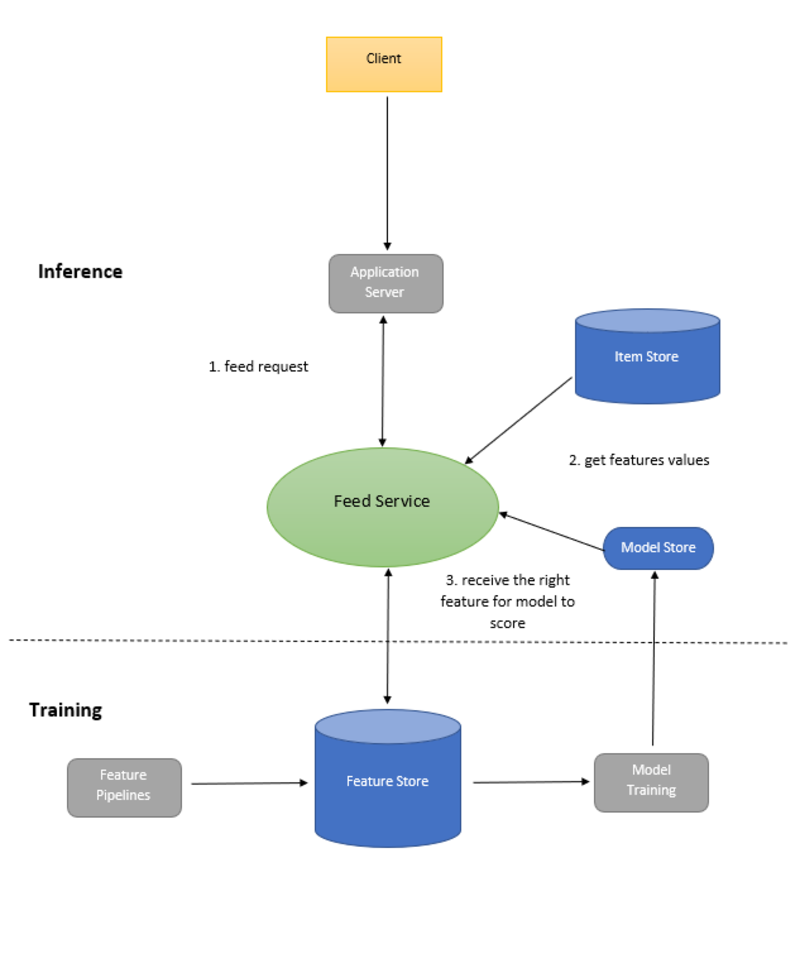
We can summarize the whole process of the feed ranking with this high-level design shown in figure 1.

Let’s see how the flow of the feed ranking process occurs, as shown in the figure below:

  • When the user visits the LinkedIn homepage, requests are sent to the Application server for feeds.
  • The Application server sends feed requests to the Feed Service.
  • Feed Service then gets the latest model from the model store and the right features from the Feature Store.
  • Feature Store: Feature store, stores the feature values. During inference, there should be low latency to access features before scoring.
  • Feed Service receives all the feeds from the ItemStore.
  • Item Store: Item store stores all activities generated by users. In addition to that, it also stores the models for different users. Since it is important to maintain a consistent user experience by providing the same feed rank method for each user. ItemStore provides the right model for the right users.
  • Feed Service will then provide the model with the features to get predictions. The feed service here represents both the retrieval and ranking service for better visualization.
  • The model will return the feeds ranked by CTR likelihood which is then returned to the application server.


How LinkedIn Uses Machine Learning To Rank Your Feed 

Figure 1. LinkedIn feed ranking high-level design.

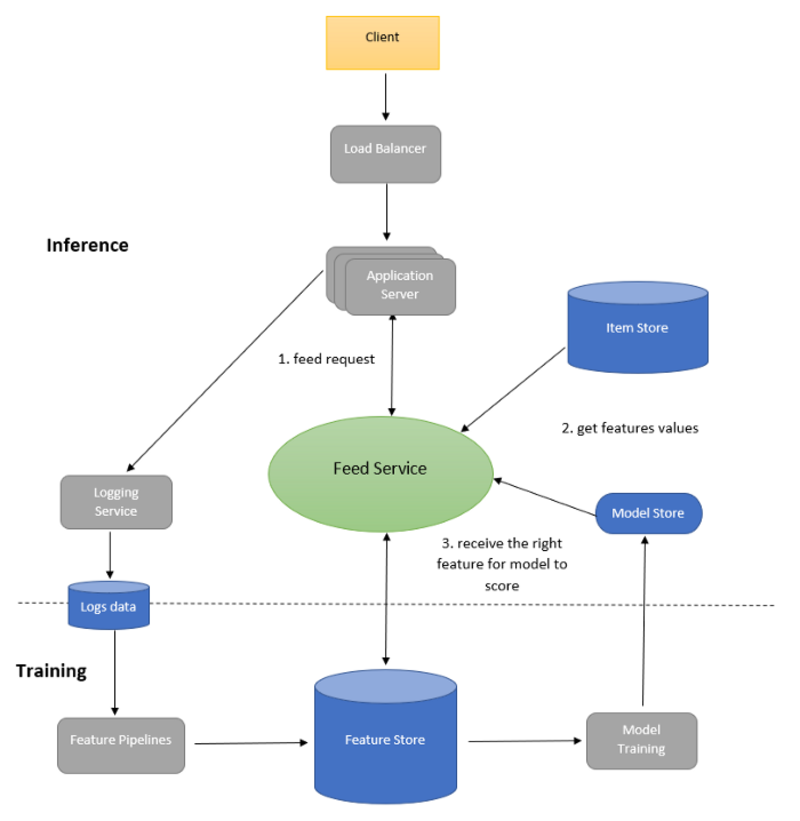
To scale the feed ranking system, we can put a Load Balancer in front of the Application Servers. This will balance and distribute the load among the several application servers in the system.


How LinkedIn Uses Machine Learning To Rank Your Feed 

Figure 2. The scaled LinkedIn feed ranking high-level design.

6. References

  1. Strategies for Keeping the LinkedIn Feed Relevant
  2. Machine Learning Design Interview

By

Youssef Hosni is Co-Founder at Elfehres, Ph.D. Researcher – Computer vision, and Data Scientist

Sourced from KDnuggets

By Kelly Main

And no, it doesn’t involve yoga, meditation, diet, or exercise.

Happiness is a universal desire. Yet it’s something most people struggle to find, never mind sustain, says Dr. Nathaniel Daw, a professor in neuroscience at Princeton University. According to his research, published by Medical News Today, humans are wired for unhappiness. But this predisposition is anything but a prognosis.

As elusive as happiness may be, it doesn’t have to feel like a lifelong rabbit hunt where happiness springs up from nowhere as quickly as it disappears. The secret to finding happiness isn’t as much about knowing where to look for it, as it is knowing how to look at it, says AngelList co-founder, Naval Ravikant.

According to Ravikant, it was his ability to find happiness that helped him build a successful startup and become the billionaire he is today. Because success isn’t a path to happiness. Happiness is a path to success. And research proves it.

Time and time again, studies show that happiness increases your odds of success. It helps explain how Elon Musk notoriously works 120 hours per week–becoming one of the most successful entrepreneurs of our time and the richest person in the world.

In other words, the happier you are, the more likely you are to be successful. Ravikant says there are a few simple things anyone can do to hack happiness–no matter how pessimistic you might naturally be.

Desire is suffering

While there is a benefit to innate unhappiness and dissatisfaction that is derived from a desire for more, Dr. Daw says this also “comes at the expense of constantly devaluing what we already have achieved, which the authors suggest might, taken to extremes, relate to depression.”

In other words, our desires serve as conditions for happiness. And we have all of these conditions for happiness that we have constructed.

Maybe we want more money, a nicer car, five-star vacations, a boss that recognizes our talents, an endlessly doting partner, a family that effortlessly gets along, or in-laws that don’t get on our nerves. But as long as we have these external gatekeepers to happiness, we’ll be hard-pressed to find happiness within ourselves.

Focus on one desire at a time

The problem then becomes, Ravikant says, that we have too many desires.

Limit your focus to one desire in order to achieve it. In this case, that one desire is happiness. So the question becomes, “does this ultimately lead me toward happiness?” When we field everything we do through a lens of whether or not our actions or thoughts help us or hinder us in the pursuit of our utmost desire, we set ourselves up for success.

Take for example a very mundane task such as taking out the garbage. No one enjoys doing it, but it does lend to our overall happiness as the alternative would ultimately lead to living in squalor–something no one truly enjoys.

Make happiness a priority

To quote Confucius: “The healthy man has 10,000 desires, but the sick man has just one.”

It illustrates that when things get difficult, we are able to eliminate the noise and clearly focus on what is important. In a dire position, priorities become obvious. But we don’t have to wait for an illness or a grim prognosis to prioritize happiness.

Entrepreneurs often fall prey to prioritization mismanagement. With so many (big) ideas, they are often left thinly spread. By doing a little of everything, like a jack of all trades, they turn into a master of none–goals and happiness included.

It’s this lack of prioritizing what matters most that drives many startups (and founders) into the ground.

Increase happiness through framing

There are two ways of seeing just about anything. This means that we can choose happiness by framing it the right way.

For example, consider a colleague who forwards you a number of emails you don’t need. You could think it’s obnoxious and that they don’t have any discernment (or even respect for your time). But you could frame it as though they are being considerate and keeping you in the loop, or that they are kindly giving you the power to decide which of the emails are of value to you.

It’s a process that eliminates negative judgment. It may not come as second nature in concept, but in practice it can. Soon we begin to look at the world through a positive lens, rather than a negative one, which shapes our experiences and our overall happiness.

Every entrepreneur seeks massive success, and yet to amass success, you need to amass happiness. The two go hand in hand, because while success does not equate to happiness, happiness is, by and large, success.

Feature Image Credit: Getty Images

By Kelly Main

Sourced from Inc.

By Steve Strauss

I was famously (infamously) unimpressed with Twitter when it first stormed the beaches a little more than a dozen years ago, telling my USA TODAY column readers not to tweet because “no one cares what you had for lunch!”

Admittedly, my then-editor at the time was not much better, awkwardly titling that column, “Should entrepreneurs Twitter? Uh, no.”

But for sheer audacity and getting-it-wrongness, we pale in comparison to the man who bought the platform for some $44 billion and proceeded, in a few short weeks, to practically burn it to the ground.

Want to ruin your small business? Then all you have to do is take a few pages out of Elon Musk’s playbook.

Overwhelmed: Elon Musk says he has ‘too much work on my plate’ following Twitter takeover at G-20 forum

1. Upset your employees

Businesspeople generally, and small businesspeople in particular, are wont to say our most valuable asset is our people, our team.

Makes sense, no? It is your valuable staff members who do the work, deal with customers, sell, put out fires, manage expectations and get the job done.

I once saw a report that said the most successful franchise owners were not the ones who understood marketing best, or who had the best locations, but rather were the ones who were the best managers. By being inclusive, positive and rewarding, great managers fostered great teams. Great teams begat happy customers and happy customers became repeat customers.

Another speed bump: Elon Musk is making automakers uncomfortable on Twitter

Elon seems to have forgotten that. After buying the company he:

  •  Fired about 3,700 people, roughly half of Twitter’s workforce
  • Also fired the CEO, the COO, their general counsel and the head of policy. Other execs, seeing the writing on the wall, quit.
  • Making people work twice as hard because, literally, half the team is gone, and then giving them no leadership nor direction is a sure way to start sinking a ship.

But Elon wasn’t done there. Via email he also informed those remaining that the new normal of hybrid work was over and that all employees would be expected to be 100% full-time, in the office.

How very 2018.

Want to go out of business? Make people work more, work harder, fire their friends, fire their bosses and put them in an environment they don’t want to be in.

More turbulence: Fake Eli Lilly Twitter account locked down after false claims of ‘free’ insulin

2. Scare your customers

As a business model, Twitter is not great. It has only ever been profitable twice (2018 and 2019.) In 2020, the year the whole world moved online and chatted over the Internet, Twitter lost a billion dollars.

Twitter makes the vast majority of its revenue from ads and advertisers, meaning, you and I and the rest of Twitter’s tweeters are not really its customers. Its real customers are its corporate advertisers.

Well, with the business in freefall, with banned and suspended people likely coming back, with the executives that advertisers traditionally dealt with either gone or overworked, and with bots and hate speech running amok because content moderation is in decline, those same advertisers have given Twitter a serious rethink.

Indeed, Volkswagen, United Airlines and many other corporate advertisers have all paused their advertising on the platform.

Fleeing for the exits: Twitter lost more than 1.3 million users in the week after Elon Musk bought it

3. Botch the brand

Great brands are valuable, and they are tough to create. Branding takes time, effort, money, luck, consistency, and vision.

One way Twitter built its brand was by offering a valuable blue checkmark that verified some people as real top tweeters, legit voices worthy of attention. Blue ticks were not easy to get. But now it looks as if anyone with $8 a month to spare will be able to buy one.

Because, after all, if you lose your top advertisers, you have to make that money up somehow, right?

Calculating: Elon Musk’s net worth cut nearly in half as Tesla stock prices dive

But if everyone can buy verification, then no one is actually verified, and that means that you can add even more fake accounts to this witch’s brew.

With no verification, short-staffed, morale among employees, advertisers, and users at an all-time low, with content moderation moderated, it is probably no surprise that Musk recently told those who are left on the sinking ship that . . . bankruptcy may be in Twitter’s future.

The man is a business startup genius for sure, but who knew that he was also gifted at shipwrecks?

By Steve Strauss

Steve Strauss is an in-demand speaker, attorney and the bestselling author of 18 books, including his latest,”Your Small Business Boom.” Named by SCORE as the top small-business champion in the country, you can learn more about Steve and the Strauss Group at MrAllBiz.com, get more tips at Planet Small Business and connect with him on Twitter at @SteveStrauss and on Facebook at PlanetSmallBusiness

Sourced from USA Today

By Phil Britt

With TikTok expected to rake in $10 billion in ad revenue in 2022, a ban would likely have a serious effect on marketers and advertisers.

Federal Communications Commissioner Brendan Carr called last month for the Council on Foreign Investment in the United States (CFIUS) to take action to ban TikTok, according to an Axios report. And the FBI weighed in on TikTok security concerns this past week.

Though the FCC itself has no outright power to ban the popular social media platform, which has a reported 200 million downloads in the United States alone, the popular app has come under fire due to its Chinese ownership as well as concerns about security and the spread of misinformation. A strong stance by the FCC — Carr is one of five commissioners — could prompt Congress to take action regarding the platform.

Such a ban would have an effect on marketers and advertisers. According to a New York Times article, TikTok expects to generate $10 billion in ad revenue this year.

Below are some of the pros and cons of potentially banning the platform.

Pro: TikTok Is Poor at Handling Data

TikTok should be banned in the United States, said Lyle Solomon, Oak View Law Group principal attorney, citing TikTok’s handling of US user data and its “blatant contradictions” in how it handles the data.

TikTok’s US branch has repeatedly claimed that its data centers are in the country, Solomon explained. “However, the more extensive links of sharing US user data with the parent company, ByteDance, cannot be underplayed. Data from US users was repeatedly accessed within China’s borders by ByteDance employees. Senior TikTok employees claimed that certain ByteDance employees in China had access to all US personal data.”

Chinese law also concerns Solomon because the government can ask Chinese companies for any amount of user data. He pointed out that TikTok’s close ties with its parent company, ByteDance, the fact that Chinese authorities can legally ask for the personal data of US citizens and that TikTok has repeatedly misused US user data has put him in favour of a TikTok ban.

Con: Another TikTok-Like Platform Would Fill the Void

Suggesting that TikTok should be banned is reactionary and fails to consider the nature of such platforms, according to William Pickering, digital marketing executive at The Big Phone Store. “If TikTok were to be banned, another platform would simply fill the gap left in the market, just as TikTok was once Music.ly, and Vine acted as a precursor to both platforms in delivering short-form video content.”

Arguing that TikTok should be banned is taking a prescriptivist attitude toward technology based on one’s own personal biases and refusing to accept the inevitable evolution and proliferation of social media platforms based on current trends, Pickering added. “I think you would be hard pressed to find a member of Gen Z who holds the opinion that TikTok should be outright banned, outside of blatant contrarianism and paranoia over Chinese state surveillance.”

TikTok could make some changes to address objections about its business practices and platform, Pickering said. “But such issues are present on any major social media platform. There are problems with any system based on delivering users’ content specifically tailored to their preferences through an algorithm: such as echo chambers, the grooming of young children, reduction in attention span, etc.”

But a knee-jerk banning of TikTok in its entirety is a refusal to accept that these issues are based on the manipulation of base human psychological traits, Pickering concluded.

Pro: TikTok Is a ‘Cancerous’ Technology

Nima Olumi, Lightyear Strategies CEO, thinks not only that TikTok should be banned, but regulators should also take a hard look at Meta’s Facebook.

“TikTok and Meta are cancerous technologies that destroy human productivity and attention spans,” Olumi argues. “We need to tax social media — either the company or the user — to get daily active usage down. The average American currently spends four hours a day on social media.”

Just over one-fifth (21%) of Americans made 2022 New Year’s resolutions that included reducing time on social media, but, like many such resolutions, there’s no indication of a slowdown, with users spending 95 minutes a day on TikTok alone.

“This is clearly a cry for help,” Olumi said, adding that these platforms detract from a person’s productivity. “Apps like TikTok and Meta are designed to keep users on the platform for as much time as possible. They make their revenue through ad dollars and engagement is the only metric they care about.”

Con: TikTok Ban Would Negatively Impact US Livelihoods

Luke Lintz, HighKey Enterprises LLC founder and CEO, agreed that TikTok is no different from many other social media platforms, though it likely collects more data than others.

TikTok is expanding into a wide range of industries and partnering with major merchants to launch a marketplace to compete with Amazon, Lintz added. TikTok has already figured out the top of the marketing funnel, so the expansion will enable users to buy products and services without leaving the TikTok platform.

“Banning TikTok is not the correct solution because there are so many US content creators making their livelihoods from TikTok, and many users enjoy the platform,” Lintz added. “I believe the correct solution is setting guidelines for a USA majority stake ownership in TikTok.”

Final Thoughts on Banning TikTok

There is no questioning the popularity of the platform, nor its use as an effective marketing tool for many. Even so, members of both major political parties are wary of anything involving oversight by the Chinese government, and the privacy of personal data is a major concern, with the United States and European Union continuing to strengthen laws concerning personally identifiable information.

So the debate regarding whether or not to ban TikTok is likely to continue for the foreseeable future.

By Phil Britt

Sourced from CMSWire

By Jessica Stillman

Did everyone start treating you differently around when you hit 40? A new study helps explain why.

There are plenty of reasons for people to get a bit grumpier as they age. Many of us gain more responsibilities to juggle as we get older. The resulting exhaustion wears on the nerves. Then there are all the usual petty indignities of age — the creaky knees, sore backs, bottles of hair dye. Those cheer no one up either.

But perhaps the most annoying aspect of growing older for women is the biases and stereotypes you’re confronted with. Sure, people may underestimate or inappropriately sexualize younger women (and that’s no picnic). But cross the boundary of 40 and suddenly you have another problem: when people look at you, they automatically think of their nagging mom, kooky aunt, or cranky battle ax of a boss.

Don’t believe me? Then I have a wildly annoying new study out of UC Berkeley to show you.

Middle-aged women versus outdated stereotypes

As Berkely Haas News reports, the study was inspired by the personal experiences of Jennifer Chatman, a tenured professor at the university’s Haas School of Business who has won many teaching awards, and received glowing student feedback earlier in her career. But when she hit 40, something weird happened.

While Chatman felt objectively better at her job — she had more experience and knowledge under her belt, after all — her student evaluations began to decline. Why might that be, she wondered?

To investigate, she rounded up a group of colleagues and conducted a series of experiments, the results of which were recently published in the journal Organizational Behaviour and Human Decision Processes. Warning: if you are a middle-aged woman, they may make your head explode from sheer rage.

Whether the research team asked volunteers to rate fictional supervisors or dug into mountains of data on student evaluations throughout professors’ careers, the conclusion was the same. As women enter middle age, others tend to automatically see them as less warm and therefore less likable. And that’s true even if literally nothing changes about them except for the number of candles on the birthday cake.

In one study, the researchers gave volunteers short profiles of a fictional boss. All the details of these profiles were the same except from the name. Sometimes the boss was named “Sue,” other times “Steve.” Despite the profiles containing identical information, participants rated middle-aged “Sue” as significantly less warm and friendly.

“It’s just stunning,” Chatman says. “These stereotypes are so hardwired and deeply entrenched that they come out even when absolutely identical information is provided about a man and a woman.”

Yet another hurdle for ambitious women

It is of course infuriating that people are primed to see women of a certain age as, in the vernacular, bitches. Chatman points out it is also a big block to their career advancement.

“Middle age is a make-or-break time, when people are being groomed and considered for the top jobs,” she commented. “We have to look beyond the pipeline to see what’s actually happening in terms of the experiences women are having throughout their careers.”

Tired stereotypes of middle-aged women as naggy, frumpy, and grumpy create an additional barrier to female advancement. At just the age that many professional women have accumulated the skills and contacts they need to soar in their careers, they are saddled with outmoded expectations that can prevent them from reaching their full potential.

You’re plenty nice, it’s the world that has to change

What’s the takeaway here? If your first impulse is to counsel middle-aged women to act nicer at work, maybe take a pause. (And not just because our cheeks are already aching from all the fake smiling we do.) The problem here isn’t that middle-aged women are actually grumpy, rude, or sour-faced. The problem is bias in society. That’s what needs to change, according to the researchers.

“I would hate for the message to be that women need to be more careful about how they present themselves,” says Chatman, “because these findings already point to the fact that women have a narrower band of acceptable behavior.”

Instead, the researchers hope their work will nudge bosses to be more thoughtful when judging employees. If you know that nearly all of us have been exposed to these stereotypes, you’ll be better placed to make sure they don’t creep in when you’re evaluating employees.

“We need to create systems and standardization for how we discuss and evaluate candidates,” study co-author Laura Kray says, “and either exclude feedback on personality, or make sure it is considered equally for men.” Leaders, keep that in mind next time you’re tempted to a dismiss a middle-aged woman as cold, cranky, or unlikable.

Feature Image Credit: Getty Images

By Jessica Stillman

Sourced from Inc.

By David Mather

Before investing in augmented reality (AR), brands must consider some basic principles – and no, QR codes are no longer enough. Zappar’s Dave Mather outlines the rules of engagement for using AR in marketing strategy.

It’s nearly 2023. The metaverse and associated immersive technologies are key talking points in boardrooms across the globe. For many, they represent new and interesting ways to reach and engage younger, more discerning audiences as tried-and-tested marketing channels fail to cut through.

According to Snap’s latest Augmentality Shift report with Ipsos, four out of five brands that use augmented reality (AR) say that it helps to drive sales, acquire new customers, and increase performance. These are all metrics that marketers should care about.

However, many aren’t driving consistent results from the technology. Worse yet, many are still failing to use it at all.

With immersive technologies becoming a mainstay in how we communicate, marketers must start thinking about how they can use AR to increase engagement. Before diving in headfirst, read up on these five key principles.

1. Don’t use AR for AR’s sake

AR is not for everybody. Nor should it be used to ‘tick a box’. Instead, think deeply about the problem you’re solving with AR and how it ties back to your campaign objectives (and wider marketing strategy). If you don’t have a clearly defined objective or measurement of success, don’t do it.

You should be able to communicate the reason you’re using the technology back to the business (or client) before you start thinking about creating any AR solution.

2. Put your audience first

All marketers should be familiar with this rule: put your audience first. This comes down to where they are, who they are, what device they’re likely using, and where they are in the world.

Without this, you can’t use AR effectively. Understanding your audience deeply, and in what context they’ll be consuming your AR experience, is key.

3. Be authentic to your brand

As with any campaign, you want it to embody the essence of your brand, your values, mission, and purpose. It’s no different in AR. In fact, the technology heightens this dimension.

We’re seeing this more with brands entering the metaverse and not necessarily understanding the technology, audience, and purpose (I’m looking at you, Walmart). Make sure your AR experience fits with your brand values, tone of voice and (to reiterate the second rule) your audience.

A great example of this is a campaign we worked on at Zappar for Yorkshire Tea and their ‘Yorkshire Tree’ campaign. The AR experience took their mission to plant one million trees across Kenya and the UK to a new level, immersing users in their story with an interactive AR mini-game that put them in the driving seat, helping them plant the trees.

4. Think engagement, not reach

AR is great for a lot of things: explaining complex concepts, visualizing products in their natural habitats, and delivering greater personalization at scale. However, where it really adds true value is engagement.

It can be as simple as adding a holographic video message in AR within your customer comms from a senior leader, or as complex as creating AR portals into new worlds.

Think about the additional engagement this offers your marketing. Yes, AR is a ton more accessible than 3-4 years ago with the advent of WebAR (3.9bn devices to be precise). Delivering a deeply personal and visceral experience is where you’ll pocket the difference.

The key takeaway here is that people are actively engaging with the AR content you create, more often than not in the real world by physically moving around 3D content. This is a step change from watching a video ad across paid social.

5. Don’t get lazy with your CTA

Don’t forget about your call to action (CTA) and how you’re getting people into your AR experience. A great call to action is simple, direct, and to the point. Remember to communicate the unique value you’re offering your audience clearly and simply.

At the end of the day, it’s a value exchange and people want a return on the time they’re investing in your experience. Please, don’t add a basic ‘scan me’ to your AR; it simply isn’t enough nowadays, and you won’t get people into the content you’ve spent so much time creating.

Get these five principles right and you’ll be well on your way to creating more successful marketing campaigns that put AR front-and-center, driving real business value.

Feature Image Credit: UNIBOA via Unsplash

By David Mather

Sourced from The Drum

By Jennifer Jolly

Here’s how to combat targeted ads, hackers, and cyber thieves.

Sometimes I feel like I spend my entire day dodging attacks on my digital identity. I wake up to scammy text messages begging me to click sketchy links. I delete them. Brush my teeth.

Open my email and voila! Fake sweepstakes emails — from my own email address, no less — telling me I won everything from a power drill to a Yeti cooler. I delete those, too. By noon I’ve silenced at least a half dozen robocalls, and at least once a day I see a Facebook ad for something I recently talked to my husband about — is Siri eavesdropping on me, too?

Screengrab of scam email from me.
Jennifer Jolly

Obviously, I’m not alone. With so many scams floating around we’re all starting to see privacy dangers around every mouse click, even where they might not exist, like in a Snapchat filter.

The recent midterm elections and upcoming Black Friday/Cyber Monday online shopping extravaganza have only made these concerns more intense. If you haven’t gotten at least a hundred unsolicited text messages — again, with sketchy-looking links — consider yourself lucky.

Where is all of this headed? Are we forever doomed to a future of digital paranoia, and the threat of cybercrime, stolen money, identities or worse? Is there a way to break free from all these shady spammers, scammers and thieves?

The good news is: It all gets a lot less scary once you realize what is going on.

Now you know: 7 default settings tech companies don’t ever want you to change

An email from myself?

I get emails from myself all the time … only I never sent them. They’re often low-effort scam-bait messages claiming that I won something or I have unclaimed funds somewhere. Or even more annoying, that I’ve been hacked “watching porn” on my laptop and better pay up — or else.

Spoiler alert, there’s no watching porn or getting hacked actually going on, these are among the most common of threats.

You likely get these, too. No doubt, looking at your own email address in the “From” line is unsettling, but how does that even happen?

Sadly, it’s easy. The email addresses that populate when you open an email are rarely verified, especially if you use a free email service. Using a less-secure Simple Mail Transfer Protocol (SMTP) server, a scammer can just type in what they want the “To” and “From” addresses to say.

Someone using one of these servers — a scammer can just set one up themselves — can make an email look like it came from anyone, including you. It really is that easy.

As annoying as it is to change an email service, you can avoid these spoofed emails and do away with a whole lot of spam and scam messages by switching to a secure email provider.

ProtonMail is a popular one these days. It’s free for a private email account, and since it uses more advanced protocols than most free services, it spots spoofed emails, so you don’t have to.

Online scams targeting veterans and active duty members. Here’s how to protect yourself.

Password Paranoia

Oh, passwords. I don’t know of a single person on the planet that actually likes the password system, but there’s no getting around them … or is there?

“Passwords have been the default mechanism for authentication since the beginning of computer technology,” Bob Eckel, president and CEO of Aware, a biometrics software company based out of Massachusetts, tells me over email.

“They don’t require extra or special hardware, there are no compatibility issues and they are a cost-effective option for companies and businesses of all sizes, which is why they are still the go-to for identity or use authentication today.”

The biggest problem with passwords is that they’re far less secure now than they were a couple of decades ago. Modern hackers use more advanced techniques, and most of us don’t practice good password hygiene, such as using a different password for every account.

If you use your birthday, maiden name, pet’s name or one of the most easily hacked passwords on the planet, like 1234, or “password,” you’re just begging to get scammed.

Companies like Apple and Google pioneered new methods for securing digital devices such as smartphones and even laptops, but individual accounts for the millions of apps we all use still require passwords. Our own fear and apprehension are a big part of the reason that certain biometric technologies aren’t catching on as fast as they could.

RNC sues Google over email spam filters: Alleges ‘bias against Republicans’ ahead of midterms

“Certain segments of the general public, such as baby boomers, for example, continue to be weary of facial authentication; instead, they’re much more receptive to fingerprints. Therefore, we need to continue our mission to educate both organizations and consumers about the technology and special techniques used to make facial authentication highly safe, secure, and accurate,” Eckel says.

While we wait for passwords to kick the bucket, utilizing features like Apple’s “Sign in with Apple” can effectively bypass many app login requirements and use your smartphone as the default for verification.

It’s also a lot more convenient than inventing a new password for every app, and lets you use FaceID or TouchID (depending on your device) to log into just about anything.

Man who lied about being a millionaire: Fake Navy SEAL stole up to $1.5M in romance scam, DOJ says

Is Siri listening?

Do you ever see an ad for something you were just talking about with a friend, within earshot of your phone?

It’s easy to assume that since our phones are constantly listening to us — waiting for the trigger word, like “Hey Siri,” “Okay Google,” or even “Alexa” — that they may be working behind the scenes to feed us relevant ads. That’s not exactly right, but it’s not that far off either.

“Our phones are designed to listen, first and foremost, to virtually assist us, which can explain why you may be served ads that directly relate to a conversation you just had,” Eckel adds. “It is similar to how search engines work by tracking your activity to ensure it is delivering the most relevant results.”

But it’s important to note that Apple, Amazon and Google have all stated that they treat the audio from their respective virtual assistants with the utmost security and privacy.

Tab overload? How to control what happens when you start your browser

You may get a relevant ad on your computer, related to a voice prompt if you choose to search Amazon’s marketplace using Alexa, for example, but having a background conversation with a friend isn’t the reason you get those ads.

The more likely scenario is that your searches on desktop or mobile triggered an ad algorithm to suggest those relevant products for you.

I know it can seem creepy and weird, but unless the big three companies are lying through their teeth — and security researchers haven’t busted them yet — it’s just a coincidence and a cleverly-designed ad system.

It’s not you, it’s them: Google, Alexa and Siri may answer even if you haven’t called

Steps to be more secure online

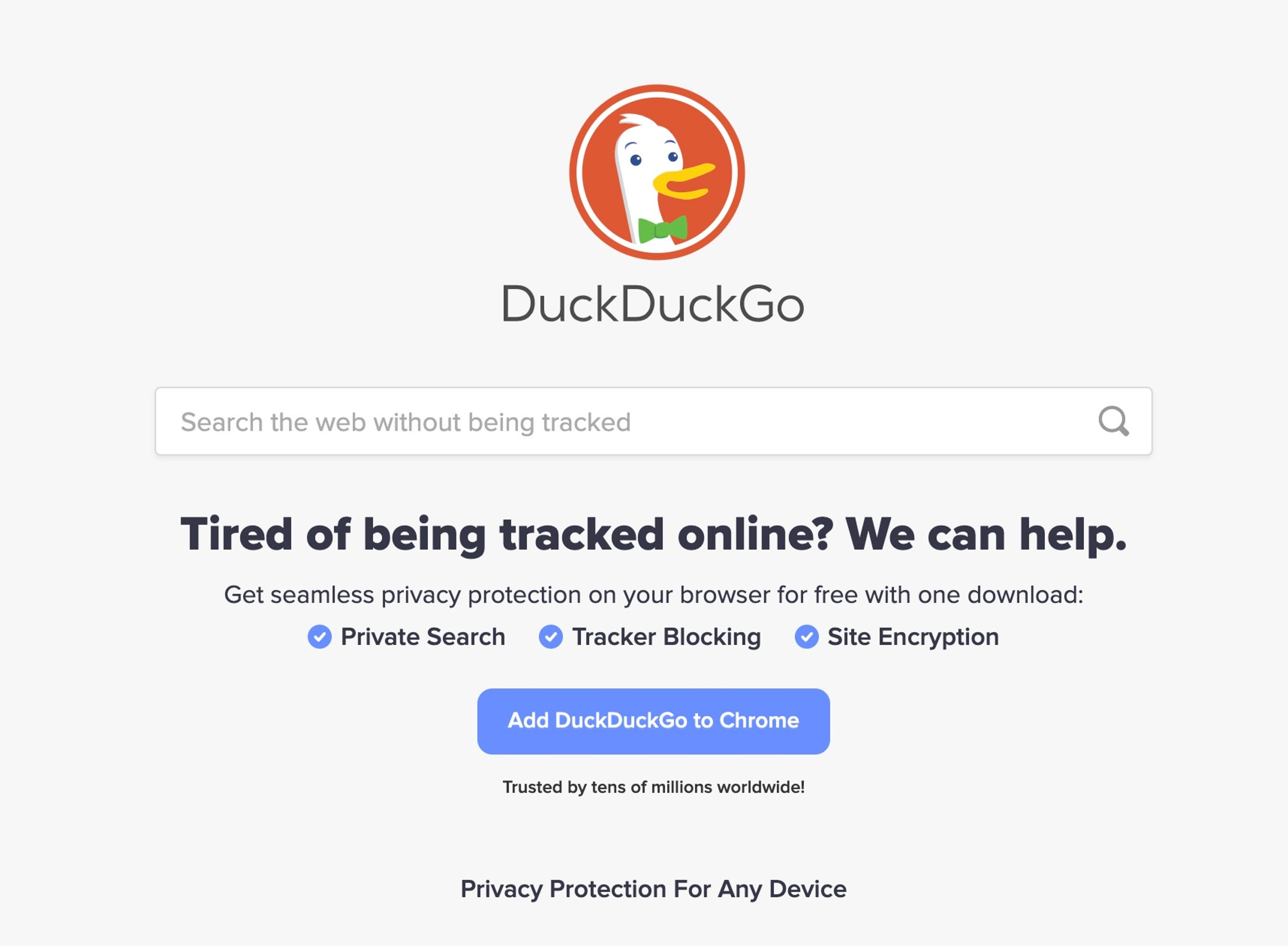
Duckduckgo screenshot.
Jennifer Jolly

What can you do about it all? Here are some simple steps you can take to search for information online as privately as possible these days:

  • Use a privacy-focused search engine that doesn’t collect as much data about your habits as say, Google. Options here include DuckDuckGo or Brave Search.
  • Disable your mobile ad ID on your smartphone and tablet, and block ads on your laptop and desktop browsers. Most smartphone apps default to collecting tons of data about your behavior. There are easy ways to disable these functions in the settings on iPhones and Androids that run on the Google operating system.
  • Use an ad blocker such as Ghostery or AdBlock Plus.

By Jennifer Jolly

Jennifer Jolly is an Emmy Award-winning consumer tech columnist. Email her at j[email protected]. Follow her on Twitter: @JenniferJolly. The views and opinions expressed in this column are the author’s and do not necessarily reflect those of USA TODAY.

Sourced from US Today Tech

By Seb Joseph and Krystal Scanlon

The public boycott of advertising on Twitter is starting to look a lot like a long goodbye.

GroupM, the world’s largest media buying agency, is telling clients that Twitter is now a “high risk” media buy following a barrage of controversies, U-turns and confusion that capped off Elon Musk’s second week as the owner of the social network.

The advice was shared in a document, seen by Digiday, that warns marketers of the risks of advertising on the volatile social network. It reads: “Based on the news yesterday [Nov. 10] of additional senior management resignations from key posts, high profile examples of blue check abuse on corporate accounts, and the potential inability for Twitter to comply with their federal consent decree, GroupM’s Twitter Risk Assessment is increased to a High-Risk rating for all tactics.”

If this stance is to change, Twitter has to resolve several issues, per the document. They are as follows:

    • Return to baseline NSFW levels
    • Re-population of IT security, privacy, trust & safety senior staff
    • Establishment of internal checks & balances
    • Full transparency on future development plans of community guidelines/content moderation/ anything affecting user security or brand safety
  • Demonstrated commitment to effective content moderation, enforcing current Twitter Rules, e.g., account impersonation, violative content removal timing, intolerance of hate speech & misinformation, etc.

It’s a reminder of where the real power lies in this standoff between Twitter and advertisers. Hint: advertising on Twitter has always been a nice to have, not a must have for the advertisers that spend on it. That may be one of the few things that hasn’t changed since Musk took over.

That’s not to say that advertisers are apathetic on Twitter’s fate. They’re concerned, of course — the social network still serves as a major cog in the global news cycle, after all — but they’re not rattled. Not even as Twitter’s senior ranks unravel.

The unraveling accelerated after Musk held an hour-long pow wow on the platform last week (Nov 10). It was done to reassure advertisers that Twitter’s future was fine. A series of sudden resignations and subsequent reversals of them revealed they were anything but. Not least because it involved some of the same people who have wanted the market to believe in Musk. Robin Wheeler, Twitter’s de facto head of ad sales, for starters. A little over a day after she was talking up Musk’s plans on Twitter Spaces, she resigned, and then decided to stay, per Bloomberg.

The symbolism isn’t lost on marketers.

“Corporance governance is shifting all the time,” said one senior marketer, who spoke on condition of anonymity because they were not authorized to speak to Digiday. “I can afford to wait and see how this all shakes out. This isn’t like Facebook or YouTube where we might structure media plans around those platforms. On the contrary, our organization is trying to call in any fungible spending right now. Thank you Mr. Musk.”

It gets worse. The other executive on that call with Musk and Wheeler — Twitter’s head of trust and safety Yoel Roth — also resigned. Unlike Wheeler, Roth doesn’t seem to have reversed that decision. Neither has Twitter’s chief information security officer and chief privacy officer, who have also resigned. Oh, and don’t forget all this is happening as the Federal Trade Commission watches on with “deep concern.”

So not only does Twitter pose a brand safety risk to advertisers, it could also be a cybersecurity risk too.

Either one would blow a hole in the ads business of any platform in the current climate — let alone one that most marketers aren’t too concerned about.

“Yes, Twitter is part of the cultural moment, but it doesn’t have a good direct response product so spending there is quite nebulous — or just not good,” said a media director at one of the advertisers that has stopped advertising on the social network. “It’s never been a critical part of the media strategies or plans that I oversee.”

Nothing Musk has said to advertisers either on stage, on calls or even his tweets has been able to change that sobering fact. In fact, the more the controversial billionaire talks about Twitter and advertising on it, the more confused advertisers seem to get.

The way Musk sees it, Twitter is like a town square where “freedom of speech is not freedom of reach”. In other words, people can say all sorts of things — some of it even unsavory — it just doesn’t necessarily have to get amplified to the masses.

The problem is who gets to decide what gets amplified? Whatever the answer is, chances are it’s going to be inextricably linked to pernicious relativism. It’s hard to see otherwise after Musk said he viewed the “truth is a nebulous concept”. Controversy is never far from views like this, and that’s the last thing marketers want to be near right now.

“Elon saying ‘truth is a nebulous concept’ at the start of the session is highly concerning,” said Ruben Schreurs, group chief product officer at media management firm Ebiquity. “This is Kellyanne Conway making a case for ‘alternative facts’ all over again. Truth is truth, simple as that. There’s nothing nebulous about it.”

Schreurs frustration echoes a lot of what the 15 ad executives Digiday has spoken to since Musk took have said. They bemoan a pitch to advertisers that’s light on core principles and permanently in a state of flux, or as amenable behind closed doors as it is combative in the spotlight. In short, marketers aren’t too bothered by what Musk says on Twitter Spaces, at conferences or behind closed doors. They only care about what he does.

“Speaking more specifically about our client set that potentially applies to an even broader group of advertisers, Twitter is not integral enough to their advertising mix to demand this much of their attention and time,” said Adam Telian, vp of media services at marketing agency New Engen.

Needless to say, those pulled ad dollars don’t look like they’re going to be coming back this side of 2023. Then again, they never really were. Advertisers had essentially cut short their spending for this year on Twitter. Nothing Musk has done so far has been able to convince them otherwise.

His new verification scheme? The indecision over it has allowed for fake and parody accounts to proliferate in its slipstream. What about Musk’s plan for Twitter to take another crack at video, or become a payments company or even re-architect the backend of its ad tech in order to power better targeting? Easier said than done at the company in the throes of an employee exodus. It’s the same with his threats. Remember, Musk’s vow to “thermonuclear name and shame” the advertisers that had pulled ad dollars? Still waiting.

Color marketers confused.

“At a base level, Twitter’s reason for being is currently very unclear, as evidenced by his “we’re going to be everything” comments, making it a highly suspect platform to spend money on,” said Evan Levy, president at ad agency Fitzco. “We know TikTok’s reason for being. We know the NFL’s reason for being. Understanding the platforms or properties we’re investing media dollars into should be table stakes. Twitter? To be determined – and so should brands’ investment there.”

It’s a precarious position for any business built on ad dollars — even more so one that’s intrinsically entwined to Musk. His antics are having a direct impact on the business on multiple fronts. Not that he would know. Rather, Musk believes, as stated in meetings with advertisers, that his actions should be divorced from his business — even as ad dollars continue to pour out of it as a direct result of what he’s doing. Regardless of how he opts to try and prop up his flagging asset, the clock is ticking. The entrepreneur has already warned that his company won’t be able to come through the economic downturn if it can’t replace the ad dollars the business has lost since his arrival with additional income. Bankruptcy is not out of the question, he has said. Advertisers are a lot of things, charitable isn’t one of them.

Featrue Image Credit: Ivy Liu 

By Seb Joseph and Krystal Scanlon

Sourced from DIGIDAY

By Samuel Thimothy

Let’s dive into why you shouldn’t outsource your content and how to manage content creation internally.

Feature Image Credit: Getty Images

By Samuel Thimothy

VP at OneIMS.com, an inbound marketing agency, and co-founder of Clickx.io, the digital marketing intelligence platform.

Sourced from Inc.