Author

editor

Browsing

By

A robust online presence is crucial to the success of your business.

Regardless of the kind of you operate, there are many things you can gain from having a strong online presence. With a powerful online presence, you can boost brand awareness, increase leads and increase sales. So, as we are moving closer to 2023, every business must plan to take its online presence to the next level.

In this post, we will explain some important things every business should do to improve its online presence in 2023.

Build a user-friendly, attractive website

When creating an impressive online presence in 2023, the importance of having a website cannot be overemphasized. Your website can make it easier for people to know what you are capable of offering them. Additionally, it can tell people more about your work process, work hours, location, contact information and lots more.

But you shouldn’t just create any site. It must be user-friendly and visually appealing. This is because the expectations of consumers are high nowadays. As a result, they will not waste their time on a low-quality, hard-to-navigate website. So, you should hire the service of experienced website developers and designers to ensure your site meets the required standard.

Use SEO

Search engine optimization (SEO) is a digital for increasing your brand’s visibility in search results. As your website ranks higher in search results, more people will be able to come across your brand. Therefore, SEO can make a big difference in your online presence.

To optimize your site for SEO in 2023, you should invest in finding the most relevant keywords. Afterward, use the keywords appropriately and naturally in your headers, meta description, content, social media posts, etc.

Also, you shouldn’t forget the three most crucial aspects of SEO, which are:

When done correctly, SEO will help you to reach more potential customers, thus, boosting your online presence.

Take advantage of local directories

Although it may seem that local directories are only meant for local businesses, all businesses can gain from them. With the directories aid, many would-be customers can check out your business without going to your site. So, as you are trying to boost your business’s online presence, you need to create profiles on local directories such as .

Invest in online ads

While a business can grow online organically without ads, online ads can make the job easier and faster. Therefore, if you want to improve your business’s online presence, you need to invest in online ads. , Google, and other platforms now allow users to pay for ads. These ads will showcase your offers, ensuring that more people know about your business.

Online ads are helpful for businesses in different ways. Firstly, it can be tailored to suit your target audience. You can use age, interests, location, gender, behaviour and other parameters to determine who will see the ads. Secondly, the ads can be done in varying formats, such as images, texts, infographics and videos.

Focus on only the most important online platforms

You can explore numerous platforms when it comes to boosting the image of your business online. However, you must be careful, as being present on several platforms may not be advantageous to your business. Generally, you will have to spend lots of time online marketing your business through numerous platforms. This can be pretty distracting and even prevent you from offering quality services and products to existing customers.

As a result, you should only focus on the most vital platforms. If you can only maximize the use of your website, emails and three social media platforms, you should concentrate on them. You just need to select the best platforms that will assist you in getting the most from your online presence.

Post shareable and emotional content consistently

Another way to improve your online presence is to post content your audience can share with friends. By sharing your content, it will be able to reach more people, thus, boosting your online presence. Nevertheless, most users will only share content that resonates with them emotionally. So, creating emotional and shareable content from time to time on your website and social media pages is paramount.

Infuse emotional phrases and words into your headers, captions, blog posts, etc. Add exciting images, videos, stats and emojis to your content. Also, you can directly encourage the readers to share your post.

Use email marketing

Even though email marketing is one of the oldest means of digital marketing, it is still crucial today. Many users utilize emails and check their inbox messages regularly. According to Optinmonster.com, about 99% of email users open their emails at least once daily. So, if you can reach out to existing and would-be customers through emails, you will increase your online presence in 2023.

To optimize email marketing, you must build an email list and craft unique subject lines and content. Also, you must send emails regularly, but don’t spam your audiences.

Explore guest posting

As you continue to look for ways to improve the online presence of your business, you shouldn’t limit it to your platforms. For instance, guest posting can be a great way to let more people know about your business. Guest posting refers to the process of creating a blog post on another platform’s blog. You need to add a link to your website or blog in the blog post. When people engage with your post on the website, they may click the link and visit your website.

When choosing a platform for guest posting, ensure it is a platform with many audiences. Such a platform will allow you to reach more people.

After doing everything above, you should keep track of the progress of your effort with Google Analytics, SEMrush, Ahrefs, etc. Keep updating these things until you have accomplished the goal of improving your business’s online presence in 2023.

By

Sourced from Entrepreneur

By Stephen Connors

Can affiliate email marketing make you money while you sleep?

Yes, and how does a mind-blowing ROI of $36 for every $1 spent sound?

Pretty incredible!

And in this post, we’ll show you how to get your slice of the extremely lucrative affiliate marketing pie.

Here’s what you’ll learn:

  • What to do before, during, and after launching an affiliate email marketing campaign.
  • Simple but effective email marketing best practices.
  • Need to know tips that’ll elevate your next campaign.

Let’s go!

What is Affiliate Email Marketing?

Affiliate email marketing is a form of digital marketing that promotes affiliate products and services via an email list.

You earn a commission when someone buys something or performs a desired action (like signing up for a webinar) through your affiliate link contained in that email.

What’s the Difference Between Email Marketing and Affiliate Email Marketing?

Affiliate email marketing is a subset of email marketing that uses a list of email subscribers to promote someone else’s products and services through affiliate programs and links.

An affiliate email campaign can link to physical products, invite people to a webinar, direct them to a social media post, and so on.

Email marketing is similar except the marketing is for that business’s own products.

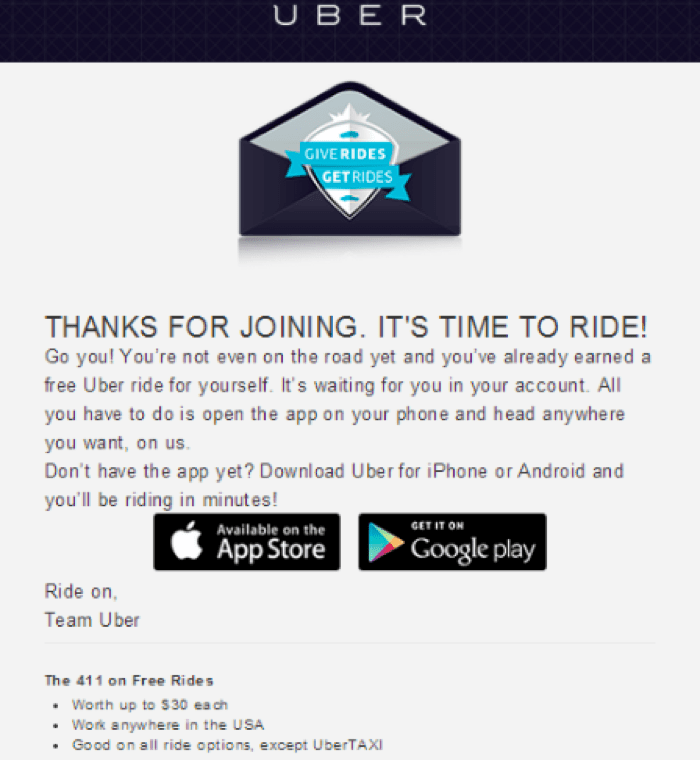
Here is an example of email marketing, where Uber offers a free ride just for signing up to their mailing list:

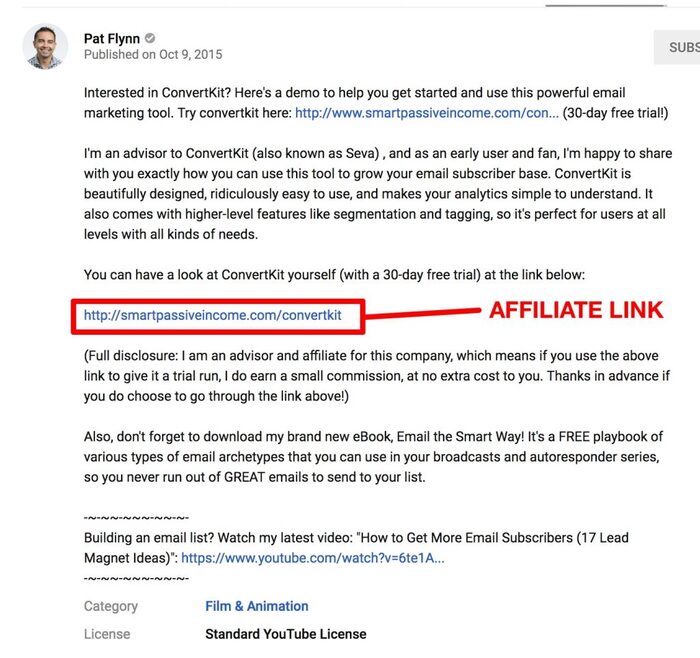
And here’s an example of affiliate email marketing where Pat Flynn promotes CovertKit in one of his emails. Note the affiliate link.

But the bottom line: Uber’s marketing strategy was to promote their own product in their email, but Pat Flynn’s was to promote someone else’s.

How to Launch an Affiliate Email Marketing Campaign in 3 Steps

No matter what part of the affiliate email marketing process you’re in, we’ve got you covered.

So feel free to skip around depending on what part applies to you.

Step 1: Before Launch

Start here if you don’t have an email service provider (EMS), an email list, or know what the CAN-SPAM is.

Step 2: Launch

Start here if you don’t have the right affiliate links or haven’t learned how to write an email using them.

Step 3: After Launch

Start here if you want to learn how feedback and analytics can improve your results.

1. Before You Launch An Affiliate Email Marketing Campaign

Choose the Right Email Service Provider

An email service provider (ESP) manages bulk email services between you and your group of subscribers. For example, ConvertKit, the email service provider Smart Blogger recommends for most content creators.

But the most important role for an ESP in email affiliate marketing — besides making your life easier — is to build trust, bring value, and provide the best experience possible for your email subscribers.

Here are some must-have email marketing software features:

1. Scalability?

You may find an ESP that meets your needs today, but what about tomorrow? Is there a cap or does it support unlimited emails?

2. Can you track and report?

You’re going to want to know things like deliverability and open rates.

How else are you going to know if your marketing efforts are resonating with your subscribers or if someone needs to be purged from your list?

3. Can you segment?

You don’t want to send offers to people who’ve already bought the product or service. You want the right email going to the right person at the right time.

4. Do they automate?

Why not write emails once and then automate them to send in a sequence? It may be more setup work up front, but it’ll be much less work afterward.

5. Do they offer email templates or builders?

Even if you’re a design wiz, using a prebuilt professional email template or email builder looks great and saves time.

Affiliate Links VS Affiliate Marketing

However, not all email service providers (ESPs) are created equal.

The difference between how an ESP allows the use of affiliate links compared to affiliate marketing can be night and day, and the waters here can get a little murky.

In general:

  • Affiliate links market products or services in general or at random to a third-party business.
  • Affiliate marketing, on the other hand, markets products or services by teaming up with a specific third-party business.

While most ESPs allow affiliate links, some have more restrictions than others.

For example, the popular email provider Mailchimp allows certain affiliate links but not affiliate marketing.

GetResponse, on the other hand, allows both affiliate links and affiliate marketing.

But these policies are nuanced, so be sure to research your ESP’s specific policy to ensure your affiliate model is a good match, which is something you’ll want to do before sending your first email.

Here’s why…

What’s the CAN-SPAM?

The Controlling the Assault of Non-Solicited Pornography and Marketing Act, (CAN-SPAM) governs the use of commercial emails in the United States.

Other countries may have similar laws.

ESPs, understandably, want to avoid the possibility of facing legal action because one of their users intentionally, or unintentionally, violated the law.

As a result, they all have to follow certain guidelines for emails sent through their service.

Strict adherence to CAN-SPAM is a must. Failure to do so may result in being booted off the platform and possibly permanently losing access to your hard-earned email list.

Whether the ESP you’re considering has a stated policy on its website governing affiliate links or not, reach out to them for clarification to ensure you know EXACTLY what is and what’s not allowed

And now that you’re a CAN-SPAM pro, it’s time to build your email list.

Build an Email List for Affiliate Marketing

The key to building a large email list isn’t in the tactics, it’s in the connection and value offered.

Some strategies, of course, have proven to be more effective than others. But the greatest affiliate marketing techniques in the world won’t work if people don’t feel you can relate to them — and this is especially true for affiliate email marketing.

That said, incentives are a brilliant way to provide value to potential customers and build your email list at the same time. Lead magnets and opt-in offers prove upfront that you’re a valuable, trusted resource. And here are some tried and true strategies that you could use:

  • Cheat sheets (or checklists)
  • White papers
  • How-to guides
  • Special reports
  • Content upgrades
  • Contests and giveaways
  • Opt-in forms and pop-ups
  • Squeeze pages
  • Social media

Regardless of the method(s) you choose, keep in mind that it’s going to take time. Mailing lists of thousands of passionate fans aren’t built overnight.

2. How to Launch an Affiliate Email Marketing Campaign

You’ve got your email list and your email service provider, and now you’re ready to make boatloads of that affiliate income.

Now what?

Now it’s time to launch! Well, almost.

What you send won’t matter if no one opens it. Everything needs to work together from the subject to the affiliate links to pique your target audience’s interest, solve their problems, and excite them enough to take action.

Here’s what you need to know:

Subject Lines

If the subject line doesn’t grab their attention and compel the reader to open it, nobody will know about your awesome content or can’t-live-without offer. And worse, since affiliate email campaigns are built on relationships, you’ll miss a valuable opportunity to build trust.

Because the subject of writing winning email subject lines is so important I’d be doing you a disservice if I tried to cover it all here, but here are some important tips to get you started with affiliate email subject lines:

  • Create intrigue with sensory and/or power words, instead of “salesy” jargon.
  • Highlight the value clearly. How else will your subscribers know it’s worthwhile?
  • Present warmly as if you were writing to someone who personally knew.

Hopefully, that gets you started, but click here for a deeper dive into how to write email subject lines that work.

Keep the Body Short

Next, keep the body of your email short. People have short attention spans, and they skim. They’re looking for reasons to hit the back button.

Don’t give it to them.

Hit that pain point immediately in a way that they can’t ignore. The solution to their problem lies in clicking that embedded link.

Links

Speaking of links, you should only include affiliate links to products and services that will truly benefit your audience.

If trust is destroyed, it’s almost impossible to regain, so the links must be catered to your specific audience. But, and this is important, the links must also work well for you — that’s kind of the whole point!

Best Types of Links

You probably don’t want affiliate links to health and personal care as an Amazon Associate, since they only offer a 1% commission.

Instead, consider something like Bluehost, which offers up to $65 per sign-up or referral, it’s something people will need for years to come, and your marketing efforts will get more bang for their buck.

Email Sequences and Triggering

Building trust in affiliate marketing can be a full-time job. But what if you could get better results with less time?

Email sequences are a predesigned group of emails that deploy automatically. That means you can create content once but keep pumping it out on repeat.

But how do you know when it should be sent?

That’s where triggers come in.

Triggers are prompts caused by certain events, like an abandoned cart sequence, a purchase to overcome the inevitable buyer’s remorse that accompanies a high ticket item, or something as simple as a new subscriber welcome email.

You can write it once and then automate it to send as subscribers join the fold or hit certain milestones.

OK, so once you’ve sent emails with value-packed subject lines, built trust with email sequences, and tuned into your audience’s needs and wants, your work is well on its way.

But it isn’t over yet.

3. After You Launch an Affiliate Email Marketing Campaign

By now you’ve fostered trust with well-written email content. You’ve sent links that improve your subscribers’ lives.

Now it’s time to double down on serving your audience and get those recurring commissions!

The best affiliate marketers do this by using the right tools. Tools that answer certain questions.

Like how did your email perform?

How many were opened?

Did any bounce? How many times was the link followed?

In short, does anyone want to buy what you’re selling? And this is where analytics can provide the data to create emails so good your subscribers won’t be able to ignore you.

Open Rates

Open rates track how many sent emails were opened.

Why is this important?

Because people love content that sparks their interest, solves a problem, or helps make a dream come true — emails that provide value. And an open rate of less than 15% – 30% is cause to reconsider your affiliate offer’s value.

Bounce Rates

Bounce rates track how many emails were sent but couldn’t be delivered.  Under 2% and you’re good. Higher? Not so good.

Why is this important?

Because a high bounce rate could cause your ESP to start directing your email to spam. And nothing dissolves trust faster than fishing an email out of your spam folder.

To prevent this, have your new subscribers verify their subscriptions. Cut out the “spammy” or “salesy” language, especially in the subject line. Or maybe you just need to clean your list and toss out the duds.

Click-to-Open Rates

Click-to-open rates (CTORs) track how many of your links were clicked when the email that contained the link was opened. After all, this is the whole point of affiliate email marketing.

So if your click-to-open rate is less than 20% – 30% or any of your other analytics are off, it’s time to find out why.

And it’s A/B testing to the rescue.

A/B Testing

A/B testing tests two different versions of the same email. Each one is sent, tracked, and then analyzed for performance.

Low open rates? A/B test with two different value offerings, let’s say a white paper vs. a free course.

Low click-to-open rates? A/B test with two different calls-to-action.

The beauty is that you’ll be able to customize your A/B testing to fit your specific needs. And once you do, you’ll have come full cycle in your affiliate email marketing launch.

So you’re good to go!

But if you want to avoid the painful and embarrassing mistakes newer affiliate email marketers experience, the next section is for you.

Tips & Best Practices for Successful Affiliate Email Marketing

So far you’ve learned the lion’s share of what makes for successful affiliate email marketing.

But there’s no way we could cover everything.

What we can do, though, is circle back and fill in the most helpful blanks with must-have tips and best practices.

That way you can customize content to a higher percentage of readers, open access to free feedback, supercharge the trust and confidence needed to make those affiliate commissions, and more.

1. Segmentation

Some people like widgets. Others like gadgets. While the two markets often overlap, you wouldn’t want to send a follow-up widget email to a gadget buyer, would you? You’ll confuse them and come across as disorganized.

But if you segment your audience into specific groups, it can give you an increased ability to connect with your specific audience, even though they may not all have the same exact needs or preferences (widgets vs gadgets).

And besides that, it’s easier to write a personable subject line or call to action if you can narrow down and segment your audience.

2. Allow Email Replies

Don’t use something like no-reply(at)widgets.com. If people have questions, concerns, or want to give you some feedback, you need to be available. That’s how you learn what your audience wants. Talk with them. Relationships go two ways. And you may get some great ideas for material for future posts if you ensure the lines of communication are open.

3. Keep Your Email Lists Clean

Don’t make your subscribers search for your emails in the spam folder. Because they won’t. A dirty email list sends too many emails to spam or has too many unengaged subscribers.

Some ESPs will even suspend your account if your bounce rate is too high.

So in order to keep your email list clean:

  • Purge email addresses with consistently high bounce rates.
  • Consider a double opt-in function to ensure people want to be on your list in the first place.
  • Create a re-engagement sequence for cold subscribers.

4. Personalize Your Emails

Everybody loves the sound of their name. Which email would you be more likely to open?

One that says,

Or one that says,

As simple as it sounds, personalized emails make (and maintain) personal connections.

5. Verify New Contacts With a Double Opt-In

We all make mistakes. Sometimes people mistype their email address into your contact form. If that happens your content may go to someone not interested in hearing from you, or it’ll be sent to an undeliverable email account.

It’ll look bad on your ESP stats and deprive the reader of your content.

Don’t let this happen to you.

Use a double opt-in.

6. Send a Welcome Email

An automated welcome email is a no-brainer.

Write a valuable email and use your ESP’s marketing automation feature to send it as soon as someone subscribes to start things off right.

The welcome email’s content might offer an exclusive gift, a specific call to action, or just reinforce that this person is a perfect fit for your offer.

Everyone wants to feel important, right?

7. Relationships

Unlike many forms of marketing, where it’s all about the sale, affiliate email marketing is about relationships.

Arguably, this is the most important affiliate email marketing tip there is.

Your role is to sound like that of a satisfied customer sharing good news with a friend over a cup of coffee, and not like a used car salesman trying to make a monthly quota.

Remember, people subscribe to an email list because they perceive value in doing so.

They trusted you.

Abuse that trust, and they’ll unsubscribe or delete your emails without reading them.

Be warm. Be friendly. Be sincere.

Affiliate Email Marketing: Final Thoughts

We’ve just given you our top tips for achieving fame and fortune in the world of affiliate email marketing.

The sky’s the limit if you can connect with your audience and make them eager to read what you have to say.

Never forget that you’re a trusted friend sharing valuable information that’s going to make your readers’ lives happier, healthier, and more fulfilling.

Remember, if you wouldn’t recommend a product or service to a family member, you have no business offering it to your audience, no matter how much it pays.

Put people first, and the money will follow.

By Stephen Connors

Steve is a freelance Smart Blogger Certified Content and Email Marketer. When he isn’t contemplating the mysteries of the universe (and rooting for the perpetually pathetic Detroit Lions), he’s busy trying to master the art of making money online. You can learn more about him here.

Sourced from SmartBlogger

By Scott Gardner

Before the Covid-19 pandemic, brand marketers perhaps could argue about the importance of brand loyalty—diehard customers who could always be counted on to purchase your product above all others, even if yours cost a smidge more.

Today, the notion of brand loyalty is obsolete. Supply chain issues that have left store shelves intermittently empty, coupled with rising costs, pretty much hastened the demise of an idea that was already waning.

As much as we’d like to think otherwise, most consumers today are not loyal to any brand. Rather than be loyal to a brand, consumers’ relationships with brands are more fluid post-Covid. They enter into and sometimes fall out of brand relationships on whims. And just like any relationship, it can last a day, a year or a lifetime. It’s up to them. To maintain these relationships with customers, a brand needs to build on the relationship and invest in it daily.

Creating Brand Believers

When that brand relationship is nurtured properly, the ultimate payoff is better than loyalty—it’s creating brand believers. This is a focused group of your customers who have a shared set of interests, values or beliefs in views about your brand. It’s not all of your customers to be sure, but rather that core group that is most likely to evangelize on behalf of your brand. They’re the ones driving word of mouth, telling their friends and spreading the word online. Believers are connected by a pattern of shared symbolic consumption in which people choose brands for more than just the function they provide—for them, brands carry meaning, values and cultural symbols.

What does this mean? Customers are ready to have a relationship with a brand beyond the product itself. Brand believers make purchase decisions and balance functional needs with their aspirations, emotional desires and even their sense of self-identity. They’re also magnetic, inspiring other customers to be more like they are.

But who are they really, and how do you find them? That is the problem companies run into at this stage in the conversation. The reason is that for many companies, the customer data that’s key to identifying loyal customers does not work to find your believers. Believer data is typically never researched in the first place. That’s because this data is about how customers think and make decisions, not about the brand itself or whether they’re good customers. What motivates and drives them as people? What’s important to them?

Understanding Mindset Territories

More than simple surveys or demographic generalizations, getting at the heart of what makes people tick requires a deeper dive. Marketers need to don their professorial leather-patched houndstooth jackets and ask deeper, more academically inclined questions that attempt to understand how their customers approach life, what they value and what motivates their behaviour.

The answer is not found in simple customer surveys but rather by looking inward at the data siloed within your company and asking the tough questions internally. Who are your customers and what’s really the most effective strategy to understand them?

So, a typical question we might ask CMOs to help them better understand who their customers really are might be: What are the psychographic characteristics that you associate with your customers? What do they value? What do you think draws them to your brand over another?

You need to work to uncover those answers, derived from data produced by asking the right questions. This information will reveal certain defining characteristics of your customers. For example, is your brand believer a social butterfly? Or perhaps someone who is happiest when they’re hanging out with a bunch of people and they’re the center of attention? Maybe they’re the “hardworking realist,” the “laid-back plodder,” the “playful explorer” or the “confident patriot.” Internally, we call these mindset territories or, more simply put, a detailed psychological categorization of who your customers are. Once we determine these varied, individual mindset territories, we begin to see the brand strategy road map that will be most effective at turning them from customers into brand believers. That means unlocking the specific needs that drive choices.

When you’re tapping into insights, and that data is informing the creative your agencies are delivering, you’re achieving a new level of synergy between what a brand represents and who the customer is. It is as remarkable as it is provable. It’s not happening by chance—it’s not your brand suddenly having a moment, but rather year-in, year-out sustained growth.

For example, one of our clients—a recognizable brand specializing in single-serve coffee—wanted to expand into tea in a major way. Our agency’s analysis showed their brand believer to be a mindset territory we describe as “the New Americans”—those with tea-drinking sensibilities and who are distinctly American. This insight became what drove our brand strategy and creative approach. An example of this was to build the brand around the idea of igniting the modern tea revolution and getting our brand believers to think differently about tea. This translated into creative executions that were decidedly American and not rooted in the traditionally floral, fruity and ornate tea world that our grandmothers embrace. The packaging design was simple, powerful and bold. Brand experiences were influenced through the lens of a technology innovator, where an orthodox tea leaf reaches its full potential married with precision. Those insights helped to design the brand experience and ultimately a successful entry into the tea category.

Okay, now that your brand and customer are aligned, there is one final piece that is missing: your employees. In my next article, I’ll look at the importance of getting your employees to become believers in your brand.

Feature Image Credit: getty

By Scott Gardner

Scott Gardner is the Founder and CEO of Liquid Agency, a full-service brand, employee and customer experience agency based in San Jose, CA. Read Scott Gardner’s full executive profile here.

Sourced from Forbes

By

Here are four free marketing hacks most first-time entrepreneurs gravely underestimate and underutilize, plus a fifth bonus hack that can make you millions.

Many entrepreneurs are great visionaries, proficient builders and competent operators; however, when it comes to being creative, flexible and innovative marketers and salespeople, many of us — especially first-timers — fall flat. I can’t tell you how many entrepreneurs have come to me with the assumption they’ll simply “run ads” or “pay influencers” to grow from an idea to multi-million-dollar profits. While I’m not suggesting ads and influencer promotions can’t work wonders for some companies, it should come as no surprise that with their ubiquitous proliferation, their efficacy has waned.

Audiences have come to expect, and therefore oftentimes ignore, these methods, which means a lot more capital (money) may be required to reach a critical mass of prospects to arrive at an acceptable conversion rate that ultimately leads to actual profits. That’s a long-winded way of saying pay-to-play digital marketing is doable, but oftentimes more difficult, time-consuming and costly than expect.

That said, the vast majority of first-time and early-stage entrepreneurs fail to recognize or take advantage of the multitude of free, highly-effective marketing tactics sitting at their fingertips. These commonly overlooked growth hacks can yield millions in low-CAC () , and I’ve experienced this firsthand, as have a handful of my fellow profit-focused founder friends. Here are four underrated, free marketing hacks you can utilize to catapult your venture’s growth — plus, a fifth bonus hack that made my friend millions without a dime spent on ads or .

1. Customization

This first hack isn’t scalable, but it is a great launchpad. When you’re first building your business, the most important thing is creating happy customers, even if that means doing the unreasonable or unscalable. Why? Because these first customers will create the testimonials, reinforced confidence, potential referrals and the overall inertia to push you from a handful of customers to hundreds of customers to thousands and so on. One of the biggest mistakes forward-thinking entrepreneurs make is attempting to build a well-oiled, scalable machine at the expense of the customer experience.

Simply put, customization is one of the greatest free hacks you have at your disposal as a first-time, early-stage entrepreneur and CEO of a small, fledgling venture. While you shouldn’t plan or expect to bend over backward for every customer as you grow, doing so for a few key clients early on can pay dividends for months, years and even decades to come. Don’t be afraid to win over your first customers with unscalable customization; it may pay off tenfold (or more) if you leverage it wisely.

2. Leverage customer testimonials

Speaking of leveraging unscalable customization wisely, that all begins with robust client testimonials. One of the most devastating missed opportunities I’ve witnessed far too many entrepreneurs suffer is the lack of testimonials, simply because they never thought to ask the customers. It is ten times harder to track down customers weeks or months later and reach them, let alone actually capture an enthusiastic, contagiously positive testimonial in comparison to doing so during a customer’s current experience with your company.

One of the most strategic moves I made early on was to include a customer testimonial and feedback form that all clients have to fill out before the last piece of their service is delivered for one of my companies. In so doing, my team has garnered hundreds (maybe thousands) of detailed glowing testimonials without lifting a finger. These are in your own backyard if you act swiftly.

3. Tap into your former clients’ networks

Along the lines of leveraging former customer testimonials as a growth hack (to wildly increase your free marketing content and purchase conversions, due to the plethora of and social proof), you can also tap into those former clients’ networks. One mistake I’ve made in serving a client base who may compete with one another is capping their likelihood of recommending others for our service. If, however, you serve a broad client base that isn’t competitive with one another, then offering an attractive (lucrative) affiliate incentive program to those early customers can be a great way to grow sales passively, thanks to your motivated crew of evangelist former customers who love your product, money, and spreading the gospel of their positive experience with their friends (for a financial upside).

4. Don’t underestimate email marketing

People can knock email and the written word all they want, claiming video or audio is all that matters these days, but as someone who’s sent close to 100 million emails over the past three years — and profited handsomely from them — my results prove otherwise. The biggest mistake entrepreneurs make with email marketing is to assume that sending one, three or even “seven” (that’s commonly touted as the magical number) emails is enough to judge a sequence’s success. There are customers who were on my company’s email list for over two years, received over 60 messages from us and ultimately spent hundreds or thousands of dollars when that right time, subject line or message hit them. There are also customers who purchase within the first few emails they receive, making up for the former.

The point being: If you’re willing to be patient, experiment and analyse the data from your email marketing, it’s entirely possible to build a marketing strategy all around the written word. It won’t, however, likely happen overnight, and you can’t simply pay your way into accelerated success with this channel.

5. This free tool built my friend’s multi-million-dollar agency (ad-free)

Though my current companies don’t employ this method, I have peer founders and friends who’ve built multi-million-dollar businesses all around DMs (direct messages) on channels ranging from groups to . No, they didn’t have large followings prior; they simply identified the right audience, crafted a client-centric message (or many) and began testing their luck. Similar to email, this strategy is a bit of a numbers game and will surely take some trial, error and improvement — but it’s a free option first-time founders shouldn’t sleep on.

The early-stage advantage

So many bootstrapped, first-time and early-stage (pre-revenue or pre-profit) founders lament their lack of funds or marketing muscle. While capital can surely expedite some methods of marketing, it’s oftentimes a crutch used to minimize the amount of time and hands-on effort founders need to put into marketing. That said, one of the advantages of being a first-time, bootstrapped and early-stage founder is that time, creativity, flexibility and resourcefulness should all be growth hacks you have on your side. You may not be able to out-spend a VC-backed startup’s digital marketing blitz, but you can out-strategy them if you’re willing to get a little bit creative, roll up your sleeves and do a few things that may not scale.

By

Sourced from Entrepreneur

By Bart Magera

It’s easy to get caught up in the latest marketing fad and forget about the tried-and-true strategies that stand the test of time. In evergreen marketing, it’s all about taking a long-term view of your marketing efforts.

If you want to learn how to drive more traffic to your website through the creation of high-quality content, this guide to evergreen marketing breaks down everything you need to know.

What Is Evergreen Marketing?

evergreen campaign

Evergreen marketing is the use of marketing strategies that are long-lasting and relevant without becoming outdated. It comes from the idea of an evergreen tree that symbolizes perpetual life.

This type of marketing campaign is often centered around evergreen topics that are relevant to a wide range of people. Examples include health and wellness, personal finance, and career advice.

The goal of evergreen marketing is to produce content that will continue to be valuable to consumers over time.

One of the advantages of evergreen campaigns is that it can help you build a more sustainable business. By creating content that remains relevant and useful over time, you can attract a consistent stream of leads and customers.

Evergreen marketing can also help you save money on your marketing budget. Because you don’t have to keep producing content, you can invest your resources in other areas of your business.

Top Evergreen Niches

Top Evergreen Niches

A successful business is built on a well-researched evergreen strategy.

With so many options and channels available today, it can be tough to know where to focus your efforts.

You want a solid plan that will stand the test of time. Health, finance, dating, self-help, and technology are all top evergreen niches with staying power.

Each has its own challenges and opportunities, but they all share some common denominators that make them strong contenders for long-term success.

Health

Health in digital marketing

The health industry is worth trillions of dollars, and it’s no surprise that companies are willing to spend billions of dollars on marketing to tap into this lucrative market.

Health is an evergreen niche because people will always be interested in improving their health and prolonging their life. This means that there will always be a demand for products and services that improve health and wellbeing.

There are many different sub-niches within the health industry, such as:

  • Weight loss
  • Fitness
  • Mental health
  • Skincare

Some of the most successful health campaigns have been those that focus on prevention rather than cure. For example, campaigns that promote healthy eating and exercise can be very effective in preventing diseases such as obesity and heart disease.

Health is a complex topic, and there is always more to learn. This makes it an ideal niche for content marketing, as you can create informative blog posts, guides, and video content that will help your audience to improve their health.

If you’re interested in marketing in the health industry, then you need to make sure that you have a good understanding of the latest trends and developments. With this knowledge, you’ll be able to create targeted campaigns that resonate with your audience and help you achieve your business goals.

Finance

Finance is timeless content

Money matters are always top of mind for people, which is why the finance niche is so popular. From saving money to investing money, there are endless topics to explore in this space.

And with such a wide range of sub-niches—from credit cards to mortgages to retirement planning—you’re sure to find a topic that interests you.

One way to stand out in the finance niche is to offer actionable advice that people can use in their everyday lives.

For example, you could write blog posts about how to save money on groceries or how to get out of debt. Another option would be creating videos that showcase the best investment strategies for beginners.

Dating

Dating in online advertising

The dating industry is always growing, and there are new players entering the market all the time.

This can be good news for consumers, as it means there are more choices and more competition. It can also be good news for investors, as the dating industry is a very lucrative one.

There are a number of reasons why the dating industry is always growing. One of the biggest reasons is that people are always looking for love. No matter how many relationships someone has been in, they always want to find that special someone. Plus, with divorce on the rise, there are also more people who are single and looking for love.

Another reason why the dating industry is always growing is because of technology. With new technology comes new ways to connect with people.

And, as we become more and more reliant on technology, we are also becoming more reliant on online dating sites and apps to meet our needs.

Key Components Of Evergreen Marketing

Key Components Of Evergreen Marketing

In order to have a successful and long-lasting marketing campaign, you need to focus on evergreen concepts.

These are tried-and-true marketing concepts that will maintain their relevancy and effectiveness over time.

By understanding and implementing these key components of evergreen marketing, you can create a campaign that will continue to attract new customers and deliver lasting benefits for your business.

Keyword Research

Keyword Research as a foundation for a solid marketing strategy

In order to write evergreen articles, you need to first start with keyword research.

Keyword research allows you to find relevant and fresh terms that people are searching for. In turn, you will use these keywords in your content in order to drive traffic and attract clients.

The goal is to find keywords that are relevant to your business and that will be searched for by potential clients now and in the foreseeable future.

To get started, brainstorm a list of potential topics that apply to your business. Once you have a list of possible topics, start researching keywords associated with those topics.

There are a number of different keyword research tools you can use, like Semrush and Google Trends.

Once you have a list of relevant keywords, integrate them into your content in a way that sounds natural. Don’t stuff your keywords in awkwardly. Instead, use them in a way that enhances your content and makes it more readable.

In addition to using keywords throughout the body of your article, be sure to include them in the title and in the meta tags (if you’re using WordPress, Rank Math is a great plugin that will help you with this).

By following these steps, you can write evergreen articles that will help you attract new clients and drive traffic to your website for years to come.

Powerful Branding

powerful brand identity is the backbone of a successful evergreen campaign

A strong brand is another essential element of evergreen marketing.

Your brand should be instantly recognizable and convey the key messages of your business. Additionally, it should be consistent across all platforms including your website, your social media accounts, and your blog posts.

A brand is more than just a logo or a product.

A strong brand is the result of careful planning and execution and is the embodiment of an organization’s values, mission, and personality.

It is what sets you apart from your competitors as well as how you are remembered by your customers.

Building a strong brand takes time and effort, but it is worth it.

A well-defined brand will give your company direction and focus. It will attract new customers and help you retain the ones you have. Branding will give you a competitive advantage and increase your company’s value.

There are many elements to consider when defining your brand, but three of the most important are mission, values, and personality:

  • Mission: Your mission statement should be clear, concise, and easy to remember. It should explain what you do or what you stand for.
  • Values: Your values are the principles that guide your behaviour and decision-making. They should be reflected in everything you do, from the way you treat your employees to the way you design your products.
  • Personality: Your brand’s personality should be consistent with its mission and values. It should be reflected in your tone of voice, visual identity, and communication style.

Laser-Targeted Audience

Laser-Targeted Audience in marketing campaigns

As your company grows, you need to have a target audience in mind with each new piece of content you produce, whether it’s a blog post, website update, or even a sales deck.

The first step in any successful marketing campaign is to understand your target audience.

  • What are their needs and wants?
  • What motivates them?
  • What concerns do they have?

Knowing your audience inside and out will help you create content and messages that resonate with them and lead them to take action.

Not only will this help you produce more relevant and more effective content, but zeroing in on your target clientele will also result in increased sales and new clients.

That’s where evergreen content comes in. This is information that is not tied to a specific time or date and can be referenced long after it’s been published.

For example, rather than creating a blog post about the best Fourth of July recipes, consider writing one that showcases summer grilling tips that can be used all season long.

Laser-targeted content like this has a number of benefits for your company:

  • It’s timeless. Evergreen content keeps bringing in new site visitors and customers long after it’s been published, which means more sales for your company.
  • It’s cost-effective. Once you’ve created evergreen content, you can set it on autopilot and let it do the work for you. This is a great way to get the most bang for your marketing buck!
  • It builds trust with your audience. When people see that you have information that is relevant and useful no matter when they visit your site or read your blog, they are more likely to trust your company and do business with you in the future.

Creating laser-targeted, evergreen content may require a bit more effort upfront, but the payoffs are well worth it!

high quality content is one example of what small business owners should focus on

High Quality Content

When most people think of marketing, they think of designing campaigns to attract new customers.

Creating quality content is one of the best ways to attract new customers and keep them coming back for more well into the future.

When producing blog posts, articles, videos, or other forms of content, focus on topics that are evergreen and will be relevant for years to come. This will ensure that your content has lasting value, making them just as relevant in six months or a year as they are today.

Evergreen marketing is about creating content that is relevant and timeless, providing long-lived benefits for your business. High-quality content is the key to an evergreen marketing campaign.

By crafting new content that is relevant to your target audience, you can keep your campaigns fresh and drive results year-round.

An evergreen marketing campaign can provide lasting benefits for your business by ensuring you are always top of mind with your target audience.

Promote Your Content Widely

Once you’ve created quality content, it’s important to promote it widely so that it reaches your target audience.

Use your social media following, email marketing, paid advertising, and other channels to get the word out about your latest blog post or video.

The goal is to reach as many people as possible so that you can improve brand awareness and drive more traffic to your website.

By following these tips, you can create an evergreen marketing campaign that will continue to deliver results for your business over time.

The Pitfalls Of Evergreen Marketing

What To Avoid In Evergreen Marketing

Many businesses get stuck in a rut, relying on the same seasonal promotions and flash sales to bring in customers.

While it’s important to have a solid marketing plan in place, it’s even more important to be flexible and adjust your strategy as the market changes. If you don’t, you risk falling behind your competition.

Here are some common pitfalls of evergreen marketing, and how you can avoid them:

Not Being Flexible

As mentioned above, the key to evergreen marketing is being flexible and adjusting your strategy as the market changes.

If you’re not willing to change your approach, you’ll quickly fall behind your competition.

Relying Too Much on Promotions

Seasonal promotions and flash sales can be a great way to attract customers, but if that’s all you have in your evergreen marketing plan, you’re not going to be very successful.

Promotions should be just one part of a larger strategy that also includes things like content marketing and social media engagement.

For some good ideas on content marketing, check out these top content marketing blogs.

Ignoring Customer Feedback

Evergreen marketing is all about understanding what your customers want and need, and then delivering it to them.

If you ignore customer feedback, you’re not doing your job properly. Pay attention to what they’re saying and use it to improve your strategies moving forward.

Not Measuring Results

Measuring results is crucial for any marketing campaign, but it’s even more important for evergreen marketing plans.

Without measurement, you won’t know what’s working and what isn’t, and you won’t be able to make necessary adjustments.

Make sure you have a system in place for tracking key metrics so you can continually optimize your strategy.

How To Write Evergreen Content For SEO

If you want your SEO articles to have a long shelf life, you need to make sure they’re evergreen.

Evergreen content is the kind of content that will never go out of style or expire. It’s relevant now and will continue to be so in the foreseeable future.

This strategy is important for business owners because it’s a way to continue getting traffic to your site long after the article is published.

If you write an article about the latest fashion trends, it might get a lot of traffic when it’s first published. But in a few months, it will be obsolete.

On the other hand, an article about how to start a business will be just as up-to-date six months from now as it is today.

To write evergreen content, avoid topics that have an expiration date. Stick to timeless topics that will always be applicable. Don’t forget to use keywords that people are likely to search for even years from now. If you do this, your content will have a long shelf life and continue bringing traffic to your site for years to come.


By Bart Magera

Sourced from Niche Pursuits

By Nathan Eddy
Building a customer-centric future is more important now than ever. Agile CX designs that can keep up with changing customer preferences are essential.

The race to customer experience (CX) excellence has been on for quite some time, but today it’s more apparent than ever that the online experience can really make or break a brand.

There’s very little room for error, and this is even truer in an economic downturn when customers are more cautious with their spending.

Having a customer-driven, solution-focused approach to CX design is critical to delivering the experiences customers want — not the ones you think they want.

Marketing and CX experts need to be aligned on what both see as the common customer problems, customer bright spots and the priorities to reinforce and fix those areas to best work together to incorporate design thinking.

Boosting CX Agility With Design Thinking

“The secret to increasing engagement and reducing dropoff is pretty simple: understanding what customers are trying to do, and how they want to go about it,” explained Niki Hall, CMO of Contentsquare.

She said the benefit of the design thinking approach is that is has a built-in strategy to test, troubleshoot and improve — key attributes of CX agility, which has proven critical in the face of shifting consumer trends.

The short form of the design thinking process can be articulated in five steps or phases: empathize, define, ideate, prototype and test.

“The whole design thinking methodology is underpinned by empathy — in other words, the ability to put yourself in someone else’s shoes,” Hall said.

When it comes to building standout experiences that can adapt to shifting consumer priorities, having that ability to understand customers in real time and to surface friction and bottlenecks along the customer journey is key.

“That’s the beauty of customer experience data — with a holistic understanding of why customers behave the way they do, CX teams are equipped to experiment, iterate and improve,” she noted.

Design Thinking Offers Consistent Approach

Chad Storlie, senior director and analyst at Gartner, explained there are two primary reasons why design thinking is important for CX.

“First, design thinking is built around the customer and CX improvements all revolve around determining and delivering to the customer needs along the customer journey,” he said. “Second, design thinking is a consistent approach for observing, understanding and delivering to customer needs.”

He said this consistent approach fits very well with other customer experience tools such as personas, journey maps and customer experience scorecards.

“Design thinking is not a ‘giant killer’ for instant customer experience success,” he cautioned. “It is a rigorous research and development process that must be fully adhered to, so customer needs are clearly understood, developed, tested and delivered for customer success.”

Customer Needs Must Be the Focus

Just like in customer experience, the success of design thinking is built within the clear and precise understanding of what the customer needs to be successful at the design point or at the customer journey stage, which is usually encapsulated within the empathize and define steps.

Storlie said these are the critically essential elements because if you do not fully understand what the customer needs, then all the following steps in the design thinking process will be flawed because you did not fully understand what the customer needed to be successful.

“For example, if I am building a mobile application targeted at rural farmers, I have key considerations for the daily work of a farmer,” he said. ”If I don’t make the application UX easy to use when the farmers are wearing gloves or when they are in a low availability of Wi-Fi area, I am fundamentally misunderstanding my customer base in my design process.”

Therefore, the design thinking process should really emphasize customer observation, customer “go and see,” and customer interviews to make sure that they have identified the correct customer needs.

A Companywide Commitment to Design Thinking

From Hall’s perspective, design thinking is more than just a tactic; for it to be impactful, it needs to be an organizationwide mindset.

“When it comes to building outstanding customer experiences, customer understanding needs to be at the heart of all decision-making, and across the organization,” she explained.

Design thinking provides a framework and methodology to ensure impactful action, but it really boils down to having a human-driven, solution-focused, iterative process — something that can benefit any innovation and troubleshooting strategy.

Storlie said design thinking must focus on the consistent end-to-end execution of a process that will deliver for the customer.

“Design thinking will extend into internal teams that need to have their own internal redesign process to meet the customer needs that design thinking steps have revealed,” he noted.

With this understanding, design thinking stakeholders must include the internal functional teams that are directly and indirectly involved with delivering the improved process originating from the design thinking process.

He pointed out the inclusion of all direct and indirect internal stakeholders also significantly increases the likelihood of adoption because stakeholders are identified and included in the design thinking process from the beginning.

“The inclusion of internal stakeholders also makes the design thinking team more effective because the internal stakeholders can provide their expertise and historical experience to ensure an effective design thinking product,” Storlie said.

Building a Customer-Centric Future

Hall explained business success in the customer experience era hinges on understanding customers and being able to adapt as quickly as their priorities and preferences do.

“Consumers have never had more influence and agency over the digital experience, and this is only increasing,” she said. “A keen understanding of customers and the ability to drive intelligent and impactful action across the organization will be key to keeping up with the pace of digital transformation.”

Storlie added the real reason that customer experience and marketing professionals should be excited about the growing appreciation of design thinking is that it is another important step placing the customer at the centre of an organization.

“The transition from a product-centric approach to a customer-centric approach is a challenge for every organization,” Storlie explained. “The use of design thinking is another important tool that helps an organization understand, create options, test and deploy solutions that will make a real difference for customers.”

By Nathan Eddy

Sourced from CMSWIRE

The recent story of Meta, née Facebook, has really been two stories. One of them, going back some time now, is about a brand in crisis. 2016 was “the year Facebook became the bad guy.” The next two years were the ones that “shook Facebook.” 2018 brought 15 months of “fresh hell” for the company, before, in 2020, amid some perhaps more salient issues facing the company and the world, Fast Company awarded it “worst brand of the year.” 2021 was “Facebook’s very bad year,” according to The Guardian. “No, really, it might be the worst yet.”

The other story, which didn’t discredit the first one but certainly didn’t agree with it, was basically a line going up and to the right:

This chart ends in September 2021 — a moment when things were still looking good for the company then known as Facebook.

Was Facebook destroying democracy, driving your family and friends insane, racking up thousands of dollars in future therapy bills for your kids, and fracking the discourse until the water isn’t safe to drink? Okay, maybe. But, and, it was also a strong buy — every “worst” year also its best one yet.

These parallel stories started converging right after the crop in this chart, in September of 2021, when Facebook’s stock peaked above $353. The next month — almost exactly a year ago — Facebook molted into Meta, a “Social Technology Company” with a foot in the metaverse.

Over the next year, its stock halved in value and Meta saw its first reported declines in daily users, as well as its first year-over-year decline in revenue.

With its Q3 earnings announcement, Facebook’s two stories became one, with the stock chart corroborating that the company is indeed in crisis. For the second quarter in a row, its revenue declined, and the company projected more pain next quarter. Its operating margin fell from 36 percent to 20 percent year over year, and its net income fell by a shocking 52 percent. “While we face near-term challenges on revenue, the fundamentals are there for a return to stronger revenue growth,” Mr. Zuckerberg said. The stock tumbled in after-hours trading and at Thursday’s open it was below $100 for the first time since 2016 — the first of its Very Bad Years. It is now down about 70 percent from its highs last year shortly before the rebranding.

A broad slump in tech stocks, challenging macro conditions, and even-worse-than-expected fallout from Apple’s restrictive App Tracking Transparency rules share some blame here. Meta has company: Snapchat’s earnings were a disaster, and Alphabet blamed its own bad quarter on “pullbacks in advertiser spends.”

But Meta’s bad quarter, and bad year, also belong squarely to Meta. The company lost more than $9 billion on Reality Labs, which encompasses most of its VR and Metaverse ventures, so far this year. This new line of business — the plan for a post-Facebook Meta — has been losing more money by the quarter as its revenue has decreased. Recent reporting from both the New York Times and Wall Street Journal suggested that the project is internally regarded as a disaster and a distraction. (If you’re still not sure what the metaverse is, or is supposed to become, Meta has happened upon an early use case: It’s a place where you can send billions of dollars to make it disappear.)

Mark Zuckerberg’s story here remains the same: The core business still makes a lot of money, and the metaverse is the next big thing, and we’ll be ready for that, but it’s going to take a while, so please be patient. Which, sure, but we should be as clear as possible about what this means. That core business does continue to make a lot of money, but every possible alarm is going off regarding its future prospects.

Facebook, the main app, is not a healthy platform; within Facebook, it’s understood to be in a sort of managed decline, as users in its most mature and lucrative markets continue to use and enjoy it less; Meta’s big plan for the platform is to replace its guts with a TikTok-style recommendation engine, which, considering the raw material it will be working with, sounds like a rolling family reunion hosted in a chumbox. Instagram is hemorrhaging attention to TikTok, and is midway through an unbecoming transformation into a TikTok clone — a playbook that worked for Facebook, when it copied Twitter for the News Feed, and for Instagram, when it incorporated a version of Snapchat’s Story feature, but which, this time around, seems mostly to be alienating users, creators, and advertisers. Meta, in other words, is profoundly remaking the older services that make the vast majority of its money. It’s taking a serious risk in doing so — materially, tampering with or failing to save these services is much more significant than Meta’s metaverse spending. But it’s also not clear that the company has a better option. It took half a decade for Facebook’s foul vibes to catch up with it, which doesn’t bode especially well for Instagram in 2023.

And while it’s easy to joke about the specifics of Meta’s metaverse work, the promotion of which has included staggering quantities of raw Zuckerberg, this, too, should be understood as riskier, and weirder, than Meta would have us think. Meta became one of the largest companies in the world by selling ads on two of the largest social-media platforms on the internet; it did this with a combination of shrewdness, ruthlessness, and a great deal of good timing and luck. Now, the plan is basically to manifest a whole new more favorable environment in which it’s free to grow without limits again. It’s a blank slate within a blank slate! It’s nothing like anything the company has succeeded with before. It’s ambitious, because it has to be, and we can’t ignore it, because Meta is spending billions to make it happen. But nobody has to pretend it makes much sense, either! Not even Wall Street.

Feature Image Credit: Virtual Zuck has legs, but Meta stock very much does not. Photo: Meta

Sourced from Intelligencer

By Raul Mercado

If you’re a business owner, then you know that copywriting is key to your success. However, crafting high-quality copy can be time-consuming and expensive, especially if you don’t have the skillset yourself or have access to a tool like Funnel Scripts software.

This copywriting tool is designed to help business owners create high-converting sales letters, webinar scripts, email campaigns, and more.

In this article, you’ll get an in-depth Funnel Scripts review including its features, benefits, and pricing. We’ll also compare it to some of its top competitors so you can make the best decision for your budget.

Sign up for Funnel Scripts here!

(FYI – ClickFunnels has a 14-day free trial. This lets you try Funnel Scripts as well as all the other tools available to see if they are right for your business.)


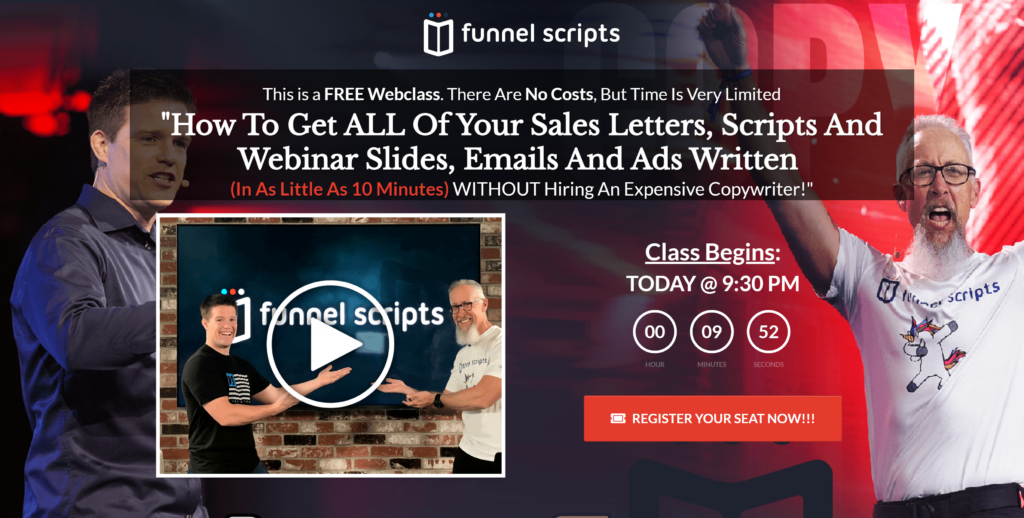
Homepage of Funnel scripts

Funnel Scripts is a software program that automatically generates copy based on specific inputs you give for various questions. It was created by internet marketer, Russell Brunson, and copywriter, Jim Edwards. The two have over 50 years of experience between them in the fields of sales, marketing, and copywriting.

The software is designed to help business owners save time and money on copywriting costs. It does this by providing templates and scripts for various types of sales letters, webinars, webpages, and more.

The Founders Behind Funnel Scripts

Jim Edwards and Russel Brunson going over papers

Russell Brunson hit internet fame with the creation of ClickFunnels, a funnel-building software that easily creates webpages and funnels for businesses. Brunson is also the author of multiple best-selling books including Dotcom Secrets and Expert Secrets.

Brunson has one of the largest digital marketing followings on the internet and his Two Comma Club Coaching program boasts over 24,000 members. He is a thought leader in the industry and is known for always over-delivering on his promises.

His partner, Jim Edwards, is a well-known copywriter who has worked with some of the biggest names in internet marketing. He’s also the creator of the popular podcast, The Sales Copywriting & Content Marketing Hacks Show.

Edwards has teamed up with Brunson throughout the years on several marketing campaigns promoting new products within the Clickfunnels universe.

The two created Funnel Scripts as a way to decrease the amount of time it took for entrepreneurs to write their own copy, but that’s not the only benefit of using the tool.

Benefits of Funnel Scripts

Once you log in and start using Funnel Scripts, it’s easy to see why so many entrepreneurs count on it on a daily basis. Here are a few ways your business will improve by implementing Funnel Scripts software.

No Need For A Copywriter

Managing freelancers who are unreliable and don’t deliver the level of quality you want is frustrating.

One week you might get professional-level copy and the next week your freelancer is “sick” and needs to take a few days off. Not only is this inconvenient, but you have to spend your own time writing and editing a piece of copy you didn’t plan on creating in the first place.

Hiring a full-time copywriter can be an even bigger ordeal. You could take weeks training the copywriter to follow your exact methods only to learn they quit the very next day.

Funnel Scripts eliminates the need for a copywriter altogether. You won’t have to deal with unreliable workers or spend your own time crafting copy.

You’ll get high-converting copy every time without having to manage a team of writers.

Improved Quality Across All Sales Materials

When you hire a copywriter, they usually specialize in one specific type of copy. They might be good at writing sales letters but not so much at webinar scripts. Perhaps they’re great at email sequences but fall short when it comes to creating compelling social media ads.

This can be a problem because you’ll need to either find a copywriter for each type of sales material you need or learn how to write the copy yourself.

When you access Funnel Scripts you’ll have high-converting templates and scripts for every type of marketing collateral imaginable. You’ll never have to worry about the quality of your copy again.

Saves You Time and Money

Hiring writers, managing deadlines, and coordinating communication channels takes time and a lot of money.

You could easily spend hundreds per month on multiple copywriters, which quickly eats into your profits. The time it takes to manage a team of writers can easily put you at 50-60 hour work weeks.

By using Funnel Scripts, you can get all the copy you need for a fraction of the price. You don’t even have to pay for Clickfunnels to gain access to Funnel Scripts (get the 14-day free trial!).

Using the software will ultimately give you time back in your day and keep your wallets feeling heavy. There’s a free trial along with a money-back guarantee to ease your worries.

Based On Proven Formulas

The biggest benefit of using Funnel Scripts is the templates. They are based on years of copywriting experience from one of the best to put hands to keyboards.

Jim Edwards has condensed his decades-long expertise into an easy-to-use software. The formulas have been tested and proven to convert time and time again.

You won’t have to wonder if your copy is good enough or scratch your head over what’s missing. All you need to do is put in the information Funnel Scripts asks for and watch as high-converting sales materials appear before your eyes.

Of course, everyone else who has the program has access to the same templates you do. To keep them unique, you’ll want to put your own vocabulary and personality into every sentence.

Funnel Scripts Features

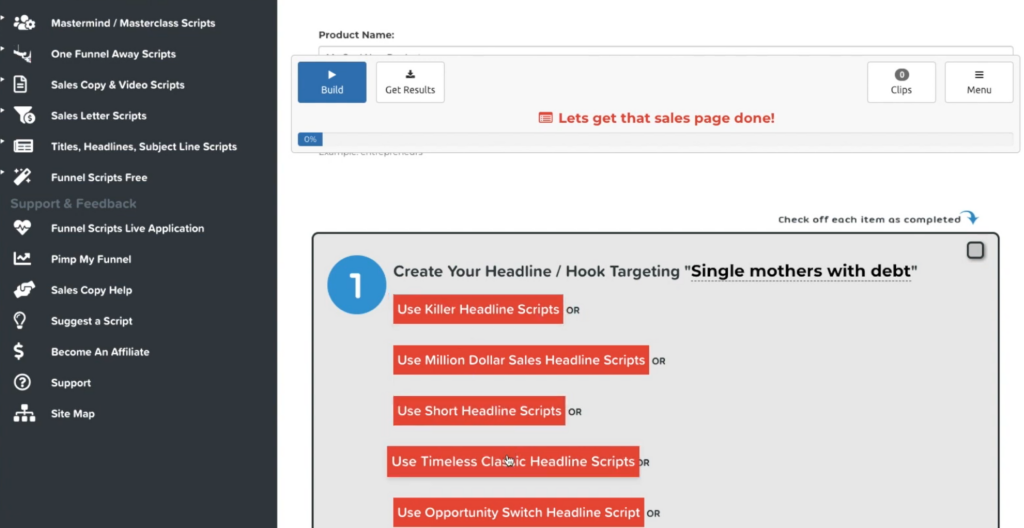
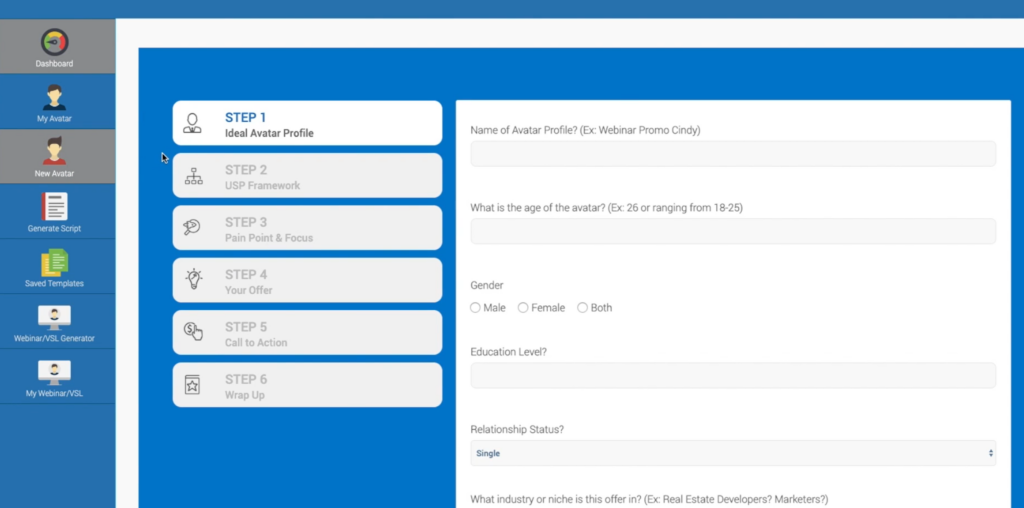
Funnel Scripts template

Funnel Scripts is fairly straightforward in its operation, but the power comes in the magnitude of templates it contains and the added bonuses it offers.

Here is a list of the various features to expect from Funnel Scripts:

  • Sales Letters: Sales letters were first popularized by Gary Halbert and are one of the most effective ways to close a deal. Funnel Scripts gives you access to long-form sales scripts, short sales scripts, and video sales scripts.
  • Email Scripts: Email marketing campaigns can have a large impact on your lifetime customer value if you can get people to click through to your offer. Webinar follow-ups, teaser scripts, promotional emails, and more are available.
  • Sales Copy and Video Scripts: You’ll get one of the biggest libraries of scripts in the sales copy and video scripts section. Everything from Amazon and eCommerce scripts to lead capture and testimonial scripts.
  • Downloadable Wizards: Instead of needing access to the internet, downloadable script wizards allow you to take the power of Funnel Scripts offline. Several key scripts are available for download and you’ll need a computer to run the programs.
  • Titles and Headlines: Most people who look at an ad, read a blog article, or open an email are concentrated solely on the title or the headline. You’ll get help crafting the perfect title or headline with scripts built just for your business.
  • Classic Ad Copy: You’ll have access to Facebook ad scripts, Google Ad scripts, Instagram ad scripts, and more with proven ad copy that converts.
  • Bullet Scripts: You can use bullet scripts in any of your other copy-related pieces of content. The bullet points on Funnel Scripts include features, benefits, meanings, and Russell Brunson’s own style.
  • Content Creation: Businesses looking for long-term solutions to acquiring customers can use content creation scripts. It’ll help you build out a system of bringing customers to your website without paying for ads.
  • Bonuses: To add even more value to the software, a few Funnel Scripts bonuses are included like live monthly coaching calls with Jim Edwards himself, dotcom secrets scripts, and expert secrets scripts.

Funnel Scripts Cost

Even though you’ll save in the long run compared to hiring a full-time writer, Funnel Scripts is still expensive for most entrepreneurs. To make matters worse, you won’t see many discounts or special offers for the course throughout the year.

You’ll fork over a one-time payment of $797 to use the copywriting software and gain access to all the features mentioned earlier.

While most beginning entrepreneurs won’t be able to afford the price plan and see the full Funnel Scripts worth, there are some alternatives you can consider.

Funnel Scripts Software Alternatives

Below are the copywriting tools that compare to Funnel Scripts and, in some ways, even surpass it. Learn how each one works and how they all align with your online business goals.

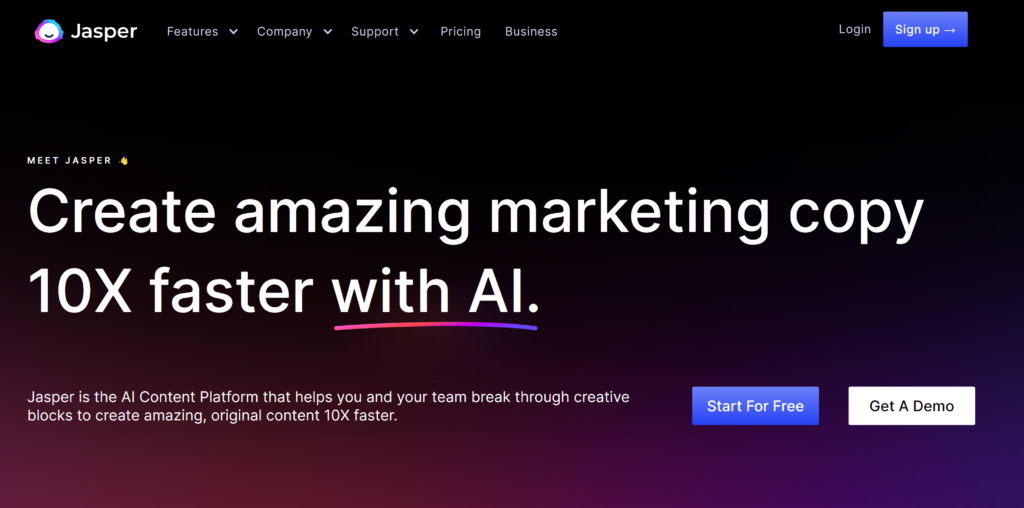
Jasper.ai

Jasper.ai dashboard

Seemingly out of nowhere, Jasper.ai has become one of the most popular and industry-changing copywriting tools available.

Funnel Scripts is essentially a copywriting software program that plugs your inputs into already written copy. Jasper.ai is entirely powered by AI and GPT-3 and automatically creates original storytelling copy that is written right in front of your eyes.

You simply give Jasper.ai a prompt like “Write an email for a sales funnel” and it’ll generate high-converting copy in seconds. The tool has a number of templates you can use like ad copy, social media copy, blog post copy, Quora answers, and more.

Jasper is the future of computer-assisted writing and is at the cutting edge of what you can expect from future copywriting tools.

You can learn all of the details in our full Jasper AI review here.

Pricing: Starter Plan – $24/mo for 20,000 words, Boss Mode – $49/mo for 50,000 words.


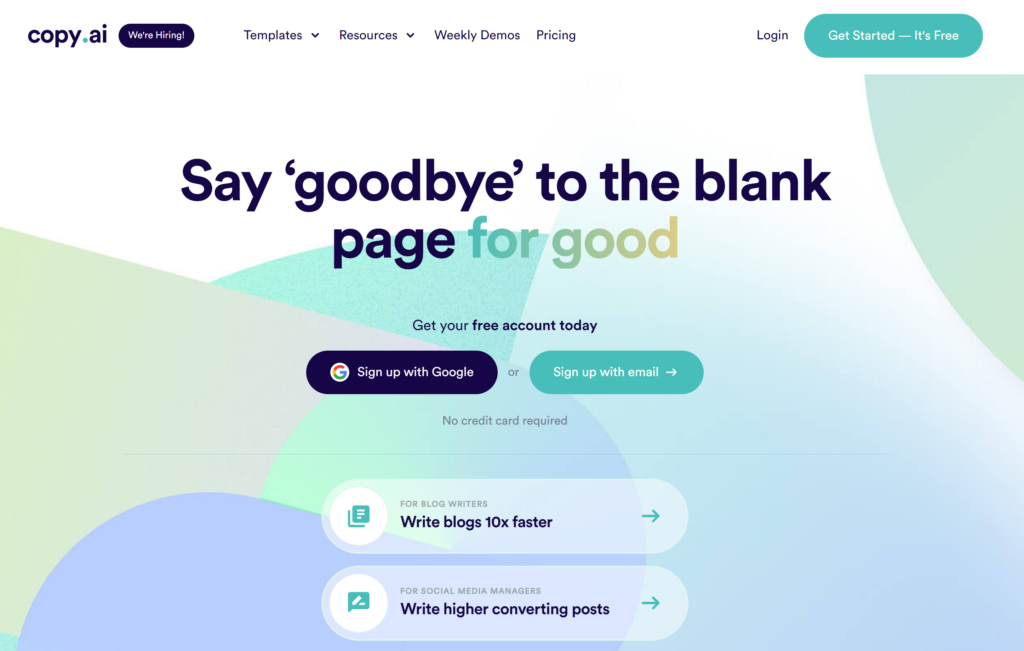
CopyAI

Copy.ai homepage

In terms of performance, CopyAI delivers a powerful copywriting assistant product that would suit most professionals and experts. It’s powered by AI, delivers original copy in seconds, and is used by tons of entrepreneurs, marketers, and copywriters.

You’ll be able to do just about anything with CopyAI including:

  • Blog content
  • Sales copy
  • Digital ad copy
  • Social media content
  • eCommerce copy
  • Website copy
  • Build sales funnel copy

There are over 90 different templates and tools that help you streamline your content production. Using the tool is incredibly easy and it’s comparable in performance to Jasper.ai (see our head-to-head Jasper AI vs CopyAI comparison here).

Add a statement about what you’d like to create, add some main points, choose a tone, and you’re finished. You’ll even get multiple results to choose from.

Price: Free plan for 2,000 words per month, Pro plan – $49/mo for 40,000 words


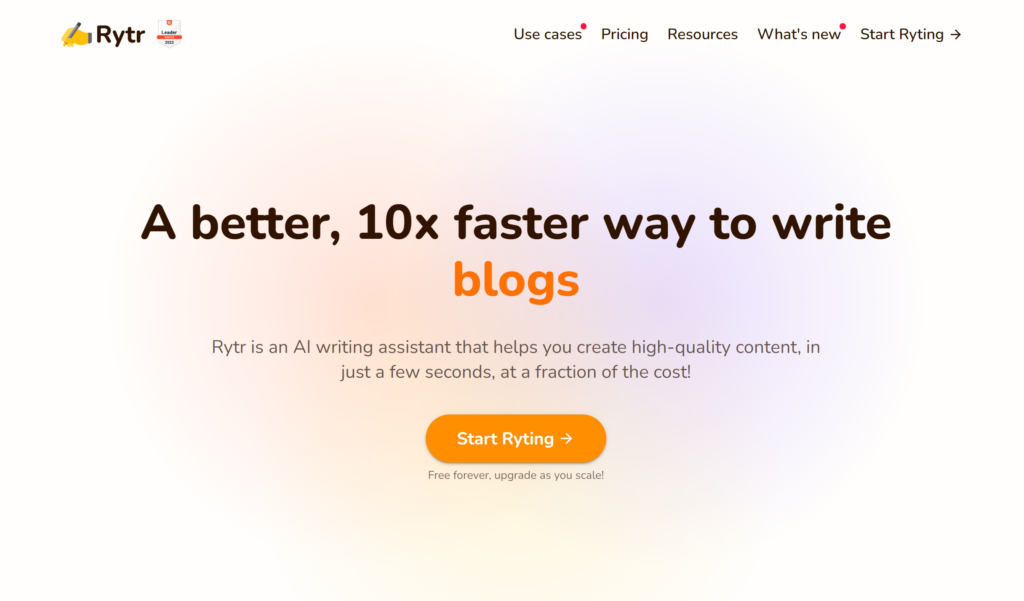
Rytr

Rytr homepage

Rytr is a simple version of the more complex AI writing tools on this list. It still produces completely original copy using machine learning; it just doesn’t have the impressive amount of templates to make your writing quicker.

You can choose a use case and then add your own inputs to give the tool context. Then, Rytr creates the copy for you in seconds.

It does have a nifty tone input that includes:

  • Joyful
  • Passionate
  • Thoughtful
  • Urgent
  • Worried
  • Inspirational
  • Informative
  • Humorous

Learn more in our Rytr review or compare Jasper AI vs Rytr here.

Price: Free, Saver Plan – $9/mo for 100k characters, Unlimited Plan – $29/mo


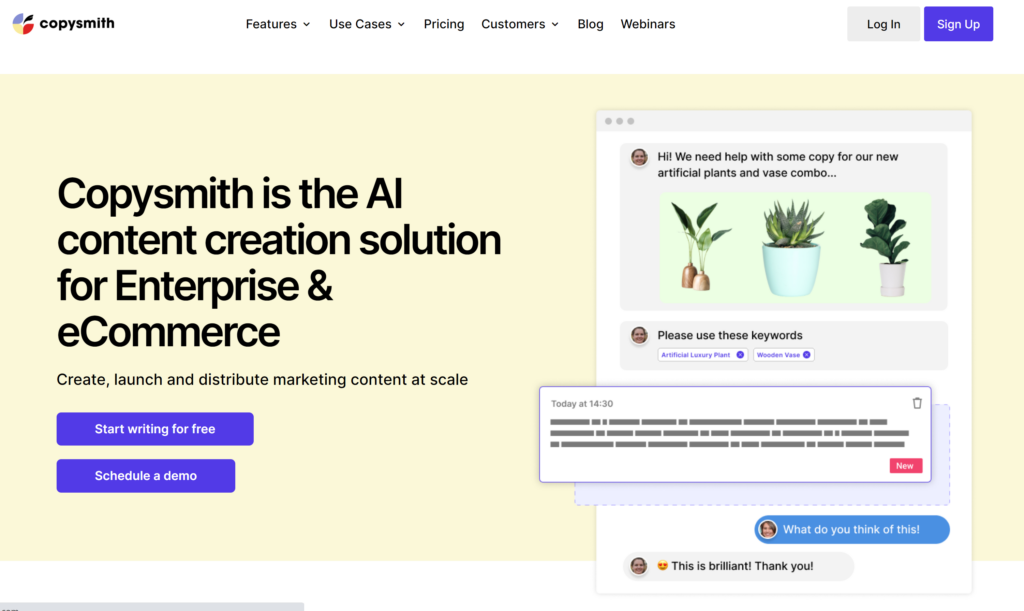
Copysmith

Copysmith homepage

Few other copywriting tools target eCommerce and enterprise owners like Copysmith. Store owners will be able to easily create advertisements or product descriptions using the tool.

There are a number of integrations you can connect to Copysmith for better efficiency. You can use the tool for a number of content pieces including:

  • Content enhancement
  • Advertising scripts
  • Social media
  • Blog templates
  • Brainstorming
  • Product descriptions

While it doesn’t have nearly as many templates as some of the other top platforms, the concentration on eCommerce helps online store owners save a lot of time and money trying to find the perfect writer.

Get all the details about this tool in our Copysmith review.

Pricing: Starter – $19/mo for 40k words per month, Professional – $59/mo for 260k words per month


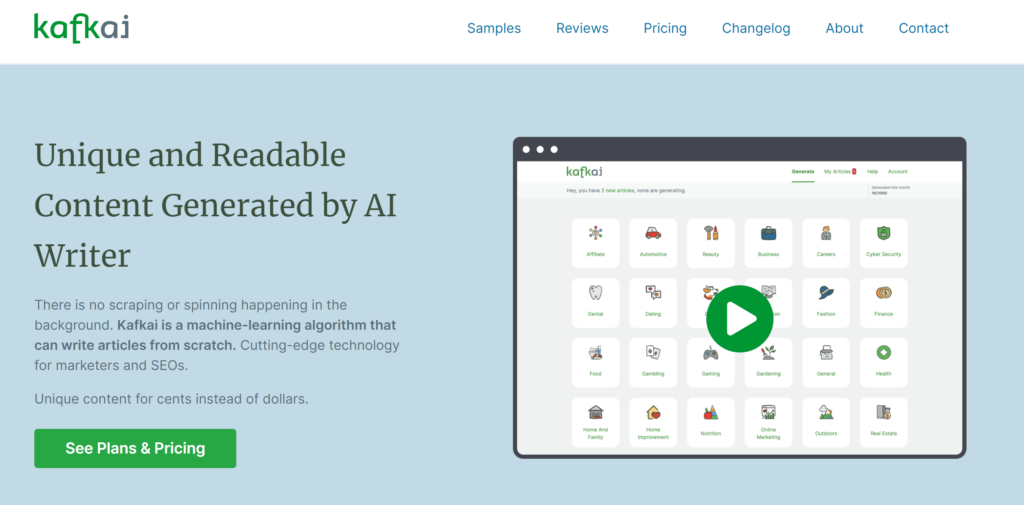
Kafkai

Kafkai homepage

You’ll have the same machine learning assistance with Kafkai when generating copy that converts. The company was founded by SEO experts and marketers and is one of the only platforms that specifically targets these two industries.

The tool has been specifically trained by the Kafkai team to integrate popular SEO niches for better results. There are three modes of operation that include a couple of trained models and one general writer model that isn’t trained in SEO niches.

Also impressive is Kafkai’s ability to translate articles into seven different languages including:

  • Dutch
  • French
  • German
  • Italian
  • Spanish
  • Swedish

Price:

  • Writer – $29/mo for 100 monthly articles
  • Newsroom – $49/mo for 250 monthly articles
  • Printing Press – $129/mo for 1,000 monthly articles
  • Industrial Printer $199/mo for 2,500 monthly articles

Builderall Script Generator

Builderall Script Generator input section

Builderall has a ton of features that are helpful for any marketer like a drag-and-drop website builder, email marketing, CRM, and a script generator. The latter can help you craft sales copy for your website, webinars, funnels, emails, and more.

The company has developed video tutorials for getting the most from the script generator, but the unique aspect is the avatar. You can build an ideal persona and generate copy that’s catered to their interests.

Builderall is perfect for businesses that need a suite of tools in one location. It’s simple, easy to use, and helps keep you organized. Be sure to check out our comparison of Builderall vs ClickFunnels for an even better understanding of the tool!

Price:

  • Cheetah – $16.90/mo
  • Marketer $76.90/mo
  • Premium $87.90/mo

Zyro Content Generator

Zyro Content Generator homepage

The best part about the Zyro Content Generator is that it’s completely free to use. You don’t have to pay a single dollar to gain access. Simply head over to the site and start generating copy.

The downside is that you have very limited flexibility in what the generator actually creates. You’re given a set of categories to choose from and, once you make the last selection, the copy is generated for you.

More than likely, the content doesn’t have any significance to your specific business and you’ll need to customize it to fit your needs. There is, however, an option to write a few sentences about your business and have Zyro create content based on your input.

Some of the categories include:

  • Restaurants and food
  • Events and weddings
  • Health and living
  • Sports and entertainment
  • Beauty and cosmetics

Pricing: Free


Closers Copy

Closers Copy homepage

Closers Copy believes their product concentrates on marketing copy more than any other. While most platforms create templates for a range of content material, Closers Copy seems to be one of the few that have marketing down to a science.

There are over 700 different frameworks available that make generating copy even easier. To help new users, Closers Copy has created multiple training videos that introduce the user to the platform and how best to use it.

Pricing: Power – $49.99/mo for 300 AI runs, Superpower – $79.99/mo for unlimited AI writing


Automatic Scripts

Automatic Scripts homepage

While some of the platforms on this list are confusing for the user, Automatic Scripts is incredibly easy to use. The dashboard is straightforward and has a number of scripts to choose from including:

  • Sales letters
  • Facebook ads
  • Email campaigns
  • Webinars
  • Upsells
  • Testimonials

Once you pick a script in the platform, you’ll have to choose a formula or model which guides the AI tool to write your copy. For example, if you picked “email campaign” as your script, you’ll have to choose between the “Hero’s Journey,” “Problem-Agitate-Solution,” and other formulas.

After that, all you need to do is enter some key information about what you’re selling and let Automatic Scripts go. You’ll be able to build sales funnels with ease using the Scripts copywriting software.

Pricing: Standard – $39 per month, Enterprise – $69 per month.


Instant Scripts

Instant Scripts homepage

Dan Lok is a very successful copywriter, online marketer, and entrepreneur. His company, Instant Scripts, sells a number of copywriting products that are supposed to help entrepreneurs close deals and make more money.

Instant Scripts has hundreds of templates available and thousands of different copy elements to choose from. Unfortunately, Instant Scripts, much like Funnel Scripts, is simply a program that plugs your inputs into existing formulas.

In that sense, the product doesn’t create anything new per se, it just uses the proven formulas that convert and customizes it for your business. Although helpful, it’s only a matter of time before AI platforms push these types of programs into the background.

Pricing: $295 for one year


Script Engage

Script Engage homepage

Script Engage has everything you’ll need to create engaging copy for your business. Your upsell pages, headlines, download pages, lead generation pages, ads, and webinars are all easy to create using the tool.

Most entrepreneurs will be interested in the Complete Email Sequence feature included with a monthly payment. You’ll be able to easily create an email funnel sequence that converts your leads into paying customers.


Scriptdoll

Scriptdoll signup page

The fancy machine-learning original copy you can produce with other tools on this list won’t come with Scriptdoll. You’ll get old-fashioned, battle-tested templates delivered to your email with fillable input fields for customization.

Scriptdoll organizes the templates by campaign and you’ll have four to choose from including:

  • Email marketing campaign
  • Long-form sales copy
  • Short-form sales copy
  • Video Script

The templates are all written by professional marketers and copywriters. Once you have access, you’ll enter all your business information using the editor.

Price: $99.95 per month, $799.95 per year

Should You Use Funnel Scripts Software?

Funnel Scripts software uses your own inputs and integrates them seamlessly into conversion-focused templates that have been tested by expert marketers Russel Brunson and Jim Edwards. In this Funnel Scripts review, you’ve learned about the various script templates available and the helpful downloadable script wizard that lets you work offline.

The high one-time payment may not fit lean entrepreneur budgets, but it’s cheaper than paying monthly subscriptions for more advanced AI copywriting assistants. As mentioned in the intro, ClickFunnels offers a 14 day free trial and a money-back guarantee to ease your decision, so you can try Funnel Scripts and more risk-free!

Try Funnel Scripts here!


By Raul Mercado

Raul is a content connoisseur who appreciates articles that age well. He believes in digital marketing as a financial freedom tool and shares his research, facts, and opinions through his writing. When he isn’t writing he is traveling with his partner Rachel and working on campinghelper.com.

Sourced from Niche Pursuits

By

(Pocket-lint) – No one likes to be interrupted by an annoying advert, but on our phones, it has become an all too common experience.

Most people know that they can block ads on their desktop or laptop computer, but our phones tend to be plagued with the things. Long gone are the days when you could install Ad Block Plus from the Play Store, Google doesn’t allow system-wide ad blockers anymore.

So, how do you go about blocking ads? Thankfully, it’s very easy, and we’ve got everything covered in this guide.

But first, a few things to mention. It’s important to remember that ads help keep sites going (including this one) and they’re important for content creators, too. So even though they can be irritating, in some cases, it’s worth allowing ads to help support the content that you love.

Also, we’ll be focusing on browser-based ad blocking, so keep in mind that these solutions won’t block ads in other apps, like games, for instance.

With that said, let’s get into the guide.

How to block pop-ups and intrusive ads in Chrome

Chrome is the default browser on the majority of Android phones, and as such, it’s the one the vast majority of people stick to.

You don’t need to swap to another browser to block ads, though. Thankfully, Chrome has some handy tools built-in to help with this.

The only caveat is that Chrome doesn’t block all ads, just pop-ups and ads that it deems intrusive or misleading. Here’s how you activate the features:

  1. Open Chrome on your Android phone
  2. Tap the three dots in the top right corner
  3. Tap on Settings
  4. Scroll down to Site settings and select it
  5. Tap Pop-ups and redirects
  6. Make sure the slider is toggled to the left
  7. Go back to the previous page
  8. Tap Ads and do the same thing

Now, Chrome will prevent the majority of pop-up ads from loading, and block ads entirely on sites that have misleading and intrusive ads. In some ways, it’s the best of both worlds as it allows you to support the content that you care about without suffering through egregious pop-ups.

But what if you want to take things a step further and block everything? Read on.

How to block ads with different browsers

If you’re willing to ditch Chrome, there are plenty of browsers that offer more robust ad-blocking options. Just keep in mind that you won’t be able to sync your history and bookmarks with Chrome on desktop, if you use that.

Our favourite option is Firefox, it allows for add-ons to be installed, and they work like Chrome extensions on desktop. uBlock Origin is a powerful, free and open-source ad blocker that can easily be added to the Firefox Android browser, and it’ll block just about everything.

Another great and full-featured option is the Opera browser, which has a solid ad blocker built-in and even a free VPN. There’s even a straight-up Adblock Browser, if all you care about is blocking ads.

How to block ads with an app

So, that’s browsers sorted, but what if you want to block ads in other apps? As we mentioned up top, Google has long since removed ad-blocking apps from its Play Store, but that doesn’t mean that you can’t block ads elsewhere.

You’ll have to side-load these apps, which can be a little daunting if you’ve never done it before, but it doesn’t mean the apps are untrustworthy – just that Google’s not so keen on you using them. Which is understandable, given its business model.

Apps like AdGuard and AdLock come from notable cyber-security brands and so should be perfectly safe to use. The downside is that they’re subscription based, so you’ll have to pay a monthly fee once your trial ends.

By 

Sourced from Pocket-lint