Author

editor

Browsing

By Nick Barthram

The antidote to a lack of audience attention isn’t being quicker, it’s being interesting. Despite being bombarded with ads, clickbait, and 15-second viral videos, when creating a brand story, quicker isn’t better, better is better. The truth is, humanity isn’t changing as fast as the algorithms would have us believe. We still crave nuance, a good story, and a meaningful experience. And that’s what your brand needs to deliver if it wants any chance of making a difference.

It’s no secret that people are struggling with reduced attention spans as they are bombarded by a cacophony of information. Everything else is becoming quicker and ‘snackable’ to fit into people’s fragmented lives: TikTok’s short-form meteoric rise is mirrored in some mainstream TV programming running in 15-minute episodes and a cultural shift from ‘experiences’ to ‘moments’. Even my local supermarket is in on it, selling ‘speedy sausages’ so you can spend less time cooking and more time scrolling.

For those of us involved in the brand-building business, this is turning into consistent recommendations from media agencies to only use 6 seconds or 15 seconds because “that’s all the audience has time for.” By this logic, it seems their antidote to the lack of attention is to be quick: Iknowyou’rereallybusybutlookatmyproductthanks.

But how can you be interesting in 6 seconds?

The thing is, human beings haven’t fundamentally changed in the last 50 years – I doubt we’ve changed much in thousands – and our attention is still captured by stories, by heroes and villains, by high stakes, by novel ideas, and by exciting discoveries. And for those of us who are not able to tell a story in a haiku or rival Hemingway’s famous six-word story, “For Sale: Baby shoes, never worn.“, that means being interesting means taking time.

What works for modern brand-building is taking the time to be interesting.

– Nick Barthram, Founder and Strategy Partner @ Firehaus

I was recently involved in a protracted argument with a media agency about including any ad longer than 15 seconds in a brand-building YouTube ads campaign. We eventually compromised with an A/B test. And guess what? The 60-second ad massively outperformed the 15-second one. So much so that if we had only used the 60-second ad, we would have tripled the time viewers spent with the brand after the YouTube skip button appeared. Click-through rates – while less important – were also better for the longer ads.

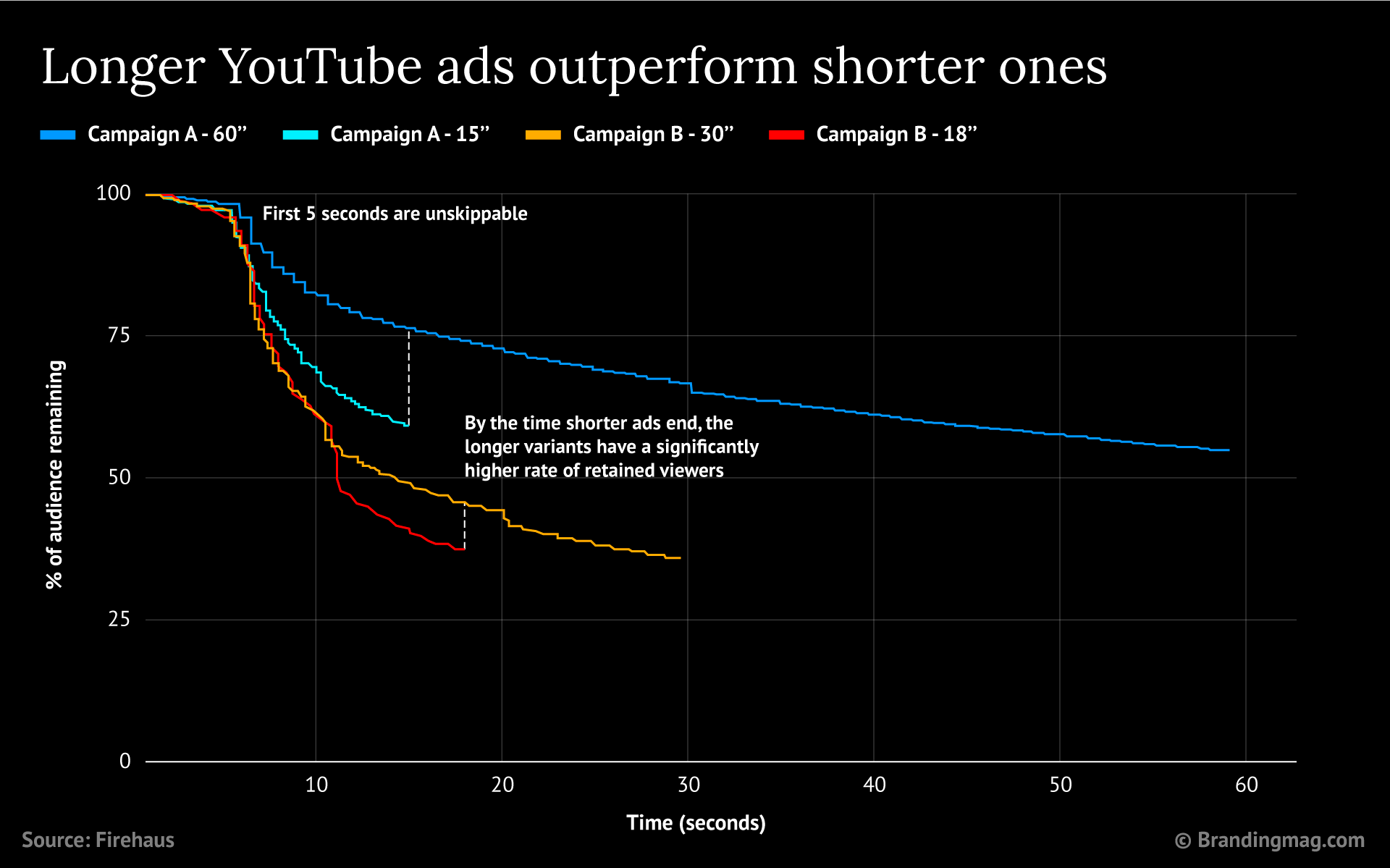
We were told, “Maybe it’s just a coincidence.” So, we tried it again on another campaign – not our creative this time – and lo and behold the longer format outperformed the shorter one. The chart below shows just how much more attention the longer formats were able to hold – if we had only shown the first 15 seconds of each, they would have still outperformed the carefully constructed shorter ads:

The recent ‘How it started vs. How it’s going’ trend on Marketing Twitter features people comparing famous old ads with their modern counterparts. It ignited a debate, and the defenders of the new cry that us dinosaurs championing the classics (I’m still in my thirties) have a failed understanding of modern media. Maybe some of the examples are a little too cherry-picked, but they’re missing the point – what works for modern media platforms is short content so that they can fit more ads in and make more dollars. What works for modern brand-building is taking the time to be interesting.

The irony is that most campaigns that win effectiveness awards (you know, the ones that worked) are all based around longer content. Recently, Cadburys and VCCP won the prestigious IPA Effectiveness Grand Prix with a campaign kickstarted by a brilliantly evocative and emotional story, delivered in 60 seconds.

Now that is how you do it right. The campaign was responsible for a 22% increase in sales equating to £261m over the three years it ran. It worked. Yes, there were 15-second cut-downs, there were activation ads with strong product messaging, and it wasn’t all down to one 60-second spot. But the point is, all of that was built out from the story. They didn’t start with a time limit and see what they could squeeze in.

As Howard Gossage said: “Nobody reads advertising. People read what interests them, and sometimes it’s an ad.” It was true back then and it’s true now. Give your brand time to be interesting, put resources behind being interesting, and people will reward you with their attention.

So, the next time you think about building your brand, give your brand more than 15 seconds to tell a story.

Feature Cover Image: Stanislav

By Nick Barthram

Nick Barthram is the Founder and Strategy Partner at Firehaus. Nick ensures everything is focused on business growth – rooted in evidence and insight. Having held marketing strategy and research roles in a number of agencies, he’s helped countless businesses find their purpose and embed it in their communications and behavior. He has driven growth for large brands such as Continental, Danone, and ITV, and helped scale others like ASOS, Zwift, and Cycliq.

Sourced from Bm

By Webb Wright

Whether it’s Meta, a MetaMask or the metaverse, here’s an explanation for many of the most commonly-used web3 terms.

Airdrop. In the crypto world, an airdrop is a free distribution of tokens or coins from a company directly into its users’ or members’ wallets.

Altcoins, or alts, are cryptocurrencies that are relatively new to the market and have relatively low valuations. A conjoining of the words ‘alternative’ and ‘coin,’ the term ‘altcoin’ initially was used to refer to any cryptocurrency that wasn’t Bitcoin.

Augmented reality (AR). A technology that combines elements of virtual reality (VR) with physical reality. In its current form, AR can be facilitated by devices worn over the eyes – such as glasses or goggles – or by a smartphone or computer screen. Pokémon Go is one common example of AR, because it blends virtual information with one’s physical environment.

Avatar. An avatar is a digital rendering of a human being or other entity in VR, a video game, the internet or another virtual space.

Bitcoin is at the time of writing the most valuable cryptocurrency in the world. It was also the world’s very first cryptocurrency, postulated by ‘Satoshi Nakamoto’ (which is typically presumed to be a pseudonym) in a now-famous white paper called ‘A Peer-to-Peer Electronic Cash System’ in 2008.

Blockchain. A ‘blockchain’ is a distributed digital ledger that’s used to record transactions. It’s an immutable database, which means that information can’t be tampered with or altered once it’s been recorded. If there’s an error in an entry, then a new, revised entry must be made, and both entries will subsequently be visible on the ledger.

The name comes from the fact that a blockchain stores data in ‘blocks,’ individual units that are linked, or ‘chained,’ together. New data is filed into blocks – and blocks are subsequently chained together – in chronological order, so a blockchain becomes longer and longer as more information is added to it. Each new piece of information is also assigned a timestamp, which makes it easy for users to find out exactly when it was linked to the database. The transparency and immutability of the blockchain makes it a very reliable and trustworthy business resource both for individuals and companies.

Block. A block, the constituent element of a blockchain, is an individual unit in which data is stored.

A bridge, in a web3 context, is a protocol which links blockchain systems together, allowing users from one system to send assets and information to another.

To burn an NFT is effectively to send it into oblivion, the closest thing to destroying it completely. Nothing that’s been coded on the blockchain can be deleted, so anyone who wants to delete (burn) an NFT has to send it to a smart contract that nobody can access.

Centralized system. This is a system that is controlled and organized according to a rigid hierarchical structure. In such a system, power and decision-making authority is concentrated in the hands of a relatively small number of individuals at the top of the hierarchy. Corporations, for example, are centralized systems.

A consensus mechanism is a system that validates transactions and encodes new information on a blockchain. The most common consensus mechanisms are Proof-of-Work (PoW) and Proof-of-Stake (PoS).

Cryptography. A word derived from the Greek ‘kryptos’ meaning ‘hidden’ – this is the process of using mathematics to encode and protect sensitive information from malicious actors.

A crypto winter is a period of steep decline within the cryptocurrency market, resulting in the loss of huge sums of money for some investors.

DAO. A Decentralized Autonomous Organization, colloquially referred to as a ‘DAO,’ is an organization that is controlled by its members and not subject to the authority of any single individual or entity. Unlike a traditional corporation or government, they are completely free of hierarchical, top-down structures. Its codes of conduct are recorded on a blockchain to ensure transparency and decentralization. Participation in a DAO is usually accessed through the acquisition of a digital token.

Dapp. A decentralized application, colloquially called a dapp, is an application constructed on the blockchain. Dapps function autonomously, according to the stipulations in smart contracts. Like any other application on your phone, dapps come with a user interface and are designed to provide some kind of practical utility.

A decentralized system is one that’s controlled in equal measure by each of its constituent parts. Blockchains – the technological framework for web3 – are decentralized, meaning that no single individual, corporation or other entity is able to exert a disproportionate degree of control over how they are constructed and run.

DeFi. Decentralized finance, or DeFi, refers to a financial system built upon the blockchain, and therefore fully distributed and not subject to any centralized authority, such as a bank, government agency or financial management firm.

Digital twin. This is a virtual rendering of a physical object. But a digital twin is more than a mere three-dimensional simulacrum – they’re designed, ideally, to be as dynamic and environment-dependent as the objects they’re imitating. For example, let’s say a team of engineers is making structural improvements to a bridge. They could design a simulation of that bridge, a simple 3D model, which would allow them to make basic measurements and study the overall structure. But that simulation wouldn’t be able to tell them much about how the wind, the traffic or any other number of more subtle environmental factors have been impacting the integrity of the bridge. To study those processes, they might distribute sensors over the bridge in order to create a digital twin. This would allow the team to create a much more informative model.

Ethereum is a decentralized blockchain network built by Vitalik Buterin in 2015. The open-source network is home to its native cryptocurrency, also called Ethereum but more commonly known simply as Ether or ETH (there’s some debate about whether it’s pronounced ‘eth’ or ‘eeth’). The Ethereum platform also gave rise to smart contracts – a subject we’ll dive into another week. As of March, ETH is the second most-valuable cryptocurrency in the world, after Bitcoin.

Extended reality. Also commonly referred to as ‘XR,’ extended reality is a category of multiple technologies – including VR, AR and mixed reality (MR) – which, in various ways, blend virtual worlds with physical reality.

Fiat money. Not to be confused with the car brand, fiat money is a term used to refer to any kind of currency that has been declared legal tender by a government body. (The declaration itself is often called a fiat.) Fiat money isn’t backed by any intrinsically valuable commodity, such as precious metals like gold and silver. Instead, the value of fiat money is determined by the fluctuations of supply and demand. Paper money, like the US dollar, is fiat money.

Fiat money is subject to an economic force called ‘variable supply,’ which means the governing body that issued the fiat can control its value by tweaking a variety of levers, such as the adjustment of interest rates. Cryptocurrency, which is not subject to the authority of any centralized authority, is often positioned as the opposite of fiat money.

Floor price” refers to the lowest price for which a product or service can sell at an auction. This is a common phrase to encounter on NFT auction platforms, such as OpenSea.

Fungibility. A term used in economics to refer to a commodity that is precisely equal in value and therefore exchangeable with other identical versions of that same commodity. A $1 bill, for example, is fungible, because it can be exchanged for any other $1 bill – they have the same value and therefore, for all intents and purposes, are identical.

Gas. In the context of web3, gas refers to a fee that’s required in order to execute a smart contract or transaction on Ethereum blockchain. Gas, which is often denominated in a very tiny fraction of an ETH called a WEI, is paid to node operators, AKA miners.

GM,” a common greeting on social media among web3 enthusiasts, means “good morning.”

Gwei. The smallest denomination of the cryptocurrency ETH is called Gwei. 1 ETH is worth 1bn Gwei.

HODL is a common acronym used in the crypto space, which stands for ‘hold on for dear life.’ It’s typically invoked at times when the crypto market is undergoing some dramatic fluctuations and investors are feeling nervous, as in: “Don’t sell just yet, the markets will recover and your investments will bounce back if you just HODL.”

Interoperability, in web3-speak, refers to the ability of multiple blockchains to cooperate and exchange information with one another, enabling virtual assets (such as non-fungible tokens [NFTs]), avatars and other pieces of code to move seamlessly from one platform to another.

IRL. Shorthand for ‘in real life,’ IRL is an acronym commonly used in the web3 space to describe a person, place, thing or event in physical – as opposed to virtual – reality.

Layer 1 (L1) blockchains are the foundations of multi-level blockchain frameworks. They can facilitate transactions without support from other blockchain networks. All layer 1 blockchains – including Bitcoin and Ethereum – offer their own native cryptocurrency as a means of accessing their networks.

Layer 2 (L2) blockchains are built on top of layer 1 blockchains, often enhancing the latter’s performance and expanding its accessibility. Polygon, for example, is a popular layer 2 blockchain that allows users to enjoy the benefits of using the Ethereum network without having to go through that network’s relatively slow transaction speed and costly fees.

Liquidity is a term used in economics to describe the degree to which an asset can be converted into either cash or some other asset.

A main network, or mainnet, is a finalized version of a blockchain that is fully developed and available for public use.

Meatspace refers to the physical world, ie the tangible counterpart to the virtual world of the metaverse. It may not be the most elegant of terms, but it’s been catching on among tech circles.

Meta. Facebook Inc changed its name to Meta (officially Meta Platforms Inc) as part of the company’s pivot toward the metaverse. There are many who mistakenly believe that the metaverse is a technology owned by Meta.

MetaMask is a software built for the Ethereum blockchain that functions as a crypto wallet.

Metaverse. ‘The metaverse’ is not synonymous with ‘web3.’ The former is the virtual landscape that’s accessible via VR technology, whereas the latter is a term that’s commonly used to describe the next evolutionary stage of the internet. ‘Web3’ is inclusive of blockchain, cryptocurrency, the metaverse and other emergent technologies.

Minting is a term used to describe the process of registering a digital asset on the blockchain, thereby turning it into a purchasable NFT. Once an NFT has been minted, given the nature of the blockchain it cannot be altered. Minting NFTs on the blockchain requires a vast amount of energy, which has led many to criticize the blockchain and its proponents.

Mixed reality, or MR, is a technology that, like AR, blends virtual and physical components. Unlike AR, however, MR allows the user to interact with virtual elements in more or less the same way that they would in the real world. Looking through an MR headset at your real, actual dining room table, for example, you might see a virtual potted plant sitting on top of it, which you can then pick up and put down, just as you could with a physical, tangible houseplant.

NFT. A non-fungible token, or NFT, is a collection of data stored on a blockchain that is non-interchangeable – in other words, it can’t be replicated into multiple copies of equal value in the same way that, say, US quarters can be replicated and exchanged with one another. (See definition for ‘fungible’ above.)

NGMI is a popular slang acronym in the NFT space, meaning ‘not gonna make it,’ and used to refer to a campaign or specific token that is unlikely to attain a high value. Its opposite, WGMI – ‘we’re gonna make it’ – is also commonly used.

Off-chain transactions do not take place on a blockchain network, but they can subsequently be incorporated into a blockchain. The parties to off-chain transactions must consent to use an intermediary third-party to validate the transaction. (Note: “Off-chain” can also refer to data that exists separately from the blockchain.)

On-chain transactions are executed, verified and recorded on a blockchain network. Once completed, the record of these transactions is viewable for all members of the associated blockchain network. (Note: “On-chain” can also refer to data that exists on the blockchain.)

P2P. Peer-to-peer, or P2P, is a term used to describe a network of individual computers exchanging information with one another without the oversight of a central server. Management of a P2P network is distributed among its constituent computers.

PAOP. A Proof of Attendance Protocol, or POAP, is a virtual token that serves as evidence – also commonly called a ‘badge’ – that an individual attended, either virtually or IRL, a particular event.

Private key, in crypto-speak, is an alphanumeric code that must be entered by a user in order to access one’s wallet or authorize an exchange of blockchain-based assets or currency.

Proof of Stake, or PoS, is a system for validating transactions and establishing new blocks in the blockchain. It’s a consensus-based mechanism, with each validator’s role in the process being directly proportional to the size of their stake in the cryptocurrency that’s involved in the transaction.

Proof of Work, or PoW, is another system for establishing consensus and building new blocks in the blockchain. A PoW mechanism requires each participant in a cryptographic process to submit proof that they have expended a certain amount of contributory computational effort.

Public key is an alphanumeric code that’s connected with a particular wallet. Analogous to a bank account number, a public key is a code that other users would input to send assets directly into your wallet.

Redpilled is a slang term used to describe a situation in which someone’s worldview – or their perspective on a specific issue – has undergone a sudden and dramatic shift. The phrase refers to the famous red pill from The Matrix film franchise, which basically symbolizes the decision to swallow a hard and uncomfortable truth about oneself or about the nature of reality.

Smart contracts are blockchain-based computer programs that are designed to automatically go into effect as soon as the parties privy to the contract have fulfilled their respective obligations. Once they’ve been coded and their terms have been agreed upon, they become fully automated, which negates the need for any facilitating third party. Because they’re built upon the blockchain, transactions made via smart contracts can be closely monitored – but can’t be tampered with after the fact – by the parties involved.

A test network, or testnet, is a blockchain where developers can test the functionality of new protocols, before activating them on a mainnet.

Tokenomics, a blending of the words ‘token’ and economics, is an umbrella term that refers to all of the various qualities of a virtual currency that can cause its market value to fluctuate.

TradFi is tongue-in-cheek shorthand that some in the crypto community use to refer to ‘traditional finance’ – basically the pre-DeFi paradigm of centralized financial authority, in which governments, banks and other institutions control and regulate currency.

Virtual reality (VR) is a technology that creates three-dimensional, immersive digital environments, wherein visitors can interact with other people (or rather, their avatars) and other elements of the environment. VR technology, though still in its infancy, has been advancing rapidly. Meta’s Oculus Quest headset is an example of a piece of hardware that can transport the wearer to VR worlds.

Wallet. A crypto wallet is an application that stores and protects the keys to blockchain-based assets and accounts. (See definitions for ‘private key’ and ‘public key’ above.)

By Webb Wright

Sourced from The Drum

By

Businesses will soon need professionals whose job is to create a presence and potentially build with Web3 technologies and concepts in the metaverse — and there’s plenty that businesses can do now to prepare for that.

Twelve years ago, companies didn’t hire talent — they didn’t think they needed it. But now? Businesses need social media directors and entire social media teams. The same is true for playing in the metaverse.

It is my belief that within the next three to five years, a minimum of 30% of business is going to come from a blend of metaverse experiences and implementations of Web3 technologies (e.g. artificial intelligence, and nonfungible tokens, or NFTs). It is essential for creative agencies (e.g. agencies, marketing agencies, etc.) to prepare how they will play a role in the metaverse now so their customers will be able to find them.

The big three

The first step in preparing for the metaverse is for creative agencies to decide which of the three roles they will play — either the expert experimenter, the contributor or the activator. Making this decision now will help companies get ready for when their customers arrive in the metaverse, and it’s only a matter of time before they do.

  • Expert experimenters. These are businesses that have an understanding of the metaverse already. To find out whether they are in this group, can ask themselves if their business strives to be the deep subject matter expert on all things in the digital universe, or whether it’s an early adopter at the vanguard of new technologies. In that case, they need to understand the technologies involved within the metaverse and how Web3 is speeding up evolutions and revolutions.
  • Contributors. These are businesses that are still in their infancy in terms of embracing this new wave of technology and deep subject matter expertise is not required. Creative agencies in this group can introduce their client partner brands to the metaverse and converge their physical and digital presence in a way that is profitable and meets .
  • Activators. This last group is made of businesses that focus on seeking ways to offer holistic experiences for businesses and audiences to have within the metaverse. Businesses in this group are like a hybrid between the expert experimenters and the contributors.

Nevertheless, whether you know a little or a lot about Web3, you can’t afford to be left out completely; defining your role is an essential first step in preparing for the integration of the metaverse. People are investing in the metaverse heavily. It’s expected to reach $5 trillion in value by 2030, and this number is exponentially growing each and every month.

Next steps

After leadership at creative agencies decide which role they want to play, they need to develop a strategy and strengthen their online presence. To do this, they will want to hire people whose job it is to prepare the company to implement itself into the metaverse, in whichever role the company has chosen to take. Doing this will help them strengthen their brand identity — and thus, brand loyalty — before the metaverse fully arrives (and it’s coming sooner than we think).

Additionally, leaders and creatives should focus on user experience. What kind of experience do they want their customers to have with their business in the metaverse? This is essential for brands getting established in the metaverse because if they can think one or two steps ahead of what their customers will want when they emerge into the metaverse, brands will be there waiting, ready to give customers what they’re looking for.

Finally, it’s critical for creative agency leaders to remain adaptable as they learn more about the metaverse while it’s still unfolding. Staying adaptable and remaining at-the-ready for change will help agencies stay ahead and prepared to meet customers when they find them in the metaverse.

The importance of Web3

Even if your agency isn’t embracing extended reality and other metaverse projects, experiences and communities quite yet, many of your client partners’ customers are. And arguably, meeting customers where they are is the single most important piece to building brands and businesses that grow and transform.

The metaverse isn’t just a probability — it’s inevitable. Throughout the evolution of the internet, waves of advancement emerged because of technological advancement. The internet went from simply being a new technology to sharing the world of information through web browsers to developing social media. Underneath all that were advancements in the programming language, faster internet speeds and, of course, the smartphone.

Now, we are in a new wave: the wave of augmented reality (AR), VR and mixed-reality experiences with the technologies to make them work even more soundly and profoundly. If you haven’t begun exploring immersive platforms and how you can approach conversations and tactics related to the metaverse with your client partners, the time has come.

The natural progression

If trends in technology really do repeat history, then it won’t be long before hanging out in the metaverse becomes more mainstream. We must watch where people go. An immersive in which customers socialize, shop, relax, work and play isn’t so far-fetched anymore.

Given there was a time when people thought the idea of online dating, smartphones, social media and real human connection online was scary and too futuristic, it makes sense that agencies might be facing those same fears about the metaverse. The popular movie Her may have seemed sad and dystopian, but there were some interesting predictive themes being provoked in that film. Concepts like love, connection, relationships, identity and community will evolve as they always have over time.

However, knowing what we know now, we understand that embracing new technologies is far better than avoiding them. And for creative agencies, it’s much more profitable. The metaverse is becoming so much more than a buzzword, and the reality is that advertisers and marketers will be doing business in a virtual world at an exponential rate as seamlessly as they advertise on social media — and very soon. Blending our real and virtual lives has already begun, and the sooner you get on board, develop a point of view and experiment, the better.

By

Sourced from Entrepreneur

By

A beautiful design will attract the eye, but the message is what gets a potential customer to move forward. Before spending thousands of dollars on custom visual branding, elevate your brand with messaging that resonates.

A big mistake too many entrepreneurs make is spending thousands and thousands of dollars on a visual brand identity without proving their offers or their messaging. But what good are pretty visuals if too many people are confused when you talk about what you do? An indicator that you should prioritize your brand messaging over your brand imagery or brand design is a high bounce rate on your website, as shown in Analytics. Another indicator is that your business only gets referrals.

While you could ask a brand designer to create a custom , color palette and typography or a videographer and photographer to provide you with beautiful brand imagery, this almost always becomes an expensive mistake if you haven’t proven your offers, or if your messaging doesn’t resonate.

To get started with elevating your messaging, consider creating a guide to your brand messaging and brand voice. This is one of the most important internal business documents any business owner should refer back to again and again as your brand evolves. In this article, I’ll break down the 3 most important elements of an effective brand messaging guide, so your brand can attract more perfect-fit customers. I like to break down the brand messaging guides into three parts: the brand strategy, the ideal client and the brand voice.

The brand strategy

At a high level, the brand strategy consists of the following foundational components:

The unique value proposition: This is a non-negotiable for every business’s brand strategy. Your value proposition is how you differentiate yourself. With a weak value proposition, customers won’t have a compelling reason why they should consider you over your competitors. When this is strong, you make your brand un-copyable, and you will always be in demand, no matter what the competition comes out with, because you know who you are.

Brand mission: This is one of the strongest things you can communicate about your brand because it communicates why your company exists in the first place.

Core values: What does your brand stand for and not stand for? When you have your brand values in place, all company decisions — from , customer experience and team hiring — can be made much faster. This should come from what your ideal customers value.

Brand stories: What led to the birth of your brand? Did you have unfortunate experiences that led you to do something different in the market? How does that move your company forward in service of your mission? What results have you helped your customers achieve? How did you refine your product? Answering all of these questions will help create a narrative that will help customers relate to your brand.

Brand personality: A defined brand personality shapes how your company makes people feel. What characteristics does the brand have that a customer will relate to? At a high level, a brand personality defines the direction of your messaging and all copywriting. Think about it like this: What would make your customer want to have dinner with your brand if it were a person?

The ideal client

When it comes to crafting marketing messages to attract your perfect-fit customer, there are three main messages to repeat before you present your unique process or your offer:

Pain points: What is your customer struggling with? How aware are they of that struggle?

Desired transformation: In their words, what does your customer want? What do they value?

Failed attempts: What other solutions has your customer already tried? What solutions exist, and how do those solutions fail to serve your ideal customer?

The brand voice

Brand messaging and brand voice are not the same thing. Think of the song, “Happy Birthday.” The melody will never change, but a musician can change other things, like the key signature, the tempo or even the instrumental or choral arrangement. That’s just a fancy way of saying you can play “Happy Birthday” with different instruments, keys or tempos, but the tune will always stay the same. Think of brand messaging as the melody to “Happy Birthday,” and brand voice as all of the ways “Happy Birthday” can be performed differently. Let’s get a little more specific about brand voice.

Brand sayings: What phrases or terms does your brand repeat over and over? The vocabulary your brand plays on repeat must be in service of reinforcing your brand mission and values, so if this is difficult to define, refine your brand values first.

Tone: What emotions will connect your ideal client to your company? How do you describe their pain points and desires? How does the tone shift when you are talking about your origin story or your expertise?

Articulation and style: This is where things get a little more technical. Articulation and style refer to how your brand embellishes certain tones as shown in punctuation, emojis and other typographical symbols.

By

Sourced from Entrepreneur

By

Businesses will soon need professionals whose job is to create a presence and potentially build with Web3 technologies and concepts in the metaverse — and there’s plenty that businesses can do now to prepare for that.

Twelve years ago, companies didn’t hire talent — they didn’t think they needed it. But now? Businesses need social media directors and entire social media teams. The same is true for playing in the metaverse.

It is my belief that within the next three to five years, a minimum of 30% of business is going to come from a blend of metaverse experiences and implementations of Web3 technologies (e.g. artificial intelligence, and nonfungible tokens, or NFTs). It is essential for creative agencies (e.g. agencies, marketing agencies, etc.) to prepare how they will play a role in the metaverse now so their customers will be able to find them.

The big three

The first step in preparing for the metaverse is for creative agencies to decide which of the three roles they will play — either the expert experimenter, the contributor or the activator. Making this decision now will help companies get ready for when their customers arrive in the metaverse, and it’s only a matter of time before they do.

  • Expert experimenters. These are businesses that have an understanding of the metaverse already. To find out whether they are in this group, can ask themselves if their business strives to be the deep subject matter expert on all things in the digital universe, or whether it’s an early adopter at the vanguard of new technologies. In that case, they need to understand the technologies involved within the metaverse and how Web3 is speeding up evolutions and revolutions.
  • Contributors. These are businesses that are still in their infancy in terms of embracing this new wave of technology and deep subject matter expertise is not required. Creative agencies in this group can introduce their client partner brands to the metaverse and converge their physical and digital presence in a way that is profitable and meets .
  • Activators. This last group is made of businesses that focus on seeking ways to offer holistic experiences for businesses and audiences to have within the metaverse. Businesses in this group are like a hybrid between the expert experimenters and the contributors.

Nevertheless, whether you know a little or a lot about Web3, you can’t afford to be left out completely; defining your role is an essential first step in preparing for the integration of the metaverse. People are investing in the metaverse heavily. It’s expected to reach $5 trillion in value by 2030, and this number is exponentially growing each and every month.

Next steps

After leadership at creative agencies decide which role they want to play, they need to develop a strategy and strengthen their online presence. To do this, they will want to hire people whose job it is to prepare the company to implement itself into the metaverse, in whichever role the company has chosen to take. Doing this will help them strengthen their brand identity — and thus, brand loyalty — before the metaverse fully arrives (and it’s coming sooner than we think).

Additionally, leaders and creatives should focus on user experience. What kind of experience do they want their customers to have with their business in the metaverse? This is essential for brands getting established in the metaverse because if they can think one or two steps ahead of what their customers will want when they emerge into the metaverse, brands will be there waiting, ready to give customers what they’re looking for.

Finally, it’s critical for creative agency leaders to remain adaptable as they learn more about the metaverse while it’s still unfolding. Staying adaptable and remaining at-the-ready for change will help agencies stay ahead and prepared to meet customers when they find them in the metaverse.

The importance of Web3

Even if your agency isn’t embracing extended reality and other metaverse projects, experiences and communities quite yet, many of your client partners’ customers are. And arguably, meeting customers where they are is the single most important piece to building brands and businesses that grow and transform.

The metaverse isn’t just a probability — it’s inevitable. Throughout the evolution of the internet, waves of advancement emerged because of technological advancement. The internet went from simply being a new technology to sharing the world of information through web browsers to developing social media. Underneath all that were advancements in the programming language, faster internet speeds and, of course, the smartphone.

Now, we are in a new wave: the wave of augmented reality (AR), VR and mixed-reality experiences with the technologies to make them work even more soundly and profoundly. If you haven’t begun exploring immersive platforms and how you can approach conversations and tactics related to the metaverse with your client partners, the time has come.

The natural progression

If trends in technology really do repeat history, then it won’t be long before hanging out in the metaverse becomes more mainstream. We must watch where people go. An immersive in which customers socialize, shop, relax, work and play isn’t so far-fetched anymore.

Given there was a time when people thought the idea of online dating, smartphones, social media and real human connection online was scary and too futuristic, it makes sense that agencies might be facing those same fears about the metaverse. The popular movie Her may have seemed sad and dystopian, but there were some interesting predictive themes being provoked in that film. Concepts like love, connection, relationships, identity and community will evolve as they always have over time.

However, knowing what we know now, we understand that embracing new technologies is far better than avoiding them. And for creative agencies, it’s much more profitable. The metaverse is becoming so much more than a buzzword, and the reality is that advertisers and marketers will be doing business in a virtual world at an exponential rate as seamlessly as they advertise on social media — and very soon. Blending our real and virtual lives has already begun, and the sooner you get on board, develop a point of view and experiment, the better.

By

Sourced from Entrepreneur

By Vanessa Serna

  • Google employees mocked the company’s false advertisement of the private browsing ‘incognito mode’ option in a string of leaked emails from 2018 
  • Engineers at the company suggested the tech giant halt the name ‘incognito mode’ after a study was released about the browsers lack of protection 
  • A judge in Oakland, California, will review the emails along with other documentation and decide if a consumer lawsuit targeting the feature will proceed 

Leaked emails reveal Google employees mocked the company’s ‘incognito mode’ browser feature, saying it was not ‘truly private’ as the tech giant suggests.

In a series of emails cited in a California-based lawsuit on behalf of a million users, employees in 2018 suggested the company halt deceptive advertising of the incognito feature on Google that supposedly allows users to ‘browse privately’ to avoid others using a shared device to view the search history.

The lawsuit alleges the private browsing option that features an outline of a mysterious man with glasses and a detective hat is misleading since Google can still view consumer data, according to Bloomberg.

We need to stop calling it Incognito and stop using the Spy Guy icon,’ an engineer said in an email chain in 2018 after providing a study about the lack of protections on the browser.

Another engineer responded with a meme of the Simpsons television show episode where a look-alike of Homer Simpson, dubbed ‘Guy Incognito,’ was shown identical to the show protagonist but with a mustache, suit, and top hat.

The engineer joked that Guy Incognito’s costume ‘accurately conveys the level of privacy [the browser] provides.’

A judge will rule on Tuesday on whether the lawsuit will proceed. If found liable, Google may be fined to pay billions to consumers.

Google is facing a lawsuit after consumers suggested the company's Incognito browser isn't actually private

Google is facing a lawsuit after consumers suggested the company’s Incognito browser isn’t actually private

The lawsuit sites employee's emails from 2018 that suggested the company halt the false advertising of the private browsing feature

The lawsuit sites employee’s emails from 2018 that suggested the company halt the false advertising of the private browsing feature

One employee joked the Incognito icon should be a look-alike of Homer Simpson, dubbed Guy Incognito, was shown identical to the show protagonist but with a mustache, suit and top hat

One employee joked the Incognito icon should be a look-alike of Homer Simpson, dubbed Guy Incognito, was shown identical to the show protagonist but with a mustache, suit and top hat

Google’s marketing chief Lorraine Twohill emailed CEO Sundar Pichai last year on International Data Privacy Day to request the tech giant become more private, according to Bloomberg.

‘Make Incognito Mode truly private, Twohill wrote in an email. ‘We are limited in how strongly we can market Incognito because it’s not truly private, thus requiring really fuzzy, hedging language that is almost more damaging.’

Twohill’s email and other employee documentation are among the court documents that will be reviewed in an Oakland, California, courtroom on Tuesday.

Incognito mode on Google advertises that other users will not be able to view browsing history – but doesn’t say the tech giant cannot view data.

‘Privacy controls have long been built into our services and we encourage our teams to constantly discuss or consider ideas to improve them,’ a Google spokesperson said in a statement.

‘Incognito mode offers users a private browsing experience, and we’ve been clear about how it works and what it does whereas the plaintiffs in this case have purposely mischaracterized our statements.’

The lawsuit further cites an email sent to CEO Sundar Pichai last year urging to make the tech giant more private for consumers

The lawsuit further cites an email sent to CEO Sundar Pichai last year urging to make the tech giant more private for consumers

US District Judge Yvonne Gonzalez Rogers will review the case. If found liable, Google could owe millions of consumers up to $1,000 per violation, according to Bloomberg.

The lawsuit also aims to hold the tech giant responsible for lacking transparency on the Incognito mode option that was believed to keep browsing private for users.

Consumers are suggesting Google change the language on the private browsing feature to make users aware that the tech giant can still gather their data.

By Vanessa Serna

Sourced from Mail Online

By Entrepreneurs’ Organization

Generate the right approach to building conversions by asking the right questions.

Feature Image Credit: Getty Images

By Entrepreneurs’ Organization

@EntrepreneurOrg

Sourced from Inc.

By

Want to drive more engagement with Instagram Reels? Wonder how the Instagram Add Yours sticker works?

In this article, you’ll learn how to place the Instagram Add Yours sticker in reels and find six ideas for using it to engage your audience, improve brand visibility, start trends, and more.

What Is the Add Yours Sticker for Instagram and Facebook Reels?

The Add Yours sticker is an interactive tool that you can use with Facebook and Instagram Reels. You may have noticed (or even tested) the Add Yours sticker that Instagram rolled out for Stories in autumn 2021.

The Add Yours sticker for Instagram (and Facebook) Reels is similar, aside from one key difference. Rather than prompting users to create stories, the Reels version of the Add Yours sticker invites users to contribute reels on a certain theme.

what-is-the-add-your-sticker-for-instagram-and-facebook-reels-example-1

If the Add Yours sticker sounds like a great tool for boosting awareness of your business and engaging your audience, you’re right. When you use this sticker on your Reels, you can get more eyes on your brand, collaborate with your audience, and potentially start trends. We’ll cover some specific use cases below.

When you create a Facebook or Instagram reel that includes an Add Yours prompt, anyone can engage with it. However, the outcome differs depending on the user’s account settings:

  • When users with public accounts tap the sticker, the Instagram or Facebook app automatically opens the Reels creation workflow and displays a disclaimer: Your reel will be added to a sticker page for this prompt.

Click HERE to read remainder of article.

By

Sourced from Social Media Examiner

Sourced from Entrepreneur

A “boring” company with a purposeful and consistent personality will bring about a positive emotional response from its target audience.

Some industries are tougher to market than others. Industries like hospitality, real estate, development, construction and the list continues. If you find yourself at the helm of a business in any of these fields —don’t fret — because you’re in good company. You just need to think more outside the box regarding .

The label of a “boring” company is subjective and doesn’t mean one iota that your business is that or unmarketable. It means that a cookie-cutter action plan won’t work for you, and that’s perfectly okay. Taking a “dull” or, dare to say, “unsexy” enterprise to the masses (or at the very least your ) means that creativity and looking at what you do with fresh eyes is going to be the thing that gets you noticed. When you look like everyone else, there’s no way to stand out from the crowd.

Introduce yourself

The best way to start the conversation is to introduce yourself. Have you ever met someone who starts telling you about their work yet somehow missed that vital step of telling you who they are or the backstory about how they got started? Even when communicating with your target audience, they still want and need to get to know you. How else will you build trust and show expertise in your field?

Humanized marketing focuses on the personal side of the consumer-business relationship, and it’s essential in the age of automation and artificial intelligence. All businesses have brand personality, or a set of human characteristics that shape how people feel about their mission, services or products. It pays to take the time to figure these out or revisit what you already know before tackling any future marketing campaigns.

A “boring” company with a purposeful and consistent personality will bring about a positive emotional response from its target audience. When an audience can get to know these companies, they start to see how they differ from similar companies in the area. This makes your company more likely to be chosen to work with when the time comes to use your services or products.

Not everyone will like your content

All businesses want to create content that appeals to a broader audience. It’s how they continue to build and attract attention beyond their usual customer base. While “boring” businesses might want to try all the latest marketing trends and be on popular platforms, they still need to create content that matches their company’s personality, targets the base they can best serve, and do it in a way that feels authentic. While that sounds like a lot, consider the opposite: pursuing anyone and everyone in a marketing free-for-all that leaves you overwhelmed with tough-to-carry-out content ideas and very little return on time investment.

Many businesses underestimate how interesting they are, so ditch the worries about the content being too humdrum to make an impact. A veterinary clinic might have more cute and furry faces to include in its marketing. Still, “boring” industries have many opportunities for eye-catching visuals and community connections. Get nerdy about your work, aim to educate people who might be curious, and use photos and videos. Need help doing it? Hire a digital marketer who understands your field and is well-versed in what works. Try the trendy stuff when it fits into your overall strategy. Let your company show off its expertise, and that weekly blog post or clever TikTok or Instagram Reels series might be what makes it all come together.

Become an expert

Businesses in the quieter industries might be concerned that they’re giving away too many details in their marketing. Sharing a day in the life of a real estate agent or common mistakes a contractor fixes when re-tiling a bathroom won’t necessarily inspire competition or make someone drive to a big box store in search of their next DIY project. Instead, it will provide value and position your business as one that helps earn trust and establish you as an expert.

The competition is still going to do business. Focusing too much on others, the digital marketing content they’re putting out and their follower counts only leads to losing focus on the goals of your business. Growing an audience takes time, and a dedicated following who knows and understands what you do will ultimately convert to revenue. Ask what people want to learn more about, focus your content on serving their needs and help people understand how a job in your industry gets done. Chances are there’s an audience for you who will appreciate it and turn to your business when they need support.

Your industry knowledge might seem mundane to you, but it’s exclusive insider information for an audience of potential customers. When your digital marketing content has a purpose, someone is bound to find it interesting. Think of all the times you’ve interacted with marketing focused on pitches and lead generation. People are likelier to stick around when a business offers way more than concern over its bottom line.

Know what you need

No matter the industry, an effective digital marketing strategy comes down to finding balance. It is not difficult to underestimate the time needed to plan posts, create newsletter content and engage with the community a business owner hopes to build. They are there to help business owners focus on what they do best to get where they want to go. Remember, there are marketing professionals who work with companies in industries that need a little more sparkle and shine to stand out. They will help your business share your skills and successes, so it can attract the attention it deserves.

Sourced from Entrepreneur

By Mike Barrett of Supernatural

And how to save it with creative technology

Dear advertising industry—clients, potential clients, partners, collaborators, creatives, strategists, brand marketers and everyone else who reads Muse by Clio:

Right now it feels like advertising is broadly disdained, even by the people who make it. Everywhere from Fishbowl to LinkedIn to recent surveys, advertising professionals are over it all. Among advertising professionals, more than half of us think that “advertising is a waste of time.” Two-thirds (66 percent) believe that “brands who express views on political or social issues are just trying to exploit them.” I could go on, but you get the point. Right now, we have a very low opinion of what we do.

And yet, what we do is important. Advertising is part of the critical infrastructure of modern life. Arguably one of the most critical pieces of infrastructure there is. Advertising is indispensable to capitalism, which for all its flaws remains the best source of social mobility in the U.S. and around the world. If capitalism is the engine of social mobility, advertising is the gasoline that it runs on.

Beyond that, advertising supports the free flow of information on the internet—if you like The New York Times, you like advertising. If you like the internet in general, you like advertising. The entire operating system that runs modern life, runs on advertising. In fact, the average consumer spends roughly 13 hours a day interacting with ad-supported media. Advertising either directly funds or heavily subsidizes the majority of sources that people use to decide everything from who they should vote for, to what they think about a range of social issues, to what they should do with their money.

It should alarm us all, then, that advertising is in as rough shape as it is. The people who make it don’t respect it, the consumers who watch it by and large don’t enjoy it, and the clients who fund it are increasingly frustrated with it. These are the problems we, collectively, need to address.

If advertising is to thrive, it needs to be better overall. Easier to make, so that the industry doesn’t turn over 30 percent of its employees every single year. More effective, so that clients are more able to make the business case for it. And above all, more enjoyable for the people who watch it, so they tune it out less.

But how can we make advertising better? Knowing that if some companies, leaders and innovators don’t start changing how we think and work now that the industry as we know it will die, we’re investing in technology. And in order for us to go a step further and embrace technology, it will need to be made by creative people. The industry is littered with companies who have made a technology solution that will work for creative people who adapt their process to the technology. These technologies fail because they are fundamentally backwards. We have to adapt the technology to the people, if we expect them to use it.

Together, we need to build technology for creative people, by creative people, to make the industry we work in a little bit better. Because advertising matters, not just for the people who make it, but for the free flow of information on the internet. We can’t let something so important to our everyday lives and something we really do love continue to struggle because we’re not willing to change.

By Mike Barrett of Supernatural

Sourced from Muse by Clio