Author

editor

Browsing

By Jonathan Vanian

Facebook parent Meta

is opening up new avenues for advertising on Instagram and Messenger as the company seeks to reverse a downward trend in revenue that recently pushed the stock price to its lowest since early 2019.

In an event for advertisers on Monday, Meta introduced a new way for advertisers to display ads on Instagram’s explore page, which shows content to users based on their preferences and routines, and on the profile pages of all public, non-teen Instagram users. As part of a new test of the ad format, select influencers will be able to allow ads to appear on their feeds as a potential source of revenue.

On the Messenger messaging service, Facebook is launching a tool that uses machine learning software to show ads intended to “reach people who are most likely to make a purchase,” said Maz Sharafi, Meta’s vice president of marketing and growth for business messaging. Sharafi noted that “the important thing here is that we do not use message content for ads,” implying that the company will not analyse Messenger messages to determine which ads get placed.

The announcements come just three weeks before Meta is scheduled to release its third-quarter earnings report, which is expected to show a second straight period of declining revenue. The company gets substantially all of its sales from mobile ads, a business that’s been hammered this year because of Apple’s

privacy updates to its operating system as well as a sputtering economy and rising competition from TikTok. Meta’s stock has lost close to 60% of its value this year.

As Meta looks to the future, the company is banking on the emergence of virtual reality and the metaverse to drive growth. It’s now starting to experiment with how advertisers will exist in that world.

Meta said it’s testing augmented reality ads within Instagram’s main feed and stories feature, said Nicola Mendelsohn, Meta’s vice president of the global business group, at the ad event. Most consumers experience AR today when they interact with the digital filters that decorate the photos and videos they see on social media services like Facebook and Snapchat.

“Through the AR experience, brands can encourage people to actually try out and try on that product or interact with effects from their surroundings,” Mendelsohn said.

Another new option for businesses on Instagram is an ad product called multiadvertiser ads that will show users a carousel of related promotions to accompany the original ad. Meta didn’t providing pricing details on any of its new offerings.

One of Facebook’s primary challenges this year has been its hefty investments in its TikTok competitor called Reels, because there isn’t yet an established ad format for short-form, viral videos.

To try to take advantage of the growing popularity of Reels, Meta is debuting what it calls post-loop ads, a new ad format for creators and companies. A creator can run these short video ads of their partners in between their Reels. That feature is only available on the core Facebook app.

Additionally, businesses have the option of embedding a carousel of ads onto the bottom of a creator’s Reels if approved by the creator.

Clarification: This story has been updated to clarify that ads will be rolled out to all Instagram users.

Feature Image Credit: Onur Dogman | Lightrocket | Getty Images

By Jonathan Vanian

@jonathanvanian

Sourced from CNBC

By

Government agencies and private security companies in the U.S. have found a cost-effective way to engage in warrantless surveillance of individuals, groups and places: a pay-for-access web tool called Fog Reveal.

The tool enables law enforcement officers to see “patterns of life” – where and when people work and live, with whom they associate and what places they visit. The tool’s maker, Fog Data Science, claims to have billions of data points from over 250 million U.S. mobile devices.

Fog Reveal came to light when the Electronic Frontier Foundation (EFF), a nonprofit that advocates for online civil liberties, was investigating location data brokers and uncovered the program through a Freedom of Information Act request. EFF’s investigation found that Fog Reveal enables law enforcement and private companies to identify and track people and monitor specific places and events, like rallies, protests, places of worship and health care clinics. The Associated Press found that nearly two dozen government agencies across the country have contracted with Fog Data Science to use the tool.

Government use of Fog Reveal highlights a problematic difference between data privacy law and electronic surveillance law in the U.S. It is a difference that creates a sort of loophole, permitting enormous quantities of personal data to be collected, aggregated and used in ways that are not transparent to most persons. That difference is far more important in the wake of the Supreme Court’s Dobbs v. Jackson Women’s Health Organization decision, which revoked the constitutional right to an abortion. Dobbs puts the privacy of reproductive health information and related data points, including relevant location data, in significant jeopardy.

The trove of personal data Fog Data Science is selling, and government agencies are buying, exists because ever-advancing technologies in smart devices collect increasingly vast amounts of intimate data. Without meaningful choice or control on the user’s part, smart device and app makers collect, use and sell that data. It is a technological and legal dilemma that threatens individual privacy and liberty, and it is a problem I have worked on for years as a practicing lawyer, researcher and law professor.

Government surveillance

U.S. intelligence agencies have long used technology to engage in surveillance programs like PRISM, collecting data about individuals from tech companies like Google, particularly since 9/11 – ostensibly for national security reasons. These programs typically are authorized by and subject to the Foreign Intelligence Surveillance Act and the Patriot Act. While there is critical debate about the merits and abuses of these laws and programs, they operate under a modicum of court and congressional oversight.

Domestic law enforcement agencies also use technology for surveillance, but generally with greater restrictions. The U.S. Supreme Court has ruled that the Constitution’s Fourth Amendment, which protects against unreasonable search and seizure, and federal electronic surveillance law require domestic law enforcement agencies to obtain a warrant before tracking someone’s location using a GPS device or cell site location information.

Fog Reveal is something else entirely. The tool – made possible by smart device technology and that difference between data privacy and electronic surveillance law protections – allows domestic law enforcement and private entities to buy access to compiled data about most U.S. mobile phones, including location data. It enables tracking and monitoring of people on a massive scale without court oversight or public transparency. The company has made few public comments, but details of its technology have come out through the referenced EFF and AP investigations.

Fog Reveal’s data

Every smartphone has an advertising ID – a series of numbers that uniquely identifies the device. Supposedly, advertising IDs are anonymous and not linked directly to the subscriber’s name. In reality, that may not be the case.

Private companies and apps harness smartphones’ GPS capabilities, which provide detailed location data, and advertising IDs, so that wherever a smartphone goes and any time a user downloads an app or visits a website, it creates a trail. Fog Data Science says it obtains this “commercially available data” from data brokers, permitting the tool to follow devices through their advertising IDs. While these numbers do not contain the name of the phone’s user, they can easily be traced to homes and workplaces to help police identify the user and establish pattern-of-life analyses.

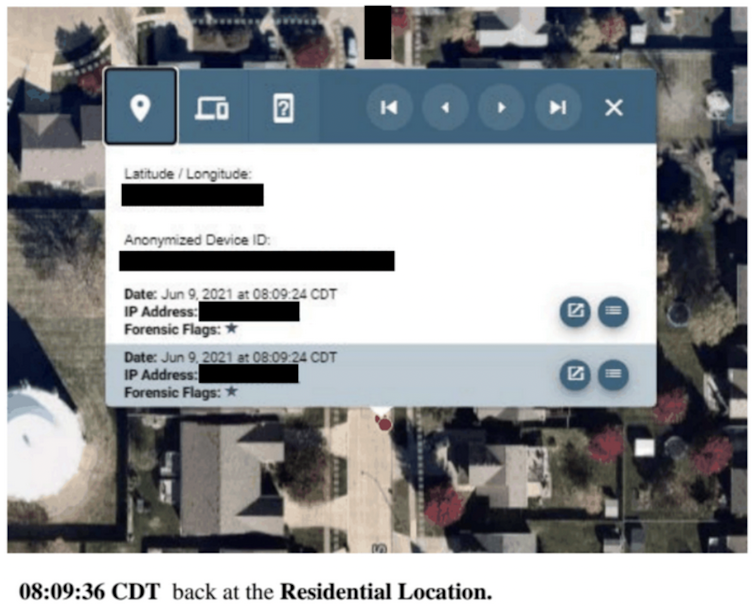
a screenshot showing a text box with a row of icons at the top over a satellite view of a neighborhood
Fog Reveal allows users to see that a specific mobile phone was at a specific place at a specific time. Electronic Frontier Foundation, CC BY

Law enforcement use of Fog Reveal puts a spotlight on that loophole between U.S. data privacy law and electronic surveillance law. The hole is so large that – despite Supreme Court rulings requiring a warrant for law enforcement to use GPS and cell site data to track persons – it is not clear whether law enforcement use of Fog Reveal is unlawful.

Electronic surveillance vs. data privacy

Electronic surveillance law protections and data privacy mean two very different things in the U.S. There are robust federal electronic surveillance laws governing domestic surveillance. The Electronic Communications Privacy Act regulates when and how domestic law enforcement and private entities can “wiretap,” i.e., intercept a person’s communications, or track a person’s location.

Coupled with Fourth Amendment protections, ECPA generally requires law enforcement agencies to get a warrant based on probable cause to intercept someone’s communications or track someone’s location using GPS and cell site location information. Also, ECPA permits an officer to get a warrant only when the officer is investigating certain crimes, so the law limits its own authority to permit surveillance of only serious crimes. Violation of ECPA is a crime.

The vast majority of states have laws that mirror ECPA, although some states, like Maryland, afford citizens more protections from unwanted surveillance.

The Fog Reveal tool raises enormous privacy and civil liberties concerns, yet what it is selling – the ability to track most persons at all times – may be permissible because the U.S. lacks a comprehensive federal data privacy law. ECPA permits interceptions and electronic surveillance when a person consents to that surveillance.

With little in the way of federal data privacy laws, once someone clicks “I agree” on a pop-up box, there are few limitations on private entities’ collection, use and aggregation of user data, including location data. This is the loophole between data privacy and electronic surveillance law protections, and it creates the framework that underpins the massive U.S. data sharing market.

AP investigative journalist Garance Burke explains how she and her colleagues uncovered law enforcement use of Fog Reveal.

The need for data privacy law

Without robust federal data privacy safeguards, smart device manufacturers, app makers and data brokers will continue, unfettered, to utilize smart devices’ sophisticated sensing technologies and GPS capabilities to collect and commercially aggregate vast quantities of intimate and revealing data. As it stands, that data trove may not be protected from law enforcement agencies. But the permitted commercial use of advertising IDs to track devices and users without meaningful notice and consent could change if the American Data Privacy Protection Act, approved by the U.S. House of Representatives Committee on Energy and Commerce by a vote of 53-2 on July 20, 2022, passes.

ADPPA’s future is uncertain. The app industry is strongly resisting any curtailment of its data collection practices, and some states are resisting ADPPA’s federal preemption provision, which could minimize the protections afforded via state data privacy laws. For example, Nancy Pelosi, speaker of the U.S. House of Representatives, has said lawmakers will need to address concerns from California that the bill overrides the state’s stronger protections before she will call for a vote on ADPPA.

The stakes are high. Recent law enforcement investigations highlight the real-world consequences that flow from the lack of robust data privacy protection. Given the Dobbs ruling, these situations will proliferate absent congressional action.

By

Sourced from The Conversation

By Claudia Ratterman

Tick…Tick…Tick. Is time running out on your opportunity to effectively use TikTok? Not if you make wise investments.

From recent feature rollouts to off the chart viewership numbers, TikTok has eclipsed a number of social platforms in key engagement areas, such as retention rate and active collaboration features like duets and stitches.

Best-in-class brands leverage TikTok’s native tools, editing features, ad formats and ecommerce capabilities to maximize reach and facilitate purchase. In fact, 84% of the top 50 brands ranked in Gartner’s latest Social Media Benchmarks Digital IQ had a TikTok profile as of November 2021.

However, there are still many high-performing brands that are either underinvesting in their brand TikTok pages or ignoring the platform altogether. What does this mean for digital marketing leaders?

Lost Opportunities With Target Audience

First, those that overlook TikTok will miss connecting with key audiences. TikTok commands a large, hyper-engaged user base that demands marketers’ attention. The platform is investing in increasingly sophisticated commercial features, too, such as TikTok Ads Manager and objectives driven Promote feature. TikTok gives brands the ability to invest in a number of different ad formats and influencer partnerships that drive a specific call to action among a highly targeted audience.

Given this, digital marketers should assess the scope of TikTok’s growth and audience, its business tools and the competitive landscape to kick off informed discussions about the merits of investment within the marketing organization and the rest of the C-suite.

Missing Out on Social Commerce Growth

Second, TikTok’s increased investment in social commerce means digital marketing leaders also risk losing out on a major monetization opportunity. According to TikTok, the hashtag #TikTokMadeMeBuyIt has more than 6.8 billion views and viral videos regularly translate to direct sales lift. One beauty brand saw more than a 600% increase in daily sales after their watermelon products went viral on the app, too. TikTok has capitalized on the success of viral products by introducing in-app ecommerce capabilities — for example, in-app store and link in bio — to enable a seamless buying experience for consumers.

As a result, digital marketers must track TikTok’s commerce features and gauge alignment with key marketing goals. Monitor ongoing legal concerns and remain transparent with users as personal data privacy remains a growing concern.

How to Leverage TikTok to Improve the Customer Journey Experience

Brands that effectively use TikTok — and other major social media channels for that matter — throughout the customer journey outperform competitors by lifting word of mouth, engaging more prospects and driving more valuable engagement with customers.

Digital marketing leaders have traditionally focused their social media efforts on brand posts, advertising and influencer marketing to improve brand awareness and consideration. However, they often fail to develop and invest in social strategies that lift customer satisfaction, loyalty and brand advocacy, missing out on opportunities to deepen customer relationships.

In order to drive value through social media successfully, brands should focus on the greater context of consumer needs and understanding how and why customers use social channels, not just what channels they use.

Sourced from CMSWire

By

If you thought there’s no corner on Instagram without ads, you’re wrong, my good friend. Meta can always make room for more, and that’s exactly what it’s about to do.

As the company is struggling with a major financial loss, it needs a way to generate more revenue. So, Instagram is about to get even more ads, and they’re going to be everywhere.

There are already ads on your Feed, in Reels, in Stories… So is there even a place where there can be more of them? Meta found the way, so they will now be on in your Explore feed, and a feed of posts you see when you click on someone’s profile. Brands can already post ads to the Explore feed, and the profile feed ads are still in the testing phase. “As a part of this test, we will experiment with a monetization opportunity that will allow eligible creators to earn extra income from ads displayed in their profile feeds, beginning with select U.S. creators,” Meta writes.

But wait, there’s more. Instagram now also has AI-powered multi-advertiser ads. In other words, Instagram’s algorithm will pay attention when you engage with an ad. And then, it will deliver ads underneath that it thinks may interest you.

In the announcement, Meta writes that new ad placements and formats are there “to help businesses tell their story and reach new customers.” So kind of them, right? As a mere Instagram user and creator, I feel like both my work and the work of the people I follow are drowning in ads and branded content. I think it’s only a matter of time before we find an alternative for showcasing and selling our artwork.

[via Engadget]

By

Dunja Djudjic is a writer and photographer from Novi Sad, Serbia. You can see her work on Flickr, Behance and her Facebook page.

Sourced from www.diyphotography.net

By

Content is still a powerful proponent in creating a strategy that is both creative and effective. Utilizing tactics in storytelling and maintaining an analytical approach can certainly guide a mediocre campaign to becoming a successful bombshell for a company.

No matter which way you look at it, the ecommerce landscape is getting increasingly competitive. Staying ahead of the competition heading into 2023 will take precision. costs are up, and campaigns cantered on quality, customer-focused content have been dwindling because it has become more about making a quick buck.

According to Shopify, the future of ecommerce is in the rise of acquisition costs, steering clear of third-party cookies and the power of social commerce. Brands must be both authentic and readily available to their customers but also have the ability to engage their audience. As ecommerce continues to shift toward , content is the driving force behind a ‘s success.

Ecommerce across is becoming increasingly popular heading into 2023. In fact, via , on a worldwide scale, are presumed to triple by 2025. Additionally, nearly 30% of United States-based internet users are already making social media platform purchases. currently serves as the global leader as about half of its internet users are making social network purchases which, when compared to the U.S., equates to almost 10x.

It all comes down to the value in customer retention and acquisition. What ecommerce storefronts should not steer away from is generating quality, timely and customer-focused content that will not only attract new customers but keep them loyal to your brand. The question you should be asking yourself is: What is my company doing to create an experience for my customers?

Content is king in determining ecommerce success in 2023

Content is still a powerful proponent in creating a strategy that is both creative and effective. Utilizing tactics in storytelling and maintaining an analytical approach can certainly guide a mediocre campaign to becoming a successful bombshell for a company.

The ability to tell a story that is consistent with a brand’s mission can serve as a powerful tool in attracting an audience and maintaining it as a valuable, consistent and recurring community for one’s business. However, it is important to remember that it is the people, not the product, at its core.

In 2022, paid social was not as much a determining factor for attracting buyers if the content did not resonate with its audience and customer base. The same will apply in 2023. The community needs to connect with an ecommerce business on a personal and even inspirational level, before buyers are motivated to maintain the needed consistency. If sales and traffic are both down, then there is a good chance that neither the content nor the reach is serving its purpose.

With roughly four months remaining in 2022, it is important to buck the trend of most B2C companies in halting the production of B2C content without focusing on B2C results. In other words, as we progress into the new year, companies should begin to create campaigns and strategies that essentially “hit home” with customers and followings, rather than turning in campaigns to generate a quick buck.

Content needs to use written, visual and audio to drive marketing funnels in building interest, desire, action and awareness. In fact, 2023 will be more about how content doesn’t necessarily drive customers to make a purchase, but rather, how it creates an opportunity to better their lives.

You may be asking yourself, how can I develop marquee content to give me an advantage over my competitors? There are roughly three factors to consider. It is important for the consumer, who essentially is digitally window shopping, to want to stop and see more of what your store has to offer. The proper steps here are to attract, engage and garner a positive outcome.

This is done by drawing attention to stopping the prospective customer, whether via an engaging picture, video or short-form copy. Remember, especially in 2022, attention spans are shrinking, and it is important to distribute the who, what, when, where, why and how for the customer quickly and painlessly. Next, customers need to feel engaged, so sparking their interest and convincing them to draw on their desire is important. Typically, the videos earning the most bang for their bucks are the 3-5 second Facebook videos and reels, while even the 30-second “shorts” on have proven successful as well.

  • Ecommerce will continue to migrate more toward working in conjunction with social media platforms.
  • Brand marketing and customer engagement, including advertising, is essentially moving more toward a social media-centric approach.
  • Video, and to a lesser extent, pictures, are providing a more social aspect to ecommerce sales, which is reimagining how companies engage with consumers.
  • Instagram is coming around, but in adopting a TikTok-type method, platforms are seeing the power of video when it comes to social media ecommerce. With the ability to perform consultations, recommendations and livestreams, products and experiences are personalized for consumers.

Related: 5 Steps to Level Up Your Social-Commerce Strategy

The moral of the story for the remaining months in 2022 as we progress toward 2023 is: When the customer has the desire to navigate and explore, action comes into play. The content should be results-driven. After all, it’s about the sale in the ecommerce world.

By

Sourced from Entrepreneur

By Chris Donkin

The European Union Digital Services Act (DSA) cleared its final major regulatory hurdle, with online providers set to be slapped with new rules around combating illegal activity and restrictions on targeted advertising.

After months going through the various stages of the European Union legal process, including being passed by the European Parliament, the DSA was given final approval by the European Council today (4 October).

The document now needs to be signed by the respective presidents of the European Council and European Parliament, before being printed in the Official Journal of the European Union.

It will come into force 15 months after publication.

The DSA has been welcomed by mobile industry bodies GSMA and ETNO. It is an attempt to tackle promotion of illegal content and goods online by increasing accountability from large platform providers including search and social media companies.

Providers must react “quickly, while respecting fundamental rights” when illegal content is posted; targeted advertising to children based on their personal data is banned; and there are limits on advertising based on sensitive data including gender, race or religion.

The DSA also prohibits misleading interfaces designed to trick social media users into making “unintended, unwilling and potentially harmful decisions regarding the processing of their personal data.”

There are also a set of rules applicable to online channels to combat the sale of illegal goods.

Search options
The regulation also slaps separate obligations on “very large online platforms and search engines”, requiring them to offer users a way to source content recommendations not based on profiling, and to “analyse the systematic risks they create”.

This latter clause includes assessing risks around dissemination of illegal content and investigating any negative impacts on fundamental rights, electoral processes, gender-based violence and mental health.    

The DSA compliments the Digital Markets Act, which was approved by the European Council in July and is set to be published in the Official Journal next week.

By Chris Donkin

Chris joined the Mobile World Live team in November 2016 having previously worked at a number of UK media outlets including Trinity Mirror, The Press Association and UK telecoms publication Mobile News. After spending 10 years in journalism, he moved to telecoms PR as a content specialist producing white papers and marketing collateral for some of the biggest names in the mobile sector. Now working as Content Editor across all channels of the MWL portfolio, Chris produces news and in-depth features on key issues from across the industry. @ChrisDonkin1

Sourced from Mobile World Live

Sourced from BOSS Magazine

Fortunately, there are plenty of ways to promote your business without breaking the bank.

As a business owner, you know that promotion is essential to keeping your business afloat. But what do you do when you don’t have a lot of money to spend on marketing? Fortunately, there are plenty of ways to promote your business without breaking the bank. We delve into some budget-friendly ways to get the word out about your business without spending a fortune.

Give away free stuff

Who doesn’t love freebies? Offering promotional items like quality lighters by IGO Promo emblazoned with your company logo is a great way to get people interested in your business. You can hand them out at trade shows or other events, or include them in direct mail campaigns. Just make sure you choose items that will be used and appreciated — no one wants another cheap keychain that’s going to end up in the bottom of a messy drawer somewhere.

Get involved in your local community

One great way to promote your small business is to get involved in your local community. Volunteer for a charity that is relevant to your business, sponsor a small league team or participate in a community event. Not only will this help you raise awareness for your business, but it will also give you the opportunity to build relationships with potential and current customers. Plus, it’s a great way to show your employees that you’re invested in more than just the bottom line.

Create a great website

In today’s digital age, every business needs to have an outstanding website. Your website should be user-friendly, visually appealing, and informative. Include clear calls to action, plenty of contact information and compelling content that will make people want to do business with you. This will not only help you attract new customers, but it will also help you retain the ones you already have. There are plenty of budget-friendly website builders out there, so there’s no excuse for having a less-than-stellar website.

Use social media wisely

Social media platforms like Facebook, Twitter, and Instagram provide tremendous opportunities for promoting your business on a budget. Just make sure you’re using them wisely. Posting too often or failing to engage with your followers will quickly lead to people tuning you out. Instead, focus on creating quality content that provides value and promoting special offers or discounts that will appeal to your target audience.

Get listed in online directories

Most people nowadays use the internet when they’re looking for local businesses. That’s why it’s important to make sure your business is listed in online directories like Google My Business, Yelp, Bing Places for Business, and Yahoo Business Listings. These listings are free and can help potential customers find you when they’re searching online for businesses like yours. Plus, being listed in these directories can also help improve your search engine ranking — another great way to attract new customers.

Network, network, network!

Meeting new people is always good for business — you never know when you might meet someone who’s interested in what you have to offer. Attend local Chamber of Commerce meetings or other networking events where you’ll have the opportunity to connect with other small business owners and potential customers in person. You can also join relevant online communities and forums where you can share your expert insights and connect with people from all over the world.

As you can see, there are plenty of ways to promote your small business without spending a fortune. So get out there and start spreading the word about your business! It’s sure to pay off in the long run.

Sourced from BOSS Magazine

By Anton Volovyk

The rapid start-up of new businesses has led to oversaturation and excessive competition in media buying and digital traffic. In this overwhelming digital landscape, it seems like only ad empires like Google and Amazon are benefiting. Despite Facebook plateauing, and the worst spring for stocks since 2008, new platforms like TikTok are readily taking up market share and consolidating profits, and the ad industry is booming.

It’s no secret that digital advertising is an attention game. However, time spent on social media and on screens has not only peaked but has generally been plateauing since the pandemic. Unfortunately, the reduction of digital traffic isn’t reducing digital advertising, it is having the opposite effect. The digital ad space is becoming even more saturated.

Even though traffic is down, and saturation is up, there are three universal ways for brands to work with their audience, product, and business models to lead the market.

#1 Growing the community

The cheapest and the most effective way to improve your business performance.

Customer retention and loyalty should be primary areas of focus. Depending on the industry, acquiring a new customer may cost 5-25 times more than retaining an existing one. The solution is to retain current customers by building a community around your brand.

The community represents the core of customers who are most interested in your product, are brand ambassadors, and communicate with each other. Communities help foster repeat purchases, improve retention, fix product bugs in real time using direct feedback, distribute brand messages for free, and can offer even more:

  • Communities produce UGC, which may go viral.
  • New customers are more likely to make decisions based on feedback from other users versus marketing messages directly from a company.
  • Communities help people establish strong social bonds based on common interests.
  • Community makes customers feel good, social interaction produces dopamine.
  • Community members are generally very profitable for a company given that they usually have higher LTV (Lifetime Value).

Harley-Davidson and the British cycling brand Rapha are good examples of building a strong community around a product. Both brands have managed to create a club of dedicated and loyal members with a subscription model and benefits like club memberships, sharing experiences, organizing meetings with cycling and motorcycle enthusiasts using the app, drinking coffee at partner points, and even offering bike rentals from their stores.

#2 Integrating growth loops into your product and business model

Marketing tricks that help businesses grow organically.

Since the late 2000s, many innovative companies have been launched (Uber, Airbnb, Spotify, and many others) that soon became leaders in their niches. All of these companies utilized a non-standard marketing approach. They didn’t reject the traditional AARRR Pirate framework (Acquisition, Activation, Retention, Referral, and Revenue). In addition to this more traditional sales funnel, they incorporated growth loops into their business models.

The logic behind a growth loop is that the contribution of each new user should lead to a particular action that positively affects the likelihood of user acquisition. Thus, without additional marketing efforts, the client’s community constantly grows and each client brings in a new one.

The neo banking company Revolut claims to have acquired 4M users through viral growth loops, and the first 1.5 million users were reportedly acquired without spending on advertising. How? Revolut’s Head of Growth for UK/IE calls it an Offline → Online → Offline acquisition loop. Users receive their Revolut card delivery at home, they share the unboxing experience on social media, complete registration, and get rewarded for signing up new users. It is simple but effective.

#3 Analysing and catching global trends ahead of the competition

It’s hard, but it works all the time.

Do you remember the first ad banner? In 1994, at the dawn of digital advertising a little rectangle purchased by AT&T on HotWired hit a record 44% click through rate. Today, the best banners boast much lower rates, generally from 0.39% in Tech to 1.08% in Real Estate for example.

Social media marketing indicators, which performed actively in the mid-2000s, are not representative today. Despite Apple’s iOS privacy changes, US advertisers are estimated to spend over $58B on Facebook advertising in 2022, up 15.5% from last year. But most web users find digital ads too intrusive and annoying.

To catch user attention, brands are hunting for their audience in places where people spend most of their time. According to State of Mobile 2022 data, people are still spending their time on social media with global time spent on social apps reaching 412 billion hours in 2021 (up to 35% from 2018).

In the last few years, advertisers have been using a mobile-first approach in which companies start product design from the mobile end, which is fitting, as mobile has become the priority.

TikTok remains the most downloaded app in the world, allowing users to scroll through a feed of short videos without tapping any buttons. The company has made a breakthrough in mobile consumption, allowing advertisers to get effective campaign results without taking users out of the app.

Trends run out of steam. What’s next?

Today, the web is becoming more interactive. Many tech experts believe we are smoothly moving into the Web 3 phase — the next Internet generation. In the 90s, we just “read” the Internet in its Web 1 form. With the rise of the first social networks in Web 2, users gained more online opportunities. Web 3 heralds the invention of new tools for interaction, and the Metaverse is one of its upcoming trends. A huge number of companies, big and small are now developing tools and technologies that will accelerate web decentralization and allow the introduction of more sales and distribution channels. The creator economy will reach the next level as soon as users, endowed with rights to content, get to the centre of the new web infrastructure.

Thanks to new technologies, the Internet will change, as will advertising.

The full-scale penetration of Metaverse-like experiences and the massive rollout of AR/VR has not yet happened. Still, many tech companies are already working on creating ad opportunities in virtual environments, launching digital clothing brands, hosting virtual shows and exhibitions, and more. For example, this July, India’s largest Food Delivery presented a hyper-localized video campaign on YouTube. This ad featured an actor mentioning the name of the dish, restaurant, and city, which vary from viewer to viewer based on their phone’s GPS.

If there is one thing we can expect from the digital landscape, it is change. No one knows exactly what the future of the Internet will look like, but it will certainly be more immersive and personalized. The new web will affect the whole of advertising, but brands can continue to thrive if they build community, integrate growth loops and keep an eye on the next emergent trend.

Feature Image Credit: Joe Yates

By Anton Volovyk

Anton Volovyk holds an MBA degree from Harvard Business School and a Master in Finance degree from IE Business School. Anton is an expert in app-monetization, business development, and leadership. Before Reface, he worked at the Boston Consulting Group, a global strategy consulting company working with clients across consumer, tech, and media. Prior to BCG, Anton worked in investment banking in the M&A department and Private Equity as a tech and consumer investor.

Sourced from Bm

By Kim Komando

As long as your phone is on, it’s sharing data. This happens whether you have an iPhone or Android, but one company is tracking much more than the other. Tap or click here to see if Apple or Google collects more data.

I bet your home address, phone number, and even more personal information is a search away available to anyone, often for free. I value my privacy, so my team and I put together a great resource to help you out. Tap or click here for steps to remove yourself from 19 of the largest people finder sites.

Advertisers are notorious for watching what you do and where you go online. That’s valuable and very profitable information. Here’s one way to stop some of the spying:

The bad kind of cookies

Think of cookies as the trail you leave behind when you’re online. A first-party cookie is created and stored in your browser when you visit a website. It keeps things like your login info and shopping cart, so you don’t have to fill them in again each time. First-party cookies also preserve options and settings.

That’s useful, but cookies can be invasive too. Companies use cookies to track where you go and what you do online. They’ll even do it on a website other than the one you’re visiting. Advertisers love cookies because they help customize the ads you see. If the ads appeal to you, you’re more likely to click them, which yields a higher return on investment.

Pro tip: You can block third-party cookies and other invasive tools through your browser. The level of protection varies, but it’s worth the time to change your default settings. Tap or click here for tips on changing your privacy settings in some of the most popular browsers.

Blocking third-party cookies and tracking is one thing, but how about not being subject to tracking methods, to begin with? That’s where AdChoices and WebChoices come in.

Kinship caregivers: Growing number of grandparents are raising grandkids — and it’s sending them into poverty

Banish tracking cookies from your browser

AdChoices is a program from the Digital Advertising Alliance, a group of advertising and marketing companies that self-regulate to offer you choices for targeted advertising. Why would they self-regulate? So, no one else steps in to do it, of course.

Try it out next time you see an ad online. Look for the small AdChoices icon. It looks like a blue triangle with a lowercase “i” in the middle.

Click that to get information about the ad, change its settings and block it. Not all advertisers participate in the program, but you’ll know it when you see the symbol.

Go further: Delete this secret ID hiding on your phone that gives away your personal details

Within AdChoices is a tool called WebChoices. You can use this tool to opt out of many companies in one step. As with AdChoices, it only works for companies that participate in the program.

Get this: I used it to kick out 144 different tracking cookies!

Here’s how to use WebChoices:

• Go to https://optout.aboutads.info. WebChoices will scan your browser and computer to find out whether first-party and third-party cookies are enabled, along with a list of companies creating targeted ads for you. You’ll also see which companies you have already opted out of if you’ve used the tool.

• After the status check is complete, click Continue.

• Look at the Customizing Ads on your Browser column to see which companies use targeted ads. If it says Yes, you can opt out of that company by checking the box under the Opt-Out column.

• Or you can select everything by clicking Opt Out of All.

• After making your selection, click Submit Your Choices. (You can skip those steps by clicking Opt Out Of All as a first step.)

• The website will process your selection, and you click View Updated Results to see how it turned out.

The WebChoices tool works for the browser you’re currently using, so run it for each if you use more than one browser. If you didn’t catch every company the first time, try rerunning the scan.

If you delete cookies, you may not see the opt-out choices for the company, so run the scan now and then.

Keep your tech-know going

My popular podcast is called “Kim Komando Today.” It’s a solid 30 minutes of tech news, tips, and callers with tech questions like you from all over the country. Search for it wherever you get your podcasts. For your convenience, hit the link below for a recent episode.

PODCAST PICK: GPS survival tip, sign digital docs, Google Photos update

In this episode, Google updates Photos with redesigned Memories and a new collage editor, use your photos for a virtual clothing fit at Walmart, Keurig’s new smart brewer makes a mind-blowing amount of coffee and how to get your real signature on digital docs. Plus, a rescue helicopter nearly abandoned a stranded man by mistaking his distress call.

Feature Image Credit: Getty Images

By Kim Komando

Check out my podcast “Kim Komando Today” on Apple, Google Podcasts, Spotify, or your favourite podcast player.

Sourced from USA TODAY Tech

Sourced from Newsweek.ogin

Industry credibility and brand recognition are critical if you hope to optimize your business for its target market.

With major competitors vying for the top spot in any industry, making a name for your business and improving the market can be a difficult journey. As a new business owner, this means you’ll need to dedicate plenty of time to learning and researching the industry to understand where your business can offer improvements.

As business leaders, the members of Newsweek Expert Forum have dealt with the challenge of breaking into the industry and gaining credibility and recognition. Below, they offer 15 tried-and-true tips for entrepreneurs attempting to optimize the market.

1. Collaborate Rather Than Competing With Competitors

Be authentic and original. Collaborate and don’t compete. As an entrepreneur, don’t look at what the competitors are doing and answer them. Instead, find what the market needs and fill it with your own authentic style, practice and invention, amplified by self-promotion utilizing the power of social media. If you let people know that you are good and worthy of recognition, they will applaud you. – Dr. Abraham Khoureis, DrAbeKhoureis.com

A business owner can build credibility by sharing their expertise with local business groups and with their clients through workshops and seminars. They can then leverage those experiences in social media posts and by asking the attendees for reviews that can be shared on their website and in marketing collateral. – LaKesha Womack, Womack Consulting Group

3. Have Street and/or Educational Credentials

Once you have had success in your endeavours, people then tend to pay more attention because there are facts to back it up. When you have that “story doing” to match the storytelling, that helps. The other way entrepreneurs can boost their credibility is by having genuinely insightful things to say about their industry. – April (Margulies) White, Trust Relations

4. Establish Your Business as a Trusted Resource

By sharing knowledge on your chosen expertise, you can become a thought leader in the market and field. This thought leadership typically makes the owner a trusted resource and therefore more credible. You can share knowledge on social platforms like LinkedIn, write guest articles, appear on podcasts and speak at events. The key is being where your audience is and looking for information. – Mary Cate Spires, Reputation Avenue

5. Offer Products or Services That the Market Values

It’s critical to deliver a high-quality product or service that the market values and one that is also trusted and secure. Simple, essential and consumable communication and marketing techniques will help build brand reputation and market demand. – Margie Kiesel, Avaneer Health

6. Surround Yourself With Those Who Have Experience

Be the subject matter expert and surround yourself with people who know what they are doing. Always walk the extra mile and be honest about the obstacles. – Krisztina Veres, Veres Career Consulting

7. Make Yourself ‘Everpresent’ on LinkedIn

With so many different opportunities to publish and connect, LinkedIn provides the key opportunity to connect and grow your professional circle in any way you want. This includes referrals, new leads, partners, investors and more. – Chris Tompkins, The Go! Agency

8. Get Yourself Out There on Social Media

Social media, giveaways and specials will put your brand out there. With exceptional value and a great product, your company will grow and flourish. – Tammy Sons, Tn Nursery

9. Consistently Be Where Your Audience Is

The rule of seven says it takes seven touchpoints before someone remembers your business. Use online and offline marketing touchpoints to surround your customers consistently with your brand. The more they see you, the more they know, like and trust you. This translates into both short-term sales and long-term brand building. – Krista Neher, Boot Camp Digital

10. Be a Thought Leader

Establish yourself as an expert in your field by writing articles or blog posts, giving speeches or presentations or even teaching classes. By sharing your knowledge and demonstrating your expertise, you will be able to build trust with potential customers and clients. Attend trade shows and conventions, join professional organizations and make connections with other professionals. – Umang Modi, TIAG, Inc.

11. Use Your Connections

Who you know is important, and people want to share experiences for you to learn from to avoid making the same mistakes they have. Look to mentors and people in the industry to see what worked for them and if you can implement those optimizations. Specifically, social media is a great way to start to gain momentum and flourish as a business while also placing the business in a media article. – Paul Miller, Miller & Company LLP

12. Be Seen

If people don’t know what your business does or who you serve, they will not be able to find you. Entrepreneurs need to ensure their ideal clients know what they have to offer. This can be done through social media and LinkedIn, providing value to podcasts, articles and the media. The more entrepreneurs get their message out, the more people they can serve. – Donna Marie Cozine, Consult DMC

13. Build on Small Successes

Proof of concept and early success is one of the best ways to build credibility, yield support and generate referrals. Track your wins, create a strong story around them and have a process in place to easily promote them. Building upon small successes leads to larger success and gives you a better ability to achieve long-term goals. – Jacob Kupietzky, HCT Executive Interim Management & Consulting

14. Create a Sustainable Business Model

I’m a big fan of sustainable business models–long-term growth plans that create sustainable cash flow. If you’re a new business owner, the first thing you have to do is prove is product market fit, then you need to get yourself a phenomenal salesperson. From there, you will get the insights you need to execute strong grassroots marketing strategies. Market penetration doesn’t happen overnight. – Melissa LuVisi, tab32

15. Gain Recognition and Credibility

Providing free, exceptionally high-value and original content that meets a need or solves a problem ensures that an entrepreneur is going to be viewed as trustworthy and reliable. These are two critical aspects to gaining recognition and credibility with both existing and potential customers as well as market influencers. – Lisa Lundy, Lisa A Lundy

Sourced from Newsweek.ogin