Author

editor

Browsing

Many people think that being a travel blogger is all about snapping pictures and writing out your adventures, but there’s so much more to it than that—and there are certain things that newbie travel bloggers should know before they get started.

We’ve compiled everything we wish we’d known when we started out on this journey into one handy blog post (which will hopefully save us from having to make this same list over and over again). Here are some tips for newbies who want to start their own blogs:

Haiku Stairs, Kaneohe, United States. Photo by Kalen Emsley, Unsplash

Have a plan

A lot of people don’t set goals for themselves, but it’s important to do so if you want to succeed as a blogger. To make sure your blog is successful and keeps growing, it’s important to have a plan for the future and know what exactly you want to achieve with your blog.

For example, if one of your goals is increasing video content on your YouTube channel because that’s where most of your audience is, then make sure that happens right away! It’s also smart to have some sort of outline or plan for any videos on the channel—it should be easy enough since they’re all scripted beforehand anyway.

You should also try not to forget about social media either; having an Instagram feed full of images from around the world isn’t enough anymore – nowadays, there needs to be some sort of story behind each photo so people can relate more easily (this goes back again into having good quality content). If someone sees something interesting while scrolling through their feed, then chances are good they’ll click through – which means more views!

Anaheim Hills, Anaheim, United States. Photo by Jordan Wozniak, Unsplash

Be consistent

If you want your blog to be successful, you need to be consistent. Having a schedule and posting regularly is key to building an audience and gaining subscribers. If people know when they can expect new content from you, they’ll be more likely to visit regularly and interact with your posts.

Don’t forget that consistency in style is just as important as consistency in frequency! Your readers will appreciate knowing what they can expect from each post—that means sticking with the style of writing (like first-person or third-person), tone (casual or formal), length (longer or shorter), and format (article vs listicle).

Make sure your content is useful

When it comes to content, make sure it’s useful. Don’t just talk about your trip; share tips and tricks that will help the reader plan their own adventure. You can even include a section on the blog where you answer people’s questions!

If you do this well enough, people will feel like they’re getting more than just a travelogue from your blog: they’ll also be learning something while they read. They’ll be able to get inspiration for their own trips and have ideas for how to spend their time once they arrive at their destination (which can make them more likely to return).

San Diego, United States. Photo by Frank Mckenna, Unsplash

Diversify your social media channels

You should use different platforms for different purposes. For example, your Instagram could be all about travel photos and what’s going on in your life at the moment; as it’s not really appropriate to post about business topics there! You can keep your LinkedIn account for that. So, if you’re looking to grow your following on social media, make sure that you’re posting content that fits with each channel’s personality—and not just copying-and-pasting the same thing everywhere.

Use social media for research and networking. It may sound counterintuitive at first (since we’ve been told our whole lives not to talk about schoolwork), but think of blogging as a job: If someone was paying you an hourly wage with benefits included, would they expect their employees not to ask questions? Of course not!

Connect with other bloggers

If you’re a new blogger, the best way to connect with other travel bloggers is to get out there and find them—and don’t just stick to the Internet! Make it a point to attend conferences or meetups in your city on a regular basis so that you can build relationships in person as well as online.

Partner up with hotels and airlines

There are several ways to find hotels and airlines that would be good partners for you, but the best way is to start by checking out your competitors’ partnerships. If they’re working with companies like Hyatt, Hilton, and American Airlines, then those could be good options for you as well.

Highway 212, Lithonia, United States. Photo by Matt Duncan, Unsplash

Travel safely and learn how to protect your stuff

Most people would only talk about growth but not about how to protect your stuff while traveling. We find it as essential as the other points because one bad memory can scar your future travels forever.

Hence, it goes beyond simply bringing a lock and keeping your stuff on you at all times. You’ll also want to make sure you have insurance in case of theft, loss, or damage to your items. The best thing to do is get travel insurance as soon as possible before leaving home, but it’s not too late if you already have a trip planned!

Travel with friends whenever possible. While solo travel is great for some people, having someone else with you can help reduce stress levels while traveling abroad and keep things from getting boring when there’s nothing going on in your itinerary.

Conclusion

We hope this article has been helpful in guiding you to start your own travel blog. If you have any questions, feel free to ask us!

Sourced from Go World Travel Magazine

By Claudia Ratterman
Marketers should explore four emerging tech trends and how they impact customer data management and consumer privacy.

For brands, the pandemic’s initial disruptions are easing, if not absent, while spiralling inflation, talent scarcity and lingering supply chain challenges continue to contest marketers’ best laid plans.

Against this conflicting backdrop, marketers seek to balance between tried-and-true, personalized campaigns with novel digital experiences that differentiate their brands.

In contrast to the new customer acquisition strategies of 2021 and early 2022, the rest of this year and next will emphasize a more comprehensive view of the customer to unify cross-functional data to improve customer experience (CX), drive conversions and ensure retention.

New to this year’s Gartner Hype Cycle for Digital Marketing are four key technologies that will help marketers with this renewed focus of integrating customer data to drive innovation: generative AI, emotion AI, digital twin of a customer and customer data ethics.

Here’s how digital marketing leaders can incorporate these crucial technologies into their strategies.

Generative AI: Determine Initial Marketing Use Cases

Generative AI is a disruptive technology that impacts content development, CX enhancement and the generation of synthetic data. It learns from existing artifacts to generate new, realistic artifacts (e.g., video, speech) that reflect the characteristics of the training data without repetition.

In spite of third-party data depreciation, enterprises are still charged with both delivering a strong CX and influencing customer decisions. Generative AI can help marketers identify the core characteristics of customers to then target them with custom content in a privacy-compliant way.

In fact by 2025, Gartner expects 30% of outbound marketing messages from large organizations will be synthetically generated.

We see generative AI take hold in digital commerce; for example, where brands can generate human images for customers to try on clothes or makeup virtually. Avatars and virtual influencers can also engage customers on social media and in the metaverse to provide customer support.

Obstacles in digital marketers’ use of generative AI include potential government hurdles that seek to limit associated research, or the unfortunate reality of the technology being used for deepfakes, fraud and disinformation.

What can digital marketers do? Start by investigating how generative AI techniques benefit your industry and determine initial marketing use cases where you can rely on purchased capabilities or partnerships. Document the opportunities synthetic data could bring in terms of facilitating data monetization and lowering the cost of data acquisition.

Emotion AI: Explore Vendor Capabilities

Emotion AI uses computer vision, audio/voice input and more to translate behavioural attributes into human emotions, helping marketers better personalize digital communications. This is part of a larger trend we call “influence engineering,” which seeks to automate elements of digital experience that guide user choices at scale by learning and applying techniques of behavioural science.

Emotions play a key role in all phases of customer journeys. Access to emotion data delivers insights into motivational drivers that help them test and refine content, tailor digital experiences and build deeper connections between people and brands.

By 2024, 30% of marketers will use emotion AI, up from less than 5% today. Yet privacy concerns remain an obstacle to rapid adoption of many use cases, especially in live situations (versus lab/research environments). Hesitation around the manipulative power of emotion-aware algorithms and potential bias are prevalent, too. To avoid bias when using facial expression analysis, models must be retrained in different geographies to detect nuances due to different cultural backgrounds.

What can digital marketers do? Review vendors’ emotion AI capabilities and use cases carefully in order to enhance customer analytics and behavioural profiling. Appoint responsibility for data privacy in your organization to a chief data privacy officer or equivalent and ensure they work with your chosen vendor to avoid user backlash due to sensitive data being collected.

Digital Twin of a Customer (DToCs): Run Pilots, Establish Trust

A DToC is a dynamic virtual representation of a customer that simulates and learns to emulate and anticipate behavior. DToCs help data-rich organizations provide a more personalized, curated CX to customers, many of whose buying habits have changed due to inflation.

DToC can both transform and disrupt: Privacy and cyber-risk concerns may lengthen the time it takes DToCs to mature. Plus, it’s challenging for organizations to embark on customer data ethics initiatives, which are essential to the success of DToC projects.

What can digital marketers do? Begin by running a pilot and comparing results with and without a DToC and define the benefits to customers and establish trust. Explain how they can control, or cancel, data usage, and eventually integrate DToCs with existing marketing technology systems for maximum utility.

Customer Data Ethics: Be Transparent

Customer data ethics aligns business practices with moral and ethical policies that reflect a company’s values. The need for such arises from the often unintended social and environmental consequences of using customer data to maximize profits.

It’s clear that AI is a growing force within marketing as techniques for marketing automation and personalization. The public — and marketers — increasingly recognize the tendency of these techniques to amplify biases in customer data used to train them. As organizations expand their focus on privacy and Environmental, Social and Governance (ESG) issues, addressing the ethical challenges of algorithmic marketing practices becomes imperative to keep company practices and values aligned.

What can digital marketers do? Go beyond mere compliance and treat customer data ethics as an ethos that your company publicly shares with all stakeholders. Operationalize the ethical evaluation of all automated decision making and tailor global brand or corporate frameworks to specific geographies, audiences and societies. Establishing and monitoring long-term metrics that tie customer data ethics to economic factors (e.g., ESG ratings and brand equity measures) will ensure the most value is realized.

Conclusion: Determine Value for Emerging Marketing Technology Trends

While investment in such technologies continues apace, digital marketing leaders still grapple with the challenges associated with these powerful yet immature technologies. AI and machine learning (ML) are highly dependent on access to customer data, yet only 14% of organizations have achieved a 360-degree view of the customer. Furthermore, consumer and regulatory concerns about their ethical implications may erode trust among customers.

Digital marketers must take a critical look at each of these technology trends to determine what value they bring to their organizations, especially within the confines of economic headwinds.

By Claudia Ratterman

Claudia Ratterman is a Director Analyst for Gartner for Marketers, based in Los Angeles. She has over 14 years of experience building Social Media Marketing Strategies for billion-dollar brands such as Disney, Tide, Pampers, Olay and Amgen.

Sourced from CMSWIRE

By Steve Allen

Before you can grow your business, you need to know your numbers.

Simply adding more content to your blog or social media channels without knowing what works (and what doesn’t) is a big waste of time and effort.

To know the right course of action, your engagement metrics will provide everything you need to achieve significant results.

In this post, we look at 19 engagement metrics to help you measure the performance of your content, so you can growth hack your way to success.

Let’s dive in.

What Are Engagement Metrics?

Engagement metrics are a method used to measure the frequency of user impressions, interactions, and purchases of your content and products online.

Common types of metrics include:

  • Impressions: The number of times a piece of content is displayed on a screen, whether it gets clicked or not
  • Reach: The number of people who see your content
  • Conversions: The number of times someone takes a desired action after viewing a piece of content (clicks a link in an email, becomes a subscriber, buys a product, etc.)

They are used as Key Performance Indicators or KPIs, providing insightful data behind what’s working to grow your business.

Why Engagement Metrics Matter

Engagement Metrics

Knowing the metrics behind user engagement is not only valuable but essential for business growth.

The more engagement your audience shows, the more likely they are to become customers.

Your metrics give you insight into how people interact with the content you publish.

Here are three benefits for tracking user engagement metrics.

1. Discover if people are consuming your content

When you track user engagement, you’re able to see if your content is being consumed or not, enabling you to make necessary changes.

If you publish a lot of content, your metrics can reveal whether a lack of engagement is down due to an algorithm or interest in the content.

2. Know what content gets attention

When you know which content gets the most attention, you can ask yourself why.

By comparing popular content with underperforming content, you can understand your audience better and provide them with more of what they want.

Sometimes higher performing content comes down to design, the copy you use, or the topic. Analysing which content does best helps you zone in on what works.

3. Make better business decisions

Sure, you can hire a team or agency who monitors your metrics and helps you growth hack more traffic, leads, and sales.

But if you’re a one-person team, knowing your metrics is essential. When you wear all the hats in your business, you need to know how to make the right decisions.

Then, if you want to pay a VA to do some of this work, you’ll at least know which metrics are important and understand your VA’s suggestions.

Essential Engagement Metrics for Your Website or Blog

In this group of metrics, we’ll look at the most essential things to measure on your website and blog.

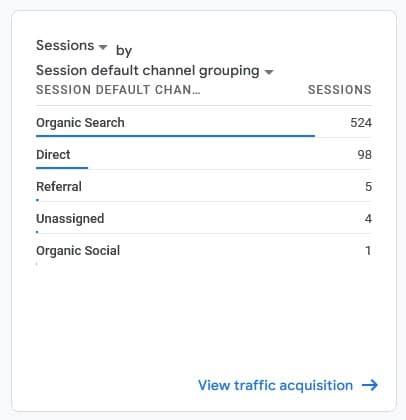
Sessions

Sessions are the total number of visits your website gets in a chosen timeframe.

This shouldn’t be mistaken with visitors or the number of people who visit your site, because the same people can visit your website multiple times and be counted as separate sessions.

Google Analytics 4 counts a session within a 30-minute window. That means if someone visits your site, leaves in 10 minutes, and then comes back 5 minutes later, it’s still counted as one session.

Sessions can be found in Google Analytics, under Acquisition Overview:

You can improve sessions by running ads to your website or by increasing organic traffic through content marketing.

Using WordPress? Check our article on the best Google Analytics plugins for WordPress.

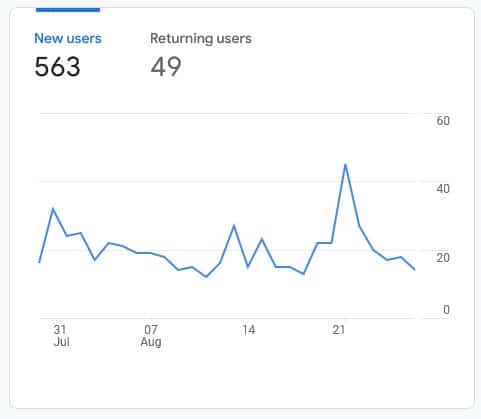
New users vs returning users

These metrics show the number of new users and returning users you get on your site. They can be found under the Retentions report in GA4.

A new user is essentially a visitor who hasn’t visited your site before and a returning user is a someone who has.

These metrics can help you establish how valuable your visitors are when running an online shopping cart.

More on Ecommerce metrics later.

Pageviews

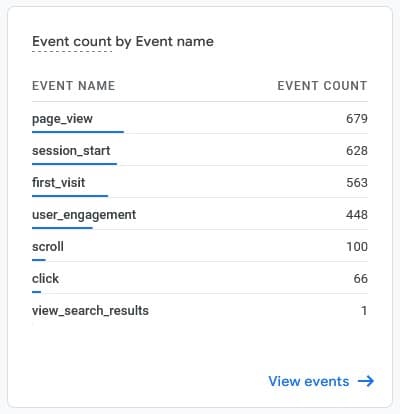
This metric is the number of views a webpage receives in a given timeframe. It’s different to sessions because one person can view more than one page per session.

A webpage can be a home page, contact page, or an article on your blog.

When people are talking about website traffic, they are sometimes referring to sessions or pageviews. However, they are quite different.

Pageviews can be tracked in Google Analytics under Engagement Overview and Events:

Pages per session/visit

Pages per session is the average number of pages people view on your website per session in a chosen timeframe.

So if you get 10 sessions in one day by 10 people and each person views 2 pages each, your average pages per session would be 2.

This metric helps you know if people are clicking on multiple pages on your site, either to read more content or learn more about you and your business.

The higher the number, the more engagement you have. A good range to aim for depends on the type of business and content you have.

But an unofficial standard is 2.6 pages per session.

If your average pages per session is low, you can improve it by adding more relevant internal links in articles, improve site navigation, or keep a clean site design.

For more information on performing an internal link audit, we have a full guide here.

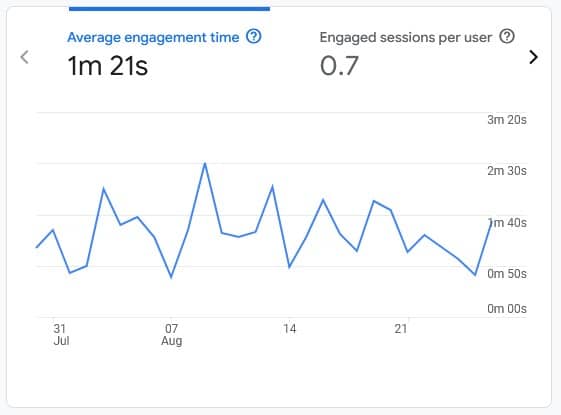
Average engagement time

This is the average time people spend on your website over a specific period.

You can also get a breakdown of average time spent per session in GA4 under the Engagement Overview page.

Engagement metrics - Average engagement time

It’s calculated per visitor and over the average session duration. This is an important metric because it can tell you whether or not your visitors are sticking around.

If your average engagement time is low, it could mean the pages they land on aren’t providing the user with the information they were looking for.

Improving this metric can be done by making each page hyper specific, providing enough valuable content, and having strong keyword intent.

Read our post on Google Analytics for Blogs to learn more.

Engagement Metrics for Ecommerce or Affiliate Sites

Customer satisfaction is essential for any business, including eCommerce brands.

Knowing these metrics will help you gain clarity to maximize business growth.

Revenue

Engagement Metrics for eCommerce

Increased revenue is a clear metric you’re doing something right. This is what all businesses want to see in their analytics dashboard.

Measuring it will depend on the platform you’re using, most of which can be integrated with Google Analytics.

Looking at this metric directly might not reveal much, but knowing your averages can allow you to drill into contributing factors when things don’t look right.

Order Value

Order value is the average amount customers spend per order in your eCommerce store.

Increasing this number will usually increase your overall revenue.

Other than increasing traffic and conversions, here are a few more ways to increase average order value:

  • Set an order minimum for free shipping
  • Cross promote similar products with upsells and order bumps
  • Add lower-priced products that complement your catalog

Increasing order value will usually add more revenue to your business.

Abandonment rate

Abandonment rate tells you the percentage of how many people leave the checkout page without purchasing in a given timeframe.

It’s the total number of people who make a purchase divided by the total number of people who visit the checkout page, then turned into a percentage.

The calculation looks like this:

(1 – (100 purchases ÷ 400 checkout visitors)) * 100 = 75%

In the above example, 400 people landed on the checkout page and 100 of them continued with their purchase.

That means that 75% of people didn’t abandon the sale.

Knowing this metric helps you better understand how to increase sales at the checkout level.

Many shopping cart platforms will trigger an abandonment cart email sequence when the customer enters their email and then leaves before purchasing.

Conversion rate

The conversion rate in ecommerce is the number of people who buy compared to the total number of traffic to product pages.

So if your online store received 500 visitors last month, and you made 20 sales, your conversion rate would be 4%.

When you monitor this metric, you can identify potential issues people might have when making purchase decisions.

You can improve this number by making your shopping experience more user-friendly.

Click-through rate (CTR)

Click-through rate is the total number of ads or search results that are clicked compared to the number of times they are seen, also known as impressions.

For example: Your Facebook ad is seen 10,000 times and gets clicked 800 times, giving you a CTR of 8%.

Or your Google search results get 50,000 impressions last month and got 6,000 clicks to your website, giving you a CTR of 12%.

Measuring this metric in your ads platform will help you make improvements to the copy in your ads or make changes to your offer.

And keeping track of your search traffic, CTR will show where to improve the copy in your titles and aiming for higher rankings.

Engagement Metrics for Email Marketing

Email marketing still has the highest ROI out of any other marketing channel.

These are the metrics to look out for when improving email engagement.

Email sign-ups

Engagement Metrics for Email

Email sign-ups are the total number of email subscribers you gained in a certain timeframe, usually tracked monthly.

It’s an essential metric to monitor if you want to grow your email list and revenue.

Email marketing services like Flodesk or ConvertKit keep track of this metric for you, with percentage stats on increases and declines.

To grow email sign-ups, you can offer a lead magnet, add a popup to WordPress, or reposition opt-in forms.

Also, check our post on how to build an email list from YouTube.

Form impressions

This metric can be found in some email opt-in plugins such as OptinCat and Sumo. It shows the number of times an opt-in form is seen in the browser. OptinMonster of course includes this with all of their packages as well!

It can be very useful because it can help you locate optimal areas to place opt-in forms on your site.

For example, let’s say you have an opt-in form in the sidebar and you’re getting lots of sign-ups. Maybe your form impressions are disproportionately high and it would make sense to place the form somewhere else.

Trying different locations could result in more of your visitors seeing it and getting even more subscribers than before.

Open rate

Email open rate is the percentage of your email subscribers who open your emails.

All email marketing services, like ConvertKit, will share this number so you can make improvements to your email campaigns.

A low open rate could mean that people aren’t getting your emails in their inbox or the subject lines aren’t attracting clicks.

Improving email deliverability and testing your subject lines are effective ways to improve your open rates.

Email CTR

Email CTR is the percentage of subscribers who click links inside the emails you send them.

If you get a decent open rate but a low email CTR, then knowing this number can help you resolve the issue.

It could be the copy in the email isn’t engaging enough, or that you don’t have enough links, or that your call to action isn’t clear enough.

Either way, this metric can direct you to testing different things in your emails to see what gets more clicks.

Engagement Metrics for Social Media

Social media engagement metrics are an integral part of business growth through social media marketing.

Here are the metrics you want to keep a close eye on.

Reach

Reach on social media is the amount of times your content is viewed. You can see your total reach in your analytics dashboard or for each individual post.

Tracking this metric will help you understand what types of content people are consuming, what they’re interested in, or which types the algorithms are favouring.

It’s a good idea to create similar content that is doing well to see if they propel growth.

Impressions

Impressions on social channels are the total number of times your content gets seen in feeds or elsewhere, even if it isn’t clicked on.

This number will almost always be higher than reach because not everyone who scrolls past your content will click on it.

Monitoring your impressions helps you know if your content is grabbing people’s attention enough or if you need to write more interesting captions.

Engagement rate

This is quite an important social media metric and one that will help grow your socials the most.

It’s how many times people interact with your content, so likes, saves, comments, or shares, etc.

The more content engagement you get, the more it gets favoured by the algorithms. That’s because the platforms want people to stick around for as long as possible.

When you know which content performs the best, you’re able to give your audience what they want.

Video watch time or completion rate

Watch time is the number of minutes and hours your videos have been watched over a specified time period.

Completion rate, on the other hand is the percentage of viewers who watch your videos to the very end.

Both provide you with great insights into the quality and engagement of your videos.

The more time your audience spends watching your videos, the more you’ll build a relationship with them and the more you’ll grow your social media channels.

Customer engagement metrics

A customer engagement metric will help you further understand the relationship between how your customers engage with your marketing strategies.

Customer Satisfaction Score (CSAT)

This metric is a key performance indicator of how satisfied customers are with a company’s products and services.

A Customer Satisfaction Score can be obtained by asking customers a simple question, “How satisfied are you with your overall experience of your product?” and getting them to rate it out of 5 or 10.

The CSAT score is then calculated by taking the positive responses and dividing them by the total number of responses, and multiplied by 100, giving a percentage.

For example, if you receive 100 total responses and 65 were positive, your CSAT score would be 65%.

The metric is a great indicator of customer experience, which can be collected on your website or in email campaigns.

Net Promoter Score (NPS)

Net Promoter Score or NPS is like Customer Satisfaction Score, but is calculated differently and measures customer loyalty.

Customers are given a simple question such as, “How likely are you to recommend [Product/Service] to a friend or colleague?”, in which they can score between 1 and 10.

Respondents are then put into one of three categories:

  • Promoters: People who scored 9 – 10
  • Passives: People who scored 7 – 8
  • Detractors: People who scored 1 – 6

Then the percentage of detractors is subtracted from the percentage of promotors to get the final score.

For example, if 55% were promoters, 40% were passives, and 5% were detractors, the total score would be 50%.

The range can be between -100 and +100 and the higher the number, the better.

Conclusion

That concludes this post on the most important engagement metrics you need to know about.

Staying ahead of these metrics will give you a huge advantage when focusing on business growth.

To learn more about improving these numbers read our post on how to increase blog traffic.

By Steve Allen

Steve Allen is a niche site builder, writer, and all-around WordPress wizard.

He enjoys personal development, entrepreneurship, double espressos, and making things work better than they did before.

Sourced from Niche Pursuits

By Jon Mundy

Google will soon clamp down on VPN apps that block ads on the Android platform.

The tech giant, which still earns most of its vast revenue from advertising, will prohibit VPN apps on the Google Play Store from actively interfering with ads from November 1.

Google updated its Google Play policy last month, setting down strict stipulations for VPN apps. This includes a rule that such apps can’t “manipulate ads that can impact apps monetization.”

Another stipulation is that “Only apps that use the VPNService and have VPN as their core functionality can create a secure device-level tunnel to a remote server”.

These measures appear designed to secure user data with such VPN services, as well as to prevent ad fraud. As part of the new terms and conditions, VPN developers must encrypt data across the whole process.

However, as The Register reports, some developers aren’t too happy with Google’s new stipulations, feeling that it’s too sweeping with its requirements. Older versions of Blokada and Jumbo could be ruled out based on the new rules.

Blokada’s developers also speculate that the likes of privacy-focused web search app DuckDuckGo could be a casualty of Google’s new rules, though DuckDuckGo’s developer itself believes that it will be alright.

Apple applies a similar set of VPN-focused rules for iOS, though interestingly it doesn’t specifically rule out interfering with ads.

Around this time last year, Google announced that it was offering its own VPN service to subscribers of its 2 TB and higher Google One plans in the UK and other countries after an initial 2020 rollout in the US.

By Jon Mundy

Jon is a seasoned freelance writer who started covering games and apps in 2007 before expanding into smartphones and consumer tech, dabbling in lifestyle and media coverage along the way.

Sourced from Trusted Reviews


By Mark Andrews

Auto companies are designing ways to build a car’s fuel cells into its frame, making electric rides cheaper, roomier, and able to hit ranges of 620 miles.

Weight is one of the biggest banes for car designers and engineers. Batteries are exceedingly heavy and dense, and with the internal combustion engine rapidly pulling over for an electric future, the question of how to deal with an EV’s added battery mass is becoming all the more important.

If you want to build an EV with better range, slapping in a larger battery to provide that range is not necessarily the solution. You would then have to increase the size of the brakes to make them capable of stopping the heavier car, and because of the bigger brakes you now need bigger wheels, and the weight of all those items would require a stronger structure. This is what car designers call the “weight spiral,” and the problem with batteries is that they require you to lug around dead weight just to power the vehicle.

But what if you could integrate the battery into the structure of the car so that the cells could serve the dual purpose of powering the vehicle and serving as its skeleton? That is exactly what Tesla and Chinese companies such as BYD and CATL are working on. The new structural designs coming out of these companies stand to not only change the way EVs are produced but increase vehicle ranges while decreasing manufacturing costs.

According to Euan McTurk, a consultant battery electrochemist at Plug Life Consulting, since technologies such as cell-to-pack, cell-to-body, and cell-to-chassis battery construction allow batteries to be more efficiently distributed inside the car, they get us much closer to a hypothetical perfect EV battery. “The ultimate battery pack would be one that consists of 100 percent active material. That is, every part of the battery pack stores and releases energy,” he says.

Traditionally, EV batteries have used cell modules that are then interconnected into packs. BYD pioneered cell-to-pack technology, which does away with the intermediate module stage and puts the cells directly into the pack. According to Richie Frost, the founder and CEO of Sprint Power, “standard modules may fit well within one pack but leave large areas of ‘wasted’ space in another pack. By removing the constraints of a module, the number of cells can be maximized within any enclosure.”

So cell-to-pack allows the module building blocks to be left out of a battery pack, meaning less wasted volume. BYD has also championed LFP (lithium iron phosphate) batteries, which have better chemical stability and are cheaper to produce. One problem is that the energy density of LFP cells isn’t that good compared to the NCM (nickel cobalt manganese) chemistry cells used in EVs like Hyundai’s Kona Electric, Jaguar’s I-Pace, and Volkswagen’s ID range. However, a cell-to-pack design enables the company to fit more cells into a given space and increase the density to a level closer to that achievable with NCM batteries.

Shenzhen-based BYD is one of the world’s most vertically integrated EV producers—meaning it makes the batteries, many of the vehicle components, and the cars themselves—but it actually started out as a battery company. Its biggest rival in the Chinese battery space is Contemporary Amperex Technology, a company that in 2021 was the world’s largest EV battery producer, with a 32.6 percent market share. This was largely due to CATL dominating the Chinese market with a 52 percent share.

CATL already has a plant in Germany, along with a $5 billion battery plant under construction in Indonesia and plans for a similar investment in the US. Its own investments in both lithium and cobalt mining help shield the company from commodity price fluctuations. But one of the key factors for CATL’s global expansion will be cell-to-chassis technology, where the battery, chassis, and underbody of an EV are integrated as one, completely eliminating the need for a separate battery pack in the vehicle.

Redistributing the batteries’ bulk will also free up space in a car’s design for a roomier interior, since designers will no longer need to raise the floor height of an EV to stash the cells underneath in a big slab. Freed from these previous constraints, as the cells can make up the entire chassis, manufacturers will be able to squeeze more cells into each EV, thereby increasing range.

CATL estimates that production vehicles of this design will achieve ranges of 1,000 kilometres (621 miles) per charge—a 40 percent increase over conventional battery tech.

Body Shop

At Tesla’s 2020 Battery Day, the company shared information about a few key advancements. While Tesla’s new 4680 battery dominated the headlines, CEO Elon Musk and senior vice president Drew Baglino outlined how production of Tesla cars was changing through the usage of large-scale die-cast parts to replace multiple smaller components. They also said that Tesla would start using cell-to-body technology by around 2023.

Using the analogy of an aircraft wing—where now instead of having a wing with a fuel tank inside, the tanks are wing-shaped—the duo said the battery cells would become integrated into a car’s structure. To do that, Tesla has developed a new glue. Normally the glue in a battery pack keeps the cells and pack plates together and acts as a fire retardant. Tesla’s solution adds a strengthening function for the adhesive, making the whole battery load-bearing.

McTurk explains: “Integrating cells into the chassis allows the cells and the chassis to become multi-purpose. The cells become energy-storing and structurally supporting, while the chassis becomes structurally supporting and cell-protecting. This effectively cancels out the weight of the cell casing, turning it from dead weight into something valuable to the structure of the vehicle.”

According to Tesla, this design, along with its die-casting, could allow vehicles to save 370 parts. This cuts body weight by 10 percent, lowers battery costs by 7 percent per kilowatt-hour, and improves vehicle range.

While Tesla’s 4680 battery with its larger volume seems to play an integral role in the company’s ability to move to a cell-to-body design, CATL’s new Qilin battery boasts a 13 percent increase in capacity over the 4680, with a volume utilization efficiency of 72 percent and an energy density of up to 255 watt-hours per kilogram. It is set to become a key part of CATL’s third-generation cell-to-pack solution and will likely form the basis of the company’s cell-to-chassis offering.

An Easy Cell

topdown view of Leapmotor C01 EV

The Leapmotor C01 sedan, on sale later in 2022, uses a cell-to-chassis design.

Photograph: Leapmotor

For those thinking these breakthrough battery technologies are still a few years off, cell-to-chassis is in fact already here. The rapidly growing but still relatively unknown Chinese EV startup Leapmotor claims to be the first company to bring a production car featuring cell-to-chassis technology to market. Leap’s C01 sedan should go on sale before the end of 2022. Using proprietary technology, which the company has offered to share for free, Leap says the C01 offers superior handling (the better weight distribution of cell-to-chassis designs might account for this), slightly longer range, and improved collision safety.

Many EVs were previously created from the platforms of internal-combustion cars—and some still are—but the adoption of cell-to-chassis designs will make those older platforms hopelessly outclassed. According to Frost at Sprint Power, “the commitment by most [manufacturers] to an EV-only future in conjunction with more integrated designs, such as cell-to-chassis, will lead to significant improvements in the overall design and performance of EVs.”

While cell-to-chassis tech is undoubtedly the next step with EVs, it is not a panacea. Technologies like solid-state batteries and sodium-based batteries are likely to be parts of the puzzle. And cell-to-chassis adoption will undoubtedly introduce new problems for the industry.

For one thing, replacing faulty cells will be far more difficult in a cell-to-chassis housing, as each cell will be an integral part of the car’s structure. Then there is the question of what happens when the car is scrapped. Currently, modules can find their way into many second-life applications, but  McTurk believes the larger battery sizes in cell-to-pack and cell-to-chassis designs may limit them to grid-storage applications.

Feature Image Credit: The Leapmotor C01 is among the first EVs to use a new battery design that provides a range of benefits.Photograph: Leapmotor

By Mark Andrews

Sourced from WIRED

By

With the rise of social media, our increasingly digital world has completely changed the landscape of how we think about branding today.

The concept of branding has almost always referred to a name and . But times have changed, as we all know, in this digital era with lots of noise.

Consumers today are always connected, meaning have had to find deeper ways of connecting with them. Social media has given the world access to every success and shortcoming, with users openly promoting or denouncing brands to their followers. Wendy’s social media branding strategy has famously caught the attention and adornment of millennials and Gen Z with their quick-witted roasts of customers and brands on Twitter. Many companies have tried to accomplish recognition with similar strategies, only to miss the mark and have their brand trend for all the wrong reasons.

Branding strategies have had to grow and adapt to the , so here is a ten-day crash course.

Day #1 — Set the groundwork

To effectively perform in your industry, you need to know your industry. Researching the brands of other key players in your sector is a great first step in your branding journey. Compare the offerings and branding of your competitors, accounting for everything from their visual aesthetic and efforts to their customer feedback channels. Looking at local brands can help you define yourself in your current market, while large name brands can give you a benchmark to aspire to. is an integral part of the branding process and will considerably affect the direction you decide to take once you’ve produced a tangible concept.

However, don’t just pay attention to the success stories. Consider cases where brands have failed. Compare the changes made when companies have launched a rebrand. Seeing where others made mistakes may prevent you from making similar ones in the future.

Day #2 — Define and differentiate

It sounds simple, but to be a successful brand, you need to be able to differentiate yourself from the competition. The way to do that is through defining yourself and your brand. What makes you different from your competitors? What services do you provide that other companies do not? How do your mission and values compare to other businesses in your industry? Answering these questions is key to carving out a spot for yourself among your competition.

Bernadette Jiwa, a brand strategist and blogger at The Story of Telling, says, “The difference between a good idea and a commercial success is context—The understanding about who the product or service is for, what they really want deep down and why they will care about this, more than that.”

Day #3 — Identify your audience so you can identify with them

Write down the detailed demographics of your target audience and other questions you want to consider when developing a brand for that audience.

How old are they? What gender? Are they wealthy corporate types or middle-class and family-focused? Where do they live and shop? What is it that they need? Is another company currently filling that need?

The more specifically you can identify your audience, the easier it will be to create a brand they will relate to. Karena Dawn and Katrina Hodgson of Tone It Up started by creating a YouTube channel to share their love of fitness, and today, they share over a million followers. Their ability to connect with their community was pivotal to their success, recognizing that they provided a service for consumers like themselves. Those customers recognized this connection and have now become the brand themselves, conducting worldwide meetups and creating trending hashtags on social media.

Day #4 — Find your voice

Once you’ve found your audience, you need to develop the voice that you will be speaking to that audience.

What channels do you want your brand to speak to customers through, and how do you wish to communicate to those customers? Perhaps the wealthy, corporate types prefer a more professional or service-oriented voice, whereas young, recent graduates may engage more with a conversational or friendly voice. It’s essential that your brand voice can communicate effectively with your target demographic and entice them to keep the conversation going.

Day #5 — Personality, please

Your brand represents you, so show your personality through your brand. Consumers today don’t just want the same old service from a company presented the same way as every other company. They expect their needs to be met but want those needs to be tailored to them through relatability and personal interactions.

Try looking at various personality spectrums and think about which end you want your brand to fall on. Do you want your brand to give off fun energy or stay stoic and serious? Are you looking to be modern and cutting-edge, or classic and traditional? Are you interested in accessibility for all, or is exclusivity a part of your brand’s desirability?

Day #6 — Share your story

Consumers are real people and want to be able to relate to real people, which is challenging to do when a brand is anonymous. Melissa Cassera, a marketing, communications and PR expert, advises, “Don’t edit yourself out of your brand. This is one of the most common mistakes I notice with entrepreneurs, especially in copy and content. If you tend to edit your voice and personality, then dictate what you want to say, record it, and transcribe it. It works wonders!” If your audience can connect with you or your story, they will likely join your brand.

Day #7 — Test and tweak

Receiving feedback from a trusted circle that can relate to your target demographic can provide valuable insights into aspects of branding you may have missed. Writers often say they cannot edit their own work, as it becomes harder to recognize errors in a piece the more you’ve read over it. The same can be said when developing your brand. Perhaps you missed an essential aspect of your brand story while focusing on a different aspect. It is better to catch missed opportunities and ensure you successfully serve your audience before an entire release. “Don’t just put something out there to put something out there. Make it right the first time!” designer and stylist Megan Bailey says.

Day #8 — Professionally create, integrate and replicate

When making the official assets for your brand, make sure those assets are professional. Whether they are in-house or contracted, hire a graphic designer to create your logo, website, business cards, etc. Hire a marketing expert to execute your strategy effectively. Research internal and external systems that will keep your communications with stakeholders organized and professional, and integrate your assets into those systems. Every asset you put out to consumers should represent your brand, whether digital or static. Those assets should be replicated, promoted and shared regularly in the area where you have found your niche.

Day #9 — Keep it consistent

Arguably, the most critical aspect of successful branding is ensuring your brand is consistent. Meghan Bailey also advises, “Right from the start — every single piece of material from a logo to photography to social media posts need to be consistent and professionally organized. The ultimate goal is to have people gravitate and recognize your work instantly”. The more recognizable your brand is, the more recognizable your product or service will be, and the closer you’ll become to solidifying your brand as a household name.

Day #10 — Give yourself a hand (and a break)

You’ve made it through our ten-day crash course and have hopefully developed a successful brand concept in that time. Give yourself a quick break to take pride in your work, then get out there and promote!

Feature Image Credit: Shutterstock

By

Sourced from Entrepreneur

By Jane Hanson

You’ve got 10 minutes.

That’s the span of time most people can stay mentally engaged with a presentation before they check out. So, unless you can create stimulating content and deliver it masterfully, you will find your audience scrolling through TikTok and checking their email. Studies have shown that 4 in 5 business professionals, regardless of age, shifted their focus away from the speaker in the most recent presentation they watched!

But keeping your audience engaged is no easy task – public speaking, both in person and via video, can easily get your heart racing and your palms sweating. If that happens to you, you’re not alone. It’s estimated that more than 80% of all people fear speaking in public.

This series will help allay those fears, offering tips from preparation through delivery, helping you give a presentation that is enjoyable, informative and, most importantly, memorable.

Let’s start with your preparation. Here are 8 important tips to prepare you for the big day:

1. Know who will be in the room. Knowing your audience is the single most important aspect of developing your presentation. Learning about their values, attitudes and beliefs will keep you from making mistakes …like saying the wrong thing or telling a joke that may be offensive. Things to consider include the geographical location of your presentation and the age, gender, ethnicity, religion, culture and education level of your audience.

2. Understand your purpose. It’s important to understand the goal of your presentation. Are you trying to educate the audience or entertain them? Are you hoping to achieve something actionable at the end? Before drafting your presentation, fill in this sentence: “My goal in this presentation is for the audience to know ____ and do _____.” This will help direct your content and inform your call to action at the end.

3. Less is more. As French philosopher Blaise Pascal famously said, “If I had more time, I would have written a shorter letter.” You’re giving this presentation because you are perceived as an expert on the topic. But you don’t want to cram ten pounds of information into a 5-pound bag. Stick to the salient points or else your listeners will be overwhelmed with information and won’t remember much of it.

4. Practice a confident intro. The most difficult part of public speaking is actually getting started. Your open should be an attention grabber—you can start with a shocking number (note my intro above!), a rhetorical question, a poll, a question or even a joke. This immediately gets the audience engaged. But whatever you do, make sure to practice it in front of a mirror enough times that you are familiar with it so you start off smoothly and confidently.

5. Land the plane. Create a powerful conclusion, which oftentimes is a call to action. In other words, after listening to you speak, what do you want your audience to do (this goes back to #2 above, understanding your purpose.) Did you teach them something they now should put into action? Do you want them to buy something or were you simply there to entertain?

Here are four effective strategies for a strong close:

– Set up a question during the introduction and finish your speech by answering it.

– Tell a story … or you could be finishing a story you started during your presentation. People are 22 times more likely to remember something if it’s wrapped in a story.

– Give your presentation a memorable title and then use the title to conclude the speech.

– Use a powerful quote, but make sure it’s not a cliché.

6. Make your slides easy on the eye. Think of your slides like a billboard – you should be able to digest the information in the amount of time it takes to drive by. Also, your slides should never have a font smaller than 30 point and should include one main topic and a few supporting bullets. And don’t overwhelm the audience with a ton of numbers (they will likely tune out). Using captivating images on a slide is a great way to keep the audience’s attention. Studies have shown that 3 days after a presentation, people who only heard a speaker remembered about 10% of the information, while people who also saw images remembered 65%.

7. Videos reign supreme. Audiences love to watch videos because they break up the monotony of hearing one voice speaking. But a clip needs to be short—no more than thirty seconds. And don’t use videos that sound self-promotional; that will compromise your credibility.

8. Give yourself props. Think about using props during your presentation to mix things up a bit. The prop might be an example of what you’re selling or something you’ve used that further supports your topic. But make sure that it’s big enough for the audience to see, and most importantly, practice when and how you will use it. If something goes awry mid-presentation, it can be very distracting.

90% of anxiety over public speaking comes from a lack of prep. When someone tells me they are “winging it”, I wince. Adequate preparation can make the difference between a “meh” performance and a memorable one.

Feature Image Credit: getty

By Jane Hanson

I am a communications coach with vast experience working with female leaders across many businesses: finance, insurance, startups and entrepreneurs, fintech, health care, technology, retail, and media; my background as a broadcaster on NBC for 27 years gives me special insights in dealing with today’s virtual world; and helps leaders use video to be their best selves. At NBC, I won 9 Emmys for reporting on events ranging from 911 to Olympic champions. My thousands of interviews gave me insights on how to effectively deliver messages succinctly and impactfully. What I write about will give great tips and tricks on how to resonate with every audience—make awesome presentations and compelling interviews; and will offer pragmatic solutions to the challenges we face today. I focus on what you say, how you say it, and how your body language keeps it all in sync.

Sourced from Forbes

By Ben Sherry

Artificial intelligence technology may help solve retention problems in the customer service industry.

Solving the customer service industry’s notorious retention issues has been something of a white whale for entrepreneurs. According to data from AI company Cresta, annual turnover rates at contact centres jumped from 30-45 percent to around 80 percent during the pandemic. High turnover rates can lead to longer customer wait times, as it can take between seven to nine weeks to hire a new agent, and many more months to fully train them. Several potential fixes have been introduced, such as A.I.-powered chatbots and virtual customer service representatives, but a true “silver bullet” solution has yet to be found.

One of the reasons call centre employees burn out so quickly is that they’re frequently forced to deal with abusive callers. This abuse often comes in the form of bigoted tirades from American clients. Maxim Serebryakov, the 24 year-old CEO of Palo Alto-based accent augmentation company Sanas, saw this problem up close when his friend Raul Garcia Letona was forced to leave Stanford and support his family in Nicaragua by getting a job at a call centre. Serebryakov began toying with the idea of using artificial intelligence to change a call centre agent’s accent in real time, and in 2020 co-founded Sanas. By processing a multitude of voices and corresponding transcripts through an algorithm, Sanas allows call centre agents to choose how their accent will sound to clients.

Many call centre agents grow up in the U.S. and speak perfect English but are regularly subjected to verbal abuse from bigoted Americans because of their accents, Serebryakov says. Despite Garcia Letona’s high level of education, he was underperforming due to his thick South American accent.

Feature Image Credit: Getty Images

By Ben Sherry

Sourced from Inc.

By Vineet Gupta

It’s customary to have questions in mind before releasing a new product. For example, we often wonder how the market will respond to our products. Would customers like it? But what if you had a tool that would make it easier for you to get answers to such questions?

Sounds impressive, right?

An in-depth analysis of your past, present, and potential customers can help you find insights that can help you enhance your product or develop more potent marketing messages.

New brands and features are constantly being brought to the market to entice buyers. Sometimes we assume that we have a good understanding of our consumer base, but with each new product that enters the market, the expectations alter.

With the aid of market research software tools, you can quickly identify your target customer base and locate new ones. 29% of small firms use these technologies to understand customer needs better.

There are now many online tools available for market research, many of which are free or provide free and paid access. Although not all-inclusive, we’ve compiled a list of 5 excellent platforms that disseminate market data, insight, and information.

What is a market research tool?

Market research is the procedure of obtaining and examining data about your clients, both existing and potential, to enhance your corporate strategy. It helps comprehend the information and decode how to expand the business with confidence. In addition, you can use the tools to test product or service concepts, improve marketing efforts, and more.

B2B market research tools assist in lowering the risk of business decisions. A decent research tool should analyse the data as well as collect it. Would it be helpful to know the chances that your product would be successful?

Think Market Trends, Market Finder, and other marketing research tools provide intriguing insights on whether people are looking for your product, which markets to target for launch, and which retail categories are growing as the months and seasons go by. Because before making a purchase, 81% of customers research the platform’s goods and services online.

The ‘Find My Audience’ feature in the market research software tool enables you to research what your potential customers are passionate about and what you should cover in your brand’s marketing campaigns if you’d want to advertise your goods using social media.

It should give the knowledge needed to support market theories and make better decisions. You should be able to optimize sales strategies, marketing, etc., thanks to the insights!

The market categories where your goods or services are most likely to sell are revealed by research tools. For example, you may determine your target market by analysing client feedback to find out where the need for your product arises.

How can market research tools help you?

Consumer rejoices over their good fortune when they view an advertisement for a product that seems ideal for them, although this situation probably wasn’t (and shouldn’t have been) a matter of chance. Companies use strategic market research to make these situations conceivable.

A recent report by First Research Inc. estimates that market research tools contribute to $45 billion in annual global income. With proper knowledge about its target market, a business may produce products and design marketing initiatives directly speaking to consumers. But, the advantages don’t end there!

It is simply upon an intelligent business to ascertain a product’s potential for success after the initial glimmer of curiosity. You can do market research to find out if an opportunity exists, how to position a product or service, or what customers think once it has been released.

Start by exploring market research by utilizing these market research tools for startups and resources if you’re aware of the significant consequences of failure. Then, before a new launch, gathering data and opinions may help you increase success rates.

Organizations have learned some of the most significant industry revelations and the minor facts that most people miss, thanks to market research.

69% of startups estimated that they could target more customer base after using market research tools. Market research is crucial because it enables businesses to interpret information and make defensible judgments.

The following strategies of marketing research tools will help you attract potential clients and keep them hooked with a sustainable retention rate:

  •  Customer-centric approach:

Understanding your customer base better is the primary goal of a market research tool, which is a crucial step in developing a customer-focused company. Customer experience is always put first in customer-centric businesses. According to HubSpot, customer-focused companies are 60% more profitable. It is clear why putting the needs and wants of the client first will lead to success.

You can learn about your target clients’ requirements and preferences, as well as other critical factors, through market research. You cannot successfully establish a customer-centric firm without an understanding of your customers.

  •  Reduce risk by testing:

Any business effort must include some elements of risk. Businesses would limit their opportunity for the benefit if they didn’t take risks. Successful companies, however, typically take proactive measures to reduce their risks. Avoiding risk does not include being still and doing nothing. Firms should use market research tools instead to minimize risks and increase benefits.

Making sure a product is in demand is crucial in reducing risks. Numerous items actually fail. Research Inc. states the failure rate could be as high as 95%. Even if that estimate is probably too high, it is nevertheless true that many new products miss their target market and wind up in clearance racks.

  •  Informed decisions:

Companies invest in market research tools to make their decisions more data-driven. However, decisions should not be made based just on intuition.

For instance, you might think it’s a smart business move to release a premium version of your product at a higher price point. But did you realize that consumers also associate expensive goods with premium labels? As a result, their trust may be lost if demands are not met. As a result, they might decide to leave you.

Conducting market research is the only way to be specific. However, to create your own survey and polls for an informed, fact-based decision, you can explore some inexpensive tools which are an alternative to Surveymonkey.

  •  Stay on the top of trends:

Not only new enterprises should conduct market research. Businesses must adapt in order to improve client connections as consumers do. Keeping up with current trends can be accomplished with the help of market research. Secondary research is frequently used to study trends. Consumer interest in new product features can be discovered, for instance, through industry publications or research from your competitors.

Market research tools are crucial if you want to keep up with today’s rapid cultural changes. You must keep up with trends in various areas, including your target audience’s purchasing habits, the most effective advertising platforms, packaging preferences, product features, pertinent content, and much more.

  •  Better connect with customers:

Regardless of your target, adopting a one-size-fits-all strategy for marketing channels can be an expensive error. The print magazines, television shows, and websites your audience frequents can be very different from those of the target market for your previous offering.

Making the proper marketing channel selections is a crucial first step in reaching your target audience. Still, to genuinely connect with them, you also need to customize the content of your marketing materials. Again, using the proper market research tool can allow you to excel at this.

5 Best Market Research Tools & Software’s for your Business

Market analysis tools increase your chances of long-term success significantly. You can only find the information you need to create a product or service that

  • meets the needs of your potential customers
  • distinguishes yourselves from the competition through market research.

You may learn a lot from each of these services, regardless of whether you work for a major corporation, a small business, or another type of organization. So here are the top 5 market analysis tools we’ve found and our recommendations for using them.

1. Usersnap

With the use of in-app screen captures, surveys, and feature request boards, Usersnap enables you to get additional product insights. Your one-stop tool for collecting consumer feedback.

Create unique feedback widgets and buttons to engage with your users. Provide feedback channels like a feature request form, screen recording with voice feedback, Net Promoter Score (NPS), Customer Effort Score (CES), Customer Satisfaction (CSAT) questionnaires, etc. Also, make user behaviour and URLs the basis for feedback surveys with segmenting and targeting options. Console log failures and user environment information are automatically attached.

Features:

  • You may assign, classify, and discuss issues and requests in one dashboard.
  • Efficiently manage customer feedback to boost satisfaction.
  • You may update the status of your tickets and receive community support for your product ideas.
  • With the reply-to-sender function, you may close the feedback loop.

Pros: 

  • Enables you to launch and distribute testing pages to people
  • Flexibility of usage and implementation
  • Simple for customers to provide feedback from their point of view

Cons:

  • When it comes to enterprise solutions, the price is high for a self-service product.
  • Lack of two-way integrations

Pricing: Starts from $19/ month.

2. Outgrow

Outgrow makes it simple for marketers to make calculators, suggestions, quizzes, and polls for better lead generation, qualification, and monetization. With Outgrow, marketers can quickly create these solutions without the assistance of a developer or designer.

Features: 

  • Outgrow has a host of design templates that are fully optimized for mobile, desktop, and tablet.
  • Easily embeddable into your advertising, websites, mobile apps, social media, SMS, and email communication. In addition,
  • There are over 1000 pre-made content pieces and funnels that are optimized to improve conversion so you can change the questions, make a few tweaks
  • It’s consistent with your brand and has your own interactive content ready in minutes.

Pros: 

  • The quiz is fun, and site visitors are likelier to return more than once.
  • Outgrow has been the ultimate tool allowing us to connect with a youthful audience through quizzes and calculators
  • The platform is intuitive and easy to navigate; no coding experience is required. As a professional marketer with a tight budget,

Cons:

  • The options to customize the design have some limitations
  • Problematic to style if you aren’t on the top pricing plan, everything is an upcharge

Pricing: Starts from $25/ month.

3. HubSpot

With a wide variety of question types and a scalable framework, you may customize your survey to meet the demands of your organization.

Send your customized survey to your teams through a web link or email, and then quickly publish the results to strengthen customer interactions and increase customer retention.

Features:

  • HubSpot will assist you with selecting the best feedback instrument and distribution mechanism, whether it be email, chat, or online link.
  • To measure customer loyalty at each touchpoint, choose from pre-built Net Promoter Score (NPS), Customer Effort Score (CES), and Customer Satisfaction (CSAT) questionnaires.
  • You can automate your customer care procedures with task creation, escalation, and ticket routing.

Pros:

  • Using a global, collaborative inbox that compiles customer emails, chats, and other correspondence, manage 1-to-1 customer communications at scale.
  • Convert your clients’ most commonly asked support questions and issues into a comprehensive, search engine-indexed knowledge store of how-to guides and manuals.
  • Use bots to direct consumers to pertinent support content, the right chat agent, and more to increase the efficiency of live chat and grow 1-to-1 discussions.

Cons:

  • The monthly cost of the Starter package is only $50. However, if your company is smaller or you’re simply on a restricted budget.
  • HubSpot’s free edition has extremely few capabilities, so you can only use it for the bare minimum of tasks.

Pricing: Starts from $50/ month.

4. Woorise

Make attractive surveys that people want to take. Create the ideal survey and include several questions, reasoning, and personalized branding. Real-time, graphical findings are displayed. Increase response rates by interacting with customers on their chosen platforms and devices. Deliver your survey via a landing page, or copy the code and paste it into your emails or website. Any survey is fully responsive and performs well on every platform and device.

Features:

  • Send emails by default as soon as a form is submitted. To send customized notifications based on user preferences, use conditional logic and merge tags.
  • You may easily see our entire website, landing pages, and Woorise dashboard on any device because they are all mobile-responsively designed.

Pros:

  • With a drag-and-drop interface, you can quickly alter any campaign component, including form fields and social media actions, without the assistance of a developer.
  • Data from each participant is exported as a CSV file. Do You require more authority? For example, you can set optional filters and a date range to export only the required information.
  • By breaking up complicated forms into separate steps, you can quickly and easily get more information from your prospects.

Cons:

  • There is insufficient documentation.
  • Can’t remove watermark in simple plans

Pricing: Starts from $29/ month

5. Zonka feedback


You may gather feedback from website visitors and evaluate their experience using link surveys, QR codes, and in-app surveys. Reach out to customers remotely to learn more about their experiences via email embedded surveys, email button surveys, and email signature surveys. By holding live polls, you can determine the preferences and viewpoints of the public. After the poll, show the audience the live results.

Features:

  • Use quizzes to engage your viewers, test their knowledge, and establish rapport. At the end of the test, display the scoreboard and the solutions.
  • Take feedback from customers on-site and gather leads using touchscreen devices without WiFi. Automatic syncing.
  • Create Dynamic Surveys using survey white-labelling, themes, multilingual surveys, pre-fill data, variables, answer piping, and logic.

Pros:

  • Use a straightforward NPS question to gauge customer loyalty.
  • Follow the performance of the Customer Support Team.
  • Ideal for transactions and post-service
  • To reduce churn, lower customer effort

Cons:

  • The inability to skip questions with irrelevant sections.
  • When leaving feedback, the screen occasionally takes a long time to load the app or tab on the home screen.

Pricing: Starts from $96/ year.

Utilizing market research will ultimately provide you with a significant competitive advantage. Due to the benefits listed above and the fact that less than 40% of marketers employ consumer research as a decision-making tool, this is the case.

One of the most effective methods to use market research data is to optimize and educate your marketing strategy from campaign conception to execution.

The future of marketing research is already here

According to market research numbers and trends, many of these trends have been boiling below the surface for the past few years. As a result, you are now prepared to command attention. Understanding the primary market research trends will put you in an excellent position to support your brand with intelligent customer intelligence.

Tools for market research are a priceless resource for learning precisely what your target audience is thinking. Whether you conduct your research using free or expensive technologies, you can find a wealth of information that could completely change the course of your company.

Stop making snap judgments; take the time to learn about your target audience and utilize that knowledge to guide your marketing plan.

By Vineet Gupta

Vineet is a software engineer by qualification and an online marketer by profession. He likes studying Google search algorithms and helps businesses by improving their online presence.

Sourced from readwrite

By

If you’re currently looking for a job, there’s a lot you need to get in place, from your video interview space to the tools you need to do the job. But perhaps the most useful document you need to prepare to attract recruiters and hiring managers is a resumé. Take a task off your list with a lifetime subscription to the Complete Resoume AI Assistant Resumé Writer.

Let AI write your resumé

Enjoying 4.7 out of five stars on AppSumo and a No. 1 Product of the Day award on Product Hunt, Resoume ensures you’re writing an industry-standard CV every time. It starts by importing and collating the data from your LinkedIn profile, which helps you keep your message consistent and save you from copying and pasting.

Then, use one of 20 templates, and get pointers from the resumé feedback page before you submit. Resoume can be used from anywhere, so if you meet a contact in person, you can write, customize and send a CV straight from your iPhone.

From there, the AI designs your resumé to be friendly to applicant-tracking systems and your personal brand, with customizable themes, fonts and more. It also uses the resumé to write an effective cover letter. (All you need to do is tweak the letter with personal touches.) All documents are easily shared online and can be downloaded as PDFs, so you’ll never have to worry about having enough copies.

In addition to a strong resumé, Resoume offers a suite of tools to support your achievements. A portfolio-building tool helps you quickly assemble your best work for sharing both in documentation and on job sites. Resoume also offers website creation features to help you create a crisp, focused applicant profile. Actionable analytics show you how many views you’re getting and how to refine your presentation and targeted industry for better results.

Save on a Complete Resoume AI Assistant Resumé Writer: Lifetime Subscription

An effective job search starts with an effective resumé. A lifetime subscription to the Complete Resoume AI Assistant Resumé Writer gives you AI-powered job search tools for $39.99 (regularly $600).

Prices subject to change.

By

Sourced from Cult of Mac